|
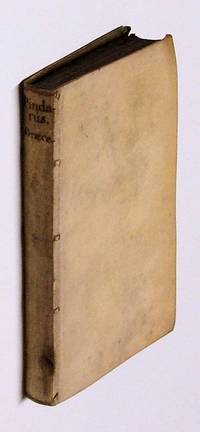
PINDARUS
PINDAROU OLUMPIA PUTHIA NEMEA ISTHMIA. Pindari Olympia Pythia Nemea Isthmia.
Leiden Lugduni Batavorum Ex officina Plantiniana Apud Franciscum Raphalengium 1590. 8vo. XVI2464 blank p. Vellum. 16 cm Ref: Hoffmann 398; Graesse 5294; Ebert 16858 Details: Woodcut printer's mark on the title it depicts a hand that comes out of a cloud and draws a circle with a pair of compasses the motto is: 'Labore et constantia'. Short biography of Pindar by Gyraldus in Latin precedes the Greek text of the epinicia. Greek text only Condition: Vellum age-tanned. Some small wormholes in the blank upper corner of the first gathering smaller pinpoint ones in next six gatherings nowhere affecting the text. The edges of the lower corner of the first gathering eaten away by some insect Note: A quarter of the works of the Greek poet Pindar ca. 518-438 BC his four books of 'epinicia' named after the Great Games the Olympian Pythian Nemean and Isthmian survive. Pindar wrote eulogistic hymns to celebrate a victory in athletics boxing and horse racing. Praised in a magnificent way are the victor his family the native city. 'Each ode draws from a variety of historical cultural and mythological sources. The highly allusive manner by which this material is presented is complemented by an equally rich repertoire of metrical patterns from epic Doric and Aeolic systems'. The Classical tradition Cambridge Mass. 2010 p. 729 'Extended similes and difficult metaphors intricate syntax and rapid narration far-reaching digressions and bold disruptions' result in grandiose but also obscure enigmatic and sometimes seemingly awkward poetry. Already in antiquity the comic playwright Aristophanes presented in the 'Aves' Pindaric poetry as foolish pretentious and embarrassing. The Hellenistic poets Callimachus and Theocritus wrote poetry under his influence. The Roman poet Horace thought him grandiose and sublime. Pindar's influence on European literature is great. The great number of editions in Greek and Latin translations of Pindar's odes that were printed in the 16th century are an indication of a continuous and widespread humanist interest. Many of Pindar's gnomic maximes and punctuated statements containing elements of traditional wisdom were collected in Renaissance anthologies of 'sententiae' for example in Erasmus's Adagia. Already the first full Latin translation of Pindar 1528 indexed all the gnomes according to moral lessons. 'The sententious Pindar . provided the Humanists of the Reformation with pithy statements of moral instruction and wordly advice which ensured the poet's place in pedagogical circles'. 'The sheer variety of Pindarically influenced traditions -the political ode and the personal the religious hymn and the song of genius the freely aimless and the rigorously concise- all serve as a testament not only to Pindar's versatility but also to his rich potential to inspire'. Op. cit. p. 730 For Filelfo Pontano Cowley Dryden Pindar was a model for political encomium and there are quite a number of imitators of Pindar in European literature. Giangiorgio Trissino wrote a tragedy and three canzoni in a form approximating Pindar's practice Luigi Alamanni modelled his hymns on the Pindaric ode Ronsard wanted to be the French Pindar introducing the Pindaric ode into the vernacular literature of France. The French author Voltaire made the witty remark that Pindar wrote verses that no one understood and everyone had to admire. For Thomas Gray Goethe and Hölderlin he was a genius. § This Pindar edition of 1590 is based according to Hoffmann Graesse & Ebert on the Greek text of the edition of 1560 produced by the French scholar/printer Henri Estienne Henricus Stephanus. Stephanus published a second 1566 and third edition 1586 all three containing in addition to the Greek text a Latin translation of the odes but the 1560 edition is to be preferred because the Greek text is according to Dibdin the most correct. Plantin published a reissue of the Greek text of this 1560 edition earlier in 1567. Greek text only Provenance: On the front pastedown in pencil: '18 april 1961' written by the Flemish linguist Walter Couvreur 1914-1996 who was an Orientalist and professor of Indoeuropean linguistics at the University of Gent. It indicates the date of aquisition. The place of acquisition he wrote on the flyleaf at the end: 'Utrecht Beijers veiling Wille'. On the front flyleaf an illegible name and 'J. Wille 10 febr. 1928'. J. Wille 1881-1964 was professor of Dutch literature and linguistics and at the same time librarian of the protestant Free University at Amsterdam. His specialty was 18th century Dutch literature and an excessive buyer of books. His books were auctioned by Beijers at Utrecht on the 23rd 26-27th april 1961. It was the largest private library ever auctioned by Beijers. P.J. Buijsters 'Geschiedenis van de Nederlandse bibliofilie boek- en prentverzamelaars 1750-2010' Nijmegen 2010 p.110/11; including a picture of Wille Collation: 8 A-P8 Q6 leaves Q5 & Q6 blank Photographs on request hardcover
书商的参考编号 : 120117
|
|
|
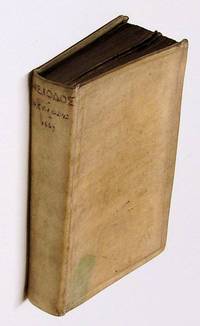
HESIODUS
HÊSIODOU ASKRAIOU TA HEURISKOMENA. Hesiodi Ascraei quae extant. Ex recensione Johannis Georgii Graevii cum ejusdem animadversionibus & notis. Accedunt notae ineditae Josephi Scaligeri et Francisci Guieti. Bound with: Johannis Georgii Graevii Lectiones Hesiodeae ut & notae Josephi Scaligeri et Franscisci Guieti.
Amsterdam Amstelodami Apud Danielem Elzevirium 1667. 8vo. 2 volumes in 1: XXXII1639 fragmenta; IV1838 7 index & 1 errata1 blank p. Vellum 16 cm Ref: STCN 850625599; Neue Pauly Supplement 2 p. 282: Hesiodus EF 10; Willems 1378; Berghman 830; Rahir 1439; Brunet 3141; Graesse 3263; Ebert 9603; Dibdin 234/35; Moss 1470 Details: Greek text and Latin translation. Boards with blind fillet border. First title printed in red and black. Woodcut printer's mark of Louis and Daniel Elzevier on both titles both showing different versions of the Minerva type; they depict Minerva under an olive tree she holds a banner with the motto: 'Ne extra oleas' to be understood as 'Stay within the bounds of wisdom' Condition: Vellum slightly worn. Boards slightly curved. Old ownership entry on the front flyleaf and on the title. 2 gatherings loosening. A few old ink inscriptions in the margins. Small inkstains on 1 p. A small and faint waterstain in the lower corner of the beginning. Small wormhole in the upper margins of the second half nimbling only at the head of a few letters Note: Hesiodus from Askra a small town in Boiotia born ca. 775 BC is one of Greek's oldest poets. His poems are in Homeric hexameters and show his interest in ethics and systematization. His work was known throughout antiquity to rhapsodes scholars and schoolboys. The Byzantines compiled scholia from ancient commentaries for eludication. The Renaissance didnot quite appreciate him. Until 1667 ca. 18 editions of his 'opera omnia' were published not much. Hesiod's reception chiefly concerns myths and the motifs that he provides and these motifs certainly appealed to mythographers historians of religion poets and painters. 'Hesiodic details of myth saturate European epic and mythopoeic writings perhaps most spectacular in Dante Milton Blake . who make much of Hesiod's infernal regions his Titans and primordial monsters his giant battles'. The Classical Tradition N.Y 2010 p. 435 Of Hesiod survives his 'Theogonia' or 'Theogony' which 'deals with the origin and genealogy of the gods . and the events that led to the kingship of Zeus: the castration of Uranos by Kronos and the overthrow of Kronos and the Titans by the Olympians'. OCD 2nd ed. p. 510 The 'Works and Days' or 'Erga kai Hêmerai' of Hesiod which was always most read has been called a 'gospel of labour'. The poet recommends the hard and honest life of a farmer. He 'inveighs against dishonesty and idleness by turns using myth . parable allegory and threats of divine anger. . The poem as a whole is a unique source for social conditions in early archaic Greece.' OCD 2nd ed. p. 511 The third poem that has survived is the 'Shield' or 'Aspis' a short narrative poem on Heracles' fight with Cycnus a bloodthirsty son of the god Ares. It derives its name from the long description of Heracles' shield. 'Artists have never abandoned a fascination with Hesiod on the Muses. In the 19th century the artist Gustave Moreau created many visual representations of their initiation of the poet. Both Rubens and Goya painted famous and harrowing pictures of Kronos Saturn devouring one of his children a motif from the Theogony; William Blake engraved a series after drawings by his friend John Flaxman . Georges Braque chose the 'Theogony' as the subject of 20 etchings'. The Classical Tradition N.Y. 2010 p. 436 § This edition of Hesiod was produced by the Dutch classical scholar of German descent Johann Georg Greffe or Graeve better known as Graevius 1632-1703 professor of Latin at the Univerisity of Utrecht during the last forty years of his life. The Hesiod was almost his only edition of a Greek classic. Graevius limited his attention mainly to writers of Latin prose and primarily to Cicero. He is best known for his huge 12 volume 'Thesaurus antiquitatum Romanarum'. Graevius tells in the preface of this Hesiod edition that he corrected the text of the 'Works and Days' with the help of two manuscript owned by Isaac Vossius. One them contained commentary of Tzetzes. From the French scholar Emericus Bigotius he received Graevius tells annotations of J. Scaliger and Franciscus Guietus. Dibdin echoes this preface 'Graevius has here presented us with an original edition; and partly by the help of Mss. and a careful examination of ancient editions and partly by his own critical acumen has rectified the text and supplied some of the deficiences'. The first volume contains the revised text and corrected Latin translation. The second Graevius' own annotations and the observations of Scaliger and Guietus Provenance: On the title has been written in small type: 'Johannes Grimm me suis annumerat Anno MDCLXXXI die 21 Aprilis'. § On the front flyleaf: 'ex libris F.J. Brevet a.d. 1914'. The jurist Frederik Jacobus Brevet 1893-1983 was a businessman and a man of letters. In 1958 he published a translation of 16 odes and an epode of Horace. In 1966 followed a more varied collection 'Mozaïek' which contained besides more translations of Horace also Catullus a number of poems from the 'Carmina Burana' and from the Greek poet Meleager and poetry of his own. In 1978 appeared a translation of all 103 odes of Horace. From 1952 till the end his life he contributed many articles on classical culture to the periodical Hermeneus of the Dutch Classical Society NKV. On the blank verso of the last leaf an old inscription: 'Hic est liber condiscipuli mei suavissimi' not followed by a name Collation: -28; A-L8; A-M8 Photographs on request hardcover
书商的参考编号 : 152349
|
|
|
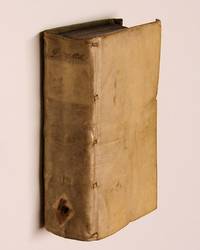
BARLAEUS, CASPER
Casparis Barlaei Antverpiani Poematum pars II: Elegiarum et Miscellaneorum carminum.
Amsterdam Amstelodami Apud Joannem Blaeu 1646. 12mo. VIII576 p. Overlapping vellum 13 cm Details: 5 thongs laced through the joints. Woodcut printer's mark on the title depicting a celestial sphere flanked by Tempus and Hercules motto: 'Indefessus agendo'. This is the second volume of a two volume set. The first volume was published in 1645 by Blaeu simply as 'Poemata' Condition: Vellum age-toned. Old name on the title. Faint waterstain in the upper and lower margin of most quires. Note: When he was one year old the Flemish parents of the Dutch polymath poet theologian and historian Caspar Barlaeus 1584-1648 had to flee Antwerp for the 'Spanish fury'. 'They settled in Zaltbommel where his father eventually would become head of the Latin school. Caspar studied theology and philosophy at the University of Leiden. After his study he preached for 1.5 years in the village of Nieuwe-Tonge before returning to Leiden in 1612 as an under-regent of a college. From 1617 he also was professor in philosophy at the university. Because of his remonstrant sympathies he was forced out of this job in 1619. He then studied and graduated in medicines in Caen but never practiced professionally. . From 1631 he was professor of philosophy and rhetoric at the Amsterdam Athenaeum Athenaeum Illustre which is commonly regarded as the predecessor of the University of Amsterdam. . Barlaeus published many volumes of poetry particularly Latin poetry. He also wrote the eulogy that accompanies the 1622 portrait of cartographer Willem Blaeu' the father of Johannes Blaeu the publisher of this fourth enlarged edition of 1645-1646. Source Wikipedia English Provenance: From the library of Andrew Fletcher of Saltoun 1653-1716 a Scottish author and politician. He was leading the opposition against the 1707 Act of Union between Scotland and England. He also was an passionate book collector Collation: 4 a-z12 h3 = k3 2a-2b6 chi4 Photographs on request hardcover
书商的参考编号 : 120033
|
|
|
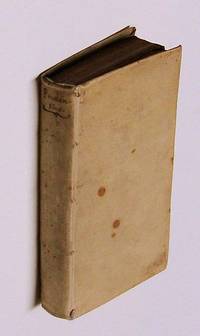
PRUDENTIUS
Aurelii Prudentii Clementis V.C. Opera. Ex postrema doct. virorum recensione.
Amsterdam Amsterodami Apud Guiljel. Janss. Caesium Blaeu 1625. 12mo. 2611 blank p. Vellum. 11.1 cm Horatius Christianus Details: 5 thongs laced through the joints. Engraved title it depicts a huge Christian warrior who makes mincemeat of heathens and heretics. There in no introduction only the text Condition: Some small spots on the boards. The edges of the front flyleaf are thumbed and show 2 tears. Upper edge of first leaves slightly thumbed. Very tiny hole in inner margin of the title Note: The Roman poet Aurelius Clemens Prudentius born 348/49 died after 405 A.D. of Spanish origin was besides a man of letters also an industrious public servant. He was a fervent Christian who had not cut himself off from the culture of the ancient world. 'He regarded the pagan literature and art not as things to be rejected but as part of the inheritance into which Christian Rome enters'. 'Prudentius' ed. H.J. Thomson Cambr. Mass. 2000 vol. 1 p. IX Loeb Classical Library 'It is as a poet in whom is embodied a reconciliation between the new faith and the old culture and in whom Christian thought claims rank in the world of letters that Prudentius is historically important'. Op. cit. p. X He 'was a pioneer in the creation of a Christian literature and has the credit of originating new types of Christian poetry the literary hymn the moral allegory and what has been called the Christian ballad'. Op. cit. XII His hymns are odes in which pagan mythology is replaced by stories from the Bible. By the great English scholar Richard Bentley he was described as 'Christianorum Maro et Flaccus'. 'Prudentius was much read in the Middle Ages. His influence is also visible in medieval art. More than 300 manuscripts survive. § Allthough this edition of 1625 is not very rare it is not to be found in the usual reference works Schweiger Dibdin Moss Graesse Ebert or Brunet Provenance: On the front flyleaf in old ink: 'A.E. Ihre' Collation: A-Q8 R4 minus leaf R4 R3 verso blank Photographs on request hardcover
书商的参考编号 : 120151
|
|
|
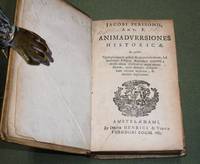
PERIZONIUS,J
Jacobi Perisonii Ant. F. Animadversiones historicae in quibus quamplurima in priscis Romanarum rerum sed utriusque Linguae autoribus notantur multa etiam illustrantur atque emendantur varia denique antiquorum rituum eruunter & uberius explicantur.
Amsterdam Amstelaedami Ex officina Henrici & Viduae Theodori Boom 1685. 8vo. XXXII47016 index2 blank p. Vellum 16.5 cm A masterpiece of historical criticism. Sandys Details: Woodcut printer's mark on the title it depicts a gardener who waters a shoot that arises from a tree Boom is Dutch for tree; the motto reads: 'Tandem fit surculus arbor' A shoot at length becomes a tree a popular motto in the Netherlands ever since the war of independence against the Spaniards which lasted 80-years Condition: The spine was problably once exposed to a fire it is blackish and the gilt is almost invisible; part of the shield pasted on the spine. Head of the spine is gone. Both boards age-toned and somewhat soiled. Faint ownership entry on the title. Title slightly soiled. Paper slightly yellowing Note: The historian of classical scholarship J.E. Sandys observes that this collections of 'Animadversiones' of Jacobus Perizonius is recognised as a masterpiece of historical criticism and as an anticipation of Niebuhr's method of dealing with the early history of Rome. J.E. Sandys 'A history of classical scholarship' New York 1964 volume 2 p. 331 Jacob Perizonius 1651-1715 is the Grecian form of the Dutch name Voorbroek. He was from 1682 professor of History at the University of Franeker and from 1693 of Leiden. His 'Animadversiones historicae' of 1685 made his name. The basic principle of Perizonius is simply that human knowledge is limited and liable to error. This idea he applies to ancient authors. Scribes of later centuries are not always to be blamed for the mistakes and contradictions in the surviving texts he argues. In this way Perizonius unmasks the ancient authors and demystifies their 'sacrosanctity'. 'Homines fuerunt veteres illi' the ancients were humans after all who erred and made mistakes; and consequently they are open to criticism. Ancient historians like Livy Sueton Florus Plutarch et alii he states regularly mix up names confuse dates and make all kind of errors. Their works do not offer indisputable thruths as many contemporaries thought. The task of the critic is to purge the ancient texts of mistakes. The principle aim of Perizonius is not to bowdlerize the style and expurgate the language but to investigate the historic contents of the texts. He tries to reconstruct Roman history investigating with a critical eye the historical data which have come down to us. The fallability of ancient historians was proven already by earlier generations of scholars that is true but historical truth can only be attained with a critical research methodology shifting through evidence and comparing the facts which passed down through the centuries. Perizonius's 'Animadversiones historicae' laid the foundations of historical criticism in modern time Provenance: On the front flyleaf: 'Bib. Theol. Ohly' Collation: -28; A-Z8 Aa-Gg8 Hh4 leaf Hh4 blank Photographs on request hardcover
书商的参考编号 : 120118
|
|
|
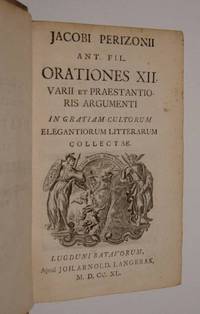
PERIZONIUS,J
Jacobi Perizonii Ant. Fil. Orationes XII varii et praestantioris argumenti in gratiam cultorum elegantiorum litterarum collectae
Leiden Lugdini Batavorum Apud Joh. Arnold Langerak 1740. 8vo. XXXVIII592 p. Vellum 17 cm Details: 5 thongs laced through the joints. Engraved printer's mark on the title it depicts a man who is busy climing a steep hill; a winged diety Father Time Tempus who sways his scythe and has an hourglass on his head helps him to ascend; at the top of the hill rests a huge cornucopia; this scene is flanked Athena and the Muse Clio whose head is winged and who has scroll and quill at hand; the motto reads: 'Dum audes ardua vinces' 'You will be succesful daring' Condition: Vellum age-toned. Both pastedowns slightly stained. Small paper label on the back Note: The Dutch ancient historian Jacobus Perizonius 1651-1715 was professor of History at the University of Franeker from 1682 and from 1693 of Leiden. His historical work broke new ground and may be said to have laid the foundations of historical criticism. It anticipates Niebuhr's method of dealing with the early history of Rome. He made his name with his 'Animadversiones historicae' 1685 which work is recognised as a masterpiece of historical criticism. 'In his 'Origines Babylonicae et Aegypticae 1711 he was the first to suggest the spuriousness of the royal list of Manetho and he defended the chronology of Scaliger'. J.E. Sandys 'A history of classical scholarship' New York 1964 volume 2 p. 331 Perizonius wrote also a learned dissertation on Dictys 1702. His merit as a philologist is demonstrated in his commentary on the 'Minerva' of Sanctius which became a standard 1687 1693 1702 1704 1714 1733 1752 1754 1789 1793 1795 & 1809 and his edition of the 'Variae Historiae' a miscellany of the late antique author Aelianus 1701. § From the dedication at the beginning of this book dated Zaltbommel 1739 we learn that F.G. Westerhovius is the editor of this collection of speeches of Jacob Perizonius 'praeceptoris quondam mei amantissimi'. Westerhovius studied probably under Perizonius at the University of Leiden where Perizonius lectured from 1693. Frederik Wilhelm Westerhovius was born in 1675 and was appointed rector of the Schola Latina at Gorichem and later still alive in 1742 Zaltbommel. Westerhovius added after the 'dedicatio' a 7 page biographical sketch Viri Clarissimi Jacobi Perizonii vita of his admired professor and a list of 12 pages Codices quos Bibliothecae legavit Clarissimus Jacobus Perizonius listing the 38 manuscripts among which one of the 10th century and 59 valuable postincunabula Perizonius bequaethed to the Library of the University of Leiden. The collection of orations opens with Perizonius's inaugural lecture held at Franeker 'De Ciceronis industria' 1682 and his inaugural lecture of Leiden 'De usu Graecae Romanaeque linguae' 1693. Follow 'De Pyrrhonismo historico' 'De doctrinae studiis nuper cultis' 'De origine et natura Imperii' 'De bello contra Gallos et Hispanos' 'De Aethere Britannis & Batavis militante' 'De facta nuper pace' 'Cum Vilhelmus & Maria coronarentur' 'Funebris Mariae Reginae' 'In obitum Abrahami Gravii' Provenance: From the library of Caspar Reuvens and with his library ticket on the spine. Caspar Jacob Christiaan Reuvens 1793-1835 was a Dutch historian and archaeologist. He was the founding director of the Rijksmuseum van Oudheden Dutch National Museum of Antiquities in Leiden the world's first ever professor of archaeology at Leiden University and conducted the first excavations at the Roman provincial site Forum Hadriani in the Netherlands'. See English Wikipedia with his portrait On the verso of the front flyleaf has been attached a small leaflet format visiting card with the text: 'Jacob Perizonius wenscht mijn geachte Buurman in de Veenlaan te 's Gravenhage een gelukzalig jaar van 1867'. On the backside of this: 'Dr. Wap en echtgenoot 1 januari 1867 met een boekgeschenk'. Perizonius is here used as the messenger of the New Year's wishes of Doctor Johannes Jacobus Franciscus Wap to one of his neighbours. The Dutchman Jan Wap 1806-1880 was in the 19th century a wellknown man of letters. The city of The Hague honoured him by naming a street after him the Jan Wapstraat. Wap was living at the time at the Veenkade number 14. The Veenkade nowadays Toussaintkade a row of houses for well to do citizens was part of the canal system singel which went round the city untill the end of the 19th century Collation: -28 34 minus leaf 34 A-2O8 leaf L5 signed M5; leaf 2H6 signed 2H5 Photographs on request hardcover
书商的参考编号 : 120119
|
|
|
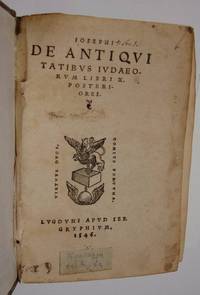
JOSEPHUS FLAVIUS
Fl. Iosephi Omnia quae extant opera. Tomus I & II: Quorum hic tomus I& II continet Antiquitatum Iudaicarum libros decem priores et libri X posteriores.
Lyon Lugduni Apud Seb. Gryphium 1546. 8vo. 2 volumes: LXXII index5521 blank1 printer's mark; 5261 blank1 printer's mark p. 20th century leather 18 cm Omnia quae extant opera vol. 1 & 2: De antiquitatibus Iudaeorum libri XX Ref: Schreckenberg p. 7 Schreckenberg Supplementband p. 167; Hoffmann 2450; Graesse 3481 Details: These two volumes are the volumes 1 & 2 of a 3 volume set 'Omnia quae extant opera' and they contain the complete Latin translation of 'De antiquitatibus Iudaeorum libri XX'. Volume 3 with the remaining works of Josephus is lacking. On the titles are the printer's mark of Sebastianus Gryphius depicting a griffin which mythological animal symbolizes courage diligence watchfulness and rapidity of execution used as a pun of his family name Gryph or Greif. From the claws of this creature hangs a big rectangular stone symbolizing Constancy beneath which is a winged globe symbolizing Fortune. The motto is 'Virtute duce / comite fortuna' 'Virtue thy leader fortune thy comrade' a quote from a letter of Cicero to Plancus Epistulae ad Familiares liber X3. On the last page of both volumes a woodcut griffin. Latin translation only Condition: Old leather binding covered with untanned leather. Binding with traces of wear. Front hinge of volume 1 cracking. Flyleaves absent. Both pastedowns of volume 2 renewed. Titles somewhat soiled and with a small inscription. A name on the first title neatly erased. Small paper label on the title of volume 2. Small tear in title of volume 2 because of overstretch in the margin. Occasional old and small ink underlinings. One old and small ink annotation in German Note: Flavius Josephus born 37/38 A.D. 'was a Jewish priest of aristocratic descent and a Pharisee. Though a zealous defender of Jewish religion and culture politically he was pro-Roman and without sympathy for extreme Jewish nationalism'. His first work was a history of the First war of Palestine Jews against the Romans which raged from 66 till 70 A.D. and of which the author was an eyewitness. The war ended with the fall of Jerusalem the walls and Temple were destroyed and most of its inhabitants were enslaved. Josephus who tried to follow the objective methods of Thucydides and Polybius wrote this history in Aramaic 'of which a Greek translation the extant 'Bellum Judaicum' in seven books appeared between 75 and 79. . His next work the 'Antiquitates Judaicae' in twenty books published 93/94 is a history of the Jews from the Creation to immediately before the outbreak of the war giving a fuller account of the period from the Maccabees to A.D. 66 than that in 'Bellum Judaicum' and showing a more hostile attitude to Herod the Great'. OCD 2nd ed. p. 565 Josephus probably wrote this work sometimes also called 'Judaica Archaeologia' to defend the sacred history of the Jews and 'to show that Jewish tradition was as ancient and trustworthy as the Egyptian and Mesopotamian traditions and surely preceded Greek culture. The Classical Tradition Cambr. Mass. 2010 p. 497 § The 'editio princeps' of the Greek text of the complete works of Josephus was published in Basel in 1544 by Frobenius and was edited by Arnoldus Arlenius Peraxylus with the help of Sigismund Gelenius. The 'editio princeps' of the ancient Latin translation of 'De antiquitatibus Judaeorum' was published much earlier in Augsburg in 1470. See Schreckenberg p. 1 This translation is sometimes ascribed to the Roman statesman and author Cassiodorus born ca. 485 died after 580 who served in the administration of Theoderic the Great king of the Ostrogoths. He however didnot translate it but he commissioned the translation. He mentions this explicitily in his Institutiones 1:171: 'Ut est Iosephus . Hunc tamen ab amicis nostris quoniam est subtilis nimis et multiplex magno labore in libris viginti duobus converti fecimus in Latinum'. 'Ich habe ihn aber dennoch von meinen Freunden unter viel Mühen- er gilt ja als ungemein scharfsinnig und vielschichtig- in 22 Büchern ins Lateinische übertragen lassen'. Cassiodor Institutiones Divinarum übersetzt und eingeleitet von W. Bürsgens Freiburg etc. 2003 p. 222/223 Our Gryphius edition of 1546 is a reissue of that translation of 1470 Provenance: In the first title are faintly discernable traces of 6 blind stamped capitals: 'LDDAVH'. A name Collation: alpha-epsilon8 zeta4; a-z8; A-L8 M4; aa-KK8 Photographs on request hardcover
书商的参考编号 : 120138
|
|
|
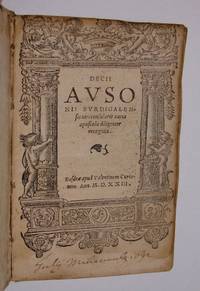
AUSONIUS
Decii Ausonii Burdigalensis viri consularis varia opuscula dilegenter recognita.
Basel Basileae Apud Valentinum Curionem 1523. 8vo. XVI2493 p. Early 20th century half vellum 15.5 cm Ref: VD16 A 4385; Schweiger 221: 'nicht ohne krit. Werth'; Fabricius/Ernesti 3147 Details: Title with large woodcut borders. Large printer's mark designed by Hans Holebein at the end; Holbein worked for Curio from 1521 till 1524. Heitz/Bernoulli 'Basler Büchermarken' Strassburg 1895 p. 67 illustration 102 Condition: Binding probably early 20th century. Damaged back restored with a strip vellum. Title slightly soiled and its edges are somewhat thumbed and its upper margin is somewhat cut short. Name on the title below the imprint. First gathering slightly waterstained. No flyleaves. Paper slightly yellowing Note: Decimus Magnus Ausonius of Burdigala Bordeaux ca. 310-394 was according to H.J. Rose an example of the senile degeneration of 4th century Latin literature and the first glimmer heralding the full day of French literature. He wrote trifles sometimes pretty or clever often tiresome. H.J. Rose 'A History of Latin Literature' London 1967 p. 527/29. H.G. Evelyn White the editor of the Loeb edition is even more negative: 'As poetry . the great mass of his verse is negligible'. The chief value of Ausonius' work is according to him historical. Loeb Classical Library Ausonius Cambr. Mass. 1919. p. VII The 'Neue Pauly' is more positive: 'Ausonius repräsentiert eine Kultur der Bewahrung und des Erbes. Allenthalben greift er auf die griech. und lat. Lit. zurück über die er souverän verfügt und gestaltet anspielungs- und voraussetzungsreiche pretiöse Gebilde von formalem Raffinement'. Der Neue Pauly 2334 Alexander Souter is in the Oxford Classical Dictionary full of praise: 'His numerous poems written in various metres . are of considerable interest in both subject-matter and style. There are over a hundred epigrams some of which are in Greek and others translated from Greek. There are 25 letters. His correspondence with Paulinus of Nola is the most notable part of these. The Ephemeris includes many poems in various metres dealing with daily life. The Parentalia is a collection of short poems in memory of deceased relatives of the poet. The Commemoratio Professorum Burdigalensium is of interest for the history of education. . This account by no means exhausts the list of minor poems throughout which the author's minute knowledge of Virgil is apparant and his Christian faith is not obtruded. His most important poem is the Mosella which still attracts readers. It is a rhetorically fashioned laudatio in 483 hexameters and describes in considerable detail the various fish to be found in the river as well as some of the fine buildings on the banks and other features the whole constituting a series of episodes composed like the rest of Ausonius' verse according to rule'. OCD 2nd ed. p. 154 § Not known on which edition this 1523 edition is based. It is not a reissue of the Juntae or Aldus edition both of 1517. It has after the short biography of Ausonius by Petrus Crinitus with which it opens a 10 page 'Scriptorum Ausonii Catalogus'. Follow the Epigrammata the Eidyllia among them Mosella Epistolae and other minor works; it ends with Ausonius' 'Periochae in omnes Homeri Rhapsodias' Provenance: Name on the title is partly illegible: 'Galij Milia. 1692' Collation: a-q8 r6 leaf r6 recto blank Photographs on request hardcover
书商的参考编号 : 120150
|
|
|
VOSSIUS,GJ G J
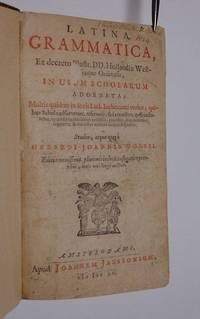
Latina grammatica. Ex decreto Illustr. D.D. Hollandiae Westfrisiae Ordinum in usum scholarum adornata. Multis quidem in locis Lud. Lithocomi verbis quibus Scholae adsueverant reservatis; sed erroribus quibus scatebat emendatis; inuitilibus refectis; pluribus quae defierent suppletis & omnibus meliori ordine dispositis. Studio atque opera Gerardi Joannis Vossii. Editio novissima plurimis in locis castigatior prioribus notis vero longe auctior. Bound with: Latina syntaxis in usum scholarum Hollandiae & West-Frisiae superiorum auctoritate adornata. Passim quidem reservatis fere praeceptis & exemplis Ludolffi Lithocomi; Sed plurimis repurgata ab erroribus etiam superfluis omissis additis necessariis atque omnibus meliore ordine digestis. Opera Gerardo Jo. Vossii. &: Latina prosodia et artis metricae elementa in usum scholarum Hollandiae ac West-Frisae conscripta a Gerardo Jo. Vossio.
Amsterdam Amstelodami Apud Joannem Janssonium 1660. 3 volumes in 1. VIII1751 blank;176 p. Eighteenth century boards. 16 cm Details: First title printed in red & black. Woodcut printer's mark on all 3 titles depicting a farmer and a man with a Jacob's staff before his eye between them a celestial sphere above them Fama blowing 2 trumpets motto: 'Vivitur ingenio' short for 'Vivitur ingenio caetera mortis erunt' 'one lives on by the spirit the rest shall belong to death' Condition: Cover scuffed and worn at the extremities. First title dustsoiled with an ownership entry on the blank upper margin; a very small spot 0.5x1 cm on the title superficially worn away. 2 small biographic clippings neatly tipped in on the front pastedown. A few old ink underlinings. One marginal well succeeded paper repair. Library stamp on verso of title. Paper yellowed Note: This Latin grammar was commissioned in 1625 by the Provincal Governments of Holland and West-Frisia Staten van Holland for the use in local Latin schools in the Western part of the Dutch Republic. It was produced by the Dutch classical scholar Gerardus Johannes Vossius 1577-1649 according to Sandys the greatest polyhistor of his age. In 1622 he was appointed professor of Eloquence at Leyden and in 1631 he accepted the professorship of History at Amsterdam. His Latin grammar remained the standard grammar on Dutch schools untill the middle of the 19th century. In 1625 the 'Staten van Holland' decreed that the same set of rules should apply to all public schools in their provinces. The schools should have the same order of classes and lessons the same schedule authors and exercises. It was decided that uniform schoolbooks grammars and sound texts were needed. E.J. Kuiper 'De Hollandse 'Schoolordre' van 1625' Groningen 1958 p. 80 The 'Staten of Holland' wanted to improve education at the Latin-schools which prepared for the University for the standard of education and discipline had got worse because of the Eighty Years' War. The grammar was first published in 1626 and found the next 2 centuries numerous new and revised editions. The first volume contains the latina etymologia the second the latina syntaxis the third the latina prosodia Provenance: Library stamp on verso of title: 'Grosherzogliche Bibliothek Neustrelitz'. 'Die 1796 gegründete Herzogliche später Grosshezogliche Bibliothek Neustrelitz umfasste zunächt die private herzogliche Büchersammlung und enthielt 1829 etwa 50.000 Bände. Dieser Bestand wurde in den nächsten 50 Jahren kaum vergrössert. . Für 1875 werden sehr unsicheren Schätzungen - die Bibliothek war unterbesetzt - 60.000 bis 70.000 Bände angegeben erst ab 1894 erhöht sich diese Zahl auf 100.000. Obwhol der Philologe Friedrich Latendorf 1831-1898 den Wert der Bibliothek für das geistige Leben des Landes immer wieder betonte . musste er feststellen dass wichtige Werke fehlten Disziplinen wie Medizin und Juristerei fast völlig vernachlässigt waren und der Bibliothek seit ihrer Gründung der Charakter des Zufälligen anhaftete' The schoolboy Heinrich Schliemann saw in the underpaid librarian Carl Andress 'der offenbar kein abgeschlossenes Studium Literatur alte und neue Sprachen besass' 'einer der gelehrtesten Männer Deutschlands'. U. Hass-Zumkehr 'Daniel Sanders: Aufgeklärte Germanistik im 19. Jahrhundert' Berlin/New York 1995 p. 307/08 The library had in 1920 132.000 volumes. In 1950 the library was 'aufgelöst und ihre Bestände auf acht Bibliotheken und Museen in Schwerin Greifswald Rostock und Berlin aufgeteilt worden. Mit dieser Aktion ging der betroffenen Region eine unersetzbare Quelle der kultur- und regionalgeschichtlichen Forschung verloren'. B. Fabian Handbuch der historischen Buchbestände in Deutschland online Collation: 8 A-L8 leaf L8 verso blank; a-l8 Photographs on request hardcover
书商的参考编号 : 120183
|
|
|
BAIF, L DE
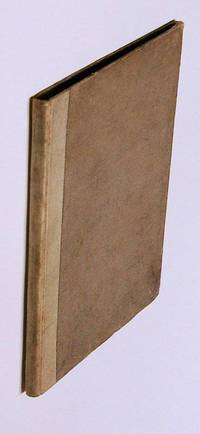
De vasculis libellus adulescentulorum causa ex Bayfio decerptus addita vulgari latinarum vocum interpretatione.
Paris Parisiis Ex officina Roberti Stephani typographi Regii 1543. Colophon at the end: 'Excudebat Rob. Stephanus Typographus Regius Parisiis an. M.D.XLIII XIII Cal. Oct. 8vo. 523 index1 blank p. Half vellum 20th century 17 cm Ref: not in Renouard 'Ann. de l'Impr. des Estienne' see however p. 58 1543/12: 'Carolus Stephanus De re Vestiaria Vascularia et Navali ex Bayfio. Addita vulgaris linguae interpretatione'; not in Brunet Graesse or Ebert Details: Printer's Olive tree device of the Stephanus family on the title motto: 'Noli altum sapere' short for 'Noli altum sapere sed time' in English 'Donot be high-minded but fear'. Epistola Beati Pauli ad Romanos 1120 Condition: The right upper corner of the first gathering slightly waterstained Note: The French diplomat humanist and poet Lazare de Baïf ca. 1496-1547 was born near La Flèche in Anjou. He wrote in Latin and translated from Greek into French. He translated the Electra of Sophocles which was printed in 1537 in Paris. He was abbot of Charroux and Grenetière and counselor of the parliament of Paris. Around the year 1530 Baïf was sent to Venice as ambassador where he fell in love with a woman of rank with whom he had a son in 1532. The boy was named Jean-Antoine the future poet of the Pléiade. Lazarus de Baïf being of ecclesiastical orders could of course not marry his mistress but he recognized her son and legitimized him later. He took the boy to Paris where he gave him a worthy education. Some of his tutors were Dorat a brilliant Hellenist and Latin scholar and Charles Estienne his friend and disciple. In 1526 De Baif published his first work in Basel De re vestiaria which earned him a reputation among French scholars as second in rank to Guillaume Budé. As a diplomat he continued his philological and archaeological studies and corresponded with Erasmus Bembo and many other humanists. 'His scholarly reputation rests squarely on his three Latin works: De re vestiaria of 1526 . De vasculis Basel H. Froben 1531 . and finally De re navali Paris R. Estienne 1536' which was accompanied by illustrations derived from sketches of the pillar of Trajan and other monuments. Contemporaries of Erasmus: A Biographical Register of the Renaissance and Reformation Toronto 1985 p.87/88 In 1549 Robert Estienne posthumely published an edition of these works which were revised and expanded by the author. Charles Estienne rearranged de Baïfs works on naval matters clothing and vases of the ancients for the use of young students. Various editions between 1535 and 1537 The first 'school-edition' of the book on ancient vases came from the presses of Robert Estienne in 1536 and was repeated in Basel by Froben in 1537 and 1541. De vasculis libellus adulescentulorum causa ex Baysio decerptus. Addita vulgari Latinarum vocum interpretatione In the preface to De Vasculis Charles Estienne tells the reader that not all aliquot studious young students iuniores tyrunculi could understand De Baif's work. se non omnia intelligere quae in libello Bayfii de vasculis continerentur. Therefore when he heard this De Baif gave his friend permission to make a summary of his book. facile passus est suum libellum in brevem quandam summulam contrahi Charles Estienne 1504-1564 'was an early exponent of the science of anatomy in France. Charles was a younger brother of Robert Estienne I the famous printer and son to Henri who Latinized the family name as Stephanus' . After the usual humanistic training Greek and latin classics he studied medicine and took his doctor's degree at Paris. He was for a time tutor to Jean-Antoine de Baïf the future poet. It is uncertain whether he taught publicly. His career was interrupted by the oppressive persecutions in which their religious opinions involved the family. Wikipedia s.v. Charles Estienne Robert Estienne published De Baifs work on vases in the same year 1543 also accompanied by a French translation See Renouard § This 1543 edition seems to be rare. KVK records only a few copies worldwide Collation: a-c8 d4 Photographs on request hardcover
书商的参考编号 : 120164
|
|
|
FLORUS
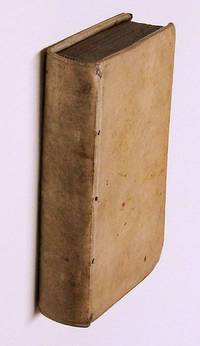
Lucii Annaei Flori Rerum Romanarum editio novissima accurante Joanne Freinshemio. In qua quid praestitum sit aversa pagina docet.
Strassburg Argentorati Apud Georg. Andr. Dolhopf & Joh.Eberh. Zetzner 1669. 8vo. 32452155 'Variae lectiones' & index1 blank p.; frontispiece. Vellum 17 cm Ref: VD17 3:306199X; Schweiger 2361; Fabricius/Ernesti 2444; Graesse 2605 Details: 5 thongs laced through the joints. Frontispiece depicts two discussing Roman warriors at their feet the she-wolf and the twins Romulus and Remus above their head soars a big eagle holding in its claws a crown and a scepter. Woodcut printer's mark depicting a bust of the Greek goddess Athena Condition: 3 thongs of the joint of the lower board snapped. Vellum age-toned & somewhat soiled. Pastedown of the lower board detached. Old ink annotations in the first gatherings. Ten gatherings browning Note: Favourite school-book in the 17th century. This is the chief work of the Roman historian Lucius Annaeus Florus who lived at the beginning 2nd century AD. It is an abridgement of Roman history with special reference to the wars waged up to the age of Augustus. Florus 'shows a certain literary gift marred however by a strong tendency to rhetoric. His brevity often entails obscurity though he sometimes produces a felicitous epigram. . As an historian he is often inaccurate in both chronology and geography but the work as a whole achieves a limited success as a rapid sketch of Roman military history. It was a favourite school-book in the 17th century'. OCD 2nd ed. p. 442 This Florus edition was produced by the German classical scholar Johannes Casper Freinsheim 1608-1660. He was an excellent representative of the flourishing school of Roman History at the University of Strassburg. 'The editions of the Roman historians published by this school were distinguished for the excellence'. According to Sandys he 'produced excellent editions of Florus'. Sandys 2 p. 367 . At the end have been added 22 pages with 'Variae Lectiones' and an index of 134 pages of which Fabricius/Ernesti record that 'In indice multa ad explicandam latinitatem pertinentia sunt'. This edition of 1669 is a reissue of the edition of 1636 also printed by Zetzner in Strassburg. It is based according to the enumeration on the verso of the title on earlier editions: 'Flori contextus a Iohanne Camerte Ioanne Stadio Elia Vineto Iano Grutero Claudio Salmasio & Isacio Pontano e manuscriptis codicibus emendatus in versiculos distinctus'. Freinshemius added many conjectures of his own consulting older editions. In the introduction however no mention is made of manuscripts but 'interdum etiam ubi manifesta correctionis ratio est ex aliorum ingenio nostroque restituimus'. p. a8 verso The editio of Camertis is of 1518 Stadius of 1567 Vinetus of 1576 Gruter of 1597 Salmasius of 1609 Pontanus of 1626. The notes at the end of each caput have been selected from the just mentioned editors '& quotquot ex aliis philologicis auctoribus nostrove ingenio depromere licuit' p. a2 verso Collation: a-b8 A-2P8 leaf 2P8 verso blank Photographs on request hardcover
书商的参考编号 : 120131
|
|
|
DEMOSTHENES & AESCHINES
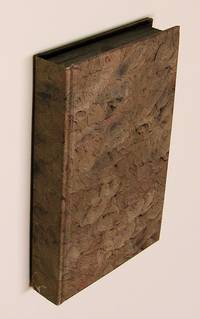
Demosthenis et Aeschinis Mutuae accusationes de ementita Legatione et de Corona ac contra Timarchum quinque numero cum earum argumentis ipsorum oratorum vita et Aeschinis Epistola ad Athenienses ac indice copioso. Nuper a bene docto viro traductae. Dictorum series versa pagina conintetur. Cum Privilegio Veneto.
Venice Venetiis Apud Hieronymum Scotum 1545. 2231 blank leaves. Limp overlapping vellum. 16 cm Ref: Edit16 CNCE 16736; Hoffmann 1528 Details: Latin translation only. Woodcut printer's mark on the title page and at the end of the book depicting a branch of olive and a palm tree graft onto a trunk with between them an anchor; anchor and trunk are held together bij the initials SOS Signum Octaviani Scoti; a banner runs around with the motto: 'In tenebris fulget'. Printed in italics except for the title. Some historiated and ornamental woodcut initials Condition: Vellum age-tanned and slightly soiled. 2 tiny holes in both boards because of the 2 ties which have disappeared Note: In the preface of this book the learned anonymous translator explains his readers that it was his aim to collect for those who are not able to read Greek qui graeca non legerant in one volume in unum eundemque codicem ac seorsum ab reliquis five speeches translated into Latin of Demosthenes and Aeschines because those speeches full of mutual accusations and attacks belonged together inter se sint connexae . ut una ab altera divelli non possit. They shared the same actors and the same subject matter and showed to the consent of all the power of speech and the art of oratory in her perfection tota ars dicendi & vis orandi. Demosthenes and Aeschines were at daggers drawn and therefore the collections begins with the 'Contra Timarchum oratio' because this speech was the beginning of their enmity quod inde Demosthenis & Aeschinis inimicitiae exordium habuerint. In this preface he severely criticizes the clumsy Latin translation of Leonardus Aretinus Leonardo Aretino known to us also as Leonardo Bruni ca. 1370-1444. He calls his translations 'mendosae' and unreliable. The anonymous translator not only translated speeches of Demosthenes and Aeschines he added also relevant material from other sources such as Libanius Philostratus and Apollonius which he now translates into Latin for the first time adiunctis tam Libanii quam aliorum argumentis ad eas ipsas orationes. Interpres lectori S.P.D. leaf 2/3 Translated are beside Aeschines' 'Contra Timarchum Oratio' the 'Oratio de ementita legatione' of Demosthenes and Aeschines now commonly known as 'De falsa legatione' and the 'Oratio contra Ctesiphontem de Corona' and the 'Oratio de Corona pro Ctesiphonte' of both men. Added are biographic sketches argumenta and testimonia. § The Athenian Demosthenes 384-322 BC was without doubt the greatest orator of his time. His surviving speeches are mostly connected with his politics. He was a fierce opponent of Philippus II king of Macedon since 359 who gradually tried to subject the whole of Greece. In 351 he delivered his first Philippic against him. His speeches against Philippus known as Philippics are one long warning against the growing Macedonian power. Demosthenes attacked also the pro-Macedonian elements in Athens who sought peace with Philippus and wanted to give in. One of their leaders was the orator Aeschines 389-314 BC. In 345 Demosthenes and his Athenian ally Timarchus tried to impeach in a speech called 'De falsa legatione' or 'On the false embassy' Aeschines 'for wilfully neglecting the interest of Athens as a member of the embassy which had negociated the peace' H.J. Rose A handbook of Greek literature London 1965 p. 291. Demosthenes held Aeschines responsible for Philip's use of the peace negotiations to intervene in other Greek city-states. Demosthenes was unsuccessful and Aeschines was acquitted having delivered a speech in which he defends himself against accusations of treason and collusion with the enemy. Instead of refuting the accusations directly Aeschines used Athenian Civil Procedure to argue against Timarchus as a qualified prosecutor. The feud reached its peak in 330 with Demosthenes' most famous oratorical effort the so-called speech 'On the Crown'. A member of his party Ctesiphon had proposed in 336 to honor Demosthenes for his services as was customary with a golden crown. Nothing came of it the next 6 years mainly because Aeschines accused Ctesiphon of legal irregularities but in effect he attacked Demosthenes' policy. In 330 after a charge of Aeschines 'Demosthenes replied in the masterpiece commonly known in modern times as the 'De Corona'. It is partly a formal rebuttal of the charge against Ktesiphon but this is the weakest part of it for technically Aischines had the law on his side. Substantially it is a magnificent defence of the principles guiding the anti-Macedonian party justifying them in face of failure. Less to modern taste is its bitter personal attack on Aischines who however had not spared Demosthenes in his own speech'. Rose p. 292 Provenance: On the front flyleaf in pencil '7 januari 1961' written by the Flemish linguist Walter Couvreur 1914-1996 who was an Orientalist and professor of Indoeuropean linguistics at the University of Gent. It is the date of acquisition. The place of acquisition he wrote on the flyleaf at the end: 'Turijn Bottega d'Erasmo' Collation: A-2E8 last leaf blank pagination sometimes irregular Photographs on request hardcover
书商的参考编号 : 120062

|
|
|
CAMERARIUS,J
Notatio figurarum orationis et mutatae simplicis elocutionis in apostolicis scriptis ad perspiciendam de intellecto sermone sententiam autorum studio Ioachimi Camerarii Pabepergensis.
Leipzig Lipsiae Edita in Officina Valentini Papae 1556. 8vo. XVI368 p. Modern hardback. 16.5 cm Ref: VD16 C 485; cf. Brunet 11513 he mentions only the edition of Leipzig 1572 Details: Modern and modest binding; the second and last gathering of the introduction 8 leaves is missing; this last half of the introduction is added in photocopy. Some woodcut inititals Condition: Paper on the boards very superficially damaged. The second and third leaf of the first gathering are loose the remaining leaves of this first gathering are loosening; the last gathering of the introduction is missing Note: The German classical scholar Joachim Camerarius was born in 1500 in Bamberg. He died in Leipzig in 1574. He held classical professorships at Nürnberg Tübingen and Leipzig and was one of the most significant representatives of Renaissance humanism in the Reformation. His interests were diverse and his productivity spectacular. 'His numerous editions of the Classics without attaining the highest rank are characterised by acumen en good taste'. In critical acumen Camerarius 'holds one of the foremost places among the German scholars of the sixteenth century'. J.E. Sandys 'A history of classical scholarship' N.Y. 1964 p. 266/67 He also wrote poetry produced biographies of famous contemporaries and wrote on church history theology and paedagogy. His wrote his works for academic students explaining matters of style rhetoric and grammar. 'Der Ehrenplatz in seinem Werk gebührt seiner erstmal in 1552 in Basel gedruckten vollständigen Edition der plautinischen Komödien welche in der Geschichte der neuzeitlichen Plautus-Philologie eine neue Phase inaugurierte'. Neue Pauly Suppl. 6 p. 195. In this 'Notatio figurarum orationis' we see Camerarius at work this time on the 'Letters of the Apostles' which form a part of the 'New Testament'. Here he gives special attention to rhetorical and stylistic explanations of the text. In 1572 Camerarius published in Leipzig an augmented and revised edition. He added his 'notationes' on the remaining books of the 'New Testament' the 'Acts of the Apostles' and the 'Apocalyps'. The book seems to be rare. We found only a few copies in Germany Austria and England in KVK Collation: Aa-8 Lacking Bb8 A - Z-8 Photographs on request hardcover
书商的参考编号 : 120040
|
|
|
HOMERUS
Homeri Odyssea. Cum interpretatione lat. ad verbum post alias omnes editiones repurgata plurimis erroribus & quidem crassis alicubi partim ab Henr. Stephano partim ab aliis. Adjecti sunt etiam Homerici Centones qui Graece HOMÊPOKENTPA: item proverbialium Homeri versuum libellus. Editio postrema diligenter recognita per I.T.P.
Amsterdam Amstelredami Sumptibus Henrici Laurent Bibliopolae 1648. 8vo. 80316741 index p. Contemporary overlapping vellum 16 cm Ref: Schweiger 1158; Hoffmann 2318; Graesse 3328; Ebert 9968; cf Dibdin 251/52 for the Stephanus edition of 1588; Brunet 3272 Details: Greek text with facing Latin translation. Woodcut printer's mark on the title depicting a gardener who is removing with his pruning knife dead bad and otherwise harmful wood. The motto is: 'Non odit tamen' 'Even so he does not hate the tree'. At the end before the index 67 pages filled with 'Homeric centones' Condition: Vellum age-tanned. Edges of both pastedowns worn. A small and faint waterstain at the right upper corner of the last third of the leaves. Paper slightly yellowing Note: This is part two only the Odyssey part of a two volume set of the 'Homeri Opera cum interpretatione latina' . Editio postrema diligenter recognita per' one 'I.T.P.' published by Laurentius in 1648. This 1648 edition is a reissue of a Parisian edition of 1622/24: 'Homeri poemata duo Ilias et Odyssea sive Ulyssea. Alia item carmina eiusdem . Cum interpretatione lat. Accedunt Homerici centones et proverbialium Homeri versuum libellus. Editio postrema diligenter recognita par I.T.P.'. Who this I.T.P. or J.T.P. was no bibliographer has found out so far. What his editorial contribution was no one knows and has not yet been investigated. He is possibly a Frenchman. All bibliographers agree that this Parisian edition was a repetition of still an earlier 2 volume edition which came from the presses of the famous French scholar and printer Henricus Stephanus the Second in 1588: 'Homeri Ilias et Odyssea alia item carmina eiusdem cum interpretatione latina repurgata plurimis erroribus partim ab Henrico Stephano. Adiecti Homeric centones item proverbialium versuum libellus'. The Latin translation of Homer was made by the Cretan Greek scholar Franciscus Portus 1511-1581. He taught Greek at Ferrara and had to leave for Geneva in 1559 owing to his sympathy with the cause of Reformation. Dibdin notes that his translation was 'not remarkable for its accuracy'. For the good things in the Greek text the credits were given to Henry Estienne or in Latin Henricus Stephanus 1531-1598. 'He will always be numbered among the principal editors of Homer' Dibdin concludes. For the weaknesses in the text it is explained that the great scholar was at the time absent from the office/printshop and that part of it was printed without his superintendence. The Stephanus text of Homer became a kind of standard text in the Netherlands and in Britain. There was another 2 volume reissue published in Amsterdam by Ravestein 1650. This 1648 Odyssey edition on offer further contains the 'Batrachomyomachia' and the 'Homeric hymns' but also the so-called 'Homeric centones' a work composed in late antiquity. These centones derived from the Greek 'kentron' 'needle' form 'patchwork poetry' and consist of complete or half Homeric hexameters. Knit together they create a new narrative of the Bible especially the Gospels in the august epic style of the ancients. They were first printed in 1504 by Aldus. The genre flourished in late antiquity and there was a revival during the Renaissance Provenance: A small coat of arms measuring 1.5 cm has been blind stamped in the front flylaef it consists of a shield divided into 4 fields; in the right upper and left lower field there is a standing cross in the left upper field what seem 2 crossed swords right lower field seems empty. Upon the shield rests a crown with seven points Collation: A-3L8 Photographs on request hardcover
书商的参考编号 : 120082

|
|
|
ARISTAENETUS
Aristaeneti Epistolae graecae cum versione latina et notis Josiae Merceri curante Joan. Cornelio de Pauw cujus notae accedunt.
Utrecht Trajecti ad Rhenum Apud Hermannum Besseling 1737. 4to. XXIV2871 colophon p. Overlapping vellum 15.5 cm Ref: Hoffmann 1240; Schweiger 144; Dibdin 1292; Fabricius Bibliotheca Graeca ed. 4a Hamburg 1780 p. 696; Brunet 1448; Ebert 1066; Graesse 1204 Details: 5 thongs laced through the joints. Title printed in red and black. Woodcut ornament on the title. Greek text with facing Latin translation commentary on the lower half of the page. Edges dyed blue Condition: Vellum slightly soiled. Stamp and name on the front flyleaf. Small part of the right lower corner of the front flyleaf cut off and renewed. Small shelf number in red ink on the title. Two stamps on the verso of the title Note: A survey of erotic motives in the literature of Greece and Rome. Aristaenetus is the established name of the author of a collection of love letters in two books probably from the beginning of the 6th century AD. It survives only in one Codex of which the first folio with the name of the real author is lacking. Aristaenetus Bestpraiseworthy is only applied to the sender of the first letter. This is clearly a case of an imaginary letter-writer. The sources used are Plato Menander Lucianus Alciphron Philostratus the ancient novels and love elegies of Callimachus. Aristaenetus draws however in a conventional way a veil over too explicit love-making. The collection is a kind of survey of erotic motives in the literature of Greece and Rome. Everyting erotic however is covered with a veil of prudery. Aristaenetus ends after some cuddling before the bedroom is entered. Neue Pauly 11087 The collection was allready attributed to Aristaenetus in the 'editio princeps' of Antwerp 1566 edited by J. Sambucus. An edition with a Latin translation was published in 1595 in Paris by Iosias Mercier the 4th edition of which dates from 1639. Mercier was the first to observe that the first letter of the collection was imagined to have been written by one Aristaenetus and that the collection belonged to the genre of imaginative epistolography. Aristaenetus had to wait almost a century for the next edition which appeared in 1736 in Utrecht produced by Jacobus van Lanckom. Exactly the same edition was brought on the market by the Utrecht publisher Hermannus Besseling only the impressum on the title differs the rest is exactly the same. It was said that Aristaenetus was put to sleep in the commentary of Pauw. A revised edition was published in Zwolle in 1749. Cornelis de Pauw born ca. 1680 in Utrecht was canon of the 'Sint Jan'. He was a classical scholar of some repute and published several editions of Greek and Roman authors Hephaestion Horapollo Anacreon Quintus Smyrnaeus Theophrastus's Characters Phrynichus Aeschylus. By some detractors he was considered to be an 'homme médiocrement savant' whose ignorance was only exceeded by his impudence. He died in 1749 Provenance: On the front flyleaf a stamp: 'Prof.Dr. Joh. Irmscher Berlin NO 55 Erich-Weinert-Strasse 126'. Johannes Irmscher born in Dresden 1920 was a classical philologist and byzantine scholar who made his carreer in the DDR. He died in 2000. On the same flyleaf also in ink: 'C. Schoenemannus Isleb. 1782'. This book once belonged to the German classical scholar and geographer Karl Traugott Gottlob Schoenemann born in Eisleben in 1765. He studied classical philology and ancient geography in Göttingen. In 1787 and 1788 he published the treatises 'De geographia Homeri' and 'De geographia Argonautarum' . He died prematurely in 1802. Posterity is still thankful for his 'Bibliotheca historico-litteraria patrum latinorum a Tertulliano usque ad Gregorium M. et Isidorum Hispalensem' 1792/94 a still indespensable work of reference for early Christian Latin literature from Tertullian to Isidor of Sevilla. On the title in red ink: 'Ph.H. 85'. On the verso of the title a round stamp of: 'Biblioth. Gymn. Ill. Gothana'. This stamps dates from before 1859. In that year the local 'Gymnasium Illustre' and the 'Herzogliches Realgymnasium' were transformed into the 'Gymnasium Ernestinum Gotha'. See Wikipedia 'Ernestinum Gotha' Collation: 8 24 A-S4 Photographs on request hardcover
书商的参考编号 : 120031
|
|
|
HORATIUS
Q. Horatius Flaccus ex recensione Heinsii et Fabri ac cum variis lectionibus Rich. Bentleii.
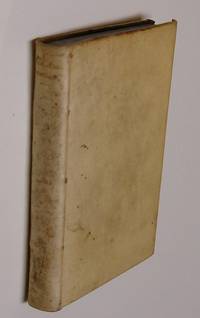
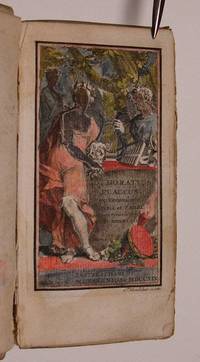
Amsterdam Amstelaedami Ap. R. et G. Wetstenios 1719. 12mo. 2142 blank p. Vellum 12.5 cm Ref: Schweiger 2407; Graesse 3354 Details: 4 thongs laced through the joints. Title engraved by J. Wandelaar Condition: Vellum age-tanned. Both pastedown detached. Right margin slightly thumbed. Engraved title coloured with watercolours. Some old ink underlinings. Faintly waterstained Note: This booklet was produced for schoolboys and educated men able to read Latin but not to be bothered with philological niceties. The Wetsteins had already published an important Horace edition of the English genius Richard Bentley for scholars in Amsterdam in 1713. In a short note p. 5 the 'typographus' Wetstein tells the reader that this booklet offers all that is to be desired for little money paucis accipe. The odes he says are preceded sometimes by an indication of the metre 'ex mente A. Manutii' to make scansion especially for schoolboys tirones easy. For the constitution of the text he follows Daniel Heinsius and Tanaquil Faber. The 'variae lectiones' of Richard Bentley are printed in the lower margins to enable the reader to choose for himself. § The works of the Roman poet Quintus Horatius Flaccus 65-8 B.C. have enjoyed a continuous presence in European culture. Till well into the 20th century he stood central in school curricula. Earlier in the Middle Ages he was next to Vergil the most important school author. Horace is transmitted in around 300 medieval manuscripts. The Renaissance saw the beginning of a flood of editions. 'For Neo-latin poetry until modern times and for all the vernacular literature of Europe from the 16th through the 18th centuries Horace provided the dominant model both for private lyrics celebrating wine and love and for public lyrics celebrating affairs of state'. Young poets used Horace to learn the trade. 'Horace's elegant rationalism and moral wisdom and also his disabused and tolerant tone made his poems favorite reading during the Enlightenment'. The Classical Tradition Cambr. Mass. 2010 p. 454/60 Provenence: Small ownership entry on the front flyleaf: 'F.J.P. Verbrugge'. The Dutchman Franciscus Johannes Petrus Verbrugge was born in Bergen op Zoom and took his doctoral degree 3 july 1973 defending his dissertation 'Versgrens en zin in Ovidius' Heroides'. He has published on Dutch and classical literature especially poetry and on the reception of classical culture in several periodicals. Collation: A-N8; O4 O4 blank Photographs on request hardcover
书商的参考编号 : 120083
|
|
|
MAXIMUS TYRIUS
V.C. Maximi Tyri Philosophi Platonici Dissertationes XLI. Graece. Cum interpretatione notis & emendationibus Danielis Heinsii. Accessit Alcinoi In doctrinam Platonis introductio ab eodem emendata: & alia ejusdem generis.
Leiden Lugduni Batavorum Apud Joannem Patium Acad. Typogr. 1607. 8vo. 3 parts in 1: XXIII1 blank408; 1241141 blank; 159 unnumbered pages1 blank p. Vellum 17.5 cm Ref: Hoffmann 2585; Schweiger 1204; Dibdin 2232; Graesse 4453; Ebert 13450; Brunet 31552 Details: Greek texts and Latin translations. Each part has its own title the first is in red & black. Woodcut printer's mark of Paets on the titles depicting a winged young woman who holds a scythe in her left hand and an opened book in her right arm Condition: Vellum age-toned and spotted. Tiny hole in the vellum of the lower board. Both pastedowns detached. Bookplate pasted on inside of the upper board. First title finger soiled. Almost invisible pinpoint wormhole at the tip of the right upper corner of ca. 250 p. Paper yellowing Note: The Greek Platonist Maximus Tyrus ca. 125-185 AD was an itinerant philosopher who left us 41 dissertations dalexeis on theological ethical and philosophical subjects. These lectures are not great literature nor specimina of great learning. Philosophical originality is not be be looked for in these lectures.The author offers a pleasant prensentation of a theme and his lectures 'are simply eloquent exhortations to virtue decked out in quotations chiefly from Plato and Homer'. OCD 2nd ed. 658 The themes are for example: 'die Lust hêdonê 29-33 sokratische Liebe 18-22 platonische Theologie 11 'daimones' 8-9 Gebet 5 Weissagung und freier Wille 13 das Böse 41 und Wiedererinnerung 10'. Neue Pauly 71074/75 Maximus Tyrius was widely read by humanists like Ficino Bessarion and Poliziano. The 'editio princeps' was published in 1557 by the French scholar/publisher Henricus Stephanus. The next important and authorative edition was published in 1607 by the Dutch scholar Daniel Heinsius 1580-1655 who was in 1607 librarian of the University of Leiden. In 1609 he succeeded as professor of Greek his praeceptor Josephus Justus Scaliger. The first 300 pages of the first part of this book contain the Greek text of the 'Dissertationes' followed by a number of Pythagorean fragments and by 27 pages 'castigationes' on Maximus Tyrius by Henricus Stephanus. The pages 329-386 contain the Greek text of Alcinous' handbook of Platonism 'Introductio in Platonicam philosophiam'; the pages 387-408 contain Diogenes Laertius on Plato. The second part contains Heinsius's Latin translation of Maximus Tyrius and Alcinous; added are 33 pages with a Latin translation of the earlier mentioned Pythagorean fragments made by the Dutch scholar Willem Canter. At the end 27 pages filled with Apuleius's 'De Deo Socratis liber qui Maximi Dissertat. de eodem respondet'. Part 3 contains the notes of Heinsius. Heinsius based his edition of Maximus Tyrius on that of Stephanus but 'quae corrupta erant emendavimus quae obscuriora leviter illustravimus'. Part 1 leaf 6 recto But he was a conservative and reserved text critic 'Nobis' he explains 'temeritas nunquam placuit et si quid in autoribus peccandum est timidus videri malo quam audax'. Part 3 leaf a4 recto/verso Heinsius also produced the Latin translation and notes. In a 'Lectori' to the third part Heinsius tells that the French scholar Isaac Casaubon sent him a manuscript of Maximus Tyrius's 'Dissertationes'. It arrived too late for amending the Greek text and Latin translation but Heinsius used it for and in his notes. Heinsius received also some excerpts excerpta quaedam of Sixtus Arcerius and the Heidelberg professor Marquard Freher 1565-1614 sent him a manuscript from the Palatine Library Provenance: Armorial bookplate of the barony 'Sinclair' a shield divided into 4 fields flanked by 2 griffons a baron's coronet on top above which a peer's helmet with mantlings and a crest consisting of a swam on its nest. Each of the four fields is filled with what seems a ship under sail. Old manuscript shelfmark on and under the bookplate. The motto reads: 'Fide sed pugna' 'with faith but with fist' Collation: 8 24 leaf 24 verso blank; a-u8 x4 y-cc8; pi2 b-dd8 cc4 a-k8 Photographs on request hardcover
书商的参考编号 : 120123
|
|
|
VOET,P
Pauli Voet Gisb. Fil. Juris in Acad. Ultraject. Antecessoris & Vianensis Camerae Senatoris De duellis ex omni jure decisis casubus liber singularis. Editione iterata auctus et emendatus.
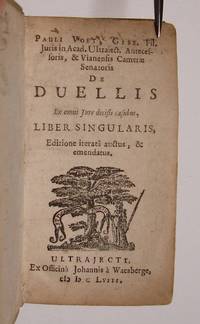
Utrecht Ultrajecti Ex officina Johannis à Waesberge 1658. 12mo. VIII384 p. Vellum. 14 cm Details: 5 thongs laced through the joints. Woodcut printer's mark on the title depicting Pallas Athena under an apple tree motto: 'Et flore et fructu' Condition: Vellum soiled and spotted. Fading manuscript title on the back. Front flyleaf removed Note: The Dutchman Paulus Voet latinized as Paulus Voetus or Voetius 1619-1667 was a jurist classical scholar and philosopher. In 1640 he took his Magister's degree and was appointed a year later professor extraordinarius of Metaphysics at the University of Utrecht. There he showed himself an opponent of the philosophy of René Descartes. In the meantime he studied law and got his law degree in 1645. A professorship of Logic and of Greek was offered to him in 1648. In 1645 he had already published his 'In Herodiani Marcum et Commodum Notae'. From 1652 he lectured also on law. He was a member of the Chamber of Justice in the nearby city of Vianen. As a professor of law he has laid with his publications the foundations of international private law as he dealt with the question why a sovereign state should apply foreign law on its territory. In 1646 Voet published the first edition of his work on duels 'De duellis licitis et illicitis liber singularis' in which he examined the phenomenon insult and duel. In 1658 he published a second revised and augmented edition. Voet furiously opposed duelling. Duellist were in his opinion rather meticulosi than audaces men full of fear instead of audacia courage and intrepidity. It would be better if unworthy revilers who insulted men of honour would not be given the opportunity to duel but would be punished with infamia disgrace. If this was done 'non adeo audacter & licentiose conviciatores qui responso digni non sunt in virorum bonorum famam grassarentur'. p. 310 In chapter 35 the last chapter which is on slander he reveals his own involvement. Voet tells how his father and he were once the victim of slander. p. 311/13 He reminds there how the Dukes of Brabant in order to prevent duelling proclaimed 'se offenso honoris reparationem curaturos' that they would secure the honour of those insulted. p. 319 If someone had dealt another soldier a box on the ear alapa colaphus he would receive a box on the ear or a kick in front of his batallion in presentia cohortis would be disarmed and then be sacked Provenance: On the front pastedown: 'Delfosse 1769 Collation: 4 A-P12 Q8 R4 Photographs on request hardcover
书商的参考编号 : 120185
|
|
|
ERASMUS
Des. Erasmi Roterod. Colloquia nunc emendatiora.
Amsterdam Amstelodami Ex officina Elzeviriana 1662. 12mo. XX672 p. Overlapping vellum. 14 cm Ref: Willems 1285: 'Réimpression ligne pour ligne de l'édition donnée par les Elzevier en 1655'; Berghman 1350; Rahir 1324; Brunet 21040 Details: 5 thongs laced through the joints. Title engraved by Corn. Cl. Duysend it depicts a standing Erasmus who looks through a telescope into a clouded sky; from a cloud comes the hand of God that bears the 'globus cruciger' corss-bearing orb in German Reichsapfel; the globe represents the earth and he who holds the globe owns the world. The motto on the title suits Erasmus: 'Vidit pervidit risit'. This engraved title was already used by Elsevier for the edition of the Colloquia of 1636. On the last of the preliminary pages a woodcut illustration depicting both sides of a medal of Erasmus on the recto his portrait on the verso his motto: 'Concedo nulli'; around it the legend with Erasmus' interpretation of his motto: 'Mors ultima linea rerum' Condition: Vellum age-tanned and somewhat soiled Note: 'The Colloquia like the Adagia were written over a period of years and constantly enlarged as edition succeeded edition. From their earliest form of short models of Latin conversation and formulae of etiquette composed at Paris in 1497 for the use of some pupils and first printed in 1518 they grew into 'a rich and motley collection of dialogues each a master piece of literary form well-knit spontaneous convincing unsurpassed in lightness vivacity and fluent Latin each one a finished one-act play' Huizinga. The Colloquia full of witty and penetrating observations on ordinary day-to-day happenings as well as on the basic weakness of Church and society are an invaluable mine of information about 16th century customs institutions and social problems. Besides their success as a schoolbook was unrivaled and the stream of editions and translations flowed almost uninterruptedly down to modern times'. Gilhofer & Ranschburg GmbH Catalogue 50 Erasmus published on the 500th anniversary of his birth' Luzern ca. 1967 p. 34 The Colloquia are preceded by a short biography of Erasmus last sentence: 'Discerptus est ab utraque dum utrique studet consulere' and a table of content Collation: 10 A-2E12 Photographs on request hardcover
书商的参考编号 : 120064

|
|
|
GELLIUS
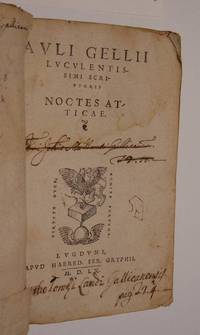
Auli Gellii luculentissimi scriptoris Noctes Atticae.
Lyon Lugduni Apud Haered. Seb. Gryphii 1560. LXIIII blank5333 blank p. Limp vellum 17 cm Ref: Schweiger 378; Dibdin 1340: 'beautiful and accurate edition . deserving of the student's notice'; Moss 1203; Graesse 346; Ebert 8283 Details: Gryphius' woodcut printer's mark on the title depicting a griffin which mythological animal symbolizes courage diligence watchfulness and rapidity of execution used as a pun of his family name Gryph or Greif. From the claws of this creature hangs a big rectangular stone beneath which is a winged orb. The motto is 'Virtute duce / comite fortuna' 'Virtue thy leader fortune thy comrade' a quote from a letter of Cicero to Plancus Epistulae ad Familiares liber X3. At the end a woodcut griffin. The text is printed completely in italics except for the title Condition: Vellum shabby wrinkled and showing some old repairs. Corners somewhat dog-eared at the end and beginning. Two old ownership inscriptions on the title one on the front pastedown. Upper margin of the first gatherings and a number of gatherings halfway slightly waterstained. Front flyleaf removed. Paper yellowing. A few small ink stains on the edge of the bookblock Note: The Latin author Aulus Gellius ca. 125-180 AD was never counted as a major author in antiquity nor later. His only work 'Noctes Atticae' or 'Attic Nights' is a miscellany that 'ranges from literature to law from wondrous tales to moral philosophy; one of his favorite topics is the Latin language'. . The exposition in a mildly archaizing but never difficult Latin often takes the form of dialogues with or between culturally eminent persons whom Gellius had known'. It derives its name from the fact of its having been written during the long nights of a winter which the author spent in Attica as a young itinerant student. The Noctes Atticae were exploited by pagans and Christians alike in late antiquity. In medieval florilegia he is much quoted for piquant tales and moral sentiments. 'From Petrarch onward Gellius became a favorite author of the Renaissance'. 'More than 100 manuscripts were copied'. He was used as a valuable source of information on the Latin language and had preserved numerous quotations from lost authors which were presented with grace and elegance. Gellius became a model for the 'Miscellanea' of the Italian humanist Angelo Poliziano. 'In the 18th century however new canons of elegance caused his style to seem less attractive and compilation sank to minor merit' Quotations from 'The Classical Tradition' Cambr. Mass. 2010 p. 386/7 According to Graesse this 1560 edition of Gellius is a reissue of the edition of Badius Ascensius of 1532. If this is correct than it was reissued without the preliminaries and the notes. Sebastianus Gryphius was an excellent Latin scholar himself and the printer of a host of handy and relatively cheap editions of Latin authors. Gellius was for him a moneyspinner for he published Gellius editions in 1537 1539 1546 1559 1560 & 1566 Provenance: Provenance the Tuscan city Gallicano. The first ownership inscription below the imprint is very legible: 'Bartholomaei Landi Gallicanensis' probably a Bartolomeo Landi from Gallicano. The second name on the title is crossed out: '. Johannis Mamanti Gallicanensis'. 'Johannis' and Gallicanensis' bear a contraction sign. The first name is illegible it is also contracted and ends probably on '-bri' The inscription on the front pastedown is a problem: 'Di Prese Gio. Mamanti da Gallicano'. Gallicano is a comune municipality in the Province of Lucca in the Italian region Tuscany located about 70 kilometres northwest of Florence Collation: A-D8 gathering C bound before B; a-z8 A-K8 L4 leaf L3 verso printer's mark leaf L4 blank Photographs on request hardcover
书商的参考编号 : 120130
|
|
|
TURSELLINUS,H
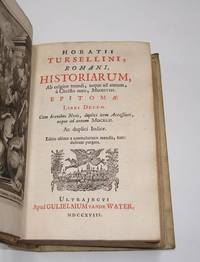
Horatii Tursellini Romani Historiarum ab origine mundi usque ad annum a Christo nato 1598. Epitomae libri decem. Cum brevibus notis duplici item accessione usque ad annum 1642 ac duplici indice. Editio ultima a quamplurimis mendis nunc demum purgata.
Utrecht Ultrajecti Apud Gulielmum vande Water 1718. 8vo. XVI56674 index p. frontispiece. Vellum 16.5 cm Ref: cf. Graesse 6/2216 Details: 5 thongs laced through the joints. Boards blind tooled. Frontispiece engraved by P. Sluyter probably depicting the Muse Clio a winged woman with a quill in her hand and a laurel wreath on her head; she is visited by several allegorical figures such as Father Time and a naked woman with a palm branch Victoria in her hand; in the background is Fama who blows her horn. Title printed in red and black. Woodcut printer's mark on the title depicting Fama hovering above a city the motto is: 'Pax artium altrix' Condition: Vellum somewhat soiled ans spotted. Small inkstain on the front board. All four ties gone Note: Not much is known about the Italian Jesuit scholar Orazio Torsellini or Orazio Torsellino latinized as Horatius Tursellinus 1545-1599. Tursellinus taught at several Jesuit Colleges in Italy and lectured for 20 year at the 'Collegium Romanum' in Rome. His most important works are De particulis latinae orationis a biography of the Jesuit missionary Franciscus Xaverius published in 1596 and a universal history Epitome Historiarum libri X which treated in 10 books the complete history from Adam till 1598 and which remained popular for centuries on schools and universities. For a long time it was used even at the protestant universities in the Dutch Republic. 100 or more editions and adaptations were produced until 1845. Right from the start it was a success and became a standard. The book was reissued in Italy in Rome Venice Milan and Perugia in France in Douai Lyon Paris Rouen Caen Toulouse and in Germany in Cologne München and Frankfurt generally cities where Jesuits had their colleges. The first edition in the Low Countries appeared in The Hague in 1678 and was edited by Johann Conrad Nuber who introduced this manual at the University of Leiden. In 1688 and in 1695 it was reissued in Franeker followed by editions produced by the Utrecht printer W. vande Water in 1710 1718 1730 and 1744. In 1708 a Dutch translation was published in Amsterdam. The manual was published for the last time in The Low Countries in 1786. The continuatio till 1624 incorporated in this edition of 1718 was produced by the French historian Henri de Sponde Henricus Spondanus and adopted from his Annales Baronii. See for Tursellinus: H.W.A.M. Sancisi Weerdenburg 'Lege veteres sperne recentiores : Tursellinus en het achttiende-eeuwse geschiedenisonderwijs' in Utrechtse Historische Cahiers Jaargang 17 1996 1: 'Studeren en promoveren in Utrecht' p. 22/35; and also 'Biographie Universelle ancienne et moderne' Paris 1826 vol. 46 p. 233/4. § This historical work is of course outdated but nowadays every classical scholar still knows Tursellinus which is to say that he/she knows and sometimes uses: 'Tursellinus seu de particulis Latinis commentarii' in the edition that was published by the German scholar Ferdinand Gotthelf Hand Leipzig 1829/45 and later reprinted by Hakkert in 1969. This work first published in Rome as De particulis latinae orationis and brought Tursellinus fame among classical scholars. It offered the student of eloquence the means to speak coherently by the correct use of those small particles and adverbs which glue his speech together. Tursellinus his highly praised by H.J. Sandys for his accurate scholarship Collation: pi1 8 minus leaf 8 = pi1 A-2R6 Photographs on request hardcover
书商的参考编号 : 120176
|
|
|
JUSTINUS
Justini Historiae Philippicae. Variantes lectiones adjecit P. Burmannus.
Leiden Lugduni Batavorum Apud Samuel. Luchtmans 1722. 12mo. Frontispiece XXIV44362 index1 blank p. Contemporary stiff wrappers. 14 cm Ref: Schweiger 2492; Fabricius/Ernesti 366; Graesse 3513; Ebert 11155 Details: Margins uncut. Engraved frontispiece depicting a half naked woman who blows a trumpet that she holds in her left hand; in her right hands she holds a string to which are attached 2 crowns and a laurel wreath; she stands on a globe amidst all kinds of spolia; right of her is a monument with celestial symbols stars and a radiant sun. Is she a combination of Fama Dea Roma Juno Caelestis On the title a woodcut printer's mark that shows a standing woman within an oval wreath; she hold in her right hand a hammer in her left a hook a little flame burns on her head at her feet is a crane that holds a stone in one of its claws. The motto is: 'Deo duce ingenio arte vigilantia laboreCondition: Paper on the back partly gone Note: This is an epitome made by one Justinus probably in the third century A.D. of the 'Historiae Philippicae' of the Augustan historian of Gaulish descent Pompeius Trogus who got his nomen because his grandfather was given Roman citizenship by the Roman military leader Pompeius Magnus after his campaign against Sertorius in Spain. Important parts of Trogus' 'Historiae Philippicae' which numbered 44 books only survive in this epitome of Justin who boiled it down it is estimated to 1/10th or 1/6th. Neue Pauly 10 p. 115 Trogus produced a universal history of the peoples outside Italy. He seems to have used no other sources than Greek historians and his story runs from Ninus king of Assyria to the absorbtion of the other nations into the Roman empire and the establishment of the 'Pax Augusta'. Books 7/12 describe the rise of Philip II and of Macedonia. Books 13/40 treat the Hellenistic kingdoms. 41/42 contain the history of Parthia 43 of Italy and 44 the history of Spain. Inserted are many historical and geographical excursus for example on the history of Armenia or the Jewish wars. The leading concept of Trogus' history was the so-called 'translatio imperii' which conceived history as a linear succession of empires under a singular ruler or emperor. The narrative is elaborate dramatic and moralizing. Trogus was according to Rose an very passable stylist who arranged his second hand material intelligently and showed 'some original views how to write history. . Even in this diminished condition the epitome the history is interesting reading often containing facts not to be met with elsewhere and one of our much too scanty sources for the history of the eastern Mediterranean and the adjacent countries'. H.J. Rose 'A Handbook of Latin literature' 'London 1967 p. 312/13 The epitome of Justin was widely read in the Middle Ages. § This Justinus edition was produced by the Dutch classical scholar Pieter Burman or Petrus Burmannus 1668-1741 from 1696 professor of Eloquence at Utrecht and from 1715 at Leyden. As an editor he confined himself to the Latin classics. He produced editions of the Roman poets Ovid Lucan Claudian and Valerius Flaccus. Of prose the writers he edited Petronius Velleius Paterculus Justin Quintilian and Suetonius'. J.E. Sandys 'A history of classical scholarship' N.Y.1974 vol. 2 p. 445 Burman was not an original scholar but more an industrious manufacturer of so-called 'Variorum' editions from 'cum notis Variorum' editions with a 'textus receptus' which was widely accepted accompanied by an overload of often ill-digested commentaries excerpts and annotations of various specialists and other leading scholars. This Justinus is an exception it is mean and lean; it offers a text borrowed from Graevius without commentary but with occasionally variant readings that were taken from earlier editions of Aldus Giunta Bongarsius Graevius Hearne et aliiCollation: 12 A-X12 Photographs on request unknown
书商的参考编号 : 120091
|
|
|
TERENTIUS
De zes comedien van P. Terentius. Verduitst door Henricus Zwaardekroon rector der Schole tot Rotterdam.
Rotterdam Gedrukt bij Johannes Naeranus 1668. 12mo. 4986 blank p. Vellum 12.5 cm Ref: Geerebaert 138116; OiN 362 Condition: Binding scuffed spotted and soiled. Frontispiece removed. Oval stamp on the title. Some worming in the blank upper margin occasionally nibbling at letters. Paper yellowing Note: The late antique grammarian Aelius Donatus 4th century A.D wrote not only a commentary on the plays of the Roman playwright Publius Terentius Afer ca. 190-159 B.C. but also a short biography in which he tells that Terentius was born in the Roman province Africa and that he came as a slave in the houshold of the senator Terentius Lucanus. He adopted his name when he was manumitted. Terentius is the author of 'fabulae palliatae' which means 'plays in Greek cloths'. He adapted Greek plays especially those of the Greek playwright Menander to the taste of the Romans. Six of his comedies have survived. For later generations he became a model for elegant Latin. His style was closer to everyday conversation than Plautus' an earlier contemporary comic playwright whose style was more extravagant. He was quoted by Cicero Horace Persius and the Church Fathers. Ever since antiquity he lived also a long and influential life in schools as a model for Latin language and rhetoric. In the Middle Ages he was read for his moral sentences. He was imitated by the German abbess Hrotsvitha of Gandersheim ca. 935 - ca. 973 in her 'Dramenbuch' with which she wanted to create a Christian alternative for the pagan comedies. With the coming of humanism Terentius enjoyed a renaissance in the classroom and on stage. Scholars rejected the 'barbaries' of Medieval Latin and chose the elegance of Cicero and Terentius as their model. In his 'De ratione studii' 1511 the Dutch humanist Desiderius Erasmus 1466-1536 encouraged the study of Terentius for his language and moral utility. 'Among Latin writers who is more valuable as a standard of language than Terence He is pure concise and closer to everyday speech and by the very nature of his subject matter is also congenial to youth'. The Classical Tradition 2010 p. 930 Erasmus published later in life in 1532 an edition of Terentius' plays. Erasmus seems to have learned the whole of Terentius by heart in his youth. He admired the author for his 'latinitas' and his civilized humor. His ideal as a humanist and pedagogue was the creation of better men with the help of the classics. He held the opinion that schoolboys should read Terentius over and over again. Thus they could master a pure Latin style and learn at the same time good morals. Several Dutch humanists wrote 'Dialogi pueriles' fictitious dialogues to train schoolboys to converse in Latin; conversations which much Terentius in it. § The first Dutch translation of Terentius appeared in 1555 in Antwerp. Almost one century later 2 other new translation followed. In 1646 the remonstrant reverent Henricus Oosterhaern published a prose translation in Rotterdam. His translation is as literal as possible. His aim in didactic. He hopes that his readers will polish their speech and style when reading Terentius that they will learn from Terentius a 'suyvere en cierlijke manier van spreken en schryven'. P.J.M. van Alphen Nederlandse Terentius-vertalingen in de 16e en 17e eeuw Tilburg 1954 p. 95 Two years later in 1648 Rotterdam saw the next and more elegant prose translation now by another remonstrant the schoolmaster Henricus Zwaerdecroon since 1634 Rector of the 'Schola Latina Erasmiana'. NNBW 5.1182/83 In the dedication in this edition to his 'alumnus' Adrianus de Matenesse Zwaerdecroon dwells on the diligence and enthousiasm he and other old schoolboys displayed while reading Terentius. On their request Zwaerdecroon tells us and because they are leaving for the university he made this translation. Sometimes we find in the Dutch translation words or passages printed in italics. Those words and passages have been added to improve the Dutch and to explain matters. The edifying comedies of Terence were not only read by schoolboys. The Dutch philosopher Spinoza must also have studied his Terentius very thoroughly. In his work hundreds of quotations and borrowings from Terence can be traced. Spinoza used them to define and illustrate human feelings weaknesses and passions. F. Akkerman Spinoza's tekort aan woorden Leiden 1977 p. 3 In the same year as this edition 1648 the Rotterdam printer Naeranus brought a translation only edition on the market. This translation was reissued again in 1668 this edition Provenance: Stamp on the title: 'Bibliotheek Missiehuis Tilburg Collation: A-X12 leaves X10 X11 & X12 blank. leaf A2 the frontispiece gone Photographs on request hardcover
书商的参考编号 : 120174
|
|
|
LAMPADIUS,J
Tractatus de Constitutione Imperii Romano-Germanici auctore Iacobo Lampadio I.C. Accessit eiusdem Discursus de Natura nummi & interpretatio L. 2. C. 'de usucap. pro Hered'. Item Iacobi Augusti Thuani Germaniae descriptio ex eius lib. 2 Histor.
Leiden Lugduni Batavorum Ex officina Ioannis Maire 1634. 24mo. 380 p. engraved title. Overlapping vellum 11 cm Ref: Breugelmans p. 364 1634:4 Details: 2 thongs laced through the joints. Short title in ink on the back. The engraved title depitcts the emperor of the Holy Roman Empire on his throne with his regalia. The lower part of the title is adorned by 7 coats of arms of German states Condition: Vellum age-tanned. Ink stain on the back. Small inscription on recto of front flyleaf. Upper margin of the title slightly stained and showing an old ownership entry. A small stamp on the lower margin of the recto side of the second leaf. Four new brown ribbons attached to the covers Note: The German diplomat and jurist Jacobus Lampadius Jakob Lampe 1593-1649 conducted a lively correspondence with Conring Althusius Grotius Georg Calixt et alii. His theory of constitutional law which contributed to the further development of the prevailing dualism in the Holy Roman Empire into a system of federate states in accordance with a shared sovereignty between the Emperor and the German lands has become with adaptions to the peace of Westphalia of 1648 which ended the thirty years' war in Germany made by Conring and later by Kulpis a widely read standard work on the constitutional relations in Germany during the second half of the 17th century. It was first published in 1621 as 'Dissertatio de jurisdictione in Imperio nostro Romano-Germanico'. H. Conring Conringius produced in 1630 an augmented and revised edition under the title of 'De constitutione reipublicae Romano-Germanicae'. The Leiden publisher Maire brought Conring's edition on the market as 'Tractatus de Constitutione Imperii Romano-Germanici'. NDB 13 454/56 Provenance: On the front flyleaf: 'C. desars 1654'. This name is repeated in smaller type on the title. On the verso of the title in faint ink: 'Ex libris Jacobs'. On the recto of leaf A2 a small stamp: 'Albert Conrot Luxembourg'. On the internet we found one Albert Conrot 'industriel à Luxembourg' corresponding member of the 'Institut Archéologique de Luxembourg'. He died in 1904 Collation: A-2A8 minus the blank leaves 2A7 & 2A8 Photographs on request hardcover
书商的参考编号 : 120098
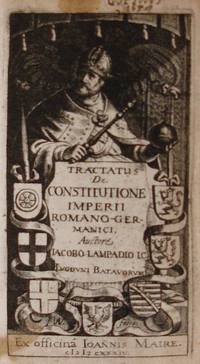
|
|
|
JUSTINUS
Iustini Historici Clarissimi In Trogi Pompeii historias libri quadragintaquatuor a Ioan. Sichardo summa diligentia recogniti & illustrati. Quibus adiecimus certo consilio Sex. Aurelium Victorem qui Caesarum vitas a D. Augusto ad Theodosium usque historia prosequutus est. Cum indice.
Basel Basileae Apud Andream Cratandrum 1526. Cum privilegio Caesareo. Colophon at the end: 'Basileae per Andream Cratandrum Mense Ianuario anno 1526' 8vo. VIII37141 index errata colophon p. 20th century overlapping vellum 14.5 cm Ref: VD16 T 2050; Schweiger 2487; Graesse 3512; Ebert 11134 Details: Printed completely in italic letters. Woodcut printer's mark on the last page it depicts an almost naked Fortuna with winged feet standing on a globe which is divided in four parts; in her right hand she hold a opened razor blade with her left hand she makes a gesture as if she wants to grab something; the back of her head is shaven bald and the long lock in front is blown to the right; Fortuna stand in an architectural alcove. There is no motto. This variant of Cratander's printer's mark is not mentioned by A. Wolkenhauer 'Zu schwer für Apoll die Antike in humanistischen Druckerzeichen des 16. Jahrhunderts' Wiesbaden 2002 Condition: Title dustsoiled and showing a thumbed right edge. Two small holes in the right lower corner of the title. Old ownership entry at the top of the title erased. Old name on the title. Paper somewhat yellowing. Occasional old ink notes and underlinings; right margin cut rather short Note: This is an epitome made by one Justinus probably in the third century A.D. of the 'Historiae Philippicae' of the Augustan historian of Gaulish descent Pompeius Trogus who got his nomen because his grandfather was given Roman citizenship by Pompeius after his campaign against Sertorius in Spain. Important parts of his 'Historiae' which numbered 44 books only survive in this epitome of Justin in which it was boiled down it is estimated to 1/10th or 1/6th. Neue Pauly 10 p. 115 Trogus produced a universal history of the peoples outside Italy. He seems to have used no other sources than Greek historians and his story runs from Ninus king of Assyria to the absorbtion of the other nations into the Roman empire and the establishment of the 'Pax Augusta'. Books 7/12 describe the rise of Philip II and of Macedon. Books 13/40 treat the Hellenistic kingdoms. 42/42 contain the history of Parthia 43 of Italy and 44 the history of Spain. Inserted are many historical and geographical excursus for example on the history of Armenia or the Jewish wars. The leading concept of Trogus' history was the so-called 'translatio imperii' which conceived history as a linear succession of empires under a singular ruler or emperor. The narrative is elaborate dramatic and moralizing. Trogus was according to Rose an very passable stylist who arranged his second hand material intelligently and showed 'some original views how to write history. . Even in this diminished condition the epitome the history is interesting reading often containing facts not to be met with elsewhere and one of our much too scanty sources for the history of the eastern Mediterranean and the adjacent countries'. H.J. Rose 'A Handbook of Latin literature' 'London 1967 p. 312/13 The epitome of Justin was widely read in the Middle Ages because it seemed to legitimize the 'translatio imperii' to the Pope but also the emergence of the Holy Roman Empire as legitimate continuation of the Roman Empire. See for 'translatio imperii' English Wikipedia After the Historiae Philippicae has been added the 'Vitae Caesarum' of the late antique Roman historian Aurelius Victor biographies of Roman emperors from Augustus to Constantius 360 A.D. It treats biographical material in a moralizing fashion and is based for the first emperors on Suetonius. § The German jurist Johannes Sichard 1499-1552 was from 1535 till his death professor of Roman Law at the University of Tübingen. This representative of humanistic jurisprudence published on the Codex Iustinianus but also some important legal texts of Germanic peoples especially the 'Breviary of Alaric' Breviarium Alaricianum 1528 laws of the Ripuarian Franks Alemanns and Bavarians 1530. He was also a legal counselor in lawsuits for the Dukes of Württemberg in their legal controversies with Ferdinand king of the Holy Roman empire. This Justinus seems to have been his only edition of a Roman author. ADB 34 143/46 It was reissued by Cratander in 1530 Provenance: On the front flyleaf in pencil: '13 Oc. 1962' written by the Flemish linguist Walter Couvreur 1914-1996 who was an Orientalist and professor of Indoeuropean linguistics at the University of Gent. It indicates the date of aquisition. The place of acquisition he wrote on the flyleaf at the end: 'Luik Halbart'. The ownership entries on the title are made illegible Collation: a4 b-z8 A-C8 D6 Photographs on request hardcover
书商的参考编号 : 120090
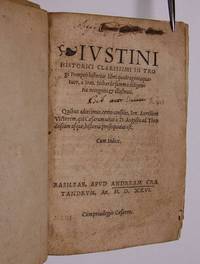
|
|
|
HEINSIUS,D
Laus asini. Tertia parte auctior cum aliis festivis opusculis.
Leiden Lugd. Batavorum Ex Officina Elzeviriana 1629. 24mo. XX4382 blank p. Overlapping vellum 11.5 cm Ref: STCN ppn 832854379; Willems 315; Berghman 1247; Rahir 286; Brunet 384; Graesse 3233 Details: 5 thongs laced through the joints. Engraved title depicting 2 learned gentlemen perhaps Ewaldus Schrevelius to whom the book is dedicated and Heinsius' friend Aldoph Vorstius who doff their hats for an ass Condition: Vellum soiled and scratched. Front board slightly damaged at the upper edge. All four ties gone. Front flyleaf removed. Right edge of the title thumbed very tiny and almost invisible hole in the title Note: The 'Laus asini ad Senatum Populumque eorum qui ignari omnium scientias hoc tempore contemnunt was published anonymously for the first time in 1623. An augmented edition appeared in 1629. The author is according to all critics the Dutch classical scholar and neolatin poet Daniel Heinsius 1580-1655. It pokes fun at people in an Erasmian spirit and seems to have lost none of its topicality. The aim is Heinsius tells in the 'ad lectorem' to vindicate men of letters and those who love to learn from the contempt of ignorant people who not only heartily ridicule liberrime. illudunt them but also culture eruditioni and the sciences. leaf 6 recto & verso This eulogy is a satire on ignorance and voluntary servitude. It is hard to fathom because of the complexity of its style and the overabundance of erudition or put more positively the veritable fireworks of learned allusions which often obscures matters. The first edition of 1623 which contained the 'Laus Asini' only is augmented in this second edition with 6 other pieces 1: an Menippean satire 'Cras credo hodie nihil' 2: 'Epistola qua agitur an & qualis viro literato sit ducenda uxor' 3: 'Laus pediculi ad Conscriptos Mendicorum Patres' 4: 'Epistola de poetarum ineptiis & saeculi vitio' 5: 'Argumentum Batrachomyomachiae' 6: 'Viro Nobilissimo Ioanni Milandro Domino de Poederoeye Principi a Secretis: de Graeculis quos illi commendaverat'. At the end Heinsius added a short letter to H. Grotius and a consolation poem for his friend Baudius on the occasion of the death of his wife Collation: 6 24 A-2N6 2O4 leaf 2O4 blank Photographs on request hardcover
书商的参考编号 : 120077
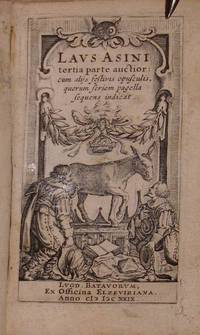
|
|
|
CICERO
M.T. Ciceronis De officiis ex recensione Heusingerorum. Cato major Laelius Paradoxa Somnium Scipionis ex recensione J.A. Ernesti.
Utrecht Trajecti ad Rhenum Apud B. Wild & J. Altheer 1794. 12mo. II288 p. Vellum 13.5 cm Ref: Schweiger 2205; cf. Dibdin 1415; cf. Moss 1309 Details: 2 thongs laced through the joints. Edges dyed red. Label with woodcut coat of arms of Rotterdam measuring 35 x 45 cm on the front pastedown. Latin text of Cicero only no preface notes translation or commentary Condition: Vellum a bit rubbed and soiled Note: This collection of philosophical works of the Roman politician and orator Marcus Tullius Cicero 106-43 BC the De Officiis Cato Major Laelius Paradoxa and the Somnium must have seen ever since it first appeared in 1469 hundreds of editions. Of these five texts the first one on the Offices was the most important and the most popular. The editio princeps of the Offices was published in 1465. The excellent Heusingerii-edition of the Offices dates from 1783 'without which no critical student can fully comprehend this treatise of Cicero. It may be called the joint production of Grandfather Father and Son Heusingeri. . I give this edition a ready and hearty recommendation to every classical collector'. Dibdin The German 'Schulmann' and local historian Johann Michael Heusinger 1690-1751 was rector of several Gymnasia in Laubach from 1730 in Gotha and from 1738 in Eisenach. His edition of Cicero of the Offices has 'noch jetzt ihre Brauchbarkeit nicht eingebüßt. Als guter Beobachter des Sprachgebrauchs hat er im Lateinischen mehrere Sprachgesetze ausgestellt die sich als richtig bewährt haben; als Kritiker war er besonnen so daß ihm manche sichere Verbesserung verderbter Stellen verdankt wird'. ADB 12 334/335 His son Jakob Friedrich Heusinger 1719-1778 was also a 'Gymnasialrektor'. Johann Michael collated for the text several manuscripts and consulted late antique sources his son consulted five more manuscripts from Wolfenbüttel and used ancient grammarians and earlier editions. 'Der erste beschäftigte sich vorzürglich mit der Erläuterungen Jakob Friedrich mehr mit der Critik'. Hoffmann However both men died before the edition was finished. The son of Jakob Friedrich Konrad Heusinger 1752-1820 finally edited the work of both his father and grandfather wrote an introduction produced an index and published it in 1783 in Braunschweig. Konrad was also a 'Schulmann' and classical scholar. He succeeded his father at the Gymnasium of Wolfenbüttel. ADB 12336/37 The four remaining texts of Cicero in this collection were adopted from the third edition 1774/77 of the Opera Omnia edition of the German classical philologist and theologian Johann August Ernesti 1707-1781. This collection on 1794 is a school text. It offers the Latin text of Cicero's treatises only no preface notes translation or commentary Provenance: The label with the woodcut coat of arms of Rotterdam is perhaps an indication that the book was a small gift of the City Council Collation: pi1 A-M12 Photographs on request hardcover
书商的参考编号 : 120010
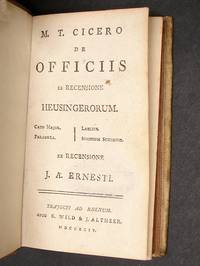
|
|
|
VERHAAL VAN DE OUDE KERKGEBRUIKEN,
of eene naaukeurige geschiedsbeschyving bevattende hunne geboorte en aanwas hoe zy ter Kerke ingeslopen en langs welke trappen zy tot de bygeloovigheit zyn overgegaan. Door en geacht voorstander der rechtzinnige Leere en Kerk.
Rotterdam Gedrukt by Arnold Willis 1725. 8vo. LVI170 p. Half calf 16 cm Anti-papist History of the Church Details: Back ruled gilt and with 4 raised bands. Woodcut ornament on the title. Edges dyed red. In Gothic script Condition: Binding scuffed especially at the extremes. Head of the spine chafed corners bumped Note: This anonymous anti-papist history of the church was first published in The Hague in 1629 as 'Traitté des cérémonies anciennes ou Histoire contenant leurs naissance & accroissement leurs entrée en l'église & par quels degrez elles ont passé iusques à la superstitition'. In it the author tries to find the origin of all abuse in the church in Medieval superstition invented by the enemies of the true faith. It was repeated in Amsterdam in 1646. In the dedication to a revised and augmented edition which was called a second edition seconde édition of 1662 the author at last reveals himself as Jonas Porrée. He dedicates that edition to Charles II since 1660 protestant king of England as 'défenseur de la foi' a defender who ironically on his deathbed in 1685 was received into the Catholic Church. In the dedication Porrée expresses also his admiration for the Anglian Church and its episcopal administration. This subversive anti-papist history was a tremendous success. It appeared reissued and revised in French in 1661 1662 1672 1673 1677 1678 1717 and 1772. It was also translated into English as 'Vitis degeneris or The degenerate plant being a treatise of antient ceremonies: containing an historical account of their rise and growth their first entrance into the Church and their gradual advancement to superstition therein' London 1668. It was reissued in 1669. A German translation was published in 1691 as 'Christianismi Degeneris Historia oder Historische Beschreibung der in der Alten Christlichen Kirchen geübten Ceremonien und Gottes-diensts: Wie weit dieselbigen vom heutigen Papstum unterscheiden gewesen'. A second edition appeared in 1692. The first Dutch translation dates from 1723 and seems extremely rare. In the Netherlands only the University Library of Leiden and of the Free University of Amsterdam hold a copy. In KVK Karlsruher Virtueller Katalog we found further only one copy in the University Library of Jena. This second edition of 1725 seems even more rare. We found only one copy available in the Library of the Free University and not one in KVK. This edition of 1725 was dedicated by the publisher Arnold Willis to his friend the reverend 'Theodorus vander Vis predikant te Niervaart gezegt De Klundert '. In the preface p. 2 recto Willis tells that the first edition of two years earlier was sold out quickly and that he therefore now brings on the market a second edition of the translation. It is even more attractive he says because it is corrected and augmented considerably. See for the French editions of 1646 and 1662 and the author Jonas Porrée: 'Bulletin - Société de l'histoire du protestantisme français' 7e année Paris 1858 p. 213-215 Collation: pi1 -38 44 minus leaf 44; A-K8 L4 M2 minus leaf M2 Photographs on request hardcover
书商的参考编号 : 120008

|
|
|
FLORUS
L. Annaei Flori Rerum Romanarum libri quatuor annotationibus in usum studiosae juventutis instar commentarii illustrati auctore Johanne Min-Ellio. Quibus accedunt exerptiones chronologicae ad Flori Historias accommodatae; additus denique L. Ampelius ex Bibliotheca Salmasii.
Rotterdam Roterodami Ex officina Arnoldi Leers 1680. 12mo. XXIV including frontispiece 405; 99 index2 blank p. Vellum 14 cm Favourite school-book in the 17th century Ref: Schweiger 361 Details: 5 thongs laced through the joints. Frontispiece depicting a victorious Dea Roma on a pedastal flanked by a statue of Romulus and of Caesar who symbolize the beginning and the end of this historical work. At their feet the famous twins and the she-wolf. Woodcut printer's mark on the title its motto reads: 'Labore et Vigilantia'. It depicts a woman Vigilantia holding an open book in her left hand and a oil lamp in her right. At her feet a crane. The element 'labor' is represented by a ploughing farmer in the background. Leers used 8 different versions of this mark Condition: Vellum age-toned. Big inkstain on the lower board; a small shower of tiny inkstains on the back; two old and small paper library lables on the back. Name on the front flyleaf. Frontispiece printed with a worn plate. The outer edge of the frontispiece is thumbed. The paper is slightly yellowing Note: This is the chief work of the Roman historian Lucius Annaeus Florus who lived at the beginning 2nd century AD. It is an abridgement of Roman history with special reference to the wars waged up to the age of Augustus. Florus 'shows a certain literary gift marred howeverby a strong tendency to rhetoric. His brevity often entails obscurity though he sometimes produces a felicitous epigram. . As an historian he is often inaccurate in both chronology and geography but the work as a whole achieves a limited success as a rapid sketch of Roman military history. It was a favourite school-book in the 17th century'. OCD 2nd ed. p. 442 Schweiger records a host of Florus editions among which 6 by the Dutch schoolmaster Johannes Min-Ellius ca. 1625-1670. He produced one of the many school-editions of Florus. It was first published in Rotterdam in 1670 was a success and was repeated there in 1680 and in 1698 in Copenhagen in 1700 in London in 1706 and in Leipzig in 1734. One seldom sees an edition of Min-Ellius in good condition. He was educated at the Erasmianum at Rotterdam and was until his death a Praeceptor at the same school. Minellius or Min-ellius produced several school editions of classical authors such as Vergil Florus Horace Terentius and Ovid with ample annotations in easy Latin. At the end of the 17th and in the 18th century his editions were widely used not only on Dutch grammar schools but also on German English and Danish schools. After that they were barred from the schools because they were too unscientific and offered too much help. They were esteemed to be 'pontes asinorum' Provenance: 'Samuel Joannes de Hoest 1817 6m. 9d.' = 9 June 1817. Ds. Samuel Johannes de Hoest was a minister of the Dutch Protestant church in several small Dutch towns. He was born in Amsterdam in 1804. His father was there a pharmacist. Young Samuel visited the Athenaeum Illustre in his hometown. Thereafter he studied theology in Utrecht. He left quite a number of praeches. He died in Nijkerk in 1877 where he preached from 1831. NNBW 8782/84 more in J.P. de Bie & J. Loosjes 'Biographisch woordenboek van protestantsche godgeleerden in Nederland. Deel 4' The Hague 1931 p./ 92/93 So Samuel Joannes got this schoolbook a week before his 13th birthday perhaps at the beginning or the end of his first year at the Athenaeum and most likely from his parents. He certainly didnot receive it at the Athenaeum where this kind of easy Latin books for dummies were banned Collation: 12 A-X12Photographs on request hardcover
书商的参考编号 : 120015
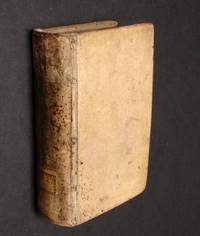
|
|
|
SANNAZARIUS
Actii Sinceri Sannazarii Neapolitani viri patricii Opera latina omnia & integra. Accedunt notae ad Eclogas Elegias & Epigrammata. Bound with: Trium fratrum Amaltheorum Hieronymi Io. Baptistae Cornelii Carmina. Editio secunda plurimis in locis castigata.
Amsterdam Amstelaedami Apud Henricum Wetstenium 1689. 12mo. 2 volumes in 1: XXIV2382 blank; XII132 p. Vellum. 15 cm Ref: STCN ppn 842282777; Brunet 5127; Graesse 6/1265; Ebert 20262 Details: 5 thongs laced through the joints. 2 titles printed in red and black each with the same woodcut printer's mark on it depicting a celestial sphere. After the preliminary pages of the first volume come Sannazaro's Latin poems p. 1/158 followed by explanatory notes p. 159/238. The second volume contains the Latin poetry of the Amalthei brothers Condition: Vellum age-toned back soiled. Bookplate pasted on the front pastedown. Old ink inscription in English on the verso of the flyleaf at the end Note: We learn from the 'Praefatio' of the 'Opera omnia' edition of Sannazarius Amsterdam 1728 that the editor and commentator of this edition of 1689 is the Dutch scholar Janus Broukhusius. Already on the first page of that 'Praefatio' of the Sannazarius of 1728 which was edited by the Dutch minor poet Pieter Vlaming 1686-1733 the editor tells the reader that he used for his edition the previous edition of Broukhusius published by Wetstein. 'editionem Wetstenianam secutus .' etc. Praefatio 1728 p. 6 recto In addition we read on the title page of 1728: 'ex secundis curis J. Broukhusii'. This proves that the edition of 1689 was published by Janus Broukhusius Joan van Broekhuizen in Dutch 1649-1707. § This scholar/soldier pursued during an adventurous life his classical studies and poetry at leisure. As a neolatin poet he is known as the 'Propertius of Holland'. Sandys 2329 In 1684 he published his 'Carmina' a collection of his Neolatin poetry. His editions of Propertius 1702 and Tibullus 1707 laid the foundation for his reputation as a classical scholar. He was admired as a latinist for his taste and for his erudition. NNBW 4309/12 § The Italian and Neo-latin poet Jacopo Sannazaro 1458 -1530 in Latin Jacobus Sannazarius also known as Actius Sincerus was of noble birth and a courtier at the court of the royal House of Aragon kings of Naples. Here he found a humanist atmosphere favourable for the development of his talents. The humanist Giovanni Gioviano Pontano 1426-1503 advisor and chancellor of the Aragonese dynasty became his intellectual mentor. He took his young student in his Academy the 'Accademia Pontaniana' under the name of 'Actius Sincerus'. There he deeply influenced his pupil's philological approach to antiquity and his knowledge of classical culture. After Pontanus' death Sannazarius became the head of this Academy. Sannazarius' masterwork 'Arcadia' written in Italian exercised a great influence on European poetry instituting the theme of the idyllic land Arcadia. He devoted the last decades of his literary activity exclusively to Neo-Latin poetry modelled on Vergil. In the normative 'Tati Renaissance Library' Sannazarius is advertised as 'the finest Neo-Latin poet of the Italian Renaissance'. His 'corpus' of Latin poetry written in an elegant style was small but nevertheless very influential and widely read. We counted in KVK ca. 30 editions of his 'Opera Omnia' printed before 1689 the first of which was published by Aldus in 1535. His 'De partu Virginis' an epic of ca. 1450 verses published in 1526 brought him the title of the 'Christian Vergil'. His style is said to be equal to Vergil with whom he emulated. In his other works he also emulated with Ovid and Horace. § In the first volume of this edition of 1689 we find Sannazaro's poetry; the collection opens with: 'De partu Virginis libri tres' a poem which Erasmus is said to have liked though he found this poem on the birth of Christ too secular. Follows a short 'Lamentatio de Christi morte' then 5 'Eclogae' which renewed the bucolic genre the traditional shepherds of Virgil being replaced here by fishermen. Follow Sannazarius' 'Elegiarum libri tres' and 3 books of 'Epigrammata'. § The second volume contains the 'Carmina' of the brothers Hieronymus Jo. Baptista and Cornelius Amaltheus Jeronimo born 1507 Giambatista born 1525 and Cornelio Amaltheo edited by the Dutch latinist Johannes Georgius Graevius who was a friend of Broukhusius the editor of the first volume. All 3 brothers were skilled and highly appreciated neo-latin poets. Hieronymus whose style was of singular elegance and purity so excelled in Latin poetry that he is placed by the French humanist Muretus 1526-1585 among the most talented poets. Giambatista's Latin poems gave him a reputation equal to his brother. Cornelius left only a few Latin poems he died young. They show that he shared the talents of his brothers. The poems of the brothers were first collected and published by Hieronymus Alexander at Venice in 1627. Graevius here offers a revised 'editio secunda' Provenance: The armorial bookplate on the pastedown is of 'Henry A. Bright' its motto is 'Post tenebras lucem'. The family pedigree of the English merchant and author Henry Arthur Bright 1830-1884 'goes back to Nathaniel Bright of Worcester 1493-1564 whose grandson Henry Bright was canon of Worcester and purchased the manor of Brockbury in the parish of Colwall Herefordshire which still remained in the family'. He was educated at Rugby School and at Trinity College Cambridge. In Liverpool he was the centre of literary interests and literary friendships. He was a member of the Roxburghe Club and of the Philobiblon Society as well as of the local historical and literary societies. Source Wikipedia 'Henry Arthur Bright' The family had a substantial library put together over generations Collation: 12 A-K12leaf K12 blank; 26 2A-E12 2F6 Photographs on request hardcover
书商的参考编号 : 154826
|
|
|
SANNAZARIUS
Actii Sinceri Sannazarii Patricii Neapolitani Opera omnia latine scripta ex secundis curis J. Broukhusii. Accedunt Gabrielis Altilii Danielis Cereti & fratrum Amaltheorum carmina; vitae Sannazarianae & notae Petri Vlamingii.
Amsterdam Amstelaedami Apud viduam Gerardi onder den Linden 1728. 8vo. IIXVIII errata63220 index & errata p. frontispiece 1 engraved plate 1 text engraving. Green vellum. 20 cm Ref: STCN ppn 189042265; Brunet 5127: 'Bonne édition'; Graesse 6/1265; Ebert 20263 Details: This book has 2 different title pages. This anomaly tell us about a publisher's death and the efforts of his widow to continue the firm. The very first title bound before the frontispiece is printed in black has no printer's mark and shows the impressum: 'Amstelaedami Apud Gerardum Onder de Linden 1727'. The second title bound after the frontispiece is printed in red and black has a printer's mark but is now dated 1728 and published 'apud Viduam Gerardi Onder de Linden'. Gerard Onder de Linden died in 1727 leaving Vlaming's Opera edition of Sannazarius unfinished. In the 'Boekzaal der geleerde waerelt' volume 25 of december 1727 the public was informed that the widow who hoped to continue the business with the help of God was planning to publish the Sannazarius' edition soon. 'De Weduwe Gerard Onder de Linden die in afwagtinge van Godts hulp met hare winkel enz. in alles zal continueren zal in 't kort uitgeven 'Actii Sinceri Sannazarii . Opera' We couldnot find in the STCN and KVK any copy of Vlaming's edition dated 1727. The title page of 1727 was apparantly removed in most copies. In the mean time the widow had apparantly decided to print a more posh red-and-black title adorned with a printer's mark. She added also a nice frontispiece with her name on it designed and executed by 2 wellknown Dutch artists. She did so in cooperation with the Amsterdam printer Hermannus Uytwerf who brought copies on the market with his own imprint. The rest is identical. § Vellum dyed green. Back with 5 raised bands and a red morocco shield in the second compartment. Edges dyed red. The frontispiece designed by J. Goeree and executed by J. Houbraken depicts a bare-breasted Fama holding in her right hand her trumpet and a shield with the portrait of Sannazarius; on the shield his name: Actius Sincerus Sannazarius; under the left arm of Fame rests a scroll with the table of contents. § Printer's mark on the title depicting Fama flying above symbols of wisdom and blowing her trumpet. The motto is derived from Martial X212 and reads: 'Non norunt haec monumenta mori' 'These monuments donot know how to die'. § Text engraving on page 491 at the beginning of a biography of Sannazarius by Joannes Antonius Vulpius; depicted are both sides of a bronze medallion on the recto the portrait of Sannazarius and on the verso a scene with the birth of Christ referring to Sannazarius' 'De partu Virginis'. At p. 526 has been inserted a full page engraving of the 'Sannazaro Monument' in the church 'Santa Maria de Parto' a church built on the initiative of Sannazarius on a piece of land donated by king Frederick Frederigo of Aragon. The mausoleum erected in 1537 is a highlight of Napolitan Renaissance art. It was probably made after a design by Sannazarius himself Condition: Binding scuffed and worn at the extremes. Head and tail of the spine chafed. Corners bumped & slightly creased. Both joints splitting but strong. An old ink insciption on the 1728 title has been wiped out resulting in some stains. Paper yellowing Note: The Italian and Neo-latin poet Jacopo Sannazaro 1458 -1530 in Latin Jacobus Sannazarius also known as Actius Sincerus was of noble birth and a courtier at the court of the royal House of Aragon kings of Naples. Here he found a humanist atmosphere favourable for the development of his talents. The humanist Giovanni Gioviano Pontano 1426-1503 advisor and chancellor of the Aragonese dynasty became his intellectual mentor. He took his young student in his Academy the 'Accademia Pontaniana' under the name of 'Actius Sincerus'. There he deeply influenced his pupil's philological approach to antiquity and his knowledge of classical culture. After Pontanus' death Sannazarius became the head of this Academy. Sannazarius' masterwork 'Arcadia' written in Italian exercised a great influence on European poetry instituting the theme of the idyllic land Arcadia. After having written the 'Arcadia' in vernacular Sannazarius devoted the last decades of his literary activity exclusively to Neo-Latin poetry modelled on Vergil. In the normative 'Tati Renaissance Library' Sannazarius is advertised as 'the finest Neo-Latin poet of the Italian Renaissance'. His 'corpus' of Latin poetry written in an elegant style was small but nevertheless very influential and widely read. We counted in KVK ca. 30 editions of his 'Opera Omnia' printed before 1730 the first of which was published by Aldus in 1535. His 'De partu Virginis' an epic of ca. 1450 verses published in 1526 brought him the title of the 'Christian Vergil'. His style is said to be equal to Vergil with whom he emulated. In his other works he also emulated with Ovid and Horace. § In this edition of 1728 we find in the first half Sannazaro's poetry; the collection opens with: 'De partu Virginis' a poem which Erasmus is said to have liked though he found this poem on the birth of Christ too secular. Follows a short 'De morte Christi Domini ad mortales lamentatio' then 6 'Eclogae' which renewed the bucolic genre the traditional shepherds of Virgil being replaced here by fishermen. Follow 3 books of Sannazarius' 'Elegiae' and 3 books of 'Epigrammata'. The section on Sannazaro ends with a number of 'Carmina de Sannazario et ad Sannazarium'. The second half of the book contains the short 'Epithalamium' of Gabriel Altilius called 'Sannazarii sodalis' and the even shorter 'Salix' of Daniel Ceretus. The greater part of the second half is filled with the 'Carmina' of the brothers Hieronymus Jo. Baptista and Cornelius Amaltheus Jeronimo born 1507 Giambatista born 1525 and Cornelio Amaltheo together 175 pages edited previously in 1689 by J. Graevius under the title 'Trium fratrum Amaltheorum Carmina'. Graevius' preface is also repeated here. All 3 brothers were skilled and highly appreciated neo-latin poets. Hieronymus so excelled in Latin poetry that he is placed by the French humanist Muretus 1526-1585 among the most talented poets. Giambatista's Latin poems gave him a reputation equal to his brother. After this section follows a biography of Sannazarius written by the Italian classical scholar Giovanni Antonio Volpi 1686-1766 in Latin Johannes Antonius Vulpius. After the biography we find on 54 pages a collection of select 'testimonia' concerning Sannazarius. The book concludes with 50 pages filled with the notes of the Dutch scholar Pieter Vlaming 1686-1733. Vlaming a minor poet had a life long interest in Sannazarius. In 1710 he began with his translation into Dutch of the 'Arcadia' and he later produced the notes in Latin to the present edition of the Latin poems of Sannazaro edited by the Dutch scholar Janus Broukhusius. In the introduction to this 1728 edition written by Vlaming he tells about his interest in Sannazarius: 'ab ineunte aetate imo pene puer unice semper sum admiratus maturiore hac mea veneror suspicio & colo'. p. 6 recto § Vlaming's edition still has great value for the Dutch researcher Corine Flinterman proves in her master paper 'In vergetelheid geraakte epigrammen van Iacopo Sannazaro' Amsterdam 2013 that the latest edition of Sannazaro's Latin works 'Jacopo Sannazaro. Latin Poetry' by Michael C.J. Putnam Cambridge Massachusetts 2009 The I Tatti Renaissance Library 38 suffers from many omissions and mistakes. A sad thing because Putnam's work is considered an authorative point of reference for experts in Renaissance studies. Putnam based his sloppy edition Flinterman reveals on some incomplete 18th century italian editions which lacked 13 anti-papal epigrams. § This title of 1728 seems to be rare for in American Exchange we found only 2 copies both auctioned by Sothebys in 1952 and in 1959 Collation: pi1 title 1727 2pi2 8 minus the leaves 1 & 2 chi1 errata A-2S8 minus the blank leaves 2S7 and 2S8; plate bound after p. 526 The STCN copy doesnot have the 1727 title nor the errata leaf at the end of the preliminaries. This errata leaf is almost identical to the errata leaf at the end Photographs on request hardcover
书商的参考编号 : 154825
|
|
|
Figuren 1 / Figuren I
Veb Staatliche Porzellan - Manufaktur Meissen 1963. Hardcover. Very Good/No Jacket as published. 12" x 8.5. A detailed account of the porcelain figures manufactured by the Meissen company during the 18th century. The format is one page of colour photographs of the figurines and one page of description with description artist date and height information in German English French Italian Spanish and Russian. A good quality book in clean and sound condition. No dust jacket not sure if it ever had one. All orders processed and shipped promptly from the UK. Please email with your questions. Please do not select economy shipping at checkout if your destination is outside the UK. <br/> <br/> Veb Staatliche Porzellan - Manufaktur Meissen hardcover
书商的参考编号 : 020312

|
|
|
DAMM,ChT h T
Inleiding in de fabelkunde der oude Grieken en Romeinen door Christiaan Tobias Damm rector van het Koninglyk Gymnasium te Berlin. Naar den vyfden druk uit het Hoogduitsch vertaald.
Leiden Leyden By W.H. Gryp 1786. 8vo. IIVIII348XX p. Half calf 16 cm Details: Back ruled gilt. Marbled endpapers Condition: Binding scuffed back rubbed corners bumped. Stamp on front flyleaf 3 stamps on the title Note: Christian Tobias Damm 1699-1778 'Rector am köllnischen Gymnasium zu Berlin' 'im grauen Kloster' in the 'Klosterstrasse' was a solid classicist and one of the first German scholars who stressed the excellence of Greek literature and its language compared to Roman literature and language. He also stressed the necessity of imitating the Greek examples for the improvement of national education. He wanted to make the masterpieces of Greek poetry accessable for a general public with litteral and trusty translations. He produced a Lexicon Pindaricum and Novem lexicon Graecum etymologicum et reale cui pro basi substratae sunt concordantiae et elucidationes homericae et Pindaricae. Berlin 1765 He also made a much criticized translation of Homer. One critic accused him of having murdered Homer. He had more success with his manual of Greek and Roman mythology: 'Einleitung in die Götterlehre und Fabelgeschichte der ältesten griechischen und römischen Welt'. Berlin 1763 Allgemeine Deutsche Biographie 4 1876 p. 718 This manual remained in use in Germany well into the 19th century and was translated into Dutch and Norwegian. The manual was reissued several times in Holland. The Dutch publisher of this 1786 edition misunderstood 'Köllnisches Gymnasium' and had 'Koninglyk' Royal printed on the title page Collation: pi1 4 A-Z8 2A2 Photographs on request unknown
书商的参考编号 : 120231
|
|
|
TACITUS
C. Cornelius Tacitus accurante Matthia Berneggero.
Strassburg Argentorati Ediderunt Haeredes Lazari Zezneri 1638. 8vo. XVIII11231 blank p. Vellum 17.5 cm Ref: VD17 23:249104Z; Schweiger 21002; Dibdin 2452; Moss 2643; Graesse 6/2 9; Fabricius/ Ernesti 2398 Details: Fine contemporary vellum. 6 thongs laced through the joints. Engraved title depicting an altar left of which stands a Roman emperor right a German warrior; on the surface of the altar the text 'Aeternitati' for Eternity; just above the altar hangs the globe upon which stands an eagle with spread wings. This scene seems a combination of two Roman coins. It was perhaps made after the verso side of a coin struck by Constantine the Great in Trier in 321 A.D.; on this coin there is however no eagle; a scene consisting of a globe on which an eagle stands is to be seen on a denarius of Caracalla struck after 217 A.D.; this old eagle-and-globe symbol adorns since 1883 the escutcheon of the United States Marine Corps. This frontispiece is purely propagandistic in its presentation. It depicts not so much the struggle between the Romans and the German tribes that Tacitus tells about. It rather symbolizes the claim of the Holy Roman Empire Sacrum Romanum Imperium Heiliges Römisches Reich that it was the legitimate successor 'for eternity' of the Roman Empire. The imperial banner of the Holy Roman Empire depicted a black eagle Condition: A bookplate has been pasted on the front pastedown. A small piece of the blank margin of preliminary leaf a8 has been torn off without loss of text and was not successfully repaired. The lower margin of some gatherings is faintly waterstained Note: The Roman historian Publius Cornelius Tacitus offered ammunition for many intellectual and political battles in 16th and 17th century Europe. The turmoil caused by the emerging new monarchies in England France en Spain civil and religious wars in Italy and Germany and the plague made Tacitus' account of the state of the early Roman Empire increasingly topical and relevant. The debate Tacitus provoked in intellectual circles was of course on Roman history but also on literary style in Latin and the vernacular but more so on historical and political thought. Tacitus ideas were not original but he brought them in a forceful lapidary way oneliners ready for the use in debate. Tacitus became in a corrupted world 'the one true guide for those involved in the awful revolution of modern times: he "teaches well the mode of life under tyrants just as he teaches tyrants how to establish tyranny'' '. The Classical Tradition Cambr. Mass. 2010 p. 921 The French humanist scholar Muretus Marc Antoine Muret 1526-1585 declared that 'Tacitus' descriptions of lost liberty failed revolutions vicious civil wars and mad emperors amounted to a theater of our time'. Op. cit. ibid. § The editor of this Tacitus edition the German classical scholar Matthias Bernegger 1582-1640 was the founder of the School of Roman history at Strassburg where a protestant university was founded in 1621. The model of this school was the Flemish editor of Tacitus Justus Lipsius 1547-1606 who was one of the most learned men of his day. His great Tacitus editions placed and still places him in the front rank of classical scholarship. This Tacitus edition of Bernegger includes 'many excellent notes and emendations due to his pupil and son-in-law Johannes Casper Freinsheim 1608-1660 the foremost representative of this school'. SandysJ.E. 'A History of Classical Scholarship' N.Y. 1964 p. 367 The edition offers also a 144 page treatise 'Ioannis Freinshemii expositio locorum cornelianorum intactorum interpretibus aut secus acceptorum' and an elaborate and exemplary 272 page 'Index in Tacitum confectus industria et labore Melchiore Freinshemii'. § Lipsius praised Tacitus as a teacher of vital political lessons. In his Politica Politicorum sive Civilis doctrinae libri sex 1589 'a brilliant textbook in mosaic form composed of passages from the ancients far more of them taken from Tacitus than from any other source- Lipsius showed how to make a version of Tacitus' analysis of empire fit the practical needs of the modern governing classes'. The Classical Tradition Cambr. Mass. 2010 p. 921 Bernegger professor of History from 1613 till his death in 1640 produced a revised and augmented edition of Lipsius' Politica which was published posthumously in Strassburg in 1642. It saw several reissues in that city and in Frankfurt. Bernegger was from his appointment in Strassburg in 1613 the starting point of the so-called Lipsian tradition an historic-political school of thought in late humanist philology which exercised well into the 18th century influence on the German protestant universities of Jena Altorf Marburg and Strassburg 'Justus Lipsius Politica: Six Books of Politics Or Political Instruction' Edited with translation and introduction by J. Waszink Assen 2004 p. 194/95 Bernegger lectured on Lipsius' Politica and like Lipsius he considered Tacitus' view on politics the best guiding principle leading to 'prudentia' in the turmoil of his time Provenance: On the front pastedown a bookplate: 'Ex libris Bibliothecarii Paul Scherrer - Bylund' with the text: 'Vita fluit pilumque ferit rapidum tamen astra lucent in tenebris clarius atque manent' and also its translation: 'Unser Leben verrint und Pfeile verwunden doch immer leuchten je dunkler es wird heller die Sterne für uns'. The Swiss librarian and author Paul Scherrer-Bylund 1908-1992 was 'Direktor der Zentralbibliothek Zürich Universitätsbibliothek und . Direktor der Bibliothek der Eidgenössischen Technischen Hochschule ETH Zürich. Schrieb u.a.: "Von der Macht und der Sendung des Buchdrucks" 1961 "Die Stellung des Bibliothekars in der modernen Gesellschaft" 1967 "Gottfried Keller - Wildling des Glaubens" 1969. source: the German version of Who's Who Collation: a8 b2 minus b2; A-4A8 4B2 Photographs on request hardcover
书商的参考编号 : 120187
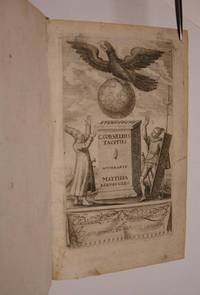
|
|
|
ERASMUS
Desiderii Erasmi Roterodami Liber utilissimus de conscribendis epistolis continens artificium & praecepta in earum compositione observanda. Editio nova diligenter ab erratis expurgata.
Amsterdam Apud Henricum & Theodorum Boom 1670. 12mo. 470331 blank p. frontispiece. Calf 13 cm The definitive work on the subject Ref: Spoelder p. 644: Middelburg 5; Details: Prize copy but without the prize. Back ruled gilt with a red morocco letterpiece. The boards have gilt borders. In the center of both boards the gilt coat of arms of Middelburg. The frontispiece depicts Erasmus in his study writing a letter. On the title a woodcut printer's mark depicting Hercules club at hand and the Nemean lion under a tree the motto reads: 'Virtus nescia vinci' 'Virtue doesnot know defeat' Condition: Some wear to the extremes. Front flyleaf removed. The blank upper margin of the frontispiece slightly cut short Note: The genesis of the treatise 'De conscribendis epistolis' of the Dutch humanist and scholar Desiderius Eramus 1566/69-1536 is rather complicated. The genuine edition authorized by Erasmus was first published in Basel by Froben in 1522. In the short preface to this work repeated also in this edition of 1670 Erasmus explains that he feels obliged to publish this work because a kind of pirate edition had been published in England recently i.e. 'Libellus de conscribendis epistolis' published in 1521 by John Siberch in Cambridge without his knowledge and consent. It was pirated from a copy of an old manuscript work of him on the art of writing letters which he wrote he continues about 30 years ago annis abhinc ferme triginta ca. 1492 in Paris at the request of a friend. Erasmus is very unhappy with this English edition because it is 'non solum rude sed & truncum et mutilum'. And now he offers the reader a completely revised and expanded treatment. The emphasis in the treatment remains clearly pedagogical. Erasmus gives an elaborate lesson on the presentation of the subject matter illustrating how the teacher should give an outline of the subject to be treated define it in some detail provide material from the classical authors and his own work Collation: A-X12 leaf X12 verso blank Photographs on request hardcover
书商的参考编号 : 120238
|
|
|
PLUTARCHUS
Plutarchi Cheronaei Philosophi et Historici Vitae comparatae illustrium virorum graecorum & romanorum ita digestae ut temporum ordo seriesque constet. Hermanno Cruserio I.C. interprete. Cum indice verborum & rerum locupletissimo & fidelissimo. Tomus Secundus.
Lyon Lugduni Apud Antonium Gryphium 1566. 16mo. 87660 index p. 18th century red morocco. 12 cm Volume 2 of 3 only Ref: Hoffmann 3198; Brunet 4737; Graesse 5361 Details: Back gilt with floral motives boards with gilt wavelike borders. Marbled endpapers. Woodcut printer's mark on the title depicting a griffin which mythological animal symbolizes courage diligence watchfulness and rapidity of execution used as a pun of the family name Gryph or Greif of German origin. The motto is 'Virtute duce / comite fortuna' 'Virtue thy leader fortune thy comrade' a quote from a letter of Cicero to Plancus. Ep. ad Familiares liber X3 This second volume contains the Lives of Aristides/Cato Maior Agis & Cleomenes/Tiber. & C. Gracchi Pyrrhus/Marius Lysander/Sulla Eumenes/Sertorius Cimon/Lucullus Nicias/Crassus Agesilaus/Pompeius Phocion/Cato Minor Condition: Binding scuffed especially at the extremities. Corners bumped. Superficial damage to both boards. The turn-in of the upper board partly and of the lower board almost completely gone. Edges partly faintly stained. Faint name on the title. The words 'Tomus Secundus' have been erased resulting in a small hole in the title Note: The Greek philosophic stylist Plutarchus of Chaeroneia ca. 46-120 A.D. wrote numerous short treatises on ethics and philosophy. He is however best known as historian and biographer. Plutarch composed with his famous 'Vitae' or Parallel Lives written ca. 100-120 A.D. a work of timeless quality. His aim was not writing history but biography so his chief interest was in the characters of the heroes and villains he portrayed never avoiding a good story. Plutarch exercised a very profound influence on Western civilisation. His 'Vitae' has been one of the most frequently and continuously read books of the Werstern tradition. The Classical Tradition Cambr. Mass. 2010 p. 747. Treacherous to the historian Plutarch has won however since the Renaissance the affection of the many generations to whom he has been a main source of understanding of the ancient world that is early modern Europe discovered the ancient world through Plutarch's eyes. The Lives could gain an enormous impact by providing later biographers and literary authors an outstanding model. It is very well known for example that authors like Montaigne Corneille Racine Rousseau Schiller and Shakespeare heavily drew upon the Lives. Until the 19th century the Lives were invoked as models of totalitarism anticlericalism by supporters and opponents. 'The founders of American democracy were avid readers of Plutarch as well and some laced their prose with evidence of that fact. Franklin and Hamilton in particular proclaimed their admiration for the Lives' The Classical Tradition Cambr. Mass. 2010 p. 749 § This Latin translation of 1566 was made by the Dutch humanist Herman Cruyser or Crüser in Latin Cruserius born in 1510 in the Dutch city of Kampen. He was a jurist and diplomat for the duchess of Guelderland and for the duchess of Cleve Jülich & Berg. In his sparetime he translated some treatises of Galenus and the 'Vitae' of Plutarch. His translation of the 'Vitae' was first published in Basel in 1564 in folio. On the title of that edition he is described as 'Ducis Clivensis & Iuliaensis consilarius interpres elegantissimus ac fidelissimus'. Our edition of Gryphius of 1566 in smaller format and cheaper is a reissue of that expensive folio edition of 1564. Hoffmann writes that the translation of Cruyser first appeared in 1561 but it seems that no one has ever seen a copy of that edition. Cruyser died in 1575. 'Als Wilhelms Wilhelm duke of Cleve and Jülich älteste Tochter Maria Eleonore 1573 den geisteskranken Herzog Albrecht Friedrich von Preußen heiratete begleitete Crüser sie als Gesandter und persönlicher Ratgeber und blieb bis zu seinem Tode bei ihr in Königsberg'. NDB 3 1957 p. 430 Provenance: On the title the name of 'François Lamb' Collation: Aa8 B-3M8 3N4 Photographs on request hardcover
书商的参考编号 : 120298
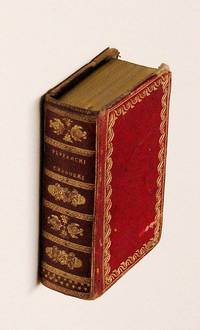
|
|
|
CICERO
M. Tullii Ciceronis Epistolae ad Atticum aliosque; ad optimas editiones collatae.
Amsterdam Amstelaedami Apud Joannem Blaeu 1657. 12mo. XII740 p. Calf 14 cm Ref: STCN ppn 093089015; not in Brunet Graesse Moss Ebert or Schweiger but cf. Schweiger 2106 Details: Back gilt and with 5 raised bands. Woodcut printer's mark on the title depicting a sphere with the signs of the zodiac; the sphere is flanked by Tempus who holds a scythe and has a winged hour glass on his head and Hercules leaning on his club; the motto is: 'Indefessus agendo' Condition: Binding scuffed. Leather chafed at the head & tail of the spine. Corners bumped. Both joints cracking but firm. A small stain on the title. Bookplate on the front pastedown Note: This title is a reissue of volume VI of the 10 volume 'M. Tullii Ciceronis Opera' published by Bonaventura and Abraham Elzevier at Leiden in 1642. It contains: 'Epistolarum ad Pompon. Atticum libri XVI'; 'T. Pomponii Attici vita'; 'Epistolarum ad Brutum liber'; 'Epistolarum ad Quintum fratrem libri III'; 'Ad Octaviam Epistola una' and is preceded by a 8 page introduction of Paulus Manutius. The Elzevier edition was held in considerable esteem and was much sought after. Johannes Blaeu took advantage of this success and reissued the volume with Cicero's letters to Atticus his brother Quintus to Brutus and the 'ad Octavium epistola' together with 'T. Pomponii Attici vita' by Cornelius Nepos separately. Even the title is apart from his own printer's mark is an imitation of that of the Elzevier brothers. The Elzevier edition was based on the Cicero edition of Janus Gruter Hamburg 1618. In 1659 Blaeu published a complete 10 volume reissue of the Elzevier edition of 1642 Provenance: On the front pastedown has been pasted an engraved coat of arms without a name it shows an oval shield with a helmet on top. The shield is divided in 4 quarters in the first and fourth quarter a tree in second and third quarter three geese swans or ducks. On the front flyleaf the name: 'L.' or 'S. Gounelle' Collation: 6 A-2H12 leaves 2H11 & 2H12 blank Photographs on request hardcover
书商的参考编号 : 120222
|
|
|
HOMERUS
Homeri poetae clariss. Ilias. Interprete Lauren. Valla.
N.pl. Cologne Eucharius Cervicornus excudebat 1527. 4951 woodcut32 index p. 20th century calf 16 cm Ref: VD16 H 4663; Hoffmann 2334; Not in Brunet Graesse Ebert & Moss Details: Latin translation only. Very tasteful new binding in antique 16th century style with 4 raised bands on the back and a red shield in the second compartment. Title with woodcut borders depicting in the lower part the adoration of Christ by the three Magi; the text of the title is flanked by 2 pillars; on the upper part two winged putti that flank a coat of arms; on the shield of it a kind of thornbush thorns - antlers; above the shield are the three crowns of the arms of the city Cologne. The woodcut at the end of the Ilias depicts Saint George killing the dragon Condition: The title is slightly soiled and its right margin and that of the last leaf are thumbed. A tiny and almost invisible hole in the title Note: 'Despite the faltering knowledge of Greek in the early Middle Ages stories of the battle of Troy and the wanderings of Odysseus never lost their appeal in the European imagination. Christian intellectuals read and reread these tales in late antique Latin paraphrases that communicated most of the content but little of the poetic virtuosity of Homer's Iliad and Odyssey. Some like the Ilias latina which condensed Homer's poem into 1070 lines of Latin hexameter were crude distillations of long familiar stories. Others like the 'Ephemeris belli Troiani' of Dictys Cretensis and the 'Historia de excidio Troiae' of Dares Phrygius were presented as Latin translations of lost Greek accounts of the fall of Troy allegedly composed by individuals who had taken part in the battle. In the absence of the Greek originals these Latin texts mediated the tale of Troy's fall to medieval readers for almost a millenium. . It was only in the 14th century that early humanists sought out Homer's poems in Greek and rendered them into Latin for a learned audience eager to devour the poet's words even if they were mediated in another language. By the end of the 15th century 17 Latin translations of the works of Homer had appeared. G.S. Scott's review of B. Schneider and Chr. Meckelnborg 'Odyssea Homeri a Francisco Griffolino Aretino in Latinum translata' in 'The Medieval Review' of 13-03-06 The most influential one was the prose translation of The Italian humanist Lorenzo Valla latinized as Laurentius Valla 1407-1457 famous student of the humanist scholar Giovanni Aurispa promoter of the revival of Greek studies in Renaissance Italy. In 1450 Valla was appointed professor of Rhetoric in Rome. He is one of the founders of historical criticism. On the basis of textual analysis he proved that the so-called 'Donation of Constantine' in the decree of Gratian was a forgery being an interpolated passage. 'In the domain of pure scholarship Valla's reputation mainly rests on his widely diffused work 'On the Elegancies of the Latin language' the result of many years of labour. He here attacks the barbarous Latin of the Middle Ages and of his own times.' Sandys 268 As a Greek scholar Valla translated Thucydides Herodotus and the 'De Corona' of Demosthenes. In the service of the king of Naples he translated between 1442 and 1444 the first 16 books of the Ilias of Homer. This translation left incomplete was completed by Valla's pupil Francesco Griffolini sometime before 1461 and was first published in 1474 Provenance: On the front pastedown a small bookseller's label: 'Matthäus Truppe Buchhandlung u. Antiquariat Graz Stubenberggasse 7' Collation: A-2H8 2a-2b8 woodcut on 2H8 verso Photographs on request hardcover
书商的参考编号 : 120257

|
|
|
SENECA
L. & M. Annaei Senecae atque aliorum Tragoediae. Animadversionibus et notis marginalibus fideliter emendatae atque illustratae. Cum indice locupletissimo. Cura et industria Thomae Farnabii. Cum gratia & privilegio Sacr. Caesar. Majest.
Frankfurt Francfurti Impensis Ioannis Stoeckle Librarii ibid. 1625. 8vo. XVI481358 index p. Modern hardback 17 cm Ref: VD17 23:284078M; Schweiger 2 939/40; Graesse 6/1 358/59; Ebert 20934; cf. Brunet 5286 Details: Second half 20th century binding. Woodcut printer's mark on the title depicting a man climbing a steep rock on top of which sits an eagle on a nest; the motto: 'Nulla est via invia virtuti' Condition: Title slightly soiled. Small name on the title. The blank upper margin of the title has been cut off and repaired with a strip of paper. Paper yellowing Note: The English classical scholar Thomas Farnaby latinized as Thomas Farnabius ca. 1575-1647 explains in the short preface to this edition that he attributes following Lipsius Delrio J. Scaliger and D. Heinsius the Medea Troades and the Phaedra to the Roman author/philosopher Lucius Annaeus Seneca Philosophus the Hercules Oetaeus to quispiam poetaster and the Octavia to a nec felicior artifex. The other plays the Hercules Furens Phoenissae Oedipus Agamemnon and the Thysestes he attributes to one Marcus Seneca Tragicus. Nowadays these plays are attributed to Lucius Annaeus Seneca; the Octavia is certainly spurious and of the Hercules Oetaeus it is acknowledged that the language and metre resemble Seneca's. There is 'widespread agreement that Seneca's tragedies are important dramas and that the question whether they were composed for recitation or for performance is largely irrelevant. . Modern opinion is divided over the extent of Stoic doctrine in them; the majority incline toward judging them solely as dramas. Knowledge of the tragedies was spotty in late antiquity; . The earliest complete manuscript is the Codex Etruscus from Italy in the 11th century. It was read by Poliziano and was the basis of the edition of J.F. Gronovius Amsterdam 1661 the first reliable printed text. . Seneca was by far the most important classical model for Renaissance tragedy at a time when Greek tragedy was hardly known. . There is philosophical reflection especially in the choruses but that is not their main purpose and there is psychological subtlety despite the rhetoric. . Julius Caesar Scaliger in his Poetices maintained that Seneca surpassed the Greek tragedians in dignity maiestas and had greater polish and brilliance cultus ac nitor than Euripides. The Classical Tradition Cambridge Mass. 2010 p. 876 § The greatest scholarly achievement of Thomas Farnaby were his editions of classical Roman poets and playwrights accompanied by thorough Latin notes such as Juvenal 1612 the tragedies of Seneca 1613 Martialis 1615 Lucanus 1618 Vergil 1634 Ovid's Metamorphoses 1636 Terentius 1651 'As a school teacher a rhetorical theorist and an editor of classical texts Farnaby was one of the most influential scholars of the early seventeenth century. His schoolbooks on rhetoric were highly popular in the schoolroom he collaborated and corresponded with some of the most distinguished continental scholars of his day and his editions contributed greatly to the development of early modern textual criticism'. DBC 1308/9 Farnaby's edition of Seneca's tragedies which was first published in London in 1613 was reissued several times in Amsterdam in 1633 1656 and 1678 Provenance: On the title the name: 'Portz 1713'. On the front flyleaf the name of 'Lennart Hakanson' 1939-1987 professor of Latin at the university of Uppsala Collation: :8 A-2L8 minus blank leaf 2L8 Photographs on request hardcover
书商的参考编号 : 120190
|
|
|
GEOPONICA
Constantini Caesaris selectarum praeceptionum de agricultura libri viginti. Iano Cornario Medico interprete.
Lyon Lugduni Apud Seb. Gryphium 1541. 8vo. 349;15 index2 blank p. 18th century calf 16 cm Ref: Hoffmann 1422; Graesse 353; Ebert 8337; Not in Brunet Details: Back gilt and with 3 raised bands. Boards with tripple fillet borders and gilt floral ornaments at the corners. Woodcut printer's mark of Sebastianus Gryphius on the title depicting a griffin which mythological animal symbolizes courage diligence watchfulness and rapidity of execution used as a pun of his family name Gryph or Greif. From the claws of this creature hangs a big rectangular stone symbolizing Constancy beneath which hangs a winged globe symbolizing Fortune. The motto is 'Virtute duce / comite fortuna' 'Virtue thy leader fortune thy comrade' is a quote from a letter of Cicero to Plancus Epistulae ad Familiares liber X3. Printed completely in italics Condition: Binding worn at the extremes. Boards slightly and superficially damaged. The right upper corner of the first 27 and the last 12 leaves repaired. A tear in the margin of the second leaf has been repaired skilfully and almost invisibly. Stains at the upper margin in the beginning right margin slightly waterstained throughout. Name on the title Note: Famine with the plague was a great problem in France during the first half of the 16th century. There were serious food shortages and outbreaks of disease in the early 1520th. This scourge reached its peak in the crisis of 1545/46 which was perhaps the most terrible year in the history of 16th century Paris. Many thousands died of hunger. This period is marked by a dramatic fall in living standards. The gravity of the situation began to be reflected in the medical and agricultural literature of that time: how to avoid disease and preserve health in times of dearth on a poor diet of gruel bread broth and beer. The French humanist schoolmaster Robert Breton whose ideas were heavily coloured by classical influences published in 1539 his 'Agriculturae encomium' in which he emphasized the need to combine theoretical and practical learning in agriculture. 'The food produced in the countryside he pointed out was absolutely essential to the existence of the towns and the state itself'. H. Heller Labour science and technology in France Cambr. 1996 p. 66 Food especially grain was not only scarce because of the ignorance and poverty of the peasantry but also because of warfare. Towards the middle of this century the provision of an adequate food supply became urgent. 'Beyond assuring the subsistence of the population it was critical to maintaining the momentum of the burgeoning manufacturing sector of the economy. Sustaining profit margins in industry depended on controlling wages. Relatively low wages were only possible if the costs of grain . could be contained. As a result one notes a growing preoccupation with agriculture among humanist authors'. H. Heller p. 65 § The basis for the reform of European agriculture was laid by the works of three Roman gentlemen-farmers and landowners Cato Varro and Columella and Constantinus Caesar's Geoponica. Between 1529 and 1550 eight Latin editions of the works of Cato Varro Columella and Palladius were published in Paris and Lyon. Palladius 1551 and Columella 1551 1558 were also translated into French. The first Latin translation of the Geoponica was published in Basel by Froben & Episcopius in 1538 one year before the Greek 'editio princeps'. Hoffmann records between 1538 and 1550 six issues of the Latin translation four or more of French translations and three of Italian translations. The first Latin translation of the Geoponica was made from the same manuscript as the Greek 'editio princeps' by the German 'medicus physicus' Janus Cornarius or 'Johann Haynpol' 'Hagenbut' or 'Hanbut' 1500-1558. In the 'Praefatio' Cornarius remarks concerning the importance of his translation that it helps to understand and restore innumerable passages in Cato Varro Columella Palladius and even Pliny Maior that are obscure or incomprehensible. innumerabiles loci aut omnino luxati reponi possunt aut obscurati intellegi'. Praefatio p. 7 He also stresses that it is shameful and harmful for medicins to be ignorant of agriculture. Idem p. 5 The study of agriculture studium agriculturae is most useful utilissimum and most necessary necessarium. Idem p. 3 § After completing his medical studies in Wittenberg he travelled through Europe to gain possession of the original works of the ancient Greek physicians. He stayed for a long time in Basel where he became an intimate friend of Erasmus. In 1542 he was appointed professor of medicine in Marburg in 1557 he followed a call to Jena but died there the following year. He published works of several Greek medical authors as well as Latin translations works that contributed substantially to the spiritual enlightenment of his age. He was admired for the reliability and exactness of his translations and his pure Latinity. These translations are now considered to be Cornarius' most valued works. Allgemeine Deutsche Biographie 4 1876 p. 481 See for the editions of 1538 and 1539 'Griechischer Geist aus Basler Pressen' no's 364 and 365 The result of this abundance of editions and translations was a flood of other publications on food and crops and suggestions for the development of agriculture on a more rational basis. § The Geoponica or Geoponika agricultural pursuits a collection of 20 books filled with agricultural information was commissioned by the Byzantine emperor Constantine VII Porphyrogenitus who reigned from 913 to 959. His aim was to bring Byzantine farming on a higher level. This '10th century collection is sometimes wrongly ascribed to the 7th century author Cassianus Bassus whose collection also titled Geoponica was integrated into the extant work. Bassus drew heavily on the work of another agricultural compiler Vindonius Anatolius 4th century. The ultimate sources of the Geoponica include Pliny various lost Hellenistic and Roman-period Greek agriculture and veterinary authors. 1 Of the atmosphere and of the rising and setting of the stars. 2 Of general matters appertaining to agriculture and of the different kinds of corn. 3 Of the various agricultural duties suitable to each month. 4-5 Of the cultivation of the vine. 6-8 Of the making of wine. 9 Of the cultivation of the olive and the making of oil. 10-12 Of horticulture. 13 Of the animals and insects injurious to plants. 14 Of pigeons and other birds. 15 Of natural sympathies and antipathies and of the management of bees. 16 Of horses donkeys and camels. 17 Of the breeding of cattle. 18 Of the breeding of sheep. 19 Of dogs hares deer pigs and of salting meat. 20 Of fishes'. Source for the contents of the books: Wikipedia s.v. Geoponica § Constantine VII was an excellent Emperor according to Norwich in his 'A Short History of Byzantium'. He calls him 'a competent conscientious and hard-working administrator and an inspired picker of men whose appointments to military naval ecclesiastical civil and academic posts were both imaginative and successful'. Not only did he much to develop higher education but he improved also the economic and military strength of the weakening Byzantine Empire. An important step was made when Constantine ordered in 947 the immediate restitution without compensation of all peasant lands Provenance: On the title the name of: 'De la Croiserie Grimaudet 1596' Collation: a-y8 z8 leaf z7 blank minus leaf z8 Photographs on request hardcover
书商的参考编号 : 120229

|
|
|
WOUWER,J
Ioannis Wouweri Dies aestiva sive De umbra paegnion. Una cum Iani Dousae F. in eandem declamatione. Editio postrema castigatior & adjectionibus in fine locupletior.
Oxford Oxonii Excudebat G. Turner Impensis Guilielmi Webb 1636. 12mo. XXVIII15622 index2 blank p. Later calf. 15 cm Ref: ESTC S120326 Details: Back with five raised bands and elaborately gilt. Boards with blind double fillet borders Condition: Small pencil note on the front pastedown and the title Note: The German scholar Johann von Wowern or Wower or Wouwer 1574/75-1612 son of a Dutch religious refugee studied law at the university of Marburg and went in 1593 to Leiden to continue his studies especially classics at the newly established university. There he stayed for five years and established relations with the Dutch scholars Meursius Scriverius Heinsius and Baudius and also with Scaliger. The arch-enemy of Scaliger Caspar Scioppius suggested maliciously that Scaliger had entertained illicit sexual relations with Wower. Wower published an edition of Petronius' 'Satyricon' Lugd. Bat. 1596 the recension of which 'contains enough felicitous emendations to earn him the kind of immortality reserved to the chosen few: a place in the apparatus of modern critical editions'. L. Deitz 'Ioannes Wower of Hamburg Philologist and Polymath. A Preliminary Sketch of His Life and Works' Journal of the Warburg and Courtauld Institutes Vol. 58 1995 p. 138 Wower furthermore published Apollinarius Sidonius' Opera Lyon 1598 reissued 1617 a rather worthless and partly plagiarized edition; Firmius Maternus' 'De errore profanarum religionum' Hamb. 1603 reissued 1645 which was to remain the standard text for more than two centuries; 'Octavius' of Minucius Felix Hamburg 1603; 'Ad Q. Septimii Florentis Tertulliani opera emendationes epidicticae' Francof. 1603 & 1612; Apuleius' 'Opera' Hamb. 1606. His 'Syntagma de graeca et latina Bibliorum interpretatione' and 'Epistolarum centuriae duae' were published posthumously Hamb. 1618. In 1610 Wower published in Hamburg his 'Dies aestiva sive de umbra paegnion' or 'A Summer's Day or: a playful Poem on Shade'. The 'Summer's Day' 'belongs to the genre of mock-serious encomia in which so many humanists excelled and of which Erasmus's 'Praise of Folly' is the best-known example. These learned disquisitions praising lice fever baldnes the bull of Phalaris or the 'ens rationis' indeed anything unhealthy ridiculous preposterous or unintelligible tend to be amusing only at surface level concealing as they do the bitter pill of the moralist. Wower's short praise of shade is no exception and his intricate definitions of shade in general and the species into which it divides are clearly surservient to another purpose albeit not a particularly original one: 'In this life we pursue less things themselves than their shadows and semblances. Therefore I fancied a sustained stroll and an incursion into the realm of Shade to give it my most heartfelt embrace. Indeed . everything that mortals pine for and strenuously seek is. changeable deceptive unstable and liable to vanish with the precipitate haste of a shadow; a wise man should not even wish for these things'. Dies Aestiva 1610 p. C2 recto The theme is trite but its exposition and variations show great literary skill and perfect mastery of the Latin language. For what it is worth I would not hesitate to qualify the Paegnion as a little 'chef d'oeuvre' of its kind'. Op. cit. p. 141 See for Wower also 'Wowern' in: 'Allgemeine Deutsche Biographie' 44 1898 p. 220 The 'Dies Aestiva' was reissued in 1617 and 1636. § The last 33 p. contain 'Iani Dousae F. in Laudem Umbrae declamatio'. This piece was first published in Leiden in 1591 by Wower's friend the Dutch humanist scholar Janus Dousa 1545-1604 together with a 'Carmen' on this same subject. The poem has been omitted in this 1636 edition Provenance: On the front pastedown in pencil: 'Peter v. Veldhuijsen 6/4/ '83' Collation: A12 chi2 B-G12 H6 I12 leaf I12 blank Photographs on request hardcover
书商的参考编号 : 120320
|
|
|
PLUTARCHUS
Traitté de la superstition composé par Plutarque & traduit par Mr. Le Fevre. Avec un Entretien sur la vie de Romulus.
Saumur Par Jean Lesnier Marchand Libraire 1666. 12mo. 521173 p. Calf 15 cm Ref: Hoffmann 3217; Graesse 5369 Details: Back with 4 raised bands; back and borders of the boards ruled blind. Woodcut printer's mark on the title of Jean Lesnier it depicts an eagle that soars above a city; in its beak a banner with the motto 'movendo'. Woodcut headpieces and initials. Paper of excellent quality Condition: Binding a bit chafed and slightly worn at the extremities. Tear in leaf A4 Note: The Greek philosopher historian and educator Plutarchus of Chaeroneia was born before 50 A.D. and died after A.D. 120. He is our most important witness of the spiritual climate of the first and second century A.D. He wrote numerous short treatises of popular moral philosophy which go under the general name of the Moralia. They include debating themes works in the form of question and answer and serious discussions of philosophical topics. His warm and sympathetic personality can be traced in many treatises which contain also a great deal of antiquarian knowledge picked up by Plutarchus in the course of his wide reading. H.J. Rose A Handbook of Greek literature London 1965 p. 408. The Moralia were very influential in the Renaissance. 'It is no exaggeration to say that Renaissance and early modern Europe discovered Greece and Rome through Plutarch's eyes'. The Classical Tradition Cambr. Mass. 2010 p. 748. § Since the Plutarch edition of 1572 of Henri Estienne Henricus Stephanus the 76 treatises of the Moralia are divided into 14 books and the Latin titles he gave to the treatises are still in use today. Our book is a translation into French of the 14th treatise Plutarch's essay on Superstition 'De Superstitione' 'e desdaµa' Moralia Book 2 164E-171F. It is an attempt to prove that superstition is a dangerous venom and far worse than atheism. Plutarch argues that the 'atheist when he is ill takes into account and calls to mind the times when he has eaten too much or drunk too much wine also irregularities in his daily life or instances of over-fatigue or unaccustomed changes of air or locality; and again when he has given offence in administering office and has encountered disrepute with the masses or calumny with a ruler he looks to find the reason in himself and his own surroundings: Where did I err and what have I done What duty of mine was neglected But in the estimation of the superstitious man every indisposition of his body loss of property deaths of children or mishaps and failures in public life are classed as 'afflictions of God' or 'attacks of an evil spirit'. For this reason he has no heart to relieve the situation or undo its effects or to find some remedy for it or to take a strong stand against it lest he seem to fight against God and to rebel at his punishment; but when he is ill the physician is ejected from the house and when he is in grief the door is shut on the philosopher who would advise and comfort him'. Babbit's translation of 168B-C in the Loeb Classical Library edition of the Moralia 1928 § The treatise which Faber calls 'un des plus excellens traittés qui'ait iamais fait Plutarque' Préface p. 22 was translated by the French scholar Tanneguy Le Fèvre latinized as Tanaquil Faber 1615-1672 who was from 1665 'professeur de grec de l'Académie protestante de Saumur'. Faber was a diligent editor of Greek and Latin texts. He opposed contemporary superstition which he calls 'une maladie de l'ame'. Préface p. 19 He considered atheists 'irreligieux' . gens sans religion'. Idem p. 35. Faber is famous because of his daughter Anne who married in 1664 the learned printer Jean de Lesnier 1639-1675 when she was seventeen years old. So De Lesnier who was printer for the protestant academy of Saumur printed and published this translation for his father in law. After the publisher's early death in 1675 Anne widowed at the age of 28 married in 1683 André Dacier pupil of her father and became a respected classical philologist herself under the name of 'Madame Dacier'. The work seems to be rare; we found in KVK only a few copies Collation: -212 32 A-E12 Photographs on request hardcover
书商的参考编号 : 120297
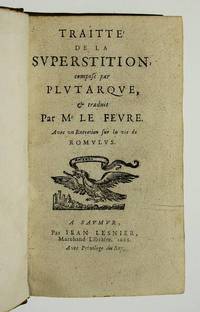
|
|
|
MABLY,GB DE G B
Observations sur les Romains. Par M. l'Abbé de Mably. Seconde édition revue & corrigée.
Geneva Genève Par la Compagnie des Libraires 1767. 12mo. VIIIIV4262 advertisements errata p. Contemporary mottled calf. 17 cm Ref: Cioranescu 41169; Brunet vol. 6 22934 Details: Back tooled gilt with floral motives and with a red morocco shield in the second compartment. Endpapers marbled Condition: Binding slightly worn at the extremes. Corners grazed. Paper yellowing Note: The Frenchman Gabriel Bonnot de Mably 1709-1785 also known as Abbé de Mably was a philosopher and historian of great repute in the 18th century and a pioneer of the French Revolution. After a short career in diplomacy he dedicated himself to literary and scholarly studies. He was a lifelong friend of the philosopher Rousseau who tutored from 1740 to 1741 the two sons of his brother Jean a not very successful experience. He was an exponent of the Enlightenment and sharply condemned the 'ancien régime'. His writings are characterized by his pursuit to build society on a more moral basis and to return to the original state of the civic society as it was in the time of the Athenian Lycurgus. He opposed inherited wealth and the privileges of nobility. Some of his works were published posthumously because their content was too subversive. His work was a source of inspiration for the revolutionaries of the French revolution. § In 1740 De Mably published 'Parallèle des Romains et des François par rapport au gouvernement' in which he drew comparisons between the history structures and accomplishments of the Roman state and those of France. He associated Rome with grandeur with France and with imperial civilizing missions. The book was received favourably but so he tells in the preface to this 'Observations sur les Romains' which was first published in Geneva in 1751 and is repeated in this second revised edition of 1767 that he had come to the conclusion that his 'Parallèle des Romains et des François par rapport au gouvernement' of 1740 had overshot its mark he calls the book even a 'faute'. Preface p. VIII He is very harsh about his own book: 'Ouvrage de sang froid je trouvai qu'un plan que j'avois jugé très-judicieux n'étoit en aucune façon raisonnable. Nul ordre nulle liaison dans les idées des répétitions sans nombre des objets présentés sous un faux jour; ce n'étoient pas là les seuls défauts ou m'avoit fait tomber la manie du Paralelle'. p. VI He had seen similarities where there were none. And in stead of publishing a second revised edition of this failed work Au lieu de vouloir corriger mon Parallele incorrigible pour en faire une nouvelle édition he decided to compose a complete new study on the rise and fall of Rome Collation: 6 A-R12 S10 Photographs on request unknown
书商的参考编号 : 120277
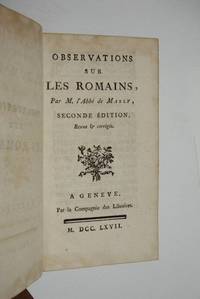
|
|
|
WALCH,JEI J E I
Io. Ernest. Imman. Walchii De arte critica veterum Romanorum liber. Editio secunda auctior et emendatior.
Jena Ienae Sumtu Io. Christoph. Straussii 1757. 8vo. VIII23611 index1 blank p. Vellum 17.5 cm Ref: VD18 10328696 Details: Manuscript title on the back. Woodcut printer's mark on the title with the initials J.C.S. on a baroque escutcheon that leans against a bush Condition: Vellum age-tanned. Small name on the front flyleaf. Paper yellowing Note: Johannes Ernst Immanuel Walch 1725-1778 studied classical and semitic languages at the University of Jena and also natural science and mathematics. In 1750 be was appointed professor extraordinarius of theology and in 1755 he became professor ordinarius of logic and metaphysics. In 1759 he exchanged this chair for a professorship of rhetoric and poetry. His main interest as a classical scholar was the exegese of the New Testament. As was the custom of his time the professor Eloquentiae published a number of short 'programmata'. Noteworthy are his 3 volume 'In Acta Apostolorum Dissertationes' 1756 1759 1761 and his posthumously published Observationes in Matthaeum ex Graecis inscriptionibus 1779 In these works he tries to determine the meaning of the Greek of the New Testament using profane sources and above all inscriptions.To promote the study of Greek philology he published in 1763 an Introductio in linguam graecam a useful encyclopedia of Greek philology which offered a survey of the sources of the Greek language and an outline of the history of Greek literature. § The book here on offer is announced on the title as second edition. Walch himself tells about the history of the 'first edition' in the preface. This first edition consisted he tells in reality of 3 dissertations on the 'ars critica' published between 1747 and 1750. The dissertations were defended by his students 'more academico' but were in reality written by himself. The first dissertation of 1747 Dissertatio de ortu et progressu artis criticae apud veteres romanos was defended by one Johannes Gottlieb Oleario. When Walch noticed that this dissertation met with some success he wrote in 1749 another dissertation on this subject Diatribe de arte critica veterum romanorum' which was defended 'praeside M. Io. Ernesto Immanueli Walchio' by one Fridericus Fürchtenicht and in 1750 one Johannes Fridericus Thauer defended Walch's Diatribe posterior de arte critica veterum romanorum. The second edition of 1757 is he says an updated adaptation and revision of these three dissertations. Praefatio p. 4 recto & verso In Lebensgeschichte des Joh. Ernst Immanuel Walch Jena 1780 these 3 treatises are numbered among his own 'Akademische Disputationen'. Walch's De arte critica has been examined recently at an online platform of scholarly German publications 'Fachpublikation' by Prof. Dr. Fee-Alexandra Haase: 'Kunst der Kritik´ ars critica ist in der Aufklärung eine Bezeichnung für eine Methode der Textbearbeitung in der Philologie und Grammatik. Der Begriff wird für die Bezeichnung der antiken Rhetorik bei der Darstellung von Quintilian und zur Beschreibung von Methoden und Formen von Texten zur Umschreibung des praktischen Anwendungsbereichs der Rhetorik in der Kritik von Kunst und Literatur in Staatsschriften eingesetzt. In diesen Schriften wird von Autoren nach den Disziplinen Philologie und Geschichtsschreibung ein Ideal von Kritikern dargestellt die als Vertreter einer Kunst der Kritik ars critica Anteil an verschiedenen Disziplinen haben. Das Bild ist noch in Johann Ernst Immanuel Walchs Schrift De arte critica veterum Romanorum aus dem 17. Jahrhunderts durch die Übernahme von dessen Anweisungen zur Rednerausbildung in der Institutio Oratoria geprägt. Quintilian repräsentiert für Walch die Personalunion von Rhetoriker Kritiker und Grammatiker und wird neben anderen Vertretern als ein Gewährsmann für Lehren in den Fächern Rhetorik Dichtung und Kunst der Kritik ars critica herangezogen. Eine Gliederung dieser ´Kunst der Kritik´ ars critica in drei Disziplinen legt Walch zugrunde. So verwendet Walch die Dreiteilung von Kritik in die Bereiche der Anwendung in der Philosophie Geschichte und Grammatik. Als Vertreter der Disziplinen aus der antiken Kunst der Kritik ars critica dienen ihm Homer Aristoteles und die in platonischen Schriften dargestellten Personen Kratylos Gorgias Ion und Sokrates. Neben dieser Definition des Gegenstands für den Bereich der Kritik bestimmt er als philologische Aufgaben der Kunst der Kritik die Verbesserung emendatio von falschen Textstellen und die Auslegung interpretatio eines Textes. Als Bestandteile der Literaturkritik führt Walch das Wissen richtig zu sprechen recte loquendi scientia und die dichterische Erzählung narratio poetarum an. Eine Aufgabe der Kritik critica ist die Deutung der Dichter interpretatio poetarum. So bemerkt Walch daß die Kritik zu den Aufgaben der Rhetorik gehört und Rhetoriker wie Dionysius Halicarnassus und Isokrates für die Leistungen der angewandten Methoden der Kritik beispielhaft sind. Für die Methode des rechtmäßigen Schreibens mit dem Begriff Verfahren des rechten Schreibens recte scribendi ratio beruft er sich auf Quintilian der diese Fähigkeit als Quelle des Urteils mit dem Begriff Urteil iudicium betrachtet. Walch weist mittels des historischen Beispiels Quintilians darauf hin daß der Kritiker criticus und der Grammatiker grammaticus identisch sein können. Als Beispiel dieser Personalunion dient ihm Quintilian der nicht nur die Vorschriften für das gute Reden bene dicendi sondern auch die Methoden der Erregung von Affekten ratio concitandorum affectuum beherrschte. Als Arten und Gebrauch von Sentenzen genera et usus sententiarum werden die Erfindung inventio propositionum und die Art und Weise des Lesens und Nachahmens von Literatur legendi atque imitandi modus vermittelt. Ein Beispiel für die Anwendung einer Kunst der Kritik ars critica als philologische Kritik an Texten im 18. Jahrhundert ist Johannes Ernst Immanuel Walch. Einen Bereich der Anwendung von Kritik repräsentiert im Jahre 1757 ein Werk von Ernst Immanuel Walch das mit der Terminologie der Kritik für Kunst und Literaturgeschichtsschreibung als ein historisch-kritischer Kommentar zu den Quellen konzipiert ist' Fee-Alexandra Haase § In chapter 38 of his Prolegomena ad Homerum 1795 Friedrich August Wolf numbers Walch in a note on the history of grammar and criticism among the scholars who 'historiam grammaticae et criticae docte persequuntur'. Prolegomena p. CLXXI. A third edition was published in 1771. This third edition is however exactly the same as the second edition. We compared both editions and must conclude that only the title and the date of the last leaf of the praefatio were changed. So the edition of 1757 was not really a success. Provenance: On the front flyleaf the name: 'M. Boas Apr. 1904'. This is Marcus Boas 19 Juni 1879 Amsterdam 6 Mei 1942. One of his teachers at the Stedelijk Gymnasium of Amsterdam was the Latinist IJ.H. Rogge who stimulated him to study classics. His professors in Amsterdam were Naber later Kuiper and Karsten. He obtained in 1905 his doctorate with a cum laude dissertation De Epigrammatis Simonideis. He continued his studies in Bonn under Solmsen Brinkmann and Loeschke. In 1906 he met Prof. Vollmer who advised him 'Machen Sie den Cato' to concentrate on the Disticha Catonis. The study of this Latin collection of proverbial wisdom and morality by an unknown late antique 3rd or 4th century author called Dionysius Cato which was the most popular medieval schoolbook for teaching Latin became his lifelong fascination. 'Jaarboek van de Maatschappij der Nederlandse Letterkunde te Leiden 1946-1947' Leiden 1948 p. 21/23 Disticha Catonis recensuit et apparatu critico instruxit Marcus Boas 1952. Bijdrage tot de kennis van den middel-nederlandschen Cato 1904; Het Egmondsche Cato-handschrift 1913; Een Latijnsche metrische Cato-paraphrase met parodie in een onbekenden Italiaanschen druk van 1539 1927; De Cato van Adam de Suel Leiden 1935; De Cato-edities van Otto Arntzenius en haar replieken 1937 Collation: 4 A-P8 Q4 Photographs on request hardcover
书商的参考编号 : 120188
|
|
|
VORSTIUS,J
De latinitate merito suspecta Deque vitiis sermonis latini quae vulgo fere non animadvertuntur liber; quem alter de latinitate falso suspecta antecessit auctore Johanne Vorstio. Editio nova auctior & cum indice. Bound with volume 2: De latinitate falso suspecta deque Latinae Linguae cum Germanica convenientia liber auctore Johanne Vorstio. Adjecti sunt plenissimi indices. Editio tertia priori correctior.
Ad 1: Berlin Berlini Impensis Danielis Reichelii bibliop. Typis Christophori Fleischeri 1682. Ad 2: Berlin Berolini Sumptibus Joh. Fried. Gleditschii 1690. 8vo. 2 volumes in 1: VIII282 recte 272;8 index; XII;298;26 index p. Vellum 17 cm Ref: Ad 1: VD17 12:130206A; Ad 2: VD17 3:314302R Details: 5 thongs laced through the joints. Manuscript title on the back. Title in red and black Condition: Vellum soiled and spotted. Front flyleaf removed. Small name on the first title. Blank lower corner of the first title cut off. Paper browning as usual with German books of that period Note: The German philologist and theologian Johann Vorst or Johannes Vorstius 1623-1676 became after his studies master at several gymnasia Flensburg Berlin meanwhile increasing his fame by producing learned books and editions of various Latin authors. The Philologia Sacra being the center of his work he was also in his time one of the most distinguished experts on Hebrew. These works his classical work and his schoolbooks are now forgotten. He lives however on in the history of German linguistics through a small booklet: 'Observationum in linguam vernaculam specimen' Coloniae Brandenburg 1669. Vorstius was inspired by the Roman linguist Varro and as a sample of his intensive study of his mother tongue and its history he offers in 19 chapters as many etymological monographies. Not one of his etymological studies is completely wrong most of them actually are proofs of his admirable linguistic insight. Vorstius knew everything that was printed in Germany the Netherlands England and Scandinavia on the remains of older germanic languages. His arrangement of forms and meanings is chronologically generally correct and he refrained from the irrelevant etymological riddles that were so popular in his time. He didnot juggle with Hebrew and showed his knowledge of Latin and Greek only in instructive parallels and analogies. ADB 40308/09 Traces of his linguistic and etymological interest can be found in the second part of De latinitate merito and falso suspecta where Vorstius offers analogies between the Greek Latin and German languages. De latinitate merito and falso suspecta is a study in Latin style how to speak and write pure Latin. The correct use of Latin was in the 17th and 18th century still considered to be of importance. The use of exemplary Latin was for some scholars of that period the same as practising pure science. De latinitate merito and falso suspecta was first published in Berlin in 1669. Revised and augmented 2nd 3rd and 4th editions appeared in 1674 1669 1682 1698 1703 and 1722 Provenance: On the title in old ink 'C. Stemel' Collation: Ad 1: :8 A-R8 S4. Ad 2: 6 A-U8. X2 Photographs on request hardcover
书商的参考编号 : 120191
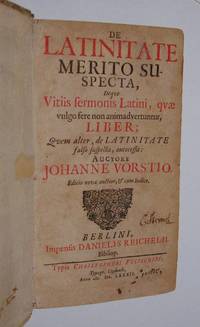
|
|
|
DIONYSIUS HALICARNASSENSIS
Dionysii Halicarnassei Antiquitatum sive Originum Romanarum libri decem Sigismundo Gelenio interprete. Adiecimus Undecimum ex versione Lapi: ac indicem rerum notatu dignarum locupletissimum.
Lyon Lugduni Apud Antonium Vincentium 1561. Colophon at the end: 'Lugduni excudebat Symphorianus Barbierus 16mo. 85466 p. Calf 12.5 cm Ref: Hoffmann 1586; Graesse 2400 Details: Back gilt and with 4 raised bands red morocco shield in the second compartment. Endpapers marbled. Edges of the bookblock dyed red. Latin translation only. Condition: Binding somewhat scuffed corners bumped. Waterstain on the title. Paper slightly yellowing Note: The 'Antiquitates Romanae' of the Greek rhetor and historian Dionysius Halicarnassensis who came to Rome ca. 30 B.C. to teach rhetoric and who spent there at least 22 years or longer are little known and little read nowadays. His work on literary criticism still is of importance for it shows that he was an excellent critic with good taste great knowledge and a subtle judgement. As historian however he is almost forgotten. H.J. Rose's summary of the 'Antiquitates Romanae' explains its weakness: 'He writes as might be expected in the rhetorical tradition and as a result his book is nearly worthless as history devoting much space to elaborate retelling to the late and artificial mythology of Rome. For this very reason however it is of some service to students of Roman antiquities for it preserves a good many interesting facts concerning the earliest civil and religious institutions. We have 11 books left with excerpts from 9 more carrrying the narrative down to 271 B.C.' H.J. Rose 'A handbook of Greek literature' London 1965 p. 399 The historian Dionysius of Halicarnassus enjoyed great authority until the 18th century. He was thought to be superior to the other Roman historians who wrote about the early history of Rome. His influence on the 'artes historicae' of the Renaissance is great. He was admired by Bodin Vossius and Scaliger. Then the spirit of the Enlightenment made his poetic conception of history obsolete. Scholars like the Dutch ancient historian Perizonius made mincemeat of him and burried him in the dust of oblivion. The 'Altertumswissenschaft' of the 19th century held him also in low esteem and he was degraded to 'Graeculus' an insignificant Greek. The last decades seem to be friendlier for Dionysius. Bowersock Gabba. He now has simply become a witness whom scholars start to ask other questions. § The Bohemian classical scholar Sigismund Gelenius or Zikmund Hrubý 1497-1554 produced editions of Callimachus Aristophanes the Planudean Anthology Origenes and the 'editio princeps' of several minor Greek geographers. Circa 1524 he ended up in Basel where he worked as 'lector' translator and critic in the famous Publishing House of Frobenius. Neue Deutsche Biographie 6 1964 p. 173 He declined lucrative professorships. In Basel he published in 1549 his Latin translation of the 'Antiquitates Romanae' of Dionysius Halicarnassensis for the first time. It was reissued by Froben in 1555 and 1561. The Lyon printer Sebastianus Gryphus repeated the edition also in 1555 and in 1561 the Lyon printer Antonius Vincentius saw room for yet another edition Provenance: On the verso of the front flyleaf in ink: 'Bibliothecae Publicae Sancti Vincent Bisunt lotte 177'. Bisunt is Bisuntium the Latin name of the French city Besançon. The French Abbé Jean-Baptiste Boisot 1638-1694 was a historian and a bibliophile. He was appointed abbot of the Benedict abbey of Saint Vincent in Besançon by King Louis XIV. The abbot left his manuscripts and books to the abbey of Saint Vincent on condition that the library should be open to the public. à charge et condition qu'ils mettront le tout dans une salle qui sera ouverte deux fois la semaine à tous ceux qui voudront y entrer ; lesquels pourront y lire et étudier autant de temps qu'ils souhaiteront pendant les deux jours sans que pourtant il leur soit permis d'en distraire aucun livre. This library forms the kernel of Municipal Library of Besançon. See for this man his library and the abbey his lemma in Wikipédia § On the flyleaf also in a more recent hand: 'ex libris ecure Dénans 1727'. § Still more recent a small ownership label pasted on the verso of the marbled front endpaper: 'Dr. Charles Groffier'. § On the same spot in pencil: 'Brussel 27 sept. 1963' written by the Flemish linguist Walter Couvreur 1914-1996 who was an Orientalist and professor of Indoeuropean linguistics at the University of Gent. It indicates the date of aquisition Collation: a-z8; A-2L8 2M4 Photographs on request hardcover
书商的参考编号 : 120236
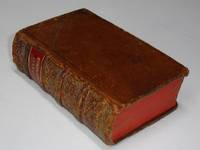
|
|
|
TACITUS
C. Cornelius Tacitus accurante Matthia Berneggero.
Strassburg Argentorati Ediderunt Georgius Andreas Dolhopfius & Johannes Eberhardus Zetznerus 1664. 8vo. XVIII11222 blank p. Overlapping vellum 17 cm Ref: VD17 547:695101K; Schweiger 21002; Dibdin 2452; Moss 2643; Graesse 6/2 9; Fabricius/Ernesti 2398 Details: 6 thongs laced through the joints. Engraved title depicting an altar left of which stands a Roman emperor right a German warrior; on the surface of the altar the text 'Aeternitati' for Eternity; just above the altar hangs the globe upon which stands an eagle with spread wings. This scene seems a combination of two Roman coins. It was perhaps made after the verso side of a coin struck by Constantine the Great in Trier in 321 A.D.; on this coin there is however no eagle; a scene consisting of a globe on which an eagle stands is to be seen on a denarius of Caracalla struck after 217 A.D. This frontispiece is purely propagandistic in its presentation. It depicts not so much the struggle between the Romans and the German tribes that Tacitus tells about. It rather symbolizes the claim of the Holy Roman Empire Sacrum Romanum Imperium Heiliges Römisches Reich that it was the legitimate successor 'for eternity' of the Roman Empire. The imperial banner of the Holy Roman Empire depicted a black eagle Condition: Vellum age-tanned and slightly worn & spotted. Head of the spine chafed. Front & rear joint starting to split for 1 cm. Some old ink underlinings. Paper browning. Bookplate on the front pastdown Note: The Roman historian Publius Cornelius Tacitus offered ammunition for many intellectual and political battles in 16th and 17th century Europe. The turmoil caused by the emerging new monarchies in England France en Spain civil and religious wars in Italy and Germany and the plague made Tacitus' account of the state of the early Roman Empire increasingly topical and relevant. The debate Tacitus provoked in intellectual circles was of course on Roman history but also on literary style in Latin and the vernacular but more so on historical and political thought. Tacitus ideas were not original but he brought them in a forceful lapidary way oneliners ready for the use in debate. Tacitus became in a corrupted world 'the one true guide for those involved in the awful revolution of modern times: he "teaches well the mode of life under tyrants just as he teaches tyrants how to establish tyranny'' '. The Classical Tradition Cambr. Mass. 2010 p. 921 The French humanist scholar Muretus Marc Antoine Muret 1526-1585 declared that 'Tacitus' descriptions of lost liberty failed revolutions vicious civil wars and mad emperors amounted to a theater of our time'. Op. cit. ibid. § The editor of this Tacitus edition the German classical scholar Matthias Bernegger 1582-1640 was the founder of the School of Roman history at Strassburg where a protestant university was founded in 1621. The model of this school was the Flemish editor of Tacitus Justus Lipsius 1547-1606 who was one of the most learned men of his day. His great Tacitus editions placed and still places Lipsius in the front rank of classical scholarship. Our Tacitus edition of 1664 is an exact reissue of Bernegger's Tacitus that was first published in in Strassburg in 1638. It includes 'many excellent notes and emendations due to his pupil and son-in-law Johannes Casper Freinsheim 1608-1660 the foremost representative of this school'. SandysJ.E. 'A History of Classical Scholarship' N.Y. 1964 p. 367 The edition offers also a 144 page treatise 'Ioannis Freinshemii expositio locorum cornelianorum intactorum interpretibus aut secus acceptorum' and an elaborate and exemplary 272 page 'Index in Tacitum confectus industria et labore Melchiore Freinshemii'. § Lipsius praised Tacitus as a teacher of vital political lessons. In his Politica Politicorum sive Civilis doctrinae libri sex 1589 'a brilliant textbook in mosaic form composed of passages from the ancients far more of them taken from Tacitus than from any other source - Lipsius showed how to make a version of Tacitus' analysis of empire fit the practical needs of the modern governing classes'. The Classical Tradition Cambr. Mass. 2010 p. 921 Bernegger professor of History from 1613 till his death in 1640 produced a revised and augmented edition of Lipsius' Politica which was published posthumously in Strassburg in 1642. It saw several reissues in that city and in Frankfurt. Bernegger was from his appointment in Strassburg in 1613 the starting point of the so-called Lipsian tradition an historic-political school of thought in late humanist philology which exercised well into the 18th century influence on the German protestant universities of Jena Altorf Marburg and Strassburg 'Justus Lipsius Politica: Six Books of Politics Or Political Instruction' Edited with translation and introduction by J. Waszink Assen 2004 p. 194/95 Bernegger lectured on Lipsius' Politica and like Lipsius he considered Tacitus' view on politics the best guiding principle leading to 'prudentia' in the turmoil of his time. Provenance: Bookplate: 'Bibliothek Oberherrlingen E.M. 1839'. Eugen von Maucler 1783-1859 was a German politician and bibliophile. His library was located at 'Schloss Oberherrlingen' near Ulm; see for Eugen von Maucler his library a portrait and a picture of the bookplate: WikipaediaCollation: a8 minus leaf a8 b2; A-4A8 4B2 leaf 4B2 blank Photographs on request hardcover
书商的参考编号 : 120198
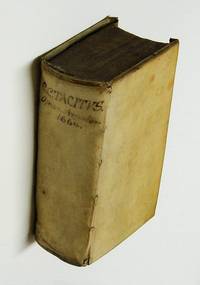
|
|
|
LATOMUS,J
Corsendonca sive Coenobii canonicorum regularium Ordinis S. Augustini de Corsendoncq origo et progressus auctore Ioanne Latomo Throni Mariani iuxta Herentaliam Coenobiarcha. Ioannes Hoybergius S.T.B.F. Prior Corsendoncanus nunc primum edidit continuavit & notationibus illustravit. Quibus non solum multa quae ad Brabantiae Historiam pertinent sed & variorum Coenobiorum origines e tenebris eruuntur.
Antwerp Antverpiae Apud Hieronymum Verdussium 1644. 8vo. XVI18028 index p. Calf. 15 cm Ref: Beledimar 962; In STCV; NNBW 2787/88 Details: Back gilt and with 5 raised bands. Morocco shield in the second compartment. Edges of the boards gilt. Marbled endpapers Condition: Binding slightly worn especially at the extremes. Trace of a bookplate on the front pastedown Note: Johannes Latomus Bergizomius was born in the Dutch city Bergen op Zoom in 1520 he died in Antwerp in 1578 in the 'Falconsklooster'. He was a son of Jacob Steenhauwers and Margaretha Vordeels and made his profession in the Augustine monastery 'Marientroon' near Grobbendonk in the region of Herenthals was appointed abbot Coenobiarcha of the priory of Corsendonk in 1551. He not only was a wise and amiable man and a prudent administrator but he was also considered an excellent poet a conscientious historian and a great scholar. He saved the autograph of the 'Imitatio Christi' of Thomas a Kempis from oblivion. His best known work 'Corsendonca' describes the history of the former Augustine priory of Corsendonk south of Turnhout. NNBW 2787/88 The priory was part of the chapter of Windesheim and was founded in 1395 by Maria of Gelre also known as Maria of Brabant daughter of Duke Jan III of Brabant. The monastery was closed down by the emperor Joseph II in 1785; the closing became definitive in 1795. See Wikipedia 'Corsendonk Priorij The history of Corsendonk continued after Latomus' death by prior Hoybergius till 1642 fills the first 38 pages of the book. The rest consists of Hoybergius' notes. The priory was in the 17th and 18th century known for its scriptorium and Latin tuition. § Johannes Latomus was also an excellent Neolatin poet. Hofman Peerlkamp praises his poetry for its elegance: 'Carmina certe quibus Elogia Joviani ornavit elegantia amoenitate et acumine plerumque excellunt. Nec deest nitor et facilitas orationis'. Hofman Peerlkamp 'Liber de vita doctrina et facultate Nederlandicorum qui carmina latina composuerunt' Haarlem 1888 p. 118/19 § The 'Corsendonca' of Johannes Latomus Bergizomius is in ADB Algemeine Deutsch Biographie vol.18 p. 4 erroneously attributed to his namesake and contemporary the German historian and theologian Johannes Latomus 1524-1600 deacon of the Frankfurter 'Chorherrenstift St. Bartholomäi'. He wrote about the history of Frankfurt Provenance: On the front flyleaf: 'L. Mostelmans' Collation: 8 A-N8 Photographs on request hardcover
书商的参考编号 : 120267
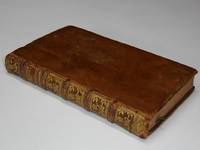
|
|
|
HORATIUS
Q. Horatii Flacci Odarum sive Carminum libri quatuor. Epodon liber unus cum annotatiunculis quam antea auctoribus in margine adiectis quae brevis commentarii vice esse possint. Nicolai Perotti libellus non infrugifer de metris Odarum Horatianarum. Bound with: Q. Horatii Flacci Epistolarum libri duo. Sermonum sive satyrarum libri duo ad Mecaenatem. Ars poetica ad Pisones. cum annotatiunculis quam antea auctoribus in margine adiectis quae brevis commentarii vice esse possint. And: Iunii Iuvenalis Aquinatis Satyrae decem et sex. Cum annotatiunculis in margine adiectis quae brevis commentarii vice esse possint. And: Auli Persii Flacci Satyrae sex. Cum annotatiunculis in margine adiectis quae brevis commentarii vice esse possint.
Paris Parisiis Apud Simonem Colinaeum 1535 - 1541. Ad 1 & 2: 1539. Ad 3: 1535. Ad 4: 1541 8vo. 4 volumes in 1: 967564 & 12 leaves. 20th century red morocco. 8vo. 17.5 cm Ref: Ad 1: Schweiger 2420 reissue of the edition of 1533. Brunet 3314: 'Texte d'Alde édition correcte'. Dibdin 293. Moss 212. Graesse 3350. Ebert 10154 Ad 2: Schweiger 2426. Brunet 3314. Dibdin 293. Moss 212. Graesse 3350. Ebert 10154. Ad 3: Schweiger 2503 & 508 reissue edition of 1528 Brunet 3630. Dibdin 2153. Graesse 3519. Ebert 11224. Ad 4: Schweiger 2709. cf. Moss 2259. Dibdin 2153. Graesse 5212 Details: Back ruled gilt and with a black morocco shield. Each of the four titles shows Colinaeus' woodcut printer's mark: the Great Reaper Tempus swaying his scythe; 'Father Time' in the shape of a winged Satyr moves on a broad pedestal above which are shown flowers and grass cut down; behind this figure we read word 'Tempus'; upon the pedestal is the motto: 'Virtus sola aciem retundit istam'. All 4 copies printed completely in Italics. Dibdin on this Italic letter: 'To the curious this will be an additional incitement to purchase the work as Colinaeus is thought perhaps not very justly to have surpassed Aldus himself in the Italic type'. Woodcut initials Condition: Wear to the extremities. Back slightly rubbed. 3 small & old inscriptions on the first title which is somewhat soiled; one of the names has been erased. Small wormhole in the first four leaves. Occasional old ink underlings and annotations Note: This convolute contains 4 titles that were published by Simon de Colines who was one of the greatest typographers printers and publishers of Renaissance Paris. He was active in Paris between 1520 and 1546 and cut lucid and elegant roman and italic types and a beautiful Greek type superior to its predecessors. Colines was associated with the elder Henri Estienne I and continued his work after his death in 1520. He married the widow of Henri Estienne and was in charge of the press until Estiennes son Robert I entered the business in 1526 by which time Colines had set up his own shop nearby. In 1528 he began to use italic type. Colines published many Greek and Latin classics. In 2012 K. Amert published a monograph: 'The Scythe and the Rabbit: Simon de Colines and the Culture of the Book in Renaissance Paris'. § All four titles in this binding form more or less a unity not only with respect to content the best of Latin poetry but also in appearance. Colines chose for all four good quality paper the same type and the same layout. Even the appearance and the wording of the title pages show similarity. Colines did not only have taste but he had also a sharp eye for good scholarship. He chose to reissue editions of the Venetian printer Aldus Manutius whose books were amongst the best of his age sometimes for centuries to come. The Horace volumes were first published by Colines in 1528. At the end Colines placed a short metrical treatise of the Italian humanist Nicolaus Perrotti 1429-1480 his 'libellus de metris Odarum Horatiarum'. In the margins of his Juvenal Colines repeated the marginal notes that were printed in the Horace/Juvenal edition of 1524 published by the Basle publisher Valentin Curio. In aedibus Valentini Curionis In Blackwell's Companion to the ancient world 'A Companion to Persius and Juvenal' edited by S. Braund & J. Osgood Oxford 2012 chapter 'Renaissance scholarship on Juvenal and Persius' these marginal notes in the edition of Valentin Curio are erroneously attributed to the Italian humanist Celio Secondo Curione in Latin Caelius Secundus Curio 1503-1569. This misunderstanding probably arises from the fact that Caelius Secundus Curio published a folio edition of the satires with commentary of Juvenal & Persius in Basel Froben/Episcopius in 1551. See Schweiger 2509 Provenance: At the upper edge of the title: 'phi ign: pagart no. 193'. We found a Philippe Ignace Pagart in 'Coutumes locales tant anciennes que nouvelles des bailliages ville et echevinage de Saint-Omer' Paris 1744 p. 16. He is referred to as one of the 'Officiers du Roi au Bailliage de Saint-Omer'. On the internet we found further: 'messire Philippe-Ignace Pagart sieur du Buis 1969-1760 nommé conseiller au bailliage de Saint-Omer 1723' Collation: a-m8; a-i8 k3 leaf k3 blank; a-h8; a8 b4 Photographs on request unknown
书商的参考编号 : 120259

|
|
|
CASAUBON,I
Isaaci Casauboni De Satyrica Graecorum Poesi & Romanorum Satira libri duo. In quibus etiam poetae recensentur qui in utraque poesi floruerunt. Accedit: Cyclops Euripidae latinitate donata a Q. Septimo Florente Christiano
Paris Parisiis Apud Ambrosium & Hieronymum Drouart 1605. 8vo. XVI3562 addenda2 blank382 blank p. 1 text engraving. Restored full calf 17 'Casaubon produced the first critical survey of literary history in his 'De Satyra Graecorum Poesi & Romanorum Satira' which has gone through many editions and can fairly be called a model of its kind'. Wilamowitz Ref: Brunet 11613/14; Ebert 3628 Details: Binding tastefully and expertly restored antique style. Back with 4 raised bands. The remains of the original gilt back skillfully attached to the spine. An engraving of an ancient gem on p. 67 Condition: Title slightly spotted; paper slightly yellowing Note: The French scholar Isaac Casaubon latinized as Casaubonus 1559-1614 was of Huguenot parents. He studied in Geneva where he succeeded the Cretan Franciscus Portus as professor in 1582. In 1596 he left for Montpellier to teach. In 1599 the king of France invited him to come to Paris to aid in a proposed 'restoration' of the university. 'At Paris he had the title 'Lecteur du Roi' but owing doubtless to his remaining true to his protestant principles he was not appointed to an actual professorship'. Sandys 2207 After the murder of Henry IV he had to leave France and accepted an invitation to come to England where he was given a pension. He produced many important and often still unsuperseded editions and commentaries such as Diogenes Laertius 1583 Aristotle 1590 Athenaeus 1596-1600 Historiae Augustae 1603 and Persius 1605. § Isaac Casaubon's 'De Satyrica Graecorum Poesi et Romanorum Satira libri duo' is the central text in the Renaissance theory of satire and still is from a modern point of view. It's importance for modern scholarship lies in the decisive disentanglement of the Greek and the Roman satiric traditions. Casaubon proved with massive learning that the literary genre of the satire had nothing to do what so ever with Greek Satyrs as was believed by great scholars as J. Scaliger and D. Heinsius who insisted that Greek and Roman satire formed a single tradition and that this genre was essentially a dramatic form descended from Satyr plays. Casaubon's view that the satire derives from 'satura' or 'satira' meaning 'full' as in 'satira/satura lanx' has been accepted by modern scholarship as accurate. A 'satura lanx' was a plate full of all kinds of first fruits i.e. religious offerings of the first agricultural produce to the gods. 'De Satyrica' liber II p. 318 Such plates lances were simply called 'saturas' medleys full of different things. Idem p. 319 'Sic apud Latinos quaelibet mixtura specierum diversarum 'satura' sit dicta'. Idem p. 321 Laws with interpolations were also called 'saturas'. The 2nd century Roman linguist Sextus Pompeius Festus Pompeius Casaubon adds observed: 'Satura est lex multis aliis legibus conferta'. Idem p. 321 So 'simillime igitur & poëmatia quo breviter multi perstringebantur SATURAE vel ut posterius coeptum pronuntiari SATIRAE dictae sunt'. p. 323 § At the end has been added a Latin translation of the Cyclops of Euripides made by Q. Septimus Florens Christianus. The translation is preceded by a short praefatio which is dedicated to Claudius Christianus son of Florens. Casaubon praises the father and tells that he has proven in caput VI of liber I p. 207/29 that the Cyclops is a Greek Satyr play the only one that survived completely. § Florens Christianus Florent Chrétien was a French poet born in 1541 who was the author of satires against Ronsard. He translated also several classical authors Collation: a8 A-Y8 Z4 leaf Z4 blank A-B8 C4 leaf C4 blank Photographs on request hardcover
书商的参考编号 : 120212
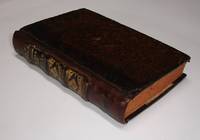
|
|

 ?????????
 ?????PDF???
 RSS feed
 ??
??


