|
THUCYDIDES
Thucydides over den oorlog der Peloponnesers en Atheners. Vertaald door H. Frieseman.
Amsterdam Te Amsteldam Bij Pieter den Hengst 1786. 8vo. 2 volumes: VIII424; II4851 p. Contemporary marbled boards. 21 cm Ref: STCN ppn 177080426; Geerebaert 841; OiN 372 Details: Backs ruled gilt and with a blue letterpiece in the 'second compartment' Condition: Binding worn especially at the extremes. Backs rubbed. Letterpiece on the back of volume 2 slightly damaged. 1 stamp on the first title. 2 stamps on the second title Note: This is the first translation into Dutch of the work of the Greek historian Thucydides 'perhaps the greatest historian who has yet lived incontestably the greatest in antiquity'. H.J. Rose A handbook of Greek literature London 1965 p. 302 The translation was made by the Dutch schoolman Hendrik Frieseman born ca. 1755. Later in life he succeeded in obtaining the rectorship of the 'Schola Latina' of Harderwijk where he died in 1821. Van der Aa 16252 In his short preface Frieseman tells us that he used for his translation the text of Duker. This must be the very learned edition with text and exhaustive commentary produced by Carolus Andreas Duker Amsterdam 1731. Frieseman tried he says to imitate the compact and succinct style of the Greek historian and tried to avoid the loose and 'agreable' style of the translation of the Frenchmen Ablancourt first published in 1662. He reproaches the famous Ablancourt that he occasionaly seems to contradict and improve Thucydides which is not the task of the translator Provenance: stamp on title: 'Bibliotheek Aloysius-college s'-Gravenhage' and of 'Bibl.-Gymn. Catv.' this must be the Sint Wilbrordus Gymnasium at Katwijk Collation: 4 A-2C8 2D4; pi1 A-2G8 2H2 2I1 Photographs on request hardcover
书商的参考编号 : 130343
|
|
|
FESTUS & M VERRIUS FLACCUS
Sexti Pompei Festi De verborum significatione fragmentum. Ex vetustissimo exemplari Bibliothecae Farnesianae descriptum. Schedae quae Festi fragmento detractae apud Pomponium Laetum extabant. Ex bibliotheca Fulvi Ursini. Notae in Sex. Pompei Festi fragmentum schedas & epitomam.
Genève apud Petrum Santandreanum 1583. 8vo. 11961862 p. Vellum 17 cm Ref: 1 GLN 3005; Schweiger 2354 Smitskamp 60 Details: Six thongs laced through the joints. Veritas printer's device on the title: a woman the naked truth seated on a cubus holding a radiant sun in her right hand; in her left hand she holds an opened book and a palm leaf; her feet rest on the globe; the garland of fruit which surrounds her shows a ribbon with the text in Greek: 'Alêtheia Pandamatôr' i.e. 'Allmighty Truth'. Condition: Vellum partly soiled. Right margin of title slightly thumbed; title slightly browning Note: Festus is a 2nd century grammarian who produced an abbreviation of a lexicographic work by Marcus Verrius Flaccus a wellknown antiquarian and grammarian living in Augustan Rome. Verrius compiled an enormous lexicon in 80 books full of unusual difficult and archaic words with discussions about customs political institutions belief and Roman law. Remains of his work survive in the epitome of 20 books made by Sextus Pompeius Festus. Festus also added examples found in other sources; the original work of Verrius is completely lost and only 1 manuscript of Festus survived the Middle Ages in an heavily mutilated form. The first reliable text which was a great improvement compared to earlier editions was published in 1559 by Antonio Agustin 1517-1586 who made good use of the Farnese manuscript at Naples and aimed at reconstructing the text in a strict alphabetical order from A to V with the help of other Medieval epitomes of Festus. GLN 15-16 states that this edition is a reissue of an edition published in 1581 in Rome. According to Smitskamp 60 Fulvius Ursinus simply reproduces Scaliger's edition without mentioning his name. In the praefatio to the 62 pages with learned notes the reader is assured that this edition of 1583 is a faithful transcription of the sole surviving MS of Festus Collation: A-N8 O4; A-C8 D8 minus leaf D8 Photographs on request hardcover
书商的参考编号 : 120331

|
|
|
PLINIUS MINOR
Caii Plinii Caecilii Secundi Opera quae supersunt omnia. Ad fidem optimarum editionum diligenter expressa. Liber I-X: ex recensione Cortii et Longolii. Panegyricus Nervae Trajano Augusto dictus ex editione T. Hearne
Glasgow Glasguae In aedibus academicis excudebant Robertus et Andreas Foulis Academiae typographi 1751. 12mo. 3 volumes in 2: IV1-2751 blank; IV277-6331 blank23 p. index1 blank p. Vellum 13 cm Ref: Gaskell no. 208 p. 163 and especially no. 208 p. 419; ESTC Citation No. T190303; Schweiger 2807: 'Sehr saubrer Abdruck des Textes der Briefe nach Corte und Longolius und des Panegyricus nach Th. Hearne'; Graesse 5346; Ebert 17358; cf. Dibdin 2331 & 332; cf. Moss 2495 Details: 2 thongs laced through the joints. Short title in ink on the back Condition: Vellum slightly soiled and scratched. Some foxing. Paper yellowing Note: The Roman civilian administrator Gaius Plinius Caecilius Secundus 61-112 A.D published 9 books of literary letters consisting of short essays character sketches and sensible observations. The letters paint the high society of the young Roman empire. The tenth book contains Pliny's correspondence with the emperor Trajan. Pliny is famous for his description of the eruption of the Vesuvius on the 24th of August in 79 A.D. He was a nephew of the encyclopedist Pliny the Elder who died observing the eruption from afar overcome by poisonous fumes. Pliny the Younger held under Trajanus a number of magistracies. In 111 or 112 he became governor of Bithynia. From here he was in constant correspondence with the Emperor. His letters which were conceived of as artistic productions are more or less epistolary essays. In the late antiquity and later in the Renaissance the literary letter had a widespread influence. § The Scottish printers Robert and Andrew Foulis chose for this edition of Pliny's 247 letters the best available text at the time. It was produced by the German classical scholar Gottlieb Cortius or Kortte 1698-1731 who made his name producing editions of Latin authors and whose works were provided with very extensive commentaries in the manner of the Dutch scholar Petrus Burmannus. His very critical and elaborate Plinus Minor edition was published in Amsterdam in 1734. Cortius died before he could finish the job. Most publishing work was done by a pupil of his the young German philologist Paul Daniel Longolius 1704-1779. He added also emendations of his own. Longolius published 3 ancient authors in an exemplary manner these Letters of Pliny the Younger and also Diogenes Laertius 1739 and Gellius 1741. ADB 19156/7 His Plinius edition is called by Ernesti the editio optima Ernesti/Fabricius Bibliotheca Latina 2416 For the Panegyricus Foulis used the edition of Pliny the Younger which was produced by the English scholar Thomas Hearne 1678-1735 and which dates from 1703 Oxford. It is called by Dibdin a 'very respectable edition'. § Thousands of panegyrics must have been delivered in antiquity. Only a few of them survive. A panegyric is an elaborate eulogy a formal set-piece oration in praise of an emperors or a high dignitary and was an integral part of the ceremony of politics in the Roman empire. The most influential panegyric speech was delivered in 100 A.D. by Plinius Minor before Trajan and the Senate in Rome in which he thanks the emperor for his election to the consulship. It served as a model of rhetoricians in late antiquity. 'It went on to teach many Renaissance and Baroque ceremonial orators how to address supreme political authorities in public speeches. The Classical Tradition Cambr. Mass. 2010 p. 745. His most famous imitator in the Renaissance was Erasmus. By the 18th century the panegyric was treated with suspicion for it easily slid from a showpiece of praise to mindless flattery. 'For Enlightenment critics panegyrics were not to be seen as part of a vital political culture; rather they were a sure index of the constriction of personal liberty and the inevitable bankruptcy of language under autocracy'. The Classical Tradition Cambr. Mass. 2010 p. 684 In the 35 years between 1742 and 1776 the learned Foulis brothers who were University Printers to the University of Glasgow produced ca. 590 titles. Circa 100 of them are Greek or Latin editions. The Foulises printed textbooks for the University but also works of learning and general literature. From their presses have come some of the finest specimens of accurate and elegant printing that was produced in the eighteenth century. They once hung up the sheets of an Horace edition 1744 which was being printed in the college of Glasgow and offered a reward to those who could discover an inaccuracy. It seems that this Pliny edition was originally planned in two volumes. On the verso of the titles of volume 1 and 2 one reads: 'Epistolarum libri sex priores' and 'Epistolarum libri quatuor posteriores. Panegyricus Nervae Trajano Augusto dictus'. However at the bottom of page 503 the first page of the Panegyricus is printed 'Vol. III'. It was probably intended later on that the Panegyricus should comprise the third volume 'but no copy has been seen with a separately-bound vol. III nor one with a Vol. III title page'. Gaskell p. 164 The Panegyricus is instead of a title preceded by 2 leaves which only announce the Panegyricus and donot have an imprint. The Foulises produced in this same year also a quarto edition of the Letters of Pliny. Gaskell 207 Collation: Vol. 1: pi2 A-L12; M6. Vol. 2: pi2 N-X12 Y6 minus blank leaf Y6; pi2 leaf pi1 half-title pi2 volume title Z-2D12 2E6 2F12 leaf 2F12 verso blank Photographs on request hardcover
书商的参考编号 : 120516
|
|
|
GELLIUS
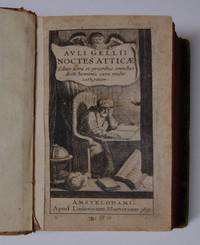
Auli Gellii Noctes Atticae. Editio nova et prioribus omnibus docti hominis cura multo castigatior.
Amsterdam Amstelodami Apud Ludovicum Elzevirium 1651. 12mo. XLVIII498122 index p. 19th cent. marbled boards. 13 cm Ref: Neue Pauly Suppl. 2 p. 261; Willems 1127: 'Édition fort jolie et qui passe pour très correcte'; Berghman 2065 ; Rahir 1145; Graesse 346; Ebert 8287; Dibdin 1340/41; Fabricius/Ernesti 310: 'emendatissima editio'; Schweiger 2378: 'Neue werthvolle Recens. nach Handschr. von Jo.Frd. Gronovius'; Brunet 21524: 'Jolie édition' Details: 5 thongs laced through the joints; engraved title depicting a learned writer at work under the light of an oil lamp Condition: Cover worn at the extremities; marbled paper on the back scuffed; lower corner of a few leaves vaguely waterstained; without the last two blank leaves. Paper somewhat yellowing Note: A favorite author of the Renaissance. The Latin author Aulus Gellius ca. 125-180 AD was never counted as a major author in antiquity nor later. His only work 'Noctes Atticae' or 'Attic Nights' is a miscellany that 'ranges from literature to law from wondrous tales to moral philosophy; one of his favorite topics is the Latin language'. . The exposition in a mildly archaizing but never difficult Latin often takes the form of dialogues with or between culturally eminent persons whom Gellius had known'. It derives its name from the fact of its having been written during the long nights of a winter which the author spent in Attica as a young itinerant student. The Noctes Atticae were exploited by pagans and Christians alike in late antiquity. In medieval florilegia he is much quoted for piquant tales and moral sentiments. 'From Petrarch onward Gellius became a favorite author of the Renaissance'. 'More than 100 manuscripts were copied'. He was used as a valuable source of information on the Latin language and had preserved numerous quotations from lost authors which were presented with grace and elegance. Gellius became a model for the 'Miscellanea' of the Italian humanist Angelo Poliziano. 'In the 18th century however new canons of elegance caused his style to seem less attractive and compilation sank to minor merit' Quotations from 'The Classical Tradition' Cambr. Mass. 2010 p. 386/7 The 20 books of the Noctes Atticae were ably edited 'cura docti hominis'. This learned editor was the Dutch classicist of German origin Johann Friedrich Gronov or Gronovius 1611-1671 He was the successor of Heinsius at the University of Leiden and he was influenced by Vossius Grotius Heinsius & Scriverius. His editions mark an epoch in the study of Livy of Seneca Tacitus & Gellius. Sandys History of Classical Scholarship 2321 Provenance: On the front pastedown in ink the name of 'Berend van Marle' or 'Barend van Marle' and in pencil the name of a collector of Elzeviers 'J. van Dijck' Collation: - 2-12; A - 2C-12 lacking the blanks 2C11 & 2C12 Photographs on request hardcover
书商的参考编号 : 120071
|
|
|
OCELLUS
Betrachtungen des Ocellus von Lukanien über die Welt. Aus dem Griechischen in das Französische übersetzt und mit verschiedenen Abhandlungen über die wichtigsten Punkte der Hauptwissenschaft der Naturlehre und der Sittenlehre der Alten die man als den zweyten Theil der Weltweisheit der gesunden Vernunft ansehen kann begeleitet von dem Herrn Marquis d'Argens Seiner königlichen Majestät in Preussen Kammerherrn Mitglied der königlichen Akademie der Wissenschaften und Direktor der philologischen Klasse. Aus dem Französischen des Herrn Marquis in das Deutsche übersetzt.
Breslau Verlegts George Gottlieb Horn 1763. 8vo. 50462 p. Restored half vellum 17 cm Ref: Hoffmann 32; Ebert 14990; cf. Brunet 4151 for the French edition of 1762; not yet in VD18 Details: The binding is not original but originating from an other book of approximately the same size. The vellum on the boards seems old but the leather on the back is recent. The pastedowns are new and marbled the flyleaves are old but not original. Greek text with facing German translation abundant commentary Condition: The paper is browning & foxed; title spotted its margins thumbed. Small hole in the right margin of the title not reaching text. Right upper corner of 1 leaf torn off with the loss of some letters at the beginning & end of the first sentence. Some words on 1 page erased with ink. Small hole in the last leaf resulting in the loss of some letters. Some pencil Note: This book is a gesture of friendship. It was produced by Jean Baptiste de Boyer Marquis d'Argens for his close friend Frederick the Great Friedrich der Grosse the philosopher/king of Prussia to give him some comfort in tempestuous times when it looked as if he stood on the eve of the fall of his kingdom. 1760/61 were years of disaster for Frederick during the Seven Year's war 1756/1763 an 18th century world war between Prussia Kurhannover and Great Britain against the rest of Europe. In the midst of slaughter the Marquis and Frederick exchanged letters. In a letter of october 1760 Lettre 88 Frederick seemed desparate. La fin de mes jours est empoissonée' he writes. 'Je n'ai ni secours ni diversion ni paix ni rien au monde à espérer. The end of the letter is gloomy. Adieu mon cher Marquis ne m'oubliez pas & soyez tranquille spectateur de ce qu'il plaira à la fatalité & à la brutale rage de nos ennemis d'ordonner de nous. Oeuvres postumes de Frédéric II Tome XI: Correspondance avec le Marquis d'Argens Amsterdam 1789 p. 200 The king meanwhile finds like the Roman emperor Marcus Aurelius comfort in philosophy. Je n'ai de soutien au milieu de tant de contrariétés que ma philosophie; c'est un bâton sur lequel je m'étaie. Lettre 92 p. 210 In the summer of 1761 when all seemed lost D'Argens took up his pen and produced for his king this Ocellus edition. 'Ocellus or Occellus of Lucania occurs in Iamblichus' list of Pythagoreans but the work peri tês tou pantos phuseôs bearing his name and known as early as the first century B.C. is undoubtedly spurious. It shows considerable traces of Aristotelian influence and may problably be dated about 150 B.C.' OCD 2nd ed. p. 745 'Ocellus' Schrift über das All soll offenkundig die aristotelische Lehre von der Ewigkeit der Welt und des Menschengeschlechtes mit der Autorität des Pythagoras versehen vielleicht auch die Abhängigkeit des Aristoteles von letzterem belegen'. Neue Pauly vol. 111155 § The Frenchman Jean Baptiste de Boyer Marquis d'Argens 1704-1771 who edited and translated this text is still convinced that its author the philosopher Ocellus lived in the 6th century B.C. That it might be a forgery doesnot enter his mind. The marquis tells in the preface that it is better to read zu Erlernung der alten Weltweisheit Pref. p. 10 the concise original works of the ancients than the more wordy new publications for sie stellen uns die Lehrgebäude der alten Weltweisen nicht in der gehörigen Kürze dar Pref. p. 10. His translation of and commentary on Ocellus illustrate he goes on themes which he the Marquis developed previously. This Ocellus should be considered to be a supplement to the Marquis's Die Philosophie der gesunden Vernunft oder philosophische Betrachtungen über die Ungewissheit der menschlichen Erkäntniss Breslau 1756 a translation into German of his La philosophie du bons-sens ou réflexions philosophique sur l'incertitude des connoissances humaines first published 1737 which saw many reissues and was translated into English Dutch and Italian. Pref. p. 10 Ocellus he tells lived before Socrates Plato and Aristotle and one finds in his work den Grund worauf die späteren Weltweisen hernach ihre Lehrgebäude aufgeführet haben. Pref. p. 11 To prove his point he quotes Plato Philo Alexandrinus Lucianus and Stobaeus. Stobaeus who lived in the 5th century A.D. even wrote a summary of Ocellus' work. He quotes: Ocellus sagt er Stobaeus hält in seinem Buche von der Natur der Welt dafür dass die Welt ewig sey und er beweiset theils diese Meinung theils sucht er auch darzuthun dass die Bewegung die Zeit und die Figur der Welt schon von Ewigkeit her mit der Welt zugleich gewesen sind. Denn die Figur der Welt ist zirkulförmig. Ein Zirkul aber ist sich an allen Seiten gleich und ähnlich und hat also keinen Anfang oder Ende. Die Bewegung ist ebenfalls ewig denn sie geschiehet in einem Kreis und kann also eben so wenig als dieser einen Anfang oder Ende haben. Die Zeit is ebenfalls ewig und unendlich weil dasienige was bewegt wird ohne Anfang und Ende ist. Die Natur leidet also niemals einige Veränderung sie wird weder besser noch schlechter sondern sie bleibet eben so in alle Ewigkeit wie sie von Ewigkeit her gewesen ist'. Pref. p. 19/20 The Marquis proudly tells that his translation is the first one in a modern language. He translates as litteral as possible he says but took the liberty to elaborate on some passages of his translation da ich sonst hätte befürchten müssen das die Uebersetzung vielen Lesern unverständlich würde geworden seyn. Pref. p. 24 The best earlier edition with Latin translation was according to the Marquis produced by the Englishman Thomas Gale Amsterdam 1688. Pref. p. 26 He calls the commentary of the Italian Vizanius Bologna 1646 worthless. The aim of his own commentary is die vornehmsten Punkte der Gottesgelehrsamkeit der Naturlehre und der Sittenlehre zu erörtern und die Uebereinstimmung oder Verschiedenheit der ältern und neuern Gottesgelehrten und Weltweisen in Absicht derselben zu zeigen. Und ich glaube das wenn man unpartheyisch die verschiedenen Meinungen der Alten und Neuen von Zeit zu Zeit untersuchen wollte man daraus eine kurzgefasste Geschichte des menschlichen Verstandes verfertigen könnte'. Pref. p. 27 § The philosopher and author Jean-Baptiste de Boyer Marquis d'Argens was a fierce opponent of the Catholic Church of intollerance and of religious oppression. His books frequently ended up on the Index of forbidden books. His best known work is his Lettres Juives The Hague 1738/42. Frederick the Great king of Prussia invited him to his court. He appreciated him for his attacks upon orthodox religion. There he remained 25 years as a friend and advisor of the king. As the title says D'Argens was Seiner königlichen Majestät in Preussen Kammerherr salary 1500 Reichtaler Mitglied der königlichen Akademie der Wissenschaften in Berlin und Direktor der philologischen Klasse. At the end of his short lemma in Wikipedia French one finds a huge list with his publications. Far more reliable information on D'Argens can be found here: ub-dok.uni-trier.de/argens/bio/bio.htm. D'Argens established relations with the republic of letters in Germany. Especially sein Engagement für den jüdischen Philosophen Moses Mendelssohn ist in der Literaturgeschichte in Erinnerung geblieben. He befriended king Frederick's friend Voltaire mit dem ihn eine zwar zeitweise getrübte aber doch lebenslange Freundschaft verband. His most influential philosophic work was his Philosophie du bon sens which wanted to incite mistrust against all authorities. It saw several translations and 13 editions in the 18th century. This book Betrachtungen des Ocellus was published one year earlier in 1762 in Berlin in French the original title of which is Ocellus Lucanus en Grec et en Français avec des dissertations sur les principales questions de la Métaphysique de la Physique & de la Morale des anciens qui peuvent servir de suite à la Philosophie du Bon sens. Chr.A. Klotz praises in his review in the Acta Litteraria vol. II pars I Altenburg 1765 p. 39/64 the translation of d'Argens. Vidimus Dargensium bene Graecos scriptores e Graeco in Gallicum sermomem vertisse assecutum esse plerumque feliciter sensum auctorum . explicuisse omnia luculenter nihilque ad eorum sententias intelligendas pertineret omisse. p. 41/42 His commentary is very useful and informative immortales Dargensio gratias res litteraria deberet. p. 55. The aim of d'Argens of producing this book was not purely philologic. He didnot want to produce a scientific text. He is a philosopher of the Enlightenment who tries to convince his readers with the help of the ideas of an ancient philosopher that morality is possible without a God. He is an opponent of the religious metaphysics of the German precursor of the Aufklärung the philosopher Gottfried Wilhelm Leibniz. § From the correspondence between D'Argens and king Fredrick the Great in the years 1761/62 we learn something about the aim of this book and the motives for its creation. In a letter to Frederick dated 3 november 1761 lettre 121 D'Argens announced his translation to Frederick. J'ai discontinué depuis de deux mois ma traduction de Plutarque que je reprendrai bientôt & j'ai employé ce temps à traduire le plus ancient philosophe Grec qui nous reste appelé Ocellus Lucanus; il a fait un ouvrage sur la nécessité de l'éternité du monde; il vivoit long-temps avant Socrate Platon Aristote &c. Son ouvrage est court mais excellent; j'y ai joint sous le prétexte d'éclaircir le texte plusieurs dissertations qui ne feront pas rire les ennemis des philosophes'. Oeuvres postumes de Frédéric II Tome XI: Correspondance avec le Marquis d'Argens Amsterdam 1789 p. 272/73 Six weeks later lettre 123 24 december 1761 the Marquis explains Frederick that the Ocellus edition with his translation and his dissertations was not produced for the scholarly world. His Majesty will see que je n'ai pas fait la sauce pour le poisson mais que j'a cuit le poisson pour avoir le prétexte de faire la sauce. Passez-moi Sire ce mauvais proverbe parce qu'il explique bien l'idée que j'ai eue en traduisant Ocellus'. Correspondance avec le Marquis de'Argens p. 277/78 From letter 122 it appears that D'Argens has sent to the king in the mean time the preface to his new book. He produced the Ocellus he tells the king almost one year later lettre 176 October 1762 to vent his gal la bile que nos ennemis me faisoient faire about infamous libels with attacks upon the philosophers Voltaire D'Argens et alii and their maecenas at Sans-Souci king Frederick. J'ai composé celles dissertations sur Ocellus pour répondre indirectement à trente libelles qu'on publioit en Allemagne & en France contre les philosophes & cela pour en revenir toujours à celui de Sans-Souci & à ceux qu'il honoroit de ses bontés'. Correspondance avec le Marquis de'Argens p. 385 D'Argens refers to books like L'Anti-Sans-Souci ou la folie des nouveaux philosophes which was published in 'Bouillon' in 1761. This libel targeted the entourage of the king people like Voltaire La Mettrie and D'Argens and indirectly the king himself. We have seen that D'Argens found it his duty to lay aside his work on Plutarch and to support his king in this tempestuous year of 1761 by attacking Frederick's ennemies who rejoiced in his misfortunes. That the king was very pleased with the gesture of D'Argens is proved by the fact that Frederick offered a deluxe gift copy of the French edition of 1762 bound in red morocco leather to his reader Vorleser Henri Alexandre de Catt. It is one of the rare known gift copies of Frederick. The anecdote connected with this gift is too striking to omit. Möchlicherweise hat der König das Buch kurz nach dem Tod der Zarin Elisabeth 5. Januar 1762 seinem Vorleser de Catt geschenkt. Als der König Ende 1761 die Meldung erhielt dass die Zarin schwer erkrankt sei sagte er zu de Catt: 'Sie werden sehen dass sie nicht stirbt und dass ich gegen das Unwetter weiter ankämpfen muss. Ich gehe eine Wette ein dass sie wieder gesund wird'. De Catt war anderer Ansicht. Sie schlossen eine Wette ab und der König versprach seinem Vorleser für den Fall dass er verlieren sollte ein Geschenk. This was the best and most important bet Frederick ever lost. We quote from Wikipedia's lemma Seven Year's War: 'Britain now threatened to withdraw its subsidies if Prussia didn't seriously consider offering to make concessions to secure peace. As the Prussian armies had dwindled to just 60.000 men Frederick's survival was severely threatened. Then on 5 January 1762 the Russian Empress Elizabeth died. Her Prussophile successor Peter III at once recalled Russian armies from Berlin . This turn of events has become known as the 'miracle of the House of Brandenburg'. A photo of this gift copy and the anecdote can be found on: www.die-buecher-des-koenigs.de/pdf/Friedrich_20120111.pdf. This very gift copy was auctioned in 2010 by Jeschke van Vliet Buch- und Kunstauktionen. The price was 11408 Euro. The German version of 1763 of this book is very rare. We found in KVK a few copies in German libraries one in a French and one in an Austrian library. One copy was auctioned in 1974 JAP Jahrbuch der Auktionspreise vol. XXV Collation: a-c8 d1; A8 minus blank leaf A8 B-2F8. nothing missing between A and B all is regular Photographs on request hardcover
书商的参考编号 : 120532
|
|
|
(RAPIN,R)
Observationes in poëmata Homeri et Virgilii e Gallico latine redditae. Jano Broukhusio interprete.
Utrecht Trajecti ad Rhenum Apud Franciscum Halma Academ. Typogr. Ordinarium 1684. 12mo. 128 p. Contemporary calf 17 cm Ref: Schweiger 21247; Hoffmann 2377; A. Grafton The classical tradition Cambr. Mass. p. 496 Details: Gilt back with 5 raised bands and a small red morocco shield in the second compartment reading: 'Obs. in Hom. & Vir. Woodcut of two winged putti on the title Condition: Back rubbed gilt fading away. 1 lower corner bumped. Old bibliographic inscription on the verso of the front flyleaf Note: René Rapin Renatus Rapinus 1621-1687 was a French Jesuit who earned his fame as a Neolatin and French poet and was called 'the second Theocritus'. Rapin also distinguished himself with his critical essays. Alongside Boileau he set forth the neo-classic canon of his age. A.F.B. Clark Boileau and the French classical critics in England 1660-1830 Paris 1925 p. 275/85. His celebrated Observations sur les poëmes d'Homère et de Virgile Paris 1669 earlier published in Paris as Comparaison des poëmes de Homère et de Virgile in 1664 3rd ed. is his best known treatise on literary criticism. It was even reprinted by Olms in 1973. This treatise is a contribution to the ongoing 17th century debate the Querelle des Anciens et des Modernes also known as the Battle of the Books which found a kick-off at the beginning of the century in Italy with an attack on the admirers of the genius of Homer. It swung over to France in 1635. The main battle was launched in 1687 by Charles Perrault. In this debate the bad and raw taste of the epics of Homer was compared with the more refined taste of Virgil and of contemporary French poets who were considered by some to be superior to the ancients. René Rapin is cautious in this debate. He is not blind for the genius of Homer but admires the propriety and eloquence of Virgil more. He concludes that Homerum plus habere ingenii Virgilium plus judicii & delectus that Homer has more genius Virgil more judgement and power. The behaviour of Homeric Achilles is a danger for society whereas Aeneas is useful and glorious. The reason for Homeric brutality Rapin explains is that there was not yet any idea of moral virtue in his days. The book of Rapin quickly found an English translation which was published in London in 1670 and in 1672. The translation into Latin for the not French reading public was made by Joh. Broukhusius. The Dutch biographer J.A. Worp observes in his praefatio to Jani Broukhusii epistolae selectae Groningen 1889 p. 8: Traiecti Broukhusius edidit versionem Latinam opusculi Gallico sermone scripti a Renato Rapino. This translation was reissued in 1704 by J. Palmerus in his Apologia pro Lucano and in the Dissertationes selectae crit. de poetis graecis et latinis of I. Bergler Leiden 1707. The translator is the Dutch scholar/soldier Joan van Broekhuizen Janus Broukhusius 1649-1707 who during an adventurous life pursued his classical studies and poetry at leisure. In the same year he published his Carmina a collection of his Neolatin poetry. Utrecht 1684. His editions of Propertius 1702 and Tibullus 1707 laid the foundation for his reputation as a classical scholar. He was admired as a latinist for his taste and for his erudition. NNBW 4309/12 Collation: A-E12 F4 Photographs on request hardcover
书商的参考编号 : 120478
|
|
|
PHAEDRUS
Phaedri Aug. liberti Fabularum Aesopiarum libri V. Cum integris commentariis Marq. Gudii Conr. Rittershusii Nic. Rigaltii Is. Neveleti Nic. Heinsii Joan. Schefferi Jo. Lud. Praschii & excerptis aliorum curante Petro Burmanno.
Leiden Lugduni in Batavis Apud Samuelem Luchtmans 1728. 8vo. 2 parts in 1: LXII398;25870 index p. including frontispiece. Calf 21 cm Ref: STCN 296744565; Schweiger 2736; cf. Dibdin 2280; cf. Moss 2394; Graesse 5253; Brunet 4588; Ebert 16595 Details: Back with 5 raised bands. Morocco letterpiece once red in the second compartment. Floral gilt ornaments in the other compartments. Marbled endpapers. Title in red & black. Woodcut ornament on the title. Frontispiece designed by P. Tiedeman and executed by J. Mulder depicting Phaedrus with pen on paper while he listens to his Muse; in the background Aesopus surrounded by fable animals Condition: Back scuffed. Corners bumped Note: The Roman poet Phaedrus 15 B.C. - ca. 50 A.D. occupies in the history of the fable a very important role. He was a slave of Thracian descent and became a freedman libertus of the first Roman emperor Augustus. He composed 5 books probably incomplete of verse fables. His beast-tales are adaptions of the fables of the Greek poet and archfabulist Aesopus or Aisopos 6th century B.C and inventions of his own. Phaedrus prides himself to have elevated the fable into an independent genre of literature. Sometimes he satirizes contemporary conditions and he is always fond of emphasizing the moral of the story. 'The presentation is in general animated and marked by a brevity of which Phaedrus is rightly proud but which sometimes leads to obscurity'. OCD 2nd ed. p. 809 Nevertheless his style is clear pure and simple this in contrast to the swollen rhetoric of his time. He was widely read in the Middle Ages. During the 17th & 18th he was also very much en vogue. Schweiger lists hundreds of editions. Very popular among scholars and students were the Dutch 'Variorum editions' of Phaedrus. This kind of editions offered a 'textus receptus' which was widely accepted and was accompanied with the commentary and the annotations of various specialists taken or excerpted from earlier useful normative or renewing editions. Editions like these 'cum notis Variorum' were useful but never broke new ground. This 'Variorum edition' was produced by the leading scholar Petrus Burmannus 1668-1741. He was professor of Latin at the University of Utrecht from 1696 and at Leiden from 1715. As an editor he was an industrious manufacturer of 'Variorum editions' confining himself to the Latin classics. He edited besides Phaedrus Horace Claudian Ovid Lucan and the Poetae Latini Minores Petronius Quintilian Suetonius. Sandys 2 p. 343/5 Didbin and Moss do not mention this 'Variorum edition' of 1728. They mention only the Burmannus editions of 1698 and 1718. Schweiger had a sharper eye for he observes about this edition of 1728: 'Bloss neuer Titel zur Ausgabe von 1718'. This 1728 edition is indeed exactly the same as the edition of 1718. We compared both editions and must conclude that Luchtmans must have bought the unsold copies of the edition of 1718 from the publisher Scheurleer in The Hague removed the original title added only a new title-page dated 1728 and brought them to the market for the second time Collation: pi1 8 minus leaf 8 2-38 46 51; A-2B8 minus blank leaf 2B8; a-v8 x4 Photographs on request hardcover
书商的参考编号 : 130435
|
|
|
(HOFFMANN, HEINRICH CARL GEORG).
Teutsche Volks-Geschichten aus dem ersten Jahrhundert vor und nach Christi unsres Heilands Geburt.
Heidelberg Bei Mohr & Winter 1821. 8vo. VIII3422 corrigenda p. 10 engraved plates 1 folding map. Hardbound. 24 cm Ref: Holzmann/Bohatta IV 10414 s.v. Volksgeschichten An attempt of the Heidelberger 'Romantik' to build a national German character. Details: Contemporary 'Pappband'. The 10 plates mostly heroic scenes were drawn by the author 7 of which were etched by Bauch and 3 by Schilbach. The map which was also drawn by the author is a lithography and shows boundaries in 7 watercolours Condition: Cover very worn at the extremities. Corners bumped. Head & tail of the spine damaged. Boards spotted. Partly foxed. Some pencil. Inscribed dedication on the front pastedown. A former owner has written in pencil on the title: 'Verf. Hoffmann Heinr. Karl Georg' Note: This title is a typical example of the German 'Romantik' showing the growing interest in the ancient roots of the Germans and their 'Volksgeschichten'. The book which was published anonymously offers 'inter alia' also a long chapter on 'Die Befreiung Teutschlands durch Hermann den Cherusker'. Books like this were meant to entice the proponents of the Pan-German movement into a stronger sense of unity for a people that was hopelessly divided. § This title of 1821 is attributed by bibliographers to Heinrich Karl Hoffmann. A confirmation of this attribution we found in an announcement in the 'Neckar-Zeitung no. 326 Mittwoch 27. Nov. 1822' p. 1412: 'Heidelberg. Um vielfältigen Anfragen und Wünschen zu begegnen und zu entsprechen erkläre ich hiemit öffentlich dass ich gesonnen und entschlossen bin als eine Fortsetzung der von mir herausgegebenen 'Teutschen Volksgeschichten aus dem ersten Jahrhundert vor und nach Christi Geburt' Heidelberg bei C.F. Winter 1821 auch die nachfolgenden Geschichten der Teutschen zu beschreiben. Es versteht sich von selbst dass zwar der Geist und Zweck meiner Arbeit vollkommen sich gleich bleiben wird demungeachtet die Art der Darstellung sich in die Eigenthümlichkeit des Gegenstandes fügen und darum wohl da und dort andere Gestalt und Farbe annehmen muss. Auch jetzt bitte ich wieder wie vor der Herausgabe des ersten Versuchs alle Freunde der teutschen Geschichte mich mit Rath und Hülfe zu unterstützen. . Darmstadt den 11. Nov. 1822'. An earlier announcement of the same Hoffmann in the 'Allgemeine Zeitung No. 49 Sonnabend 24 März 1821' p. 195 proves that he is not the editor Herausgeber but the author of the collection: 'Ich habe . angekündigt dass ich begonnen sey die Geschichte unserer Vorfahren vor der Völkerwanderung mit Bildern verziert . zu schreiben. . unter dem Titel Teutsche Volks-geschichte aus dem ersten Jahrhundert vor und nach Christi Geburt'. He has two objectives zwiefachen Absicht for this publication he declares first it is his aim to present to the uneducated and uninformed German public a mirror that reflects its original simple and sound identity and secondly he aims at making the history of the German people relevant to their lives. § The liberal revolutionary nationalist Heinrich Karl Hofmann 1795-1845 studied law at the University of Heidelberg and later worked as a lawyer for the Hessian state government at Darmstadt. Hermann Haupt published in 1912 a biography of him: 'Heinrich Karl Hofmann ein süddeutscher Vorkämpfer des deutschen Einheitsgedanken' Heidelberg C. Winter. Hofmann was also closely connected with the ' Vormärz' and a protagonist of the Darmstadt Blacks. § The 'akademische Buchhandlung und Verlag' established in 1801 by Jacob Benjamin Mohr has become famous as the Press of the 'Heidelberger Romantik'. The firm published i.a. 'Des Knaben Wunderhorn' by Achim von Arnim and Clemens Brentano Görres' 'Teutsche Volksbücher' and many more titles which are still read today. In 1815 Christian Friedrich Winter 1773-1858 an old friend of Mohr joined as a partner. The cooperation lasted till 1822. Christian Winter was a radical liberal whose name is closely connected with the 'Vormärz' period and the Revolution of 1848/49. In 1845 he was elected 'Bürgermeister' of Heidelberg Provenance: Interesting provenance. On the front pastedown a handwritten dedication by one of the publishers Christian Friedrich Winter. The dedicatee is 'Herrn Minister General v. Schaefer'. The text reads: 'Seiner Excellenz dem hochverehrten teutschen Krieger und biedern Vertheidiger des Rechts und der Wahrheit Herrn Minister General v. Schaefer mit offener Verehrung der Verleger C. Winter'. This is Konrad Rüdolf Freiherr von Schäffer 1770-1833. He was an old war-horse who fought many battles first against and later with the French. Since 1814 he was Grand-ducal lieutenant-general of Baden and head of the 'Kriegsministerium' of the 'Kabinet Winter' of Ludwig Georg Winter from 1831 till 1833. At the bottom the signature of Christian Winter Collation: -4 1 - 21-8 22-4 Photographs on request hardcover
书商的参考编号 : 140095
|
|
|
PYTHAGORAS- JOCHER,ChrG r G
De Pythagorae methodo philosophiam docendi disserit atque ad Orationem memoriae Ridelianae sacram die XXV Novemb. A.R.S. MDCCXLI in Auditorio Philosophico hora IX habendam invitat Christ. Gottlieb Ioecher Academiae H.T. Rector et ordinis philosophici exdecanus.
N.pl. Lipsiae Breitkopf literis Breitkopfianis 1741. 4to. 12 p. Paper wrappers gone. 19.5 cm Ref: NDB 10452; not yet in VD18 Condition: The original green paper wrapper has been removed Note: Invitation of the Rector of the University of Leipzig Christian Gottlieb Jöcher to attent a meeting in the 'Philosophicum Auditorium' in memory of 'Georgius Ridelius von Leuenstern und Seyfersdorf'. p. 12 ADB/NDB does not know him. In Worldcat we found invitations to such meetings to commemorate Ridelius in 1713 1728 1732 1733 & 1748. Ridelius had established a fund for scholarships for students from his own region. At the end of this short essay on Pythagoras Ridelius is called 'Haeriditarius a kind of hereditary peer in Treschen'. Treschen since 1945 Polish Trestno lies in former Silesia in the region of Wroclaw Breslau. Ridelius was an army officer a 'cohortis bellicae capitaneus'. p. 12 Jöcher announces that a promising student who is a benificiary of such a scholarship stipendio liberali one 'Ernestus Fridericus Wuttge Olna-Silesius' will speech in memory of his 'Euergetes'. The essay on Pythagoras which preceeds this invitation was written by the German philosopher librarian and lexicographer Christian Gottlieb Jöcher 1694-1758. It deals with the way in which Pythagoras organized his teachings and classified his students. Born in Leipzig Jöcher was from 1730 professor of philosophy and from 1732 of history of the University of Leipzig. From 1742 onward he was also its librarian. Jöcher however is best know for the 4th edition of his colossal and still indispensable work of reference 'Jöchers Allgemeines Gelehrten-Lexicon' 4th ed. 1874-1787. Jöcher was apparantly interested like Ridelius in the sponsoring of poorer students from different regions. 'Er is ausserdem Aufseher des kurfürstlichen Stipendienwesens und Konvikts sowie Präfekt der Akademischen Dorfschaften'. Jöcher was famous for his occasional speeches and funeral orations. NDB 10452 Jöcher might have promoted the art of rhetoric among his students and have stimulated one of them to hold a splendid speech on a wellknown countryman. § We quote a lemma on Ridelius that we found in 'Des schlesischen Adels anderer Theil oder Fortsetzung Schlesischer Curiositäten' Leipzig/Breslau 1728 page 418: 'Der Freiherr von Riedel. Wie der helle Stern am Himmel im Löwen Löwenstern! also gläntzt dieses vornehmen Hauses Ruhm-würdige Wohlthätigkeit und Liebe zu Gelehrten in und ausser Schlesien. Georgius Ridelius à Löwenstern & Seiffersdorff Haereditarius hereditary peer in Treschen in Castris Episcopi Monasteriensis & ipsius Caesaris Leopoldi Tribunitia Dignitate ornatus stipendium olim legavit perpetuum quo Vratislaviensis vel alius e Silesia oriundus Lipsiae studiis incumbens biennio fruatur simulque ordinavit ut illud merens quotannis die Michaëlis aut non ita diu post Benefactoris memoriam refricet'. The fortified city Münster was the capital and garrison town of the Prince-Bishopric of Münster. Ridelius had in the army of the bishop a rank of 'tribunitia dignitas' garrison commander Ridelius had that rank also in the army of the Holy Roman Emperor Leopold I 1640-1705 King of Hungary and Croatia King of Bohemia and King of Serbia. Ridelius might have fought the Ottomans in 1683 near Vienna. What 'office of tribune' meant we couldnot find out Collation: 4 2 Photographs on request unknown
书商的参考编号 : 130454
|
|
|
SULPICIUS SEVERUS
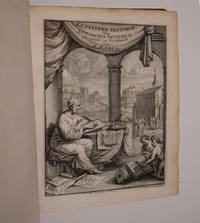
Kerkelyke Historie van Sulpicius Severus. Sedert des Weerelds aanvang tot het vierhonderdste jaar na Christus geboorte; vervolgd tot den tijd van Keizer Karel den V. Uit het Latijn vertaald en met uitvoerige aanmerkingen verrijkt door Pieter Rabus. Met privilegie van d'Ed. Gr. Mog. Heeren Staten van Holland en West-vriesland.
Rotterdam Te Rotterdam By Barent Bos Boekverkooper 1702. 4to. XXXIV560 p. frontispiece 2 plates. Overlapping vellum 21 cm Ref: STCN ppn 216756308; OiN 355 Details: 6 thongs laced through the joints. Frontispiece by C. Huyberts depicts Sulpicius in his study writing his 'Sacrae Historiae'. Title in red and black. Woodcut printer's mark on the title depicting the goddess of wisdom Athena surrounded by a great number of books; it's appropriate motto: 'Non curta supellex' 'not an ill-furnished mind/library'. The other 2 engraved plates show biblical and historical scenes Condition: Binding slightly soiled and scratched Note: The first ecclesiastical histories in the Latin West were translations of Greek historians. Hieronymus translated the 'Chronicon' or 'Chronicle' Pantodapê historia / Universal history of Eusebius bishop of Caesarea to which he added a continuation of his own up to 378 A.D. And the monk Tyrannius Rufinus translated Eusebius' 'Church History' Ekklêsiastikê historia. It was published in 402 or 403 and continued the work from the reign of Constantine the Great to the death of Theodosius 395. It was published in 402 or 403. The first independant Church History in the West was written by Sulpicius Severus ca. 363-420 an eminent Latin-Christian historian originating from South-West Gaul. His 'Sacrae Historiae' or 'Chronica' appeared in 402. The 'Sacrae Historiae' or in Dutch 'Kerkelyke Historie' tells the 'sacred history' from Adam till ca. 400 A.D. This is the first and up till now the only complete Dutch translation. Sulpicius is not only translated but also 'met opmerkingen opgeheldert' i.e. elucidated with notes. In them the translator Pieter Rabus criticizes Severus. The notes usually occupy more than half a page. Pieter Rabus 1660-1702 was a famous man of letters in his days. He also translated Erasmus. As an enlightened author and journalist he wrote against superstition and intolerance. In 1686 he became 'Praeceptor' of the Erasmianum in Rotterdam. After 'Kerkelyke Historie' of Sulpicius follows a translation of the continuation of the 'Chronica' by Johannes Sleidanus 1507-1556 'De quattuor summis imperiis'. This part comprises the last 110 pages and deals with the history of the church during the Middle Ages. J.J.V.M. de Vet 'Pieter Rabus 1660-1702' Amsterdam 1980 Collation: 4 2-44 52 minus blank leaf 52 A-4A4 Photographs on request hardcover
书商的参考编号 : 130099
|
|
|
PLAUTUS
M. Acci Plauti Comoediae XX. superstites nunc denuo post omnium editiones ad fidem meliorem codd. & inprimis vetustissimis MSS. Camerarii seu Camerario-Palatinorum ut & doctissimis virorum curas accuratius exactae & novis commentariis illustratae. . Plautina item fragmenta ad similem faciem concinnata & Plauto denique supposita omnia studio & industria Frid. Taubmanni Franci.
Wittenberg Apud Zachariam Schurerum typis Johannis Gormanni 1612. 4to. 2 volumes: XVIXXIV1320122 index1 printer's mark1 blank p. 19th cent. boards. 24 cm Ref: VD17 1:043513Q. Schweiger p. 764/5: 'Gänzliche Umarbeitung seiner Ausg. . T.'s Commentar ist höchst schätzbar'. Dibdin 2311: Taubmann 'has greatly contributed towards the restoration of the true text of Plautus'. Fabricius/Ernesti Bibl. Lat. 1773 I19/20: 'Praestantissimae ad intelligendum hunc Comicum sunt editiones Taubmannianae . contextum pluribus locis exhibent meliorem ac praeter luculentos commentarios omnium quique ante Plauto manus admoverant industriam delibantes ac vincentes'; Brunet 4708/09; Graesse 5328; Ebert 17191 Details: 19th cent. uniform black boards with red morocco letterpiece on the back. Printer's mark on the title which depicts an intertwined snake feather & laurel with a soaring bird a pigeon on top and is repeated at the end with the addition 'Wittenbergae typis Johannis Gormanni'. The motto reads: 'Simplicitas astu bene fermentata triumphat' Condition: Binding very scuffed worn at extremities. Paper on the boards & the backs partly worn away. Joints of the second volume cracking. Small inkstain on the upper edge of the first 100 pages. Title browned. Regularly old ink underlinings occasional ink annotations by a German hand. Ownership entries on the front endpapers Note: The German humanist Friedrich Taubmann 1565-1613 a man of humble origin was 'Professor Poeseos' Latin at the University of Wittenberg from 1595. He was also an accomplished Neolatin poet. His favorite author meum poeticum cor was the Roman playwright Plautus ca. 250-184 B.C. He considered his much critized first edition of Plautus of 1605 a disaster and asked the publisher to destroy the remainder 2/3 of the copies printed and to replace it by a revised second edition which was indeed published in 1612. Taubmann was above all a compiler of the commentaries of others. He employed the Plautus text of Camerarius for his edition and new material provided by the Flemish classical scholar Janus Gruterus or in Dutch Jan Gruter since 1602 Keeper of the Bibliotheca Palatina at Heidelberg. Gruter had bought from the sons of Joachim Camerarius 1500-1574 for his library 2 manuscripts the 'codex vetus' and 'codex decurtatus' because he realized more than Camerarius himself the exceptional worth of both manuscripts. Taubmann received valuable help from the Keeper who collated the Palatine manuscripts and made good use of them in his second edition. 'In der That beruht der Werth der Taubmann'schen Edition in dem ausserordentlichen Reichthume der commentatorischen Parallelen; nach dieser Hinsicht mag sie heute noch mehr als geschichtliche Aufmerksamkeit beanspruchen. Die zweite Ausgabe war textlich viel sorgsamer und übertraf in Correctheit Typenwahl und Ausstattung die über alle Maassen liederliche erste erklecklich' ADB 37433-440. This second edition of 1612 receives also much praise from Schweiger Dibdin and Fabricius/Ernesti. At the end are added 2 treatises the first by J. Camerarius 'De Fabulis Plautinis' and the second by J.C. Scaliger 'De carminibus Comicis'. Taubmann died the year after the appearance of this great edition leaving a wife and 5 young children. His edition's fame survived him Provenance: On the front flyleaf: 'Laurenz Lersch 1835'. Johann Heinrich Laurenz Lersch 1811-1849 was a German archaeologist and classical philologist. He has a lemma in Wikipedia § Also the name of 'Paul Weiland stud. phil. 1883' Collation: a-b4 2-44; A-4Z4; a-4t4 4u2 Photographs on request Heavy set may require extra shipping costs hardcover
书商的参考编号 : 140114 ???????? : XXX1320122 978XXX1320123
|
|
|
JULIANUS
Les Césars de l'empereur Julien traduits du grec par feu Mr. le Baron de Spanheim avec des remarques & des preuves enrichies de plus de 300 médailles & autres anciens monumens gravés par Bernard Picart le Romain.
Amsterdam Chez François l'Honoré 1728. 4to. XII including frontispieceXLII2862;196 p. portrait numerous text illustrations. Full contemporary calf. 26 cm Ref: STCN ppn 183621573; Hoffmann 2496; Brunet 3597: 'édition recherchée'; Ebert 10997; Graesse 3497; Neue Pauly Suppl. 2 p. 338 where the edition of 1683 is mentioned Details: Gilt back with 5 raised bands. Red morocco shield in the second compartment. Title in red en black. Finely engraved frontispiece it depicts a banquet scene with dining and discussing deified Roman emperors. Engraved vignette of Julian on the title. Full page engraved portrait depicting at full length a statue of count Jean Matthias de Schoulembourg commander in chief of the Venetian army to whom the translation has been dedicated. At the beginning of the dedication an engraved headpiece with the coat of arms of Schoulembourg. Engravings of coins and medals throughout the text made by the famous French engraver Bernard Picart. Latin translation no Greek text Condition: Binding worn at extremities. Back rubbed. Joints starting to split but strong. Tail of the spine chafed. Both boards slightly scratched. Paper yellowing. Some faint foxing. Small wormhole in the blank gutter of 24 leaves far from the text Note: The Roman emperor Flavius Claudius Julianus 331-363 is the best documented ruler of late antiquity. He was a nephew of Constantine the Great ca. 280-337 A.D. who had adopted christianity and imposed it on his empire. For dynastic reasons Constantine in between wiped out in a massacre young Julian's family. In exile Julian covertly converted to neoplatonic polytheism. Julian was later at the age of 24 appointed Caesar by the successor of Constantine the emperor Constantius II. In this capacity he proved himself a successful general in Gaule where he repeatedly drove back and crushed the invading Germanic tribes. After the death of Constantius in 361 Julian openly adopted and promoted paganism. Hence the title 'Apostata' because he was the last emperor who rejected and challenged christianity. He tried to revive the pagan state cult and to restore the traditional pagan religious practices. His reign however lasted only 18 months from 361 till 363. 'Julian's voice can be heard memorably in his surviving writings particularly in his letters in a fierce denunciation of the people of Antioch 'Misopogon' or 'Beard-Hater' and in a satire on his imperial predecessors 'Convivium sive Caesares' which ends with a vicious portrait of Christ'. The Classical Tradition Cambridge Massachusetts 2010 p. 500 Julian was both philosopher and a men of letters and far too human for his time. His work 'Against the Galileans' Christians meant to refute christian dogmas is lost but partly survives in fragments and excerpts in 'Contra Iulianum' a work full of slander by a fierce enemy of Julian Cyrillus bishop of Alexandria. § A French translation of Julian's satire 'Convivium sive Caesares' commonly called the 'Caesars' was published in 1666 by the Swiss scholar and diplomat Ezechiel Spanheim 1629-1710. It was repeated in 1683 in Paris and in 1728 in Amsterdam now with 300 engravings of medals and coins. Spanheim was a prominent name in the field of numismatics and is best known for his 'De praestantia et usu veterum numismatum' of 1664 revised and enlarged in 1706. In 1680 Spanheim entered the service of Elector of Brandenburg as minister of state. As ambassador of the Great Elector he spent nine years at the court of Paris. After the Peace of Ryswick in 1697 he returned as ambassador to France where he remained until 1702. On the very day of the coronation of Frederik I as king of Prusia 18th of January 1701 Spanheim was made Baron this to thank him for his services. In 1702 he went on his final diplomatic mission as first Prussian ambassador to England. He died in London in 1710 having eaten too much grapes Clericus tells us. Baron von Spanheim had an encyclopedic knowledge of the ancient world. In 1696 Spanheim published an edition of the 'Opera Omnia' of Julian. § This 1728 edition is the third of that translation. Spanheim had printed as is explained by the Swiss/Dutch scholar Jean Clericus beneath the text observations to help less well informed 'ordinary' men of letters. This ingenious satire is difficult reading 'being full of erudition and allusions to many facts customs and opinions of Greek and Latin authors'. At the end there are 196 pages with 'preuves des remarques sur les Césars de l'empereur Julien' with remarks and discussions for scholars and more experienced men of letters. The translation Clericus assures us 'is written in a pure style and is very accurate; otherwise that piece of Julian would have lost its beauty. Anyone who compares it with the earlier Latin versions of Cantoclarus and Cunaeus will easily percieve that those translations wanted to be mended and that many passages were spoiled or unintelligible. Besides those translators did not write a sufficient number of remarks to make one understand the sense and design of Julian'. A sympathetic and informative obituary of Spanheim by Johannes Clericus was published in the 'Memoirs of literature containing a large account of many valuable books letters and dissertations upon several subjects' Second edition London 1722 p. 412-426 Provenance: From the Rostagni Library. 'The Rostagni private library has been built over a time of 133 years between 1880 and 2013 by 3 generations of collectors: Augusto Gabinio 1863-1939 internist his nephew Augusto Rostagni 1892-1961 classical philologist at the University of Turin and his son Luigi Rostagni 1932 Operational Director. . Augusto Rostagni taught Ancient literature in various Italian Universities. In 1928 he was appointed professor in Latin literature at the University of Turin an office he fulfilled until his death in 1961. He became one of Italy's most authorative philologists of the 20th century. He held positions of President of the Turin Institute of Classical Philology Dean of the Department of Literature and Philosophy Editor of the Rivista di Filologia Classica President of the 'Accademia delle Scienze di Torino'. He was a well-known member of many Italian and foreign academies and institutions amongst them the Accademia dei Lincei. The Department of Philology Linguistics & Classical Tradition of the University of Turin is named after him.' Burgersdijk & Niermans Auction sale 340 Leiden 2014 p.68 Collation: pi2 French title & frontispiece 4 portrait after leaf 1 -54 61; A-2N4; A-2A4; 2B2. Engraved portrait before leaf 2 Photographs on request hardcover
书商的参考编号 : 152321
|
|
|
LYSIAS & ISOCRATES
The orations of Lysias and Isocrates translated from the Greek; with some account of their lives; and a discourse on the history manners and character of the Greeks from the conclusion of the Peloponnesian war to the battle of Chaeronea by John Gillies LL.D.
London Edinburgh Printed for J. Murray and J. Bell 1778. 4to. XXXVICXXXV1 blank4981 errata1 blank p.; a portrait of Lysias & of Isocrates. Calf 28 cm Ref: ESTC Citation No. T106138; Hoffmann 2490 & 2575: 'eine gute Übersetzung'; Ebert 10628 & 12573; Moss 2119: 'faithful and masterly'; Brunet 31258: 'Traduction fidèle et comme telle fort estimée; Graesse 4315; Ebert 12573; Dict. of British Classicists 2370/2 Details: Back ruled gilt and with 5 raised bands. Red morocco shield with gold lettering in the second compartment. Small and fading gilt coat of arms on the boards within a surrounding banner on which: 'The Society of writers to the Signet'. This is a society of Scottish lawyers Wide margins. Both engravings were made 'ex marmore antiquo in Museo Capitolino'. Edges dyed red Condition: Binding scuffed & scratched. Extremities chafed corners bumped. Joints split but strong. Front hinge cracking. Some insignificant foxing. Old ink inscription on the title reading: 'The Society of Clerks to the Signet' Note: The speeches of the Athenian orators Lysias c. 459-380 B.C. and Isocrates 436-338 B.C. are of great importance for the understanding of the great political issues of the 4th century. Their speeches provide us with a most valuable insight in and commentary on the social and political events in Athens. 'Taken separately their writings are imperfect; when combined they afford a system of information equally extensive and satisfactory'. Preface p. pi3 recto. The English translation of 18 speeches of Lysias and 6 of Isocrates by the Scottish classical scholar and ancient historian John Gillies 1747-1836 is mentioned one of his major contributions to classical scholarship. 'In the long preliminary discourse on the history and private lives and manners of the Greeks during the period 404 to 338 B.C. Gillies specifically adopted Isocrates as his source partly no doubt because it suited his own strongly monarchist views to do so'. DBC 2371 § During the conference 'Revolutions and Classics' of the UCL held in 2016 where scholars examined the manner in which classical texts have been deployed in societies undergoing rapid and radical social change it was argued by the young independent scholar Sebastian Robins that it was Gillies' intention to make available to his contemporaries classical texts that he believed bore immediately on the most pressing political questions of the day: the American Revolutionary War a war which had just begun. This armed conflict between Great Britain and its 13 North American colonies raged from 1775 till 1783 during which the colonies declared in July 1776 independence as the United States of America. The authority of the two Athenian orators Robins says overrules and rectifies that of the contemporary Athenian orator Demosthenes and that of the late antique historian/philosopher Plutarch and others 'on the basis of which some of the most ingenious eighteenth-century writers had raised flattering accounts of Greek virtue and glory. Their speeches moreover contain compelling evidence of the violence prejudice and corruption of the ancient Greeks and of the shortcomings of ancient republican institutions. Champions of the nascent American republic on both sides of the Atlantic Gillies declares' ought on the authority of the speeches he translates to reassess their faith in the relationship between democracy and virtue which he assumed underpinned the Congressional declarion of 1776. § Gillies is best known for his 'History of Ancient Greece' 1786 the first substantial complete survey in English of the whole Greek history to the time of August. It became popular and was quickly translated into German and French Provenance: Stamp of the Scottish 'Society of the writers to the Signet' on the boards Collation: pi4 A-C4 D2 a-3r4; B-3R4 3S2 portrait after leaf L1 and T3 Photographs on request Heavy book may require extra shipping costs hardcover
书商的参考编号 : 140113
|
|
|
PLUTARCHUS
Les vies des hommes illustres grecs et romains comparées l'une avec l'autre par Plutarque de Chaeronée. Translatées par M. Iacques Amyot Conseiller du Roy & par luy reveuës & corrigées. Avec les vies d'Annibal & de Scipion l'Africain traduites de Latin en François par Charles de l'Écluse. Plus les vies d'Epaminondas de Philippus de Macedoine de Dionysius l'aisné tyran de Sicile d'Auguste Caesar de Plutarque & de Senecque. Item les vies des excellens Chefs de guerre escrites par Aemilius Probus. Amples sommaires sur chacune vie: annotations morales en marge chronologie divers indices & les vives effigies des hommes illustres. Le tout recueilly & disposé par S.G. S.
Paris A Paris Chez Jean du-Carroy 1612. 8vo. 2 volumes: XXXII118147 index;129434 index p. New vellum. 18.5 cm Ref: cf. Hoffmann 3214 Details: Small woodcut portrait of Plutarch on both titles. Every 'Vita' is preceded by a coinlike woodcut portrait Condition: The first letter of several lines on both titles disappears in the left margin because of new endpapers which have been attached to a small paper repair in the gutter. Edges of both titles thumbed. Some stains on the front edge of vol. I. Outer margin of the title and the first gathering of the first volume stained. Paper slightly yellowing Note: The 'Vitae Parallelae' or 'Parallel Lives' form a collection of biographies of ancient historical figures. There are 23 pairs 19 of them with a comparison attached to it. The object of Plutarch was not to write history but to exemplify private virtue and vice in the careers of great men. Hence his careful treatment of education and character and his love for anecdotes. 'Tantalizing and treacherous to the historian Plutarch has won the affection of the many generations to whom he has been a main source of understanding of the ancient world by his unerring choice of detail his vivid and memorable narrative and his flexible and controlled style varying in complexity and richness'. OCD 2nd. ed. p. 849 The 'Lives' in Greek Latin and other translations were for centuries compulsory classic reading for educated people. Many authors playwrights painters drank from this source. § The French humanist Jacques Amyot 1513-1593 was one of the most famous and influential translators of the Renaissance. Allthough the son of poor parents he was appointed professor of Greek and Latin at the University of Bourges. He even became bishop of Auxerre. He first translated into French the romance of Heliodorus 1547. In 1554 his translation of the historian Diodorus Siculus was published and in 1559 the 'Daphnis and Chloë' of Longus. From 1559 till 1565 he worked on his famous translation 'Vies Parallèles des Hommes Illustres' of the Greek historian/philosopher Plutarch ca. 50 - ca. 120 A.D. For his translations he visited the Bibliotheca Vaticana and the libraries of Venice to study Greek codices. The translation of the 'Vitae Parallelae' is Amyot's greatest success and ranks among the most admired works of the French Renaissance both for its new standards of scholarship and for the perceived elegance of its style. The list of reissues and reprints seems endless. His translation was again translated into Dutch and English. Especially the English translation by Thomas North 1535-1604 was influential because it formed the source from which Shakespeare drew the material for his Julius Caesar Coriolanus and Antony and Cleopatra. It is in the last-named play that he follows the Lives most closely whole speeches being taken directly from North. § An expanded edition of Amyot's French translation was published in 1587 by one S.G.S. He added translations of the 'vitae' of Hannibal and Scipio Africanus in the 16th century believed to be the work of Plutarch himself but written by the 15th century imitator of Plutarch Donato Acciaiuoli 1470 and translated into French by the Dutch botanist Carolus Clusius in French Charles de l'Écluse 1561. This S.G.S. is the French calvinist minister Simon Goulard Senlisien born in 1543 in Senlis Oise. See www.idref.fr/026898411 Goulard also 'produced comparisons where these were missing in Plutarch as well as new Lives of Epaminondas and Philip Dionysius and Augustus Caesar and Plutarch and Seneca'. F. Manzini 'Stendhal's Parallel Lives' Oxford etc. 2004 p. 37/38 § This French edition of 'Vies des hommes illustres' of 1612 is a page-for-page reissue of the edition of 1594 which was published in Geneva by Jacq. Stoer Collation: â8 ê8; A-4G8 4H8 minus leaf 4H7 & 4H8; A-4O8 Photographs on request Heavy book may require extra shipping costs hardcover
书商的参考编号 : 130135
|
|
|
NEPOS
Cornelius Nepos perperam vulgo Aemilius Probus dictus De vita excellentium Imperatorum. Diesen giebt nach Art seines Plinii und Horatii mit auserlesenen philologischen moralischen u. historischen Anmerckungen auf eine ganz neue nützliche und leichte Weise nebst einer Vorrede und dienlichen Registern heraus M. Caspar Gottschling Siles. Neustadt-Brandenb. Rect. und Bibliothec.
Brandenburg Zu finden bey Johann Ernst Wohlfelden Buchhändlern. Gedruckt bey Christian Hallen Kön. Preuss. privil. Buchh 1729. 8vo. XLVIII including frontispiece624 p. Vellum 17.5 cm Ref: Not in Schweiger Brunet Ebert Graesse; not yet in VD18 Details: Nice copy. 5 thongs laced through both joints. Short title in ink on the frontcover. Frontispiece by Daniel Fincke depicting the historian Nepos at work while Mars and Athena keep guard. Title in red and black. Latin text on the upper half and German commentary on the lower half of the page. Good quality paper Condition: Vellum somewhat soiled. Small stamp and a name on the verso of the frontispiece. Front flyleaf renewed Note: This is an edition with an accompanying commentary in German of the only surviving complete work of the Roman historian Cornelius Nepos ca. 100-24 B.C. De excellentibus ducibus exterrarum gentium. It is the first collection of biographies from antiquity. It contains the lives of 20 Greek generals and the Carthaginians Hamilkar and Hannibal. An ancient editor added to this collection the lives of M. Porcius Cato and of Pomponius Atticus the friend and correspondent of Cicero. Already in late antiquity this collection was ascribed to the grammarian Aemilius Probus and the editio princeps of 1471 bears his name. In his edition of 1569 the French classical scholar Dionysius Lambinus proved on stylistic grounds that this work must have been written by the contemporary of Cicero Cornelius Nepos alone. Later editions often mention both names and combine the names of the authors with vel seusive or vulgo. § The simple style of writing of Nepos has made him a standard choice for schools. Schweiger mentions numerous editions. The German scholar and historian Caspar Gottschling 1679-1739 is the author of a great number of publications. He used many pseudonymes among which Carolus de Gaule or Charles de Gaule. Since 1710 he was Rektor of the Gymnasium of Neustadt Brandenburg. Best known are his editions of the school authors Nepos Pliny Cicero and Horace. In 1717 he published in Halle his German translation of Nepos. This was followed by his edition of Nepos with a commentary in German. Wellknown is also his contribution to the Land of Cockaigne legend Der Staat von Schlaraffenland which he published in 1710. See for Gottschling Handbuch Gelehrtenkultur der Frühen Neuzeit Bln. 2001 p. 310/11 Provenance: Small oval stamp of Döllinger and the manuscript name of Döllinger dated 1874 on the verso of the frontispiece. This is Johann Joseph Ignaz von Döllinger 1799 - 1890 who 'was a German theologian Catholic priest and church historian who rejected the dogma of papal infallibility. He is considered an important contributor to the doctrine growth and development of the Old Catholic Church though he himself never joined that denomination'. He was educated in the gymnasium at Würzburg and then began to study natural philosophy at the University of Würzburg where his father held a professorship. In 1826 became professor of theology at the University of Munich where he spent the rest of his life. See for Döllinger his long Wikipedia German article Döllinger loved Nepos. He once told about his Gymnasium time: I simply adored Nepos and glowed with enthusiasm for Mithrydates Marcus Aurelius Homer Sophocles and a host of others. Even now by way of a treat I read Greek before I go to bed and sometimes in the morning. And when I take my evening walk in the English Garden I go over the Greek tragedies to myself and find them excellent company. And when asked for his enthousiasm for the English General Gordon the late governor-general of the Soudan whom he thought a figure of heroic proportions . Second to none in moral grandeur and worthy to be placed by the side of Bismarck and of Moltke Döllinger asked rhetorically: Take for instance the case of boys reading Homer or Nepos through for the first time. Do you mean to tell me that they German youths no longer have any feeling of enthusiasm for the heroes of these great works ' Conversations of Dr. Döllinger London 1892 p. 173 and 174 These conversations took place 12 years earlier in the English Garden in Munich. This famous Englisher Garten still exists and has its own Wikipedia article Collation: a-c8 A-2Q8 Photographs on request hardcover
书商的参考编号 : 120479
|
|
|
ZACCARIA,FRANCESCO ANTONIO
Istituzione antiquario-lapidaria o sia introduzione allo studio delle antiche latine iscrizioni in tre libri proposta.
Roma In Roma A spese di Venanzio Monaldini Mercante di Libri nella stamperia di Giovanni Zempel 1770. 8vo. XL532 recte 536 p. Contemporary boards. 23 cm Ref: Brunet 62 nr.29897; Graesse 6/2502 where the second edition of Venice 1793 is mentioned; Ebert 24208 also mentioning 1793 Details: A contemporary cardboard binding in good condition. Engraved printer's device on the title depicting a winged Fama who holds her trumpet; the motto reads: 'Utilitate Bonarum Artium'; at her feet marble fragments of inscriptions; from the trumpet hangs a banner with the initials of the proud sponsor Venanzio Monaldini. Facsimile inscriptions throughout. Short title in ink on the back Condition: Some wear to the extremes. Some slight foxing. French title inscribed by a contemporary hand. Title slightly foxed Note: Sommervogel ascribes 161 works to the prolific Italian scholar and Jesuit Francesco Antonio Zaccaria or Zacharias 1714-1795. He published on church history theology canon law but also on archaeology and Italian literature. He succeeded as librarian and archivist of the Ducal library of Modena the famous historian Muratori. Later he was appointed professor of church history at the Sapienza University of Rome. § The 18th century saw a deepening of the science of epigraphy; much emphasis was laid on the importance of historical sources such as inscriptions and coins. There was a demand for well edited and trustworthy collections and manuals. With his 'Istituzione' Zaccaria published a manual devided into 3 books: 1: 'Del pregio e dell'eccellenza delle latine iscrizioni' 2: 'Della tessitura delle antiche iscrizioni' 3: 'Delle intelligenza delle iscrizioni' and illuminated with numerous examples. The manual saw a second edition in 1793 and was also translated into Spanish; Zaccaria wrote also a manual on numismatics Collation: a8 b12 A-Q8 R10 S-2I8 2K10. Pagination error in gathering R: 253/6 is repeated Photographs on request hardcover
书商的参考编号 : 130069
|
|
|
PLUTARCHUS
T'Leven der doorluchtige Griecken ende Romeynen tegen elck anderen vergeleken door Plutarchus van Chaeronea. Wt de Griecsche sprake overgeset door M. Iaques Amyot Abt van Bellozane ende Raedt des Coninckx van Franckrijck by hem overzien ende verbetert. Mitsgaders het leven van Hannibal Scipio den Africaen uyt het Latyn verfranscht by Carolus Clusius. Voorder het Leven van Epaminondas Philippus van Macedonien Dionysius den Ouden Tyran van Sicilien Augustus Cesar Plutarchus ende Seneca ende noch het Leven vande negen treffelijcke krijgs-oversten beschreven door Aemylius Probus. Met een cort begrijp op elcx leven Leeringen op de kant Chronijck ende Leer-registers alles versamelt ende uytgegeven by Simon Goulart Senlisien. Tesamen van nieus tot gemeen nut verduyscht door A. Van Zuylen Van Nieuvelt ende ten deele by eenen anderen beminder.
Delft Tot Delft Utrecht Tot Wtrecht By Adriaen Gerritsen van Beyeren ende Felix van Sambrix sic & By David van Hoogenhuysen 1644. Folio. VI5484 leaves. Calf 32 cm Ref: STCN 141469102; Geerebaert 693 records this second edition of the first complete Dutch translation of 1603; OiN 310; Hoffmann 3227; Graesse 5365/66; Ebert 17507 Details: Back gilt & with 6 raised bands. Unsigned engraved architectural frontispiece depicting a chapel in a temple in the niches of which stand 4 statues one of them is Mercurius. The chapel is flanked by Romulus and Theseus the founders of Rome and Athens; in the dome of the chapel is a portrait of Plutarchus. Woodcut printer's mark on the title depicting a three-master on a rough sea motto: 'Durate'. Woodcut initials at the beginning of a 'vita'. To some copies has been added after the title page 1 leaf with a dedication 'Aende Hoogh-Moghende Heeren de Staten Generael' to the States General of the Dutch Republic. This copy doesnot have that dedication Condition: Head & foot of the spine partly worn away. Old leather repairs to the upper part of both joints. Upper joint and hinge cracking but still strong. Leather repairs to 3 corners. 1 bumped corner grazed. Small hole in the leather of the lower board. Front endpapers renewed. Original front flyleaf preserved but worn & with a fold. Margins of the frontispiece thumbed & slightly frayed. Some faint & small waterstains on the lower margin of ca. hundred leaves Note: This translation of 1644 is reissue of the first complete Dutch translation originally published in 1603. § The Greek philosophic stylist Plutarchus of Chaeroneia ca. 46-120 A.D. wrote numerous short treatises on ethics and philosophy. He is however best known as historian and biographer. Plutarch composed with his famous 'Vitae' or Parallel Lives written ca. 100-120 A.D. a work of timeless quality. His aim was not writing history but biography so his chief interest was in the characters of the heroes and villains he portrayed never avoiding a good story. Plutarch exercised a very profound influence on Western civilisation. His 'Vitae' has been one of the most frequently and continuously read books of the Western tradition. The Classical Tradition Cambr. Mass. 2010 p. 747. Treacherous to the historian Plutarch has won however since the Renaissance the affection of the many generations to whom he has been a main source of understanding of the ancient world that is early modern Europe discovered the ancient world for a great part through Plutarch's eyes. The Lives could gain an enormous impact by providing later biographers and literary authors an outstanding model. It is very well known for example that authors like Montaigne Corneille Racine Rousseau Schiller and Shakespeare heavily drew upon the Lives. Until the 19th century the Lives were invoked as models of totalitarism anticlericalism by supporters and opponents. 'The founders of American democracy were avid readers of Plutarch as well and some laced their prose with evidence of that fact. Franklin and Hamilton in particular proclaimed their admiration for the Lives' Idem p. 749 § On the continent the 'Lives' were widely read in the French translation of the French humanist Jacques Amyot 1513-1593 who was one of the most famous and influential translators of the Renaissance. Although the son of poor parents he was appointed professor of Greek and Latin at the University of Bourges. He even became bishop of Auxerre. From 1559 till 1565 he worked on his famous translation of the 'Vies Parallèles des Hommes Illustres'. For his translations he visited the 'Bibliotheca Vaticana' and the libraries of Venice to study Greek codices. His translation was considered by some to be so excellent that it even excelled the original Greek. 'Maer sal tot besluyt ghenoech sijn alleen aen te roere hoe dat M. Iacques Amyot s'conincx Raedt in dit groote werck sijnen swaren arbeyt zoo heeft besteedt ende de oversettinge zoo wel getroffen dat veele cloecke mannen meenen dat deselve den Griecxen text in cierlijckheydt overtreffet.' Leaf 3 verso of the preface § This Dutch translation was based on the French text which was reedited by the French calvinist minister author and translator S.G.S. i.e. Simon Goulard Silvanectinus from Senlis 1547-1628. Goulard published an expanded edition of Amyot's French translation in 1587. He added translations of the 'vitae' of Hannibal and Scipio Africanus in the 16th century believed to be the work of Plutarch himself but written by the 15th century imitator of Plutarch Donato Acciaiuoli 1470 and translated into French by the Dutch botanist Carolus Clusius in French Charles de l'Écluse 1561. Goulard also 'produced comparisons where these were missing in Plutarch as well as new Lives of Epaminondas and Philip Dionysius and Augustus Caesar and Plutarch and Seneca'. F. Manzini 'Stendhal's Parallel Lives' Oxford etc. 2004 p. 37/38 § The title of this Dutch translation is more or less an adaptation of the French title page of the edition Paris 1592. The Dutch translation was made the preface reveals by A.V.Z.V. Nieuvelt that is Adam van Zuylen van Nieuvelt and was first published. posthumely in 1603. This edition of 1644 is a line for line reedition of that translation. Van Zuylen van Nieuvelt also translated the 'Cyropaedia' of Xenophon published in 1592. He is a fine example of the Renaissance soldier. He fought in the Eighty Years' War the Dutch war of Independence 1568-1648 against the Spaniards. In 1583 he was for a year baljuw bailiff of Schoonhoven a small city just east of Rotterdam. Later he was captain of an infantery regiment of the son in law of William of Orange Philips of Hohenlohe fighting against the Spaniards in the East of the Netherlands. In 1580 Adam van Zuylen was wounded in the lost and forgotten battle of Hardenberg where the troops of the young republic lost 1500 man. See: members.home.nl/m.tettero/Watergeuzen/Hardenberg.htm Later Van Zuylen campaigned in the province of Friesland and in 1596 he took part in the defence of Hulst a fortified city in Zeeland. There he was taken prisoner by the Spaniards. He died that same year. Still this soldier found time to translate 'Vies Parallèles des Hommes Illustres' of Amyot and Machiavelli's 'Discorsi' and 'Il Principe' also from the French. After his death the manuscript with the translation of Amyot's Plutarch came into the possession of the Leiden publishers Paedts and Bouwens who decided to enlarge this work and to adopt it to the highly successfull French Amyot edition produced by Simon Goulart which contained not only useful notes and some commentary but also a kind of continuation consisting of the biographies of a number of ancient generals and kings. These new additions were translated by an anonymous man of letters. 'Maer alle de voorverhaelde nieuwe byvoegselen van Simon Goulart sijn ten jongsten verduytscht zoo in gedicht als anders by eenen anderen wesende een liefhebber sijner moeder tale'. Leaf. 3 verso of the preface Van der Aa 13393 Collation: 6 A-4Z6 leaf 4Z6 verso blank Photographs on request Heavy book may require extra shipping costs hardcover
书商的参考编号 : 151922
|
|
|
CICERO
Manuscript of 36 pages containing lecture notes on the first 18 capita of the 'Laelius' of Cicero a dialogue on friendship.
No place no date. Boards. 20 cm Details: The handwriting which is of the first half of the 18th century is hasty but very well legible. The leaves are bound by pamphlet stitch within plain grey boards. Condition: Right lower corner somewhat dog-eared; some small damage to the right lower corner of about 12 pages with the loss of some letters Note: The notes are from the hand of a Dutchman. They explain words verbs and syntax and offer references to other works of Cicero and other writers especially Nepos. Regularly Latin expressions and phrases have been translated into DutchPhotographs on request hardcover
书商的参考编号 : 130043
|
|
|
CLAUDIANUS
Cl. Claudiani Principum Heroumque Poetae praegloriosissimi Quae exstant. Caspar Barthius ope XVII manuscriptorum exemplarium restituit; commentario multo locupletiore grammatico critico philologo historico philosophico politicoque ita illustravit ut Auctor pretiosissimus omni aetati scholasticae academicae aulicae politicaeque esse debeat ex commendato commendatissimus.
Frankfurt Francofurti Apud Joannem Naumannum Bibliop. Hamburgensem 1650. 4to. LXXVI including title & frontispiece1111 blank13711 blank31 corrigenda1 blank p. Vellum 21 cm Ref: VD17 3:006469N; Schweiger 2283; Dibdin 1470: 'Barthius commentary is not only superior to every work which preceded it but has never been surpassed by any similar production'; Moss 1376/7: 'rare and held in considerable estimation'; Brunet 288; Ebert 4756; Graesse 2194; Fabricius/Ernesti 3201 Details: 5 thongs laced through both joints. Frontispiece by A. Aubry depicting the Roman emperor Theodosius the Great and his 'Magister Militum' Stilicho who guards 2 little boys Honorius and Arcadius. Title in red and black. Woodcut printer's mark on the title motto: 'Superata tellus sidera domat'. Woodcut initials and headpieces Condition: Vellum soiled and loosening from fore edge of both boards. Upper board slightly curved. Front endpapers worn. Old inscription and name on the front flyleaf. Name below the frontispiece. Name and small stamp on the title. Stain in the upper margin of frontispiece and title leaf Note: 1650 was a lucky year for the last important Roman poet Claudius Claudianus ca. 400. In the same year as Barthius the Dutch scholar Nicolaas Heinsius published an edition of the works of Claudian. Claudianus 'war ein sehr fruchtbarer temperamentvoller Dichter und bietet reichen historischen Stoff in rhetorischem Stil'. Buchwald Tusculum-Lexikon 3rd ed. p. 171/2 As 'tribunus et notarius' he acted as court poet for the emperor Theodosius his general Stilicho and the emperor's sons Honorius and Arcadius. In 400 he was honoured with a bronze statue on the Forum Trajanum in Rome. His work was widely read in the Middle Ages. The humanists also placed him on the center stage. In the beginning of the 20th century philologist lost interest but since the rise of interest in late antiquity in the sixties he is again recognized as one of the great Roman poets. NP. s.v. Claudianus. Caspar von Barth or Barthius 1587-1658 was a child prodigy. He read a lot during his lifetime but seems to have known little. His specialty seems to have been hoarding material. In his youth in 1612 he published his first edition of Claudian. He republished it with many corrections and additions in 1650. The commentary is says Schweiger 'überladen'. The very weight of this book almost 2 kilo's proves that he is right. For some Barthius was a charlatan for others a 'divinum ingenium'. Barthius 'war gelehrt hatte viel gelesen und so auch in seinen Schriften ausgespeichert aber Ordnung Klarheit und Schärfe lässt sich vermissen' is the final judgment in ADB. Allgemeine Deutsche Biographie 2 p. 101/2 This edition shows however enough glimpses of genius to deserve the praise most bibliographers assigned to him Provenance: On the front flyleaf the name of Lennart Håkanson professor of Latin Literature at the Univ. of Uppsala 1980-1987. § 2 other names seem to point to Denmark. Under the frontispiece in old ink: 'Axelii Julii Iv. F. Nobilis Dani Dno de Wolstorp etc. Anno 1657'. We found on the internet the following provenance dated 1662 of one 'Axelius Julius Ivari Filius Dus de Wolstorp hujus Libri possessor ' in an edition of 'De anulis antiquis' of 1654. This makes: 'Axelii Julii Ivari Filii Nobilis Dani Domino de Wolstorp'. The 'Domino' is awkward. § In faint ink in the right margin of the frontispiece and on the title: 'J. Mundelstrup'. We found the following title a poem in Latin and Danish on the internet of one J. Mundelstrup: 'a Augustiss. Friderico Qvarto Daniæ . regi gloriosissimam pacem regnis Ao. 1720 vindicatam gratulabatur'. § A small round stamp on in left lower corner of the title: 'A.St.B.' Collation: a4 a2 plus 2a4; meaning that between leaf a2 and a3 has been inserted a second gathering of 4 leaves signed a containing an afterwards composed dedication b-e4 minus the blank leaf e4 f-h4 i2; A-O4 leaf O4 verso blank; A-8K4 8L2; 8M-8P4 leaf 8P4 verso blank Photographs on request Heavy book may require extra shipping costs hardcover
书商的参考编号 : 130046
|
|
|
CURTIUS RUFUS
Hoogberoemde historie van 't leven ende de daden Alexandri de Groote. Inhoudende hoe hy Europa overheerd Darius der Persen Coninck met gansch Asia ende India tot de Oceanische Zee t'ondergebraght heeft ende eyntlijck tot Babilon gestorven is. Overgeset uyt Latijn door A. SNEL. Den vierden druck gecorrigeert.
Rotterdam By Pieter van Waesbergen 1648. 8vo. 51314 p. Vellum 16 cm Ref: Geerebaert 105c; OiN 154; Schweiger 2328 Details: Engraved title depicting Alexander on horseback at his feet a trampled Darius; printed in Gothic type as is usual with translations into Dutch Condition: Shabby: vellum worn back wrinkled; small tear at head of spine; book block loose in binding; front endpapers gone; rear endpapers loose; title soiled loosening and with thumbed edges; small wormhole in the first 6 leaves near the left upper corner; first 2 gatherings dampstained at the lower margin; gatherings quite loose Note: This Dutch translation of Curtius Rufus was a great success. It was first published in 1613 and was reissued 15 times for the last time ca. 1765. It was far more popular than the translation of Glazemaker that was reprinted only 2 times. Not much is known of the translator A. Snel. Van der Aa only records what we know already that one A. Snel produced a translation of Curtius Rufus. The short preface of the second edition of 1627 signed by one Albrecht Snel which is reprinted here in this 4th edition learns us more. It is in fact a dedicatio to the 'Rulers' of the city of Delft and the 'Opper-Heeren' that is curators of the local Schola Latina. Albrecht Snel tells the reader that he is a teacher at the local Schola Latina and that he wants to dedicate his translation as first-fruits to the excellent members of the City Council just like the old Greeks did when they wanted to thank their benefactors. He calls his bosses 'Voedster-Heeren' i.e. sponsors or patrons of Greek and Latin and of those whom they charge to teach them at the local school. From the preface of the first edition of 1613 of this translation and which was left out in later editions we learn more about Snel. We learn something about his aim while translating Curtius Rufus. His aim is didactic. We must Snel says learn from the best examples available what to do and what to avoid. We can do this best by reading the ancient historians of whom Curtius Rufus is the best. Snel turns against those who proclaim that Dutch is inferior to Latin. We learn also which text Snel used for his translation the 'Raphalyn'. This must be the edition of 'De rebus gestis Alexandri Magni' published 'ex officina Plantiniana Raphelengii' in Leiden in 1606. The translation is preceded by 'Byvoeghingh uit verschyden schrijvers tot vervullinghe van Quinti Curtii eerste' and 'tweede' boec.' This is a translation of a reconstruction of the lost first 2 books from other sources Collation: A-2K8 Photographs on request hardcover
书商的参考编号 : 120048
|
|
|
CURTIUS RUFUS
Q. Curtii Rufi Historia Alexandri Magni. Cum notis selectiss. Variorum Raderi Freinshemii Loccenii Blancardi &c. Editio accuratissima. Accurante C.S.M.D.
Amsterdam Amstelodami Ex officina Elzeviriana 1664. 8vo. IV93461 blank;7511 p. folding map and folding plate. Mottled 18th century calf 19.5 cm Ref: STCN ppn 094956561; Schweiger 2320; Willems 1325; Berghman 2054; Rahir 1369; Moss 548; Dibdin 375; Graesse 2311; Ebert 5549 Details: Beautiful binding. Back with 5 raised bands and panelled gilt with repeating floral motifs; in the center of the compartments gilt birds visit a bunch of flowers. Brown morocco letterpiece in the second compartment. All 3 edges of both boards gilt. Edges of the bookblock dyed red. Endpapers marbled. Engraved title which depicts a world conquering Alexander on horseback trampling his enemy Darius. He is accompanied by a flying Fama who blows her horn. The plate depicts the 'fons solis' a fountain in the Egyptian oasis of the temple of Ammon cool at midday and warm at the rising and setting of the sun. Alexander visited this famous oracle in order to obtain an answer concerning the divinity of his origin; the map shows the triumphal march of Alexander through Egypt and Asia Condition: Fine. Some rubbing on the upper board. Some light foxing Note: This is a typical Variorum edition. It offers a 'textus receptus' which is widely accepted accompanied with the commentary and the annotations of various specialists taken or excerpted from earlier useful normative or renewing editions. Editions like these 'cum notis Variorum' were useful but never broke new ground. The production of these sometimes overloaded 'dustbins' of knowledge was the specialty of Dutch scholars of the 17th and 18th century. The compilers seldom were great scholars but often hard working schoolmasters. Their involvement in publishing a new edition was limited to the necessary but ungrateful task of the beast of burden. In a 'Variorum' edition of Claudianus published by the same Elzevier a year later we get a glimpse of such a division of labour. There the 'typographus' i.e. Louis and/or Daniel Elzevier tells the reader that a 'vir diligentissimus' the schoolmaster Cornelius Schrevelius excerpted from the best sources all that was necessary for a good understanding of the text. 'Quod ad praestantissimi poetae intellectum pertineret ex optimis Doctissimorum Virorum' follows a number of names of Claudianus editors and commentators 'aliorumque qui antea in eo illustrando elaborarunt notis & commentariis selectissima quaeque excerpsit'. § Quintus Curtius Rufus probably first cent. A.D. is the author of the only surviving monography on Alexander the Great in Latin. He was historian enough to use sources which drew from different traditions conscientiously. His aim was not to write great literature but his 'Historia' certainly possesses great narrative qualities acquired by a thorough knowledge of the epic and historiographic tradition and a training in Roman rhetoric. NP s.v. Curtius This work consisting of 10 books did not survive in its entirety the first 2 books are lost. Now the text of Curtius Rufus is preceded here by a rather strange philological accomplishment by the German scholar Johannes Casper Freinsheim 1608-1660. He endeavoured to repair the loss of the 2 lost books by a composition of his own a feat which was much admired by his contemporaries. He published this new text earlier in his edition of 1640. Moss declares that this supplemented text is 'scarcely descernible from that of Q. Curtius'. This 'Variorum' edition of Curtius Rufus was produced by the above mentioned Cornelis Schrevelius 1608 - 1664 who took his doctoral degree in Paris as a Doctor of Medicine in 1627. Hence C.S.M.D. on the title that is 'Cornelis Schrevelius Medicus Doctor'. He was Rector of the Schola Latina at Leiden Provenance: name in ballpoint on the front flyleaf of Lennart Håkanson professor of Latin Literature at the Univ. of Uppsala 1980-1987 Collation: pi2 a-h8 i4 k2; A-3A8 Photographs on request hardcover
书商的参考编号 : 130180
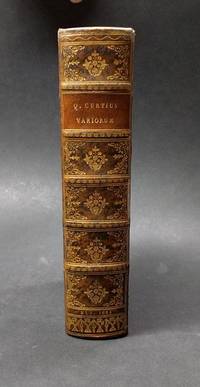
|
|
|
CLAUDIANUS
Cl. Claudiani Quae exstant. Nic. Heinsius Dan. Fil. recensuit ac notas addidit post primam editionem altera fere parte nunc auctiores. Accedunt selecta Variorum commentaria accurante C.S.M.D.
Amsterdam Amstelodami Ex Officina Elzeviriana 1665. 8vo. XXVIII91715 index p. Vellum 20 cm Ref: Schweiger 2283/84; Dibdin 1471: 'in fact the best Variorum edition'; Moss 1377: 'a very correct and valuable edition' and 'This is one of the very scarcest of the Variorum editions'; Graesse 2194; Ebert 4757; Brunet 288; Ernesti Bibl. Lat. 1774 3201: 'sed optima est ed. a. 1665'; Willems 1350: 'fort bien imprimé'; Rahir 1400; Berghman 2036; Spoelder Enkhuizen 1 p. 554 Details: Prize copy prize gone. 6 thongs laced through both joints. Gilt coat of arms of Enkhuizen within blind ruled borders on both boards. Engraved title depicting the rape of Proserpina and the battle of the Giants against the gods. The notes are printed on the lower half of the pages below the text Condition: Vellum varnished the bad result is a gleaming binding with a few brownish strokes. Gilt fading. 4 thongs on the front joint broken. All 4 ties gone. Small bookplate on the front pastedown. Name on front flyleaf Note: This is the second edition of the works of the Roman poet Claudius Claudianus produced by Nicolaas Heinsius 1620-1681 who was the only son of Daniel Heinsius. It was first published in 1650. Nicolaas never held any academic post. Let us see what Sandys tells about this genius: 'His practice in versification his wide reading in classical and post-classical Latin and his knowledge of Greek literature made him an accomplished scholar. As a textual critic he had acquired an extensive knowledge of various readings by his study of MSS'. And: 'In making his selection from the vast mass of variants he was guided by a fine taste and a sound judgement acquired by long experience'. And: 'His editions of the Latin poets laid the foundation of the textual criticism of those authors and he has thus obtained the title of 'sopitator poetarum Latinorum.' Sandys 2323/327. Heinsius consulted he says in the praefatio for his first edition some 28 manuscripts 'viginti enim & octo fere ad manum fuerunt ut vides'. Among these were 2 from the University Library of Leiden and 2 from the Bodleian. Also 2 that were in the possession of the successor of Plantin the publisher Balthasar Moretus manuscripts that were originally used for the Plantin edition of Claudian by Pulman. Antwerp 1571 Heinsius rebukes Pulman for having neglected one of these which he calls 'insignis' and 'probus'. Pulman used it sluggishly 'oscitanter'. Heinsius consulted also 3 manuscripts which the French librarian and collector of manuscripts Alexander Petavius Petau had send him one of the Royal Library one of his own and one owned by J.A. de Thou Thuanus. After his edition of 1650 Heinsius continued to consult during his diplomatic travels through Europe 10 'bis quini' other excellent manuscripts containing texts of Claudian. Heinsius gives in the new praefatio to this second edition written 14 years after the first edition 'ante annos hosce plus minus quatuordenos' a dazzling account of the books and manuscripts he consulted for the new edition. We also get a glimpse of the huge network of scholarly friends of which Heisius was a member. This second edition was published so the title says by Cornelis Schrevelius who took his doctoral degree in Paris as a Doctor of Medicine in 1627. Hence C.S.M.D. that is Cornelis Schrevelius Medicus Doctor. He taught classics at the Schola Latina at Leiden where he had been raised himself. In 1642 he succeeded his father Theodorus Schrevelius as the rector Moderator of the school. He died in 1664 a few days after having completed this edition of Claudian. He raised at least 11 kids and fell victim to the plague. A.M. Coebergh van den Braak Meer dan zes eeuwen Leids Gymnasium Leiden 1988 p. 47/55; includes also his portrait. The involvement of Schrevelius in publishing a new edition of Claudian was limited to the necessary but ungrateful task of the beast of burden. He did so the 'typographus' who must be Daniel Elzevier tells us in his short address to the reader all that is necessary for a better understanding of Claudian producing excerpts from the commentaries and editions of the best scholars Provenance: An engraved armorial bookplate on upper pastedown of one 'Joshua Ruddock': a crown with 3 strawberry leaves on it and a 'pearl' in the center of the leaves on top an eagle with spread wings. On the front flyleaf the name of Lennart Håkanson professor of Latin Literature at the Univ. of Uppsala 1980-1987 Collation: 8 26 A-3M8 3N2 Photographs on request hardcover
书商的参考编号 : 130044
|
|
|
LIBRI DE RE RUSTICA
Methodus rustica Catonis atq. Varronis praeceptis aphoristicis per locos communes digestis a Theodoro Zvingero typice delineata & illustrata.
Basel Basileae Petri Pernae opera atque impensa n.d. 1567. 8vo. XXIV4942 blank22 index p. Overlapping vellum 19 cm Ref: VD16 C 1580; Schweiger 275 Details: 2 thongs laced through the joints. Woodcut printer's mark on the title: a woman holding a oil lamp motto: 'Verbum tuum lucerna pedibus meis'. Psalm 119 verse 105 Occasional woodcut initials Condition: Vellum soiled and wrinkled. Small hole in the back and in the upper board. Front endpapers renewed in 19th century. 19th century annotations concerning Zwinger Cato & Varro on the front pastedown and recto of the front flyleaf. Title slightly soiled. Small fold in right lower corner of the title. Small stain at the bottom of the title Note: Theodor Zwinger 1533-1588 or Theodorus Zuingerus also spelled as Zwingerus or Zvingerus was of humble descent. He studied philosophy in Paris under Petrus Ramus. Supported by the printer/bookdealer Perna he later went to Padua where he studied medicin for 6 years. After his promotion in 1559 he returned to his hometown Basel and was appointed professor of Greek and Moral philosophy. In 1580 he became also professor of Medicin. He is best known for his editions of the Nicomachean Ethics of the Greek philosopher Aristotle which he published in 1566 & 1588. Griechischer Geist aus Basler Pressen no. 127 and 128 He produced also a kind of encyclopedia which was much admired in his time 'Theatrum vitae humanae' Basel 1565. As a physician and logician he published his thoughts about the agricultural works of the Roman authors Cato 234-149 B.C. and Varro 116-27 B.C. He tries to analyse their opinions and show their structures in systematic tables like he had previously done with Aristotle. At the end he publishes texts of Cato and Varro on agriculture a fact that escaped many bibliographers. In vol. 1 p. CXXXIX of the Biponti edition of the 'Scriptores Rei Rusticae' edited by J.M. Gesner 1671-1761 it is stated that the text of Cato follows the edition of P. Victorius 1543 and the text of Varro is that of J.J. Scaliger 1565 For Zwinger see ADB 45543/4 where this title is omitted. It is however mentioned in Zedler 64862/4 § Famine with war and the plague was a great problem in Italy France England and Germany during the first half of the 16th century. There were serious food shortages and outbreaks of disease in the 1520th and 1530th. This scourge reached its peak in the crisis of 1545/46 which was perhaps the most terrible year in the history of 16th century Paris. Many thousands died of hunger. This period is marked by a dramatic fall in living standards. The gravity of the situation began to be reflected in the medical and agricultural literature of that time: how to avoid disease and preserve health in times of dearth on a poor diet of gruel bread broth and beer. The French humanist schoolmaster Robert Breton whose ideas were heavily coloured by classical influences published in 1539 his Agriculturae encomium in which he emphasized the need to combine theoretical and practical learning in agriculture. 'The food produced in the countryside he pointed out was absolutely essential to the existence of the towns and the state itself'. H. Heller Labour science and technology in France Cambr. 1996 p. 66 Food especially grain was not only scarce because of the ignorance and poverty of the peasantry but also because of warfare. Towards the middle of this century the provision of an adequate food supply became urgent. 'Beyond assuring the subsistence of the population it as critical to maintaining the momentum of the burgeoning manufacturing sector of the economy. Sustaining profit margins in industry depended on controling wages. Relatively low wages were only possible if the cost of grain . could be contained. As a result one notes a growing preoccupation with agriculture among humanist authors'. Op. cit. p. 65 Between 1529 and 1550 eight Latin editions of the works of Cato Varro Columella and Palladius were published in Paris and Lyon. The result was also a flood of publications on food and crops and suggestions for the development of agriculture on a more rational basis. The basis for reform was laid by Roman gentlemen-farmers and landowners like Cato and Varro who wrote about agriculture and who were also successful practical farmers. Their aim was to bring Roman farming on a higher level. Their works on agriculture are among the chief texts on agriculture and rural life in antiquity. The oldest is the Roman politician Marcus Porcius Cato 234-149 B.C. the source of famous maxims for orators like rem tene verba sequentur and that an orator is a vir bonus dicendi peritus. 'He distinguished himself for fearless and ruthless attacks on those whose way of life did not agree with his own somewhat old-fashioned and puritanical morality'. H.J. Rose A Handbook of Latin Literature London 1967 p. 91 In style and in character he was a typical farmer shrewd hardworking frugal honest sincere but limited. His De re rustica also known as De agri cultura is a kind of commonplace book. It gives us a view of the life of an oldfashioned landowner in that age and offers information on Roman cult and rustic folklore. The second work was written by possibly the greatest scholar Rome produced Marcus Terentius Varro 116-27 B.C. Of the mass of works he wrote only one is preserved to us completely De re rustica and further more parts and fragments of some others. He was a landowner on a large scale who wrote De re rustica in his eightieth year annus octogesimus he tells us in the beginning ut sarcinas colligam ante quam profiscar e vita. It is a philosophic dialogue in 3 books in which he gives sound and practical advice for managing a farm I a stock-ranch II poultry aviary and herb-garden III. 'While giving interesting information on the state of agriculture at that time it is withal a pleasantly discursive book the work of a garrulously entertaining old scholar' H.J. Rose A Handbook of Latin Literature London 1967 p. 222 § The texts of Cato Varro and Columella were edited by Piero Vettori or Petrus Victorius 1499-1585 the foremost representative of classical scholarship in Italy during the 16th century which may well be called the Saeculum Victorianum. J.E. Sandys A history of classical scholarship N.Y. 1964 p. 135 With his publication in 1541 begins for the Scriptores De re rustica according to J.M. Gesner in his Biponti-edition of 1787 a new era the Aetas Victoriana. Vettori whom Fabricius/Ernsti calls the 'saviour' sospitator of the genre concentrated himself with the help of old manuscripts and his own wit especially on Cato and Varro Collation: alfa8 beta4 a-z8 leaves s7 and s8 blank A-I8 K4 minus leaf K4 Photographs on request hardcover
书商的参考编号 : 130040
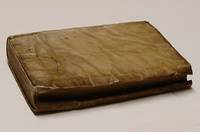
|
|
|
CURTIUS RUFUS
Quinti Curtii Rufi De rebus gestis Alexandri Magni regis Macedonum libri superstites. Cum omnibus supplementis variantibus lectionibus commentariis ac notis perpetuis Fr. Modii V. Acidalii T. Popmae Joh. Freinshemii Joh. Schefferi Christoph. Cellarii Nic. Heinsii. Selectis & excerptis Ph. Rubenii J. Rutgersii C. Barthii Joh. Loccenii M. Raderi Cl. Salmasii J.F. Gronovii M. Tellierii Christoph. Aug. Heumanni itemque Jac. Perizonii vindiciis & aliorum observationibus auctioribusque indicibus curavit & digessit Henricus Snakenburg.
Delft Leiden Delphis & Lugd. Bat. Apud Adrianum Beman Samuelem Luchtmans 1724. 4to. XXXVII8242221 p. Frontispiece folding map & 17 engraved plates. Vellum 25 cm Ref: STCN ppn 141302143; Schweiger 2323; Brunet 2450: 'édition très estimée'; Moss 2549: 'This is undoubtedly a very excellent and copious edition'; Ernesti 2352/3; Dibdin 2376/7: 'a very valuable performance and deservedly held in high respect'; Ebert 5554: 'Eine der schätzbarst. Ausgg. dieser Art'; Graesse 2311/12; Spoelder p. 580 's-Gravenhage 5 Details: Prize copy without the prize. Back with 6 raised bands. Boards with gilt borders and the gilt coat of arms of The Hague. Title in red & black. Woodcut printer's mark of Luchtmans on the title. Folding map of the expedition of Alexander plates with archaeological object mythological scenes and portraits. The catchword on the last leaf of the first gathering leaf 1cross4 verso containing the 'Dedicatio' does not connect to the heading of the next gathering 2cross4 which contains the preface Benevolo Lectori. This preface was inserted as often occured in a later stage of the production Condition: Prize removed. Vellum slightly soiled Note: 'This is one of the most valuable Editions of the Latin Classics I have ever read. Snakenburg has approved himself in this work to be a very able and judicious critic. Few editors have illustrated their authors so well'. With this quotation begins the review of Moss of this quarto Variorum edition. Like other Variorum editions it offers a 'textus receptus' which is widely accepted in this case the text published by the German scholar Johannes Casper Freinsheim 1608-1660 which appeared in 1640. The text on the upper half of the pages is accompanied with the commentary and the annotations of various specialists on the lower half These are taken or excerpted from earlier useful normative or renewing editions. Editions like this one 'cum notis Variorum' were useful but never broke new ground. The production of these sometimes overloaded vehicles of knowledge was the specialty of Dutch scholars of the 17th and 18th century. The compilers seldom were great scholars but often hard working schoolmasters. Yet Snakenburg did also some research. In a long and well-wrought introduction Snakenburg elaborates on the books he used and the scholars who helped him. He seems to have digested anything worth knowing about Curtius Rufus. He also asked permission from the University Library of Leiden to consult a 'codex antiquissimus'. He further inspected 2 other manuscripts one 'minime negligendus' and the third of a more recent date both 'codices Vossiani'. He collected readings emendations and collations from all normative sources but also e.g. annotations which he found in the margins of a book once owned by the Dutch scholar Nicolaas Heinsius 1620-1681. § Quintus Curtius Rufus probably first cent. A.D. is the author of the only surviving monography on Alexander the Great in Latin. This work consisting of 10 books did not survive in its entirety the first 2 books are lost. The text of Curtius Rufus is preceded in this edition by a rather peculiar philological accomplishment by Freinsheim. He endeavoured to repair the loss of the 2 lost books by a composition of his own a feat which was much admired by his contemporaries. He had published this addition earlier in his edition of 1640. The only thing Hendrik Snakenburg 1674-1750 ever did for scholarship is this Variorum edition. The praise and success which he earned with this one edition makes it likely that he was a good critic with a sound judgement. Snakenburg spent his life teaching classics at the 'Schola Latina' of Leiden. In 1740 he was appointed Rector. In Leiden he was befriended with the classical scholar J. Gronovius and one of the publishers of this book Samuel Luchtmans. His portrait painted by J. Houbraken in 1715 is in the possession of the 'Lakenhal' in Leiden. For Snakenburg see Van der Aa 17-2801 and NNBW 21333/4 Provenance: In pencil on the front pastedown: 'Dr. Brinkgreve'. This is Dr. Marius Roelof Johan Brinkgreve 1888-1966 a Dutch teacher of classics at the gymnasium of Utrecht 1912-1919 later till 1937 the director of 'Koninklijke Begeer' a silver-factory in the small town of Voorschoten. He was an active fascist ca. 1933 party offical of the 'Nationale Unie' and in 1934 leader of the 'Algemeene Nederlandsche Fascisten Bond'. During WW II he sided with the German oppressor. See for Brinkgreve 'Repertorium kleine politieke partijen 1918-1967'; also G. Brinkgreve 'Schrijvend in 't Aalsmeerder veerhuis opstellen van Geurt Brinkgreve' 1982 p. 93/105 with a portrait Collation: pi1 frontispiece 1-cross4 3cross1 -74 A-6P4 6Q4 minus leaf 6Q4 6R2 leaf 6R2 blank Photographs on request Heavy book may require extra shipping costs hardcover
书商的参考编号 : 140111
|
|
|
FRIESEMAN,H
Nieuw Nederduitsch-Latijnsch woordenboek door H. Frieseman lid van het Utrechtsche Genootschap van Kunsten en Wetenschappen en Rector van het Veluwsche Gymnasium te Harderwijk.
Zutphen Bij H.C.A. Thieme 1810. 8vo. 2 volumes: VIII1448 p. Contemporary boards 17 cm Details: Marbled paper on cover Condition: Binding worn especially at the extremities Note: Hendrik Frieseman ca. 1755-1821 was the last rector of the Schola Latina of Harderwijk from 1805 till 1814. The school had only 6 pupils when it closed down. The Schola Latina had become obsolete and lost pupils to the local French school; Frieseman published also the first complete translation into Dutch of Thucydides in 1786. OiN p. 372 Onderzoek naar zeventien Gelderse Latijnse scholen. Zutphen 1985 p. 287 Photographs on request hardcover
书商的参考编号 : 120134
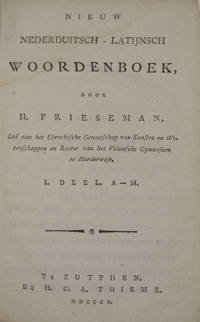
|
|
|
BERONICIUS
P.J. Beronicii Georgarchontomachia caeterorumque ejus carminum sylvula; quorum prius carmine belgico secutum. Boeren- en overheids-stryd en de overige gedichten van P.J. Beronicius welkers eerste in Nederduitsche vaarzen is nagevolgd door J.B. Waar by gevoegd is het zonderling leven des dichters; een goed aantal van Nederduitsche aanteekeningen; en een keurig zestal van fraaije koperen platen.
Te Goes & Middelburg Bij Jacobus Huysman & Jeroen van de Sande J.z. 1766. 8vo. XX178 p. Modern half vellum 22 cm Ref: Best source: C.J. Krijger 'P.J. Beronicius Boeren- en Overheidsstryd 1673'. Doctoraal scriptie 1986 Reliable: Winkler Prins 6e dr. vol. 3 p. 777; also important: Sizoo Hermeneus 8 1936 p.17/21; uncritical: Van der AA 2442/45; NNBW 888 Details: Tasteful antique style binding with a red morocco shield on the back. Frontispiece & six scenes on three plates by Simon Fokke. The frontispiece depicts the crowning with a laurel wreath by Apollo of a beggarly fellow who wears ragged clothing. In the distance we see the townscape of Middelburg in the front a pile of books and the attributes of a chimney sweep; on the plates scenes of armed and angry mobs. On the verso of the title the signature of one of the publishers J. Huysman. At the end have been added 22 pages with 'adnotationes ad Georgarchontomachiae librum 1 & 2' by Petrus Rabus followed by 20 pages filled with annotations of J.B. in Dutch Condition: A light brown stain on the lower margin of 3 leaves Note: In 1672 on the 21st of july a false rumour swept over the Dutch island of Walcheren: 'The French fleet is landing'. These were combustable times called in Dutch 'het rampjaar' i.e. the year of disasters when the Dutch Republic was besieged from all quarters. At this rumour a furious mob of armed farmers invaded Middelburg the capital of the province of Zeeland. The mob assaulted and arrested city officials considered to be traitors. In the next year a mock epic concerning this historic event was published in Amsterdam 'auctore N. Autopte' i.e. by Mr. Eyewitness. In 1676 the remonstrant minister Anthony Borremans who died in 1683 a man well versed in Greek and Latin reported in the 6th chapter of his Variae Lectiones that the author was one Petrus Johannes Beronicius. He procured also a biographic sketch of this Beronicius which seems to be the starting point of a mystification. Borremans tells that he and some gentlemen J. Antonides van der Goes Dirk Buysero Johan Frederik Gymnich once ran in Middelburg into a pityful drunk who composed Latin verse incredibly fast and on the spot. He was a man of loose morals who earned his living sweeping chimneys and grinding knives. Nevertheless this dirty little fellow 'klein roetzwart rond en dik oud en slordig gekleed' who also made strange gestures was an accomplished neolatin poet. It was said that he spoke his Latin too fast even for the classical scholar J.F. Gronovius when they met. He also spoke Greek fluently and could speak judiciously and scholarly about classical authors. This wonder of the world had witnessed the revolt of the farmers and knowing his Homer very well produced extempore a burlesque epic about the event the Georgarchontomachia. In february 1673 this colourful drunk was found dead in a ditch. The classical scholar and neolatin poet Petrus Rabus 1660-1702 published in 1691 an new edition of this satyrical follow-up of the Homeric Batrachomyomachia accompanied by a translation into Dutch and annotations. He also followed the biography by Borremans. The Latin text was published and translated once again by one J.B. in 1766. J.B. also printed the biographic sketch of Borremans and added 20 pages of notes in Dutch of his own. The biographic data of this versifying chimney sweep were reproduced indiscriminately in later biographic surveys like Van der Aa and NNBW. STCN suggests that Dirk Buysero 1644-1708 a city official of the city of Vlissingen Flushing who was one of the men who met Beronicius might be the real author. There is no evidence for this. It is even improbable. Buysero did not compose one syllable of neolatin poetry. Our guess is that it might be the scholar and soldier Joan van Broekhuizen Janus Broukhusius 1649-1707 who was an intimate friend of Buysero and Van der Goes and was himself an accomplished neolatin poet and a translator. Stylistic research is needed here. A problem is that the name of J.P. Beronicius is not an invention or concoction. There exists in the city accounts of Middelburg a record of someone bearing his name for producing some occasional verses Collation: 8 22 A-L8 M1 Photographs on request hardcover
书商的参考编号 : 130030
|
|
|
SA, MANUEL DE
Aphorismi confessariorum ex doctorum sententiis collecti auctore Emanuele Sa Lusitano doctore Theologo Societatis Iesu. Nunc accurate expurgati a Reverendiss. P.M. Sacri Palatii Apost. Indicatis Doct. locis annotationibusque per Andream Victorellum Bass. Theol. illustrati & aucti. Permissu Superiorum. Editio ultima prioribus correctior.
Köln Coloniae Apud Ioannem Crithium Sub signo Galli 1612. 12mo. IV65014 indices p. Overlapping vellum 14 cm Details: 5 thongs laced through the joints. Woodcut printer's mark of the Jesuit Order on the title Condition: Vellum age-tanned. All four ties gone. Outer edge of the first and last two leaves are slightly thumbed Note: The Portuguese Jesuit theologian and Biblical scholar Manuel de Sá 1530-1596 the latinized form is Emanuel Sa has written three important works which were repeatedly published in most European countries well into the seventeenth century: 'Scholia in Quatuor Evangelia' 'Notationes in totam Scripturam Sacram' and the 'Aphorismi confessariorum'. In 1557 he was appointed professor at the Roman College at Rome where he lectured on the prophecies of Osee one of the minor prophets and the 'Summa' of Thomas Aquinas. Pope Pius V appointed De Sa as a member of the commission in charge of preparing an authentic edition of the Septuagint. His last work the 'Aphorismi confessariorum' first published in Venice in 1595 is considered to be his most important work. In it the entries are arranged as in encyclopedias in alphabetical order. The word 'aphorism' on the title has little to do with the meaning that we give it today. For instance under the heading 'Episcopus' De Sa offers 43 quotes from different authorative sources to explain the duties and power of a bishop. In 1603 the 'Aphorismi confessariorum' were censured and placed on the 'Index Librorum Prohibitorum' of the Catholic Church in English 'List of Banned Books' a list of publications deemed heretical or anti-clerical. This was done apparently because the 'Master of the Sacred Palace' Magister Sacri Palatii thought some of its maxims not in line with opinions commonly held among catholic theologians. As the title of this 1612 edition shows it was later corrected nuper accurate expurgati and removed 'permissu Superiorum' from the Roman Index. The work was for some decades very popular. Between 1595 and 1632 almost every year somewhere a new edition was printed. The Cologne printer Crithius alone published this work in 1600 1609 1612 1615 and 1621. It was even published in Tokyo in 1603 Collation: Ò2 A-Z12 Aa-Dd12 E8 Photographs on request hardcover
书商的参考编号 : 120149
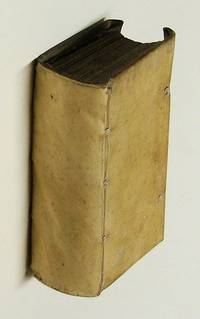
|
|
|
NEPOS
Cornelii Nepotis Vitae excellentium Imperatorum observationibus & notis commentatorum omnium quotquot hactenus innotuere illustratae. Accesserunt huic editioni praecipuorum Graeciae Imperatorum icones aeri incisae; ut & index rerum & verborum auctior & emendatior.
Amsterdam Amstelodami Prostant apud Wetstenios 1707. 8vo. XXXII including frontispiece43940 index1 blank p. Modern half calf. 19 cm Ref: STCN ppn 186438281; Schweiger 2299; Dibdin 2245; Moss 2319/20; Fabricius/Ernesti I105: 'quae locupletissima est editio'; cf. Graesse 2270 ed. Keuchenius Details: The engraved frontispiece is dated 1704 and is executed by J. Visscher depicting Clio with a pen in her hand she receives advice from Kronos who holds his scythe Fama blows her trumpet. Small engraved illustrations on 12 p. Condition: Name on the blank margin of the frontispiece. Oval stamp on the title. Paper slightly warped and yellowing Note: This is an edition with commentary of the only surviving complete work of the Roman historian Cornelius Nepos ca. 100-24 B.C. 'De excellentibus ducibus exterrarum gentium'. He is the author of the first surviving ancient collection of biographies. 'De excellentibus etc.' contains the lives of 20 Greek generals and the Carthaginians Hamilkar and Hannibal. § Nepos corresponded with Cicero and was close with Cicero's friend Atticus. The collection served probably as a model for Plutarch's 'Vitae Parallelae'. In his own days and in late antiquity Nepos was considered to be a source of importance. The churchfather Hieronymus included him in his 'De viris illustribus' 392 A.D. in his list of great authors and historians. Already in late antiquity this Nepos collection was ascribed to the grammarian Aemilius Probus and the 'editio princeps' of 1471 bears that name. § The simple style of writing of Nepos has made him a standard choice for schools. The biographies provided the pupils also models of behaviour. Schweiger mentions numerous editions. This edition is a so-called Variorum edition an edition which contained everthing a student required. Such an edition offers the 'textus receptus' which is widely accepted accompanied with the commentary and the annotations of specialists taken from earlier useful normative or renewing editions. Editions like these 'cum notis Variorum' were useful but never broke new ground. The production of this kind of editions was the specialty of Dutch scholars of the 17th and 18th century. The compilers seldom were great scholars but often hard working schoolmasters. Such a useful edition was published in 1658 in Leiden by the Hackius brothers. It was produced by the young Dutch scholar R. Keuchenius 1636-1673 who matriculated in 1654 and was later in life appointed professor of Roman History of the 'Athenaeum Illustre' at Amsterdam. The edition of 1658 was revised and augmented by an anonymous editor and republished in 1675 by the same Hackius brothers. The preface of Keuchenius to the edition of 1658 and the testimonia was repeated but now anonymously. The anonymous editor seems to be Keuchenius for the main body of his work and his own notes have been preserved. In a short 'ad lectorem' Keuchenius in 1658 and anonymous in 1675 the editor explains that he based his edition on those of Lambinus and Longolius and that he passim added selected observations of Gifanius Savarus Schottus Boeclerus Gebhardus Ernesti and Bosius. He also elucidated the Lives with passages from ancient Greek historians like Herodotus Thucydides Xenophon and Plutarch. The edition of 1675 became the model of a line of clones including the frontispiece and illustrations. It was reprinted 'verbatim' line by line page by page with the same layout and the same kind of typeface by the Blaeu brothers in 1687 probably Mortier in 1704 by Janssonius van Waesberge in 1705 by Wetstein in 1707 this edition and by Samuel Luchtmans in 1728 Provenance: On the frontispiece: 'B.L.W. Mensing'. Between In the second half of the 19th century B.L.W. Mensing exploited a boarding school in Schoonoord an estate in the Dutch city of Rijswijk. See Wikipedia Buitenplaats Schoonoord § On the title the stamp of: 'Huize Katwijk De Breul Zeist'. This school still exists and is now called Katholieke Scholengemeenschap De Breul. See Wikipedia The school was established as a boarding school in 1831 in 'Katwijk aan den Rijn' and was in 1842 transfered to the Jesuits. The school moved to The Hague in 1928 then to Noordwijkerhout in 1941 and finally in1946 to 'De Breul' an estate between Zeist and Driebergen in the province Utrecht Collation: -28; A-2G8 leaf 2G8 verso blank Photographs on request unknown
书商的参考编号 : 152704
|
|
|
EPICTETUS
Epicteti Manuale et Sententiae. Quibus accedunt Tabula Cebetis & alia affinis argumenti in linguam Latinam conversa a Marco Meibomio. Subjiciuntur eiusdem notae emendationes Claudii Salmasii in Epictetum notae illorum & alius viri docti in Dissertationes Epicteti ab Arriano digestas & varians scriptura codicum manu exaratorum cura Hadriani Relandi.
Utrecht Trajecti Batavorum Ex officina Gulielmi Broedelet bibliopolae 1711. 4to. 3 parts in 1: XX1511;124; 15259 index1 blank p. Calf. 21 cm Ref: STCN ppn 185671004; Oldfather no. 287; Hoffmann 215; Didbin 2515/6: 'The edition is a valuable and critical one'; Ebert 6775; Brunet 21012/13; Graesse 2484; P.A. Hansen 'A bibliography of Danish contributions to classical scholarship from the 16th century to 1970' Copenhagen 1977 no. 363 Details: Back gilt and with 5 raised bands. Title printed in red and black. Woodcut printer's mark on the title depicting Athena and Hermes motto: 'Suum cuique tribue'. Woodcut initials. Greek text with facing Latin translation. Last 152 pages are filled with the notes of Meiboom 1-32 the notes and emendations of the Enchiridium by Salmasius 33-48 notes and emendations by Meiboom and Salmasius 'in Arriani Epictetum' 49-98 variae lectiones 99-136 and an 'Accessio ad emendationes Meibomianas in Dissertationes Epicteteas Arriani' 137-152. The last 4 pages of the preliminary leaves are owing to a binder's error to be found in the last gathering of the book. § 'Alius' in the title is an old genitive form with a long i Condition: Cover scuffed; back rubbed; corners bumped; front joint starting to split; head & tail of the spine chafed; bookplate on front pastedown Note: There is something odd about this title. Half of the book is printed carefully with the use of beautiful Greek and Roman type and is presented in a balanced layout. The woodcut initials are sharp and elegant. The other half of the book is printed on paper of somewhat lesser quality with the use of dull and conventional Greek and Roman type. The woodcut initials are quite common and worn. This difference has its story and reflects the life and character of its main contributor Marcus Meibom. The 'fine' half was printed in Copenhagen about 40 years earlier than the other half which was printed in Utrecht in 1711. § The Danish philologist Marcus Meibom or Marcus Meibomius was born in 1630 in Tönning in Schleswig-Holstein. He was a scholar with a bad temper and a lot of ennemies. After a turbulent life he died poor in Utrecht in 1710 or 1711. He was 'one of those colourful people who despite numerous initiatives was unable to ascend in the Republic of Letters. He had achieved some fame with an edition of seven classical authors on music which he dedicated to Queen Christina of Sweden and for which he received an invitation to her court in return. He himself had reconstructed instruments from antiquity with which he tried to put on a concert for the court of the Queen; unfortunately the performance generated only hilarity and ended in turmoil. Frustrated Meiboom then attacked a friend of the Queen which forced him to leave'. D. van Miert 'Humanism in an age of science: the Amsterdam Athenaeum in the Golden Age 1632-1704' Leiden 2009 p. 88 Meibom treated everyone crudely and could never restrain his arrogance. The Dutch gentleman/scholar Nicolaas Heinsius called him a 'hungry rogue' and an 'ungrateful person'. D. van Miert p. 89 In 1653 Meibom left Sweden and entered into the service of king Frederic III of Denmark. He was made royal librarian and professor at Uppsala the next year. Michaud 'Biographie Universelle' Vol. 28 Lpz. 1843 p. 520/1 In 1668 he accepted a position at the Athenaeum Illustre at Amsterdam to give public lectures and private tuition with a salary of 1200 guilders a year. One year later in 1670 he was fired. The reason was that as Burmannus reports in a letter 'Meiboom had turned up his nose at the obligation to give private tuition to the sons of the bourgomasters'. D. van Miert p. 90 'Meiboom next dedicated himself to the military shipping trade. He reviewed a book on this subject by Johan Scheffer and wrote a book himself on antique triremes with which he left for England to convince Charles II that these antique vessels would give him supremacy at sea'. D. van Miert p. 91 Of course this untertaking was not successful. He also tried to sell his project to the French but found no one interested. His next great project in England in 1674 was the publishing of the Old Testament with his remarks on the Hebrew text of which he wanted to correct numerous passages. He shocked the English and had to return to Holland poorer than ever. Nevertheless he possessed some very valubable ancient manuscripts which he did not want to sell. He died in Utrecht where his heirs found the unfinished edition of Epictetus printed ca. 40 years before which they sold to the publisher Broedelet. He asked Hadrianus Relandus to finish it. § The part of Meibom opens with the Greek text with facing Latin translation of the Enchiridion then follow the 'Epicteti Sententiae ex Joanne Stobaeo Graece & Latine' the 'Cebetis Thebani Tabula Graece & Latine' and 'Prodicus de Hercule ex Xenophontis Memorabilium libro IIdo secundo Joa. Leunclavio interprete' a allegoric story about Hercules on the crossroads where he has to choose between Virtue and Vice. Meibom finished with 'Hippocratis Epistola' to Damagetus a long letter concerning the madness of the 'laughing philosopher' Democritus. This letter is a founding text in the history of melancholy. Relandus tells the reader in the preface that while he was working on this edition he stumbled upon a traesure thesaurum an Epictetus edition dated 1595 Oldfather 15 from the library of Meibom in the margins of which the French scholar Claude de Saumaise or Claudius Salmasius 1588-1653 had jotted down corrections and emendations to the Enchiridion. General preface leaf 2 and preface to the notes of Salmasius p. 37/38 Salmasius was in Leyden the successor of Scaliger and a prolific author and textual critic. He had produced once an Enchiridium edition himself. Amsterdam 1640 § Michaud tells about Meibom's part of this Enchiridion edition that the 'roi de Danemarck fit imprimer cet ouvrage à ses frais et fit présent de la totalité de l'édition à Meibom qui la garda plus de quarante ans dans son cabinet'. Michaud vol. 28 p. 521 The quality of the printing of Meibom's part of the book seems to affirm the story of Michaud still the question remains why Meibom had transported heavy barrels full of quality printing to Amsterdam in 1668/69 and forgot about it for the next 40 years Boter follows the suggestion of Schweighaeuser in his edition of 1798 Schweighaeuser Lpz. 1798 p. LIXV and argues that Meibom did not think his own work worthy of publication. G. Boter 'The Encheiridion of Epictetus and its three christian adaptations' Leiden 1999 p. 78 This seems hard to believe with regard to such an arrogant and headstrong character. He was very much convinced of his own genius. Graevius wrote in a letter to N. Heinsius that Meibom considered himself a better philologist than Isaac Casaubon Carlo Sigonio Gronovius and Salmasius. D. van Miert p. 91 Modesty and humility were not his strongest points. The flaws in the character of this manic man who led a tumultuous life might be the cause of the abandonment of the project. Moreover when Meibon arrived in Amsterdam and would have asked around in 1669 if someone was interested in publishing his Epictetus' Enchiridium he would have heard that in Amsterdam the publishers Boom and Ravestein were already busy producing an edition for 1670 as did the Van Gaasbeek brothers. Anyway Meibom's heirs sold part of his possessions including the barrels filled with plano sheats of a book which had never been published. The first page of the collection simply said 'Epicteti Manuale Graece & Latine'. The load of paper was bought by the publisher Broedelet who asked the Dutch scholar Hadrianus Relandus for whom he had published several titles to write an introduction and to produce some commentary and an index. 'Relandus did his best he wrote introductions to the different parts added the notes of Meibom and Salmasius which he had found among Meibom's papers and in the margins of some of his books. He added also collations of two manuscripts the 'codex Hafniensis' p. 101-119 of the second part and the 'codex Gerdesianus' p. 120-136 of the second part. That Meibom did a good job was already noted in 1711 in the periodical 'Acta Eruditorum. 'Haec editio est accurata & a mendis typographicis pura literis elegantibus & majoribus impressa'. Acta Eruditorum 1711 p. 374 Furthermore Schweighaeuser dedicates almost seven of his preliminary pages of his famous 1798 edition of the Enchiridium to this work of Meibomius/Relandus. And G. Boter deems Meibomius/Relandus worthy of incorporating them in the short list of 'Studiosi in apparatu critico laudati' of his edition of the Enchiridium published in the normative 'Bibliotheca Teubneriana' series Berlin 2007. Adrianus Reland or Hadrianus Relandus 1676-1718 was a child prodigy. At 13 he enrolled as a student at the University of Utrecht where he studied philosophy classics and oriental languages. In 1700 he was appointed professor of Oriental languages and Holy Antiquities. This 'jewel' of the university remained in Utrecht till his untimely death at the age of 41. He didnot publish much on Oriental languages but wrote some influential works on Hebrew antiquities the 'Antiquitates sacrae veterum Hebraeorum' 1708 & 1712 publisher Broedelet and 'Palestina ex monumentis veteribus illustrata' 1714 publisher Broedelet. His best known work seems to be 'De religione mohammedica' 1705 publisher Broedelet which was reissued several times and was translated into several languages. In this work he broke new ground with an honest and correct approach of this religion. As a consequence the Vatican placed it on the Index of forbidden books Provenance: On the front pastedown the remains of a woodcut bookplate. The lower part with the name of the owner has been removed. It shows the Royal arms of the United Kingdom as used by the Hanover dynasty between 1714 and 1800 during the reign of King George I II & III. See Wikipedia s.v. 'Royal coat of arms of the United Kingdom' The shield is oval and rests on a pedestal. Around the oval a belt with the motto of the Order of the Garter 'Honi soit qui mal y pense'. The oval is surmounted with a royal crown. Before the pedestal a banner with the motto of the English monarchs 'Dieu et mon droit'. Right of the shield the Unicorn and left a crowned lion. There is no royal helm beneath the crown The bookplate is probably of a royal or of a library of a public institution and dates from before 1800 Collation: -24 A-T4 2A-2P4 2Q2. A-R4 S4-T4 S-2A4 2B4 leaf 2B2 verso blank the second and third leaf of the last gathering 2B are signed 31 and 32; these 2 leaves ought to have been cut out and bound after leaf 24; we once sold another copy of this book and it showed the same binder's error Photographs on request hardcover
书商的参考编号 : 130463
|
|
|
BEROALDUS, PHILIPPUS
Varia Philippi Beroaldi opuscula in hoc Codice contenta. Orationes: praelectiones; & Praefationes: & quaedam mithicae Historiae Philippi Beroaldi. Item Plusculae Angeli Politiani; Hermolai Barbari atque una Iasonis Maini ad serenissimum Maximilianum invictissimum Rhomanorum imperatorem Oratio. Epigrammata ac ludicra quaedam facilioris musae carmina eruditissimi viri Philippi Beroaldi ab Ascensio nuper eludicata: nunc demum coimpressa & eo ordine disposita ut maxime moralia sint omnium prima. L. Coelii Lactantii Firmiani pia Nenia verbis Christi domini crucifixi sua in nos beneficia commemorantis. Item Phi. Beroaldi de septem sapientium sententiis Libellus. Eiusdem Symbola Pythagorae moraliter explicata. De optimo statu & de foelicitate. Declamatio Philosophi medici & oratoris. Declamatio ebriosi scortatoris & aleatoris. Oratio autem proverbialis caeteris apposita est.
N.pl. Basel n.d. 1513 Colophon at the end: 'Orationes & Opuscula Philippi Beroaldi Bononiensis oratoris & poetae disertissimi finiunt foeliciter Basileae exarata Anno a partu Virginis salutifero 1513 8vo. 162 leaves. Modern half pigskin over wooden boards. 21 cm Ref: VD16 B 2135; Renouard Bibliographie des impressions et des oeuvres de Josse Badius Ascensius II p. 169 Philippus Beroaldus Varia Opuscula no. 6 Details: Modern binding antique style. On the upper board has been preserved an old original strip of vellum which bears a pattern of blindstamped 5 lozenges filled with doubleheaded aegles above their heads a crown. 3 raised bands on the back. 2 clasps & catches. 2 small contemporary inscriptions of one hand on the title both references to passages in the book: 'Asinus Asinius Pollio : 90' and ' Oeconomia : 123'; most capitals at the beginning of sentences are carefully rubricated; in the margins of the first 123 pages are written many short notes mostly catchwords with the same contemporary red ink. At the end in the same hand a kind of table of content in black ink. Occasional underlinings in red ink. According to VD16 is the printer of this book Gregor Barthelomaeus a rather obscure printer Condition: title somewhat soiled; the blank verso of the last leaf has been pasted on a blank leaf probably the flyleaf of the original. On the verso of this blank leaf is written the above mentioned table of content; faint waterstain in the upper margin of the last 18 leaves Note: This edition of smaller works of Beroaldus is a reissue of an edition of his 'Varia Opuscula' published in Basel in 1509 by Gregor Bartholomaeus and Wolfgang Lachner. This supports the assumption of VD16 that Gregor Bartholomaeus is also the publisher of this 1513 edition. In 1513 the publisher added at the end to the collection an interesting letter which Beroaldus wrote in 1505 to Erasmus Vitellius Erasmus Ciolek bishop of Plozk in Poland: 'Opusculum de terraemotu & pestilentia'. Folia 146-162 In this letter Beroaldus describes the earthquake that hit his hometown Bologna on the first of January of 1505 ea nocte quam subsecutus est dies divo Silvestro dicatus its violent aftershocks and its consequences e.g. the destruction of his own house people gone mad etc. Hora circiter undecima subitarius terraemotus cum sono terrifico factus concussit urbem nostram. f. 147 verso § This editon of 1513 consists of a collection of speeches treatises and Neolatin poetry of the Italian humanist classical scholar Filippo Beroaldo Philippus Beroaldus 1453-1505. It contains for the greater part prose i.e. speeches on classical topics and examples of oratory including some pieces of Polizziano and Ermelao Barbaro. It contains also an essay on the sentences or sayings of the Seven Wise Philosophers and an important essay on the symbolism in the doctrine of Pythagoras. We find also some declamations e.g. a witty conversation of a drunk and his friends a whore-hopper and a gambler. There is also poetry e.g 'Paeanes Beatae Mariae Virginis' which is a Latin adaptation of a number of poems of Petrarca epigrams but also verse in a lighter vein facilioris musae. All poems are surrounded by commentary. § Beroaldus was professor of literature of the University of Bologna his native city from 1472 till his death. He was widely known for his erudition. His most important contribution to scholarship are his good editions of Latin Classics. He published texts and excellent commentaries of Plinius Maior Apuleius Gellius Suetonius Catullus Propertius and Plautus editions in which he proved is vast knowledge and command of Latin literature from the patristic authors to contemporary scholars. He was one of the founders a 'of new annotative miscellanistic commentary style' His latinity was rebuked because his style resembled more that of Apuleius than of Cicero. Beroaldus compiled this collection and had it printed on the request te impulsore of 'Martinus Boemus' whom he calls in the short 'praefatio' on the verso of the title his pupil. This pupil is also known as Martinus Mares Martinus Crumloviensis. He studied 6 years under Beroaldus from 1487 till 1493. Thereupon he returned home to Krumlow in Bohemia. 'Filippo Beroaldo l'Ancien' S. Fabrizio-Coast & F. La Brasca Bern Lang 2005 p. 8. The first edition of these speeches called 'varia opuscula' was published in 1491 in Bologna and was reproduced several times by the Parisian printer Badius Ascensius. The first editions produced by Ascensius from 1505 contained only the orations of Beroaldus mostly on topics of classical philology some on contemporary history. They fill the first 61 leaves of our 1513 edition. The second part of this book begins with the collection of verse. The unknown printer probably Gregor Bartholomaeus repeats on the verso of leaf 61 in the edition of 1509 leaf 62 at the beginning of this second part simply and shamelessly the title under which Ascensius had recently published nuper the poetry in Paris. The rest the last 70 leaves of the book is filled with philosophical letters declamations and treatises of Beroaldus in Latin which were likewise borrowed from previous editions of Ascensius e.g. a declamation 'an orator sit philosopho & medico anteponendus' and other usefull subjects for humanist school education. At the very end have been added 11 p. with 'Annotationes in Galenum' because so explains Beroaldus much mention was made of Galenus in the preceding chapter on 'pestilentia'. Beroaldus must have been very popular in his time. The bibliography of Renouard on Ascensius numbers 74 different editions of which 12 with the title 'varia opuscula' of his orations declamations letters and poetry in the first 20 years of the 16th century Provenance: The writer of the numerous red marginalia is unknown Collation: A-T8 V4 Y6 Photographs on request hardcover
书商的参考编号 : 130436
|
|
|
BENEDICTUS
Den regel van den Heyligen Vader Benedictus Abt ende Patriarch der Monincken in den Westen. Nieuws over-geset uyt het Latijn in de Nederduytsche tale door eenen Religieus van de Abdije van S. Salvator der Ordere van Cisteaux. Tweeden druck.
Antwerp 't Antwerpen By de Wed. vander Hey op de Meir in den H. Geest. Met Approbatie n.d. ca. 1768 12mo. 1506 p. Calf 12.2 cm Ref: A. Welkenhuysen 'Benedicti Regula belgice over bibliografie van Benedictus-vertalingen en oude drukken van de 'Regel' in het Nederduits' in Zetesis Album amicorum door vrienden en collaga's aangeboden aan Prof. Dr. E. de Strycker Antw. Utrecht 1954 p. 396-415 especially p. 412-415; Bibl. Cath. Neerl. Impr. 1954 p. 469 no. 1528'; not yet in STCV Details: Back with 3 raised bands. Gilt floral motive in the 4 compartments. Engraved printer's mark on the title depicting the radiant dove of the Holy Ghost amidst clouds Condition: Upper corners of the boards abraded. Front flyleaf removed Note: Benedictus of Nursia ca. 480 - ca. 550 A.D. is the Father of western monachism. In 519 he founded on the Monte Casino the Archabbey of the Benedictine Order. Wanting to reform monasticsm he composed ca. 540 his Regula monachorumRules for monks in which he expressed his Ora et Labora-spirituality in 73 chapters. Until this day this Regula exercises influence. 'The Rule is marked by prudence and humanity and leads by observance and obedience to the perfect following of Christ. It is safeguarded and applied by a patriarchal abbot chosen by his monks with full authority who is directed to take counsel and to care for the individual. The chief task and central act of the community is the Divine Office opus Dei which with private prayer spiritual reading and work fills the day. All monks must renounce private ownership though the monastery may own property; the regime is austere but not exacting' L. Dysinger St. John's Seminary Camarillo online article. The first translation of the Regula into Dutch dates from 1373 OiN p. 122. The oldest printed Dutch translation appeared in Bruges in 1625 and was produced by Hendrik vanden Zype since 1616 abbott of S. Andries neffens Brugghe primarily it seems for the female followers of Benedictus in Bruges. There was in that time an open conflict in Bruges between the bischop and the abbess of the Benedictinesses. The aim of this translation seems to have been to put the Benedictinesses of Bruges in their place. In the dedication of the1625 edition we are told that it was made ad utilitatem et commoditatem Religiosarum Benedictinarum. In 1629 a new updated version of this translation was published in Douai in the North of France a catholic bulwark of the Contrareformation against the spreading of the protestantism in the Low Countries. This edition was probably also produced for the Benedictinesses but now of Douai for on the title is a citation of the Church Father Athanasius Logos sôtêrias pros tên parthenon. A new translation of the Regula appeared in 1694 in Antwerp. The Flemish latinist Andries Welkenhuysen has compared the translation of 1625 with the one of 1694 and concluded that the translation was not new at all but that the anonymous Religieus van de Abdije van S. Salvator der Ordere van Cisteaux Cistercian monk of the Abbey of S. Salvator mentioned on the title simply made an aggiornamento of the edition of Bruges. This edition of 1694 was used for a second edition which was published by the widow Vander Hey in Antwerp in 1768. There is no date on the title. Welkenhuysen finds that this second edition is apart from some orthographica identical with that one of 1694. It even repeats the approbatio of 1694 at the end. The date of publication of this second edition is between 1747 the year that Coenraad Ignatius vander Hey died and his wife took over and 1772 the year the widow died. Welkenhuysen has compared all the books printed by the widow vander Hey concerning the wear of the typeface the printer's mark and the bibliographic address. He found that the widow used the copper engraving of the printer's mark of this book the dove of the Holy Ghost only for 3 books 2 times in 1756 and 1 time for this undated book. The exact same wording of the imprint 't Antwerpen by de Wed. vander Hey op de Meir in den H. Geest' occurs only once in an edition of 1768. Therefore Welkenhuysen dates this book ca. 1768. This book seems to be rare. We located only one copy in a Dutch library erroneously dated 1694 a copy in the University Library of Gent and 2 copies in the University Library of Leuven. There is not yet a copy recorded in STCV or Beledimar Collation: A-F12 G6 Photographs on request hardcover
书商的参考编号 : 120535
|
|
|
PLINIUS MINOR
Caji Plinii Caecilii Secundi Panegyricus cum notis integris Francisci Jureti Joannis Livineji Justi Lipsii Petri Fabri Conradi Rittershusii Jani Gruteri Christiani Gotlibi Schwarzii et selectis aliorum curante Joanne Arntzenio qui & suas adnotationes adjecit. Accedit Joannis Masson Vita Plinii editio tertia auctior.
Amsterdam Amstelaedami Apud Janssonio Waesbergios 1738. 4to. XXIV including frontispieceXCII4 index; 46957 index p. Half vellum 25 cm Ref: STCN ppn 186699948; Schweiger 2812/3; Dibdin 2335; Moss 2495/6; Fabricius/Ernesti 2423; Graesse 5349: 'Bonne édition'; Ebert 17374 Details: Early 20th century binding. Brown gilt morocco shield on the back. Title in red & black. Engraved printer's mark on the title depicting a mole flanked by a seating Hermes and Athena; the motto is: 'vulgo caeca vocor video sed acutius ipso' 'By the crowd I am called blind; but I see better than itself'. The frontispiece is bound after the title it is engraved by W. Jongman; on it we see on orator Plinius standing on a kind of pedestal; he is pronouncing his eulogy in the Senate in front of a statue of the emperor Trajanus; the senate is listening and someone enters with a laurel wreath for the orator in his hand Condition: paper browning and browned Note: In 100 A.D. The Roman civilian administrator Gaius Plinius Caecilius Secundus or Pliny the Younger 61-112 A.D was elected 'consul electus'. On the occasion of his entry on the position of consul Pliny pronounced in the Senate an eulogy to thank the emperor. This specimen of his eloquence survived and is known as the 'Panegyricus'. In his speech he elaborated on all the admirable actions and good qualities of the emperor Trajanus. Pliny published also 9 books of literary letters consisting of short essays character sketches and sensible observations. The letters paint the high society of the young Roman empire. The tenth book contains Pliny's correspondence with the emperor Trajan. Pliny is famous for his description of the eruption of the Vesuvius on the 24th of August in 79 A.D. He was a nephew of the encyclopedist Pliny the Elder who died observing the eruption from afar overcome by poisonous fumes. Pliny the Younger held under Trajanus a number of magistracies. In 111 or 112 he became governor of Bithynia. From here he was in constant correspondence with the Emperor. The Dutch scholar Johannes Arntzenius 1702 - 1759 had experience with Panegyrics and late Latin. In 1733 he already had edited the Roman eulogist Aurelius Victor. Later in life in 1753 he produced an edition of another Panegyricus that of the late antique author Pacatus Drepanius. Arntzenius was professor of Eloquentia and Historia of the University at Franeker since 1743. NNBW 1 179/80 Provenance: Name on front flyleaf: 'J.W. Tellegen' Collation: -34 first gathering: 1 4 frontispiece then 2 & 3 i.e. leaf pi1 of the STCN copy the frontispiece has been bound in our copy immediately after the title leaf 1; 2-34; a - m4; chi1 A-3V4 minus blank leaf 3V4 Photographs on request hardcover
书商的参考编号 : 140117
|
|
|
HUET,PD P D
Histoire du commerce et de la navigation des anciens. Par M. Huet ancien Evêque d'Avranches sous-Précepteur de feu Mr. le Dauphin & l'un des quarante de l'Académie Françoise. Seconde édition revue.
Paris Chez Antoine-Urbain Coustelier 1716. 8vo. XXIV44650 index p. Old marbled boards. 17 cm Ref: Sandys 2292/3 Details: Margins uncut woodcut illustration on the title Condition: Binding worn. Back faded. 2 old paper labels on the back. Library stamp on the title Note: The French cleric and scholar Pierre Daniel Huet 1630-1721 was coadjutor in the tuition of the Grand Dauphin the son of Louis XIV future king. He was also general editor and organiser of the wellknown series of Delphin Classics. Among patrologists he is best known for his edition in 1668 in Rouen of Origenes' 'Commentaria in Sacras Scripturas'. In the preface to this history of ancient commerce Huet explains that it was commissioned by 'monsieur Colbert ministre et sécretaire d'état'. Il ne falloit pas Monsieur une autorité moindre que la vôtre pour me faire quitter les autres études qui m'occupent . pour en entreprendre une autre si differente & vous rapporter l'Histoire du Commerce & de la Navigation des Anciens'. Colbert did so Huet tells in his quality of 'Intendant general du Commerce & de la Navigation de ce France Royaume'. Préface p. 1/2 Colbert 1619-1683 who was a kind of minister of Finance improved the state of French manufacturing and brought the economy back from the brink of bankruptcy during the rule of king Louis XIV who fought many expensive wars. Colbert succeeded in creating a favourable balance of trade and in increasing France's colonial holdings. Colbert saw that if his country wanted to compete with the Dutch Republic and England he had to promote French industry and commerce. He worked 'to ensure that the French East India Company had access to foreign markets so that they could always obtain coffee cotton dyewoods fur pepper and sugar. In addition Colbert founded the French merchant marine'. Wikipedia Colbert died in 1683 and Huet's histoire was only published in 1716 33 years after his death by the Parisian publisher François Fournier who owned according to the 'Extrait du Privilege du Roy' the right to print this title. He apparantly gave his colleague Antoine-Urbaine Coustelier permission to publish another edition. At the end of the 'Privilège du Roy' has been added 'Imprimé pour la seconde fois le 1. Sept. 1716'. p. b4 verso In the 'avertissement du libraire' immediately after the title the publisher confesses that monsieur Huet then 86 years old thought this work 'si peu convenable à son âge & à la profession' that he wanted it rather to lay buried in dust on the shelves in his 'cabinet' than publish it. It was only after the prayers of his friends lovers of literature and supporters of the interest of the state that he gave permission to publish this work of his youth. p. a1 recto & verso Huet apparantly took the trouble to revise his work and prepare it for an second edition. It was a success. It was reissued in France in 1727 and 1763 translated into English 1717 German 1763 & 1775 and Italian 1737 Provenance: Stamp on the title: 'Ex bibliotheca Comit. de Krassow-Divitz'. This book probably comes from the library of Karl Reinhard Adolph Graf von Krassow 1812-1892. There may however be other members of this noble family who once owned this book Collation: a8 b4; A-2H8 Photographs on request hardcover
书商的参考编号 : 120065
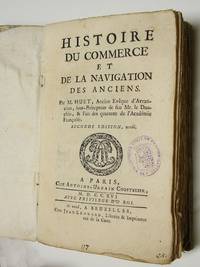
|
|
|
GELLIUS
Auli Gellii Noctium Atticarum libri XX prout supersunt quos ad libros MSStos novo & multo labore exegerunt perpetuis notis & emendationibus illustraverunt Johannes Fredericus et Jacobus Gronovii. Accedunt Gasp. Scioppii integra MSStorum duorum codicum collatio Petri Lambecii lucubrationes Gellianae & ex Lud. Carrionis castigationibus utilia excerpta ut & selecta variaque commentaria ab Ant. Thysio & Jac. Oiselio congesta.
Leiden Lugduni Batavorum Apud Cornelium Boutesteyn & Johannem du Vivié 1706. 4to. XXXVI90363 indices p. Vellum 25.5 cm Ref: STCN ppn 227931653; Neue Pauly Suppl. 2 p. 261; Schweiger 2379: 'Noch immer sehr gesuchte Ausgabe und durch die neueste Bearbeitung nicht entbehrlich gemacht'; Dibdin 1341: 'This edition . has as much literary merit as any of the Dutch editions of the classics in 4to. The notes of other critics are selected with judgment and the explanatory remarks of Gronovius must give every scholar the most exalted idea of his singular erudition'; Moss 2204/5; Fabricius/Ernesti 310: 'Haec editio repetita est'. Ernesti calls this edition 'luculenta'; Brunet 22 1524: 'Édition la meilleure qui ait paru jusqu'ici'; Spoelder p. 527 Delft 1 Details: Prize copy of the Schola Latina of the city of Delft without the prize. Back with 5 raised bands. Short title in ink in the second compartment. Gilt double fillet borders on both boards gilt fleur-de-lis in all 4 corners; gilt Y in the center of both boards. Engraved frontispiece by Goeree/Sluyter depicting the Roman author in his study at his desk; he has just started writing the first sentence of the last chapter of his book liber XX caput 11 on the role of papyrus in front of him; we read: 'P. Lavinii liber est non'; in front of Gellius are burning oil lamps; through the window one sees a moonlit Athens. Title in red and black. Engraved scene of a walled city presumably Athens on the title Condition: Vellum age-toned somewhat soiled and scratched. Small stain on the frontcover. Front flyleaf and the prize gone. Front joint partly split. Small stamp on the title. Some foxing Note: The 'Noctes Atticae' of the Roman author Aulus Gellius ca. A.D. 130 - ca. 180 contain many delightful scenes which he collected during his student days at Athens. The 'Attic Nights' is in fact a 'collection of mainly short chapters dealing with a great variety of topics: philosophy history law grammar literary criticism textual questions and many others'. . 'the great usefulness of the Noctes Atticae is derived from the preservation of countless fragments of earlier writers'. OCD 2nd ed. p. 460 § The editions of classical writers of Latin prose produced by the Dutch scholar of German origin Johann Friedrich Gronov 1611-1671 mark a epoch in the study of Livy the Senecas Tacitus and Gellius. Sandys 2319/21 He published his first Gellius edition in 1651 which is praised by Fabricius/Ernesti as 'emendatissimam'. Johann Friedrich was appointed 'professor eloquentiae' at the 'Athenaeum Illustre' of Deventer in 1642. Here he started a period of continuous and fruitful scholarly activity. In 1658 he came to Leiden to succeed Daniel Heinsius as professor of Greek and History. In 1687 the son of Johann Friedrich Jacobus Jakob Gronovius 1645-1716 who was professor of classics at Leiden from 1679 till his death produced a new edition of his father's Gellius. He added to it the commentary written by his father at an earlier date. This commentary only covers the books I-IX. In 1706 Jacobus Gronovius published another revised and augmented edition. It contains a great number of observations of Antony Thys or Antonius Thysius ca. 1603-1665 professor of 'Poiesis' of the University at Leiden and Jacobus Oiselius 1631-1686 and Johannes Fredricus Gronovius the father of Jacobus. It offers also the collations of 2 manuscripts made by the German scholar Kasper Schoppe or Gasparus Scioppius 1599-1649. Jacobus Gronovius received those collations he tells in the 'Dedicatio' from the Italian publisher/librarian Antonio Magliabechi 1633-1714 who possessed a Gellius edition once owned and annotated by Schioppius. 'Scias' writes Magliabechi to Gronovius 'igitur servari in mea Bibliotheca . Gellium ipsa Scioppii manu adnotatum & variantibus lectionibus non uno in loco illustratum'. p. 4 recto This edition also offers some 'excerpta' from the corrections of the Belgian latinist Louis Carrion or Ludovicus Carrio 1547-1595 who had published a Gellius edition in 1585 in Paris Provenance: The stamp on the title reads: 'P.C. Molhuijsen'. Philipp Christiaan Molhuijsen 1870-1944 is best known as chief librarian of the Royal Library at The Hague as editor of the Correspondence of Grotius and editor of the NNBW the 'Nieuw Nederlandsch Biographisch Woordenboek'. He studied classics in Leyden and published in 1896 a dissertation 'De tribus Homeri Odysseae codicibus antiquissimis'. In 1897 he started his bibliographic career as librarian of the Library of the University at Leiden. From 1911 on he was the leading force of the Dutch Biographic Dictionary the 'Nieuw Nederlandsch Biographisch Woordenboek' better known as NNBW. In 1921 he was appointed chief librarian of the 'Koninklijke Bibliotheek' at The Hague. He also produced the first 2 volumes of the correspondence of Hugo Grotius 1928-1937 Collation: 4 including frontispiece and title 22 3-54; A - 6F4 leaf 6F4 blank Photographs on request Heavy book may require extra shipping costs hardcover
书商的参考编号 : 150550
|
|
|
SENECA
L. Annaei Senecae Opera quae extant omnia a Iusto Lipsio emendata et scholiis illustrata. Editio quarta atque ab ultima Lipsi manu. Aucta Liberti Fromondi scholiis ad Quaestiones Naturales & Ludum de morte Claudii Caesaris quibus in hac editione accedunt eiusdem Liberti Fromondi ad Quaestiones Naturales excursus novi.
Antwerp Antverpiae Ex officina Plantiniana Balthasaris Moreti 1652. Folio. XVIXXXVI9111 blank p.; portrait of Lipsius; engraved title; a bust of Seneca and a plate of Seneca standing in a tub both plates by C. Galle after Rubens. Calf 41 cm. Ref: STCV: 6608951; Schweiger 2902: 'Gesuchteste Ausgabe des Lipsius aber nicht weiter als Wiederholung der von 1632'; Brunet 5276/77: 'Édition estimée. Les 3 premières éditions Antverpiae ex off. Plantiniana 1605 1615 et 1632 sont moins complètes.'; Dibdin 2397: 'excellent notes of Lipsius'; Moss 2578: 'it is certainly a very elegant publication'; Fabricius-Ernesti 2115; Ebert 20860: 'Beste und gesuchteste der von Lipsius besorgten Ausg.'; Graesse 6/1 348/49: 'très recherchée'; Spoelder 642 Middelburg 4 Details: Prize copy but lacking the prize. Gilt back with 7 raised bands red morocco shield in the second compartment. Borders of both boards gilt and with the coat of arms of Middelburg in the center. Portait of Lipsius engraved by Cornelius Galle. Engraved architectural title the text of it is flanked by the statues of Greek philosopher Zeno the founder of the Stoic school whose doctrine of suicide as a 'reasonable exit' from life in response to incurable disease or inexorable pain Seneca accepted and Zeno's pupil Cleanthes; in the upper frieze reside pictures of Hercules Pallas and Ulysses at the feet of Cleanthes and Zeno are the portraits of Seneca and Epictetus. The full page 'Seneca standing in his bath' is engraved by Cornelius Galle and made after the famous painting of Rubens 'the death of Seneca'. The full page portrait of Seneca was engraved after a drawing of Rubens. A smaller engraved portrait of Seneca 11.5x13.5 cm on page XXIV after the Italian scholar and antiquarian Fulvius Orsinus imago quae a Fulvio quidem Ursino prodita est. Woodcut initials. § The 'Officina Plantiniana' issued 2 'Opera' editions of Seneca in 1652. This is the second issue probably printed by Petrus III Bellerus for Balthasar Moretus. Bellerus printer's device is found on f. X6 verso and f. Y4 recto Condition: Binding somewhat scuffed and scratched. Front joint beginning to split. Head and tail of the spine chafed. Corners slightly bumped. The school prize has been removed. Edges of both flyleaves browning. Some leaves yellowing a few are browning. Faint waterstain in the right margin of the last 6 gatherings Note: The Roman philosopher and politician Lucius Annaeus Seneca ca. 4 BC - 65 AD has ever since antiquity been controversial. He was 'attacked for his Latin style his political compromises and his wealth. . Seneca . devoted himself to philosophy finally being charged with complicity in the conspiracy of Piso in 65. His suicide ordered by Nero is described by Tacitus . The death scene 'imago vitae suae' 'the image of his life' has been a significant element in Seneca's influence on posterity. . His style was urgent colourful and pointed appropriate for the fragmented ethical and political ambiguities of his time and it ultimately proved to be an effective vehicle for the Latin Church Fathers'. 'The classical tradition' Cambridige Mass. 2010 p. 873 By the 4th century Seneca's reputation as an author and as a philosopher had recovered. He is praised by Boethius d. ca. 524 and has through the works of Cassiodorus d. ca. 585 and Martin of Braga d. ca. 579 influenced medieval and Renaissance philosophy. From the 13th century onward he was widely read especially after the invention of printing. A Senecan Renaissance was advanced with the editions of Erasmus who did much to improve the text. Seneca's reputation was further enhanced by the magnificent edition of his 'Opera' produced by the Flemish scholar Justus Lipsius and published in 1605 by the Flemish 'Officina Plantiniana' lead by Balthasar Moretus. This edition and the later ones of 1615 1632 and 1652 were adorned with elaborate title pages and portraits engraved by T. Galle and C. Galle. The worth of Lipsius' editions lies in the preface and commentary. 'His commentary while economical by modern standards was fuller than that by Erasmus. Lipsius died before he could finish his commentary on 'Quaestiones Naturales'. The first edition of Lipsius' Seneca 1605 included a commentary by M.A. Muretus d. 1585 replaced by that of Libertus Fromond in later editions. The introductory paragraphs to each section of Seneca's prose were lucid concise and often enthusiastic. 'Legite iuvenes senesque!' is a frequent exhortation typical of Lipsius' primary goal which was to teach'. Idem p. 875 'Moretus had been Lipsius' student and he was a friend of Peter Paul Rubens whom he commissioned to design for the 1615 edition and its successors a portrait of Lipsius and two full-page engravings of Seneca one of an ancient bust believed to be of Seneca and owned by the artist and the other of Seneca entering the bath in which he died. The latter engraving was related to Rubens's 1608 painting of Seneca's death which further spread the fame of Seneca as a martyr to tyranny who died true to his philosophical principles'. Idem ibidem § Justus Lipsius the greatest Latin scholar of his time came in 1579 to the recently founded University of Leyden 1575 to teach Latin. He resided there with great distinction as honorary Professor of History from 1579 till 1591. According to J.E. Sandys his greatest strength lies in textual criticism and exegesis. J.E. Sandys History of Classical Scholarship N.Y. 1964 vol. 2 p. 303. Lipsius edited only Latin prose writers. He was not attracted to Latin verse. The 'Opera omnia' of this edition do not include Seneca's tragedies Collation: -24 A-C6 A-4G6 leaf 4G6 verso blank; leaf 1 portr. Lipsius 2 engraved title 23 Seneca in bath 24 bust of Seneca Photographs on request Heavy book may require extra shipping costs hardcover
书商的参考编号 : 150629
|
|
|
COLLECTIO PISAURENSIS,
omnium poematum carminum fragmentorum latinorum sive ad christianos sive ad ethnicos sive ad certos sive ad incertos poetas; a prima latinae linguae aetate ad sextum usque christianum seculum & Longobardorum in Italiam adventum pertinens ab omnium poetarum libris collectionibus lapidibus codicibus exscripta.
Pesaro Pisauri Ex Amantina Chalcographia 1766. 4to. 6 vols: XVIIILII522; IIXXXV480; IIXXIV5291 blank; IILXXIV514; IIVIII388; IIXII306 p. H.calf 27 cm Ref: Schweiger 21284; Ebert 4932; Brunet 2134; Graesse 2215 Details: Backs with 5 raised bands. Floral ornament in the compartments on the back. Edges dyed red. Engraved printer's mark on the first title it depicts a flying Fama the banner of her trumpet reads: 'Hic meret aera liber Sosiis' taken from the 'Ars Poetica' of Horace verse 345/46: 'Hic meret aera liber Sosiis hic et mare transit et longum noto scriptori prorogat aevum'. 'That is the book to make money for the Sosii; this the one to cross the sea and extend to a distant day its author's fame'. Fairglouch Loeb translation. Woodcut initials. Printed in 2 columns. 9 folding leaves of volume 4 are filled with the virtuoso 'carmina figurata' of the late antique poet Publilius Optatianus Porphyrius. The poems of a dazzling technical virtuosity are attractively printed some in red and black on folding leaves to display their ingenuous composition. See J. S. Edwards: 'The Carmina of Publilius Optatianus Porphyrius and the Creative Process' at: somegreymatter.com Condition: Backs rubbed. Head & tail of the backs somewhat chafed. Boards slightly scratched. Paper partly yellowing some gathering slightly browning. Some pinpoint and unobjectionable wormholes in a limited number of pages of volume 1 & 4 Note: The 'Collectio Pisaurensis' is dedicated to the Marquis Carlo Mosca Barzi 'protagonista della cultura Pesarese del 1700' by Paschalis Amatus Pasquali Amati teacher of the illustrious Gymnasium of Pesaro. During their talks in the last few years Amati tells us in the preface they discussed the need for a new and better edition of a corpus comprising all latin poets. The existing collections all printed outside Italy were found to be incomplete and of doubtful quality. Then the Marquis asked young Amati to produce for him a new and better corpus of all Latin poets qui Italici fere omnes & nostrates fuissent which would make Italy proud. Amati gave up his job at the Gymnasium and completed in 2 years this 'Collectio Pisaurensis' in the service of the Marquis who owned also a printing office an office which was called for this occasion after Amati the 'Amatina Chalcographia'. Amati disputes next about the faults of the previous collections of Geneva 1611 Lyon 1616 and of London 1713 which were not well organized not complete and full of typographical errors wrong readings and emendations. He then explains how he searched for new material and how he divided and classified it more logically and chronologically. He consulted important collections edited previously by Henricus en Robertus Stephanus Scriverius Scaliger Almeloveen Burmannus Gruterus and many others. Amati had the bright idea to offer the reader for each author also the biographies and bibliographical matter collected by G. Fabricius in his 'Bibliotheca Latina' 1734-1746. For the authors especially the late antique and christian ones who were not incorporated in Fabricius' bibliography Amati printed the bio- and bibliographical data that he found in the best editions of the time. Amati was not only busy in his study editing this corpus but he also supervised the printing itself. He complains about the tumultuous activity in the printing shop about the pressure of his printers and the heat of the printing type. We donot know if the publishing of the 'Collectio' was as profitable for the Marquis as for the Sosii the work of Horace but it surely extended the fame of the young editor and his noble employer because the 'Collectio' was far better and far completer that earlier editions. The first 4 volumes contain the profane latin poets up to Claudian with at the end of the 4th volume the 'Anthologia Latina'. Volume 5 & 6 contain the 'poetae christiani' with at the end of the last volume an 'Anthologia Christiana' of minor poets collected from manuscripts and inscriptions. § Pasquale Amati or Amatius 1726-1797 was a classical scholar he calls himself 'Litterarum satis expers' but also a jurist. He was professor of Roman law of the University of Ferrara. He is also known for his dissertation 'De restitutione Purpurarum' about the colour purple in antiquity Collation: the collation is sometimes irregular but consistent and complete details on request Photographs on request Heavy set may require extra shipping costs hardcover
书商的参考编号 : 150253
|
|
|
HERODOTUS
Herodoti Halicarnassei Historiae libri IX: et de vita Homeri libellus. Illi ex interpretatione Laurentio Vallae adscripta hic ex interpretatione Conradi Heresbachii; utraque ab Henr. Stephano recognita. Ex Ctesia excerptae historiae. Apologia Henr. Stephani pro Herodoto. Accedit in hac editione Spicilegium Frid. Sylburgii ad Henr. Stephanum virum clariss.
Frankfurt Francofurti Apud haeredes Andreae Wecheli 1584. 8vo. LXXII59288 p. Pigskin 18.5 cm Ref: VD16 H 2515. Weitere Nummern: VD16 C 6157 VD16 E 4005 VD16 H 2533; Hoffmann 2236; Graesse 3256; Ebert 9560 but see also 9542 Details: Latin translation only. The binding of this book is important in the context of the cultural history of Lutheranism. The binding dates from the last 2 decades of the 16th century. The back has 4 raised bands. The boards are decorated with blind stamped triple fillet borders and a row consisting of floral motives and some tiny portraits. The central panel of the upper board shows a fine example of a well preserved portrait of Johann Friedrich I the Magnanimous der Grossmüthige Elector of Saxony Kurfürst und Herzog von Sachsen 1503-1554 in full armour with 3 lines of text at the bottom: 'Victus eras acie fidei con / stantia tandem victorem / ante homines fecit et ante deum'; on the lower board the blindstamped impressive and also well preserved coat of arms of this Elector of Saxony who became after his death a kind of protestant Saint. He still is for the 3rd of March the day he died is still commemorated in the evangelical church of Germany. Because the portrait of this nobleman also figures on a book held in the Penn Libraries where it is described as 'Elector of Saxony possibly August I 1526-1586' Cicero Philosophical works 1565 copy in Rare Book & Manuscript Library Call no.: LatC C4855.10 1565 we will investigate this in some detail. Johann Friedrich I was an ardent follower of Martin Luther with whom he corresponded. He was a lifelong promotor of the reformatory movement and one of the movement's most important political leaders. Johann Friedrich was defeated and taken prisoner on the 24th of april 1547 by troops of the emperor Charles V in the neighbourhood of Mühlberg battle of Mühlberg 'mannhaft fechtend am Backen verwundet'. On this wound on the cheek and the resulting scar see below On the 10th of May he was sentenced to death. This sentence was not carried out. Johann Friedrich had however to abdicate but he refused to be converted to Catholicism. In captivity his political role came to an end but in prison he became a protestant Saint. 'Mit diesem jähen Sturzen war Johann Friedrichs politische Rolle zu Ende. Nicht aber seine politische Bedeutung für das evangelische Deutschland. Die heitere Ruhe mit dem er sein Unglück hinnahm die Unerschütterlichkeit seiner religiösen Überzeugung . machten ihn zum leuchtende Vorbilde seiner Glaubensgenossen .'. Charles V tried to force him to accept catholicism he humiliated him but 'Alles erklärte er J.Fr. habe er bisher hintangesetzt um das Wort Gottes lauter und rein zu erhalten. Obwohl er bereits Alles verloren und ein armer Gefangener geworden solle ihn doch Gott davor behüten dass er nun zu letzt noch davon abweichen die erkannte Wahrheit verleugnen und das Papstthum annehmen solle'. The duke was released in 1552 and his way home was a real triumph. 'Die Heimkehr des fürstlichen Martyrers über Nürnberg und Bamberg glich einem Triumphzuge; wohin er kam strömte das Volk ihm entgegen. . Zu Jena empfingen ihn Professoren und Studenten der neubegründeten Universität'. . Melanchthon wrote after his death: 'Die Bekenntniss und Beständigkeit Herzog Johann Friedrichs hat unsere Kirche mehr gefrommt als vielleicht die Victoria hat dienen mögen'. German quotations: ADB 14 p.326/330 In 1551 Matthes Gebel made a medal with the portrait of a bearded duke with a clearly visible scar on his left cheek. There is also an engraved portrait with a scar made in 1547 the year of the battle of Mühlberg. This scar on the left cheek which is apparantly part of the iconography of the Duke is also clearly visible on the blindstamped portrait on the front of this book. So our conclusion must be that this portrait belongs to Johann Friedrich I. The coat of arms on the backcover was made after an engraving of Lucas Cranach a friend of Johann Friedrich. In Jena there is a statue of Johann Friedrich the socalled 'Hanfried-Denkmal' to commemorate the founding of the University in 1558 of which Johann Friedrich had been the driving force. The 'Deutsches Historisches Museum' holds a number of paintings 1630 which depict the life of this protestant Saint in 28 scenes. § Wechel's woodcut printer's mark on the title depicting the winged horse Pegasus gracefully arched over a caduceus and 2 intertwined cornucopiae Condition: Cover soiled and worn at the extremities. Some damage to the head and tail of the back and to the upper board. Corners heavily bumped. 2 old ownership inscriptions on the title. Small inscription with references to Cicero on the front pastedown. Small inscription on the verso of the title. Occasional old red ink underlinings. Occasional marginalia in the Apologia probably made by Christoph Richter see below Note: This book is a reissue of a revised Latin translation of Herodotus' 'Historiae' made by Lorenzo Valla and published by the French humanist/scholar Henri Estienne or in Latin Henricus Stephanus in Geneva in 1566. Stephanus plays an important role in the history of the reception of Herodotus. In 1474 the Latin translation of Valla was first published. 1502 saw the 'editio princeps' of the Greek text. In the same time the work of the detractors and critics of this Greek historian came on the market especially Plutarch's 'De Herodoti malignitate' 1509 but also works of Aristotle Herodotus is ignorant Flavius Josephus he is a liar Strabo he likes to tell simple stories Lucianus does not tell the truth Gellius he invents stories. The supporters of Herodotus were in the minority. We only mention Cicero who called him 'Pater historiae'. When Henri Estienne was planning to publish a new revised Latin translation of Herodotus he decided to try his talents as a critic on Herodotus and wrote in his defence his 'Apologia pro Herodoto' to accompany this revised translation which was published by him in Geneva in 1566. This treatise is full of philological niceties and Latin and Greek quotations to be read by a humanist forum. See 'Henrici Stephani Apologia pro Herodoto. Henri Estienne Apologie für Herodot nach der Erstausgabe Genf 1566 herausgegeben und übersetzt von Johannes Kramer' Meisenheim am Glan Hain 1980 p. VII. A copy of this book is sold together with this 1584 edition § In the introductory letter of the German classical scholar Fredericus Sylburg we are told that this 1584 reissue was published no not for the money but because there arose a demand for a Latin translation of Herodotus from Eastern Europe 'e Pannonia superiore Boiemia & aliis quibusdam locis' leaf a2 recto. It was brought on the market not to compete with the folio edition of 1566 but for people who could not afford such an expensive book and prefered a smaller and cheaper edition 'nostra vero tenuioris fortunae hominibus' leaf a2 recto. Sylburg added he says occasional marginal notes to the text of his own and other scholars Provenance: The provenance theme of this book is Saxonian and Lutheran. 1: An old and long inscription written on the front flyleaf: 'Tout avec Dieu. Pour temoigner ma tres bonne amitie et affection que je porte a Monsr. Jean Trölschen je luy ay donne ceste livre priant de le prandre a bon gre et demeurant jusque au tombeau Son bien humble et bien affectione serviteur M. Jean Ernst Gerard Jenensis'. There are two Lutheran theologians bearing the name 'Johannes Ernst Gerhard' father 1621-1668 and son 1662-1707. Both were born and educated in Jena. The Father was appointed professor 'Historiarum' in Jena in 1652 his son taught theology in Jena and became professor in Giessen in 1700. ADB 8772 Who the receiver 'Jean' or 'Johannes' or 'Hans Trölschen' was we could not find out. § 2: On the title in old ink 'Ex libris M. Johann Rolle . Vicar'. § 3: Below the imprint an old ink inscription: 'Sum ex libris Christoph. Richteri Altenburg' continued with a verse from the New Testament in Greek: 'Hêmôn gar to politeuma en ouranois huparchei' 'For our converstation is in heaven' Ep. ad Ephesios 320. Christoph Richter 'Altenburger Baumeister' was the architect of the 'Gottsackerkirche zur Auferstehung Christi' in Altenburg. This Lutheran church was built in late renaissance style between 1639-1650. See the 'Liste der Kirchen im Altenburger Land' in Wikipedia § 4: Old ink inscription on the blank lower margin of the verso of the title: 'Hunc librum dono accepi a Dn. N. Joh. erased Christ. Ungewittero ut monumentum aeternae suae benevolentiae J.W. Riedesel'. This might be the Hessian protestant theologian Christoph Ungewitter 1681-1756 who was 'Hofprediger' of the 'Landgraf' of Kassel. ADB 39/303 The receiver of this book may be the jurist and diplomat 'Johann Wilhelm Freiherr von Riedesel zu Eisenbach' 1705-1782 of Hessian nobility. NDB 21570-72 He was 'Reichskammergerichtsassessor' in Wetzlar. Much on him is to be found in: 'Reichspersonal Funktionsträger für Kaiser und Reich' edited by A. Baumann Köln 2003. § 5: On the front flyleaf in pencil '27 december 1960' written by the Flemish linguist Walter Couvreur 1914-1996 professor of Indoeuropean linguistics at the University of Gent. The place of acquisition he wrote on the flyleaf at the end: 'Frankfurt Mineur' Collation: alpha-delta8 eta4; a-z8 A-T8 V4 leaf V3 missigned V2 Photographs on request hardcover
书商的参考编号 : 130080

|
|
|
EPICTETUS
EPIKTÊTOY Egcheiridion KEBÊTOS thêbaiou Pinaks; kai THEOPHRASTOY Êthikoi Charaktêres. Epicteti Enchiridion Cebetis Thebani Tabula; et Theophrasti Characteres Ethici. Cum versione latina. Denuo recognita & notis illustrata.
Oxford Oxonii E Theatro Sheldoniano 1670. 8vo. XV11431;9518 p. Calf 15.5 cm Ref: Oldfather 175 see also 114; Ebert 6771; not in Hoffmann; only 2 copies in the British Libraries; cf. Brunet 21012 who mentions an edition of 1707 Details: Back ruled gilt and with 4 raised bands. Black morocco shield in second compartment. Boards ruled with double fillet borders. Greek text with facing Latin translation Condition: Cover scuffed and worn at the extremes. Head of the spine gone for 1 cm. Front joint beginning to split. Corners bumped Note: This book is the first publication for the market i.e. 'real book' printed in the famous Sheldonian Theatre which was named after the Chancellor of the University and archbishop of Canterbury Gilbert Sheldon. The building a work of Christopher Wren was completed in 1668. The Vice-Chancellor of the University John Fell 'the most powerful man on the University' in those days 'persuaded Sheldon that when not in use the building might be used for printing. Composing frames and presses no less than five a large number then all built locally were moved in before the builders were out late in 1668 or early 1669'. N. Barker 'The Oxford University Press and the spread of Learning 1478-1978 Oxf. 1978 p. 15 In F. Madan's 'Oxford books a bibliography of printed works relating to the University and City of Oxford or printed or published there' Oxford 1895-1931 we found for 1670 only a few small occasional publications e.g. some epicedia funeral songs or more or less internal University documents such as the 'Parecbolae sive excerpta e corpore statutorum Universitatis Oxon. in usum juventutis academicae'. The only real book 'e Theatro Sheldoniano' in 1670 is this Epictetus/Cebes/Theophrastus edition. Madan vol. 3 1931 no. 2853 For the previous year of 1669 Madan mentions only the imprint 'e theatro Sheldoniano' for the occasional poem of Corbet Owen 'Carmen Pindaricum' a bad poem by the way which was recited at the opening of the Theatre on the 9th of July 1669. In order to understand the following search for the identity of the editor of this anonymous 1670 edition one should know that an expanded edition 'e Theatro Sheldoniano' was printed in 1680 also anonymously and another one in 1707. The 1707 edition mentions on its title an editor 'C. Aldrich' Carolus Charles Aldrich student of 'Christ Church'. Later bibliographers assumed that this same Aldrich must also have been responsible for the anonymous 1670 & 1680 editions. Now Aldrich's dates are 1681-1737. See for Charles Aldrich 'A directory of the parochial libraries of the Church of England and the Church of Wales' by N.R. Ker & M. Perkins London 2004 p. 235 s.v. Henley-On-Thames where the story of his library is told So Charles Aldrich cannot have produced the edition of 1670 nor that one of 1680. He however gives us a clue to the identity of the editor of the 1680 edition. The real editor of the 1680 edition we must conclude is most probably the classical scholar Dean of Christ Church bishop of Oxford John Fell because Aldrich tells us on page a4-recto of his 'Ad Lectorem' that he 'minime deflexisse' from 'illa Felli editione' of 1680. This could mean of course 'from the edition of the University Press led by John Fell' but this seems far fetched. More probable is that Aldrich refers to an Epictetus edition of 1680 which was produced by Fell himself. The name on the title of the 1707 edition caused later bibliographers Fabricius/Harles Bibliotheca Graeca Hamburg 1796 volume V p. 80 but also Oldfather in his 'Bibliography of Epictetus' no's 114 and 117 to ascribe the 1670 and 1680 edition erroneously to Aldrich. As shown above the almost certain editor of the 1680 edition is John Fell. On the title of the 1680 edition even the phrase on the title of 1670 'denuo recognita & notis illustrata' was copied. That it is a reprint with the addition of passages from Prodicus and Cicero not yet found in the first edition of 1670 is proved by the reproduction in 1680 of the 1670 misprint of 'viderà' for 'videre' on page A4-verso of the preface. In the preface of 1670 it is admitted that the edition is based on earlier ones especially those of Meric Casaubon and Salmasius but the editor claims to have filled some 'lacunae' and to have corrected the Greek text and Latin translation by Meric Casaubon first published in 1659 not only with the help of the printed sources but also by collating manuscripts from the Bodleian Library and the Library of the New College. A3-verso From the abundant notes of others he offers only an anthology sylva to elucidate some matters. These notes can be found at the end of the book and they number only 8 pages. The notes are brief for the editor says that he does not approve of voluminous books stuffed with unnecessary knowledge. To underline his loathing he tells the reader that he left the job of compiling this 'sylva' of notes to a 'juvenis studiosus' who had plenty of time for that cui otium magis suppetebat. A3-verso & A4-recto The tone of the writer of the preface is mature and very confident he surely is a proud and advanced scholar. This leaves us in Oxford ca. 1670 with only one person John Fell 1625-1686 a great classical scholar Dean of Christ Church bishop of Oxford and Architypographus of the University Press from 1672. He had a high reputation as a Grecian and a philologist and published editions of Cyprian Aratus Theocritus Athenagoras and other classical authors. N. Barker 'The Oxford University Press and the Spread of Learning' Oxf. 1978 p. 14-26; see also the 11th edition of the Encyclopaedia Britannica s.v. John Fell It is more than appropriate to assume that Fell produced the first 'real' book be it for students for the press of his University. For the founding of the revived Press of the University of Oxford was his work alone. Epictetus and the 2 other works in this volume have been repeatedly republished by the University Press in 1680 and 1707 already mentioned but also in 1702 1715 1723 1739 and 1804 Madan no. 2853 Madan tells about the misprint 'viderà' for 'videre' in the preface that it 'is perhaps in all copies corrected by hand'. Our copy apparantly escaped the attention of the corrector for the misprint has not been corrected. This book seems to be extremely rare. We found only 5 copies in British Libraries one in the British Library 2 in the Bodleian one in Cambridge University Library and one in Sheffield. All British university libraries hold an electronic or microfilm copy of the book. They all ascribe this edition to Aldrich except the British Library and the Bodleian. They mention John Fell. We searched in KVK for other copies and we found only 2 other copies one in the University Library Gent and one in the Royal Library of Denmark. The copy of the 'Staatsbibliothek zu Berlin' is lost owing to 'Kriegsverlust'. We found not one copy auctioned in 'Americana Exchange' Provenance: The front pastedown has once been renewed. Through the paper is vaguely visible a big bookplate Collation: A-Q8 R4 Photographs on request hardcover
书商的参考编号 : 120243
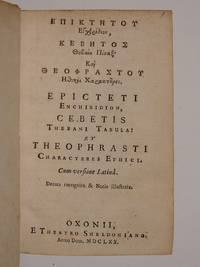
|
|
|
POEMATA PYTHAGORAE, & PHOCYLIDIS
Poemata Pythagorae & Phocylidis. Cum duplici interpretatione Viti Amerbachii. Bound with: Theognidis Megarensis Sententiae cum versione latina ita ut verbum verbo conferri possit addita earundem explicatione a Philip. Melanth. in Schola Wuiteberggensi. And: Sibyllinorum Oraculorum libri VIII. Addita Sebastiani Castalionis interpretatione Latina quae Graeco eregione respondeat. Cum annotationib. Xysti Betuleij in Graeca Sibyllina oracula et Sebastiani Castalionis in translationem suamque annotationes numeris marginalibus signantur.
Ad 1: Strasbourg Argentorati Apud Christianum Mylium 1565. Ad 2: Leipzig Lipsiae Ioannes Rhamba excudebat 1569. Ad 3: Basel Basileae Per Ioannem Oporinum n.d. Colophon at the end: 'Basileae Ex officina Ioannis Oporini Anno Salutis humanae 1555 Mense Augusto 8vo. 3 volumes in 1: Ad 1: 16341 blank p. Ad. 2: 951 blank p. Ad 3: 33321 blank p. Vellum 17 cm Ref: Ad 1: VD16 P 5452; Hoffmann 3330 not this year 1565; Schweiger 1282 also not this year. Graesse 5516. Ad 2: VD 16 ZV 19766; Hoffmann 3510; Schweiger 1316. Ad 3: VD16 S 6278; Griechischer Geist aus Basler Presse 462 but see also 460 and 461; Hoffmann 3396; Schweiger 1287: 'Enth. Verbess. aus e. Mscr. des Marcus Antimachus zu Florenz. Andere Varr. welche nicht in den Text aufgenommen sind stehen am Rande'. Brunet 5370; Ebert 21169; Graesse 6/1398 Details: Three rare texts in an unattractive binding. Ad 1: Printer's mark on the title depicting a furious swan within a laurel wreath. Ad 2: Woodcut round portrait of Melanchthon on the title. Ad 3: Greek text with opposing Latin translation; woodcut initials Condition: Vellum dyed red soiled and very worn; endpapers gone. This was a convolute consisting of 4 volumes. One of them was once removed leaving an open space exposing the 3 broad bands of an ancient manuscript to which the book has been sewn. First title soiled and with an old manuscript note in the blank margin; its right edge of the first leaves thumbed. Occasional old ink underlinings and marginalia of the hands of 2 or 3 'adolescentes studiosi'. On the last page in old ink the first 10 lines of a poem of the Hungarian humanist Janus Pannonius 1434-1472 known all over Europe 'De paparum creandorum ritu immutato' in which he ridiculed the pope Note: Ad 1 & 2: The 'gnome' or 'sententia' the pithy expression of a general thought is probably as old as human speech. In literature it is allready found in Homer e.g. the much quoted proverb 'A multitude of masters is no good thing; let there be one master'. Ilias II204 Early Greek poets among whom Theognis and Phocylides are supposed to have summarized the ethic doctrines in short 'gnomai' sayings which according to Aristotle are more credible than certain long argumentations. Famous Greek expressions of a striking thought everyone knows are 'gnôthi seauthon' and 'mêden agan'. The 'gnome' was used occasionally in poetry or prose but as a literary form it can be traced back to the Greek poets Phocylides and Theognis. Phocylides of Milete wrote hexametric and elegiac 'gnômai'. According to Suda he lived ca. 540 B.C. The 200 or so hexameters of his 'Poema nouthêtikon or 'poema admonitorium' were ascribed to Phocylides in the 16th century. It was first published under his name in 1495. In the 16th century this didactic ethical poem was a very popular schoolbook as it had been on Byzantine schools for centuries. This edition was probably also meant for young students or schoolboys it should be studied carefully by 'adolescentes studiosi'. A great number of editions almost one every year translations and commentaries were produced by schoolmasters in the 16th century. 'Die Richtung der Zeit ging recht ernstlich dahin die Jugenderziehung auf eine Vereinigung biblischer Glaubens- und Sittenlehre mit klassischer Reinheit der Form zu gründen' J. Bernays Ueber das Phokylideische Gedicht' in 'Jahresbericht des jüdisch-theologischen Seminars' Breslau 1856 p. I The 'poema admonitorium' then ascribed to Phocylides was often combined with Theognis whose work was already a schoolbook in antiquity. Was Theognis purely pagan the reading of Phocylides was more in line with biblical ethics. The christian ethics found in the work of a noble pagan poet who lived in the 6th century before Christ proved the correctness of the bible it was thought. The German classical philologist Friedrich Sylburg 1536-1596 was the first to doubt the attribution of the 'poema admonitorium' to Phocylides. And in 1606 the French genius Joseph Scaliger proved on stylistic grounds and with respect to the content that the real author was perhaps a Christian. After this the interest in the poem waned and finally it sank into oblivion. Nowadays the author is called 'Pseudo-Phocylides'. Of the Greek elegiac poet Theognis also flourishing ca. 540 B.C. survive 1389 lines. As with Phocylides there is dispute about their authenticity. 'We may conjecture that it was popular if not composed in aristocratic circles in Athens in the 5th century' C.M Bowra concludes for part of the work of Theognis. OCD s.v. Theognis Theognis' songs were probably sung at symposia during the 5th and 4th century B.C. In this time the anthology of verses was formed which has come down to us. The Greek text of Theognis and its accompanying metrical Latin translation in distichs was produced by the German classical scholar and reformer Philippus Melanchthon 1497-1560 also known as the intellectual leader of Lutheranism. At the age of 21 he became professor of Greek at the University of Wittenberg. This convolute contains also the Golden verses carmen aureum or carmina aurea which are attributed to the Greek philosopher Pythagoras. They were well known among educated readers in Antiquity. In the Renaissance the verses found like Phocylides and Theognis a place in schoolbooks. Nowadays the verses are relativily unknown among classicists. The 'carmen aureum' consists of 71 didactic hexameters. Every scholar who looked at these verses seems to have his own opinion about its author origin and date. Quot homines tot sententiae It is however clear 'from the testimonia that the Golden Verses was highly regarded in late antiquity as a concise formulation of principles of the philosophical life. The Neoplatonists starting with Iamblichus probably all used the poem as a propaedeutic moral instruction preparing the way for philosophy proper'. 'The Pythagorean Golden Verses'. With introduction and commentary by J.C. Thom Leiden 1995 p. 13 The testimonia indicate also that the authorship of the poem was already problematical in antiquity. p. 15 The editor and translator of the Golden Verses and Phocylides is the German humanist Veit Amerbach or in Latin Vitus Amerbachius 1503-1557 who was first a Lutheran but later converted to catholocism. He studied in Wittenberg where he met Luther and Melanchthon. Later he turned against his former friends. Ad 3: Interest in the oracles of the Sibyl was at its height in the sixteenth century. Before 1600 messages of this prophetess were 'widely diffused and her fame led to depiction by noted artists such as Van Eyk Perugino Pinturichio Michelangelo and Raphael and even to musical settings of her verses'. The Classical Tradition Cambr. Mass. 2010 p. 884 The first female seer known as Sibyl appeared in the 6th century B.C. in connection with Erythrae a Greek city in Asia Minor. In the first century B.C. the Roman scholar Varro listed already 10 different Sibyls. The collection of Greek prophecies of the Sibyl of Cumae Sibyllini libri the Sibylline books had an official place in Roman religion and were meant to guide the Romans through political and natural crises. In 83 B.C. the collection was destroyed by a fire in the temple of Iuppiter on the Capitolium. A new collection of ficticious oracles under the prestigious name of the Sibyls was formed in late antiquity. 'The Sibylline books that became important in the later Western tradition were the product of Jews and Christians who seized on this form of revalatory literature for their own purposes'. The Classical Tradition p. 884 These Greek hexameters proclaimed the superiority first of Judaism and then of Christianity. The verses criticized pagan gods and pagan immorality and predicted their impending doom. Christians of the East and the West used the oracles as evidence that God had employed pagan female seers to announce the coming of Christ. The Sibylline oracles were widely used by many church fathers Augustinus accepted even the Sibyl as a member of the 'City of God' because of the acrostic poem that hymned Christ's return. In the late Middle Ages new Sibylline prophecies were produced to promote forms of apocalypticism. The 16th century editors of the oracles were convinced of their religious worth and their authenticity. Italian humanists and platonists considered the oracles to belong to the 'prisca theologia'. 'But the 1599 Paris edition of Joseph Koch expressed doubts about the antiquity and authority of the verses'. A 'battle of books' ensued in the 17th century as classical scholars such as Isaac Casaubon and Richard Simon mounted arguments against the authenticity of the oracles'. Nowadays they are 'studied for what they tell us about Judaism and Christianity in the Hellenistic and Roman worlds'. The Classical Tradition p. 885 This is the third and most complete edition of the Oracula Sibyllina which the Basler publisher Johannes Oporinus produced. The first one of 1545 the 'editio princeps' of these prophecies contains the Greek text only. The second of 1546 offers a Latin translation only and the third of 1555 combines the Greek text and Latin translation. The Augsburger poet classical scholar and 'Schulrektor' Sixt Birk or in Latin Xystus Betuleius 1501-1554 is the editor of the 'editio princeps' ca. 4200 Greek hexameters in 8 books which he had found in a manuscript that the government of Augsburg had recently acquired in Venice. The manuscript he says 'recens est: eleganter quidem & splendide sed . parum orthographice scriptus'. p. 16/17 of the prefatory letter The verse collection consists of ancient pagan jewish and christian prophecies. In his introductory letter of 1545 which is reprinted in the 1555 edition Betuleius declares that he used the manuscript to elucidate many references to the oracles of the Sibyls in the 'De Divina Institutione' of Lactancius. He is convinced of the christian nature of the oracles in which the will of God has found an expression. 'Misit benignissimus Deus . suae voluntatis interpretes'. p. 8 Betuleius honestly declares that he lacks the time and the erudition to produce a commentary and a translation into Latin. 'Non dubito quin futuri sint qui his vaticiniis licet multis in locis truncatis & mutilis vel interpretatione vel enarratione sint lumen aliquod illaturi'. p. 8 The next year 1546 saw already the hoped for Latin translation of this difficult text. It was produced by the French humanist scholar Sebastian Castellio also known as Sebastianus Castalio or in French as Sébastien de Châtillon 1515-1563. He was rector of the school in Geneva but had to leave the city because he was a defender of religious tolerance and was accused of undermining the prestige of the calvinist clergy. Reduced to utter poverty he went to Basel in 1544 and began proof-reading for the publisher Oporinus and producing Greek Hebrew and Latin translations. This Latin translation the second book on the oracles which Oporinus published must have been among his first jobs for Oporinus. In 1551 Castellio published his Latin translation of the Bible. In Basel Castellio's fortunes improved and in 1553 he was appointed professor of Greek. In the dedication which precedes the translation of the oracles Castellio defends the authenticity and the divine nature of the Sibylline oracles. 'Haec igitur oracula Sibyllae' . vera sunt'. p. 18 He used for his translation the original Greek manuscript which Betuleius had sent to Oporinus and 2 other manuscripts. Castellio offers also variant readings contributed by the Italian scholar Marcantonio Antimaco or in Latin Marcus Antonius Antimachus 1473-1552 who was a prolific humanist translator of Greek texts and who was the owner of one of the two manuscripts 'qui vetus habet exemplar' p. 17. Castellio's translation of the Sibylline Oracles is 'zwar metrisch doch nicht weniger wörtlich als eine Prosaübersetzung. An einigen Stellen habe er den Text verbessern können an andern Lücken belassen oder Teilübersetzungen in Prosa bieten müssen'. Griechischer Geist aus Basler Presse no. 461 Castellio raises in his preface the problem that the Sibylline books may be forgeries 'either relatively recent ones of from the early Christian period. Both possibilities he denies saying that it would have been too difficult for any recent forger and that Ancient references to Sibyls as well as Virgil's 4th Eclogue argue against an earlier one. . At all events the publication of these texts set in motion a slow but inexorable process of textual criticism which meant that by the 17th century scholars were prepared to say that Lactantius and even St. Augustine had been mistaken in believing these oracles to be of great antiquity'. J. Britnell 'The rise and fall of the Sibyls in Renaissance France' in 'Schooling and Society' edited by A.A. MacDonald & M.W. Twoney Leuven 2004 p. 179 Castellio added also his annotations to the text. The third Oporinus edition of the Sibylline oracles of 1555 was also edited by Castellio and contains the introductions to the editions of 1545 1546 and of 1555 the Greek text of Betuleius corrected by Castellio and his Latin translation printed parallel to the Greek text. Castellio added his own notes and those of Betuleius. At the end we find the 'iudicia' of Eusebius and Augustine concerning the Acrostiches of Sibylla Erithraea; included is also the acrostichon of the Sibylla 'IESUS CHRISTUS DEI FILIUS SERVATOR CRUCS' p. 290/91 and other Sibyllan prophecies on Christ; Castellio added also a Latin verse translation of 5 1/2 pages of the so-called 'Carmen Mosis' a long prophetic poem Deuteronomium chapter 32 which is said to have found a place in the Ark of the Convenant. Castellio erroneously refers to this 'Song of Moses' as 'Exodus chapter 32'. p. 328 Collation: Ad 1: A-K8 L4 leaf L4 verso blank Ad 2: A-F8 leaf F8 verso blank. Ad 3: a-x8 leaf x8 verso blank Photographs on request hardcover
书商的参考编号 : 151943
|
|
|
PLUTARCHUS
Opuscula Plutarchi Chaeronei sedulo undequaque collecta & diligenter recognita ac in unam faciem bellatule coimpressa quorum ante praefationem patebit & numerus & series praemisso quam amplissimo & rerum & verborum indice. Addita autem sunt nuper opuscula haec duo De cohibenda iracundia & curiositate.
N.pl. Paris Vaenundantur in Officina Ascensiana 1526. Colophon at the end: 'Sub prelo Ascensiano ad Nonas Febru. 1526' Small folio. XIV191 leaves. Contemporary leather. 31 cm Ref: BP16_104378; Renouard Badius Ascensius 3 p. 175 no. 9; Hoffmann 3198/99; cf Schweiger 1264 ed. Paris Asc. 1521; Graesse 5362 Graesse forgot to mention the year 1526; Pettegree/Walsby 83345 Details: Spine with 6 raised bands. Gilt floral motives in the compartments. Ascensius's woodcut printer's device with the date 1520 on the title-page surrounded by broad woodcut borders with some allegorical scenes. The short preface of Iodocus Badius Ascensius' is dated 1521. Ca. 60 big woodcut initials Condition: Cover grazed scuffed & soiled. Foot of the spine chafed. Red morocco shield in the second compartment partly gone. Gilt stamp in the centre of both boards erased and made unrecognizable probably with sandpaper. Two old and faint ownership entries on the title. Below the printer's mark a small name has been erased resulting in a tiny hole in the paper. Lower margin of the second half waterstained. Big stain on one leaf. Foxing near the end. Lacking the last blank leaf. Some old ink underlinings and notes Note: The Greek philosopher historian and educator Plutarchus of Chaeroneia was born before 50 A.D. and died after A.D. 120. He is our most important witness of the spiritual climate of the first and second century A.D. He wrote numerous short treatises of popular moral philosophy which go under the general name of 'Moralia'. They include debating themes works in the form of question and answer and serious discussions of philosophical topics. His warm and sympathetic personality can be traced in many treatises which contain also a great deal of antiquarian knowledge picked up by Plutarchus in the course of his wide reading. H.J. Rose A Handbook of Greek literature London 1965 p. 408 The Moralia were very influential in the Renaissance. 'It is no exaggeration to say that Renaissance and early modern Europe discovered Greece and Rome through Plutarch's eyes'. The Classical Tradition Cambr. Mass. 2010 p. 748. Hoffmann mentions a great number of Greek Greek/Latin editions and Latin translations of part of the Moralia which were produced during the first half of the 16th century. The French publisher of Flemish origin Badius Ascensius 1462-1535 who was himself an accomplished Greek scholar produced between 1503 and 1526 9 different editions of treatises of the Moralia with translations of Erasmus and Guillaume Budé. The last one this edition of 1526 has Latin translations made by Erasmus Budaeus Melanchthon et alii. It copies the preceding edition of 1521 but adds at the end 8 leaves with 2 new treatises 'De cohibenda iracundia' & 'De curiositate' both translated by Erasmus. The edition contains also short introductions to several treatises written by the leading scholars of that period Provenance: 2 faint and illegible names on the title one word recognizable as 'Anthonii' Collation: â8 ê6 a-z8 A8 minus A8 a blank leaf Photographs on request hardcover
书商的参考编号 : 140127
|
|
|
PLAUTUS
M. Accius Plautus ex fide atque auctoritate complurium librorum manuscriptorum opera Dionys. Lambini Monstroliensis emendatus; ab eodemque commentariis explicatus. Nunc denuo plurimis quae in praecedentibus editionibus irrepserant mendis repurgatus; multisque in locis in gratiam antiquariorum illustratus. Additi quoque sunt duo indices copiosissimi. Prior verborum locutionum & sententiarum; posterior eorum quae commentariis D. Lambini continentur.
Geneva Coloniae Allobrogum Apud Petrum & Iacobum Chouët 1622. 4to. VIII92051 index1 blank p. Calf 25 cm Ref: Schweiger 2765; Fabricius/Ernesti 118; Moss 2461; Ebert 17188; cf. GLN 15-16 no. 3810; cf. Dibdin 2310/11; Graesse 5328; Ebert 17188 Details: Back with 4 raised bands. Gilt letterpiece in the second compartment. Boards blindtooled. Title with woodcut architectural borders. Occasional woodcut headpieces and initials Condition: Binding very scuffed that is: hinges cracked head & tail of the spine chafed back rubbed boards scratched corners bumped outer edge of upper board abraded. Paper age-toned occasionally foxed. Small inscription on the front flyleaf Note: The French scholar Denys Lambin Dionysius Lambinus in Latin 1520-1572 earned his fame in the field of Latin scholarship with his great editions of Horace 1561 Lucretius 1564 and Cicero 1566. He was 'Professor Regius' of Greek at the 'Collège de France' from 1561 till his death. The 19th century English editor and commentator of Lucretius H.A.J. Munro ranks him as one of the best scholars of his time. He says that 'The quickness of his intellect united with his exquisite knowledge of the language gave him great power in the field of conjecture and for nearly 3 centuries his remained the standard text'. Munro DRN 4th ed. vol. 1 p.14/15. Lambinus' 'reading was as vast as accurate and its results are given in a style of unsurpassed clearness and beauty' Munro adds. In 1576/77 4/5 years after his death appeared at last his edition of the comedies written by the Roman playwright Plautus 250-184 B.C. It is his last great work in which he showed great critical learning and ability to discover hidden meanings and innuendo. He fell ill exhausted by the weight of his studies and had only time to complete 13 of the 21 plays. This is told in an address to the reader by Iacobus Helias or Jacques Hélias or Jacques Hélie who was the successor of Lambinus as 'Regius professor' of Greek literature from 1572 till 1590 and who completed the work of his colleague. The difficulties Helias says in collating manuscripts mending the text of Plautus and writing a commentary are enormous. The text is corrupt and deformed by mistakes and there is a host of different readings caused by the ignorance and negligence of later generations. Helias lists the humanist scholars who shared with Lambinus their observations on difficult places not forgetting himself. Lambinus had not left his work on Plautus ready to print. Helias completed the work partly by transcribing what remained of the observations of Lambinus on the subsequent comedies. He complemented what was left open and supplied and corrected many quotations. Sometimes he had to work out what Lambinus had only sketched. Finally Helias added 2 indices one for the text of Plautus and the other for the commentary. Lambinus collated for his edition a number of manuscripts and collected many passages from the ancient grammarians. This is how Lambinus' Plautus is valued in modern scholarship: 'Many valuable emendations go back to Denis Lambin .; his later comments reveal that he had lost energy and acumen due to his ailments'. Plautus Vol. 1 Loeb Classical Library no. 60 Cambr. Mass. 2011 p. CXIV. Lambinus' successor Helias left no trace in the history of scholarship except for completing the work of his colleague. This edition of 1622 produced by Chouët is a reissue of this important edition of 1576/77. Provenance: Written on the front flyleaf: 'Sum H. S.s J.U. doctoris anno 1642'. Who the 'juris utriusque doctor' was who acquired this book in 1642 we cannot decipher; he was probably a Dutchman or someone from the Rhine valley for the same hand wrote at the top of the same page: 'Emptus quatuor florinos'. § In another hand: 'Ex Biblioth. V. Ampl. J. van Buuren' Collation: q4 A-Z8 Aa-Zz8 AA-KK8 LL4 MM-PP8 QQ2 leaf QQ2 verso blank Photographs on request hardcover
书商的参考编号 : 140110
|
|
|
SCALIGER,JJ J J
Illustriss. viri Iosephi Scaligeri Iulii Caes. à Burden F. Epistolae omnes quae reperiri potuerunt nunc primum collectae ac editae. Caeteris praefixa est ea quae est De gente Scaligera; in qua de autoris vita; & sub finem Danielis Heinsii De morte eius altera.
Leiden Lugduni Batavorum Ex officina Bonaventurae & Abrahami Elzevir 1627. 8vo. XXIV8871 blank p. Limp restored vellum 18 cm Ref: STCN ppn 840010095; Willems 288; Berghman 1393; Rahir 253; Smitskamp Scaliger Collection 166; Graesse 6/2289; Ebert 20438 Details: Elsevier's printer's mark on the title depicting an old man who stands in the shade of a vine- elmtree symbolising the symbiotic relationship between scholar and publisher; the motto: 'Non solus' probably indicates the interdependency of publisher and scholar Condition: Binding recently restored antique style. Vellum soiled. Endpapers renewed. Old and small ownership entry on the title. Edges of the title and last leaf and the tip of the upper corner of first & last 2 leaves skillfully restored. Last 2 leaves slightly soiled. Some faint pencil Note: The place of Josephus Justus Scaliger 1549-1609 in the history of classical scholarship is royal. His preeminence is summarized masterly in the blurb text of the dustjacket of the intellectual biography of Anthony Grafton 'Joseph Scaliger A study in the history of classical scholarship' Oxford 1983/93. 'In an age of great classical scholars Joseph Scaliger was the greatest. His early work as an editor of Latin texts won the attention of the learned throughout Europe and contained technical innovations that remain of interest. His later work as the founder of the discipline of historical chronology involved him in the superhuman task of trying to reconstruct every sophisticated calender and to date every significant event in human history. Along the way he emended hundreds of corrupt passages in classical texts collated scores of manuscripts quarrelled with dozens of his rivals failed humiliatingly . to prove that he was descended from the della Scala of Verona - and dashed off in his spare time works that would remain standard for centuries like Gruter's Corpus of inscriptions the publication of which Scaliger oversaw. His work was perhaps most important in that it showed that the Bible and the events it recorded could not be understood except in the light of the writings of the pagans and the methods of classical scholarship'. In 1593 he filled the vacant place left by Justus Lipsius at the young the University of Leiden. 'His disinclination to lecture was duly respected; all that the authorities at Leyden desired was his living and inspiring presence in that seat of Protestant learning' Sandys p. 202. On this honorary post he produced works that made him immortal and lend lustre to Leyden and its Universtiy. Scaliger spent the last 16 years of his life in Leiden as the jewel of the University. There he enjoyed also the friendship of a great numbers of pupils and admirers. To his circle belonged H. Grotius D. Heinsius the Dousae and in France Du Thou and Casaubon. Scaliger died in the arms of his favourite pupil and closest friend Daniel Heinsius who wrote a funerary oration for him. The correspondence reflects his relations with contemporary scholars and scientists and the scholarly circles in which he moved. He corresponded with Salmasius Heinsius Casaubon Lindenbrogius Gruter Lipsius Labbaeus and many others. Scaliger had inherited from his father Julius Caesar Scaliger a profound belief in his descent from the noble Veronese family Della Scala. The correspondence opens with a 58 page letter addressed to Dousa and is on this matter 'De vetustate gentis Scaligerae in qua & de vita utriusque Scaligeri'. Here Scaliger tries to prove his princely descent Provenance: Old ownership entry on the title of one 'J. Bridges' who also contributed some small marginalia in a clear and legible hand Collation: 8 24; A-3I8 3K4 Photographs on request hardcover
书商的参考编号 : 130434
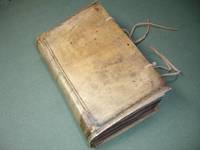
|
|
|
SCALIGER,JJ- J J
Prima Scaligerana nusquam antehac edita cum praefatione T. Fabri.
Utrecht Ultrajecti Apud Petrum Elzevirium 1670. 8vo. X1011 blank p. Modern half vellum 16 cm Ref: Willems 1605: one of the few Elzevier-editions from Utrecht; Rahir 1782; Berghman 1339; Not in the 'Scaliger Collection' Smitskamp Leiden 1993 only mentioned in the register p. 128. Not in Brunet Graesse or Ebert Details: Boards with marbled paper. Woodcut printer's mark on title depicting a celestial sphere Condition: Small stamp on the title Note: The place of Josephus Justus Scaliger 1549-1609 in the history of classical scholarship is royal. His preeminence is best understood from the entry which the French classicist Isaac Casaubon made in his diary after the death of this great man: 'Exstincta est illa seculi nostri lampas lumen litterarum decus Galliae ornamentum unicum Europae'. His erudition was considered by his contemporaries to be a wonder of mankind. 'He not only exhibits a remarable aptitude for the soundest type of textual emendation; but he is also the founder of historical criticism. His main strength lay in a clear conception of antiquity as a whole and in the concentration of vast and varied learning on distinctly important works' Sandys History of Classical Scholarship p. 199-204. He was one of the first to point the way to a sounder method of emendation founded on the genuine tradition of MSS. In 1590 he filled the vacant place left by Justus Lipsius at the young the University of Leiden. 'His disinclination to lecture was duly respected; all that the authorities at Leyden desired was his living and inspiring presence in that seat of Protestant learning' Sandys p. 202. On this honorary post he produced works that made him immortal. His immortality was further ensured by the publication after his death of the Prima Scaligerana a collection of table conversations in which observations of great scientific value can be found and which is an exeptional and much-quoted source in the historiography of the late humanistic republic of letters. The complicated history of this Prima Scaligerana and Secunda Scaligerana is explained best online at The Warburg Institute research/projects/scaliger/scaligerana. The table conversations were originally penned down by a friend of Scaliger the medicin François de Saint-Vertunien Franciscus Vertunianus. 'Soweit sie also mündliche Aeusserungen Scaligers enthält umfasst die Sammlung die Periode 1574 bis 1593.' . Nach Vertunians Tode 1607 blieben diese Aufzeichnungen unter seinen Papieren in Poitiers liegen bis sie um das Jahr 1669 ein dortiger Advokat de Sigogne an sich brachte und dem Tanaquil Faber nach Saumur zur Herausgabe schickte'. BernaysJ. Joseph Justus Scaliger Berlin 1855 p. 232 They left the press in Saumur in that same year under a fake imprint i.e. 'Groningae apud Petrum Smithaeum 1669' this to escape the attention of the authorities of the church and the state. This work was edited by the French classical scholar Tanneguy Lefebvre or in Latin Tanaquillus Faber 1615-1672. In the short preface to this work M. Lefebvre explains also why this edition was called: Prima Scaligerana. That was because the edition of another collection of Scaligerana which was published a few years earlier 1666 & 1668 contained material of a later date than his edition. The Dutch printer Pieter Elzevier one of the last Elzeviers of this celebrated family of booksellers publishers and printers of the 17th century published in 1670 this reissue of the Groningen edition of 1669. There exists an editio altera priore emendatior with the imprint Ultrajecti Apud Petrum Elsevirium 1671 which is however a counterfeit executed in France and considered a false Elsevier Collation: A-G8 Photographs on request hardcover
书商的参考编号 : 120508
|
|
|
DESRIVIERES, DIT BOURGUIGNON,F
Loisirs d'un Soldat du Régiment des Gardes Françoises. Seconde édition revue corrigée & augmentée. Broché 1 liv. 10 sous And: Réponse de l'auteur à différentes critiques dont on a honoré Ses Loisirs. Bound with: Réponse des Soldats du Régiment des Gardes Françoises aux Loisirs d'un Soldat du même Régiment.nd
ad 1: A Amsterdam & se trouve à Paris Chez Saillant Libraire rue Saint-Jean-de Beauvais 1767; ad 2: N.pl. 1767. 8vo. 2 volumes consisting of 3 parts bound in 1 volume: 1174;48 p. Contemporary wrappers. 18 cm Ref: Cf. Cioranescu 23764 & 23765 Details: Uncut edges. Woodcut ornament on both titles. Some woodcut headpieces Condition: Marbled cover scuffed. Paper on the back partly gone. Somewhat dog-eared Note: The most important evolution in European warfare of the 17th century was the expansion of its armies. This development started about 1630 rose to a high level during the French wars of expansion 1660-1710 and continued in the 18th century. The increase in scale made it necessary to professionalize logistics administration and the recruting of soldiers. Most countries formed standing armies. This brought an end to the undisciplined mercenary armies of uncertain loyalty and strengthened the grip of the central governments on the military. The result was a further knitting together and a growing identification between the nation and its armed forces. The first Military Academies were established and the compulsory conscription of young and able citizens was organized. The officer's corps consisted predominantly of loyal noblemen who found in the army a vehicle for their ambitions. Source R. Lesaffer Europa: een zoektocht naar vrede 1453-1763 en 1945-1997. Leuven 1999 p. 315-317 § This book anonymously published in 1767 was written by an officer of the Régiment des Gardes Françaises the infantery regiment of la Maison du Roi of France the core of the French army and also responsible for guarding the exterior of the Versailles and for maintaining public order in Paris. The aim of this officer was to civilize his colleagues and soldiers of the French army. The occupation of a warrior is he says a noble and grave one. p. 10 However the reputation of the French army he continues is lousy. 'Sans les excès auxquels nos Troupes ont été capables de se porter nos diverses Campagnes au-delà des Monts auroient eu des suites plus heureuses; la France compteroit peut-être la Hollande au nombre de ses Provinces; les Allemands nous aimeroient & notre nom seroit honoré chez nos autres voisins'. p. 12 The French soldier should not rape and plunder but he should behave himself. 'Un Soldat tel que le demande de la gloire & l'interêt de l'Etat est un homme qui se fait un devoir de suivre sa Religion d'aimer sa Patrie qui sait marcher à l'ennemi & le combattre'. p. 15/16 He should love his country and his Monarch. 'Quelque soin que prenne l'amour-propre de grossir notre mérite à nos yeux l'attachement sacré des François à leur légitimes Souverains doit être regardé comme la seule qualité solide qui les distingua de tous tems des autres peuples' p. 28 The role of the École Militaire is important. 'C'est dans ce temple de Mars que sont conservés avec dignité les restes précieux d'un peuple de Héros qui ne connurent point d'autre fortune que celle de l'Etat c'est-là que croissent sous les yeux de Minerve de jeunes Hercules . c'est de là que sortiront des Officiers . & que le Soldat n'appercevra en eux aucun des vices ni des ridicules qui sont les suites d'une éducation campagnarde ou efféminée'. p. 32 The identity of the author of this book is revealed by the French author and philosopher Voltaire already in the September issue of the Mercure de France of 1767. There we find on p. 29: a 6 line poem announced as 'Vers de M. de Voltaire au sieur Desrivières Soldat du Régiment des Gardes-Françoises de la Compagnie De la Tour à l'occasion d'un livre intitulé: Loisirs d'un Soldat &.: 'Soldat digne de Xénophon / Ou d'un César ou d'un Biron / Ton écrit dans les coeurs allume / Un feu d'une héroïque ardeur; / Ton Régiment sera vainqueur / Par ton courage & par ta plume'. Not much is known about this Ferdinand Desrivières dit Bourguignon. Desrivières was born in 1734 in the Bourgogne and was an officer sergent who wrote in his spare time his Loisirs to instruct and enlighten his fellow officers. He signed the preface to this treatise with DRS. Des RivièreS His Loisirs was first published in Paris by the publisher/librarian Charles Saillant in 1767 and found several reissues. It was translated into German in 1770. In the same year of its first publication 1767 an augmented second edition was published in Amsterdam. Desrivières added a short continuation in which he discussed several reviews of his Loisirs. He later published also an Essai sur le vrai mérite de l'Officier 1769 which was republished in 1771 under a new title: Suite des loisirs d'un Soldat. Guerrier d'après l'Antique et de bons originaux modernes. In 1770 he produced a Compliment des Gardes françoises à Msgr. le Dauphin sur son mariage to congratulate the crown prince the later King Louis XVI and his wife Marie Antoinette. He did so en vers grivois. The Amsterdam edition was possibly produced in cooperation with the Huguenot publisher Marc Michel Rey 1720-1780 who resided in Amsterdam and published many titles of French philosophers. Rey and Saillant had e.g. previously collaborated in the production Du Contrat Social of the French philosopher J.J. Rousseau. The description of the Bibliothèque National calls the Amsterdam address of this 1767 edition fake and observes that the book was produced with permission tacite. The first part of this second edition of the Loisirs p. 9-132 is a line for line reissue of the first edition of Paris 1767. Only the preliminary pages are printed with different type face. The remaining pages p. 133-174 contain the added observations of Desrivières concerning reviews of the first edition. From the same press comes the second volume the Réponse des Soldats du Régiment. These 3 parts are seldom found toghether in one volume. The Regiment of Desrivières was disbanded on the 31th of August in 1789. Voltaire praises Desrivières as we have seen sky-high Xenophon Caesar but his contemporary the philosopher Denis Diderot 1713-1784 one of the editors of the famous Encyclopédie thought otherwise. He condems him utterly the man and his style. We cite his opinion on Desrivières' Essai sur le vrai mérite de l'officier of 1769: 'C'est l'ouvrage d'un homme qui a nuls principes aucune conséquence dans l'esprit; qui ne sait pas penser et qui ne sait encore moins écrire insolent et bas insultant l'étranger et les subalternes flattant ridiculement les grands; qui se déchaine contre ceux qui croient aux revenants et qui croit aux vertus hériditaires qui recommande la bonne institution des jeunes gens et qui cite à la page suivante le mérite de Duguesclin qui ne savait pas lire. C'est l'ouvrage d'un homme sans goût et dont les pages sont farcies des plus ridicules citations en vers. Avec tout cela il est si doux de lire des propos ou des actions qui font honneur à l'espèce humaine que je ne mépriserais pas celui qui pourrait aller jusqu'à la dernière page de ce livre et cela me serait arrivé si l'on ne m'eût prévenu que votre colporteur ne reprenait pas les livres coupés'. Fragments inédits de Diderot Revue de l'Histoire littéraire de la France 1ère année no. 2 1894 p. 169 The loyalty to the House of Bourbon according to Desrivieres essential for the courage of the French soldier desintegrated rapidly at the beginning of the French Revolution. 'The sympathy shown by the Gardes Françaises for the French Revolution at its outbreak was crucial to the initial success of the rising.' Wikipedia s.v. Gardes Françaises. There was desertion in June 1789 and on the 14th of July mutinous Gardes Françaises took part in the storming of the Bastille. What role the 55 year old if he was still alive Desrivières played in this history doesnot tell Collation: pi1 A8 B4 C8 D4 E8 F4 G8 H4 I8 K4 L4 M2; N8 O4 P8 Q1; A8 B4 C8 D4 Photographs on request unknown
书商的参考编号 : 120530
|
|
|
CAPELLE,AG VAN A G
Commentatio de Regibus et Antiquitatibus Pergamenis.
N.pl. n.d. Amsterdam 1842 VIII172 p. 1 plate with coins 1 folding lithographed map. Contemporary blue stiff wrappers. 28 cm Note: The Dutch schoolmaster Arend Gerard van Capelle 1795-1852 was conrector and later rector of the Gymnasium of Amsterdam the precursor of the 'Barlaeus Gymnasium'. His dissertation of 1817 was on Hellenistic history 'De Zenobia Palmyrenorum Augusta'. He published also an edition of Terentius 'P. Terentii Afri Comoediae quas ad fidem optimarum editionum denuo castigavit illustravit edidit Arentius Gerardus Van Cappelle' Amsterdam 1838. unknown
书商的参考编号 : 152696
|
|
|
COLUTHUS
KOLOUTHOU HARPAGÊ HELENÊS. Coluthi raptus Helenae. Recensuit ad fidem codicum MSS. ac variantes lectiones et notas adiecit Joannes Daniel a Lennep. Accedunt eiusdem animadversionum libri tres tum in Coluthum tum in nonnullos alios auctores.
Leeuwarden Leovardiae Ex officina Guilielmi Coulon Illustr. Frisiae Ordd. & Acad. Typographi colophon: Typis J. Brouwer Franequerae 1747. 8vo. XXVI1271 blank;2151 colophon p. Vellum 20 cm Ref: STCN ppn 156632918; Hoffmann I471; Brunet 2173/74; Ebert 5018; Graesse 2231 Details: 6 thongs laced through both joints. Title in red & black. Greek text with facing Latin translation and critical notes on the lower part of the page. The second part of the work consists of 2 books with a commentary on Coluthus and a third on several other Greek authors Condition: Vellum showing the patina of its age. Free endpapers gone. Edges of first leaves thumbed. Paper yellowing the title page somewhat browning Note: The second edition of the OCD 1970 is rather negative about the Greek epic poet of Egyptian origin Coluthus or Colluthus ca. 5th cent. A.D. His only surviving work the 'Rape of Helena' an epyllion of 392 hexameters is deemed uninspired and clearly influenced by Nonnus. Dibdin in his famous bibliography and much later H.J. Rose in his 'A Handbook of Greek literature' did not take the trouble of mentioning him at all. The 11th edition of the Encyclopeda Brittanica of 1910 volume VI finds the poem 'dull and tasteless devoid of imagination a poor imitation of Homer and it has little to recommend it except its harmonious versification based upon the technical rules of Nonnus'. The RE volume XI of 1922 col. 1099 s.v. 'Kolluthos' is harsh and finds his poetry 'Machwerk sprachliche und sachliche Stümperei'. Nowadays Coluthus' poetry is rehabilitated. Der 'Neue Pauly' volume 3 of 1999 is positive. Coluthus is called 'ein vollendeter Künstler' who imitates Homer. 'Der Tradition hellenistischer Dichtung folgend wendet er die stilistischen Regeln der 'imitatio' der 'variatio' und der 'oppositio in imitando' an'. NP s.v. Kolluthos In 2010 Coluthus' poem was upgraded to 'a short and charming miniature epic'. GriffinJ. 'The Cambridge Companion to the Epic' Cambr. 2010 p. 28 § The 'Rape of Helena' tells the story of the Trojan prince Paris and Helena the wife of the Spartan king Menelaus from the wedding of Peleus and Thetis the judgement of Paris the elopement of Helena from Sparta till the arrival of Paris and Helena in Troy and as we all know 'Helenae raptus belli Trojani causa habendus'. The young Dutch scholar Johannes Daniël van Lennep born in Leeuwarden in 1724 chose to produce this edition of Coluthus to finish his studies under Valckenaer and Schrader at the University of Franeker. He did not edit Coluthus to rehabilitate him or because he liked his poetry it has nothing to recommend itself he says in the preface. His edition is proof of his competence as a scholar on the threshold of a scholarly career. Praefatio page V The professor of Greek at Leyden University Tiberius Hemsterhuis who Van Lennep much admired and under whom he wanted to continue his studies once called the work of Coluthus 'corruptissimum simul et mutilum'. Idem p. VI Van Lennep produced his Coluthus to show him that he was able to amend this corrupt text. Idem p. VII He thanks his professor Valckenaer for giving him his collation of an important manuscript the Vossianus. He thanks also Jacobus Philippus d'Orville 1696-1775 since 1730 professor Greek of the 'Athenaeum Illustre' of Amsterdam and the young scholar David Ruhnkenius 1723-1798 for their collations of important manuscripts which they consulted in the libraries of Florence Paris Milan and Hamburg. Idem p. XI & XIII. On stylistic grounds he dates the poem not long after Nonnus and Tryphiodorus. Idem p. XX See for Van Lennep J.G. Gerretzen's dissertation 'Schola Hemsterhusiana' Nijmegen-Utrecht 1940 p. 312-329 Van Lennep studied under Hemsterhuis another 5 years. In 1752 he was appointed professor of Greek and Latin at the University of Groningen. He died in 1771 in Franeker Collation: 8 24 1 leaf signed 25; A-H8 leaf H8 verso blank; 2A-N8 2O4 Photographs on request hardcover
书商的参考编号 : 130319
|
|
|
CUPERUS,G
Gisb. Cuperi Harpocrates sive Explicatio imagunculae argenteae perantiquae quae in figuram Harpocratis formata representat Solem. Ejusdem Monumenta antiqua inedita. Multi auctorum loci multae inscriptiones marmora nummi gemmae varii ritus & antiquitates in utroque opusculo emendantur & illustrantur. Accedit Stephani Le Moine Epistola de Melanophoris.
Utrecht Trajecti ad Rhenum Apud Franciscum Halma Acad. Typogr. 1687. 4to. VIII29414 index p. frontispiece 6 plates of which 5 folding text engravings. Vellum. 20.5 cm Ref: STCN ppn 833724266; Brunet 6 no. 22603; Cicognara 3212; Ebert 5512; Graesse 2308 Details: 5 thongs laced through both joints. Engraved frontispiece it depicts Harpocrates standing on a pedestal around him gods like Apollo Hermes Serapis and Isis and in the foreground Tempus who shovels for Egyptian antiquities. Title printed in red and black. Woodcut printer's mark on the title motto: 'vivitur in genio' 'only through his genius man survives'. 3 woodcut headpieces 3 cul de lampe vignettes text engravings on 39 pages small woodcuts on 2 pages; 6 plates depicting ancient monuments Condition: Vellum soiled and slightly stained. Front flyleaf gone Note: This title of 1687 is a philological tour de force of the Dutch classical scholar Gisbertus Cuper or Cuperus in Dutch Gijsbert Kuiper 1644-1716. He was professor of Latin and Greek literature at the 'Athenaeum Illustre' of Deventer from 1668 till 1681 and at the same time mayor of this old city which once had been a member of the Hanseatic League. Cuper has his own lemma on Wikipedia in Dutch only. In this title Cuper examines a deity of Egyptian origin Harpocrates who was imported into Rome in the second century B.C. and who was connected with the mystery cult of the Egyptian goddess Isis. Cuper's research began he tells us in the preface with a small silver statuette which he saw in the famous collection of his friend and scholar Johannes Smetius whom he visited in 1674 in Nijmegen. The statuette was found in the ground of the collector's hometown Nijmegen. It is a sculpture of a small boy almost naked and with a lotus flower on his head. He is winged and wears a small quiver on his back; the boy holds the index finger of his right hand against his lips as if to enjoin silence. p. 1: 'manus dextrae digito indice premit vocem & silentia suadet' From his right arm hangs a small bucket situla and around his left arm coils a snake. His left hand rests on a club around which another snake coils and to which a goose has been attached. At the boy's right foot sits a rabbit or hare. At his left foot a small bird of prey accipiter vel alia avis. p. 2 As soon as Cuper saw this aenigmatic figurine he decided to examine it for he could not imagine that all those attributes had been added without any intention. He recognized the boy from a Egyptian hieroglyph as Harpocration whom Egyptian superstition brought to Rome. He immediately realized also that this boy did not ask for silence non silentium tantum digito suadens but that he represented the Sun verum Solis imaginem referens. p. 2 In the rest of the book Cuper closely examines all the relevant passages concerning Harpocrates' iconography in ancient authors in mythology on gemmae coins inscriptions amulets etc. to prove his point that Harpocrates's finger was misunderstood from the Roman scholar Varro to Augustine and that the boy was not a diety of Silence at all. The boy did not ask for silence he argues but was a representation of the rising sun because the ancient Egyptians greeted and honoured it's appearance by pressing their index finger against their lips. The 'Harpocrates' was first published in 1676 in Amsterdam 'apud Theodorum Pluymer'. This 1687 edition is a reissue considerably augmented with 'Gisberti Cuperi Monumenta antiqua inedita' ca. 70 pages in which Cuper discusses recent finds. He offers a description and image of the finds and tries to explain matters with the help of ancient sources and the work of contemporary scholars. At the end has also been added 'Ad Gisb. Cuperum De Melanphoris epististola' 30 pages written by the French orientalist Stephanus Le Moine 1624-1689 who lectured in Leiden from 1676. His letter is a treatise on the black clothes melamphoroi which the members of the Isis fraternities wore when they lamented the fate of their goddess. This book of Cuper is tough reading the Latin is difficult and it abounds in philological pedantry. The Latin text of the second part of the book Cuper's 'Monumenta antiqua inedita' can be found on: stilus.nl/cuper/ where one can also download a translation of it into Dutch by Leo Nellissen who is an expert on Smetius Collation: 4 including frontispiece; A-Z4 Aa-Pp4 Qq2 Photographs on request hardcover
书商的参考编号 : 151911
|
|
|
CLAUDIANUS
Cl. Claudiani Quae exstant. Varietate lectionis et perpetua adnotatione illustrata a Io. Matthia Gesnero. Accedit index uberrimus.
Leipzig Lipsiae In officina Fritschia 1759. 8vo. 2 volumes: XIV p. p. 1-400; 2401-720; 222 index2 blank. Vellum. 20 cm Ref: Neue Pauly Suppl. 2 p. 178: 'enthält . nützlichen lat. Komm.'; Schweiger 2184: 'Im wesentlichen ist der Text der Ausg. von Heinsius 1650 wiederhohlt aber auch dessen spätere Emendationen u. ältere Ausgg. zu Rathe gezogen. Die kurzen Anmerkgg. erläutern trefflich den Sinn die Sprache u. die Sachen'; Dibdin 1471/72: 'A work so recommended . will not make the student hesitate long about the necessity of procuring it.'; Moss 1377: 'undoubtedly a very excellent and valuable edition'.; Ebert 4759; Brunet 288; Graesse 2194; Not yet in VD18; Fabricius/Ernesti 3202 Details: 2 thongs laced through the joints. Back ruled gilt and with a black shield in the 'second' and 'fourth compartment'. Endpapers and edges marbled Condition: Vellum age-tanned and slightly soiled. The edges of the shields on the back damaged. The boards of volume 1 are slightly outstanding volume 2 more so. Foxed paper somewhat browning Note: The Roman poet Claudius Claudianus ca. 400 AD 'war ein sehr fruchtbarer temperamentvoller Dichter und bietet reichen historischen Stoff in rhetorischem Stil'. Buchwald Tusculum-Lexikon 3rd ed. p. 171/172 As 'tribunus et notarius' he acted as court poet eulogizing the emperor Theodosius his general Stilicho and the emperor's sons Honorius and Arcadius. In 400 he was honoured with a bronze statue on the Forum Trajanum in Rome and a rich bride selected for him by Stilicho's wife. He is the last representative of the classical tradition of Latin poetry. 'In diction and technique he bears comparison with the best Silver Age work but his considerable gifts of invective description and epigram are offsett by a deplorable tendency of over-elaboration. His writings are a useful . historical source for his period'. OCD 2nd ed. p. 245 Claudianus died ca. 404. § His work was widely read in the Middle Ages. The humanists also placed him on the center stage. In the beginning of the 20th century philologist lost interest but since the rise of interest in late antiquity in the sixties he is again recognized as one of the great Roman poets. This edition of Claudian of the German classical scholar Johann Matthias Gesner 1691-1761 gives evidence of sound scholarship but just like his many other editions of ancient authors of Gesner the edition does never break new ground. It just is a testimony of solid current knowledge. Textual critiscism was not Gesner's strongest point. His notes are excellent and learned well calculated to illustrate the poet. The edition contains erudite prolegomena a literary history of Claudianus 'variae lectiones' and a useful account of editions. Gesner earned lasting fame with his epoch-making lexicographic work especially with his revised edition of the 'Dictionarum seu Latinae linguae thesaurus' of Robertus Stephanus London 1734. Wilamowitz calls Gesner the 'Praeceptor Germaniae' 'denn er hat die Leipziger Thomasschule zu einer Musteranstalt gemacht . und ihm bleibt der Ruhm das erste philologisches Seminar gegrundet zu haben'. U. von Wilamowitz-Moellendorff 'Geschichte der klassichen Philologie' Leipzig/Berlin 1921 p. 42 Collation: a-c8 chi1 'addenda emendanda' after leaf a1; A-Z8 Aa-Bb8 chi1 title second volume Cc-Zz8 Aaa-Nnn8 leaf Nnn8 blank Photographs on request hardcover
书商的参考编号 : 152315
|
|
|
CEBES
KEBÊTOS THÊBAIOU PINAX. Cebes des Thebaners Gemählde mit erklärenden Anmerkungen und einem vollständigen Wortregister. Für Schulen bearbeitet von Johann David Büchling.
Meissen Bey Karl Friedrich Wilhelm Erbstein 1796. 8vo. 176 p. Contemporary boards 18 cm Ref: VD18 11454512; Hoffmann 1443; not in Graesse or Ebert Details: Schoolbook with an introduction of 34 p. At the end an index verborum of 54 p. Greek text on the upper half of the page German notes on the lower half Condition: Cover worn at the extremities. Paper slightly yellowing. Two ownership inscriptions on the front endpapers Note: The dialogue Cebetis tabula dates from the first century A.D. it was attributed to the philosopher Cebes a student of the Athenian Socrates. In it an ancient temple painting which caught the attention of two visitors is explained by an old man. It is an allegorical picture on which the dangers and temptations of human life are symbolically represented. It shows that happiness can only be reached by a proper education and a virtuous life. This once popular ethical work is now almost forgotten. But in the 16th 17th and 18th century it was widely read especially by clerics and schoolboys. This edition of Büchling is meant for beginners is told in the introduction. Experience in Privatuntericht and in the classroom has learned Büchling the usefulness of this text. § The German schoolmaster Johann David Büchling 1762-1811 was born in Halle. He produced school editions of a great number of Roman and Greek school authors e.g. Sallustius Aesopus Palaephatus Cicero Anacreon Theophrastus and Nepos Provenance: On the front pastedown 'Bibl. Scholae Cathedr. Gustrov acc. 1812'. Güstrow is a small city in Mecklenburg Vorpommern. The Cathedral School Domschule had a large library which was dispersed after WW II. The building from 1575 still exists. On the flyleaf difficult to read: 'Wilhelm . Ludewig Land Grübenhagen den 26ten Märtz 1797' Collation: A-L8 Photographs on request hardcover
书商的参考编号 : 120525
|
|
|
DIOGENES LAERTIUS
Diogenis Laertii De vita et moribus philosophorum libri X. Recens ad exemplar Graecum collati ex eiusque fide cura doctissimorum virorum restituti & emendati. Cum indice nominum ac rerum locupletissimo.
Paris Parisiis Apud Hieronymum de Marnef sub Pelicano Monte D. Hilarii 1560. 12mo. 59628 index2 epilogue 'Candido Lectori'1 woodcut illustration1 woodcut printer's mark of De Marnef p. Later vellum 13 cm - The greatest known source of information about the philosophers of antiquity Ref: Hoffmann 1569; Graesse 2397 erroneously dating 1561 Details: 2 thongs laced through the joints. Woodcut printer's mark of De Marnef on the title BaTyR no. 28133 depicting a pelican on his nest feeding his young with his own blood; the motto is: 'In me mors in me vita'. On the last page another version of De Marnef's printer's mark BaTyR no. 2882 now depicting a griffon that holds in its claw a cubic weight to which is attached a winged globe. The cube stands for constancy and the globe for fortune; the motto is: 'Virtutis et gloriae comes invidia'. Marnef used this version of his mark only at the end of the books he printed; This printer's mark very closely resembles that of the Lyonese printer Sébastien Gryphius only the motto is different. Greek text and a Latin translation. Condition: Vellum somewhat age-toned. Short title in ink on the back. Front flyleaf removed. Stamp on front pastedown and on the title; tiny hole in outer margins of title; 4 tiny holes in last leaf; Binder's error: he bound leaf X7 p. 333/4 probably a cancel before leaf X3 Note: This is according to Graesse a repetition of the edition of 'De vita et moribus etc.' edited by Johannes Boulierius Jean Boulier Lyon 1556. We compared both works and conclude that Graesse is more or less right. The typesetter of the 1560 edition had most probably the 1556 edition before him. He repeats even the printed marginal remarks and annotations. But there are occasionally minute differences in the Greek text and sometimes the 1560 edition adds an explanatory marginal remark. In book 7 p. 340 in the life of Zeno Criticus for instance we found a printed 'varia lectio'. There 1556 has only therizonti 1560 adds in the margin: ' Forte erizonti contentioso'. In 1556 the number 58 is quintaginta & octo in 1560 Duodesexaginta. p. 425 & 342 In the epilogue dated 1560 we read that we have here a text revised and ameliorated with the help of a manuscript 'cuius quamvis mutili veritate & fide non pauca restituenda emendandaque curavit Hieronymus Marnefius Parisiensis Typographus'. Leaf 2Q7. This activity is confirmed in the 'Extrait du Privilège du Roi' which grants Marnefius the exclusive right to publish this text 'Lequel auroit esté nouvelement reveu visité corrigé additionné & augmenté' for the next six years. Leaf A1 verso which is the verso of the title Immediately after this privilege and preceding the Latin translation we find a 3 page letter of Fr. Ambrosius addressed to Cosimo de' Medici. This letter is meant to assure the reader that this 1560 translation is a reliable old and often printed one based on the translation that was made by the Italian priest theologian and Hellenist Ambrogio Traversari O.S.B. Cam. also known as Ambrosius Traversari or Ambrosius Camaldulensis 1386-1439. He worked between 1424 and 1433 on this translation which came to be widely circulated in manuscript form and was only published in Rome in 1472. In this dedicatory letter Ambrosius Traversari tells us that he translated the 'Lives of the Philosophers' at the request of Cosimo de' Medici. 'Tibi . hoc opus dedicatum fuit qui & autoritate tua in primis nos ad illud impulisti'. p. 5 The 'Lives of the Philosophers' of the Greek author Diogenes Laertius who probably lived in the first half of the 3rd cent. A.D. is a compendium full of biographies of the ancient philosophers from Thales to Epicurus and their doctrines. Diogenes Laertius drew his material from earlier compilations. His reliability and value differ from passage to passage. Some give invaluable information other passages offer mere caricature. OCD 2nd ed. p. 348/49 It 'provides not a systematic analysis but rather a eulogistic narrative of the course of ancient philosophy . of the four main classical schools the Academy Peripatetics Stoics and Epicureans. Anecdotal and perhaps largely apocryphal in nature still it gave to Renaissance humanists some conception of ancient philosophy especially of Platonic and Epicurean thought'. Ch.L. Stinger 'Humanism and the Church Fathers: Ambrogio Traversari 1386-1439 and Christian antiquity in the Italian Renaissance' Albany 1977 p. 71 Provenance: On the front pastedown a green stamp of 'Univ. Doz. Dr. Mag. F.F. Schwarz Professor. A 8810 Graz Panoramagasse 2A' with a handwritten date of acquisition '1973'. Franz Ferdinand Schwarz was from 1982 till 1996 professor of classical philology at the University of Graz where he was born in 1934. He died in his hometown in 2001 after a long illness. See his wikipedia lemma 'Franz Ferdinand Schwarz' On the title an old almost illegible stamp of the University of Ferrara showing a tree in its center and part of the legend 'Università di Ferrara' Collation: A - 2Q-8 Photographs on request hardcover
书商的参考编号 : 120058

|
|

 ?????????
 ?????PDF???
 RSS feed
 ??
??


