|
EINSTEIN, ALBERT (+) P. EHRENFEST.
Zur Quantentheorie des Strahlungsgleichgewichts.
Berlin Julius Springer 1923. 8vo. Entire volume 19 and 20 of "Zeitschrift für Physik" bound in contemporary black half cloth with gilt title to spine. Library stamp to title-page and paper label pasted on to lower part of spine. Minor wear to extremities. A nice and clean copy. Pp. 301-6. Entire volume: IV 426 pp. <br/><br/><em>First edition.Weil 138; Schilpp-Shields 178.The volume also contains:Meitner Lise. Ueber eine mögliche Deutung des kontinuierlichen beta-Strahlenspektrums. Pp. 307-321.Pauli W. Zur Frage der Zuordnung der Komplexstrukturterme in starken und in schwachen äusseren Feldern. Pp. 371-88. </em> hardcover
Bookseller reference : 43840
|
|
|
EINSTEIN, ALBERT (+) P. EHRENFEST.
Zur Quantentheorie des Strahlungsgleichgewichts.
Berlin Julius Springer 1923. 8vo. Bound in contemporary half cloth with gilt lettering to spine. Library stamp to front free end paper and titel page. In "Zeitschrift für Physik" bd. 19. Fine and clean. Pp. 301-6. Entire volume: IV 415 pp. <br/><br/><em>First edition.Weil 138; Schilpp-Shields 178.The volume also contains:Meitner Lise. Ueber eine mögliche Deutung des kontinuierlichen beta-Strahlenspektrums. Pp. 307-321. </em> hardcover
Bookseller reference : 48937
|
|
|
EINSTEIN, ALBERT.
Zur Quantentheorie der Strahlung. - FOUNDING LASER PHYSICS.
Leipzig S. Hirzel 1917. Royal8vo. Bound in contemporary half calf with gilt lettering to spine and 5 raised bands with ornaments in gilt. In "Physikalische Zeitschrift" Bd. 18 1917. Spine and hinges with wear otherwise a fine and clean copy. Pp. 121-128. Entire volume: XI 1 604 pp. 14 plates. <br/><br/><em>The paper was first published in 1916 in Mitteilungen der Physikalischen Gesellschaft in Zürich but here for the first time in Physikalische Zeitschrift. All subsequent research on absorption and emission of radiation and the entire discovery of the maser later the laser was based on the research presented in the present paper. The paper is also notable for introducing the concept but not the name of the photon; Einstein argues that in the interaction of matter and radiation there must be in addition to the processes of absorption and spontaneous emission a third process of stimulated emission. If stimulated emission exists then he can derive the Planck distribution for blackbody radiation and without it the same argument implies the invalid Wien-distribution theory."In this paper he derived Planck's original quantum law from a different starting point he suggested that as well as spontaneous emission and absorption there could also take place the process of stimulated emission. In 1917 this seemed mainly of theoretical interest; forty years later it was utilized to provide the maser and laser of modern technology. In 1916 "Einstein came back once more to blackbody radiation and made further progress. In November 1916 he wrote to Besso: 'A splendid light has fallen on me about the absorption and emission of radiation'. His reasoning is divided into three papers two of which appeared in 1916 and the third one early in 1917 the two papers above - note that these are the two papers of Einstein on radiation theory cited by Weil as "principal works"; a third paper from 1916 is not. In these papers Einstein proposed a statistical theory of the interaction between atoms and photons gave a new demonstration of Planck's radiation theory and introduced the concept of 'stimulated emission' providing the basis for the discovery of masers and lasers " Bertolotti The History of the Laser."When Einstein returned to the radiation problem in 1916 the quantum theory had undergone a major change. Niels Bohr's papers had opened a new and fertile domain for the application of quantum concepts-the explanation of atomic structure and atomic spectra. In addition Bohr's work and its generalizations by Arnold Sommerfeld and others constituted a fresh approach to the foundations of the quantum theory of matter. Einstein's new work showed the influence of these ideas . He had found still another derivation of Planck's black-body radiation law an "astonishingly simple and general" one which he thought mightproperly be called "the derivation" 12 of this important law. It was based on statistical assumptions about the processes of absorption and emission of radiation and on Bohr's basic quantum hypothesis that atomic systems have a discrete set of possible stationary states. The proof turned on the requirement that absorption and emission of radiation both spontaneous and stimulated suffice to keep a gas of atoms in thermodynamic equilibrium. This paper introduced the concept of stimulated emission into the quantum theory and is therefore often described as the basis of laser physics. Einstein himself considered the most important contribution of this work to be not the new derivation of the distribution law but rather the arguments he presented for the directional character of energy quanta. DSB Weil No 91 with an asterix denoting major paper. </em> hardcover
Bookseller reference : 46895
|
|
|
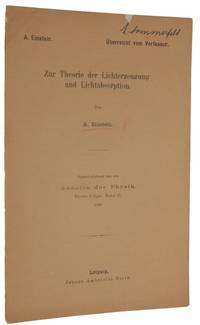
EINSTEIN, Albert
Zur Theorie der Lichterzeugung und Lichtabsorption. Offprint from Annalen der Physik 4. Folge 20. Bd. 1906
Leipzig: Johann Ambrosius Barth 1906. First edition. <p>EINSTEIN ON HIS LIGHT-QUANTUM HYPOTHESIS</p> . <p>First edition very rare author’s presentation offprint “Überreicht vom Verfasser†from the library of the great German physicist Arnold Sommerfeld of this brilliant follow-up to Einstein’s landmark 1905 paper on the photoelectric effect for which he was awarded the 1921 Nobel Prize in physics. “Thomas Kuhn has argued that it is not to Planck in 1900 but to Einstein in 1905 that we owe the origins of quantum theory†Cassidy. In the 1905 paper ‘On a heuristic point of view concerning the production and transformation of light’ Einstein had explained the photoelectric effect—the emission of electrons from a metal when irradiated by light—by making the revolutionary proposal that light rather than consisting of continuous waves was instead made up of discrete particles of energy “light quanta†which transferred their entire payload of energy to an electron on impact. In the 1905 paper Einstein made use of Planck’s formula for blackbody radiation which had introduced the concept of energy quantization. “In a companion paper published in 1906 offered here Einstein exposed appeal to the quantum as fundamentally counter to the ethos of classical physics: ‘the theoretical bases on which Planck’s radiation theory rests are different from those of Maxwell’s theory’. Planck had not initially intended to quantify light-radiation itself but Einstein demonstrated that his own ‘light-quantum hypothesis’ was implicit in Planck’s earlier work†Honner p. 31. “At first Einstein believed that the light-quantum hypothesis was merely ‘heuristic’: light behaved only as if it consisted of discontinuous quanta … In his 1906 paper Einstein used his statistical mechanics to demonstrate that when light interacts with matter Planck’s entire formula can arise only from the existence of light quanta—not from waves†Cassidy. As Einstein stated when he published the 1905 paper “Planck’s theory of radiation seemed to me in a certain respect the antithesis of my own. New considerations which are presented in section 1 of this paper demonstrated to me however that the theoretical bases on which Planck’s radiation theory rests are different from those of Maxwell’s theory and of electron theory. The difference furthermore is precisely that Planck’s theory implicitly makes use of the light-quantum hypothesis†p. 199 of the present paper translation from Kuhn p. 182. Later in the paper p. 203 Einstein is forced to make the following assumption: “Although Maxwell’s theory is not applicable to elementary resonators the average energy of such a resonator in a radiation field is the same as that which one would compute from Maxwell’s theoryâ€. “That statement marks the emergence of the basic paradox of the old quantum theory. The theory has recourse to both Maxwell’s equations and those of classical mechanics but its further formulation is incompatible with one or both of those classical theories. Other physicists were to exploit the resulting inconsistency as an argument against any form of quantum discontinuity and Einstein himself was deeply disturbed by it … But neither he nor anyone else was successful in finding a classical resolution of the quantum paradox. When two decades later Bohr and others found a way to resolve it Einstein was unable to accept their fundamentally non-classical interpretation†Kuhn pp. 184-185. RBH lists 4 other copies: in the offprint collections of Einstein himself Christie’s June 17 2008 lot 100 Richard Green Christie’s June 17 2008 lot 101 Hans Albert Einstein Christie’s June 14 2006 lot 264 and Harvey Plotnick Christie’s October 4 2002 lot 105. This copy was presented by Einstein to one of the leading physicists of the time surely hoping to make himself known in the scientific world when he was still a technical expert in the Swiss Patent Office.</p> <br /> <p>Provenance: Arnold Sommerfeld 1868-1951 his signature and characteristic numbering in red pencil ‘8’ on front cover. “The son of a physician Sommerfeld was educated at the University of Königsberg. After teaching briefly at the universities of Göttingen Clausthal and Aachen he was appointed professor of physics at the University of Münich in 1906. Sommerfeld should have retired in 1936 in favour of his pupil Werner Heisenberg. Opposition from the Nazi party to Heisenberg’s appointment prolonged Sommerfeld’s tenure and it was not in fact until late 1939 that he finally retired to be succeeded not by Heisenberg but by Wilhelm Müller a Nazi aerodynamicist without a single publication in physics to his credit. Although Sommerfeld and Heisenberg were not Jewish they were regarded by the Nazis as Jewish sympathizers. Sommerfeld however survived the war and returned to his Münich chair in 1945 continuing to work at physics until he died in a car accident in 1951†Oxford Reference. “Arnold Sommerfeld was one of the most distinguished representatives of the transition period between classical and modern theoretical physics. The work of his youth was still firmly anchored in the conceptions of the nineteenth century; but when in the first decennium of the century the flood of new discoveries experimental and theoretical broke the dams of tradition he became a leader of the new movement and in combining the two ways of thinking he exerted a powerful influence on the younger generation. This combination of a classical mind to whom clarity of conception and mathematical rigour are essential with the adventurous spirit of a pioneer are the roots of his scientific success while his exceptional gift of communicating his ideas by spoken and written word made him a great teacher†Max Born p. 275. </p> <br /> <p>“Einstein started to study black-body radiation well before 1905. Mach’s Wärmelehre which Einstein read in 1897 or shortly thereafter contains two chapters on thermal radiation culminating in a discussion of Kirchhoff's work. Kirchhoff showed that the energy emission spectrum of a perfectly black body defined as one absorbing all incident radiation at a given temperature is a universal function of the temperature and wavelength. He inferred that equilibrium thermal radiation in a cavity with walls maintained at a certain temperature behaves like radiation emitted by a black body at the same temperature. </p> <br /> <p>“H. F. Weber Einstein’s physics professor at the ETH attempted to determine the universal black-body radiation function. He made measurements of the energy spectrum and proposed an empirical formula for the distribution function … anticipating Wien’s formulation of the displacement law for black-body radiation. Weber described his work in a course at the ETH given during the winter semester of 1898-1899 for which Einstein registered. </p> <br /> <p>“By March 1899 Einstein had started to think seriously about the problem of radiation. In the spring of 1901 he was closely following Planck’s work on black-body radiation. Originally Planck had hoped to explain irreversibility by studying electromagnetic radiation but came to recognize that this could not be done without introducing statistical elements into the argument. In a series of papers published between 1897 and 1900 Planck utilized Maxwell’s electrodynamics to develop a theory of thermal radiation in interaction with one or more identical charged harmonic oscillators within a cavity. He was only able to account for the irreversible approach to thermal equilibrium by employing methods analogous to those Boltzmann used in kinetic theory. Planck introduced the notion of ‘natural’ that is maximally disordered radiation which he defined in analogy with Boltzmann’s definition of molecular chaos … </p> <br /> <p>“Planck calculated the average energy of an oscillator by making assumptions about the entropy of the oscillators that enabled him to derive Wien’s law for the blackbody spectrum which originally seemed well supported by the experimental evidence. But by the turn of the century new observations showed systematic deviations from Wien’s law for large values of temperature. </p> <br /> <p>“Planck in 1900 presented a new energy density distribution formula that agreed closely with observations over the entire spectrum … this expression now known as Planck’s law or Planck’s formula involves a new constant h later called Planck’s constant. To derive this formula Planck calculated the entropy of the oscillators using what Einstein later called ‘the Boltzmann principle’: S = k log W where S is the entropy of a macroscopic state of the system the probability of which is W and k is ‘Boltzmann’s constant’. Following Boltzmann Planck took W proportional to the number of ‘complexions’ or possible microconfigurations of the system corresponding to its state. He calculated this number by dividing the total energy of the state into a finite number of elements of equal magnitude and counting the number of possible ways of distributing these energy elements among the individual oscillators. If the size of the energy elements is set equal to hv where v is the frequency of the oscillators an expression for the entropy of an oscillator results that leads to Planck’s formula .</p> <br /> <p>“In the 1905 paper Einstein showed that the expression for the volume dependence of the entropy of radiation at a given frequency is similar in form to that of the entropy of an ideal gas. He concluded that ‘monochromatic radiation of low density behaves thermodynamically as though it consisted of quanta of energy which are independent of one another’ … Einstein opened the paper by pointing out the ‘fundamental formal distinction’ between current theories of matter in which the energy of a body is represented as a sum over a finite number of degrees of freedom and Maxwell’s theory in which the energy is a continuous spatial function having an infinite number of degrees of freedom. He suggested that the inability of Maxwell’s theory to give an adequate account of radiation might be remedied by a theory in which radiant energy is distributed discontinuously in space. Einstein formulated ‘the light quantum hypothesis’ that the energy of a light ray emitted from a point is not continuously distributed over an ever increasing space but consists of a finite number of energy quanta which are localized at points in space which move without dividing and which can only be produced and absorbed as complete units … Einstein asserted that Planck’s derivation implicitly assumes quantization of the energies of charged oscillators†Papers pp. 134-142.</p> <br /> <p>“In 1905 Einstein could not make sense of Planck’s derivation of Planck’s law. In fact he seems to have deliberately avoided any reference to Planck’s law in his reasoning … The following year Einstein ceased to avoid Planck’s law as he discovered a new way to justify Planck’s formal steps toward this law. If a resonator of frequency ν can only emit or absorb full light quanta Einstein reasoned then its energy can only be an integral multiple of hν and Planck’s characterization of the complexions for a set of resonators receives a dynamical justification. The only remaining difficulty is that Planck’s derivation of the relation between the average energy of a resonator and the spectral density of radiation becomes void. Einstein expressed the need of a new derivation based on some quantized dynamics for the interaction between matter and radiation. Ten years elapsed however before he filled the gap†Janssen & Lehner p. 126. </p> <br /> <p>In the final section of this paper Einstein gives a new application of his ‘heuristic principle’ to the explanation of the ‘Volta effect’ – that when two different metals are placed in contact a potential difference between them is observed.</p> <br /> <p>BRL 12; Weil 12. Shields “Writings of Albert Einstein†in Albert Einstein: Philosopher-Scientist 1948 pp. 689-758 no. 13; also included in Shields’ “Chronological list of principal works†on p. 757. The Cambridge Companion to Einstein Janssen & Lehner eds. 2014. The Collected Papers of Albert Einstein Vol. 2: The Swiss Years: Writings 1900-1909. Born ‘Arnold Johannes Wilhelm Sommerfeld 1868-1951’ Obituary Notices of Fellows of the Royal Society 8 1952 pp. 275-296.</p> <br /> <p>Cassidy “Einstein on the Photoelectric Effect.†Einstein: Image and Impact. American Institute of Physics n.d. Honner The Description of Nature 1988. Kuhn Black-Body Theory and the Quantum Discontinuity 1894-1912 1978. Pais Subtle is the Lord 1982.</p> <br/> <br/> 8vo 222 x 144 mm pp. 199-206. Original printed wrappers small chip from upper edge of front wrapper. Johann Ambrosius Barth unknown
Bookseller reference : 6413
|
|
|
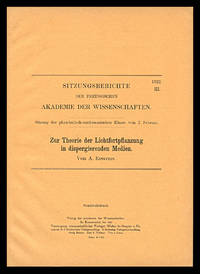
Einstein, A. [Albert]
Zur Theorie der Lichtfortpflanzung in dispergierenden Medien. Offprint from Sitzungsbericht der Preussischen Akademie der Wissenschaften 1922 pp. 18-22 THEORY OF THE LIGHT PROPAGATION IN DISPERSIVE MEDIA
Berlin: Verlag der Akademie der Wissenschaften 1922. 1st Edition. FIRST EDITION COMMERCIAL OFFPRINT ISSUE OF EINSTEIN'S THEORY OF THE LIGHT PROPAGATION IN DISPERSIVE MEDIA. WEIL 120. <br /> <br /> "After 1917 Einstein firmly believed that light-quanta were here to stay thus it is not surprising that he would look for new ways in which the existence of photons might lead to observable deviation from the classical picture. In this he did not succeed. At one point in 1921 he thought he had found a new quantum criterion but it soon turned out to be a false lead as demonstrated in this paper" Schilpp-Shields 162. <br /> <br /> That paper — the one offered here — is Einstein's evidence that his 1921 efforts were incorrect. In it Einstein introduces a calculation on the topic and explains why his earlier proposed experiment had not been well considered because it could not predict a good choice between two theoretical alternatives" Calaprice Einstein Encyclopedia 98. CONDITION & DETAILS: Berlin: Koniglich Akademie der Wissenschaften. Commercial offprint from Sitzungsberichte der Koniglich preussischen Akademie der Wissenschaften III 1916 pp. 18-22. Octavo 252 x 179 mm. Original printed wrappers. Pristine inside and out. Fine. Verlag der Akademie der Wissenschaften unknown
Bookseller reference : 1648
|
|
|
EINSTEIN, ALBERT. - THE PHOTOELECTRIC EQUATION - THE NOBEL PRIZE PAPERS.
Zur Theorie der Lichterzeugung und Lichtsabsorption; withbound: Das princip von der Erhaltung der Schwerpunktsbewegung und die Trägheit der Energie; 2 papers.
Leipzig Johann Ambrosius Barth 1906. Full cloth. Spine with gilt lettering. In: "Annalen der Physik. Vierte Folge. Band 20. Herausgegeben von Paul Drude." Portrait Paul Drude VIII1048 pp. and 6 plates. Einstein papers: pp. 199-206 and 627-33. Internally fine and clean. The entire volume offered. Broad margins. <br/><br/><em>Both papers first edition. It was for the papers "Ueber einen die Erzeugung und Verwandlung des Lichtes betreffenden heuristischen Gesichtspunkt" of 1905 and "Zur Theorie der Lichterzeugung. Theory of light emission and absorption the offered item that Einstein was awarded the Nobel Prize in 1921. "The quantum theory has affected virtually every branch of physics. Its earliest and one of its most significant developments was Einstein's application of the theory to what is known as the 'photo-electrical effect'.Einstein explained this effext by suggesting that the classical view that light is emitted in the form of continous waves must be abandoned. The photo-electrical effect could be explained only as an example of quantum action where the waves of light or X-rays are emitted in minute particles or bullets. It is he size of the bullet the wave-lenght of the radiation which determines the number of electrons ejected. It was for this and not for the theory of relativity that Einstein was awarded the Nobel Prize in 1921. Einstein's two fundamental papers on this subject are "Ueber einem Erzeugung." 1905 and Zur Theorie der Lichterzeugung the paper offered here" PMM the note to 391. In the second paper Principle of the conservation of the centre of mass motion and the inertia of energy he shows that the conservation of mass is a special application of his energy principle E= Mc2 - Weil: 12 & 13.Among the many papers in this volume we have Max von Laue: Zur Thermodynamik der Inteferenzerscheinungen. pp. 365-378. </em> hardcover
Bookseller reference : 59121
|
|
|
Einstein, E.
Zur Theorie des Radiometers.
Leipzig Johann Ambosius Barth 1922. 8vo. 14 pp. Original printed wrappers. = An important contribution to the understanding of the radiometer effect by the physicist Edith Einstein 1888-1960. "The Crookes radiometer also known as a light mill consists of an airtight glass bulb containing a partial vacuum with a set of vanes which are mounted on a spindle inside. The vanes rotate when exposed to light with faster rotation for more intense light providing a quantitative measurement of electromagnetic radiation intensity. The reason for the rotation was a cause of much scientific debate in the ten years following the invention of the device" Wikipedia. James Clerk Maxwell first gave a wrong then a correct explanation. However some subtleties still needed to be solved. "In 1920 Albert Einstein selected this topic as a suitable PhD thesis for his cousin Edith Einstein. She completed her doctorate under the supervision of Paul Epstein but with considerable imput from Einstein himself" Calaprice et al. Later in 1924 Albert wrote another paper on the radiometer effect correcting Edith on a few issues. Published in the famous Annalen der Physik vierte Folge Band 69. This being the complete Heft 4 published on 30 November 1922. Minimal wear to spine ends otherwise a very good clean copy. Very uncommon. Calaprice et al. An Einstein Encyclopaedia p. 160. unknown
Bookseller reference : 74098
|
|
|
Einstein, A.
Zur Theorie der Radiometerkräfte.
Braunschweig Friedrich Vierweg & Sohn; Berlin J. Springer 1924. 8vo 22.8 x 15.4 cm. 6 pp. Original printed wrappers. = On the theory of radiometer forces. "The Crookes radiometer also known as a light mill consists of an airtight glass bulb containing a partial vacuum with a set of vanes which are mounted on a spindle inside. The vanes rotate when exposed to light with faster rotation for more intense light providing a quantitative measurement of electromagnetic radiation intensity. The reason for the rotation was a cause of much scientific debate in the ten years following the invention of the device" Wikipedia. James Clerk Maxwell first gave a wrong then a correct explanation. However some subtleties still needed to be solved and in 1924 Albert Einstein had a crack at it "A partial explanation is that gas molecules hitting the warmer side of the vane will pick up some of the heat bouncing off the vane with increased speed. Giving the molecule this extra boost effectively means that a minute pressure is exerted on the vane. The imbalance of this effect between the warmer black side and the cooler silver side means the net pressure on the vane is equivalent to a push on the black side and as a result the vanes spin round with the black side trailing. The problem with this idea is that while the faster moving molecules produce more force they also do a better job of stopping other molecules from reaching the vane so the net force on the vane should be the same. The greater temperature causes a decrease in local density which results in the same force on both sides. Years after this explanation was dismissed Albert Einstein showed that the two pressures do not cancel out exactly at the edges of the vanes because of the temperature difference there. The force predicted by Einstein would be enough to move the vanes but not fast enough" Wikipedia. Contained first paper in: Zeitschrift für Physik volume 271. The complete issue in its original wrappers. Front wrapper slightly spotted at the fore and bottom edges. Volume number written on spine. A very good clean copy. Weil 139. unknown
Bookseller reference : 72535

|
|
|
Einstein, Albert
Zur Theorie der Räume mit Riemann-Metrik und Fernparallelismus. Offprint
1930. Offprint from Sitzungsberichte der preussischen Akademie der Wissenschaften 1930. Single sheet pp. 1-2. 256 x 184 mm. Upper edge a bit creased light toning but very good. First edition offprint issue. One of Einstein's last papers on Riemann metrics and distant parallelism written the year before he abandonded this approach to constructing a unified field theory. Pais Subtle is the Lord p. 347. Weil Albert Einstein Bibliography 173. unknown
Bookseller reference : 43314

|
|
|
EINSTEIN, A. (+) S. N. BOSE.
Zur Theorie der Radiometerkräfte Addendum to Bose's paper: Einstein Über die Entwicklung des Drehkristallverfahrens. Bemerkung zu der Arbeit von Polanyi Schiebold und Wissenberg.
Berlin Springer 1924. 8vo. Bound in contemporary half cloth. In "Zeitschrift für Physik" Bd. 27. Entire volume offered. Stamp to front free end paper. Fine and clean. Einstein: Pp. 1-6; P. 392. Bose: P. 392. Entire volume: IV 395 1 pp. <br/><br/><em>First appearance of Einstein's paper on statistical mechanics and the physics of radiometers. Weil 139 143a </em> hardcover
Bookseller reference : 49431
|
|
|
EINSTEIN, ALBERT. - THE PHOTOELECTRIC EQUATION.
Zur Theorie der Lichterzeugung und Lichtsabsorption; withbound: Das princip von der Erhaltung der Schwerpunktsbewegung und die Trägheit der Energie; 2 papers.
Leipzig Johann Ambrosius Barth 1906. Bound together in one contemp. hcloth. Small tears to spine ends. = "Annalen der Physik. Vierte Folge. Band 20. Herausgegeben von Paul Drude." Portrait Paul Drude VIII1048 pp. and 6 plates. Einstein papers: pp. 199-206 and 627-33. Internally fine and clean. The whole volume offered. <br/><br/><em>Both papers first edition. It was for the papers "Ueber einen die Erzeugung und Verwandlung des Lichtes betreffenden heuristischen Gesichtspunkt" of 1905 and "Zur Theorie der Lichterzeugung. Theory of light emission and absorption the offered item that Einstein was awarded the Nobel Prize in 1921."The quantum theory has affected virtually every branch of physics. Its earliest and one of its most significant developments was Einstein's application of the theory to what is known as the 'photo-electrical effect'.Einstein explained this effext by suggesting that the classical view that light is emitted in the form of continous waves must be abandoned. The photo-electrical effect could be explained only as an example of quantum action where the waves of light or X-rays are emitted in minute particles or bullets. It is he size of the bullet the wave-lenght of the radiation which determines the number of electrons ejected. It was for this and not for the theory of relativity that Einstein was awarded the Nobel Prize in 1921. Einstein's two fundamental papers on this subject are "Ueber einem Erzeugung." 1905 and Zur Theorie der Lichterzeugung the paper offered here" PMM the note to 391. In the second paper Principle of the conservation of the centre of mass motion and the inertia of energy he shows that the conservation of mass is a special application of his energy principle E= Mc2 - Weil: 12 & 13.Among the many papers in this volume we have Max von Laue: Zur Thermodynamik der Inteferenzerscheinungen. pp. 365-378. </em> hardcover
Bookseller reference : 38794
|
|
|
EINSTEIN, ALBERT. - THE NOBEL-PRIZE PAPER.
Zur Theorie der Lichterzeugung und Lichtsabsorption; Eingegangen 13. März 1906. On the Theory of Light Production and Light Absorption.
Leipzig Johann Ambrosius Barth 1906. No wrappers. Extracted from "Annalen der Physik" Vierte Folge. Bd. 20. Pp. 199-206. Clean and fine. <br/><br/><em>First printing of one of the papers for which Einstein was awarded the Nobel Prize in 1921. It was for the papers "Ueber einen die Erzeugung und Verwandlung des Lichtes betreffenden heuristischen Gesichtspunkt" of 1905 and "Zur Theorie der Lichterzeugung. Theory of light emission and absorption the offered item that Einstein received the prize: "for his services to theoretical physics and especially for his discoveryof the law of the photoelectrical effect" - his reward was not based on relativity."The quantum theory has affected virtually every branch of physics. Its earliest and one of its most significant developments was Einstein's application of the theory to what is known as the 'photo-electrical effect'.Einstein explained this effext by suggesting that the classical view that light is emitted in the form of continous waves must be abandoned. The photo-electrical effect could be explained only as an example of quantum action where the waves of light or X-rays are emitted in minute particles or bullets. It is he size of the bullet the wave-lenght of the radiation which determines the number of electrons ejected. It was for this and not for the theory of relativity that Einstein was awarded the Nobel Prize in 1921. Einstein's two fundamental papers on this subject are "Ueber einem Erzeugung." 1905 and Zur Theorie der Lichterzeugung the paper offered here" PMM the note to 391.Weil: 12 with an asterix denoting a major paper - Boni:12. </em> unknown
Bookseller reference : 46956

|
|
|
EINSTEIN, ALBERT. - THE PHOTOELECTRIC EQUATION.
Zur Theorie der Lichterzeugung und Lichtsabsorption; withbound: Das princip von der Erhaltung der Schwerpunktsbewegung und die Trägheit der Energie; 2 papers.
Leipzig Johann Ambrosius Barth 1906. Bound together in one contemp. halfcalf. Spine gilt. Minor scratches to spine. A stamp to titlepage and htitle. "Annalen der Physik. Vierte Folge. Band 20. Herausgegeben von Paul Drude." Portrait Paul Drude VIII1048 pp. and 6 plates. Einstein papers: pp. 199-206 and 627-33. The entire volume offered. <br/><br/><em>Both papers first edition. It was for the papers "Ueber einen die Erzeugung und Verwandlung des Lichtes betreffenden heuristischen Gesichtspunkt" of 1905 and "Zur Theorie der Lichterzeugung. Theory of light emission and absorption the offered item that Einstein was awarded the Nobel Prize in 1921."The quantum theory has affected virtually every branch of physics. Its earliest and one of its most significant developments was Einstein's application of the theory to what is known as the 'photo-electrical effect'.Einstein explained this effext by suggesting that the classical view that light is emitted in the form of continous waves must be abandoned. The photo-electrical effect could be explained only as an example of quantum action where the waves of light or X-rays are emitted in minute particles or bullets. It is he size of the bullet the wave-lenght of the radiation which determines the number of electrons ejected. It was for this and not for the theory of relativity that Einstein was awarded the Nobel Prize in 1921. Einstein's two fundamental papers on this subject are "Ueber einem Erzeugung." 1905 and Zur Theorie der Lichterzeugung the paper offered here" PMM the note to 391. In the second paper Principle of the conservation of the centre of mass motion and the inertia of energy he shows that the conservation of mass is a special application of his energy principle E= Mc2 - Weil: 12 & 13.Among the many papers in this volume we have Max von Laue: Zur Thermodynamik der Inteferenzerscheinungen. pp. 365-378. </em> unknown
Bookseller reference : 46962
|
|
|
EINSTEIN, ALBERT.
Zur Theorie der Lichtfortpflanzung in dispergierenden Medien.
Berlin Gruyter & Co. 1922. 4to. Orig.printed orange wrappers. Offprint/Sonderabdruck aus Sitzungsberichten. pp. 18-22. Fine fresh copy. <br/><br/><em>First edition in the rare Offprint still called "Abdruck". - Weil No. 120.The early Offprints from "Sitzungsberichten." are called "Sonderabdruck" up to Weil No.165 including this. From Weil 166 they are called "Sonderausgabe.". - Before 161 up to 160 the Offprints do not have separate title and pagination the pagination follows the numbering in the periodical. From 166 the Offprint has both separate printed title and pagination. - So Weil Nos 161-165 is still "Abdruck" but with separate title and pagination. These facts are not mentioned in the bibliographies. </em> unknown
Bookseller reference : 28358
|
|
|
Einstein, Albert
Zur Theorie der Lichterzeugung und Lichtabsorption AND Das Prinzip von der Erhaltung der Schwerpunktsbewegung und die Trägheit der Energie in Annalen der Physik Vol. 20 1906 pp. 199-206; pp. 627-633
Leipzig: Barth 1906. 1st Edition. FIRST EDITION FIRST ISSUE of two important 1906 Einstein papers. Einstein wrote two papers on the photoelectric effect his revolutionary 1905 paper and "Zur Theorie der Lichterzeugung und Lichtabsorption" his continuation of it. In them Einstein employed Planck's theory that luminous energy can be absorbed or emitted only in discrete amounts called quanta and proposed a theory of light quanta involving particles with no mass photons whose energy depended on frequency. All of Einstein's experimental results confirmed that light actually consisted of discrete energy packets. <br /> <br /> "Based on this theory Einstein wrote an equation describing how the photoelectric effect works. The energy of individual electrons emitted by a photocell is a function of the frequency of the light hitting the photocell and the rate of electron emission is a function of the light source's intensity number of photons with sufficient energy being emitted. This is contrary to what is predicted by classical physics" History of Physics: The Wenner Collection. <br /> <br /> In this Einstein's second paper on photoelectrics he revisited Planck's theory and from it developed his ideas to show that an electromagnetic wave such as light could be described as a particle photon with discrete quanta of energy that was dependent on its frequency. In the long history of quantum mechanics this would lead to a theory of unity between subatomic particles and electromagnetic waves called wave-particle duality in which particles and waves were neither one nor the other but had certain properties of both. <br /> <br /> At first Einstein believed that light-quantum hypothesis was merely 'heuristic': that it behaved only as if it consisted of discontinuous quanta. But in this paper and others to follow Einstein used his statistical mechanics to demonstrate that when light interacts with matter Planck's entire formula can arise only from the existence of light quanta -- not from waves. In other words in explaining the photoelectric effect by extending Planck's concept of quantum of energy had Einstein "demonstrated that his own 'light-quantum hypothesis' was implicit in Planck's earlier work" Honner The Description of Nature 31. <br /> <br /> ALSO included in this volume is "Daz Prinzip von der Erhaltung." The Principle of Conservation of Motion of the Center of Gravity and the Inertia of Energy. In this "ingenious thought experiment involving energy transport in a hollow cylinder Einstein returned to the relationship between inertial mass and energy giving more general arguments for their complete equivalence" Calaprice The Einstein Almanac 18. This was the first statement that the conservation of mass is a special case of the conservation of energy. CONDITION & DETAILS: Leipzig: Barth 1906. Octavo. 8.75 x 6 inches; 222 x 152mm. Ex-libris bearing minimal markings only a small stamp on the title page. Illustration: 6 plates and figures throughout. Entire volume in black cloth gilt-lettered at the spine. The cloth is a bit rubbed and scuffed and there is fading at the spine. Solidly and tightly bound. Bright and clean throughout. Barth hardcover
Bookseller reference : 292
|
|
|
Einstein, Albert (1879-1955)
Zur Theorie der Lichtfortpflanzung in dispergierenden Medien
Berlin: Sitzungsberichten der Preussischen Akademie der Wissenschaften 1922. First Thus. First Thus. Einstein Albert 1879-1955. Zur Theorie der Lichtfortpflanzung in dispergierenden Medien. Complete. Quarto. Offprint from Sitzungsberichten der Preussischen Akademie der Wissenschaften. Berlin: 1922. First edition in very fine condition. This superb offprint is a separate printing of the Prussian Academy's session reports here with independent pagination. A small number of such off prints were presented to the author by the publisher as voucher copies. References: Schilpp-Shields 162; Weil 120. This paper gives evidence that Einsteins ideas on the photon were not able to contradict classical theory. "Since after 1917 Einstein firmly believed that light-quanta were here to stay it is not surprising that he would look for new ways in which the existence of photons might lead to observable deviation from the classical picture. In this he did not succeed. At one point in 1921 he thought he had found a new quantum criterion but it soon turned out to be a false lead as demonstrated in this paper". An excellent example. "The early Offprints from "Sitzungsberichten." are called "Sonderabdruck" up to Weil No.165 including this. From Weil 166 they are called "Sonderausgabe.". - Before 161 up to 160 the Offprints do not have separate title and pagination the pagination follows the numbering in the periodical. From 166 the Offprint has both separate printed title and pagination. - So Weil Nos 161-165 is still "Abdruck" but with separate title and pagination. Sitzungsberichten der Preussischen Akademie der Wissenschaften unknown
Bookseller reference : 32430

|
|
|
Einstein, Albert
Zur Theorie der Lichterzeugung und Lichtabsorption. WITH: Das Prinzip von der Erhaltung der Schwerpunktsbewgung und die Tragheit der Energie
Leipzig: Barth 1906. 1st Edition. Hardcover. Fine. FIRST EDITION of two important Einstein papers including one of the two papers on his Noble Prize winning work on the photoelectric effect. On the Theory of Light Production and Light Absorption: A continuation and development of Einstein's revolutionary first paper in 1905 on the photoelectric effect "On a Heuristic Point of View about the Creation and Conversion of Light". <br /> <br /> "In a companion paper to "On a Heuristic Point." published in 1906 Einstein exposed appeal to the quantum as fundamentally counter to the ethos of classical physics: 'the theoretical bases on which Planck's radiation theory rests are different from those of Maxwell's theory'. Planck had not initially intended to quantify light-radiation itself but Einstein demonstrated that his own 'light-quantum hypothesis' was implicit in Planck's earlier work. In viewing radiation not as a continuous wave but as composed of small packets of energy later called photons Einstein was again shaking the foundations of classical physics" Honner The Description of Nature 31. Particle Physics: One Hundred Years of Discoveries: "Corpuscular-wave dualism for photons. Explanation of the photoelectric effect using the quantum hypothesis of Planck. Nobel prize to A. Einstein awarded in 1921 'for services to Theoretical Physics and especially of he law of the photoelectric effect.'" Weil 12.<br /> <br /> The Principle of Conservation of Motion of the Center of Gravity and the Inertia of Energy: Einstein's further development of E=mc2. Einstein boldly uses his relationship to insist that the conservation of mass is a special case of the conservation of energy and broadens the law to include not only mechanical but electromagnetic processes as well. Weil 13. <br /> <br /> IN: Annalen der Physik Vol. 20 pp. 199-206; 627-633. Leipzig: Barth 1906. Octavo modern full green morocco. Rippling to the first few leaves of volume not affecting Einstein papers. Provenance: with library stamp on series title from the prestigious Gmelin Institute after 1996 part of the Max Planck Institute. Very handsomely bound. Barth hardcover
Bookseller reference : 602

|
|
|
Einstein, Albert
Zur Theorie der Lichtfortpflanzung in dispergierenden Medien. Weil 120. Offprint from S. preuss. Akad. Wiss
1922. unknown
Bookseller reference : 37405
|
|
|
Einstein, Albert & Mayer, Walter
Zwei Strenge statische Lösungen der Feldgleichungen der einheitlichen Feldtheorie.
1930. S.Ber. Akad. Wiss. Berl. 1930/ 6. - Berlin Verlag der Akademie der Wissenschaften 1930 8° 13 S. orig. Broschur. First Edtion; the rare off-print from the "Sitzungsberichte". Weil No. 170; Schilpp-Shields No.240; Alicke No. 144 unknown
Bookseller reference : 27085
|
|
|
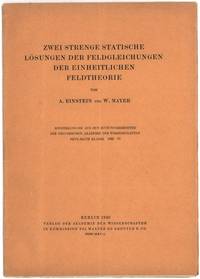
EINSTEIN, ALBERT und W. MAYER.
Zwei strenge statische Lösungen der feldgleichungen der einheitlichen Feldtheorie.
Berlin Gruyter & Co. 1930. 4to. Orig. printed orange wrappers. Offprint/Sonderausgabe aus Sitzungsberichten.pp. 1-13. Fine fresh copy. <br/><br/><em>First edition in the rare Offprint with its separate printed title and separate pagination. Se Weil No. 170 not mentioning this.The early Offprints from "Sitzungsberichten." are called "Sonderabdruck" up to Weil No.165 including this. From Weil 166 they are called "Sonderausgabe.". - Before 161 up to 160 the Offprints do not have separate title and pagination the pagination follows the numbering in the periodical. From 166 the Offprint has both separate printed title and pagination. - So Weil Nos 161-165 is still "Abdruck" but with separate title and pagination. These facts are not mentioned in the bibliographies. </em> unknown
Bookseller reference : 28376
|
|
|
EINSTEIN, ALBERT und W. MAYER.
Zwei strenge statische Lösungen der Feldgleichungen der einheitlichen Feldtheorie.
Berlin Akademie der Wissenschaften 1930. 4to. Orig. printed green wrapper. No VI 1930 of Sitzungsberichte der Preussische Akademie der Wissenschaften. Wrappers with very small nicks atspine. Small part of one corner gone. pp. 110-120. A small stamp at foot of frontwrapper. <br/><br/><em>First edition in the periodical form. - Weil No. 170 </em> unknown
Bookseller reference : 38646
|
|
|
Einstein, Albert
Zwei strenge statische Losungen der Feldgleichungen der einheitlichen Feldtheorie. Offprint
Berlin: Akad. Wiss 1930. Weil 170. Offprint from S. preuss. Akad. Wiss. Akad. Wiss unknown
Bookseller reference : 37422

|
|
|
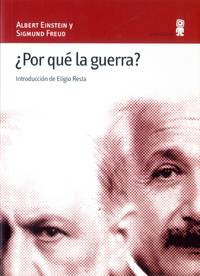
Einstein, Albert/ Freud, Sigmund
¿Por qué la guerra
Editorial Minuscula S.L.U. 2001. Paperback. New. Spanish language. 7.24x5.28x0.39 inches. Editorial Minuscula, S.L.U. paperback
Bookseller reference : 2-8495587033 ISBN : 8495587033 9788495587039
|
|
|
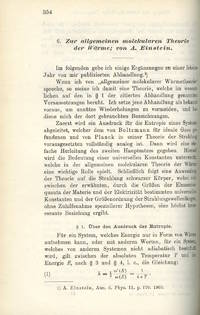
EINSTEIN, ALBERT
“Allgemeinen molekulare Theorie der Wärme†in Annalen der Physik 4. Folge Band 14
<p>Brown buckram. Library markings.</p><p>FIRST EDITION of Einstein's fifth published paper "On the General Molecular Theory of Heat" pp. 354-362.</p><br /> Annalen der Physik
Bookseller reference : 32820371
|
|
|
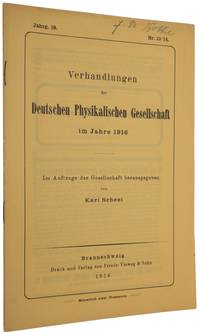
EINSTEIN, Albert
‘Strahlungs-Emission und Absorption nach der Quantentheorie’ pp. 318-323 in: Verhandlungen der Deutschen Physikalischen Gesellschaft Jahrg. 18 Nr. 13/14 30 July 1916
Braunschweig: Druck und Verlag von Friedr. Vieweg and Son 1916. First edition. DISCOVERY OF STIMULATED EMISSION OF RADIATION<br /> THE PRINCIPLE OF THE LASER<br /> INSCRIBED BY EINSTEIN TO A FELLOW NOBEL LAUREATE. <p>First edition complete journal issue in original printed wrappers inscribed by Einstein to fellow Nobel Laureate Walther Bothe. “This work represents a major step forward in quantum theory†Calaprice p. 297. It introduced the concept of stimulated emission of radiation the theoretical basis for the laser; it also contained a new derivation of Planck’s radiation law which provided as a by-product a justification of the frequency rule forming the basis of Bohr’s theory of atomic spectra. “According to Albert Einstein when more atoms occupy a higher energy state than a lower one under normal temperature equilibrium it is possible to force atoms to return to an unexcited state by stimulating them with the same energy as would be emitted naturally†Britannica. This is ‘stimulated emission.’ “To claim that Einstein almost invented the laser would be an exaggeration but the laser’s underlying mechanism stimulated emission of radiation was a creation of his radiation theory†Kleppner pp. 32-33. “During the summer of 1916 less than a year after he had completed the general theory of relativity Einstein made a new major contribution to the quantum theory. The two papers he wrote then deal with the quantum theory of radiation by arguments that do not depend on the classical electromagnetic theory as had all earlier treatments of Planck's radiation law … When Einstein returned to the radiation problem in 1916 the quantum theory had undergone a major change. Niels Bohr’s papers had opened a new and fertile domain for the application of quantum concepts – the explanation of atomic structure and atomic spectra. In addition Bohr's work and its generalizations by Arnold Sommerfeld and others constituted a fresh approach to the foundations of the quantum theory of matter" DSB. In this paper “Einstein considers a system of atoms in equilibrium with an external radiation field. An atom can change its internal energy state by absorbing or emitting radiation. Einstein introduces three basic assumptions about these exchanges of energy between matter and field. First the probability of absorption of radiation is proportional to the radiation density. Second there are two kinds of emission processes: one – spontaneous – following a law like that of radioactive decay; the other – stimulated – induced by the radiation field and with probability proportional to the radiation density. Third at equilibrium the atoms are distributed among their internal states according to the Boltzmann distribution law. From these assumptions Planck's law follows in a simple way. Einstein was very pleased with his derivation which he characterized in a letter to Besso: ‘An amazingly simple derivation of Planck's formula I should like to say the derivation.’ As a bonus from his derivation Einstein found that the energy difference between two internal energy states of the atom had to be equal to hv with v the frequency of the radiation absorbed or emitted in transitions between these two states thus confirming one of the postulates of Niels Bohr's theory of spectra†Papers 6 xxiii-xxiv. “Einstein meant the second part of this study a proof of the oriented character of the emission process to be his most essential contribution to quantum radiation theory this second paper was published later in 1916 as ‘Zür Quantentheorie der Strahlung’. Instead Bohr gave more importance to the new deduction of the blackbody law; for this deduction reinforced the basic assumptions of his atomic theory and completed them with a statistical description of radiation processes†Darrigol p. 120. </p> <br /> <p>Provenance: Inscribed by Einstein on front wrapper “für. Dr Bothe†i.e. Walther Bothe 1891-1957. “In 1929 in collaboration with W. Kolhörster Bothe introduced a new method for the study of cosmic and ultraviolet rays by passing them through suitably arranged Geiger counters and by this method demonstrated the presence of penetrating charged particles in the rays and defined the paths of individual rays. For his discovery of the ‘method of coincidence’ and the discoveries subsequently made by it which laid the foundations of nuclear spectroscopy Bothe was awarded jointly with Max Born the Nobel Prize in Physics 1954†.</p> <br /> <p>While Einstein commended Planck’s epoch-making derivation of his radiation law in 1900 which ushered in the quantum era he had also noted its limitations. Einstein also saw inconsistencies in Planck’s derivation of his law. For Einstein this inconsistency was no reason to reject Planck’s quantum theory but it was a reason to study the foundations of traditional radiation theory and if needed revise them. </p> <br /> <p>“As Einstein had noted in 1906 Planck’s derivation of the Rayleigh-Jeans law</p> <br /> <p>uν = 8πν2/c3 kT</p> <br /> <p>between average resonator energy uν and radiation spectrum ν only applied to classical resonators T is the temperature k is Boltzmann’s constant. A new quantum-theoretical picture of the interaction between matter and radiation was needed. Einstein found it in the summer of 1916 after the completion of his general theory of gravitation left him more time for quantum meditation.</p> <br /> <p>“The new picture presumably emerged from a combination of three elements: Einstein’s derivation of the law of photochemical equivalence his analogy between quantum states and chemical species and Niels Bohr’s theory of atomic spectra. According to Bohr atoms and molecules can only exist in a series of quantum states S0 S1 . . . Sn . . . with well-defined energies E0 E1 . . . En . . . Their interaction with radiation occurs through quantum jumps with characteristic values of the frequency of the emitted or absorbed radiation. Regarding the quantum states as chemical species and remembering his photochemical reasoning Einstein knew that he could derive Wien’s law by balancing the absorption process Sn hν → Sn1 with the emission process Sn1 → Sn hν and by making the probability of the first reaction proportional to the density of radiation at frequency ν. Something in this reasoning needed to be altered in order to get Planck’s law instead of Wien’s. </p> <br /> <p>“At this point Einstein appealed to an analogy between classical and quantum theory. According to classical theory an oscillating dipole spontaneously emits radiation whether or not radiation is initially present in its surroundings. When external radiation encounters this dipole it may either be absorbed if the phase of the incoming wave agrees with that of the oscillator or it may be amplified in the contrary case. In the quantum theory of radiation Einstein similarly admitted the existence of three kinds of processes: spontaneous emission Ausstrahlung absorption negative Einstrahlung and stimulated emission positive Einstrahlung. The modern terminology is Bohr’s. For the probability per time unit of the respective sorts of quantum jump Einstein assumed the forms</p> <br /> <p>Anm ÏνBnm ÏνBmn</p> <br /> <p>where n is the upper quantum state m the lower one and Ïν is the density of radiation at the frequency ν.</p> <br /> <p>“Einstein did not say much on the nature of the probabilities he thus introduced. He only commented that his theory had the weakness to leave to chance the instant and direction of the spontaneous emission of light. He also noted the similarity between spontaneous emission and radioactive decay. Undoubtedly he would have preferred a theory in which the emission and absorption probabilities were deduced from an underlying deterministic theory. He nonetheless expressed his ‘full trust in the present way of reasoning’. The probabilistic description of the interaction was a natural counterpart of the discrete character of quantum states: if a quantum system evolves mostly through quantum jumps then the probability of a quantum jump obviously is the main quantity of physical interest. Instead of speculating on the precise timing and fine structure of the jumps Einstein proceeded to show what could be done by means of the new probability coefficients.</p> <br /> <p>“At thermal equilibrium Einstein reasoned statistical mechanics requires the number of atoms in a quantum state n to be proportional to exp−En /kT. The kinetic equilibrium between the atoms and surrounding radiation further requires that the number of quantum jumps from m to n should be equal to the number of reverse jumps:</p> <br /> <p>ÏνBnm exp−Em /kT = ÏνBnm Anm exp−En /kT.</p> <br /> <p>In the high temperature limit for which Ïν → ∞ this condition gives</p> <br /> <p>Bnm = Bmn.</p> <br /> <p>Therefore the equilibrium value uν of the density Ïν is given by</p> <br /> <p>uνexpEn − Em/kT – 1 = Anm / Bnm.</p> <br /> <p>According to a thermodynamic theorem by Wien uν/ν3 must be a function of ν/T only. Hence En − Em must be proportional to ν. Einstein thus derived Bohr’s strange frequency rule ΔE = hν with complete generality and without recourse to any of the empirical laws of spectra. He then required the expression of uν to agree with the Rayleigh-Jeans law in the low-frequency limit. The outcome was Planck’s law as well as the relation</p> <br /> <p>Anm / Bnm = 8Ï€hν3/c3</p> <br /> <p>between Einstein’s two probability coefficients …</p> <br /> <p>“Einstein’s new theory of radiation is now remembered for the introduction of stimulated emission which famously permitted the conception of masers and lasers. For Einstein and for his contemporaries the importance of these memoirs lay elsewhere. First Einstein filled an important gap in the derivation of Planck’s law by means of a simple statistical description of radiation processes. Second he corroborated two basic assumptions of Bohr’s atomic theory: the existence of stationary states and the frequency rule. In this regard it should be emphasized that before Einstein’s and Sommerfeld’s contributions of 1916 Bohr believed that his frequency rule only applied to strictly periodic systems. For instance he regarded the Zeeman effect as a violation of this rule. Einstein’s new considerations established its complete generality†Darrigol in Cambridge Companion to Einstein pp. 134-136.</p> <br /> <p>“The implication of Einstein’s theory of stimulated emission was that if one arranges for a large number of atoms to be in identical excited states a stray photon of the right energy can stimulate one atom to emit another photon which stimulates another… and all the atoms release their excess energy in a sudden cascade. What’s more the photon released by stimulated emission will be in phase – coherent – with the one that stimulated it and so all the light produced in the cascade will be coherent.</p> <br /> <p>“In 1955 American physicist Charles Townes of Columbia University in New York an expert in molecular spectroscopy and his co-workers showed how stimulated emission could be used to make a device for generating or amplifying microwaves which they called a maser microwave amplified stimulated emission of radiation. Three years later Townes and Arthur Schawlow explained how to extend the idea to visible and infrared frequencies to make an ‘optical maser’ – in effect the laser.</p> <br /> <p>“They proposed using ordinary incoherent light to pump atoms into an excited state setting up the ‘population inversion’ in which the atoms are primed to return to their ground state by emitting photons. And their design used an optical cavity – basically two mirrors between which photons would bounce – to trap the emitted photons while they stimulated more emission. The device they explained would generate ‘extremely monochromatic single-wavelength and coherent light’. Theodore Maiman of the Hughes Research Laboratories in Malibu California described such a device using a ruby crystal already used for masers as the lasing medium in 1960†‘A century ago Einstein sparked the notion of the laser’ Physics World History Blog 31 August 2017.</p> <br /> <p>Weil 85. Calaprice An Einstein Encyclopedia 2015. Darrigol From c-numbers to q-numbers 1992. Kleppner ‘Rereading Einstein on radiation’ Physics Today 58 2005 pp. 30-33. Pais Subtle is the Lord 1982.</p> <br/> <br/> 8vo 228 x 154 mm pp. 315-332. Original printed wrappers. A fine copy. Druck und Verlag von Friedr. Vieweg and Son unknown
Bookseller reference : 6164
|
|
|
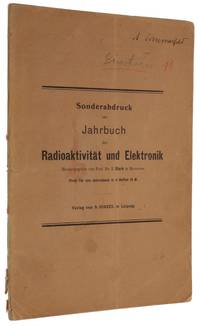
EINSTEIN, Albert
Über das Relativitätprinzip und die aus demselben gezogenen Folgerungen On the relativity principle and the conclusions drawn from it. Offprint from: Jahrbuch der Radioaktivität und Elektronik Band 4 Heft 16
Leipzig: S. Hirzel 1907. First edition. <p>THE EQUIVALENCE PRINCIPLE ‘THE HAPPIEST THOUGHT OF MY LIFE’</p> . <p>First edition extremely rare author’s presentation offprint with ‘Überreicht vom Verfasser’ Presented by the Author stamped on front wrapper from the library of the great German physicist Arnold Sommerfeld of this crucially important transitional paper in which Einstein introduced the equivalence principle that uniform acceleration and gravitation are equivalent in their physical effects which launched him on his path to general relativity. “Einstein's efforts to incorporate gravitation into the theory of relativity led him in 1907 to formulate a new formal principle later named the principle of equivalence. He stressed that when gravitational effects are taken into account it is impossible to maintain the privileged role that inertial frames of reference still have in the original relativity theory. He concluded that if gravitation is to be included it is necessary to extend the relativity principle. The search for a group of transformations wider than the Lorentz group under which the laws of physics remain invariant when gravitation is included lasted from 1907 until the end of 1915 leading finally to what Einstein considered his greatest achievement the general theory of relativity†Collected Papers 2 p. xxix. “On p. 443 are probably the first explicit statements both of the equivalence of inertial and gravitational mass and of the equation for mass in terms of energy E = mc2 now regarded as the theoretical basis for the release of atomic energy†Weil. In 1905 “Einstein said that all energy of whatever sort has mass. It took even him two years more to come to the stupendous realization that the reverse must also hold: that all mass of whatever sort must have energy. . With mass and energy thus wholly equivalent Einstein was able in 1907 in a long and mainly expository paper published in the Jahrbuch der Radioactivität the offered paper to write his famous equation E = mc2 . In presenting his equation in 1907 Einstein spoke of it as the most important consequence of his theory of relativity†Hoffmann Albert Einstein p. 81. “Of greatest importance is the last part of the paper which generalizes the principle of relativity from uniformly moving systems to uniformly ‘accelerated’ systems. . He introduces the principle of equivalence which claims that the problem of a uniform and stationary gravitational field on the one hand and the system moving with a constant acceleration without any gravitation on the other hand are physically indistinguishable situations. This principle put him in a position to find out what effect gravitation has on an arbitrary physical phenomenon because all he had to do was to observe that phenomenon from an accelerated reference system. He thus obtains the speeding up of clocks in a field of increased gravitational potential which must lead to a universal red shift of the spectral lines coming from the Sun and likewise to a bending of light rays near to the limb of the Sun. Furthermore this hypothesis at once makes it clear why inertial mass and gravitational mass must be under all circumstances strictly proportional to one another. . Hence the principle of the energy value of inertial mass must be extended to the gravitational mass†Lanczos The Einstein Decade p. 153. Later Einstein wrote that when he was working on this paper “There occurred to me the happiest thought of my life in the following form. The gravitational field has only a relative existence in a way similar to the electric field generated by magnetoelectric induction. Because for an observer falling freely from the roof of a house there exists – at least in his immediate surroundings – no gravitational field†Einstein’s emphasis Pais Subtle is the Lord p. 178. Although Einstein submitted the paper on 4 December 1907; it was published in the January 22 issue of the Jahrbuch. This is one of Einstein’s rarest major papers in offprint form. RBH lists three copies: Plotnick Christie’s 2002; Einstein’s own collection of his offprints Christie’s 2008; and Richard Green Christie’s 2008. OCLC lists 6 copies worldwide Morgan; Princeton; Stanford; Trinity College Cambridge; Queen’s University Kingston ON; Thomas Fisher. This copy was presented by Einstein to one of the leading physicists of the time surely hoping to make himself known in the scientific world when he was still a technical expert in the Swiss Patent Office.</p> <br /> <p>Provenance: Arnold Sommerfeld 1868-1951 his signature and characteristic numbering in red pencil ‘11’ on front cover. “The son of a physician Sommerfeld was educated at the University of Königsberg. After teaching briefly at the universities of Göttingen Clausthal and Aachen he was appointed professor of physics at the University of Münich in 1906. Sommerfeld should have retired in 1936 in favour of his pupil Werner Heisenberg. Opposition from the Nazi party to Heisenberg’s appointment prolonged Sommerfeld’s tenure and it was not in fact until late 1939 that he finally retired to be succeeded not by Heisenberg but by Wilhelm Müller a Nazi aerodynamicist without a single publication in physics to his credit. Although Sommerfeld and Heisenberg were not Jewish they were regarded by the Nazis as Jewish sympathizers. Sommerfeld however survived the war and returned to his Münich chair in 1945 continuing to work at physics until he died in a car accident in 1951†Oxford Reference. “Arnold Sommerfeld was one of the most distinguished representatives of the transition period between classical and modern theoretical physics. The work of his youth was still firmly anchored in the conceptions of the nineteenth century; but when in the first decennium of the century the flood of new discoveries experimental and theoretical broke the dams of tradition he became a leader of the new movement and in combining the two ways of thinking he exerted a powerful influence on the younger generation. This combination of a classical mind to whom clarity of conception and mathematical rigour are essential with the adventurous spirit of a pioneer are the roots of his scientific success while his exceptional gift of communicating his ideas by spoken and written word made him a great teacher†Max Born p. 275. </p> <br /> <p>“His first important paper on relativity theory after 1905 is the 1907 review. This article was written at the request of Johannes Stark the editor of the Jahrbuch. On September 25 1907 Einstein had accepted this invitation. On November 1 Einstein further wrote to Stark: ‘I am now ready with the first part of the work for your Jahrbuch. I am working zealously on the second part in my unfortunately scarce spare time.’ Since this second part contains the remarks on gravitation it seems probable that Einstein’s ‘happiest thought’ came to him sometime in November 1907. We certainly know where he was when he had this idea. In his Kyoto lecture he told the story: ‘I was sitting in a chair in the patent office at Bern when all of a sudden a thought occurred to me. ‘If a person falls freely he will not feel his own weight!’ I was startled. This simple thought made a deep impression on me. It impelled me toward a theory of gravitation’ …</p> <br /> <p>“Three main issues are raised in Section V of the Jahrbuch article. </p> <br /> <p>The Equivalence Principle. ‘Is it conceivable that the principle of relativity also holds for systems which are accelerated relative to each other’ That is Einstein’s starting question. Then he gives the standard argument. A reference frame Σ1 is accelerated in the x direction with a constant acceleration γ. A second frame Σ2 is at rest in a homogeneous gravitational field which imparts an acceleration –γ in the x direction to all objects. ‘In the present state of experience we have no reason to assume that … Σ1 and Σ2 are distinct in any respect and in what follows we shall therefore assume the complete physical equivalence of a gravitational field and the corresponding acceleration of the reference frame. This assumption extends the principle of relativity to the case of uniformly accelerated motion of the reference frame … he began by applying his new postulate to the Maxwell equations always for uniform acceleration. He did not raise the question of the further extension to nonuniform acceleration until 1912 the year he first referred to his hypothesis as the ‘equivalence principle.’</p> <br /> <p>The Gravitational Red Shift. Many textbooks on relativity ascribe to Einstein the method of calculating the red shift by means of the Doppler effect of light falling from the top to the bottom of an upwardly accelerating elevator. That is indeed the derivation he gave in 1911. However he was already aware of the red shift in 1907. The derivation he gave at that time is less general more tortured and yet oddly more sophisticated. It deserves particular mention because it contains the germ of two ideas that were to become cornerstones of his final theory: the existence of local Lorenz frames and the constancy of the velocity of light for infinitesimally small paths …</p> <br /> <p>Maxwell’s Equations; Bending of Light; Gravitational Energy = mc2. Indomitably Einstein goes on. He tackles the Maxwell equations next. He concludes that Maxwell’s equations have the same form in a uniformly accelerated reference frame as in a non-accelerated frame but with a modified velocity of light. ‘It follows that the light rays … are bent by the gravitational field.’ Second he examines the energy conservation law in the accelerated frame and finds ‘a very notable result … In a gravitational field one must associate with every energy E an additional position-dependent energy which equals the position-dependent energy of a ‘ponderable’ mass of magnitude E/mc2. The law E = mc2 therefore holds not only for inertial but also for gravitational mass’ …</p> <br /> <p>“This review does not have the perfection of the 1905 paper on special relativity. The approximations are clumsy and mask the generality of the conclusions. Einstein was the first to say so in 1911. The conclusion about the bending of light is qualitatively correct quantitatively wrong – though in 1907 not yet logically wrong. Einstein was the first to realize this in 1915. Despite all this I admire this article at least as much as the perfect relativity paper on 1905 not as much for its details as for its courage†Pais pp. 179-182.</p> <br /> <p>“In 1920 Einstein recalled how he first arrived at the ideas behind the equivalence principle: </p> <br /> <p>‘While I was occupied in 1907 with a comprehensive survey of the special theory for the ‘Yearbook for Radioactivity and Electronics’ I also had to attempt to modify Newton’s theory of gravitation in such a way that its laws fitted into the theory. Attempts along these lines showed the feasibility of this enterprise but did not satisfy me because they had to be based on physical hypotheses that were not well-founded. Then there came to me the most fortunate thought of my life in the following form: </p> <br /> <p>‘Like the electric field generated by electromagnetic induction . the gravitational field only has a relative existence. Because for an observer freely falling from the roof of a house during his fall there exists—at least in his immediate neighborhood—no gravitation field. Indeed if the observer lets go of any objects relative to him they remain in a state of rest or uniform motion independently of their particular chemical or physical composition note by AE: air resistance is naturally ignored in this argument. The observer is thus justified in interpreting his state as being at rest. </p> <br /> <p>‘Through these considerations the unusually extraordinary experimental law that all bodies fall with equal acceleration in the same gravitational field immediately obtains a deep physical significance. For if there were just one single thing that fell differently from the others in the gravitational field then with its help the observer could recognize that he was falling in a gravitational field. If such a thing does not exist—which experiment has shown with great precision—then there is no objective basis for the observer to regard himself as falling in a gravitational field. Rather he has the right to regard his state as one of rest and with respect to a gravitational field his neighborhood as field free. The experimental fact of the material-independence of the acceleration due to gravity is thus a powerful argument for the extension of the relativity postulate to coordinate systems in non-uniform relative motion with respect to each other . The generalization of the relativity principle thus indicates a speculative path towards the investigation of the properties of the gravitational field.’ </p> <br /> <p>“Einstein alludes here to his initial attempts to set up a special-relativistic theory of gravitation but gives no details. In 1933 he gave the fullest account of how he ‘arrived at the equivalence principle by a detour Umweg’ through such attempts. After mentioning his doubts after 1905 about the privileged dynamical role of inertial systems and his early fascination by Mach’s idea that the acceleration of a body is not absolute but relative to the rest of the bodies in the universe he turns to the events of 1907:</p> <br /> <p>‘I first came a step closer to the solution of the problem when I attempted to treat the law of gravitation within the framework of special relativity. Like most authors at the time I attempted to establish a field law for gravitation since the introduction of an unmediated action at a distance was no longer possible at least in any sort of natural way on account of the abolition of the concept of absolute simultaneity. </p> <br /> <p>‘The simplest thing naturally was to preserve the Laplacian scalar gravitational potential and to supplement Poisson’s equation in the obvious way by a term involving time derivatives so that the special theory of relativity was satisfactorily taken into account. The equation of motion of a particle also had to be modified to accord with the special theory. The way to do so was less uniquely prescribed since the inertial mass of a body might well depend on its gravitational potential. This was even to be expected on the basis of the law of the inertia of energy. </p> <br /> <p>‘However such investigations led to a result that made me highly suspicious. For according to classical mechanics the vertical acceleration of a body in a vertical gravitational field is independent of the horizontal component of its velocity. This is connected with the fact that the vertical acceleration of a mechanical system or rather of its center of mass in such a gravitational field turns out to be independent of its internal kinetic energy. According to the theory I was pursuing however such an independence of the gravitational acceleration from the horizontal velocity or from the internal energy of a system did not occur.</p> <br /> <p>‘This did not accord with an old fact of experience that all bodies experience the same acceleration in a gravitational field. This law which can also be formulated as the law of equality of inertial and gravitational mass now appeared to me in its deep significance. I was most highly amazed by it and guessed that in it must lie the key to the deeper under- standing of inertia and gravitation.’ </p> <br /> <p>“Turning from later reminiscences let us see how Einstein presented his approach to gravitation in 1907:</p> <br /> <p>‘Up to now we have only applied the principle of relativity i.e. the presupposition that the laws of nature are independent of the state of motion of the reference system to acceleration-free reference systems. Is it conceivable that the principle of relativity also holds for systems that are accelerated relative to each other </p> <br /> <p>‘This is not the place for an exhaustive treatment of this question. Since however it is bound to occur to anyone who has followed the previous applications of the relativity principle I shall not avoid taking a position on the question here. Consider two systems in motion Σ1 and Σ2. Let Σ1 be accelerated in the direction of its X -axis and let γ be the magnitude constant in time of this acceleration. Let Σ2 be at rest but in a homogeneous gravitational field that imparts an acceleration –γ in the direction of the X -axis to all objects. As far as we know the laws of physics with respect to Σ1do not differ from those with respect to Σ2; this is due to the circumstance that all bodies in a gravitational field are equally accelerated. So we have no basis in the current state of our experience for the assumption that the systems Σ1and Σ2differ from each other in any respect; and therefore in what follows shall assume the complete physical equivalence of a gravitational field and the corresponding acceleration of a reference system. </p> <br /> <p>‘This assumption extends the principle of relativity to the case of uniformly-accelerated translational motion of the reference system. The heuristic value of this assumption lies in the circumstance that it allows the replacement of a homogeneous gravitational field by a uniformly accelerated reference system which to a certain extent is amenable to theoretical treatment.’ </p> <br /> <p>“Some further comments on this equivalence in his next paper on gravitation in 1911 are illuminating. He notes that in both systems objects subject to no other forces fall with constant acceleration:</p> <br /> <p>‘For the accelerated system K′ corresponding to the 1907 Σ1 this follows directly from the Galileian principle of inertia; for the system K at rest in a homogeneous gravitational field corresponding to the 1907 Σ2 however it follows from the experimental fact that in such a field all bodies are equally strongly uniformly accelerated. This experience of the equal falling of all bodies in a gravitational field is the most universal with which the observation of nature has provided us; in spite of that this law has not found any place in the foundations of our physical picture of the world … From this standpoint one can as little speak of the absolute acceleration of a reference system as one can of the absolute velocity of a system according to the usual special theory of relativity. Naturally one cannot replace an arbitrary gravitational field by a state of motion of the system without a gravitational field; just as little as one can trans- form all points of an arbitrarily moving medium to rest by a relativity transformation. From this standpoint the equal falling of all bodies in a gravitational field is obvious. </p> <br /> <p>‘As long as we confine ourselves to purely mechanical processes within the realm of validity of Newtonian mechanics we are certain of the equivalence of the systems K and K′. Our point of view will only have a deeper significance however if the systems K and K′ are equivalent with respect to all physical processes i.e. if the laws of nature with respect to K agree completely with those with respect to K′. By assuming this we obtain a principle that if it really is correct possesses a great heuristic significance. For by means of theoretical consideration of processes that take place relative to a uniformly accelerated reference system we obtain conclusions about the course of processes in a homogeneous gravitational field.’</p> <br /> <p>“With hindsight one can see that Einstein’s attempt to find the best way to implement mathematically the physical insights about gravitation incorporated in the equivalence principle was hampered significantly by the absence of the appropriate mathematical concepts. His insight as he put is a few years later that gravitation and inertia are “essentially the same†wesensgleich cries out for implementation by their incorporation into a single inertio-gravitational field represented mathematically by a non-flat affine connection on a four-dimensional manifold. But the concept of such a connection was only developed after and largely in response to the formulation of the general theory. So Einstein had to make do with what was available: Riemannian geometry and the tensor calculus as developed by the turn of the century i.e. based on the concept of the metric tensor without a geometrical interpretation of the covariant derivative†Stachel pp. 83-86.</p> <br /> <p>BRL 20; Stanitz 94; Weil 21. Born ‘Arnold Johannes Wilhelm Sommerfeld 1868-1951’ Obituary Notices of Fellows of the Royal Society 8 1952 pp. 275-296. Stachel ‘The first two acts’ pp. 81-112 in: Gravitation in the Twilight of Classical Physics. The Promise of Mathematics Renn & Schemmel eds. 2007.</p> <br/> <br/> 8vo 231 x 157 mm pp. 411-462. Original printed wrappers upper cover a bit soiled lower part of spine worn light vertical crease for posting faint ink stain to page 418 spine strip with wear and tear. S. Hirzel unknown
Bookseller reference : 6410
|
|
|
EINSTEIN, ALBERT
Über das Relativitätsprinzip und die aus demselben gezogenen Folgerungen On the Relativity Principle and the Conclusions Drawn from It
Leipzig: S. Hirzel 1908. First edition. original wrappers. Very Good. THE BIRTH OF GENERAL RELATIVITY: FIRST PRINTING IN RARE ORIGINAL WRAPPERS OF ONE ONE EINSTEIN'S MOST IMPORTANT PAPERS; containing the beginning of general relativity the derivations of the equivalence principle gravitational redshift and the gravitational bending of light. "Einstein's road to general relativity began in November 1907 when he was struggling against a deadline to finish an article for a science yearbook explaining his special theory of relativity. Two limitations of that theory still bothered him: it applied only to uniform constant-velocity motion. and it did not incorporate Newton's theory of gravity. <br /> <br /> "'I was sitting in a chair in the patent office at Bern when all of a sudden a thought occurred to me' he recalled. 'If a person falls freely he will not feel his own weight.' That realization which 'startled' him launched him on an arduous eight-year effort to generalize his special theory of relativity and 'impelled me toward a theory of gravitation.' Later he would call it 'the happiest though in my life.'<br /> <br /> "The tale of the falling man has become an iconic one and in some accounts it actually involves a painter who fell from the roof of an apartment building near the patent office. Einstein refined his thought experiment so that the falling man was in an enclosed chamber such as an elevator in free fall above the earth. In this falling chamber at least until it crashed the man would feel weightless. Any objects he emptied from his pocket and let loose would float alongside him.<br /> <br /> "Looking at it another way Einstein imagined a man in an enclosed chamber floating in deep space 'far removed from stars and other appreciable masses.' He would experience the same perceptions of weightlessness. 'Gravitation naturally does not exist for this observer. He must fasten himself with strings to the floor otherwise the slightest impact against the floor will cause him to rise slowly towards the ceiling.'<br /> <br /> "Then Einstein imagined that a rope was hooked onto the roof of the chamber and pulled up with a constant force. 'The chamber together with the observer then begin to move "upwards" with a uniformly accelerated motion.' The man inside will feel himself pressed to the floor. 'He is then standing in the chest in exactly the same way as anyone stands in a room of a house on our earth. The man in the chamber will come to the conclusion that he and the chest are in a gravitational field. Just then however he discovers the hook in the middle of the lid of the chest and the rope which is attached to it and he consequently comes to the conclusion that the chamber is suspended at rest in the gravitational field.'<br /> <br /> Einstein observed that inertial mass always equals gravitational mass and through his thought experiments concluded that "From this correspondence it follows that it is impossible to discover by experiment whether a given system of coordinates is accelerated or whether. the observed effects are due to a gravitational field."<br /> <br /> "Einstein called this 'the equivalence principle.' The local effects of gravity and of acceleration are equivalent. <br /> <br /> "In 1907 working against the deadline imposed by the Yearbook of Radioactivity and Electronics Einstein tacked on a fifth section to his article on relativity that sketched out his new ideas. He also came up with many predictions that could be tested including that light should be bent by gravity and that the wavelength of light emitted from a source with a large mass such as the sun should increase slightly in what has become known as the gravitational redshift. <br /> <br /> "It would take Einstein another eight years until November 1915 to work out the fundamentals of this theory and find the math to express it. Then it would take another four years before the most vivid of his predictions the extent to which gravity would bend light was verified by dramatic observations. But at least Einstein now had a vision one that started him on the road toward one of the most elegant and impressive achievements in the history of physics: the general theory of relativity" Isaacson Einstein 145-49. <br /> <br /> Weil in his bibliography also notes that "On p.443 are probably the first explicit statements both of the equivalence of inertial and gravitational mass and of the equation for mass in terms of energy now regarded as the theoretical basis for the release of atomic energy." Weil 21. <br /> <br /> Although Einstein submitted the paper on 4 December 1907 it wasn't published until the January 22 issue of the Jarbuch. Note: There was a very short "Correction" in a subsequent issue not included here.<br /> <br /> IN: Jahrbuch der Radioactivität under Electronik Vierter Band - 4. Heft No. 16 pp. 411-462. Leipzig: S. Hirzel 1908. Octavo original wrappers; handsome custom box. Light wear to wrappers and split to spine; text fine with Einstein paper largely unopened. <br /> <br /> AN EXTREMELY RARE COPY IN ORIGINAL WRAPPERS OF ONE OF EINSTEIN'S MOST IMPORTANT PAPERS. S. Hirzel unknown
Bookseller reference : 2507
|
|
|
EINSTEIN, Albert
Ãœber den Einfluss der Schwerkraft auf die Ausbreitung des Lichtes On the influence of gravity on the propagation of light. Offprint from: Annalen der Physik Vierte Folge Band 35
Leipzig: Johann Ambrosius Barth 1911. First edition. <p>GRAVITATIONAL RED-SHIFT AND THE BENDING OF LIGHT</p> . <p>First edition extremely rare author’s presentation offprint with ‘Überreicht vom Verfasser’ Presented by the Author stamped on front wrapper from the library of the great German physicist Arnold Sommerfeld of Einstein’s “first paper completely devoted to general relativity†Brandt p. 105. This epochal paper applies the equivalence principle that acceleration and gravitation are equivalent in their physical effects to demonstrate two effects of gravity on light: the gravitational bending of light and the gravitational redshift. “In 1911 Einstein proceeded to revise and improve his earlier presentation in 1907 making the principle of equivalence the central feature of his treatment. Einstein now included an elegant proof based on a cyclic process reminiscent of thermodynamics that the gravitational mass of a body as well as its inertial mass is increased by the amount E/c2 when the body absorbs energy E c being the speed of light†Collected Papers p. xxix. Einstein applies this result to show first that if light of frequency ν travels a distance d against a gravitational field which would exert an acceleration g on a gravitating body its frequency is reduced by Δν = νgd/c2 – this is the gravitational redshift. And second Einstein deduced the deflection of a light ray moving in the gravitational field of a spherical body – he finds that the light suffers a deflection toward the source given by 2Gm/dc2 where d is the distance of closest approach to the body of mass m and G is the gravitational constant. “The paper ends with a plea to the astronomers: ‘It is urgently desirable that astronomers concern themselves with the question brought up here even if the foregoing considerations might seem insufficiently founded or even adventurous’†Pais p. 200. The bending of light was famously observed by Eddington and his team during a solar eclipse in 1919; the gravitational redshift was more difficult to measure but Einstein’s prediction was confirmed by Pound & Rebka at Harvard in 1960 using a laboratory experiment not astronomical observations. “Thus in 1911 we discern the first glimpses of the new Einstein program: to derive the equivalence principle from a new theory of gravitation. This cannot be achieved within the framework of what he called the ordinary relativity theory the special theory. Therefore one must look for a new theory not only of gravitation but also of relativity. Another point made in this paper likewise bears on that new program. ‘Of course one cannot replace an arbitrary gravitational field by a state of motion without gravitational field as little as one can transform to rest by means of a relativity transformation all points of an arbitrarily moving medium.’ This statement would continue to be true in the ultimate general theory of relativity†Pais pp. 195-196. OCLC lists three copies: King’s College London; Württembergische Landesbibliothek; Swiss National Library. RBH list only two other copies both sold by Christie’s: the Plotnick copy in 2002 and that in Einstein’s own collection of his offprints in 2008.</p> <br /> <p>Provenance: Arnold Sommerfeld 1868-1951 his characteristic numbering in red pencil ‘20’ on front cover. “The son of a physician Sommerfeld was educated at the University of Königsberg. After teaching briefly at the universities of Göttingen Clausthal and Aachen he was appointed professor of physics at the University of Münich in 1906. Sommerfeld should have retired in 1936 in favour of his pupil Werner Heisenberg. Opposition from the Nazi party to Heisenberg’s appointment prolonged Sommerfeld’s tenure and it was not in fact until late 1939 that he finally retired to be succeeded not by Heisenberg but by Wilhelm Müller a Nazi aerodynamicist without a single publication in physics to his credit. Although Sommerfeld and Heisenberg were not Jewish they were regarded by the Nazis as Jewish sympathizers. Sommerfeld however survived the war and returned to his Münich chair in 1945 continuing to work at physics until he died in a car accident in 1951†Oxford Reference. “Arnold Sommerfeld was one of the most distinguished representatives of the transition period between classical and modern theoretical physics. The work of his youth was still firmly anchored in the conceptions of the nineteenth century; but when in the first decennium of the century the flood of new discoveries experimental and theoretical broke the dams of tradition he became a leader of the new movement and in combining the two ways of thinking he exerted a powerful influence on the younger generation. This combination of a classical mind to whom clarity of conception and mathematical rigour are essential with the adventurous spirit of a pioneer are the roots of his scientific success while his exceptional gift of communicating his ideas by spoken and written word made him a great teacher†Max Born p. 275. </p> <br /> <p>“In 1907 still working at the patent office in Bern Einstein began to study the laws of physics in reference frames with an accelerated relative motion. When he completed this work in 1915 he called it the General Theory of Relativity. At various occasions Einstein recalled his starting point in this project. It struck him that a man falling from the top of a roof he said did not feel his own weight. In the reference frame of the building it is the weight or gravitational force which make the man fall but in a reference frame moving with the man there is another force exactly counteracting the weight so that there is no net force. In that frame the man stays at rest. Einstein realized that acceleration and gravitation are equivalent to each other. That was later called the equivalence principle. If he would be able to extend his theory of relativity to accelerated reference frames he would be able to do for the theory of gravitation what he had done for electrodynamics with special relativity. He gave a first glimpse at his new topic in a review article on special relativity written in 1907 ‘Über das Relativitätprinzip und die aus demselben gezogenen Folgerungen’ Jahrbuch der Radioaktivität und Elektronik Bd. 4 pp. 411-62†Brandt p. 105.</p> <br /> <p>“A few months before the Solvay Congress Einstein had returned to the questions concerning gravitation and accelerated frames of reference that he first raised in his 1907 review article on relativity. These subjects had gone unmentioned in his papers for four years and hardly ever appear in his correspondence during that time. But in June 1911 Einstein completed a short paper ‘On the Influence of Gravitation on the Propagation of Light.’ This was only a month after his letter to Besso announcing that he was abandoning his efforts to create a new theory of radiation. It looks as though his renunciation of that quest set him free to focus his attention once more on gravitation†Collected Papers p. xxix. </p> <br /> <p>“It is characteristic for Einstein that in the same paper he proposed a way to verify his predictions experimentally … From his formula for the gravitational redshift he computed that the frequency of a spectral line emitted by an atom on the surface of the sun would be reduced by two parts in a million when that light reached the earth. Thus a line spectrum originating from the sun is shifted to lower frequencies and therefore to longer wavelengths compared to a spectrum emitted in the laboratory. This redshift is difficult to measure because the surface of the sun is a nasty environment with high pressure storms and magnetic fields all influencing spectral lines. But with modern techniques it has been well established even in the laboratory with radiation climbing against the earth’s gravitation for only a few meters.</p> <br /> <p>“Einstein also computed the bending of light by gravitation. If the light of a star passes near the surface of the sun and is then observed by an astronomer on the earth the star appears to be in a slightly different position because the light was attracted by the sun and thus the ray was bent on its way from star to the earth. Einstein found a bending angle of 0.83 seconds of an arc. This number was too small by a factor of two but nobody knew because the effect had not been measured. However Einstein himself realized that his theory had to be refined. For a homogeneous gravitational field a field that is constant everywhere he could replace gravitation by a single transformation to an accelerated coordinate system. For a more complicated field like that of the sun or that of all stars the transformation would have to be different for every point in space. That seemed a formidable problem†Brandt p. 106. The correct calculation of light bending was made only in 1915 when Einstein had the final version of general relativity.</p> <br /> <p>“His 1911 paper was specifically prompted by his new realization that it should be possible to observe the gravitational bending of light … One had to observe a star whose light would travel close by the sun on its way to the observer. This could be done during a total eclipse of the sun …</p> <br /> <p>“Einstein took the initiative in consulting experimental colleagues about the possibilities for checking these results. In August 1911 he began corresponding with W.H. Julius of Utrecht about the gravitational redshift among other matters. At about the same time he raised with Erwin Freundlich at Berlin the question of observing the deflecting of starlight by the gravitational field of the sun a subject on which he corresponded with George Ellery Hale at the Mount Wilson Observatory two years later. There would however be no reliable results on either of these subjects for years to come. But whether or not there were experimental results to help in guiding his work generalizing relativity and creating a new theory of gravitation became the problem that absorbed his attention for the next few years. ‘I am just now lecturing on the foundations of that poor dead mechanics which is so beautiful’ he wrote to Zangger a month after the Solvay Congress. ‘What will its successor look like With that question I torment myself ceaselessly’†Collected Papers pp. xxix-xxx.</p> <br /> <p>“English interest in the bending of light developed soon after copies of Einstein’s general relativity papers were sent from Holland by de Sitter to Arthur Stanley Eddington at Cambridge … a subsequent report by Eddington … stressed the importance of the deflection of light. In March 1917 the Astronomer Royal Sir Frank Watson Dyson drew attention to the excellence of the star configuration on May 29 1919 another eclipse date for measuring the alleged deflection … Two expeditions were mounted one to Sobral in Brazil led by Andrew Crommelin from the Greenwich Observatory and one to Principe Island off the coast of Spanish Guinea led by Eddington. Before departing Eddington wrote ‘The present eclipse expeditions may for the first time demonstrate the weight of light i.e. the Newton value; or they may confirm Einstein’s weird theory of non-Euclidean space which predicted twice the Newton value; or they may lead to a result of yet more far-reaching consequences – no deflection’ … The expeditions returned. Data analysis began. According to a preliminary report by Eddington to the meeting of the British Association held in Bournemouth on September 9-13 the bending of light lay between 0.87 and double that value. Word reached Lorentz. Lorentz cabled Einstein … Then came November 6 1919 the day on which Einstein was canonized … the setting a joint meeting of the Royal Society and the Royal Astronomical Society resembled a Congregation of Rites. Dyson acted as postulator ably assisted by Crommelin and Eddington as advocate-procurators. Dyson speaking first concluded his remarks with the statement ‘After a careful study of the plates I am prepared to say that they confirm Einstein’s prediction. A very definite result has been obtained that light is deflected in accordance with Einstein's law of gravitation’†Pais pp. 304-305.</p> <br /> <p>The gravitational bending of light has recently found a new application – the search for extra-solar planets. “… the ‘most curious effect’ of the bending of starlight by the gravity of intervening foreground stars – now commonly referred to as ‘gravitational microlensing’ – has become one of the successfully applied techniques to detect planets orbiting stars other than the Sun while being quite unlike any other … Gravitational microlensing favours a range of orbital separations that covers planets whose orbital periods are too long to allow detection by other indirect techniques but which are still too close to their host star to be detected by means of their emitted or reflected light. Rather than being limited to the Solar neighbourhood a unique opportunity is provided for inferring a census of planets orbiting stars belonging to two distinct populations within the Milky Way with a sensitivity not only reaching down to Earth mass but even below with ground-based observations. The capabilities of gravitational microlensing extend even to obtaining evidence of a planet orbiting a star in another galaxy†Dominik.</p> <br /> <p>BRL 39; Parkinson p. 471; Weil 43. The Collected Papers of Albert Einstein vol. 3 The Swiss Years: Writings 1909–1911 Princeton: Princeton University Press 1994. Born ‘Arnold Johannes Wilhelm Sommerfeld 1868-1951’ Obituary Notices of Fellows of the Royal Society 8 1952 pp. 275-296. Brandt The Harvest of a Century Oxford: Oxford University Press 2009. Dominik ‘Studying planet populations with Einstein’s blip’ Philosophical Transactions of the Royal Society A: Mathematical Physical and Engineering Sciences vol. 368 no. 1924 2010. Pais Subtle is the Lord Oxford: Clarendon Press 1982.</p> <br/> <br/> 8vo 222 x 144 mm pp. 1 blank 898–908. Original printed orange wrappers light vertical crease for posting. Johann Ambrosius Barth unknown
Bookseller reference : 6407
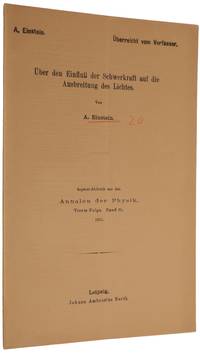
|
|
|
Einstein, Albert
Über den Einfluß der Schwerkraft auf die Ausbreitung des lichtes. In Annalen der Physik 35
Leipzig: Johann Ambrosius Barth 1911. The Genesis of General Relativity<p>Einstein Albert 1879-1955. 1 Elementare betrachtungen über die thermische molekularbewengung in festen Körpern. In Annalen der Physik 35 9: 679-94 pp. Weil 42. 2 Über den Einfluß der Schwerkraft auf die Ausbreitung des lichtes. In Annalen der Physik 35 10: 898-908 pp. Weil 43. Red cloth gilt spine lettering. Figs. Text-illust. 214 x 140 mm. Whole volume: viii 1040 pp. 6 plates 3 b/w silver photos 1 colorized 2 folding. Very good. </p> <p>Approximate English translations of titles: 1 "Elementary considerations about thermal molecular motion in solid bodies" and 2 "On the influence of gravity on the propagation of light." </p> <br /> <br /> <p>"Einstein returns to his thoughts on gravitation and discusses his ideas on the static gravitational field no. 1 above advancing the "half-shift" prediction of the deflection of light by a massive body such as the Sun. In his early papers on the subject . . . he used two important features: the principle of equivalence and the role of the speed of light. In this paper he takes a broader perspective saying that if a light beam is bent in an accelerating frame of reference then if the theory is correct it must also be besnt by gravity by exactly the equivalent amount." Calaprice An Einstein Encyclopedia.</p> <p>"An important conclusion of this paper is that the velocity of light in a gravitational field is a function of the place. The equation: </p> <p> c = c01 / c2</p> <p> signifies that there exists a relationship between the velocity of light and the gravitational potential; the latter influences the first." Weinstein Einstein's 1912-1913 struggles with Gravitation Theory: Importance of Static Gravitational Fields Theory. </p> <br /> <br /> <p>"Here no. 2 above Einstein continues the work he had begun in 1907 on the specific heat of solids where the heat agitation of solids was reduced to a monochromatic oscillation of the atom and the specific heat was determined based on the quantum treatment of an oscillator in a radiation field. He explains the discrepencies between his formula and the measurements at low temperatures" Calaprice An Einstein Encyclopedia. </p> <br /> <br /> <p>Weil's Einstein Bibliography nos. 42 and 43. Boni's Einstein Checklist nos. 38 39. </p> . Johann Ambrosius Barth unknown
Bookseller reference : 50424

|
|
|
Einstein, A.
Über die spezielle und die allgemeine Relativitätstheorie Wissenschaftliche Taschenbücher 59 German Edition
hardcover. Good. Access codes and supplements are not guaranteed with used items. May be an ex-library book. hardcover
Bookseller reference : 3112596013.G ISBN : 3112596013 9783112596012
|
|
|
Einstein, Albert
Über die spezielle und die allgemeine Relativitätstheorie German Edition
paperback. Good. Access codes and supplements are not guaranteed with used items. May be an ex-library book. paperback
Bookseller reference : 3540424520.G ISBN : 3540424520 9783540424529
|
|
|
Einstein, Albert
Über die spezielle und die allgemeine Relativitätstheorie.
1969. Berlin/ Oxford/ Braunschweig Akademie-Verlag/ Pergamon Press/ Vieweg&Sohn 1969. Kl.-8°. 4 Abb. im Text 130 S. 1 Bl. Anzeigen. Original-Kartonband leicht braunrandig und kncikspurig. Innen sauber und gut erhalten. Wissenschaftliche Taschenbücher Band 59. unknown
Bookseller reference : 46171HB
|
|
|
Einstein, Albert 1879-1955
Über die spezielle und allgemeine Relativitätstheorie gemeinverständlich
like new. unknown
Bookseller reference : 45054501 ISBN : 1015504620 9781015504622
|
|
|
Einstein, Albert.
Über die spezielle und die allgemeine Relativitätstheorie. Mit dem Bildniss des Verfassers nach Herm.Struck. 11. Aufl. 46.-50. Tsd.
Braunschweig Vieweg 1921. IV 91 S. OKart. etwas gebräunt Umschlag randrissig = Sammlung Vieweg ; 38. Weil 90 zur Erstausgabe von 1917. Braunschweig, Vieweg 1921. unknown
Bookseller reference : NAT2035a
|
|
|
Einstein, A.
Über Die Spezielle Und Die Allgemeine Relativitätstheorie
De Gruyter 1970. Hardcover. New. 21 reprint edition. 136 pages. German language. 5.00x0.44x8.00 inches. De Gruyter hardcover
Bookseller reference : x-3112596013 ISBN : 3112596013 9783112596012
|
|
|
Einstein, A.
Über Die Spezielle Und Die Allgemeine Relativitätstheorie
De Gruyter 1969. Hardcover. New. 21 reprint edition. 136 pages. German language. 5.00x0.44x8.00 inches. De Gruyter hardcover
Bookseller reference : x-3112595998 ISBN : 3112595998 9783112595992
|
|
|
Einstein, Albert
Über die spezielle und die allgemeine Relativitätstheorie Gemeinverständlich German Edition
paperback. Good. Access codes and supplements are not guaranteed with used items. May be an ex-library book. paperback
Bookseller reference : 3322982726.G ISBN : 3322982726 9783322982728
|
|
|
Einstein, Albert
Über die Spezielle und Allgemeine Relativitätstheorie: Gemeinverständlich German Edition
paperback. Good. Access codes and supplements are not guaranteed with used items. May be an ex-library book. paperback
Bookseller reference : 3322983196.G ISBN : 3322983196 9783322983190
|
|
|
Einstein, Albert
Über die spezielle und die allgemeine Relativitätstheorie: Gemeinverständlich: 10 Sammlung Vieweg 10
paperback. Good. Access codes and supplements are not guaranteed with used items. May be an ex-library book. paperback
Bookseller reference : 3663037754.G ISBN : 3663037754 9783663037750
|
|
|
Einstein, Albert
Über die Entwickelung unserer Anschauungen über das Wesen und die Konstitution der Strahlung 20: pp.482-500.
1909. Verh. Dtsch. Physik. Ges. 11/ 1-24. - Hrsg. im Auftrage der Gesellschaft von Karl Scheel. - Braunschweig Druck und Verlag von Friedrich Vieweg und Sohn 1909 8° VII 749 pp. Abbildungen Halbleinenband d.Zt.; St.a.Tit.; feines Expl. First Edition! The true first printing see below of this paper which Wolfgang Pauli said "can be considered as one of the landmarks in the development of theoretical physics" Schilpp p. 154. This paper marks the introduction of the modern "photon" concept although the term itself was introduced much later in a 1926 paper by Gilbert N. Lewis. It contains "the first well-conceived promulgation of the wave-particle duality of light which had implications as profound as Einstein's earlier theoretical breakthroughs" Isaacson p.157. Einstein here anticipated the principle of complementarity one of the fundamental principles of quantum mechanics. His own proposal for a solution of the wave-particle paradox - that Maxwell's equations for electromagnetic fields be modified to allow wave solutions that are bound to singularities of the field - was never developed although it may have influenced Louis de Broglie's pilot wave hypothesis for quantum mechanics developed in his famous thesis Recherches sur la théorie des quanta 1924. The present paper was also published in Physikalische Zeitschrift Vol. 10 1909 but the Verhandlungen printing has priority: it was published on 30 October 1909 the Physikalische Zeitschrift printing appeared on 10 November. "This extensive paper given as lecture before the 81st assembly of the "Gesellschaft Deutscher Naturforscher" in Salzburg on 21st September 1909. He spoke on "The Development of Our View of the Nature and Constitution of Radiation" a topic that embraced both relativity and quanta. Among those who attended Einstein's lecture were some of the world's foremost physicists. In Einstein's austere opinion his address regarded strictly as a work of science was of little importance since as he writes to a co-worker it contained nothing new. Einstein was being overmodest. Besides to many in Einstein's audience and it should be born in mind that it was the year after Minkowski's stirring introduction of the concept of the fourth dimension this Lecture came as a revelation. The occasion was important for Einstein too. He had been working for years in a sort of scientific exile and his curiosity as to what great scientists were like in face-to-face discussion was at least as great as their curiosity about him. His confidence in himself was certainly not harmed when he found that he was able to hold his own easily in their company. Moreover at this congress Einstein first met Planck. In addition he made new'lasting friendships leading to a voluminous scientific correspondence. Amongst those attending the congress were Max von Laue Max Born. Arnold Sommerfeld Hasnohrl. Ladenburg. Max von Laue was to be the first to publish in 1911 the first text-book on relativity theory. All of them are present in this issue with scientific papers of their own." Walter Alicke 11. Jahrg. 30. Oktober 1909 Nr. 20 - Vorgetragen in der Sitzung der physiklaischen abteilung der 81. Versalung Deutscher Naturforscher und Ärzte zu Salzburg am 21. September 1909." Weil No. 30; Schilpp-Shields No. 30; Hoffmann Einstein p. 93. unknown
Bookseller reference : 52424
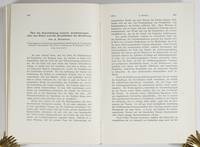
|
|
|
Einstein, Albert
Über die neueren Umwandlungen welche unsere Anschauungen über die Natur des Lichts erfahren haben. Diskusssion 2/1: p.41.
1909. Verh. Ges. Naturf. Ärzte 81/1. 2.T./1.2. - Versammlung Salzburg 1909 . - Leipzig F.C.W. Vogel 1910 8° 4 205 3; XII 234 4 pp.; XIV 317 1 39 Abbildungen im Text Halbleinenband Erstdruck! EINSTEIN und die Salzburger Naturforscherversammlung! "In das helle Rampenlicht der physikalischen Bühne trat das Quantenproblem erstmalig beim Auftritt EINSTEINS auf der 81. Versammlung der Deutschen Naturforscher und Ärzte die vom 19. bis 25. September 1909 in Salzburg stattfand. EINSTEIN war bislang nur einigen wenigen jüngeren Physikern die die Reise nach Bern nicht gescheut hatten persönlich bekannt geworden. Als EINSTEIN nun zum ersten Mal an einem Naturforscherkongreß teilnahm begegneten ihm viele Fachkollegen mit außergewöhnlichem Interesse; sein Auftreten war zweifellos ein Höhepunkt der Tagung. Die Versammlung blieb - was insbesondere die "stark besuchte physikalische Abteilung" betraf - allen Beteiligten als höchst glanzvoll in Erinnerung. So schrieb etwa LISE MEITNER: "This congress was altogether a very impressive experience. It was attended by theoretical and experimental physicists from the entire world . . It was really something quite out of the ordinary a most stimulating meeting". EINSTEINS Vortrag fand in der Abteilung Physik in Gemeinschaft mit der Abteilung Mathematik am 21. September 1909 zu Beginn der Nachmittagssitzung statt. Aus den angegebenen Zahlen kann man schließen daß über 100 Hörer EINSTEINS Referat beiwohnten unter ihnen ein Großteil der führenden Physiker des deutschen Sprachraumes. EINSTEINS Vortrag "Über die Entwicklung unserer Anschauungen über das Wesen und die Konstitution der Strahlung" beeindruckte die Hörer zumindest die jüngeren gewaltig. EINSTEIN vertrat und begründete die These daß weder die bisherige Wellentheorie noch eine naiv-korpuskulare Auffassung des Lichtes angemessen ist sondern daß "eine Art Verschmelzung von Undulations- und Emissionstheorie" die Wirklichkeit trifft. EINSTEIN hatte damit in die Optik das Dualitätsprinzip eingeführt welches nach einem Worte SOMMERFELDS "unter allen erstaunlichen Entdeckungen dieses Jahrhunderts die erstaunlichste ist". Wie MAX BORN registrierte wurde "von der versammelten Gelehrsamkeit EINSTEINS Leistung abgestempelt". EINSTEIN wurde sozusagen in den engen Kreis der führenden Physiker aufgenommen. Tatsächlich spricht aus PLANCKS Diskussionsbemerkung große Hochachtung wenn auch PLANCK den kühnen Ideen des jungen EINSTEIN was die Lichtquantenhypothese betraf gleichsam noch die offizielle Billigung versagte. Zweifellos muß der Auftritt EINSTEINS und PLANCKS Stellungnahme großes Aufsehen erregt haben. Unmittelbar vordergründig konnte EINSTEIN mit seiner Lichtquantenhypothese nicht durchdringen. FRITZ REICHE einer der zahlreichen jüngeren Teilnehmer berichtete: "I must say I was very much impressed by the appearance of the second term in the fiuctuation formula. Though it is of course a rather indistinct proof of photons'. I remember of course that people were opposed and tried to find another reason or tried to give the formula another form." Auch PAUL EPSTEIN glaubte nicht daß EINSTEIN mit seinem Vortrag allzuviele überzeugte: "HEILBRON: Do you recall whether that talk of EINSTEIN had a great effect' EPSTEIN: NO great effect. You see the chairman of the meeting was PLANCK and he immediately said that it was very interesting but he did not quite agree with it. And the only man who seconded at that meeting was JOHANNES STARK. You see it was too far advanced". Für EINSTEIN war die Salzburger Tagung nicht nur deshalb bedeutungsvoll weil er hier zum ersten Male vor einem großen Kreis seine Gedanken vortragen konnte sondern ihm hier auch die Möglichkeit gegeben war mit seinen Kollegen in einen persönlichen Gedankenaustausch zu treten. Dies gilt für MAX PLANCK für MAX BORN und besonders für ARNOLD SOMMERFELD. Die nach Herkommen und Veranlagung so verschiedenen Männer der Ostpreuße SOMMERFELD und der Weltbürger EINSTEIN begründeten in Salzburg eine auf gegenseitige Hochachtung basierende Zuneigung die den Wandel der Zeiten überdauerte. EINSTEIN schloß wie er an JOHANN JACOB LAUB schrieb SOMMERFELD stürmisch in sein Herz. Er sei "ganz verliebt" in ihn denn "er ist ein prachtvoller Kerl". Ähnlich hegte auch SOMMERFELD für EINSTEIN fortan das Gefühl der "Bewunderung und Verehrung". Konnte man EINSTEIN in der Lichtquantenhypothese auch nicht folgen mußte man seine Überlegungen doch als scharfsinnig anerkennen. Jedenfalls war nun seit dem ersten Hervortreten im Jahre 1905 EINSTEIN aus einem unbekannten "Experten III. Klasse" beim Eidgenössischen Patentamt zu einem Manne geworden dem ungewöhnlicher Respekt gezollt wurde. Wesentlich war daß EINSTEIN in seinem Salzburger Referat nicht nur über die Spezielle Relativitätstheorie vortrug "die er kleineren Propheten überließ" sondern hauptsächlich über das Quantenproblem. Vor dem Forum der großen Physikerversammlung wurde so die Bedeutung dieses weitgehend ungelösten Fragenkomplexes hervorgehoben. EINSTEINS Ansehen das er sich vor allem durch die Begründung der Speziellen Relativitätstheorie verschafft hatte veranlaßte nun manchen Kollegen doch sich auch mit dem Quantenproblem ernsthaft zu beschäftigen. Heute betrachten wir Relativitäts- und Quantentheorie als zuständig für getrennte Erfahrungsbereiche: Die Spezielle Relativitätstheorie basiert auf der Endlichkeit der Lichtgeschwindigkeit während die nichtrelativistische Quantentheorie als Konsequenz der Naturkonstanten h 4= 0 erscheint. Haben also die beiden wichtigsten physikalischen Theorien des beginnenden 20. Jahrhunderts auch keinen logischen Zusammenhang so war doch ihre Entwicklung historisch eng verknüpft. Die Erfolge der Relativitätstheorie bewirkten eine schnellere Entwicklung der Quantentheorie." Armin Hermann & Ulrich Benz Quanten- und relativitätstheorie im Speigel der Naturforscherversammlungen 1906-1920 pp.130-131 unknown
Bookseller reference : 37675
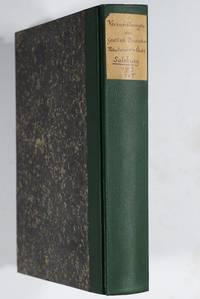
|
|
|
Einstein, Albert 1879-1955
Über die spezielle und allgemeine Relativitätstheorie gemeinverständlich German Edition
hardcover. Good. Access codes and supplements are not guaranteed with used items. May be an ex-library book. hardcover
Bookseller reference : 1015495907.G ISBN : 1015495907 9781015495906
|
|
|
Einstein, Albert 1879-1955
Über die spezielle und allgemeine Relativitätstheorie gemeinverständlich German Edition
paperback. Good. Access codes and supplements are not guaranteed with used items. May be an ex-library book. paperback
Bookseller reference : 1015504620.G ISBN : 1015504620 9781015504622
|
|
|
Einstein, Albert
Über die Möglichkeit einer neuen Prüfung des Relativitätsprinzips; 2 Bemerkungen zu der Notiz von Hrn. Paul Ehrenfest: "Die translation deformierbarer Elektronen und der Flächensatz"; 3 Über die vom relativitätsprinzip geforderte Trägheit der Energie. In Annalen der Physik 23
Leipzig: Johann Ambrosius Barth 1907. Einstein explicitly establishes E=mc2.<p>Einstein Albert 1879-1955. 1 Über die Möglichkeit einer neuen Prüfung des Relativitätsprinzips. In Annalen der Physik 23 6: pp. 197-8. 2 Bemerkungen zu der Notiz von Hrn. Paul Ehrenfest: "Die translation deformierbarer Elektronen und der Flächensatz." In Annalen der Physik 23 6: pp. 206-8. 3 Über die vom relativitätsprinzip geforderte Trägheit der Energie. In Annalen der Physik 23 7: pp. 371-384. 8vo. Red cloth gilt lettering on spine. 214 x 140 mm. Whole volume: viii 1000 pp. 4 plates numbered Taf. I - IV. Tafs. I II and IV are folding Taf. III is b/w silver photograph tipped to sheet. Foot of the spine is repaired. Very good. </p> <br /> <br /> <p>Approximate English translations of titles: 1 "On the possibility of a new test of the principle of relativity." 2 "Remarks on Mr. Paul Ehrenfest's note: 'The translation of deformable electrons and the surface theorem.'" 3 "On the inertia of energy required by the principle of relativity." </p> In “On the inertia of energy required by the relativity principle†May 1907 “Using rather than m V rather than c and 0 rather than E0 Einstein wrote his famous equation for the first time as V2= 0 and he did it in a footnote. At the end of that paper he introduced the symbol E0 to denote energy in the rest frame and wrote the famous expression again this time as =E0/V2.†-Eugene Hecht How Einstein confirmed E0 = mc2 </p> <p> In the third paper Einstein explicitly establishes his famous equation E=mc2 although with different symbols. In this paper Einstein discussed the relationship between inertial mass and energy arguing for their complete equivalence namely that every mass has an equivalent energy just as every form of energy has an equivalent mass. This relation says that a photon can convert for the equivalence of mass and energy his celebrated equation E = mc2 Calaprice The Einstein Almanac. </p> <br /> <br /> <p> Weil's Einstein Bibliography nos. 17 18 and 19 respectively. <br> Boni's Einstein Checklist nos. 17 18 and 19 respectively.</p> . Johann Ambrosius Barth unknown
Bookseller reference : 50420
|
|
|
Einstein, Albert.
Über die spezielle und die allgemeine Relativitätstheorie:
Braunschweig: Friedrich Vieweg 1917. Ninth printing. Acceptable. 23 cm; iv. 79 pages. Three figures in text along with numerous equations. In original printed wraps. Acceptable only with paper peeling from the spine and sewing tender. Paper cover is completely detached in front and hanging by a thread in back. The pages are yellowed. There is an ownership autograph of one E. Bodländer. That said a clean unmarked copy in original state. <br /><br />The original German edition of Einstein's epoch-making "On the Special and General Theory of Relativity. Friedrich Vieweg paperback
Bookseller reference : 6547

|
|
|
Einstein, Albert
Über Die Spezielle Und Allgemeine Relativitätstheorie: Gemeinverständlich
Vieweg Teubner Verlag 1963. Paperback. New. 19 edition. 113 pages. German language. 8.26x5.82x0.32 inches. Vieweg + Teubner Verlag paperback
Bookseller reference : x-3322983196 ISBN : 3322983196 9783322983190
|
|
|
Einstein, Albert
Über Die Spezielle Und Die Allgemeine Relativitätstheorie Gemeinverständlich
Vieweg Teubner Verlag 1921. Paperback. New. 11 edition. 98 pages. German language. 8.82x5.98x0.32 inches. Vieweg + Teubner Verlag paperback
Bookseller reference : x-3322982726 ISBN : 3322982726 9783322982728
|
|
|
Einstein, Albert
Über Die Spezielle Und Die Allgemeine Relativitätstheorie: Gemeinverständlich
Vieweg Teubner Verlag 1920. Paperback. New. 10 spi rep edition. 95 pages. German language. 8.51x5.52x0.25 inches. Vieweg + Teubner Verlag paperback
Bookseller reference : x-3663037754 ISBN : 3663037754 9783663037750
|
|
|
Einstein, Albert and J. J. Laub
Über die elektromagnetischen Grundgleichungen für bewegter Körper. Offprint
1908. <p>Einstein Albert 1879-1955 and Jakob Johann Laub 1884-1962. Über die elektromagnetischen Grundgleichungen für bewegter Körper. Offprint from Annalen der Physik 4th series 26 1908. 532-540pp. 225 x 146 mm. Original printed wrappers. Fine.</p> <p>First Edition Offprint Issue. Einstein’s first paper written jointly with a collaborator on the relativistic electrodynamics of ponderable media. “In 1908 Laub wrote works together with Einstein on the basic electromagnetic equations which was aimed to replace the four-dimensional formulation of the electrodynamics by Minkowski by a simpler classical formulation. Both Laub and Einstein discounted the spacetime formalism as too complicated. However it turned out that Minkowski’s spacetime formalism was fundamental for the further development of special relativity†Wikipedia. Pais Subtle is the Lord pp. 151 154. Shields 23. Weil 23.</p> . unknown
Bookseller reference : 43217

|
|
|
EINSTEIN, ALBERT & J. LAUB.
Über die elektromagnetischen Grundgleichungen für bewegte Körper Fundamental equations of the electromagnetism of moving bodies; And same authors: Über die elektromagnetischen Felde auf ruhende Körper ausgeübten ponderomotorischen Kräfte Ponderom.
Leipzig J.A. Barth 1908. 2 contemp. hcalf and hcloth. Spines slightly rubbed. In "Annalen der Physik. Hrsg. von W. Wien und M. Planck" vol. 26 and 27. VI1032 and plates pp. VIII1112 pp. and plates.- Einstein & Laub papers: pp.532-541 pp. 541-550 pp. p. 232. Whole volumes offered. <br/><br/><em>First editions of all three papers.- Volume 26 contains also a first printing of Max Planck. "Zur Dynamik bewegter Systeme". Pp. 1-34. Planck Akademie No 76. - Weil: 22 1-2 and 23. </em> hardcover
Bookseller reference : 39155
|
|

 Receive by email
 Download as PDF document
 RSS feed
 Permanent link


