|
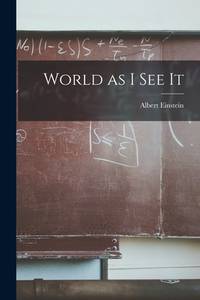
Einstein, Albert
World as I See It
paperback. Good. Access codes and supplements are not guaranteed with used items. May be an ex-library book. paperback
Bookseller reference : 1013652592.G ISBN : 1013652592 9781013652592
|
|
|
Einstein, Albert
World As I See It
mass_market. Good. Access codes and supplements are not guaranteed with used items. May be an ex-library book. unknown
Bookseller reference : 9568356347.G ISBN : 9568356347 9789568356347

|
|
|
Einstein, Albert
World As I See It
BN Publishing 2007-07-17. Mass Market Paperback. New. New. In shrink wrap. Looks like an interesting title! BN Publishing paperback
Bookseller reference : Q-9568356347 ISBN : 9568356347 9789568356347
|
|
|
EINSTEIN, Albert [in] KLEINSMID, Rufus B. (et al, eds)
World Disarmament" - article in World Affairs Interpreter. Vol 3 no. 2 Summer 1932
Los Angeles: Los ANgeles University of International Relations 1932. First Edition. Quarto 26cm. Pictorial card wrappers; 96pp. Mild external soil; Very Good or better. Includes a translation of Dr. Einstein's 1932 address "World Disarmament" delivered at the World Affairs Dinner in Pasadena February 1 1932. Other contributions Ken Nakazawa and N. Wing Mah on the Sino-Japanese Controversy Bernard Mollenhauer et al. Los ANgeles University of International Relations unknown
Bookseller reference : 40505

|
|
|
Einstein, Albert; trans. Li Hao A. 爱因斯坦;李灝(译)
Xiang dui lun de yi yi 相对论的æ„义
Beijing: Ke xue chu ban she 1979. v 111p. slender paperback very good. Translation of the fifth edition of "The meaning of Relativity. Ke xue chu ban she unknown
Bookseller reference : 228499

|
|
|
Einstein, Carl
XXe Siecle: Georges Braque
Paris London and New York: Editions Des Chroniques Du Jour and A. Zwemmer and E. Weyhe 1934. Limited to 700 copies. Softcover. Good scuffs to glassine. spine ends rubbed & chipped w/ glassine chipped. textblock split at pg 140 w/ minor splits to multiple minor splits to closing plate section. Grey glued wraps with white lettering on cover and spine. 140 pgs w/ frontis & 102 bw plates; 1 color litho. glassine wrapper. text in French. Color plate with tissue guard intact. Majority of pages are unopened. Photo is of another copy from our collection. Editions Des Chroniques Du Jour (and) A. Zwemmer (and) E. Weyhe paperback
Bookseller reference : 186351
|
|
|
Einstein, Carl
XXe Siecle: Georges Braque
Paris London and New York: Editions Des Chroniques Du Jour and A. Zwemmer and E. Weyhe 1934. Limited to 700 copies. Softcover. Good glassine jackets scuffed marked & foxed; may have chipping & tears to edges corners & spines. spines split; glue & binding intact. Grey glued wraps with white lettering on cover and spine. 2 preliminary leaves 13-140 pages 2 leaves including plates frontispiece prior to p. 13 102 bw and 1 color plate that appears to be a lithograph. Text is in French. Lacks a signed etching. Pages remain bright with instances of foxing. Editions Des Chroniques Du Jour (and) A. Zwemmer (and) E. Weyhe unknown
Bookseller reference : 173435

|
|
|
Einstein, Margie
You can get pregnant fast: Essential Guide to Help Conceive a Baby Quickly
like new. unknown
Bookseller reference : 24575184 ISBN : 1515051315 9781515051312

|
|
|
Einstein, Margie
You can get pregnant fast: Essential Guide to Help Conceive a Baby Quickly
new. unknown
Bookseller reference : 24575184-n ISBN : 1515051315 9781515051312
|
|
|
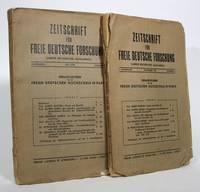
Einstein, Albert; Meusel, Alfred; Lips, Julius E.; Vermeil, Edmond u. a.
Zeitschrift für freie deutsche Forschung. Libres recherches allemandes. 1. Jahrgang Nummer 1 und 2.
1938. 2 Bände. Paris Science et Litterature 1938. Gr.-8°. 168 S. - 144 S. Unbeschnittene Original-Broschuren gebräunt leicht angerändert Band 1 leicht fleckig. Band 1 stellenweise und Band 2 erste Seite geringfügig fleckig. Band 2 durchgehend leicht gebräunt und stellenweise etwas bestoßen in der unteren Außenecke. Sonst beide Bände innen gut. Enthält u.a. die Abhandlung "Physik und Realitt I-II" so vollständig von Albert Einstein. unknown
Bookseller reference : 46056HB
|
|
|
Einstein, Albert et al.
Zeitschrift fur Freie Deutsche Forschung Libres Recherches Allemandes July & November Two Issues
Rue Cujas Paris: Verlag Science et Literature 1938. 1st Edition. Soft cover. Very Good. 8vo medium. 2 Volumes Tan wrappers lettered in black 168pp; 144pp light foxing and sunning on text-block some unopened pages wrappers somewhat soiled some faint damp stains front wrapper of second volume detached tears and chips to extremities and spine ends of both volumes. Very Good. Scarce According to the Leo Baek Institute for the Study of German-Jewish History and Culture "Ernst Heidelberger established a bookstore in Paris in September 1937. The bookstore offered émigré journals and exile literature. In the following years he published a few books including Einstein's Physik und Realität under the imprint Science et Literature. He also became the publisher of two journals Zeitschrift für freie deutsche Forschung and the Freie deutsche Hochschulen." These two volumes offer articles from Einstein on Physics and Relativity as well as The Logical Psychological and Physical Limits of the Uncertainty Principle On the Philosophy of National Socialism Forms of Government and Administration among Indigenous Peoples National Socialist Science and the Tasks of Free German Science Physics and Reality Principles of German Foreign Policy Forms of Government and Administration among Indigenous Peoples Heinrich Heine and the European Revolutions Studies on the Economic Situation of the Population in Germany I. Study: The Development of Wage Rates in Germany 1932-1938. Published by the Free German Academy in Paris. Verlag Science et Literature unknown
Bookseller reference : 016311
|
|
|
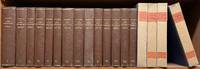
EINSTEIN, Alfred (Ed.)
Zeitschrift für Musikwissenschaft. 1 1918 - 17 1935.
Leipzig Breitkopf und Härtel 1918-35. 8vo. Later brown cloth up to 1932 1932-35 sewn as issued in boxes. 14 volumes and four boxes. With library stamps from Musikmuseet in Stockholm. All published. Alfred Einstein was editor up to 1933 when he had to leave Nazi Germany. Editor for the two last years was Max Schneider. hardcover
Bookseller reference : 84067
|
|
|
Einstein, Alfred:
Zeitschrift für Musikwissenschaft herausgegeben von der Deutschen Musikgesellschaft. 1. Jahrgang 1918 Heft 1 8. Jahrgang 1925/26 1-12 9. Jahrgang 1926/27 1-12 13. Jahrgang 1930/31 1-12 14. Jahrgang 1931/32 1-12.
Verlag von Breitkopf & Härtel Leipzig 1925. Softcover Zustand: keine Eintragungen. Rücken Ecken Kanten stärker bestoßen/berieben. Der Rücken ist verletzt die Deckblätter sind lose bei den Jahrgängen 8 und 9. Verlag von Breitkopf & Härtel, Leipzig, paperback
Bookseller reference : 223902
|
|
|
EINSTEIN, ALBERT.
Zu Kaluzas Theorie des Zusammenhanges von Gravitation und Elektricität. Erste-Zweite Mittheilung.
Berlin Gruyter & Co. 1927. 4to. Orig. printed orange wrappers. Offprint/Sonderabdruck aus Sitzungsberichten.pp.23-30. Fine fresh copy. <br/><br/><em>First edition of rare Offprint still called "Abdruck". - Weil No. 156.The early Offprints from "Sitzungsberichten." are called "Sonderabdruck" up to Weil No.165 including this. From Weil 166 they are called "Sonderausgabe.". - Before 161 up to 160 the Offprints do not have separate title and pagination the pagination follows the numbering in the periodical. From 166 the Offprint has both separate printed title and pagination. - So Weil Nos 161-165 is still "Abdruck" but with separate title and pagination. These facts are not mentioned in the bibliographies. </em> unknown
Bookseller reference : 28360
|
|
|
EINSTEIN, A.
Zu Kaluzas Theorie des Zusammenhanges von Gravitation und Elektrizität. Erste und zweite Mitteilung.
Berlin 1927. Orig. printed orange wrappers. Back strengthend with matching paper. Fresh copy. Offprint/Sonderabdr. aus "Sitzungsberichte". pp. 23-30. <br/><br/><em>First edition. Weil No. 156. </em> unknown
Bookseller reference : 22776
|
|
|
Einstein, Albert, W. Einthoven, et al.
Zue allgemeinen molekularen Theorie der Wärme Annalen der Physik: Vierte Folge Band 14
Johann Ambrosius Barth Leipzig 1904. Hardcover. Good. 8vo hardcover. No dj lavender cloth. Good condition. Covers faded spine title still legible. Endpapers age-toned; contents clean no marking or writing. Binding sturdy square and tight. 1040 pp. including Einstein's seminal paper on pages 354-362 Johann Ambrosius Barth, Leipzig hardcover
Bookseller reference : 1191206.18
|
|
|
EINSTEIN, ALBERT.
Zum Ehrenfest'schen Paradoxon. Bemerkung zu V. Varicaks Aufsatz.
Leipzig Hirzel 1911. 4to. Contemp. modest hcloth. Light wear to spine. Stamp on title. "Physikalische Zeitschrift. Hrsg. von E. Riecke und F. krüger. Zwölfter Jahrgang." XXIII1256 pp Illustrated. Einstein paper pp. 509-10. The whole volume offered. <br/><br/><em>First printing of Einstein's paper on the Paradox of Ehrenfest first presented by Paul Ehrenfest in 1909.Weil No 44. </em> hardcover
Bookseller reference : 38845
|
|
|
Einstein, Albert
Zum gegenwärtigen Stande des Gravitationsproblems. Vortrag. Versammlung deutscher Naturforscher zu Wien .pp.3-26. Laue Max: Röntgenstrahl-Interferenzen pp.37-42.
1914. Verh. Ges. Naturf. Ärzte 85.Vers. Wien 1913. - 12/1 Bd.: Naturwissenschaftliche Abteilungen. - Leipzig F.C.W. Vogel 1914 8° 4 366 VIII 834 pp. 108 Abbildungen 3 Taf. Halbledereinband der Zeit; feines Expl. First and original edition of Einstein's famous lecture in a well preserved copy. By 1913 Einstein had reached a temporary impasse following the publication of his and Marcel Grossmann's "Entwurf einer Verallgemeinerten Relalitivitätstheorie.". but his view on the need for generalising the Special Theory aroused great interest and in September he but them before the 85th Congress. held in Vienna. The auditorium was packed with scientists anxious to hear about a theory even more outlandish than Special Relativity. In some ways they were disappointed. Instead of the esoteric explanations they had expected there came one of Einstein's minor masterpieces of simple statement an account in which he compared the development of the various theories of gravitation with the development of successive concepts of electricity. Weil No. 54; Clark-Einstein pp.158ff; Schilpp-Shields No. R8; Alicke No.51a. unknown
Bookseller reference : 27393
|
|
|
EINSTEIN, A[lbert].
Zum gegenwärtigen Stande des Gravitationsproblems. pp. 1249-1266. CONTAINED IN : RIECKE E. und SIMON H. TH. eds. Physikalische Zeitschrift. Vol.14. 1913. pp. XXXI i 1312. 65 plates.
. Library copy with book-plate and stamp at the front cloth scuffed and discoloured with a touch of wear to the spine ends but despite its massive size the joints are firm and the contents clean. WEIL #54; BONI RUSS LAURENCE #55 - Einstein's famous exposition to the 85th. Vienna Congress. In the following discussion there are contributions from BORN JÄGER REISSNER RIECKE MIE HASENÖHRL. hardcover
Bookseller reference : 58378
|
|
|
EINSTEIN, ALBERT.
Zum gegenwärtigen Stande des Gravitationsproblems.
Leipzig 15. December 1913. 4to. "Physikalische Zeitschrift No. 25 15. December 1913. 14 Jahrgang" pp. 1249-1312. Einsteins paper: 1249-1266 Discussion pp. 1262-66. <br/><br/><em>First edition. This is the famous address that Einstein gave on the occasion on the 85th Congress "Versammlung Deutscher Naturforscher und Aerzte zu Wien" in their meeting September 23 1913 together with the ensuing discussion. - Weil No. 54. </em> unknown
Bookseller reference : 38802
|
|
|
EINSTEIN, A.
Zum gegenwärtigen Stande des Gravitationsproblems.
Leipzig S. Hirzel 1913. Royal8vo. Uncut unopened in the original wrappers. In "Physikalische Zeitschrift" Vol. 14 1913. Entire issue offered. Front wrapper detached and lower right corner is missing. Extremities with nicks otherwise very fine and clean. Rare unopened. Pp. 1249-1266. Discussion; Pp. 1262-66. Entire volume: XXXI 1 1312 pp. LVI plates. <br/><br/><em>First printing the famous address that Einstein gave on the occasion on the 85th Congress "Versammlung Deutscher Naturforscher und Aerzte zu Wien" in their meeting September 23 1913 together with the ensuing discussion. In it he compared the development of the various theories of gravitation with the development of successive concepts of electricity.Weil No. 54. </em> unknown
Bookseller reference : 47060

|
|
|
EINSTEIN, A.
Zum gegenwärtigen Stande des Gravitationsproblems.
Leipzig S. Hirzel 1913. Royal8vo. Bound in contemporary half cloth with gilt lettering to spine. In "Physikalische Zeitschrift" Vol. 14 1913. Entire issue offered. Binding with wear front hinge loose. Front free end-paper and title page with library stamps. Internally fine and clean. Pp. 1249-1266. Discussion; Pp. 1262-66. Entire volume: XXXI 1 1312 pp. LVI plates. <br/><br/><em>First printing the famous address that Einstein gave on the occasion on the 85th Congress "Versammlung Deutscher Naturforscher und Aerzte zu Wien" in their meeting September 23 1913 together with the ensuing discussion. In it he compared the development of the various theories of gravitation with the development of successive concepts of electricity.Weil No. 54. </em> hardcover
Bookseller reference : 46938
|
|
|
EINSTEIN, ALBERT.
Zum hundertjährigen Gedenktag von Lord Kelvins Geburt.
Berlin Julius Springer 1924. 4to. Orig. printed wrappers. In "Die Naturwissenschaften" 12. Jahrg. Heft 30 pp. 601-602. The whole of Heft 30 present. <br/><br/><em>First edition. - Weil 140. </em> unknown
Bookseller reference : 38641
|
|
|
EINSTEIN, ALBERT.
Zum hundertjährigen Gedenktag von Lord Kelvins Geburt.
Berlin Julius Springer 1924. Royal8vo. Bound in contemporary half cloth with gilt lettering to spine. In "Die Naturwissenschaften" 12. Jahrg 1924. The whole year offered. "12" written in hand to spine otherwise a very fine and clean copy. Pp. 601-602. Entire volume: XXV 1 1412 60 pp. <br/><br/><em>First printing of Einstein's paper on Lord Kelvin and his scientific work. The occasion was the Centenary Year of Thomson's birth and Einstein wrote 'Zum hundertjährigen Gedenktag von Lord Kelvins Geburt 26. Juni 1824'. In the mid-nineteenth century Thomson's ideas on thermodynamics established the base line for future generations of scientists. Likewise in 1905 Einstein changed the world of physics forever with the publication of his radical new ideas on special relativity."We may learn from Einstein the philosopher of his interest in the founding scientists of the nineteenth century such as Kelvin and Maxwell of science being not only about instrumentation mathematics and formulae but also about sharing in the aspirations and achievements of other scientists past or present." Trainer Einstein's Centenary Tribute The volume contain several other papers by influential contemporary phycisians. Weil 140. </em> hardcover
Bookseller reference : 47162
|
|
|
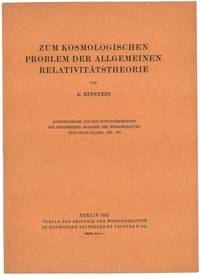
Einstein, Albert
Zum Kosmologischen Problem der allgemeinen Relativitätstheorie.
1931. S.Ber. Akad. Wiss. Berl. 1931/12. - Berlin Verlag der Akademie der Wissenschaften 1927 8°5 S. orig. Broschur. First Edition! A fine and fresh copy in the rare off-print form from the "Sitzungsbereichte." Interesting is to note in the publisher's ad on the last page of the back-cover that all the off-prints of Einstein's papers published by the Academy between 1914 and 1921 are marked out ofprint as early as 1931! Weil N0.179; Schilp-Shields No. 249 unknown
Bookseller reference : 28980
|
|
|
EINSTEIN, ALBERT.
Zum Kosmologischen problem der allgemeinen Relativitätstheorie.
Berlin Gruyter & Co. 1931. 4to. Orig. printed orange wrappers. Offprint/Sonderausgabe aus Sitzungsberichten.pp.1-5. Fine fresh copy. <br/><br/><em>First edition in the rare Offprint with the separate printed title and separate pagination. See Weil No. 179 where this is not mentioned.The early Offprints from "Sitzungsberichten." are called "Sonderabdruck" up to Weil No.165 including this. From Weil 166 they are called "Sonderausgabe.". - Before 161 up to 160 the Offprints do not have separate title and pagination the pagination follows the numbering in the periodical. From 166 the Offprint has both separate printed title and pagination. - So Weil Nos 161-165 is still "Abdruck" but with separate title and pagination. These facts are not mentioned in the bibliographies. </em> unknown
Bookseller reference : 28366
|
|
|
EINSTEIN, ALBERT - SCHRODINGER, ERWIN.
Zum kosmologischen Problem der allgemeinen Relativitätstheorie. Withbound Schrödinger: Spezielle Relativitätstheorie und Quantenmechanik.
Berlin Akademie der Wissenschaften 1931. 4to. Orig. printed wrappers. Small nicks to margin of wrapper. "Sitzungsberichte der Preussischen Akademie der Wissenschaften" issue XII pp. 233-247. Einstein paper: pp. 235-237 Schrödinger paper: pp. 238-247. <br/><br/><em>Both papers first edition. - Weil No 179. </em> unknown
Bookseller reference : 38899
|
|
|
Einstein, Albert
Zum kosmologischen Problem der allgemeinen Relativittstheorie. Weil 179. Offprint from S. preuss. Akad. Wiss
Berlin: Akad. Wiss 1931. Akad. Wiss unknown
Bookseller reference : 37423

|
|
|
EINSTEIN, ALBERT.
Zum Quantensatz von Somerfeld und Epstein;
Braunschweig Vieweg & Sohn 1917. Contemp. hcalf. Spine worn and covers detached. Internally clean and fine. "Verhandlungen der Deutschen Physikalischen Gesellschaft im Jahre 1917. Neunzehnter Jahrgang. Herausgegeben von Karl Scheel." V372 pp. Einstein paper: pp. 82-92. The whole volume offered. <br/><br/><em>First edition. Containing also Max von Laue: "Bandenspektrum und molekulare Quantendrehungen; pp.130-38. and "Ein Versagen der klassischen Optik: pp. 19-21. - Weil No 94. </em> unknown
Bookseller reference : 38838
|
|
|
Einstein, Albert
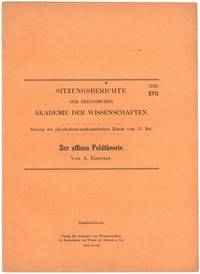
Zur affinen Feldtheorie.
1923. S.Ber. Akad. Wiss. Berl. 1923/ 8. - Berlin Verlag der Akademie der Wissenschaften 1923 8° 4 S. orig. Broschur. First edition. A fine fresh copy in the rare off-print form. Marked with an asterisk by Weil denoting a major paper. "Einstein's attempts to formulate a unified field theory stemmed from his dissatisfaction with the general relativity theory which did not adequately incorporate the electromagnetic field into the geometry of space-time. In 1918 Hermann Weyl had begun investigating the possibility of constructing a unified field theory preserving the dimensionality of space-time while formally altering its geometry making it a special case of the class known as affine geometries. Einstein's first investigation of Weyl's ideas published in the present paper introduced the notion of distant parallelism; however Einstein later rejected Weyl's theory." Weil No. 132; Schilpp--Shields No. 171; Alicke No.113; Norman Library 698; Boni 141 unknown
Bookseller reference : 31740
|
|
|
EINSTEIN, ALBERT.
Zur affinen Feldtheorie.
Berlin Gruyter & Co. 1923. 4to. Orig. printed orange wrappers. Offprint/Sonderabdruck aus "Sitzungsberichteder Preus.pp. 137-40. Fine fresh copy. <br/><br/><em>First edition in the rare Offprint still called "Abdruck". Weil No. 132 with an asterix denoting a major work. - Here Einstein gives his first investigation of the "Affine geometries" and introduces the notion of "Distant parallelism".The early Offprints from "Sitzungsberichten." are called "Sonderabdruck" up to Weil No.165 including this. From Weil 166 they are called "Sonderausgabe.". - Before 161 up to 160 the Offprints do not have separate title and pagination the pagination follows the numbering in the periodical. From 166 the Offprint has both separate printed title and pagination. - So Weil Nos 161-165 is still "Abdruck" but with separate title and pagination. These facts are not mentioned in the bibliographies. </em> unknown
Bookseller reference : 28357
|
|
|
Einstein, Albert (1879-1955)
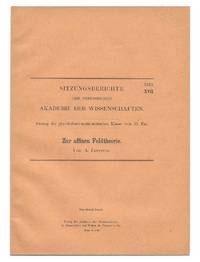
Zur Affinen Feldtheorie. Relativity
Berlin: Berlin: Sitzungsberichte der Preussischen Akademie der Wissenschaften XVIII 1923. First Thus. Soft cover. First Thus. Soft cover. Einstein Albert 1879-1955. Zur affinen Feldtheorie. Offprint from Sitzungsberichten der Preussischen Akademie der Wissenschaften 1923. XVIII. 8vo.4 137-140 First edition. Orange wrappers. A fine fresh copy in the rare off-print form marked with an asterisk by Weil denoting a major paper "Sonderabdruck" & deemed of sufficient interest that a translation was published in Nature Magazine. "Einstein's attempts to formulate a unified field theory the theoretical framework to account for the fundamental forces of nature. stemmed from his dissatisfaction with the general relativity theory which did not adequately incorporate the electromagnetic field into the geometry of space-time". Einstein's first investigation of Weyl's ideas published in the present paper which Weyl had begun working on in 1918. Weyl was investigating the possibility of constructing a unified field theory preserving the dimensionality of space-time while formally altering its geometry making it a special case of the class known as affine geometries. However Einstein later rejected Weyl's theory. "Weil No. 132; Schilpp--Shields No. 171; Alicke No.113; Norman Library 698; Boni 141. Affine Geometry is not concerned with the notions of circle angle and distance. It's a known dictum that in Affine Geometry all triangles are the same. In this context the word affine was first used by Euler affinis. In modern parlance Affine Geometry is a study of properties of geometric objects that remain invariant under affine transformations mappings. Affine transformations preserve collinearity of points: if three points belong to the same straight line their images under affine transformations also belong to the same line and in addition the middle point remains between the other two points." The early Offprints from "Sitzungsberichten." are called "Sonderabdruck" up to Weil No.165 including this. From Weil 166 they are called "Sonderausgabe.". - Before 161 up to 160 the Offprints do not have separate title and pagination the pagination follows the numbering in the periodical. From 166 the Offprint has both separate printed title and pagination. - So Weil Nos 161-165 is still "Abdruck" but with separate title and pagination. Berlin: Sitzungsberichte der Preussischen Akademie der Wissenschaften, XVIII unknown
Bookseller reference : 32429
|
|
|
Einstein, Albert
Zur affinen Feldtheorie. Weil 132. Offprint from S. preuss. Akad. Wiss
1923. <p>Einstein Albert 1879-1955. Zur affinen Feldtheorie. Offprint from Sitzungsberichte der preussischen Akademie der Wissenschaften 17 1923. 137-140pp. 256 x 185 mm. Original printed wrappers. Fine.</p> <p>First Edition Offprint Issue. In 1923 Einstein published four short papers of which "Zur affinen Feldtheorie" is the third on Eddington's attempt at a unified field theory marking the beginning of a scientific passion that would dominate the remainder of his career. In 1921 British physicist Arthur Eddington had proposed a unified field theory inspired by the work of Hermann Weyl. "Einstein's own initial reaction was that Eddington had created a beautiful framework without content. Nevertheless he began to examine what would be made of these ideas and finally decided that 'I must absolutely publish since Eddington's idea must be thought through to the end.' That was what he wrote to Weyl. Three days later he wrote to him again about unified field theories: 'Above stands the marble smile of implacable Nature which has endowed us more with longing than with intellectual capacity.' Thus romantically began Einstein's adventures with general connections adventures that were to continue until his final hours" Pais Subtle is the Lord p. 343. This paper is included on Shields's list of Einstein's most significant papers; see Albert Einstein Philosopher-Scientist 1949 p. 758. Shields 175. Weil 132. </p> . unknown
Bookseller reference : 37407
|
|
|
EINSTEIN, Albert
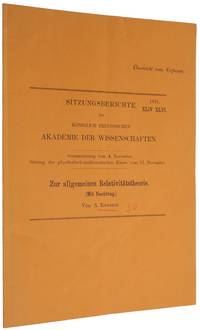
Zur allgemeinen Relativitätstheorie with: Zur allgemeinen Relativitätstheorie Nachtrag. Offprint from Sitzungsberichte der Preussischen Akademie der Wissenschaften XLIV November 4 1915 & XLV. XLVI November 11 1915
Berlin: Königlichen Akademie der Wissenschaften 1915. First edition. <p>EINSTEIN’S COMPLETION OF THE GENERAL THEORY OF RELATIVITY</p> . <p>First editions extremely rare author’s presentation offprint not to be confused with the much more common trade separate – see below from the library of the great German physicist Arnold Sommerfeld of the first two of the papers published in November 1915 that document Einstein’s final version of the general theory of relativity. “In the half century and more of Einstein’s work in science one discovery stands above all as his greatest achievement. It is his general theory of relativity†Norton. “There was difficulty reconciling the Newtonian theory of gravitation with its instantaneous propagation of forces with the requirements of special relativity; and Einstein working on this difficulty was led to a generalization of relativity – which was probably the greatest scientific discovery that was ever made†Dirac quoted in Chandrasekhar p. 3. Einstein’s special theory of relativity 1905 showed that the laws of physics are the same in all inertial i.e. non-accelerating frames of reference. It was then natural to ask whether it was possible to extend this principle of relativity to the more general case of frames of reference in arbitrary states of motion. This problem became linked to a theory of gravitation with Einstein’s ‘equivalence principle’ of 1907 according to which the effects of gravity are locally equivalent to those of accelerated motion. Einstein’s first steps towards a geometrical theory of gravitation were taken in August 1912 when his friend Marcel Grossmann provided the necessary mathematical tools. “Some time between August 10 and August 16 it became clear to Einstein that Riemannian geometry is the correct mathematical tool for what we now call general relativity theory. The impact of this abrupt realization was to change his outlook on physics and physical theory for the rest of his life†Pais p. 210. The resulting ‘Entwurf’ theory 1913 had much in common with the final theory of 1915 but based on a fallacious argument Einstein abandoned the requirement that the theory should be ‘generally-covariant’ i.e. that arbitrary frames of reference should be allowed. “After three years of fruitless peregrinations the revelation came to Einstein that he had been constantly on the wrong track although in 1913 he had been so near to the right solution†Lanczos p. 211. On November 4 1915 he presented to a plenary session of the Prussian Academy a new version of general relativity ‘Zur allgemeinen Relativitätstheorie’ “based on the postulate of covariance with respect to transformations with determinant 1†and stated that he had “completely lost confidence†in the ‘Entwurf’ equations. On November 18 he published his calculation of the precession of the perihelion of Mercury based on the new theory: its agreement with observation confirmed that the theory was correct the Entwurf theory predicted half the observed value of the precession.</p> <br /> <p>Provenance: Arnold Sommerfeld 1868-1951 his characteristic numbering in red pencil ‘30’ on front cover. “The son of a physician Sommerfeld was educated at the University of Königsberg. After teaching briefly at the universities of Göttingen Clausthal and Aachen he was appointed professor of physics at the University of Münich in 1906. Sommerfeld should have retired in 1936 in favour of his pupil Werner Heisenberg. Opposition from the Nazi party to Heisenberg’s appointment prolonged Sommerfeld’s tenure and it was not in fact until late 1939 that he finally retired to be succeeded not by Heisenberg but by Wilhelm Müller a Nazi aerodynamicist without a single publication in physics to his credit. Although Sommerfeld and Heisenberg were not Jewish they were regarded by the Nazis as Jewish sympathizers. Sommerfeld however survived the war and returned to his Münich chair in 1945 continuing to work at physics until he died in a car accident in 1951†Oxford Reference. “Arnold Sommerfeld was one of the most distinguished representatives of the transition period between classical and modern theoretical physics. The work of his youth was still firmly anchored in the conceptions of the nineteenth century; but when in the first decennium of the century the flood of new discoveries experimental and theoretical broke the dams of tradition he became a leader of the new movement and in combining the two ways of thinking he exerted a powerful influence on the younger generation. This combination of a classical mind to whom clarity of conception and mathematical rigour are essential with the adventurous spirit of a pioneer are the roots of his scientific success while his exceptional gift of communicating his ideas by spoken and written word made him a great teacher†Max Born p. 275. </p> <br /> <p>“In June 1905 while still a patent examiner in Bern Einstein submitted his famous work on the electrodynamics of moving bodies to the Annalen der Physik. This work contained his special theory of relativity in which he asserted the equivalence of all inertial frames of reference as a fundamental postulate of physics. The question which then naturally arose was whether it was possible to extend this principle of relativity to the more general case of frames of reference in arbitrary states of motion. But he could find no workable basis for such an extension until he tried to incorporate gravitation into his new special theory of relativity for a review article in 1907 ‘Uber das Relativitätsprinzip und die ausdemselben gezogenen Folgerungen’ Jahrbuch der Radioaktivitat und Elektronik 4 1907 411-62. The difficulties of this task led him to a new principle later to be called the ‘principle of equivalence.’</p> <br /> <p>“On the basis of the fact that all bodies fall alike in a gravitational field Einstein postulated the complete physical equivalence of a homogeneous gravitational field and a uniform acceleration of the frame of reference. This extended the principle of relativity to the case of uniform acceleration. It also foreshadowed the problem whose complete solution would lead him to his general theory of relativity: the construction of a relativistically acceptable theory of gravitation based on the principle of equivalence†Norton p. 258.</p> <br /> <p>One application of the equivalence principle proved crucial to the subsequent development of his ideas on general relativity. Einstein considered an observer standing on a rotating disc – a non-inertial accelerating reference frame. According to special relativity measuring rods aligned with the circumference of the disc will contract due to their motion whereas measuring rods positioned along the radius of the disc will not. Hence the ratio of the circumference of the disc to its diameter will be less than π. “The spatial geometry for the rotating observer is therefore non-euclidean. Invoking the equivalence principle Einstein concluded that this will be true for an observer in a gravitational field as well. This then is what first suggested to Einstein that gravity should be represented by curved space-time. </p> <br /> <p>“To describe curved space-time Einstein turned to Gauss’s theory of curved surfaces a subject he vaguely remembered from his student days at the ETH in Zürich. He had learned it from the notes of his classmate Marcel Grossmann. Upon his return to his alma mater as a full professor of physics in 1912 Einstein learned from Grossmann now a colleague in the mathematics department of the ETH about the extension of Gauss’s theory to spaces of higher dimension by Riemann and others. Riemann’s theory provided Einstein with the mathematical object with which he could unify the effects of gravity and acceleration: the metric field†Janssen p. 65.</p> <br /> <p>The first product of this collaboration was the Entwurf einer verallgemeinerten Relativitätstheorie und einer Theorie der Gravitation published before the end of June 1913 which contained many of the essential features of the final general theory of relativity; most importantly it introduced the ‘metric’ of space-time. In Minkowski’s formulation of special relativity 1908 the most important quantity is the ‘world function’ of two events which determines the metric and causal structure of space-time. If these events have coordinates x y z t and x’ y’ z’ t’ in some inertial reference frame the world function is:</p> <br /> <p>c2t’ – t2 – x’ – x2 – y’ – y2 – z’ – z2</p> <br /> <p>where c is the speed of light. Its crucial property is that it depends only on the two events and not on the choice of inertial reference frame – in other words it is unchanged ‘invariant’ when x y z t and x’ y’ z’ t’ are both subjected to any Lorentz transformation. Einstein and Grossmann began with the world function in differential form:</p> <br /> <p>ds2 = c2dt2 – dx2 – dy2 – dz2</p> <br /> <p>If we now subject x y z t to an arbitrary coordinate transformation not necessarily a Lorentz transformation this takes the general form</p> <br /> <p>ds2 = g11dx12 g12dx1dx2 …. ;</p> <br /> <p>the collection of quantities gμν which in general depend on the coordinates x1 x2 x3 x4 is called the metric. Based on analogy with Newton’s theory Einstein expected that the gravitational equations should be of the form</p> <br /> <p>Gμν = Tμν</p> <br /> <p>where Gμν is a purely geometric quantity constructed solely from the metric gμν and its derivatives up to the second order and the ‘stress-energy tensor’ Tμν contains the information about the matter that is producing the gravitational field including energy density momentum fluxes and stresses. The question was: what exactly should Gμνbe</p> <br /> <p>Einstein and Grossmann found that generally covariant equations did not seem to be compatible with energy-momentum conservation or reduce to the equations of Newtonian gravitational theory for weak static fields both essential requirements of the correct theory. Einstein therefore decided to settle in the ‘Entwurf’ for equations with very limited covariance – instead of arbitrary changes in coordinates only linear ones were allowed. The restricted covariance of the ‘Entwurf’ field equations continued to bother him until in late August 1913 he convinced himself that such restrictions are unavoidable by means of the infamous “hole argument†first published as an addendum to the reprint of the ‘Entwurf’ article in Zeitschrift für Physik in January 1914. This ingenious argument showed correctly that if the gravitational equations were generally covariant the metric gμν would not be uniquely determined by the matter distribution i.e. by Tμν. He concluded incorrectly that this implied that general covariance must be ruled out the hole argument does not work if only linear coordinate transformations are allowed. The appropriate analogy is with electromagnetism: the metric is analogous to the scalar and vector potentials of electromagnetism and it was well known certainly to Einstein that these potentials are not uniquely determined by the charges and currents producing the electromagnetic field. </p> <br /> <p>That the ‘Entwurf’ theory was incorrect was made clear by Einstein’s attempt in collaboration with Michele Besso another former classmate to explain the motion of the perihelion of Mercury. In 1859 Urbain Jean Joseph Le Verrier had observed the ‘precession’ of Mercury’s orbit: this orbit is an ellipse but the ellipse is not fixed in space but slowly rotates. From early on in his search for a new relativistic theory of gravitation Einstein had been interested in the problem of Mercury’s perihelion. In a letter to his friend Conrad Habicht in 1907 Einstein had already expressed his hope that such a theory would explain the anomalous advance of Mercury’s perihelion. Besso visited Einstein in Zürich in June 1913 and the two men calculated the precession expected on the basis of the ‘Entwurf’ theory. Disappointingly it was only about half the observed anomaly. </p> <br /> <p>Einstein left Zürich in March 1914 to take up a professorship in Berlin which was to be his home until December 1932. He made no further progress on the gravitational equations until the summer of 1915 although a detailed exposition of the ‘Entwurf’ theory was published in October 1914 in which Einstein maintained the need for restricted covariance and even claimed that this determined the gravitational Lagrangian uniquely. “Einstein still believed in the ‘old’ theory as late as July 1915 between July and October he found objections to that theory and his final version was conceived and worked out between late October and November 25 … What made Einstein change his mind between July and October Letters to Sommerfeld and Lorentz show that he had found at least three objections against the old theory: 1 its restricted covariance did not include uniform rotations 2 the precession of the perihelion of Mercury came out too small by a factor of about 2 and 3 his proof of October 1914 of the uniqueness of the gravitational Lagrangian was incorrect. Einstein got rid of all these shortcomings in a series of four brief articles offered here …</p> <br /> <p>“On November 4 Einstein presented to the plenary session of the Prussian Academy a new version of general relativity ‘based on the postulate of covariance with respect to transformations with determinant 1’. He began this paper by stating that he had ‘completely lost confidence’ in the equations proposed in October 1914. At that time he had given a proof of the uniqueness of the gravitational Lagrangian. He had realized meanwhile that this proof ‘rested on misconception’ and so he continued ‘I was led back to a more general covariance of the field equations a requirement which I had abandoned only with a heavy heart in the course of my collaboration with my friend Grossmann three years earlier’ …</p> <br /> <p>“Einstein and Grossmann had concluded that the gravitational equations could be invariant under linear transformations only and Einstein’s justification for this restriction was based on the belief that the gravitational equations ought to determine the gμν uniquely a point he continued to stress in October 1914. In his new paper he finally liberated himself from this three-year-old prejudice. That is the main advance on November 4. His answers were still not entirely right. There was still one flaw a much smaller one which he eliminated three weeks later. But the road lay open. He was lyrical. ‘No one who has really grasped it can escape the magic of this new theory.’</p> <br /> <p>“The remaining flaw was of course Einstein’s unnecessary restriction to unimodular transformations. The reasons which led him to introduce this constraint were not deep I believe. He simply noted that this restricted class of transformations permits simplifications of the tensor calculus … The new equations are a vast improvement over the Einstein-Grossmann equations and cure one of the ailments he had diagnosed only recently: unimodular transformations do include rotations with arbitrarily varying angular velocities. In addition he proved that the new equations can be derived from a variational principle and that the conservation laws are satisfied†Pais pp. 250-252.</p> <br /> <p>On November 11 he submitted a ‘Nachtrag’ to his paper of a week earlier. “Einstein proposes a scheme that is even tighter than the one of a week earlier. Not only shall the theory be invariant with respect to unimodular transformations … but more strongly it shall satisfy the condition that the determinant of the matrix gμν is equal to minus one … During the next two weeks Einstein believed that this new condition had brought him closer to general covariance … One week later he remarked that ‘no objections of principle’ can be raised against it†ibid. pp. 252-253. Norton p. 309 points out that Einstein had in fact made a significant advance in this paper: namely he had finally found generally covariant field equations that reduced to the Newtonian equations in the weak field limit†ibid. p. 253.</p> <br /> <p>On November 18 still retaining the restrictions of his paper of a week earlier Einstein presented in ‘Erklarung der Perihelbewegung des Merkur aus der allgemeinen Relativitätstheorie’“two of his greatest discoveries. Each of these changed his life. The first result was that his theory explains … quantitatively … the secular rotation of the orbit of Mercury discovered by Le Verrier … without the need of any special hypothesis. This discovery was I believe by far the strongest emotional experience in Einstein’s scientific life perhaps in all his life. Nature had spoken to him. He had to be right. 'For a few days I was beside myself with joyous excitement’. Later he told Fokker that his discovery had given him palpitations of the heart. What he told de Haas is even more profoundly significant: when he saw that his calculations agreed with the unexplained astronomical observations he had the feeling that something actually snapped in him …</p> <br /> <p>“Einstein’s discovery resolved a difficulty that was known for more than sixty years. Urbain Jean Joseph Le Verrier had been the first to find evidence for an anomaly in the orbit of Mercury and also the first to attempt to explain this effect … In 1859 he found that the perihelion of Mercury advances by thirty-eight seconds per century due to ‘some as yet unknown action on which no light has been thrown … a grave difficulty worthy of attention by astronomers’†ibid. pp. 253-254. A more accurate measurement of 43 seconds was made by Simon Newcomb in 1882 and this was precisely the value predicted by the new theory. </p> <br /> <p>The prediction of the bending of light in a gravitational field was treated only briefly in ‘Erklarung der Perihelbewegung des Merkur aus der allgemeinen Relativitätstheorie’ probably because no accurate measurement of it had been made so this prediction could not be confirmed at the time. Einstein had realised in 1907 based on the equivalence principle that some bending of light should occur but he believed that the effect was too small to be observed. In 1911 he realized that the effect could be detected for starlight grazing the sun during a total eclipse and found that the amount of bending in that case is 0''.87 – this value could in fact have been computed by Newton from his law of gravitation and his corpuscular theory of light. In 3 Einstein discovered that general relativity implies a bending of light by the sun equal to 1".74 twice the Newtonian value. This factor of 2 set the stage for a confrontation between Newton and Einstein.</p> <br /> <p>“It was not until May 1919 that two British expeditions obtained the first useful photographs and not until November 1919 that their results were formally announced … In March 1917 the Astronomer Royal Sir Frank Watson Dyson drew attention to the excellence of the star configuration on May 29 1919 an eclipse date for measuring the alleged deflection … Two expeditions were mounted one to Sobral in Brazil led by Andrew Crommelin from the Greenwich Observatory and one to Principe Island off the coast of Spanish Guinea led by Eddington. Before departing Eddington wrote ‘The present eclipse expeditions may for the first time demonstrate the weight of light i.e. the Newton value; or they may confirm Einstein’s weird theory of non-Euclidean space; or they may lead to a result of yet more far-reaching consequences – no deflection’ … The expeditions returned. Data analysis began. According to a preliminary report by Eddington to the meeting of the British Association held in Bournemouth on September 9-13 the bending of light lay between 0''.87 and double that value. Word reached Lorentz. Lorentz cabled Einstein … Then came November 6 1919 the day on which Einstein was canonized†Pais 304-305. At a joint meeting of the Royal Society and the Royal Astronomical Society on that date Dyson concluded his remarks with the statement “‘After a careful study of the plates I am prepared to say that they confirm Einstein’s prediction. A very definite result has been obtained that light is deflected in accordance with Einstein’s law of gravitation’†ibid. p. 305. </p> <br /> <p>Three remarks may be made on the speed with which after eight years of struggle Einstein completed these final papers on his theory. The first is that Einstein had come very close to the correct gravitational equations in the second half of 1912 – they are recorded in his ‘Zurich notebook’ – but he discarded them because of his arguments against general covariance as we have seen. Once he no longer believed in these arguments he could return to the work carried out in the Zurich notebook and complete it. The second is that the detailed calculations in 3 relating to Mercury’s perihelion were in fact very similar to those he had carried out with Besso in 1913 and so required relatively little extra effort. The final point is that Einstein was in competition with the great Göttingen mathematician David Hilbert.</p> <br /> <p>This author’s presentation offprint is of extreme rarity and must be distinguished from other so-called ‘offprints’ of papers from the Berlin Sitzungsberichte many of which are commonly available on the market. The celebrated bookseller Ernst Weil 1919-1981 in the introduction to his Einstein bibliography wrote: “I have often been asked about the number of those offprints. It seems to be certain that there were few before 1914. They were given only to the author and mostly ‘Überreicht vom Verfasser’ Presented by the Author is printed on the wrapper. Later on I have no doubt many more offprints were made and also sold as such especially by the Berlin Academy.†If the term ‘offprint’ means as we believe it should a separate printing of a journal article given only to the author for distribution to colleagues then ‘offprints’ were not commercially available. Although there is certainly some truth in Weil’s remark in our view it requires clarification and explanation.</p> <br /> <p>Until about 1916 most of Einstein’s papers were published in Annalen der Physik; from 1916 until he left Germany for the United States in 1933 most were published in the Berlin Sitzungsberichte. The Sitzungsberichte differed from other journals in which Einstein published in that it made separate printings of its papers commercially available. These separate printings have ‘Sonderabdruck’ printed on the front wrapper the usual German term for offprint but they are not offprints according to our definition. They were available to anyone; indeed a price list of these ‘trade offprints’ is printed on the rear wrapper. True author’s presentation offprints can be distinguished from these trade offprints by the presence of ‘Überreicht vom Verfasser’ on the front wrapper as in the present offprint.</p> <br /> <p>In the period 1916 to 1919 or 1920 the Sitzungsberichte trade offprints are themselves rare: for example RBH list only three ‘offprints’ of Einstein’s famous 1917 Sitzungsberichte paper ‘Kosmologische Betrachtungen zur allgemeinen Relativitätstheorie’ the auction records do not distinguish between trade and author’s presentation offprints. After 1919 or 1920 however the trade offprints become much more common although the author’s presentation offprints are still very rare. The reason for this change is that it was only in 1919 that Einstein became famous among the general public.</p> <br /> <p>It might seem obvious that Einstein’s fame dates from 1905 his ‘annus mirabilis’ in which he published his epoch-making papers on special relativity and the light quantum. However these works did not make him immediately well known even in the physics community – many physicists did not understand or accept his work and it was two or three years before his genius was fully accepted even by his colleagues. Among the general public Einstein became well known only in late 1919 following the success of Eddington’s expedition to observe the bending of light by the Sun which confirmed Einstein’s general theory of relativity. This was front-page news and made Einstein universally famous. See Chapter 16 ‘The suddenly famous Doctor Einstein’ in Pais Subtle is the Lord for an account of these events. Before 1919 the trade offprints of Einstein’s papers would probably only have been purchased by professional physicists; after 1919 everyone wanted a memento of the famous Dr. Einstein whether or not they understood anything of theoretical physics and the trade offprints of his papers were printed and sold in far greater numbers than before to meet the demand. It is telling that when these post-1919 trade offprints appear on the market they are often in mint condition – they were never read simply because their owners were unable to understand them.</p> <br /> <p>In our view Einstein’s author’s presentation offprints are rare from any journal and any period though of course some are rarer than others. Before 1919 or 1920 the Sitzungsberichte trade offprints are also rare although not are rare as the author’s presentation offprints; after 1919 or 1920 the trade offprints are much more common.</p> <br /> <p>BRL 74; Weil 75; Born ‘Arnold Johannes Wilhelm Sommerfeld 1868-1951’ Obituary Notices of Fellows of the Royal Society 8 1952 pp. 275-296. Chandrasekhra ‘The general theory of relativity: Why “It is probably the most beautiful of all existing theories†Journal of Astrophysics 5 1984 pp. 3-11; Eisenstaedt The Curious History of Relativity 2006; Janssen ‘Of pots and holes: Einstein’s bumpy road to general relativity’ Annalen der Physik 14 Supplement 2005 pp. 58-85; Lanczos Einstein Decade: 1905-1915 1974; Norton ‘How Einstein found his field equations: 1912-1915’ Historical Studies in the Physical Sciences 14 1984 pp. 253-316; Pais Subtle is the Lord 1982.</p> <br/> <br/> Large 8vo 252 x 180mm pp. 778-786; 799-801. Original printed wrappers light vertical crease from posting. Königlichen Akademie der Wissenschaften unknown
Bookseller reference : 6406
|
|
|
Einstein, Albert
Zur Allgemeinen Molekularen Theorie Der Warme Pages 354-362 in the Annalen Der Physik Vierte Folge Band 14
Leipzig: J. A. Barth 1904. First Edition. Contemporary Red Cloth. Very Good. J. A. Barth Hardcover
Bookseller reference : 003207
|
|
|
EINSTEIN, ALBERT.
Zur allgemeinen Relativitätstheorie.
Berlin Gruyter & Co. 1923. 4to. Orig. orange printed wrappers. Offprint/Sonderabdruck aus Sitzungsberichten.pp. 32-38. Fine fresh copy. <br/><br/><em>First edition in the rare Offprint stilled called "Abdruck". Weil No. 131.The early Offprints from "Sitzungsberichten." are called "Sonderabdruck" up to Weil No.165 including this. From Weil 166 they are called "Sonderausgabe.". - Before 161 up to 160 the Offprints do not have separate title and pagination the pagination follows the numbering in the periodical. From 166 the Offprint has both separate printed title and pagination. - So Weil Nos 161-165 is still "Abdruck" but with separate title and pagination. These facts are not mentioned in the bibliographies. </em> unknown
Bookseller reference : 28359
|
|
|
EINSTEIN, ALBERT.
Zur allgemeinen molekularen Theorie der Wärme;
Leipzig J.A. Barth 1904. Contemp. hcloth tears to hinges at upper part of spine. "Annalen der Physik. Vierte Folge. Band 14. Herausgegeben von Paul Drude". VIII1040 pp. and 3 plates. The Einstein paper: pp. 354-362. Internally clean and fine. The whole volume offered. <br/><br/><em>First edition of Einstein's fifth work. "It was in this last of his early series of papers before the announcement of the theory of relativity in 1905 that Einstein introduced a new theme. Einstein asked for the physical significance of the constant now known as Boltzmann's konstant 'k'.It was already well known from the theory of the ideal gas that 'k' was simply related to the gas constant 'R' and to Avogardo's number the number of molecules in a gram-molecular weight of any substance. Einstein showed that 'k' entered into still another basic equation of the statistical theory the expression for the mean square fluctuation of the energy about its average value. This meant that 'k' determines the thermal stability of a system.the paper contains the seeds of much of his later work.Walter Alicke. - Weil No 5. </em> hardcover
Bookseller reference : 38818
|
|
|
Einstein, Albert
Zur allgemeine Relativitatstheorie. Offprint from S. preuss. Akad. Wiss. Weil 131
1923. unknown
Bookseller reference : 37406
|
|
|
Einstein, Alfred
Zur Deutschen Literatur für Viola Da Gamba im 16. Und 17. Jahrhundert: Inaugural-Dissertation zur Erlangung der Doktorwürde Verfaßt und der 1. Sektion . Vorgelegt am 11. Dezem German Edition
hardcover. Good. Access codes and supplements are not guaranteed with used items. May be an ex-library book. hardcover
Bookseller reference : 0483176052.G ISBN : 0483176052 9780483176058

|
|
|
Einstein, Alfred
Zur Deutschen Literatur Für Viola Da Gamba Im 16. Und 17. Jahrhundert Issue 1 German Edition
hardcover. Good. Access codes and supplements are not guaranteed with used items. May be an ex-library book. hardcover
Bookseller reference : 1016678002.G ISBN : 1016678002 9781016678001

|
|
|
EINSTEIN, A[lbert]
Zur einheitlichen Feldtheorie
Berlin: Verlag der Akademia der Wissenschaften in Kommission bei Walter de Gruyter 1929. FIRST EDITION. Original printed orange wrappers; a fine copy unopened and bound into morocco-backed cloth boards spine labeled in gilt. First edition first issue in the rare author’s offprint form with a newly set title-page. One of Einstein’s last important scientific works this publication of the unified field theory caused quite a sensation. It was the first separate printing of one of a series of five papers published between 1925 and 1929 in which Einstein attempted to develop a unified field theory reconciling in a single formula the laws of electromagnetism and gravitation.<br /> <br /> Weil 165; Printing & the Mind of Man 418. Verlag der Akademia der Wissenschaften in Kommission bei Walter de Gruyter unknown
Bookseller reference : 19299
|
|
|
Einstein, Albert
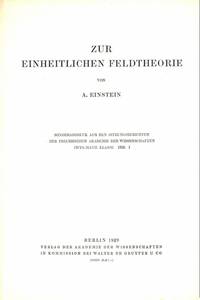
Zur Einheitlichen Feldtheorie.
1929. S.Ber. Akad. Wiss. Berl. 1929/ 1. - Berlin Verlag der Akademie der Wissenschaften 1930 8° 8 S. in schönem Pappband der Zeit. First Edition! "The unified Field Theory" is one of Einstein's last important scientific works. According to Weil "This paper represents a new development which was immediate news. A translation by L.L.Whyte appeared in the London Times of Feb. 4 1929. It was quoted in full in "Observatory" vol. 52 under the title "New Field Theory" pp.82-87 and 1930 pp.11-118." In 1928 Einstein embarked on a new approach to a unified field theory . involving what he called 'distant parallelism' . By early 1929 he had solved the main problems involved in writing down field equations for his unified field theory. On the day of offical publication of the third of a formidably technical series of 9 articles on the theory . excited headlines appeared in foreign newspapers throughout the world . In this frenzied unscientific atmosphere Einstein's new theory was hailed in the press as an outstanding scientific advance. Yet Einstein had stated in his article it was still tentative; and soon he found he had to abandon it. - cf.Parkinson Breakthroughs p.279 Weil No. 165 Schlipp Einstein No.226; Alicke No. 141; Norman Coll. I 700 unknown
Bookseller reference : 27093
|
|
|
EINSTEIN, ALBERT.
Zur Einheitlichen Feldtheorie.
Berlin Gruyter & Co. 1929. 4to. Orig. orange printed wrappers. Offprint/Sonderabdruck aus Sitzungsberichten.pp. 1-8. Fine fresh copy. <br/><br/><em>First edition in the rare Offprint still called "Abdruck" but having separate printed title and separate pagination. See Weil No. 165 where this is not mentioned.Weil No. 165 with an asterix denoting a major work. "The Unified Field-Theory is one of the last importent works by Einstein. This paper presents a new development which was immediate news; translations and abstracts of ite appeared at once besides numerous articles in general periodicals" W. Alicke.The early Offprints from "Sitzungsberichten." are called "Sonderabdruck" up to Weil No.165 including this. From Weil 166 they are called "Sonderausgabe.". - Before 161 up to 160 the Offprints do not have separate title and pagination the pagination follows the numbering in the periodical. From 166 the Offprint has both separate printed title and pagination. - So Weil Nos 161-165 is still "Abdruck" but with separate title and pagination. These facts are not mentioned in the bibliographies. </em> unknown
Bookseller reference : 28362
|
|
|
EINSTEIN, A.
Zur einheitlichen Feldtheorie.
Berlin 1929. Orig. printed orange wrappers. Back strengthend with matching paper. Fresh copy. Offprint/Sonderabdr. aus "Sitzungsberichte". pp. 1-8. <br/><br/><em>First edition. Weil No. 165 - with asterics denoting major work. Printing and the Mind of Man 416. </em> unknown
Bookseller reference : 22771
|
|
|
Einstein, Albert
Zur einheitlichen Feldtheorie. Weil 165. Offprint from S. preuss. Akad. Wiss
1929. <p>Einstein Albert 1879-1955. Zur einheitlichen Feldtheorie. Offprint from Sitzungsberichten der preussischen Akademie der Wissenschaften 1 1929. 8vo. 8pp. Berlin: Verlag der Akademie der Wissenschaft 1929. 256 x 183 mm. Original printed wrappers slightly soiled and creased. Very good. </p> <p>First Separate Edition. "In 1928 Einstein embarked on a new approach to a unified field theory . . . involving what he called 'distant parallelism'. . . . By early 1929 he had solved the main problems involved in writing down field equations for his unified theory. On the day of official publication of the third of a formidably technical series of nine articles on the theory . . . excited headlines appeared in foreign newspapers throughout the world. . . . In this frenzied unscientific atmosphere Einstein's new theory was hailed in the press as an outstanding scientific advance. Yet Einstein had stated in his article that it was still tentative; and soon he found he had to abandon it Hoffman Einstein pp. 225-26. This paper is included on Shields's list of Einstein's most significant papers; see Albert Einstein Philosopher-Scientist 1949 p. 758. Weil 165. Pais Subtle is the Lord pp. 344-46. </p> . unknown
Bookseller reference : 37419
|
|
|
EINSTEIN, ALBERT
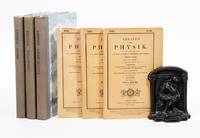
Zur Elektrodynamik bewegter Korper Special Relativity; WITH: Ãœber einen die Erzeugung und Verwandlung des Lichtes betreffenden heuristischen Gesichtspunkt Light Quanta. WITH: Ãœber die von der molekularkinetischen Theorie der Warme geforderte Bewegung von in ruhenden Flussigkeiten suspendierten Teilchen Existence of Atoms
<p>Leipzig: Johann Ambrosius Barth 1905. First edition. original wrappers. Very Good. FIRST PRINTINGS WITH EXTREMELY RARE ORIGINAL WRAPPERS of Einstein's revolutionary papers of 1905 including the first edition of the initial paper on special relativity; three of the most important papers in the history of science. Beautiful clean copies without any institutional stamps. In the first paper "On a Heuristic Viewpoint Concerning the Production and Transformation of Light" published in March "Einstein postulated that light is composed of individual quanta later called photons that in addition to wavelike behaviour demonstrate certain properties unique to particles. In a single stroke he thus revolutionized the theory of light and provided an explanation for among other phenomena the emission of electrons from some solids when struck by light called the photoelectric effect" Britannica. It was for this paper on the photoelectric effect that Einstein was granted the Nobel Prize in physics in 1921. The next paper "On the Motion-Required by the Molecular Kinetic Theory of Heat-of Small Particles Suspended in a Stationary Liquid" published in May provided a theoretical explanation of Brownian motion. It is generally regarded as the first proof that molecules exist.<br /><br />Although the first two papers were of astonishing originality and importance it was the third paper introducing what would be later known as Einstein's special theory of relativity that would make him famous. "Toward the end of June it was all written up and on June 30 receipt of the manuscript was recorded at the editorial office of Annalen in Berlin. The thirty-page article published three months later was titled 'On the Electrodynamics of Moving Bodies'. It was a treatise beyond compare and without precedent one of the greatest scientific achievements in content and one of the most brilliant in style. Of course there were later additions some from Einstein himself and some from others but these were mere addenda to a theory which had appeared before all the world ready and complete valid for all time" Folsing Albert Einstein. Einstein's theory with the premise that "if for all frames of reference the speed of light is constant and if all natural laws are the same then both time and motion are found to be relative to the observer" "involved a complete rethinking of the entire conceptual tradition of modern physics from its beginning" Britannica; Folsing. Weil 6. Weil 8. Weil 9. Grolier/Horblit 26b.<br /><br />Zur Elektrodynamik bewegter Korper in Annalen der Physik Vierte Folge Volume 17 part 10 pp. 891-921; WITH: Ãœber einen die Erzeugung und Verwandlung des Lichtes betreffenden heuristischen Gesichtspunkt ibid part 6 pp. 132-148. WITH: Ãœber die von der molekularkinetischen Theorie der Warme geforderte Bewegung von in ruhenden Flussigkeiten suspendierten Teilchen ibid part 8 pp. 549-560. Leipzig: Johann Ambrosius Barth 1905. Octavo three issues in original wrappers rebacked; three custom boxes. <br /><br />Note: The issues are slightly trimmed indicating that it is likely they were originally bound with the wrappers and then re-assembled. With general title page volume half-title and index included in part 6. Some chipping to exceedingly rare and brittle original wrappers; otherwise fine. Extremely rare in such outstanding condition.</p> Johann Ambrosius Barth
Bookseller reference : 2895
|
|
|
EINSTEIN, Albert
Zur Quantentheorie des idealen Gases. Offprint from: Sitzungsberichte der Preussischen Akademie der Wissenschaften Bd. 3 1925
Berlin: Königlich Akademie der Wissenschaften 1925. First edition. BOSE-EINSTEIN STATISTICS – WITHOUT THE STATISTICS. <p>First edition very rare author’s presentation offprint not to be confused with the more common trade separate – see below from the library of the great German physicist Arnold Sommerfeld with his signature and annotations of Einstein’s third paper on his quantum theory of the ideal gas of 1924–1925 Einstein’s “last major innovative contribution to physics†Pais Subtle is the Lord p. 343. In 1924 Einstein received a copy of the Indian physicist S. N. Bose’s paper ‘Planck’s law and the hypothesis of light quanta.’ Einstein immediately recognized its importance and had it published shortly followed by a paper of his own applying Bose’s ideas to ideal gases rather than radiation molecules rather than light quanta. These two papers laid the foundations of ‘Bose-Einstein statistics.’ Einstein published a second paper in which he showed that the new statistics led to the prediction of a new state of matter the ‘Bose-Einstein condensate’ the creation of which in the laboratory was the topic of the 2001 Nobel Prize in Physics. At the time however many of Einstein’s colleagues in particular his close friend Paul Ehrenfest were sceptical of the new statistics. Einstein therefore attempted in the present paper to justify his quantum theory of the ideal gas by more traditional methods rather than the novel statistics he had used in his two previous papers. “It contains an attempt to extend and exhaust the characterization of the monatomic ideal gas without appealing to combinatorics. Its ambiguities illustrate Einstein’s confusion with his initial success in extending Bose’s results and in realizing the consequences of what later came to be called Bose–Einstein statistics … Its arguments are based on Einstein’s belief in the complete analogy between the thermodynamics of light quanta and of material particles and invoke considerations of adiabatic transformations as well as of dimensional analysis. These techniques were well known to Einstein from earlier work on Wien’s displacement law Planck’s radiation theory and the specific heat of solids†Pérez & Sauer. “In a letter to Ehrenfest he writes that on his next visit in Leyden ‘I shall then convince you completely of the gas-degeneracy-equation. I found another safe though not entirely complete approach to it free of the incriminating statistics’. The arguments advanced in this third paper indeed do not make use of the new statistics. Instead Einstein invokes arguments involving dimensional analysis and adiabatic compression†Papers p. lxx. The only other copy of this offprint listed on RBH is that in Einstein’s own collection Christie’s 2008.</p> <br /> <p>Provenance: Arnold Sommerfeld 1868-1951 his signature and characteristic numbering in red pencil ‘44’ on front cover and three annotations in the text. The annotations consist of corrections to formulas 5 on p. 20 11 and 12 on p. 21 16a on p. 23 and 19 on p. 24 to the equation on the last line of p. 22 and to two mathematical symbolson lines 2 and 3 of p. 25. “The son of a physician Sommerfeld was educated at the University of Königsberg. After teaching briefly at the universities of Göttingen Clausthal and Aachen he was appointed professor of physics at the University of Münich in 1906. Sommerfeld should have retired in 1936 in favour of his pupil Werner Heisenberg. Opposition from the Nazi party to Heisenberg’s appointment prolonged Sommerfeld’s tenure and it was not in fact until late 1939 that he finally retired to be succeeded not by Heisenberg but by Wilhelm Müller a Nazi aerodynamicist without a single publication in physics to his credit. Although Sommerfeld and Heisenberg were not Jewish they were regarded by the Nazis as Jewish sympathizers. Sommerfeld however survived the war and returned to his Münich chair in 1945 continuing to work at physics until he died in a car accident in 1951†Oxford Reference. “Arnold Sommerfeld was one of the most distinguished representatives of the transition period between classical and modern theoretical physics. The work of his youth was still firmly anchored in the conceptions of the nineteenth century; but when in the first decennium of the century the flood of new discoveries experimental and theoretical broke the dams of tradition he became a leader of the new movement and in combining the two ways of thinking he exerted a powerful influence on the younger generation. This combination of a classical mind to whom clarity of conception and mathematical rigour are essential with the adventurous spirit of a pioneer are the roots of his scientific success while his exceptional gift of communicating his ideas by spoken and written word made him a great teacher†Max Born p. 275. </p> <br /> <p>The motivation for the publication of this paper is given by Einstein in the opening paragraph translation from Papers Vol. 14 English Translation Supplement:</p> <br /> <p>‘Stimulated by a derivation of Planck’s radiation formula originating from Bose which consistently supports itself on the light-quantum hypothesis I recently postulated a quantum theory for ideal gas. This theory seems legitimate when one starts out from the conviction that a light quantum disregarding its polarization property differs from a monatomic molecule essentially only in that the quantum’s mass at rest is vanishingly small. But because the presupposition of this analogy is certainly not accepted by all researchers and furthermore because the statistical method used by Mr. Bose and me is certainly not beyond doubt but rather just seems justified a posteriori by its success in the case of radiation I looked for other considerations on the quantum theory of ideal gas that are as free of arbitrary hypotheses as possible. These considerations shall be communicated in the following. They provide an effective support for the theory postulated earlier even though the results attained do not yield a full substitute for that theory. Here it is a matter of establishing considerations in the field of gas theory by a method and with results largely analogous to those in the field of radiation theory leading to Wien’s displacement law.’</p> <br /> <p>“Einstein followed an approach in this paper that was not based only on statistical considerations and that was closer to thermodynamics. He tried to find general conditions that any theory of the ideal gas would have to satisfy mainly by establishing and exploiting analogies with radiation where the displacement law at least provided some hints as to what the radiation law should look like†Pérez & Sauer.</p> <br /> <p>The problem Einstein wished to solve was to find the distribution function Ï = ÏL κT V m where L is the kinetic energy κ the Boltzmann constant T the temperature V the volume and m the mass of the molecules. The distribution law will be of the form</p> <br /> <p>dn = ÏL κT V mVdp1dp2dp3 / h3</p> <br /> <p>where dn is the number of molecules whose Cartesian components of the momenta are in the range p1 p2 p3 to p1 dp1 p2 dp2 p3 dp3 h is Planck’s constant. Einstein did not assume that collisions between molecules are governed by the laws of mechanics. He asserted that if that were the case one would arrive at the classical Maxwell’s distribution law. He neglected interactions among molecules this being essentially the definition of an ideal gas.</p> <br /> <p>Einstein first used dimensional analysis to place a restriction on the possible forms of the distribution function. He had used similar arguments in his 1909 paper ‘Zum gegenwärtigen Stand des Strahlungsproblems’ Physikalische Zeitschrift 10 185–193 to deduce Wien’s displacement law and in his 1911 paper on the quantum theory of solids ‘Elementare Betrachtungen über die thermische Molekularbewegung in festen Körpern’ Annalen der Physik 35 679–694. Since Ï is dimensionless a pure number it had to be a function only of dimensionless combinations of L κT V m and h. There are two independent such combinations which means that Ï is reduced to a function of two variables rather than five:</p> <br /> <p>A = L/κT and B = mV/N2/3κT/h2.</p> <br /> <p>To reduce Ï to a function of a single variable Einstein needed further restrictions. “Einstein proposed two of those:</p> <br /> <br /> The entropy of an ideal gas does not change in an ‘infinitely slow adiabatic’ sic compression.<br /> The required velocity distribution is valid for an ideal gas also in an external field of conservative forces.<br /> <br /> <p>Einstein argued that these two properties should be valid disregarding collisions. But the neglect of intermolecular collisions made their assumption unprovable even if they would be ‘very natural.’ In support of both he announced they would lead not only to the same result but also to a result according to which Maxwell’s distribution law is valid in the region where quantum effects can be neglected†Pérez & Sauer.</p> <br /> <p>Einstein deduced from these assumptions that </p> <br /> <p>Ï = ΨA χB </p> <br /> <p>where Ψ and χ are universal functions of dimensionless variables. </p> <br /> <p>Einstein then looked at the case in which the constant h disappears from the expression for dn i.e. at the classical limit. He found that </p> <br /> <p>Ï = Be–A </p> <br /> <p>i.e. the Maxwell-Boltzmann law. In contrast Einstein’s statistical theory had produced the expression</p> <br /> <p>Ï = B/eA – 1.</p> <br /> <p>“Summarizing Einstein pointed out that two aims have been achieved:</p> <br /> <p>‘First we found a general condition equation which has to be satisfied by any theory of the ideal gas. Second it follows from the above that the equation of state which I derived will not be changed by either adiabatic compression or by the existence of conservative force fields’†Pérez & Sauer. </p> <br /> <p>Why was this paper little noticed by Einstein’s colleagues “The practically immediate appearance of the revolutionary contributions of 1925 to quantum theory eclipsed any possible interest of Einstein’s paper. The arguments it contains only concern the ideal gas from a thermodynamic perspective. But what is more important it includes hypotheses that were in open contradiction with the course quantum researches had taken. Many physicists had rejected already the laws of mechanics and Einstein assumed their validity for describing the motions of the gas molecules.</p> <br /> <p>“The papers of the twenties that refer to Einstein’s theory usually mention all three instalments. This indicates that in spite of the almost complete lack of comments on it its existence was known. We are inclined to think that it simply was not of any interest to Einstein’s colleagues. Einstein justified the considerations of the non-statistical paper with the deep dissatisfaction over the statistical route by which he had arrived at the new distribution function. However the problem was not whether his colleagues saw Bose’s statistics favourably but that in the following months the physicists’ ideas around the quantum issues changed substantially. Bose’s statistics in spite of implying a way of counting that was incompatible with classical statistics led to an already accepted result. This was much more than could be said of other attempts of explaining for example the Zeeman effect or multielectronic spectra …</p> <br /> <p>“In retrospect Einstein’s initial suspicion about Bose’s statistics will turn into one of the first symptoms of his later distancing himself from quantum mechanics. For this reason we find no justification for the neglect of Einstein’s paper by historians of physics. Perhaps we are dealing here with Einstein’s last attempt to contribute positively to the construction of the quantum theory for which he had done so much. In addition this paper closed the circle he initiated in 1905 with the hypothesis of energy quanta. First the analogy was going one way now finally it was also going the other way. The statistical dependence among light quanta which had limited the analogy with an ideal gas now was found also among molecules. Hence for the first time the analogy was complete …</p> <br /> <p>“The last ‘positive contribution’ of Einstein to statistical physics includes a paper in which he offered arguments independent of the ‘incriminated statistics’ because what nowadays is called Bose-Einstein’s statistics was not more according to its creator than a calculatory artifice absolutely devoid of any physical meaning. It was simply a consequence of using the wrong mechanics or of not considering some kind of interaction. As Einstein explained to Halpern it ‘cannot be considered as giving a true theoretical basis to Planck’s law’†Pérez & Sauer.</p> <br /> <p>This author’s presentation offprint is very rare and must be distinguished from other so-called ‘offprints’ of papers from the Berlin Sitzungsberichte many of which are commonly available on the market. The celebrated bookseller Ernst Weil 1919-1981 in the introduction to his Einstein bibliography wrote: “I have often been asked about the number of those offprints. It seems to be certain that there were few before 1914. They were given only to the author and mostly ‘Überreicht vom Verfasser’ Presented by the Author is printed on the wrapper. Later on I have no doubt many more offprints were made and also sold as such especially by the Berlin Academy.†If the term ‘offprint’ means as we believe it should a separate printing of a journal article given only to the author for distribution to colleagues then ‘offprints’ were not commercially available. Although there is certainly some truth in Weil’s remark in our view it requires clarification and explanation.</p> <br /> <p>Until about 1916 most of Einstein’s papers were published in Annalen der Physik; from 1916 until he left Germany for the United States in 1933 most were published in the Berlin Sitzungsberichte. The Sitzungsberichte differed from other journals in which Einstein published in that it made separate printings of its papers commercially available. These separate printings have ‘Sonderabdruck’ printed on the front wrapper the usual German term for offprint but they are not offprints according to our definition. They were available to anyone; indeed a price list of these ‘trade offprints’ is printed on the rear wrapper. True author’s presentation offprints can be distinguished from these trade offprints by the presence of ‘Überreicht vom Verfasser’ on the front wrapper as in the present offprint.</p> <br /> <p>In the period 1916 to 1919 or 1920 the Sitzungsberichte trade offprints are themselves rare: for example RBH list only three ‘offprints’ of Einstein’s famous 1917 Sitzungsberichte paper ‘Kosmologische Betrachtungen zur allgemeinen Relativitätstheorie’ the auction records do not distinguish between trade and author’s presentation offprints. After 1919 or 1920 however the trade offprints become much more common although the author’s presentation offprints are still very rare. The reason for this change is that it was only in 1919 that Einstein became famous among the general public.</p> <br /> <p>Weil 145. Shields “Writings of Albert Einstein†in Albert Einstein: Philosopher-Scientist 1948 pp. 689-758 no. 195. Born ‘Arnold Johannes Wilhelm Sommerfeld 1868-1951’ Obituary Notices of Fellows of the Royal Society 8 1952 pp. 275-296. The Collected Papers of Albert Einstein digital Vol. 14: The Berlin Years: Writings & Correspondence April 1923-May 1925. Pais Subtle is the Lord 1982. Pérez & Sauer ‘Einstein’s quantum theory of the monatomic ideal gas: non-statistical arguments for a new statistics’ Archive for History of Exact Sciences 64 2010 pp. 561-612.</p> <br/> <br/> 8vo 255 x 183 mm pp. 18-25. Original orange printed wrappers. Königlich Akademie der Wissenschaften unknown
Bookseller reference : 6417
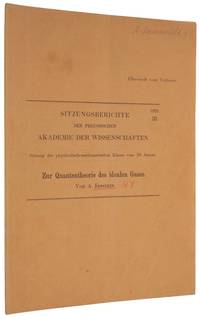
|
|
|
Einstein, Albert and Paul Ehrenfest
Zur Quantentheorie des Strahlungsgleichgewichts Zeitschrift fur Physik Vol. 19 20 pp. 301-306 1923. ON THE QUANTUM THEORY OF THE RADIATIVE EQUILIBRIUM Not ex-library
Berlin: Vieweg und Springer 1923. 1st Edition. This paper "On the Quantum Theory of the Radiative Equilibrium" introduces the expression "negative irradiance" "negative Einstrahlung" for the emission of a quantum by action of irradiance Calaprice 121. <br /> <br /> Following his work on general relativity in 1916 Einstein continued searching for new ways in which the existence of photons might lead to observable derivations from the classical picture" Pais p. 413. In 1922 after six years of experimental and theoretical work Arthur H. Compton discovered what came to be called the Compton effect; Peter Debye also discovered this independently and virtually simultaneously. <br /> <br /> Pauli then used Compton & Deby's work to extend Einstein's 1917 work to the case of radiation in equilibrium with free electrons Pais 414. "Pauli examined the requirements of detailed balance under Lorentz transformations and found that scattering of light by free electrons must include a term of a form which we would now call stimulated emission . . . Einstein and Ehrenfest then showed that Pauli's results could be obtained by an extension of Einstein's 1917 paper with the unnecessary specialization to discrete energy levels removed . . . <br /> <br /> "The core of Einstein's argument is that the scattering process should be broken into two parts: the absorption of energy from radiation of frequency 1 and the emission of energy as radiation of frequency 2" Lewis "Einstein's derivation of Planck's radiation law" AJP 1973 38-44. <br /> <br /> Weil Einstein Bibliography 138; Pais Subtle is the Lord 21 413; Lewis "Einstein's derivation of Planck's radiation law" AJP 1973 38-44; Calaprice Einstein Almanac 121. <br /> <br /> ALSO INCLUDED IN VOLUME 19 ARE PAPERS BY: Hertz Meitner Lande Hertzfeld Joos Kossel Lande Sommerfeld Seeliger Wentzel Raschevsky Ebert and Toussaint among many others. <br /> <br /> ALSO INCLUDED IN VOLUME 20 ARE PAPERS BY: Pauli Ornstein Raschevsky Bothe Walter Hermann and Przibram among many others. CONDITION: Berlin: Julius Springer. Volumes 19 & 20 bound as one. iv 415pp v 426pp. NOT EX-LIBRARY. Solidly and cleanly bound in blue cloth gilt-lettered at the spine. Bright and clean inside and out. Very good condition. Vieweg und Springer hardcover
Bookseller reference : 1650
|
|
|
Einstein, Albert and Paul Ehrenfest
Zur Quantentheorie des Strahlungsgleichgewichts. Offprint
1923. <p>Einstein Albert 1879-1955 and Paul Ehrenfest 1880-1933. Zur Quantentheorie des Strahlungsgleichgewichts. Offprint from Zeitschrift für Physik 19 1923. 301-306pp. Original printed self-wrappers. 230 x 157 mm. Light toning but very good.</p> <p>First Edition Offprint Issue. In 1916 after publishing his great work on general relativity Einstein returned to the question of blackbody radiation. In November 1916 he wrote to his friend Besso that “a splendid light has dawned on me about the absorption and emission of radiation†quoted in Pais p. 405 one that led him to a new derivation of Planck’s radiation law and convinced him of the reality of light-quanta photons. After publishing these results in three papers culminating with the famous “Zur Quantentheorie der Strahlung†1917 Einstein kept looking for “new ways in which the existence of photons might lead to observable derivations from the classical picture†Pais p. 413. He found none until 1923 when Arthur Compton and Peter Debye independently derived the relativistic kinematics for the scattering of a photon off an electron at rest. The work of Compton and Debye led Wolfgang Pauli to extend Einstein’s work of 1917 to the case of radiation in equilibrium with free electrons see Pais p. 414n. “Pauli examined the requirements of detailed balance under Lorentz transformations and found that scattering of light by free electrons must include a term of a form which we would now call stimulated emission . . . Einstein and Ehrenfest then showed that Pauli’s results could be obtained by an extension of Einstein’s 1917 paper with the unnecessary specialization to discrete energy levels removed . . . The core of Einstein’s argument is that the scattering process should be broken into two parts: the absorption of energy from radiation of frequency 1 and the emission of energy as radiation of frequency 2†Lewis p. 42. Lewis “Einstein’s derivation of Planck’s radiation law†American Journal of Physics 41 1973: 38-44. Pais Subtle is the Lord ch. 21. Weil Albert Einstein Bibliography 138.</p> . unknown
Bookseller reference : 43288

|
|
|
EINSTEIN, ALBERT (+) P. EHRENFEST.
Zur Quantentheorie des Strahlungsgleichgewichts.
Berlin Julius Springer 1923. 8vo. Bound in contemporary full cloth with gilt lettering to spine. Entire volume 19 "Zeitschrift für Physik" Library stamp to title-page and paper label pasted on to lower part of spine. Minor wear to extremities. A nice and clean copy. Pp. 301-6. Entire volume: IV 426 pp. <br/><br/><em>First edition.Weil 138; Schilpp-Shields 178.The volume also contains:Meitner Lise. Ueber eine mögliche Deutung des kontinuierlichen beta-Strahlenspektrums. Pp. 307-321. </em> hardcover
Bookseller reference : 49498
|
|

 Receive by email
 Download as PDF document
 RSS feed
 Permanent link


