|
EINSTEIN, A. (+) E. RUPP.
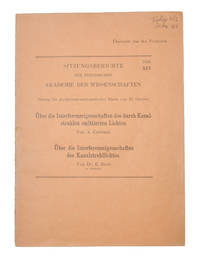
Ãœber die Interferenzeigenschaften des durch Kanalstrahlen emittierten Lichtes Einstein Ãœber die Interferenzeigenschaften des Kanalstrahllichtes Rupp. Offprint from "Sitzungsberichte der Preussischen Akademie der Wissenschaften" XXV 1926. - THE GREATEST SCANDAL IN PHYSICS - AUTHOR'S PRESENTATION OFFPRINT ISSUE
1926. Royal8vo. Author's presentation offprint with the printed presentation statement on top of frontwrapper "Ãœberreicht von den Verfassern" i.e. "Given by the authors". Original printed wrappers. Front wrapper loose but fully intact. "Chilpp 202" and "Recdese 160" written in hand to top of front wrapper. A very fine and clean copy. Pp. 334-351. <br/><br/><em>First edition in the scarce author's presentation offprint issue of this important paper which contains Einstein's theories on wave-particle duality and German physicist Rupp's work on the same subject seemingly to corroborating Einstein's theories. Rupp's experimental results later turned out to have been falsifications and today he is mainly known as the protagonist in one of the biggest scandals in physics in the 20th century.Rupp published a number of papers on the interference properties of light emitted by canal ray sources. These articles particularly the present that came into being in close collaboration with Albert Einstein attracted quite a lot of attention as they probed the wave versus particle nature of light. They also significantly propelled Rupp's career even though they were considered highly controversial to begin with.In April 1926 Albert Einstein proposed to Emil Rupp to carry out two experiments that were to prove the wave nature of light versus the particle nature of light: the so-called 'Wire Grid Experiment' and the 'Rotated Mirror Experiment' experiments that Einstein had worked on theoretically and now would like to gain confirmation of through experiments. Rupp at the time regarded as one of the most important and most competent experimental physicists gladly took up the challenge. Rupp's observations - though highly controversial - confirmed Einstein's theory. Due to the surprising outcome of the experiments Einstein was interested in exactly how it they were conducted as Rupp's initial descriptions did not convince him that the results were feasible."Rupp stood by his observations and suggested yet other circumstances that might explain them. Did Einstein now realize that there was something rather dubious about Rupp's work He had seen him change his data repeatedly-and each time in better accordance with his own criticism and on one occasion in no less than two days. He had had to accept that Rupp claimed to earlier have "unknowingly" or "unconsciously" rotated a mirror and he will likely have seen that Rupp's work was highly controversial amongst experimentalists leading to very public criticism in Die Naturwissenschaften. He himself was now also convinced that in fact Rupp's results were incomprehensible. So did Einstein choose to suspend the publication of Rupp's piece so that an additional round of checks and balances could take place The answer is no: Rupp's paper was presented by Einstein to the Prussian Academy in a session on 21 October 1926 and it appeared in print in the Academy's proceedings in November of 1926-the articles by Einstein and Rupp came out back to back and reprints circulated with both papers bound together with a joint cover page that displayed both titles. Einstein referred in his article to Rupp's claims and he had even written the abstract of Rupp's paper" Dongen: "Emil Rupp Albert Einstein and the Canal Ray Experiments on Wave-Particle".The first clear indication that Rupp's work was impossible to recreate came in 1930 in a paper published by Staub - nothing was wrong with Einstein's theory but Rupp's work was simply impossible: "Rupp immediately set out to respond to Straub's publication. On 12 July 1930 he sent a first draft to Einstein to whom he also announced his intention of redoing his canal ray experiments-Straub was dismissed as a clumsy graduate student with a lousy apparatus. Einstein suggested inviting Straub once Rupp had his experiment up and running again but cautioned him not to engage the polemic in too sharp a tone". Rupp managed to convince the physics society and continued to publish the new few years. In 1934 various different physicians pointed out that Rupp's work was impossible to recreate and in 1935 the final blow to Rupp's career came about when the German Physical Society's decided not to allow any citations of Rupp's work. This seems to have had very severe consequences as today it is almost impossible to find any quotations - or even mentioning of Rupp in general let alone his fraud - in any historical studies of either quantum theory or of Einstein.Despite the unquestionable fraud by Rupp his experiments and collaboration with Einstein might have had a positive influence on the further progression to quantum mechanics. The two present papers became of seminal importance in the discussions between Bohr and Heisenberg which eventually in 1927 resulted in Heisenberg publishing his landmark thesis on the uncertainty principle. When Max Born received the Nobel Prize in physics he stated that: "An idea of Einstein gave me the lead From the present paper. He had tried to make the duality of particles-light quanta or photons-and waves comprehensible by interpreting the square of the optical wave amplitudes as probability density for the occurrence of photons."Boni 160; Weil 153. </em> unknown
Bookseller reference : 46540
|
|
|
EINSTEIN, ALBERT.
Über die vom Relativitätsprincip geforderte Trägheit der Energie. - THE FIRST EXPLICIT STATEMENT OF THE ENERGY-MASS EQUATION
Leibzig Johann Ambrosius Barth 1907. 8vo. In contemporary full cloth with gilt lettering to spine. In "Annalen der Physik" Vierte Folge Band 23. Entire volume offered. Ex-libris pasted on to top right corner of pasted down front free end-paper. Light rubbing to extremities a very fine and clean copy not an ex-library copy. Pp.371-384. Entire volume: VIII 1000 pp. 4 plates. <br/><br/><em>First edition of the first explicit statement of Einstein's landmark energy-mass equation E=mc2.Nearly all descriptions of Einstein's scientific work state that the mass-energy equivalence E=mc2 was first formulated in Einstein's 1907 review paper 'Über das Relativitätsprinzip und die aus demselben gezogenen.' published in 'Jahrbuch der Radioaktivität und Elektronik' see Weil no. 21 and Dictionary of Scientific Biography vol. 4 pp.323 for examples. However in his paper 'Über die von Relativitätsprincip geforderte Trägheit der Energie' the offered paper which predates the former mentioned by six months Einstein gave a clear statement of the mass-energy equivalence E=mc2. See Lanczos: The Einstein Decade pp.149-150 and 153 as well as Volume 2 of 'The Collected Papers of Albert Einstein' pp. 428.Einstein's first paper regarding the relation E=mc2 is his fourth 1905 paper 'Ist die Trägheit eines Körpers von seinem Energieinhalt abhängig'. In this short paper Einstein showed that a body releasing the energy E in the form of radiation will have its mass decreased by E/c2 and concluded that the mass of a body is a measure of its energy content e.g. that all energy has mass. The next time Einstein returns to the subject is in his 1906 paper 'Das Prinzip von der Erhaltung der Schwerpunkts Bewegung und die Trägheit der Energie.'. Here Einstein concluded that one must either ascribe the inertial mass E/c2 to any form of energy E or else give up the fundamental law mechanics regarding conservation of the motion of the center of gravity. Then finally in the 1907 paper 'Über die von Relativitätsprincip geforderte Trägheit der Energie.' the offered paper Einstein makes the decisive step of assuming that all mass has energy. On page 382 Einstein considers the total energy of a moving mass point as the sum of its kinetic energy and its rest energy. In classical mechanics it is most convenient to set the second term to zero but in relativistic mechanics one obtains the simplest expression by setting the rest energy equal to mc2. Einstein then continues to show that this stipulation cannot lead to a contradiction in any relativistic argument. In a footnote on page 382 Einstein states for the first time the equation E=mc2 and mentions that this equation is the expression of the principle of the equivalence of mass and energy - see Volume 2 of 'The Collected Papers of Albert Einstein' pp. 428.The volume contains another paper by Einstein "Bemerkungen zu der Notiz von Hrn. Paul Ehrenfest: "Die Translation deformierbarer Elektronen und der Flächensatz"" pp.206-208. - Weil No. 18.Collected Works Doc. 45. Weil 19. Boni 19. </em> hardcover
Bookseller reference : 50595
|
|
|
EINSTEIN, ALBERT.
Über die Möglichkeit einer neuen Prüfung des Relativitätsprinzips.
Leipzig Barth 1907. 8vo. Extract from "Annalen der Physik IV23" pp.197-198. <br/><br/><em>First edition in the periodical form. - Weil No. 17. </em> unknown
Bookseller reference : 41347
|
|
|
EINSTEIN, ALBERT.
Über die Möglichkeit einer neuen Prüfung des Relativitätsprinzips.
Leipzig Barth 1907. 8vo. Extract from "Annalen der Physik IV23" pp.197-198. Some slight browning to leaves. <br/><br/><em>First edition. Weil No. 17. </em> unknown
Bookseller reference : 29338
|
|
|
EINSTEIN, ALBERT. - FIRST PRINTING OF E=mc2
Über die Möglichkeit einer neuen Prüfung des Relativitätsprinzips; withbound: Bemerkungen zu der Notiz von Hrn. Paul Ehrenfest: "Die Translation deformierbarer Elektronen und der Flächensatz"; withbound: Über die vom Relativitätsprinzip gefordert.
Leipzig J.A. Barth 1907. Contep. hcloth. Both hinges with a tear at upper part. "Annalen der Physik Vierte Folge. Band 23. Herausgegeben von W.Wien und M. Planck" VIII1000 pp. and 4 plates. Einstein's papers pp. 197-98 a. 206-209 a. 371-384. Internally fine and clean. The whole volume offered. <br/><br/><em>All 3 papers in first edition. - The first paper "New possibility of testing the relativity principle" deals with the shift of canal rays in the Dobbler effect as a possible confirmation of the Principle of Relativity - the confirmation became actual only in 1938 when new improved instrumentation made it possible. - The second paper "remarks concerning Paul Ehrenfest's note: 'Translation of the deformable electron and the momentum law' Einstein gives his answer by relating it to his Theory of Relativity. - The third paper "The inertia of energy as demanded by the principle of relativity" which is a importen paper as it i is the first to state E=mc2 in its general form. general form. This new relation which was adumbrated already in his paper of 1906 Das prinzip von der Erhaltung der Schwerpunktsbewegung brings about the complete unification of mass and energy into a single concept. In natural units which make c=1 we have E=m i.e. mass and energy are one and the same quantity. Every form of energy also has a mass value just as every mass represents a definite amount of energy. - Weil Nos 1718 a. 19 </em> hardcover
Bookseller reference : 38817
|
|
|
EINSTEIN, ALBERT. - THE FIRST EXPLICIT STATEMENT OF THE ENERGY-MASS EQUATION !!
Über die vom Relativitätsprincip geforderte Trägheit der Energie. On the Inertia of Energy Required by the Relativity Principle.
Leibzig Johann Ambrosius Barth 1907. 8vo. Contemp. hcalf. Spine gilt. Title-and tomelabels with gilt lettering. Slightly rubbed. In "Annalen der Physik" Vierte Folge Band 23. VIII1000 pp. a. 4 plates. The entire volume offered. Einstein's paper: pp.371-384. A small stamp on titlepage Gmelin.Institut. Internally clean and fine. <br/><br/><em>First edition of the first explicit statement of Einstein's energy-mass equation E=mc2.Nearly all descriptions of Einstein's scientific work state that the mass-energy equivalence E=mc2 was first formulated in Einstein's 1907 review paper 'Über das Relativitätsprinzip und die aus demselben gezogenen.' published in 'Jahrbuch der Radioaktivität und Elektronik' see Weil no. 21 and Dictionary of Scientific Biography vol. 4 pp.323 for examples. However in his paper 'Über die von Relativitätsprincip geforderte Trägheit der Energie' the offered paper which predates the former mentioned by six months Einstein gave a clear statement of the mass-energy equivalence E=mc2. See Lanczos: The Einstein Decade pp.149-150 and 153 as well as Volume 2 of 'The Collected Papers of Albert Einstein' pp. 428.Einstein's first paper regarding the relation E=mc2 is his fourth 1905 paper 'Ist die Trägheit eines Körpers von seinem Energieinhalt abhängig'. In this short paper Einstein showed that a body releasing the energy E in the form of radiation will have its mass decreased by E/c2 and concluded that the mass of a body is a measure of its energy content e.g. that all energy has mass. The next time Einstein returns to the subject is in his 1906 paper 'Das Prinzip von der Erhaltung der Schwerpunkts Bewegung und die Trägheit der Energie.'. Here Einstein concluded that one must either ascribe the inertial mass E/c2 to any form of energy E or else give up the fundamental law mechanics regarding conservation of the motion of the center of gravity. Then finally in the 1907 paper 'Über die von Relativitätsprincip geforderte Trägheit der Energie.' the offered paper Einstein makes the decisive step of assuming that all mass has energy. On page 382 Einstein considers the total energy of a moving mass point as the sum of its kinetic energy and its rest energy. In classical mechanics it is most convenient to set the second term to zero but in relativistic mechanics one obtains the simplest expression by setting the rest energy equal to mc2. Einstein then continues to show that this stipulation cannot lead to a contradiction in any relativistic argument. In a footnote on page 382 Einstein states for the first time the equation E=mc2 and mentions that this equation is the expression of the principle of the equivalence of mass and energy - see Volume 2 of 'The Collected Papers of Albert Einstein' pp. 428.The volume contains another paper by Einstein "Bemerkungen zu der Notiz von Hrn. Paul Ehrenfest: "Die Translation deformierbarer Elektronen und der Flächensatz"" pp.206-208. - Weil No. 18.Collected Works Doc. 45. Weil 19. Boni 19. </em> unknown
Bookseller reference : 47457
|
|
|
EINSTEIN, ALBERT. - THE FIRST EXPLICIT STATEMENT OF THE ENERGY-MASS EQUATION !!
Über die vom Relativitätsprincip geforderte Trägheit der Energie. On the Inertia of Energy Required by the Relativity Principle.
Leibzig Johann Ambrosius Barth 1907. 8vo. Contemp. hcalf. Spine gilt and with gilt lettering. Slightly rubbed and light wear to spineends. In "Annalen der Physik" Vierte Folge Band 23. VIII1000 pp. a. 4 plates. The entire volume offered. Einstein's paper: pp.371-384. Stamps on titlepage Allgemeine Electricitäts-Gesellschaft a. AEG Forschungsinstitut. Internally clean. <br/><br/><em>First edition of the first explicit statement of Einstein's energy-mass equation E=mc2.Nearly all descriptions of Einstein's scientific work state that the mass-energy equivalence E=mc2 was first formulated in Einstein's 1907 review paper 'Über das Relativitätsprinzip und die aus demselben gezogenen.' published in 'Jahrbuch der Radioaktivität und Elektronik' see Weil no. 21 and Dictionary of Scientific Biography vol. 4 pp.323 for examples. However in his paper 'Über die von Relativitätsprincip geforderte Trägheit der Energie' the offered paper which predates the former mentioned by six months Einstein gave a clear statement of the mass-energy equivalence E=mc2. See Lanczos: The Einstein Decade pp.149-150 and 153 as well as Volume 2 of 'The Collected Papers of Albert Einstein' pp. 428.Einstein's first paper regarding the relation E=mc2 is his fourth 1905 paper 'Ist die Trägheit eines Körpers von seinem Energieinhalt abhängig'. In this short paper Einstein showed that a body releasing the energy E in the form of radiation will have its mass decreased by E/c2 and concluded that the mass of a body is a measure of its energy content e.g. that all energy has mass. The next time Einstein returns to the subject is in his 1906 paper 'Das Prinzip von der Erhaltung der Schwerpunkts Bewegung und die Trägheit der Energie.'. Here Einstein concluded that one must either ascribe the inertial mass E/c2 to any form of energy E or else give up the fundamental law mechanics regarding conservation of the motion of the center of gravity. Then finally in the 1907 paper 'Über die von Relativitätsprincip geforderte Trägheit der Energie.' the offered paper Einstein makes the decisive step of assuming that all mass has energy. On page 382 Einstein considers the total energy of a moving mass point as the sum of its kinetic energy and its rest energy. In classical mechanics it is most convenient to set the second term to zero but in relativistic mechanics one obtains the simplest expression by setting the rest energy equal to mc2. Einstein then continues to show that this stipulation cannot lead to a contradiction in any relativistic argument. In a footnote on page 382 Einstein states for the first time the equation E=mc2 and mentions that this equation is the expression of the principle of the equivalence of mass and energy - see Volume 2 of 'The Collected Papers of Albert Einstein' pp. 428.The volume contains another paper by Einstein "Bemerkungen zu der Notiz von Hrn. Paul Ehrenfest: "Die Translation deformierbarer Elektronen und der Flächensatz"" pp.206-208. - Weil No. 18. Further with 2 importent papers by Max v. Laue.Collected Works Doc. 45. Weil 19. Boni 19. </em> unknown
Bookseller reference : 53408
|
|
|
EINSTEIN, A.
Über die spezielle und die allgemeine Relativitätstheorie. Gemeinverständlich. Zweite Auflage.
Braunschweig Fridr. Vieweg. & Sohn 1917. "Heft 38 sammlung Vieweg" 8vo. Orig. printed wrappers. Title page with ink note and owners name. Some underlinings in ink. IV70 pp. <br/><br/><em>Second printing of the original from the same year. Weil No. 90. </em> unknown
Bookseller reference : 22780

|
|
|
EINSTEIN, ALBERT.
Ãœber die Entwickelung unserer Anschauungen iiber das Wesen und die Konstitution der Strahlung.
Braunschweig Friedrich Vieweg und Sohn 1909. 8vo. Bound in contemporary half calf with gilt lettering to spine. In "Verhandlungen der Deutsche Physikalische Gesellschaft" 11 Jahrgang 1909. Reprinted same year in "Physikalische Zeitschrift 10". Bound with "Berichte der Deutschen Physikalischen Gesellschaft" 7 Jahrgang 1909. Capitals and hindges with wear. Internally very fine and clean. Pp. 482-500. Entire volume: 2 749 3 VII 450 pp. <br/><br/><em>First printing of Einstein's famous lecture in which he anticipated the discovery of black-body radiation and famously stated that: "the next phase in the development of theoretical physics will bring us a theory of light which may be regarded as a sort of fusion of the undulatory and emission theories of light" The present paper Pp. 482-3. He furthermore stated that the electromagnetic fields that constitute light will no longer appear to be states of a hypothetical medium but rather independent entities emitted by the sources of light exactly as in the Newtonian emission theory of light. The paper was delivered as a lecture before the 81st assembly of the 'Gesellschaft Deutscher Naturforscher' in Salzburg on 21st September 1909.The occasion was important for Einstein since he for years had been working in scientific exile. Among those who attended Einstein's lecture were some of the world's foremost physicists such as; Max von Laue Max Born Arnold Sommerfeld. All published papers of their own in the present volume. Weil No. 30. </em> unknown
Bookseller reference : 47376
|
|
|
Einstein, Albert
Über ein den Elementarprozeß der Lichtemission betreffendes Experiment. Offprint
1921. Offprint from Sitzungsberichte der preussischen Akademie der Wissenschaften 1921. Single sheet pp. 882-883. 256 x 184 mm. Minor marginal tears one corner chipped but very good. First ediiton offprint issue. "Since after 1917 Einstein firmly believed that light-quanta were here to stay it is not surprising that he would look for new ways in which the existence of photons might lead to observable devations from the classical picture. In this he did not succeed. At one point in 1921 he thought he had found a new quantum criterion published in the present paper but it soon turned out to be a false lead" Pais Subtle is the Lord pp. 412-413. Weil Albert Einstein Bibliography 118. unknown
Bookseller reference : 43316

|
|
|
EINSTEIN, Albert
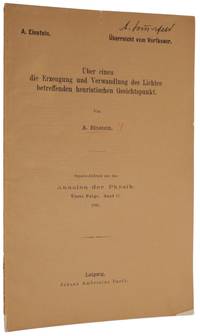
Ãœber einen der Erzeugung und Verwandlung des Lichtes betreffenden heuristischen Gesichtpunkt. Offprint from Annalen der Physik 4. Folge 17. Band 1905
Leipzig: Johann Ambrosius Barth 1905. First edition. EINSTEIN’S NOBEL PRIZE PAPER. <p>First edition very rare author’s presentation offprint ‘Überreicht vom Verfasser’ from the library of the great German physicist Arnold Sommerfeld of Einstein’s paper on light quanta and the explanation of the photoelectric effect for which he was awarded the 1921 Nobel Prize for physics. “Thomas Kuhn has argued that it is not to Planck in 1900 but to Einstein in 1905 that we owe the origins of quantum theory†Cassidy. Completed in March of 1905 Einstein’s annus mirabilis ‘On a heuristic point of view about the creation and conversion of light’ was the first of four epochal scientific papers published by Einstein that year; the others were his paper on Brownian motion and two papers on the special theory of relativity. “No one before or since has widened the horizons of physics in so short a time as Einstein did in 1905†Pais p. 47. Einstein’s paper on light quanta was the only one of his works that he himself called ‘revolutionary’ and for good reason: “The heuristic viewpoint of the title was nothing less than the suggestion that light be considered a collection of independent particles of energy … Einstein had his reasons for advancing such a bold suggestion one that seemed to dismiss a century of evidence supporting the wave theory of light. First among these was a negative result: The combination of the electromagnetic theory of light with the statistical mechanics of particles was incapable of dealing with the problem of black-body radiation. It predicted that radiation in thermodynamic equilibrium within an enclosure would have a frequency distribution corresponding to an infinite amount of energy at the high-frequency end of the spectrum. This was incompatible with the experimental results but worse than that it meant that the theory did not give an acceptable answer to the problem … Einstein showed that his strange proposal of light quanta could immediately account for several puzzling properties of fluorescence photoionization and especially of the photoelectric effect†DSB. “He determined that a massless quantum of light the photon would have to impart the energy required according to Planck's radiation law to break the attractive forces holding the electrons in the metal. This theory was one of the milestones in the development of quantum mechanics making Einstein the foremost pioneer in the field and opening the world of quantum physics†Calaprice The Einstein Almanac p. 14. Einstein submitted his light-quanta paper to Annalen der Physik immediately upon its completion; it was published in the first issue of Vol. 17 which was distributed on June 9 1905. A letter from Einstein to his friend Conrad Habicht written in April 1905 indicates that Einstein had received his allotment of offprints of the paper by that date; thus the offprint rather than the journal article represents the true first edition. In his bibliography of Einstein’s works Weil states that “it seems to be certain that there were few offprints of Einstein’s papers made before 1914. They were given only to the author and mostly ‘Überreicht vom Verfasser’ Presented by the Author is printed on the wrapper as in our copy†Weil p. 4. RBH lists six other copies in the last half-century. This copy was presented by Einstein to one of the leading physicists of the time surely hoping to make himself known in the scientific world when he was still a a technical expert in the Swiss Patent Office.</p> <br /> <p>Provenance: Arnold Sommerfeld 1868-1951 his signature and characteristic numbering in red pencil ‘7’ on front cover. “The son of a physician Sommerfeld was educated at the University of Königsberg. After teaching briefly at the universities of Göttingen Clausthal and Aachen he was appointed professor of physics at the University of Münich in 1906. Sommerfeld should have retired in 1936 in favour of his pupil Werner Heisenberg. Opposition from the Nazi party to Heisenberg’s appointment prolonged Sommerfeld’s tenure and it was not in fact until late 1939 that he finally retired to be succeeded not by Heisenberg but by Wilhelm Müller a Nazi aerodynamicist without a single publication in physics to his credit. Although Sommerfeld and Heisenberg were not Jewish they were regarded by the Nazis as Jewish sympathizers. Sommerfeld however survived the war and returned to his Münich chair in 1945 continuing to work at physics until he died in a car accident in 1951†Oxford Reference. “Arnold Sommerfeld was one of the most distinguished representatives of the transition period between classical and modern theoretical physics. The work of his youth was still firmly anchored in the conceptions of the nineteenth century; but when in the first decennium of the century the flood of new discoveries experimental and theoretical broke the dams of tradition he became a leader of the new movement and in combining the two ways of thinking he exerted a powerful influence on the younger generation. This combination of a classical mind to whom clarity of conception and mathematical rigour are essential with the adventurous spirit of a pioneer are the roots of his scientific success while his exceptional gift of communicating his ideas by spoken and written word made him a great teacher†Max Born p. 275. </p> <br /> <p>Some time in the first half of the year 1905 Einstein wrote a letter to Conrad Habicht in which he announced that he would soon send him copies of four different scientific papers: the first dealt with radiation the offered paper; the second with methods to determine the real dimensions of atoms; the third with the irregular motion of particles suspended in fluids; and the fourth with the electrodynamics of moving bodies … The first paper … bore the title ‘On a heuristic point of view about the creation and conversion of light’ … ‘It is on radiation and energy of light’ he described its content to Habicht ‘and it is very revolutionary as you will see yourself’†The Historical Development of Quantum Theory vol. 1 pp. 70-72.</p> <br /> <p>“In describing four of his 1905 papers Einstein characterized only the one on the quantum hypothesis as revolutionary. It is now regarded as revolutionary in challenging the unlimited validity of Maxwell’s theory of light and suggesting the existence of light quanta. The paper shows that at a sufficiently high frequency the entropy of equilibrium thermal or ‘black-body’ radiation behaves as if the radiation consists of a gas of independent ‘quanta of light energy’ each with energy proportional to the frequency. Einstein showed how to explain several otherwise puzzling phenomena by assuming that the interaction of light with matter consists of the emission or absorption of such energy quanta …</p> <br /> <p>“Einstein started to study black-body radiation well before 1905. Mach’s Wärmelehre which Einstein read in 1897 or shortly thereafter contains two chapters on thermal radiation culminating in a discussion of Kirchhoff's work. Kirchhoff showed that the energy emission spectrum of a perfectly black body defined as one absorbing all incident radiation at a given temperature is a universal function of the temperature and wavelength. He inferred that equilibrium thermal radiation in a cavity with walls maintained at a certain temperature behaves like radiation emitted by a black body at the same temperature. </p> <br /> <p>“H. F. Weber Einstein's physics professor at the ETH attempted to determine the universal black-body radiation function. He made measurements of the energy spectrum and proposed an empirical formula for the distribution function … anticipating Wien’s formulation of the displacement law for black-body radiation. Weber described his work in a course at the ETH given during the winter semester of 1898-1899 for which Einstein registered. </p> <br /> <p>“By March 1899 Einstein had started to think seriously about the problem of radiation. In the spring of 1901 he was closely following Planck’s work on black-body radiation. Originally Planck had hoped to explain irreversibility by studying electromagnetic radiation but came to recognize that this could not be done without introducing statistical elements into the argument. In a series of papers published between 1897 and 1900 Planck utilized Maxwell’s electrodynamics to develop a theory of thermal radiation in interaction with one or more identical charged harmonic oscillators within a cavity. He was only able to account for the irreversible approach to thermal equilibrium by employing methods analogous to those Boltzmann used in kinetic theory. Planck introduced the notion of ‘natural’ that is maximally disordered radiation which he defined in analogy with Boltzmann's definition of molecular chaos … </p> <br /> <p>“Planck calculated the average energy of an oscillator by making assumptions about the entropy of the oscillators that enabled him to derive Wien’s law for the blackbody spectrum which originally seemed well supported by the experimental evidence. But by the turn of the century new observations showed systematic deviations from Wien’s law for large values of temperature. </p> <br /> <p>“Planck in 1900 presented a new energy density distribution formula that agreed closely with observations over the entire spectrum … this expression now known as Planck’s law or Planck’s formula involves a new constant h later called Planck’s constant. To derive this formula Planck calculated the entropy of the oscillators using what Einstein later called ‘the Boltzmann principle’: S = k log W where S is the entropy of a macroscopic state of the system the probability of which is W and k is ‘Boltzmann’s constant. Following Boltzmann Planck took W proportional to the number of ‘complexions’ or possible microconfigurations of the system corresponding to its state. He calculated this number by dividing the total energy of the state into a finite number of elements of equal magnitude and counting the number of possible ways of distributing these energy elements among the individual oscillators. If the size of the energy elements is set equal to hv where v is the frequency of the oscillators an expression for the entropy of an oscillator results that leads to Planck’s formula. </p> <br /> <p>“Although Einstein expressed misgivings about Planck’s approach in 1901 he did not mention Planck or black-body radiation in his papers until 1904. A study of the foundations of statistical physics which he undertook between 1902 and 1904 provided Einstein with the tools he needed to analyze Planck’s derivation and to explore its consequences. At least three elements of Einstein’s ‘general molecular theory of heat’ were central to his subsequent work on the quantum hypothesis: the introduction of the canonical ensemble; the interpretation of probability in Boltzmann’s principle; and the study of energy fluctuations in thermal equilibrium. </p> <br /> <p>“In an analysis of the canonical ensemble Einstein proved that the equipartition theorem holds for any system in thermal equilibrium. In 1905 he showed that when applied to an ensemble of charged harmonic oscillators in equilbrium with thermal radiation the equipartition theorem leads to a black-body distribution law now known as the Rayleigh-Jeans law and that Planck’s derivation would also lead to this law on the assumption that all ‘complexions’ were equally probable … Einstein showed that if the energies available to a canonical ensemble of oscillators are arbitrarily restricted to multiples of the energy element hv then all possible complexions are not equally probable and Planck’s law results.</p> <br /> <p>“A third element of Einstein’s work on statistical physics that is central to his work on the quantum hypothesis is his method for calculating mean square fluctuations in the state variables of a system in thermal equilibrium. He employed the canonical ensemble to calculate such fluctuations in the energy of mechanical systems and then applied the result to a nonmechanical system – black-body radiation deducing a relation that agrees with Wien’s displacement law. This agreement confirms the applicability of statistical concepts to radiation and may have suggested to him the possibility that radiation could be treated as a system with a finite number of degrees of freedom a possibility he raised at the outset of his first paper on the quantum hypothesis … </p> <br /> <p>“Among Einstein’s papers on the quantum hypothesis the 1905 paper is unique in arguing for the notion of light quanta without using either the formal apparatus of his statistical papers or Planck’s law … In order to suggest what new concepts might be needed he focused on the problematic Wien region. Using Wien’s law Einstein showed that the expression for the volume dependence of the entropy of radiation at a given frequency is similar in form to that of the entropy of an ideal gas. He concluded that ‘monochromatic radiation of low density within the range of validity of Wien's radiation formula behaves thermodynamically as though it consisted of quanta of energy which are independent of one another’ … Einstein opened the paper by pointing out the ‘fundamental formal distinction’ between current theories of matter in which the energy of a body is represented as a sum over a finite number of degrees of freedom and Maxwell’s theory in which the energy is a continuous spatial function having an infinite number of degrees of freedom. He suggested that the inability of Maxwell’s theory to give an adequate account of radiation might be remedied by a theory in which radiant energy is distributed discontinuously in space. Einstein formulated ‘the light quantum hypothesis’ that the energy of a light ray emitted from a point is not continuously distributed over an ever increasing space but consists of a finite number of energy quanta which are localized at points in space which move without dividing and which can only be produced and absorbed as complete units … Einstein asserted that Planck’s derivation implicitly assumes quantization of the energies of charged oscillators …</p> <br /> <p>“In addition to their contributions to theory each of Einstein’s first three papers on the quantum hypothesis also provides ingenious explanations of observed phenomena or predictions of new ones. The offered paper examines three interactions of light with matter treated ‘as if light consisted of such energy quanta’: Stokes’s rule for fluorescence; the ionization of gases by ultraviolet light; and the photoelectric effect … It proposes what later became known as Einstein’s photoelectric equation … Although his derivation of this equation was later considered to be a leading achievement of that paper – it is cited in his 1922 Nobel Prize award – for almost two decades the argument failed to persuade most physicists of the validity of the light quantum hypothesis. Lenard’s experimental studies to which Einstein referred only provide qualitative evidence … For almost a decade the quantitative relationship between electron energy and radiation frequency was in doubt. By about 1914 there was a substantial body of evidence tending to support Einstein’s photoelectric equation. Millikan’s studies clinched the case for almost all physicists. But even the confirmation of Einstein’s photoelectric equation did not bring about widespread acceptance of the concept of light quanta. Alternative interpretations of the photoelectric effect still received general support for a number of years†The Collected Papers of Albert Einstein vol. 2 pp. 134-142.</p> <br /> <p>BRL 7; Weil 6. Pais Subtle is the Lord pp. 364-68. See Printing and the Mind of Man 391. Born ‘Arnold Johannes Wilhelm Sommerfeld 1868-1951’ Obituary Notices of Fellows of the Royal Society 8 1952 pp. 275-296. Cassidy “Einstein on the Photoelectric Effect.†Einstein: Image and Impact. American Institute of Physics n.d.</p> <br /> <br/> <br/> 8vo 222 x 144 mm pp. 1 132-148. Original printed wrappers upper outer corner of rear wrapper with loss nowhere near printed area small chips from lower outer corner of front wrapper and bottom of spine. Johann Ambrosius Barth unknown
Bookseller reference : 6412
|
|
|
Einstein, Albert
Über einen Satz der Wahrscheinlichkeitsrechnung und seine Anwendung in der Strahlungstheorie with L. Hopf; Statistische Untersuchung der Bewegung eines Resonators in einem Strahlungsfeld with L. Hopf; and Theorie der Opaleszens von homogenen Flüssigkeiten und Flüssigkeitsgemischen in der Nähe des kritischen Zustandes. In Annalen der Physik und Chemie 33
Leipzig: Johann Ambrosius Barth 1910. <p>Einstein Albert 1879-1955. 1 Uber einen Satz der Wahrscheinlichkeitsrechnung und seine Anwendung in der Strahlungstheorie with L. Hopf. pp. 1096-1104. Weil 34 Boni 29. 2 Statistiche Untersuchung der Bewegung eines Resonators in einem Strahlungsfeld with L. Hopf. pp. 1105-1115. Weil 35 Boni 30. 3 Theorie der Opaleszens von homogenen Flüssigkeiten und Flüssigkeitsgemischen in der Nähe des kritischen Zustandes. pp. 1275-1298. Weil 36. In Annalen der Physik und Chemie 33. Red cloth with gilt lettering on the spine. Whole volume: viii 1584 pp. 6 plates. Text-figs. 210 x 130 mm. Very good copy. </p> <br /> <br /> <p>Approximate English translations of titles and brief explanations of papers:<br> <br /> <br /> 1 "On a theorem of probability calculus and its application in the radiation theory." "Einstein and Hopf wrote this paper to show that the failure of statistical mechanics vis-a-vis the radiation law cannot be ameliorated by proposing that individual statistical events in the emission of light from different points on the surface of a luminous body are not actually independent but instead are interdependent with each other. Even if one assumes a failure to be statistically independent one derives the same usual form of the radiation law as Fourier sum." p. 290. Calaprice Kennefick & Shulmann. An Einstein Encyclopedia. 2015.</p> <br /> <br /> <p>2 "Statistical investigation of the movement of a resonator in a radiation field." With: L. Hopf. "The authors make use of the results in no. 1 above demonstrating that the Rayleigh-Jeans law of radiation is an unavoidable consequence of statistics even if we avoid assumptions that we may think need correction. In other words we cannot blame statistics for a faulty result." p. 290. Calaprice Kennefick & Shulmann. An Einstein Encyclopedia. 2015. </p> <br /> <br /> <p>3 "Theory of the opalescence of homogenous liquids and liquid mixtures near the critical state"."Einstein explains the optical effects that occur near the critical point of a fluid at which liquid gas phases can coexist and of a binary mixture of liquids that can also explain the blue color of the sky. It adds to earlier stuidies that provided evidence for the atomistic constitution of matter and is one of the most difficult papers to understand." p. 290. Calaprice Kennefick & Shulmann. An Einstein Encyclopedia. 2015. </p> <br /> <br /> <p>"October 1910. E. completes a paper on critical opalescence his last major work in classical statistical physics." Pais Subtle is the Lord. 523. </p> <br /> <br /> <p>Weil's Einstein Bibliography nos. 34 35 and 36 respectively.</p> <br /> <p>Boni's Einstein Checklist nos. 29 30 and 31 respectively. </p> . Johann Ambrosius Barth unknown
Bookseller reference : 50336
|
|
|
Einstein, Albert
Über eine Methode zur Bestimmung des Verhältnisses der transversalen und longitudinalen Masse des Elektrons
1906. <p>Einstein Albert 1879-1955. Über eine Methode zur Bestimmung des Verhältnisses der transversalen und longitudinalen Masse des Elektrons. Offprint from Annalen der Physik 21 1906. 583-586pp. 223 x 145 mm. Original printed wrappers chipped spine splitting minor spotting. Light toning but very good.</p> <p>First Edition Rare Offprint Issue. In his landmark 1905 paper on special relativity Einstein used the velocity-dependent concepts of transverse and longitudinal mass for the moving electron these terms have now been replaced with the concept of relativistic mass first defined by Lewis and Tolman in 1909. In the present paper Einstein proposed an experimental method for determining the ratio of the transverse to the longitudinal mass and invited experimentalists to verify his special theory of relativity. Einstein later abandoned velocity-dependent mass concepts stating in 1948 that “it is better to introduce no other mass concept than the ‘rest mass’ m†quoted in L. B. Okun “The concept of mass†Physics Today 1989: 31-36. Lavenda A New Perspective on Relativity pp. 7-8. Weil Albert Einstein Bibliography 14. </p> . unknown
Bookseller reference : 43289

|
|
|
EINSTEIN, A.
Über eine Methode zur Bestimmung des Verhältnisses der transversalen und longitudinalen Masse des Elektrons.
Leipzig Ambrosius Barth 1906. 8vo. In contemporary halv calf with four raised bands and gilt lettering to spine. In "Annalen der Physik" Vierte Folge Band 21. Entire volume offered. Stamp to title page. Wear to extremities. Internally fine and clean. Pp. 583-86. Entire volume: 1055 VIII pp. <br/><br/><em>First printing of Einstein's paper on a method for the determination of the transversal and longitudinal mass of the electron. This eventually caused a major breakthrough in Weil no. 14 </em> hardcover
Bookseller reference : 50324
|
|
|
EINSTEIN, ALBERT.
Ãœber einen Satz der Wahrscheinlichkeitsrechnung und seine Anwendung in der Strahlentheorie Together with L. Hopf; Withbound: Statistische Untersuchungen der Bewegung eines Resnators in einem Strahlungsfeld; Withbound: Theorie der Opaleszenz von .
Leipzig J.A. Barth 1910. Contemp. hcalf. Spine gilt a fs scratches to spine. VIII1584 pp. and 6 plates. Einstein papers: pp. 1096: pp. 1105-1115; pp. 1275-1298. Fine and clean. The whole volume offered. <br/><br/><em>All three papers first edition. The purpose of "A theorem in probability and its application in the Theory of radiation" is to demonstrate that the failure of statistical mechanics with respect to the radiation law Rayleigh - Jeans law contradicted by experience cannot be removed by the conjecture that perhaps the individual statistical events should not follow the usual law of independence product of probabilities instead of assuming a certain interdependence between them. Lanczos. The second paper "Statistical investigation on of the motion of an oscillator in a radiation field" makes use of the results of the previous investigation. Einstein's aim is to demonstrate that the Rayleigh-jeans law of radiation contracdicted by the physical facts is an unavoidable consequence of statistics even if we avoid any kind of assumption which may be suspected of needing correction. Lanczos. The third paper "Theory of the opalescence of homogenous fluids and fluid mixtures near the critical state" is an importent investigation and one of the most difficult of all his papers to understand. The aim of the paper is to complement the work of Smoluchovski Ann. d. Physik25 1908 who gave a general explanation of the strong density fluctuations - and the opalescence thus generated - of two fluids near the critical state of mixture or a single fluid near the critical state of condensation on the basis of the kinetic theory of heat. he did notgive howeverthe quantitative details concerning the scattered light associated with this phenomenon. Lanczos. - Weil Nos 34 35 and 36 with an asterix denoting major work. </em> unknown
Bookseller reference : 38842
|
|
|
EINSTEIN, ALBERT (+) L. HOPF.
Über einen Satz der Wahrscheinlichkeitsrechnung und seine Anwendung in der Strahlentheorie. Statistische Untersuchung der Bewegung eines Resonators in einem Strahlungsfeld Theorie der Opaleszenz von hogenen Flüssigkeitsgemischen in der Nähe de.
Leipzig Barth 1910. 8vo. Bound in contemporary half cloth with gilt lettering to spine. In "Annalen der Physik" Bd. 33 1910. Entire volume offered. Library stamp to verso of title page light wear to extremities. Otherwise fine and clean. pp. 1096-1104 and pp. 1105-1115; Pp. 1275-1298 Entire volume: VIII 1584 pp. 6 plates. <br/><br/><em>First appearance of all three papers. The purpose of "A theorem in probability and its application in the Theory of radiation" is to demonstrate that the failure of statistical mechanics with respect to the radiation law Rayleigh - Jeans law contradicted by experience cannot be removed by the conjecture that perhaps the individual statistical events should not follow the usual law of independence product of probabilities instead of assuming a certain interdependence between them. Lanczos. The second paper "Statistical investigation on of the motion of an oscillator in a radiation field" makes use of the results of the previous investigation. Einstein's aim is to demonstrate that the Rayleigh-jeans law of radiation contracdicted by the physical facts is an unavoidable consequence of statistics even if we avoid any kind of assumption which may be suspected of needing correction. Lanczos. The third paper "Theory of the opalescence of homogenous fluids and fluid mixtures near the critical state" is an importent investigation and one of the most difficult of all his papers to understand. The aim of the paper is to complement the work of Smoluchovski Ann. d. Physik25 1908 who gave a general explanation of the strong density fluctuations - and the opalescence thus generated - of two fluids near the critical state of mixture or a single fluid near the critical state of condensation on the basis of the kinetic theory of heat. he did notgive howeverthe quantitative details concerning the scattered light associated with this phenomenon. Lanczos. - Weil Nos 34 35 and 36 with an asterix denoting major work.Weil No. 34 35 & 36. </em> hardcover
Bookseller reference : 49714
|
|
|
EINSTEIN, ALBERT.
Über eine Methode zur Bestimmung des Verhältnisses der transversalen und longitudinalen Masse der Elektrons:
Leipzig J. A. Barth 1906. Contemp. hcloth. Light wear to edges. A small tear at upper part of fronthinge. "Annalen der Physik. Vierte Folge. Band 21. Hrsg. von W.Wien und M. Planck". VIII1056 pp.and 9 plates. Einstein paper: pp. 583-86. Internally clean and fine. The whole volume offered. <br/><br/><em>First edition. Einsten describes in this paper "Method for the determination of the ratio of the transversal to the longitudinal mass of the electron" an apparatus which would make it possible to determine with great accuracy the law according to which the mass of the electron changes with the velocity. - Weil No 14. </em> hardcover
Bookseller reference : 38833
|
|
|
EINSTEIN, ALBERT und L. HOPF.
Ãœber einen Satz der Wahrscheinlichkeitsrechnung und seine Anwendung in der Strahlentheorie. und Statistische Untersuchung der Bewegung eines Resonators in einem Strahlungsfeld;
Leipzig Barth 1910. 8vo. Extracted from "Annalen der Physik IV Bd. 33" pp. 1096-1104 and pp. 1105-1115. Fine and clean. Supplied with a facsimile wrapper from the offprint to the first paper. <br/><br/><em>Both works in first edition. - Weil No. 34 and 35. </em> unknown
Bookseller reference : 29307
|
|
|
Einstein, Albert (1879-1955)
Über eine naheliegende Ergänzung des Fundamentes der allgemeinen Relativitätstheorie. RELATIVITY THEORY
Berlin: Akad. Wiss. Berl. 1921 Berichte 51-53 1921. First Edition. Soft cover. First Edition. Soft cover. ALBERT EINSTEIN. Über eine naheliegende Ergänzung des Fundamentes der allgemeinen Relativitätstheorie Berlin 1921 8vo. 26.5 x 18.5 cms Akad. Wiss. Berl. 1921 Berichte 51-53 pp.261-264. Original printed wrappers. NEAR MINT CONDITION. A fine fresh example small pencil mark to upper wrapper of THIS RARE PAPER!! - ."Although Einstein could not accept Weyl's theory as a physical theory he cherished "its courageous mathematical construction" and thought intensively about its conceptual foundation. This becomes clear from his paper "On a complement at hand of the bases of general relativity" of 1921. In it he raised the question whether it would be possible to generate a geometry just from the conformal invariance of Equation without use of the conception "distance" i.e. without using rulers and clocks. He then embarked on conformal invariants and tensors of gauge-weight 0 and gave the one formed from the square of Weyl's conformal curvature tensor" Hubert F.M. Goenner On the History of Unified Field Theories. Reference: Weil N. 116; Schlipp-Shields No.145. Akad. Wiss. Berl., 1921, Berichte 51-53 unknown
Bookseller reference : 32433

|
|
|
Einstein, Albert
Über Friedrich Kottlers Abhandlung "Über Einsteins Äquivalenzhypothese und die Gravitation." In Ann. Phys. Lpz. 51
Leipzig: Johann Ambrosius Barth 1916. Einstein Albert 1879-1955. Über Friedrich Kottlers Abhandlung "Über Einsteins Äquivalenzhypothese und die Gravitation." In Annalen der Physik 51 638-642 pp. Red cloth with gilt lettering on the spine. Whole volume: 883 pp. 4 plates. Figs. Text-illust. 210 x 130 mm. A very good copy.<br /> <br /> <p>Weil's Einstein Bibliography no. 81. <br> <br /> Boni's Einstein Checklist no. 79. </p> . Johann Ambrosius Barth unknown
Bookseller reference : 50341
|
|
|
EINSTEIN, ALBERT.
Über Friedrich Kottlers Abhandlung "Über Ensteins Äquivalenzhypothese und die Gravitation";
Leipzig J.A. Barth 1916. Orig. printed wrappers. Frontwrapper lacking lower left coener. "Annalenn der Physik. Vierte Folge. Band 51. 6. Heft." =1916 No. 22 pp. 577-684 and 3 plates. Einstein's paper: pp. 639-42. Internally clean and fine. <br/><br/><em>First edition. Weil No 81. </em> unknown
Bookseller reference : 38829
|
|
|
Einstein, Albert 1879-1955
ÔøΩber die spezielle und allgemeine RelativitÔøΩtstheorie gemeinverstÔøΩndlich German Edition
Legare Street Press 10/26/2022 12:00:01. hardcover. Very Good. 0.2500 9.2100 6.1400. Legare Street Press hardcover
Bookseller reference : mon0003873498 ISBN : 1015495907 9781015495906
|
|
|
Einstein, Albert
Äther und Relativitäts-Theorie.
1920. Berlin Springer 1920. 8°. 15 1 S. Unbeschnittene Original-Broschur gebräunt leicht fleckig. Durchgehend mäßig braunfleckig. Sonst gut. unknown
Bookseller reference : 7913FB
|
|
|
EINSTEIN, ALBERT.
Äther und Relativitätstheorie. Rede gehalten am 5.Mai 1920 an der Reich=Universität zu Leiden.
Berlin Julius Springer 1920. Clothbacked boards. Bound with orig. printed wrappers. Small inkspots in inner margins of wrappers. 15 pp. <br/><br/><em>First edition. - Weil No. 111. </em> hardcover
Bookseller reference : 29309
|
|
|
EINSTEIN, ALBERT.
Äther und Relativitäts-Theorie. Rede gehalten am 5. Mai 1920 an der Reichs-Universität zu Leiden.
Berlin Julius Springer 1920. Uncut in orig. printed wrappers. 15 1 pp. Clean and fine near mint condition. <br/><br/><em>First edition. - Weil: 111. </em> unknown
Bookseller reference : 38643
|
|
|
EINSTEIN, ALBERT.
Äther und Relativitätstheorie. Rede gehalten am 5. Mai 1920 an der Reich=Universität zu Leiden.
Berlin Julius Springer 1920. Uncut in orig. printed wrappers. 15 pp. <br/><br/><em>First edition. - Weil No. 111. </em> unknown
Bookseller reference : 29310
|
|
|
Einstein, Albert
�ber die spezielle und die allgemeine Relativit�tstheorie / Relativity: The Special and the General Theory Bilingual Edition - German & English . . Science and Philosophy � German & English
NEW. unknown
Bookseller reference : BIB-NOV-14-2025-94145 ISBN : 9798895131874 9798895131
|
|
|
Einstein, Albert
Über den Frieden.
1975 3-261-01384-2. 1. deutsche Originalausgabe. Bern: Lang 1975. 8°. 675 S. 15 sw-Abbildungen und Faksimiles gebunden Schutzumschlag leicht berieben; gut erhalten unknown
Bookseller reference : 51401BB ISBN : 3261013842 9783261013842

|
|
|
EINSTEIN, A(lbert).
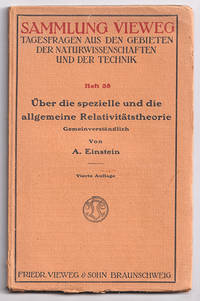
Über die spezielle und die allgemeine Relativitätstheorie Gemeinverständlich.
Braunschweig Vieweg 1919. 4. Aufl. gr.-8°. IV 83 S. Mit 3 Textabb. OBrosch. Kanten berieb. - Sammlung Vieweg Tagesfragen aus den Gebieten der Naturwissenschaften und der Technik Heft 38 Braunschweig, Vieweg 1919. unknown
Bookseller reference : 1261-25
|
|
|
Einstein, Albert
Albert through the looking glass. The personal papers of Albert Einstein. Von Ze'ev Rosenkranz.
Hebrew University of Jerusalem, 1998. 156 S. mit zahlr. Abb., gebundene Ausgabe.
Bookseller reference : 917101

|
|
|
Einstein, Albert
Aus meinen späten Jahren,
Frankfurt/M/Berlin/Wien, Ullstein Verlag (= Ullstein-Materialien Taschenbuch Band 35196), 1984. 8°, 272 S., original Kartonage (Paperback), an den Einbandkanten zum Teil minimal berieben, sonst schönes, sauberes Exemplar
Bookseller reference : 16377CB

|
|
|
Einstein, Albert
Correspondance avec Michele Besso 1903-1955
Paris, Collection Savoir Hermann, 1979. - kartoniert, 327 S. - deutliche Lesespuren, etwas eselsohrig, Rücken knickspurig, Besitzervermerk auf Titel - 8° Buch kartoniert
Bookseller reference : Ein0029 ISBN : 270565898
|
|
|
Einstein, Albert
Die Grundlage der allgemeinen Relativitätstheorie. (= Sonderdruck aus den ?Annalen der Physik?, Band 49, Folge IV, 1916).
Leipzig, Verlag von Johann Ambrosius Barth (Druck von Metzger & Wittig in Leipzig), 1916. Gr.-8°. 64 S., OKart.
Bookseller reference : 62767
|
|
|
Einstein, Albert
Einsteins Universum. Von Nigel Calder. Aus d. Engl. von Wolfram Knapp.
Frankfurt am Main ; Wien ; Zürich : Büchergilde Gutenberg, 1980. 201 S. : Ill., graph. Darst. ; 24 cm. Originalleinen mit illustr. Schutzumschlag.
Bookseller reference : 1113503

|
|
|
Einstein, Albert
Il lato umano. Uno stravagante autoritratto del più grande scienziato del nostro tempo
Mm 120x195 Edizione allegata a Focus - Brossura editoriale con bandelle, 113 pagine. Edizione a cura di Helen Dukas e Banesh Hoffmann, prefazione di Claudio Bartocci. Opera in condizioni pari al nuovo. SPEDIZIONE IN 24 ORE DALLA CONFERMA DELL'ORDINE.
|
|
|
Einstein, Albert
Izafiyet Teorisi, in das Türkische von Gülen Aktas,
Istanbul, Say Dagitim Ltd., 1993. 8°, 149 S. (Text: Türkisch), illustr. original Kartonage (Paperback), Einband leicht berieben und minimal beschabt ein klein wenig knickspurig, sonst aber gutes, sauberes Exemplar (kalax-T)
Bookseller reference : 6162CB

|
|
|
Einstein, Albert
Mein Weltbild, hrsg. von Carl Seelig,
Frankfurt/M., Ullstein, 1962. 8°, 200 S., farbig illustr. original Kartonage (Paperback), neue, vom Verfasser durchgesehene und wesentlich e Rückdeckel mit einem 7cm langen Längskickchen parallel zur Außenkante, ebendort ein 3mm-Randrisschen, Einbandkanten stellenweise berieben, Papier ein wenig nachgedunkelt, sonst ein gutes, sauberes, anstreichungsfreies Exemplar
Bookseller reference : 15517BB

|
|
|
Einstein, Albert
Teoria dei quanti di luce
Mm 130x200 Collana "Menti dinamiche" - Brossura editoriale con bandelle, 125 pagine. Edizione a cura e con un saggio di Armin Hermann. Introduzione di Francesco La Teana. Opera in condizioni pari al nuovo. SPEDIZIONE IN 24 ORE DALLA CONFERMA DELL'ORDINE.
|
|
|
Einstein, Albert - Holton, Gerald James
Thematische Analyse der Wissenschaft : d. Physik Einsteins u. seiner Zeit. Gerald Holton. Übers. von Horst Huber / Suhrkamp-Taschenbuch Wissenschaft ; 293 1. Aufl.
Frankfurt am Main : Suhrkamp 1981. 417 S. : 1 Ill., graph. Darst ; 18 cm kart., Taschenbuch, Exemplar in gutem Erhaltungszustand, Neupreis in Euro: 29,99
Bookseller reference : 32557

|
|
|
Einstein, Albert / Denis Brian
Einstein - Sein Leben,
Weinheim, Wiley-VCH, 2005. 8°, 727 S., original Pappband mit illustr. original Schutzumschlag, (Hardcover), bis Seite 12 einige Bleistiftanstreichungen und Randmarginalien, danach ein ungelesenes, sauberes Exemplar der maßgeblichen Einstein-Biographie
Bookseller reference : 39118AB

|
|
|
Einstein, Albert and Winokur Mark (Text)
Einstein. A portrait.
Corte Madera (Calif.), Pomegranate Artbooks, 1984.
Bookseller reference : 13657

|
|
|
Einstein, Albert e Infeld, Leopold (Castagnoli, Carlo: Prefazione di)
L'evoluzione della fisica. Sviluppo delle idee dai concetti iniziali alla relatività e ai quanti (volume doppio)
Einstein, Albert e Infeld, Leopold (Castagnoli, Carlo: Prefazione di) L'evoluzione della fisica. Sviluppo delle idee dai concetti iniziali alla relatività e ai quanti (volume doppio). Torino, Paolo Boringhieri-Editore Boringhieri società per azioni (corso Vittorio Emanuele 86) - tipografia Gravinese (Stampa) 1985 italian, in sedicesimo pp. (2)+310+(4)=316 X impressione della I ed. nella collana Universale scientifica Boringhieri: giugno 1985 (ed. originale: The Evolution of Physics. The Growth of Ideas from Early Concepts to Relativity and Quanta, Cambridge University Press 1938 - I ed. italiana: Torino, Boringhieri 1948 - I ed. Universale scientifica Boringhieri: 1965). Traduzione di Adele Graziadei. Collana Universale scientifica Boringhieri, volume doppio 1/2. XVI grande/ (2)+310+(4)=316/ brossura in cartoncino bianco goffrato effetto tela con grafica in nero e bianco e con illustrazione in b/n al primo piatto. Con figure in nero nel testo e in nero e in b/n in tavole patinate f.t.. Stato buono (usura della copertina, in particolare al dorso e ai margini- copertina e pagine brunite e con fioriture).

|
|
|
Einstein, Albert und Marcel (Mitwirkender) Grossmann
Entwurf einer verallgemeinerten Relativitätstheorie und einer Theorie der Gravitation : 1. Physikalischer Teil von Albert Einstein. 2. Mathematischer Teil von Marcel Grossmann
Leipzig ; Berlin : Teubner 1913. 1st Edition 1st Edition 38 S. ; 25cm Halbleinen [3 Warenabbildungen] 0
Bookseller reference : 76293

|
|
|
Einstein, Albert und Max Born
Briefwechsel 1916 - 1955. Mit einem Geleitwort von Bertrand Russell und einem Vorwort von Werner Heisenberg 3. Auflage.
München : Langen Müller, 2005. 391 S. ; 21 cm Originalpappband mit Original-Schutzumschlag.
Bookseller reference : 251199

|
|
|
Einstein, Albert und Philipp Frank
Einstein : sein Leben und seine Zeit. Von Philipp Frank. Mit e. Vorw. von Albert Einstein.
Braunschweig, Wiesbaden : Vieweg Verlag, 1979. 467 S. : 1 Ill. ; 23 cm; fadengeh. Orig.-Pappband m. OUmschl.
Bookseller reference : 1199794

|
|
|
Einstein, Albert; Simon, Leon [Translator]
About Zionism: Speeches and Lectures By Professor Albert Einstein
[8] 9-94 pages. Select Bibliography. First published in London in 1930. "Professor Einstein is better known as a physicist than as a Zionist. Yet for many years he has given abundant proof both of a keen interest in Zionism and of a penetrating insight into its underlying ideas. He is impelled to Zionism by his acute consciousness of the excessive price at which the blessings of assimilation are bought by the Jewish communities of the Western world, which for him are mainly represented by that of Germany. The price is a loss of solidarity, of moral independence and self-respect. These, in his view, can be regained only if assimilated Jews find some common task, of absolute human value, to which they can bend their corporate energies as Jews. Such a task is to be found in the restoration of Jewish national life in Palestine." - Introduction. Unmarked with average wear. Backstrip lettering faded. Binding tight. A sound copy of this important compilation. Emanuel p.51. Boni, Russ & Laurence 306. Book

|
|
|
EINSTEIN, C
Werke. Hrsg. v. R.-P. Baacke unter Mitarb. v. J. Kwasn u.a.
Berlin, Medusa Verl., 1980. Bd. 1 u. 2 nebst Präludium. Mit zahlr. Illustr. u. Abb. 518; 408; 80 S. OSeide-Einbände m. OU. u. OKt. Präludium: vord. fliegendes Vorsatzblatt m. kl. Längsabschnitt, ingesamt sehr gutes Ex.
Bookseller reference : 98563AB ISBN : 388602010
|
|
|
Einstein, Carl
Carl Einstein: Werke; Bd. 1., 1908 - 1918. hrsg.von Rolf-Peter Baacke, unter Mitarb. von Jens Kwasny.
Medusa; Berlin, 1980. 518 S. : Illustrationen; 8°. Originalleinen mit Schutzumschlag.
Bookseller reference : 1056931

|
|
|
Einstein, Carl
Der unentwegte Platoniker. [Von Carl Einstein]. Erstauflage, limitiert.
Leipzig: Kurt Wolff Verlag 1918. 177, (3) Seiten. Titel in rot-schwarzem Druck. 8° (21 x 14 cm). Orig.-Halblederband mit goldgeprägtem Rückentitel und goldgefärbtem Kopfschnitt. [Hardcover / fest gebunden].
Bookseller reference : 2112837

|
|
|
Einstein,Albert
EL SIGNIFICADO DE LA RELATIVIDAD
Planeta DeAgostini.Colección:Obras maestras del pensamiento contemporáneo 2. Bueno. Barcelona 1985. Rústica. 256 paginas 12x19 cm.Rozadofirma y fecha.SINOPSIS:En 1905 siendo profesor auxiliar en Berna Albert Einstein dio a conocer su teorÃa de la relatividad restringida que modificaba profundamente los conceptos de la fÃsica clásica. En 1916 enunció la teorÃa de la relatividad generalizada pieza fundamental de la fÃsica moderna. En El significado de la relatividad el propio Einstein nos introduce en las bases de su teorÃa.Albert Einstein Ulm 1879-Princeton 1955. FÃsico alemán. Tras efectuar estudios secundarios poco brillantes en Munich en 1896 ingresó en el Instituto Politécnico de Zurich y adoptó la ciudadanÃa suiza. Profesor en las universidades de Berna Zurich Praga y BerlÃn y miembro honorÃfico de numerosas academias y sociedades cientÃficas. Recibió el premio Nobel de fÃsica en 1921. En 1933 se trasladó a Estados Unidos donde adquirió la nacionalidad norteamericana y en 1940 a pesar de su actitud pacifista promovió la fabricación de la primera bomba atómica. Planeta DeAgostini.Colección:Obras maestras del pensamiento contemporáneo 2 paperback
Bookseller reference : LV98453 ISBN : 8439500025 9788439500025
|
|

 Receive by email
 Download as PDF document
 RSS feed
 Permanent link


