|
|
|
DEL CASTILLO Michel:
Tanguy.
Paris, Collection blanche, Gallimard, 1994. In-8 broché de 298-[4] pages, couverture imprimée, bande de lancement conservée. Petit accroc à la bande de lancement.
Referenz des Buchhändlers : 4934

|
|
|
DELRUE Aimé
TAPUSCRIT ORIGINAL : "NOS ZELUS, COMEDIE EN 3 ACTES" , par Aimé DELRUE
NANTES 1952 un Tapuscrit original, broché marron-clair in-quarto (21 x 26,8 cm), dos muet (spine without title), titre imprimé en noir sur la 1ère de couverture, Ex-libris manuscrit au stylo bleu en haut au dos de la 1ère de couverture : "...A. RABIN FILS, 8, rue de la Corderie Ancenis ...", envoi autographe manuscrit au crayon bleu en haut de la première page : "...A Mon Ami RABIN, avec toutes mes amitiés...Ancenis le 29 Novembre 1952...(signé) A. DELRUE....", texte tapuscrit en noir (d'un seul côté) avec corrections et ajouts de texte manuscrits au crayon bleu par Aimé DELRUE, 53 feuillets,
Referenz des Buchhändlers : 25589
|
|
|
DELAMARE George.
Théoclée.
Paris, Albin Michel, 1929. In-12, broché, couverture imprimée en deux tons, 253 pp.
Referenz des Buchhändlers : 17453
|
|
|
DELACHAUX, Guillaume ; BENDIXEN, Dora (ill.)
Viens dans ma Maison. Poèmes. [ Livre dédicacé par l'auteur ]
Peintures Dora Bendixen, 1 vol. in-8 br., Imprimé en Italie, 1996, 63 pp.
Referenz des Buchhändlers : 35369

|
|
|
Delavigne, Arthur,Jacques Normand, - DUMAS FILS ALEXANDRE - Louis de Chatillon
Voila Monsieur!: Comédie En Un Acte- L'Ami des Femmes. Comédie en cinq actes - Le Secret de Benoît, comédie en 2 actes et en prose,ENVOIS autographe AUTEURS.
Un volume in12 reliure demi basane noire,dos orné titré: theatre ,comprend :Delavigne, Arthur,Jacques Normand Voila Monsieur!: Comédie En Un Acte Paris Calmann Lévy 1895.,47 pages ENVOI autographe AUTEUR relié avec DUMAS FILS ALEXANDRE : L'Ami des Femmes. Comédie en cinq actes,Calmann Lévy 1890,148p. relié avec Le Secret de Benoît, comédie en 2 actes et en prose, par Louis de Chatillon. Nîmes : Impr. de F. Chastanier, 1891. 72 p.-ENVOI autographe AUTEUR
Referenz des Buchhändlers : 26146

|
|
|
DELUY (Henri).
« Je ne suis pas un autre » In memoriam Georges Bataille. Poème lyrique. Musique de Patrice Mestral.
Paris : Fourbis, 1994. Un volume 16x20,7cm broché de 58 pages. Edition originale avec un envoi autographe signé de l’auteur. Bon état.
Referenz des Buchhändlers : 41202

|
|
|
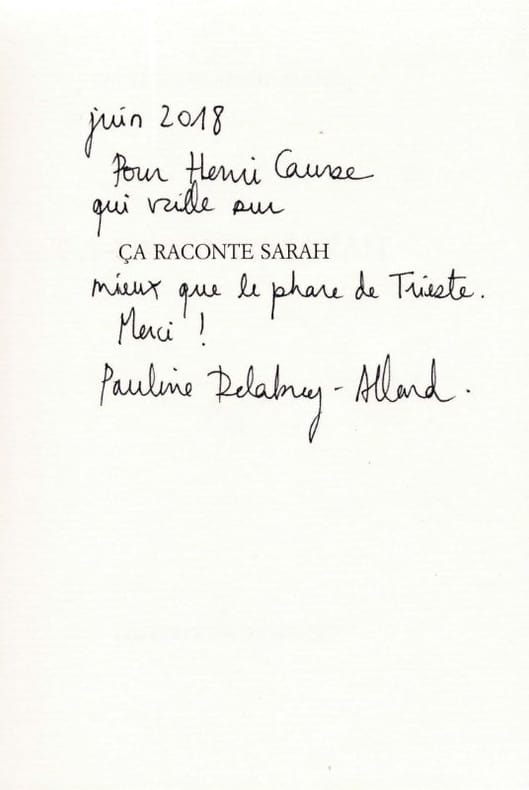
DELABROY-ALLARD (Pauline).
Ça raconte Sarah.
Paris Editions de Minuit 2018 1 vol. broché in-8, broché, non coupé, 188 pp. Edition originale du premier livre de l'autrice (née en 1988). Un des 27 exemplaires sur vergé de Scheipen (seul grand papier), et parmi ceux-ci l'un des 7 hors commerce (ex. n°IV), avec un bel envoi autographe signé de l'autrice à Henri Causse, directeur commercial des éditions de Minuit. En parfait état.
Referenz des Buchhändlers : 118375
|
|
|
DELABROY-ALLARD (Pauline).
Ça raconte Sarah.
Paris Editions de Minuit 2018 1 vol. broché in-8, broché, non coupé, 188 pp. Edition originale du premier livre de l'autrice (née en 1988). Un des 27 exemplaires sur vergé de Scheipen (seul grand papier), et parmi ceux-ci l'un des 7 hors commerce (ex. n°IV), avec un bel envoi autographe signé de l'autrice à Henri Causse, directeur commercial des éditions de Minuit. En parfait état.
Referenz des Buchhändlers : 118375
|
|
|
DELAHACHE Georges (Lucien Aaron dit)
Écrivain, auteur du mémoire "Juifs" publié aux Cahiers de la quinzaine.
L.A.S. Paris le 14 janvier 1912, à Monsieur Bouat (descendant du Général) et L.A.S. du 25 octobre 1928, à propos d'une cérémonie commémorative d'un écrivain (?). Très bon
Referenz des Buchhändlers : 9285

|
|
|
DEL BIANCO, Oscar (?-?)
Typed Letter Signed
Conductor. TLS 1p 8½" X 11" String Symphonic Ensemble Society letterhead Pittsburgh PA 1934 November 7. Addressed to pianist John G. Leiser. Very good. Letter of appreciation transmitting autographed program. With original envelope. Also signed program 8pp 6" X 9¼" Pittsburgh PA 1934 October 19. Inscribed to John G. Leiser on first page above Del Bianco's photograph. unknown
Referenz des Buchhändlers : 27441
|
|
|
DEL CAMPO Cupertino (José Balsamo).
Vibraciones y Reflejos.
Buenos Aires, M. Rodrigues Giles, 1908, in-16, br., pp. 319, (5). Minimi difetti al dorso. Prima edizione, con dedica autografa dell'autore.

|
|
|
DELACHAUX, Guillaume ; BENDIXEN, Dora (ill.)
Viens dans ma Maison. Poèmes. [ Livre dédicacé par l'auteur ]
Peintures Dora Bendixen, 1 vol. in-8 br., Imprimé en Italie, 1996, 63 pp. Envoi de l'auteur. Bon exemplaire pour cet ouvrage du poète français G. Delachaux, illustré par l'artiste norvégienne Dora Bendixen. Français

|
|
|
DELACOUR, André
L'Angoisse [ Edition originale - Livre dédicacé par l'auteur ]
1 vol. in-12 br., Editions du Temps Présent, Paris, 1913, 123 pp. Bel envoi de l'auteur "A Mademoiselle Le Quéré, qui fut la belle et intelligente Pankasté que, dans mes premiers rêves de poète, je n'avais pas espéré voir si parfaitement humanisée, Avec l'hommage de mon admiration, de ma gratitude et de mon respect". Bon état (dos un peu passé). Poète et critique, André Delacour (1882-1958) sera notamment chef des informations de Radio-Paris (en 1935). Français

|
|
|
DELACROIX Eugène
Lettre autographe inédite à "Julie" (Louise de Pron) : "trompe-moi si tu veux, je te croirai, je veux tant te croire et j'en ai si besoin"
- s.d. (ca 1823), 12x18,2 cm et 10x15,5cm, Six pages sur deux feuillets rempliés. - Unpublished handwritten letter to "Julie" (Louise de Pron): "Fool me if you want, I'll believe you, I want to believe you so much and I need it" [ca 1823] | 12 x 18,2 cm and 10 x 15,5 cm | six pages on two double leaves Almost entirely unpublished handwritten letter from the painter Eugène Delacroix to the love of his youth, the mysterious "Julie", now identified as being Madame de Pron, by her maiden name Louise du Bois des Cours de La Maisonfort, wife of Louis-Jules Baron Rossignol de Pron and daughter of the Marquis de La Maisonfort, Minister of France in Tuscany, patron of Lamartine and friend of Chateaubriand. 90 lines, 6 pages on two folded leaves. A few deletions and two bibliographical annotations in pencil on the upper part of the first page ("no114"). This letter is one of the last to his lover in private ownership, all of Delacroix's correspondence to Madame de Pron being kept at the Getty Research Institute (Los Angeles). Only nine of the ninety lines of this unpublished letter were transcribed in the Burlington Magazine in September 2009, alongside the long article by Michèle Hanoosh, Bertrand and Lorraine Servois, whose research finally revealed the identity of the famous recipient. Sublime love letter from twenty-four-year-old Eugène Delacroix, addressed to his lover Madame de Pron, twelve years his senior, who unleashed the liveliest passion in him. This episode of the painter's youth, then considered the rising star of Romanticism, for a long time remained a mystery in the biography of Delacroix, who was careful to preserve the anonymity of his lover thanks to various pseudonyms: "Cara", "the Lady of the Italians", and even "Julie", as in this letter, in reference to the famous epistolary novel Julie ou la Nouvelle Héloïse by Rousseau. For obvious reasons, Delacroix did not sign his name on any of the letters in correspondence with the lady. A great figure of the legitimate aristocracy, the recipient of this feverish letter is Madame de Pron, daughter of the Marquis de La Maisonfort, Minister of France in Tuscany, patron of Lamartine, friend of Chateaubriand. Her beauty was immortalized in 1818 by Élisabeth Vigée-Lebrun, who painted her portrait in pastel, with an oriental hairstyle. Delacroix and Madame de Pron met in April 1822 when the portrait of the latter's son, Adrien, was commissioned, a pupil at the Lycée Impérial (now Lycée Louis-le-Grand). Delacroix had been commissioned for the portrait by his close friend Charles Soulier, Madame de Pron's lover, who despite himself, served as an intermediary for Delacroix. In the absence of Soulier, who had gone to Italy, the painter and the young women established an intense romantic relationship. The portrait commission became a pretext for their tender meetings in his studio on rue de Grès, while no trace of the child's painting has been found to this day. Their adventure lasted a little over a year, but it was one of the most intense passions of the artist's life. Our letter undoubtedly corresponds to the last throes of their relationship, in the month of November 1823. After one of their visits at the end of a hiatus of several months, Delacroix writes to her again under the influence of emotion: "I come home with a shaken heart, what a wonderful evening! [...] Sometimes I say to myself: why did I see her again? In the calm sanctuary where I lived, even in the middle of the invisible places that I had formed [...] I managed to silence my heart". Madame de Pron had indeed decided to bring an end to their intimate relationship (see her letter from 10 November 1823: "I want sweet friendship [...] I do not want to torment you", (Getty Research Institute). Losing all discernment and with blind devotion, Delacroix attempts to revive their affair: "Make me lie, prove to me that your soul is indeed that of the Julie that I once knew, since mine has regained its charming

|
|
|
DELACROIX Eugène
Lettre autographe à "Julie" (Louise de Pron) : "Je voudrais circuler avec ton sang dans les veines et aller dans ton cur, y voir si je l'occupe tout entier."
- mercredi 5 novembre [1823], 19,7x29,9cm, une feuille rempliée. - Handwritten letter to "Julie" (Louise de Pron): "I would like to circulate with your blood in my veins and go into your heart, to see if I occupy it entirely" Wednesday 5 November [1823] | 19,7 x 29,9 cm | one double leaf Handwritten dated letter from the painter Eugène Delacroix to the love of his youth, the mysterious "Julie", now identified as being Madame de Pron, by her maiden name Louise du Bois des Cours de La Maisonfort, wife of Louis-Jules Baron Rossignol de Pron and daughter of the Marquis de La Maisonfort, Minister of France in Tuscany, patron of Lamartine and friend of Chateaubriand. 27 lines on a folded leaf. Two marginal tears on the fold of the leaf. Discreet tears to the upper part. Note in pencil from a previous bibliographer on the upper right (« No 11 »). This letter remains one of the last to his lover in private ownership, all of Delacroix's correspondence to Madame de Pron being kept at the J. Paul Getty Research Institute (Los Angeles). It was only transcribed in the Burlington Magazine in September 2009, alongside the long article by Michèle Hanoosh, Bertrand and Lorraine Servois, whose research finally revealed the identity of the famous recipient. "Love me like I love you, as love wants us to love." Writing in the heat of passion, the young Eugène gave free rein to his amorous form in this true epistolary work of art, where desires and memories, romanticism and prosaicness combine, and from which the great pictorial themes of the genius Delacroix emerge. In April 1822, when he presented his first large painting Dante et Virgile aux Enfers, at the Salon, Delacroix discovered Paradise thanks to his meeting with Madame de Pron, mistress of his close friend Charles Soulier who asked him to paint the portrait of her son, Adrien. No one knows if this portrait that has never been found was ever completed, but it served as a pretext for the secret meetings of the two lovers in the studio on rue de Grès. Louise's beauty had been immortalized a few years earlier by the delicate stroke of Élisabeth Vigée-Lebrun, who painted a portrait of her with an oriental hairstyle in a naturally elegant pose. Their adventure lasted a little over a year, but it was one of the most intense passions of the artist's life. He was not, however, the only lover of this astonishing woman, whose alcoholic and violent husband had just been interned at the Royal House of Charenton after being declared insane. Alone, Madame de Pron found comfort in the arms of a group of lovers, including Soulier, a friend of Delacroix, and General de Coëtlosquet, whom she would marry after her divorce was finalized in 1829. These scandalous affairs could, under no pretext, been made public; and Delacroix, in his letters and notebooks, therefore nicknamed his lover "Julie" (in reference to La Nouvelle Héloïse), "J." or "Cara". His discretion was such that even his biographers could not until recently discover the mysterious identity of Delacroix's most burning passion. The future painter of harems from Algiers was himself, therefore, one of Madame de Pron's men. Although he respects his rivals, one of whom is a close friend and the other a future sponsor for whom he will later paint his surprising Nature morte au homard, (Louvre Museum), Delacroix suffers from the polyandry of his mistress, while he himself abandoned Émilie Robert, his lover and model for Scènes du Massacre de Scio. Delacroix's letters bear the mark of "Julie"'s painful inconsistency, and of the precariousness of this mad love for an aristocrat of high lineage, married, mother, twelve years his senior and already promised to her noble and rich cousin. But that is of little importance because "Love [...] is a tyrant: it wants everything, and when it has everything, it wants the impossible." The beauty of the lovers' love letters shares the same perfection of the painter's works; Delacroix multiplies his sketch

|
|
|
Delacroix, Eugène, French painter (1798-1863).
6 autograph letters signed. No place, 1840-1857.
8vo. Altogether 7 pp. on 5 bifolia and one single sheet, two with autograph address on verso. To the physician and politician Jacques Alexandre Bixio and his wife Mélanie Bixio, née Gaume (b. 1806), about his health and his work, accepting or declining their invitations. - Recovering from an illness, but still avoiding appointments, cancelling his visit as conversation still wears him out quickly, and insisting that only a period of prolonged seclusion will fully cure him: "Cher Bixio, je suis convalescent mais toujours au même point. Je suis obligé d'eviter toute réunion. Au bout de quelques minutes de conversation, je suis très fatigué. Il n'y a qu'une réclusion encore prolongée qui puisse me guérir [...]" (27 April, no year). - Accepting Mélanie's invitation, happy to hear that she likes his Hamlet series: "Je serai bien heureux de me rendre à votre aimable invitation pour jeudi. Je vous remercie pour mon Hamlet de ce que vous pensez d'aimable sur son compte. Je le trouve bien heureux de vous plaire [...]" ("Ce mardi 1"). - Cancelling a dinner invitation as he is enjoying a time of seclusion: "Le remède de la réclusion lui réussit depuis le commencement de l'hiver: il s'y résigne malgré la privation de l'aimable société à laquelle il fait ses amitiés et exprime ses regrets [...]" (2 Feb., no year). - Apologizing for not having availed himself of Bixio's invitation, as he spent New Year's Eve with some old friends at his own place: "Cher Monsieur, je ne me suis pas rendu à votre aimable invitation malgrès tout le plaisir que j'y aurais trouvé. Si je n'avais passé la soirée de mon côté avec quelques vieux amis pour enterrer l'année [...]" (1 Jan., no year). - Trying to obtain for them last-minute theatre or opera tickets, pointing out that the list has been closed for a long time: "Je vais remuer les derniers moyens pour vous avoir les billets qu'on s'arrache cette fois. La liste est close depuis longtemps et il m'a fallu une certaine intrigue pour en avoir vendredi dernier [...]" ("Ce dimanche"). - Occasional light foxing.
|
|
|
Delacroix, Eugène, French painter (1798-1863).
Autograph letter signed ("EugDelacroix"). N. p., "Jeudi matin".
8vo. 1 p. on bifolium. With autograph address and traces of seal. To his friend, the curator and collector Horace de Viel-Castel (1802-64), expressing his wish to contribute to the "soirée de l'Europe" and asking for the time of a musical performance at the event: "J'ai envie d'aller à la soirée de L'Europe. Je suppose que vous y allez. Dites moi si vous savez à quelle heure sela commence (la musique s'entend dont je suis curieux) - Je pense que nous n'avons pas besoin d'invitation à titre de collaborateurs [...]". - Traces of folds. With a tear from breaking the seal. Very light browning and foxing. With collector's notes in pencil.
|
|
|
Delacroix, Eugène, French painter (1798-1863).
Autograph letter signed ("EugDelacroix"). N. p., "Jeudi" (ca. 1839?).
8vo. 1 p. To an unnamed close friend, apologizing for not being able to meet him and complaining about sleeplessness and illness: "Excusez-moi: je serai aux antipodes de chez vous et il me serait bien difficile d'aller vous voir. Mais je me dédommagera un autre jour. Je suis devenu un couche-tôt. Je suis malade et les jours sont si courts qu'il faut se lever matin [...]". - Somewhat smudged with insignificant foxing. A collector's note in pencil dates the letter to 1839/40.
|
|
|
Delacroix, Eugène, French painter (1798-1863).
Autograph letter signed ("EugDelacroix"). Rue de choiseul 15 (Paris), 29 April [1828].
4to. 1 p. To Louis François Sosthènes, vicomte de La Rochefoucauld, directeur des beaux-arts, reminding him of a request for an appointment from a few days earlier: "J'ai eu l'honneur de vous écrire il y a quelques jours pour solliciter un rendez vous après avoir été assez malheureuse pour ne pas vous rencontrer lorsque vous m'en aviez assigné un précédemment. Je prends la liberté de vous le rappeller [!] et vous prie d'agréer les assurances de la haute considération, avec laquelle j'ai l'honneur d'être [...]". - Trivial though this beautiful letter may seem, it is highly indicative of Délacroix's poor relationship with the ultraroyalist vicomte. As "directeur général des beaux-arts" to King Charles X between 1824 and 1830, de La Rochefoucauld wielded enormous influence over French artists. In 1825, Délacroix's monumental "Massacre at Chios" had been acquired for the Musée du Luxembourg, following its exhibition in 1824. This controversial purchase was made by Auguste de Forbin, director of the Louvre, without de La Rochefoucauld's approval. No further acquistions of Délacroix's works by the French state would follow during de La Rochefoucauld's directorate, and in 1828 he affronted Délacroix by suggesting he change his painting of "The Death of Sardanapalus", on display at the Salon, so that it might be acquired by the French state. Délacroix categorically opposed this interference, a possible topic of discussion in the appointment he sought from de La Rochefoucauld in this letter. The letter can be dated by Délacroix's address, as he resided in 15 Rue de Choiseul only in 1828. - Traces of folds and insignificant browning to the margins. With collector's note in pencil, also dating the letter to 1828.
|
|
|
Delacroix, Eugène, French painter (1798-1863).
Autograph letter signed. No place, "ce dimanche".
8vo. 1 page on bifolium. With autograph address verso. To the composer Jacques François Élie Fromental Halévy at the Opéra, asking for the tickets he was promised for tonight, and requesting him to remind the opera director Henri Duponchel to put him on the list of people allowed to enter the stage so that he may see him: "Mon cher ami, je vous envois demander les billets que vous voulez bien me donner pour ce soir. Je vous prie aussi de rappeler à Duponchel de me faire mettre sur la liste des gens qui peuvent passer sur la scène pour que j'aille vous voir quelques fois [...]". - Small tear to upper right corner, barely touching text.
|
|
|
Delacroix, Eugène, French painter (1798-1863).
Autograph letter signed. No place, "Ce mercredi".
8vo. 2 pp. on bifolium. With autograph address verso. To the painter Charles Soulier at the Duke of Noaille's home in Maintenon, glad that he found the metope he was looking for and that he is working hard. He mentions a letter by the painter Thales Fielding, which he did not take the time fully to understand and which his friend Jean-Baptiste Pierret mailed to Soulier, asking him to write to Fielding at once to inquire about his wishes, supposing he would like to return a watercolour via the publisher Ostervald. He concludes with asking him to return soon, as he is bored on his own: "Je suis bien content que tu aies retrouvé la métope, mon cher et bon, et aussi que tu travailles beaucoup. Pierret a pris soin de te renvoyer ce que tu lui demandais et en même temps un morceau de lettre de Fielding pour toi, que je n'ai pas pris le temps de comprendre. Je voudrais que tu lui écrivisses de suite ce qu'il désire au sujet de son aquarelle etc. Il m'a semblé qu'il voulait la renvoyer par Mr Ostervald [...] Reviens vite. Je m'ennuie seul [...]". - A few small traces of worming. Lettres intimes XXXVIII, 166.
|
|
|
Delacroix, Eugène, French painter (1798-1863).
Autograph letter signed. No place, 10. XII. 1818.
8vo. 1½ pp. on bifolium. With autograph address verso. In English, to the painter Charles Soulier at the Hôtel de l'intendance du domaine extraordinaire in Paris, regretting his being unable to see him on Saturday, being otherwise engaged, and confessing his desire to improve his English skills, also mentioning his collaboration with the writer Horace Raisson and the painter Pierre-Narcisse Guérin: "I am very displeased to cannot to go Saturday to pass the night in your pleasant company: for I have promised another person to see her that day; it is not, as you shall imagine and Mester Horace also, without a great discontent; but I hope it will not be the last time, we shall have the opportunity of coming together. I thank you at your Italian-English-french and grateful letter: I conjure you to excuse my bad english language. I dare, a little time past, with your obligeant lessons, I will better speak and write in that fair tongue, in which I am so desiderous to be readily instructed. Should Mester Raisson, have the complaisance to go on Saturday in the morning at M. Guérin's house, or Sunday at my own, likewise in the morning, we could together so resolve, in what day we can to begin our undertaking of colorage, which I wish to see quickly terminated. Your sincere friend and thankful disciple [...]". - Soulier met Delacroix in 1816 through their friend Horace Raisson. Having spent a long time in England, Soulier had been introduced to watercolour by Copley Fielding, and he in turn introduced Delacroix, then in the studio of Pierre-Narcisse Guérin, to the technique, including executing drawings of machines for patents. - A small hole near right margin, not touching text; top left corner of the address page clipped away. Correspondance générale I, 37.
|
|
|
Delacroix, Eugène, French painter (1798-1863).
Autograph letter signed. No place, 18. I. 1840.
8vo. 1 page. To a principal asking for his student Fusiez to be enrolled in the school: "Je vous prie de vouloir bien inscrire sur les registres de l'école M. Fusiez mon élève. Je vous serai très reconnaissant de cette obligeance [...]".
|
|
|
Delacroix, Eugène, French painter (1798-1863).
Autograph letter signed. No place, 19. VI. 1828.
8vo. 3 pp. on bifolium. With autograph address verso. To the painter Charles Soulier, complaining about their separation which he deems "abominable, damnable, miserable", hoping to be able to visit him during the winter, mentioning Soulier's employer, who apparently is in the habit of risking large sums of money, suggesting Soulier should invest his capital with him instead, concluding with sending love and the regards of his mistress, Eugenie Dalton: "Les séparations sont abominables, damnables, misérables, et cependant malgré le déchirement qu'elles causent, il vaut encore mieux se voir aussi de temps en temps. Si je puis comme je l'espère faire un petit séjour auprès de toi, nous en prendrons une dose pour quelque temps. Cela dépend comme je te l'ai dit de ce que les pratiques me promettront de besogne pour mon hyver [...] Je suis un cochon, je me conduis comme cent cochons et je prends à chaque instant la résolution de m'amender. J'ai vu un friend of mine qui est dans les affaires, dans les banques &c. et qui me disait que ton patron était un vrai fou, qui risquait souvent de se perdre. Cela m'a fait peine pour toi [...] Au reste tu seras toujours à même de placer tes capitaux plus avantageusement; avec les miens par exemple; tu es sûr qu'ils ne seront jamais pris par personne [...] La beauté [i. e. Eugénie Dalton] est sensible à ton bon souvenir: elle t'embrasse et t'aimait déjà. Mais c'est pour moi que tu as laissé un grand vide [...]". Correspondance générale (t. I, p. 218).
|
|
|
Delacroix, Eugène, French painter (1798-1863).
Autograph letter signed. Saint-Cyr, 15. X. 1821.
8vo. 2 pp. on bifolium. With autograph address verso. To the writer Achille Piron at Hôtel des Postes in Paris, enjoying the good weather in Saint-Cyr, where he plans to stay for a few days to relax after a period of intensive work, likely referring to the painting "The Barque of Dante", and regretting his being unable to join Piron's riding party on Wednesday, as he wants to rest and suffers from a large scab on his buttocks, making it difficult for him to sit, hoping to make up for it on another day with good weather, a healthy bottom and enough money: "Le temps qui est beau me sollicite pour y rester quelques jours que je ne crois pas inutiles à ma santé après le travail auquel je me suis livré. C'est un des motifs qui me confirme quoiqu'à mon grand regret dans l'impossibilité de partager mercredi votre bonne partie de cheval dont je me promettais beaucoup de plaisir. Il y a encore un autre motif qui n'est pas sans influencer ma détermination. Ma fesse droite est hypothéquée par une croûte épaisse et noire et saillante qui me rend fort difficile de m'assoir; surtout sur les selles de Mr Dominique. L'année n'aura pas j'espère perdu encore tous ses beaux jours et ma croûte ne durera pas éternellement. C'est assez te dire que c'est une partie remise que je reprendrai avec chaleur à la première occasion de beau temps, de santé fessière, et d'argent qui se présentera". - Concluding with a 12-line poem: "Invoque tous les Dieux pour qu'un ciel sans nuage / Embellisse chacun des jours de mon voyage [...] / Que je plains les coursiers qui dans mes jambes pris / Par monts et par vallons, hors des murs de Paris / Entraîneront un maître aussi fougueux qu'habile / À tourner au manège, à galoper en ville; / Je plains aussi le cu de cet écuyer ferme: / Mais de ces vils secrets que sa culotte enferme / Rien sur son mâle front ne se remarquera [...]". Lettres intimes XXVII, 134.
|
|
|
Delacroix, Eugène, French painter (1798-1863).
Autograph manuscript signed ("Delacroix"). No place, [ca. 1815].
4to. 3½ pp. on bifolium. Charming document of the painter's formative years at the Lycée Impérial in Paris, with drafts of his French and Latin homework and Greek vocabulary. Delacroix wrote a text on the breeding behaviour of eagles: "L'heure où l'aigle se met en recherche et s'envole est depuis son repos jusques au soir. [...] La partie supérieure de leur bec lorsqu'ils vieillissent devient extrêmement grand de sorte qu'ils meurent de faim parce qu'il demeure toujours recourbé. Ils donnent à leurs petits une nourriture abondante; mais comme souvent il n'est pas aisé de la leur procurer chaque jour, lorsqu'ils n'en ont point ils les portent dehors. S'ils voient quelqu'un qui tente de s'emparer de leurs petits ils le frappent de leurs ailes et le déchirent de leurs ongles". For his Latin homework, Delacroix wrote or copied a text on a painter, which he then put into verse: "Pictor quondam celeberrimus statuerat omnes populos una tabellâ pingere [...]". - With some ink spots and minor tears.
|
|
|
Delacroix, Eugène, French painter and etcher (1798-1863).
Autograph letter signed. No place, "le 30 au soir".
8vo. 1 page on bifolium. To Madame Belloe, thanking for an invitation.

|
|
|
Delacroix, Henry-Eugène, French painter (1845-1930).
Autograph letter signed. Paris, 29. IV. 1902.
8vo. 2½ pp. on bifolium. Interesting letter to a friend named Dorchain, probably the playwright Auguste Dorchain, asking him for support with Quentin Beauchard, a magistrate at the Ministry of Culture, ahead of the Paris Salon. Delacroix was hoping for the acquisition of his painting by the state and lobbied with Beauchard and other members of a ministerial commission: "J'attache la plus grande importance à son opinion qui, paraît-il, est préponderante au Conseil. Puis je continuerai mes démarches auprès des autres membres de la [...] Commission dite des B[eau]x Arts". Another concern of Delacroix' was the presentation of his painting, which was good overall, although in a "somewhat dark hall": "Mon tableau est bien exposé, quoique dans une salle un peu sombre, il ne faut pas trop se plaindre". In a short postscript, Delacroix asks Dorchain to put in a good word for him with journalists. - Minimal foxing and browning.
|
|
|
DELAGE, Edmond
Le Drame du Jutland [ Edition originale - Livre dédicacé par l'auteur ]
Exemplaire du service de presse marqué S.P., 1 vol. in-8 reliure brdel demi-percaline mauve, couvertures conservées, Bernard Grasset, Paris, 1929, 233 pp. Bel exemplaire dédicacé par l'auteur "A J. Talabard, son dévoué collaborateur". Normalien, agrégé d'allemand, Edmond Delage (1886-1968) fut professeur à l'Ecole navale, journaliste aux meilleurs journaux et président de l'Académie de Marine. Français

|
|
|
DELAGRANGE, Ch. ; FARMAIRE, Léon ; PLANET, Louis ; PIC, Maurice ; Collectif
[ Recueil d'entomologie : ] Note sur le Lasiocampa Otus Drury, N°11 5 juin 1889 de la Revue des Sciences naturelles appliquées, 7 pp. [ Suivi de : ] Descriptions de Coléoptères des environs d'Akbès (Syrie) par M. Léon Farmaire [ récoltés par Ch. Delagrange ], extrait des Annales de la Société Entomologique de Belgique Tome XXXV, 1892, 16 pp. [ avec une L.A.S. de Léon Farmaire, 3 pp. ] [ Suivi de : ] Les Coléoptères des genres Pseudolucane et Lucane, par Louis Planet [ 1 ff. décrivant L. Cervus Var. Akbesiana ] [ Suivi de : ] Bulletin bibliographique Séance du 22 juillet 1891, pp. CXXIX-CXLIV [ Dédicacé par l'auteur H. du Buysson "à M. Ch. Delagrange Souvenir du descripteur du .. de son voyage en Syrie ] [ Suivi de : ] Voyage de M. Charles Delagrange dans la Haute-Syrie en 1891. Elatérides par H. du Buysson. Extrait des annales de la Société Entomologique de France, 1896, pp. 38-42 [ avec 3 pages de liste manuscrite ] [ Suivi de : ] Voyage de M. Charles Delagrange dans la Haute-Syrie. Année 1891. Longicornes par Maurice Pic, Extrait des annales de la Société Entomologique de France, pp. 413-422 [ Suivi de : ] Description de Longicornes de Syrie, par Maurice Pic, 3 pp. [ Suivi de : ] Extrait du Bulletin de la Société entomol. de France 1892, pp. ccxvii-ccxiv [ Suivi de : ] "Notice sur le pays d'Akbès (Haute-Syrie), sa position géographique, sa flore et sa faune", Extrait du Bulletin de la Société entomol. de France, Congrès annuel Séance du 26 février 1895, pp. xci-cxi [ Suivi de : ] Voyage de M. Ch. Delagrange dans la Haute-Syrie. Liste des Anthicides et supplément aux Longicornes, par Maurice Pic, Extrait du Bulletin de la Société entomol. de France, 1897, pp.389-392 [ Suivi de : ] Descriptions de Coléoptères d'Anatolie & de Syrie, par Maurice Pic,Extrait de la Revue scientifique du Bourbonnais et du Centre de la France, mai-juin 1898, 4 pp. [ Suivi de : ] Diagnoses de coléoptères malacodermes et phytophages, Miscelannea Entomologica VI, n°10 et 11, 7 pp. [ Suivi de : ] Descriptions de Coléoptères par M. Pic, de Digoin, Société d'Histoire Naturelle d'Automne, 1897, 4 pp. [ Suivi de : ] Synopsis des espèces paléarctiques du genre Clerus Müller (Trichodes Herbst) par A. Champenois, Extrait de l'Abeille, Tome XXX, Société Entomologique de France, Paris, 1900, 46 pp. [ Suivi de : ] Revision analytique des Coléoptères du genre Amphicoma, par E. Reitter, Extrait de l'Abeille, Tome XXIX, Société Entomologique de France, Paris, 1896, 20 pp. et 1 planche [ Suivi de : ] Espèces inédites de Curculionides de l'Ancien Monde, extrait de Le Frelon, Journal d'Entomologie, 1892-1893, 16 pp. [ Suivi de : ] Le Bruchus Irresectus Fahr. Insecte coléoptère, parasite des haricots cultivés (Description et Biologie - Moyens de Destruction) par Galien Mingaud, En vente chez M. Jacques Hasslach, Nîmes, paru en Juin 1900 [ Suivi de : ] Bulletin de la Société Entomologique de France, Paris, 1898, pp. 379-423 [ Suivi de : ] Bulletin de la Société Entomologique de France, Paris, 1893, ccclx pp. [ Suivi de : ] Bulletin de la Société Entomologique de France, Paris, 1894, ccxii pp. [ Suivi de : ] Bulletin de la Société Entomologique de France, Paris, 1919, pp. 39-48 [ Suivi de : ] Bulletin de la Société Entomologique de France, Paris, 1920, 12 pp.
1 vol. in-8 reliure demi-percaline verte, [ Recueil d'entomologie : ] Note sur le Lasiocampa Otus Drury, N°11 5 juin 1889 de la Revue des Sciences naturelles appliquées, 7 pp. [ Suivi de : ] Descriptions de Coléoptères des environs d'Akbès (Syrie) par M. Léon Farmaire [ récoltés par Ch. Delagrange ], extrait des Annales de la Société Entomologique de Belgique Tome XXXV, 1892, 16 pp. [ avec une L.A.S. de Léon Farmaire, 3 pp. ] [ Suivi de : ] Les Coléoptères des genres Pseudolucane et Lucane, par Louis Planet [ 1 ff. décrivant L. Cervus Var. Akbesiana ] [ Suivi de : ] Bulletin bibliographique Séance du 22 juillet 1891, pp. CXXIX-CXLIV [ Dédicacé par l'auteur H. du Buysson "à M. Ch. Delagrange Souvenir du descripteur du .. de son voyage en Syrie ] [ Suivi de : ] Voyage de M. Charles Delagrange dans la Haute-Syrie en 1891. Elatérides par H. du Buysson. Extrait des annales de la Société Entomologique de France, 1896, pp. 38-42 [ avec 3 pages de liste manuscrite ] [ Suivi de : ] Voyage de M. Charles Delagrange dans la Haute-Syrie. Année 1891. Longicornes par Maurice Pic, Extrait des annales de la Société Entomologique de France, pp. 413-422 [ Suivi de : ] Description de Longicornes de Syrie, par Maurice Pic, 3 pp. [ Suivi de : ] Extrait du Bulletin de la Société entomol. de France 1892, pp. ccxvii-ccxiv [ Suivi de : ] "Notice sur le pays d'Akbès (Haute-Syrie), sa position géographique, sa flore et sa faune", Extrait du Bulletin de la Société entomol. de France, Congrès annuel Séance du 26 février 1895, pp. xci-cxi [ Suivi de : ] Voyage de M. Ch. Delagrange dans la Haute-Syrie. Liste des Anthicides et supplément aux Longicornes, par Maurice Pic, Extrait du Bulletin de la Société entomol. de France, 1897, pp.389-392 [ Suivi de : ] Descriptions de Coléoptères d'Anatolie & de Syrie, par Maurice Pic,Extrait de la Revue scientifique du Bourbonnais et du Centre de la France, mai-juin 1898, 4 pp. [ Suivi de : ] Diagnoses de coléoptères malacodermes et phytophages, Miscelannea Entomologica VI, n°10 et 11, 7 pp. [ Suivi de : ] Descriptions de Coléoptères par M. Pic, de Digoin, Société d'Histoire Naturelle d'Automne, 1897, 4 pp. [ Suivi de : ] Synopsis des espèces paléarctiques du genre Clerus Müller (Trichodes Herbst) par A. Champenois, Extrait de l'Abeille, Tome XXX, Société Entomologique de France, Paris, 1900, 46 pp. [ Suivi de : ] Revision analytique des Coléoptères du genre Amphicoma, par E. Reitter, Extrait de l'Abeille, Tome XXIX, Société Entomologique de France, Paris, 1896, 20 pp. et 1 planche [ Suivi de : ] Espèces inédites de Curculionides de l'Ancien Monde, extrait de Le Frelon, Journal d'Entomologie, 1892-1893, 16 pp. [ Suivi de : ] Le Bruchus Irresectus Fahr. Insecte coléoptère, parasite des haricots cultivés (Description et Biologie - Moyens de Destruction) par Galien Mingaud, En vente chez M. Jacques Hasslach, Nîmes, paru en Juin 1900 [ Suivi de : ] Bulletin de la Société Entomologique de France, Paris, 1898, pp. 379-423 [ Suivi de : ] Bulletin de la Société Entomologique de France, Paris, 1893, ccclx pp. [ Suivi de : ] Bulletin de la Société Entomologique de France, Paris, 1894, ccxii pp. [ Suivi de : ] Bulletin de la Société Entomologique de France, Paris, 1919, pp. 39-48 [ Suivi de : ] Bulletin de la Société Entomologique de France, Paris, 1920, 12 pp. Très intéressant recueil de 22 extraits et brochures, établi par le naturaliste Ch. Delagrange, d'abord établi à Besançon, puis à Paris, au 6 rue de Furstenberg (entomologie générale avec spécialité de Coléoptères et de Lépidoptères, fabrication de boîtes à insectes). La plupart des extraits et tirés-à-part évoquent la description des nombreux spécimens récoltés par Ch. Delagrange lors de son expédition en Haute-Syrie ; Ch. Delagrange y a joint un courrier autographe de Léon Farmaire, et a joint en garde le Menu du Banquet annuel de la Société Entomologique de France pour l'année 1893. Français

|
|
|
Delaire, Jacques Auguste, Komponist und Musikkritiker (1795-1864).
"Le Paladin et la bergère". Eigenh. Musikmanuskript mit U. Beiliegend hs. Text und Druckausgabe. O. O., September 1826.
Titel, 2 SS. Qu.-Folio. Der Text, von anderer Hand, 3½ SS. auf gefalt. Doppelblatt. 8vo. Notendruck: Lithogr. Titel (von Mendouze), 2 SS. gest. Noten und Text auf gefalt. Bogen (Paris, Aulagnier, o. J.). Folio. Noten für Singstimme und Klavierbegleitung ("Un paladin de riche armure laissait aller à l'aventure"), unterlegt mit dem Text der ersten Strophe. Der vollständige Text von Adolphe Michel auf separat beiliegendem Faltblatt (von der Hand des Dichters?). Der Notendruck wasserrandig und braunfleckig. - Frühe Liedkomposition des aus Moulins (Allier) gebürtigen Komponisten, der sich 1826 als Beamter in Paris niederließ; jahrelang schrieb er für die "Revue musicale". Zu seinen Werken zählen u. a. ein "Stabat mater" für vier Stimmen und Orchester, die lyrische Szene "La Grèce" für Chor und Orchester, eine Sinfonie, Streichquartette.

|
|
|
DELAMARE George.
Le Roi de Minuit.
Paris, Albin Michel, 1926. In-12, broché, non coupé, couverture imprimée en noir et rouge Edition originale. Un des 25 exemplaires numérotés sur vergé pur fil Montgolfier, seul tirage en grand papier en parfait état enrichi d'un bel envoi autographe de l'auteur.
|
|
|
DELAMARE, Charles
Le monde est grand... [ Livre dédicacé par l'auteur ]
1 vol. in-8 br., LPF Editions, 2001, 310 pp. Bel envoi de l'auteur : "A ... Le Monde est grand... (et Ben Laden est son prophète). Avec ses amitiés et son meilleurs souvenir". Français

|
|
|
DELAND, Margaret (1857-1945)
Typed Note Signed / Unsigned Portrait
This popular American novelist short story author and poet an advocate of literary realism began with the bestselling "John Ward Preacher" in 1888 her first book continuing through dozens more titles over the next half century including the series of "Old Chester" novels set in the Pittsburgh area of her childhood. TNS 1p 6" X 9¼" Boston MA 1940 March 7. Addressed to Arnold F. Gates 1914-93 noted Lincoln and Civil War scholar. Near fine. On pictorial letterhead of "The Sheraton" in which she lived her final years and died the writer thanks an admirer for birthday greetings and comments on her 1916 and 1935 releases respectively: "It pleases me to know that you liked THE RISING TIDE which I think has been forgotten by everybody except the author! and that you found IF THIS BE I interersting." The exclamation mark quoted was added in Deland's hand. Boldly signed in black ink. Accompanied by a fine delightful heavy stock 8" X 11" unsigned portrait a sepia-tone turn-of-the-century half-length image of a youngish Deland in Victorian garb seated clutching a magazine. unknown
Referenz des Buchhändlers : 40826

|
|
|
Delane, John Thadeus, editor of The Times (1817-1879).
2 autograph letters signed (one in third person). [London], 14 Jan. (no year) and 24 Sept. 1856.
8vo. Together (2½+3 =) 5½ pp. on 2 bifolia. With autograph addresses. To Thorton Leigh Hunt, editor of The Daily Telegraph, about a misunderstanding: "I enclose my correspondence with Mr. Dunning to which I suppose your letter of yesterday's date refers. It is quite clear there has been some mistake or misrepresentation but I am content to leave the matter as it stands. If, however, you wish on Mr. Levy's [i.e., Joseph Moses Levy, the printer of The Daily Telegraph] part to make any explanation respecting it, you will find me here at 3 o'clock to-day [...]" (14 Jan., no year). - To the editor of the London newspaper "The Globe, marked "Private", asking him not to publish any notes about his upcoming tour of the United States: "Mr. Delane presents his Compliments to the Editor of the Globe and would be very much obliged if the Editor would exclude from his columns any notice which may appear in the American papers of a short tour which Mr. Delane thinks of making in the United States. Mr. Delane need not assure the Editor of the Globe [...] that he will [...] abstain from taking part in any public proceedings. Under these circumstances he hopes that the Globe will allow him to enjoy the ordinary privacy of an English tourist whatever nonsense may be written about him in the American papers. It may seem presumptuous to think such a request necessary but Mr. Delane has already seen in some of the Transatlantic journals paragraphs respecting his tour & its object which he should be very sorry to see reproduced in England [...]" (24 Sept. 1856). - Each with 2 small strips of old mounting tape on verso.
|
|
|
Delannoy, Marcel, French composer (1898-1962).
Autograph letter signed. Saint-Germain-en-Laye, [1932-1933].
8vo. 2½ pp. on bifolium. Interesting letter to a journalist, concerning Delannoy's incidental music for François Poché's adaptation of Aristophanes' Peace (La Paix). Delannoy was frustrated because his role as composer had not been mentioned in the reviews of the successful production at Charles Dullin's Théâtre de l'Atelier in January 1932: "Je suis très étonné par les critiques faites sur la Paix, qui constatent le succès de l'œuvre et ne mentionnent même pas mon nom. Sans rien exagérer, il me semble que ma musique contribue dans une certaine part à ce succès". Therefore, he asks the recipient to write an article about his music: "Vous serait-il possible d'écrire un papier la-dessus : 'La musique, à l'Atelier'". Delannoy complains about music critics who "do not want to know anything but opera and comical opera" and suggests that the recipient remind his readers of similar compositions for dramatic works, such as Auric's 'Les oiseaux' and Milhaud's 'Le château des papes'. A list of the principal pieces of the composition follows. - Somewhat creased and duststained. With a rubbed spot at the address, effacing the name of the recipient.
|
|
|
Delannoy, Marcel, Komponist (1898-1962)
Eigenh. Musikmanuskript mit Widmung und U., 2 eigenh. Briefe mit U. sowie eigenh. Postkarte mit U.
o.J. St. Germain en Laye und Boulogne, Oktober 1930 bis 3. V. 1957, Verschied. Formate. Zus. 5 Seiten.
Referenz des Buchhändlers : 46916
|
|
|
DELAROA, Joseph
Le Duc de Persigny et les doctrines de l'Empire [ Livre dédicacé par l'auteur ]
Précédé d'une notice par Joseph Delaroa, 1 vol. in-4 reliure plein-chagrin vert, dos à 5 nerfs, toutes tranches dorées, coupes et chasses ornée, Henri Plon, Paris, 1865, 2 ff., 395 pp. Bel envoi de l'auteur "à M. le Baron de Richemont, Sénateur, hommage de respectueuse amitié". Etat très satisfaisant (rel. frottée, essentiellement en plats, ex-libris du Baron Paul de Richemont contrecollé en garde). L'auteur, Joseph Delaroa (1821-1890), issu d'une vieille famille de Saint-Etienne, fut notamment chef de bureau au Ministère de l'Intérieur, conseiller général de la Loire, secrétaire du Duc de Persigny. Il écrivit plusieurs ouvrages consacrés en particulier à l'histoire du Forez. Il présida d'ailleurs la société des Foréziens, à sa création à Paris en 1885. Français

|
|
|
Delaroche, Paul, French painter (1797-1856).
Autograph letter signed. Rome, 11. XII. ?
8vo. 1 page on bifolium. With integral address panel. To his brother, painter Jules Delaroche.
|
|
|
DELARUE-MARDRUS (Lucie).
L'Amour attend.
Paris, Ferenczi, 1937. In-12, broché, 230 pp. Exemplaire du S.P. Envoi autographe de l'auteur. (il n'a été tiré de cet ouvrage que 20 ex numérotés).
|
|
|
DELAUNAY, Gabriel
L'Herbe et le Vent. Feuillets du temps volé. [ Edition originale - Livre dédicacé par l'auteur ]
Un des 55 exemplaires sur vélin du Marais numérotés, 1 vol. in-12 reliure demi-chagrin à coins maroquiné bordeaux, dos à 4 nerfs orné, tête dorée, couv. et dos conservé, Editions Albin Michel, Paris, 1970, 268 pp. Edition originale. Belle dédicace de Gabriel Delaunay : "A mon collègue et successeur André Faure, qui, je le sais, était encore plus prophète que moi, je dédie l'essai de la page 47 et celui de la page 49". Bel exemplaire en superbe état. Français

|
|
|
Delaunay, Jules-Élie, French painter (1828-1891).
Autograph letter signed. No place, 18. III. 1875.
8vo. 1 page on bifolium. In French. To a friend, accepting her invitation for Sunday, hoping to achieve what she promised and concluding with kind regards to her parents: "Certainement j'en vendrai à la charmante invitation que vous me transmettez pour dimanche, et j'espère enfin entrer en poursuivre de ce que vous m'avez promi. Croyez [...] en mes meilleurs sentiments auprès de vos [...] parents [...]". - Slightly creased.
|
|
|
Delaunay, Louis Arsène, französischer Schauspieler (1826-1903).
Portraitphotographie mit eigenh. U. O. O. u. D.
105:65 mm. Kniestück des Schauspielers aus dem Atelier des Photographen C. Reutlinger. Mit der Signatur am unteren Rand des Trägerkartons.

|
|
|
Delaunay, Robert, French painter (1885-1941).
Autograph letter signed. No place, "lundi" [1924].
4to. 2 pp. To the German art critic and writer Carl Einstein, discussing "art simultané" and the aesthetic revolution of the 1910s, as well as the works of his wife Sonia. Delaunay writes that he received Einstein's letter; he replies in eight numbered points, mentioning drawings of Paris as well as the notes of the Spanish essayist and poet Guillermo de Torre on "simultanéisme", which he would like to revise, as he considers it absolutely necessary to resist the infamous reaction of those who started the revolution in the 1910s and have now returned to neo-Grecian, Rococo, neo-Baroque or even faux Chaldean styles, which reveal a spirit of decadence and decay in people's minds: "Il faut absolument combattre cette infâme réaction de ceux qui commencèrent la révolution de 1910-11-12-13-14 - qui reviennent au néo-grec - au rococo - au néo Barocco etc - ou au faux chaldéen [...] Il y a actuellement dans les esprits un esprit de décadence, de pourriture et de décomposition. Il faut dans tous les pays des enquêtes. Une révision des choses? Bilan des générations". - He wonders whether they will find a prominent place to exhibit their proofs and photographic documents in support of their claims: "Dites moi [...] si nous pouvons disposer d'une place assez importante pour que nous ayons des preuves, des documents photographiques pour appuyer ces dires". - In conclusion Delaunay mentions the poem "La Mode qui vient" by Joseph Delteil, which the poet read during a charity event held at the Claridge Hotel on 24 March 1924 during the presentation of several models of Sonia Delaunay's clothes; enclosing a copy of the poem and several photos of the fashion show: "Un très joli poème de l'admirable Delteil avec des photos photos [!] des choses de Mme Sonia d'une scène de mode qui a été donné au Claridge au printemps". - 4 marginal tears near each corner repaired with adhesive tape.
|
|
|
Delaunay, Sonia, French painter and designer (1885-1979).
Autograph letter signed. (Heidelberg), 27. IX. 1924.
4to. 1 page. To the German art critic and writer Carl Einstein, mailing some notes by her husband, the painter Robert Delaunay, encouraging him to contact her during her stay in Heidelberg if the notes need any further explanation: "Cher Monsieur, je vous enoye ces notes que mon mari m'a prié de vous transmettre. Je suis en ce moment à Heidelberg et si vous voulez avoir quelques renseignements ou expliquations relatif à ces notes - voulez vous m'écrire ici [...]".
|
|
|
Delaunay-Terk, Sonia, French artist (1885-1979).
Autograph letter signed. Paris, 4. X. 1927.
4to. ¾ p. To Madame Kramstyk, the wife of the Polish realist painter Roman Kramstyk (also spelt Kramsztyk, 1885-1942), thanking her for sending an article: "J'ai trouvé en rentrant de voyage votre lettre et l'article et vous remercie de me l'avoir envoyé. J'espére avoir le plaisir de vous voir un jour [...]". - Delaunay, who together with her husband Robert developed a vibrant, colourful branch of cubism known as orphism, was known for an immense range of design, from painting to fabric design, set design, costumes, furniture and books. - On stationery with artistically printed letterhead. Left margin with punched holes (no loss to text).
|
|
|
Delavigne, Casimir, französischer Dichter (1793-1843).
Eigenh. Brief mit U. O. O., le 7 mars.
1 S. 8vo. "Je serais charmé, Monsieur, de faire quelque chose qui vous fut agréable; mais le travail suivi qu'a demandé mon courage à tout-à-fait dérangé ma santé, en la lecture en théâtre m'a tellement fatigué que je me voie forcé d'ajourner même celle que j'ai promise à ma famille […]".

|
|
|
Delavrancea, Cella, Pianist (1887-1991).
Konzertprogramm mit eigenh. U. [Temeswar], Dezember 1923
1 S. 8vo. Autogramm des Pianisten auf dem Programm eines Klavierkonzertes mit sechs Musikstücken, das er in Temeswar gab.
|
|
|
DELAY, Dr. Maurice
Du Traitement de la Périgastrite, suite d'Ulcère de l'Estomac [ Edition originale - Livre dédicacé par l'auteur ]
1 vol. in-8 br., A. Storck & Cie, Lyon, Paris, 1904, 104 pp. Edition originale de la thèse de Maurice Delay, chirurgien et homme politique (maire de Bayonne de 1947 à 1958). Il est le père de Jean Delay et le grand-père de l'académicienne Florence Delay. Très bel envoi de l'auteur :"Souvenir, mon cher Fernand, de notre bonne amitié, de notre camaraderie de collège, de nos études médicales. En souhaitant que chaque jour nous rapproche davantage. Hommages très respectueux à Madame Ducournau, et à bientôt j'espère ; je suis aussi depuis deux jours à Bayonne définitivement. 25 mars 1904. Bayonne, 17 rue Victor Hugo". Français

|
|
|
Delbrück, Hans, Historiker (1848-1929)
Eigenh. Briefumschlag.
o.J. Berlin, 13. III. 1897
Referenz des Buchhändlers : 36790
|
|
|

 Per e-mail erhalten
 Als pdf-Dokument herunterladen
 RSS feed
 Permanenter link


