|
|
|
Eugène Ionesco (avec Massin et Henry Cohen)
La Cantatrice Chauve, suivie d'une scène inédite. Interprétations typographique et photo-graphique de Massin et d'Henry Cohen d'après la mise en scène de Nicolas Bataille.
Auteur : Eugène Ionesco (avec Massin et Henry Cohen) Titre : La Cantatrice Chauve, suivie d'une scène inédite. Interprétations typographique et photo-graphique de Massin et d'Henry Cohen d'après la mise en scène de Nicolas Bataille. Édition : Éditions Gallimard, Paris, 1972 Tirage : Tirage limité, exemplaire n B 867 sur papier couché spécial des Papeteries de Condat (tirage total à 2200 exemplaires). Exemplaire exceptionnellement enrichi d'un double envoi autographe signé : le premier d'Eugène Ionesco (à l'encre bleue, daté 1993) et le second de Massin (à l'encre noire, daté 1999 avec la mention « ce livre où l'oeil écoute et l'oreille voit »). Reliure : Broché. Exemplaire tel que paru, avec ses marges non coupées. Dimensions : 22 x 28 cm État : Bon état général, complet. Présence de deux déchirures sur la jaquette. Intérieur très frais. Voir photos pour plus de détails. Nombre de pages : Non paginé.
Bookseller reference : boz_006698

|
|
|
Eugène LABICHE
Eugène LABICHE, Dramaturge - LETTRE AUTOGRAPHE SIGNÉE, 1872
Lettre autographe signée de Eugène LABICHE, en date du 22 octobre 1872. État: Voir photos pour plus de détails. Dimensions : 10.5 x 13 cm. 1 page.
Bookseller reference : boz_003429

|
|
|
Eugène Labiche
Eugène LABICHE. Lot de 7 LAS à Hippolyte LEROUX, "Le bras D'Ernest", 1856
Eugène LABICHE. Lot de 7 LAS à Hippolyte LEROUX, "Le bras D'Ernest", 1856 Dramaturge français Belle correspondance de 7 lettres autographes signée d'Eugène Labiche, adressée à Hippolyte LEROUX, avec comme principal sujet la pièce qu'ils ont coécrit, "Le bras D'Ernest", représentée pour la première fois à Paris au Théâtre du Palais-Royal le 26 janvier 1857. Les lettres sont datées entre le 25 aout 1856 et le 10 janvier 1857. Dimensions : 13,5 x 20,7 cm Nombre de pages : 12 pages Eugène Labiche Eugène Labiche est un dramaturge français, né le 6 mai 1815 à Paris et mort le 22 janvier 1888 à Paris 9ᵉ. Il est élu membre de l'Académie française en 1880 au fauteuil 15, à la suite du journaliste Ustazade Silvestre de Sacy.
Bookseller reference : boz_001787

|
|
|
Eugène LANGEVIN (pseudonyme René Brécy) - [Saint Lô 1878 - 1956] - Journaliste français
Lettre autographe signée à Fernand Demeure - Paris le 20 février 1954 -
2 pages in8 - bon état - La lettre est signée à la fois de son nom et de son pseudonyme -
Bookseller reference : 35155
|
|
|
Eugène Lapeyre avec un bel envoi de l'auteur !
LES REGRETS Poèmes
LES REGRETS Poèmes Eugène Lapeyre avec un bel envoi de l'auteur ! volume in-8, 160x130,42 pages , bel exemplaire petit tirage a 250 ex, ici n° 82 Paris de l'Ermitage MCMXXVIII
Bookseller reference : CZC-3900

|
|
|
Eugène Lapeyre avec un bel envoi de l'auteur !
LES REGRETS Poèmes
LES REGRETS Poèmes Eugène Lapeyre avec un bel envoi de l'auteur ! volume in-8, 160x130,42 pages , bel exemplaire petit tirage a 250 ex, ici n° 82 Paris de l'Ermitage MCMXXVIII
Bookseller reference : CZC-3900
|
|
|
Eugène Lintilhac. Envoi de l'auteur
HISTOIRE DU THÉÂTRE EN FRANCE
Envoi de l'auteur en page de garde Tome II. La Comédie, Moyen Age et Renaissance. Relé vol in8, 180x120, pages. bien frais, bon état intérieur. 423pp Paris, Flammarion, ss date vers 1900
Bookseller reference : CZC-5181

|
|
|
Eugène Lintilhac. Envoi de l'auteur
HISTOIRE DU THÉÂTRE EN FRANCE
Envoi de l'auteur en page de garde Tome II. La Comédie, Moyen Age et Renaissance. Relé vol in8, 180x120, pages. bien frais, bon état intérieur. 423pp Paris, Flammarion, ss date vers 1900
Bookseller reference : CZC-5181
|
|
|
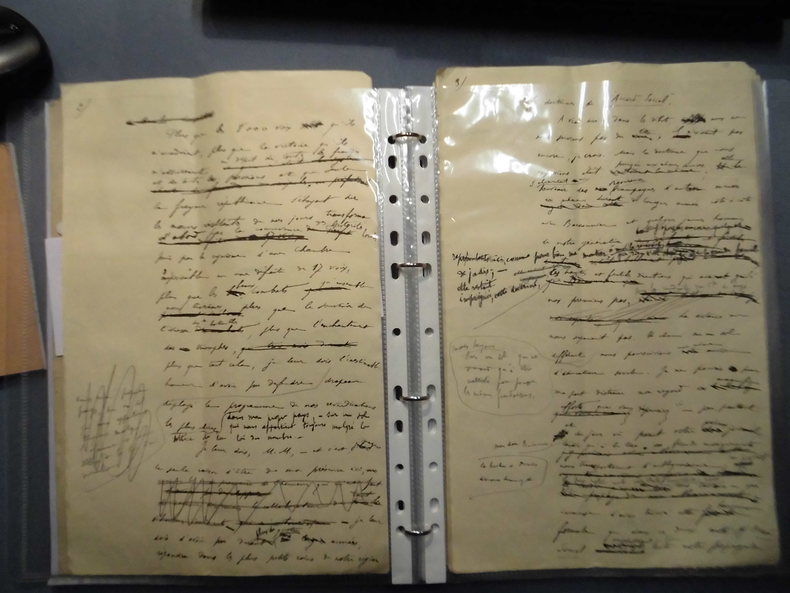
Eugène MAGNE Né en 1873 à Avignon et mort à Nîmes en 1950; Conseiller municipal de Nîmes, Conseiller général du Gard et Député du Gard (1919-1924).
Manuscrit brouillon de 18 pages in-4 d'une intervention à Paris (Sociétés savantes)faite le 9 Octobre 1910. Second manuscrit d'un discours intitulé 'le Corporatisme, l'Anti-étatisme" + 2pp.non identifiées.
Bookseller reference : 10
|
|
|
Eugène Manuel
Eugène Manuel - DEUX LETTRES AUTOGRAPHES SIGNÉES À Philippe Gille - 1888 & 1899
Eugène Manuel. Deux lettres autographes signées à Philippe Gille, 1888 et 1899 Poète français Deux lettres autographes signées d'Eugène Manuel, adressées à Philippe Gille, avec certificat d'expertise. * Lettre autographe signée datée du 26 mai 1888, écrite à l'encre sur un double feuillet de papier vergé filigrané, avec son enveloppe timbrée et tamponnée : Eugène Manuel adresse ses remerciements à Philippe Gille pour avoir publié ses vers dans le Figaro. Dimensions : 11,6 X 17,9 cm État : Voir photos et description pour plus de détails. Nombre de pages : 2 pages * Lettre autographe signée datée du 22 juillet 1899, écrite à l'encre sur un double feuillet de papier vergé filigrané : Eugène Manuel adresse ses félicitations à Gille pour son succès à l'élection. Dimensions : 11,5 X 17,7 cm État : Voir photos et description pour plus de détails. Nombre de pages : 2 pages Eugène Manuel Eugène Manuel, né le 13 juillet 1823 à Paris où il est mort le 1ᵉʳ juin 1901 dans le 16ᵉ arrondissement, est un poète, professeur et homme politique français. Wikipédia Contactez-nous Lettres autographes, vieux papiers, livres anciens, photographies, gravures, timbres... Nous expertisons et/ou rachetons dans toute la France vos lettres, collections de lettres et livres anciens. Paiement Sont acceptés les paiements par eBay, par PayPal, par virement ou par chèque. Envoi Envoi soigné dans un emballage rigide et étanche sous trois jours. Prévoir les délais postaux habituels en plus. Retour Satisfait ou remboursé. Si vous n'êtes pas entièrement satisfait, retour à la charge du vendeur pour l'Europe. À la charge de l'acheteur pour le reste du monde.
Bookseller reference : boz_005759

|
|
|
Eugène Manuel
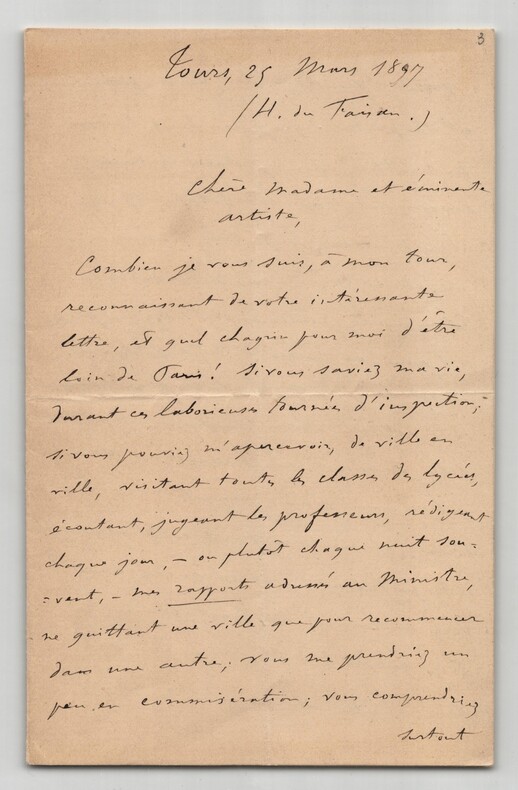
Eugène Manuel - Lettre autographe signée - Tours 1897
Eugène Manuel. Lettre autographe signée, Tours, 1897 Dimensions : 11,2 x 17,7 cm Nombre de pages : 4 pages État : Voir photos et description pour plus de détails. Eugène Manuel, né le 13 juillet 1823 à Paris où il est mort le 1ᵉʳ juin 1901 dans le 16ᵉ arrondissement, est un poète, professeur et homme politique français.
Bookseller reference : boz_002106
|
|
|
Eugène Manuel
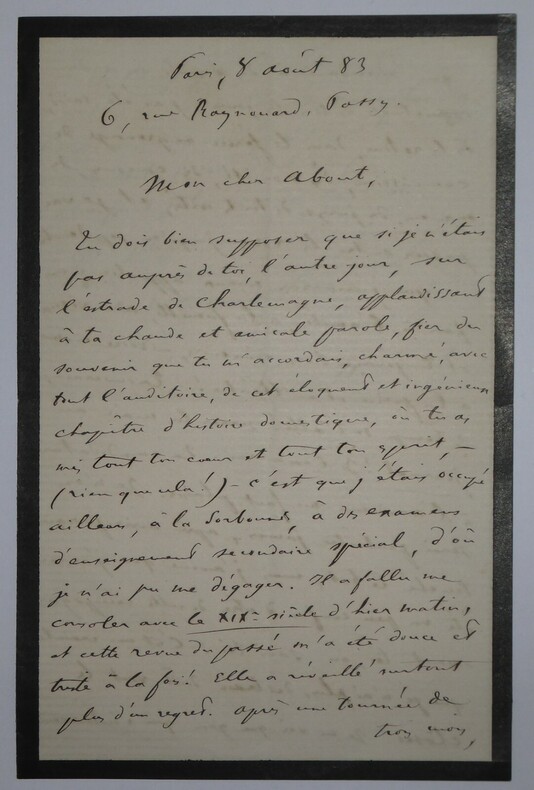
MANUEL Eugène - LETTRE AUTOGRAPHE SIGNÉE À Edmond ABOUT, PASSY, AOÛT 1883
Eugène MANUEL. Lettre autographe signée et datée du 8 août 1883, Passy. Dimensions : 12 x 18.5 cm. 3 pages. Etat : Bon état de conservation.
Bookseller reference : boz_004901
|
|
|
Eugène MANUEL
MANUSCRIT POEME "L'eau qui dort", c. 1900
Eugène MANUEL. Manuscrit signé du poème L'eau qui dort , c. 1900-1902. Manuscrit en cinq pages du poème L'eau qui dort, seulement parût dans le journal Le Petit Parisien (dont édition de juillet 1902). Les cinq pages sont reliées au coin par un clou (origine et non remplacé). Le poème se compose de 18 strophes de six vers (sizain en rimes AABCCB) , réparties en 3 parties et ayant un thème pastoral. Dimensions : 13.5 x 21 cm. 5 pages. Etat : Bon état de conservation malgré la légère usure. Eugène Manuel, né le 13 juillet 1823 à Paris où il est mort le 1ᵉʳ juin 1901 dans le 16ᵉ arrondissement, est un poète, professeur et homme politique français. Wikipédia Envoi soigné dans un emballage rigide et étanche. Satisfait ou remboursé. Si vous n'êtes pas entièrement satisfait, je reprends la marchandise avec retour à ma charge pour l'Europe et à la charge de l'acheteur pour le reste du monde. N’hésitez pas à visiter ma boutique et affiner vos recherches en fonction des catégories qui vous intéressent. Ma boutique L'Art Délivré. Lettres autographes, vieux papiers, livres anciens, photographies, gravures, timbres… Nous expertisons et/ou rachetons dans toute la France vos lettres, collections de lettres et livres anciens. Merci de votre visite. Jérôme KAYSER.
Bookseller reference : boz_006079

|
|
|
Eugène Manuel
Pendant la guerre ( Poésies)
Contient; Poésies, pour les blessés, les pigeons de la République, Bonjour bon an !, Henri regnault, Les absents, l'obus, délivrance, etc. Bel envoi aux écoles professionnelles Lerm (?), offrande et souvenir de l'auteur.. " Vol, in-8, relié, 19x15, trace de mouillure ancienne, bel exemplaire, 190pp. Paris, Calmann Lévy, 1877 ref/293
Bookseller reference : CZC-12627

|
|
|
Eugène Manuel
Pendant la guerre ( Poésies)
Contient; Poésies, pour les blessés, les pigeons de la République, Bonjour bon an !, Henri regnault, Les absents, l'obus, délivrance, etc. Bel envoi aux écoles professionnelles Lerm (?), offrande et souvenir de l'auteur.. " Vol, in-8, relié, 19x15, trace de mouillure ancienne, bel exemplaire, 190pp. Paris, Calmann Lévy, 1877 ref/293
Bookseller reference : CZC-12627
|
|
|
Eugène MARSAN - [Bari 1882 - 1936] - Ecrivain et journaliste français
Lettre Autographe Signée au Comte Philipon - Paris le 12 juillet 1926 -
1 page in8 - enveloppe - bon état -
Bookseller reference : 34930
|
|
|
Eugène Mayer
MAYER Eugène - Carte de visite simple annotée, remerciements
Eugène MAYER. Carte de visite simple annotée. Carte de visite (liseré de deuil noir fin) adressée à un tiers afin de le remercier. Dimensions : 10 x 6.5 cm. Etat : Bon état de conservation . Voir photos pour référence. Benjamin-Charles-Eugène Mayer, né à Cologne le 12 août 1843 et mort après 1909, est un financier et patron de presse français du XIXᵉ siècle. Wikipédia Envoi soigné dans un emballage rigide et étanche. Satisfait ou remboursé. Si vous n'êtes pas entièrement satisfait, je reprends la marchandise avec retour à ma charge pour l'Europe et à la charge de l'acheteur pour le reste du monde. N’hésitez pas à visiter ma boutique et affiner vos recherches en fonction des catégories qui vous intéressent. Ma boutique L'Art Délivré. Lettres autographes, vieux papiers, livres anciens, photographies, gravures, timbres… Nous expertisons et/ou rachetons dans toute la France vos lettres, collections de lettres et livres anciens. Merci de votre visite. Jérôme KAYSER.
Bookseller reference : boz_005857

|
|
|
Eugène Michel CHEVREUL
Eugène Michel CHEVREUL, Chimiste - LETTRE AUTOGRAPHE SIGNÉE Paris 1860, 2 PAGES
Eugène Michel CHEVREUL . Lettre autographe signée, Paris, 1860. Dimensions : 13,4 x 20,7 cm. 2 pages. État : Voir photos pour plus de détails.
Bookseller reference : boz_003412

|
|
|
Eugène Montfort
Eugène Montfort - Lettre autographe signée à Mr Descaves - 1902
Eugène Montfort. Lettre autographe signée à Mr Descaves, 1902 Écrivain français Lettre autographe signée d'Eugène Montfort, adressée à Monsieur Descaves, datée du 2 juin 1902 à Paris. Rédigée à l'encre noire sur un double feuillet de papier vélin. Dimensions : 13,5 x 21,4 cm État : Bel état de conservation. Nombre de pages : 2 pages Eugène Montfort Eugène Jules Montfort est un écrivain français né le 7 février 1877 à Paris et mort le 12 décembre 1936 à Port-Vendres.
Bookseller reference : boz_002467

|
|
|
Eugène Montfort
Eugène Montfort - Lettre autographe signée à Mr Descaves "Antimilitariste" 1902
Eugène Montfort. Lettre autographe signée à Mr Descaves, "Antimilitariste", 1902 Écrivain français Lettre autographe signée d'Eugène Montfort, adressée à Monsieur Descaves, datée du 26 mars 1902 à Paris. Rédigée à l'encre noire sur un feuillet de papier vélin. Dimensions : 13,5 x 21,3 cm État : Bel état de conservation. Nombre de pages : 1 page Eugène Montfort Eugène Jules Montfort est un écrivain français né le 7 février 1877 à Paris et mort le 12 décembre 1936 à Port-Vendres.
Bookseller reference : boz_004307

|
|
|
Eugène MONTFORT - [Paris 1877 - 1936] - Ecrivain français
Lettre Autographe Signée à "Arthur Cantillon" - le 9 juin 1914 -
1 page in12 - adresse au dos - Carte postale - bon état -
Bookseller reference : 33480
|
|
|
Eugène MORET - [1835 - 1890] - Ecrivain français
Lettre Autographe Signée à "Cher Monsieur" - le 22 octobre 1880 -
1 page 1/2 in8 - bon état -
Bookseller reference : GF29731
|
|
|
Eugène Muller
1880. Lettre autographe Eugène Muller écrivain Francais XIXe
document authentique du XIXe siècle, datée 1881 sur 1 page, format 21 cm x 13,5 cm, pliure, bel état Eugène Muller, écrivain, né à Vernaison le 31/07/1826, mort à Paris le 08/11/1913. Il arrive à St-Etienne dès l'âge de deux ans. Un de ses romans, Madame Claude, a été diffusé sous forme de feuilleton dans Le Petit Stéphanois en 1881. ref/Cla5
Bookseller reference : CZC-12314

|
|
|
Eugène Muller
1880. Lettre autographe Eugène Muller écrivain Francais XIXe
document authentique du XIXe siècle, datée 1881 sur 1 page, format 21 cm x 13,5 cm, pliure, bel état Eugène Muller, écrivain, né à Vernaison le 31/07/1826, mort à Paris le 08/11/1913. Il arrive à St-Etienne dès l'âge de deux ans. Un de ses romans, Madame Claude, a été diffusé sous forme de feuilleton dans Le Petit Stéphanois en 1881. ref/Cla5
Bookseller reference : CZC-12314
|
|
|
Eugène MUNTZ - [Soultz-sous-Forêts 1845 - Paris 1902] - Historien de l'art français
Lettre Autographe Signée à "Cher Monsieur" -
3 pages 1/4 in8 - bon état -
Bookseller reference : GF27109
|
|
|
Eugène Paillet
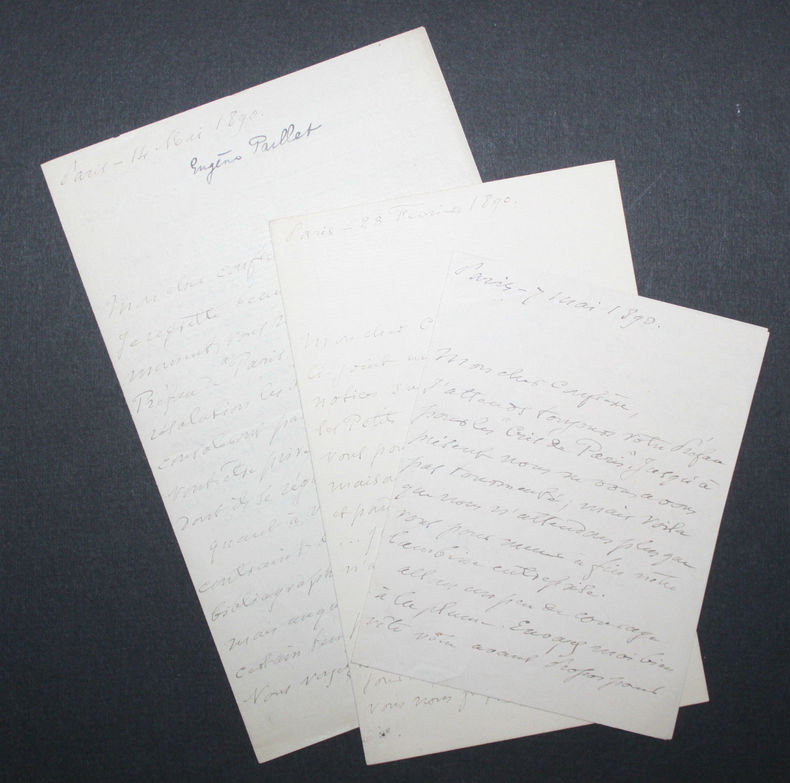
Trois lettres autographes d’Eugène Paillet[1] bibliophile, Président des Amis des Livres, à Octave Uzanne (1890).
Lettre I. Paris – 28 février 1890. [3 pages in-12 sur papier vergé crème]. Mon cher confrère, Ci-joint une vingtaine de notices sur « Paris qui Crie[2] ou les Petits métiers. » De cette façon vous pouvez prendre l’air de la maison, ruminer votre provende et pondre une jolie petite Préface : … J’espère que Mr. Prudhomme n’aurait pas dit mieux. Mais nous sommes, très, très pressés et nous n’attendons plus que vous pour paraître au grand jour. Après les coups réitérés dont vous nous frappez dans le Livre Moderne[3], sans relâche et sans indulgence exagérée, il faut que nous publions (sic) au plus vite un volume pour riposter à pareille artillerie. Or il sera assez coquet de vous voir escarmoucher dans notre Préface en faveur des Amis des Livres[4]. Qu’elle soit vive, brève, peu poussée et bien troussée, votre Préface, d’ailleurs comme vous savez les faire. Je ne vous en demande pas long, mais bon et prompt ; si c’était possible, avant votre départ pour les pays étranges[5]. Je vous rappelle que les gravures seront peinturlurées et que le texte est dû à la collaboration des membres de la société. [1] Eugène Paillet (1829-1901) est le fondateur de la société des Amis des Livres. C’était un ardent bibliophile. Sa bibliothèque fut vendue en trois fois, dont deux ventes de son vivant. - Bibliothèque d'un bibliophile, 1865-1885. Lille, Danel, 1885, petit in-8, XVI + 149 pp + (1) f. Ce catalogue à été édité à 200 exemplaires tous numérotés sur vergé de Hollande. 1000 livres sont décrits. - Catalogue des livres de la bibliothèque de M. Eugène Paillet. Paris, Damascène Morgand, 1887, in-8 avec un portrait, 170 pages, tirage à 797 exemplaires numérotés, les exemplaires sont sur grand papier vélin d'Arches. - La bibliothèque de feu M. Eugène Paillet (Président de la Société des Amis des Livres). Paris, Damascène Morgand, 1902, 2 vol. in-8. [2] Paris qui crie (petits métiers). Notices par Albert Arnal, Henry Spencer, Ashbee, Jules Claretie, Abel Giraudeau, Henry Houssaye, Henri Meilhac, Victor Mercier, Eugène Paillet, Jean Paillet, Roger Portalis, E. Rodrigues. Préface de Henri Beraldi. 1 vol. petit in-4°, 1890. 30 dessins en couleurs de Pierre Vidal, tirés au patron. Imprimé par G. Chamerot. [3] Le Livre Moderne est la nouvelle revue éphémère que vient d’entreprendre Octave Uzanne à la fin de l’année 1889. Elle comptera 24 livraisons mensuelles, soit deux années d’existence (1890 et 1891). Uzanne inflige de sévères critiques à peine voilées aux Amis des Livres dirigés par Eugène Paillet et ce dès les premières pages de sa nouvelle revue : « Soit qu’il nous plaise de résumer en un court chapitre la théorie de l’illustration moderne, soit qu’il nous convienne de parler du format des livres d’art, soit enfin que la fantaisie nous porte à partir en guerre contre la routine de nos éditeurs les plus en renom, dont l’esprit de nouveauté, de recherche et d’originalité se donne si peu carrière, on peut être assuré que nous ne faiblirons pas à notre tâche et que nous irons toujours de l’avant, sans crainte de nous attirer les sarcasmes et les calomnies des bibliophiles vieux jeu, rétrogrades, fermés aux visions du progrès et qui, loin de s’appeler amis des livres, méritent par leurs préjugés et leurs errements le qualificatif plus juste d’ennemis du Livre. (…) » (Nos variations futures sur l’art du livre et le livre d’art moderne, p. 5). Il poursuit ses acides critiques envers les Amis des Livres p. 58-60 « Les collègues de M. Eugène Paillet manifestent une impatience légitime et trouvent que la Société (des Amis des Livres) est d’un platonisme navrant. » et plus loin : « Franchement il serait temps que les Amis des Livres montrent qu’ils ne sont pas morts, frappés par l’influenza du lazaronisme et la malaria de l’indifférence. » (On-dit, racontages et anecdotes du monde des curieux). On lit encore dans la livraison du 10 février 1890 (p. 133) : « (le trésorier venant d’être renouvelé le 14 janvier) Rien d’autre à signaler ; le Comité ayant été nommé à nouveau sans autre changement, maître Eugène Paillet en tête, à cette présidence qu’il occupe si bien avec toutes les qualités requises, courtoisie, belle humeur et autorité sereine. » (Le monde des livres – ce qui s’y dit, s’y fait, s’y prépare). [4] Eugène Paillet ne manque pas d’humour en disant cela. Il sait comme les Amis des Livres sont maltraités par Uzanne dans le Livre Moderne et pourtant une demande de Préface lui a été faite. [5] Nous ne savons pas vers quelle destination Uzanne devait partir dans le courant de 1890, peut-être Anvers ? (exposition Plantin). Agréez, mon cher confrère, l’assurance de mes sentiments tout dévoués. Eugène Paillet Mr. Meilhac[1] fait l’article du Café-concert et Mr. Clarétie[2] m’a remis celui de la Bouquetière. Ces deux notices ne sont pas encore imprimées, c’est pourquoi je vous les signale, sans vous les envoyer. Ashbee[3] a composé en anglais une définition du Distributeur de Prospectus. Ne faites pas attention aux incorrections des placards – ils ne sont pas encore corrigés. Lettre II. Paris – 7 mai 1890. [2 pages petit in-12 sur papier vélin crème]. [1] Henry Meilhac, né le 21 février 1831 à Paris où il est mort le 6 juillet 1897, est un auteur dramatique, librettiste d'opérettes et d'opéras français. Après ses études au collège Louis-le-Grand, Henry Meilhac travailla tout d'abord comme employé dans une librairie. Puis il continua comme dessinateur au Journal pour rire, de 1852 à 1855, sous le pseudonyme de Thalin, et donna des articles dans diverses revues où se signalait déjà sa fantaisie dans le plus pur esprit boulevardier. Meilhac était grand, bel homme, bon vivant, amateur de jolies femmes jusqu'à rester célibataire. Avec Ludovic Halévy, rencontré en 1860, il entama une collaboration de près de vingt ans, donnant les livrets des plus célèbres opérettes de Jacques Offenbach dont La Belle Hélène (1864), La Vie parisienne (1866), La Grande-Duchesse de Gérolstein (1867) et La Périchole (1868) et aussi de Carmen de Georges Bizet (1875). Il signa également les livrets d'opérettes de Charles Lecocq et de Hervé. Le duo composa aussi des vaudevilles et des comédies: Les Brebis de Panurge (1863), Fanny Lear (1868), Froufrou (1869), Tricoche et Cacolet (1872), Le Prince (1876), La Cigale (1877), Le Mari de la débutante (1879). Des deux duettistes, Henri Meilhac apportait en propre une fantaisie irrésistible, confinant parfois à la loufoquerie. Gagnant beaucoup d'argent, il en dépensait beaucoup, cherchant l'inspiration dans les grands restaurants, les cigares et le champagne. Meilhac et Halévy fréquentèrent le salon littéraire de Geneviève Halévy ou l'on rencontrait Lucien Guitry, Paul Bourget ou Joseph Reinach, entre autres. La collaboration de Meilhac et Halévy cessa en 1881. Meilhac signa également des pièces avec d'autres collaborateurs, notamment Mam'zelle Nitouche (1883) avec Albert Millaud (1844-1892) et Manon de Jules Massenet avec Philippe Gille. Il encouragea les débuts de Georges Feydeau. Il fut élu à l'Académie française le 26 avril 1888 au fauteuil 15, en remplacement d'Eugène Labiche. [2]Arsène Arnaud Claretie, dit Jules Claretie, né à Limoges le 3 décembre 1840 et mort à Paris le 23 décembre 1913, est un romancier et auteur dramatique français, également historien et chroniqueur de la vie parisienne. Jules Claretie collabore à de nombreux journaux, notamment au Figaro et au Temps, sous plusieurs pseudonymes. Il tient la critique théâtrale à L'Opinion nationale, au Soir, à La Presse. Ami d'Étienne Arago, il publie une analyse de ses Mémoires dans Le Temps du 28 mai 1892. Historien, il compose entre autres une Histoire de la Révolution de 1870-1871. Il publie de nombreux romans, tels que Monsieur le Ministre, Le Million et Le Prince Zilah, parmi lesquels plusieurs sont adaptés pour la scène. En 1894, il écrit pour Massenet le livret de La Navarraise et celui d' Amadis, tiré d'Amadis de Gaule, roman chevaleresque de Garci Rodríguez de Montalvo, qui n'est créé qu'après la mort des deux artistes, le 1er avril 1922 au Grand théâtre de Monte Carlo. Il est président de la Société des gens de lettres. En 1882 et 1883, il est vice-président de la Société des Auteurs et Compositeurs Dramatiques. De 1885 à 1913, il est administrateur général de la Comédie-Française, dont il ouvre les portes à des auteurs contemporains tels que Paul Hervieu, Henry Bataille et Octave Mirbeau, dont il fait jouer Les affaires sont les affaires et, à contre-cœur et contraint par une décision de justice, Le Foyer. Il est élu membre de l'Académie française le 26 janvier 1888. [3] Henry Spencer Ashbee (21 April 1834 – 29 July 1900) was a book collector, writer, and bibliographer, notorious for his massive, clandestine three volume bibliography of erotic literature written under the pseudonym of Pisanus Fraxi. Mon cher confrère, J’attends toujours votre Préface pour les « Cris de Paris ». Jusqu’à présent nous ne vous avons pas tourmenté ; mais voilà que nous n’attendons plus que vous pour mener à fin notre lambine entreprise. Allons un peu de courage à la plume – Envoyez moi bien vite votre avant propos pour que Chamerot[1] l’imprime de son mieux et que notre ouvrage paraisse enfin dans toute sa gloire. Je compte, mon cher confrère, sur votre gracieuse complaisance et vous prie d’agréer l’assurance de mes sentiments dévoués. Eugène Paillet Lettre III. Paris – 14 mai 1890. [2 pages grand in-12 sur papier vergé crème]. Mon cher confrère, Je regrette beaucoup qu’au dernier moment, vous renonciez à écrire la Préface de « Paris qui Crie ». De cette résolution les Amis des Livres ne se consolent pas facilement, puisqu’ils vont être privés d’un mets savoureux, dont ils se régalaient à l’avance. Quant à votre serviteur, le voila contraint de faire appel à un bibliographe moins accablé de besogne[2] ; mais auquel il faudra toujours un certain temps pour composer sa copie. Vous voyez qu’il n’y a pas de notre faute et vous n’avez plus le cœur de nous plaisanter dans le Livre, sur notre lenteur à produire un ouvrage. Quoi qu’il en soit, je suis persuadé que, seules, vos occupations vous empêchent de nous accorder votre collaboration et je souhaite que vous n’assumiez pas un travail trop considérable qui finirait par vous fatiguer. Mais, si vous n’écrivez pas pour nous, il ne faut pas nous priver de votre présence et nous serions tous très heureux de vous voir à la première réunion des Amis des Livres. Elle aura lieu au mois de juin. Agréez, mon cher confrère, avec l’expression de tous nos regrets, l’assurance de mes sentiments dévoués. Eugène Paillet [1] C’est bien Georges Chamerot qui imprimera le volume pour les Amis des Livres. [2] C’est finalement à Henri Beraldi qu’échouera la Préface de Paris qui crie. Henri Beraldi (1849-1931), presque exact contemporain d’Octave Uzanne, était un éminent biblio-iconophile. Il est connut comme bibliographe pour ces deux ouvrages sur les graveurs du XVIIIe et du XIXe s., et comme historien pour son ouvrage sur les Pyrénées. C’est lui qui prit la présidence des Amis des Livres au décès d’Eugène Paillet en 1901.
Bookseller reference : AMO-2439
|
|
|
Eugène RAPP
Eugène RAPP dessinateur RARE LETTRE AUTOGRAPHE SIGNÉE Mr. MONTORGUEIL Paris 1889
Lettre autographe signée de Eugène RAPP en date du 23 janvier 1889 à Paris. Lettre de 2 pages dans laquelle il parle de Clavel et Désiré au sujet d'un bouquin. État: Voir photos pour plus de détails. Dimensions : 13,2 x 21 cm . 2 pages. Eugène Heimburger, connu sous le nom de plume d’ Eugène Rapp , né le 4 avril 1863 à Strasbourg et mort le 14 décembre 1889 à Paris , est un dessinateur de presse , journaliste et illustrateur français . Wikipédia. Envoi soigné dans un emballage rigide et étanche. Satisfait ou remboursé. Si vous n'êtes pas entièrement satisfait, je reprends la marchandise avec retour à ma charge pour l'Europe et à la charge de l'acheteur pour le reste du monde. N’hésitez pas à visiter ma boutique et affiner vos recherches en fonction des catégories qui vous intéressent. Ma boutique L'Art Délivré. Lettres autographes, vieux papiers, livres anciens, photographies, gravures, timbres… Nous expertisons et/ou rachetons dans toute la France vos lettres, collections de lettres et livres anciens. Merci de votre visite. Jérôme KAYSER.
Bookseller reference : boz_006022

|
|
|
Eugène RAPP
Eugène RAPP, dessinateur, RARE LETTRE AUTOGRAPHE SIGNÉE MONTORGUEIL Paris 1889
Lettre autographe signée de Eugène RAPP en date du 8 janvier 1889 à Paris. Il lui donne un rendez-vous pour parler d'une affaire. État: Voir photos pour plus de détails. Dimensions : 9 x 11,4 cm . 2 pages. Eugène Heimburger, connu sous le nom de plume d’ Eugène Rapp , né le 4 avril 1863 à Strasbourg et mort le 14 décembre 1889 à Paris , est un dessinateur de presse , journaliste et illustrateur français . Wikipédia. Envoi soigné dans un emballage rigide et étanche. Satisfait ou remboursé. Si vous n'êtes pas entièrement satisfait, je reprends la marchandise avec retour à ma charge pour l'Europe et à la charge de l'acheteur pour le reste du monde. N’hésitez pas à visiter ma boutique et affiner vos recherches en fonction des catégories qui vous intéressent. Ma boutique L'Art Délivré. Lettres autographes, vieux papiers, livres anciens, photographies, gravures, timbres… Nous expertisons et/ou rachetons dans toute la France vos lettres, collections de lettres et livres anciens. Merci de votre visite. Jérôme KAYSER.
Bookseller reference : boz_005822

|
|
|
Eugène RAPP
Eugène RAPP, dessinateur, RARE LETTRE AUTOGRAPHE SIGNÉE MONTORGUEIL, Paris 1889
Lettre autographe signée de Eugène RAPP en date du 12 septembre 1889 à Paris sur papier à en-tête "La Jeune République Journal Quotidien". Lettre d'une page dans laquelle il invite son correspondant à un déjeuner. Il déclare également être très malade et se préoccuper davantage de sa santé plutôt qu'à ses ouvrages. État: Voir photos pour plus de détails. Dimensions : 13,2 x 21 cm . 2 pages. Eugène Heimburger, connu sous le nom de plume d’ Eugène Rapp , né le 4 avril 1863 à Strasbourg et mort le 14 décembre 1889 à Paris , est un dessinateur de presse , journaliste et illustrateur français . Wikipédia. Envoi soigné dans un emballage rigide et étanche. Satisfait ou remboursé. Si vous n'êtes pas entièrement satisfait, je reprends la marchandise avec retour à ma charge pour l'Europe et à la charge de l'acheteur pour le reste du monde. N’hésitez pas à visiter ma boutique et affiner vos recherches en fonction des catégories qui vous intéressent. Ma boutique L'Art Délivré. Lettres autographes, vieux papiers, livres anciens, photographies, gravures, timbres… Nous expertisons et/ou rachetons dans toute la France vos lettres, collections de lettres et livres anciens. Merci de votre visite. Jérôme KAYSER.
Bookseller reference : boz_005992

|
|
|
Eugène Rigal
Envoi autographe Eugène Rigal. Centenaire de Victor Hugo ( discours) EO 1902
CENTENAIRE DE VICTOR HUGO ( 26 février 1902), discours prononcé par Eugène Rigal bel envoi de l'auteur en page de garde ! vol broché, 240x130, parfait état, 56pp Montpellier Serre et Roumégous 1902. Edition Originale Eugène Rigal, né le 12 septembre 1898 à Beaumont-de-Lomagne (Tarn-et-Garonne) et mort le 23 avril 1966 à Neuilly-sur-Seine (Seine), est un homme politique français. Issu de la petite bourgeoisie, Eugène Rigal travaille comme comptable quand il s'engage, en 1928, au sein du petit Parti Démocrate Populaire. Ayant naturellement rejoint le Mouvement Républicain Populaire à la Libération, il est élu conseiller général de la Seine, dans le canton de Sceaux-est. En 1945, il est en deuxième position sur la liste MRP menée par André Pailleux pour l'élection de la première assemblée constituante, et est élu député. L'année suivante, en juin, il prend la tête de cette liste après le retrait de Pailleux. Il est réélu, de même qu'en novembre 1946. A l'assemblée, il se consacre d'abord essentiellement à la question de la nationalisation de la Banque de France, ainsi que, plus généralement, aux questions bancaires, financières et comptables. Fin 1945, il est rapporteur du budget des Caisses d'épargne. Très actif à partir de 1947, il fait de nombreuses interventions en tribune, dépose de nombreux textes, pour l'essentiel sur les mêmes types de questions que précédemment. Il est à plusieurs reprises rapporteur de projets de loi et de chapitres budgétaires. Sur l'ensemble de ces questions, il défend des positions libérales classiques, plutôt hostiles à l'impôt. Il se retire de la vie politique en 1951, au profit de Joseph Dumas, et reprend ses activités professionnelles. refc/31
Bookseller reference : CZC-3044

|
|
|
Eugène Rigal
Envoi autographe Eugène Rigal. Centenaire de Victor Hugo ( discours) EO 1902
CENTENAIRE DE VICTOR HUGO ( 26 février 1902), discours prononcé par Eugène Rigal bel envoi de l'auteur en page de garde ! vol broché, 240x130, parfait état, 56pp Montpellier Serre et Roumégous 1902. Edition Originale Eugène Rigal, né le 12 septembre 1898 à Beaumont-de-Lomagne (Tarn-et-Garonne) et mort le 23 avril 1966 à Neuilly-sur-Seine (Seine), est un homme politique français. Issu de la petite bourgeoisie, Eugène Rigal travaille comme comptable quand il s'engage, en 1928, au sein du petit Parti Démocrate Populaire. Ayant naturellement rejoint le Mouvement Républicain Populaire à la Libération, il est élu conseiller général de la Seine, dans le canton de Sceaux-est. En 1945, il est en deuxième position sur la liste MRP menée par André Pailleux pour l'élection de la première assemblée constituante, et est élu député. L'année suivante, en juin, il prend la tête de cette liste après le retrait de Pailleux. Il est réélu, de même qu'en novembre 1946. A l'assemblée, il se consacre d'abord essentiellement à la question de la nationalisation de la Banque de France, ainsi que, plus généralement, aux questions bancaires, financières et comptables. Fin 1945, il est rapporteur du budget des Caisses d'épargne. Très actif à partir de 1947, il fait de nombreuses interventions en tribune, dépose de nombreux textes, pour l'essentiel sur les mêmes types de questions que précédemment. Il est à plusieurs reprises rapporteur de projets de loi et de chapitres budgétaires. Sur l'ensemble de ces questions, il défend des positions libérales classiques, plutôt hostiles à l'impôt. Il se retire de la vie politique en 1951, au profit de Joseph Dumas, et reprend ses activités professionnelles. refc/31
Bookseller reference : CZC-3044
|
|
|
Eugène Riguidel et Gilles Gahinet.
Deux pour vaincre, transat en double
Envoi autographe de Eugène Riguidel broché, 24x15, usures d'usages de la couverture, bel état interieur, 275pp. Cahiers d'illustrations photographiques. Robert Laffont, 1979 ref/101
Bookseller reference : CZC-12771

|
|
|
Eugène Riguidel et Gilles Gahinet.
Deux pour vaincre, transat en double
Envoi autographe de Eugène Riguidel broché, 24x15, usures d'usages de la couverture, bel état interieur, 275pp. Cahiers d'illustrations photographiques. Robert Laffont, 1979 ref/101
Bookseller reference : CZC-12771
|
|
|
Eugène Sarlin
ÉMOIS ET MURMURES
avec envoi de l'auteur ! vol broché, 15x10, bon état intérieur, 115pp Paris Ducrocq 1905 ref/78/2
Bookseller reference : CZC-10537

|
|
|
Eugène Sarlin
ÉMOIS ET MURMURES
avec envoi de l'auteur ! vol broché, 15x10, bon état intérieur, 115pp Paris Ducrocq 1905 ref/78/2
Bookseller reference : CZC-10537
|
|
|
Eugène SAUZAY
Eugène SAUZAY - Lettre Autographe Signée "cela est vrai, vive la science", 1891
Eugène SAUZAY - Lettre Autographe Signée "cela est vrai, vive la science", 1891 Violoniste Eugène SAUZAY - Lettre Autographe Signée "cela est vrai, vive la science", 1891. Dimensions : 13,5 x 10,1 cm État : Voir photos pour plus de détails. Nombre de pages : 1 page Eugène SAUZAY Charles Eugène Sauzay, né le 14 juillet 1809 à Paris et mort dans la même ville le 24 janvier 1901, est un violoniste, compositeur et musicographe français. Wikipédia Contactez-nous Lettres autographes, vieux papiers, livres anciens, photographies, gravures, timbres... Nous expertisons et/ou rachetons dans toute la France vos lettres, collections de lettres et livres anciens. Paiement Sont acceptés les paiements par eBay, par PayPal, par virement ou par chèque. Envoi Envoi soigné dans un emballage rigide et étanche sous trois jours. Prévoir les délais postaux habituels en plus. Retour Satisfait ou remboursé. Si vous n'êtes pas entièrement satisfait, retour à la charge du vendeur pour l'Europe. À la charge de l'acheteur pour le reste du monde.
Bookseller reference : boz_005697

|
|
|
Eugène SAUZAY
Eugène SAUZAY - Lettre Autographe Signée "mauvaise santé"
Eugène SAUZAY - Lettre Autographe Signée "mauvaise santé" Violoniste Eugène SAUZAY - Lettre Autographe Signée "mauvaise santé". Dimensions : 15,4 x 9,8 cm État : Voir photos pour plus de détails. Nombre de pages : 1 page Eugène SAUZAY Charles Eugène Sauzay, né le 14 juillet 1809 à Paris et mort dans la même ville le 24 janvier 1901, est un violoniste, compositeur et musicographe français.
Bookseller reference : boz_003136

|
|
|
Eugène SAUZAY
Eugène SAUZAY - Lettre Autographe Signée, 1898, Votre charmante poésie
Eugène SAUZAY - Lettre Autographe Signée, 1898. Dimensions : 15,6 x 9,9 cm État : Voir photos pour plus de détails. Nombre de pages : 1 page. Charles Eugène Sauzay, né le 14 juillet 1809 à Paris et mort dans la même ville le 24 janvier 1901, est un violoniste, compositeur et musicographe français.
Bookseller reference : boz_002313

|
|
|
Eugène Schnerb
SCHNERB Eugène - LETTRE REPONSE AUTOGRAPHE SIGNEE À Edmond ABOUT ? PARIS 1874
Eugène SCHNERB. Lettre autographe signée en date du 15 septembre 1874 à Paris. Lettre de quatre pages divisée en deux parties : les trois premières pages concernent la demande initiale possiblement soit de Edmond About soit "E. Baur" . Dans sa lettre, sont abordés plusieurs sujets différents comme tout d'abord, l'état de santé de la mère d'un de leur collaborateur, puis le calme plat de la vie politique du moment et aussi "la question du local". La dernière page est réservée à la réponse d'Eugène Schnerb. Il salue l'épouse d'Edmond About. Dimensions : 13.5 x 21 cm. 4 pages. Etat : Bon état de conservation . Voir photos pour référence. Eugène Schnerb (11 août 1839, Paris- 24 juin 1897, Paris) est un publiciste (journaliste) et haut fonctionnaire français. Envoi soigné dans un emballage rigide et étanche. Satisfait ou remboursé. Si vous n'êtes pas entièrement satisfait, je reprends la marchandise avec retour à ma charge pour l'Europe et à la charge de l'acheteur pour le reste du monde. N’hésitez pas à visiter ma boutique et affiner vos recherches en fonction des catégories qui vous intéressent. Ma boutique L'Art Délivré. Lettres autographes, vieux papiers, livres anciens, photographies, gravures, timbres… Nous expertisons et/ou rachetons dans toute la France vos lettres, collections de lettres et livres anciens. Merci de votre visite. Jérôme KAYSER.
Bookseller reference : boz_005994

|
|
|
Eugène Scribe
SCRIBE Eugène - LETTRE AUTOGRAPHE SIGNÉE À Albert MILLAUD, Paris
Eugène SCRIBE. Lettre autographe signée adressée à son voisin, Albert MILLAUD. Paris. Dimensions : 13,5 x 20,6 cm. 1 page. État : Bon état. Une déchirure est visible à l'intérieur du feuillet.
Bookseller reference : boz_003521

|
|
|
Eugène Soubeyre
AIME DES DIEUX
Bel envoi autographe de l'auteur: " Au grand statuaire Maxime Réal del Sarte, à l'auteur de l'inoubliable" Jeanne d'Arc au buché " et de tant d'autres belles œuvres. Amicalement. Eugène Soubeyre. " vol broché, 195x140, bel état intérieur, 233pp. Tirage à 100 exemplaires sur papier Lafuma, numéroté et signé par l'auteur, ici n° 35. Édition Rupella, La Rochelle, MCMXXXVII ref/157
Bookseller reference : CZC-6808

|
|
|
Eugène Soubeyre
AIME DES DIEUX
Bel envoi autographe de l'auteur: " Au grand statuaire Maxime Réal del Sarte, à l'auteur de l'inoubliable" Jeanne d'Arc au buché " et de tant d'autres belles œuvres. Amicalement. Eugène Soubeyre. " vol broché, 195x140, bel état intérieur, 233pp. Tirage à 100 exemplaires sur papier Lafuma, numéroté et signé par l'auteur, ici n° 35. Édition Rupella, La Rochelle, MCMXXXVII ref/157
Bookseller reference : CZC-6808
|
|
|
Eugène TISSERAND
Eugène TISSERAND - Lettre autographe signée - Obsèques Henri TRESCA - 1885
Eugène TISSERAND. Lettre autographe signée, Obsèques Henri TRESCA, 1885 Dimensions : 13 x 20,4 cm Nombre de pages : 1 page
Bookseller reference : boz_002746

|
|
|
Eugène Varlin
ÉMOIS ET MURMURES
ÉMOIS ET MURMURES Eugène Varlin avec envoi de l'auteur ! vol broché, 150x95, bon état intérieur, 115pp Paris Ducrocq 1905 ref/c12
Bookseller reference : CZC-4180

|
|
|
Eugène Varlin
ÉMOIS ET MURMURES
ÉMOIS ET MURMURES Eugène Varlin avec envoi de l'auteur ! vol broché, 150x95, bon état intérieur, 115pp Paris Ducrocq 1905 ref/c12
Bookseller reference : CZC-4180
|
|
|
Eugène Veuillot
VEUILLOT Eugène - CARTE DE VISITE SIMPLE
Eugène VEUILLOT. Carte de visite simple sans annotations. Dimensions : 10 x 5.7 cm. Etat : Excellent état de conservation.
Bookseller reference : boz_004488

|
|
|
Eugène Veuillot
VEUILLOT Eugène - LETTRE AUTOGRAPHE SIGNÉE, REDACTION L'UNIVERS, PARIS
Eugène VEUILLOT. Lettre autographe signée, Paris. Lettre d'une page sur papier à en-tête "L'Univers - Rédaction" adressée à une connaissance demandant l'envoi d'un exemplaire d'un ouvrage. Dimensions : 14 x 20.5 cm. Etat : Etat moyennement bon. Présence de quelques tâches sur le recto en transpiration sur le verso et d'onglets. Eugène Veuillot, né le 5 octobre 1818 à Boynes et mort le 18 septembre 1905 à Paris 7ᵉ, est un journaliste français, qui a dirigé avec son frère Louis, puis avec ses fils François et Pierre, le journal d'obédience catholique L'Univers. Wikipédia Envoi soigné dans un emballage rigide et étanche. N’hésitez pas à visiter ma boutique et affiner vos recherches en fonction des catégories qui vous intéressent. Ma boutique L'Art Délivré. Lettres autographes, vieux papiers, livres anciens, photographies, gravures, timbres… Nous expertisons et/ou rachetons dans toute la France vos lettres, collections de lettres et livres anciens. Merci de votre visite. Jérôme KAYSER.
Bookseller reference : boz_005421

|
|
|
Eugène Veuillot
VEUILLOT Eugène - LETTRE AUTOGRAPHE SIGNÉE, REDACTION L'UNIVERS, PARIS, 1895
Eugène VEUILLOT. Lettre autographe signée et datée du 16 avril 1895, à Paris. Lettre d'une page sur papier à en-tête "L'Univers - Rédaction" adressée à son "cher monsieur et vieil ami" traitant d'un compte à régler pour lui et sa nièce. Il demande le montant exact à régler et voudrait s'en acquitter. Dimensions : 13.5 x 20.5 cm. Etat : Bon état malgré la présence d'onglets au verso. Eugène Veuillot, né le 5 octobre 1818 à Boynes et mort le 18 septembre 1905 à Paris 7ᵉ, est un journaliste français, qui a dirigé avec son frère Louis, puis avec ses fils François et Pierre, le journal d'obédience catholique L'Univers. Wikipédia Envoi soigné dans un emballage rigide et étanche. N’hésitez pas à visiter ma boutique et affiner vos recherches en fonction des catégories qui vous intéressent. Ma boutique L'Art Délivré. Lettres autographes, vieux papiers, livres anciens, photographies, gravures, timbres… Nous expertisons et/ou rachetons dans toute la France vos lettres, collections de lettres et livres anciens. Merci de votre visite. Jérôme KAYSER.
Bookseller reference : boz_005699

|
|
|
Eugène Woestyn
Pouvoir manuscrit signé par Eugène Woestyn – Collection 24 auteurs & musiciens
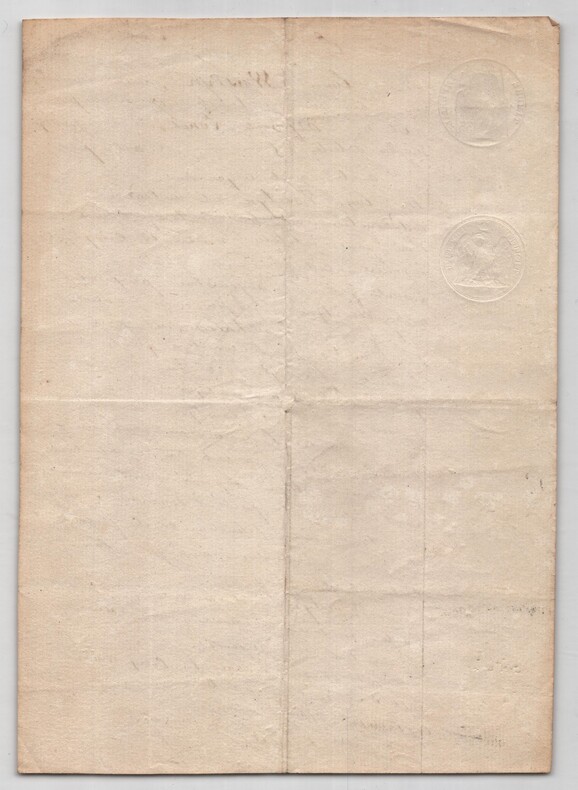
Eugène Woestyn Pouvoir manuscrit signé par Eugène Woestyn, auteur dramatique et librettiste français. Dimensions : 24 x 17 cm.
Bookseller reference : boz_003131
|
|
|
Eugène-Melchior de VOGUE - [Nice 1848 - Paris 1910] - Ecrivain, diplomate et homme politique français
Lettre autographe signée à "Cher Monsieur"- le 10 juin 1891 -
2 pages in8 - bon état -
Bookseller reference : 32949
|
|
|

 Receive by email
 Download as PDF document
 RSS feed
 Permanent link


