|
|
|
Hausmann, Manfred, Schriftsteller (1898-1986)
Eigenh. Brief mit U.
o.J. Worpswede, 28. III. 1942, Gr.-8°. 1 Seite. Briefkopf.
Referentie van de boekhandelaar : 45219
|
|
|
Hausmann, Manfred, Schriftsteller (1898-1986)
Eigenh. Brief mit U.
o.J. Dyllenhoff bei Bremen, 5. V. 1960, 4°. 1 Seite. Doppelblatt. Auf dem Privatdruck "Herbstabend am Strom" (1958).
Referentie van de boekhandelaar : 60473
|
|
|
Hausmann, Manfred, Schriftsteller (1898-1986)
Eigenh. Brief mit U.
o.J. Bremen, Oktober 1978, Gr.-8°. 1 Seite. Doppelblatt. Mit eigenh. Umschlag.
Referentie van de boekhandelaar : 54560
|
|
|
Hausmann, Manfred, Schriftsteller (1898-1986)
Eigenh. Brief mit U.
o.J. Worpswede, 6. V. 1946, Gr.-8°. 1 Seite. Gelocht, Eingangsstempel.
Referentie van de boekhandelaar : 54559
|
|
|
Hausmann, Manfred, Schriftsteller (1898-1986)
Eigenh. Brief mit U.
o.J. Bremen, 28. VIII. 1974, Gr.-8°. 1 Seite.
Referentie van de boekhandelaar : 44685
|
|
|
Hausmann, Manfred, Schriftsteller (1898-1986)
Eigenh. Gedichtmanuskript (22 Zeilen) mit U.
o.J. , Ohne Ort und Jahr, Fol. 1 Seite. Gelocht.
Referentie van de boekhandelaar : 57586
|
|
|
Hausmann, Manfred, Schriftsteller (1898-1986)
Eigenh. Gedichtmanuskript (4 Zeilen) mit U.
o.J. o. O., 1980, 8° 1/2 Seite.
Referentie van de boekhandelaar : 61344
|
|
|
Hausmann, Manfred, Schriftsteller (1898-1986)
Masch.Schriftstück mit eigenh. Ergänzung.
o.J. Ohne Ort und Datum, , 4°. 1/2 Seite.
Referentie van de boekhandelaar : 61258
|
|
|
Hausmann, Manfred, Schriftsteller (1898-1986).
Eigenh. Bildpostkarte mit U. Worpswede, 27. IX. 1938.
1 S. Qu.-8vo. Mit eh. Adresse. Dankt Josef Wesely für ihm übersandte Geburtstagswünsche. - Hausmann war 1924/25 Feuilletonredakteur der Bremer ‘Weserzeitung’ und seit 1927 als selbständiger Schriftsteller tätig. Unter dem Einfluß der Schriften Karl Barths und Kierkegaards wandte er sich seit den dreißiger Jahren einem christlichen Existentialismus zu und wurde 1967 Ältestenprediger an der protestantischen Kirche in Bremen-Rönnebeck. Der vielfach ausgezeichnete Schriftsteller schrieb Prosa, Lyrik, Mysterien- und Legendenspiele sowie die Autobiographie "Kleine Begegnungen mit großen Leuten" (1973). Durchaus umstritten ist seine Rolle als "Mitläufer" der Nationalsozialisten. Vgl. Kosch VII, 554f.

|
|
|
Hausmann, Manfred, Schriftsteller (1898-1986).
Eigenh. Postkarte mit U. Dresden, 15. IX. 1964.
1 S. Qu.-8vo. Bedankt sich bei Josef Wesely.
|
|
|
Hausmann, Manfred, Schriftsteller (1898-1986).
Eigenh. Postkarte mit U. Worpswede, 21. XII. 1941.
1 S. 8vo. Mit eh. Adresse und Absender. An Friedrich Herrmann, Herstellungsleiter beim S. Fischer- und Suhrkamp Verlag: "Für den eigentlichen Text von 'Einer muss wachen' habe ich keine Änderungsvorschläge. Dagegen sähe ich ganz gern, wenn vorn die Höhe der Auflage angegeben und hinten zu den angezeigten Bildern auch noch 'Quartier bei Magelone' hinzugefügt würde [...]". - "Einer muß wachen" und "Quartier bei Magelone. Aus den Papieren des Oberstleutnants Skram" erschienen beide im selben Jahr bei S. Fischer.
|
|
|
Hausmann, Robert, Cellist (1852-1909).
Eigenh. Brief mit U. Wohl Berlin, 3. XII. 1903.
1 S. auf Doppelblatt. Gr.-8vo. An eine Lucy: "Inzwischen werden Sie meinen Brief erhalten haben. Wir freuen uns sehr auf unser Musiziren. Die Probe zum Sextett u. Quintett muß am Montag den 7t. Dez. um 11 Uhr Vorm. im Hotel stattfinden, da wir am 8t u. 9t. Dez. auf Reisen sind [...]".

|
|
|
Hausner, Berta, Schauspielerin (1869-1932).
3 eigenh. Briefe und 1 eh. Portraitpostkarte mit U. sowie 1 Kabinettphotographie mit eh. Widmung und U. Berlin, 17.XII. 1921 - 31.XII. 1928.
Zusammen 10½ SS. 8vo. bzw. 16,5:10,8 cm. Schöne Briefe an den Wiener Industriellen Eugen Herz (1875-1944): “Trotzdem ich von Euch so lange Jahre fort bin kann ich doch sagen: unvergessen lebt Ihr, die Ihr mir nahe gestanden in meinem Herzen! Als ob es 2-3 Jahre wär[e]n - sehe ich Sie lieber Eugen - Franz - Marie Tewele u. mich - im Salettl am See bei der Tarokparthie [...] Was hat sich seit dem Alles abgerollt! Drama auf Drama, wie selbst ein Shakespeare oder Goethe nicht schildern könnte. Dabei wurde man alt, arm und kalt nur reich an Verlusten [...] Grüßen Sie mir bitte [...] meinen geliebten Papa Zierer der garnicht mehr an mich denkt [...]” (Br. v. 17.XII. 1921). - Als die Inflation in Deutschland im November 1923 ihren traurigen Höhepunkt erreicht und die Deutsche Reichsbank als höchsten Wert einen Geldschein über 100 Billionen Mark drucken lassen muß, schreibt die Schauspielerin: “Wie sehr Du mir geholfen hast kannst Du kaum ermessen - weil Ihr Gottlob nie, auch nicht in Wien’s schlechtester Zeit das mitgemacht habt was wir schaudernd miterleben müssen. Es ist einfach nicht mehr erträglich weil die Summen nicht aufzubringen sind. Jeder Tag entwertet das Geld immer mehr u. die Preise für Alles steigen bei jeder Entwertung. Dazu wird Alles jetzt nach Gold berechnet, Wohnung, Gas, Elekt[risches] Licht, Lebensmittel kurz Alles. Ein Brot kostet heute 800 Milliarden - gleich 80 Goldpfennigen - ein Pf Wurst 8 Billionen [...]”. - Die aus Olmütz stammende Schauspielerin debütierte mit fünfzehn Jahren am Theater ihrer Geburtsstadt und spielte anschließend in Karlsbad, Bremen, Brünn und Graz. Seit 1887 Mitglied des Deutschen Theaters in Berlin, wechselte sie nach einem Gastspiel in St. Petersburg an das Wiener Volkstheater, kehrte 1895 nach Berlin zurück und gehörte bis zu ihrem Abschied von der Bühne dem Ensemble des Kgl. Schauspielhauses an. - Eugen Herz war seit 1915 als kommerzieller und seit 1928 als leitender Direktor der Österreichischen Alpine Montangesellschaft tätig und vertrat die österreichische Eisenindustrie bei den internationalen Verbänden und europäischen Kartellen. Von 1930-33 auch als Vizepräsident der Wiener Handelskammer tätig, war Herz später Zensor der Österreichischen Nationalbank und Präsident des österreichischen Industriellenverbandes. - Die Portraitpostkarte mit halbfigürlicher Darstellung der Künstlerin; die Kabinettphotographie aus dem Hause E. Bieber in Berlin mit einem Brustbild und einer Widmung für “[m]einen jüngsten ‘Zukunftscollegen’ Herrn Steffi Herz mit den allerherzlichsten Segenswünschen für seine Carriere”.
|
|
|
Hausner, Bertha, Schauspielerin (geb. 1869).
Eigenh. Widmung mit U. O. O. u. D.
88 x 156 mm. Auf Trägerkarton. "Das Edle zu erkennen ist Gewinn- / Der nimmer uns entrissen werden kann. (Goethe)".

|
|
|
Hausner, Bertha, Schauspielerin (geb. 1869).
Portraitphotographie mit eigenh. Widmung und U. O. O. u. D.
165:110mm. Aus dem Atelier des Photographen Krziwanek, Wien & Ischl, mit dessen gedr. Signet am unteren Rand des Trägerkartons. Mit Widmung "Allen die mich kennen, tausendfach was sie mir gönnen" und Unterschrift auf der Bildseite.

|
|
|
HAUSNER, Rudolf (1914-95)
Color Photograph Signed
This Austrian painter sculptor and printmaker was a surrealist who has been described as "the first psychoanalytical painter" but it is for co-founding the Vienna School of Fantastic Realism in the late 1950s together with Ernst Fuchs Wolfgang Hutter and several others that he's best remembered. Color PS 5 3/4" X 4" n.p. n.y. lightly pencilled February 1986 on verso. Near fine. Glossy heavy stock reproduction of Hausner's 1948 surrealist painting "Forum der Einwartsgewendeten Optik" from the Historical Museum of the City of Vienna signed large and bold in blue ballpoint along the blank lower margin. A superb example and seldom found in this form. unknown
Referentie van de boekhandelaar : 42454

|
|
|
Hausner, Rudolf, Maler und Grafiker (1914-1995)
Masch. Brief mit eigenh. U.
o.J. Wien, 2. VI. 1964, Fol. 1 Seite.
Referentie van de boekhandelaar : 52713
|
|
|
Hausner, Rudolf, Maler und Graphiker (1914-1995).
Portraitphotographie mit eigenh. U. O. O. u. D.
189:131 mm.
|
|
|
Hausrath, Adolf, evangelischer Theologe (1837-1909).
Eigenh. Postkarte mit U. Heidelberg, 24. VI. 1884.
1 S. Qu.-8vo. An den Studenten Eugen von Mor: "Macht ist vergänglich, nur das Schöne ist ewig". - Adolf Hausrath war Professor für Kirchengeschichte und neutestamentliche Exegese in Heidelberg. "Er veröffentlichte - zunächst unter Pseudonym - Romane aus der Kirchengeschichte (u. a. 'Klytia', 1883) und wurde vor allem durch seine Biographie 'Luthers Leben' (2 Bde., 1904/05) bekannt" (DBE). Als "George Taylor", so sein Pseudonym, gilt er "neben Felix Dahn und [Georg] Ebers als Hauptvertreter des sogenannten 'Professorenromans'" (Wikipedia).

|
|
|
Hauss, Karl, Sänger (1892-1982)
Rollenbild mit eigenh. Beschriftung und U. sowie masch. Brief mit eigenh. U. und eigenh. Brief mit U.
o.J. Hannover, März 1950 bis 16. VIII. 1977, Verschied. Formate. Zus. ca. 3 Seiten.
Referentie van de boekhandelaar : 36976
|
|
|
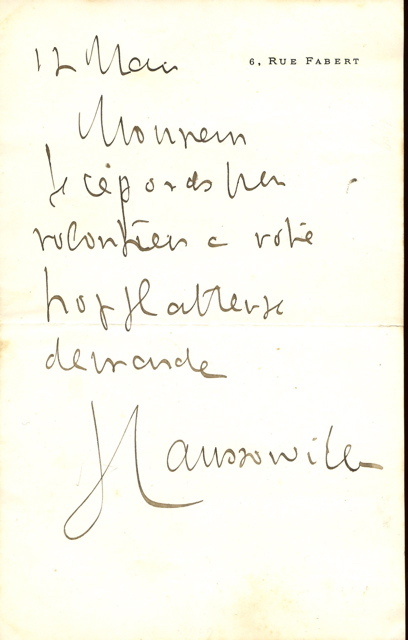
HAUSSONVILLE Comte d’
1843 - 1924. Écrivain et homme politique. Représentant en 1891 le comte de Paris auprès des comités monarchiques. Académie française en 1888. L.A.S.
Billet en réponse à une demande d’autographe.
Referentie van de boekhandelaar : 4734
|
|
|
Haussonville, Paul-Gabriel, comte d', historien, essayiste et homme politique (1809-1884).
Lot d'1 L.A.S. avec enveloppe et 1 P.A.S. [Paris], s. d.
3p½ In-8 et 2p In-12. Courriers adressés à Alfred de Foville concernant des médailles, la lettre à propos de renseignements données par Foville, le carton à propos de la vente de deux médailles par Haussonville. - Ancienne collection de Foville.

|
|
|
Haussonville, Paul-Gabriel, comte d', historien, essayiste et homme politique (1809-1884).
Lot de 9 Courriers autographes à Paul Thureau-Dangin. [Paris], aucun n'est daté précisément (aucune année).
Il y a cinq L.A.S. in-8, de 1 à 4 pages, 12 pages en tout et quatre P.A.S., cartons in-12 R°/V°, soit 8 pages donc 20 pages de correspondance. Ancienne collection de Foville.

|
|
|
HAUSWIRTH, Charles A (ca 1870s-?)
Typed Note Signed
Copper boom town Butte Montana notorious as a lawless town filled with bars and brothels began to turn around when this noted Butte merchant a progressive Republican was elected mayor in 1935 until 1941 and proclaimed in his inaugural address "It is doubtful if any city is in a more deplorable physical and financial condition" and set about to clean up the town. TNS 1p 8½" X 11" Butte MT 1940 August 2. Addressed to Samuel Tuzzo. Very good. On "City of Butte" letterhead noting "Office of Mayor" Hauswirth writes "It is with pleasure that I add my name to your list of signatures." He signs in full in bold green ink. Fun bit of unusual Old West history. unknown
Referentie van de boekhandelaar : 31968

|
|
|
Hautecoeur, Louis
Histoire de l'art De la magie à la religion ; de la réalité à la beauté ; de la nature a l'abstraction
1959 Paris Flammarion éditeur 1959 3 forts volumes in8, brochés sous jaquettes, 684 ; 686 ;674p p.illustrées Bon état des ouvrages meme si les, jaquettes sont un peu usées, les trois tomes sont enrichis d'envois autographes (signés par Louis Hautecoeur)
Referentie van de boekhandelaar : 12787
|
|
|
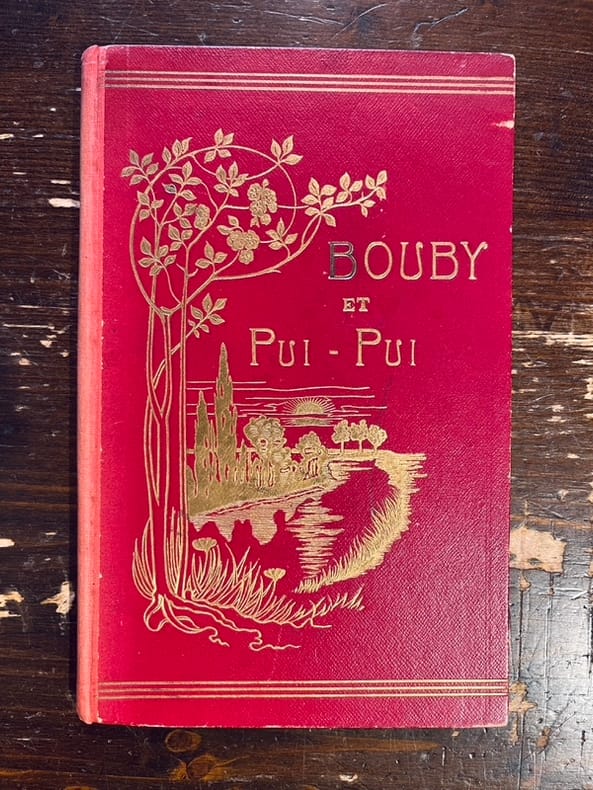
HAUTESOURCE Louise pseudonyme de Rosine TISSOT-CERUTTI:
Bouby et Pui-Pui. Histoire pour les enfants.
Genève, Librairie Georg & Co, 1899. In-8 de 82-[4] pages, cartonnage d'éditeur illustré, dos de percaline muette.
Referentie van de boekhandelaar : 21994
|
|
|
Hauth, Emil van, Maler (1899-1974)
2 eigenh. Briefe mit U.
o.J. München, 22. IV. 1964 und 25. IX. 1966, Fol. Zus. 2 Seiten.
Referentie van de boekhandelaar : 59660
|
|
|
Hautsch, Hugo, Historiker (1895-1972).
2 Dankeskarten mit eh. U. Wien, [Februar 1955].
2 SS. Qu.-8vo und 120 x 70 mm. Mit 2 eh. beschr. Kuverts. Dankt Josef Wesely für Geburtstagswünsche.
|
|
|
HAVARD, Henry.
La Hollande pittoresque. Le coeur du pays. Voyage dans la hollande méridionale, la Zélande et le Brabant. Illustré d'après les croquis de M. le baron de Constant- Rebecque et de l'auteur.
Paris, Plon et Cie, 1878 ; grand in-18°, demi-basane bleue nuit de l' époque, dos lise orné de filets dorés et à froid et pointillés dorés en place des nerfs, auteur et titre dorés; (6), 434, ( 1)pp et 8 gravures sur bois hors texte et 1 carte dépliante.Reliure frottée aux coiffes et charnières; piqûres ou taches jaunes.
Referentie van de boekhandelaar : c6847
|
|
|
HAVEL, Vaclav - CABALLERO, CARUNCHO, etc.
LA TENTACIÓN - Madrid 1990 - Muy ilustrado - Serigrafías numeradas y firmadas
Madrid, Edit. Rowohlt, 1990. Edición de 221 ejemplares. El nuestro Núm. 20 de la edición de 175 ejemplares numerados y firmados por los artistas. Ilustraciones serigráficas y con protector transparente de José Caballero, Luis Caruncho, Alvaro Delgado, Carlos Evangelista, J.L. Fajardo, José M. Iglesias, Agueda de la Pisa y Salvador Victoria, numeradas y firmadas. 163p. 4º apaisado. Símil piel editorial algo rozada. Interior en perfecto estado. Buen ejemplar.
|
|
|
Havel, Václav, Schriftsteller und Politiker (1936-2012).
Portraitphotographie mit eigenh. U. O. O. u. D.
130:183 mm. Hüftstück en face in S/W.

|
|
|
Havemann, Gustav, Violinist, Leiter der Reichsmusikkammer (1882-1960)
Eigenh. Briefkarte mit U.
o.J. Ohne Ort (Darmstadt), 26. II. 1908, Qu.-Kl.-8°. 2 Seiten. Kartonblatt. Abgerundete Ecken..
Referentie van de boekhandelaar : 48818
|
|
|
HAVEMYER, William F (1804-74)
Autograph Letter Signed
This sugar refining mogul served as Democratic mayor of New York City 1845 1848; elected reform mayor in 1872 after helping uncover the "Tweed Ring." ALS 1p 7 3/4" X 9 3/4" New York NY 1845 August 5. Addressed to Cornelius W. Lawrence 1791-1861 collector of customs at the port of New York. Fine. Binding traces along left edge. Letter of recommendation for Jacob Arculasius "the son of one of our oldest and most respectable citizens." Integral address leaf in Havemyer's hand. Scarce. unknown
Referentie van de boekhandelaar : 15404

|
|
|
Haverkamp, Wilhelm, German sculptor (1864-1929).
Autograph signature. Friedenau-Berlin, 4. I. 1910.
Oblong 8vo (postcard). 1 page. Inscribed to the German dermatologist Alwin Scharlau. - Awarded the Rome Prize of the Prussian Academy of Arts in 1890, Haverkamp spent two years in Italy where he created several of his most popular works, including "Knabengruppe" and "Bocksprung", before returning to Berlin, where he won several awards in the following years and became a teacher at the Kunstgewerbemuseum in 1901. - Small ink spots and creases; postmark on verso showing through. Self-addressed by the collector on the reverse. The Mecklenburg physician Scharlau (b. 1888) assembled a collection of artists' autographs by personal application.
|
|
|
Haverman, Hendrik Johann, Dutch painter and lithographer (1857-1928).
Autograph quotation signed. The Hague, 1. XI. 1917.
Oblong 8vo (postcard). 1 page. Inscribed to the German dermatologist Alwin Scharlau: "Es wird mich sehr erfreuen Ihr Ansuch[en] einzuwilligen. In vorzuglichster [!] Hochachtung ganz ergebenst [...]". - Studying in Amsterdam and Brussels, Haverman specialized in portraiture, took study trips to France, Italy and Spain, and won several awards at exhibtions between 1879 and 1903. - A few small creases. Self-addressed by the collector on the reverse. The Mecklenburg physician Scharlau (b. 1888) assembled a collection of artists' autographs by personal application.
|
|
|
HAVET (Mireille, de Soyecourt).
Arlequin. Image de Printemps. Récit d’Adieux. Dialogue. Narcisse (épopée). 5 poèmes tapuscrits. 1919-1921.
44 feuillets, format in-4. Sans date (1919-1921).Ensemble de 5 longs poèmes de la jeune Mireille Havet (1898-1932) en grande partie inédits. Promise à tous les succès dans les lettres, et soutenue par ses amis Colette, Cocteau, Paul Fort, Natalie Clifford-Barney, et l’entourage des salons mondains, ainsi que celui des premiers surréalistes, Mireille Havet avait été accueillie dans Les Soirées de Paris et qualifiée de manière élogieuse par Apollinaire comme « sa petite poyetesse ». Cette suite de poèmes est tapuscrite, avec quelques rares corrections de coquilles, dans un texte suivant une composition soignée. — Arlequin. S. d. (mai). 8 feuillets avec d’importantes variantes sur le texte qui sera publié dans les Écrits nouveaux de juin 1922. Il s’agit du poème le plus connu de Mireille Havet, inspiré de la trame de son roman autobiographique, Carnaval. — Image de Printemps. S. d. 4 ff. — Récit d’Adieux. S. d. 6 ff. — Dialogue. S. d. (mai). 7 ff. — Narcisse (épopée). 1919-1921. 19 ff.
Referentie van de boekhandelaar : 21111
|
|
|
HAVET (Mireille, de Soyecourt).
Conte. Manuscrit autographe. à Marcelle Garros.
22 p. in-4 (la dernière effrangée en bordure sans atteinte au texte). St-Raphaël en Provence, commencé le mardi 7 septembre, terminé le mercredi 8 septembre (circa 1921). Nombreuses ratures et corrections. Les manuscrits de Mireille Havet sont d’une grande rareté, malgré l’ampleur de son œuvre découverte récemment (son Journal en cours de publication aux éditions Claire Paulhan comporte déjà cinq volumes), la plupart de ses papiers ayant disparu. Une partie seulement fut redécouverte au milieu des années 1990 dans les archives de Ludmila Savitzky, légataire de Mireille Havet, et déposée dans une collection publique. Conte très probablement inédit dédié à son amie Marcelle Garros, veuve de l’aviateur Roland Garros mort en 1918. C’est Jean Cocteau qui lui présentera Mireille Havet ; Marcelle Garros deviendra un temps son amante et l’initiera à l’opium, tout en la soutenant et l’encourageant dans sa création littéraire. Récit envoûtant et plein de sensualité, il évoque les soirées dans une fumerie d’opium avec tout son cérémonial et ses accessoires, entremêlé à une histoire d’amour saphique ressassée sans fin… (…) Vos amis aimaient votre maison, votre vie, votre beauté régulière qui dédaignait le luxe de la ville couchée dans la lumière et d’où vous êtes venue légère pour quelques saisons (…). Pour cette demeure silencieuse ou vous avez réussi l’atmosphère de conte, un songe aux yeux ouverts entre l’esprit et le corps docile d’une amie (…). Le récit se termine ainsi : Madame terminons ce mensonge je ne connais pas votre maison j ’ignore même si comme le dit la légende vous y habitez seule ou avec une amie vous savez mieux que moi que je n’y entrerai jamais et qu’il n’y a pas de terrasse. Tout ceci est une histoire. J ’ai rêvé devant une façade close aux livres que j ’aime… Et au verso de cette dernière page, cet envoi : Pour toi Marcelle, que j ’ai écrit cette histoire [que] tu m’as toi-même répétée, pour te distraire. Cette maison, nous l’avons vue hier en nous promenant. Tu m’as raconté ce qu’on disait autrefois sur la propriétaire mais tu sais bien que j ’ignore comme toi jusqu’au nom de cette femme.
Referentie van de boekhandelaar : 21112
|
|
|
HAWAD - CLAUDOT (Hélène) -
Testament nomade -
traduction du touareg et adaptation française de Hawad et Hélène Claudot - La Bouilladise : Edition Amara, 1989 - illustré de calligraphies de Hawad dans et hors texte en noir - deuxième édition avec un envoi autographe signé de l'auteur en touareg - bon état (sinon couverture légèrement frotté à la pliure du dos) -
Referentie van de boekhandelaar : 41437

|
|
|
Hawel, Rudolf, Schriftsteller (1860-1923)
Eigenh. in Bleistift beschriftete Porträtpostkarte.
o.J. Linz, 13. XII. 1905, 1 Seite. Mit Adresse.
Referentie van de boekhandelaar : 43436
|
|
|
Hawel, Rudolf, Schriftsteller (1860-1923).
2 eigenh. Briefe mit U. Wien, [1901] und 24.XI. 1903.
Zusammen 4½ SS. auf Doppelblättern. 8vo. Beide Briefe an einen Freund: “Die Streitaxt kann ich nicht begraben, da ich sie bereits zum alten Eisen geworfen habe [...] Direktor Gettke führt schon Ende Februar ‘Mutter Sorge’ auf und zwar mit Thaller und der Niese. Der 4. Akt gefällt ihm ganz außerordentlich. Das Stück wird auch ganz anders aussehen, als es bis jetzt in [se]iner verstümmelten Form ausgesehen hat [...]” (undat. Brief, vermutl. 1901). - Ernst Gettke (1841-1912) hatte von 1897-1907 die Leitung des Raimundtheaters in Wien inne; der Sänger und Schauspieler Willy Thaller (1854-1941) wurde nach einer abwechslungsreichen Laufbahn, die den gebürtigen Grazer u. a. in zahlreiche amerikanische Städte sowie nach Prag, Budapest und anderswohin führte, 1924 Ensemblemitglied des Wiener Burgtheaters; die Volksschauspielerin Hansi Niese (1875-1934), war seit 1900 am Theater in der Josefstadt engagiert. - Der zweite Brief betrifft die Aufführung von Hawels Komödie ‘Die Politiker’: “Betrachte es als meine Pflicht, Dich über den Stand der uns beide berührenden Angelegenheiten in Kenntnis zu setzen. Die ‘Politiker’ sind seit 14 Tagen ohne besonderen Schaden genommen zu haben, aus den Krallen der Censur entronnen. Die e[r]ste Aufführung erfolgt in der ersten Jännerwoche und zwar aus Rücksicht für [!] den großen Erfolg der ‘Liebesfreuden’ so spät [...]” (Br. v. 24.XI. 1903). - Der gebürtige Wiener Rudolf Hawel, Träger des Bauernfeld- (für ‘Mutter Sorge’) und des Raimundpreises (für ‘Die Politiker’) trat nach 1900 mit zahlreichen häufig und gern aufgeführten Volksstücken an die Öffentlichkeit. Vgl. Kosch II, 865f., Giebisch-G. 143, Öst. Lex. I, 482 und Czeike III, 99. - Beide Briefe im linken Rand gelocht (unbedeutender Buchstabenverlust), der undatierte Br. zudem im Längsfalz etwas eingerissen.
|
|
|
Hawel, Rudolf, Schriftsteller (1860-1923).
Albumblatt mit eigenh. U. O. O. u. D.
1 S. Qu.-schmal8vo. Der gebürtige Wiener Rudolf Hawel, Träger des Bauernfeld- (für ‘Mutter Sorge’) und des Raimundpreises (für ‘Die Politiker’) trat nach 1900 mit zahlreichen häufig und gern aufgeführten Volksstücken an die Öffentlichkeit.
|
|
|
Hawel, Rudolf, Schriftsteller (1860-1923).
Eigenh. Albumblatt mit U. O. O. u. D.
1 S. Qu.-kl.-8vo. "Jung is' halt allweil jung! (Mutter Sorge, II. Akt)". - Der gebürtige Wiener Rudolf Hawel, Träger des Bauernfeld- (für "Mutter Sorge") und des Raimundpreises (für "Die Politiker") trat nach 1900 mit zahlreichen häufig und gern aufgeführten Volksstücken an die Öffentlichkeit.

|
|
|
Hawel, Rudolf, Schriftsteller (1860-1923).
Eigenh. Albumblatt mit U. Wien, 27. XI. 1909.
1 S. 4to. "Die Poesie | Ich wohn in einem dunklen Haus, | Geschlossen sind die Fenster | Und drinnen spukt in Nacht und Graus Unheimlich wirrer, toller Braus, | Die wilden Gedankengespenster. | Da kommt mein stilles Lied so sacht, | Die Laden aufzuzschließen, | Daß sich die holde Frühlingspracht | Blühend und funkelnd in die Nacht | Des Herzens kann ergießen". - Der gebürtige Wiener Rudolf Hawel, Träger des Bauernfeld- (für "Mutter Sorge") und des Raimundpreises (für "Die Politiker") trat nach 1900 mit zahlreichen häufig und gern aufgeführten Volksstücken an die Öffentlichkeit. - Stärkere Faltspur im Mittelfalz.

|
|
|
Hawking, Stephen / Rocek, Martin (eds.).
Superspace and Supergravity: Proceedings of the Nuffield Workshop, Cambridge June 16-July 12, 1980. Cambridge, Cambridge University Press, 1981.
8vo (226 x 152 mm). Publisher's maroon cloth, lettered in silver on spine, original pictorial dustjacket. Author's presentation copy, inscribed on the title page in Hawking's own hand. This is a collection of densely mathematical papers given at a workshop on supergravity organized by Hawking. The dustjacket reproduces a blackboard covered with doodles by Martin Rocek and other attendees at the Nuffield Workshop, including a caricature of Hawking himself: the blackboard itself remained in Hawking's office in Cambridge until his death. A fine copy of the first edition. - Provenance: authorial inscription on title "Love from Stephen x x x"; Judy Fella (Hawking's first secretary and later PA and nursing co-ordinator: Fella typed up some of the manuscript for the work, and is depicted, as "one of the Fella's", in the cover artwork).
|
|
|
Hawking, Stephen, theoretical physicist (1942-2018).
A Brief History of Time. From the Big Bang to Black Holes. New York, Bantam Books, 1988.
8vo (230 x 153mm). Text illustrations. Publisher's black quarter cloth, blue pictorial dustjacket. First American edition with authorial thumbprint of Hawking's bestselling science classic. A fine copy, 'signed' with an authorial thumbprint on front free endpaper. - Provenance: Judy Fella (Hawking's first secretary, and later PA and nursing coordinator: Fella worked with Hawking on the first draft of "A Brief History of Time").
|
|
|
Hawking, Stephen, theoretical physicist (1942-2018).
Typed letter signed ("Stephen") to Charles W. Misner. Cambridge, 10. XI. 1970.
4to. (197:244 mm). 1 page. On headed "air letter" paper. One of Hawking’s students, Gary Gibbons, is to attend the meeting of the American Physical Society in New Orleans from 23-25 November, "where he will report on the British work on the design and construction of gravitational wave detectors. We think that, without the use of liquid helium, we can improve the sensitivity by a factor of 100. The first of these detectors should be operating before the end of the year, and the second one at Reading should follow soon after". Hawking hopes that Gary might stay on after the New Orleans meeting to attend the relativistic astrophysics conference in Austin, with a visit to the University of Maryland in between, and asks for Misner’s help in organising this visit: [Joseph] Weber will be too busy to show Gibbons around, but Hawking notes that Gary should really see Misner and [Dieter] Brill: "he is primarily a theoretician and is interested in the problem of how much gravitational radiation would be emitted by a collapsing object". Hawking also announces the birth of a little girl, "Catherine Lucy, though we will probably call her Lucy", born a little plumper than Robert, and very well behaved. - In 2016, over 45 years after Stephen Hawking’s hopeful mention in the present letter of the gravitational wave detectors being built in England - and one hundred years after Albert Einstein first predicted the existence of gravitational waves - scientists would finally have proof of these elusive ripples in space-time: the unmistakeable "ringing" as two black holes collides was heard at the Advanced Laser Interferometer Gravitational-Wave Observatory (LIGO) on 11 February 2016. When asked for comment, Hawking said that the discovery would "revolutionise" astronomy, noting also that it had proved his calculations of 1970 to be correct: "The observed properties of this system are consistent with predictions about black holes that I made in 1970 here in Cambridge". Hawking and his student Gary Gibbons would go on to collaborate in their research, lending their names to the "Gibbons-Hawking effect", "Gibbons-Hawking space", and the "Gibbons-Hawking ansatz". - Provenance: Charles W. Misner.
|
|
|
Hawking, Stephen, theoretical physicist (1942-2018).
Typed letter signed (‘Stephen’) to Charles Misner. Cambridge, 21. XI. 1967.
4to. (203:254 mm). 1 page. On headed notepaper. Hawking encloses an improved version of a paper co-authored with George Ellis (the work, not present here, was ‘The Cosmic Black-Body Radiation and the Existence of Singularities in Our Universe’, The Astrophysical Journal, Vol. 152 (April 1968), p. 25], noting that the ‘calculations of the convergence condition have been redrawn’. Hawking enjoyed his visit to Maryland, which prompted some ideas about Misner incompleteness that he intends to put into a paper when he has time. He continues: ‘I heard Stan Deser outline his proof that mass is positive definite. He claims that a function whose only critical value is zero and which has a local minimum there is necessarily positive elsewhere. It seems to me that there are counter examples to this in finite dimensions – not to speak of the infinite dimensions case’. A reminder about payment for his last week at Maryland and travel expenses ends the letter, Hawking professing himself embarrassed, but mentioning it in case the cheque might be missing in the post. - Stephen Hawking first met the American physicist Charles W. Misner during the latter’s 1966-67 visit to Cambridge at the invitation of Hawking’s postgraduate supervisor Dennis Sciama; the two became close, and Hawking visited Misner at his own institution, the University of Maryland, at the end of 1967. Hawking’s work on singularity theorems, which he first published in his 1965 doctoral thesis, overlapped with the research Misner was undertaking on geodesical incompleteness, a notion at the centre of the concepts Hawking was developing with Roger Penrose (the ‘Penrose-Hawking singularity theorems’). Here, Hawking seemingly refers to a proof that another of their colleagues in the field, Stanley Deser, would publish the following year in the Physical Review Letters, in a paper entitled ‘Positive-Definiteness of Gravitational Field Energy’. - Provenance: Charles W. Misner.
|
|
|
Hawkins, Sir Anthony Hope, English novelist and playwright (1863-1933).
Autograph lettercard signed ("AnthonyHHawkins"). [London], 24. IV. 1897.
Oblong small 8vo. 1 p. To C. A. Reiss, apologizes for not being able to attend the Balliol dinner.
|
|
|
HAWTHORNE (Nathaniel) -
La Fille de Rappaccini et autres contes -
traduit de l'américain par Henri Parisot - Paris : Flammarion (Collection "L'Age d'Or"), 1972 - un volume in-8 (14x20cm) broché sous couverture illustrée en couleurs (dessin de Max Ernst), 142 pages - édition originale avec un envoi autographe signé de Henri Parisot adressé à Victor-Henri Debidour, critique au Bulletin des lettres -
Referentie van de boekhandelaar : 39458

|
|
|
HAWTHORNE Nathaniel
L'Enterrement de Roger Malvin et autres contes étranges
Paris Flammarion - Collection "L'Age d'or". 1977 In-8 Broché Edition originale
Referentie van de boekhandelaar : 014203
|
|
|

 De zoekresultaten per email ontvangen
 Zoekresultaten downloaden als PDF
 RSS feed
 Permanente link


