|
|
|
Jansen, Cornelius, theologian and bishop of Ypres (1585-1638).
Autograph letter (draft). Leuven, 4 Oct. 1635.
Folio. 1¾ pp. Unpublished letter to the jurist Gérard de Courselle (Corselius), regarding a controversy at the Leuven "Collegium Baianum": "[...] Collegium Baianum mihi caro erit quam maxime. Sed vereor ut E. D. Mercerus non permittat. Nam quamvis Facultates S. Theol. et V. Juris perspicuum ius sibi competere putent ac dicant, perstat tamen immobilis. Egi cum ipso diu hesterna die, ut saltem rem istam, arbitris committi sineret Lovanii, Bruxellae, Mechliniae; nec scio an aliquid profecerim. Consilium enim ab advocato se petiturum afferebat [...] Agam quicquid potuero, ut Collegio bene provideatur [...]". - This letter was hitherto not traceable, but was mentioned in a letter that Jansen wrote to Corselius on the same day (cf. Orcibal no. 205). Extremely rare. - Upper and lower edges untrimmed; browned and spotty at the right edge, otherwise in good condition. Not in: Jean Orcibal, Correspondance de Jansénius. Louvain und Paris, Bureaux de la revue und Librairie philosophique J. Vrin, 1947 (= Les origines du Jansénisme 1 = Bibl. de la Revue d'Histoire eccl., fasc. 25).

|
|
|
Janssen, Horst (1929-1995)
Eigenh. Brief mit Selbstkarikatur. Handzeichnung (10 x 17,5 cm) und Text in schwarzem Kugelschreiber, datiert 17.12.67.
Hamburg, 1967. Papierbogen 29,7 x 21 cm. Unter Feinkarton-Passepartout.
Riferimento per il libraio : 88032

|
|
|
Janssen, Horst, Grafiker (1929-1995)
Gedrucktes Leporello mit eigenh. Bleistiftsignatur.
o.J. Ohne Ort (Hamburg, Hans Christians, 1968), Ca. 13,5 x 13 cm. 5 Seiten. Leporello.
Riferimento per il libraio : 52718
|
|
|
Janssen, Horst, Zeichner und Graphiker (1929-1995)
Eigenh. Kunstpostkarte mit U. (Paraphe).
o.J. Hamburg, 18. IX. 1987, 1 Seite. Mit Adresse.
Riferimento per il libraio : 51291
|
|
|
Janssen, Horst, Zeichner und Graphiker (1929-1995)
Eigenh. Kunstpostkarte mit U. (Paraphe).
o.J. Hamburg, 11. VIII. 1987, 1 Seite. Mit Adresse.
Riferimento per il libraio : 51292
|
|
|
Janssen, Johannes, katholischer Priester und Historiker (1829-1891).
2 eigenh. Briefe mit U. und eh. Briefkarte mit U. Frankfurt, 1880-1886.
Zus. 4¼ SS. auf 2 Doppelbll. und einem Einzelblatt. 8vo und qu.-12mo. An den Bruder seines verstorbenen Freundes, dessen Gedichte er posthum veröffentlichen will: "Hochverehrter Herr, gestern habe ich die sehr schöne Photographie nach dem Steinle'schen Blatte, welche Sie aus dem Nachlaße Ihres sel. Bruders mir gütigst zum Andenken auswählten, richtig erhalten. Ich spreche Ihnen dafür meinen herzlichsten Dank aus [...] Kommen Sie vielleicht im Sommer in hiesige Gegend? Wie viel Stoff zum Gespräche würde uns der selige Bruder geben. Ich habe von ihm noch zwei ungedruckte Gedichte an mich [...] Auf den Wunsch mehrerer Freunde [...] will ich sie drucken lassen und werde mir erlauben Ihnen davon ein Exemplar zu schicken [...]" (18. II. 1880). - An einen Historiker mit Dank für Material zu seinem Hauptwerk, der achtbändigen "Geschichte des deutschen Volkes seit dem Ausgang des Mittelalters" (1878-94): "Hochverehrter Herr Rath! mit herzlichstem Danke sende ich Ihnen beifolgend das mir gütigst geliehene Werk zurück, aus welchem ich manches werthvolle Material für den vierten Band der Geschichte geschöpft habe. Ich bitte um Entschuldigung, daß die Rücksendung wegen eines längeren Unwohlseins, an dem ich laborirte, nicht eher erfolgen konnte. Mehrere ehrverletzende Angriffe gegen mein Werk nöthigen mich zu einer Broschüre: 'Zur Verteidigung [...]' wie sehr ich auch sonst jede persönliche Polemik fliehe [...]" (29. V. 1882). - Mit Dank für ein Buch: "Verehrtester! vielen Dank fürs soeben erhaltene Buch. Hofftl. wird unsere nächste persönl. Begegnung nicht eine so kurze sein [...]" (13. V. 1886).
|
|
|
Janssen, Johannes, katholischer Priester und Historiker (1829-1891).
Eigenh. Brief mit U. Frankfurt a. M., 5. XI. 1871.
1 S. auf Doppelblatt. Kl.-8vo. An die [Literarische Anstalt in Frankfurt a. M.]: "Im Namen des Bonner Theolog. Literaturblattes (worin ich diesen Sommer Kriegls 'Bürgerthum' besprochen) frage ich ergebens an, ob Sie d. genannten Bl. [?] ein Recensionsexemplar der eben bei Ihnen erschienenen 'Gesch. v. Frkfurt' von Kriegl zur Verfügung stellen wollen [...]". - Janssens Besprechung von G. L. Kriegls "Deutschem Bürgerthum im Mittelalter" war in der Ausgabe vom 14. August erschienen (Jg. 6, Nr. 17, 1871, Spalten 557-562).
|
|
|
Janssen, Julia, Schauspielerin (1900-1982).
Albumblatt mit eigenh. U. O. O., 11. V. 1932.
½ S. Qu.-8vo. Die Tochter des Komponisten und Musikdirektors Julius Janssen debütierte 1927 am Wiener Burgtheater. Sie war in dem Stummfilm "Die Frau von gestern und morgen" und in dem Spielfilm "Der Himmel auf Erden" (1935) zu sehen.
|
|
|
Janssen, Julia, Schauspielerin (1900-1982).
Eigenh. Brief mit U. Wien, 5. III. 1941.
1 S. 4to. An Paul (wohl der Schauspieler Paul Pranger): "Durch meinen - ach, zu seltenen - Besuch im Theater, höre ich erst heute von dem grossen Verlust, der Dich betroffen hat. Ich möchte Dir nur sagen, wie ich von Herzen mit Dir fühle […]". - Die Tochter des Komponisten und Musikdirektors Julius Janssen debütierte 1927 am Wiener Burgtheater, dessen Ensemble sie lange Jahre angehören sollte. Im Film war sie nur zweimal, in "Der Himmel auf Erden" (1935) und in "Singende Jugend" (1936) zu sehen.
|
|
|
Janssen, Julia, Schauspielerin (1900-1982).
Eigenh. Portraitpostkarte, Visitkarte mit mehreren eh. Zeilen und U. und eh. Billett mit U. O. O. u. D.
Zusammen 3 SS. (Kl.-)8vo. An die Schauspielerin Lili Marberg. - Die Tochter des Komponisten und Musdikdirektors Julius Janssen debütierte 1927 am Wiener Burgtheater, dessen Ensemble sie lange Jahre angehören sollte. Im Film war sie nur zweimal, in "Der Himmerl auf Erden" (1935) und in "Singende Jugend" (1936) zu sehen. - Lili Marberg (1876-1962) gehörte von 1911 bis 1950 dem Wiener Burgtheater an. Seit 1936 auch Ehrenmitglied, spielte sie zunächst in Stücken Wedekinds, Hauptmanns und Ibsens, später vorwiegend Königinnen und mütterliche Frauen und galt weithin als vorzügliche Charakterdarstellerin. Zu ihren Hauptrollen zählten Desdemona, Hedda Gabler und Helena in "Vor Sonnenaufgang". Ihre einzige Filmrolle war die des Fräulein Munk in Walter Reischs "Silhouetten" (1936). - Die Portraitpostkarte mit kl. Ausschnitt, dadurch geringfügiger Textverlust.
|
|
|
Janssen, Karl, German sculptor (1855-1927).
Autograph signature. [Postmark: Bengsdorf, 22 Aug. 1917].
Oblong 8vo (postcard). 1 page. Inscribed to the German dermatologist Alwin Scharlau. - A Neo-Baroque artist, Janssen specialized in tombs, equestrian statues and war memorials, and was commissioned, along with Josef Tüshaus (1851-1901), to produce the sculpture group "Vater Rhein und seine Töchter" for the visit of German Emperor Wilhelm to Düsseldorf in 1884, a work which proved so popular that a more durable version in bronze was created for a city fountain. - A few small creases and ink spots. Self-addressed by the collector on the reverse. The Mecklenburg physician Scharlau (b. 1888) assembled a collection of artists' autographs by personal application.
|
|
|
Jantsch, Gustav, Chemiker (1882-1954).
Ms. Brief mit eigenh. U. Graz, 21. XII. 1952.
½ S. Gr.-8vo. An den Chirurgen und Krebsforscher Leopold Schönbauer mit Grüßen zu Weihnacht und Neujahr. - Sich 1911 mit einer Arbeit "Ueber Doppelnitrate der seltenen Erden" habilitierend, ging Gustav Jantsch 1920 ging er als Privatdozent an die TH Karlsruhe, wurde 1921 Abteilungsleiter und Vorstand der Anorganischen wissenschaftlich-technischen Laboratorien der IG Farbenindustrie Leverkusen und folgte 1924 einem Ruf als o.Prof. der anorganischen Chemie nach Bonn. Seit 1927 wirkte er in gleicher Stellung an der TH Graz. - Leopold Schönbauer (1888-1963) war Begründer der Neurochirurgie in Österreich und errichtete zusammen mit Karl Honey und Julius Tandler die erste Krebsberatungsstelle in Wien; von 1945 bis 61 Direktor des Allgemeinen Krankenhauses und provisorischer Leiter des Instituts für Geschichte der Medizin - dessen "Beiträge" er ab 1948 herausgab -, war Schönbauer zusammen mit dem Psychiater und Neurologen Hans Hoff und dem Internisten Karl Fellinger an den Planungen zum Neubau des Allgemeinen Krankenhauses beteiligt. - Auf Briefpapier mit gedr. Briefkopf; im linken Rand gelocht (keine Textberührung).
|
|
|
Jantsch, Heinrich, Schauspieler, Theaterdirektor und Bühnenautor (1845-1899).
Kabinettphotographie mit eigenh. Widmung und U. verso. Halle a. S., 4. IX. 1887.
144:95 mm auf etwas größerem Untersatzkarton. Halbfigürliches Portrait im Profil aus dem Hause M. Heinzelmann, Halle a. S. - Jantsch war als Stenograph im öffentlichen Dienst tätig, gab das "Stenographische Wochenblatt" heraus und entschied sich 1867 für eine Bühnenkarriere. Nach abgeschlossener Ausbildung am Sulkowskitheater spielte er dann an verschiedenen österreichischen und deutschen Provinztheatern, ehe er nach Halle a. S., ans Deutsche Theater in Budapest und ans Mainzer Stadttheater engagiert wurde. 1875 übernahm er das Victoria-Theater in Frankfurt a. M. und leitete von 1882 bis 86 das Stadttheater von Danzig. 1892 erwarb er das Fürsttheater im Wiener Prater und führte es als Wiener Volkstheater im k.k. Prater (seit 1896 Jantschtheater). Als Bühnenautor schrieb er mehrere Volksstücke, darunter "Der Herrgottsbruder" (1876).
|
|
|
JANVIER (Ludovic).
Brèves d'amour. Nouvelles.
Paris Gallimard 1993 1 vol. broché in-8, broché, 188 pp. Edition originale avec un envoi de l'auteur au critique littéraire Jean-Pierre Richard. Bande éditeur conservée. Excellent état.
Riferimento per il libraio : 97754
|
|
|
JANVIER (Ludovic).
Brèves d'amour. Nouvelles.
Paris Gallimard 1993 1 vol. broché in-8, broché, 188 pp. Edition originale avec un envoi de l'auteur au critique littéraire Jean-Pierre Richard. Bande éditeur conservée. Excellent état.
Riferimento per il libraio : 97754
|
|
|
Janvier, Antide, noted clock-maker (1751-1835).
4 autograph letters signed. N. p., 1810 to 1823.
(Small) 4to. Altogether 5¾ pp. on 7 ff. 2 letters with autogr. address. I) 10 January 1810, to E. Hutin, rue Neuve St Eustache, 32, sending him a copy of a letter he has received from the Bishop of Strasbourg (Jean Pierre Saurine, 1733-1819) concerning the non-payment of a debt by a third party to Janvier. - II: 21 February 1810, to the same. The affair has a defect; Janvier hopes to avoid a judgement. - III: 6 May 1815, to Jacques René Tenon (1724-1815, surgeon, Member of the Institute), concerning a vacancy in the section 'Mécanique' at the Institut. The sheet has been heavily scored through with a resulting ink-burn (with minor loss), running diagonally across the letter. - IV: 26 October 1823 Claude Pierre Molard (1758-1837, mechanician, member of the Institute) soliciting his support in the forthcoming election of a mechanician to replace A. L. Breguet, deceased. - The four letters presented here are all unknown to biographers of Janvier and cast new light on the circumstances of his bankruptcy in 1810, on his acquaintances and collaborators, and on his efforts to gain admittance to the Institut de France.

|
|
|
Japha, Georg, Komponist und Konzertmeister (1835-1892)
Eigenh. musikalisches Albumblatt mit Widmung und U.
o.J. Köln, 1. 4. 1878, Quer-Fol. 18 x 25 cm. 1 Seite.
Riferimento per il libraio : 56003
|
|
|
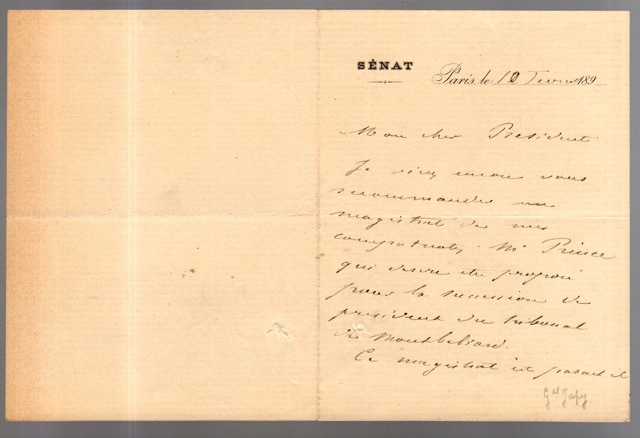
JAPY Général
Lettre autographe signée en date du 10 février 189?, sur papier à en-tête du Sénat. Il demande une intervention en faveur d'un candidat à la présidence du Tribunald eMontbéliard ..; Très bon 1 feuille in-8°
Riferimento per il libraio : 10191
|
|
|
Jaques, Heinrich, Politiker und Jurist (1831-1894).
Eigenh. Brief mit U. O. O., 9. III. 1879.
¾ S. auf Doppelblatt. 8vo. An einen namentlich nicht genannten Kollegen: "Könnte ich Sie heute zu irgendeiner Zeit noch sprechen, wann und wo? [...]". - Jaques war mehrere Jahre lang Leiter des Bankhauses Wertheimsteins Söhne und war hernach seit 1869 als Hof- und Gerichtsadvokat in Wien tätig. Seit 1879 war er Reichsratsabgeordneter der Vereinigten deutschen Linken, trat für die Entschädigung unschuldig Verurteilter sowie für die Schaffung eines Wahlgerichtshofs ein und brachte einschlägige Gesetzesentwürfe ins Parlament. Ferner war Jaques Mitbegründer der Grillparzer-Gesellschaft und der Wiener Handelsakademie sowie Vizepräsident der Wiener Juristen. Jaques, der 1894 freiwillig aus dem Leben schied, veröffentlichte auch zahlreiche einschlägige Schriften über Eisenbahn- und Eisenbahnpolitik, Wuchergesetzgebung, außenpolitische und strafrechtliche Fragen und dgl. mehr. - Auf Briefpapier mit gepr. Initialen.
|
|
|
Jaques, Heinrich, Politiker und Jurist (1831-1894).
Eigenh. Brief mit U. Wien, 18. X. 1870.
1 S. auf Doppelblatt. 8vo. An einen namentlich nicht genannten Hofrat: "Ich sende Ihnen in der Anlage meine Schrift, hoffend, daß Sie ihr freundliche Aufmerksamkeit schenken, vertrauend auf Ihre Sympathie für die Sache, die ich darin vertrete. Was in der Schrift ausgeführt ist, hängt auch zusammen mit dem Gegenstand des Processes, von dem wir gestern sprachen und Sie finden in No. V das Beweisthum angedeutet, bezüglich dessen ich an Ihr Wohlwollen appellirte [...]". - Jaques war mehrere Jahre lang Leiter des Bankhauses Wertheimsteins Söhne und war hernach seit 1869 als Hof- und Gerichtsadvokat in Wien tätig. Seit 1879 war er Reichsratsabgeordneter der Vereinigten deutschen Linken, trat für die Entschädigung unschuldig Verurteilter sowie für die Schaffung eines Wahlgerichtshofs ein und brachte einschlägige Gesetzesentwürfe ins Parlament. Ferner war Jaques Mitbegründer der Grillparzer-Gesellschaft und der Wiener Handelsakademie sowie Vizepräsident der Wiener Juristen. Jaques, der 1894 freiwillig aus dem Leben schied, veröffentlichte auch zahlreiche einschlägige Schriften über Eisenbahn- und Eisenbahnpolitik, Wuchergesetzgebung, außenpolitische und strafrechtliche Fragen und dgl. mehr. - Auf Briefpapier mit gepr. Initialen. - In altem Sammlungsumschlag mit irrtümlicher Identifikation seines Vornameninitials als "G"; ohne die erwähnte Anlage.
|
|
|
Jaray, Hans (Wien 1906-90) und Sylvia Lydi (geb. 1933), orig. Fotografie
Szenenbild mit Hans Jaray und Sylvia Lydi, möglicherweise eine Aufnahme einer Szene aus Molnars "Delia" in den Wiener Kammerspielen 1959/60 unter Jarays Leitung.
Orig.-Fotografie mit eigenh. Widmung. (Wien), April 1960. Ca. 22 x 28 cm.- Auf Karton montiert.
Riferimento per il libraio : 46733
|
|
|
Jarcke, Carl Ernst, dt. Jurist u. politischer Publizist (1801-1852)
2 eigenh. Briefe m. Unterschrift.
Wien, 1840-1846. Zus. 4 S., 8° bzw. Gr.-8°.
Riferimento per il libraio : 36259

|
|
|
Jarcke, Karl Ernst, Jurist und Publizist (1801-1852).
2 eigenh. Briefe mit U. O. O., 6.IV. [18]41 bzw. 17.IV. [18]46.
Zusammen 2 SS. 4to und 8vo. Ein Brief mit Adr. "Dürfte ich Hrn. Hochwohlgeboren große Güte wohl mit der Bitte um Hut und Degen, die Sie mir gütigst versprachen, in Anspruch nehmen? [...]" (Br. v. 6. IV. [18]41). Im Brief an den Historiker Paul Kaltenbaeck (1804-1861) entschuldigt der Jurist sein Fernbleiben, "[ü]bernächste Woche habe ich mehr Zeit [...]". - Nach Abschluß seines Hauptwerks, des ‘Handbuchs des gemeinen deutschen Strafrechts’ (1827-30) und nach Ausbruch der Julirevolution 1830 sich verstärkt der Politik zuwendend, wurde Jarcke 1831 Redakteur des 'Politischen Wochenblatts' und 1832 von Metternich als k. k. Rat und Staatskanzleipublizist in die Wiener Staatskanzlei berufen. “Unter dem Einfluß Carl Ludwig von Hallers in Preußen einer der entschiedensten Vertreter der Restauration geworden, bekämpfte Jarcke in Österreich den Josephinismus und gehörte zu den Verfechtern des Ultramontanismus. 1839 gründete er zusammen mit Joseph von Görres die 'Historisch-Politischen Blätter für das katholische Deutschland' in München, wohin Jarcke nach seiner Beurlaubung infolge der Revolution 1848 zog, kehrte jedoch nach deren Niederschlagung wieder nach Wien zurück" (DBE). Vgl. auch Kosch II, 1140.
|
|
|
JARDEL, Marguerite
Quelques Poèmes [ Livre dédicacé par l'auteur ]
1 vol. in-8 br., s.l.n.d. (circa 1960), s.n., 61 pp. Envoi de l'auteur. Etat très satisfaisant (couv. lég. frotté) pour ce recueil de poésie de Marguerite Jardel (honorée par l'Académie française du prix Juteau-Duvigneaux en 1961 pour Le Chevalier des Cimes). Français

|
|
|
JARDIN (Claudine).
Comme une amie...
Paris Julliard 1984 1 vol. broché in-8, broché, 270 pp. Envoi autographe signé de l'auteur à Caroline et Jean Mauriac. Bon état.
Riferimento per il libraio : 101058
|
|
|
JARDIN (Claudine).
Comme une amie...
Paris Julliard 1984 1 vol. broché in-8, broché, 270 pp. Envoi autographe signé de l'auteur à Caroline et Jean Mauriac. Bon état.
Riferimento per il libraio : 101058
|
|
|
Jardin Alexandre:
Ma mère avait raison.
Grasset, 2017. In-8 broché, couverture imprimée en deux tons.
Riferimento per il libraio : 18085

|
|
|
JARJAVAY (C.).
Au fil de l'eau : quelques vers. Sonnets, rondels, croquis.
Périgueux Impr.-Lithogr. Ronteix 1908 1 vol. broché in-8, broché, 79 pp. Edition originale enrichie d'un envoi autographe signé de l'auteur. Rousseurs à la couverture et petit manque de papier au dos. Sinon exemplaire convenable.
Riferimento per il libraio : 115425
|
|
|
JARJAVAY (C.).
Au fil de l'eau : quelques vers. Sonnets, rondels, croquis.
Périgueux Impr.-Lithogr. Ronteix 1908 1 vol. broché in-8, broché, 79 pp. Edition originale enrichie d'un envoi autographe signé de l'auteur. Rousseurs à la couverture et petit manque de papier au dos. Sinon exemplaire convenable.
Riferimento per il libraio : 115425
|
|
|
Jarl, Otto, Bildhauer (1856-1915).
3 eigenh. Briefe, 2 eh. Postkarten und 2 gedr. Visitkarten mit mehreren eh. Zeilen und U. Wien, 1909 und 1910.
Zusammen 7½ SS. Meist 8vo. Mit einem eh. adr. Kuvert. Beiliegend 2 gedr. Parten zum Tod des Bildhauers und 1 gedr. Dankesbillett der Hinterbliebenen an H. A. Schwer. “Gelägentlich [!] des Besuches des Schwedischen Königs in der Jagdausstellung Eüserte [!] sich der König sehr lobend über meinen Elch im Schwed. Pawillon [!] u. hatte den Wunsch denselben zu besitzen. Am Bahnhof bei der Abfahrt nach München überreichte er mir eigenhändig den Wasaorden I. Kl. für mein Künstlerisches Schaffen [...]” (Br. v. 24. V. 1910). - “Durch Ihre werte Karte in Kenntniss [!] gesetzt das [!] die Gemeinde Wien einen Ehrenpreis für die Hundeausstellung stiften will”, gestattet sich der Bildhauer, die Herren zur Besichtigung seiner Arbeiten in sein Atelier zu laden (Br. v. 3. VI. 1910). - Der in Schweden aufgewachsene, von Björnstjerne Björnson geförderte Bildhauer kam 1880 nach Wien und studierte dort bei Joseph Weitmann und Edmund von Hellmer. Gefördert von seinem späteren Schwiegervater, dem Architekten Friedrich Schmidt, wurde er Portraitplastiker, widmete “sich ausschließlich der Tierbildnerei” und brachte es zu “ausgezeichneten Leistungen auf diesem Gebiet” (Thieme/B. XVIII, 431). - Einige Briefe im Rand gelocht (keine bzw. nur minimale Textberührung). - In altem Sammlungsumschlag.
|
|
|
JARLOT (Gérard).
Un chat qui aboie.
Paris Gallimard 1963 1 vol. broché in-8, broché, non coupé, 464 pp. Edition originale enrichie d'un envoi autographe signé de l'auteur : "Pour Alain Resnais, qui fut, avec Marguerite [Duras], mon premier lecteur, ce Chat qui aboie / J'espère qu'il vous plaira, mais pourquoi on ne se voit jamais ?". Dos un peu jauni avec quelques petites salissures. Complet du prière d'insérer. Journaliste et écrivain, Gérard Jarlot accompagna Marguerite Duras dans son adaptation cinématographique de Moderato Cantabile (1960) et co-signa avec elle deux autres scénarios : Une aussi longue absence (1961) et L'Itinéraire marin (1962, inachevé). Prière d'insérer joint. Dos sali. Exemplaire provenant de la bibliothèque d'Alain Resnais.
Riferimento per il libraio : 112829
|
|
|
JARLOT (Gérard).
Un chat qui aboie.
Paris Gallimard 1963 1 vol. broché in-8, broché, non coupé, 464 pp. Edition originale enrichie d'un envoi autographe signé de l'auteur : "Pour Alain Resnais, qui fut, avec Marguerite [Duras], mon premier lecteur, ce Chat qui aboie / J'espère qu'il vous plaira, mais pourquoi on ne se voit jamais ?". Dos un peu jauni avec quelques petites salissures. Complet du prière d'insérer. Journaliste et écrivain, Gérard Jarlot accompagna Marguerite Duras dans son adaptation cinématographique de Moderato Cantabile (1960) et co-signa avec elle deux autres scénarios : Une aussi longue absence (1961) et L'Itinéraire marin (1962, inachevé). Prière d'insérer joint. Dos sali. Exemplaire provenant de la bibliothèque d'Alain Resnais.
Riferimento per il libraio : 112829
|
|
|
JARLOT (Gérard).
Un mauvais lieu.
Paris Gallimard 1948 1 vol. Broché in-12, broché, non coupé, 195 pp. Edition originale en service de presse avec un envoi de l'auteur à Jean Blanzat. Prière d'insérer conservé. Dos légèrement passé, sinon bon état.
Riferimento per il libraio : 31989
|
|
|
JARLOT (Gérard).
Un mauvais lieu.
Paris Gallimard 1948 1 vol. Broché in-12, broché, non coupé, 195 pp. Edition originale en service de presse avec un envoi de l'auteur à Jean Blanzat. Prière d'insérer conservé. Dos légèrement passé, sinon bon état.
Riferimento per il libraio : 31989
|
|
|
Jarno, Georg, Komponist und Kapellmeister (1868-1920).
Eigenh. Brief mit U. Halle, 29. XI. 1896.
1 S. auf Doppelblatt. Gr.-8vo. An einen namentlich nicht genannten Intendaten: "Nachdem meine Oper 'Die schwarze Kaschka' bei ihren bisherigen Aufführungen in Breslau, Altenburg und nunmehr in Halle laut Ausspruch seitens der Direktionen, der Presse und des Publikums Erfolge errungen hat, wie sie glänzender vielleicht nur die Cavalleria, Bajazzi u. Hänsel u. Gretel erzielte, nehme ich mir die Freiheit Euer Hochwolgeboren zu einer der hiesigen Reprisen höflichst einzuladen [...]". - Mit kleiner Unterstreichung in blauem Farbstift.
|
|
|
Jarno, Georg, Komponist und Kapellmeister (1868-1920).
Eigenh. Postkarte mit U. Breslau, 4. XI. 1906.
1 S. Qu.-8vo. Mit eh. Adresse. An die Exposition der Bühnengenossenschaftszeitung: "Würden Sie die Freundlichkeit haben, Ihr Manuscript mir auf ein[en] Tag anzuvertrauen. Wenn es gut ist will ich gerne mit Ihnen arbeiten resp. es Ihnen abkaufen [...]". - Georg Jarno war 1907 auf Einladung seines Bruders, des Josefstadt-Direktors Josef Jarno, nach Wien gekommen und schrieb gemeinsam mit Bernhard Buchbinder für Josefs Gattin, die Soubrette Hansi Niese, die Operette "Die Försterchristl". Nach deren durchschlagendem Erfolg als freischaffender Komponist leben könnend, schrieb Jarno noch einige andere Operetten, denen allerdings wenig bis kein Erfolg beschieden war. - Etwas angestaubt und abgegriffen und mit Absenderstempel.

|
|
|
Jarno, Josef, Schauspieler, Regisseur und Theaterdirektor (1865-1932).
Eigenh. Manuskript mit U. O. O. u. D., [wohl Wien, November oder Dezember 1911].
1 S. Qu.-8vo. Manuskript einer Tischrede auf die eigene Person, zu der die namentlich nicht genannte Redaktion der "Österreichischen illustrierten Zeitung" aufgefordert hatte: "Wenn ich heute am Sylvesterabend mein Glas erhebe und zu Ehren Josef Jarnos einen Toast ausbringe so möchte ich diesem strebsamen Menschen wünschen, daß ich ihn im kommenden Jahr an einem 'künstlerisch' geleiteten Theater nur als Darsteller antreffe [...]". - Jarno wurde von Josef Lewinsky im Schauspiel unterrichtet, debütierte am Sommertheater in Ischl als Thalmüller-Loisl in Anzengrubers "Pfarrer von Kirchfeld" und wurde nach einem Engagement in Laibach an das Deutsche Schauspielhaus in Budapest und später an das Residenztheater in Berlin verpflichtet, bevor er seit 1895 dem Ensemble des dortigen Deutschen Theaters angehörte. Daneben wirkte er erfolgreich als Regisseur, schrieb mehrfach übersetzte und vielgespielte Schwänke und übernahm 1899 die Leitung des Neuen Theaters in Berlin, die er jedoch noch im selben Jahr zugunsten der Direktion des Theaters in der Josefstadt in Wien aufgab. Diesem bis 1923 vorstehend, kaufte er daneben das ehemalige Jantschtheater im Wiener Prater, das er Lustspieltheater nannte, leitete auch jeweils über mehrere Jahre hinweg das Neue Wiener Stadttheater, die Renaissance-Bühne und das Ischler Kurtheater. Seit 1899 war er mit der Schauspielerin Hansi Jarno verheiratet. - Etwas angestaubt und mit kleinen redaktionellen Notizen in rotem Farbstift.

|
|
|
Jarno, Josef, Schauspieler, Regisseur und Theaterdirektor (1865-1932).
Eigenh. Postkarte mit U. Wien, [2. VI. 1925].
1 S. Qu.-8vo. Die Adresse von anderer Hand. An die Redaktion des "Wiener Salonblattes": "Meine 'Ferien' bestehen darin daß ich die 'Renaissance Bühne' das 'Lustspieltheater' und das 'Kur-Theater' in Bad Ischl leite! - Im September hoffe ich dann ganz 'erholt' zu sein! [...]".
|
|
|
Jarno, Josef, Schauspieler, Regisseur und Theaterdirektor (1865-1932).
Portraitpostkarte mit eigenh. Namenszug auf der Bildseite und eh. Adresse. Wien, 10. oder 11. I. 1911.
1 S. 8vo. Brustbild im ¾-Profil. - Jarno wurde von Josef Lewinsky im Schauspiel unterrichtet, debütierte am Sommertheater in Ischl als Thalmüller-Loisl in Anzengrubers "Pfarrer von Kirchfeld" und wurde nach einem Engagement in Laibach an das Deutsche Schauspielhaus in Budapest und später an das Residenztheater in Berlin verpflichtet, bevor er seit 1895 dem Ensemble des dortigen Deutschen Theaters angehörte. Daneben wirkte er erfolgreich als Regisseur, schrieb mehrfach übersetzte und vielgespielte Schwänke und übernahm 1899 die Leitung des Neuen Theaters in Berlin, die er jedoch noch im selben Jahr zugunsten der Direktion des Theaters in der Josefstadt in Wien aufgab. Diesem bis 1923 vorstehend, kaufte er daneben das ehemalige Jantschtheater im Wiener Prater, das er Lustspieltheater nannte, leitete auch jeweils über mehrere Jahre hinweg das Neue Wiener Stadttheater, die Renaissance-Bühne und das Ischler Kurtheater. Seit 1899 war er mit der Schauspielerin Hansi Jarno verheiratet.
|
|
|
Jaromil JIRES - [Bratislava 1935 - Prague 2001] - Réalisateur et scénariste tchéque -
Lettre Autographe Signée à "Chère Suzanne" - Prague le 30 juillet 1997 -
1 page in12 - (carte) - trés bon état -
Riferimento per il libraio : 35129
|
|
|
Jarosy, Albert, Komponist und Violinist (1883-?)
Eigenh. Albumblatt mit U.
o.J. Mitau, September 1911, 4°. 1 Seite.
Riferimento per il libraio : 38325
|
|
|
JARRY (Alfred).
L'amour absolu, suivi de L'autre Alceste. Préface de Maurice Saillet.
Paris Mercure de France 1952 1 vol. Broché in-16, broché, 123 pp. Première édition collective. Exemplaire sur alfa avec cette justification de la main de Maurice Saillet : "H.C. pour Georges Bataille, M.S.". Couverture détachée, seul le premier plat est conservé (mouillures). A RESTAURER
Riferimento per il libraio : 6447
|
|
|
JARRY (Alfred).
L'amour absolu, suivi de L'autre Alceste. Préface de Maurice Saillet.
Paris Mercure de France 1952 1 vol. Broché in-16, broché, 123 pp. Première édition collective. Exemplaire sur alfa avec cette justification de la main de Maurice Saillet : "H.C. pour Georges Bataille, M.S.". Couverture détachée, seul le premier plat est conservé (mouillures). A RESTAURER
Riferimento per il libraio : 6447
|
|
|
Jaskewitz, Josef Franz, Sänger und Regisseur (1805-1888).
Eigenh. Brief mit U. sowie 8 weiteren U. von Bühnenkünstlern. Wiesbaden, 24. II. 1864.
1 S. auf Doppelblatt. 4to. An den Sänger Ludwig Cramolini (1805-1884): "Wir Unterzeichnete haben in Erfahrung gebracht daß Morgen am 23. d. M. Dein 40 jähriges Jubiläum als Bühnenkünstler in Darmstadt gefeiert wird, und bitten Dich auch unsere herzlichsten Glückwünsche zu diesem seltenen Feste nicht zu verschmähen! Ist es uns auch durch Zeit und Umstände nicht vergönnt persönlich dieser hohen Feier beiwohnen zu können, so wollen wir durch Beisendung unserer Conterfei's Deine Erinnerung an Uns auch erhalten! [...]". - Mit den Unterschriften von Johann Baptist Hagen, H. und M. Bertram, D. Klein, Bodo Borchers, C. Caffieri, H. Carnov und Josef Peretti. - Etwas fleckig und gebräunt und mit Randeinrissen.

|
|
|
Jaskewitz, Josef Franz, Sänger und Regisseur (1805-1888).
Eigenh. Brief mit U. Wiesbaden, 30. VIII. 1842.
1 S. auf Doppelblatt. Gr.-8vo. Mit eh. Adresse (Faltbrief). An den Sänger Ludwig Cramolini (1805-1884): "So eben erfahre ich von unserem Götz daß er Dich schriftlich gebethen, Ihm in seinem Benefiz welches künftigen Montag statt finden soll, mitzuwirken; auch ich bitte Dich recht herzlich wenn Du es möglich machen kannst, Ihm diese Bitte nicht zu versagen, es wird Dir unfehlbar von größtem Nutzen sein indem Dir ganz gewiss die hiesige Intendanz dabei ein convenables Gastspiel anbieten wird. Ich habe dies aus sicherer Quelle und würde mich ungemein freuen einige vergnügte Abende in Deiner Gesellschaft zubringen zu können. Noch einmal refüsiere obigen Bittsteller nicht denn er ist unsere gute alte Haut [...]". - Jaskewitz stammte aus Wien und war ab 1840 in Wiesbaden engagiert (vgl. ÖBL III, 85). - Etwas gebräunt und mit Randläsuren; Bl. 2 mit kleinem Ausriß durch Siegelbruch.

|
|
|
Jasmin, Jacques, Dichter (1798-1864).
Eigenh. Brief mit U. Agen, 2. III. 1863.
3 SS. auf Doppelblatt. 8vo. An zwei Freunde über ein Konzert für Waisenkinder, mit der Bitte, eine Eintrittskarte an Madame Masceau zu übermitteln, bedauernd, dass die Harfenistin die Abendvorstellung nicht beenden könne, doch mit dem Hinweis auf die hervorragende Sängerin, die ohnehin mehr einbringe und für deren Begleitung bereits eine Pianistin gefunden sei, über Magnonnets Freude, ihn begleiten zu dürfen, und über eine kürzlich in der Zeitung "La Gironde" erschienene wohlwollende Besprechung seiner Dichtung: "Je vous prie de remettre vous même, ou d'envoyer ce billet de votre part à Madame Masceau [...] je regrette que la gracieuse harpiste ne vient pas completter cette harmonieuse soirée, mais enfin, le rossignol qui vous reste paiera double [...] il va sans dire qu'on a trouvé une pianiste pour accompagner [...] Magnonnet serait aux anges de m'accompagner pour passer quelques jours avec vous autres, et sa santé revenue pourrait a la rigueur le lui permettre [...] Savez vous que la Gironde a fait un petit compte rendu de ma lecture chez venot, très bien, très chaleureux! [...]".
|
|
|
Jasper, Viktor, Kupferstecher, Maler und Restaurator (1848-1931).
2 eigenh. Briefe mit U. Perchtoldsdorf und Wien, 1912.
Zusammen 3 SS. 4to und 8vo. “Im Verein mit einigen Künstlerkollegen habe ich in Perchtoldsdorf eine Ausstellung gemacht, welche vielleicht bodenständig bezeichnet werden kann. Wir bieten was wir können und sind erfreut darüber, daß sowohl Publikum wie Kritik die Sache beifällig aufgenommen haben [...]” (Br. v. 2. VIII. 1912). - Jasper wurde 1865-80 als Schüler Louis Jacobys an der Wiener Akademie der bildenden Künste zum Kupferstecher ausgebildet und schuf als erste Arbeiten Stiche für archäologische Zeitschriften sowie Titelvignetten und Reproduktionen nach Portraits und Werken alter Meister. Von 1882-96 war er Mitglied der Gesellschaft bildender Künstler Wiens; seit 1887 auch als Restaurator am Hofmuseum tätig, war er 1888-1910 an der Graphischen Lehr- und Versuchsanstalt in Wien. Vgl. Thieme/B. XVIII, 441 und Czeike III, 345. - Im linken Rand gelocht (keine Textberührung). - In altem Sammlungsumschlag.
|
|
|
Jaspers, Karl, German-Swiss psychiatrist and philosopher (1883-1969).
Autograph letter signed. Heidelberg, 4 May 1922.
8vo. 2 pp. With an addendum. Writing as professor of psychology at Heidelberg University, to Alexander Amersdorffer, first secretary of the Prussian Academy of Arts, who had asked him for a professional opinion on the case of the German painter Carl Blechen, who had died deranged in 1840: "Nach dem Material, das Sie mir senden, ist [...] eine Geisteskrankheit und zwar ein sogenannter Krankheitsprocess (im Gegensatz zu einer blossen Veranlagung oder dauernden Constitution) sicher. Aber eine Diagnose würde ich nicht wagen. Um eine Persönlichkeit psychiatrisch aufzufassen, dazu muss man das gesamte Material studieren. Die Diagnose im Sinne der Benennung mit einem Krankheitsnamen ist das letzte und für unsere Einsicht auch vielleicht das wenigst interessante [...] Vor Jahren habe ich einmal [...] mich mit Rethel beschäftigt. Hier konnte man die sichere Diagnose 'Paralyse' gewinnen, zugleich aber feststellen, dass für die Zeit des Kunstschaffens diese Erkrankung völlig gleichgültig ist. Nur in den letzten Bildern liessen sich einige paralytische Störungen [...] leicht sehen. Interessant wird die Fragestellung, wo die Krankheit selbst etwas schafft, das wir positiv werten. Bei Blechen würde ich [...] zunächst die Briefe [...] chronologisch betrachten, um den ersten Beginn der Erkrankung zu finden [...]". - Accompanied by a letter from Jaspers to his friend, the German psychiatrist Johannes Heinrich Schultz in Jena, thanking him for his response to Jaspers's pathography of Strindberg.
|
|
|
Jaspers, Karl, Psychiater und Philosoph (1883-1969).
2 Briefe mit eigenh. U. sowie vereinzelten eh. Korrekturen und Einfügungen im Text. Basel, 1958 und 1962.
Zusammen (4½+2¼ =) 6¾ SS. auf 6 Bll. 4to. Mit einem eh. adr. Kuvert. Beiliegend eine eh. Briefkarte mit U. (O. O. u. D. 1 S. Qu.-8vo). Inhaltsreiche Briefe an den oldenburgischen Kommunalpolitiker Heinz Rathert bzw. dessen Sohn Peter, ehemals Schüler am dortigen Alten Gymnasium, der Jaspers nach seinen "positiven Erinnerungen an das Oldenburger Gymnasium" gefragt hatte. Jaspers, aus einer Oldenburger Bankiersfamilie stammend, hatte am AGO 1901 sein Abitur abgelegt. "Sie sprechen zu mir aus Ihrer Schülermitverwaltung. Meine Frage ist, worauf sich diese Mitarbeit erstrecken dürfte [...] Sie darf sich nicht beziehen auf das, was dem Gehalt nach durch die Autorität der Ueberlieferung und der Lehrer gegeben ist [...] Nur in extremen Fällen gewinnt es Sinn, dass Schüler [...] den untauglichen Lehrer in Anklagezustand versetzen. Mangel an der jeden Augenblick überlegenen Intelligenz dürfte kein Grund sein, sondern allein der Charakter und eine verderbliche Gesinnung. Die Auflehnung ist immer ein revolutionärer Akt, der an sich nicht auf die Schule gehört, sondern in das spätere politische Leben [...] Dafür, dass der rechte Schüler fordern darf, zu verstehen, was er verehren, feiern, erinnern soll, ein Beispiel: Die Verfassung der Bundesrepublik (das Grundgesetz) könnte vielleicht Gegenstand des Unterrichts in der höchsten Klasse sein, wenn der humanistische Schüler anlässlich Thukydides, Plato, Cicero, Montesquieu ein wenig Kunde vom politischen Denken gewonnen hat [...]" (Br. v. 29. VII. 1958). - Der Brief vom 28. II. 1962 im Zusammenhang mit einer seit 1959 projektierten Universitätsgründung in Oldenburg, ein Vorhaben, für das Jaspers große "Schwierigkeiten, die im politischen Kampfe zu überwinden sind" voraussagt: "Hier ist nicht nur die Ueberlegenheit anderer Orte offenbar [...] Die Gemäldegalerie ist zwar der Zahl nach der grössere Teil der alten grossherzöglichen Galerie, der Freund unserer Jugend, im Augusteum. Die besten und kostbarsten Bilder wurden vom Grossherzog verkauft. Man fand sie später wieder in Berlin, Amsterdam und anderswo. Staat und Stadt erklärten damals, zum Ankauf finanziell nicht in der Lage zu sein. Ich erinnere mich noch einer Diskussion mit meinem Onkel: Ihr müßt eben eine Anleihe machen, oder auf anderes verzichten. Diese Bilder sind doch Substanz, mehr wert als Gold und dazu ganz anders wertvoll, weil unersetzlich. Weder Grossherzog noch Staat haben damals gezeigt, dass in Oldenburg der Sinn für das Wesentliche des Geistes nicht zur Geltung kam, ja kaum verstanden wurde in der Not [...] Es kommt alles auf das gegenwärtige und das geistige Vermögen der Zukunft an [...]". Die Universität wurde schließlich 1973 gegründet. - Die beiliegende Briefkarte mit Neujahrsgrüßen ist ebenfalls an Vater oder Sohn Rathert gerichtet. - Die Briefe jeweils mit gestemp. Briefkopf auf Bl. 1 und kleinen Spuren alter Heftung, die Briefkarte mit gedr. Briefkopf.
|
|
|
Jaspers, Karl, Psychiater und Philosoph (1883-1969).
Gedr. Antwortkarte. [Poststempel: Basel, 24. X. 1958].
1 S. Qu.-8vo. Mit hs. adr. Kuvert und Adressstempel. An den Mediziner und Autographensammler Joachim Ruf in Esslingen mit Dank für dessen Interesse und der Entschuldigung, dass Jaspers nicht in der Lage sei, persönlich zu antworten: "Herr Prof. Jaspers kann Ihren Wunsch leider nicht erfüllen, weil er krank ist [...]". - Beiliegend eine gedr. Antwortkarte von Jaspers Gattin Gertrud (1879-1974) mit hs. adr. Kuvert und zwei Zeitungsartikel zum Tod des Philosophen.
|
|
|

 Ricevere i risultati per e-mail
 Scaricare i risultati in PDF
 RSS feed
 Link
Link


