|
|
|
Beauharnais, Théodelinde de, Tochter von Eugène de Beauharnais, Prinzessin Auguste von Bayern (1814-1857).
Brief mit eigenh. U. ("Théodelinde v. Württemberg"). Stuttgart, 23. XII. 1851.
1 S. auf Doppelblatt. 8vo. Mit eh. adress. Kuvert und Siegel. An den Advokaten Keller in München: "Euer Hochwohlgeboren zeige ich den Empfang des Ewiggeldsbriefes von Therese Widmann zu München über 13.000 fl an. Zugleich danke ich für Ihre Bemühung in dieser Sache, und indem ich Sie ersuche mich von Ihren Auslagen in Kenntniß setzen zu wollen, wünsche ich Ihnen ein glückliches neues Jahr und versichere Sie meiner Hochachtung [...] Die Papiere über die oesterreichische Forderung habe ich erhalten doch noch nicht Zeit gefunden zu lesen, dar ich diese Abschriften behalten? Wolle Gott daß etwas gutes herauskomme". - Mit einer Bleistiftnotiz (vermutlich des Empfängers) zur Nachschrift.
|
|
|
BEAULIEU, Armand
[ 3 tirés à part dont deux dédicacés ] La Correspondance de Mersenne et ses problèmes mathématiques - Secret ou Mystification ? Aristarchi de Mundi Systemate. Avec notes de Roberval - Les Réactions des Savants français au début du XVIIe siècle devant l'héliocentrisme de Galilée.
3 tirés à part, 1983-1985 et s.d., pp. 15-37 ; pp. 37-46 ; pp. 373-381 Bon ensemble. Prix du lot Français

|
|
|
BEAUMARCHAIS (Pierre-Augustin Caron de)
Lettre allographe signée
Paris, 4 avril 1781.In-4, 2 pp. (quelques petits froissements et taches).
Referenz des Buchhändlers : 22972

|
|
|
BEAUMARCHAIS (Pierre-Augustin Caron de).
La Folle Journée, ou le Mariage de Figaro, comédie en cinq actes, en prose, par M. de Beaumarchais. Représentée pour la première fois par les Comédiens français ordinaires du Roi, le mardi 27 avril 1784.
[Kehl], De l'Imprimerie de la Société littéraire-typographique ; et se trouve à Paris, chez Ruault, 1785 ; in-8. LI-(1)-199 pp.-(1). 10 planches hors-texte. Maroquin rouge, dos à nerfs richement orné, encadrements de triples filets dorés sur les plats, doubles filets sur les coupes, dentelle dorée sur les chasses, tranches dorées. (Rel. Chambolle-Duru). Bel exemplaire à grande marges, présentant cependant un coin émoussé et des frottements en tête des deux charnières. Conservé sous chemise et étui avec dos de maroquin brun, titre doré.
Referenz des Buchhändlers : 12484

|
|
|
Beaumarchais, Marie-Thérèse-Amélie Caron de, third wife of Pierre Beaumarchais (1751-1816).
Autograph letter. No place or date, [after 1809].
4to. 4 pp. Concerning her husband, the polymath Pierre Beaumarchais (1732-99), whom she describes as "mon mari et mon meilleur ami pendant vingt ans, et je n'ai rien vu en lui que de louable et de généraux: les nombreuses persécutions dont il a été souvent la victime, n'ont jamais eu le pouvoir de troubler la sérénité de son âme [...]". - Beaumarchais lived with his lover, Marie-Thérèse de Willer-Mawlaz, for 12 years before she became his third wife in 1786. Together they had a daughter, Eugénie. Beaumarchais was accused by his enemies of poisoning his first two wives in order to lay claim to their family inheritance. While there was insufficient evidence to support the accusations, whether or not the poisonings took place is still the subject of debate. - Somewhat browned.
|
|
|
Beaumarchais, Pierre-Augustin Caron de, French writer (1732-1799).
Document signed ("Caron de Beaumarchais"). Paris, 1. XI. 1783 [?].
4to. 1 p. Several buyers of an annuity, including Beaumarchais, commit themselves with their signature to the payment of 10,000 livres on January 1, 1787. - Slightly browned due to paper and somewhat spotty; three pinhead-sized holes in the lower left corner.

|
|
|
Beaume (Georges)
En voyage. - Du Rhin à la Bidassoa.
français In-12 de 264 pp.; broché (couverture remontée). En pays annexé. Dans le Jura. Vers la Cerdagne. L'Aveyron et le Tarn. En Gascogne. En Béarn. La Biscaye. Avec 26 gravures dans le texte et 15 planches hors texte (illustrations par la photographie). Exemplaire enrichi d'un envoi autographe signé de l'auteur. Tâches sur la page de titre.
|
|
|
Beaume (Georges) V. Spahn
Pour la vie et pour l'amour.
français Sans date (1907). In-8 de 238 pp.; broché de l'éditeur. Illustrations en couleurs de Spahn. Exemplaire enrichi d'un bel autographe signé de l'auteur. Petites usures au dos.
|
|
|
Beaume, Georges, French writer (1861-1940).
22 autograph letters signed. Together with 3 autograph notes signed and one autograph note on letters of Émile Beaume. Vincennes, Paris, and Pézenas, 1898-1914.
8vo. Together 63 pp. on bifolia. Professional correspondence with the art critic Henry Lapauze and his wife, the poet and novelist Jeanne Loiseau, known as Daniel Loiseau (3 letters). Most letters concern publication projects with Laupauze's magazines "Gaulois" and later "La Renaissance" or requests for such collaborations. Beaume was often struggling to make ends meet and wrote several insistent, if not desperate letters, such as this: "You do not want to push me back into misfortune, you who knows my efforts, my numerous acts. We are of the same earth, the same soil. I appeal to your sympathy, your friendship. If I have to sell my copy that is what I have to do to feed my family [...]" (Vincennes, 3 June 1901, transl.). In a 1902 letter to Jeanne Loiseau, Beaume inquired after publication opportunities in the feminist magazine "Femina", founded that same year: "I do not know whether you have sympathy for me; I hope so and I dare to write to you. The cricket must sing but, above all, it must look for work just like the ant. I would like to propose myself [...] to Femina and I am afraid to burn my wings rushing into blind flight". - Apparently, Loiseau suggested a co-written piece, offending Beaume: "Concerning the collaboration, I am very surprised that you could even suggest the mere idea to me. I have always been singing alone. If another voice were to mingle with mine, I should not enjoy myself anymore [...]" (Paris, 10 Jan. 1902). At one point, Beaume even asked Jeanne Loiseau to join friends in a donation to him and his family: "I have used up all my immediate means of subsistence; I am on the verge of being without resources. Once more I must take recourse to the society that has saved me several times [...]" (Paris, 9 Nov. 1912). Among Beaume's and Lapauze's mutual acquaintances were Jean Bertheroy, Louis Ganderax, Georges Lecomte, and André Theuriet. - Another important part of the correspondence concerns George Beaume's son Émile who studied painting at the École des Beaux-Arts under Fernand Cormon from 1907 onwards. Beaume asked Lapauze to support his son's emerging career by various means, particularly through mentions of his paintings in the salon criticisms of "Gaulois" and jury votes for awards: "Last year, Émile obtained an encouragement prize of 500f. This year, he asks for a prize of 1000f. or a travel stipend. He can obtain the prize particularly if my friends are so kind to lend him their votes and support. I know with what passionate dedication you defend those you love. I am asking you to love my son like myself. You would do us good" (Paris, 18 May 1910). Beaume also mentions that he wrote the same request to Henry Roujon, essayist and secretary of the Académie des Beaux-Arts. In a letter concerning Émile's application for the prestigious Prix de Rome, Beaume even enclosed a list of the jurors, hoping that Lapauze would use his connections to support Émile (Paris, 13 April 1912). Although Émile failed to win the prize in 1912, he was successful later. Two connected letters from June 1912 were written on behalf of the young sculptor Joachim Costa (1888-1971), probably a friend of Émile's. - All letters by Émile Beaume were written to thank Lapauze or to ask him for similar favours as his father did on his behalf; some are in connection with particular letters by Georges Beaume. The only dated letter was written on 5 May 1911; they are all presented to Lapauze with signed notes by Georges Beaume such as: “Bonjour, Lapauze. This child does not know how to do anything. I thank you myself and I am quite content that you were so kind as to talk about this young painter and to give him a bit of the courage that he needs. Please give my warmest regards to Daniel Loiseau". - Well preserved. Minor browning and occasional minor tears or stains.
|
|
|
Beaumont, (Léonce) Élie de, französischer Geologe (1798-1874).
Eigenh. Brief mit U. Paris, 5. IX. 1874.
¾ S. auf Doppelblatt. 8vo. An einen namentlich nicht genannten Adressaten: "Monsieur, J’ai l’honneur de vous adresser ci-joints les accusés de réception des dernières livraisons que j’ai reçus par vos soins des importantes publications de l’Academie des sciences à Vienne. Je vous prie d’être assez bon pour excuser le retard qu’une distraction bien involuntaire a apporté dans cet envoi et d’agréer avec tous mes remerciments l’expression de ma consideration le plus distinguée [...]". - Élie de Beaumont erstellte 1840 die erste geologische Karte von ganz Frankreich. Wesentliche Aspekte seiner Theorie über den Ursprung der Kettengebirge und ihre Ursache waren für den größten Teil des 19. Jahrhunderts maßgeblich. Der Mount Elie de Beaumont in Neuseeland und der Mondkrater Beaumont sind nach ihm benannt. - Auf Briefpapier mit schwarzem Trauerrand.
|
|
|
BEAUMONT, Gustave de
L'Irlande sociale, politique et religieuse (2 Tomes - Complet) [ Livre dédicacé par l'auteur ]
Par Gustave de Beaumont, auteur de "Marie ou l'Esclavage aux Etats-Unis", l'un des auteurs du "Système pénitentiaire aux Etats-Unis", deuxième édition, 2 vol. in-8 reliure de l'époque demi-basane noire, Librairie de Charles Gosselin, Paris, 1839, 2 ff., XX-417 pp. ; 2 ff., 395 pp.
Referenz des Buchhändlers : 65307

|
|
|
BEAUNIER (André).
Eloges.
Paris R. Roger & F. Chernoviz 1909 1 vol. relié in-12, bradel demi-percaline orangée, fleuron doré et pièce de titre au dos, couvertures conservées, 289 + (3) pp. Edition originale avec un envoi autographe signé de l'auteur à Maurice Donnay, avec son ex-libris en couleurs relié en tête. Bon exemplaire.
Referenz des Buchhändlers : 125828

|
|
|
BEAUNIER (André).
Eloges.
Paris R. Roger & F. Chernoviz 1909 1 vol. relié in-12, bradel demi-percaline orangée, fleuron doré et pièce de titre au dos, couvertures conservées, 289 + (3) pp. Edition originale avec un envoi autographe signé de l'auteur à Maurice Donnay, avec son ex-libris en couleurs relié en tête. Bon exemplaire.
Referenz des Buchhändlers : 125828
|
|
|
BEAUNIER (André).
Visages d'hier et d'aujourd'hui.
Paris Plon-Nourrit 1911 1 vol. relié in-12, bradel demi-percaline orangée, fleuron doré et pièce de titre au dos, couvertures conservées, VII + 288 pp. Edition originale avec un envoi autographe signé de l'auteur à Maurice Donnay, avec son ex-libris en couleurs relié en tête. Bon exemplaire.
Referenz des Buchhändlers : 125827

|
|
|
BEAUNIER (André).
Visages d'hier et d'aujourd'hui.
Paris Plon-Nourrit 1911 1 vol. relié in-12, bradel demi-percaline orangée, fleuron doré et pièce de titre au dos, couvertures conservées, VII + 288 pp. Edition originale avec un envoi autographe signé de l'auteur à Maurice Donnay, avec son ex-libris en couleurs relié en tête. Bon exemplaire.
Referenz des Buchhändlers : 125827
|
|
|
Beaunier, André, French novelist and literary critic (1869-1925).
3 autograph letters signed. N. p. [Paris], 1912-1913.
8vo. Altogether 7½ pp. on bifolia. With 1 autograph envelope. Interesting correspondence concerning Beaunier's research on Égide de Lespinasse, Chevalier de Langeac. - In the earliest letter with a poststamp from 20 January 1912, Beaunier asks a journalist at "Le Petit Marseillais" named Thomas to go to the archive of the Académie de Marseille and find out "the date of a competition whose subject must have been a eulogy of Cook, the navigator". Should there be any records of such a competition, Beaunier wants to know if the competition was won by the Chevalier de Langeac or if he was at least among the competitors and if there is a copy of the winning text in the archive. - On 8 February [1912], Beaunier thanks Thomas and asks him to thank the art critic and academy member Charles Vincens (1833-1916) on his behalf, as he had agreed to do the research on Langeac in the archive. He announces to come to Marseille for a conference entitled "Greece and us", on which occasion he would like to meet Vincens to discuss potential archival finds. - Almost a year later, on 15 January 1913, Beaunier writes to a different recipient, most likely Vincens himself, to thank him and inform him that the aforementioned conference in Marseille "has been turned into a brochure of the 'Ligue pour la culture française'" that he attached to the letter. - The rather obscure Chevalier de Langeac (1752-1839) featured in Beaunier's 1919 biography of Joseph Joubert. - The letter from 20 January 1912 on stationery of "Le Figaro". The late later letters on stationery with embossed monogram and address. - Well preserved.

|
|
|
Beaunier, André, writer and critic (1869-1925).
Autograph manuscript signed. No place or date.
8vo. 2½ pp. on 3 ff. With autograph pagination and mounted lithographed title label "Sergots". A satirical character study describing the type of a city sergeant or gendarme (as reflected in the colloquial term "Sergot" used before the War): "Régulier et assidu à travers les rues, les avenues, les boulevards, il erre comme une âme en peine. A quoi rêve-t-il? Ah! qui le sait? [...] Il faut plaindre infiniment le sergot, car il s'ennuie. Son ennui peut aller jusqu'à la plus intense exaspération. Et s'il n'avait pour apaiser ses nerfs souffrants quelques contribuables, de temps en temps, à passer à tabac, il mourrait. Il mourrait en maudissant les circonstances fortuites par lesquelles il s'est vu séparer, un beau jour, de cette humanité normale qui vit humblement, crie: 'Mort aux vaches!' et se fait arrêter [...]" ("Regular and assiduous throughout the streets, avenues, boulevards, he wanders, a troubled soul. Of what is he dreaming? Ah! who knows? [...] The sergot is to be pitied infinitely, for he is bored. His boredom can even take the form of the most intense exasperation. And had he not a few taxpayers to beat up, to ease his ailing nerves from time to time, he would die. He would die cursing the arbitrary circumstances by which he saw himself separated, one fine day, from normal humankind which lives humbly, cries: 'Death to Pigs', and gets arrested [...]"). - Some marginal defects and slight browning.
|
|
|
BEAUSEIGNEUR, A.
Contribution à l'étude de la flore mycologique des Landes. (Basidiomycètes et Ascomycètes) [ Edition originale - Livre dédicacé par l'auteur ]
1 vol. in-8 br., Imprimerie J. Glize, Saint-Sever-sur-Adour, 1926, 238 pp. avec 2 planches hors texte
Referenz des Buchhändlers : 70689

|
|
|
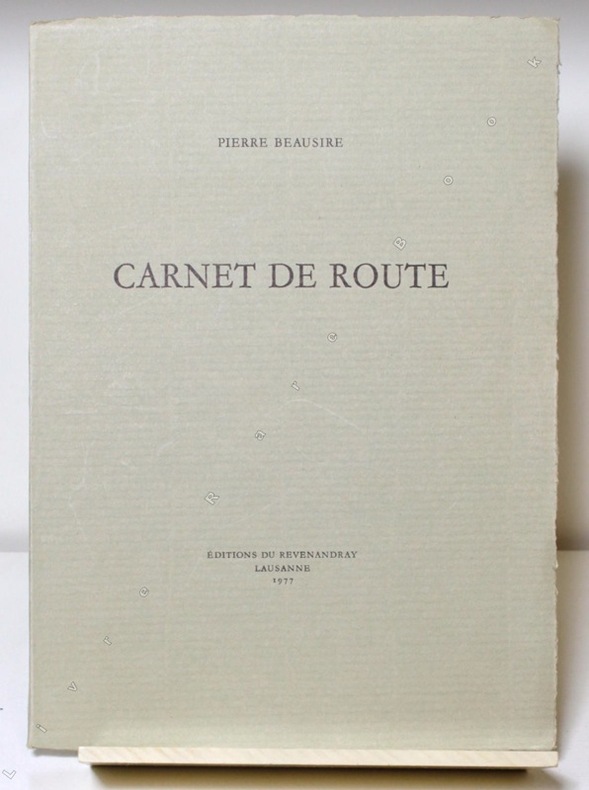
BEAUSIRE Pierre:
Carnet de route.
Lausanne, Editions du Revenandray, 1977. In-4 broché de 56 pages. Bel état, non coupé.
Referenz des Buchhändlers : 4841
|
|
|
BEAUSSANT (Claudine).
La Comtesse de Ségur ou l'enfance de l'art.
Paris Robert Laffont, coll. "Elle était une fois" 1988 1 vol. broché in-8, broché, 316 pp., 4 planches de reproductions en noir. Edition originale avec un envoi autographe signé à Nathalie Sarraute, "ce livre qui lui rappellera peut-être des souvenirs d'enfance".
Referenz des Buchhändlers : 107853
|
|
|
BEAUSSANT (Claudine).
La Comtesse de Ségur ou l'enfance de l'art.
Paris Robert Laffont, coll. "Elle était une fois" 1988 1 vol. broché in-8, broché, 316 pp., 4 planches de reproductions en noir. Edition originale avec un envoi autographe signé à Nathalie Sarraute, "ce livre qui lui rappellera peut-être des souvenirs d'enfance".
Referenz des Buchhändlers : 107853
|
|
|
BEAUSSANT (Philippe).
Le jeu de la pierre et de la foi.
Paris Gallimard, coll. "Le chemin" 1962 1 vol. broché in-12, broché, 164 pp., 31 photos en noir hors-texte. Introduction de Marcel Arland. Edition originale en service de presse avec un envoi de l'auteur "Pour M. Georges Bataille, hommage de l'auteur. Philippe Beaussant". Prière d'insérer joint. Couverture légèrement défraîchie.
Referenz des Buchhändlers : 93328
|
|
|
BEAUSSANT (Philippe).
Le jeu de la pierre et de la foi.
Paris Gallimard, coll. "Le chemin" 1962 1 vol. broché in-12, broché, 164 pp., 31 photos en noir hors-texte. Introduction de Marcel Arland. Edition originale en service de presse avec un envoi de l'auteur "Pour M. Georges Bataille, hommage de l'auteur. Philippe Beaussant". Prière d'insérer joint. Couverture légèrement défraîchie.
Referenz des Buchhändlers : 93328
|
|
|
Beautemps-Beaupré, Charles-François, Hydrograph (1766-1854).
Eigenh. U. O. O. u. D.
Ca. 20:70 mm. Auf Papierträger montiert (ca. 85:210 mm).
|
|
|
BEAUVAIS (André).
Recueil de poésies, nouvelles, comédie.
La Mans Typographie Edmond Monnoyer 1893 1 vol. broché in-8, broché, 146 pp. Edition originale collective ornée d'un portrait de l'auteur en frontispice. Avec un pastiche peu connu de Zola (p. 117). Tirage restreint sur papier chiffon. Envoi de l'auteur. Dos cassé et manques de papier angulaires aux couvertures.
Referenz des Buchhändlers : 49597
|
|
|
BEAUVAIS (André).
Recueil de poésies, nouvelles, comédie.
La Mans Typographie Edmond Monnoyer 1893 1 vol. broché in-8, broché, 146 pp. Edition originale collective ornée d'un portrait de l'auteur en frontispice. Avec un pastiche peu connu de Zola (p. 117). Tirage restreint sur papier chiffon. Envoi de l'auteur. Dos cassé et manques de papier angulaires aux couvertures.
Referenz des Buchhändlers : 49597
|
|
|
BEAUVAIS, Arsène
[ Lot de 3 manuscrits autographes : ] Le Siège de Calais (1347) Opéra en quatre Actes et cinq Tableaux [ On joint : ] Hildegarde. Légende en deux Actes [ On joint : ] Marguerite, Opéra-Comique en un acte. Paroles de Arsène Beauvais [ On joint : ] Le Siècle Typographique. 14e année n° 126 juin-juillet 1904, avec notice consacrée à Arsène Beauvais [ On joint : ] La France Fortifiée, par Arsène Beauvais [ On joint : ] Diplôme de Concours de Poésie des Concours littéraires de la Revue Stéphanoise (Poésie), troisième prix attribué à Arsène Beauvais, le 29 août 1894
Le Siège de Calais (1347) Opéra en quatre Actes et cinq Tableaux, 1 cahier in-4 br., 35 ff. [ On joint : ] Hildegarde. Légende en deux Actes, 11 ff. [ On joint : ] Marguerite, Opéra-Comique en un acte. Paroles de Arsène Beauvais, s.d., 4 ff. [ On joint : ] Le Siècle Typographique. 14e année n° 126 juin-juillet 1904, avec notice consacrée à Arsène Beauvais [ On joint : ] La France Fortifiée, Imprimerie Typographique A. Beauvais, Melun, 1886, 31 pp. [ On joint : ] Diplôme de Concours de Poésie des Concours littéraires de la Revue Stéphanoise (Poésie), troisième prix attribué à Arsène Beauvais, le 29 août 1894
Referenz des Buchhändlers : 67150

|
|
|
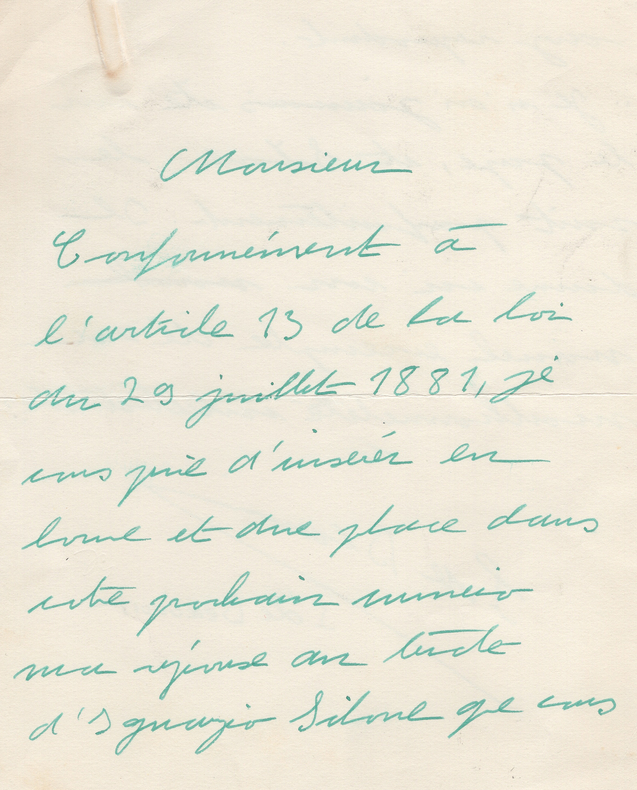
BEAUVOIR (Simone de).
Lettre autographe signée à un directeur de journal [Témoins].
S.l., s.d. [1963]. 2 pp. in 8°, à l’encre verte.Trace d'attache métallique dans la marge supérieure.
Referenz des Buchhändlers : AMA-82
|
|
|
BEAUVOIR Roger de
Lettre Autographe Signée de Roger de Beauvoir.
Lettre Autographe Signée de Roger de Beauvoir adressée à Bocage (1799-1862), acteur, puis directeur du Théâtre de l'Odéon. "Prenez vous en à votre jeu dans Rémy si toutes les femmes veulent voir comment vous devenez si vite un vrai vieux".1 page format in-8°(21x14) sous chemise biographique. Joint une autre LAS au même 1/4 de pages in-8°. Très bon état.-De l'ancienne collection A. Baron, assureur, puis syndic-liquidateur à Bourges.Eugène-Augustin-Nicolas Roger dit Roger de Beauvoir, né le 28 novembre 1807 à Paris (2e) et décédé le 27 août 1866 à Paris (17e), est un romancier, poète et dramaturge romantique français. Il fut un grand ami d'Alexandre Dumas père dont il fut, avec Chateaubriand le témoin lors de son mariage avec Ida Ferrier. Ses oeuvres les plus connues sont Le Chevalier de Saint-Georges (1840) et Les oeufs de Pâques (1856).
Referenz des Buchhändlers : 16894

|
|
|
BEAUVOIR Simone de
Lettre autographe signée adressée à Antoinette Boulesteix
- 2 Juillet 1980, 14,5x20,5cm, 1 page + 1 enveloppe. - Lettre autographe signée de Simone de Beauvoir de 9 lignes adressée à Antoinette Boulesteix, enveloppe jointe. Une pliure centrale inhérente à l'envoi et une trace d'enveloppe en pied de la lettre, l'enveloppe et la lettre ayant dû être collées ensemble puis séparées. "Chère mademoiselle, je suis très touchée de cette lettre mais je n'ai pas le temps de rencontrer votre mère. Je quitte Paris pour aller me reposer à la campagne. Dites lui mes regrets, et croyez à mes meilleurs sentiments. Simone de Beauvoir." [ENGLISH DESCRIPTION ON DEMAND]

|
|
|
BEAUVOIR Simone de
Lettre autographe signée inédite : "Sartre a trouvé les lettres tout à fait intéressantes et il est tout à fait d'accord pour en publier d'abord une dizaine (ou un peu davantage) dans les T. M. [Temps Modernes]"
- s.d. (ca 1950), 21x27cm, 1 page 1/2 sur un feuillet. - Unpublished, handwritten, signed letter: "Sartre a trouvé les lettres tout à fait intéressantes et il est tout à fait d'accord pour en publier d'abord une dizaine (ou un peu davantage) dans les T. M. [Temps Modernes]" "Sartre found the letters quite interesting and he fully agrees to publish first a dozen (or a few more) in the T. M. [Temps Modernes]" s.d(ca 1950), 21 x 27 cm, 1 and a 1/2 pages on a leaf Handwritten signed letter from Simone de Beauvoir addressed to an unknown female correspondent. One and a half pages on a leaf. Two perforations in the left margin, folds from having been sent and some tiny tears at the top not affecting the text. Significant unpublished letter testifying to Simon de Beauvoir's involvement in Temps modernes and the concerns of the participants of this journal in the aftermath of the Second World War. This letter attests to the intense preparation work for the articles, in this case the project of a publication concerning Fritz von Unruh, an important figure of pacifism. Fritz von Unruh was an officer during the First World War and published Opfergang (1916), the first German work on the war to have been translated into French, under the title Verdun, by Jacques Benoist-Méchin in 1923. A pacifist, the author joined the "Eisernen Front" in 1931 to fight again the rise of nationalist parties, led by the NSDAP. An Anti-Nazi, he left Germany in 1933, was stripped of his German nationality in 1939 and the same year was sent to a detention camp in France before taking refuge in the United States, he returned to his native country only in 1948. "Sartre a trouvé les lettres tout à fait intéressantes et il est tout à fait d'accord pour en publier d'abord une dizaine (ou un peu davantage) dans les T. M. [Temps Modernes]" "Sartre found the letters quite interesting and he fully agrees to publish first a dozen (or a few more) in the T. M. [Temps Modernes]" The famous "letters" are those received by Fritz von Unruh after his speech entitled "An die Deutschen" [To the Germans] on 18 May 1948, at the Church of Saint Paul in Frankfurt, to celebrate the centenary of the German Assembly in the presence of federal and allied authorities. "Dans ce discours, von Unruh, exilé aux États-Unis pendant la guerre, dénonce la responsabilité allemande mais rejette également le communisme, tout comme la présence et les stratégies géopolitiques des Alliés occidentaux en Allemagne." "In this speech, von Unruh, exiled to the United States during the war, denounces German responsibility but also rejects communism, as well as the presence and geopolitical strategies of the Western Allies in Germany" (Stève Bessac-Vaure. "L'Allemagne dans Les Temps modernes (1951-1956)", 2013) This broadcasted speech had a huge impact and von Unruh immediately received thousands of letters in response to this intervention. The editorial board of Temps modernes, concerned about the political resurgence of Nazism in the aftermath of the Second World War, seems very interested in the publication of the letters and Beauvoir as the leader states: "Il faudrait une petite introduction et le discours d'Unruh. [...] Il n'y a donc, puisque vous vous chargez vous même de la traduction, qu'à m'envoyer 11 rue de la Bûcherie Ve, la traduction du premier lot de lettres avec introduction et discours et je vous écrirai immédiatement pour vous dire si nous en souhaitons un second lot et si l'idée du livre est retenue." "It would take a small introduction and Unruh's speech. [...] So, since you take charge of the translation yourself, just send me, 11 rue de la Bûcherie Ve, the translation of the first batch of letters with the introduction and speech and I will write to you immediately to tell you if we want a second batch and if the idea of the book is retained." Going beyond the scope of the publication in review, the two women already seem to consider transforming the articles to be published into a work

|
|
|
Beauvoir, Roger de (1809-1866), Schriftsteller
Eigenhändiger Brief mit Unterschrift und kleiner Zeichnung. Mit schwarzer Tinte geschrieben u. gezeichnet.
[Paris?], ohne Jahr. 1 Bl. (16 x 20 cm).
Referenz des Buchhändlers : 79573

|
|
|
BEAUVOIR, Roger de.
L'Armée Française. Album Annuaire 1903 ( 15ème année).
Paris, Plon-Nourrit et Cie, (1903); 1 volume in-4°, plein cartonnage gris pale de l'éditeur illustré en noir au 1er plat avec titre en noir et rouge, belle publicité de Mahut au 2ème plat pour Dubonnet en noir et rouge, dos de toile rouge muet; 3ff.nch., 96pp., 1f.nch.Cartonnage un peu décoloré au 1er plat , coins un peu émoussés, infime accroc au dos.
Referenz des Buchhändlers : cROU-231
|
|
|
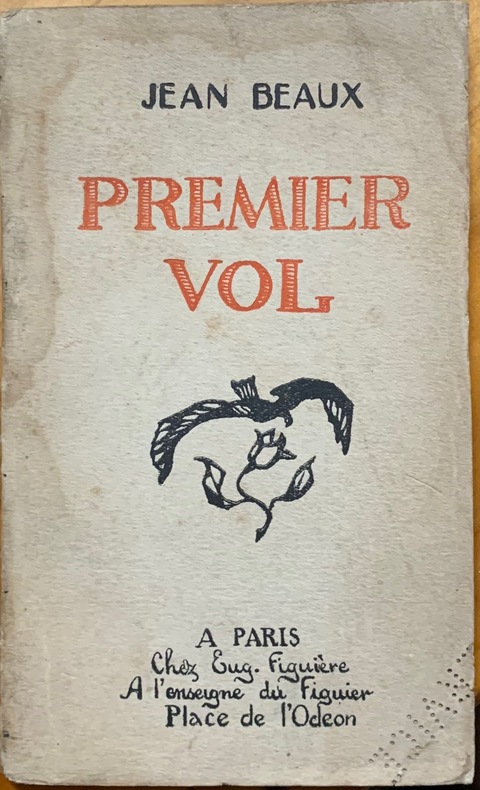
BEAUX Jean.
Premier Vol.
1920 Paris, chez Eugène Figuière, sans date ( vers 1920); petit in-16° broché, couverture crème imprimée en noir et rouge; 96pp.
Referenz des Buchhändlers : 7820
|
|
|
Bebel, August, German socialist politician and one of the founders of the Social Democratic Workers' Party of Germany (1840-1913).
Autograph letter, signed with initials. Berlin, 17 Oct. 1903.
8vo.½ p. on bifolium. To "L[ieber] R[ahn?]", obviously an employee of the Vorwärts-Druckerei, sending corrections for an article which has to be published the day after. - On stationery with printed address; slightly dusty and spotty, some smalll damage to edges.
|
|
|
Bebel, August, German socialist politician, and writer (1840-1913).
Autograph letter signed ("A. Bebel"). Berlin, 30 April 1895.
8vo. 1½ pages on bifolium. To an unnamed addressee, agrees to hold a lecture in Apolda or Weimar on Saturday evening. - August Bebel is best remembered as one of the founders of the Social Democratic Workers' Party of Germany (SDAP) in 1869, which in 1875 merged with the General German Workers' Association into the Socialist Workers' Party of Germany (SAPD). During the repression under the terms of the Anti-Socialist Laws, Bebel became the leading figure of the social democratic movement in Germany and from 1892 until his death served as chairman of the Social Democratic Party of Germany.

|
|
|
Bebel, August, Politiker und Publizist, Mitbegründer der Sozialdemokratischen Arbeiterpartei (1840-1913).
Albumblatt mit eigenh. U. Berlin, 8. V. 1897.
1 S. auf Doppelblatt. 8vo. "Geehrtes Fräulein / Um Ihren Wunsch zu erfüllen sende ich Ihnen diese Zeile. / Hochachtungsvoll / A. Bebel". - Mit stärkeren Randläsuren.
|
|
|
BECAMPS, Pierre
J.B.-M. Lacombe Présidence de la Commission militaire. La Révolution à Bordeaux. [Edition originale - Livre dédicacé par l'auteur ]
Un des 1000 exemplaires sur blanc Gardenia numéroté, 1 vol. in-8 br., Editions Bière, Bordeaux, 1953, XII-403 pp. Bel envoi de l'auteur à l'écrivain bordelais Albert Rèche (1913-2016) : "A mon ami Albert Rèche, ce fragment d'histoire de notre cité". Bon exemplaire. Français

|
|
|
BECAMPS, Pierre
J.B.-M. Lacombe Présidence de la Commission militaire. La Révolution à Bordeaux. [Edition originale - Livre dédicacé par l'auteur ]
Un des 1000 exemplaires sur blanc Gardenia numéroté, 1 vol. in-8 br., Editions Bière, Bordeaux, 1953, XII-403 pp.
Referenz des Buchhändlers : 50542

|
|
|
BECAMPS, Pierre ; [ SALMIDE, Henri ; STAHLSCHMIDT, Heinz ]
Libération de Bordeaux [ Exceptionnel exemplaire annoté et enrichi d'une très longue dédicace d'Heinz Stahlschmidt, "l'homme qui avait fait sauter le bunker de la rue Raze" ]
1 vol. in-8 br., Collection La Libération de la France, Hachette Littératures, 1974, 221 pp. Exceptionnel exemplaire enrichi d'une très longue dédicace d'Heinz Stahlschmidt (alias Henri Salmide) sur 4 pages. Henri Salmide, né Heinz Stahlschmidt le 13 novembre 1919 à Dortmund et mort à l'âge de 90 ans le 23 février 2010 à Bordeaux, est un sous-officier de la Kriegsmarine1 qui a empêché la destruction du port de Bordeaux en août 1944 durant la Seconde Guerre mondiale. Il commente l'ouvrage dans plusieurs notes marginales, et dans sa très longue dédicace dont voici quelques extraits : "Je suis heureux car grâce à mon action isolée, 3000 bordelais ne sont pas morts. Et tout ce qui était miné n'a pas sauté. ... Mais je regrette la carence du groupe de résistance que j'ai contacté, auquel j'ai proposé cette action humanitaire toute faite. N'ayant pu, en deux semaines, trouver l'homme nécessaire pour cette action, cela ne me laissait pas de choix... [ et ] ... j suis je suis devenu aux yeux de certains "l'homme qui a fait sauter le bunker de la rue Raze". " Avec mon séjour à Bordeaux, je suis obligé d'en faire la triste expérience. Et je paye et paie encore le prix de rester un homme indépendant et loyal, qui n'est pas disposé de se laisser dépouiller d'être l'auteur et par la force des choses l'exécuteur de cette action". Etat satisfaisant (couv. frottée avec petits accrocs). Français

|
|
|
BECAMPS, Pierre ; [ SALMIDE, Henri ; STAHLSCHMIDT, Heinz ]
Libération de Bordeaux [ Exceptionnel exemplaire annoté et enrichi d'une très longue dédicace d'Heinz Stahlschmidt, "l'homme qui avait fait sauter le bunker de la rue Raze" ]
1 vol. in-8 br., Collection La Libération de la France, Hachette Littératures, 1974, 221 pp.
Referenz des Buchhändlers : 43420

|
|
|
Becattini, Francesco, Historiker (1743-1813)
Vita, e azioni militari di Ernesto Gedeone Barone di Laudon Feld-Maresciallo e supremo Comandante delle Armate di Casa d'Austria.
o.J. Venezia, Valle,, 1791, Kl.-8°. 144 S. Hpgt. um 1890.
Referenz des Buchhändlers : 52257
|
|
|
BECDELIEVRE Guillaume Jean Baptiste françois (Marquis de)
LETTRE DU MARQUIS DE BECDELIEVRE, SEIGNEUR DE TREAMBERT, QUILFISTRE ET QUINDENIAC (SAINT MOLF- MESQUER) A MR MOUTON DE KERGENTIL APRES SA NOMINATION COMME SENECHAL DE SES TERRES, NANTES LE 7 FEVRIER 1723
Nantes 1723 une lettre, brochure de 4 pages (une page pliée en deux), sur papier vergé ligné et filigrané, manuscrite à l'encre brune, format : 22 x 17,5 cm, lettre autographe manuscrite du marquis de becdelièvre signée, fait à nantes, le 7 Février 1723, adresse au dos : a Monsieur de Kergentil avocat à guérande avec cachet de cire rouge aux armes des becdelièvre,
Referenz des Buchhändlers : 21270
|
|
|
Becher, Alfred Julius, Musikkritiker, Komponist und einer der Hauptführer des Wiener Oktoberaufstands von 1848 (1803-1848).
"Am 26. Mai 1848". Eigenh. Gedicht. O. O., wohl 1848.
1 S. (21 Zeilen) auf Doppelblatt. 8vo. Wie am Respektblatt vermerkt an "meinen einzigen Paradiesvogel": "Über Zeit und Raum erhaben / Ist des Herzens inn'res Leben, / Und es weiß, wenn sich zu laben / Augenblicke nur gegeben, / Doppelt diese flücht'gen Gaben / Durch die Innigkeit zu heben! [...]". - Der einer rheinländischen Familie entstammende Kritiker gehörte zum Freundeskreis von Mendelssohn und Grabbe, war Professor für Musikwissenschaft im Haag und in London und kam 1845 nach Wien. "1848 begann er sich politisch zu betätigen, redigierte das Blatt 'Der Radikale' und gehörte zu den führenden Köpfen der Wiener Revolution; nach der Erstürmung Wiens wurde er verhaftet und standrechtlich erschossen" (ÖBL I, 60).

|
|
|
Becher, Alfred Julius, Musikkritiker, Komponist und einer der Hauptführer des Wiener Oktoberaufstands von 1848 (1803-1848).
Brief mit eigenh. U. Elberfeld, 6. VI. 1832.
1½ SS. auf Doppelblatt. Gr.-4to. Mit eh. Adresse (Faltbrief). Aus der Zeit von Bechers Tätigkeit als Advokat in Elberfeld; ein Brief aus Sekretärshand an C. F. Peters in Leipzig betr. "Prüfung, Bestellung und Beeidigung der Forderungen der Gläubiger in Fallitsachen P. J. Bluyhoen". - Der einer rheinländischen Familie entstammende Kritiker gehörte zum Freundeskreis von Mendelssohn und Grabbe, war Professor für Musikwissenschaft im Haag und in London und kam 1845 nach Wien. "1848 begann er sich politisch zu betätigen, redigierte das Blatt 'Der Radikale' und gehörte zu den führenden Köpfen der Wiener Revolution; nach der Erstürmung Wiens wurde er verhaftet und standrechtlich erschossen" (ÖBL I, 60).

|
|
|
Becher, Johannes R., German politician, novelist, and poet (1891-1958).
"Der Tag". Original typescript poem, signed and dated by Becher. Berlin, 17 July 1916.
4to. 4 pp. on watermarked Albert Mühle paper, small corrections in ink throughout. Manuscript of a poem written for Rose Thesing, who would become better known under her second married name, Hilferding, as wife and partner of the prominent socialist theorist and anti-Nazi activist Rudolf Hilferding. Dated by Becher in 1916, the poem consists of two sections "Abend" and "Morgen". The ink corrections throughout are small changes to insert capital letters or line breaks where needed, with a couple of small deletions and one word change. - A expressionist poet in his younger years, Becher would later embrace communism and Socialist Realism; following his years in exile during the Nazi period, he settled in East Germany where he became Minister of Culture. - Folded, as for mailing, and with some rumpling and a few creases.

|
|
|
Becher, Johannes R., Schriftsteller und Politiker (1891-1958).
Eigenhändige Sentenz mit U., zahlreichen eh. Korrekturen, eh. ausgefülltem Formularteil und eh. Namenszug. Berlin-Wilhelmsdorf, o. D.
1 S. Folio (223:282 mm). Albumblatt mit gedruckter Bordüre, gedr. Fußzeile "Beitrag zum Selbstschriftenalbum 'Deutschlands Zukunft'" und gedr. Formular für biograph. Daten, aufgezogen auf einen Bogen Pergamentpapier (ca. 330:344 mm). Umfangreiche Sentenz mit agitatorischen Anklängen gegen die Reichen und Mächtigen: "Die 'deutsche Zukunft' ist Sache des Arbeiters und sie wird davon abhängen, ob der deutsche Arbeiter und alle die, die im heutigen Deutschland nach wie vor verelendet und unterdrückt sind, ihr 'Schicksal' weiter ertragen. Dieses 'Schicksal' haben geschaffen die, die sich heute als 'Retter' oder als besonders erwählte Vertreter der Zukunft Deutschlands aufspielen [...] Wir wissen Ihr tretet nicht von selbst ab. Das 'Volk in Not' wird Euch eines Tags den Weg vorschreiben, den Ihr zu gehen habt, und wenn ihr nicht freiwillig geht, Euch zwingen [...]". - Geschrieben als Beitrag für die von Friedrich Koslowsky im Berliner Eigenbrödler-Verlag herausgegebene Faksimile-Anthologie "Deutschlands Köpfe der Gegenwart über Deutschlands Zukunft" (1928), wurde jedoch nicht aufgenommen. - Nach einem politischen Aufstieg innerhalb der KPD wurde der expressionistische Dichter Becher 1928 Vorsitzender des neu gegründeten "Bundes proletarisch-revolutionärer Schriftsteller". 1945 aus dem sowjetischen Exil zurückgekehrt, wurde er Mitglied des Parteivorstands der SED, Minister für Kultur sowie erster Präsident des Kulturbundes der DDR. Bekannt ist er auch als Verfasser des Textes der DDR-Nationalhymne.
|
|
|
Bechler, Gustav, Maler und Holzschneider (1870-1959).
Eigenh. Postkarte mit U. [Poststempel: Kufstein], o. D.
1 S. Qu.-8vo. Mit eh. Adresse verso. An den Verleger August Scherl in Berlin: "Ich hoffe Ihnen in Kurzem eine neue photogr. Aufnahme übersenden zu können [...]".
|
|
|
Bechstein, Ludwig, German writer and collector of folk tales (1801-1860).
Autograph letter signed ("Bechstein"). Meiningen, 25 Nov. 1845.
8vo. 1 page on bifolium. To an unnamed recipient, thanking for sending him some drawings and autographs. - Bechstein published many works and was a successful author of his time. His German Fairy Tale Book was even more popular than the Brothers Grimm's collection when it was first published in 1845.

|
|
|
Bechstein, Ludwig, Schriftsteller (1801-1860).
"Auf der Wartburg". Eigenh. Gedicht mit U. O. O., [1858].
1 S. 4 Strophen zu je 4 Zeilen. 8vo. "Allmorgendlich der Wartburg Thor | Geht auf mit hellem Dröhnen; | Da rauscht ein hehrer Klang hervor, | Dem Rechten, Guten, Schönen. | Wie überglüht vom Sonnenkuß | Einst Memnonsbild erklungen, | So tönt der Wartburgpforte Gruß, | Ins Morgenroth gesungen. | Sei dieser Gruß, sei dieser Laut | Erinnrungreiches Mahnen, | Dem Enkel, der an Wartburg baut, | Von seinen großen Ahnen. | Ist's Hermanns, ist's Sophie's Gruß, | Der Klang im Morgenrothe? | Dir ruft er: Heil dem Genius! | Des Zukunftglückes Bote". - Minimal fleckig und mit kleinen Faltspuren.
|
|
|

 Per e-mail erhalten
 Als pdf-Dokument herunterladen
 RSS feed
 Permanenter link


