|
|
|
SEVERINE ( alias Caroline Rémy):
Le duel des sexes.
Manuscrit autographe de 9 pages comportant de nombreuses corrections et ratures, monté sur papier ligné (montage postérieur).Autograph manuscript of 9 pages with numerous corrections and erasures, assembled on lined paper (posterior assembly).
Référence libraire : 4706

|
|
|
Sexau, Richard, Schriftsteller (1882-1962)
Eigenh. Albumblatt mit U. sowie Porträtdruck mit eigenh. U.
o.J. Ascholding, ohne Jahr, Qu.-4° und 8°. Zus. 2 Seiten.
Référence libraire : 47790
|
|
|
Seyffardt, Ernst Hermann, Komponist (1859-1942)
Eigenh. Musikmanuskript mit Widmung und U.
o.J. Stuttgart, 22. IX. 1912, Gr.-Fol. (34,5 x 25 cm). 2 Seiten.
Référence libraire : 57895
|
|
|
Sgambati, Giovanni, Komponist (1841-1914)
Eigenh. Brief mit U.
o.J. Rom, 9. VI. 1887, 8°. 2 Seiten. Doppelblatt.
Référence libraire : 61027
|
|
|
Shabbethai Ben Isaac ha-Sopher [Schabtai ha-Sofer] / Berliner, A. [Abraham, Adolf] [Ed. & Intr.]
Abhandlung über den Siddur des Schabtai ha-Sofer [Shabbethai Ben Isaac] aus Przemysl [FIRST PRINTED EDITION] Auf Grund der einzigen Handschrift in der Bibliothek des Bet ha-Midrasch in London
FIRST EDITION. This book marks the first printing of the hitherto unknown introduction to the thorough linguistic commentary on the Jewish prayer book by Shabbethai Ben Issac ha-Sofer, the renowned 17th century grammarian. The book is in Hebrew save for a 13-page introduction in German to B. Isaac's life and work by the renowned Jewish-German historian and theologian Abraham Berliner. 220x155mm. XVIII+82 pages. Marbled quarter-cloth Hardcover. Cover worn and stained. Cover edges worn. Spine bumped in several places. 1 small wormhole extends throughout the book, including the cover - NO damage to text. Two slightly smaller holes extend from the rear endpaper to page 57, with very little damage to several letters in the text - text still readable. Pen inscription on whitepage. Hebrew title page and pages 3-13 and VI-VIII stained near edges with no damage to text. Pages slightly yellowing. [SUMMARY]: This eloquent treatise on the language of the Jewish prayer-book has suffered some damage, but is still in good reading condition.
|
|
|
SHAKESPEARE William
Catalogue of the Books, Manuscripts, Works of Art, Antiquities and Relics at present exhibited at Shakespeare's Birthplace. NEAR FINE COPY
Sm. 8vo., First Edition, with a frontispiece and 60 illustrations ands facsimiles in the text; boards blocked and lettered in black, cloth back gilt, a very good, bright, clean copy. With a personal pictorial bookplate on front paste-down.

|
|
|
Shakespeare, William; Knight, Charles; Artlett, R. A. [Ill.]; Brain, J. [Ill.]; Bourne, H. [Ill.]; Brown, T. [Ill.]; Heath, Fred [Ill.]; Sharpe, C. W.
The Works of Shakspere / with notes by Charles Knight. [With illustr. by C. W. Copem ; C. R. Leslie, Maclise, E. M. Ward, W. P. Frith ; H. S. Marks ; C. Clint ; W. Q. Orchardson and others].
New York, Virtue & Co., 1873-76. 2 Bände - 2 Vols. 30 x 38 cm. 809/ 777/188 S. 44 ganzseitige Stahlstichtafelnm Frontispioez, Vigenette. Or.-Leder, blindgeprägt, vergold.Titel, ornamental vergold. Innenfileten, Ganzgoldschnitt, Calf, gilt title , gilt etsches, innen leicht gebräunt bzw. minim. fleckig, sehr schön erhalten, very nice copy Imperial Quarto.
Référence libraire : 62749AB
|
|
|
Shanks Hershel
L'Aventure des manuscrits de la mer morte
Seuil, 1996 - In-8, broché, 365 pages, fort index in fine.
Référence libraire : 13552 ISBN : 2020214172

|
|
|
Shaw, George Bernard, Schriftsteller und Nobelpreisträger (1856-1950)
Eigenh. Postkarte mit U. "GBS".
o.J. Ayot St. Lawrence, 21 III. 1925 (Poststempel), 1 Seite. - Bildseite beschabt und unkenntlich.
Référence libraire : 58800
|
|
|
SHEIKH SÜLEYMAN KASLIOGLU, (Müfti of Rhodes), (1890?-1974).
[RHODES MUFTI WHO HELPED JEWS AGAINST THE NAZIS IN RHODES] Typescript document / certificate of citizenship signed 'Seyh Süleyman' as 'Il mufti di Rodi', prepared for 'Sevgen Bechige', in the period of Italan Occupation of Rhodes.
Very Good Italian Original typescript document signed by Seyh Süleyman Kaslioglu. 30x21 cm. In Italian. Sealed by 'Rhodes Müftülügü'. 1 p. "He was the leader of the Turkish Community in Rhodes, the mufti, clergyman. During the Second World War in 1943, Nazi Germany eventually invaded Greece and moved from there to the Aegean Islands. Thus, soon after, Rhodes fell into the hands of the Nazis. They were confiscating the property of the Jews living on the island and closing the synagogues. Under these circumstances, Süleyman Kaslioglu offered to keep the Torah and other Hebrew books he received from clergy and citizens in the Murad Reis Mosque. But most of the Jews were taken to the concentration camp. Of the 1673 Jews who went to Rhodes from the concentration camp, only 151 were able to return. Süleyman Kaslioglu delivered the books of the returnees years later.". (Source: Gündem Çesme: Rodos müftüsü ve bizim Ddiyanet Isleri Baskani by Sedat Kaya).
|
|
|
Shinichi Koku (Miscellaneous manuscripts for paintings from the Sung and Yuanin), Takaaki Matsushita (Sung and Yuanin paintings
Art No. 6 July 1944 with table of contents <Japanese Version>
Japanese art publication 1944. Soft Cover. Fine. Size: 26cm Japanese art publication paperback
Référence libraire : 2092902137303468
|
|
|
Shirley TEMPLE
Photographie dédicacée par Shirley Temple
s. n. | s. l. 1988 | 20 x 25.5 cm | Une photographie
Référence libraire : 88436
|
|
|
Shirley TEMPLE
Photographie dédicacée par Shirley Temple
s. n. | s. l. s. d. [1980] | 20.5 x 25.5 cm | Une photographie
Référence libraire : 88470
|
|
|
Sibelius, Jean, Komponist (1865-1957)
3 Portätfotografien von Heinrich Iffland. Originalabzüge mit Fotografenstempel.
o.J. Jarvenpää, Haus Ainola, ohne Jahr (ca. 1938), 19 x 17 bzw. 17,5 x 23,5 cm..
Référence libraire : 57166
|
|
|
Sibelius, Jean, Komponist (1865-1957)
Portätfotografie von Otto Schneider.
o.J. Jarvenpää, Haus Ainola, ohne Jahr (ca. 1938), 24 x 19 cm.
Référence libraire : 57220
|
|
|
Siber, Franz Xaver, Arzt in München (1762-1830)
Eigenh. Schriftstück mit U.
o.J. Ohne Ort (München), 26. VIII. 1807, 8°. 1 Seite.
Référence libraire : 60740
|
|
|
SIBTU'L-MARDINÎ [BADR AL-DÎN MUHAMMAD B. MUHAMMAD B. AHMAD AL-MARDÎNÎ], (Egyptian mathematics and astronomy scholar), (1423-1493).
[ASTRONOMY - MATHEMATICS - ARABIC MANUSCRIPT: JAYB & MUQANTARÂT; SINUS & ALMUCANTAR QUADRANT] Hadhâ risâle-i rüb'u mukantarât, Hadhâ risâle-i cenûb taraf, Hadha mukharrar latashich al-shaat fî taraf al-cayb min al-rub'u' mu'âl-ihtizâr.
Very Good Arabic Original manuscript without binding. 12mo. (16 x 11 cm). In Arabic. [40] p., drawings, and tables. Marginal texts additionally. A linear wormhole on the bottom from beginning to the end, the thread in the spine is broken hence two separate parts. Otherwise a good copy. Rare manuscript compiled from works related to astronomical instruments written by probably Sibtu'l-Mardînî, copied anonymously in the early 19th century on the paper with 'ahar' with four marginal drawings and tables. The copier of this manuscript is not described. An 'Ebced' notes on the last blank page. The manuscript starts with a calendar in the Islamic system which is prepared with red and black inks and annotated info around the table. The first part includes how to use an almucantar, directions on the sphere, location of the stars in the sky. On the last two pages, the author describes the preparation of an almucantar. The second part is titled "Hadhâ risâle-i cenûb tarafi" [i.e. Tractate on the South direction], and the third and last part titled " Hadhâ risâle-i cenûb taraf, Hadha mukharrar latashich al-shaat fî taraf al-cayb min al-rub'u' mu'âl-ihtizâr", includes some 'sinus mathematics' with two impressive tables on the opposite page. Sibt al-Maridini, the full name Muhammad ibn Muhammad ibn Ahmad ibn Muhammad ibn al-Ghazal (1423-1493), was an Egyptian-born astronomer and mathematician. His father came from Damascus. The word "Sibt al-Maridini" means "the son of Al-Mardini's daughter". His maternal grandfather, Abdullah al-Mardini, was a reputed astronomer of the eighth century AH. He was a disciple of the astronomer Ibn al-Majdi (d. 850/1506). Sibt al-Mardini taught mathematics and astronomy in the Great Mosque of al-Azhar, Cairo. He was also a timekeeper (muwaqqit) of the mosque. He wrote no fewer than fifty treatises in astronomy (sine quadrants, sundials, astronomical tables, and prayer times) and wrote at least twenty-three mathematics textbooks. Al-Sakhawy counted two hundred books that were written by Sibt al-Mardini, on Islamic law, astronomy, and mathematics. Libraries that specialize in ancient manuscripts, all over the world, have transcripts of his works. Sibt al-Mardini's declared that "the opinion of the muezzins (those who call people to prayer) is less correct than that of the legal scholars and it is the latter that should be used as the basis for the determination of prayer time". (Wikipedia). Sib? al-Maridini was a prolific author of astronomical texts, which were still being used and studied into the 19th century. Little is known with certainty about his life. It is thought that he grew up in Damascus, where his maternal grandfather, Abd Allâh ibn Khalîl ibn Yûsuf Jamâl al-Dîn al-Mâridînî (died: 1406), was the muwaqqit (timekeeper) in charge of regulating the daily rituals of the Islamic community) of the Umayyad Mosque. Later he traveled to Cairo, where tradition places him as a student of Ibn al-Majdî. Sib? al-Mâridînî wrote extensively on mathematics and mathematical astronomy. Like his grandfather, he was especially interested in astronomical instruments. The bio-bibliographical sources list some 25 treatises, many of which exist today in multiple copies. According to the historian al-Jabarti (died: 1822), Sib? al-Mâridînî's works on mîqât (ritual timekeeping) and astronomical instruments were still being studied in the curriculum of Cairo's al-Azhar, one of the preeminent educational institutions in the Islamic world, at about the beginning of the 19th century. (Biographical encyclopedia of astronomers, 2007).
|
|
|
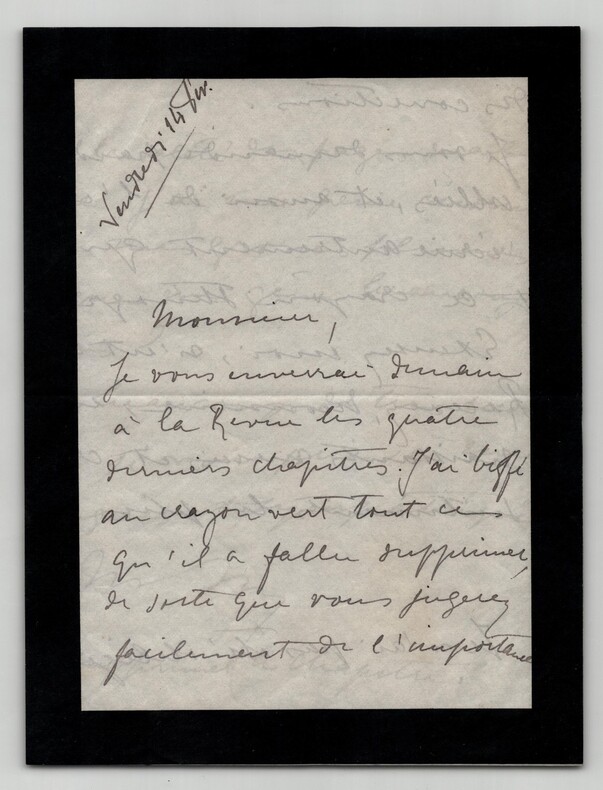
Sibylle-Gabrielle Riquetti de Mirabeau, Comtesse de Martel (GYP)
GYP - Lettre autographe signée - Rare témoignage sur ses méthodes de travail
Lettre autographe signée Dramaturge, romancière et salonnière française Lettre autographe de Sibylle-Gabrielle Riquetti de Mirabeau, Comtesse de Martel, plus connu sous le nom de plume de Gyp, signée "MM", adressée à un directeur de Revue, datée du 14 février sans année. Rédigée à l'encre noire sur un double feuillet de papier vélin avec liseré de deuil de 12 mm. Dimensions : 13,3 x 17,6 cm Nombre de pages : 2 pages GYP Sibylle Riquetti de Mirabeau, à la ville comtesse Roger de Martel de Janville, plus connue sous le nom de plume de Gyp, est une dramaturge, romancière et salonnière française, née le 15 août 1849 au château de Coëtsal et morte le 28 juin 1932 à Neuilly-sur-Seine.
Référence libraire : boz_001695
|
|
|
SICKING, L.H.J. et VAN RHEE, C.H.
FILIPS WIELANT VERZAMELD WERK II. BRIEVE INSTRUCTION EN CAUSES CIVILES
softcover, couverture carton rouge, 180 x 260mm., 377pp. ISBN 9789065690395. vol 2; Introduction - Edition du texte - Chapitres et organisation du Manuscrit - Index General. Excellent etat.

|
|
|
Sidorowitch, Constantin, Diplomat und Komponist (Daten nicht ermittelt)
Eigenh. musikalisches Albumblatt mit Widmung und U.
o.J. München, 30. X. 1879, Qu.-4° (22 x 28 cm). 1 Seite.
Référence libraire : 59105
|
|
|
Sidow, Max, Schriftsteller und Dramaturg (1897-1965)
Die goldnen Kammern. Drei Ringe andächtiger Liebe.
o.J. Darmstadt, Darmstädter Werkkunst Verlag, 1921, 4°. 18 nn. Bl. OKart. mit Kordelheftung.
Référence libraire : 57432
|
|
|
Siebeck, Wolfram, Schriftsteller (geb. 1928)
Masch. Brief mit eigenh. U.
o.J. Schondorf, 16. VI. 1982, Fol. 1 Seite. Gelocht.
Référence libraire : 42614
|
|
|
Sieben, Wilhelm, Dirigent (1881-1971)
Eigenh. Postkarte mit U.
o.J. Unterzeismering, 27. VII. 1936, (9 x 14 cm). 1 Seite.
Référence libraire : 60917
|
|
|
Sieber, Franz Wilhelm, Botaniker und Forschungsreisender (1789-1844)
Eigenh. Brief mit U.
o.J. Prag, 15. II. 1826, Gr.-4°. 1 1/2 Seiten.
Référence libraire : 52390
|
|
|
Siebrasse-Heineke, Herma, Illustratorin
Ausschneidebogen für eine "Anziehkatze".
o.J. Hemmor, ca. 1980, Quer-Folio. Zahlreiche Illustrationen auf dreifach gefaltetem Leporello.
Référence libraire : 61154
|
|
|
Sieburg, Friedrich, Schriftsteller (1893-1964)
3 masch. Briefe mit eigenh. U.
o.J. Gärtringen, 21. V. 1958 bis 17. VIII. 1960, Fol. 2 Seiten. 2 mit Briefkopf "Frankfurter Allgemeine". Gelocht.
Référence libraire : 48154
|
|
|
Sieburg, Friedrich, Schriftsteller (1893-1964)
Eigenh. Brief mit U.
o.J. Stuttgart, 24. II. 1954, Fol. 1 1/2 Seiten. Bläuliches Papier.
Référence libraire : 51586
|
|
|
Sieburg, Friedrich, Schriftsteller (1893-1964)
Eigenh. Manuskript mit U., dazu eine eigenh. Widmung mit U. auf einem Notizzettel.
o.J. Ohne Ort, 6. VII. 1959, 4° und Klein-8°. 2 Seiten.
Référence libraire : 61305
|
|
|
Siede, Ludwig, Komponist (1888-1956)
Eigenh. musikalisches Albumblatt mit U.
o.J. Berlin, Mai 1937, Qu.-8° (9,5 x 14,5 cm). 1 Seite.
Référence libraire : 55080
|
|
|
Siede, Ludwig, Komponist (1888-1956)
Eigenh. musikalisches Albumblatt mit U.
o.J. Berlin, Mai 1937, Qu.-8° (9,5 x 14,5 cm). 1 Seite.
Référence libraire : 55079
|
|
|
Siegert, Ewald, Komponist (1875-1947)
Eigenh. Musikmanuskript mit U. und eigenh. Begleitbrief mit U.
o.J. Chemnitz, 24. I.-4. II. 1925, Gr. 21 x 16,5 cm 2 Seiten & 22,5 x 14,5 cm 1 Seite..
Référence libraire : 59962
|
|
|
Sielmann, Heinz, Tierfilmer und Publizist (1917-2006)
Masch. Brief mit eigenh. U.
o.J. München, 16. II. 1982, Fol. 1 Seite.
Référence libraire : 44535
|
|
|
Sieur Lertelle
Reconnaissance de déclaration pour la Contribution Patriotique - 1791
Sieur Lertelle. Révolution française, La royauté constitutionnelle. Royale Butte Saint Roch. Reconnaissance de déclaration pour la Contribution Patriotique, 1791. Dimensions : 19 x 22,1 cm. État : Voir photos pour plus de détails. Nombre de pages : 1 page. Provenance : Vente Seignolle du 15/03/24 - lot 32, Révolution française, La royauté constitutionnelle - 1789-1792.
Référence libraire : boz_004248

|
|
|
SIFFAIT JOURDAN MAIRE DU CELLIER (LES FOLIES SIFFAIT)
LETTRE D'ALLEGEANCE DU MAIRE DU CELLIER SIFFAIT JOURDAN A MONSIEUR DE QUEBRIAC TOUT JUSTE NOMME SOUS-PREFET DE L'ARRONDISSEMENT D'ANCENIS, Le 7 Octobre 1822
1812 une lettre à en-tête de la Mairie du Cellier préimprimée en noir et manuscrite à l'encre brune, lettre de 4 pages (un feuillet plié en deux) sur velin ligné et filigrané (seule la première page est manuscrite), format : 25 x 20 cm, adresse du destinataire manuscrit à l'encre brune au milieu de la page : Monsieur DEQUEBRIAC sous-prefet de l'Arrondissement d'Ancenis à Ancenis, avec cachet de la mairie d'ancenis en noir avec les armes royales : lma couronne royale et les trois fleurs de Lys, lettre signée SIFFAIT JOURDAN à l'encre brune, Le Cellier, le 7 Octobre 1822,
Référence libraire : 24307
|
|
|
SIFFRIN Petrus O.S.B.
Liber sacramentorum Romanae Aeclesiae (Cod. Vatican. Regin. Lat. 316) Sacramentarium Gelasianum. [in: Konkordanztabellen zu den Lateinischen Sakramentarien" volume 2]
xvi + 222pp. + 4pp. ("siglen"), 21cm., in the series "Rerum Ecclesiasticarum Documenta. Subsidia Studiorum:5. Series minor: Konkordanztabellen zu den Lateinischen Sakramentarien" vol.2, original softcover, good condition, R63444
|
|
|
Sigl-Vespermann, Katharina, Sängerin (1802-1877)
Eigenh. Brief mit U.
o.J. München, 3. IV. 1840, Gr.-8° (21 x 13 cm). 2 Seiten. Doppelblatt mit Adresse.
Référence libraire : 56735
|
|
|
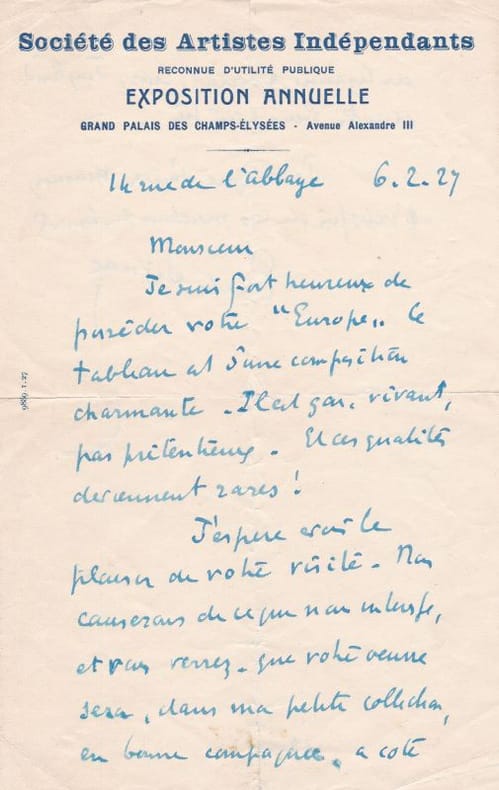
SIGNAC (Paul).
Trois lettres autographes signées adressées au peintre Pierre Monteret.
1927 4 pages in-8 à l'en-tête imprimé de la "Société des Artistes Indépendants" et une page in-4, "14 rue de l'Abbaye" et Barfleur, 6 février 1927, 17 juin 1931 et 20 février 1934. Président de la Société des Artistes Indépendants, Signac encourage le jeune peintre Pierre Monteret (né en 1897) en lui achetant un tableau, "Europe", d'une "composition charmante", et il espère recevoir sa visite : "vous verrez que votre oeuvre sera, dans ma petite collection, en bonne compagnie, à côté de Cézanne, Seurat, Jongkind et autres bons peintres"... Quatre ans plus tard, en 1931, le peintre se désole d'avoir raté la visite de Monteret et craint de ne pouvoir le soutenir "au moment où les amateurs évitent de tourner le bouton de porte des galeries, au moment où les marchands n'achètent rien et ne tiennent même pas leurs engagements"... Enfin, en 1934, il annonce être "fortement grippé" (Signac disparaît des suites d'une longue maladie en 1935) et ne peut se rendre à l'exposition de son confrère. On trouve une référence au tableau "Europe" de Pierre Monteret, présenté au Salon des artistes indépendants de 1927 et acquis par Paul Signac, dans le catalogue de la récente exposition du Musée d'Orsay, Signac collectionneur (Gallimard et Musée d'Orsay, 2021, p. 223). L'artiste Pierre Monteret partagea dans l'après-guerre la vie du peintre et maître-cartonnier d'origine russe Elie Grekoff.
Référence libraire : 111815
|
|
|
SIGNAC (Paul).
Trois lettres autographes signées adressées au peintre Pierre Monteret.
1927 4 pages in-8 à l'en-tête imprimé de la "Société des Artistes Indépendants" et une page in-4, "14 rue de l'Abbaye" et Barfleur, 6 février 1927, 17 juin 1931 et 20 février 1934. Président de la Société des Artistes Indépendants, Signac encourage le jeune peintre Pierre Monteret (né en 1897) en lui achetant un tableau, "Europe", d'une "composition charmante", et il espère recevoir sa visite : "vous verrez que votre oeuvre sera, dans ma petite collection, en bonne compagnie, à côté de Cézanne, Seurat, Jongkind et autres bons peintres"... Quatre ans plus tard, en 1931, le peintre se désole d'avoir raté la visite de Monteret et craint de ne pouvoir le soutenir "au moment où les amateurs évitent de tourner le bouton de porte des galeries, au moment où les marchands n'achètent rien et ne tiennent même pas leurs engagements"... Enfin, en 1934, il annonce être "fortement grippé" (Signac disparaît des suites d'une longue maladie en 1935) et ne peut se rendre à l'exposition de son confrère. On trouve une référence au tableau "Europe" de Pierre Monteret, présenté au Salon des artistes indépendants de 1927 et acquis par Paul Signac, dans le catalogue de la récente exposition du Musée d'Orsay, Signac collectionneur (Gallimard et Musée d'Orsay, 2021, p. 223). L'artiste Pierre Monteret partagea dans l'après-guerre la vie du peintre et maître-cartonnier d'origine russe Elie Grekoff.
Référence libraire : 111815
|
|
|
SIGNAC Paul
Lettre autographe signée adressée à Camille Pissarro : "Cela vous ennuirait-il [sic] d'écrire à Mirbeau qu'un Signac, à votre avis, ne ressemble pas plus à un Seurat qu'un Hokousai à un Hiroshigé... "
- s.d. (23 janvier 1894), 22,6x17,5cm, 2 pages sur un double feuillet déplié. - Lettre autographe signée de Paul Signac adressée à Camille Pissarro, rédigée à l'encre noire sur deux pages et signée d'un monogramme de l'artiste. Cette lettre a été retranscrite dans l'article de Pierre Michel et Christian Limousin intitulé "Octave Mirbeau et Paul Signac - Une lettre inédite de Signac à Mirbeau" (in Cahiers Octave Mirbeau, n° 16, mars 2009, pp. 202-210). "Mon cher Maître, Cela vous ennuirait-il [sic] d'écrire à Mirbeau qu'un Signac, à votre avis, ne ressemble pas plus à un Seurat qu'un Hokousai à un Hiroshigé... si toutes fois (sic) le reproche d'imitation dont il cherche à m'accabler vous semble injuste. L'amitié que vous m'avez toujours témoignée et les compliments que vous avez bien voulu faire de mes toiles, m'autorisent à vous demander ce service. Cordialement. PS" Belle lettre dans laquelle Paul Signac cherche l'appui de son maître Camille Pissarro après une critique acerbe publiée par Octave Mirbeau dans L'Echo de Paris. Dans ledit article, le premier à la Une de L'Echo de Paris du 23 janvier 1894, Octave Mirbeau n'épargne en effet pas Signac : « M. Signac a voulu continuer Seurat. Je ne puis me faire à sa peinture. Je ne méconnais pas ses qualités mais elles disparaissent sous l'amoncellement de ses défauts. Ce qu'on admettait de Georges Seurat [...] on le comprend moins chez M. Signac qui n'en est que l'adepte trop complaisant et trop littéral. Et puis cette continuelle sécheresse me choque. M. Signac fait la nature immobile et figée. Jamais le vent n'a secoué la surface inerte de ses mers, ni tordu les branches de ses pins, ni animé l'éternelle fixité de ses nuages, la raideur cartonnée de ses ciels. Il ignore le mouvement, la vie, l'âme qui est dans les choses. [...] Il serait peut-être temps, pour notre joie, que M. Signac voulût bien nous donner du Signac. Je crois qu'il le peut.» Pourquoi cette obsession pour Seurat ? « En ce début d'année 1894, la position de Mirbeau, de Geffroy, de Pissarro et que quelques autres, est de considérer que le néo-impressionnisme est bel et bien mort en 1891 avec la disparition de Seurat. Le regard rétrospectif qu'ils jettent sur cette aventure artistique les conduit à penser qu'il ne s'agissait nullement d'un prolongement, d'une continuation de l'impressionnisme par des voies nouvelles (scientifiques), mais bien d'une réaction contre lui, voire d'une liquidation pure et simple du mouvement. » (Cahiers Octave Mirbeau). La réponse de Pissarro à Signac, elle-même transcrite par Michel et Limousin, ne se fait pas attendre : cela « [l]'ennuirait d'écrire ce que vous me demandez à Mirbeau, et cela pour plusieurs raisons. [...] Premièrement parce que je suis en froid avec lui, vous le savez bien. Deuxièmement parce que, pour vous-même, il ne sied pas de discuter l'opinion d'un critique, même étant persuadé d'être dans le vrai, et, si vous voulez franchement ma façon de penser et que je suis heureux d'avoir l'occasion de vous exprimer, je trouve que la méthode même est mauvaise. Au lieu de servir l'artiste, l'ankylose et le glace. Si je vous ai fait des compliments cette année, c'est parce que j'ai trouvé vos dernières toiles mieux que celles que vous aviez exposées aux Indépendants, mais je suis loin de trouver que vous êtes dans la voie qui convient à votre tempérament essentiellement peintre et si, jusqu'à présent, je ne vous ai rien dit à ce sujet, c'est parce que j'étais sûr de vous être désagréable et, somme toute, mes convictions peuvent ne pas être partagées par vous. Réfléchissez mûrement et voyez si le moment n'est pas venu de faire votre évolution vers un art plus de sensation, plus libre et qui serait plus conforme à votre nature. » « Dépité, et privé de l'autorité d'un maître vénéré par le critique, Signac en est réduit à élaborer lui-même, et sans plus attendre, la réponse à adresser à Mirbeau [...] » (ibid.) Cette réponse prend la forme d'une longue lettre rédigée le même jou

|
|
|
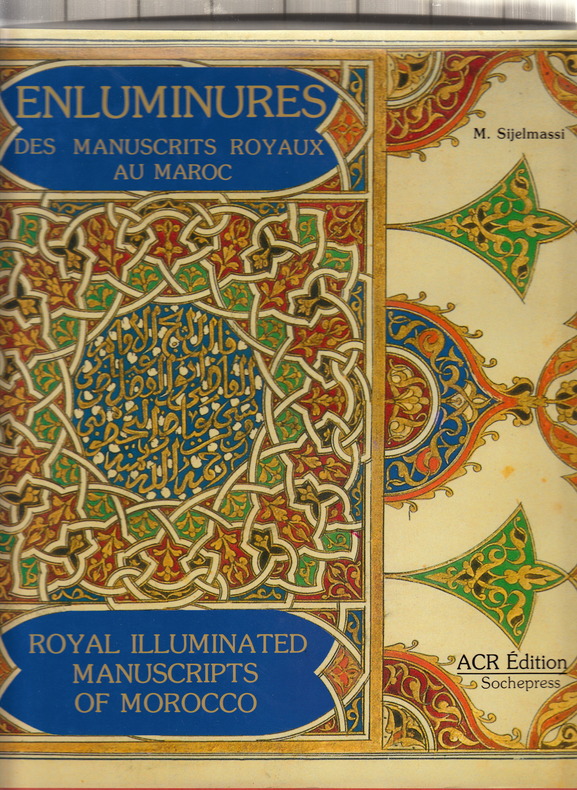
SIJELMASSI Mohammed
Les enluminures des manuscrits royaux au Maroc (Bibliothèque Al-Hassania).Royal illuminated manuscripts of Morocco.
1987 ACR, Courbevoie,1987 in-4 carré, reliure éditeur, toile orange, jaquette, 236-(34)pp. Préface de A. Miquel. Belle iconographie en couleurs.Texte en français, anglais et arabe.
Référence libraire : 21418
|
|
|
Silberhorn, Matthäus, Swabian goldsmith and painter (fl. 1830-1850).
Der Harnisch von seinem Entstehen bis zu seinem Wiedervergehen in Bildern dargestelt und gezeichnet von G. P. Rugendas. Southern Germany, "1714" (but apparently early 19th century).
Folio (217 x 337 mm). German manuscript on paper. Pictorial watercolour title, (5) pp. of text, and 14 watercolour plates or arms and armour, each with German text mounted on verso. Interleaved with a calligraphic English translation and tissue guards. - (And:) I Gradi della Cavalleria [...]. "1688" (but apparently also early 19th century). Watercolour title-page and 17 watercolour plates, captioned in Italian. With an additional watercolour plate, initialled "M.S.", loosely inserted. Late 19th century red morocco by R. W. Smith with finely gilt spine and spine-title; leading edges and inner dentelle gilt. Green calf doublures. Marbled flyleaves. Two striking series of highly decorative watercolours illustrating the history of armour throughout the ages. The first is purportedly copied after an earlier manuscript by the Augsburg artist G. P. Rugendas, dated 1714. The latter, with a date of 1688, is attributed to one "Matteo Argenteocorno" - a pseudonym for the goldsmith Matthäus Silberhorn from Ulm (cf. Thieme/Becker XXXI, p. 21), whose authorship is further established by his erased name on the final page of the first series: "Diversa objecta historialia, invenit & delineavit, & in argentam, vel aurichaleam caelavit [M. Silberhorn] a Ulmae [1841?]" (including a reference to an additional illustration not present here, showing the capture of Frederick the Fair at Mühldorf in 1322), and also by the loosely inserted watercolour bearing his initials "M.S." in ligature. - The series attributed to Rugendas shows armour from southern Germany, including a suit from the armoury at Lucerne, while four of the illustrations depict tournament armour. The Augsburg-based Rugendas was famed for his battle scenes, and while the style of the present watercolours is generally consistent with his popular drawings and prints, no original manuscript on which the present series might be based could be identified, and they are more probably original designs by Silberhorn, painting in the manner of an admired predecessor. The "Argenteocorno" manuscript depicts 13 cavalry ranks in uniforms of the War of the Spanish Succession (1701-14) set in landscapes, often with additional figures. It includes four medallion portraits of Eugene of Savoy, Maximilian Emmanuel of Bavaria, Frederick William of Brandenburg, and Alexander von Württemberg, surrounded by allegorical figures, military trophies, and battle scenes. - Hinges of the binding slightly rubbed. Some plates on variant laid papers, hinged on tabs. A unique survival, sumptuously bound in elaborately gilt American red morocco by R. W. Smith, long associated with the Grolier Club Bindery.
|
|
|
Silberschlag, Johann Esaias, Theologe und Naturforscher (1716-1791)
Eigenh. Schriftstück mit U.
o.J. Magdeburg, 11. VI. 1765, Fol. 1/2 Seite. Mit rotem Siegelabschlag.
Référence libraire : 37566
|
|
|
Siloti, Alexander, Pianist und Komponist (1863-1945)
Eigenh. Brief mit U.
o.J. Nürnberg, 11. XI. 1895, 8° (22 x 14 cm). 1 Seite, auf einem Doppelblatt mit gedrucktem Briefkopf und Abbildung "Hotel Strauss Nürnberg".
Référence libraire : 61019
|
|
|
SILVESTRE (Armand)
Critique littéraire : 2 manuscrits autographes signés
[vers le 13 juin 1896]. In-8, 2 x 2 pp.
Référence libraire : 22842

|
|
|
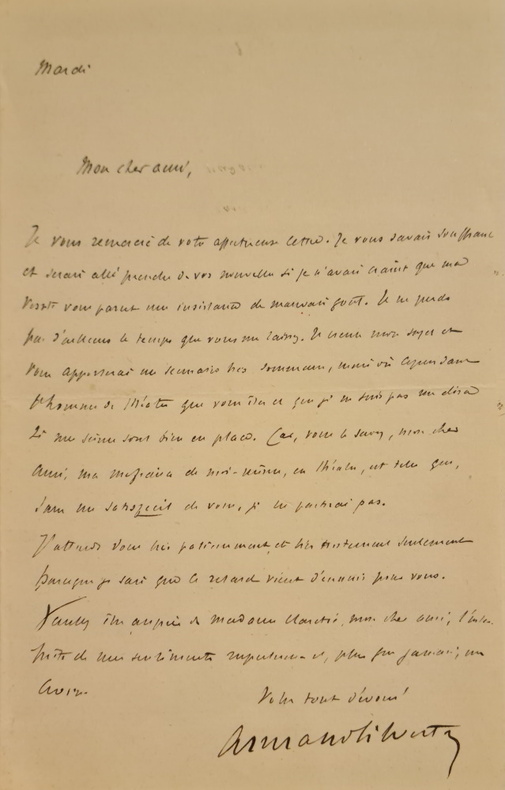
SILVESTRE (Armand).
Une lettre, un billet et une carte de visite autographes signés adressés à Jules Claretie.
1 page in-12 (s.l., "mardi"), 1 demi-page in-12 (Paris, 26 août 1882) et carte de visite ("Mardi"). Le sachant souffrant il préfère patienter pour lui transmettre "un scénario très sommaire, mais où cependant l'homme de théâtre que vous êtes, ce que je ne suis pas, me dira si mes scènes sont bien en en place". Le billet est un mot de recommandation pour une actrice. Enfin la carte concerne une demande sur la pièce Richard III.
Référence libraire : 96481
|
|
|
SILVESTRE (Armand).
Une lettre, un billet et une carte de visite autographes signés adressés à Jules Claretie.
1 page in-12 (s.l., "mardi"), 1 demi-page in-12 (Paris, 26 août 1882) et carte de visite ("Mardi"). Le sachant souffrant il préfère patienter pour lui transmettre "un scénario très sommaire, mais où cependant l'homme de théâtre que vous êtes, ce que je ne suis pas, me dira si mes scènes sont bien en en place". Le billet est un mot de recommandation pour une actrice. Enfin la carte concerne une demande sur la pièce Richard III.
Référence libraire : 96481
|
|
|
SILVESTRE Armand & MORAND Eugene
GRISELIDIS, Mystere - Gouaches. Aquarelles. Lettres ornees & ecriture par Serge Beaune
1920, En feuilles (232 x 250 mm) sous un portefeuille. 153 feuillets.Sur japon nacre, chaque feuillet manuscrit recto verso est execute sur papier japon nacre a fort grammage et se compose d’un texte manuscrit a l’imitation de l’ancien encadre de compositions art nouveau, bandeaux, culs de lampes et motifs.Les motifs decoratifs a theme animalier ou abstrait, pour certains s’inspirent de l’art roman, d’autres de themes egyptiens et orientaux.Bien qu’uniforme dans l’esprit les themes changent subtilement d’une page a l’autre en changeant de couleurs d’une scene a l’autre. Chaque initiale du texte et le nom des personnages est peint en rouge.Chaque scene (en moyenne toutes les deux et trois pages, parfois moins) s’ouvre par une peinture occupant la moitie de l’espace dans une demi ogive, realisee a la gouache puis vernie.Les ornements etant peints dans une technique mixte gouache et aquarelle.La tonalite de l’ouvrage joue sur les clairs obscurs et privilegie les scenes de nuit ou d’interieurs eclairees par des lanternes et flambeaux.Ces scenes alternent des paysages crepusculaires.Ouvrage date et signe en fin d’ouvrage « Termine le 23 mars 1920, Serge Beaune »
Référence libraire : 3001

|
|
|
SILVESTRE Armand - (Paris 1837 - Toulouse 1901) - Ecrivain français
Carte Autographe Signée à un ami -
1 page in12 + une carte de visite avec quelques mots autographes -
Référence libraire : GF20956
|
|
|
SILVESTRE Armand - (Paris 1837 - Toulouse 1901) - Ecrivain français
Lettre Autographe Signée à un ami -
1 page in8 - bon état -
Référence libraire : GF20954
|
|
|
SILVESTRE Armand - (Paris 1837 - Toulouse 1901) - Ecrivain français
Lettre Autographe Signée à un ami -
1 page in8 - un peu piquée -
Référence libraire : GF20955
|
|
|

 Recevoir par e-mail
 Télécharger en PDF
 Flux RSS
 Lien permanent


