|
|
|
[SAINTE-LUCE] ROUILLE ET HERAULT (Notaires Royaux à Nantes)
VENTE D'UNE PIECE DE TERRAIN D'1/4 DE JOURNAL JOUXTANT LA TERRE DE L'AUBINIERE EN SAINTE LUCE [PAR MR PIERRE PREBOIS ANCIEN CONSTRUCTEUR DE VAISSEAUX ET NÉGOCIANT A NANTES] ACHETÉE PAR MR PIERRE FRANCOIS GRIHAUT DE LA MOTTE SEIGNEUR DE L'AUBINIERE EN SAINTE-LUCE, NANTES LE 10 JUILLET 1777
1649 un document de 4 pages, sur vélin parcheminé, manuscrit à l'encre brune, format : 18,4 x 24,2cm, écrit sur les 3 premières pages, Signature manuscrite : ROUILLE ET HERAULT (Notaires Royaux à Nantes), Nantes, le 10 Juillet 1777,
Riferimento per il libraio : 22176
|
|
|
[SADE Donatien Alphonse François, Marquis de] SADE Renée-Pélagie Cordier de Montreuil, Marquise de
Billet autographe de reconnaissance de dettes de 150 livre à la présidente de Montreuil.
- s.n., s.l. 16 juin 1777, 17,1x11,1cm, une feuille. - Billet autographe signé de Madame de Sade, dans laquelle cette dernière reconnaît des dettes envers sa mère, Madame la présidente de Montreuil. Un petit trou sans manque de texte. Paraphe du notaire précisant le nombre de pièces en dessous des trois lignes de texte. Tout au long de sa vie, le Marquis - fastueux et très dépensier - fut criblé de dettes et n'eut de cesse de chercher de l'argent, principalement auprès de ses beaux-parents par l'entremise de sa femme. Provenance : archives de la famille. [ENGLISH DESCRIPTION ON DEMAND]

|
|
|
[SADE Donatien Alphonse François, Marquis de] SADE Renée-Pélagie Cordier de Montreuil, Marquise de
Billet autographe de reconnaissance de dettes de 200 livres à la présidente de Montreuil.
- s.n., s.l. 18 janvier 1778, 16,3x5,1cm, une feuille. - Billet autographe signé de Madame de Sade, dans laquelle cette dernière reconnaît des dettes envers sa mère, Madame la présidente de Montreuil. Un tout petit trou sans gravité. Paraphes du notaire de Sade, Maître Gibert, précisant le nombre de pièces versées au verso de chaque billet. Tout au long de sa vie, le Marquis - fastueux et très dépensier - fut criblé de dettes et n'eut de cesse de chercher de l'argent, principalement auprès de ses beaux-parents par l'entremise de sa femme. Provenance : archives de la famille. [ENGLISH DESCRIPTION ON DEMAND]

|
|
|
[SADE Donatien Alphonse François, Marquis de] SADE Renée-Pélagie Cordier de Montreuil, Marquise de
Billet autographe de reconnaissance de dettes de 200 livres à la présidente de Montreuil.
- s.n., s.l. 18 avril 1777, 11x17,1cm, un feuillet remplié. - Billet autographe signé de Madame de Sade, dans laquelle cette dernière reconnaît des dettes envers sa mère, Madame la présidente de Montreuil. Un petit trou sans manque de texte. Paraphe du notaire de Sade, Maître Gibert, précisant le nombre de pièces versées en dessous des trois lignes de texte. Tout au long de sa vie, le Marquis - fastueux et très dépensier - fut criblé de dettes et n'eut de cesse de chercher de l'argent, principalement auprès de ses beaux-parents par l'entremise de sa femme. Provenance : archives de la famille. [ENGLISH DESCRIPTION ON DEMAND]

|
|
|
[SADE Donatien Alphonse François, Marquis de] SADE Renée-Pélagie Cordier de Montreuil, Marquise de
Billet autographe de reconnaissance de dettes de 48 livres à la présidente de Montreuil.
- s.n., s.l. 15 septembre 1777, 17,1x11,1cm, une feuille. - Billet autographe signé de Madame de Sade, dans laquelle cette dernière reconnaît des dettes envers sa mère, Madame la présidente de Montreuil. Un petit trou sans manque de texte. Paraphe du notaire de Sade, Maître Gibert, précisant le nombre de pièces versées au verso du feuillet. Tout au long de sa vie, le Marquis - fastueux et très dépensier - fut criblé de dettes et n'eut de cesse de chercher de l'argent, principalement auprès de ses beaux-parents par l'entremise de sa femme. Provenance : archives de la famille. [ENGLISH DESCRIPTION ON DEMAND]

|
|
|
[SADE Donatien Alphonse François, Marquis de] SADE Renée-Pélagie Cordier de Montreuil, Marquise de
Billet autographe de reconnaissance de dettes de trois cents livres à la présidente de Montreuil.
- s.n., s.l. 18 janvier 1778, 19x12,7cm, une feuille. - Billet autographe signé de Madame de Sade, dans laquelle cette dernière reconnaît des dettes envers sa mère, Madame la présidente de Montreuil. Un tout petit trou sans gravité. Paraphes du notaire de Sade, Maître Gibert, précisant le nombre de pièces versées au verso de chaque billet. Tout au long de sa vie, le Marquis - fastueux et très dépensier - fut criblé de dettes et n'eut de cesse de chercher de l'argent, principalement auprès de ses beaux-parents par l'entremise de sa femme. Provenance : archives de la famille. [ENGLISH DESCRIPTION ON DEMAND]

|
|
|
[Salt production].
Riße und Beschreibung der Saltz-Cothen. Probably Halle/Saale, ca. 1720.
Folio (ca. 375 x 250 mm). (13) ff., 1 blank leaf. German manuscript on paper. With 10 pen-and-ink drawings in original hand colour. Contemporary boards with manuscript title label to cover. Fine German manuscript on how to increase the efficiency of German salt production. In German cities such as Halle, a major centre of the salt industry, the production of cooking salt was based essentially on the use of wells that provided a high concentration solution of brine. Extracted from the wells, the brine was boiled and refined to salt, a process carried out by specialized personnel - the "salters", who worked in small huts or cots ("Kothen" in German) located in close proximity to the wells. - Presumalby prepared by an experienced salter, the present manuscript gives detailed instructions on the efficient construction and heating of hearths and the sustainment of the required heat, as well as the correct handling of boiling pans. The text concludes with a recommendation of the highly profitable pratice of concentrating the brine using sea salt, as was common in Dutch salt production. - The charming illustrations show the interior of the cots with their various boiling and concentration pans, including diagrammatic depictions of masonry and the arrangement of pans, grids and hearths, as well as a scene of everyday life in the cot. - Engraved bookplate of the artillery school and stamp of ownership of the Hanover military library to front pastedown, the latter also to the first page. Later bookplate of the historian Hanns Freydank (1892-1971) to pastedown. Freydank is the author of numerous publications on salt production with a focus on his native Halle. - Spine and corners somewhat rubbed. Block damaged; paper slightly browned, occasional spots. A rare survival.
|
|
|
[Salzburg - Bergwesen].
Des hochlöblichen Erzstift Salzpurg Perckhwerchs Ordnung sampt dem Register und Vorred. Getrucht in der erzbischöflichen statt Salzburg durch Hansen Pauman von Rotenburg auf der Thauber anno 1551. [Salzburg, vor 1550 bzw. nach 1551].
Deutsche Handschrift auf Papier. (6), 63, (16) Bll., zwischen Titelblatt und Register durchschossen. Grün gefärbter Pergamentband der Zeit. Kl.-Folio (200 x 305 mm). Zeitgenössisches Manuskript der wichtigen Bergwerksordnung des Fürsterzbischofs Matthäus Lang von Wellenburg von 1532, die 1551 als eines der ersten gedruckten Bücher von Salzburg bei Hans Baumann erschien. Die neue Bergwerksordnung löste die älteren, teils mehrdeutigen und unverständlichen Regelwerke ab; sie bestand mit mehreren Novellierungen auch nach dem Ende des Erzstiftes weiter und wurde erst 1854 durch das Allgemeine Berggesetz für die Österreichische Monarchie abgelöst. - Die Ordnung regelte die Rechte und Pflichten der landesfürstlichen Beamten, der Gewerken und Hutleute, die Abgaben der Bergleute, die Versorgung der Bergwerke mit Holz und Lebensmitteln sowie die Arbeits- und Ruhezeiten, wobei der übermäßig lange Aufenthalt im Wirtshaus nach Feierabend unter Strafe gestellt wurde: "Wir wollen auch das unnsere Perckhrichter zu fürderung gemeines nutz und der perckhwerch [...] allenthalben darob seyen, Das die Huetleut, Lehenhewer, Gedingheuer und annder Arbaiter, all zu rechter zeit, und wie obgemelt ist, zue und von der Arbait geen, und sich nit in den Wirtshewsern, Tafernen oder anndern ennden uber die gewönndliche zeit versitzen oder verhalten, bey peen aines Reinischen guldens [...]" (fol. 35). - Der erste Teil der vorliegenden Handschrift stammt noch aus der ersten Hälfte des 16. Jhs., bricht jedoch bei Artikel 34 (fol. 63v) ab und wurde nach dem erwähnten Baumann-Druck wohl im dritten Viertel des 16. Jhs. ergänzt. Das im Zuge dieser Komplettierung entstandene Titelblatt entspricht jenem der gedruckten Ausgabe. - Einband fleckig, Rücken lädiert, Schließbänder fehlen. Papier durchgehend leicht fleckig; einzelne Seiten mit kleinen Randläsuren, teils alt mit Papierstreifen hinterlegt.
|
|
|
[Sciences] Gergonne, Joseph ; de Serres, Marcel ; Ollier, Prosper.
Certificat d'admission aux cours de la Faculté des Sciences de l'Académie de Montpellier
signé par Joseph Gergonne, doyen, et Marcel de Serres, secrétaire, délivré à Prosper Ollier, étudiant en Médecine, né aux Vans en Ardèche, en 1799 ; à Montpellier, le 21 novembre 1820 (in-8, 1 p.), cachet humide ovale de l'Académie de Montpellier.
Riferimento per il libraio : 10181

|
|
|
[Schubarth, Ernst Ludwig].
Physik nach Schubart. Berlin, 1839.
4to (273 x 90 mm). (810) pp. Manuscript in black ink, in a neat and legible Kurrent hand. With 178 precisely executed pencil and ink diagrams and sketches in the margins, together with one full-page and two tipped-in folding drawings. Contemporary drab blue linen with gilt red cloth spine label. All edges red. A meticulously maintained record of one of Schubarth's lecture series, kept by a student, "W. Mück," and a fascinating look at 19th century physics. Unpublished. - Schubarth (1797-1868) was a medical doctor, surgeon, and technological chemist. He gave lectures on chemistry and physics at the Königliches Gewerbeinstitut in Berlin from 1821 to 1848 and at the Bauakademie Berlin from 1831 to 1862. Both universities merged in 1879 and thus were forerunners of Berlin's highly regarded Technische Universität. Schubarth wrote numerous books, including "Tabellen für den Unterricht in der Physik" (1831), "Elemente der technischen Chemie" (1833), and "Lehrbuch der theoretischen Chemie" (1822). He was one of only four academics who lectured at the Gewerbeinstitut during the inaugural year of 1821. It is not known whether these lectures were given at the Gewerbeinstitut or at the Bauakademie. They have never been published. - Schubarth was known to Alexander von Humboldt, who recommended him to Michael Faraday in a letter of 9 August 1846, describing him as "a savant whose work has been most useful for the progress of the industry of this country" (Faraday, p. 537) His image can be seen on the statue of the Prussian statesman Peter Beuth, the prime mover in 19th century Prussia's industrial renewal, where Schubarth is shown addressing a group of fellow scientists. - In his book "Aesthetics, Industry and Science: Hermann von Helmholtz and the Berlin Physical Society", M. Norton Wise notes: "From the perspective of technological modernism at the Bauschule, it is noteworthy that students learned their chemistry and physics entirely from a practical and industrial perspective. Ernst Ludwig Schubarth taught the basic courses, although he had no student laboratory and surely taught experimentation by demonstration alone. After habilitating at the Medical Faculty in Berlin, Schubarth became associate professor for materia medica and chemistry at the University and one of Beuth's most stalwart contributors at the Gewerbeinstitut and Gewerbeverein, serving for years as editor of its journal" (pp. 53f.). - Binding rather rubbed, front joint cracked but sound, back hinge cracking, spine cocked. Text somewhat toned, with some light soiling, but generally in very good condition. Cf. The Correspondence of Michael Faraday, Vol. 3 (2013). M. N. Wise, Aesthetics, Industry and Science: Hermann von Helmholtz and the Berlin Physical Society (University of Chicago Press, 2018).
|
|
|
[Schulheft].
Die Formen der Kunst. Österreich (Graz?), 2. Viertel des 19. Jhs.
Deutsche Handschrift in Tinte und Blei auf Papier. 21 SS. auf 11 ff. Brauner Umschlag der Zeit, fadengeheftet. Kl.-8vo. Auf den ersten 11 Seiten des Hefts hat der Schüler eine Theorie und Beschreibung der Kunstgattungen unter dem Titel "Die Formen der Kunst" niedergeschrieben. Der Text übernimmt zahlreiche Passagen aus Johann Heinrich Dambecks "Vorlesungen über Ästhetik" (1822), die ihrerseits auf Lessings Unterscheidung von Raumkunst (plastische Künste) und Zeitkunst (Musik, Poesie) aus der berühmten Laokoon-Schrift (1766) zurückgreifen. Auf diese Reinschrift folgt ein in Blei niedergeschriebenes Gedicht "Abschied von Gratz" mit zahlreichen Korrekturen auf 9 SS. Zwei Seiten mit Kritzeleien und einfachen Rechnungen verdeutlichen, dass es sich um ein Schulheft handelt. - Das erste Blatt lose, ein Blatt herausgelöst. Insgesamt gut lesbare Handschrift von jugendlicher Hand.
|
|
|
[Schuselka, Franz, Publizist und Politiker (1811-1886)].
Der moderne Hagestolz. Lustspiel in 4 Aufzügen. [Wohl Wien], 1839.
Eigenh. Manuskript, 3 von 4 Faszikeln. Zusammen 63 SS. auf 34 Bll. Fadengeheftet. Folio. Bis auf den letzten Akt vollständiges Komödienmanuskript: ein Jugendwerk, das zwar nicht zur Aufführung gelangte, jedoch vom Verfasser zur Erzählung "Der Flatterling" umgearbeitet wurde, die 1841 fortsetzungsweise in Gottlieb Haases Unterhaltungsblatt "Bohemia" erschien (Nrn. 144-150). Wie jeweils auf Bl. 1 verso angeführt, sind die Personen des "in einer großen Residenz" spielenden Lustpiels: "Mildner - ein reicher Privatmann / Theresia - seine Gemahlin / Karl - sein Sohn / Holm - ein pensionirter Offizier / Lorchen - dessen Tochter / Dem. Florette - eine Schauspielerin / von Hahn, Chevalier Larmin [und] Marotti - Karls Freunde / Johann - Karls Jo[c]key / Marie - Florettens Kammermädchen / ein Diener Mildners”. Im linken Rand von 18. Jänner bis 11. Februar fortlaufend datiert, weist das Manuskript zahlreiche Streichungen, Korrekturen und teils mit Rotstift ausgeführte Ergänzungen auf. - Der Jurist Schuselka war einer der bekanntesten österreichischen Persönlichkeiten der Märzrevolution 1848. Ab 1839 hatte er, "der schon seit seiner Studentenzeit journalistisch tätig war, die Laufbahn eines freien Schriftstellers [ergriffen], vorerst v. a. als Mitarbeiter bei Zeitungen. Zu Beginn der 40er Jahre wandte er sich ganz der politischen Publizistik zu [...] Schuselka zählte im Vormärz wegen der polemischen Schärfe seiner gegen die Politik Metternichs und gegen die nichtddeutschen Nationalitäten des Habsburgerreiches gerichteten Schriften zu den bekanntesten liberalen Schriftstellern" (ÖBL XI, 380). Als Vertreter der großdeutschen Linken spielte er seine bedeutendste Rolle im Wiener Oktoberaufstand von 1848, wo er an der Spitze des Sicherheitsausschusses stand. Nach der Übergabe Wiens ging er nach Kremsier, wo er im Reichstag der Führer der Opposition wurde. 1850 wurde er nach seiner Rückkehr aus Wien ausgewiesen. Seiner Liebe zum Theater blieb er treu: 1849 heiratete er die Schauspielerin Ida Wohlbrück (1817-1903). - Äußerlich angestaubt; unbeschnitten.
|
|
|
[SEINE ET MARNE] [MANUSCRIT]
Plan des Propriétés appartenant à Monsieur RICARD Louis Auguste situées sur les Communes de JACQUEVILLE et BOISSY AUX CAILLES, 1908.
J. Rathier, Géomètre à Malesherbes, 1908. In-plano, rel. de l'ép. demi-chagrin rouge, dos à nerfs rehaussés d'une roulette dorée, titre doré ; 7 grands plans manuscrits sur double page, dont un dépliant et 3 tableaux synoptiques, le tout monté sur onglet. Qq. annotations au crayon.
Riferimento per il libraio : 594261
|
|
|
[Seefahrt]. - The Rosenbach Company
The Sea. Books and Manuscripts on the Art of Navigation, Geography, Naval History, Shipbuilding, Voyages, Shipwrecks, Mathematics, Including Atlases, Maps and Charts.
Philadelphia-New York, The Rosenbach Company, 1938. 4°. XI, 224 S., OKart.
Riferimento per il libraio : 48484
|
|
|
[Shooters guild regulations].
Schützenordnung von [!] Jahre 1725. Eggenburg, 1832.
Folio (246 x 398 mm). (8) pp. 19th century black boards covered with blue, pink, orange, yellow and green striped cloth and giltstamped title label. Marbled pastedowns. A 19th century manuscript copy of the 1725 statutes of the shooters guild of Eggenburg in Lower Austria, in 18 articles. Transcribed from a certified copy from 1725, the year when the statutes were originally drawn up, as witnessed by Johann Georg Philipp Fleischmann of the city chancellery. The articles mostly concern the so-called "Kränzlschießen", regular shooting events in which participants alternately would provide the prizes. Two postcards by Rudolf Branböck from 1897-98, one addressed to the "k. k. priv. Bürgerl. Schützen-Corps Commando" regarding the 1897 Easter shooting match, the other addressed to his friend Johann Schally, requesting tickets for a ball, are loosely inserted. - The fine binding is slightly rubbed, extremities bumped. Paper a little duststained with a small brownstain to the margins. Ink on first pages slightly faded. From the library of the Viennese collector Werner Habel.
|
|
|
[Siéyès (Ange-Emmanuel-Paul ; 1852-1898)]
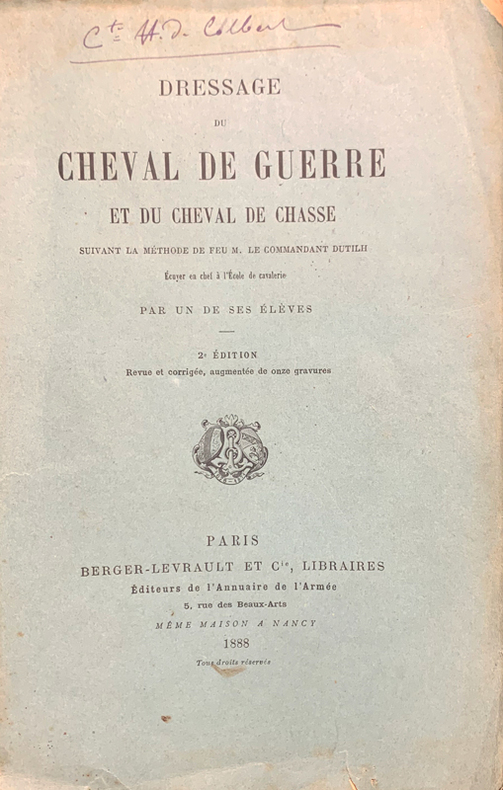
Dressage du cheval de guerre et du cheval de chasse, suivant la méthode du feu M. le commandant Dutilh écuyer en chef à l'Ecole de cavalerie, par un de des élèves [Sieyès]. 2e édition revue et corrigée, augmentée de onze gravures.
Paris, Berger-Levrault, 1888 ; in-8, broché ; 210, [2] pp. de Catalogue et 11 gravures in-texte, couverture verte imprimée.
Riferimento per il libraio : 22356
|
|
|
[SIREY]
PORTRAIT PRÉSUMÉ D’AIMÉ ALEXIS SIREY, FILS DE JEAN-BAPTISTE SIREY, École française de la fin du XIXe siècle
, 45 x 36 cm à la française [cadre], sanguine, pierre noire et rehauts de blancs sur papier, signée en bas à gauche, cadre en bois clair d’époque orné d’une fine frise (traces de frottements et petis coups sur le cadre).
Riferimento per il libraio : 4242

|
|
|
[Silk production in Granada - presentation manuscript]. Baños y Molina, Pedro Paschio de.
Manifiesto del origen, progreso, y estado de la real hacienda y renta de poblacion en la ciudad, y reyno de Granada, que ha estado enagenada de la corona desde primero de enero de 1726 hasta fin de agosto del de 760. [Granada?], 22 March 1762.
4to (the tables measuring ca. 515 x 740 mm). - (Bound with) II: Copia de la carta remitida a s.e. en 16 de septiembre de 760, que acompaño al manifiesto, plan y demas documentos sobre renta. - (Bound with) III: Manifiesto de la renta de seda del reyno de Granada, executado de orden del Exmo. Sr. Marques de Esquilace del Consejo de S.M. su secretario de el de Hacienda y Superintendente general de todas Rentas Reales. 17 ff., 11 ff., plus 2 large folding tables ("Estado de los morales y moredas existentes en la Ciudad de Granada, ciudades, villas y lugares de su thesoreria" and "Plan general de los valores que produce la Real Hacienda de población del reyno de Granada"). Stored loosely in a modern folder. Impressive calligraphic presentation manuscript with an account of the history and 18th century state of the renowned silk production in Granada. Having belonged to the Marqués de Esquilache, Minister of Charles III, and signed in Granada by Pedro Paschio de Baños y Molina (1762), this beautiful copy was executed by a skilled calligrapher for the personal collection of the Marqués, probably by a calligrapher in Granada, where resided a number of professional scribes who produced elaborately decorated Cartas Ejecutorias (patents of nobility) for the Cancilleria. - Granada was known for centuries throughout the Mediterranean and beyond for the high quality of its silk: according to the German traveller Hieronymus Münzer in 1492, theirs was the best in the world. Its fame lasted to the end of the 19th century, when the German Imperial family still bought Granada silk. The cultivation of silk in Granada had been the main source of revenue for the Muslim Nasrid Kingdom of Granada; after its fall to the Catholic kings in 1492, it filled the coffers of the Spanish crown. Until the expulsion of the Moriscos in 1609 the production of silk remained mainly in their hands. Historians have argued that the steep hike of silk taxes ordered by Philip II led to the Morisco rebellion of 1568-71. The silk was traded from three exchanges (alcacerías), the main one situated in Granada, where since the period of Nazari rule Genovese traders were active and exported the silk throughout the Mediterranean and even to America. - This document testifies to the great interest that the Spanish kings took in the promotion, cultivation, and trade of silk in the second part of the 18th century. It is a beautiful document remarkable for the wealth of information it contains. In the best spirit of the Enlightenment, it meticulously records the number of mulberry trees in all localities of Granada, from the smallest to the largest, the number of additional trees that could be planted, the yearly expenses for juros (loans that the King had vouched to pay to certain individuals and religious institutions), and other items. - The document is addressed to the Marqués de Esquilache, minister of King Charles III, by Pedro Paschaio de Baños y Molina, director of the King's revenue in Granada. Paschaio, a member of a family of accountants, became very wealthy at the service of the crown. In 1752 he owned nine houses in the Macarena in Granada, six taverns, and lands. Born in 1691, he bought the post of mayor of the city of Granada in 1724. From this position he initiated his social ascent by organizing the visit of King Philip V to the city in 1730. By 1760 he was director of finances of Granada, an office which undoubtedly augmented his wealth. He financed several important religious buildings in Granada in the late Baroque style. - Professionally restored tears, almost invisible, to large folding tables; some minor oxidation to ink as expected, but overall in excellent condition. A. M. Gómez Román, "Moral aristocrática, filantropía y promoción en la figura de Pedro Pascasio de Baños", Cuadernos de Arte de la Universidad de Granada 36 (2005), pp. 139-149. J. Highet, "Silks from Islamic Lands", Asian Art, 6 March 2014. J. R. McNeill, The Mountains of the Mediterranean. An Environmental History (Cambridge, 1992), p. 226. Girón Pascual Rafael María, Las Indias de Génova. Mercaderes genoveses en el reino de Granada durante la edad moderna (Editorial de la Universidad de Granada, 2013).
|
|
|
[SOEURS DE NOTRE-DAME DE CHAMBRIAC].
Règlement pour les Soeurs de Notre-Dame de la Montgie.
Manuscrit petit in-4 (23,5 x 18,5 cm). 11 pages - 4 feuimmets blancs. Couverture muette. Déchirure angulaire avec atteinte au texte au premier feuillet. des rousseurs.
Riferimento per il libraio : 13173
|
|
|
[Société archéologique de Béziers].
"Musée lapidaire. Aperçu général de l'histoire de Béziers." Manuscript for a general history of Béziers based on the objects of the Museum of the Archaeological Society. [Béziers], 1910-1911.
4to. French manuscript in blue and red ink on paper. 107 pp. With an index and 68 photographs mostly outside the text (37 numbered plates). Original half cloth notebook. Sewn. Beautiful, unpublished manuscript that must be attributed to a member of the Archaeological Society of Béziers. From 1866, the society’s "Musée lapidaire" was housed in the unfinished monastery attached to the Béziers Cathedral. Today, only a few of the more than 300 objects are still on display there, while most have been transferred to the Musée du Biterrois. The author traces the eventful history of Béziers based on objects of the collection and their inscriptions, dating from the Roman period to the 18th century. The objects from the Roman period offer the greatest variety; they include a head of Silenus, the statue of a Roman Emperor, locally known as Pépézut, funerary monuments and architectural ornaments. In the preface, the author thanks the former president of the Archaeological Society, Louis Noguier, and two other members who contributed to the establishment of the museum. In 1899, Noguier had published a book on the museum’s inscriptions from the Christian period. Based on a clipping from a local newspaper with an article on a congress of the Archaeological Society in January 1911, the manuscript can be tentatively ascribed to Joseph Dardé, secretary of the society and curator of the museum. - Several pages loose, as are the plates. Some browning. Occasional bent corners, margins, and minor tears.
|
|
|
[SPIESS] GODEL Vahé:
Henry Spiess poète survivant.
Genève, Georg, 1963. In-12 de format carré, broché de 130-[2] pages, couverture verte pomme.
Riferimento per il libraio : 21607

|
|
|
[Steiermark - Verwaltung].
"Extract der in der Landthandvest einkhomenden kays. rescripten und privilegien". O. O., 8. X. 1731.
Handschrift auf Papier. 4 SS. auf Doppelblatt. Folio (320:206 mm). Wohl mit Bezug auf eine gedruckte Fassung der "Lanndhanduest. Des Löblichen Hertogthumbs Steyr, darinnen Keyserliche, Königliche, und Landtsfürstliche Freyhaiten, Statua, Landtgebrauch and andere Satz" enthaltenden Gerichts-, Polizei- und Landordnung des seit 1192 zu Österreich gehörigen Herzogtums Steiermark entstandenes Exzerpt, in dem der Verfasser an Hand einzelner Abschnitte das "Rescriptum v. Verdinands des dritten, die Veranlaßte Erbhuldigung betreffend; [das] Rescriptum ab eodem die confirmation der privilegien, und [die] Concessionen dises Land Steyr betreffend" notiert. - In altem Sammlungsumschlag.
|
|
|
[Steinhauer, Anton.] Johannes à Sancto Andrea.
Vado mori, sive via omnis carnis morte duce mortalibus in processione mortuorum monstrata. Prag, Cornelius Peter Werner, 1733 [eigtl. Lwow, 1747].
Deutsche Handschrift auf Papier. (4), 52 SS., 2 w. Bll. Halblederband der Zeit. 8vo. Zeitgenössische hochbarocke Abschrift der ersten Ausgabe von Steinhauers totentanzartiger Erbauungsschrift in der Tradition der "Ars bene moriendi" durch den Lemberger Redemptoristen Johannes à Sancto Andrea (unter dem kopierten Zensurvermerk eigenh. signiert und datiert 1747). - Papierbedingt durchgehend etwas gebräunt. Vgl. Jantz 2663 (Ausg. 1744). De Backer/Sommervogel VII, 1540, 1. Graesse VI, 433.
|
|
|
[Suppression of the Society of Jesus].
"Per la soppressione della Società". Manuscript copy of ten anti-Jesuit poems. No place, late 18th century.
4to. Italian manuscript on paper. 7½ pp. on bifolia. The collection starts with a long poem comprising 37 verses of 3 lines each that calls for the suppression of the Jesuits, starting: "Giorno d'ira, e di furore / Di ruine apportatore / Spunta all'empio, e all'impostore". The unpublished poem is addressed to the Pope and repeats typical accusations brought against the Society of Jesus. - It is followed by three sonnets concerning the controversial and at the time unsuccessful canonization process for Juan de Palafox y Mendoza (1600-59), the former bishop of Puebla who had briefly served as Archbishop of Mexico (1640-42) and as Viceroy of New Spain (1642). Palafox y Mendoza is famous for his long conflict with the powerful Jesuits of New Spain over ecclesiastical jurisdiction. The Jesuits ultimately succeeded in having the bishop transferred from Puebla to a minor see in Old Castile in 1653, effectively ending his career. In the 18th century, Palafox y Mendoza's anti-Jesuit writings gained popularity and were an important factor in the banishment of the Jesuits from Spain in 1767. The introduction of the cause of beatification was approved by Pope Benedict XIII in 1726 but a positive decision by the responsible congregation in 1777 was suspended by Pope Pius VI through the intervention of the Jesuits. The poems must be seen in this context; the first stave of the third poem reads: "Oh Gesuiti! Della Terra f[a]ex, / Infine l'ha pur vinta Palafox, / E difesolo il forte Hispaniae Rex, / Che no teme da Voi la mala Nox". - The fourth sonnet in the collection is a caustic reinterpretation of the famous prophecy that Ignatius of Loyola had received in a vision of Christ near Rome in 1537, starting: "I shall be favourable to you in Rome". - Four sonnets are warnings and outright criticisms of Pope Clement XIII (1758-69), a former Jesuit. The first of the sonnets is a speech by the personification of the Adriatic Sea to the Pope, commanding him to safeguard the honour of St Peter and warning him of coming storms. This is followed by three variations of a sonnet that does not directly address Clement but openly criticizes Papal decisions and his opposition to the ruling Princes of Europe, comparing the Pope to the Kings of Egypt and Assyria in an allusion to the biblical stories of Moses and Judith. - The final sonnet in the collection with two additional staves of 3 lines in the end strikes a similar tone, now directly attacking the Jesuits. It underlines that Rome must obey the European potentates, directly mentioning the court in Vienna, in order to be saved and restore its glory by "extinguishing" the Jesuits: "Che sarai salva, e con gloria distinta / Quando la Società vedrassi estinta". - With very slight stains. Well preserved.
|
|
|
[Suppression of the Society of Jesus].
Anonymous anti-Jesuit poem written upon the death of Pope Clement XIV. No place, ca. 1774.
8vo. Italian manuscript on paper. 1 p. The poetic persona of this slanderous sonnet is the devil who informs the Jesuits of Clement's demise and incites them to use the opportunity for their malefactions, implying that they are responsible for papicides and regicides: "Mort'é Clemente (all'empia Società / Il Diavol' prese tosto a dir' così.) / Teneri Figli miei, vedete già, / Quanto per voi m'adopri e notte, e dì. / Or sappiate, che in man vi tornerá, / Tutto ciò, che il destin à voi rapí, / E che La Compagnia risorgerá, / Ad onta di Colui, che vi abboli, / Deh.' [Non] cari Figli, non temete più, / Seguite pur à uccider Papi, e Ré, / Ch'io sempre vi darró [!] forza, e virtú, / Ed al vostro valor ampia mercè, / Finchè verrete poi tutti quaggiù, / Eternamente ad abitar con me". - A slightly different version of this poem was published in the posthumous eighth volume of José Ortiz y Sanz's "Historia general de España" with the sardonic comment that the "devil apparently had some prognostic power" but that his words are unreliable, as is to be expected for a statement by the devil. - On 21 July 1773, Clement XIV issued the papal brief "Dominus ac Redemptor Noster" ordering the suppression of the Society of Jesus. This was probably the most controversial political decision of the 18th century, leading to a surge of propaganda for and against the Jesuits and the Pope that culminated after Clement's death on 22 September 1774. - Traces of folds. With a small burn hole and minor stains. J. Ortiz y Sanz, Historia general de España, Volume VIII (Madrid, 1846), p. 243.
|
|
|
[Suppression of the Society of Jesus].
Anonymous manuscript with 13 predominantly anti-Jesuit poems. No place, late 18th century.
4to. Italian manuscript on paper. 12 pp. on bifolia. The first poem in the manuscript is an anonymous sonnet entitled "In occasione della Vinciza fatta al Lotto di Napoli industriosamente dalli Romani" that compares Roman politics to the "damned game" of lottery, but also a "sorbet" that needs to be swallowed, and attacks several people, including the cardinals and Curia members Luigi Maria Torregiani and Simone Buonaccorsi, as "assassins" and "perfidious ministers" who give Romans the "title of thieves". - The second anonymous poem is an anti-Jesuit sonnet, presented as a kind of prophecy that was "recovered above" a Jesuit building in Rome "nell' Arco de' Greci", probably referring to the Collegium Graecorum. It compares the Jesuits to a "flock of birds" who built their nest from loot but are now "cast out", alluding to the suppression of the Society of Jesus in 1773. The final stave openly calls for violence, even threatening those who do not participate in the extirpation: "Per estirpar la maladetta Razza / Calpesteremo il Nido, i Padri, e l'ova | E proscritto sarà chi non c'ammazza". - This is followed by a copy of Carlo Innocenzo Frugoni's (1692-1768) sonnet "L'Angelo Sterminatore", here appropriated for anti-Jesuit purposes, calling for the "expulsion of the Society" from Parma. The sonnet has been published in the second volume of Frugoni's collected poetry (C. I. Frugone, Opere poetiche II [Parma, 1779], p. 373). - Another comparison of the Jesuits with birds, now ravens, is presented in an anonymous Latin distich: "Dar Lojoliticii [...] Opes, Gusmani Corpus Alumnis: / Num Carnes Corvus, devorat Ossa Canis." According to an added explanation, the poem was written to commemorate a Neapolitan woman who died because she compromised her devotion to St Dominic with her estimation for the Jesuits and followed "their advice" concerning her inheritance. - The fifth poem in the manuscript is another sonnet that is satirically attributed to Lorenzo Ricci, the General of the Society of Jesus at the time of their suppression. In lamenting the downfall of the Jesuits, the fictional Ricci corroborates calumnious accusations brought against them. The first stave reads: "Siam giunte al fine delle nostre imprese, / Speranza più non v'è di coglier frutti, / Il colpo già letal, onde palese / E la scentura, che sovrasta à tutti." This is followed by another sonnet that traces in a highly spiteful tone the "situation and conduct" of several important Jesuits following the suppression: "Situazione, e condotta del P. N., e di varii del Cordon Bleu dell'Ordine Lojolitico", starting with the General: "Ricci singhiozza smania, e si tapina". - Two further sonnets are actual works of the Jesuit poets Severio Bettinelli and Giulio Cesare Cordara, although the second sonnet is wrongly attributed to Bettinelli as well. Bettinelli's sonnet "Tuona, fulmina, e sbuffa Torregiani", apparently written after the expulsion of the Jesuits from Spain in 1767 in order to "slander diverse Cardinals" such as Luigi Maria Torregiani, is met with critical annotations, whereas Cordara's apologetical sonnet "Cadrà, se così in Ciel si trova scritto" is derided in two anti-Jesuit "responses" in the form of sonnets. These are immediately followed by a satirical sonnet that ridicules the expulsed Jesuits of Spain who "cannot find anybody who allows them to disembark", starting "Ah nave, ah nave che nel mezzo all'onde". Cordara's poem has been published in the Italian journal "La Voce della Ragione" in 1832, where it is dated to 1773. - Another sonnet is couched in the form of a dialogue between "Pasquino e Marforio" and is thus a classical Roman pasquinade. Pasquino asks Marforio whether it is true that a Dominican friar has been murdered in Martinique. Marforio confirms this, implicating a Jesuit named Scarponio who had brought the news to him through a disciple. - The final and longest poem of the collection (82 verses of 4 lines) is a "Canzonetta to the Genovese Signori who welcomed the Jesuits expulsed from Spain on Corsica". The poem is a furious denouncement of Genovese hospitality and closes with a plea for Justice, asking God to "release the brakes" and have the "evil Society completely suppressed and extinguished", followed by an "Amen". More than 2,600 Jesuits were forced to leave Spain in 1767 and take refuge in Corsica until 1768, when the island was taken over by France, which had already expelled the Jesuits from its territories in 1764. This development finally forced Pope Clement XIII grudgingly to allow the exiles to enter the Papal states. - Occasional stains and browning. Well preserved.
|
|
|
[Suppression of the Society of Jesus].
Anonymous manuscript with three anti-Jesuit texts. No place, ca. 1773.
4to. 1¾ pp. on bifolium. The first text is a Life of the controversial Jesuit Gabriel Malagrida (1689-1761) with its satirized counterpart, written in opposing columns. Italian introductions were added in order to lend the Latin "original texts" a note of authenticity: "Short chronicle printed underneath the image of Father Malagrida, found in the case of a Jesuit father who had been robbed in Belforte. The figure is conical and Father Malagrida is represented in the habit of a Jesuit missionary with a walking stick in hand [...]". The satirized version of the introduction identifies the Jesuits as thieves and describes Malagrida in "the habit of an assassin with a deadly knife in hand". Both "vitas" follow an established formula for short biographies of deceased Jesuits. The satirical version is fiercely vitriolic, repeating common accusations against the Jesuits such as disloyalty, idolatry, and regicide. The description of the image probably refers to an actual engraved "portrait" of Malagrida. This anonymous engraving, clearly libellous, would not have been carried by a Jesuit and circulated in various copies with anti-Jesuit captions. - Gabriel Malagrida was an Italian Jesuit who worked as a missionary in Brazil for 28 years. When he returned to Portugal in 1750, Malagrida was highly respected at court. His fervour in explaining the 1755 earthquake of Lisbon as a divine punishment gave his biggest enemy at the court, prime minister Sebastião José de Carvalho, the leverage to procure Malagrida's banishment from the capital. In 1758 he was falsely accused of having been part of the conspiracy behind an attempt on the life of King José I and found guilty of high treason. This so-called Távora affair served as a pretext for the banishment of the Jesuits from Portugal in 1759. As the Inquisition found no proof of his guilt, Malagrida could not be executed for treason, and Carvalho moved on to accuse him of heresy based on falsely attributed texts. In a blatant miscarriage of justice, Gabriel Malagrida was strangled and burned in Lisbon on 21 September 1761. - The first of two sonnets completing the collection is presented as if it had been recited by a brother of King George III during the solemn unveiling of a statue of Pope Clement XIV in the house of a Catholic English Lord. Pope Clement XIV was surprisingly popular in Britain, as he did not recognize the Catholic Jacobites as pretenders to the British throne, and for his anti-Jesuit stance. A bust of the Pope by Christopher Hewetson was copied several times for members of the British nobility. - The second anonymous sonnet "against the Jesuit fathers" was supposedly "sent to Rome printed in golden characters to the ambassador of Spain and presented to the Pope by him". The sonnet describes the purported reaction of Lorenzo Ricci, the Superior General of the Jesuits, to the suppression of the Society by Pope Clement XIV. The first stave reads: "Ricci crollando l'orgogliosa testa / Chiamo fremente i suoi Compagni, e disse / Reco novella, o Figli miei funesta, / Il rio Clemente il gran decreto scrisse". - Lorenzo Ricci was arrested soon after the suppression of the Jesuits on 21 July 1773. He was indefinitely imprisoned without trial at the Castel Sant'Angelo in Rome and died there in 1775. - Some browning, creases, and minor tears. Minimal damage due to ink corrosion.
|
|
|
[Suppression of the Society of Jesus].
Manuscript copy of six anti-Jesuit poems. No place, late 18th century.
4to. Italian manuscript on paper. 4 pp. on bifolium. The first sonnet in this collection mocks the Jesuits expelled from Spain in 1767, who did not receive permission to land with their ships in the Papal States. The first stave reads: "E ancor sul crespo di Nettuno / Van del suo fato incerte galleggiando / Le navi ch'ebber dalla Spagna il bando, / Carche d'ira di Dio vestita a bruno!". - The second poem pretends to be a lamentation of the Jesuit Provincial of Aragon: "Il Provinciale de Gesuiti d'Aragona, non permettendosele lo sbarco nel Porto di Civita Vecchia, si querela con i seguenti Versi di Virgilio". The fictional Jesuit quotes the Aeneid (I, 539-544), wherein a lack of hospitality towards the Trojans is decried. - The two following sonnets scold the Jesuits, based on a quarrel with the Piarists. In a droll metaphor, the Piarists' mantillas are described as thermometers indicating the trouble resulting from the "affairs of the Jesuits" in terms of storms and tempests: "Ma nel torbigo tempo, ed infelice / Alzarsi ad occhio, e vaccorciar si vede: / Onde or tempesta, ed or seren predite." The second sonnet is a response to the "Piarists who jubilate over the Jesuit catastrophes". - The longest poem in the collection, consisting of 14 staves of four and three lines, accuses the Jesuits of not celebrating Mass on Christmas Eve, instead luring the naive believers to celebrate an idolatrous Mass on Good Friday: "Li PP. Gesuiti nella Notte del SS. Natale non celebrano le sacre Funzioni ordinate dalla S. Chiesa come tutti gli altri Ecclesiastici; ma tengono chiuse le Porte delle loro Chiese sin' all'Aurora: Il Venerdi Santo poi espongono il SS. Sacramento col solito Rito, e Ceremonie, e danno al Popolo la Benedizione." The Jesuits are thus likened to the Protestants through a breach of the Roman Rite that has no celebration of Mass between the Lord's Supper on Holy Thursday evening and Easter Vigil. Apart from idolatry, their true motive is presented to be hunger for power. The poem calls them "treacherous pirates who only lust for kingdoms and treasures" and celebrates their expulsion from France (1764) and Spain (1767). - A final sonnet in the collection predicts the fall of the "tall, terrible colossus" that is the Jesuit Order, repeating common accusations against the Society of Jesus that was suppressed by Pope Clement XIV in 1773. - With occasional brownstains and a minor tear to the fold.
|
|
|
[TALLEMANT (Paul).
Manuscrit XVIIIe]. Le Voyage de l'Ile d'Amour ou la Clef des coeurs.
S.l.n.d., , 1713 vers . Manuscrit in-12 carré (128 x 177 mm) de (51) ff., veau brun granité, dos orné à nerfs (reliure de l'époque).
Riferimento per il libraio : 43452

|
|
|
[TALLEYRAND] - MANUSCRIT anonyme
Réflexions sur l'éducation, adressées par un père à celui qui doit élever son fils.
[1768]. Gr. in-8° 537p. Reliure plein veau d'époque, dos à nerfs orné de fleurons dorés, encadrement doré sur les plats, tranches dorées
Riferimento per il libraio : 43275

|
|
|
[Tabak; Arents, George]. - Brooks, Jerome E. (Hg.)
Tobacco. Its History Illustrated by the Books, Manuscripts and Engravings In the Library of George Arents, Jr. Together with an introductory essay a glossary and bibliographic notes by Jerome E. Brooks. 5 Bände u. 10 Lieferungen.
New York, The Rosenbach Company u.a., 1937-1969. Fol. Mit sehr zahlr., tlw. ganzs. bzw. farb. Abbildungen im Text u. auf Tafeln sowie einer gefalt. Beilage. Zus. ca. 3180 S., OLwd.-Bde. (Bde. 1-5) bzw. OUmschläge (Lieferungen 1-10).
Riferimento per il libraio : 53774
|
|
|
[Tabak; Arents, George]. - Brooks, Jerome E. (Hg.)
Tobacco. Its History Illustrated by the Books, Manuscripts and Engravings In the Library of George Arents, Jr. Together with an introductory essay a glossary and bibliographic notes by Jerome E. Brooks. 5 Bände.
Mansfield, Martino Fine Books, o. J. (Nachdruck der Ausgabe Florenz 1937-1952). 4°. Mit Abbildungen u. einer mehrf. gefalt. Beilage. Zus. ca. 2.520 S., OLwd.-Bde.
Riferimento per il libraio : 66759

|
|
|
[TEPEDELENLIZÂDE] ISMAIL RAHMI PASHA, (Active as Turkish / Ottoman governor of Adrianople between 1848-1850).
Autograph letter signed [sealed] 'Vâlî-yi Edirne Es-Seyyid Ismail Rahmi' to famous Crimean origin Haci Giray family for condolences.
Very Good Turkish, Ottoman (1500-1928) Original autograph manuscript letter sent to Haci Giray family for condolences on Haci Giray's death. 38x21 cm. On a special paper with 'ahar'. Sealed. 1 p. Has six lines. With a legible script and fine calligraphic style. It starts with 'huve'. He was a Turkish statesman, governor and member of state council according to Sicill-i Osmânî by Süreya and Türkischer Biographischer Index. The House of Giray (Crimean Tatar: Geraylar, Turkish: Âl-i Cengiz), also Girays, were the Genghisid/Turkic dynasty that reigned in the Khanate of Crimea from its formation in 1427 until its downfall in 1783. The dynasty also supplied several khans of Kazan and Astrakhan between 1521 and 1550. Apart from the royal Girays, there was also a lateral branch, the Choban Girays (Çoban Geraylar). Before reaching the age of majority, young Girays were brought up in one of the Circassian tribes, where they were instructed in the arts of war. The Giray khans were elected by other Crimean Tatar dynasts, called myrzas (mirzalar). They also elected an heir apparent, called the qalgha sultan (qalga sultan). In later centuries, the Ottoman Sultan obtained the right of installing and deposing the khans at his will. Giray family settled in Adrianople (Edirne) city in 17th century.
|
|
|
[Théodore de Banville] - LARIVIERE Charles de - [1856-1929] - Littérateur français
Manuscrit autographe d'introduction à une conférence sur Théodore de Banville et au profit de l'Alliance française à Lons-le-Saulnier -
2 pages in8 - bon état -
Riferimento per il libraio : GF27307
|
|
|
[THESE DE THEOLOGIE, MANUSCRIT] - RAPP (Emile) -
RELIGION ANTIQUE.
Strasbourg, L'AUTEUR, 1907 ; in-4, 247 pp., br. Broché en état moyen -MANUSCRIT EN ALLEMAND - these de théologie allemande dirigé par Albert Herhard -these manuelle.
Riferimento per il libraio : 201710643
|
|
|
[Theologische Handschrift].
["Schluß Denksprüche" (Incipit)]. O. O. u. D., [wohl Anfang 19. Jhdt.].
90 beschr. SS. auf 46 Bll. Marmorierter Pappband der Zeit. 4to. Der zweite Teil einer theologischen Handschrift über "Motivenlehre. Von der Unsterblichkeit der menschlichen Seele", "Von dem besonderen Gerichte", "Von dem Reinigungsorte der menschlichen Seele", "Von der Auferstehung der Todten am Ende der Welt", "Von dem allgemeinen Gerichte", "Von dem Himmel", "Von dem Orte des ewigen Unglückes" u. a. Handschrift schließt mit den Worten "Ende des zweyten Kurses der dritten Grammaticalklasse". - Der Einband etwas berieben und bestoßen, innen tadellos.
|
|
|
[THOMPSON (Henry Yates)] Editor.
Facsimiles of Two "Histoires" by Jean Foucquet from Vols. I. and II. of the "Anciennet?s des Juifs", Numbered Respectively 247 fran?ais in the National Library of France, and 101 in in the Supplemental Volume... of the Catalogue of Illuminated Manuscripts in the Collection of Henry Yates Thompson, to Which is Added a Notice with 2 Photogravures and Four Photographic Facsimiles (By Three-Colour Process) from Detached Pages of a Fifteenth-Century Manuscript of "Historie Ancienne jesqu'? Romains".
2 Vols., folio and royal 4to, 10; [ii]pp., limited edition of 20 copies, 5 photogravure, 4 coloured photograph plates, each with a leaf of letterpress explanatory text, cont. printed wrapper, cloth spine, enclosed in orig. portfolio, a nice copy. Extremely scarce, limited to 20 set for private distribution.
|
|
|
[Tibet].
The Perfection of Wisdom in Eight Thousand Lines. Tibet, 13th century CE.
20 x 65 cm. 314 sheets of heavy, multi-layered paper stained in blue over the whole area, varnished on the writing space, surrounded by a frame, within which are written 8 lines of approximately 80 characters in Tibetan uchen (dbu-can) script using gold ink. Each leaf written on both sides. Upper cover from another manuscript, in black ink; beneath a flap are 2 lines of very large script with the words "in the language of India". The first leaves of the manuscript contain 4, 5, 6 and 7 lines of script. Text is complete. A canonical Buddhist sutra and the central text of the Mahayana Prajnaparamita school. The present text is a Tibetan translation from the original Sanskrit, of which there are also Chinese, Korean, and Japanese translations. The "Perfection of Wisdom" sutra exists in a range of shorter and longer recensions, of which that in 8,000 lines is regarded as having been the source, since according to Buddhist belief, its precursor, no longer extant, in Buddhist Prakrit, the vernacular language actually spoken by the Buddha, transmitted the actual spoken words of the Buddha. This Sanskrit text was then expanded into versions in 10,000, 18,000, 25,000, and 100,000 lines or verses, for the advanced adepts who could appreciate detailed commentary, and on the other hand abbreviated to versions in 2,500, 700, 500, 300, 150 and 25 lines for those of lesser understanding. Modern scholarship considers that the text was elaborated by a series of additions to a small original core, not identical to any of the later 'short' versions, over the period from 50 to 700 CE. - The first Tibetan translation was made in around 850 CE and the second in 1020 CE. By this time the text had achieved its canonical form. Further comparison with the Sanskrit original and with additional Sanskrit manuscripts led to revisions of the Tibetan translation in 1030, 1075 and 1500. The Tibetan translation achieves a high level of understanding and accuracy and has been useful to modern scholars occupied in establishing and analysing the Sanskrit text. The whole range of Tibetan versions of the sutra on the "Perfection of Wisdom" has been edited, translated and commented on by Edward Conze. - The sutra recounts a debate at Rajagriha, on the Vulture Peak, where 1,250 Buddhist monks gathered to hear the Buddha. The other main speakers are the Buddha's disciples Subhuti, who puts forward the Prajnaparamita principles, and Sariputra, who puts forward the conservative views of those monks who are unable to follow these new developments. - While there is no colophon, this manuscript was almost certainly donated or sponsored by a lay person who hoped to win merit by financing the copying of the text. This manuscript is a superb example of Tibetan uchen (dbu-can) calligraphy produced during the 13th and 14th centuries. The text shows a few archaistic orthographic characteristics, such as the presence of the da-drag (the letter 'da' as a secondary suffix for some syllables), which suggest an early date, probably 13th or 14th century. - Although the manuscript is not illustrated, it displays some of the best uchen calligraphy produced in Tibet. The gold letters are pleasingly spaced and very exactly executed on the lustrous blue ground, which represent "the clear empty space, the void from which all things arise". - Some damage to the outer corners of the upper and lower 10-20 leaves. With very early marginal patches over tears from frequent turning of the pages. - Provenance: McCarthy Collection, Hong Kong, 2010-18. Previously in a UK private collection, UK, acquired in 1999.
|
|
|
[Tibet].
Tibetan manuscript. Tibet, 19th century.
380 x 145 mm. 34 pp. Stitched. Manuscript on iconocraphy and proportions. - Signs of age, browned.
|
|
|
[Tirol - Rattenberg].
Wareneingangsbuch einer Fernhandelsniederlassung. Rattenberg, 1788-1807 und 1810-1824.
Folio (ca. 265 x 350 mm). Deutsche Handschrift auf Papier. 1007, (25) SS., durchschossen. Blindgepr. Halblederband der Zeit über gemusterten Deckeln. Schließbänder. Eindrucksvolles Geschäftsbuch aus der Tiroler Gemeinde Rattenberg, einst zentraler Umschlagplatz für Waren der Innschifffahrt mit Beziehungen bis in den Mittleren Osten. Die jährlich dokumentierten Warenlieferungen, darunter vornehmlich Spezereien und textile Erzeugnisse sowie Branntwein, Kaffee, Tabak und Schokolade, zeugen von florierenden Handelsbeziehungen, vorrangig mit Städten in Deutschland, Österreich und Italien. Darüber hinaus scheinen auch Prag in Böhmen und sogar das Osmanische Reich auf: so importierte man in Rattenberg etwa Güter wie Rotgarn und Safran vom Händler Berusi in Konstantinopel (S. 262). - Unter den stark frequentierten europäischen Häusern sind die Tabakfabrik Maffei in München, das Handelshaus Lödel & Merkel in Nürnberg sowie die Firma Tabiseo & Pontini in Triest zu nennen. Ferner sind regelmäßige Einkäufe bei der Haller Frühlings- und Herbstmesse sowie bei der Bartholomäusmesse in Linz verzeichnet. - Von den Wirren der Napoleonischen Kriege berichtet ein Eintrag am Ende des Jahres 1796: "Dißes Jahr war der Krieg mit die Franzoßen am allerhöchsten. Sie drangen iber Brixen bis Mittewald vor und zogen durch Pusterthall bis Leoben in Steyer Mark [...]" (S. 274). - Ab 1817 mit der Angabe "in Rattenberg" in der Kopfzeile zusätzlich zu der Devise "Soli Deo Gloria" oder "Mit Gott". Einige leere Seiten herausgetrennt. Einband leicht berieben und etwas wurmstichtig, 2 Schließbänder nur fragmentarisch erhalten. Hinteres Innengelenk angebrochen; die erste Lage vom Block gelöst. Am Ende unten mit kleinem Wasserrand; vereinzelt etwas fleckig. - Überaus reichhaltige Quelle zum internationalen Warenverkehr dreier Jahrzehnte.
|
|
|
[TOULOUSE] [PARCHEMIN XVIIe]
Enregistrement du contrat de mariage entre Jean Louis Courtois, avocat en la cour, et Anne de Tiffauld, fille de Jean Arnauld de Tiffaul, avocat en la cour.
1625 Pièce ms sur parch. (0,33 x 0,22), recto-verso. Toulouse, 27 janvier 1625.
Riferimento per il libraio : 575853

|
|
|
[TOLAND (John).
Manuscrit clandestin]. Le Nazaréen ou Le Christianisme des Juifs, des gentils et des Mahométans. Traduit de l'anglois de Jean Toland.
, , 1735. 2 volumes in-8 carré manuscrits (190 x 135 mm) de (171) ff. et (93) ff., nombreuses manchettes, veau fauve glacé, dos lisse orné, pièce de titre en maroquin rouge, triple filet doré d'encadrement sur les plats, tranches dorées (reliure de l'époque).
Riferimento per il libraio : 44761

|
|
|
[TOULON. REVOLUTION].-
Récompense nationale de l'école centrale, mathématiques. Second prix remporté par Charles Martin âgé de 13 ans de la commune de Toulon, distribué par l'adon mple de Toulon en vertu de l'arrêté du dpt du Var en date du
27 fructidor.- Toulon 30 fructidor an six de la république française. (16 Septembre 1798). Feuillet in-12 manuscrit signé Guigou, Guiol, Courté et Bonhomme, cachet très pâle de l'Administration municipale de Toulon. Feuille sans doute décollée d'un ouvrage (traces au dos), déchiquetée sur les bords mais texte complet. Rare document.
Riferimento per il libraio : ORD-13598
|
|
|
[TODD (Henry John)]
Catalogue of the Books, Both Manuscript and Printed, Which are Preserved in the Library of Christ Church, Canterbury.
First Edition, [vi],cii,[ii],131,[1]pp., orig. boards, spine and printed paper label slightly chipped otherwise a nice copy, uncut. Rich in manuscript materials relating to civil and ecclesiastical history of the county, and to Saxon literature in general.
|
|
|
[TORÀ, Domingo].
Virginis Mariae Laudatoriae Praeces Laminis Aenaeis Ordine Representate 1783. Ex Libris Dominici Torà.
Volúmen en 8vo. integrado por las 58 láminas de Catharina Klauber , 112 hojas manuscritas, prácticamente todas en castellano, y una lámina grabada con el retrato de Luis XVI, con una oración escrita en el reverso, por lo que se puede suponer que la conclusión del manuscrito sería entre 1793 y 1794. Encuadernación de época en pergamino.

|
|
|
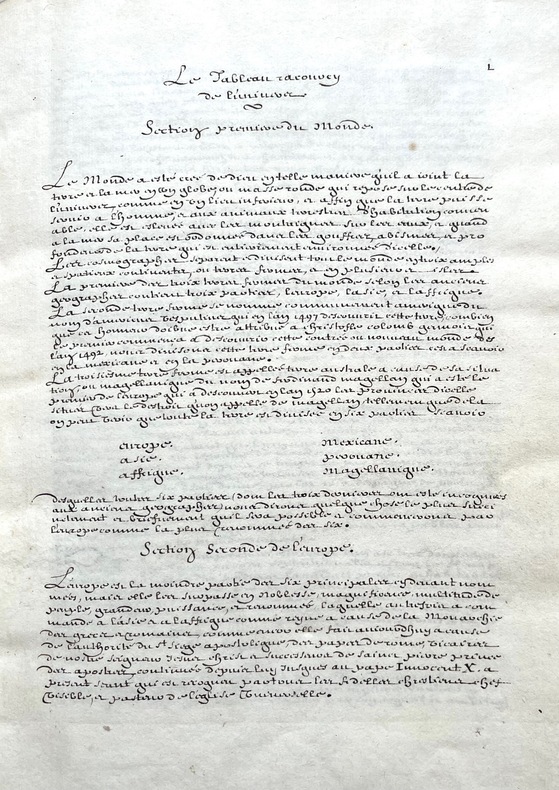
[TRAITE MANUSCRIT/MANUSCRIPT TREATISE] CHASTILLIER (Sieur Baptiste du)
LE TABLEAU de L'UNIVERS ou SONT REPRESENTEZ LES ROYAUMES, REPUBLIQUES, PRINCIPAUTES, PROVINCES DES QUATRE PARTIES DU MONDE.
1651. 1651 1 vol in-12° manuscrit (230 x 170 mm) de : [1] f. (titre) ; 180 pp. Ex libris du baron Martineau des Chesnes collé au dos du premier plat. Plein veau raciné, dos à nerfs orné et titré, double encadrement de deux filets dorés et motifs sur les plats, gardes de papier marbré. (Reliure frottée, fente aux mors et manque une coiffe).
Riferimento per il libraio : 4677
|
|
|
[TRES RICHES HEURES DU DUC DE BERRY - FAC-SIMILE]
Les Très Riches Heures du Duc de Berry. [Volume de fac-similé et volume de commentaires].
2 volumes in-folio (305 x 215 mm). Pour le volume fac-similé: reliure de maroquin rouge reproduisant la reliure d'origine, dos à 5 faux-nerfs orné de compartiments cloisonnés et fleuronnés, plats ornés d'armes dorées au centre dans un large encadrement de roulettes, tranches dorées, 207 feuillets. Pour le volume de commentaires: demi-maroquin rouge, dos lisse, titre doré, 435 pages. Feuillets de certificat signé et de table des illustrations conservés. Ensemble protégé sous coffret de plexiglas d'origine. Faksimile-Verlag, Luzern, Editions Fac-similés Lucerne, 1984
Riferimento per il libraio : 39523
|
|
|
[TRAGGIA, Joaquín, 1748-1802].
"Revoluciones i Estado actual de la Francia. Parte Segunda. 1793".
Manuscrito. 4to.; 438 pp. sin numerar, escritas con clara caligrafía. Encuadernación de época, en piel marbreada, con tejuelo.

|
|
|
[Traumdeutung].
"Daß große und Neue Traum Buch oder daß wahre Mittel für Spiellustige aus der Lotterie zu gewinnen". O. O., 1791.
Deutsche Handschrift in brauner und rosa Tinte auf Papier. (211) SS. auf 116 Bll. Halblederband der Zeit. 8vo. Seltenes und schönes Zeugnis populärer Astrologie und Zahlenmagie im Zeitalter der Aufklärung. Auf einen kurzen "Vorbericht" zur Einführung in die Thematik und ein Anwendungsbeispiel ("Es träumt einem von Äpfeln, so wird in dem Alphabet unter Lit. A. gesucht [...]") folgt eine alphabetische Liste, die hunderten Begriffen von Aal bis Zwinger jeweils Lottozahlen von 1 bis 90 zuordnet. Eine anschließende Liste mit einem Auszug von 90 zuvor genannten Begriffen und der Wunsch "Viell-Glück" schließen diesen Teil des Werkes ab. - Es folgen kurze Abschnitte mit einem Planetenkalender, einer Erklärung der Tierkreiszeichen, einer "Regula Astrologa", einer Liste mit kabbalistischen Zahlen für die 12 Monate, sowie einer Anleitung für das "geheime Italiänische Würfelspiel" mit dazugehöriger Punktetabelle. Das Manuskript wird als Übersetzung des Werks eines Astrologen aus San Marino ausgewiesen: "Von einen wohl erfahrnen italiänischen Stern Deuter in St. Marino verfasset und aus dem Italiänischen in daß Deutsche übersetzet 1791". Tatsächlich steht das Manuskript in der Tradition des neapolitanischen Traumdeutungsbuchs "La Smorfia", abgeleitet von Morpheus, dem Gott der Träume und Interpretation, das bis heute von italienischen Lottospielern benutzt wird. Das Traumdeutungssystem zu den italienischen Lottozahlen 1-90 dürfte auf das frühe 18. Jahrhundert zurückgehen, die zugrundeliegende Zahlenmystik und Traumdivination sind freilich viel älter. In Österreich wurde die erste staatliche Lotterie 1751 unter dem Namen "Lotto di Genova" durch Maria Theresia eingeführt. - Als typische Gebrauchsliteratur sind erhaltene Exemplare von "La Smorfia" äußerst selten. Auch dem vorliegenden Manuskript ist seine langjährige Benutzung anzusehen. Beide Innendeckel sind in Blei und Tinte mit Ziffern vollgeschrieben, eine Notiz stammt aus dem Jahr 1875. - Einband stärker berieben, obere rechte Ecke fehlt, Rücken eingerissen. Innen ein durchgehender leichter Wasserfleck, fleckig und gebräunt. Stellenweise etwas verblichen. Zahlreiche Seiten an der rechten obere Ecke geknickt.
|
|
|
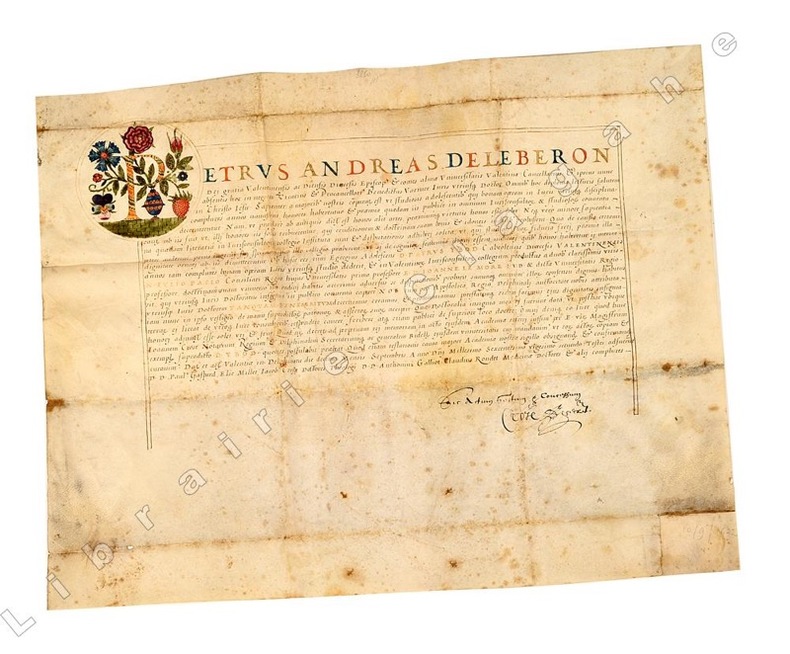
[Université de Valence (Drôme)]
Diplôme manuscrit
et enluminé sur velin ivoire (380 x 485 mm) en faveur de Petrus Ybod, reconnu comme docteur en droit, en date du 10 septembre 1622, sous l’autorité de Joanne Le More, son professeur et de Julius Pacius, premier docteur régent de la faculté de droit, sous la présidence de Petrus Andrea de Gelas de Léberon, évêque de Valence et de Die de 1600 à 1622 en sa qualité de Chancelier de l’Université. On peut noter que le jury était composé aussi de Paul Gaspard, Elie Millet et Jacques Crespe, docteurs en théologie et Antoine Galliot et Claude Rondet docteurs en médecine. Absence des lacs, signature autographe de Joannem Crose notaire du Roi et secrétaire du Dauphiné.
Riferimento per il libraio : 21381
|
|
|

 Ricevere i risultati per e-mail
 Scaricare i risultati in PDF
 RSS feed
 Link
Link


