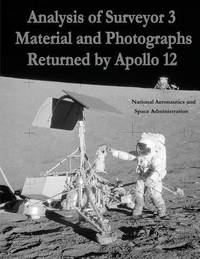
Washington DC: GPO 1973. fair to good. 604 wraps illus. figures tables bibliography appendices references some soiling to covers & spine small dings to spine. The Ad Hoc Advanced Imagers and Scanners Working Group met at Cocoa Beach FL from 11 to 15 December 1972. GPO paperback
Washington D.C: National Aeronautics and Space Administration 1977. Large Softcover. Near Fine. Binding tight and square pages clean bright and unmarked. 1977 Large Softcover. v 90 pp. Includes: Summary of U.S. Aeronautics and Space Activities of 1977; National Aeronautics and Space Administration; Department of Defense; Department of Commerce; Department of Energy; Department of Interior; Department of Transportation; Appendixes. National Aeronautics and Space Administration paperback
Washington DC: National Aeronautics and Space Administration 1993. Presumed First Edition First printing. Wraps. Good. 2 ii 111 1 pages. Map. 13 Appendices. Index. Includes Executive Summary; Space Launch Activities; Space Science; Space Flight and Space Technology; Space Communications; Aeronautical Activities; Studies of the Planet Earth; Other Aeronautical and Space Activities; and Glossary. The annual "President's Report" is a good summary of the Government's aerospace activities each year. Mandated by law it contains information on aerospace activities conducted by 14 Federal departments and agencies as well as appendices containing useful historical data on spacecraft launches and budget figures. The National Aeronautics and Space Act of 1958 directed that the annual Aeronautics and Space Report include a "comprehensive description of the programmed activities and the accomplishments of all agencies of the United States in the field of aeronautics and space activities during the preceding calendar year." This year's report has been prepared on a fiscal year basis which is consistent with the budgetary period now used in programs of the Federal Government. This report presents a fascinating snapshot of the U.S. space activities toward the end of the 20th Century. Fiscal Year FY 1992 was a significant one for U.S. aeronautics and space efforts. It included seven Space Shuttle missions and 14 Government launches of Expendable Launch Vehicles ELVs carrying a variety of payloads ranging from NASA missions to classified payloads. In addition there were eight launches of ELVs by commercial launch service providers operating under licenses issued by the Department of Transportation's Office of Commercial Space Transportation. On December 71991 the Air Force achieved initial launch capability for the new Atlas I1 launch vehicle in a commercial launch by General Dynamics with support from the Air Force. The other ELV missions launched four Navstar Global Positioning System two Defense Satellite Communications System and one Defense Meteorological Satellite Program satellites as well as two classified payloads and four NASA spacecraft. The Shuttle missions included one using the Atmospheric Laboratory for Applications and Science ATLAS-1 to study the Sun and our atmosphere as well as the first flight of the newest orbiter Endeavour which rendezvoused with retrieved and replaced the perigee kick motor of the INTELSATVI F-3 satellite that the International Telecommunications Satellite Organization INTELSAT controllers then deployed into its intended orbit. In aeronautics efforts have ranged from development of new civil and military aircraft and technologies to research and development of ways to reduce aircraft noise and improve flight safety and security. A key environmental effort in FY 1992 was monitoring ozone depletion. One of the major Earth science highlights of the year was finding that like the ozone layer over the Antarctic regions with its well documented annual depletion the ozone layer in the Northern Hemisphere is increasingly vulnerable to depletion by synthetic chemicals. Several Federal agencies have cooperated to study this and other environmental problems so we can improve the prospects for future generations who will inhabit the Earth. The budgets for aeronautics and space-distributed among 14 different Federal agencies have promoted important advances in the Nation's scientific and technical knowledge promising to enhance the quality of life on Earth through improved scientific understanding provide a more viable economy and healthier environment and ensure we live in a safer world. National Aeronautics and Space Administration paperback
Washington DC: NASA Office of Aeronautics 1999. fair. 28 cm 24 wraps illus. rear cover crinkled with small tear mailing information and ink note on rear cover NASA Office of Aeronautics paperback
Brand: US National Aeronautics and Space Admin 1996-01-01. Reissue. hardcover. Used: Good. 0.00x0.00x0.00. Buy with confidence. Excellent Customer Service & Return policy. Brand: US National Aeronautics and Space Admin hardcover
Bookseller reference : SONG0160489075 ISBN : 0160489075 9780160489075
Washington D C: National Aeronautics and Space Administration. 1969. 8vo - over 7¾" - 9¾". First Thus Used. H Paper Back. Very Good. paper #: NASA SP-5072. National Aeronautics and Space Administration unknown
NASA Washington DC. Used - Good. Good condition. astronautics exploration of outer space A copy that has been read but remains intact. May contain markings such as bookplates stamps limited notes and highlighting or a few light stains. NASA, Washington, DC unknown
John F. Kennedy Space Center FL: National Aeronautics and Space Administration Kennedy Space Center 2005. Presumed First Edition First printing. Pamphlet. Very good. The format is approximately 8.5 inches by 11 inches. 27 1 pages plus covers. Illustrated front cover. Illustrations some in color. The John F. Kennedy Space Center KSC originally known as the NASA Launch Operations Center located on Merritt Island Florida is one of the National Aeronautics and Space Administration's NASA ten field centers. Since December 1968 KSC has been NASA's primary launch center of human spaceflight. KSC is adjacent to Cape Canaveral Space Force Station CCSFS. The management of the two entities work very closely together share resources and operate facilities on each other's property. Though the first Apollo flights and all Project Mercury and Project Gemini flights took off from the then-Cape Canaveral Air Force Station the launches were managed by KSC and its previous organization the Launch Operations Directorate. Starting with the fourth Gemini mission the NASA launch control center in Florida began handing off control of the vehicle to the Mission Control Center in Houston shortly after liftoff. The center manages launch of robotic and commercial crew missions. Since 2010 the center has become a multi-user spaceport through industry partnerships even adding a new launch pad LC-39C in 2015. Among the unique facilities at KSC are the 525-foot tall Vehicle Assembly Building for stacking NASA's largest rockets the Launch Control Center which conducts space launches at KSC the Operations and Checkout Building which houses the astronauts dormitories and suit-up area a Space Station factory and a 3-mile long Shuttle Landing Facility. The National Aeronautics and Space Administration NASA is an independent agency of the U.S. federal government responsible for the civil space program aeronautics research and space research. Established in 1958 NASA succeeded the National Advisory Committee for Aeronautics NACA to give the U.S. space development effort a distinctly civilian orientation emphasizing peaceful applications in space science. NASA has since led most American space exploration including Project Mercury Project Gemini the 1968-1972 Apollo Moon landing missions the Skylab space station and the Space Shuttle. NASA currently supports the International Space Station and oversees the development of the Orion spacecraft and the Space Launch System for the crewed lunar Artemis program the Commercial Crew spacecraft and the planned Lunar Gateway space station. NASA's science is focused on: better understanding Earth through the Earth Observing System; advancing heliophysics through the efforts of the Science Mission Directorate's Heliophysics Research Program; exploring bodies throughout the Solar System with advanced robotic spacecraft such as New Horizons and planetary rovers such as Perseverance; and researching astrophysics topics such as the Big Bang through the James Webb Space Telescope and the Great Observatories and associated programs. NASA's Launch Services Program provides oversight of launch operations and countdown management for its uncrewed launches. NASA traces its roots to the National Advisory Committee for Aeronautics NACA. Despite being the birthplace of aviation by 1914 the United States recognized that it was far behind Europe in aviation capability. Determined to regain American leadership in aviation Congress created the Aviation Section of the U.S. Army Signal Corps in 1914 and established NACA in 1915 to foster aeronautical research and development. Over the next forty years NACA would conduct aeronautical research in support of the U.S. Air Force its predecessors in the U.S. Army the U.S. Navy and the civil aviation sector. After the end of World War II NACA became interested in the possibilities of guided missiles and supersonic aircraft developing and testing the Bell X-1 in a joint program with the U.S. Air Force. NACA's interest in space grew out of its rocketry program at the Pilotless Aircraft Research Division.<br /> The Soviet Union's launch of Sputnik 1 ushered in the Space Age and kicked off the Space Race. Despite NACA's early rocketry program the responsibility for launching the first American satellite fell to the Naval Research Laboratory's Project Vanguard. However Project Vanguard was plagued by several issues and the Army Ballistic Missile Agency would launch Explorer 1 America's first satellite on February 1 1958. The Eisenhower Administration decided to split the United States' military and civil spaceflight programs which were organized together under Defense Department's Advanced Research Projects Agency. NASA was established on July 29 1958 with the signing of the National Aeronautics and Space Act and it began operations on October 1 1958. As the United States' premier aeronautics agency NACA formed the core of NASA's new structure absorbing its 8000 employees and three major research laboratories. NASA also proceeded to absorb the Naval Research Laboratory's Project Vanguard the Army's Jet Propulsion Laboratory and the Army Ballistic Missile Agency under Wernher von Braun. This left NASA firmly as the United States' civil space lead and the Air Force as the military space lead. National Aeronautics and Space Administration, Kennedy Space Center unknown
Washington DC: National Archives Trust Fund Board 1984 From the collection of Wayne Prescott Suttles renowned anthropologist scholar and linguist regarding many Pacific cultures and especially the U.S. Pacific Northwest Coast Salish people. His stamp to the cover. Condition notes: stapled spine 91 numbered pp order forms; PB. Pages: clean bright tight; a.e. sunned. Cover: cream wraps photo black titles front; lt edge/shelfwear spine extrems lt sunned. National Archives Trust Fund Board paperback
Bookseller reference : 037732 ISBN : 0911333096 9780911333091
National Aeronautics Space Administration NASA. Very Good. 1971. First Edition. Wraps. 1971. Wraps softcover 226 pages. Some wear to cover else Very Good condition. NASA. No Maps. ; 4to - over 9¾" - 12" tall; 226 pages . National Aeronautics Space Administration NASA paperback
Place_Pub: Washington DC: NASA 1971. fair to good. Quarto 226 illus. 6 folding color maps in pocket at rear of book references appendics glossary covers somewhat worn and soiled. Top corner front cover and the first few pages creased pages have darkenedsomewhat. Introduction by James H. Sasser. Extremely rare item from the mission that immediately preceded the lunar landing. NASA unknown

 Receive by email
 Download as PDF document
 RSS feed
 Permanent link