|
National Aeronautics and Space Administration
Societal Impact of Spaceflight
like new. unknown
Bookseller reference : 20543171 ISBN : 1493586246 9781493586240
|
|
|
National Aeronautics and Space Administration
Societal Impact of Spaceflight
0000-00-00. hardcover. New. 6.69x1.89x9.69. Buy with confidence. Excellent Customer Service & Return policy. hardcover
Bookseller reference : DADAX0160801907 ISBN : 0160801907 9780160801907

|
|
|
National Aeronautics and Space Administration
Societal Impact of Spaceflight
0000-00-00. hardcover. Used: Good. 6.69x1.89x9.69. Buy with confidence. Excellent Customer Service & Return policy. hardcover
Bookseller reference : SONG0160801907 ISBN : 0160801907 9780160801907
|
|
|
NATIONAL AERONAUTICS AND SPACE ADMINISTRATION WASHINGTON DC
SOHO Mission Interruption Joint NASA/ESA Investigation Board
PN. New. 1998. Soft Cover. Date is original print. This is a reprint edition . PN paperback
Bookseller reference : 1309018
|
|
|
National Aeronautics and Administration
Solar Cell Radiation Handbook: Third Edition
Paperback / softback. New. paperback
Bookseller reference : B9781495366826 ISBN : 1495366820 9781495366826
|
|
|
National Aeronauti Space Administration
Solar Electric Propulsion Concepts for Human Space Exploration
Paperback / softback. New. paperback
Bookseller reference : B9781542596121 ISBN : 1542596122 9781542596121
|
|
|
National Aeronautics and Space Administration
Space Based Astronomy Teacher's Guide with Activities
Publisher: National Aeronautics and Space Adminstration 1994 Good Unbound srink wrap. Educational Product Teachers Grades 5-8. EG-102 August 1994 unknown
Bookseller reference : 001359
|
|
|
National Aeronautics and Space Administration, NASA Lewis Research Center, Space Communications Program
Space Communications Technology Link Volume 1 No. 1 Summer 1998
Cleveland OH: National Aeronautics and Space Administration NASA Lewis Research Center Space Communications Program 1998. Presumed First Edition First printing of this Premier Issue. Wraps. Very good. 15 1 pages. Illustrations. Mailing information and ink notation on back cover. Minor wear and soiling noted. This is the premier issue of a quarterly publication of the Space Communications Program at the NASA Lewis Research Center. As such it has become an extremely rare item in the space and the collectibles markets. A substantial amount of this issue's content is related to ACTS the Advance Communications Technology Satellite. NASA is developing architecture technologies communication system technologies and subsystem and component technologies to enable NASA's future missions in science and human exploration. We develop space communication architectures via commercial ventures and international forums and we are a major supporter of extending the Internet into space. Technologies are being developed to support intelligent autonomous communications architectures that enable anytime anywhere operations and provide end-to-end information delivery from space directly to users. Through coordinated studies with other NASA centers government agencies industry and academia our scientists and engineers are designing feasible communication network architectures that enable the storage transmission and dynamic routing of large amounts of data at high rates among space assets and between space and ground assets. National Aeronautics and Space Administration, NASA Lewis Research Center, Space Communications Program paperback
Bookseller reference : 77307
|
|
|
NATIONAL AERONAUTICS AND SPACE ADMINISTRATION HAMPTON VA LANGLEY RESEARCH CENTER
Space Durability of Materials Bibliography 1983-1993
PN. New. 1993. Soft Cover. Date is original print. This is a reprint edition . PN paperback
Bookseller reference : 261668
|
|
|
National Aeronautics and Space Administration (NASA)
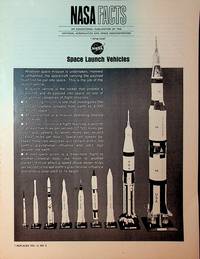
Space Launch Vehicles NF-8 / 12-67
Washington DC: National Aeronautics and Space Administration NASA 1967. Wraps. Near Fine. 8 pages. Self wrappers stapled. 8 x 10 1/4 inches. A touch of browning otherwise nice and clean. Illustrated. Wraps. Part of the NASA Facts series - an educational publication of the National Aeronautics and Space Administration NASA Office of Public Affairs Programs Division. This edition replaces Vol. II No. 5 in the series. Illustrated showing several launch vehicles on the pad with descriptions. National Aeronautics and Space Administration (NASA) unknown
Bookseller reference : 27504
|
|
|
National Aeronautics and Administration
Space Life Sciences Strategic Plan 1992
Paperback / softback. New. paperback
Bookseller reference : A9781502846235 ISBN : 1502846233 9781502846235
|
|
|
National Aeronautics and Administration
Space Life Sciences Research: The Importance of Long-Term Space Experiments
Paperback / softback. New. paperback
Bookseller reference : B9781502846099 ISBN : 1502846098 9781502846099
|
|
|
National Aeronautics and Administration
Space Life Sciences Strategic Plan 1992
Paperback / softback. New. paperback
Bookseller reference : B9781502846235 ISBN : 1502846233 9781502846235
|
|
|
National Aeronautics and Administration
Space Math VII
like new. unknown
Bookseller reference : 20546867 ISBN : 1493745093 9781493745098
|
|
|
National Aeronautics and Administration
Space Math VII
Paperback / softback. New. paperback
Bookseller reference : A9781493745098 ISBN : 1493745093 9781493745098
|
|
|
National Aeronautics and Administration
Space Math - IV
Paperback / softback. New. paperback
Bookseller reference : A9781493744954 ISBN : 149374495x 9781493744954
|
|
|
NATIONAL AERONAUTICS AND SPACE ADMINISTRATION
Space Mathematics: A Resource for Teachers Outlining Supplementary Space-Related Problems in Mathematics
NASA 1972. Pbk 4to 138pp prev ownerÕs stamp discretely on title page otherwise appears unused and an excellent clean tight unmarked copy NASA 1972 unknown
Bookseller reference : HPS1202
|
|
|
National Aeronautics and Administration
Space Math VII
Paperback / softback. New. paperback
Bookseller reference : B9781493745098 ISBN : 1493745093 9781493745098
|
|
|
National Aeronautics and Administration
Space Math V
Paperback / softback. New. paperback
Bookseller reference : B9781493744985 ISBN : 1493744984 9781493744985
|
|
|
National Aeronautics and Administration
Space Math - I
Paperback / softback. New. paperback
Bookseller reference : B9781493744732 ISBN : 1493744739 9781493744732
|
|
|
National Aeronautics and Administration
Space Math - II
Paperback / softback. New. paperback
Bookseller reference : B9781493744770 ISBN : 1493744771 9781493744770
|
|
|
National Aeronautics and Administration
Space Math - III
Paperback / softback. New. paperback
Bookseller reference : B9781493744831 ISBN : 1493744836 9781493744831
|
|
|
National Aeronautics and Administration
Space Math VIII
Paperback / softback. New. paperback
Bookseller reference : B9781493745142 ISBN : 149374514x 9781493745142
|
|
|
National Aeronautics and Administration
Space Math - IV
Paperback / softback. New. paperback
Bookseller reference : B9781493744954 ISBN : 149374495x 9781493744954
|
|
|
National Aeronautics and Administration
Space Math VI
Paperback / softback. New. paperback
Bookseller reference : B9781493745036 ISBN : 1493745034 9781493745036
|
|
|
National Aeronautics and Administration
Space Physics Missions Handbook
like new. unknown
Bookseller reference : 22147268 ISBN : 1502989530 9781502989536
|
|
|
National Aeronautics and Administration
Space Physics Missions Handbook
new. unknown
Bookseller reference : 22147268-n ISBN : 1502989530 9781502989536
|
|
|
National Aeronautics and Administration
Space Physics Missions Handbook
Paperback / softback. New. paperback
Bookseller reference : A9781502989536 ISBN : 1502989530 9781502989536
|
|
|
National Aeronautics and Administration
Space Physics Missions Handbook
Paperback / softback. New. paperback
Bookseller reference : B9781502989536 ISBN : 1502989530 9781502989536
|
|
|
National Aernautics and Space Administration
Space Programs Summary 37-62 Vol. III Supporting Research and Advanced Development for the Period February 1 to March 31 1970
Pasadena CA: Jet Propulsion Laboratory California Institute of Technology 1970. First Edition. Paperback. Very Good-. Oversize. Paperback in very good- condition. Quarto wraps as issued. 299 pages with subject index. 79 contemporary technical papers. Spine is uncreased binding tight and sturdy; text also very good. Shelfwear small bit of marker on front cover. Ships same or next business day from Dinkytown in Minneapolis Minnesota. Due to the size/weight of this book extra charges may apply for international shipping. Jet Propulsion Laboratory California Institute of Technology paperback
Bookseller reference : 312342
|
|
|
National Aeronautics and Space Administration.
Space Programs Summary 37-45 Vol.IV Supporting Research and Advance Development
Pasadena California.: Jet Propulsion Laboratory. 1967. Book. Very Good. Hardcover. 4to - over 9¾" - 12" tall. Softcover 1967 37-45 Vol.4. edition. Ex-library book with stamps and labels attached. Binding firm. Pages unmarked and clean. Covers and text in very good condition. 363 pages. Jet Propulsion Laboratory. Hardcover
Bookseller reference : 014985
|
|
|
National Aeronautics and Administration
Space Science in the Twenty-First Century: Imperatives for the Decades 1995 to 2015: Mission to Planet Earth
Paperback / softback. New. paperback
Bookseller reference : B9781502793836 ISBN : 1502793830 9781502793836
|
|
|
National Aeronautics and Space Administration
Space Settlements: A Design Study
NEW. unknown
Bookseller reference : BIB-NOV-14-2025-76566 ISBN : 9798343380667 9798343380
|
|
|
National Aeronautics and Space Administration John F. Kennedy Space Center
Space Shuttle Launches; KSC Historical Report No. 18 KHR-18 Information Summaries IS-2004-03-003-KSC
John F. Kennedy Space Center FL: National Aeronautics and Space Administration John F. Kennedy Space Center 2004. Presumed First Edition First printing. Single sheet printed on both sides. Very good. The format is approximately 17 inches by 11 inches. The sheet has been folded in half. Other than the NASA logo on each side there are no illustrations. This report covers the 113 Space Shuttle Launches from the Kennedy Space Center between 1981 and 2003. On each slide is a chronological listing of Space Shuttle Missions Operational Test Flights and Operational Flights. There is a Legend box identical on each side. Side one goes to STS 65 with some number gaps and the second side goes from STS-64 to STS-107. The information on each mission includes Mission number/name Crew Launch Date/Landing Date Orbiter Primary Payload and Launch Pad/Runway. The Space Shuttle is a retired partially reusable low Earth orbital spacecraft system operated from 1981 to 2011 by the U.S. National Aeronautics and Space Administration NASA as part of the Space Shuttle program. Its official program name was Space Transportation System STS taken from the 1969 plan led by U.S. Vice President Spiro Agnew for a system of reusable spacecraft where it was the only item funded for development. The first STS-1 of four orbital test flights occurred in 1981 leading to operational flights STS-5 beginning in 1982. Five complete Space Shuttle orbiter vehicles were built and flown on a total of 135 missions from 1981 to 2011. They launched from the Kennedy Space Center KSC in Florida. Operational missions launched numerous satellites interplanetary probes and the Hubble Space Telescope HST conducted science experiments in orbit participated in the Shuttle-Mir program with Russia and participated in the construction and servicing of the International Space Station ISS. The Space Shuttle fleet's total mission time was 1323 days. Space Shuttle components include the Orbiter Vehicle OV with three clustered Rocketdyne RS-25 main engines a pair of recoverable solid rocket boosters SRBs and the expendable external tank ET containing liquid hydrogen and liquid oxygen. The Space Shuttle was launched vertically like a conventional rocket with the two SRBs operating in parallel with the orbiter's three main engines which were fueled from the ET. The SRBs were jettisoned before the vehicle reached orbit while the main engines continued to operate and the ET was jettisoned after main engine cutoff and just before orbit insertion which used the orbiter's two Orbital Maneuvering System OMS engines. At the conclusion of the mission the orbiter fired its OMS to deorbit and reenter the atmosphere. The orbiter was protected during reentry by its thermal protection system tiles and it glided as a spaceplane to a runway landing usually to the Shuttle Landing Facility at KSC Florida or to Rogers Dry Lake in Edwards Air Force Base California. If the landing occurred at Edwards the orbiter was flown back to the KSC atop the Shuttle Carrier Aircraft SCA a specially modified Boeing 747 designed to carry the shuttle above it. The first orbiter Enterprise was built in 1976 and used in Approach and Landing Tests ALT but had no orbital capability. Four fully operational orbiters were initially built: Columbia Challenger Discovery and Atlantis. Of these two were lost in mission accidents: Challenger in 1986 and Columbia in 2003 with a total of 14 astronauts killed. A fifth operational and sixth in total orbiter Endeavour was built in 1991 to replace Challenger. The three surviving operational vehicles were retired from service following Atlantis's final flight on July 21 2011. National Aeronautics and Space Administration, John F. Kennedy Space Center unknown
Bookseller reference : 86125
|
|
|
National Aeronautics and Space Administration
Space Shuttle Spinoffs; NP-2009-04-575-HQ
Washington DC: National Aeronautics and Space Administration 2009. Presumed First Edition First printing. Single sheet stiff card stock printed on both sides. Very good. The format us approximately 8.5 inches by 11 inches. The front side has a large color photograph of the Space Shuttle and rocket and boosters on the launch pad. the back side has photographs and brief text on ten spin-off technology areas. NASA spin-off technologies are commercial products and services which have been developed with the help of NASA through research and development contracts such as Small Business Innovation Research SBIR or STTR awards licensing of NASA patents use of NASA facilities technical assistance from NASA personnel or data from NASA research. Information on new NASA technology that may be useful to industry is available in periodical and web accessible form in "NASA Tech Briefs" while successful examples of commercialization are reported annually in the NASA publication Spinoffs. The publication has documented more than 2000 technologies over time. In 1979 notable science fiction author Robert A. Heinlein helped bring awareness to the spin-offs when he was asked to appear before Congress after recovering from one of the earliest known vascular bypass operations to correct a blocked artery. In his testimony reprinted in his 1980 book Expanded Universe Heinlein claimed that four NASA spin-off technologies made the surgery possible and that they were only a few from a long list of NASA spin-off technologies from space development. Since 1976 the NASA Technology Transfer Program has connected NASA resources to private industry referring to the commercial products as spin-offs. Well-known products that NASA claims as spin-offs include memory foam originally named temper foam freeze-dried food firefighting equipment emergency "space blankets" DustBusters cochlear implants LZR Racer swimsuits and CMOS image sensors. As of 2016 NASA has published over 2000 other spin-offs in the fields of computer technology environment and agriculture health and medicine public safety transportation recreation and industrial productivity. Contrary to common belief NASA did not invent Tang Velcro or Teflon. After years of development and decades of flying the now-cancelled space shuttle program has left more to future generations than pieces for museums and fond memories of exploration. Its legacy lives on in an artificial heart device NASCAR racing cars and rescue tools used to reach car accident victims. The entire array of NASA technology spinoffs could even be greater than the number of spinoffs from the Apollo moon missions. Whether or not the space shuttle program was worth its $209 billion price tag remains a separate debate for human spaceflight advocates and critics. But NASA's official count of tech spinoffs that went on to become commercial products suggests that many people on Earth have seen benefits from the shuttle's human spaceflight program. The shuttle spawned roughly 120 commercialized spinoffs versus about 80 for the Apollo program. That's in part because the shuttle program ran for three decades as opposed to Apollo's one decade but also because NASA created a more formalized system for spinning off innovations after the Apollo era. National Aeronautics and Space Administration unknown
Bookseller reference : 86092
|
|
|
National Aeronautics and Space Administration, John F. Kennedy Space Center
Space Shuttle Launches 1981-2011; FS-2011-6-132-KSC KSC Historical Report No. 18 KHR-18
Kennedy Space Center FL: National Aeronautics and Space Administration John F. Kennedy Space Center 2011. Presumed First Edition First printing. Single sheet printed on both sides. Very good. The format is approximately 11 inches by 17 inches. This has been folded in the middle. Illustrations on both side. Illustrations are in the background on the front side and there is a nice clear black and white photograph of the shuttle and rocket on the launch pad. This listing Starts with STS-1 and concludes with STS-135 which in this document was described as "Scheduled for 07/08/11". There is a brief narrative and a listing of the five Space Shuttles Columbia Discover Atlantis Endeavour and Challenger. The list includes mission name/number crew member or members launch date landing date name of the Shuttle Primary Payload Launch Pad used and Runway landing. The Space Shuttle is a retired partially reusable low Earth orbital spacecraft system operated from 1981 to 2011 by the U.S. National Aeronautics and Space Administration NASA as part of the Space Shuttle program. Its official program name was Space Transportation System STS taken from the 1969 plan led by U.S. Vice President Spiro Agnew for a system of reusable spacecraft where it was the only item funded for development. The first STS-1 of four orbital test flights occurred in 1981 leading to operational flights STS-5 beginning in 1982. Five complete Space Shuttle orbiter vehicles were built and flown on a total of 135 missions from 1981 to 2011. They launched from the Kennedy Space Center KSC in Florida. Operational missions launched numerous satellites interplanetary probes and the Hubble Space Telescope HST conducted science experiments in orbit participated in the Shuttle-Mir program with Russia and participated in the construction and servicing of the International Space Station ISS. The Space Shuttle fleet's total mission time was 1323 days. Space Shuttle components include the Orbiter Vehicle OV with three clustered Rocketdyne RS-25 main engines a pair of recoverable solid rocket boosters SRBs and the expendable external tank ET containing liquid hydrogen and liquid oxygen. The Space Shuttle was launched vertically like a conventional rocket with the two SRBs operating in parallel with the orbiter's three main engines which were fueled from the ET. The SRBs were jettisoned before the vehicle reached orbit while the main engines continued to operate and the ET was jettisoned after main engine cutoff and just before orbit insertion which used the orbiter's two Orbital Maneuvering System OMS engines. At the conclusion of the mission the orbiter fired its OMS to deorbit and reenter the atmosphere. The orbiter was protected during reentry by its thermal protection system tiles and it glided as a spaceplane to a runway landing usually to the Shuttle Landing Facility at KSC Florida or to Rogers Dry Lake in Edwards Air Force Base California. If the landing occurred at Edwards the orbiter was flown back to the KSC atop the Shuttle Carrier Aircraft SCA a specially modified Boeing 747 designed to carry the shuttle above it. The first orbiter Enterprise was built in 1976 and used in Approach and Landing Tests ALT but had no orbital capability. Four fully operational orbiters were initially built: Columbia Challenger Discovery and Atlantis. Of these two were lost in mission accidents: Challenger in 1986 and Columbia in 2003 with a total of 14 astronauts killed. A fifth operational and sixth in total orbiter Endeavour was built in 1991 to replace Challenger. The three surviving operational vehicles were retired from service following Atlantis's final flight on July 21 2011. The U.S. relied on the Russian Soyuz spacecraft to transport astronauts to the ISS from the last Shuttle flight until the launch of the Crew Dragon Demo-2 mission in May 2020. National Aeronautics and Space Administration, John F. Kennedy Space Center unknown
Bookseller reference : 86116
|
|
|
National Aeronautics and Space Administration, Kennedy Space Center
Space Shuttle Weather Launch Commit Criteria and KSC End of Mission Weather Landing Criteria; NASA Facts FS-2011-2-023-KSC
Kennedy Space Center FL: National Aeronautics and Space Administration Kennedy Space Center 2011. Presumed First Edition may be a reprint. Stapled at upper left corner. Very good. The format is approximately 8.5 inches by 11 inches. 6 pages. Tabular data. Basic weather launch commit criteria in part includes on the pad at liftoff Temperature. Prior to external fuel tank propellant loading tanking will not begin if: a The 24-hour average temperature has been below 41 degrees. b The temperature has fallen below 33 degrees at anytime during the previous 24 hours. After tanking begins the countdown shall not be continued nor the shuttle launched if: a The temperature exceeds 99 degrees for ore than 30 consecutive minutes. b The temperature is lower than the prescribed minimum value for longer than 30 minutes unless sun angle wind temperature and relative humidity conditions permit recovery. - For tanking fueling will not begin if the wind is observed or forecast to exceed 42 knots for the next three-hour period. - For launch the allowable peak wind speed observed at the 60-foot level of the fixed service structure depends on the wind direction and ranges from 19 to 34 knots. The end of mission landing weather forecast is prepared by the NOAA National Weather Service Spaceflight Meteorology Group in Houston for the astronauts flight director and mission management team. All criteria refer to observed and forecast weather conditions. Decision time for the deorbit burn is 70 to 90 minutes before landing. The weather criteria are as follows: - Cloud coverage of 4/8 or less below 8000 feet and a visibility of 5 miles or greater required. - The peak crosswind cannot exceed 15 knots 12 knots at night. If the mission duration is greater than 20 days the limit is 12 knots day and night. - Headwind cannot exceed 25 knots. - Tailwind cannot exceed 10 knots average 15 knots peak. - No thunderstorm lightning or precipitation activity is within 30 nautical miles of the landing site. - At least two approach paths must be free from detached non-transparent thunderstorm anvils less than three-hours old within 30 nautical miles of the runway. - Turbulence must be less than or equal to moderate intensity. - Consideration may be given for landing with a "nogo" observation and a "go" forecast if at decision time analysis clearly indicates a continuing trend of improving weather conditions and the forecast states that all weather criteria will be met at landing time. National Aeronautics and Space Administration, Kennedy Space Center unknown
Bookseller reference : 86088
|
|
|
National Aeronautics and Space Administration, Kennedy Space Center
Space Shuttle: Orbiter Processing From Landing To Launch; NASA Facts FS-2005-06-018-KSC
Kennedy Space Center FL: National Aeronautics and Space Administration Kennedy Space Center 2005. Presumed First Edition probably a reprint since illustrations are black and white. Staplebound. Very good. The format is approximately 8.5 inches by 11 inches. 8 pages. Illustrations. The work of preparing a space shuttle for flight takes place primarily at the Launch Complex 39 Area. The process actually begins at the end of each flight with a landing at the center or after landing at an alternate site the return of the orbiter atop a shuttle carrier aircraft. Kennedy's Shuttle Landing Facility is the primary landing site. There are now three orbiters in the shuttle fleet: Discovery Atlantis and Endeavour. Challenger was destroyed in an accident in January 1986. Columbia was lost during approach to landing in February 2003. Each orbiter is processed independently using the same facilities. Inside is a description of an orbiter processing flow. The launch countdown begins at the T-43 hour mark about three days before launch. Launch control personnel arrive at their stations in the firing room and begin checking out the flight systems and flight software stored in mass memory units. Display systems are also reviewed. At T-27 hours a scheduled built-in hold is entered. A test of the vehicle's pyrotechnic initiator controllers is performed. When the countdown resumes cryogenic reactants are loaded into the orbiter's fuel cell storage tanks. At T-19 hours another hold allows demating of the orbiter mid-body umbilical unit. The sound suppression system water tank is filled and orbiter and ground support equipment closeouts resume. After the count is resumed the three main engines are prepared for main propellant tanking and flight. At T-11 hours a third built-in hold gives the launch team a chance to catch up on any unfinished preparations and to troubleshoot any vehicle or ground support equipment problems that may be a constraint to launch. If no problems or delays are encountered at the end of the T-11 hour hold the countdown continues. The RSS is rolled back and the orbiter is ready for fuel cell activation and external tank cryogenic propellant loading operations. The pad is cleared to the perimeter gate for operations to fill the external tank with about 500000 gallons of cryogenic propellants used by the shuttle's main engines. This is done at the pad approximately eight hours before the scheduled launch. Liquid oxygen is transferred to the external tank by pumps capable of pumping 1300 gallons per minute. The liquid vaporizes and is transferred to the external tank using pressure created by the hydrogen itself. Pumps are not needed. The final hours of the count include crew ingress crew module and white room closeout final computer and software configurations final readiness polls of the launch team terminal sequencing and finally liftoff. National Aeronautics and Space Administration, Kennedy Space Center unknown
Bookseller reference : 86094
|
|
|
National Astronautics and Space Administration
Space Shuttle Main Engine SSME Test NASA Photograph; HQL-219
Washington DC: National Astronautics and Space Administration c1988. Presumed First Edition First printing. This is one of the multiple originals issued. Single sheet printed on both sides. Very good. The format is approximately 8 inches by 10 inches. This is a single sheet with imagery on the front and printing on both sides in a plastic sleeve. On the front side is a large color photograph of the Space Shuttle Main Engine SSME Test. The other side has a brief discussion of the main engine during a full-mission duration static test. The image is undated but from the text on the back this image is believed to be circa 1988. During the course of the Space Shuttle program a total of 46 RS-25 engines were used with one extra RS-25D being built but never used. During the 135 missions for a total of 405 individual engine-missions Pratt & Whitney Rocketdyne reports a 99.95% reliability rate with the only in-flight SSME failure occurring during Space Shuttle Challenger's STS-51-F mission. The RS-25 also known as the Space Shuttle Main Engine SSME is a liquid-fuel cryogenic rocket engine that was used on NASA's Space Shuttle and is used on the Space Launch System SLS. Designed and manufactured in the United States by Rocketdyne later Pratt & Whitney Rocketdyne and Aerojet Rocketdyne the RS-25 burns cryogenic very low temperature liquid hydrogen and liquid oxygen propellants with each engine producing 418000 lbf thrust at liftoff. Although RS-25 heritage traces back to the 1960s its concerted development began in the 1970s with the first flight STS-1 on April 12 1981. The RS-25 has undergone upgrades over its operational history to improve the engine's reliability safety and maintenance load. The engine produces a specific impulse Isp of 452 seconds in vacuum or 366 seconds at sea level has a mass of approximately 7700 pounds and is capable of throttling between 67% and 109% of its rated power level in one-percent increments. Components of the RS-25 operate at temperatures ranging from 400 to 6000 °F. The Space Shuttle used a cluster of three RS-25 engines mounted at the stern of the orbiter with fuel drawn from the external tank. The engines were used for propulsion throughout the spacecraft ascent with total thrust increased by two solid rocket boosters and the orbiter's two AJ10 orbital maneuvering system engines. Following each flight the RS-25 engines were removed from the orbiter inspected refurbished and then reused on another mission. Four RS-25 engines are installed on each Space Launch System housed in the engine section at the base of the core stage and expended after use. National Astronautics and Space Administration unknown
Bookseller reference : 86154
|
|
|
National Astronautics and Space Administration
Space Shuttle Spinoffs NASA Poster; NP-2009-04-575-HQ
Washington DC: National Astronautics and Space Administration 2009. Presumed First Edition First printing. This is one of multiple originals issued. Poster. Very good. The format is approximately 8.5 inches by 11 inches. This is a single sheet with printing/imagery on both sides in a plastic sleeve. On the front side is a large color photograph of the space shuttle central fuel tank and solid rocket boosters on a launch pad at night. On the reverse there are 10 vignettes with images and texts discussing the following spinoffs Artificial Heart Rescue Tool Life-Saving Light Automotive Insulation Land Mine Removal Device Green Lubricants Firefighting Infrared Cameras Home Insulation Prosthesis Material and Video Stabilization Software. After years of development and decades of flying the now-cancelled space shuttle program has left more to future generations than pieces for museums and fond memories of exploration. Its legacy lives on in an artificial heart device NASCAR racing cars and rescue tools used to reach car accident victims. The entire array of NASA technology spinoffs could even be greater than the number of spinoffs from the Apollo moon missions. Whether or not the space shuttle program was worth its $209 billion price tag remains a separate debate for human spaceflight advocates and critics. But NASA's official count of tech spinoffs that went on to become commercial products suggests that many people on Earth have seen benefits from the shuttle's human spaceflight program. "People always think of NASA's heyday as the Apollo era but the shuttle has produced about 50 percent more spinoffs than the Apollo era" said Daniel Lockney technology transfer program executive at NASA headquarters in Washington D.C. The shuttle spawned roughly 120 commercialized spinoffs versus about 80 for the Apollo program Lockney said. That's in part because the shuttle program ran for three decades as opposed to Apollo's one decade but also because NASA created a more formalized system for spinning off innovations after the Apollo era. One case emerged just as NASA was designing the space shuttle during the energy crisis of the 1970s. Per government request the space agency tried redesigning boxy semi-trailer trucks to become more aerodynamic so that they could save on fuel. Shortly after NASA showed off its prototype design the trucking industry chose to debut its own sleeker designs. "If you ask the trucking industry if it took these designs from NASA you'll categorically get a no" Lockney said. "But a year or two after NASA's tour you see a sea change in the industry." More recently NASA supercomputers that had simulated fluid flow in shuttle rocket engines helped model the flow of blood in a tiny battery-powered heart pump just 2 inches long and 1 inch wide. The resulting changes led to the MicroMed DeBakey VAD device that keeps blood pumping through the hearts of ill patients awaiting heart transplants. Leftover rocket fuel from the space shuttle launches has gone into flare devices that disable or destroy land mines. And material that protects the space shuttle from the fierce heat of re-entry has helped protect NASCAR drivers from the engine heat of their racing cars. Even the explosive devices that separate the shuttle from its rocket boosters have become miniaturized for use in a more lightweight "Jaws of Life" device a tool that rescue squads use to cut into car wrecks and reach accident victims. "It's important to recognize that these aren't the primary missions of NASA" Lockney said. "If you wanted to create a heart pump building a rocket that will launch it into space wouldn't be the practical way to go about it." National Astronautics and Space Administration unknown
Bookseller reference : 86150
|
|
|
National Aeronautics and Space Administration
Space Shuttle Mission STS-129 Stocking The Station; Press Kit November 2009
Washington DC: National Aeronautics and Space Administration 2009. Xerox-style reproduction. Assumed only a few copies were made for media representatives. Stapled at upper left corner. Very good. ii 110 pages plus covers. Illustrations. Three-hole punched. The contents include STS-129/ULF-3 Mission Overview; STS-129 Timeline Overview; Mission Profile; Mission Objectives; Mission Personnel; STS-129 Crew; Payload Overview; Rendezvous & Docking; Spacewalks; Experiments; Shuttle Reference Data; Launch and Landing; Acronym and Abbreviations; Media Assistance and Public Affairs Contacts. STS-129 ISS assembly flight ULF3 was a NASA Space Shuttle mission to the International Space Station ISS. Atlantis was launched on November 16 2009 at 14:28 EST and landed at 09:44 EST on November 27 2009 on runway 33 at the Kennedy Space Center's Shuttle Landing Facility. It was also the last Shuttle mission of the 2000s. STS-129 focused on staging spare components outside the station. The 11-day flight included three spacewalks. The payload bay carried two large ExPRESS Logistics Carriers holding two spare gyroscopes two nitrogen tank assemblies two pump modules an ammonia tank assembly a spare latching end effector for the station's robotic arm a spare trailing umbilical system for the Mobile Transporter and a high-pressure gas tank. STS-129 was the first flight of an ExPRESS Logistics Carrier. The STS-129 mission patch was designed by Tim Gagnon and Dr. Jorge Cartes. The unusual shape of the patch resulted from the crew's desire for the patch to signify the mission's payload two ExPRESS Logistics Carriers providing equipment ensuring the longevity of the ISS. The insignia incorporates a number of design elements not typically incorporated into a single patch: the Sun Moon Mars NASA's astronaut symbol the ISS the Shuttle orbiter and the continental United States. The 13 stars on the patch represent the crewmembers' children and the Moon and Mars represent the future of space exploration. The names of the crew members are denoted on the outer band of the patch. The primary payloads were the Express Logistics Carriers designated ELC-1 and ELC-2 for the International Space Station ISS. The units carried a variety of tools and equipment designed to augment and enhance experimentation aboard ISS. Docking between Atlantis and ISS occurred on November 18 2009. Undocking occurred on November 25 2009. There were three spacewalks during the mission. The first spacewalk was conducted on November 19 2009 and lasted 6 hours 37 minutes. Astronauts Foreman and Satcher installed a spare antenna and a bracket for ammonia lines outside ISS. They also performed maintenance activities on the ISS Japanese robotic arm. The second spacewalk was conducted on November 21 2009 and lasted 6 hours 8 minutes. Astronauts Foreman and Bresnik installed the Grappling Adaptor to On-Orbit Railing GATOR to the ISS Columbus Laboratory plus an additional ham radio antenna. They also installed an antenna for wireless helmet camera video and relocated the Floating Potential Measurement Unit which takes electrical measurements outside ISS. The third spacewalk was conducted on November 23 2009 and lasted 5 hours 42 minutes. Astronauts Satcher and Bresnik installed an oxygen filled High Pressure Gas Tank on the ISS Quest Airlock. They also installed experiments to ELC-2 as well as a number of other maintenance activities. National Aeronautics and Space Administration unknown
Bookseller reference : 86136
|
|
|
National Aeronautics and Space Administration
Space Shuttle Mission STS-132 Finishing Touches; Press Kit May 2010
Washington DC: National Aeronautics and Space Administration 2010. Xerox-style reproduction. Assume relatively few copies made for media representatives. Stapled at upper left corner. Very good. ii 104 pages plus front cover. No rear cover. Illustrations. Three-hole punched. Logo of the United Space Alliance on the front cover. Includes STS-132/ULF4 Mission Overview; STS-132 Timeline Overview; Mission Profile; Mission Objectives; Mission Personnel; STS-132 Crew; Payload Overview; Rendezvous & Docking; Spacewalks; Experiments; History of Space Shuttle Atlantis; Shuttle Reference Data; Launch and Landing; Acronmyns and Abbreviations; Media Assistance; Public Affairs Contacts. STS-132 ISS assembly flight ULF4 was a NASA Space Shuttle mission during which Space Shuttle Atlantis docked with the International Space Station on May 16 2010. STS-132 was launched from the Kennedy Space Center on May 14 2010. The primary payload was the Russian Rassvet Mini-Research Module along with an Integrated Cargo Carrier-Vertical Light Deployable ICC-VLD. Atlantis landed at the Kennedy Space Center on May 26 2010. STS-132 was initially scheduled to be the final flight of Atlantis provided that the STS-335/STS-135 Launch On Need rescue mission would not be needed. However in February 2011 NASA declared that the final mission of Atlantis and of the Space Shuttle program STS-135 would be flown regardless of the funding situation. Also on board Atlantis was a 4-inch long wood sample of Sir Isaac Newton's apple tree. The piece from the original tree that supposedly inspired Newton's theory of gravity along with a picture of Newton were taken into orbit by astronaut Piers Sellers. The wood is part of the collection of the Royal Society archives in London and was returned there following the flight. Additionally a flag from Clarkson University Potsdam New York flew on board shuttle Atlantis. It was there in honor of STS-132 lead shuttle flight director Michael L. Sarafin who is an alumnus of the Clarkson University. The STS-132 mission patch was designed by NASA artist Sean Collins working with astronaut Garrett Reisman. The patch shows Atlantis flying towards a sunset landing with the names of the STS-132 astronauts around the border. During the standard post-flight inspection of Atlantis a United Space Alliance inspector found a STS-132 mission decal accompanied by an inscription "The first last flight of Atlantis left Earth on 14 May 2010 from Pad 39A" together with the crew's signatures. The worker had found it tucked away on the upper side of Locker A-16 while scanning the area with a mirror. Moreover he said the note must have been written in orbit since otherwise the author would have had to stand on their head to write it. At the time the note was written STS-132 was the last planned mission of Atlantis. However one further mission was ultimately approved for the shuttle: STS-135 which was to be the last flight of both Atlantis and the Space Shuttle program. National Aeronautics and Space Administration unknown
Bookseller reference : 86124
|
|
|
National Aeronautics and Space Administration, Kennedy Space Center
Space Shuttle Mission Chronology 2005-2006; Volume 3 IS-2007-03-005-KSC Information Summary
Kennedy Space Center FL: National Aeronautics and Space Administration Kennedy Space Center 2007. Presumed First Edition First printing. Wraps. Very good. The format is approximately 8.25 inches by 11 inches. 8 pages. Illustrations some in color. This includes information on STS-114 STS-121 STS-115 and STS-116 the 17th 18th 19th and 20th Space Station flights The write-ups include mission highlights EVAs Launch and Landing. A latter version of Volume 3 had 12 pages and included two more missions into 2007. This variant is now quite scarce having been superseded. The International Space Station ISS is the largest modular space station in low Earth orbit. The project involves five space agencies: the United States' NASA Russia's Roscosmos Japan's JAXA Europe's ESA and Canada's CSA. The ownership and use of the space station is established by intergovernmental treaties and agreements. The station serves as a microgravity and space environment research laboratory in which scientific research is conducted in astrobiology astronomy meteorology physics and other fields. The ISS is suited for testing the spacecraft systems and equipment required for possible future long-duration missions to the Moon and Mars. The Space Shuttle was a partially reusable low Earth orbital spacecraft system operated by NASA the National Aeronautics and Space Administration. Its official program name was Space Transportation System STS taken from a 1969 plan for a system of reusable spacecraft of which it was the only item funded for development. Operational missions launched numerous satellites conducted science experiments in orbit and participated in construction and servicing of the International Space Station ISS. The first of four orbital test flights occurred in 1981 leading to operational flights beginning in 1982. From 1981 to 2011 a total of 135 missions were flown all launched from Kennedy Space Center KSC in Florida. During that time period the fleet logged 1322 days 19 hours 21 minutes and 23 seconds of flight time. The longest orbital flight of the Shuttle was STS-80 at 17 days 15 hours while the shortest flight was STS-51-L at one minute 13 seconds when the Space Shuttle Challenger broke apart during launch. The cold morning shrunk an O-Ring on the right Solid Rocket Booster causing the external fuel tank to explode. The shuttles docked with Russian space station Mir nine times and visited the ISS thirty-seven times. The highest altitude apogee achieved by the shuttle was 386 milrd when deploying the Hubble Space Telescope. The program flew a total of 355 people representing 16 countries and with 852 total shuttle fliers. The Kennedy Space Center served as the landing site for 78 missions while 54 missions landed at Edwards Air Force Base in California and one mission landed at White Sands New Mexico. The first orbiter built Enterprise was used for atmospheric flight tests ALT but future plans to upgrade it to orbital capability were ultimately canceled. Four fully operational orbiters were initially built: Columbia Challenger Discovery and Atlantis. Challenger and Columbia were destroyed in mission accidents in 1986 and 2003 respectively killing a total of fourteen astronauts. A fifth operational orbiter Endeavour was built in 1991 to replace Challenger. The Space Shuttle was retired from service upon the conclusion of STS-135 by Atlantis on 21 July 2011. National Aeronautics and Space Administration, Kennedy Space Center paperback
Bookseller reference : 86117
|
|
|
National Aeronautics and Administration
Space Shuttle Program Programmatic Environmental Assessment; Transition and Program Property Disposition
Paperback / softback. New. paperback
Bookseller reference : B9781481036245 ISBN : 1481036246 9781481036245
|
|
|
National Aeronautics and Administration
Space Shuttle Guidance Navigation and Rendezvous Knowledge Capture Reports
Paperback / softback. New. paperback
Bookseller reference : B9781502793751 ISBN : 150279375x 9781502793751
|
|
|
National Aeronautics and Space Administration
Space Shuttle
U.S. Government Printing Office. Used - Good. Good condition. Covers worn and detached from top stitch. space shuttle U.S. Government Printing Office unknown
Bookseller reference : SB05C-01882
|
|
|
National Aeronautics and Space Administration, Lyndon B. Johnson Space Center
Space Shuttle
Washington DC: GPO 1975. fair to good. Quarto 77 wraps illus. tables charts covers scuffed and worn: small chips missing tear in rear DJ. GPO paperback
Bookseller reference : 12575
|
|
|
National Aeronautics and Space Administration, Lyndon B. Johnson Space Center
Space Shuttle. NASA SP-407
Washington DC: GPO 1976. fair to good. 89 wraps profusely illus. some in color title page partly detached covers scuffed and edges worn. GPO paperback
Bookseller reference : 12576
|
|
|
National Aeronautics and Space Administration, Lyndon B. Johnson Space Center
Space Shuttle. NASA SP-407
Washington DC: GPO 1976. good. 89 wraps profusely illus. some in color covers somewhat scuffed and some edge wear. Topics covered include space shuttle system and mission profile space in everyday living space shuttle vehicle economic impact of space shuttle and space shuttle participants. Form letter to NASA Headquarters Alumni laid in. GPO paperback
Bookseller reference : 50517
|
|
|
National Aeronautics and Space Administration (NASA)
Space Shuttle Mission STS 64 Press Kit
Washington: NASA 1994. 1st edition. Very Good. large octavo. hardback with dust jacket 55pp. b/w illus. The Debut of the Lidar in Space Technology and spacewalk to test new equipment for the upcoming International Space Station. Press Kit also includes flight details Launch Preparations Countdown Liftoff Flight Payloads Crew Biographies Experiments. Small date notation inside front cover otherwise Near Fine NASA hardcover
Bookseller reference : K302277
|
|

 Receive by email
 Download as PDF document
 RSS feed
 Permanent link


