Site indépendant de libraires professionnels

‎Thé‎

Main

Thèmes parents

‎Gastronomie‎
Nombre de résultats : 505 714 (10115 Page(s))

Première page Page précédente 1 ... 19 20 21 [22] 23 24 25 ... 1466 2907 4348 5789 7230 8671 10112 ... 10115 Page suivante Dernière page

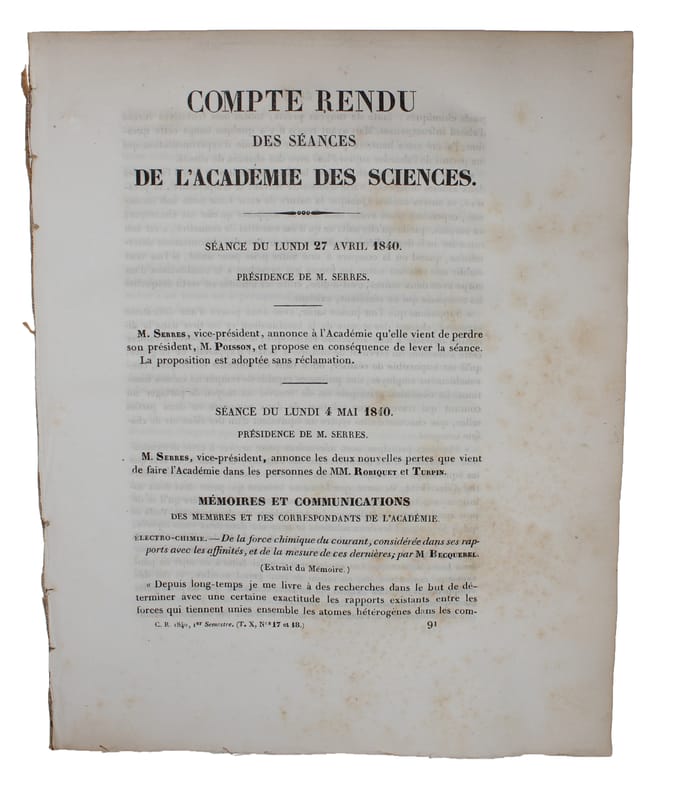
‎"BERNARD, CLAUDE. - PROOVING THE DOCTRINE OF IRRETABILITY.‎

‎Analyse physiologique des propriètés des systèmes musculaire et nerveux au moyen du curare.‎

‎Paris, Mallet-Bachelier, 1856. 4to. No wrappers. In: ""Comptes Rendus Hebdomadaires des Séances de L'Academie des Sciences"", Tome 43, No 18. Pp. (825-) 892. (Entire issue offered). Bernard's paper: pp. 825-829.‎

‎First printin of an importent paper in toxicology in which Bernard describes how he ""paralyzed motor nerve-endings with curare and demonstrated the independent excitability of muscle"" his paper is the classical proof of Haller's doctrine of irretability"" (Garrison & Morton).""Bernard was a true innovator in the study of the effects of toxic and medicinal substances. No one before him had understood so well the role of drug metabolization. He regarded poisoning as a local phenomenon, and advocated the use of certain poisons in physiological research. Curare and carbon monoxide had served him, he said, as ""chemical bistoury,"" making it possible to destroy specific structures selectively. ""(DSB).Garrison & Morton, No 616 and 2079.‎

Référence libraire : 47113

Livre Rare Book

Herman H. J. Lynge & Son
Copenhagen Denmark Dinamarca Dinamarca Danemark
[Livres de Herman H. J. Lynge & Son]

201,45 € Acheter

‎"BERNARD, CLAUDE. - THE DISCOVERY AND ISOLATION OF GLYCOGENE.‎

‎Sur le mécanisme de la formation du sucre dans le foie. (+) Suite Sur le mécanisme... (+) Remarques sur la formation de la matière glycogène du foie. (3 Papers).‎

‎Paris, Mallet-Bachelier, 1855 a. 1857. 4to. No wrappers. In: ""Comptes Rendus Hebdomadaires des Séances de L'Academie des Sciences"", Tome 41, No 13 and Tome 44, No 12 a. No. 26. Pp. 461-500, pp. 578-640 a. pp. 1293-1363 (3 entire issues offered). Bernard's papers: pp. 461-469, pp. 578-586 a. pp. 1325-1331. Some scattered brownspots to the first paper.‎

‎First printing of these two milestone-papers in physiology in which Bernard discovers and isolates glycogen from the liver, shows that it is converted into blood glucose, and discovers the process of gluconeogenesis. He further creates the concepts ""experimental determination"" and ""local interieur""Bernard undertook the task of tracing out the various transformations of food stuffs within the animal organism, beginning with the carbohydrates"" and he not only found, contrary to the accepted view, that sugar was formed in the liver, but he was also able to isolate a substance from the hepatic tissue which, though not sugar, was converted by fermentation into dextrose. He made a special study of its properties and called it ""glycogen"".""The culmination of Bernard's work on the glycogenic function of the liver. He invented the term ""internal secretion"", and can be said to have started the scientific investigation of the internal secretions, although for 30 years the significance of his work was not generally realized. By his research on glycogene Bernard showed that the body not only can break down, but can also build up, complex chemical substances.""(Garrison & Morton) .Claude Bernard (1813-78) was a key figure in French nineteenth-century science, and one of the world's great physiologists. With good reason he has been called the ‘father of experimental medicine’.Garrison & Morton No. 1000 a. 999.1‎

Référence libraire : 47110

Livre Rare Book

Herman H. J. Lynge & Son
Copenhagen Denmark Dinamarca Dinamarca Danemark
[Livres de Herman H. J. Lynge & Son]

604,35 € Acheter

‎"BERNARD, CLAUDE. - THE DISCOVERY OF THE GLYCOGENIC FUNCTION OF THE LIVER.‎

‎Sur une nouvelle fonction du foie chez l'homme et les animaux. (Extrait par l'auteur).‎

‎(Paris, Bachelier),1850. 4to. No wrappers. In: ""Comptes Rendus Hebdomadaires des Séances de L'Academie des Sciences"", Tome XXXI, No. 17. With titlepage to vol. 31. Pp. (561-) 592. (Entire issue offered). Bernard's paper: pp. 571-574. Titlepage with a faint stamp to top and a stamp in lower margin.‎

‎First appearance of the first exposition of the glycogenic function of the liver - one of the greatest physiological discoveries of the 19th century. Bernard showed that the liver builds up complex substances, including glycogen, from the nutriment brought to it by the blood and that these are subsequently modified for distribution to the body.Dibner ""Heralds of Science"" No 131 - Horblit ""One Hundred Books famous in Science"" No. 11a, here listing ""Nouvelle Fonction du Foie"" from 1853 but with the remark ""The work appeared earlier in abbreviated form in the ""Comptes rendus"" (the paper offered). - Exhibition of First Editions of Epochal Achievements in the History of Science, Berkeley 1934. No 107.‎

Référence libraire : 48830

Livre Rare Book

Herman H. J. Lynge & Son
Copenhagen Denmark Dinamarca Dinamarca Danemark
[Livres de Herman H. J. Lynge & Son]

604,35 € Acheter

‎"BERNOULLI, (JACOB). - A NEW ERA IN THE MECHANICS OF ELASTICAL BODIES.‎

‎Veritable Hypothêse de la Résistance des Solides, Avec la Démonstration de la Coubure des corps qui sont Ressort. Lettre du 12. Mars 1705.‎

‎Paris, Jean Boudot, 1706. 4to. Without wrappers. Extracted from ""Mémoires de l'Academie des Sciences. Année 1705"". Pp. 176-186 and 1 folded engraved plate.‎

‎First appearance of a founding paper in the theory of elastic curves. ""Importent also is his last work, on the resistance of elastic bodies (1705)."" (DSB II, p.49 s).""During the last quarter of the seventeenth century and the beginning of the eighteenth centuries a rapid development of the infinitesimal calculus took place. Started on the Continent by Leibnitz...it progresssed principally by the work of Jacob and John Bernoulli. In trying to expand the field of application of this new mathematical tool, they discussed several examples from mechanics and physics. One such example treated by Jacob Bernouilli..concerned the shape of the deflection curve of an elastic bar and in this way he began an importent chapter inthe mechanics of elastic bodies.""(Timoshenko ""History of Strenght of Materials"" p. 25-26).‎

Référence libraire : 44383

Livre Rare Book

Herman H. J. Lynge & Son
Copenhagen Denmark Dinamarca Dinamarca Danemark
[Livres de Herman H. J. Lynge & Son]

268,60 € Acheter

‎"BERNOULLI, (JOHANN I) - THE TAUTOCRONE CURVE IN A MEDIA.‎

‎Méthode pour trouver les Tautochrones, dans des Milieux résistants, comme le Quarré des Vitesses.‎

‎(Paris, L'Imprimerie Royale, 1732). 4to. Without wrappers. Extracted from ""Mémoires de l'Academie des Sciences. Année 1730"". Pp. 78-101.‎

‎First printing of Johann Bernoulli's importent paper in which he for the first time (Euler did it at the same time) solved the problem of finding the tautochrone in a medium that resists a body's motion directly as the square of the body's speed.After Huygens first discovered that the cylcoid was a tautochronous curve in vacuo according to the hypothesis of uniform gravity" Newton and Hermann have also given tautochrones following the hypothesis of non-uniform gravity acting, and pulling towards some fixed point as centre. Moreover, they have considered the motion to arise in a vacuum, with no resistance. Truly pertaining to resisting media, Newton has also shown that the cycloid is a tautochrone in a medium for which the resistance is proportional tothe speed moreover, as far as any other kinds resisting media are concerned, there has been no progress made either in roducing the curves themselves or in demonstrating possible tautochronism in them [The 3rd edition of the Principia that Euler refers to finally in 35 alters this view to include the type of resistance offered here. It may be of interest to the reader to observe that Johan. Bernoulli published a paper in the Memoire de l'Acad. Roy. des Sciences in 1730, also present in his Opera Omnia, T. III, p.173, with the title (in tra. from French): Method for Finding Tautochrones in Media Resisting as the Square of the Speed in which Euler does not get a mention.].‎

Référence libraire : 46599

Livre Rare Book

Herman H. J. Lynge & Son
Copenhagen Denmark Dinamarca Dinamarca Danemark
[Livres de Herman H. J. Lynge & Son]

268,60 € Acheter

‎"BERRY, M.V. (MICHAEL VICTOR) - THE DISCOVERY OF THE ""BERRY-PHASE""‎

‎Quantal phase factors accompanying adiabatic changes.‎

‎London, Royal Society, 1984. Royal8vo. Full buckram, gilt lettering to spine.In: ""Proceedings of the Royal Society of London"", Series A, vol. 392. IV,478 pp. (Entire volume offered). Berry's paper: pp. 45-57. Clean and fine.‎

‎First printing of the paper in which Berry describes his discovery of the ""Berry phase"", a unifying concept in quantum mechanics.""In 1983, Berry made the surprising discovery that a quantum system adiabatically transported round a closed circuit in the space of external parameters acquires, besides the familiar dynamical phase, a non-integrable phase depending only on the geometry of the circuit. This Berry phase, which had been overlooked for more than half a century, provides us a very deep insight on the geometric structure of quantum mechanics and gives rise to various observable effects. The concept of the Berry phase has now become a central unifying concept in quantum mechanics, with applications in fields ranging from chemistry to condensed matter physics. In particular, the Berry phase plays an important role in modern magnetism, an allows to reach a deeper understanding of a broad range of phenomena such as the spin-orbit coupling, the Aharonov-Bohm effect, the quantum Hall effect, the anomalous Hall effect, the magnon dynamics, the tunneling of magnetization in molecular magnets, etc. Further, in the light of the Berry phase, a number of new phenomena can be predicted in ferromagnets with a textured magnetization or in semiconductors with spin-orbit coupling."" (Patrick Bruno).‎

Référence libraire : 47169

Livre Rare Book

Herman H. J. Lynge & Son
Copenhagen Denmark Dinamarca Dinamarca Danemark
[Livres de Herman H. J. Lynge & Son]

429,76 € Acheter

‎"BERTHELOT, MARCELLIN. - THE FOUNDATION OF THERMOCHEMISTRY‎

‎Sur les Principes généraux de la Thermochemie. 1.- 13. Mémoire. (+) Dissolution des Acides et de Alcalis. 1. - 9. Mémoire.‎

‎Paris, Victor Masson, Imprimerie Gauthier-Villars, 1875. 8vo. Contemp. hcalf, raised bands, gilt spine. Light wear along edges. Wear to top of spine. Small stamps on verso of titlepage. Both works in ""Annales de Chimie et de Physique"", 5me Series - Tome IV. 572 pp. (The entire volume offered). Berthelot's works: pp. 5-131 a. 141-214 + pp. 445-537. Internally clean and fine.‎

‎First appearance of this collection of Berthelot's famous memoirs on thermochemistry to which he turned his attention in 1865. In these lectures he introduced the concepts of 'exothermix' and 'endothermic'. He also intorduce his famous 3 principles - equivalence between internal and heat changes in chemical reactions, heat evolved or absorbed in a chemical change depends onlyon the initial and final states of the reactans and products, provided no external work is done, and ""law of maximum work"" which says that ""every chemical change accomplished without the intervention of energy from outside tends towards the production of a body or system of bodies which produce the most heat"". The principles of Thermochemistry given here Berthelot considered himself fundamental.""In the 1860s Berthelot was done with synthesis and turned to thermochemistry, the study of the heat of chemical reactions. In some of his work he had unknowingly been anticipated by Hess, but he went much further. He devised a calorimeter within which he could measure the heat of chemical reactions and ran hundreds of determinations. This work along with that being conducted by Thomson threw the science of thermochemistry into high gear.""(Asimov).‎

Référence libraire : 43164

Livre Rare Book

Herman H. J. Lynge & Son
Copenhagen Denmark Dinamarca Dinamarca Danemark
[Livres de Herman H. J. Lynge & Son]

470,05 € Acheter

‎"BERTHOLLET, CLAUDE LOUIS. - PREPARING THE WAY FOR THE ATOMIC THEORY IN CHEMISTRY.‎

‎Recherches sur les lois de l'affinité. (+) Suite des Recherches... (+) Suite des Recherches... (+) Suite des Recherches... (+) Suite des recherches.. (5 Parts).‎

‎Paris, Chez Fuchs, An IX(1801). Boundin 3 contemp. hcalf. Gilt spuines. Light wear along edges. In: ""Annales de Chimie, ou Recueil de Mémoires concernant la Chemie"" Tome 36, 37 and 38. (Entire volumes offered). 336"330,(2)"334,(2) pp. and 5 engraved plates. Berthollet's paper: pp. 302-317, pp. 151-181, 221-252, pp. 3-29, 113-134.‎

‎Together with the memoir printed at the same time in ""Mémoires de l'Institut.."" this is the first appearance of B's groundbreaking work on the nature of chemical affinity and the fact that many factors influence chemical reactions, comparing chemical affinity to the force of gravity. The paper was at the end of the year published separately.The theory set forth here ""led directly to Prout's investigations which yielded a knowledge of definite chemical proportions and thus played a very importent part in preparing the way for the development of the Atomic Theory on which the whole modern chemistry is based.""(Duveen, p. 75).""Berthollet read a memoir on the general theory of affinities while he was still in Egypt. This was the starting point of his complete new system of chemistry, first briefly sketched in Recherches sur les lois de l’affinité (1801) and later developed into the comprehensive, two volume Essai de statique chimique. Here he attempted to provide a proper basis for chemistry, so that its experimental results could be viewed in the light of theoretical first principles. Berthollet developed a theory and a model adequate for the understanding and the interpretation of the rapidly growing body of chemical knowledge in his time. He was aware that the positive work of constructing a new theory had yet to be performed after the shock of Lavoisier’s criticism of the old chemistry.(DSB).Parkinson ""Breakthroughs"", 1801 C.‎

Référence libraire : 46023

Livre Rare Book

Herman H. J. Lynge & Son
Copenhagen Denmark Dinamarca Dinamarca Danemark
[Livres de Herman H. J. Lynge & Son]

671,50 € Acheter

‎"BERZELIUS - THE DISCOVERY OF THORIUM.‎

‎Untersuchung eines neuen Minerals und einer darin enthaltenen zuvor unbekannten Erde.‎

‎Leipzig, Johann Ambrosius Barth, 1829. Without wrappers as issued in ""Annalen der Physik und Chemie. Hrsg.von Poggendorff"", Bd. 16, Siebentes Stück. (2) + pp., 1 folded engraved plate. Entire issue offered with titlepage to volume 16. Berzelius's paper: pp. 387-415. Clean and fine.‎

‎First German printing - printed simultaneously with the English and Swedish version - of the paper in which Berzelius described his discovery of Thorium, the first element after Uranium to be identified as such. In 1829, Jöns Jakob Berzelius of the Royal Karolinska Institute, Stockholm extracted thorium from a rock specimen sent to him by an amateur mineralogist who had discovered it near Brevig and realised that it had not previously been reported. The mineral turned out to be thorium silicate, and it is now known as thorite. Berzelius even produced a sample of metallic thorium by heating thorium fluoride with potassium, and confirmed it as a new metal. He called the black mineral thorite, in honor of the Scandinavian god Thor.Parkinson ""Breakthroughs"", 1829 C.‎

Référence libraire : 49248

Livre Rare Book

Herman H. J. Lynge & Son
Copenhagen Denmark Dinamarca Dinamarca Danemark
[Livres de Herman H. J. Lynge & Son]

241,74 € Acheter

‎"BERZELIUS, J. (JÖNS JACOB). - THE SYSTEM OF NOMENCLATURE.‎

‎Versuch einer lateinischen Nomenclatur für die Chemie, nach electrisch-chemischen Ansichten. (Im Auszuge, frei bearbeitet, und mit Vorschlägen für die deutsche Nomenclatur begleitet, von Gilbert).‎

‎Leipzig, Johann Ambrosius Barth, 1812. Without wrappers. In: ""Annalen der Physik und der Physikalischen Chemie. Hrsg. Ludwig Wilhelm Gilbert"", Bd. 12 (= Bd. 42 der Reihe), Neuntes Stück. Titlepage to vol. 12. Pp. 1-116 a. 1 engraved plate. (The entire issue offered). Berzelius' paper: pp. 37-89.‎

‎First German edition of this classic paper in chemistry in which Berzelius presented his system of nomenclature to the scientific world. The paper was first preseted in French ""Essay sur la nomenclature chimique"" in Journal de Physique the year before (1811).""Of his contributions, moreover, to the development of the atomic theory and the advancement of chemical science, not the least valuable was the introduction of a chemical symbolism which, with slight modifivcations, is in use at the present day. By giving his symbols a quantitative meaning - the symbol of an element representing one atomic proportion by weight - it was possible ""to show briefly and clearly the number of elementary atoms in each compound and, after the determination of their relative weights, present the results of each analysis in a si8mple and easely retained manner."". This symbolism was speedily adopted on the Continent but, en England, only after some considerable time.""(Findley ""A Hundred Year of Chemistry"", p. 14). - Holmberg, Bibliografi öfver Berzelius, 1812:7).‎

Référence libraire : 44085

Livre Rare Book

Herman H. J. Lynge & Son
Copenhagen Denmark Dinamarca Dinamarca Danemark
[Livres de Herman H. J. Lynge & Son]

470,05 € Acheter

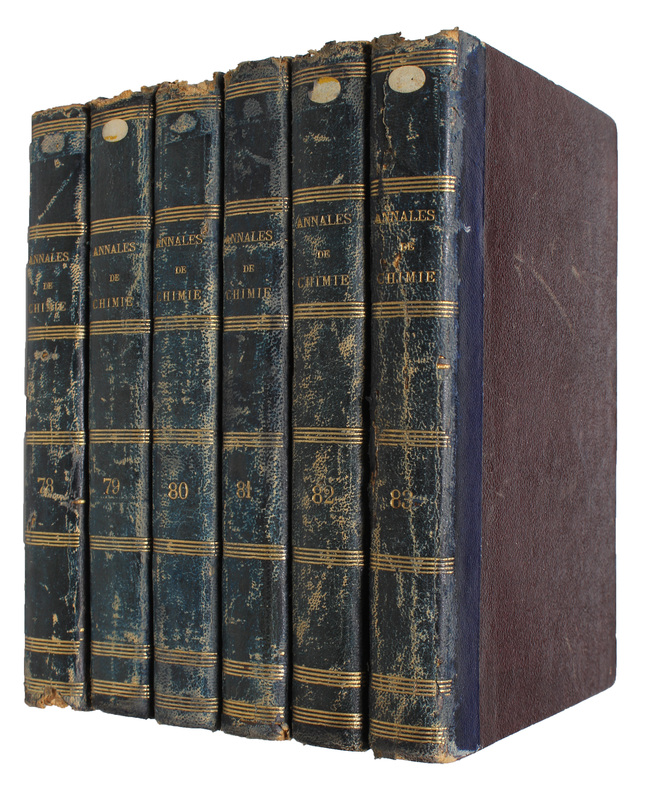
‎"BERZELIUS, JÖNS JACOB. - ONE OF THE MOST IMPORTENT WORKS IN THE HISTORY OF CHEMISTRY - THE FRENCH VERSION.‎

‎Essais sur les proportions déterminées dans lesquelles se trouvent réunis les élémens de la nature inorganiques. (+) Suite des experiences sur les proportions déterminées, d'après lesquelles les élémens de la nature inorganique s'unissent... (In all...‎

‎Paris, Chez J. Klostermann fils, 1811-12. Bound in 6 contemp. hcalf. Gilt spines, slightly rubbed. Wear to top of spines. In: ""Annales de Chimie, ou Recueil de Mémoires concernant la Chemie"" Tome 78, 79, 80, 81, 82 and 83. (Entire volumes offered). The 14 parts: (Tome 78:) pp. 5-37, 105-132, 217-242. - (Tome 79:) pp. 113-142, 233-264. - (Tome 80:) pp. 5-37, 225-258. - (Tome 81:) pp. 5-36, 278-303. - (Tome 82:) pp. 5-33, 113-125, 225-72. (Tome 83:) pp. 5-35 a. pp. 117-127. With in all 3 engraved plates. Some scattered brownspots.‎

‎The papers represents one of the first announcements of Berzelius' discovery of the fixed chemical proportions, determining the weights and valencies of the various constituent elements in inorganic compounds. The papers were published at the same time in Swedish, German (both here in Annalen and in Schweiger's Journal), and in French. By running many hundreds of analysis of chemical compounds he gave so many examples of the law of definite proportions that the world of chemistry could no longer doubt its validity, and in so doing he gave experimental evidence to the atomic theory. He hereby laid a solid fundation for the further development of chemistry. A reprint is found in Ostwald's Klassiker der exakten Wissenschaften, No. 35.According to Söderbaum (Jac. Berzelius, 2, p.12) ""It was a giant work, one of the most importent in the history of chemistry, which was here presented. One is even more impressed when one remembers that it was a pioneer undertaking in every sense of the term. Analytic and synthetic methods existed before Berzelius' time, to be sure, but there were no precise methods of the sort which he required. They all had to be elaborated at the cost of time and labour.""(J. Erik Jorpes ""Jac. Berzelius"", p.45).""In general Berzelius's efforts were directed toward the consolidation and extension of the atomic theory. He improved chemical analysis and determined the composition of a large number of compounds, thus verifying the laws of constant and multiple proportions and furnishing the most accurate equivalent weights then available. By ingenious methods he arrived at the correct atomic composition of most common substances, and thus was enabled to draw up (in 1826) a table of atomic weights very nearly identical with the modern one.""(Leicester & Klicktein ""A Source Book in Chemistry"", p. 258).Parkinson ""Breakthroughs"", 1810-20 C.‎

Référence libraire : 46030

Livre Rare Book

Herman H. J. Lynge & Son
Copenhagen Denmark Dinamarca Dinamarca Danemark
[Livres de Herman H. J. Lynge & Son]

1 678,75 € Acheter

‎"BERZELIUS, JÖNS JACOB. - ONE OF THE MOST IMPORTENT WORKS IN THE HISTORY OF CHEMISTRY- GERMAN VERSION.‎

‎Versuch, die bestimmten und einfachen Verhältnisse anzufinden, nach welchen die Bestandtheile der unorganischen Natur mit einander verbunden sind. Erste Hälfte. (+) Zweite Hälfte. (+) Erste Fortsetzung des Versuchs, die bestimmten...(+) Zweite Fortse...‎

‎Halle, Rengerschen Buchhandlung, 1811, 1811, 1812. Without wrappers as published in ""Annalen der Physik. Herausgegeben von Ludwig Wilhelm Gilbert"", Bd. 37, Drittes u. Viertes Stück + Bd. 38, Sechtes Stück + Bd. 40, Zweites u. Drittes Stück. The entire issues offered (5 issues). With titlepage to vol. 37, 38 a. 40. Pp. 233-480 a. 3 engraved plates., pp. 121-236 a. 2 engraved plates., pp. 117-348 a. 1 engraved plate. Berzelius's papers: pp. 249-337 a. 415-472.- Pp. 161-226. - Pp. 162-208 a. 235-330..‎

‎The papers represents one of the first announcements of Berzelius' discovery of the fixed chemical proportions, determining the weights and valencies of the various constituent elements in inorganic compounds. The papers were published at the same time in German (both here in Annalen and in Schweiger's Journal), and in French. By running many hundreds of analysis of chemical compounds he gave so many examples of the law of definite proportions that the world of chemistry could no longer doubt its validity, and in so doing he gave experimental evidence to the atomic theory. He hereby laid a solid fundation for the further development of chemistry.According to Söderbaum (Jac. Berzelius, 2, p.12) ""It was a giant work, one of the most importent in the history of chemistry, which was here presented. One is even more impressed when one remembers that it was a pioneer undertaking in every sense of the term. Analytic and synthetic methods existed before Berzelius' time, to be sure, but there were no precise methods of the sort which he required. They all had to be elaborated at the cost of time and labour.""(J. Erik Jorpes ""Jac. Berzelius"", p.45).""In general Berzelius's efforts were directed toward the consolidation and extension of the atomic theory. He improved chemical analysis and determined the composition of a large number of compounds, thus verifying the laws of constant and multiple proportions and furnishing the most accurate equivalent weights then available. By ingenious methods he arrived at the correct atomic composition of most common substances, and thus was enabled to draw up (in 1826) a table of atomic weights very nearly identical with the modern one.""(Leicester & Klicktein ""A Source Book in Chemistry"", p. 258).Parkinson ""Breakthroughs"", 1810-20 C.‎

Référence libraire : 43628

Livre Rare Book

Herman H. J. Lynge & Son
Copenhagen Denmark Dinamarca Dinamarca Danemark
[Livres de Herman H. J. Lynge & Son]

1 141,55 € Acheter

‎"BERZELIUS, JÖNS JACOB. - THE INTERNATIONAL LANGUAGE OF CHEMISTRY INTRODUCED.‎

‎Experiments on the Nature of Azote, of Hydrogen, and of Ammonia, and upon the Degrees of Oxidation of which Azote is susceptible. (+) Essay on the Cause of Chemical Proportions, and on some Circumstances relating to them: together with a short and eas...‎

‎London, Robert Baldwin, 1813 a. 1814. 8vo. 2 contemp. hcalf. Marbled boards. Spines lacks and boards detached. In: ""Annals of Philosophy"" or Magazine of Chemistry, Mineralogy, Mechanics... By Thomas Thomson"". Vol. II and Vol. III. Entire volumes offered. Berzelius' papers: pp. 276-284, 357-368 (the first paper in vol. II), pp. 443-454 (vol. II) a. pp. 51-62, 93-106, 244-257 a. 353-364. (vol. III). Internally fine and clean.‎

‎First printing of these milestone papers in the history of chemistry, where Berzelius introduced his famous chemical symbolism whereby an element is generally represented by the first letter of its Latin name, or, in the event of elements having the same first letter, by the first two letters. Even though his atomic symbols were introduced in 1813 (see the note on p. 359 in the first paper), it was quite a few years before Berzelius's symbols were adopted by the chemistry community. But once accepted, they became the new international language of chemistry.Berzelius ""contributed more to the development of the atomic theory and to the setting up of accurate values of the atomic weights than did any other worker of the time. Of his contributions, moreover, to the development of the atomic theory and the advancement of chemical science, not the least valuable was the introduction of a chemical symbolism which, with slight modification, is in use at the present day. By giving his symbols a quantitative meaning - the symbol of an element representing one atomic proportion by weight - it was possible ""to show briefly and clearly the number of elementary atoms in each compound and, after the determination of their relative weights, present the results of each analysis in a simple and easely retained manner"". This symbolism was speedily adopted on the Continent but, in England, only after some considerable time.""(Findlay ""A Hundred Years of Chemistry"", p. 14.).Parkinson ""Breakthroughs"", 1813 C. - Leicester & Klickstein ""A Source Book in Chemistry"", p. 258 ff. - Holmberg 1813:28 a. The volume contains other notable papers THOMAS THOMSON ""On the Discovery of the Atomic Theory"", pp. 329-338. and JOHN DALTON ""Remarks on the Essay of Dr. Berzelius on the Cause of Chemical Proportions"", pp. 174-180 (Vol. III).‎

Référence libraire : 46988

Livre Rare Book

Herman H. J. Lynge & Son
Copenhagen Denmark Dinamarca Dinamarca Danemark
[Livres de Herman H. J. Lynge & Son]

1 611,60 € Acheter

‎"BERZELIUS, JÖNS JACOB. - THE INTERNATIONAL LANGUAGE OF CHEMISTRY INTRODUCED.‎

‎Experiments on the Nature of Azote, of Hydrogen, and of Ammonia, and upon the Degrees of Oxidation of which Azote is susceptible.‎

‎London, Robert Baldwin, 1813. 8vo. Contemp. hcalf. Marbled boards. Spine lacks and boards loose. In: ""Annals of Philosophy"" or Magazine of Chemistry, Mineralogy, Mechanics... By Thomas Thomson"". Vol. II. - VIII,480 pp. a. 7 plates. (Entire volume offered). Berzelius' paper: pp. 276-284, 357-368. Some browning and brownspots to plates.‎

‎First printing of this milestone papers in the history of chemistry, where Berzelius introduced his famous chemical symbolism (the offered paper is the first on the subject - Leicester & Klickstein calls it the ""Preliminary note) whereby an element is generally represented by the first letter of its Latin name, or, in the event of elements having the same first letter, by the first two letters. Even though his atomic symbols were introduced in 1813 (see the note on p. 359), it was quite a few years before Berzelius's symbols were adopted by the chemistry community. But once accepted, they became the new international language of chemistry. Berzelius ""contributed more to the development of the atomic theory and to the setting up of accurate values of the atomic weights than did any other worker of the time. Of his contributions, moreover, to the development of the atomic theory and the advancement of chemical science, not the least valuable was the introduction of a chemical symbolism which, with slight modification, is in use at the present day. By giving his symbols a quantitative meaning - the symbol of an element representing one atomic proportion by weight - it was possible ""to show briefly and clearly the number of elementary atoms in each compound and, after the determination of their relative weights, present the results of each analysis in a simple and easely retained manner"". This symbolism was speedily adopted on the Continent but, in England, only after some considerable time.""(Findlay ""A Hundred Years of Chemistry"", p. 14.).Parkinson ""Breakthroughs"", 1813 C. - Leicester & Klickstein ""A Source Book in Chemistry"", p. 258 ff. - Holmberg 1813:28 a.‎

Référence libraire : 49243

Livre Rare Book

Herman H. J. Lynge & Son
Copenhagen Denmark Dinamarca Dinamarca Danemark
[Livres de Herman H. J. Lynge & Son]

671,50 € Acheter

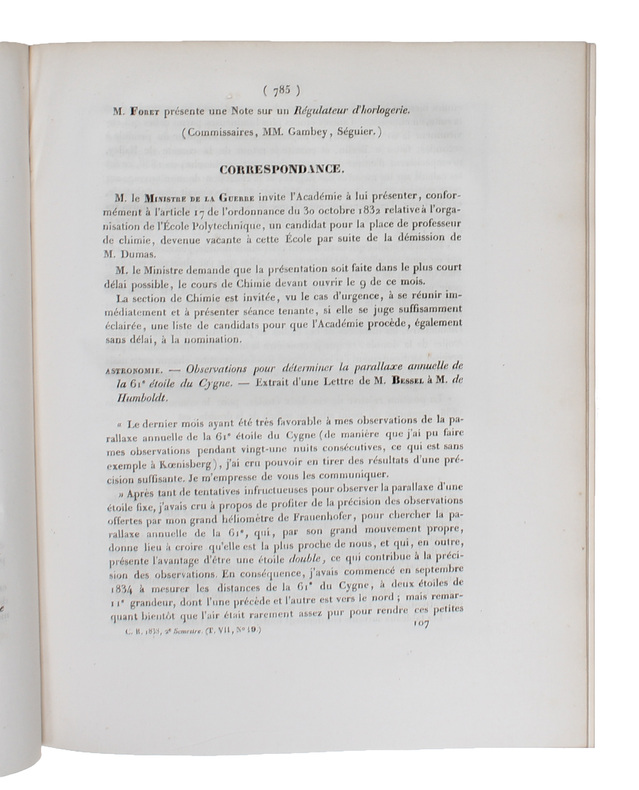
‎"BESSEL, (FRIEDRICH WILHELM) - THE FIRST MEASURE OF THE DISTANCE TO A STAR AND OF ITS PARALLAX.‎

‎Observations pour déterminer la parallaxe annuelle de la 61e étoile du Cygne. - Extrait d'une Lettre de M. Bessel à M. de Humboldt. Note de M.Arago sur le même sujet. (Séance du Lundi 5 Novembre 1838). (+) Nouvelles observations sur la parallaxe annu...‎

‎Paris, Bachelier, 1838 a. 1840. 4to. No wrappers. In: ""Comptes Rendus Hebdomadaires des Séances de L'Academie des Sciences"", Tome 7, No 19 and Tome 10, No 17/18. Pp. (769-) 803 a. pp. (671-) 717. (Entire issues offered). Bessel's papers: pp. 785-793 a. pp. 703-710. Some scattered brownspots.‎

‎First appearance of a milestone paper in astronomy, giving the solution of the great problem of distances in the universe which had baffled astronomers ever since the time of Copernicus, announcing the FIRST SUCCESSFUL DISPLACEMENT OR PARALLAX OF A FIXED STAR and hence deducing the FIRST RELIABLE DISTANCE OF THE EARTH TO A FIXED STAR. The parallax observed corresponded to ab. 600.000 times that of the earth from the sun. On these grounds Bessel calculated the distance to about 11 light years, and this was confirmed by fresh investigations by Bessel in 1839-40 (the second paper offered). In 1842-43 it was also confirmed by C.A.F. Peters at Pulkowa. It is the first published instance of the fathom-line thrown into celestial space.Bessel communicated his observations in Comptes Rendus, in a letter to Humboldt (the offered paper dated Nov. 5, 1838), in ""Monthly Notices"" in letter to J. Herschel, and in ""Astronomische Nachrichten"" Vol. 16, No 365-66 (pp. 65-96), 1838), where a more detail account was published.Ther paper ""Bestimmung der Entfernung des 61sten Stern des Schwans"" in ""Astronomische Nachrichten"" is dated at the end: Altona 1838, Dec. 13.Bessel's investigation was hailed by John Herschel when Bessel was awarded the R.A.S. gold medal ""The greatest and most glorious triumph which practical astronomy has ever witnessed"". ""For determining the parallax of 61 Cygni, Bessel selected two comparison stars of magnitude 9-10 at distances of roughly eight and twelve minutes of arc. 61 Cygni is a physical double star whose components differ in brightness by less than one magnitude. The distance of sixteen seconds of arc between the components favored the accuracy of the determination of the parallax because pointing could be carried out with two star images. After observing for eighteen months, by the fall of 1838 Bessel had enough measurements for the determination of a reliable parallax. He found that p = 0.314? with a mean error of ±:0.020?. This work was published in the Astronomische Nachrichten (1838), the first time the distance of a star became known. Bessel’s value for the parallax shows excellent agreement with the results obtained by extensive modern photographical parallax determinations,..."" (DSB).Parkinson ""Breakthroughs"" 1838 A. - Shapley & Howarth ""A Source Book in Astronomy"", pp. 216 ff.‎

Référence libraire : 47114

Livre Rare Book

Herman H. J. Lynge & Son
Copenhagen Denmark Dinamarca Dinamarca Danemark
[Livres de Herman H. J. Lynge & Son]

1 544,45 € Acheter

‎"BESSEL, (FRIEDRICH WILHELM) - THE FIRST MEASURE OF THE DISTANCE TO A STAR.‎

‎Observations pour déterminer la parallaxe annuelle de la 61e étoile du Cygne. - Extrait d'une Lettre de M. Bessel à M. de Humboldt. Note de M.Arago sur le même sujet. (Séance du Lundi 5 Novembre 1838). (+) Nouvelles observations sur la parallaxe annu...‎

‎Paris, Bachelier, 1838 a. 1840. 4to. No wrappers. In: ""Comptes Rendus Hebdomadaires des Séances de L'Academie des Sciences"", Tome 7, No 19 and Tome 10, No 17/18. With title-ages to vol. 7 and 10. Pp. (769-) 803 a. pp. (671-) 717. (Entire issues offered). Bessel's papers: pp. 785-793 a. pp. 703-710. Stamp on both titlepages. The second titlepage with a fes brownspots, otherwise clean and fine.‎

‎First appearance of a milestone paper in astronomy, giving the solution of the great problem of distances in the universe which had baffled astronomers ever since the time of Copernicus, announcing the FIRST SUCCESSFUL DISPLACEMENT OR PARALLAX OF A FIXED STAR and hence deducing the FIRST RELIABLE DISTANCE OF THE EARTH TO A FIXED STAR. The parallax observed corresponded to ab. 600.000 times that of the earth from the sun. On these grounds Bessel calculated the distance to about 11 light years, and this was confirmed by fresh investigations by Bessel in 1839-40 (the second paper offered). In 1842-43 it was also confirmed by C.A.F. Peters at Pulkowa. It is the first published instance of the fathom-line thrown into celestial space.Bessel communicated his observations in Comptes Rendus, in a letter to Humboldt (the offered paper dated Nov. 5, 1838), in ""Monthly Notices"" in letter to J. Herschel, and in ""Astronomische Nachrichten"" Vol. 16, No 365-66 (pp. 65-96), 1838), where a more detail account was published.Ther paper ""Bestimmung der Entfernung des 61sten Stern des Schwans"" in ""Astronomische Nachrichten"" is dated at the end: Altona 1838, Dec. 13.Bessel's investigation was hailed by John Herschel when Bessel was awarded the R.A.S. gold medal ""The greatest and most glorious triumph which practical astronomy has ever witnessed"". ""For determining the parallax of 61 Cygni, Bessel selected two comparison stars of magnitude 9-10 at distances of roughly eight and twelve minutes of arc. 61 Cygni is a physical double star whose components differ in brightness by less than one magnitude. The distance of sixteen seconds of arc between the components favored the accuracy of the determination of the parallax because pointing could be carried out with two star images. After observing for eighteen months, by the fall of 1838 Bessel had enough measurements for the determination of a reliable parallax. He found that p = 0.314? with a mean error of ±:0.020?. This work was published in the Astronomische Nachrichten (1838), the first time the distance of a star became known. Bessel’s value for the parallax shows excellent agreement with the results obtained by extensive modern photographical parallax determinations,..."" (DSB).Parkinson ""Breakthroughs"" 1838 A. - Shapley & Howarth ""A Source Book in Astronomy"", pp. 216 ff.‎

Référence libraire : 49473

Livre Rare Book

Herman H. J. Lynge & Son
Copenhagen Denmark Dinamarca Dinamarca Danemark
[Livres de Herman H. J. Lynge & Son]

2 014,50 € Acheter

‎"BESSEL, FRIEDRICH WILHELM. - REDUCING THE ""PERSONAL EQUATION"".‎

‎Fundamenta Astronomiae pro Anno MDCCLV deducta ex Observationibus Viri incomparabilis James Bradley in Specula Astronomica Grenovicensi per Annos 1750 - 1762 institutis.‎

‎Regiomonti (Königsberg), Frid. Nicolovium, 1818. Folio. Near contemp. hcalf. Gilt spine with gilt lettering. A small nick at upper backhinge. (12),325,(1) pp. Light scattered brownspots. Top of title-page with old owners name and a small stamp.‎

‎First edition of this milestone work in astronomical obeservation, where Bessel reduced the observations for the ""personal equation"" based on Bradley's observations and here published Bradley's Greenwich observations for the first time and making a catalogue of 3222 stars extracted from them.""The positions of Bradley’s stars valid for 1755 were published by Bessel as Fundamenta astronomiae pro anno 1755 (1818). This work also gives the proper motions of the stars, as derived from these observations of Bradley, of Piazzi, and of Bessel himself. It constitutes a milestone in the history of astronomical observations, for until then positions of stars could not be given with comparable accuracy: through Bessel’s work, Bradley’s observations were made to mark the beginning of modern astrometry. During this investigation Bessel became an admirer of the art of observation as practiced by Bradley"" and because Bradley could not evaluate his own observations, Bessel followed and also taught the principle that immediately after an observation, the reduction had to be done by the observer himself. Further, he realized that the accurate determination of the motions of the planets and the stars required continuous observations of their positions until such motions could be used to predict ""the positions of the stars .... for all times with sufficient accuracy."" (DSB).Shapley a. Howarth. A Source Boook in Astronomy, p. 103 a. 216.‎

Référence libraire : 52737

Livre Rare Book

Herman H. J. Lynge & Son
Copenhagen Denmark Dinamarca Dinamarca Danemark
[Livres de Herman H. J. Lynge & Son]

1 343,00 € Acheter

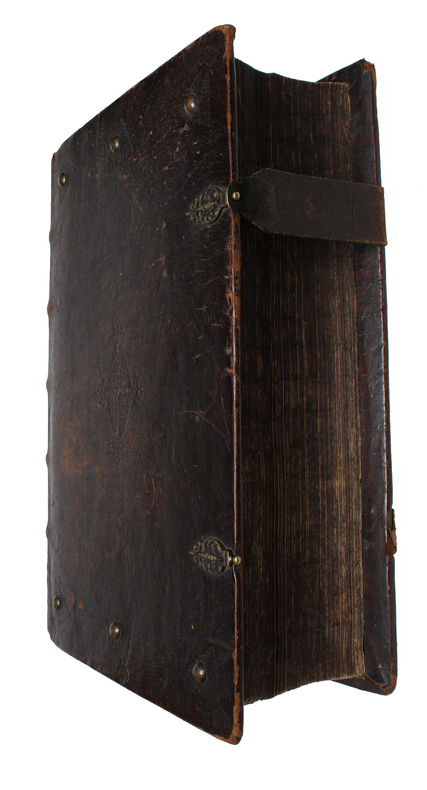
‎"BIBLIA DANICA - FREDERIK DEN II's BIBEL. - THE SECOND DANISH BIBLE IN FOLIO‎

‎Biblia. Det er den gantske Hellige Scrifft Paa Danske igien offuerseet oc Prentet effter Salige oc høylofflige ihukommelse Kong Friderichs den II. Befalning. (3 dele).‎

‎Kiøbenhaffn, (Matz Vingaard), (1588-)89. Folio. (39 x 27 cm.). Samtidigt hellæderbind i brunt kalveskind over svært træ og med kanter i smig. Lettere ophøjede bind på ryg. Håndsyede kapitælbånd. Lille hak i skindet på nederste rygfelt. Med de 4 originale hængselsbeslag i støbt messing bevarede, men den ene strop fornyet og den anden mangler. Permerne har begge blindtrykte arabesker, i midterfeltet en stor arabesk og i hjørner og kanter 6 pyramideformede arabesker, som alle er med en blindtrykt krone i pyramidens top. Permerne har mindre messingstifter med store hoveder til beskyttelse af bindet ved opslag. Marmoreret snit. Bindet er ganske velbevaret med kun lidt kantslid og let slid på de ophøjede rygbind. (22),353(i.e.354),226,159 blade. Komplet, men uden de 3 blanke blade. Træskåret titelblad med tekst trykt i rødt i midterfeltet. Titelbladsvarianten med kongens kobberstukne portræt (af Goltzius) opklæbet på bagsiden (en del eksemplarer udkom uden portrættet). Blad 2 med rigsvåbnet, bladet er kantrepareret. 2 træskårne deltitelblade. Registerbladene med svag skjold i ydre marginer. De sidste 35 blade delvist omkantede, for det meste i ydre marginer. Ganske få spredte brunpletter. Iøvrigt ganske lette brugsspor. Et udmærket velbevaret og komplet eksemplar (bortset fra de 3 blanke).På forreste friblad er anført lidt af eksemplarets ejerhistorie fra 1819, - erhvervet af Mikkel Johannesson Fladebøe som her delvist klausulerer dens ejerskab til fremtidige ejere af gården (Fladebøe ?). Senere synes den overgået til andre i slægten bosat i U.S.A. (Olaf Albertsen, Axel Albertsen, Stanley Albertsen, Sidney Albertsen). Folio. (39 x 27 cm.). Contemporary brown full calf over heavy wooden boards with oblique edges. Sloghtly raised bands to spine. Hand-stitched capital bands. A small notch to the leather of bottom compartment of spine. With the four original brass clasps preserved, but one strap has been renewed and the other is missing. Boards with large blindstamped centre-arabesque and six pyramid shaped arabesques to corners and edges, all with a blindstamped crown on top. Large-headed bras spins to boards, to protect the boards when open. Marbled edges. A bit of wear to edges and light wear to the raised bands. (22), 353(i.e.354), 226, 159 ff. Complete, save for the three blank leaves. Woodcut title-page with centre-text printed in red. The title-page variant with the engraved portrait of the king (by Goltzius) mounted on verso. Several copies were issued without portrait, and some were issued, as here, with the title-page mounted on verso. F. 2 with the royal arms, restored at edges. Two woodcut helf-titles. The index-leaves with a vague damp stain to the outer margins. The last 35 leaves have been partly re-edged, mostly at the very outer margins. A bit of light scattered brownspotting. Light signs of wear. An overall well preserved copy in- as well as externally. Front free end-paper with handwritten notes on provenance from 1819 onward – bought by Mikkel Johannesson Fladebøe, who partly clauses the ownership of the copy to the future owners of the estate (Fladebøe?). It seems to have then passed to other generations of the same lineage located in The United States (Olaf Albertsen, Axel Albertsen, Stanley Albertsen, Sidney Albertsen).‎

‎The magnificent first printing of the second Danish-Norwegian Bible in folio. This, the second Danish Bible in folio, is also the first to be printed by a Dane. The scarce and famous ""Frederik II-Bible"" constitutes the magnum opus of the famed book printer Mads Vingaard ""and the most extensive work of printing undertaken in Denmark during the sixteenth century. The book is profusely illustrated with woodcuts copied from a german Bible issued by Sigmund Feyerabend in Frankfurt a. M. 1560. The original woodcuts were made by the artist and craftsman Virgil Solis... Wide woodcut borders together with pictures using themes from the Scriptures surround the title pages and the illustrations. On the reverse of the first title page many copies have pasted in a portrait of Frederich II, engraved by the Dutch artist Hendrick Goltzius. However, this portrait may also be found on a separate leaf."" (Thesaurus I).Lauritz Nielsen, 405. - Thesaurus I, 129. - Birkelund, 34.‎

Référence libraire : 57770

Livre Rare Book

Herman H. J. Lynge & Son
Copenhagen Denmark Dinamarca Dinamarca Danemark
[Livres de Herman H. J. Lynge & Son]

12 758,50 € Acheter

‎"BIBLIA DANICA - THE CHRISTIAN IV BIBLE‎

‎Biblia Det er Den gantske Hellige Scrifft paa Danske igien offuerseet oc Prentet effter vor allernaadigste Herris oc Kongis K. Christian den IV. Befaling. Mett Register/ alle D. Lutheri Fortaler ghans Udledning i Brædden oc Viti Theodori Summarier. Cu... - [THE MAGNIFICENT CHRISTIAN IV FOLIO BIBLE]‎

‎Kiøbenhaffn, (Melchior Martzan og Salomon Sartor), (1632-) 1633. Folio (binding: 37 x 25 cm.). Bound in a spledid, contemporary full calf binding over wooden boards. Rich, elaborate gilding to both boards and spine. The gilding is vague, especially on the front board, but the tooling is very sharp, and the binding overall is magnificent. With four beautiful, ornamented brass edges to each board and two large ornamented brass clasps. All edges are gilt and beautifully blindtooled. Wear to capitals, where the cords are loosening a bit, and with a bit of loss of leather. A bit of wear to hinges, at the cords, which are showing. But overall the binding is in splendid condition. Also internally extremely well preserved. The title-page has a tiny restored hole to lower right corner, and the first four leaves might have been inserted. They are slightly smaller at the outer margin than the other leaves. But that might also be due to restoration, as the binding has not been tampered with at any point and is completely unrestored. The text is unusually nice, clean and fresh, by far the nicest copy we have ever come across. Pasted-down front end-paper with the ownership signature and lacquered coat-of-arms seal of Severin Svanenhielm (Severin Seehusen (1664-1726) ) as well as the ownership signatures of Søren Schiøtz (1796-1863) (with names of members of his family), C. Th. Zahle and Erik Zahle. With the book plate of William Davignon (d. 1924). The brass corners carry the initials HL and are depicted in Johannes Rudbeck's Svenska Bokband I (fig. 26, p.53). The binding there is dated 1622, whereas our binding is from 1633 or right after. The brass fittings were a commercial merchandise for sale in Germany and probably also in both Sweden and Denmark. Engraved title-page as well as the engraved portrait of Christian IV, all by the royal engraver Simon the Pas. Without the half-title, which merely contains the printed words ""BIBLIA / Paa Danske"", which is almost never present. (21 - not counting the engraved title-page and the portrait), 353 (i.e. 354 due to the erroneous double pagination 353), 226, 159 ff.‎

‎A magnificent copy of the scarce first edition of the last (i.e. the third) of the Danish folio-bibles, known as ""Christian IV's Bible"", being a slightly revised edition of the Bible of 1589. Christian IV is the most famous Danish king ever to have lived, and the Christian IV bible is extremely sought-after. An unusually fresh and complete (apart from the always lacking half-title) copy of this splendid bible, printed by the first royal printer Melchior Martzan and Salomon Sartor (part 2). The numerous woodcut illustrations are the same that were used for the Frederik II Bibel from 1589. The four engraved leaves - the portrait and the three title-pages - are by Simon de Pas.Bibl. Dan.I,9 - Thesaurus II, 378. - Birkelund, 41. - Darlow and Moule, 3160. Provenance: Svanenhielm was a family of Danish and Norwegian nobility. Morten Hansen Seehuusen (1629-1694) was a merchant from Bredstedt in Schleswig-Holstein, who re-located to Stavanger, Norway. His son, Severin Seehusen (1664-1726) was an official in Bergen as well as in Stavanger and Northern Norway. He owned, among other properties, Damsgård Manor outside Bergen, Svanøy in Sunnfjord, and Arnegård in Stavanger. In 1720, Severin Seehausen was ennobled under the name Svanenhielm. Søren Daniel Schiøtz (1796-1863) was a Norwegian bailiff and judge, who was also very much engaged in religious matters and came to play an important role in the history of theology in Norway. He was one of the founders of the Norwegian Mission Society and the Norwegian Israeli Mission. He translated several important upbuilding pieces from German, among them a comprehensive bible history. Carl Theodor Zahle (1866 – 1946) was a highly important Danish lawyer and politician. He was prime minister of Denmark from 1909 to 1910 and again from 1913 to 1920. In 1895, he was elected member of the lower chamber of the Danish parliament, for the Liberal Party. A campaigner for peace, in 1905 he co-founded the Social Liberal Party (Det Radikale Venstre). He stayed on as a member of Parliament for Det Radikale Venstre until 1928, when he became a member of the upper chamber of Parliament (Landstinget). In 1929, he became Minister of Justice , a post which he held until 1935. Zahle was instrumental in starting negotiations for a new Danish–Icelandic Act of Union in 1917, which resulted in Iceland being recognized as a sovereign nation in a personal union with the king of Denmark the following year. Erik Zahle (1898-1969) was a famous Danish art historian, author, and museum director.‎

Référence libraire : 60241

Livre Rare Book

Herman H. J. Lynge & Son
Copenhagen Denmark Dinamarca Dinamarca Danemark
[Livres de Herman H. J. Lynge & Son]

12 758,50 € Acheter

‎"BOHR, N. (NIELS). - THE ATOMIC MODEL AND THE ""STATIONARY STATE""‎

‎On the Quantum Theory of Radiation and the Structure of the Atom. (+) On the Decrease of velocity of Swiftly Moving Electrified Particles passing through Matter. (2 papers).‎

‎London, Taylor & Francis, 1915. Contemp. hcalf. Spine gilt, title- and tomelabels with gilt lettering. Spine a bit rubbed, some cracking to hinges, but covers not detached. In: ""The London, Edinburgh, and Dublin Philosophical Magazine and Journal of Science"", Vol. XXX, Sixth Series. VIII,824 pp., textillustr. and 18 plates. (Entire volume offered). Bohr's papers: pp. 394-413 and pp. 581-612. A stamp to verso of titlepage. Internally clean and fine.‎

‎First appearance of a landmark paper in which Bohr found experimental support for his energy equation for electron orbits and of stationary states in the work of Franck and Hertz from 1914. Furthermore, Franck and Hertz unwittingly provided an independent confirmation of the concept of stationary state. In 1914 they observed an energy threshold in the electron-stopping power of mercury vapor. This threshold, Bohr explained the following year, corresponded to a transition between the normal state and another (first excited) stationary state of the mercury atom (and not, as Franck and Hertz had originally thought, to the ionization of the atom). The supramechanical stability implied by the assumption of stationary states was now empirically proved to comprehend stability with regard to electron impacts.""Bohr had to frequently revise and refine his atomic model in light of new discoveries. One significant paper ""On the Quantum Theory of Radiation and the Structure of the Atom,"" (the paper offered) added more specific details about atomic states. For example Bohr had earlier made the argument that electrons could jump from one orbit to another as energy was emitted or absorbed. In this paper, he theorezed that an atom possesses stationary states in which energy was neither emitted nor absorbed. Any emission or absorption that did occur, such as might induce an electron ump, would correspond to the transition between two stationary states.""(sparknotes.com).An: the second paper offered. When Bohr had finished his importent paper on the hydrogen atom ""On the Theory of Decrease of Velocity of Moving Electrified Particles on passing through Matter"" 1913, he completed another paper on that subject (the paper offered), which includes the influence of effects due to relativity and to straggling (that is, the fluctuations in energy and in range of individual particles).(Pais p. 128).Rosenfeld no 13 a. 14.The volume contains further importent papers by J.J. THOMSON, W.H. BRAGG, RUTHERFORD & BARNES, SODDY & HITCHINS etc.‎

Référence libraire : 47170

Livre Rare Book

Herman H. J. Lynge & Son
Copenhagen Denmark Dinamarca Dinamarca Danemark
[Livres de Herman H. J. Lynge & Son]

872,95 € Acheter

‎"BOHR, NIELS - NAMING ""THE PRINCIPLE OF CORRESPONDENCE""‎

‎Über die Serienspektra der Elemente. (Vortrag gehalten am 27. April 1920 in der Sitzung der Deutschen Physikalischen Gesellschaft in Berlin).‎

‎Braunschweig, Vieweg & Sohn, 1920. Contemp. Hcloth. Stamp on titlepage. In ""Zeitschrift für Physik"", Bd. 2. IV,478 pp. (Entire volume offered). Bohr's paper: pp. 423-469. A very faint dampstain to right margins.‎

‎First edition of this fundamental paper in which Bohr for the first time gives name to a theory, which was for the first time used in his work ""The quantum theory of line Spectra"" from 1918, but now for the first time called ""Korrespondenzprincip"" (The Principle of Correspondence) and explained in the offered paper. The principle was introduced ""in order to obtain the necessary relation to the ordinary theory of radiation in the limit of slow vibrations we are therefore led directlyto certain conclusions about the probability of transition between two stationary states in this limit."".The ""Principle of Correspondence"" is the physical priciple that the behaviour of atomic and other systems should approximate to that predicted by classical physics in certain specific circumstances where quantum effects are expected to be unimportent. Bohr used the principle to explain his theory of the hydrogen atom, which among other things successfully predicted many features of the spectrum of light emitted by energetic hydrogen atoms. The principle formed an importent component of the early quantum theory of Bohr, Sommerfeld and others.Betty Schultz: 17.‎

Référence libraire : 48726

Livre Rare Book

Herman H. J. Lynge & Son
Copenhagen Denmark Dinamarca Dinamarca Danemark
[Livres de Herman H. J. Lynge & Son]

604,35 € Acheter

‎"BOHR, NIELS AND F. KALCKAR. - THE LIQUID DROP MODEL OF BOHR INTRODUCED.‎

‎On the Transmutation of Atomic Nuclei by Impact of Material Particles. I. General theoretical Remarks. (all published)‎

‎Copenhagen, Levin & Munksgaard,1937. 8vo. Uncut in orig. printed wrappers. In: ""Det KGL. Danske Videnskabernes Selskab. Mathematisk-fysiske Meddelelser. XIV,10"". 40 pp. Fine and clean.‎

‎First edition of the work in which Bohr introduced his famous Liquid Drop Model of the atom in order to interprete the nuclear structure. (The paper was not continued as Kalckar died the following year).""It had, of course, been clear to Bohr that analogies with atomic spectra could not be of help in interpreting his (earlier) picture of nuclear structure. Peripheral electrons, thinly spread within the atomic volume, can be compared to a dilute gas of particles interacting in pairs only. By contrast Bohr's picture of intranuclear motions of tightly bound nucleons should show 'essential collective aspects', he said. Now, together with Kalckar, he suggested that for nuclei a much more proper comparison would be with a drop of liquid. That analogy should not be taken too literally, the dynamics of a true liquid drop is vastly different from thta of nucleai. Yet the comparison, treated cautiously, was tempting and in the event proved fruitful in many respects, particularly in regard to collective motions.""(Pais ""Niels Bohr's Times"", pp. 339-40).""In the liquid drop model, formulated by Niels Bohr, the nucleons are imagined to interact strongly with each other, like the molecules in a drop of liquid. A given nucleon collides frequently with other nucleons in the nuclear interior, its mean free path as it moves about being substantially less than the nuclear radius. This constant ""jiggling around"" reminds us of the thermal agitation of the molecules in a drop of liquid. The liquid drop model permits us to correlate many facts about nuclear masses and binding energies"" it is useful in explaining nuclear fission. It also provides a useful model for understanding a large class of nuclear reactions."" (FAQ).Rosenfeld No 56.‎

Référence libraire : 48816

Livre Rare Book

Herman H. J. Lynge & Son
Copenhagen Denmark Dinamarca Dinamarca Danemark
[Livres de Herman H. J. Lynge & Son]

335,75 € Acheter

‎"BOLLÉE, LÉON. - THE INVENTION OF ""THE MILLIONAIRE CALCULATOR""‎

‎Sur une nouvelle machine à calculer.‎

‎(Paris, Gauthier-Villars, 1889). 4to. No wrappers. Disbound. In: ""Comptes Rendus Hebdomadaires des Séances de L'Academie des Sciences"", Tome 109, No 20. Pp. (723-) 758 (entire issue offered). Bollée's paper: pp. 737-739. Disbound but clean.‎

‎First printing of the paper in which Bollée describes his invention of a new calculating machine, later called ""The Millionaire"", based on a multiplying mechanism which was capable of performing multiplication directly instead of using repeated addition. As it allows multiplication by any digit it was used by government agencies ans scientists, especially astronomers, well into the twentieths century.Bollée did not produced his machine comercially, ""... but in 1893 Otto Steiger of Munich patented a calculator based on Bollée's approach, which was manufactured between 1895 and 1935 by the firm Hans W. Egli of Switzerland and marketed under the name of ""Millionaire"".... Forty-six hundred ""Millionaires"" were sold, primarly in Europe."" (Hook & Norman ""Origins of Cyberspace"" : 288).‎

Référence libraire : 48744

Livre Rare Book

Herman H. J. Lynge & Son
Copenhagen Denmark Dinamarca Dinamarca Danemark
[Livres de Herman H. J. Lynge & Son]

241,74 € Acheter

‎"BOLTZMANN, LUDWIG. - DEFENDING THE ATOMIC VIEWPOINT.‎

‎Über die Integrale linearer Differentialgleichungen mit periodischen Coëfficienten.‎

‎Wien, Karl Gerold's Sohn, 1868. 8vo. Uncut and unopened in orig. printed wrappers. In: ""Sitzungsberichte der kaiserlichen Akademie der Wissenschaften"", 58. Band, 1. Heft - Juni. Pp. (1-) 155 a. 7 plates.(Entire issue offered). Boltzmann's paper: pp. 54-59. Clean and fine.‎

‎First apperance of an importent paper in which Boltzmann from a mathematical point of view defends atomism. ""Throughout his career, even in his works on subjects other than kinetic theory Boltzmann was concerned with the mathematical problems arising from the atomic nature of matter. Thus, an early paper with the title ""Über die Integrale linearer Differentialgleichungen mit periodischcn Koeffizienten"" (1868) turned out to be an investigation of the validity of Cauchy’s theorem on this subject, which is needed to justify the application of the equations for an elastic continuum to a crystalline solid in which the local properties vary periodically from one atom to the next."" (DSB). The issue contains an importent paper by JOHANN JOSEPH LOSCHMIDT ""Ableitung des Potentiales bewegter elektrischer Massen aus dem Potentiale für die Ruhestand"", pp. 7-14, in which he attempted to derive the Weber-Ampère law from that of Coulomb, and, in accordance with Kirchhoff, to derive Ohm’s law from hydrodynamic flow laws, analogous to Poiseuille’s law.‎

Référence libraire : 47990

Livre Rare Book

Herman H. J. Lynge & Son
Copenhagen Denmark Dinamarca Dinamarca Danemark
[Livres de Herman H. J. Lynge & Son]

114,15 € Acheter

‎"BOLTZMANN, LUDWIG. - THE PRESSURE OF RADIATION.‎

‎Ueber eine von Hrn. Bartoli entdeckte Beziehung der Wärmestrahlung zum zweiten Hauptsatze. (+) Ueber das Arbeitsquantums. welches bei chemischen Verbindungen gewonnen werden kann: (Aus...der Sitzungsberichte de k. Akad. der Wiss. zu Wien).‎

‎Leipzig, Johann Ambrosius Barth, 1884. Without wrappers as issued in ""Annalen der Physik und Chemie. Hrsg. von G. Wiedemann."", Neue Folge Bd. 22, 5. Heft (= No 5). Pp. 1-144 a. 1 folded plate. (entire issue offered). Boltzmann's papers: pp. 31-39 a. pp. 39-72‎

‎First appearance of an importent paper in which Boltzmann followed up his theoretically confirmation of Stefan's experimental findings - the ""Stefan-Boltzmann law"" - by combining the Second Law of Thermodynamics with the theory of the pressure of radiation.‎

Référence libraire : 44837

Livre Rare Book

Herman H. J. Lynge & Son
Copenhagen Denmark Dinamarca Dinamarca Danemark
[Livres de Herman H. J. Lynge & Son]

335,75 € Acheter

‎"BOLTZMANN, LUDWIG. - THE STEFAN-BOLTZMANN LAW - BLACKBODY RADIATION‎

‎Ableitung des Stefan'schen Gesetzes, betreffend die Abhängigkeit der Warmestrahlung von der Temperatur aus der electromagnetischen Lichttheorie.‎

‎Leipzig, Johann Ambrosius Barth, 1884. Without wrappers as issued in ""Annalen der Physik und Chemie. Hrsg. von G. Wiedemann."", Neue Folge Bd. 22, 6. Heft (= No 6). Titlepage to vol. 22. Pp. 145-304 (entire issue offered ""Heft"" 6). Boltzmann's paper: pp. 291-294. Small stamp to titlepage and verso of.‎

‎First appearance of this importent paper in which Boltzmann uses the second law of thermodynamics and Maxwell's electromagnetic theory to derive theoretically, based on Stefan's experimental observations, the proportionality of the radiation emitted from a body and the fourth power of the temperature of the body in Kelvin units. ""The law show a possible connection between thermodynamics and electromagnetism that was exploited in the later quantum theory. In the 1920s it was applied by Edington and others in explaining the equilibrium of stellar atmospheres.""(DSB II, p. 266).""The law states that the total energy radiated per unit surface area of a black body per unit time (known variously as the black-body irradiance, energy flux density, radiant flux, or the emissive power), is directly proportional to the fourth power of the black body's thermodynamic temperature T (also called absolute temperature).The Stefan Boltzmann law was experimentally discovered in the year 1879 by Josef Stefan and deduced 1884 by Ludwig Boltzmann theoretically by thermodynamic considerations from the classical electromagnetic theory of the radiation. In the year 1900, thus 21 years after the Stefan Boltzmann law, discovered Max Planck the Planck radiation law designated after it, from which the Stefan Boltzmann law follows simply by integration over all directions and wavelengths. The Planck radiation law could attribute the Stefan Boltzmann constant also for the first time with the introduction of the quantum of action h to fundamental natural constants.""Parkinson ""Breakthroughs"" 1883 P.‎

Référence libraire : 43536

Livre Rare Book

Herman H. J. Lynge & Son
Copenhagen Denmark Dinamarca Dinamarca Danemark
[Livres de Herman H. J. Lynge & Son]

604,35 € Acheter

‎"BONNET, (CHARLES). - FIRST SCIENTIFIC DESCRIPTION OF THE TAPEWORM.‎

‎Dissertation sur le Ver nommé en Latin Tænia, & en francois Solitaire, où après avoir parlé d'un nouveau secret pour l'expulser des intestins dans lesquels il est logé, qui a eu d'heureux succès, l'on donne quelques observations sur cet Insecte. P...‎

‎Paris, L'Imprimerie Royale, 1750. 4to. Extract from ""Mémoires de Mathematique et de Physique, Présentés à l'Academie des Sciences par divers Savans"", Tome I. Pp. 478-529 pp. and 2 engraved plats. With titlepage to Volume I. A small wormhole to inner margin.‎

‎First appearance of this classic study of the tapeworm (Taenia), being the first accurate description of the Proglottids.""In 1741 he began to study reproduction by fusion and the regeneration of lost parts in the freshwater hydra and other animals. The following year he discovered that the respiration of caterpillars and butterflies is performed by pores, to which the name of stigmata has since been given. He also studied tapeworms. These investigations earned him a membership of the Royal Society of London in 1743, the same year he became a doctor of laws.""""Bonnet is considered one of the fathers of modern biology. He is distinguished for both his experimental research and his philosophy, which exerted a profound influence upon the naturalists of the eighteenth and nineteenth centuries. "" (D.S.B. II: 286).With: M. Geer ""Observation sur la propriété singulière qu'ont les grandes Chenilles á quatorze jambes & à double queue, du Saule, de seringuer de la liqueur"". Pp. 530-638 a. 1 engraved plate.‎

Référence libraire : 45045

Livre Rare Book

Herman H. J. Lynge & Son
Copenhagen Denmark Dinamarca Dinamarca Danemark
[Livres de Herman H. J. Lynge & Son]

221,59 € Acheter

‎"BOSCOVICH (BOSCOVIC), ROGER JOSEPH (RUDJER J.). - GEOMETRICAL OPTICS AND THE RAINBOW.‎

‎Extrait d'une Lettre du P. Boscovich, Jésuite, Correspondant de l'Academie, écrite à M. de Mairan.‎

‎(Paris, Imprimerie Royale, 1760). 4to. Extract from ""Mémoires de Mathematique et de Physique, Présentés à l'Academie des Sciences par divers Savans"", Tome III. Pp. 321-325. A faint dampstain to inner margins.‎

‎First apperance of Boskovic's paper in which he explains how light is refracted and reflected in droplets of water, creating the coloured rainbow - he discusses the sphericity in connection with both refraction and reflexion of light and he comments on Newton's optics.‎

Référence libraire : 45083

Livre Rare Book

Herman H. J. Lynge & Son
Copenhagen Denmark Dinamarca Dinamarca Danemark
[Livres de Herman H. J. Lynge & Son]

268,60 € Acheter

‎"Boulder" The Business Detective‎

‎Hidden Causes of Reckless Advertising Waste‎

‎Chicago: Lord and Thomas 1913. First edition. Softcover. fine. First edition stated. Printed stiff wrappers. 112 pp. Illustrated with line drawings. Twelve lessons on what NOT to do in the advertising game including "Campaigns Crippled by Fallicies by Salesmen" "Resistance in the Shipping Department" "Mail Order Hit and Miss" and more. A quick perusal showed us how what was true in 1913 is also true in some form or another a century later. Fine. <br/><br/> Lord and Thomas paperback‎

Référence libraire : E12932B

Biblio.com

The Old Book Shop of Bordentown (ABNJ)
United States Estados Unidos Estados Unidos États-Unis
[Livres de The Old Book Shop of Bordentown (ABNJ)]

33,84 € Acheter

‎"BOUSSINGAULT, JEAN BAPTISTE J.D. - REVEALING THE NITROGEN CYCLE.‎

‎Recherches chimiques sur la Végetation, entreprises dans le but d'examiner si les Plantes prennent de l'Azote à l'atmosphère. (Premier - Deuxieme Mémoire).‎

‎(Paris, Crochard, 1838). No wrappers. In: ""Annales de Chimie et de Physique"", 2. Series, Tome 67, 1. issue. Pp. 5-112 and Tome 69, 4. issue. Pp. 353-448. Boussingault's papers: pp. 5-54 and pp. 353-367.‎

‎First appearance of these classical papers on plant nutrition, in which Boussingault verified that nitrogen could not come from watering nor from atmospheric dust, but was taken in from the atmosphere.‎

Référence libraire : 45646

Livre Rare Book

Herman H. J. Lynge & Son
Copenhagen Denmark Dinamarca Dinamarca Danemark
[Livres de Herman H. J. Lynge & Son]

241,74 € Acheter

‎"BOWMAN, WILLIAM. - CLASSIC WORK ON THE STRIATED MUSCLE FIBRES.‎

‎On the Minute Structure and Movements of Voluntary Muscle...In a Letter addressed to Robert Bently Todd. Received June 18, - Read June 18, 1840. (+) Additional Note on the Contraction of Voluntary Muscle in the Living Body. received April 15, - Read A...‎

‎(London, Richard and John E., Taylor, 1840 a. 1841). 4to. No wrappers as extracted from ""Philosophical Transactions"" 1840 - Part II. Pp. 457-501 a. 4 lithographed plates + 1841 - Part I., pp. 69-72. Both papers clean and fine.‎

‎First appearance of this classic paper on the physiology of the muscles. - ""Classical description of the striated muscle"" (Garrison & Morton No. 542).Striated muscle fine structure began to be really understood following a comprehensive survey of the matter carried out by William Bowman in the late 1830s. The publications resulting from such a study, the first of which earned for the author a precocious election as Fellow of the Royal Society.""Bowman succeeded in establishing the true architecture of striated muscle fibres to the extent possible with the most advanced technology available in his day - explaining and eradicating alternative erroneous concepts in the process - but also in correctly describing the basic microstructural changes associated with contraction. In addition, although unrecognized by him or others at the time, his experiments with muscle provided direct evidence for the existence of a selectively permeable cell membrane - in the present meaning of the word - over half a century before its officially accepted discovery. Yet, in spite of these remarkable advances, Bowman arrived at the conclusion that the structure of striated muscle fibres is essentially irrelevant for the mechanism of contraction.""(Eugenio Frixione).‎

Référence libraire : 42942

Livre Rare Book

Herman H. J. Lynge & Son
Copenhagen Denmark Dinamarca Dinamarca Danemark
[Livres de Herman H. J. Lynge & Son]

382,75 € Acheter

‎"BRACONNOT, HENRI. - THE FIRST ISOLATION OF GLYCINE AND LEUCINE.‎

‎Mémoire sur la Conversion des matières animales en nouvelles substances par le moyen de l'acide sulfurique.‎

‎(Paris, Crochard, 1820).. No wrappers. Extracted from: Annales de Chimie et de Physique, Par MM. Gay-Lussac et Arago."", Series 2, Tome 13. Pp. 113-125.‎

‎First printing recording Braconnot's isolation of Glycine and Leucine which became the first instance in which a pure amino acid was received from a protein (gelatin) by acidic hydrolysis.""He went on to study the effects of sulfuric acid on animal substances: gelatin, muscle fibers, and wool. In the case of gelatin, he discovered a sugar-like substance which he called sucre de gélatine, later named glycocoll (glycine). Sulfuric acid converted wool and muscle fiber to a white substance he called leucine."" (DSB).Garrison & Morton: 668.3.‎

Référence libraire : 45518

Livre Rare Book

Herman H. J. Lynge & Son
Copenhagen Denmark Dinamarca Dinamarca Danemark
[Livres de Herman H. J. Lynge & Son]

134,30 € Acheter

‎"BRACONNOT, HENRI. - THE FIRST ISOLATION OF GLYCINE AND LEUCINE.‎

‎Mémoire sur la Conversion des matières animales en nouvelles substances par le moyen de l'acide sulfurique.‎

‎(Paris, Crochard, 1820). No wrappers. In: Annales de Chimie et de Physique, Par MM. Gay-Lussac et Arago."", Series 2, Tome 13, Cahier 2. Pp. 113-224 (entire issue offered). Braconnot's paper: pp. 113-125. Clean.‎

‎First printing recording Braconnot's isolation of Glycine and Leucine which became the first instance in which a pure amino acid was received from a protein (gelatin) by acidic hydrolysis.""He went on to study the effects of sulfuric acid on animal substances: gelatin, muscle fibers, and wool. In the case of gelatin, he discovered a sugar-like substance which he called sucre de gélatine, later named glycocoll (glycine). Sulfuric acid converted wool and muscle fiber to a white substance he called leucine."" (DSB).Garrison & Morton: 668.3.‎

Référence libraire : 50172

Livre Rare Book

Herman H. J. Lynge & Son
Copenhagen Denmark Dinamarca Dinamarca Danemark
[Livres de Herman H. J. Lynge & Son]

268,60 € Acheter

‎"BRAGG, W.H. - THE CORPUSCULAR NATURE OF X-RAYS AND GAMMA-RAYS.‎

‎The Consequences of the Corpuscular Hypothesis of the (gamma) and X-rays, and the Range of ß Rays.‎

‎(London, 1910). No wrappers. In: ""The London, Edinburgh, and Dublin Philosophical Magazine and Journal of Science"", (Sixth Series), September 1910. Pp. 385-544 a. 6 folded plates. (Entire Sept.-issue offered). Bragg's paper: pp. 385-416.‎

‎First printing of the paper in which Bragg discloses the corpuscular nature of Gamma- and X-Rays.""Considering gamma and X rays to be of the same nature, he declared the evidence in favor of the ether pulse theory to be ""overrated,"" and emphasized that theory was unable to account for the large quantity of energy and momentum that remained in the ray regardless of the distance from its source, and that could all be delivered to a single electron. During the following five years Bragg backed off somewhat from this concrete model of the gamma ray, emphasizing its ""corpuscular"" rather than its ""material"" nature. but did not abandon the general concept of an electron-with-its-charge-neutralized until after the discovery of X-ray diffraction in 1912. Thus, initially without being aware of the views of Einstein and Stark, Bragg became the first, and remained the foremost, English-language advocate of a view of X rays that stressed their ""quantal"" properties. (DSB).‎

Référence libraire : 45123

Livre Rare Book

Herman H. J. Lynge & Son
Copenhagen Denmark Dinamarca Dinamarca Danemark
[Livres de Herman H. J. Lynge & Son]

114,15 € Acheter

‎"BRAHE, TYGE (TYCHO). - THE FIRST DANISH TRANSLATION OF ""DE NOVA STELLA"".‎

‎Den Ny Stjerne (1572). Oversat fra Latin af Otto Gelsted under medvirken af Thøger Larsen med Efterskrift af Harald Mortensen og Noter af Thøger Larsen. (Omslagstitlen). Danskerens Tyge Brahe's matematiske Betragtning over den Ny og aldrig nogensinde...‎

‎Lemvig, Atlantis' Forlag, 1923. Ubeskåret i originale bogtrykte omslag. De første og sidste blade med lidt brunpletter. (2),56,(2) pp., tekstillustrationer. (Særtryk af Atlantis). Nr. 122 af 200 salgseksemplarer, hele oplaget var på 250 eksemplarer. Nederste margin af omslaget med en svag skjold.Uncut in the original printed wrappers. First and last leaves with a bit of brownspotting. Lower margin of wrapper with a faint damp stain. (2),56,(2) pp., tekstillustrationer.‎

‎Første danske oversættelse af Brahes ""De Nova Stella"". Værket er aldrig blevet oversat i sin helhed, men Gelsted og Thøger Larsen har her oversat værkets astronomiske del for første gang i det 350. år efter dens første udgivelse. First edition of the first Danish translation of any part of Brahe's seminal ""De Nova Stella"" (1573). The work has never been translated in its entirety, but here we have Gelted and Thøger Larsen's excellent translation of the astronomical part of it, published 350 years after its original publication in Latin. This is nr. 122 out of 200 copies that were for sale, being an offprint from ""Atlantis"".‎

Référence libraire : 45598

Livre Rare Book

Herman H. J. Lynge & Son
Copenhagen Denmark Dinamarca Dinamarca Danemark
[Livres de Herman H. J. Lynge & Son]

268,60 € Acheter

‎"BRANLY, ÉDOUARD. - THE INVENTION OF THE ""COHERER"" (RADIO-CONDUCTOR).‎

‎Variations de conductibilité sous diverses influences électriques.‎

‎(Paris, Gauthier-Villars), 1890. 4to. No wrappers. In: ""Comptes Rendus Hebdomadaires des Séances de L'Academie des Sciences"", Tome 111, No 21. Pp. (767-) 810. (Entire issue offered). Branly's paper: pp. 785-787.‎

‎First appearance of the paper in which Branly announced his discovery that the electrical resistance of a granular metallic conductor could drop by several orders of magnitude when excited by the electromagnetic field emitted by an electrical spark, the so-called Branly-effect.The coherer was a key enabling technology for radio, and was the first device used to detect radio signals in practical spark gap transmitter wireless telegraphy. It became the basis for radio reception around 1900, and remained in widespread use for about ten years.‎

Référence libraire : 48907

Livre Rare Book

Herman H. J. Lynge & Son
Copenhagen Denmark Dinamarca Dinamarca Danemark
[Livres de Herman H. J. Lynge & Son]

335,75 € Acheter

‎"BRAUN, FERDINAND. - THE DISCOVERY OF SEMICONDUCTOR RECTIFIER EFFECT.‎

‎Ueber die Stromleitung durch Schwefelmetalle.‎

‎Leipzig, Johann Ambrosius Barth, 1874. 8vo. Contemp. hcalf. 5 raised bands, gilt spine and gilt lettering to spine. A few scratches to spine. Small stamp on verso of first -and general- titlepage. In: ""Annalen der Physik und Chemie. Hrsg. von J.C. Poggendorff"", Sechste Reihe Bd. 3, (= Poggendorff Bd. 153). X,636 pp., 4 plates. (Entire volume offered). Braun's paper: pp. 556-563.‎

‎First printing of Brown's importent paper in which he described his discovery of a semiconductor diode, noting that electrical currents flows freely in only one direction at the contact between a metal point and a galena crystal.""In 1874 Braun published the results of his research on mineral metal sulfides. He found that these crystals conducted electric currents in only one direction. This information was important in electrical research and in measuring another property of substances, the electrical conductivity, but Braun’s discovery did not have immediate practical application. In the early twentieth century the principle that Braun had discovered was employed in crystal radio receivers.""(DSB).The Nobel Prize in Physics 1909 was awarded jointly to Guglielmo Marconi and Karl Ferdinand Braun ""in recognition of their contributions to the development of wireless telegraphy"".‎

Référence libraire : 49327

Livre Rare Book

Herman H. J. Lynge & Son
Copenhagen Denmark Dinamarca Dinamarca Danemark
[Livres de Herman H. J. Lynge & Son]

335,75 € Acheter

‎"BREGUET, ANTOINE. - THE THEORY OF THE GRAMME MACHINE.‎

‎Recherches sur la Théorie de la Machine de Gramme, sur la Cause de la Position dissymétrique de ses Frotteurs, et incidement, Étude des Écrains magnetiques.‎

‎Paris, G. Masson, Imprimerie Gauthier-Villars, 1879. 8vo. Contemporary half calf, raised bands, gilt spine. Light wear along edges. Small stamps on verso of title-page. In ""Annales de Chimie et de Physique"", Cinquiéme Series - Tome XVI. 576 pp. a. 2 folded plates. (Entire volume offered). Breguet's paper: pp. 5-48 a. 1 large folded engraved plate.‎

‎First edition of this importent paper giving the first physical theory of the Grammo machine's magnetic function. - Wheeler Gift No. 3990.A Gramme machine, Gramme ring, Gramme magneto, or Gramme dynamo is an electrical generator which produces direct current, named for its Belgian inventor, Zénobe Gramme, and was built as either a dynamo or a magneto. It was the first generator to produce power on a commercial scale for industry.‎

Référence libraire : 45987

Livre Rare Book

Herman H. J. Lynge & Son
Copenhagen Denmark Dinamarca Dinamarca Danemark
[Livres de Herman H. J. Lynge & Son]

134,30 € Acheter

‎"BRILLOUIN, LÉON.- THE INDTRODUCTION OF THE ""WKB METHOD"" IN QUANTUM MECHANICS.‎

‎La mécanique ondulatoire de Schrödinger"" une méthode générale de résolution par approximations successives.‎

‎Paris, Gauthier-Villars et Cie, 1926. 4to. Without wrappers. In: ""Comptes Rendus Hebdomadaires des Séances de L'Academie des Sciences"", Tome 183, No 1. Pp. (5-) 100. (Entire issue offered). Brillouin's paper: pp. 24-26.‎

‎First appearance of Brillouin's importent paper in which he introduced the WKB-method in quantum Mechanics.""In 1925 Brillouin was the only French theoretician to react competently to Werner Heisenberg’s new matrix mechanics. In two papers published in 1926, he contributed to the exploration of the mathematical content of Heisenberg’s theory. Brillouin’s first contribution in this field was important (the paper offered). Through a new method of semiclassical approximation, he discovered the relation between Schrodinger’s mechanics and the quantum theory of Niels Bohr and Sommerfeld. Presumably inspired by de Broglie’s early analogies between mechanics and optics, he found this approximation as the quantum mechanical counte)t of the approximation. In this procedure, stationary solutions of the Schrödinger equation are sought in the form eiS/h (as in the eikonal approximation of optics). In the first approximation (h small), S must be a solution of the Hamilton-Jacobi equation of classical mechanics, and the Bohr-Sommerfeld conditions (S = 2pnh on a closed trajectory) must be satisfied for the W function to be defined and singlevalued in all space. Subsequent corrections are proportional to successive powers of h. They intermix the various Bohr trajectories. thereby reintroducing the complex interplay of quantum states found in matrix mechanics, This method, published by Brillouin in July 1926 - anticipated by Harold Jeffreys in 1923 in a purely mathematical context, reinvented by Gregor Wentzel in September 1926. and perfected by Hendrik Kramers in November 1926 - is now called the (J) BWK method and is widely used in many quantum mechanical problems.""(DSB).See also Max Jammer ""The Conceptual development of Quantum Mechanics"", pp. 277 ff.‎

Référence libraire : 47142

Livre Rare Book

Herman H. J. Lynge & Son
Copenhagen Denmark Dinamarca Dinamarca Danemark
[Livres de Herman H. J. Lynge & Son]

201,45 € Acheter

‎"BRODIE, B.C. - THE ATOMIC DEBATE IN CHEMISTRY. - ""BOOLEAN CHEMISTRY""‎

‎The Calculus of Chemical Operations"" being a Method for the Investigation, by means of Symbols, of the Laws of the Distribution of Weight in Chemical Change. Received April 25, Read May 3, 1866. Part I-II. (I. On the Construction of Chemical Symbols. ...‎

‎(London, Taylor and Francis, 1866 a. 1877. 4to. No wrappers as extracted from ""Philosophical Transactions"", Vol. 156 - Part II a. vol. 167 - Part I. Pp. 781-859 a. pp. 35-116. Clean and fine.‎

‎First appearance of both papers, controversial as Brodie here tries to established a new chemical philosophy, refusing atomism and founding the calculation of chemical processes on Boolean Algebra, defining chemical symbols with mathematical terms and notations. The work is a remarkable attempt to set chemistry on a rational deductive basis. - The introduction in the second paper meets the main points raised by his critics.""In 1866 the Royal Society began to publish Brodie’s ""The Calculus of Chemical Operations"" (Philosophical Transactions, 156 [1866], 781-859"" 167 [1877], 35-116) which introduced Greek symbols for the chemical elements to replace the roman alphabet (Berzelian) symbols that contemporary chemists used to represent atomic weights. Brodie’s symbols, however, represented operations on space (volumes), not weights for, besides its revolutionary symbolism, the calculus also demanded an appreciation of George Boole’s algebraic logic, which Brodie had studied after the publication of Boole’s Investigation of the Laws of Thought in 1854. In this an equation such as y = xy is a symbolic statement that y is a subset of x in which the symbol x is an operator on y. Although professional mathematicians like William Donkin and Henry Smith later advised Brodie, it appears that he developed the system without professional help. The principal difficulty about the calculus for the present-day historian and philosopher of science is the need to explain it before going on to discuss it and the difficulty of giving any concise description of it. Boole had developed the concept of symbolic operators in algebraic analysis. These provided a code as to how the symbols were to be understood and manipulated. Brodie exploited this in the idea of a chemical operator, or chemical operations, that he symbolized by Greek letters. It is probably unwise, therefore, to interpret Brodie’s philosophy as analogous to Percy Bridgman’s later operationism. He proposed that if two substances with the empirically-derived weights, x and y combined to form a new compound with weight xy, then x + y = xy. From such weight equations he constructed a symbolic algebra that bypassed any atomistic interpretation.""(William H. Brock in ""Hyle Biography"").‎

Référence libraire : 43745

Livre Rare Book

Herman H. J. Lynge & Son
Copenhagen Denmark Dinamarca Dinamarca Danemark
[Livres de Herman H. J. Lynge & Son]

335,75 € Acheter

‎"BROGLIE (DE BROGLIE), LOUIS DE . - DISCOVERY OF THE WAVE THEORY OF MATTER AND CREATION OF WAVE-MECHANICS‎

‎Ondes et quanta. Note de M. Louis de Broglie, présentée par M. Jean Perrin. (Séance du 10 Septembre 1923). (+) Quanta de lumière, diffraction et interférences. Note de M. Louis de Broglie, transmise par M. Jean Perrin. (Séance du 24 Septembre 1923). (...‎

‎Paris, Gauthier-Villars et Cie, 1923. 4to. Bound in one contemp. full buckram. Spines gilt and with gilt lettering. In: ""Comptes Rendus Hebdomadaires des Séances de L'Academie des Sciences"", Tome 177. Bound with orig. printed front-wrapper to No. 1, half-title and title-page to vol. 177. 1513 pp. (Entire volume offered). De Broglie's papers: pp. 507-510, pp. 548-551 a. pp. 630-32. Clean and fine. A punched stamp on foot of title-page.‎

‎First edition of these papers which ESTABLISHED A NEW ERA IN PHYSICS by introducing the epochal new principle that particle-wave duality should apply not only to radiation but also to matter and thus CREATING QUANTUM MECHANICS. These 3 papers were extended to form his doctoral thesis of 1924 ""Recherches sur la Théorie des Quanta.""De Broglie relates ""After long reflection in solitude and meditation, I suddenly had the idea, during the year 1923, that the discovery made by Einstein in 1905 should be generalized by extending it to all material particles and notably to electrons"" (Preface to his PhD thesis 1924).""He made the leap in his September 10, 1923, paper: E=hv should hold not only for photons but also for electrons, to which he assigns a 'fictitious associated wave'. In his September 24 paper, he indicated the direction in which one 'should seek experimental confirmations of our ideas': a stream of electrons traversing an aperture whose dimensions are small compared with the wavelenght of the electron waves 'should show diffraction phenomena' .""(Pais ""Subtle is the Lord"", pp. 425-436).In the third paper (October 8) he discusses ""The interplay between the propagation of the particle and of the waves could be expressed in more formal terms as an identity between the fundamental variational principles of Pierre de Fermat (rays), and Pierre Louis Maupertuis (particles) as de Broglie discussed it further in his last communication . Therein he also considered some thermodynamic consequences of his generalized wave-particle duality. He showed in particular how one could, using Lord Rayleigh’s 1900 formula for the number of stationary modes for phase waves, obtain Planck’s division of the mechanical phase space into quantum cells.Louis de Broglie achieved a worldwide reputation for his discovery of the wave theory of matter, for which he received the Nobel Prize for physics in 1929. His work was extended into a full-fledged wave mechanics by Erwin Schrödinger and thus contributed to the creation of quantum mechanics. After an early attempt to propose a deterministic interpretation of his theory, de Broglie joined the Copenhagen school’s mainstream noncausal interpretation of the quantum theory.""(DSB).""This idea [i.e. de Broglie's that matter might behave as waves] was tested and confirmed by Davisson and Germer in 1927... Thus the duality of both light and matter had been established, and physicists had to come to terms with fundamental particles which defied simple theories and demanded two sets of 'complementary' descriptions, each applicable under certain circumstances, but incompatible with one another."" (Printing and the Mind of Man, 417).‎

Référence libraire : 49718

Livre Rare Book

Herman H. J. Lynge & Son
Copenhagen Denmark Dinamarca Dinamarca Danemark
[Livres de Herman H. J. Lynge & Son]

4 029,00 € Acheter

‎"BROGLIE (DEBROGLIE), LOUIS de. - COINING THE TERMS 'ANTIPARTICLE' AND 'ANTINEUTRINO'.‎

‎Sur la nature de photon.‎

‎(Paris, Gauthier-Villars), 1934. 4to. No wrappers. In: ""Comptes Rendus hebdomadaires des Séances de L'Academie des Sciences"", tome 198, No 2. Pp. (129-) 212. (Entire issue offered). De Broglie's paper: pp. 135-138. A stamp to the first page. Disbound.‎

‎First apperance of de Broglie's importent paper on antiparticles and the Neutrino of light. The antiparticle having the same mass as another but opposite values for its other properties.""In a communication dated January 8, 1934 (the paper offered)... de broglie stated that this new particle is an 'antiparticle which is related to (the neutrino) like the positive electron to the negative electron in the whole theory of Dirac'. In this note the terms 'antiparticle' and 'antineutrino' enter physics for the first time.""(Pais in ""Inward Bound"", p. 418).‎

Référence libraire : 48952

Livre Rare Book

Herman H. J. Lynge & Son
Copenhagen Denmark Dinamarca Dinamarca Danemark
[Livres de Herman H. J. Lynge & Son]

335,75 € Acheter

‎"BROGLIE (DEBROGLIE), LOUIS de. - DISCOVERY OF THE WAVE THEORY OF MATTER AND CREATION OF WAVE-MECHANICS.‎

‎Ondes et quanta. Note de M. Louis de Broglie, présentée par M. Jean Perrin. (Séance du 10 Septembre 1923). (+) Quanta de lumière, diffraction et interférences. Note de M. Louis de Broglie, transmise par M. Jean Perrin. (Séance du 24 Septembre 1923). (...‎

‎Paris, Gauthier-Villars et Cie, 1923. 4to. Bound in 2 contemp. full cloth. Spines gilt and with gilt lettering. In: ""Comptes Rendus Hebdomadaires des Séances de L'Academie des Sciences"", Tome 177. With htitle a. titlepage. 1513 pp. (Entire volume offered). De Broglie's papers: pp. 507-510, pp. 548-551 a. pp. 630-32. Clean and fine. A stamp to verso of titlepage.‎

‎First edition of these papers which ESTABLISHED A NEW ERA IN PHYSICS by introducing the epochal new principle that particle-wave duality should apply not only to radiation but also to matter and thus CREATING QUANTUM MECHANICS. These 3 papers were extended to form his doctoral thesis of 1924 ""Recherches sur la Théorie des Quanta.""De Broglie relates ""After long reflection in solitude and meditation, I suddenly had the idea, during the year 1923, that the discovery made by Einstein in 1905 should be generalized by extending it to all material particles and notably to electrons"" (Preface to his PhD thesis 1924).""He made the leap in his September 10, 1923, paper: E=hv should hold not only for photons but also for electrons, to which he assigns a 'fictitious associated wave'. In his September 24 paper, he indicated the direction in which one 'should seek experimental confirmations of our ideas': a stream of electrons traversing an aperture whose dimensions are small compared with the wavelenght of the electron waves 'should show diffraction phenomena' .""(Pais ""Subtle is the Lord"", pp. 425-436).In the third paper (October 8) he discusses ""The interplay between the propagation of the particle and of the waves could be expressed in more formal terms as an identity between the fundamental variational principles of Pierre de Fermat (rays), and Pierre Louis Maupertuis (particles) as de Broglie discussed it further in his last communication . Therein he also considered some thermodynamic consequences of his generalized wave-particle duality. He showed in particular how one could, using Lord Rayleigh’s 1900 formula for the number of stationary modes for phase waves, obtain Planck’s division of the mechanical phase space into quantum cells.Louis de Broglie achieved a worldwide reputation for his discovery of the wave theory of matter, for which he received the Nobel Prize for physics in 1929. His work was extended into a full-fledged wave mechanics by Erwin Schrödinger and thus contributed to the creation of quantum mechanics. After an early attempt to propose a deterministic interpretation of his theory, de Broglie joined the Copenhagen school’s mainstream noncausal interpretation of the quantum theory.""(DSB).""This idea [i.e. de Broglie's that matter might behave as waves] was tested and confirmed by Davisson and Germer in 1927... Thus the duality of both light and matter had been established, and physicists had to come to terms with fundamental particles which defied simple theories and demanded two sets of 'complementary' descriptions, each applicable under certain circumstances, but incompatible with one another."" (Printing and the Mind of Man, 417).‎

Référence libraire : 46949

Livre Rare Book

Herman H. J. Lynge & Son
Copenhagen Denmark Dinamarca Dinamarca Danemark
[Livres de Herman H. J. Lynge & Son]

4 029,00 € Acheter

‎"BROOKE, CHARLES. - THE INVENTION OF THE PHOTOGRAPHIC MAGNETOMETER.‎

‎On the Automatic Registration of Magnetometers, and other Meteorological Instruments, by Photography. Received June 16, - Read June 18, 1846. (+) On the Automatic Registration of Magnetometers,....Supplement. 1846.(2 Papers).‎

‎(London, Richard and John E. Taylor, 1847). 4to. No wrappers as extracted from ""Philosophical Transactions"" 1847 - Part I. Pp. 59-68 a. pp. 69-77, 5 lithographed plates (one folding), depicting the photographic magnetometer. Clean and fine.‎

‎First printing of an importent paper in the history of meteorology, describing the invention of the Brooke-magnetometer. This new photographic drum method ensured continuous recording of geomagnetic elements, and rapidly gained use all over the world.The instrumental developments by Ronalds and Brooke establishedthe standard technique employed for magnetic observatory recording for more than a century.In 1845 Charles Brooke devised a self-recording photographic magnetometer with a light-source, a mirror for amplifying the magnet’s movement, and a drum of photographic paper. This system gradually replaced the older manual method of taking eye-observations through vertical microscope which scanned the ends of a magnetic needle" the magnetic needle itself was suspended by a bunch of silk fibersWheeler Gift No 2858..‎

Référence libraire : 43535

Livre Rare Book

Herman H. J. Lynge & Son
Copenhagen Denmark Dinamarca Dinamarca Danemark
[Livres de Herman H. J. Lynge & Son]

241,74 € Acheter

‎"BROWN, ROBERT. - THE DISCOVERY OF ""BROWNIAN MOTION""‎

‎Mikroskopische Beobachtungen über die im Pollen der Pflanzen enthaltenen Partikeln, und über das allgemeine Vorkommen activer Molecüle in organischen und unorganischen Körpern"" (Unterdem Titel: ""A brief Account of Microscopical Observations made in th...‎

‎Leipzig, Johann Ambrosius Barth, 1828. Without wrappers as issued in ""Annalen der Physik und Chemie. Hrsg.von Poggendorff"", Bd. 14, Zweites Stück. (=Jahrgang 1828, zehntes Stück). Pp. 191-306 a. 3 engraved plates. (the entire issue offered (Heft 2) together with the titlepage to 14. Band). Brown's paper: pp. 294-313. Clean and fine. Small stamp on verso of titlepage.‎

‎First appearance in German of this monumental paper in atomic theory and kinematics, as it was the first evidence for atomism that was an observation rather than a deduction from abstract principles.""In 1827 as he was viewing a suspension of pollen in Water under the microscope, he noted that the individual grains were moving about irregularly. This, he thought, was the result of the life hidden within the pollen grains. However, when he studied dye particles (indubitably nin-livin) suspended in water, he found the same erratic motion. This has been called ""Brownian motion"" ever since and Brown could merely report on the observation. He had no explanation for it. Nor had anyone else until the development of the kinetic theory of gases by men such as Maxwell a generation later. It seemed plain. after Maxwell and especially after the work of Einstein and Perrin a half century after Maxwell, that the Brownian Motion was actually a visible effect of the fact that water was composed of particles. It was the first evidence for atomism that was an observation rather than a deduction."" (Asimov).The issue contains other importent papers by C.. Naumann, G. Magnus, Th. Saussure ""Kohlensäuregas in der Atmosphäre"" andothers.PMM: 290 (the English paper from 1828) - Sparrow, Milestones of Science No 31. - Magie ""A Source Book in Physics p. 251-255. - Dibner, Heralds of Science No 156.‎

Référence libraire : 43318

Livre Rare Book

Herman H. J. Lynge & Son
Copenhagen Denmark Dinamarca Dinamarca Danemark
[Livres de Herman H. J. Lynge & Son]

1 678,75 € Acheter

‎"BROWN-SÉQUARD, (CHARLES ÉDOURD). - THE 'FATHER' OF ENDOCRINOLOGY.‎

‎Recherches expérimentales sur la physiologie et la pathologie des capsules surrénales. (1.-2. Mémoirs). (Extrait par l'auteur). 2 papers.‎

‎(Paris, Mallet-Bachelier), 1856. 4to. No wrappers. In: ""Comptes Rendus Hebdomadaires des Séances de L'Academie des Sciences"", Tome 43, No 8 a. No. 10. Pp. (409-) 452 a. pp. (497-) 560. (Entire issues offered). Brown-Sequard's papers: pp. 422-425 a. pp. 542-546.‎

‎First appearance of a pioneering work in endocrinology, initiating the development of our knowledge of the internal secretions.""Brown-Sequard is best known for his research on the endocrine system, the present work (the papers offered) being one of the most importent in that field. By the simple experiment of exicising the adrenal glands of animals, he proved the glands were indispensable to life. It is one of the first works to demonstrate the functions of the glands of internal secretion and is basic to the development of endocrinology.""(Heirs of Hippocrates).Garrison & Morton No. 1140. - Heirs of Hippocrates No. 986.‎

Référence libraire : 49001

Livre Rare Book

Herman H. J. Lynge & Son
Copenhagen Denmark Dinamarca Dinamarca Danemark
[Livres de Herman H. J. Lynge & Son]

335,75 € Acheter

‎"BUGGE, THOMAS. - ON THE COMET OF 1807.‎

‎Betragtninger over Cometer i almindelighed og Observationer paa Comten i October, November og December 1807.‎

‎(København, S. Popp, 1810). 4to. Uden omslag som udkommet i Videnskabernes Selskabs Skrifter. (79) pp. samt 3 kobberstukne foldeplancher.‎

‎I afhandlingen afbilder den ene planche af stjernehimlen kometens bane, som den blev iagttaget i København fra begyndelsen af oktober 1807. Blandt de detaljerede beregninger og beskrivelser af kometen indeholder afhandlingen også en paragraf hvori Bugge forsøger at eliminere frygten for de skadevirkninger kometen kunne forsage. Om sandsynligheden for et sammenstød med Jorden skriver Bugge:""man kan vædde Qvadratet ef et uendeligt stort Tal imod een, at Jordens Sammenstød med en Comet ej nogensinde vil indtræffe.""‎

Référence libraire : 35978

Livre Rare Book

Herman H. J. Lynge & Son
Copenhagen Denmark Dinamarca Dinamarca Danemark
[Livres de Herman H. J. Lynge & Son]

114,15 € Acheter

‎"BUNSEN, ROBERT & HENRY E. ROSCOE. - INTRODUCING THE ""BUNSEN BURNER"" AND THE ""ACTIONOMETER"".‎

‎Photochemische Untersuchungen I.-VI. Abhandlung. (1. Erste Abhandlung - 2. Maassbestimmung der chemischen Wirkungen des Lichts. - 3. Erscheinungen der photochemischen Induction. - 4. Optische und Chemische Extinction der Strahlen. - 5. Die Sonne. - 6...‎

‎Leipzig, Johann Ambrosius Barth, 1855, 1857, 1859, 1862. Without wrappers as issued in ""Annalen der Physik und Chemie. Hrsg. von J.C. Poggendorff"". In 6 orig. parts (Heften) from vols. 96, 100 (2 Papers), 101, 108 a. 117. all with titlepage to the respective volumes. - The parts: pp. 373-512 a. 2 folded engraved plates - pp. 1-176 a. 2 engraved plates - pp. 481-660 a. 2 engraved plates. - pp. 161-320 a. 1 engraved plate. - pp. 193-368 a. 3 engraved plates. - pp. 529-660 a. 2 engraved plates.The Bunsen & Roscoe papers: pp. 373-394 - pp. 43-88 - pp. 481-516 - pp. 235-263 - pp. 193-273 - pp. 529-562. A small tear to one titlepage. All issues fine and clean.‎

‎First printing of these 6 papers constituting the classical photochemical researches, - the papers laid the foundation for the science of quantitative photochemistry.""Between 1852 and 1862 Bunsen collaborated with Sir Henry Roscoe on photochemical research involving the chemical combination of equal volumes of hydrogen and chlorine when they were illuminated.For this experiment they altered a reaction vessel devised by John Draper in 1843. Bunsen and Roscoe found that for some time after the experiment started - a time they called the induction period - no reation took place"" then the reaktion rate slowly increased until a constant rate, proportional to the intensity of the light source used, was reached. The effect of the incident light was related to the wavelenght and followed a law of inverse squares.....(they) determined that the energy of light radiated by the sun in one minute is equivalent to the energy needed for the conversion of 25x10 with a potens of 12 cubic miles of a hydrogen-chlorine mixture into hydrogen chloride.""(DSB II, pp. 589).The papers contains the description of the ACTIONOMETER, which measures the heating power of electromagnetic radiation. The main use is to measure solar energy for meteteorological applications, Bunsen and Roscoe made this invention in order to carry out their researches here.The famous ""BUNSEN BURNER"" is first described here (in vol. 100 pp. 84-86). This invention furnished Bunsen & Kirchhoff with a non-luminous gas-flame of failrly high temperature, in which chemical substances could be vaporized and a spectrum could be obtained, due purely and simply to the luminous vapour.Leicester & Klickstein ""A Source Book in Chemistry"", pp. 355-360).‎

Référence libraire : 43322

Livre Rare Book

Herman H. J. Lynge & Son
Copenhagen Denmark Dinamarca Dinamarca Danemark
[Livres de Herman H. J. Lynge & Son]

1 007,25 € Acheter

‎"BUNSEN, ROBERT & HENRY E. ROSCOE. - THE LAWS OF PHOTOCHEMICAL ACTION.‎

‎Photo-chemical Researches. - Part IV. Received May 26 - Read May 26, 1859.‎

‎(London, Taylor and Francis, 1860). 4to. No wrappers as extracted from ""Philosophical Transactions"" 1859 - Vol. 149 - Part II. Pp. 879-926. Clean and fine.‎

‎First appearance in English of a classic paper in the investigations of chemical reactions produced by lightrays. Their joined work - from 1855-59 - founded scientific photochemistry, by determining the phenomena of induction, deduction and extinction. They found that the beginning of light reaction takes place at first very slowly and that the velocity increases gradually until it attains a constant value, observing also that steam accelerates the action and that air retards it. They also gave proofs of the ""Law of Reciprocity‎

Référence libraire : 42633

Livre Rare Book

Herman H. J. Lynge & Son
Copenhagen Denmark Dinamarca Dinamarca Danemark
[Livres de Herman H. J. Lynge & Son]

167,87 € Acheter

‎"BURTON, RICHARD F. - PRESENTATION COPY - INSCRIBED FROM THE AUTHOR.‎

‎A New System of Sword Excercise for Infantry. - [PRESENTATION COPY - INSCRIBED FROM THE AUTHOR.]‎

‎London, William Clowes and Sons, 1876. Small 8vo. Original full red cloth. Title and author stamped in gold on upper wrapper. A small paperlabel at top of spine. A small stamp on top of title-page. Faint discoloration to lower part of upper wrapper. Frontispiece. 59 pp., textillustrations. Faint scattered brownspots, mainly to the first leaves. With dedication from the author on front free endpaper ""H.P./ General Baron von Bülow/ with the authors compliments."" Bülow is probably the Danish Genreral-Major Otto Chr. Severin August von Bülow (1812-95) or it could be General-Lieutnant Carl Ernst Johan Bülow (1814-1890) who was a member of the Danish legation to the English Court from 1865 to 1880. A note on the front free endpaper states, that the book in 1885 was handed over to the School of Gymnastics by General Fog. On foot of the same leaf some discoloration left over from a paperlabel.‎

‎First edition. - Extremely scarce. Penzer p.93: 'very rare'.‎

Référence libraire : 59271

Livre Rare Book

Herman H. J. Lynge & Son
Copenhagen Denmark Dinamarca Dinamarca Danemark
[Livres de Herman H. J. Lynge & Son]

6 446,40 € Acheter

Nombre de résultats : 505 714 (10115 Page(s))

Première page Page précédente 1 ... 19 20 21 [22] 23 24 25 ... 1466 2907 4348 5789 7230 8671 10112 ... 10115 Page suivante Dernière page