Onafhankelijke website van professionele boekhandelaars

‎Thé‎

Main

Parents onderwerp

‎Gastronomie‎
Aantal treffers : 506,698 (10134 pagina's)

Eerste pagina Vorige pagina 1 ... 18 19 20 [21] 22 23 24 ... 1468 2912 4356 5800 7244 8688 10132 ... 10134 Volgende pagina Laatste pagina

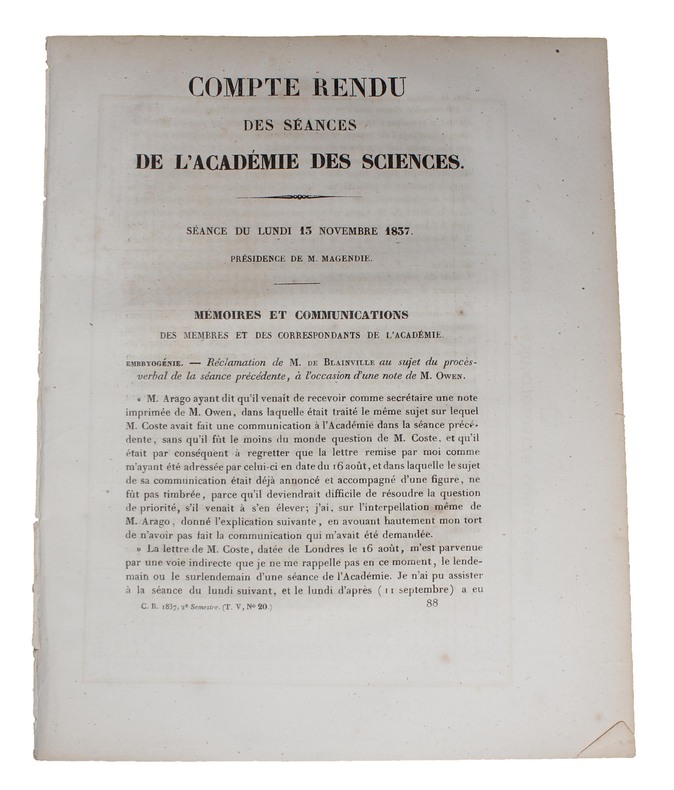
‎"POISSON, (SIMÉON-DENIS). - THE FIRST OF ITS KIND, MOVING REFERENCE FRAMES AND ACCELERATION.‎

‎Extrait de la premiere partie d'un Mémoire sur la Mouvement des projectiles dans l'air, en ayent égard à leur rotation et à l'influence du mouvement diurne de la Terre.‎

‎(Paris, Bachelier), 1837. 4to. No wrappers. In: ""Comptes Rendus Hebdomadaires des Séances de L'Academie des Sciences"", Tome 5, No. 20. Pp. (659-) 710. (Entire issue offerd). Poisson's paper: pp. 660-667.‎

‎First appearance of Poisson's importent work - the first of its kind - on the dynamics of a motion taking into account also of the motion of the reference system. The work in its full ""Sur les mouvement des projectiles dans l'air, en ayent éghard à leur figure, & la rotation et à l'influence du mouvemnet diurne de la terre"" was published two years later in 1839.""Recherches sur le mouvement des projectiles dans l’air (1839), was far better known in its day. It is the first work to deal with the subject by taking into account the rotation of the earth and the complementary acceleration resulting from the motion of the system of reference. A decade after its publication it inspired Foucault’s famous experiment demonstrating the earth’s rotation. Poisson, who had supervised Coriolis’ doctoral research, recognized the importance of his invention of a term to correct for the deviations from the law of motion that arise in a rotating reference system. Unfortunately, Poisson did not consider himself obliged to cite the name of the actual inventor of the term."" (DSB).‎

Referentie van de boekhandelaar : 47406
Livre Rare Book

Herman H. J. Lynge & Son
Copenhagen Denmark Dinamarca Dinamarca Danemark
[Books from Herman H. J. Lynge & Son]

€161.16 Kopen

‎"DEBIERNE, (ANDRÉ). - THE DISCOVERY OF ACTINIUM.‎

‎Sur une nouvelle matière radio-active.‎

‎(Paris, Gauthier-Villars), 1898. 4to. No wrappers. In: ""Comptes Rendus Hebdomadaires des Séances de L'Academie des Sciences"", Tome 129, No 16. Pp. (567-) 626. (Entire issue offered). Debierne's paper: pp. 593-595. Paperquality rather poor, a bit fragile.‎

‎First appearance of the paper in which Debierne announced his discovery of a new radioactive element found in uranium residues.""In 1906 Professor Hahn discovered radioactinium between actinium an actinium X. Actinium emanation, or ""action"", like radon, is an inert gas, was discovered independently by F. Giesel and André Debierne."" (Weeks ""Discovery of the Elements"", p. 307.Parkinson ""Breakthroughs"" 1899 C.‎

Referentie van de boekhandelaar : 47409

Livre Rare Book

Herman H. J. Lynge & Son
Copenhagen Denmark Dinamarca Dinamarca Danemark
[Books from Herman H. J. Lynge & Son]

€201.45 Kopen

‎"AVOGADRO, (AMEDEO). - EXPANDING THE LAW OF PETIT & DULONG.‎

‎Nouvelles Recherches sur la Chaleur spécifique des Corps solides et liquides.‎

‎Paris, Crochard, 1834. No wrappers. In: ""Annales de Chimie et de Physique, Par MM. Gay-Lussac et Arago."", tome 57, Cahier Oct. Pp. 113-224 a. 1 folded engraved plate. (The entire issue offered with halftitle to tome 57). Avogadro's paper: pp. 113-148. Browning to halftitle. Smoe scattered brownspots.‎

‎First printing of this paper in which Avogadro analyzed the connection between specific heats and atomic weights of chemical compounds and liquids after Dulong and Petit has announced their discovery of a relationship between heats and atomic weights of substances (the Law of Petit & Dulong). Avogadro tries to expands their law onto compounds as well.‎

Referentie van de boekhandelaar : 47415

Livre Rare Book

Herman H. J. Lynge & Son
Copenhagen Denmark Dinamarca Dinamarca Danemark
[Books from Herman H. J. Lynge & Son]

€335.75 Kopen

‎"PAULI, WOLFGANG. - ANNOUNCING THE ""EXCLUSION PRINCIPLE""‎

‎Über den Zusammenhang des Abschlusses der Elektronengruppen im Atom mit der Komplexstruktur der Spektrum. (On the Connexion between the Completion of Electron Groups in an Atom with the Complex Structure of Spectra).‎

‎Berlin, Julius Springer, 1925. 8vo. Contemp. full cloth. Gilt spine. Wear to top of spine and with 2 tears to hinges at upper spine. Inner backhinge nearly broken. A stamp to foot of a few leaves In: 'Zeitschrift für Physik', Volume 31. VIII,952 pp., textillustr. (Entire volume offered). Pauli's paper: pp.765-783. Internally clean and fine.‎

‎First edition of the first announcement of Pauli's Exclusion Principle which gives a criterion for the electronic structure of atoms, and explains the periodic table and the combining properties of the elements.Pauli first formulated his exclusion principle in this article in an attempt to explain the structure of the periodic table. By introducing an additional quantum number, namely the spin of an electron, to the already known three quantum numbers in Bohr's atom model, and by postulating that no two electrons can have the same four quantum numbers, Pauli could explain the number of electrons allowed in the outermost shell, e.g., explaining the varying lengths of successive periods in the table. The exclusion principle turned out to be applicable to all fermions, and thus plays a role in a variety of physical phenomena. For example it explains the formation of degenerate matter in white dwarfs and neutron stars. In 1945 Pauli received the Nobel Prize in physics ""for the discovery of the Exclusion Principle, also called the Pauli Principle"".This volume also contains a paper by Heisenberg: 'Über eine Anwendung des Korrespondenzprinzips auf die Frage der Polarisation des Floureszenzlichtes' , A. Einstein: ""Bemerkung zu P. Jordans Abhandlung ""Zur Theorie der Quantenstrahlung""and another paper by Pauli: 'Über den Einfluss der Geschwindigkeitsabhängigkeit der Elektronenmasse auf den Zeemaneffekt' (Zeeman-Effect and the Dependence of Electron-Mass on the Velocity).‎

Referentie van de boekhandelaar : 47417

Livre Rare Book

Herman H. J. Lynge & Son
Copenhagen Denmark Dinamarca Dinamarca Danemark
[Books from Herman H. J. Lynge & Son]

€2,820.30 Kopen

‎"HENRY, JOSEPH - THE DISCOVERY OF SELF-INDUCTION.‎

‎On the Influence of a Spiral Conductor in increasing the Intensity of Electricity from a Galvanic Arrangement of a Single Pair, &c.‎

‎(London, Richard and John E. Taylor, 1837). No wrappers. Extracted fron ""Scientific Memoirs, selected from The Transactions of Foreign Academies of Science and Learned Societies. Edited by Richard Taylor."", Vol. I. Pp. 540-547.‎

‎Henry's milestone paper announcing his discovery of electrical self-induction. ""Henry independently discovered electro-magnetic induction and in this paper announced his discovery of electric self-induction, one of the prime properies of an electro-magnetic circuit. Henry was an eminent experimenter but was casual in publishing his findings with resulting lack of recognition of his contributions.""(Bern Dibner).Dibner ""Heralds of Sciece"", No.63.It was also printed the same year in ""Transactions of the American Philosophical Society, New Series, Vol. 5"". The paper was later printed in ""Philosophical Magazine"", 1840.""The direction of Henry’s thought became somewhat apparent in his 1835 paper (refers to the papers reading before the American Phil. Soc., febr. 6th, 1835) on the action of a spiral conductor in increasing the intensity of galvanic currents. The paper started out as an affirmation of Henry’s priority in the discovery of self-induction. He then combined induction proper (using Faraday’s findings and his own) with selfinduction to show how these produce a pattern of repulsions yielding an increased effect in spirals. He specifically linked these “magneto-electrical” results to the principles of static induction developed by Cavendish and Poisson. This explanation was then applied to Savary’s report of changes of polarity when magnetic needles were placed at varying distances from a wire in which a current was being transmitted (""Mémoire sur l’aimantation,"" in Annales de chimie et de physique, 34 [1827],. That is, currents appeared periodically in the air surrounding a current-bearing straight wire as a result of the actions of induction and self-induction."" (DSB).Wheeler Gift: 2724-2725a.‎

Referentie van de boekhandelaar : 47418

Livre Rare Book

Herman H. J. Lynge & Son
Copenhagen Denmark Dinamarca Dinamarca Danemark
[Books from Herman H. J. Lynge & Son]

€470.05 Kopen

‎"AMPÈRE, ANDRÉ-MARIE. - THE CARDINAL FORMULAS OF ELECTRO-DYNAMICS.‎

‎Mémoire sur une nouvelle Expérience électrodynamique, sur son application à la formule qui représente l'action mutuelle de deux élemend de conducteurs voltaïques, et sur de nouvelles conséquences déduites de cette formule. (Lu à l'Academie royale de...‎

‎(Paris, Crochard, 1825). Extracted from ""Annales de Chimie et de Physique, Par MM. Gay-Lussac et Arago."", tome 29 a. 30. Ampère's papers: pp. 381-404 a. 1 folded engraved plate (tome 29) + Suite pp. 29-41 (tome 30) + ""Lettre à Gerhardi"": pp. 373-381 (tome 29). With both halftitlepages to vol. 29 a. 30. Scattered brownspots.‎

‎First appearance of this famous memoir, in which Ampère presented his collected results on electrodynamics to the French Academy, creating the foundation of 19th century developments in electricity and magnetism. In the words of James Clark Maxwell, ""We can scarcely believe that Ampère really discovered the law of action by means of the experiments which he describes. We are led to suspect, what, indeed, he tells us himself, that he discovered the law by some process which he has not shown us, and that when he had afterwards built up a pefect demonstration he removed all traces of the scaffolding by which he raised it.""The offered memoir was published BEFORE the famous ""Theorie mathématique des phénomènes électro-dynamiques uniquement déduite de L'expérience"", which did not appear until 1827. That 1827-Memoire incorporates, together with a new presentation of Ampère's results from 1820, 1822, 1823, the offered memoir (1825). (Horblit: 100 - Dibner: 62).""From 1814 until 1820 Ampére did not perform the kind of research that would have made it into the annals of the histrory of science, but on September 11, 1820 when he heard Francois Arago speak about Oersted's work, he got fresh inspiration and started the work that made him famous. Arago related how Oersted had found that a steady electric current influences the orientation of a compass needle. After a weak Ampère had determined experimentally that that two straight, parallel, and current-carrying, wires execute a force on each other. The magnitude of the force is inversely proportional to the distance between the wires and proportional to the strenghts of the current..... During the following years he continued his researches, both experimentally and theoretically. he built an instrument for measuring electricity that later was developed into the galvanometer. Finally in 1825 he presented his collected results to the Academy IN ONE OF THE MOST CELEBRATED MEMOIRS IN THE HISTORY OF NATURAL PHILOSOPHY (The paper offered)."" (Citizen's Compendium, p. 2). - Norman No 47.‎

Referentie van de boekhandelaar : 47420

Livre Rare Book

Herman H. J. Lynge & Son
Copenhagen Denmark Dinamarca Dinamarca Danemark
[Books from Herman H. J. Lynge & Son]

€1,275.85 Kopen

‎"BECQUEREL, HENRI. - ESTABLISHING THE CONNEXTION BETWEEN ROTATORY POWERS AND MAGNETISM.‎

‎Recherches expérimentales sur la polarisation rotatoire magnétique.‎

‎Paris, G. Masson, 1877. 8vo. Contemp. hcalf, raised bands, gilt spine. Light wear along edges. Small stamps on verso of titlepage. In: ""Annales de Chimie et de Physique"", 5e Series,Tome 12. - 576 pp. a. 1 folded plate. (The entire volume offered). Becquerel's paper: pp. 5-87.‎

‎First edition of Henri Becquerel's importent study of the magnetic substances in which he sets forth his discovery that ""the magnetic rotation of the bodies is connected with their refractive index and with another function that varies with their specific magnetism"". For the first time it was showed that there is a connexion between the rotatory power and the magnetic properties of matter.The volume contains other importent papers, more than 10 papers by , MARCELLIN BERTHELOT, mainly on Thermo-Chemistry.‎

Referentie van de boekhandelaar : 47427

Livre Rare Book

Herman H. J. Lynge & Son
Copenhagen Denmark Dinamarca Dinamarca Danemark
[Books from Herman H. J. Lynge & Son]

€335.75 Kopen

‎"CROOKES, WILLIAM. - CROOKES ON RADIOACTIVITY AND THE PRINCIPLE OF THE CONSERVATION OF ENERGY.‎

‎Sur la source de l'energie dans les corps radio-actifs.‎

‎(Paris, Gauthier-Villars), 1899. 4to. No wrappers. In: ""Comptes Rendus Hebdomadaires des Séances de L'Academie des Sciences"", Tome 128, No 3. Pp. (137-) 192. Entire issue offered). Crooke's paper: pp. 176-178.‎

‎First appearance of Crooke's statement that radioactivity seems to violate the principle of the conservation of energy.""Despite his speculative powers, Crookes at first took a conservative view of this new science, for he could not believe that radioactive elements decayed spontaneously, since this seemed to imply a violation of the conservation of energy. It was his view, expressed between 1898 and 1900, that the source of activity was external to the radioactive element. He imagined that radium, say, had the ability to act as a Maxwellian demon and select from the atmosphere those air particles which were moving more swiftly than the average, absorb some of their energy, and eject them at a lower speed. This theory, which never received full publication, contravened the second law of thermodynamics"" and although Crookes thought that he might have experimental support for it, his evidence did not measure up to the critical scrutiny of Stokes."" (DSB).The issue contains another notable paper HENRI BECQUEREL ""Sur la dispersion anomale de la vapeur de sodium incandescante, et sur quelques conséquenceas de ce phénomene"", pp. 145-151.This theory, which never received full publication, Page 480 | Top of Articlecontravened the second law of thermodynamics" and although Crookes thought that he might have experimental support for it, his evidence did not measure up to the critical scrutiny of Stokes.‎

Referentie van de boekhandelaar : 47428

Livre Rare Book

Herman H. J. Lynge & Son
Copenhagen Denmark Dinamarca Dinamarca Danemark
[Books from Herman H. J. Lynge & Son]

€134.30 Kopen

‎"BECQUEREL, HENRI - THE FIRST EVIDENCE OF A RADIOACTIVE TRANSFORMATION.‎

‎Sur la radioactivité de l'uranium.‎

‎(Paris, Gauthier-Villars), 1901. 4to. No wrappers. In: ""Comptes Rendus Hebdomadaires des Séances de L'Academie des Sciences"", Tome 133, No 24.. Pp. (969-) 1044. (Entire issue offered). Becquerel's paper: pp. 977-980.‎

‎First appearance of this historical paper in which Becquerel relates THE FIRST EVIDENCE OF A RADIOACTIVE TRANSFORMATION. ""Nothing that Becquerel subsequently accomplished (after his discovery of radioactivity in 1896) was as important as this discovery, by which he opened the way to nuclear physics. Nevertheless, there were two other occasions on which he stood directly on the path of history: when he identified electrons in the radiations of radium (1899 - 1900) and when he published the first evidence of a radioactive transformation (1901). (The paper offered).""(DSB).""To prove his supposition that the uranium would recover its activity, Becquerel set aside some of the inactive uranium solution and its radioactive barium sulfate precipitate for a period of 18 months. Late in 1901, he found that the uranium had completely regained its activity, whereas the barium sulfate precipitate had become completely inactive. Becquerel wrote: ""The loss of activity ... shows that the barium has not removed the essentially active and permanent part of the uranium. This fact constitutes, then, a strong presumption in favor of the existence of an activity peculiar to uranium, although it is not proved that the metal be not intimately united with another very active product.""‎

Referentie van de boekhandelaar : 47430

Livre Rare Book

Herman H. J. Lynge & Son
Copenhagen Denmark Dinamarca Dinamarca Danemark
[Books from Herman H. J. Lynge & Son]

€470.05 Kopen

‎"CURIE, P. (PIERRE) et A. DEBIERNE. - MEASURING ABSOLUTE TIME FOR THE FIRST TIME‎

‎Sur la radio-activité des sels de radium. (+) Sur la radio-activité provoquée par des sels de radium. (These 2 with Debierne). (+) Sur la constante de temps caractéristique de la disparition de la radioactivité induite par leradium dansune enceinte fe...‎

‎(Paris, Gauthier-Villars), 1901. 4to. No wrappers. In: ""Comptes Rendus Hebdomadaires des Séances de L'Academie des Sciences"", Tome 133, No 5 and No 23. Pp. (969-) 1044 and pp. (909-) 966. The papers: pp. 276-279 + pp. 931-934 (both from vol. 133, and entire issues offered) + Tome 135, No 20. Pp. (821-) 880. (Entire issue offered). The paper: pp. 857-59. + Tome 136, No 4. Pp. (181-) 262. (Entire issue offered). The paper: pp. 223-226.‎

‎First printing of these four papers, constituting a revolution in time measuring, as Pierre Curie here defined a STANDARD FOR THE ABSOLUTE MEASURING OF TIME ON THE BASIS OF RADIOACTIVITY, and hereby departing from the relative measurements in geology and archaeology.After the discovery of Polonium and Actinium (1898 a. 1899 ) further discoveries followed. ""First came the announcement in 1899 by Marie Curie of induced radioactivity, brought about by the action of polonium or radium on inactive substances. The induced radioactivity persisted over a considerable period of time, a phenomenon of great concern to Pierre Curie. He took up the question with Debierne, with whom he published two papers in 1901(the first two papers offered)"" their experiments could be explained by Rutherford’s theory of emanation (radon), a radioactive gas emitted by radium. With J. Danne, Curie measured the diffusion coefficient of radium emanation in the air and proved, as Rutherford had done, that it liquefies at - 150°C. In order to clarify the nature of the emanation he studied the law of diminution of the activity of a solid after having removed it from a chamber in which a radium salt was present. In two notes presented to the Academy on 17 November 1902 and 26 January 1903 (the third and fourth papers offered), Curie showed that this activity diminishes according to an exponential law characterized by a time constant that, for the emanation, is equal to 5,752 days, regardless of the conditions of the experiment. The importance of this discovery, which marks the point of departure for all modern measurements of archaeological and geological dating, did not escape his, for at a meeting of the Société Française de Physidque in 1902 he defined a standard for the absolute measurement of time on the basis of radioactivity. Almost immediately Rutherford and Soddy showed that the exponential diminution was caused by the transmutation of radioactive elements."" (DSB. Pierre Curie).‎

Referentie van de boekhandelaar : 47431

Livre Rare Book

Herman H. J. Lynge & Son
Copenhagen Denmark Dinamarca Dinamarca Danemark
[Books from Herman H. J. Lynge & Son]

€1,678.75 Kopen

‎"EINSTEIN, ALBERT. - THE FIRST EXPLICIT STATEMENT OF THE ENERGY-MASS EQUATION !!‎

‎Über die vom Relativitätsprincip geforderte Trägheit der Energie. (On the Inertia of Energy Required by the Relativity Principle).‎

‎Leibzig, Johann Ambrosius Barth, 1907. 8vo. Contemp. hcalf. Spine gilt. Title-and tomelabels with gilt lettering. Slightly rubbed. In ""Annalen der Physik"", Vierte Folge, Band 23. VIII,1000 pp. a. 4 plates. (The entire volume offered). Einstein's paper: pp.371-384. A small stamp on titlepage (Gmelin.Institut.). Internally clean and fine.‎

‎First edition of the first explicit statement of Einstein's energy-mass equation E=mc2.Nearly all descriptions of Einstein's scientific work state that the mass-energy equivalence E=mc2 was first formulated in Einstein's 1907 review paper 'Über das Relativitätsprinzip und die aus demselben gezogenen.' published in 'Jahrbuch der Radioaktivität und Elektronik' (see Weil no. 21 and Dictionary of Scientific Biography, vol. 4 pp.323 for examples). However, in his paper 'Über die von Relativitätsprincip geforderte Trägheit der Energie' [the offered paper] which predates the former mentioned by six months, Einstein gave a clear statement of the mass-energy equivalence E=mc2. See Lanczos: The Einstein Decade, pp.149-150 and 153 as well as Volume 2 of 'The Collected Papers of Albert Einstein' pp. 428.Einstein's first paper regarding the relation E=mc2 is his fourth 1905 paper, 'Ist die Trägheit eines Körpers von seinem Energieinhalt abhängig?'. In this short paper Einstein showed that a body releasing the energy E in the form of radiation will have its mass decreased by E/c2, and concluded that the mass of a body is a measure of its energy content, e.g., that all energy has mass. The next time Einstein returns to the subject is in his 1906 paper 'Das Prinzip von der Erhaltung der Schwerpunkts Bewegung und die Trägheit der Energie.'. Here Einstein concluded that one must either ascribe the inertial mass E/c2 to any form of energy E or else give up the fundamental law mechanics regarding conservation of the motion of the center of gravity. Then finally in the 1907 paper 'Über die von Relativitätsprincip geforderte Trägheit der Energie.' [the offered paper] Einstein makes the decisive step of assuming that all mass has energy. On page 382 Einstein considers the total energy of a moving mass point as the sum of its kinetic energy and its rest energy. In classical mechanics it is most convenient to set the second term to zero but in relativistic mechanics one obtains the simplest expression by setting the rest energy equal to mc2. Einstein then continues to show that this stipulation cannot lead to a contradiction in any relativistic argument. In a footnote on page 382 Einstein states for the first time the equation E=mc2 and mentions that this equation is the expression of the principle of the equivalence of mass and energy - see Volume 2 of 'The Collected Papers of Albert Einstein' pp. 428.The volume contains another paper by Einstein ""Bemerkungen zu der Notiz von Hrn. Paul Ehrenfest: ""Die Translation deformierbarer Elektronen und der Flächensatz"""", pp.206-208. - Weil No. 18.Collected Works, Doc. 45. Weil 19. Boni 19.‎

Referentie van de boekhandelaar : 47457

Livre Rare Book

Herman H. J. Lynge & Son
Copenhagen Denmark Dinamarca Dinamarca Danemark
[Books from Herman H. J. Lynge & Son]

€2,014.50 Kopen

‎"BERGSØE, ADOLPH FREDERIK. - WITH A CHAPTER ON THE DANISH WESTINDIES.‎

‎Den danske Stats Statistik fremstillet. 4 Bd.‎

‎København., Forfatterens Forlag, 1844-53. (vo. 4 samtidige hldrbd. med rygforgyldning. Forreste fals på bind 1 er revnet. XII,563,705,690,976 pp. Med 2 kort, det ene håndkoloreret (Forchammers kort fra ""Danmark geognostisk beskrevet""). Indvendig ren og frisk.‎

‎Originaludgaven af første samlede fremstilling af Danmark i statistisk henseende. 1. Bind.: ""Om den danske Stats naturlige Beskaffenhed og befolkning"" - 2. ""Om den danske Stats Landboforhold, Agerdyrkning, Industri og Handel."" - 3. Om den danske Stats immaterielle Cultur, Statsforfatning, beskatningsvæsen, og øvrige finantsielle Forhold"" - 4. Om forskjellige Statsforvaltningsforhold, Monarkiets udvortes Forhold, de fjernere Statsdele m.m.Bind 4 indeholder længere afsnit om Island (pp. 387-475, om Færøerne (pp. 475-504), om Grønland (pp. 505-556), om De dansk Vestindiske Øer (pp. 557-711).‎

Referentie van de boekhandelaar : 47476

Livre Rare Book

Herman H. J. Lynge & Son
Copenhagen Denmark Dinamarca Dinamarca Danemark
[Books from Herman H. J. Lynge & Son]

€335.75 Kopen

‎FRIHANDEL FOR ISLAND -‎

‎Forordning om udvidet Handelsfrihed for Island. Frederiksberg, den 11te September 1816.‎

‎Kiøbenhavn, Johan Frederik Schultz, (1816). 4to. 11 pp. De sidste sider lettere brunplettede.‎

‎Originaltrykket. - Fiske I:345.‎

Referentie van de boekhandelaar : 47491

Livre Rare Book

Herman H. J. Lynge & Son
Copenhagen Denmark Dinamarca Dinamarca Danemark
[Books from Herman H. J. Lynge & Son]

€67.15 Kopen

‎"THE LUNATIC ASYLUM IN SCHLESWIG -‎

‎Regulativ für die Irrenanstalt zu Schleswig.‎

‎Kopenhagen, Schultzischen Officin, 1820. 4to. 27,(2) pp.‎

‎First printing of the certificate of baptism for ""Irren Anstalt Schleswig"".‎

Referentie van de boekhandelaar : 47495

Livre Rare Book

Herman H. J. Lynge & Son
Copenhagen Denmark Dinamarca Dinamarca Danemark
[Books from Herman H. J. Lynge & Son]

€87.29 Kopen

‎ISLANDS FATTIGVÆSEN -‎

‎Reglement for Fattigvæsenets provisoriske Indretning og Bestyrelse i Island. - Reglugjørd fyrir Fátækra málefna løgun og stjórn, fyrst um sinn, á Íslandi. Kaupmannahøfn, thann 8te Januari 1834.‎

‎Kaupmannahøfn, Jens Hostrup Schultz, (1834). 4to. 33 pp.‎

‎Originaltrykket. - Fiske I: 345.‎

Referentie van de boekhandelaar : 47508

Livre Rare Book

Herman H. J. Lynge & Son
Copenhagen Denmark Dinamarca Dinamarca Danemark
[Books from Herman H. J. Lynge & Son]

€114.15 Kopen

‎ABOLITION OF THE SLAVE TRADE.‎

‎Verordnung, enthaltend nähere Bestimmungen wegen Unterdrückung des Sklavenhandels, für die Herzogthümer Schleswig und Holstein. - Forordning, indeholdende nærmere Bestremmelser angaaende Negerhandelens Undertrykkelse. Kopenhagen, den 3ten Juli 1835.‎

‎Kopenhagen, Jens Hostrup Schultz, (1835). 4to. 41 pp. Clean and fine.‎

‎First printing of the second Danish decree to abolish the slave trade. Denmark was the first souvereign state in the world to abandon the slave trade by a decree issued in 1792. This did not mean, that the trade was hereby stopped. When France and England in 1831 and 1833 in conventions banned the trade, the Danish king Frederik VI issued this decree of 1835 to support these conventions. The decree of 1835 contains a detailed Criminal Law for transport of slaves over the Atlantic.The decree was issued in two forms at the same time, one with only Danish text and one with Danish and German paralelltext (the version offered).‎

Referentie van de boekhandelaar : 47511

Livre Rare Book

Herman H. J. Lynge & Son
Copenhagen Denmark Dinamarca Dinamarca Danemark
[Books from Herman H. J. Lynge & Son]

€470.05 Kopen

‎"ABOLITION OF THE SLAVE TRADE.‎

‎Kanzlei=Patent, betreffend die Publication eines Beschlusses der deutschen Bundesversammlung wider den Negerhandel, für das Herzogthum Holstein. Kopenhagen, den 27sten März 1846.‎

‎Kopenhagen, Jens Hostrup Schultz, (1846). 4to. (4) pp.‎

‎In this decree the Danish King states that the decree issued by ""Der Deutschen Bundesversammlung"" in 1845 about the abolition of the slave trade (Negerhandel), should be in force also in the German speeking part of Denmark, Herzogthum Holstein.‎

Referentie van de boekhandelaar : 47512

Livre Rare Book

Herman H. J. Lynge & Son
Copenhagen Denmark Dinamarca Dinamarca Danemark
[Books from Herman H. J. Lynge & Son]

€100.72 Kopen

‎"HERMITE, CHARLES. - SOLVING THE QUINTIC EQUATION.‎

‎Sur la résolution de l’équation du cinquième degré. (On the Solution of the Equation of the Fifth Degree).‎

‎(Paris, Mallet-Bachelier), 1858. 4to. No wrappers. In: ""Comptes Rendus Hebdomadaires des Séances de L'Academie des Sciences"", Tome 46, No 11. Pp. (503-) 546 (entire issue offered). Hermite's paper: pp. 508-515.‎

‎First apperance of Hermite's famous paper in which he, by the application of elliptic functions, provided the first solution to the general equation of the fifth degree, the quintic equation.Hermite was a major figure in the development of the theory of algebraic forms, the arithmetical theory of quadratic forms, and the theories of elliptic and Abelian functions. He first studied the representation of integers in what are now called Hermitian forms. His famous solution of the general quintic equation appeared in Sur la résolution de l’équation du cinquième degré (1858"" ""On the Solution of the Equation of the Fifth Degree""). (Encyclopedia Britannica).Parkinson ""Breakthroughs"" 1858 M.‎

Referentie van de boekhandelaar : 47568

Livre Rare Book

Herman H. J. Lynge & Son
Copenhagen Denmark Dinamarca Dinamarca Danemark
[Books from Herman H. J. Lynge & Son]

€470.05 Kopen

‎THE FOURTH INTERNATIONAL FISHERY CONGRESS.‎

‎Proceedings of the Fourth International Fishery Congress: Organization and Sessional Business, Papers and Discussions. held at Washington, U.S.A., September 22 to 26, 1908. Published as Bulletin of the United States Bureau of Fisheries, Volume XXVIII....‎

‎Washington, Government Printing Office, 1910. 4to. Bound in 2 orig. full cloth. XIII,1411,XII pp., 156 plates (among these 10 fine colourplates and the large series of plates of Sponges), textillustrations, maps etc. Internally clean and fine.‎

Referentie van de boekhandelaar : 47758

Livre Rare Book

Herman H. J. Lynge & Son
Copenhagen Denmark Dinamarca Dinamarca Danemark
[Books from Herman H. J. Lynge & Son]

€134.30 Kopen

‎"MOISSAN, HENRI. - THE INVENTION OF THE ELECTRIC FURNACE.‎

‎Description d'un nouveau four électrique.‎

‎(Paris, Gauthier-Villars), 1892. 4to. No wrappers. In: ""Comptes Rendus Hebdomadaires des Séances de L'Academie des Sciences"", Tome 115, No 24. Pp. (1029-) 1112. (Entiere issue offered). Moissan's paper: pp. 1031-1033.nA few small tears to frontpage.‎

‎First printing of the paper in which Moissan described his famous invention of the Electric Furnace and hereby laying the foundations for high-temperature chemistry. For this invention and his isolation of flourine Moissan received the Nobel Prize in 1906.""Moissan had turned his attention to the production of artificial diamonds and in the process constructed his famous electric furnace, which, although simple in design, proved to be a technological tool of the first order. The original model, which he subsequently improved, was demonstrated to the Academy of Sciences in December 1892 (the paper offered). It consisted of two blocks of lime, one laid on the other, with a hollow space in the center for a crucible, and a longitudinal groove for two carbon electrodes which produced a high-temperature electric arc. In one experiment Moissan heated iron and carbonized sugar in his electric furnace, causing the carbon to dissolve in the molten iron..... Moissan’s electric furnace provided great impetus to the development of high-temperature chemistry. With this apparatus he prepared and studied refractory oxides, silicides, borides, and carbides" he succeeded in volatilizing many metals" and, by reducing metallic oxides with carbon, he obtained such metals as manganese, chromium, uranium, tungsten, vanadium, molybdenum, titanium, and zirconium. The electrochemical and metallurgical applications to industry of Moissan’s work became immediately apparent, for example in the large-scale production of acetylene from calcium carbide.""(DSB).Moissan received the Nobel prize in Chemistry in 1906 ""in recognition of the great services rendered by him in his investigation nd isolation of the element fluorine, and for the adoption in the service of science of the electric furnace called after him"".Parkinson ""Breakthroughs"" 1892 C.This issue also contains another notable paper by PIERRE CURIE in which he describes his invention of a quadrant electrometer that improved upon the one devised by Kelvin by adding an ingenious magnetic damper.‎

Referentie van de boekhandelaar : 47780

Livre Rare Book

Herman H. J. Lynge & Son
Copenhagen Denmark Dinamarca Dinamarca Danemark
[Books from Herman H. J. Lynge & Son]

€268.60 Kopen

‎"LAURENT, AUGUSTE. - INTRODUCING THE ""NUCLEUS THEORY"" IN CHEMISTRY.‎

‎Recherches diverses de Chimie organique. (+) Suite des Recherches diverses de Chimie organique.‎

‎Paris, Crochard, 1836. 8vo. Contemp. hcalf. Raised bands, gilt spine. A few scratches to spine. In: ""Annales de Chimie et de Physique, Par MM. Gay-Lussac et Arago."", 2e Series, Tome 66. 448 pp. a. 1 folded engraved plate. (Entire volume offered). Laurent's papers: pp. 136-213 a. pp. 314-335. Internally fine and clean.‎

‎First printing of Laurent's long paper in which he tried to develope the rules of substitution into a chemical system oforganic compounds, the ""Nucleus theory"". Laurent is considered one of the most importent chemists in the 18th centuryHis first theoretical efforts were largely taxonomic in character. He then began to develop a pictorial model based on atomistic representations as considered by earlier French crystallographers. Laurent’s ""nucleus theory"" or ""theory of derived radicals""located every substance at the intersection of two kinds of transformations: substitutions, which operate on the matter inside the fundamental radical and do not affect its general chemical behavior, and external modifications, which influence various chemical functions. (DSB).""In his studies of the derivatives of naphtalene, Laurent was impressed by the fact the the fundamental properties of these compounds remained, in spite of the various substitutions which took place in them. A certain nucleus seemed to impose its properties on all its derivatives. This nucleus theory was the basis for the unitary which was specifically formulated by Gerhardt.""(Leicester & Klickstein ""A Source Book in Chemistry"", p. 345).The volume contains other notable papers by Regnault, D'Arcet, Chevreuil, Rose, Gay-Lussac and Carlo Matteucci's importent memoir ""Sur la Propagation du Courant Electriques dans les Liquides"", pp. 225-313.‎

Referentie van de boekhandelaar : 47788

Livre Rare Book

Herman H. J. Lynge & Son
Copenhagen Denmark Dinamarca Dinamarca Danemark
[Books from Herman H. J. Lynge & Son]

€402.90 Kopen

‎"REGNAULT, V. (HENRI VICTOR) - THE CONSERVATION OF ENERGY.‎

‎Recherches sur les chaleurs spécifiques des fluides élastiques (3).‎

‎(Paris, Bachelier), 1853. 4to. No wrappers. In: ""Comptes Rendus Hebdomadaires des Séances de L'Academie des Sciences"", Tome 36, No 16. Pp. (669-) 707. (Entire issue offered). Regnault's paper: pp. 676-687. A few marginal brownspots.‎

‎First apperance of this very importent paper where Regnault declared his acceptance of the conservation of energy.""Speculation and discussions of theory are noticeably absent from Regnault’s published work, as they are from his surviving notebooks. But in 1853 he declared his acceptance of the principle of the conservation of energy"" and later he measured the mechanical equivalent of heat, although with only moderate success. In declaring his support for the principle, Regnault stated that he had subscribed to the mechanical theory of heat “for a long time” and that he had been led to it independently through his own experiments ""Comptes rendus... de AcademiE des sciences..."" (The paper offered). ""(DSB).Roberts & Trent ""Bibliotheca Mechanica"", p. 275.‎

Referentie van de boekhandelaar : 47829

Livre Rare Book

Herman H. J. Lynge & Son
Copenhagen Denmark Dinamarca Dinamarca Danemark
[Books from Herman H. J. Lynge & Son]

€241.74 Kopen

‎"HERMITE, CHARLES. - HERMITE'S THEOREM PROOVING THE TRANSCENDALITY OF e.‎

‎Sur la fonction exponentielle. (+) Suite... (+) Sur la fonction exponentielle. (+) (Suite). 4 Parts (all).‎

‎Paris: Gauthier-Villars, 1873. 4to. No wrappers. In: ""Comptes Rendus Hebdomadaires des Seances de l'Academie des Sciences"", Vol 77, Nos 1, 2, 4 a. 5 (4 entire issues offered). Hermite's paper: pp.18-24" 74-79 226-233" 285-293). With halftitle and titlepage to vol. 77.‎

‎First apperance of Hermite's epoch-making memoir in which he proved the transcendence of e, and thus initiated a new era in number theory. A decade later Lindemann used the method of Hermite's work to establish the transcendence of pi. Parkinson ""Breakthroughs"" 1873 M.‎

Referentie van de boekhandelaar : 47891

Livre Rare Book

Herman H. J. Lynge & Son
Copenhagen Denmark Dinamarca Dinamarca Danemark
[Books from Herman H. J. Lynge & Son]

€1,141.55 Kopen

‎"PAINLEVÉ, PAUL. - INTRODUCING THE PAINLEVÉ TRANSCENDENTS.‎

‎Sur les équations differentielles du second ordre à points critiques fixes.‎

‎(Paris, Gauthier-Villars), 1906. 4to. No wrappers. In: ""Comptes Rendus Hebdomadaires des Séances de L'Academie des Sciences"", Tome 143, No 26.. Pp. (1110-) 1208. (Entire issue offered). Painlevé's paper: pp. 1111-1117. Frayed in inner margins, poor paperquality.‎

‎First apperance of the paper in which Pailevé introduced the transcendents which bears his name.""The phenomenon of movable singular points was discovered by Fuchs. The study of movable singular points and of nonlinear second orderr equations with and without such singular points was taken up by many men, notably by Paul Painlevé."" (Morris Kline ""Mathematical Thought from Ancient to Modern Times"", p. 737).‎

Referentie van de boekhandelaar : 47894

Livre Rare Book

Herman H. J. Lynge & Son
Copenhagen Denmark Dinamarca Dinamarca Danemark
[Books from Herman H. J. Lynge & Son]

€134.30 Kopen

‎"FARADAY, (MICHAEL). - ON THE DISCOVERY OF ELECTOMAGNETIC INDUCTION.‎

‎(Lettré) A M. Gay-Lussac. Institution royale, Ier décembre 1832. (The letter ""On Magneto-electric Induction"").‎

‎Paris, Crochard, 1832. Contemp. hcalf. Spine gilt. Light wear along edges. Stamps to verso of titlepage. In: ""Annales de Chimie et de Physique"", 2e Series, vol. 51. (Entire volume offered). 448 pp. a. 1 folded engraved plate. Faraday's letter: pp. 404-434. Internally clean and fine.‎

‎First printing of Faraday's famous letter to Gay-Lussac in which he claim to be the discoverer of electro-magnetic induction, analysed the results of the Italian philosophers, pointing out their errors, and defending himself from what he regarded as imputations on his character. The style of this letter is unexceptionable, for Faraday could not write otherwise than as a gentleman"" but the letter shows that had he willed it he could have hit hard. The letter was later translated into English and published in ""Philosophical Magazine"" in 1840 under the title ""On Magneto-electric Induction"".""In 1831, seemingly out of nowhere, came the discovery of electromagnetic induction and the beginning of the experimental researches in electricity which were to lead Faraday to the discovery of the laws of electrochemistry, specific inductive capacity, the Faraday effect, and the foundations of classical field theory."" (DSB). The volume contains further importent papers by AMPÈRE ""Note sur une Experience de Hippolyte Pixii, relative au Courant produit par la Rotation d'un aimant, à l'aide dün appareil imagine par M. Hippolyte Pixii"", WÖHLER et LIEBIG ""recherches sur le Radical de l'Acide benzoique"" and ""Lettre de M. Berzelius sur le Benzoyle et l'Acide benzoique"", papers by Strohmeyer, Gay-Lussac, Dutrochet, Boussingault, BERZELIUS ""Sur le Bleu de Prusse et le Cyanoferrure de plomb"" etc. etc.‎

Referentie van de boekhandelaar : 47933

Livre Rare Book

Herman H. J. Lynge & Son
Copenhagen Denmark Dinamarca Dinamarca Danemark
[Books from Herman H. J. Lynge & Son]

€470.05 Kopen

‎"RUTHERFORD, E. (ERNEST). - THE NUCLEAR ATOM - PMM 411.‎

‎Die Radioaktivität. Unter Mitwirkung des Verfassers ergänzte autorisierte deutsche Ausgabe von E. Aschkinass.‎

‎Berlin, Julius Springer, 1907. Royal8vo. Uncut in orig. printed wrappers. A small nick to lower left part of frontwrapper. Stamps to titlepage. (10),597 pp., textillustrations. Internally clean. From the library of the Danish logician and philosopher Jørgen Jørgensen, with his name on top of frontwrapper.‎

‎First German edition of this importent work which is recognized as a classic, being the first textbook on Radio-Activity. To this German edition, translated from the second English of 1905, Rutherford himself has added further descriptions of the results obtained in the years in between.Rutherford made ""Proposal of a new theory of atomic disintegration and of the nuclear nature of the atom. Rutherford discovered and named the alpha, beta, and gamma rays.""( Horblitt, ""One Hundred Books famous in Science"" No 91 (Engl. ed.).""After the discovery of thorium emanations in 1900 new concepts of atomic structure followed from the brilliant experiments of Rutherford. A new theory of atomic disintegration was proposed, then the nuclear nature of the atom..... ""(Dibner ""Heralds of Science"", No 51 (Engl. ed.).‎

Referentie van de boekhandelaar : 47937

Livre Rare Book

Herman H. J. Lynge & Son
Copenhagen Denmark Dinamarca Dinamarca Danemark
[Books from Herman H. J. Lynge & Son]

€470.05 Kopen

‎"LEWIS, C.I. (CLARENCE IRVING). - ""THE LOGIC OF STRICT IMPLICATIONS""‎

‎A Survey of Symbolic Logic.‎

‎Berkeley, University of California Press, 1918. Royal8vo. Orig. full cloth. Stamps on foot of titlepage. VI,406,(4) pp., textfigs. From the library of the Danish logician and philosopher Jørgen Jørgensen with his name on front free endpaper. Some pencil underlinings by Jørgensen.‎

‎First edition of a main textbook in modern symbolic logic and having an interesting provenance as the copy has belonged to the Danish logician Jørgen Jørgensen.""Modern interest in modal Logic begins with the work of C.I. Lewis, first published in book form in his 'Survey of Symbolic Logic' of 1918. This theory is commonly called the logic of strict implication, because it was originally put forward in opposition to an account of implication which Lewis thought mistaken.""(Kneale and Kneale ""The Development of Logic"" 1962, p. 548 ff.).‎

Referentie van de boekhandelaar : 47987

Livre Rare Book

Herman H. J. Lynge & Son
Copenhagen Denmark Dinamarca Dinamarca Danemark
[Books from Herman H. J. Lynge & Son]

€248.45 Kopen

‎"BOLTZMANN, LUDWIG. - DEFENDING THE ATOMIC VIEWPOINT.‎

‎Über die Integrale linearer Differentialgleichungen mit periodischen Coëfficienten.‎

‎Wien, Karl Gerold's Sohn, 1868. 8vo. Uncut and unopened in orig. printed wrappers. In: ""Sitzungsberichte der kaiserlichen Akademie der Wissenschaften"", 58. Band, 1. Heft - Juni. Pp. (1-) 155 a. 7 plates.(Entire issue offered). Boltzmann's paper: pp. 54-59. Clean and fine.‎

‎First apperance of an importent paper in which Boltzmann from a mathematical point of view defends atomism. ""Throughout his career, even in his works on subjects other than kinetic theory Boltzmann was concerned with the mathematical problems arising from the atomic nature of matter. Thus, an early paper with the title ""Über die Integrale linearer Differentialgleichungen mit periodischcn Koeffizienten"" (1868) turned out to be an investigation of the validity of Cauchy’s theorem on this subject, which is needed to justify the application of the equations for an elastic continuum to a crystalline solid in which the local properties vary periodically from one atom to the next."" (DSB). The issue contains an importent paper by JOHANN JOSEPH LOSCHMIDT ""Ableitung des Potentiales bewegter elektrischer Massen aus dem Potentiale für die Ruhestand"", pp. 7-14, in which he attempted to derive the Weber-Ampère law from that of Coulomb, and, in accordance with Kirchhoff, to derive Ohm’s law from hydrodynamic flow laws, analogous to Poiseuille’s law.‎

Referentie van de boekhandelaar : 47990

Livre Rare Book

Herman H. J. Lynge & Son
Copenhagen Denmark Dinamarca Dinamarca Danemark
[Books from Herman H. J. Lynge & Son]

€114.15 Kopen

‎"HEISENBERG, WERNER. - THE CONSTITUTION OF MANY-ELECTRON ATOMS.‎

‎Zur Quantentheorie der Multiplettstruktur und der anomalen Zeemaneffekte. (Eingegangen am 10. April 1925).‎

‎Berlin, Julius Springer, 1925. Contemp. hcloth. Gilt lettering to spine. In: ""Zeitschrift für Physik. Hrsg. von Karl Scheel"", 32. Band. VI,951 pp., textillustr. (Entire volume offered). Heisenberg's paper: pp. 841-860. A small erased stamp on titlepage leaving two small holes, no loss of text. Internally clean.‎

‎First appearance of Heisenberg's importent paper on the complex spectra of many-electron atoms, - the third paper Heisenberg submitted from Copenhagen on the Quantum Theory.""The paper on multiplet structure and anomalous Zeeman effects..., contained a complete discussion of the problem at that time. This paper had the blessing of Niels Bohr"" also Pauli, who wasin Copenhagen when the paper was completed, agreed with its overall content. The central goal of the paper was to formulate what Bohr called 'the stress (constraint), which is not analogous to the action of external forces' and to derive quantitative conclusions from it."" (Mehra and rechenberg ""The Historical development of Quantum Theory"", vol. 2, p. 201).The volume contains another importent paper in the history of Quantum Physics: W. BOTHE und H. GEIGER ""Über das Wesen des Comptoneffekts, ein experimenteller Beitrag zur Theorie der Strahlung"", pp. 639-663.‎

Referentie van de boekhandelaar : 48025

Livre Rare Book

Herman H. J. Lynge & Son
Copenhagen Denmark Dinamarca Dinamarca Danemark
[Books from Herman H. J. Lynge & Son]

€470.05 Kopen

‎"RÖNTGEN, W.C. (WILHELM CONRAD). - THE SECOND SCIENTIFIC REVOLUTION BEGINS.‎

‎Ueber eine neue Art von Strahlen. (Erste- Zweite Mittheilung) + Weitere Betrachtungen über die Eigenschaften der X-Strahlen. (Dritte Mittheilung). 3 Papers (all).‎

‎Leipzig, Johann Ambrosius Barth, 1898. Contemp. hcalf, spine gilt and with gilt lettering. Some scratches to spine and corners bumped and with wear. Some scratching to boards.Stamps to titlepage and one leaf. In: ""Annalen der Physik und Chemie"", Neue Folge, Band 64. VIII,(2),812 a. 2 plates. (Entire volume offered). Röntgen's papers: 1. pp. 1-11, pp. 12-17 a. pp. 18-37. Internally clean.‎

‎First full exposition of Röntgen's discovery of X-rays, the foundation stones of roentgenology, unveiling a new form of matter and offering a new revolutionary method for medical diagnosis.In order to ensure priority for his discovery, Röntgen first published the two first papers (Erste-Zweite Mittheilung) as offprints from ""Sitzungsberichte der Physikalisch-medicinischen Gesellschaft zu Würtzburg"" in 1895-96, but his discovery only finds its full form in the offered papers, as ""Dritte Mittheilung"" appears here.""Aside from its obvious applications, Roentgen's discovery galvanized the world of physics and led to a rash of further discoveries that so completely overturned the old concepts of the science, that the discovery of X-rays is sometimes considered the first stroke of the Second Scientific Revolution. (The First Scientific Revolution is, of course that which included Galileo and his experiments on falling bodies). Within a matter of months, investigations of X rays led to the discovery of radioactivity by Becquerel....The importence of the discovery was well recognized in its own time. In 1896 Roentgen shared the Rumford Medal with Lenard and in 1901, when Nobel Prizes were set up.the first to be honoured with a Nobel Prize in Physics was Roentgen."" (Asimov).Garrison & Morton No 2683 (only listing 1. paper) - PMM No 380 (listing only 2 parts) - Dibner: 162 (listing only 2 parts).‎

Referentie van de boekhandelaar : 48027

Livre Rare Book

Herman H. J. Lynge & Son
Copenhagen Denmark Dinamarca Dinamarca Danemark
[Books from Herman H. J. Lynge & Son]

€1,678.75 Kopen

‎"FRANCK, J. und G. HERTZ. - PROVING THE QUANTIZED MODEL OF THE BOHR ATOM AND PLANCK'S QUANTUM THEORY.‎

‎Über Zusammenstösse zwischen Elektronen und den Molekülen des Quecksilberdampfes und die Ionisierungsspannung desselben. (+) Über die Erregung der Quecksilberresonanzlinie 253,6 (u,u) durch Elektronenstösse.‎

‎Braunschweig, Friedr. Vieweg & Sohn, 1914. Lex8vo. Contemp hcloth, gilt spine. Lower spine end a bit frayed, otherwise very fine. In: ""Verhandlungen der deutschen Physikalischen Gesellschaft im Jahre 1914"", 16. Jahrgang. IX,1072 pp. Franck & Hertz' papers: pp. 457-467 a. 512-517, textillustr. Fine and clean.‎

‎First apperance of the famous Franck-Hertz Experiment which is considered as a new and independent support, not only of Planck's quantum theory and Einstein's light-quantum hypothesis but also of Bohr's theory of the atom with stationary states of discrete energies.Franck and Hertz were awarded the Nobel Prize in Physics in 1925 for this work and Franck concluded his Nobel lecture with the words ""We know only to well that we owe the wide recognition that our work received to contact with the great concepts and ideas of M. Planck and in particular Niels Bohr.""""In their famous experiments, Franck and Hertz' showed that electrons could impart energy to a mercury atom only if they had a kinetic energy exceeding 4.9 ev., and that exactly this quantum of energy was taken up by the mercury atom, causing it to emit light of the resonance line Å 2537. It was the first direct proof of the quantized nature of the energy transfer and of the connection of the quantum DeltaE of energy with the frequency p = DeltaE/h of the light emitted as the result of the transfer. These experiments are rightly regarded as the first decisive proof of the reality of the quantized energy levels that had just been postulated by Niel’s Bohr..."" (DSB).See: Siegmund Brandt ""The Harevest of a Century. Discoveries of Modern Physics in 100 Episodes"", Episode 25, The Franck-Hartz Experiment (1914), pp. 102-104.The volume contains another importent paper ALBERT EINSTEIN ""Beiträge zur Quantentheorie"", pp. 820-828. First edition. ""In this paper.... two considerations are given which are interrelated by a common goal, inasmuch as it is attempted to derive two of the most importent achievementss of quantum theory, viz. Planck's radiation law and Nernst's third law of thermodynamics, in a new manner. The proofs do not involve Boltzmann's equation and are thus based enterely on macroscopic thermodynamics. They do introduce, however, the quantum hupothesis. (Einstein points out that the alleged 'proofs' which try to derive the theorem of Nernst from the mere fact that the heat capacity of all substances goes to zero at absolute zero temterature, are not genuine)."" (Cornelius Lanczos).Weil No 67.‎

Referentie van de boekhandelaar : 48028

Livre Rare Book

Herman H. J. Lynge & Son
Copenhagen Denmark Dinamarca Dinamarca Danemark
[Books from Herman H. J. Lynge & Son]

€671.50 Kopen

‎"REGNAULT, V. (HENRI VICTOR) - THE VAPOUR PRESSURE OF STEAM.‎

‎Mémoire sur les Forces élastiques dela vapeur d'eau.‎

‎Paris, Victor Masson, 1844. No wrappers. Extracted from ""Annales de Chimie et de Physique"", 3me Series - Tome 11. Pp. 273-335 and 1 large folded engraved plate (apparatus). With the halftitlepage to volume 11.‎

‎First printing of an importent paper in which Regnault found the connection between vapour pressure of steam at different temperatures.Henri Victor Regnault improved the method of Dalton to measure the elastic force of vapours at saturation. At the boiling point of a liquid, the elastic force of its vapour is equal to the supported pressure. Thus, if one boils water in an enclosure under increasing pressure conditions, water will reach increasing boiling temperatures at the same time. For each case, the elastic force of vapour will be equal to the imposed pressure.‎

Referentie van de boekhandelaar : 48079

Livre Rare Book

Herman H. J. Lynge & Son
Copenhagen Denmark Dinamarca Dinamarca Danemark
[Books from Herman H. J. Lynge & Son]

€134.30 Kopen

‎"AMPÈRE, ANDRÉ-MARIE. - ""ONE OF THE MOST CELEBRATED MEMOIRS IN THE HISTORY OF NATURAL PHILOSOPHY""‎

‎Mémoire sur une nouvelle Expérience électrodynamique, sur son application à la formule qui représente l'action mutuelle de deux élemend de conducteurs voltaïques, et sur de nouvelles conséquences déduites de cette formule. (Lu à l'Academie royale de...‎

‎Paris, Crochard, 1825. 8vo. Bound in 2 uniform later hcloth. Gilt lettering to spines. In: ""Annales de Chimie et de Physique, Par MM. Gay-Lussac et Arago."", tome 29 a. 30. - 448 pp. and 3 folded engraved plates + 448 pp. and 2 folded engraved plates. (The entire volumes offered). Ampère's papers: pp. 381-404 (tome 29) + Suite pp. 29-41 (tome 30) + ""Lettre à Gerhardi"": pp. 373-381 (tome 29). Some scattered brownspots.‎

‎First appearance of this famous memoir, in which Ampère presented his collected results on electrodynamics to the French Academy, creating the foundation of 19th century developments in electricity and magnetism. In the words of James Clark Maxwell, ""We can scarcely believe that Ampère really discovered the law of action by means of the experiments which he describes. We are led to suspect, what, indeed, he tells us himself, that he discovered the law by some process which he has not shown us, and that when he had afterwards built up a pefect demonstration he removed all traces of the scaffolding by which he raised it.""The offered memoir was published BEFORE the famous ""Theorie mathématique des phénomènes électro-dynamiques uniquement déduite de L'expérience"", which did not appear until 1827. That 1827-Memoire incorporates, together with a new presentation of Ampère's results from 1820, 1822, 1823, the offered memoir (1825). (Horblit: 100 - Dibner: 62).""From 1814 until 1820 Ampére did not perform the kind of research that would have made it into the annals of the histrory of science, but on September 11, 1820 when he heard Francois Arago speak about Oersted's work, he got fresh inspiration and started the work that made him famous. Arago related how Oersted had found that a steady electric current influences the orientation of a compass needle. After a weak Ampère had determined experimentally that that two straight, parallel, and current-carrying, wires execute a force on each other. The magnitude of the force is inversely proportional to the distance between the wires and proportional to the strenghts of the current..... During the following years he continued his researches, both experimentally and theoretically. he built an instrument for measuring electricity that later was developed into the galvanometer. Finally in 1825 he presented his collected results to the Academy IN ONE OF THE MOST CELEBRATED MEMOIRS IN THE HISTORY OF NATURAL PHILOSOPHY (The paper offered)."" (Citizen's Compendium, p. 2). - Norman No 47.The volumes contain many other notable papers by: Wöhler, Fresnel, Marcet, Berzelius, Felix Savart, De la Rive, Braconnet, Boussingault, Magnus, Poncelet, Vaugelin, Poisson, Gay-Lussac, Faraday, Laplace etc.‎

Referentie van de boekhandelaar : 48082

Livre Rare Book

Herman H. J. Lynge & Son
Copenhagen Denmark Dinamarca Dinamarca Danemark
[Books from Herman H. J. Lynge & Son]

€2,954.60 Kopen

‎"GALTON, FRANCIS.- THE LAW OF ANCESTRAL HEREDITY.‎

‎The average Contribution of each several Ancestor to the total heritage of the Offspring. Received and Read June 3, 1897.‎

‎London, Harrison and Sons, 1897. No wrappers. Extracted from ""Proceedings of the Royal Society"", Vol. 61. Pp. 401-413.‎

‎First printing of Galton's ""Law of ancestral Heredity""Galton's ancestral law states that the two parent contribute between them on average one-half of the total heritage of the offspring, the four grandparents one-quarter, and so on. He interpreted this law both as a representation of the separate contributions of each ancestor to the heritage of the offspring and as a multiple regression formula for predicting the value of a trait from ancestral values.Garrison & Morton: 239.‎

Referentie van de boekhandelaar : 48085

Livre Rare Book

Herman H. J. Lynge & Son
Copenhagen Denmark Dinamarca Dinamarca Danemark
[Books from Herman H. J. Lynge & Son]

€134.30 Kopen

‎"WÖHLER, F. et J. LIEBIG. - THE DISCOVERY OF ""EMULSIN"" A MAIN WORK IN ORGANIC CHEMISTRY.‎

‎Sur la Formation de l'Huile d'Amandes amères. (+) Emploi d'un nouveau Médicament en place des Waux distillées du Laurier-Cerise ou d'Amandes amères, proposé par.. F. Woehler et J. Liebig.‎

‎Paris, Crochard et Comp., 1837. Orig. printed wrappers. No backstrip. In: ""Annales de Chimie et de Physique, Par MM. Gay-Lussac et Arago."", tome 64, Cahier 2 (Fevrier 1837). Pp. 113-224. (Entire issue offered with printed wrappers.). Wöhler a. Liebig's papers: pp. 185-209 a. pp. 209-217.‎

‎First appearance of this classic paper in organic chemistry in which Wöhler and Liebig showed how Amygdalin could be decomposed by a vegetable emulsion, the first example of a glycoside. The papers were issued at the same time in ""Annalen der Physik und Chemie"".""The conclusions which you have drawn from the investigation of bitter-almond oil,"" wrote Berzelius to Liebig and Wöhler, ""are certainly the most importent which have so far been reached in the domain of vegetable chemistry, and give promise of shedding an unexpected light over this part of the science...The facts which you have set forth inspire such reflections that they may be regarded as the dawn of a new day in vegetable chemistry.""(Berzelius-Wöhler Briefwechsel).""During the years that Liebig was preoccupied with the ether theory and with organic acids, he also carried out two importent investigations with Wöhler. In october 1836 Wöhler wrote that he had discovered a way to transform amygdalin to oil of bitter almonds and hydrocyanid acis, by distilling it with manganese and sulfuric acid, and he invited Liebig to join in pursuing the topic. Two days later he made a more remarkable discovery. It had occurred to him that perhaps thetransformation of amygdalin could be effected by the albumin in the almonds, in a manner similar to the action of yeast in sugar...Wöhler suspected that the decomposition was an example of what Berzelius had recently defined as catalysis. Liebig and Wöhler then divided up the detailed examination of the properties and composition of amygdalin. They precipitated from the emulsion of almonds a substance which when dissolved retain its action. They named the active substance ""emulsion"". Its effectiveness in very small quantities confirmed that it acted like yeast.""(DSB VIII, p. 342).‎

Referentie van de boekhandelaar : 48086

Livre Rare Book

Herman H. J. Lynge & Son
Copenhagen Denmark Dinamarca Dinamarca Danemark
[Books from Herman H. J. Lynge & Son]

€335.75 Kopen

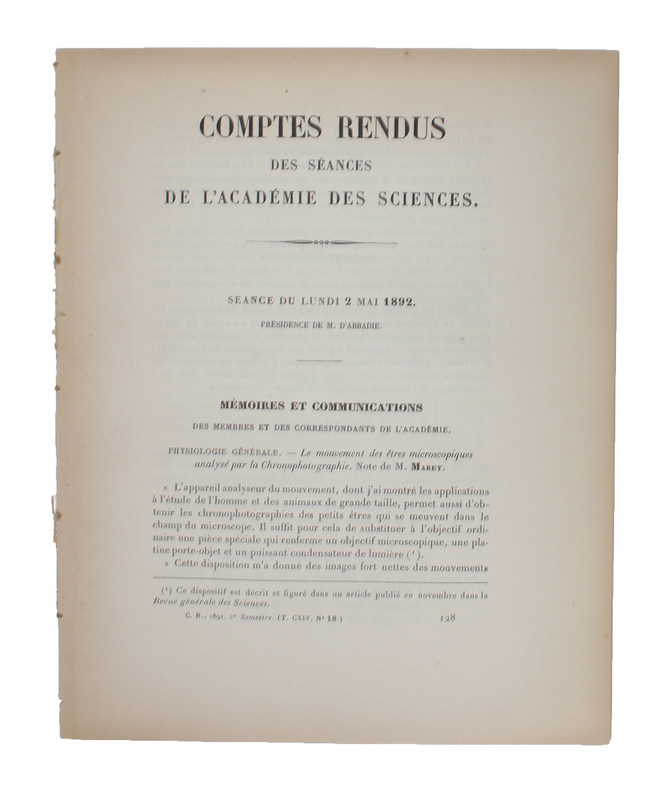
‎"MAREY, (ETIENNE JULES). - THE INVENTION OF THE PHOTOGRAPHY OF MOTION, THE CINEMATOGRAPHE.‎

‎Analyse du méchanisme de la locomotion au moyen d'une série d'images photographiques recueillies sur une même plaque et représentant les phases successives du mouvement (Séance 3 Juillet 1882). (+) Emploi de la photographie pour déterminer la tr...‎

‎Paris, Gauthier-Villars, 1882, 1888, 1892. 4to. No wrappers. 7 entire issues. In: ""Comptes Rendus Hebdomadaires des Séances de L'Academie des Sciences"", Tome 95, No 1, 6 a. 14. Tome 107, No 16, 17 a. 18, Tome 114, No 18. (7 entire issues offered). With halftitles and titlepages to Vol. 95, 107 a. 114. The papers: pp. 14-16 (No1), 267-270 (no 6), 583-585, 2 textillustr. (no 14) - pp. 607-609 (No 16), 643-645, 1 textillustr. (No 17), 677-678 (No 18) - pp. 989-990 (No. 18). Stamps on verso of titlepages.‎

‎First printing of the main papers CONSTITUTING THE INVENTION OF MODERN CINEMATOGRAPHY -- from his invention of 1888 of the ""Chronophotograph"" followed the modern ""Cinematograph"" (first described here in the offered papers of 1888).It started with his invention of the chronographic apparatus with stationary plates and chronographic disk schutter... the paper of August 7, 1882, later in 1882 his description of the photographic gun, and in the 1892 paper ""Marey constructs, according to the reversible principle of the chronophotograph, an apparatus for the projection on a screen of series of pictures taken by the afore-mentioned apparatus and thus realizes the photographic synthesis of motion"" (Joseph Maria Eder ""History of Photography"", p.510).Marey (1830-1904) was a French physician, and his inventions sprang from his investigations in the physiology of the motion of men and animals.""In 1882, Marey, often claimed to be the 'inventor of cinema,' constructed a camera (or ""photographic gun"") that could take multiple (12) photographs per second of moving animals or humans - called chronophotography or serial photography, similar to Muybridge's work on taking multiple exposed images of running horses. [The term shooting a film was possibly derived from Marey's invention.] He was able to record multiple images of a subject's movement on the same camera plate, rather than the individual images Muybridge had produced. Marey's chronophotographs (multiple exposures on single glass plates and on strips of sensitized paper - celluloid film - that passed automatically through a camera of his own design) were revolutionary. He was soon able to achieve a frame rate of 30 images. Further experimentation was conducted by French-born Louis Aime Augustin Le Prince in 1888. Le Prince used long rolls of paper covered with photographic emulsion for a camera that he devised and patented. Two short fragments survive of his early motion picture film (one of which was titled Traffic Crossing Leeds Bridge).The work of Muybridge, Marey and Le Prince laid the groundwork for the development of motion picture cameras, projectors and transparent celluloid film - hence the development of cinema. American inventor George Eastman, who had first manufactured photographic dry plates in 1878, provided a more stable type of celluloid film with his concurrent developments in 1888 of sensitized paper roll photographic film (instead of glass plates) and a convenient ""Kodak"" small box camera (a still camera) that used the roll film. He improved upon the paper roll film with another invention in 1889 - perforated celluloid (synthetic plastic material coated with gelatin) roll-film with photographic emulsion."" (Tim Dirks ""The History of Film. The Pre-1920s"").‎

Referentie van de boekhandelaar : 48088
Livre Rare Book

Herman H. J. Lynge & Son
Copenhagen Denmark Dinamarca Dinamarca Danemark
[Books from Herman H. J. Lynge & Son]

€2,484.55 Kopen

‎"PASTEUR, (LOUIS) et (JULES) JOUBERT - THE FIRST DOCUMENTED DISCOVERY OF AN ANTIBIOTIC.‎

‎Charbon et septicémie.‎

‎(Paris, Gauthier-Villars), 1877. 4to. No wrappers. In: ""Comptes Rendus Hebdomadaires des Séances de L'Academie des Sciences"", Tome 85, No 3. Pp. (101-) 168. (Entire issue offered). Pasteur & Joubert's paper: pp. (101-) 115.‎

‎First appearance of one of the founding papers in the realm of antibiotics, being the discovery of ""Vibrion septique"" (Cl. septicum), the first pathogenic anaerobe to be found. ""Pasteur and Joubert were probably the first to realize the practical implications of antibiosis. They noted the antagonism between Bacillus anthracis and other bacteria cultures (in the paper offered)""(Garrison & Morton: No. 1932.1 and 2490).‎

Referentie van de boekhandelaar : 48136

Livre Rare Book

Herman H. J. Lynge & Son
Copenhagen Denmark Dinamarca Dinamarca Danemark
[Books from Herman H. J. Lynge & Son]

€335.75 Kopen

‎"PASTEUR, (LOUIS). - THE SEPARATION OF LEFT- AND RIGHT HANDED FORMS IN SOLUTIONS.‎

‎Note relative au Penicillium glaucum et à la dissymétrie‎

‎(Paris, Mallet-Bachelier), 1860. 4to. No wrappers. In: ""Comptes Rendus Hebdomadaires des Séances de L'Academie des Sciences"", Tome 51, No 8. Pp. (273-) 307. (Entire issue offered). Pasteur's paper: pp. 298-299.‎

‎First appearance of the paper in which the optical chemical acticity in fermentation could be explained as an activity of a living organism.""He showed in 1860 that a specific mold, penicillium glaucum, selectively metabolized the right-handed form in a solution of ammonium paratartrate containing a little phosphate. Later qualified, modified, and generalized by others, Pasteur’s new method become applicable to the separation of leftand right-handed forms in a number of compounds.""(DSB).‎

Referentie van de boekhandelaar : 48139

Livre Rare Book

Herman H. J. Lynge & Son
Copenhagen Denmark Dinamarca Dinamarca Danemark
[Books from Herman H. J. Lynge & Son]

€134.30 Kopen

‎"PASTEUR, (LOUIS). - THE DOWNFALL OF THE THEORY OF SPONTANEOUS GENERATION - PMM 336 (b)‎

‎Expériences relatives aux générations dites spontanées. (+) De l'origine des ferments. Nouvelles expériences relatives aux générations dites spontanées. (+) Nouvelles expériences relatives aux générations dites spontanées. (+) Suite à une précédente c...‎

‎(Paris, Mallet-Bachelier), 1860. 4to. No wrappers. In: ""Comptes Rendus Hebdomadaires des Séances de L'Academie des Sciences"", Tome 50, No 6 a. No 19, Tome 51, No 10 a. No 19. (4 entire issues offered). Pasteur's papers: pp. 303-307, 849-854 (tome 50), pp. 348-352, 675-678 (tome 51).‎

‎First appearance of the suite of the 4 groundbreaking papers marking the downfall of the theory of spontaneous generation, and all of Pasteur's later work in this field can be seen as an extension, elaboration, and defence of the principles and methods set forth here. It is from these conclusions all modern bacteriology and immunology have developed. Pasteur was awarded the Zecker Price 1861 for these discoveries. ""Pasteur's publications on the subject of spontaneous generation consists chiefly of communications to the Academy of Sciences in Paris and published in abstracts in the Comptes rendus... (the paper offered)... In these communication he dealt with the collection and demonstration of erms in the air, the origin of ferments, the distribution of germs in nature, and many other questions. These reports were finally expanded in his famous ""Memoire sur les corpuscules organisés qui existent dans l'atmosphere. Examen de la doctrine de génerations spontanées"", which was published in 1861. (Bullocdh ""The History of Bacteriology"", p. 96).Printing and the Mind of Man No, 336 (b) - Garrison & Morton No. 2474.‎

Referentie van de boekhandelaar : 48140

Livre Rare Book

Herman H. J. Lynge & Son
Copenhagen Denmark Dinamarca Dinamarca Danemark
[Books from Herman H. J. Lynge & Son]

€1,007.25 Kopen

‎"HASSENFRATZ, (JEAN-HENRI). - THE LAGRANGE-HASSENFRATZ THEORY OF RESPIRATION.‎

‎Mémoire sur la combinaison de l'oxigene avec le carbone & l'hydrogène du sang, sur la dissolution de l'oxigène dans le sang, & sur la maniere dont le calorique se dégage.‎

‎Paris, 1791. Contemp. hcalf. Gilt spine. Spine a bit rubbed. Wear to top of spine. A dampstain to lower right corners on the first 15 leaves of the volume. Stamps to verso of titlepage. In: ""Annales de Chimie, ou Recueil de Mémoires concernant la Chemie"" Tome 9. 355 pp. a. 1 engraved plate. (Entire volume offered). Hassenfratz's paper: pp. 261-274.‎

‎First printing of a classic paper in physiology.""Hassenfratz, a pupil of Lagrange, maintained that the oxidation of carbon and hydrogen took place in the blood, and not in the lungs as taught by others.""(Garrison & Morton: 926).‎

Referentie van de boekhandelaar : 48147

Livre Rare Book

Herman H. J. Lynge & Son
Copenhagen Denmark Dinamarca Dinamarca Danemark
[Books from Herman H. J. Lynge & Son]

€268.60 Kopen

‎"BELL, ALEXANDER GRAHAM. - THE PHOTOPHONE AND SPECTRAL ANALYSIS.‎

‎Sur l'application du photophone à l'étude des bruits qui ont lieu à la surface solaire. Note présentée par M. Janssen au nom de Alex. Graham Bell.‎

‎(Paris, Gauthier-Villars), 1880. 4to. No wrappers. In: ""Comptes Rendus Hebdomadaires des Séances de L'Academie des Sciences"", Tome 91, No 18. Pp.(698-) 736. (Entire issue offered). Bell's paper: pp. 726-727.‎

‎First printing of the paper in which Bell speculates how his and Tainter's invention of the Photophone or Radiophone could have a wider use. He pondered the photophone's possible scientific use in the spectral analysis of artificial light sources, stars and sunspots. He later also speculated on its possible future applications, though he did not anticipate either the laser or fiber-optic telecommunications:""Can Imagination picture what the future of this invention is to be!.... We may talk by light to any visible distance without any conduction wire.... In general science, discoveries will be make by the Photophone that are undreamed of just now."" Not long after its invention laboratories within the Bell System continued to improve the photophone in the hope that it could supplement or replace expensive conventional telephone lines. Its earliest non-experimental use came with military communication systems during World War I and II, its key advantage being that its light-based transmissions could not be intercepted by the enemy.‎

Referentie van de boekhandelaar : 48148

Livre Rare Book

Herman H. J. Lynge & Son
Copenhagen Denmark Dinamarca Dinamarca Danemark
[Books from Herman H. J. Lynge & Son]

€161.16 Kopen

‎"BELL, ALEXANDRE (ALEXANDER) GRAHAM. - BELL, ALEXANDER GRAHAM. - ""THE GREATEST INVENTION I HAVE EVER MADE"": THE PHOTOPHONE.‎

‎De la Production et de la Reproduction du Son par la Lumière. Mémoire lu à l'Association américaine pour l'avancement des Sciences, au Congrès de Boston, le 27 août 1880. (+) Les Récepteurs photophoniques de Sélénium. (Cette Note fait suite au M´wem...‎

‎Paris, G. Masson, 1880. 8vo. Contemp. hcalf, raised bands, gilt spine. Light wear along edges. Small stamps on verso of titlepage. In: ""Annales de Chimie et de Physique"", 5e Series, Tome 21. 576 pp. and 2 folded engraved plates. (Entire volume offered). Bell's paper: 399-430. With 11 fine textillustrations (showing the apparatus). Clean and fine.‎

‎First French version of ""On the Production and Reproduction of Sound by Light"" (the French version published in November and the English in October 1880) of this importent paper in which Bell describes his and Charles Sumner Tainter's, his assistent, invention of the Photophone or Radiophone, THE PROGENITOR OF MODERN FIBER OPTICS. This invention made possible the world's FIRST WIRELESS TELEPHONE MESSAGE, and the first call was sent from the Franklin Scool to the window of Bell's laboratory, some 213 meter away.Also with Breguet's importent paper on the Selenium used in the technology.""On June 3, 1880, Alexander Graham Bell transmitted the first wireless telephone message on his newly invented ""photophone."" Bell believed the photophone was his most important invention. The device allowed for the transmission of sound on a beam of light. Of the eighteen patents granted in Bell's name alone, and the twelve he shared with his collaborators, four were for the photophone. Bell's photophone worked by projecting voice through an instrument toward a mirror. Vibrations in the voice caused similar vibrations in the mirror. Bell directed sunlight into the mirror, which captured and projected the mirror's vibrations. The vibrations were transformed back into sound at the receiving end of the projection. The photophone functioned similarly to the telephone, except the photophone used light as a means of projecting the information, while the telephone relied on electricity."" (Mary Bellis).The first successful attempts were based upon the properties of selenium: ""The electric resistance of which varies with the degree of illumination to which it is exposed. Hence, given a transmitting instrument, such as a flexible mirror, by which the vibrations of a sound could throw into vibrations a beam of light, a receiver, consisting of sensitive selenium, forming part of an electric circuit with a battery and a telephone, should suffice to translate the varying intensities of light into corresponding varying intensities of electric current, and finally into vibrations of the telephone disk audible once more as sound."" (Prescott, George. Bell's Electric Speaking Telephone. 313 p.).‎

Referentie van de boekhandelaar : 48149

Livre Rare Book

Herman H. J. Lynge & Son
Copenhagen Denmark Dinamarca Dinamarca Danemark
[Books from Herman H. J. Lynge & Son]

€671.50 Kopen

‎"FRANCK, J. und G. HERTZ. - THE FRANCK-HERTZ EXPERIMENTS, NOBEL PRIZE 1926.‎

‎Über Zusammenstösse zwischen Elektronen und den Molekülen des Quecksilberdampfes und die Ionisierungsspannung desselben. (+) Uber die Erregung der Quicksilberresonanzlinie 256,6 (u u) durch Elektronenstösse.‎

‎Braunschweig, Friedr. Vieweg & Sohn, 1914. No wrappers. In: ""Verhandlungen der deutschen Physikalischen Gesellschaft im Jahre 1914. Hrsg. von Karl Scheel"", 16. jahrgang, Nr. 10 a. 11. Pp. (437-) 494 a. (495-) 566. (Entire issues offered). With titlepage to 16. Jahrgang. The papers: pp. 457-467 a. pp. 512-517, 2 textillustr.‎

‎First apperance of these two groundbreaking papers constituting the famous ""Franck-Hertz Experiments"" giving the first experimental determination of Planck's constant not using blackbody radiation.""Thus, the experiments by Franck and hertz were later considered as a new and independent support not only of Planck's quantum theory and Einstein's light-quantum hypothesis, but also of Bohr's theory of the atom with sationary states of discrete energies. In 1926 Franck and Hertz were awardedthe Nobel prize for 1925.""(Siegmund Brandt ""The Harvest of a century"", Episode 25, p. 102).The Nobel Prize were given ""for their discovery of the laws governing the impact of an electron upon an atom"".‎

Referentie van de boekhandelaar : 48162

Livre Rare Book

Herman H. J. Lynge & Son
Copenhagen Denmark Dinamarca Dinamarca Danemark
[Books from Herman H. J. Lynge & Son]

€268.60 Kopen

‎"FRIEDEL (CHARLES). - THE FIRST PREPARATION OF ISOPROPYL.‎

‎Transformation des aldéhydes et des acétones en alcools.‎

‎(Paris, Mallet-Bachelier), 1860. 4to. No wrappers. In: ""Comptes Rendus Hebdomadaires des Séances de L'Academie des Sciences"", Tome 55, No 1. Pp. (5-) 67. (Entire issue offered). Friedel's paper: pp. 53-58.‎

‎First apperance of the paper in which Charles Friedel described how he did the first preparation of isopropyl, the first secondary alcohol.Parkinson ""Breakthroughs"", 1862 C.‎

Referentie van de boekhandelaar : 48164

Livre Rare Book

Herman H. J. Lynge & Son
Copenhagen Denmark Dinamarca Dinamarca Danemark
[Books from Herman H. J. Lynge & Son]

€134.30 Kopen

‎"PASTEUR, L. (LOUIS). - THE ""DISEASES"" OF WINE‎

‎Études sur les vins. Première partie: De l'influence de l'oxygene de l'air dans la vinification. (+) Deuxiéme partie: Des altérations spontanées ou maladies des vins, particulièrement dans le Jura.‎

‎(Paris, Mallet-Bachelier), 1863 a. 1864. 4to. No wrappers. In: ""Comptes Rendus Hebdomadaires des Séances de L'Academie des Sciences"", Tome 57, No 23 a. Tome 58, No 3. Pp. (925-) 964 a. pp. (141- 180. (2 entire issues offered). Pasteur's paper: pp. 936-942 a. 142-150 and 1 engraved plate (Maladies des Vins - leurs Fermets..).‎

‎First appearance of these famous papers initiating Pasteur's renowned studies on wine and its ""diseases"", being his most importent papers on wine.""In December 1863 Pasteur published the first of the papers that culminated in his Études sur le vin (1866"" 2nd ed. 1873). In that first paper, dealing with the role of atmospheric oxygen in vinification, he sought to establish that the aging of wine resulted from the slow penetration of atmospheric oxygen through the porous wook casks into which new wine was decanted. By virtue of this slow oxidation, he claimed, new wine grows less harsh and acid to the taste as it becomes clearer and lighter from the to the taste as it becomes clearer and lighter from the precipation of dark coloring matters. In his second paper (January 1864) Pasteur examined the ""alterations"" or ""diseases of wine, especially wine from the Jura, his native department. Reviewing the familiar disease of ""turned,"" ""acid"" ""ropy"" or ""oily "" wine, he associated each with a microscopic organism. He summarized the results of his first two papers by nothing that ""wine, which is proudced by a cellular vegetation acting as a ferment [namely, yeast], is altered only by the influence of other vegetations of the same order"" and once removed from the effects of their parasitism, it is made or matured principally by the action of atmospheric oxygen penetrating slowly through the staves of the casks.""(DSB).‎

Referentie van de boekhandelaar : 48186

Livre Rare Book

Herman H. J. Lynge & Son
Copenhagen Denmark Dinamarca Dinamarca Danemark
[Books from Herman H. J. Lynge & Son]

€604.35 Kopen

‎"VOLTA, (ALEXANDRO). - ESTABLISHING THE ""ELECTRIC CURRENT"" - THE PRECURSOR OF THE VOLTAIC CELL.‎

‎Extrait D'une lettre de M. Volta à M. Gren, sur l'électricité dite animale. Par Van Mons"" Traduit de L'Allemand. (+) Seconde lettre. (+) Addition a la Lettre précédente.‎

‎Paris, Guillaume/Fuchs, An VI, ou 1797, AN VII (1799). Without wrappers..In: ""Annales de Chimie, ou Recueil de Mémoires concernant la Chemie"" Tome 23, 4. Cahier. Titlepage to vol. 23. + Tome 29, Cahier 1, Titlepage to tome 29. Stamp to verso of titlepages. Pp. (225-) 336 + pp. (1-) 112. (2 entire issues offered). Volta's letters: pp. 276-315, 1 folded engraved plate with 22 figs. + pp. 91-93.‎

‎First French edition of these 3 letters to Gren in which Volta described his last steps towards his groundbreaking construction of his famous ""Pile"". In the letters he established the first law governing an electrical fluid and he anticipated both Davy and Faraday.""In 1796 Volta wrote three letters to Gren (published in German in Gren's N.J. der Physik). In THE FIRST he describes 'a very remarkable experiment'. A tin cup filled with soapy water, milk of lime, or better fairly strong alkaline ley, was held with one or both hands moistened witn ater, and the tip of the tongue dipped into the liquid. A sour taste was at once perceived by the tongue in contact with the alkaline liquid, which soon, changed into a salty and finally into a sharp alkaline taste. The acid taste was 'produced by the current of the electric fluid passing from the tin to thee alkaline liquer, from there to the tongue, then through the body to the layer of water and from there to the tin in a continous current..... In his SECOND LETTER Volta repeats this 'law' of the combination of three conductors. The mutual contact of silver and tin, for example, produces 'an action, a force, by means of which the first gives the electric fluid and the second receives it. If the circuit is completed by a humid concustor, a current or continous circulation of this fluid is set up in the direction indicated in the table (depicted on the attached plate)... In his THIRD LETTER Volta describes experiments in which plates of silver and zinc so smooth that they adhered on contact, polished, dry, and insulated, were brought in close contact, and separated by pulling them perpendicularly apart. They gave small deflections when applied directly to the electrometer...."" (Partington ""A History of Chemistry"", Vol. IV, pp. 10-12).‎

Referentie van de boekhandelaar : 48189

Livre Rare Book

Herman H. J. Lynge & Son
Copenhagen Denmark Dinamarca Dinamarca Danemark
[Books from Herman H. J. Lynge & Son]

€429.76 Kopen

‎"FARADAY, MICHAEL. - COINING THE WORDS ELECTRODE, ANODE, CATHODE, ION, ANION, AND CATION.‎

‎Fünfte Reihe von Experimental-Untersuchungen über Elektricität. 11. Von der elektrochemischen Zerasetzung.‎

‎Leipzig, Johann Ambrosius Barth, 1834. 8vo. Contemp. hcalf. Spine gilt and with gilt lettering. Spine slightly rubbed. In: ""Annalen der Physik und Chemie. Hrsg.von Poggendorff"", Bd. 32 (= 2. Reihe, Bd. 2). VIII,666 pp. a. 5 folded lithographed plates. (Entire volume offered). Faraday's paper: pp. 401-453 a. 1 lithographed plate. Stamp to verso of titlepage and verso of plates. Clean and fine, printed on good paper.‎

‎First appearance in German - prepared by Faraday himself for publication in Annalen - of an importent historical paper in chemistry and physics in which Faraday reexamines some of his earlier views on electro-chemical decomposition and critizises in detail the theories of Grotthuss, Davy, Riffault and Chompré, Biot, De la Rive and Hachette. Here Faraday's give coins the names, still in use, for several electrical phenomena.""For his next series of researches (the paper offered), Faraday reverted to subjects which had been among the first to attract him as an apprentice attending Davy's lectures"" the voltaic pile, and the relation of electricity to chemistry......To test the doctrine (of Davy and De La Rive) of the influence of terminals, Faraday moistened a piece of paper in a saline solution, and supported it in the air on wax, so as to occupy part of the interval between two needle points which were connected with an electric machine...under these circumstances it was found thet the salt underwent decomposition......Since in this case no metallic terminals of any kind were in contact with the solution it was evident that all hypotheses which attributed decomposition to the action of the terminals were untenable...many of the perplexities which had harassed the older theories were at once removed when the phenomena were regarded from Faraday's point of view.""(Whittaker).""Faraday's paper, 'on electrochemical decompositions, is mostly a review and criticism of earlier theories of electrolysis and the statement of his own theory tat: 'electr-chemical decomposition does not depend upon any direct attraction and repulsion of the poles (meaning thereby the metallic terminations either of the voltaic battery, or ordinary electrical machine arrangements).' Decomposition occurs on pieces of paper not directly connected with the poles of an electrical machine, the silent discharge passing throug the air."" (Partington IV:p. 115).From 1831 to 1852 Michael Faraday published his ""Experimental Researches in Electricity"" in The Philosophical Transactions of the Royal Society. These papers contain not only an impressive series of experimental discoveries, but also a collection of heterodox theoretical concepts on the nature of these phenomena expressed in terms of lines of forces and fields. He published 30 papers in all under this general title.They represents Faraday's most importent work, are classics in both chemistry and physics and are the experimental foundations for Maxwell's electro-magnetic theory of light, using Faraday's concepts of lines of force or tubes of magnetic and electrical forces. His many experiments on the effects of electricity and magnetism presented in these papers lead to the fundamental discoveries of 'induced electricity' (the Farday current), the electronic state of matter, the identity of electricity from different sources, equivalents in electro-chemical decomposition, electrostatic induction, hydro-electricity, diamagnetism, relation of gravity to electricity, atmospheric magnetism and many other.""Among experimental philosophers Faraday holds by universal consent the foremost place. The memoirs in which his discoveries are enshrined will never ceaseto be read with admiration and delight"" and future generations will preserve with an affection not less enduring the personal records and familiar letters, which recall the memory of his humble and unselfish spirit.""(Edmund Whittaker in A History of the Theories of Aether and Electricity).‎

Referentie van de boekhandelaar : 48202

Livre Rare Book

Herman H. J. Lynge & Son
Copenhagen Denmark Dinamarca Dinamarca Danemark
[Books from Herman H. J. Lynge & Son]

€382.75 Kopen

‎"CAVENDISH, HENRY. - WEIGHING THE WORLD - THE MOST IMPORTENT ADDITION TO GRAVITATION THEORY SINCE NEWTON.‎

‎Versuche über die Dichtigkeit der Erde zu Bestimmen. Erläutert vom Herausgegeber (Gilbert). (Experiments to determine the Density of the Earth.).‎

‎(Halle, Rengerschen Buchhandlung, 1799). Without wrappers. In ""Annalen der Physik. Herausgegeben von Ludwig Wilhelm Gilbert"", Bd. 2, Erstes Stück. (The entire issue offered). 1-118 a. 2 folded engraved plates. Cavendish's paper: pp. 1-62. (the torsion balance of Michell shown on the plates).‎

‎First German edition of Cavendish's famous paper in which he calculated the weight of the earth and determined its mass. He also, as the first, observed gravitational motion of minute portions of matter. He estimates the earth's mass to 6,6 x 10 to the potential of 24 kg. The original paper ""Experiments to determine the Density of the Earth"" appeared in Philosophical Transaction, 1798.""Cavendish published five papers between 1784 and 1809...With one exception they were comparatively minor productions....The exception was his determination of the density of the earth or weighing of the world in 1798, by means of John Michell's torsion balance. The apparatus consisted of two lead balls on either end of a suspended beam" these movable balls were attracted by a pair of stationary lead balls. Cavendish calculated the the force of attraction between the balls fro the observed period of oscillation of the balance and deduced the density of the earth from the force. He found it to be 5.48 times that of water. Cavendish was the first to observe gravitational motions induced by comparatively minute portions of ordinary matter...By weighing the world he rendered the law of gravitation complete. The law was no longer a proportionally statement but a quantitatively exact one" this was the most importent addition to the science of gravitation since Newton.""(DSB III, p. 158.).The issue contains further papers by Ritter, Chladni et al.‎

Referentie van de boekhandelaar : 48206

Livre Rare Book

Herman H. J. Lynge & Son
Copenhagen Denmark Dinamarca Dinamarca Danemark
[Books from Herman H. J. Lynge & Son]

€402.90 Kopen

‎"VILLARD, P. (PAUL ULRICH). - THE DISCOVERY OF GAMMA RAYS AND GAMMA RADIATION.‎

‎Sur la réflexion et la réfraction des rayons cathodiques et des rayons déviables du radium. (+) Sur le rayonnement du radium.‎

‎(Paris, Gauthier-Villars, 1900). 4to. No wrappers. In: ""Comptes Rendus Hebdomadaires des Séances de L'Academie des Sciences"", Tome 130, No 15 a. No 18. Pp. (962-) 1044 a. pp. (1145-) 1220. Entire issues offered. Stamp on first pages. A few tears to margins. Poor paperquality, fragile. Villard's papers: pp. 1010-1012 a. 1178-1182, textillustrations.‎

‎First apperance of Villard's two papers in which he announced and described the discovery of a new type of radiation more powerfull and penetrating than alpha-and beta rays. The new type of rays was named by Rutherford as gammarays.""His (Villard)experiments in radioactivity led to the unexpected discovery of gamma rays in 1900. Villard recognized them as being different from x rays because the gamma rays had a much greater penetrating depth. He had discovered they were emitted from radioactive substances and were not affected by electric or magnetic fields. These came to be called gamma rays by another scientist, Ernest Rutherford. It wasn't until 1914 that Rutherford showed that they were a form of electromagnetic (EM) like light only with a much shorter wavelength than x rays. Now we know that gamma rays are a form of EM radiation similar to x rays. Gamma rays tend to have a higher energy and a shorter wavelength than x rays do. However, the dividing line between these two forms of radiation is not clearly defined. Scientists typically apply the term gamma ray to EM radiation with energies above several hundred thousand electron volts."" (Hps - Healt Physics Society). - See Sigmund Brandt ""The Harevst of a Century"", Episode 6, p. 24 ff.).The issues contains other importent papers HENRI BECQUEREL ""Note sur la transmission du rayonnement du radium au travers des corps"", pp. 979-984 and ""Sur la transparance de l'aluminium pour le rayonnement du radium"", pp. 1154-57. P. CURIE et G. SAGNAC ""Électrisation négative des rayons secondaires produits au moyen des rayons de Röntgen"", pp. 1013-1016.‎

Referentie van de boekhandelaar : 48207

Livre Rare Book

Herman H. J. Lynge & Son
Copenhagen Denmark Dinamarca Dinamarca Danemark
[Books from Herman H. J. Lynge & Son]

€335.75 Kopen

‎"DE VRIES, HUGO. - THE REDISCOVERY OF MENDEL'S LAWS - THE BIRTH OF MODERN GENETICS.‎

‎Sur la loi de disjonction des hybrides. (The Law of Segregation of Hybrides - Das Spaltungsgesetzt der Bastarde).‎

‎Paris, Gauthier-Villars, 1900. 4to. No wrappers. In: ""Comptes Rendus Hebdomadaires des Séances de L'Academie des Sciences"", Tome 130, No 13. Titlepage to tome 130 a. pp. (809-) 864. (Entire issue offered). De Vries paper: pp. 845-847. Rather poor paperquality, fragile. Small nicks to margins of titlepage.‎

‎First appearance of a milestone paper in genetics being the ""REDISCOVERY"" OF MENDEL'S LAWS OF HEREDITY"" - This paper, together with the two other papers from the same year by Carl Correns and Erich Tschermak, laid the foundations of a new scientific discipline that, in 1906, was given the name ""genetics"", and less than a century later, rose to become the leading science in Western society. This French announcement was published 4 days before his longer paper ""Das Spaltungsgesetzt der Hybride"", in which Mendel is mentioned.De Vries completed most of his hybridization experiments without knowing about Mendel's work. Based on his own results, de Vries drew the same conclusions as Mendel. De Vries published his work in 1900, first in French then in German. In the French report there was no mention of Mendel, but this was amended by de Vries in the German paper. It is possible that de Vries read Mendel's paper before he published his own, and included Mendel's name in the later printing when he realized that other people also knew about Mendel's work. De Vries may have thought that his own conclusions were superior to Mendel's. ""During the 1880s, de Vries became interested in heredity. In 1889 he published Intracellular Pangenesis, in which he critically reviewed previous research on inheritance and advanced the theory that elements in the nucleus, ‘pangenes’, determine hereditary traits. To investigate his theories, he began breeding plants in 1892 and by 1896 had obtained clear evidence for the segregation of characters in the offspring of crosses in 3:1 ratios. He delayed publishing these results, proposing to include them in a larger book, but in 1900 he came across the work of Gregor Mendel, published 34 years earlier, and announced his own findings. This stimulated both Karl Correns and Erich von Tschermak-Seysenegg to publish their essentially similar observations."" (Oxford Dictionary of Scientists).Parkinson ""Breakthroughs"" 1900 B. - PMM 356 (the note).‎

Referentie van de boekhandelaar : 48208

Livre Rare Book

Herman H. J. Lynge & Son
Copenhagen Denmark Dinamarca Dinamarca Danemark
[Books from Herman H. J. Lynge & Son]

€1,007.25 Kopen

Aantal treffers : 506,698 (10134 pagina's)

Eerste pagina Vorige pagina 1 ... 18 19 20 [21] 22 23 24 ... 1468 2912 4356 5800 7244 8688 10132 ... 10134 Volgende pagina Laatste pagina
