Professional bookseller's independent website

‎Tea‎

Main

Parent topics

‎Gastronomy‎
Number of results : 506.698 (10134 Page(s))

First page Previous page 1 ... 20 21 22 [23] 24 25 26 ... 1469 2912 4355 5798 7241 8684 10127 ... 10134 Next page Last page

‎"JOULE, J. P. (JAMES PRESCOTT), ROBERT MAYER - THE CONTROVERSY OVER ""THE MECHANICAL EQUIVALENT OF HEAT""‎

‎Expériences sur l'identité entre le calorique et la force mécanique. Détermination de l'équivalent par la chaleur dégagée pendant la friction du mercure. (Joule) (+) Sur la transformation de la force vive en chaleur, et réciproquement. (Extrait d'u...‎

‎Paris, Bachelier, 1847 a. 1848. 4to. No wrappers. In: ""Comptes Rendus Hebdomadaires des Séances de L'Academie des Sciences"", Tome 25, No 8 and Tome 27, No 16. Pp. (286-) 324 a. pp. (373-) 400. (Entire issues offered). Joule's paper: pp. 309-311. Mayer's paper: pp. 385-387.‎

‎First apperance of the paper in which Joule presented his last and most exact measurement of ""THE MECHANICAL EQUIVALENT OF HEAT"" by using his famous experimental design, the Paddle-wheel experiment, the most direct demonstration of the heat-mechanical-work equivalence. - He reported his final determinations of the equivalent to the French Academy of Sciences, and presented this learned body with the iron paddle-wheel calorimeter he had used in the case of mercury, thus establishing that heat is a form of energy.Mayer, in his paper, claimed that he was the first to evaluate the mechanical equivalent, and thus claiming priority to the importent conservation law, the first law of thermodynamics and the conservation of energy.Parkinson ""Breakthroughs"" 1847 P.‎

Bookseller reference : 49068

Livre Rare Book

Herman H. J. Lynge & Son
Copenhagen Denmark Dinamarca Dinamarca Danemark
[Books from Herman H. J. Lynge & Son]

€ 604,35 Buy

‎"SERTÜRNER, FRIEDRICH. - THE ISOLATION OF MORPHINE AND COINING THE WORD 'MORPHINE'.‎

‎Analyse de l'Opium. De la Morphine et de l'Acide méconique, considérés comme parties essentielles de l'Opium.‎

‎Paris, Crochard, 1817. No wrappers. Extract from ""Annales de Chimie et de Physique, Par MM. Gay-Lussac et Arago."", tome 5, Cahier 1. With titlepage and htitle to vol. 5. Pp. 21-42.‎

‎First French edition (the German paper issued simutaneously in Gilbert's Annalen) of this groundbreaking paper claiming to be the first to announce the isolation of pure morphine from opium. This process marks an importent step in the beginnings of alkaloid chemistry, and the isolation of morphine is the first isolation of an alkali of vegetable origin. In his paper Sertuerner coined the word ""morphine"" after Morpheus (the Greek God of sleep).The isolation of morphine from opium, the first isolation of a natural product, was a seminal event in the development of pharmacology as an independent discipline. The purification kick-started natural product chemistry and quickly led to the isolation of a host of other alkaloids. Within a few years, in 1827, Heinrich Emanuel Merck of Darmstadt began selling morphine, resulting in the development of the eponymous company. Sertürner reported his first observations on Opium in 1805, which was mainly concerned with the constituent of meconic acid, but ""it was only in 1817...(in the paper offered) that he unequivocally reported the isolation of pure morphine. He prepared it by extracting opium with hot water and precipitating morphine with ammonia. he obtained colorless crystals, poorly soluble in water, but soluble in acids and alcohol. In order to establish that his crystals carried the pharmacological activity of raw opium, Sertuerner tested them on himself and three boys, ""none older than seventeen."". It was a near-catastrophe."" (Ryan J. Huxtable a. K.W. Schwarz).DEROSNE (1803) made claim of priority in the discovery of opium, but he only ""prepared a crude extract of opium with alcohol and water, and obtained by potassium carbonate preciipitation, what he called ""sel de Derosne"". Derosne's alkaloidal fraction lacked narcotic properties, and was probably largely narcotine (also known as noscapine), perhaps with meconic acid, both abundant in opium."" (Huxtable & Schwarz).Parkinson ""Breakthroughs"", 1817 C,The offered issue contains another importent paper by Alexander v. Humboldt: ""Sur les Lignes isothermes. (Extrait)"", pp. 102-111 and a large folded engraved plate. Here Humboldt introduced ""Isothermes"" in meteorology. This extract issued at the same time as the larger memoir which appeared in ""Mémoires de physique et de chimie de la Société d’Arcueil"" (1817).‎

Bookseller reference : 49073

Livre Rare Book

Herman H. J. Lynge & Son
Copenhagen Denmark Dinamarca Dinamarca Danemark
[Books from Herman H. J. Lynge & Son]

€ 671,50 Buy

‎"LIOUVILLE, JOSEPH. - THE EXISTANCE OF TRANSCENDENTAL NUMBERS PROVED.‎

‎Remarques... à des classes très-étendues de quantités dont la valeur n'est ni rationelle ni méme réductible à des irratonnelles algébriques... à un passage du livre des principes ou Newton... (Séance du Lundi 13 mai 1844). (+) Nouvelle démonstratio...‎

‎(Paris, Bachelier), 1844 4to. No wrappers. In: ""Comptes Rendus Hebdomadaires des Séances de L'Academie des Sciences"", Tome 18, No 20 a. 21. Pp. (883-) 898 a. pp. (899-) 960. (Entire issues offered). Liouville's papers: pp. 883-885 a. 910-911.‎

‎First printing of the papers in which Liouville proved the existence of transcendental numbers. ""J. Liouville..... invented a method (1844) for constructing any one of an extensive class of transcendental numbers. His numbers were the first to be proved transcendental" Hermite's proof of the transcendence of e ... followed in 1873" F. Lindemnn's for pi in 1882.""(Bell ""Development of Mathematics"", p. 275).Liouville showed that not only are these numbers irrational, they are always transcendental. Thus he was the first to prove the existence of transcendental numbers and also that there were an infinite number of them. Liouville suggested that e was transcendental, and provided the first example of a provably transcendental number, now known as Liouville’s constant.Parkinson ""Breakthroughs"", 1844 M.‎

Bookseller reference : 49077

Livre Rare Book

Herman H. J. Lynge & Son
Copenhagen Denmark Dinamarca Dinamarca Danemark
[Books from Herman H. J. Lynge & Son]

€ 470,05 Buy

‎"DAGUERRE, LOUIS J.M. - (ARAGO, FRANCOIS). - THE FIRST DESCRIPTION OF THE PRODUCTION OF DAGUERREOTYPES.‎

‎Le Daguerréotype.(Analyse de la communication faite à l'Academie par M. Arago).‎

‎Paris, Crochard et Comp., 1839. Contemp. hcloth. Gilt lettering to spine. In 'Annales de Chimie et de Physique', 2e series, Volume 71. (4),445,(3) pp. (Entire volume offered). Arago's paper: pp. 313-340. The first and last leaves with some browning. A few scattered brownspots.‎

‎First printing of probably the first (in the Juillet issue of Annales) official announcement of Daguerre's invention of the photographic process. The paper offered here preceeded the official report in Comptes Rendues which was published at the end of 1839 (in the July-December issue). The first report of on the discovery was presented to the Royal Academy on January 7, 1839 and delivered in full on August 19, 1839 (and printed in the July-Dec. issue of Comptes Rendues). The paper also preceeded Daguerre's own publication of 1839 ""Historique et description du daguerréotypie...""In 1839 Arago took a personal interest in announcing and popularizing the inventions of Niepce and Daguerre, who were awarded government pensions as a result of Arago’s recognition of their inventions’ potential significance.""In 1829 Daguerre went into partnership with Niepce, who had managed to produce images by the action of light some three years earlier but had failed to make the process really practical. Daguerre carried on and began to use copper plates on which silver salts were deposited. ight was made to focus upon that and an image was formed. The light portions of the image darkened the salts, while the shadowy portions left them unaffected. The unchanged salt was dissolved away by sodium thiosulfate (a process that had been suggested by John Herschel and a permanent image of sorts was left behind.""(Asimov).‎

Bookseller reference : 49078

Livre Rare Book

Herman H. J. Lynge & Son
Copenhagen Denmark Dinamarca Dinamarca Danemark
[Books from Herman H. J. Lynge & Son]

€ 1.343,00 Buy

‎"MITSCHERLICH, EILHARD. - THE LAW OF ISOMORPHISM ANNOUNCED.‎

‎Sur la Relation qui existe entre la forme cristalline et les proportions chimiques. IIe Memoire sur les Arséniates et les Phsophates. (Traduit, par l'Auteur lui-même, des Mèmoires de l'Academie royale des Sciences de Stockholm, pour l'an 1821, tome I.).‎

‎Paris, Crochard, 1821. Contemp. full cloth. Gilt lettering to spine. Light wear to top of spine. A stamp to verso of titlepage. In 'Annales de Chimie et de Physique', Volume 19. 448 pp. a. 1 large folded plate. (Entire volume offered). Mitscherlich's paper: pp. 350-419. 1 large folded engraved plates. Some scattered brownspots.‎

‎First French edition - in the authors own form and translation - of Mitcherlich's announcment of his discovery of Isomorphism, stating that similar crystalline form reflect analogous chemical formulae, which Berzelius used in fixing the formulas of compounds. Mitcherlich was at this time an assistent to Berzelius, and the first printing of this classical paper appeared the same year in Akad. Handl., Stockholm. The paper was soon afterward printed in French (the paper offered) and English, and Berzelius discussed it in his ""Jahresbericht"", so that the work quickly became known. - Leicester & Klickstein pp. 306-08.""The statement of the law of isomorphism...marks Mitscherlich's most importent contribution to chemistry - indeed, Berzelius considered Mitscherlich's discovery to be the most significant since that of chemical proportions. Berzelius himself found Mitscherlich's work to be of great use"" he was at that time concerned with the determination of the atomic weights of the elements amd the law of isomorphism provided him with a valuable tool....Berzeluius' task was simplified by the application of Mitscherlich's law...""(DSB IX, p. 424).‎

Bookseller reference : 49079

Livre Rare Book

Herman H. J. Lynge & Son
Copenhagen Denmark Dinamarca Dinamarca Danemark
[Books from Herman H. J. Lynge & Son]

€ 604,35 Buy

‎"MICHELSON, ALBERT. - PREPARING THE MICHELSON-MORLEY EXPERIMENT.‎

‎Sur le mouvement relatif de la terre et de l'éther.‎

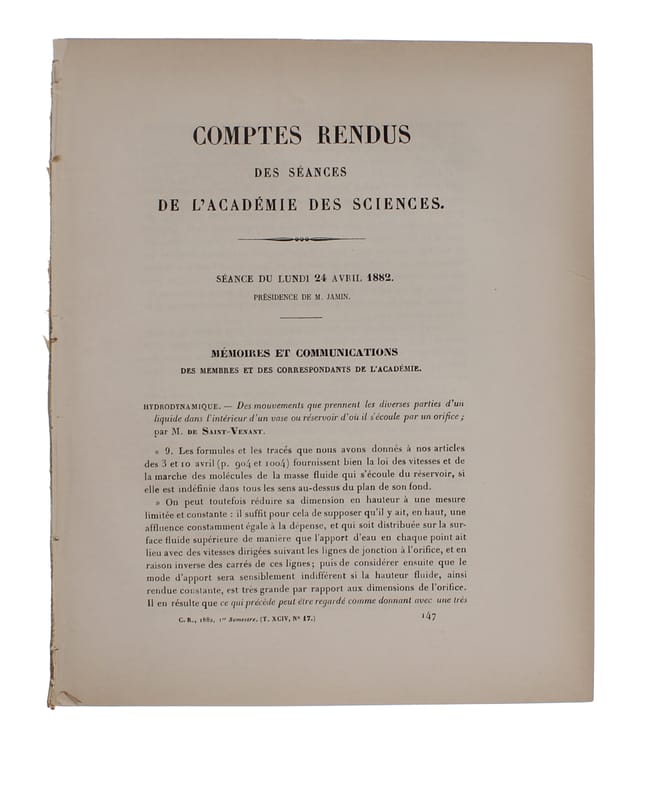
‎(Paris, Gauthier-Villars), 1882. 4to. No wrappers. In: ""Comptes Rendus Hebdomadaires des Séances de L'Academie des Sciences"", Tome 94, No 8. Pp. (473-) 548 (entire issue offered). Michelson's paper: pp. 520-523, 1 textillustr.‎

‎First printing of this importent paper in which Michelson corrected an effect on his inteferometer which he had neglected in his first experiment on the ether drag of 1881.""Michelson himself, on presenting in 1882 (the paper offered) an account of his first esperiment to the Academie des Sciences, acknowledged that he had made an error in his earler report of 1881 and had neglected the effect of the earth's motion on the path of light in the inteferometer arm at right angles to the motion"" (Holton ""Thematic origins of Scientific Thought"", p. 265).""‎

Bookseller reference : 49092

Livre Rare Book

Herman H. J. Lynge & Son
Copenhagen Denmark Dinamarca Dinamarca Danemark
[Books from Herman H. J. Lynge & Son]

€ 268,60 Buy

‎"BECQUEREL, EDMOND. - THE BEGINNING OF SOLAR-CELL-ENERGY.‎

‎Sur les effets électriques qui se produisent sous l'influence solaire.‎

‎(Paris, Bachelier), 1839. 4to. No wrappers. In: ""Comptes Rendus Hebdomadaires des Séances de L'Academie des Sciences"", Tome IX (No.22). Entire issue offered. Becquerel's paper: pp. 711-713.‎

‎First printing of this important paper, which together with Becquerel's paper ""Mémoire sur les effets èlectriques produits sous l'influence des rayons solaires"" and ""Recherches sur les effets de la radiation chimique de la lumière solaire, au moyen des courants électriques"", published the same year, marks the beginning of Solar-Cell-Energy, the first step in a long path to solar panels, and a technology of immense importence for humanity. In 1923 Albert Einstein received the Nobel Prize for his theories explaining the photoelectric effect (his 1905-paper).The ""photovoltaic effect"" is the basic physical process through which a solar cell converts sunlight into electricity. In 1839, nineteen-year-old Edmund Becquerel, a French experimental physicist, discovered the photovoltaic effect while experimenting with an electrolytic cell made up of two metal electrodes. Becquerel found that certain materials would produce small amounts of electric current when exposed to light.‎

Bookseller reference : 49104

Livre Rare Book

Herman H. J. Lynge & Son
Copenhagen Denmark Dinamarca Dinamarca Danemark
[Books from Herman H. J. Lynge & Son]

€ 335,75 Buy

‎"CAUCHY, AUGUSTIN. - THE CLASSICAL ""SAMPLING THEOREM"" STATED.‎

‎Mémoire sur diverses formules d'analyse.‎

‎(Paris, Bachelier), 1841. 4to. Without wrappers. In ""Comptes rendus hebdomadaires des séances de l’Académie des sciences"", Vol. XII, No 6. Pp. (267-) 316. (Entire issue offered). Cauchy's paper: pp. 283-298. Some scattered brownspots.‎

‎First printing of an importent paper in information theory - the paper stating the earliest version of what will later be known as the ""Nyquist Sampling Theorem"", describing how many and what kind of samples are needed to construct a curve.""The theorem will be formulated more completely in 1928 and become one of the cornerstones of information theory"" (Bryan Bunch, 1841 M).‎

Bookseller reference : 49105

Livre Rare Book

Herman H. J. Lynge & Son
Copenhagen Denmark Dinamarca Dinamarca Danemark
[Books from Herman H. J. Lynge & Son]

€ 201,45 Buy

‎"AEPINUS (ÆPINUS), FRANZ ULRICH THEODOSICUS. - ANALYSIS OF THE MICROMETER.‎

‎Sur les inconvéniens qu'on a lieu de Craindre dans l'usage du Micrometre, surtout par Rapport aux Instrumens qu'on adapte au quart de Cercle.‎

‎(Berlin, Haude et Spener, 1758). 4to. No wrappers as issued in ""Mémoires de l'Academie Royale des Sciences et Belles-Lettres"" Tome 12 (1756), pp. 365-386 a. 2 folded engraved plates.‎

‎First apperance of the paper in which Aepinus gives a mathematical analysis of a micrometer adapted to a quadrant circle, his only publication related to satronomy.‎

Bookseller reference : 49127

Livre Rare Book

Herman H. J. Lynge & Son
Copenhagen Denmark Dinamarca Dinamarca Danemark
[Books from Herman H. J. Lynge & Son]

€ 134,30 Buy

‎"MAUPERTUIS, (PIERRE LOUIS MOREAU DE). - THE EPISTEMOLOGICAL STATUS OF THE LAWS OF MOTION.‎

‎Examen philosophique de la Preuve de L'Existence de Dieu employée dans l'Essai de Cosmologie. Premier-Seconde Partie. (1. Sur l'Evidence & la certitude Mathematique. - 2. Ou l'on examine les Loix de la Nature).‎

‎(Berlin, Haude et Spener, 1758). 4to. No wrappers as issued in ""Mémoires de l'Academie Royale des Sciences et Belles-Lettres"" Tome 12 (1756), With the section-titlepage. Pp. (2),389-424.‎

‎Fisr edition of an importent paper in which Maupertuis articulates his final synthesis of his earler work on the status of natural laws of motion and with is reflexions on epistemological certainty. He here coined the term ""repliability"" to denote the unambigouos truths of arithmetics and geometry.‎

Bookseller reference : 49130

Livre Rare Book

Herman H. J. Lynge & Son
Copenhagen Denmark Dinamarca Dinamarca Danemark
[Books from Herman H. J. Lynge & Son]

€ 201,45 Buy

‎"HERMITE, CHARLES. - THE THEORY OF TRANSFORMATIONS.‎

‎Sur la théorie de la transformation des fonctions abéliennes. ( I,II,III a. IV,V,VI). 2 papers.‎

‎(Paris: Gauthier-Villars), 1855. 4to. No wrappers. In: ""Comptes Rendus Hebdomadaires des Seances de l'Academie des Sciences"", Vol 40, No 5 + 6. Pp. (205-) 260 a. pp. (261-) 324. (2 entire issue offered). Hermite's paper's: pp. 249-256 a. 304-309.‎

‎First printing of Hermite's importent paper in which he created the theory of transformations.""Another topic on which Hermite worked and made important contributions was the theory of quadratic forms. This led him to study invariant theory and he found a reciprocity law relating to binary forms. With his understanding of quadratic forms and invariant theory he created a theory of transformations in 1855. His results on this topic provided connections between number theory, theta functions, and the transformations of abelian functions.""""Hermite’s 1855 results became basic for the transformation theory of Abelian functions as well as for Camille Jordan’s theory of ""Abelian"" groups. They also led to Herrnite’s own theory of the fifth-degree equation and of the modular equations of elliptic functions.""(DSB).‎

Bookseller reference : 49133

Livre Rare Book

Herman H. J. Lynge & Son
Copenhagen Denmark Dinamarca Dinamarca Danemark
[Books from Herman H. J. Lynge & Son]

€ 161,16 Buy

‎"DALTON, JOHN. - PAWING THE WAY FOR THE ATOMIC THEORY.‎

‎Bemerkungen für und wider Dalton's neue Theorie über die beschaffenheit gemischter Gasarten, über seine Vorstellung, wie Gas im Wasser vorhanden ist, und über die Frage: ob gasarten unter einander und zum Wasser chemisch verwandt sind, oder nicht. b...‎

‎Halle, Rengerschen Buchhandlung, 1805. Contemp. hcalf. Spine gilt, raised bands, a few scratches to spine. In: ""Annalen der Physik. Herausgegeben von Ludwig Wilhelm Gilbert"", Bd. 21. (8),496 pp. and 5 engraved plates. (Entire volume offered). Stamp to verso of titlepage and verso of plates. Internally clean and fine. The papers by Dalton, Gough, Henry: pp. 377-436. And pp. 458-461.‎

‎First German editions of these importent papers on Dalton's theory of gases. The year ""1804 was notable chiefly for controversy over the mixed gases theory and particularly over its denial of weak chemical affinity forces. Continuing criticism of the theory - and the failure of particle weight studies to provide the hoped-for clinching evidence - caused Dalton to revise his ideas on mixed gases during the course of 1805."" (DSB)Smyth ""John Dalton. A Bibliography"", Nos 33, 34, 35 a. 42.‎

Bookseller reference : 49134

Livre Rare Book

Herman H. J. Lynge & Son
Copenhagen Denmark Dinamarca Dinamarca Danemark
[Books from Herman H. J. Lynge & Son]

€ 268,60 Buy

‎"NAVIER, (CLAUDE L.M.H.). - THE NAVIER-STOKES EQUATIONS FOR FLUID FLOW.‎

‎Sur les Lois des mouvemens des fluides, en ayant égard à l'adhésion des molécules.‎

‎(Paris, Crochard, 1821). No wrappers. In 'Annales de Chimie et de Physique', Volume 19, Cahier 3. Pp. 225-236 (Entire issue offered with halftitle to vol. 19). Navier's paper: pp. 244-260. A few scattered brownspots. Some browning to halftitlepage.‎

‎First appearance of Navier's famous paper in which he describes the relations between fluid flow and friction, giving the FUNDAMENTAL EQUATIONS OF THE MATHEMATICAL THEORY OF ELASTICITY. The full paper was not published until 1828. Stokes's analysis of the internal friction of fluids was published in 1845, and as he was not familiar with the French litterature of mathematical physics, he derived independently his own equations, which accounts for the double-name of the equations. ""The Navier-Stokes equation is now regarded as the universal basis of fluid mechanics, no matter how complex and unpredictable the behavior of its solutions may be. It is also known to be the only hydrodynamic equation that is compatible with the isotropy and linearity of the stress-strain relation."" (Olivier Darrigol).""Navier studied the motion of solid and liquid bodies, deriving the partial differential equations to which he applied Fourier's methods to find particular solutions. This theoretical research led him to formulate the well-known equation identified with his name and that of Stokes. Navier viewed bodies as made up of particles which are close to each other and which act on each other by means of two opposing forces - one of attraction and one of repulsion - which, when in a state of equilibrium, cancel each otherout. The repelling force resulted from the caloric that a body possessed. When equilibrium is disturbed in a solid, a restoring force acts which is proportional to the change in distance between the particles.""(DSB, X, p. 4).""The equations are useful because they describe the physics of many things of academic and economic interest. They may be used to model the weather, ocean currents, water flow in a pipe and air flow around a wing. The Navier-Stokes equations in their full and simplified forms help with the design of aircraft and cars, the study of blood flow, the design of power stations, the analysis of pollution, and many other things. Coupled with Maxwell's equations they can be used to model and study magnetohydrodynamics. ""(Wikipedia).‎

Bookseller reference : 49138

Livre Rare Book

Herman H. J. Lynge & Son
Copenhagen Denmark Dinamarca Dinamarca Danemark
[Books from Herman H. J. Lynge & Son]

€ 470,05 Buy

‎"LENZ, E. (HEINRICH FRIEDRICH EMIL.). - THE LAW OF RESISTIVITY.‎

‎On the Laws of the Conducting Powers of Wires of different Lenghts and Diameters for Electricity.‎

‎(London, Richard Taylor, 1837). No wrappers. Extracted fron ""Scientific Memoirs, selected from The Transactions of Foreign Academies of Science and Learned Societies. Edited by Richard Taylor."", Vol. I, pp. 311-324. Disbound.‎

‎First appearance in English of this importent paper in which Lenz established the law of electrical resistivity in wires, stating that ""their conductibilities are in an inverse ratio to their lengths."" The paper is a translation of ""Ueber das Gesetz der Leitungsfähigket für Electricität bei Dräthen von verschiedenen Längen und Durchmessern."", published in St. Petersbourg in 1835.‎

Bookseller reference : 49141

Livre Rare Book

Herman H. J. Lynge & Son
Copenhagen Denmark Dinamarca Dinamarca Danemark
[Books from Herman H. J. Lynge & Son]

€ 134,30 Buy

‎"POINCARE, H. (HENRI). - THE DISCOVERY OF AUTOMORPHIC FORMS.‎

‎Sur les fonctions fuchsiennes. (+) Sur les fonctions.... Note. (+) Sur les fonctions.... Note.‎

‎(Paris: Gauthier-Villars), 1882. 4to. No wrappers. In: ""Comptes Rendus Hebdomadaires des Seances de l'Academie des Sciences"", Vol 94, No 4 + 15 + 17. Pp. (149-) 184, pp. (997--) 1068 a. pp. (1139-) 1214. (3 entire issues offered). Poincare's papers: pp. 163-168, 1038-1042 a. 1166-67.‎

‎First appearance in print of the discovery of the automorphic forms, which Poincaré named Fuchsian functions.""One of Poincaré's first discoveries in mathematics, dating to the 1880s, was automorphic forms. He named them Fuchsian functions, after the mathematician Lazarus Fuchs, because Fuchs was known for being a good teacher and had researched on differential equations and the theory of functions. Poincaré actually developed the concept of these functions as part of his doctoral thesis. Under Poincaré's definition, an automorphic function is one which is analytic in its domain and is invariant under a discrete infinite group of linear fractional transformations. Automorphic functions then generalize both trigonometric and elliptic functions."" (Wikipedia).‎

Bookseller reference : 49173

Livre Rare Book

Herman H. J. Lynge & Son
Copenhagen Denmark Dinamarca Dinamarca Danemark
[Books from Herman H. J. Lynge & Son]

€ 201,45 Buy

‎"VOSSIUS, GERHARD (GERARDUS) JOHANN. - ""ARTES LIBERALES"" AND THE HISTORY OF MATHEMATICS.‎

‎Ars Historica. Sive de Historiae, & Historicis naturâ, Historiaeque scribendae praeceptis, Commentario. Ad Illustrissimum Virum, Joannem Berckium. (+) De Qvattuor Artibus popularibus, de Philologia, et Scientiis Mathematicis, Cui Operi sunjungitur, Ch...‎

‎Leiden, Joannis Maire, 1653 - Amsterdam, Ioannes Blaeu, 1650. 4to. One contemp. full vellum. Contemp. handwritten titles (weak) to spine. First title in red/black with large engraved titlevignette. (8),154,(1) pp. (Ars Historica 1653) - (16),94,(14) pp. (Grammatistice etc. 1650) - (8),83,(15) pp. (De Philologia, 1650) - (16),467,(33) pp. (De Universae Mathesios..., 1650). Fine and clean.‎

‎First edition of ""De Qvattuor Artibus..."" (which includes ""De Universae Mathesios"" with separate titlepage) and second edition of ""Ars Historica""The mathematical work: Poggendorff II, 1235. ""de Mathesios."": ""According to prof. Cantor, (it) is the first history of mathematics in its widest sense"". Honeyman Coll., 3081.‎

Bookseller reference : 49198

Livre Rare Book

Herman H. J. Lynge & Son
Copenhagen Denmark Dinamarca Dinamarca Danemark
[Books from Herman H. J. Lynge & Son]

€ 2.014,50 Buy

‎"JANSSEN, PIERRE JULES CÉSAR. - THE PHOTOGRAPHIC REVOLVER AND THE ""FIRST FILM"".‎

‎Passage de Vénus"" Methode pour obtenir photographiquement l'instant des contacts, avec les circonstances physiques qu'ils présentent. (+) Présentation de quelques spécimens de photographies solaires obtenues avec un appareil construit pour la mis...‎

‎Paris: Gauthier-Villars, 1873, 1874, 1874 a.1882. 4to. No wrappers. In: ""Comptes Rendus Hebdomadaires des Seances de l'Academie des Sciences"", Vol. 76, No 11, Vol. 78, No 25, Vol. 79, No 1, Vol. 94, No 14. (3 entire issues offered). Pp. (677-) 732, pp. (1721-) 1780, pp. (5-) 72 and pp. (901-) 996. Janssen's papers: pp. 677-679, pp. 1730-31, pp. 6-7 and pp. 909-911. (The main paper having the title-page to the volume (vol. 79), stamp to title-page).‎

‎First printings of this series of epoch-making papers in which Janssen introduced the ""PHOTOGRAPHIC REVOLVER"" and its first successfull use leading to the ""First Film"" and hereby ""realized one of the operations necessary for cinematography""(DSB).In the first papers he conceived the idea of a device of historical interest, the photographic revolver, the technique of short exposures, which is announced here. The third paper is the epoch-making paper in which he specifically describes the ""revolver"" and its results, the ""first film"". The fourth paper is his responce to Marey's famous expriments with the ""revolver"" recording the flight of birds.""A long barreled canon-like automatic camera was invented in 1874 by an outstanding pioneer of modern astronomical photography, Jules Janssen. Janssen used the revolving plate technique and called his camera a 'pistol'. Janssen's method used the forerunner of a number of 'gun' cameras with a slowly revolving plate and shutter operated by clockwork. The photos were taken every 70 seconds along the margin of the negative and he used his pistol to record a 48 image sequence of the transit of Venus across the sun at an exposure rate of 1.5 seconds.""""In planning for the observation of the transit of Venus, which he was to observe in Japan on 9 Deembe 1874, Janssen decided to substitute for visual observation at the time of transit a series of photographs taken in rapid succession, which would permit him to measure the successive positions of the planet in relation to the solar limb. He ordered the construcion of an apparatus consisting of three circular disks with the same axis: the first, pierced by twelve slits, served as the shutter"the second contained a window" the photographic plate, which was circular, was fixed to the third. The first two disks turned with a synchronized movement, the shutter disk continuously and the other irregularly in the intervals of time in which the window was not swept by a slit. A series of separate images laid out on a circle was thus obtained on the plate. In a general manner the apparatus provided an analysis of a motion on the basis of the sequence of its elemental aspects. Here Janssen realized one of the operations necessary for cinematography, which was invented twenty years later, and which required, besides analysis, the synthesis of images."" (DSB).‎

Bookseller reference : 49205

Livre Rare Book

Herman H. J. Lynge & Son
Copenhagen Denmark Dinamarca Dinamarca Danemark
[Books from Herman H. J. Lynge & Son]

€ 1.275,85 Buy

‎"RAYLEIGH, LORD (J.W. STRUTT) and WILLIAM RAMSAY. - THE DISCOVERY OF ARGON.‎

‎Argon, a New Constituent of the Atmosphere. Received and Read January 31, 1895.‎

‎London, Harrison and Sons, 1895. 4to. Orig. full cloth. Gilt lettering to spine. Blindtooled covers. First corner a bit bumped. In ""Philosophical Transactions"", Vol. 186 - I, Series A. XIV,(2),602,(4) pp. (Entire volume offered). The paper: p. 187-241 a. 8 textillustrations (apparatus). The title-page with faint brownspots. Otherwise internally clean and fine.‎

‎First printing of this importent paper in the history of chemistry, Lord Rayleigh's most famous discovery, announcing the discovery of this new gas, the first finding of one of the rare gases (inert gases) having unusual properties, and forming a distinct group in the periodic table, and all with zero valency.""The original paper in the ""Philosophical Transactions"" will undoubtly rank as a classic, the investigation having been a particularly brilliant ine."" (Ernst von Meyer in History of Chemistry). For this discovery Lord Rayleigh and W. Ramsay received the Nobel Prize (1904). The volume also contains WILLIAM CROOKES ""On the Spectra of Argon"", OSBORNE REYNOLD ""On the Dynamical Theory of Incompressible Viscous Fluids and the determination of the Criterion"", KARL PEARSON ""Contributions to the Mathematical Theory of Evolution. - II. Skew Variations in Homogenous Materials"" etc.After having made several measuring of the densities of gases, ""Rayleigh came across a curious puzzle. With oxygen, he always obtained the same density, regardless of how the oxygen might be produced, whether from one particular compound, from a second compound, or from the air. The situation was different with nitrogen. The nitrogen he obtained from air constantly showed a slightly higher density than the nitrogen he obtained from any of various compounds. Rayleigh could think of several ways in which the nitrogen obtained from air might be contaminated but none of the possibilities checked out experimentally. He was so frustrated that he went so far as to write to the journal ""Nature"" asking for suggestions. Ramsay, a brilliant Scottish chemist, asked permission to tackle the problem and received it. The upshot was that a new gas, somewhat denser that nitrogen, was discovered to exist in the atmosphere. It was named argon and it was the first of a series of rare gases of unusual properties whose existence had never been suspected.""(Asimow).Dibner, Heralds of Science No. 50 - Neville, Historical Chemical Library vol. II, p.358.‎

Bookseller reference : 49207

Livre Rare Book

Herman H. J. Lynge & Son
Copenhagen Denmark Dinamarca Dinamarca Danemark
[Books from Herman H. J. Lynge & Son]

€ 1.141,55 Buy

‎"YOUNG, THOMAS.- THE DERIVATION OF THE PRESSURE WAVE SPEED.‎

‎Hydraulic Investigations, subservient to an intended Croonian Lecture on the Motion of the Blood.‎

‎London, William Nicholson, 1809. 8vo. Contemp. hcalf, but spine lacks, boards loose. In: ""A Journal of Natural Philosophy, Chemistry, and the Arts. By William Nicholson."" Vol. XXII. - VIII,384,(8) pp. a. 10 engraved plates. Youngs paper: pp. 104-124. Small stamps to verso of titlepage. Internally fine and clean.‎

‎First appearance (together with the paper in the ""Transactions of the Royal Society at the same time) of this famous paper, containing Young's implicit discovery of the Joukowski equation for solids, 100 years before it appeared under the name of Joukowski (1847-1921), the well-known pioneer in the theory of aerodynamics.‎

Bookseller reference : 49236

Livre Rare Book

Herman H. J. Lynge & Son
Copenhagen Denmark Dinamarca Dinamarca Danemark
[Books from Herman H. J. Lynge & Son]

€ 604,35 Buy

‎"DULONG, (PIERRE) & (ALEXIS) PETIT. - THE ""LAW OF DULONG AND PETIT""‎

‎Researches on the Measure of Temperature, and on the Laws of the Communication of Heat.‎

‎London, Baldwin, Cradock, and Joy, 1819. 8vo. Contemp. hcalf. Marbled boards. Spine lacks and boards loose. In: ""Annals of Philosophy"" or Magazine of Chemistry, Mineralogy, Mechanics... By Thomas Thomson"". Vol. XIII. XCII,486 pp. a. 6 engraved plates. (Entire volume offered). Some brownspots to the plates. Iternally clean. A small stamp in upper right corner of two leaves. Dulong & Petit's paper: pp. 112-124, 161-182, 241-251, 321-339 a. 1 engraved plate.‎

‎First appearance in English of this, their (first) joint paper, which initiated the recheches leading to the the ""Law of Dulong and Petit"", the connection between atomic weight and atomic heat. The original Frensh having the title: Recherches sur les lois de dilation des solides, des liquides et des fluides élastiques, et sur la mesure exacte des temperatures.""""In 1815 Dulong’s famous collaboration with the mathematical physicist Alexis Thérèse Petit began"" it produced three important memoirs on heat (of which this is the first). The best-known part of this work is the statement of the law of constant atomic heats that bears their names, .... They began with the fundamental problem of measuring quantities of heat, which involved a critical analysis of thermometric scales. In 1804-1805 Gay-Lussac had carried out a comparison of mercury and air thermometers between 0°C. and 100°C. Dulong and Petit extended the range of comparison up to 300°C. and found an increasing discrepancy between the two scales at higher temperatures."" (DSB).‎

Bookseller reference : 49242

Livre Rare Book

Herman H. J. Lynge & Son
Copenhagen Denmark Dinamarca Dinamarca Danemark
[Books from Herman H. J. Lynge & Son]

€ 335,75 Buy

‎"BERZELIUS, JÖNS JACOB. - THE INTERNATIONAL LANGUAGE OF CHEMISTRY INTRODUCED.‎

‎Experiments on the Nature of Azote, of Hydrogen, and of Ammonia, and upon the Degrees of Oxidation of which Azote is susceptible.‎

‎London, Robert Baldwin, 1813. 8vo. Contemp. hcalf. Marbled boards. Spine lacks and boards loose. In: ""Annals of Philosophy"" or Magazine of Chemistry, Mineralogy, Mechanics... By Thomas Thomson"". Vol. II. - VIII,480 pp. a. 7 plates. (Entire volume offered). Berzelius' paper: pp. 276-284, 357-368. Some browning and brownspots to plates.‎

‎First printing of this milestone papers in the history of chemistry, where Berzelius introduced his famous chemical symbolism (the offered paper is the first on the subject - Leicester & Klickstein calls it the ""Preliminary note) whereby an element is generally represented by the first letter of its Latin name, or, in the event of elements having the same first letter, by the first two letters. Even though his atomic symbols were introduced in 1813 (see the note on p. 359), it was quite a few years before Berzelius's symbols were adopted by the chemistry community. But once accepted, they became the new international language of chemistry. Berzelius ""contributed more to the development of the atomic theory and to the setting up of accurate values of the atomic weights than did any other worker of the time. Of his contributions, moreover, to the development of the atomic theory and the advancement of chemical science, not the least valuable was the introduction of a chemical symbolism which, with slight modification, is in use at the present day. By giving his symbols a quantitative meaning - the symbol of an element representing one atomic proportion by weight - it was possible ""to show briefly and clearly the number of elementary atoms in each compound and, after the determination of their relative weights, present the results of each analysis in a simple and easely retained manner"". This symbolism was speedily adopted on the Continent but, in England, only after some considerable time.""(Findlay ""A Hundred Years of Chemistry"", p. 14.).Parkinson ""Breakthroughs"", 1813 C. - Leicester & Klickstein ""A Source Book in Chemistry"", p. 258 ff. - Holmberg 1813:28 a.‎

Bookseller reference : 49243

Livre Rare Book

Herman H. J. Lynge & Son
Copenhagen Denmark Dinamarca Dinamarca Danemark
[Books from Herman H. J. Lynge & Son]

€ 671,50 Buy

‎"BERZELIUS - THE DISCOVERY OF THORIUM.‎

‎Untersuchung eines neuen Minerals und einer darin enthaltenen zuvor unbekannten Erde.‎

‎Leipzig, Johann Ambrosius Barth, 1829. Without wrappers as issued in ""Annalen der Physik und Chemie. Hrsg.von Poggendorff"", Bd. 16, Siebentes Stück. (2) + pp., 1 folded engraved plate. Entire issue offered with titlepage to volume 16. Berzelius's paper: pp. 387-415. Clean and fine.‎

‎First German printing - printed simultaneously with the English and Swedish version - of the paper in which Berzelius described his discovery of Thorium, the first element after Uranium to be identified as such. In 1829, Jöns Jakob Berzelius of the Royal Karolinska Institute, Stockholm extracted thorium from a rock specimen sent to him by an amateur mineralogist who had discovered it near Brevig and realised that it had not previously been reported. The mineral turned out to be thorium silicate, and it is now known as thorite. Berzelius even produced a sample of metallic thorium by heating thorium fluoride with potassium, and confirmed it as a new metal. He called the black mineral thorite, in honor of the Scandinavian god Thor.Parkinson ""Breakthroughs"", 1829 C.‎

Bookseller reference : 49248

Livre Rare Book

Herman H. J. Lynge & Son
Copenhagen Denmark Dinamarca Dinamarca Danemark
[Books from Herman H. J. Lynge & Son]

€ 241,74 Buy

‎"RAMSAY, WILLIAM & PER THEODOR CLEVE. - THE INDEPENDENTLY DISCOVERY OF HELIUM ON EARTH‎

‎On a Gas showing the Spectrum of Helium, the reputed cause of D3, one of the Lines in the Coronal Spectrum. preliminary Note. (Received March 26, 1895). (+) Helium, a Gaseous Constituent of certain Minerals. Part I. And (P.E. CLEVE:) Sur la présence d...‎

‎London, arrison and Sons, 1895. - (Paris, Gauthier-Villars), 1895. 8vo. and 4to. Later full cloth, gilt lettering to spine (Ramsay) and without wrappers (Cleve). In ""Proceedings of the Royal Society"" (Ramsay), Vol. 58. (Entire vol. offered). And in ""Comptes Rendus Hebdomadaires des Séances de L'Academie des Sciences"" (Cleve), Tome 120, No 15. Pp. (797-) 850. (Entire issue offered). Ramsay's papers: pp. 65-67 and pp. 81-89. - Cleve's paper: p. 834. Stamps tp edges and a few corners a bit bumped on vol. 58, otherwise clean and fine.‎

‎First printing of both papers in which Ramsay and Cleve - independently - announced their discovery of Helium on the Earth. Although Ramsay announced the discovery of Helium before Cleve had completed his research, the Swedish chemist was independent discoverer of the element.Helium was discovered in the sun already in 1868 by Jules Janssen and independently by Lockyer the same year. Janssen discovered helium in the sun when he observed a total eclipse in India by studying the spectra of the suns chromosphere and Lockyer, also by spectroscopy, found that the new line in the spectrum did not belong to any element then known and he named it Helium for the sun.In the same volume as Ramsays paper there are 5 papers by NORMAN LOCKYER dealing with the discovery of Helium on the earth, examining Ramsay's and Cleve's findings.Parkinson ""Breakthroughs"", 1895.‎

Bookseller reference : 49284

Livre Rare Book

Herman H. J. Lynge & Son
Copenhagen Denmark Dinamarca Dinamarca Danemark
[Books from Herman H. J. Lynge & Son]

€ 604,35 Buy

‎"CROS, CHARLES. - INVENTING THE PHONOGRAPH.‎

‎""Procédé d'enregistrement et de reproduction des phénomènes perçus par l'ouïe"". (Seance du Lundi 3 decembre 1877).‎

‎(Paris, Mallet-Bachelier), 1877 4to. In: ""Comptes Rendus Hebdomadaires des Séances de L'Academie des Sciences"", Tome 85, No 23. Pp. (1029-) 1084. (Entire issue offered). Cros' letter: pp. 1082-1083.‎

‎First printing of this paper which describes the invention of the Phono-autograph (Phonograph) a few month before Edison introduced his invention. It was on this letter to the Academy that the French made claim to the invention.""He (Charles Cros) is perhaps most famous as the man who almost, but not quite, invented the phonograph. No one before M. Charles Cros had thought of reproducing sound by making an apparatus capable of registering and reproducing sounds which had been engraved with a diaphragm. The inventor gave the name of Paleophone (voix du passé) to his invention. On April 30, 1877 he submitted a sealed envelope containing a letter to the Academy of Sciences in Paris explaining his proposed method. The letter stated in French, ""Alors qu'il séjourne à Sablé au début de 1877, Charles Cros rédige une courte note, « Procédé d'enregistrement et de reproduction des phénomènes perçus par l'ouïe », dans laquelle il expose le principe de ce qu'il nomme « Paléophone » (« voix du passé ») : « Un index léger est solidaire du centre de figure d'une membrane vibrante "" il se termine par une pointe [...] qui repose sur une surface noircie à la flamme."" The English translation is one close to this: ""A lightweight index is fixed to the center of figure of a vibrating membrane, it ends with a tip [...] based on a blackened surface flame. This surface is integral with a disc driven by a double movement of rotation and linear progression. The system is reversible: when the tip makes ironing in the furrow membrane restores the original acoustic signal."" The letter was read in public on 3 December following. In his letter, after having shown that his method consisted of detecting an oscillation of a membrane and using the tracing to reproduce the oscillation with respect to its duration and intensity. Cros added that a cylindrical form for the receiving apparatus seemed to him to be the most practical, as it allowed for the graphic inscription of the vibrations by means of a very fine-threaded screw.""(Wikipedia)‎

Bookseller reference : 49293

Livre Rare Book

Herman H. J. Lynge & Son
Copenhagen Denmark Dinamarca Dinamarca Danemark
[Books from Herman H. J. Lynge & Son]

€ 221,59 Buy

‎"BRAUN, FERDINAND. - THE DISCOVERY OF SEMICONDUCTOR RECTIFIER EFFECT.‎

‎Ueber die Stromleitung durch Schwefelmetalle.‎

‎Leipzig, Johann Ambrosius Barth, 1874. 8vo. Contemp. hcalf. 5 raised bands, gilt spine and gilt lettering to spine. A few scratches to spine. Small stamp on verso of first -and general- titlepage. In: ""Annalen der Physik und Chemie. Hrsg. von J.C. Poggendorff"", Sechste Reihe Bd. 3, (= Poggendorff Bd. 153). X,636 pp., 4 plates. (Entire volume offered). Braun's paper: pp. 556-563.‎

‎First printing of Brown's importent paper in which he described his discovery of a semiconductor diode, noting that electrical currents flows freely in only one direction at the contact between a metal point and a galena crystal.""In 1874 Braun published the results of his research on mineral metal sulfides. He found that these crystals conducted electric currents in only one direction. This information was important in electrical research and in measuring another property of substances, the electrical conductivity, but Braun’s discovery did not have immediate practical application. In the early twentieth century the principle that Braun had discovered was employed in crystal radio receivers.""(DSB).The Nobel Prize in Physics 1909 was awarded jointly to Guglielmo Marconi and Karl Ferdinand Braun ""in recognition of their contributions to the development of wireless telegraphy"".‎

Bookseller reference : 49327

Livre Rare Book

Herman H. J. Lynge & Son
Copenhagen Denmark Dinamarca Dinamarca Danemark
[Books from Herman H. J. Lynge & Son]

€ 335,75 Buy

‎"LAURENT, AUGUSTE. - THE NUCLEUS THEORY OF ORGANIC COMPOUNDS.‎

‎Analyse du Spodumène de l'Arriège et de la Wichtyne. (+) Sur de nouveaux Chlorures et Bromures d'Hydrogéne carboné. (+) Sur la Nitronaphtalase, la Nitronaphtalèse et la Naphtalase. (+) Sur le Benzoyle et la Benzimide.‎

‎Paris, Crochard, 1835. Contemp. hcloth. Gilt lettering to spine. In: ""Annales de Chimie et de Physique, Par MM. Gay-Lussac et Arago."", 2e Series, tome 59. 446,(2) pp. (Entire volume offered). Some scattered brownspots. Laurent's papers: pp. 107-111, 196-220,376-397 a. 397-422.‎

‎First printing of these importent papers in the history of organic chemistry explaining the differences to Dumas' law of substitutions, and introducing a ""new type"" and what he calls ""fundamental and derived radicals"". The introduction of the ""Nucleus Theory"" was the basis for the unitary theory formulated by Gerhardt.""While studying the reactions of naphthalene and its compounds with the halogens and nitric acid, Laurent was from the start characteristically concerned with the construction of an explanatory theory that would account for these phenomena. Like most creative scientists, he generalized his solution to a specific problem through the imaginative use of analogy, leading to the elaboration of the first comprehensive theory adequate for dealing with the whole domain of contemporaneous organic chemistry."" (DSB).""A founder of modern organic chemistry, Laurent was one of the most important chemists of the nineteenth century. He considered the behavior of matter to be a manifestation of its intimate internal structure, which one cannot determine with certainty but which one has to investigate if one wants to understand. Laurent’s preoccupation was to construct a method that could guide the chemist forward along this path, from facts to their causes. He was the first chemist to intimately associate crystallo-graphic data and chemical studies. Louis Pasteur and Charles Friedel later followed the way.""(DSB).‎

Bookseller reference : 49330

Livre Rare Book

Herman H. J. Lynge & Son
Copenhagen Denmark Dinamarca Dinamarca Danemark
[Books from Herman H. J. Lynge & Son]

€ 268,60 Buy

‎"BAYLISS, W.M. (WILLIAM MADDOCK) & ERNEST H. STARLING. - FOUNDING THE SCIENCE OF ENDOCRINOLOGY.‎

‎On the Causation of the so-called 'Peripheral Secretion' of the Pancreas (Preliminary Communication). Received January 22, - Read January 23, 1902.‎

‎London, Harrison and Sons, 1902. 8vo. Contemp. full cloth. Top of spine worn down. Lower spine end with a small crack. A collation remark on title-page. A bookmark on inside frontcover, stating that the volume was bound 10/9/02 for City of Manchester. Municipal Technical School. ""Proceedings of the Royal Society"", Vol. 69. VII,501 pp. a. 6 plates. Bayliss & Starling's announcement: pp. 352-353. Internally clean.‎

‎This is the first printing, annoucing a milestone discovery which introduced a quite new field in physiology and medicine, the discovery of the FIRST HORMONE, which the discoverers named ""Secretin"". A few years later Sterling coined the word 'hormone' from the Greek 'hormon', meaning to exite or set into motion. Until know it was though that the control of the glands, here the pancreas, was controlled by the nerves (Pavlow and others), but Bayliss and Sterling showed that they have found that the intestine was signalling the pancreas by some COMPLETELY NEW MECHANISM involving a new kind of body or substance functioning as a chemical messenger. ""If nerves are the sprinters of biology, Bayliss & Starling had discovered the marathon runners. In doing so, they also founded the science of hormones, called endocrinology"" (Alan Lightman ""The Discoveries"", p. 34 ff). The announcement, as offered here, was later the same year followed by their larger paper ""The Mechanism of Pancreatic Secretion"" which they published in ""Journal of Physiology (1902)"".""With the discovery of hormones, Bayliss & Starling had found the internal command and control centers - and in this, their discovery was much larger than a new communication system. The mechanism of response and control was chemical: atoms and molecules. Now, with hormones, there was a mechanism for a living thing to regulate itself. Furthermore with hormones, an organism could not only be studied but also controlled from the outside... Never had the living body come closer to a machine, a self-regulating machine governed not only by physics but also chemistry. An not only a machine, but a machine that we human could willfully control. At the start of the new century, we still have not come to terms with the implications of this idea.""(Alan Lightman).Parkinson ""Breakthroughs"", 1902 B.‎

Bookseller reference : 49356

Livre Rare Book

Herman H. J. Lynge & Son
Copenhagen Denmark Dinamarca Dinamarca Danemark
[Books from Herman H. J. Lynge & Son]

€ 1.678,75 Buy

‎"BAYLISS, W.M. (WILLIAM MADDOCK) & ERNEST H. STARLING. - THE CHEMICAL MESSINGER.‎

‎The Chemical Regulation of the Secretory process. (Croonian Lecture).‎

‎London, Harrison and Sons, 1904. 8vo. Later full buckram. Spine with gilt lettering. In: ""Proceedings of the Royal Society"", Vol. 73. VIII,548 pp. a. 11 plates. (Entire volume offered). Bayliss & Starling's paper: pp. 310-322. A stamp to edges, otherwise clean.‎

‎First printing of this paper in which they developed the theory of hormonal control of the internal secretion, a milestone discovery by Bayliss and Starling in 1902, which introduced a quite new field in physiology and medicine, the discovery of the FIRST HORMONE, which the they named ""Secretin"". They here tries to find out how this new body could be decribed chemically, and one of the conclusions were ""It is not precipitated by tannic acid, thus excluding bodies of alkaloid nature as well as di-amido compounds. This evidence, slight thought it is, points to secretin being a body of relatively small molecular weight and not a colloid. It may be compared to the active principle of the suprarenal glands, adrenalin, which has been obtained in a crystallic form and the cemical constitution of which has been approximately determined...""(p. 314-15).Garrison & Morton: 1121.‎

Bookseller reference : 49361

Livre Rare Book

Herman H. J. Lynge & Son
Copenhagen Denmark Dinamarca Dinamarca Danemark
[Books from Herman H. J. Lynge & Son]

€ 268,60 Buy

‎"HEISENBERG, WERNER. - THE CONSTITUTION OF MANY-ELECTRON ATOMS.‎

‎Zur Quantentheorie der Multiplettstruktur und der anomalen Zeemaneffekte. (Eingegangen am 10. April 1925).‎

‎Berlin, Julius Springer, 1925. Contemp. hcloth. In: ""Zeitschrift für Physik. Hrsg. von Karl Scheel"", 32. Band. VI,951 pp., textillustr. (Entire volume offered). Heisenberg's paper: pp. 841-860. A stamp to title-page and front free endpaper. Interally clean.‎

‎First printing of Heisenberg's importent paper on the complex spectra of many-electron atoms, - the third paper Heisenberg submitted from Copenhagen on the Quantum Theory.""The paper on multiplet structure and anomalous Zeeman effects..., contained a complete discussion of the problem at that time. This paper had the blessing of Niels Bohr"" also Pauli, who was in Copenhagen when the paper was completed, agreed with its overall content. The central goal of the paper was to formulate what Bohr called 'the stress (constraint), which is not analogous to the action of external forces' and to derive quantitative conclusions from it."" (Mehra and Rechenberg ""The Historical development of Quantum Theory"", vol. 2, p. 201).The volume contains another importent paper in the history of Quantum Physics: W. BOTHE und H. GEIGER ""Über das Wesen des Comptoneffekts, ein experimenteller Beitrag zur Theorie der Strahlung"", pp. 639-663.‎

Bookseller reference : 49362

Livre Rare Book

Herman H. J. Lynge & Son
Copenhagen Denmark Dinamarca Dinamarca Danemark
[Books from Herman H. J. Lynge & Son]

€ 470,05 Buy

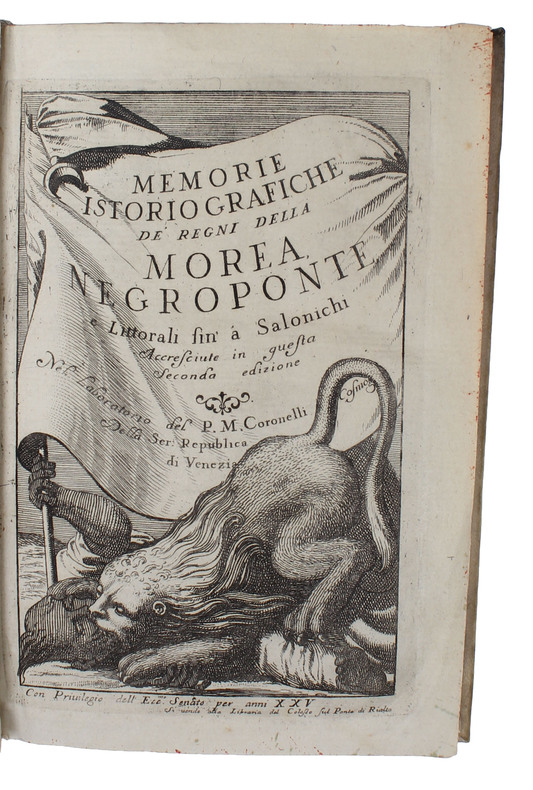
‎"CORONELLI, P.M. (VINCENZO MARIA). - THE RECONQUEST OF PELOPONNESE (MOREA).‎

‎Memorie istorio grafiche de Regni della Morea Negroponte e Littorali fin á Salonichi. Aceresciute in guesta Seconda edizione. - [THE RECONQUEST OF PELOPONNESE (MOREA).]‎

‎Venezia, (1686). 8vo. (16,5x11 cm.). Contemp. full vellum. Halftitle-page. Engraved Title-page (the Lion of St. Mark). (8),237,1 blank,(2- Indice) pp. and 41 (of 42 ?) double-page folded engraved maps and plans (bird's-eye views or plans of fortified towns and places etc.). Internally fine and clean. Printed on good paper. A fine copy.‎

‎Second edition (the first 8vo-edition), issued the same year as the first (in folio), describing the Venetian campaign for the reconquest of the Peloponnese or Morea, from which Venice had been almost completely excluded since the Turkish conquest of the Greek island in 1458.""As is often the case with Coronelli's work, the contents may vary with each example as plates were added, subtracted or changed as the editor saw fit"" (Rodney Shirley ""Maps in the Atlases of the british Library"", T.Coro-1a, - listing only 39 maps and views for this copy).Coronelli Vincenzo Maria, an Italian geographer and draughtsman, was born at Venice about 1650. From 1681-1683 he worked in Paris on a pair of 3.85 meter diameter globes for Louis XIV, which are now in the National Library in Paris. On his return to Venice he was made cosmographer of the Republic, and founded the Academy of Argonauts (the first Geographical Society). In 1702 he became general of his order.‎

Bookseller reference : 49367

Livre Rare Book

Herman H. J. Lynge & Son
Copenhagen Denmark Dinamarca Dinamarca Danemark
[Books from Herman H. J. Lynge & Son]

€ 2.686,00 Buy

‎"GRAHAM, THOMAS. - COINING THE WORD ""DIALYSIS"".‎

‎The Bakerian Lecture. - On Osmotic Force. Received June 15, - Read June 15, 1854.‎

‎(London, Richard Taylor and William Francis, 1854). 4to. No wrappers as extracted from ""Philosophical Transactions"" 1854, Vol. 144 - Part I. Pp. 177-228, 3 fine textillustrations in woodcut. Clean and fine.‎

‎First appearance of this importent paper in which Graham coins the word ""dialysis"" denoting the passage by diffusion of dissolved substances as a function of their concentration and molecular mass. In this way he further explained 'exomosis'.""Thomas Graham (1805-1869) studies diffusion in gases and solutions and discovers and names the phenomenon now known as the osmotic force. He finds that certain substances (i.e. glue) pass more slowly through membranes than others (i.e. common salt). He calls the former colloids and the latter crystalloids and introduces the notion of dialysis to describe these observations. The beginning of his famous lecture ""On osmotic force"" with illustrations is shown on the right.""(From Anders Gedeon ""Science and Technology in Medicine"", p. 244, where part of the first page and the illustrations from the offered paper, are shown).Garrison & Morton: 686 (""Investigation on osmotic force"" provided importent information for the physiologists"").‎

Bookseller reference : 49408

Livre Rare Book

Herman H. J. Lynge & Son
Copenhagen Denmark Dinamarca Dinamarca Danemark
[Books from Herman H. J. Lynge & Son]

€ 376,04 Buy

‎"POCKELS, F. - THE POCKELS EFFECT OR PHOTOELASTIC EFFECT DISCOVERED.‎

‎Ueber den Einfluss elastischer Deformationen, speciell einseitigen Druckes, auf das optische Verhalten krystallinischer Körper. (3 parts).‎

‎Leipzig, Johann Ambrosius Barth, 1889. 8VO. Contemp. hcalf. Raised bands, gilt spine. Top of spine worn and some wear to upper compartment. In ""Annalen der Physik und Chemie. Hrsg. von G. Wiedemann."", Neue Folge Bd. 37. VIII,680 pp. a. 7 folded plates. Pockels' paper: pp. 144-172, 269-305, 372-394. Small stamp to htitle, title-page and verso of. Internally fine.‎

‎First printing of Pockels' paper in which he announced the discovery of the effect which bears his name. He shows that the optical property is changed by a change in the dieelectric function induced by electric deformation of a solid. The discovery became to have a wide use in semiconductor technology.The volume contains further notable papers ELSTER & GEITEL ""Ueber die Electricitätserregung beim Contact verdünnter Gase mit galvanisch glühende Drähten"", pp. 315-329. - HEINRICH HERTZ ""Ueber die Fortleitung electrischer Wellen durch Drähte"", pp. 395-407. - W. HALLWACHS ""Ueber den Zusammenhang des Elektricitätsverlustes durch beleuchtigung mit der Lichtsabsorption"" (The photo-electric effect !), pp. 666-674, papers by Lenard, Ferdinand Braun (2 papers) etc.‎

Bookseller reference : 49414

Livre Rare Book

Herman H. J. Lynge & Son
Copenhagen Denmark Dinamarca Dinamarca Danemark
[Books from Herman H. J. Lynge & Son]

€ 241,74 Buy

‎"GRAHAM, THOMAS. - THE FOUNDATION OF COLLOID CHEMISTRY.‎

‎Liquid Diffusion applied to Analysis.‎

‎(London, Richard Taylor and William Francis, 1854). 4to. No wrappers as extracted from ""Philosophical Transactions"" 1861, Vol. 151 - Part I. Pp. 183-224, textillustrations.‎

‎First printing of a groundbreaking paper in biochemistry and physiology, as Graham here introduced the distinction between colloidal and crystalloid substances by his method of separating animal and other fluids.""Although some isolated investigations on colloids had been carried out before Graham, his publications in this field laid the foundations of colloid chemistry. In ""On the Diffusion of Liquids,"" Graham applied to liquids the exact method of inquiry he had applied to gases twenty years before, and he succeeded in placing the subject of liquid diffusion on about the same footing as that to which he had raised the subject of gaseous diffusion prior to the discovery of his numerical law. He showed that the rate of diffusion was approximately proportional to the concentration of the original solution, increased with rise in temperature, and was almost constant for groups of chemically similar salts at equal absolute (not molecular) concentrations and different with different groups.""(DSB).Garrison & Morton: 688.‎

Bookseller reference : 49415

Livre Rare Book

Herman H. J. Lynge & Son
Copenhagen Denmark Dinamarca Dinamarca Danemark
[Books from Herman H. J. Lynge & Son]

€ 402,90 Buy

‎"ARNOLD, GOTTFRID. - THE HERETICS OF THE CHURCH.‎

‎Unparteyische Kirchen= und Ketzer= Historie. Vom Anfang des Neuen Testaments Biss auf das Jahr Christi 1688. (1.-2. Theil).‎

‎Franckfurt am Mayn, Thomas Fritsch, 1700. Folio. Bound in one contemp. full calf. Spine worn. lacks leather at upper compartment and wear to lower compartment. Corners bumped and worn. (20),411:695,(36) pp. Woodcut on titlepage. A few scattered brownspots. A faint dampstain to lower margins on a few leaves. Oth3rwise internally fine.‎

‎Scarce second edition of Arnold's influential ""Impartial History of the Church and of Heresy"".""In this major revision of church history, Arnold directed his sharpest criticism against those who wrote deeply biased apologetic ""orthodox"" histories instead of trying to understand where substantial religious differences actually came from. In his view,""heresy making"" was usually the defensive reaction of those in authority, rather than a true indictment of unconventional thinkers. He thought that the worst calamity in Church history was its establishment as the accepted and orthodox faith by the Roman Emperor Constantine in the fourth century. Arnold evinced a remarkable sympathy for a huge variety of ""heretics."" This ""impartial history"" exercised a wide influence on the German Enlightenment and won approval from such thinkers as Johann Wolfgang Goethe in addition to Leo Tolstoy.""‎

Bookseller reference : 49419

Livre Rare Book

Herman H. J. Lynge & Son
Copenhagen Denmark Dinamarca Dinamarca Danemark
[Books from Herman H. J. Lynge & Son]

€ 738,65 Buy

‎"DALTON, JOHN. - THE REBIRTH OF THE ATOMIC THEORY.‎

‎Weitere Erörterung einer neuen Theorie über die Beschaffenheit gemischer Gasarten.‎

‎(Halle, Rengerschen Buchhandlung, 1803). Without wrappers as published in ""Annalen der Physik. Herausgegeben von Ludwig Wilhelm Gilbert"", Bd. 13, Viertes Stück. Pp. 385-504 a. 1 engraved plate. (The entire issue offered). Dalton's paper: pp. 438-445.‎

‎First German version of one of the founding papers in which he formulated his famous gas laws and raised the foundation of the atomic theory in chemistry.Smyth ""John Dalton... A Bibliography"", No 29.‎

Bookseller reference : 49442

Livre Rare Book

Herman H. J. Lynge & Son
Copenhagen Denmark Dinamarca Dinamarca Danemark
[Books from Herman H. J. Lynge & Son]

€ 241,74 Buy

‎"CURIE, IRÈNE & F. JOLIOT (AND P. SAVEL). - ""THE NEUTRON IDENTIFIED""‎

‎Émission de protons de grande vitesse par la substances hydrogénées sous l'influence des rayons gamma très pénétrants. (+) Effet d'absorption de rayons gamma de très haute fréquence par projection de noyaux légers. (+) Projections d'atomes par rayo...‎

‎Paris, Gauthier-Villars, 1932-33. 4to. No wrappers. In: ""Comptes Rendus Hebdomadaires des Séances de L'Academie des Sciences"", Tome 194 and tome 197. - Tome 194: Nos 3,8,10,15 a. 25. - Tome 197: No 3. (6 entire issues offered). With titlepages to both volumes. The papers: pp. 273-275, 708-711, 876-877 a. 1 plate, 1229-1232, 2208-2211 a. 237-38 (tome 197). The issue no 25: pp. 2181-2248 lacks the first leaf, no affecting the paper. Titlepages with a faint stamp.‎

‎First printing of these papers of seminal importance to the evolution of particle physics - the results of these investigations immediately lead the way to the discovery of the neutron.They found that the 'Beryllium radiation', discovered by Bothe and Becker, ejected protons from a paraffin target. This discovery was amazing because photons have no mass. However, the Joliot-Curies interpreted the results as the action of photons on the hydrogen atoms in paraffin. They used the analogy of the Compton Effect, in which photons impinging on a metal surface eject electrons. The trouble was that the electron was 1,836 times lighter than the proton and, therefore, recoiled much more easily than the heavier proton after a collision with a gamma photon. When James Chadwick reported to Lord Rutherford on the Joliot-Curies’ results, Lord Rutherford exclaimed, ""I do not believe it!"" Chadwick immediately repeated the experiments at the Cavendish Laboratory in Cambridge, England. He not only bombarded the hydrogen atoms in paraffin with the beryllium emissions, but also used helium, nitrogen, and other elements as targets. By comparing the energies of recoiling charged particles from different targets, he proved that the beryllium emissions contained a neutral component with a mass approximately equal to that of the proton. He called it the neutron.‎

Bookseller reference : 49447

Livre Rare Book

Herman H. J. Lynge & Son
Copenhagen Denmark Dinamarca Dinamarca Danemark
[Books from Herman H. J. Lynge & Son]

€ 671,50 Buy

‎THERSNER, ULRIC. - THE GRAND TOPOGRAPHY OF SWEDISH ROMANTICISM (SKÅNE).‎

‎Skånska Utsigter. Vue de Scanie. (Smudstitelbladet: Fordna och Närvarande Sverige. La Suède Ancienne et Moderne).‎

‎(Stockholm, 1816-23). Tvær-folio. (36 x 52,5 cm.). Samtidigt hldrbd. med rygforgyldning. Marmorerede permer. Lidt slidt ved øverste kapitæl. Mindre revne i nederste del af forreste fals. (Smudstitel, Dedikation til Kongen, Företal) pp. Graveret titelblad, Innehåll (2 blade), Prenumerationsblade (4) pp. samt 60 plancher i kobberstik eller aquatintetryk, tegnet af Thersner og graverede af S.H. Petersen eller C.F. Akrell. Med 60 blade beskrivende tekst (fra 1-4 pp. pr. planche). Med svensk/fransk parallelltekst. Plancherne forestiller vuer og herregårde. Enkelte marginale brunpletter, ellers et meget rent eksemplar med brede marginer.‎

‎Originaltrykket. Et ganske udmærket eksemplar af det første bind (omhandlende Skåne) af Thersners stort anlagte topografiske mesterværk, som udkom i 12 dele i årene 1816-67. Inspirationen til værket, som blev fortsat af hans datter Thora Thersner, fik han fra Dahlbergs Suecia Antiqua et Hodierna og fra Skjöldebrands Voyage Pittoresque au Cap Nord.‎

Bookseller reference : 49448

Livre Rare Book

Herman H. J. Lynge & Son
Copenhagen Denmark Dinamarca Dinamarca Danemark
[Books from Herman H. J. Lynge & Son]

€ 2.081,65 Buy

‎"BERGONIÉ, J. & L. TRIBONDEAU. - THE ""BERGONIÉ-TRIBONDEAU LAW"" OF RADIATION.‎

‎Interprétation de quelques résultats de la Radiothérapie et essai de fixation d'une technique rationelle.‎

‎(Paris, Gauthier-Villars), 1906. 4to. No wrappers. In: ""Comptes Rendus Hebdomadaires des Séances de L'Academie des Sciences"", Tome 143, No 24. Pp. (941-) 988. (Entire issue offered). The paper: pp. 983-985. Disbound.‎

‎First apperance of the paper in which the authors published the law named after them, the ""Bergonié-Tribondeau Law"", ""the sensitivity of cells to radiation varies directly with the reproductive capacity of the cells and inversely with their degree of differentiation""(Dorland).Garrison & Morton, No. 2005.‎

Bookseller reference : 49450

Livre Rare Book

Herman H. J. Lynge & Son
Copenhagen Denmark Dinamarca Dinamarca Danemark
[Books from Herman H. J. Lynge & Son]

€ 134,30 Buy

‎"PASTEUR, LOUIS. - ANNOUNCING THE DISCOVERY OF ""MOLECULAR ASSYMETRY""‎

‎Mémoire sur la relation qui peut exister entre la forme cristalline et la composition chimique, et sur la cause de la polarisation rotatoire"" (Extrait). (Séance du Lundi 22 Mai 1848).‎

‎(Paris, Bachelier), 1848. 4to. No wrappers. In: ""Comptes Rendus Hebdomadaires des Séances de L'Academie des Sciences"", Tome 26, No 21. Pp. (529-) 548. (Entire issue offered). Pasteur's paper: pp. 535-538. Clean and fine.‎

‎First appearance of the announcement of Pasteur's momentous and revolutionary discovery of ""molecular assymetry"" and founding the science of Polarimetry.The discovery was first announced by Pasteur in may 1848 by the printing of the preliminary report of only 4 short pages, in order to establish priority (the paper offered). A more full exposition was published the same year in ""Annales de Chimie et de Physique"", 3me Series - Tome XXIV.""In 1848....Pasteur studied the crystals of tartrates (one of the substances that exhibited the now-clockwise, now-counterclockwise effect) under the microscope and found that the xcrystasls were mirror images of the others. The two crystals resemmbled each other as a right-hand glove resembles a left-hand glove....This was a revolutionary discovery and it took some courage to announce it. A few years before, the well-known chemist Mitscherlich had studies the same tartrate crystals and declared them all to be identical. Pasteur was only a twenty-sic-year-old unknown. neverthelless he announced his findings and went before Biot to repeat the separation ofthe crystals before the eyes of the aged authority in the field. Biot was convinced and Pasteur received the Rumford medal of the Royal Society for his work....Pasteur had thus founded the science of polarimetry in which the measurements of the manner in which the plane of polarized light was twisted could be used to help to determine the structure of organic substance, to follow various chemical reactions, and so on.""(Asimov). Leicester & Klickstein ""A Source Book of Chemistry"", p. 374-379).‎

Bookseller reference : 49456

Livre Rare Book

Herman H. J. Lynge & Son
Copenhagen Denmark Dinamarca Dinamarca Danemark
[Books from Herman H. J. Lynge & Son]

€ 604,35 Buy

‎"BERNARD, CLAUDE - ""THE MOST COMPLETE STATEMENT OF THE FUNCTION OF THE PANCREAS""‎

‎Mémoire sur le pancréas et sur le role du suc pancréatique dans les phénomènes digestifs, particulièrement dans la digestion des matières grasses neutres.‎

‎(Paris, Mallet-Bachelier), 1856. 4to. No wrappers. In: ""Supplément aux Comptes rendus hebdomadaires des séances de l’Académie des sciences"", Tome Premier. With half-title and title-page to Tome I. Pp. 379-563 and 9 engraved plates (4 handcoloured). A punched stamp to lower margin of title-page. Clean and fine.‎

‎First printing of this celebrated memoir in which Bernard describes his importent invesigations on the function of the liver, the pancreas and the pancreatic juices.""In 1846 Bernard began studying the pancreatic juices and their role in digestion,.... By observing the processes of digestion in dogs and rabbits, and by experimentation with pure pancreatic juices collected from temporary pancreatic fistulae, Bernard was able to show that pancreatic juices made fats absorbable by breaking them down into fatty acids and glycerine. In 1856 he published his most complete statement of the function of the pancreas, ""Mémoire sur le pancréas et sur le role du suc pancréatique dans les phénomènes digestifs, particulièrement dans la digestion des matières grasses neutres."" This appered in Volume I of the supplement to the ""Comptes rendus hebdomadaires des séances de l’Académie des sciences"", and it was also published as a separate edition in book form.""(Norman p. 247).Norman ""One Hundred Books Famous in Medicine"", No 67 B. -‎

Bookseller reference : 49471

Livre Rare Book

Herman H. J. Lynge & Son
Copenhagen Denmark Dinamarca Dinamarca Danemark
[Books from Herman H. J. Lynge & Son]

€ 604,35 Buy

‎"SEMMELWEIS. IGNACE PHILIPPE. - THE DEBUT OF ASEPTIC.‎

‎Note sur la fièvre puerpérale et sur une cause qu’il regarde comme présidant très fréquemment au développement de la maladie. (Séance 21 février 1848).‎

‎(Paris, Bachelier), 1848. 4to. No wrappers. In: ""Comptes Rendus Hebdomadaires des Séances de L'Academie des Sciences"", Tome 26, No 8. Pp. (233-) 264. (Entire issue offered). Semmelweis's paper: pp. 254-255. Clean and fine.‎

‎First French announcement of this epochal event in the history of medicine, the discovery of the etiology and prevention of childbed fever. First announce by Ferdinand von Hebra in December 1847, then followed (only 2 months) after by the French announcement.""Although Semmelweis's importent discoveries were made in the 1840s, he did not publish them immediately. The first printed reports of his findings were written by his collegues and were published in various German, French, or English Journals. Semmelweis himself gave three lectures before the Imperial and Royal Medical Society of Vienna in 1850 but did not publish his complete discussion of ""The etiology, concept, and prophylaxis of childbeed fever"" until 1861, having previously contributed several shorter accounts to Hungarian medical journals.""(Norman ""One Hundred Books famous in Medicine"", p. 265).Semmelweis demonstrated that puerperal fever (also known as childbed fever) was contagious and that this incidence could drastically be reduced by appropriate hand washing by medical care-givers. He made this discovery in 1847 while working in the Maternity Department of the Vienna Lying-in Hospital. His failure to convince his fellow doctors led to a tragic conclusion. However, he was ultimately vindicated. While employed as assistant to the professor of the maternity clinic at the Vienna General Hospital in Austria in 1847, Semmelweis introduced hand washing with chlorinated lime solutions for interns who had performed autopsies. This immediately reduced the incidence of fatal puerperal fever from about 10 percent (range 5-30 percent) to about 1-2 percent.Toward the end of 1847, accounts of Semmelweis's work began to spread around Europe. Semmelweis and his students wrote letters to the directors of several prominent maternity clinics describing their recent observations. Ferdinand von Hebra, the editor of a leading Austrian medical journal, announced Semmelweis's discovery in the December 1847 and April 1848 issues of the medical journal. Hebra claimed that Semmelweis's work had a practical significance comparable to that of Edward Jenner's introduction of cowpox inoculations to prevent smallpox.Garrison & Morton: 6275 (German version).‎

Bookseller reference : 49472

Livre Rare Book

Herman H. J. Lynge & Son
Copenhagen Denmark Dinamarca Dinamarca Danemark
[Books from Herman H. J. Lynge & Son]

€ 335,75 Buy

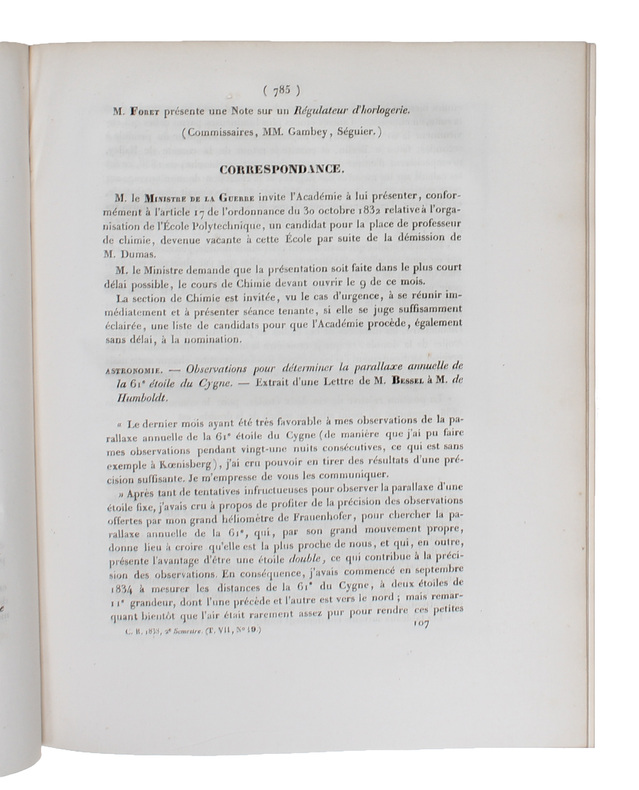
‎"BESSEL, (FRIEDRICH WILHELM) - THE FIRST MEASURE OF THE DISTANCE TO A STAR.‎

‎Observations pour déterminer la parallaxe annuelle de la 61e étoile du Cygne. - Extrait d'une Lettre de M. Bessel à M. de Humboldt. Note de M.Arago sur le même sujet. (Séance du Lundi 5 Novembre 1838). (+) Nouvelles observations sur la parallaxe annu...‎

‎Paris, Bachelier, 1838 a. 1840. 4to. No wrappers. In: ""Comptes Rendus Hebdomadaires des Séances de L'Academie des Sciences"", Tome 7, No 19 and Tome 10, No 17/18. With title-ages to vol. 7 and 10. Pp. (769-) 803 a. pp. (671-) 717. (Entire issues offered). Bessel's papers: pp. 785-793 a. pp. 703-710. Stamp on both titlepages. The second titlepage with a fes brownspots, otherwise clean and fine.‎

‎First appearance of a milestone paper in astronomy, giving the solution of the great problem of distances in the universe which had baffled astronomers ever since the time of Copernicus, announcing the FIRST SUCCESSFUL DISPLACEMENT OR PARALLAX OF A FIXED STAR and hence deducing the FIRST RELIABLE DISTANCE OF THE EARTH TO A FIXED STAR. The parallax observed corresponded to ab. 600.000 times that of the earth from the sun. On these grounds Bessel calculated the distance to about 11 light years, and this was confirmed by fresh investigations by Bessel in 1839-40 (the second paper offered). In 1842-43 it was also confirmed by C.A.F. Peters at Pulkowa. It is the first published instance of the fathom-line thrown into celestial space.Bessel communicated his observations in Comptes Rendus, in a letter to Humboldt (the offered paper dated Nov. 5, 1838), in ""Monthly Notices"" in letter to J. Herschel, and in ""Astronomische Nachrichten"" Vol. 16, No 365-66 (pp. 65-96), 1838), where a more detail account was published.Ther paper ""Bestimmung der Entfernung des 61sten Stern des Schwans"" in ""Astronomische Nachrichten"" is dated at the end: Altona 1838, Dec. 13.Bessel's investigation was hailed by John Herschel when Bessel was awarded the R.A.S. gold medal ""The greatest and most glorious triumph which practical astronomy has ever witnessed"". ""For determining the parallax of 61 Cygni, Bessel selected two comparison stars of magnitude 9-10 at distances of roughly eight and twelve minutes of arc. 61 Cygni is a physical double star whose components differ in brightness by less than one magnitude. The distance of sixteen seconds of arc between the components favored the accuracy of the determination of the parallax because pointing could be carried out with two star images. After observing for eighteen months, by the fall of 1838 Bessel had enough measurements for the determination of a reliable parallax. He found that p = 0.314? with a mean error of ±:0.020?. This work was published in the Astronomische Nachrichten (1838), the first time the distance of a star became known. Bessel’s value for the parallax shows excellent agreement with the results obtained by extensive modern photographical parallax determinations,..."" (DSB).Parkinson ""Breakthroughs"" 1838 A. - Shapley & Howarth ""A Source Book in Astronomy"", pp. 216 ff.‎

Bookseller reference : 49473

Livre Rare Book

Herman H. J. Lynge & Son
Copenhagen Denmark Dinamarca Dinamarca Danemark
[Books from Herman H. J. Lynge & Son]

€ 2.014,50 Buy

‎"ARAGO, FRANCOIS - LOUIS DAGUERRE. - THE DAGUERREOTYPE.‎

‎Le Daguerréotype. (Seance du Lundi 19 Aout 1839). (+ Daguerre:) Des procédés photogéniques comme moyens de gravure - Lettre de M. Daguerre à M. Arago. (Séance du Lundi 20 Septembre 1839).‎

‎(Paris, Bachelier), 1839. 4to. No wrappers. In: ""Comptes Rendus Hebdomadaires des Séances de L'Academie des Sciences"", Tome IX, No. 8 a. 14. Pp. (249-) 282 a. pp. (417-) 436. Arago's rapport: Pp. 250-267 - Daguerre's letter: pp. 423-429. Both issues clean and fine.‎

‎First printing of the first official and complete report of the invention of the ""daguerreotype"", the photographic process invented by Louis Daguerre. The presentation by Arago preceeded Daguerre's own publication ""Historique de description des procédés du daguerreotype et du diorama"", (1839). Together with Daguerre's letter to Arago in which he relates the process of heliography and describes his contract with Niépce to exploit the heliogrphis process. The Heliogravure was invented by Niépce‎

Bookseller reference : 49477

Livre Rare Book

Herman H. J. Lynge & Son
Copenhagen Denmark Dinamarca Dinamarca Danemark
[Books from Herman H. J. Lynge & Son]

€ 1.141,55 Buy

‎"ARAGO, FRANCOIS - LOUIS DAGUERRE. - FIRST ANNOUNCEMENT OF THE PRODUCTION OF DAGUERROTYPES.‎

‎Fixation des images qui se forment au foyer d'une chambre obscure. (Seance du Lundi 7 Janvier 1839).‎

‎Paris, Bachelier, 1839. 4to. No wrappers. In: ""Comptes Rendus Hebdomadaires des Séances de L'Academie des Sciences"", Tome VIII No. 1. Pp. 1-36. (Entire issue offered with htitles and titlepages to volume 8). Arago's paper: Pp. 4-7. Light toning to halftitle. Stamps to title-page (one punched in lower margin). Fine and clan.‎

‎First printing of the first announcement and description of the production of Daguerreotypes made by Arago to the French Academy on January 7, 1839. The first complete report was printed on August 19, 1839. The presentation by Arago preceeded Daguerre's own publication ""Historique de description des procédés du daguerreotype et du diorama"", (1839).""Arago, himself a chemist and a member of the Chamber of Deputies, made a brief pronouncement on Daguerre's proces in the Chamber on 7 January 1839 (the paper offered). and in the following August printed the full text of his report thereon made to a joint sesion of the Chambers of Deputies and the Academy of Sciences.""(PMM: 318 (Note to).‎

Bookseller reference : 49478

Livre Rare Book

Herman H. J. Lynge & Son
Copenhagen Denmark Dinamarca Dinamarca Danemark
[Books from Herman H. J. Lynge & Son]

€ 1.343,00 Buy

‎"MAREY, (ETIENNE JULES). - MAREY'S ""LAW OF THE HEART""‎

‎Loi qui préside à la fréquence des battements du coeur.‎

‎(Paris, Gauthier-Villars), 1861. 4to. No wrappers. In: ""Comptes Rendus Hebdomadaires des Séances de L'Academie des Sciences"", Tome 53, No 3. Pp. (77-) 128. (Entire issue offered). Marey's paper: pp. 95-98. Faint marginal brownspots.‎

‎First printing of the paper in which Marey formulates the law, named after him and stating that heart rate is related inversely to arterial blood pressure.Marey contributed greatly to the development of experimental physiology. In 1860 he invented the modern sphygmograph, an instrument for recording the features of the pulse and variation in blood pressure on a graph. In 1861 he formulated Marey's law. He was the first to realize the relationship between blood pressure and heart rate.Garrison & Morton: 813.‎

Bookseller reference : 49480

Livre Rare Book

Herman H. J. Lynge & Son
Copenhagen Denmark Dinamarca Dinamarca Danemark
[Books from Herman H. J. Lynge & Son]

€ 201,45 Buy

‎"FLOURENS, MARIE JEAN PIERRE. - THE ANAESTHETC EFFECT OF CHLOROFORM DISCOVERED.‎

‎Note touchant l'action de l'éther sur les centres nerveux.‎

‎(Paris, Bachelier), 1847. 4to. No wrappers. In: ""Comptes Rendus Hebdomadaires des Séances de L'Academie des Sciences"", Tome 24, No. 10. Pp. (337-) 396. (Entire issue offered). Flourens' paper: pp. 340-44. A small paperflaw in inner margin on the first leaf. Clean and fine.‎

‎First printing of groundbreaking paper on anaesthesia, disclosing that chloroform had an anaesthetic effect. Flourens made the discovery before James Young Simpson.""Little notice seems to have been taken of his paper, but later the same year Simpson independently demonstrated the value of chloroform.""(Garrison & Morton, 5654.‎

Bookseller reference : 49524

Livre Rare Book

Herman H. J. Lynge & Son
Copenhagen Denmark Dinamarca Dinamarca Danemark
[Books from Herman H. J. Lynge & Son]

€ 161,16 Buy

‎"MENDELÉEFF, D. (MENDELÉEV, MENDELEYEV, MENDELÉEFF). - THE DECISIVE CONFIRMATION OF MENDELEEV'S PERIODIC TABLE OFTHE ELEMENTS.‎

‎Remarque à propos de la découverte du gallium.‎

‎Paris, Gauthier-Villars, 1875. 4to. No wrappers. In: ""Comptes Rendus Hebdomadaires des Séances de L'Academie des Sciences"", Tome 81, No 21. Pp. (909-) 992. With titlepage to vol. 81. Mendelejeff's paper: pp. 969-972. Titlepage lightly browned and with a punched stamp in lower margin. Otherwise clean and fine.‎

‎First apperance of this importent paper which established that Gallium is identical with Eka-aluminum (the missing element between Aluminum and Indium) in Mendelejeff's periodic table. The properties of the new element corresponded well with those predicted. A bitter contorversy was raised between the discoverer of Gallium, Lecog de Boisbaudran and Mendelejeff. ""The discovery of the three elements predicted by Mendeleev was, however, of decisive importance in the acceptance of his law. In 1875 Lecoq de Boisbaudran, knowing nothing of Mendeleev’s work, discovered by spectroscopic methods a new metal, which he named gallium. Both in the nature of its discovery and in a number of its properties gallium coincided with Mendeleev’s prediction for eka-aluminum, but its specific weight at first seemed to be less than predicted. Hearing of the discovery, Mendeleev sent to France ""Zametka po povodu otkrytia gallia"" (the paper offered) (""Note on the Occasion of the Discovery of Gallium""), in which he insisted that gallium was in fact his eka-aluminum. Although Lecoq de Boisbaudran objected to this interpretation, he made a second determination of the specific weight of gallium and confirmed that such was indeed the case. From that moment the periodic law was no longer a mere hypothesis, and the scientific world was astounded to note that Mendeleev, the theorist, had seen the properties of a new element more clearly than the chemist who had empirically discovered it. From this time, too, Mendeleev’s work came to be more widely known""(DSB).Parkinson Breakthroughs"" 1875 C.‎

Bookseller reference : 49528

Livre Rare Book

Herman H. J. Lynge & Son
Copenhagen Denmark Dinamarca Dinamarca Danemark
[Books from Herman H. J. Lynge & Son]

€ 470,05 Buy

‎"WÖHLER, FRIEDRICH - THE PREPATORY WORK OF ORGANIC CHEMISTRY.‎

‎Bildung der Cyansäure auf neuem Wege, und fernere Untersuchungen über die Cyansäure und deren Salze.‎

‎Leipzig, Johann Ambrosius Barth, 1823. 8vo. Contemp. hcalf. Gilt spine and with gilt lettering. Some scratches to spine. In: ""Annalen der Physik und der Physikalischen Chemie. Hrsg. Ludwig Wilhelm Gilbert"", Bd. 13 (= Bd. 73 der Reihe). (12),444 pp., 1 folded table and 5 engraved plates. Small stamp to verso of titlepages. Internally clean and fine. Wöhler's paper: pp. 157-172.‎

‎First printing of Wöhler's importent paper in which he in reality for the first time synthezised an organic substance, leading to his historic preparation of ""artificial"" urea in 1828 ""Ueber künstliche Bildung des Harnstoffs"". This broke down the old distinction between organic and inorganic substances. ""This was the first synthesis of an organic compound, and this accomplishment is generally regarded as the beginning of organic chemistry.""(Sparrow ""Milestones of Science"", p.37, the 1828 paper).""In his published paper (the 1828 paper) Wöhler referred to his work of 1823 (the offered paper), in which he had shown that cyanogen and aqueous ammonia yielded oxalic acid and a white crystalline solid that he now realized was urea. This, and his new method, he considered to be remarkable examples of the preparation ""by art"" of a substance of animal origin from inorganic materials.""(DSB).The volume contains other notable papers BECQUEREL: ""Ueber die Electricitäts-Erregung durc Druck, nach versuchen des herrn becquerel"" ein bericht abgestatt.... von Biot. Frei übersetzt von Gilbert"", pp. 117-129. A pioneer paper on Piezoelectricity. SEEBECK ""Notiz von neuen electrisch-magnetischen Versuchen des Herrn Seebeck... mitgeteilt von Hrn Oersted."", pp. 430-32. Also papers by Heinr. Rose, Döbereiner, Lampadius, Sertürner etc. etc.‎

Bookseller reference : 49580

Livre Rare Book

Herman H. J. Lynge & Son
Copenhagen Denmark Dinamarca Dinamarca Danemark
[Books from Herman H. J. Lynge & Son]

€ 604,35 Buy

‎"PREECE, WILLIAM HENRY - THE EDISON EFFECT.‎

‎On a Peculiar Behaviour of Glow-Lamps raised to High Incandescence. (Received March 14, 1885).‎

‎London, Harrison and Sons, 1885. Later full buckram. Gilt lettering to spine. IX,506,XL pp., 1 plate, textillustr. (Entire volume offered). Preece's paper: pp. 219-230 with 6 large textillustrations. Internally clean and fine.‎

‎First printing of this importent paper in which Preece was the first to use the term ""Edison effect.""""In 1884 William Henry Preece, an official of the British General Post Office, was shown an experiment by Thomas Edison. Of this experiment Preece gave what appears to be the first printed account in a paper entitled 'On a Peculiar Behaviour of Glow-Lamps raised to High Incandescence' (the paper offered)... What Edison had demonstrated was that if a metal plate is sealed into an electric light bulb and joined to the positive end of the filament a considerable curent will pass. If the plate is joined to the negative terminal, however, no current will pass. This was known as the 'Edison effect' and in 1890 Fleming, an electrical engineer who had workes with the Edison Company in London and now was professor at University College, began a carefull study of this phenomenon in carbon filament lamps. In 1904 he was able to demonstrate that this occurred not only with electric waves but also with wireless waves. He thus introduced the basic principle of the modern wireless valve, which permits only unilateral conductivity.""(PMM No 396).Shiers & Shiers ""Early television"", No 186.‎

Bookseller reference : 49594

Livre Rare Book

Herman H. J. Lynge & Son
Copenhagen Denmark Dinamarca Dinamarca Danemark
[Books from Herman H. J. Lynge & Son]

€ 470,05 Buy

‎"LEGRAY, GUSTAVE. - THE INVENTION OF THE WAXED-PAPER PROCESS IN PHOTOGRAPHY.‎

‎Note sur un nouveau mode de préparation du papier photographique négatif. (Séance du Lundi 8 December 1851).‎

‎(Paris, Bachelier), 1851. 4to. Without wrappers. In ""Comptes rendus hebdomadaires des séances de l’Académie des sciences"", Vol. 33, No 23. Pp. (631-) 648. (Entire issue offered). Legray's paper: pp. 643-644. Clean and fine.‎

‎First printing of a landmark paper in photography, introducing his invention of the waxed-paper process.""Gustave Legray brought photograpy on paper to its culmination in the 1850s with the waxed-paper process. A struggling young artist..., Legray abandoned painting for photography around 1848, and with the financial backing of the Comte de Briges opened a portrai studio on the top floor of the same house as the Bisson brothers, in the Madelaine district. His reputation, however, was made not in the field of portraiture but as an architectural and landscape photographer. He also taught photography and ""nearly all renowned photographers of the day have been his pupils"". Legray devoted a good deal of time to experiments and wrote a number of manuals. His invention of the waxed-paper proces dates to before 25 Febr. 1851, but the manipulation was not published until the following December (the paper offered)..... The wxed-paper process was far more than a modification of the calotype, as can be seen from the substances used in oidizing paper - rice water, sugar of milk, iodide of potassium, cyanide of potassium, fluoride of potassium (to which was later added white honey and the white of some egg). Sensitizing was done with an acid solution of nitrate of silver and development took place with gallic acid.... The process took its name from the fact that the paper was waxed before iodizing, instead of merely after exposure, to facilitate printing."" (Helmut E. R. K. Gernsheim).‎

Bookseller reference : 49595

Livre Rare Book

Herman H. J. Lynge & Son
Copenhagen Denmark Dinamarca Dinamarca Danemark
[Books from Herman H. J. Lynge & Son]

€ 470,05 Buy

Number of results : 506.698 (10134 Page(s))

First page Previous page 1 ... 20 21 22 [23] 24 25 26 ... 1469 2912 4355 5798 7241 8684 10127 ... 10134 Next page Last page