|
|
|
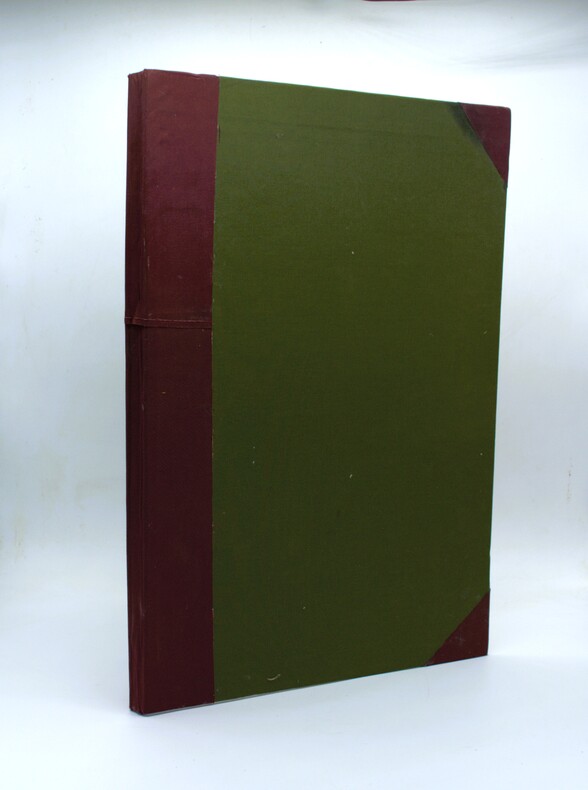
KHANZADIAN (Zadig), BERTALOT (L. de, éditeur)
Atlas de géographie économique de SYRIE et du LIBAN. Avant-propos de Monsieur Georges Leygues, député, ministre de la Marine. Géographie historique, géographie physique, richesses naturelles par Z. Khanzadian, capitaine de corvette, ingénieur hydrographe.
Paris, Commerce et industrie par L. de Bertalot, s.n., 1926. Grand in-folio (57x39cm) de [2] ff., 88 pp. (incomplet des pp. 81-88, Mouvement de la navigation maritime, Conclusion, Table des cartes) et 28 planches de cartes recto verso contenant 68 cartes numérotées 1-67 (complet) avec une carte numérotée 16 bis, dont 44 cartes historiques héliogravées ou en couleurs, certaines reproduisant des cartes anciennes, et 23 cartes politiques et économiques dessinées par l’auteur. Sans le frontispice. Cartonnage d’amateur moderne, dos et coins en toile bordeaux, plats recouverts de toile verte. Petites rousseurs éparses, quelques déchirures restaurées par endroits, légères traces de mouillures, perforations en marge inférieure de quelques planches.
Référence libraire : PHO-2298
|
|
|
KHAYADJIAN Edmond
ARCHAG TCHOBANIAN et le mouvement arménophile français.
Marseille CNDP 1986. In-8 broché couverture illustrée 352pp. Nombreuses illustrations hors texte d'après des photographies et des documents. Bel exemplaire.
Référence libraire : GITd246
|
|
|
KHEDIVE ABBAS HILMI PASHA II of EGYPT, (The last Khedive (Ottoman viceroy) of Egypt and Sudan, ruling from 8 January 1892 to 19
LE KHEDIVE - Business card of Abbas II of Egypt Khedive.
Egypt: ca. 1905 1905. Soft cover. Very Good. Original business card. 7x11 cm. Written 'Le Khedive'. Abbas Hilmi Pasha was the last Khedive Ottoman viceroy of Egypt and Sudan ruling from 8 January 1892 to 19 December 1914. In 1914 after Turkey joined the Central Powers in World War I the nationalist Khedive was removed by the British then ruling Egypt in favor of his more pro-British uncle Hussein Kamel marking the de jure end of Egypt's four-century era as a province of the Ottoman Empire which had begun in 1517. Extremely rare. See. 'Tamga pençe tugra imza' by Kologlu Orhan. p. 98. <br/> <br/> [ca. 1905] paperback
Référence libraire : 049551
|
|
|
KHEDIVE ABBAS HILMI PASHA II of EGYPT, (The last Khedive (Ottoman viceroy) of Egypt and Sudan, ruling from 8 January 1892 to 19 December 1914), (1874-1944).
[FINE ALS / ROYALTY / KHEDIVE] Autograph letter signed 'Abbas Hilmi'.
Very Good Turkish, Ottoman (1500-1928) Original autograph manuscript letter signed by Khedive Abbas Hilmi Pasha II of Egypt. 20,5x16,5 cm. In Ottoman script. 1 p. 6 lines. Sent to an unknown recipient who he called 'Efendim hazretleri' in elqab of the letter. He mentions that he received a telegraph of the recipient. He celebrated 'eid' ('Iyd-i said'). Abbas II Helmy Bey, was the last Khedive (Ottoman viceroy) of Egypt and Sudan, ruling from 8 January 1892 to 19 December 1914. In 1914, after the Ottoman Empire joined the Central Powers in World War I, the nationalist Khedive was removed by the British, then ruling Egypt, in favor of his more pro-British uncle, Hussein Kamel, marking the de jure end of Egypt's four-century era as a province of the Ottoman Empire, which had begun in 1517. Abbas Hilmy, the great-great-grandson of Muhammad Ali, was born in Alexandria, Egypt on 14 July 1874.[4] He succeeded his father, Tewfik Pasha, as Khedive of Egypt and Sudan on 8 January 1892. In 1887 he was ceremonially circumcised together with his younger brother Mohammed Ali Tewfik. The festivities lasted for three weeks and were carried out under great pomp. As a boy, he visited the United Kingdom, and he had a number of British tutors in Cairo including a governess who taught him English.[5] In a profile of Abbas II, the boys' annual, Chums, gives a lengthy account of his education. His father established a small school near the Abdin Palace in Cairo where European, Arab and Ottoman masters taught Abbas and his brother Mohammed Ali Tewfik. An American officer in the Egyptian army took charge of his military training. He attended school at Lausanne, Switzerland; then, at the age of twelve, he was sent to the Haxius School in Geneva, in preparation for his entry into the Theresianum in Vienna. In addition to Arabic and Ottoman Turkish, he had good conversational knowledge of English, French, and German. He was still in college in Vienna when he assumed the throne of the Khedivate of Egypt upon the sudden death of his father, 8 January 1892. He was bare of age according to Egyptian law; normally, eighteen in cases of succession to the throne. For some time he did not cooperate very cordially with the British, whose army had occupied Egypt in 1882. As he was young and eager to exercise his new power, he resented the interference of the British Agent and Consul General in Cairo, Sir Evelyn Baring, later made Lord Cromer. At the outset of his reign, Khedive Abbas II surrounded himself with a coterie of European advisers who opposed the British occupation of Egypt and Sudan and encouraged the young khedive to challenge Cromer by replacing his ailing prime minister with an Egyptian nationalist. At Cromer's behest, Lord Rosebery, the British foreign secretary, sent Abbas II a letter stating that the Khedive was obliged to consult the British consul on such issues as cabinet appointments. In January 1894 Abbas II made an inspection tour of Sudanese and Egyptian frontier troops stationed near the southern border, the Mahdists being at the time still in control of Sudan itself. At Wadi Halfa the Khedive made public remarks disparaging the Egyptian army units commanded by British officers. The British commander of the Egyptian army, Sir Herbert Kitchener, immediately threatened to resign. Kitchener further insisted on the dismissal of a nationalist under-secretary of war appointed by Abbas II and that an apology be made for the Khedive's criticism of the army and its officers. By 1899 he had come to accept British counsels. Also in 1899 British diplomat, Alfred Mitchell-Innes was appointed Under-Secretary of State for Finance in Egypt, and in 1900 Abbas II paid a second visit to Britain, during which he said he thought the British had done good work in Egypt and declared himself ready to cooperate with the British officials administering Egypt and Sudan. He gave his formal approval for the establishment of a sound system of justice for Egyptian nationals, a great reduction in taxation...
|
|
|
KHEDIVE ABBAS HILMI PASHA II of EGYPT, (The last Khedive (Ottoman viceroy) of Egypt and Sudan, ruling from 8 January 1892 to 19 December 1914), (1874-1944).
[LE KHEDIVE - Business card of Abbas II of Egypt, Khedive].
Very Good French Original business card. 7x11 cm. Written 'Le Khedive'. Abbas Hilmi Pasha was the last Khedive (Ottoman viceroy) of Egypt and Sudan, ruling from 8 January 1892 to 19 December 1914. In 1914, after Turkey joined the Central Powers in World War I, the nationalist Khedive was removed by the British, then ruling Egypt, in favor of his more pro-British uncle, Hussein Kamel, marking the de jure end of Egypt's four-century era as a province of the Ottoman Empire, which had begun in 1517. Extremely rare. (See. 'Tamga, pençe, tugra, imza' by Kologlu, Orhan. p. 98).
|
|
|
KIBRIS VAKIFLAR IDARESI.
The administration of vakfs Cyprus facts in figures, 1983. Preface by Nail Asafhan.
Very Good English Paperback. Pbo. Roy. 8vo. (24 x 17 cm). In English. 48 p., color and b/w ills. The administration of vakfs Cyprus facts in figures, 1983. Preface by Nail Asafhan.
|
|
|
KIBRISLIZÂDE BINBASI OSMAN BEY.
Kibrislizâde Binbasi Osman Bey'in hâtiralari ya da 19. Yüzyil'da Dogu'da Ingilizler. Translated by Ilhan Pinar.
Fine English Paperback., Fine., 20 x 14 cm., 199 p., "Kibrislizâde Binbasi Osman Bey'in hâtiralari ya da 19.Yüzyil'da Dogu'da Ingilizler.", Kibrislizâde Binbasi Osman Bey, Çev: Ilhan Pinar, Akademi Kitabevi, Izmir, 1996.
|
|
|
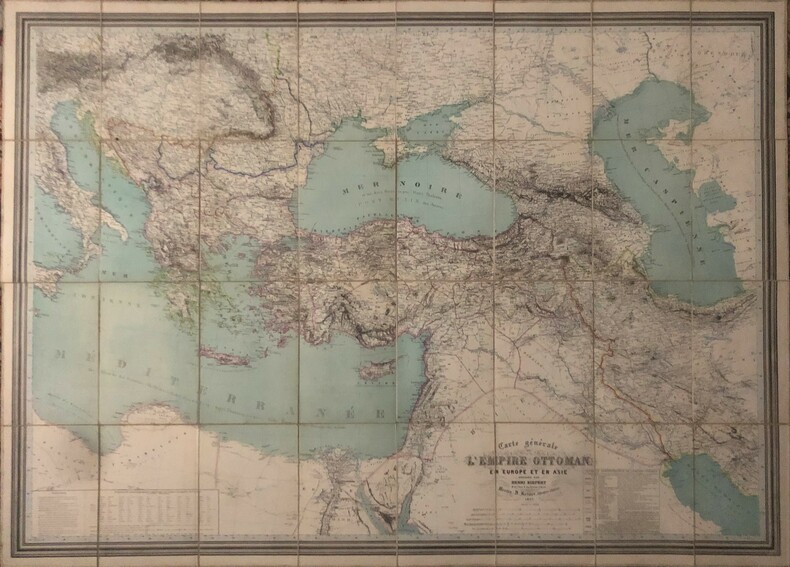
KIEPERT (Heinrich).
Carte générale de l'Empire Ottoman en Europe et en Asie
Carte générale de l'Empire Ottoman en Europe et en Asie. Berlin, D. Reimer, 1867. Carte gravée (93x129 cm) aux contours rehaussés de couleurs, repliée au format in-8, en feuilles entoilées, sous emboîtage (240x170mm)emboîtage fendu avec petit manque ,titre sur la tranche.
Référence libraire : PHO-611
|
|
|
KIEPERT, Heinrich:
General-Karte von der Europäischen Türkei, nach allen vorhandenen Originalkarten und itinerarischen Hülfsmitteln bearbeitet und gezeichnet von Heinrich Kiepert. (Inset: Das Wladikat Zrnagora oder Montenegro im doppelten Maasstabe der Hauptkarte).
Berlin, in Commission bei Dieter Raimer, 1853, ca. 90x123 cm, / mehrfach gefaltet: 24x16 cm., Schrift gestochen von W. u. C. Kratz in Weimar / Terrain radirt von C. Ohmann in Berlin. Karte in 32 Teilen auf Leinwand aufgezogen, hs. Name : Philippe de Diesbach à Agy près Fribourg en Suisse 1854, Karte im sehr gutem Zustand / Lwd teilweise etwas gebräunt.
Référence libraire : 136908aaf
|
|
|
KILISLI HACI HIDAYET AGAZÂDE, (Ayân in 'Emirler Karyesi' in the 19th century).
[OTTOMAN 'ESRAF' and 'AYÂNS'] Autograph document signed and sealed 'Kilisli Haci Hidayet Agazâde Mustafa'.
Very Good Turkish, Ottoman (1500-1928) Original autograph document signed and sealed by Haci Hidayet Agazâde Mustafa who was 'ayân' and one of 'eshraf' (descendant from a local rooted and powerful family) in 'Emirler' Karyesi (Gaziantep - Aintab). (18 x11 cm). In Ottoman script. 1 p. Includes seven lines. Sent to Hacizâde Raif Efendi. Text: "Rif'atlu Kilisli Hacizâde Raif Efendi Hazretlerine, Rif'atu efendim Emirler Karyesi (?) azâ olmak üzere muhtarimiz Mustafa Bey'e yüz gurus virüb leffen gönderilen ilmühaber mûcibince azâ idüb isbu ilmühaberi ahz ediniz. Fî 13 Mayis sene [1]306 [1890].". It says that a bribery will be given to the local manager and that document will be destroyed.
|
|
|
KILISLI LUTFULLAH HÂZIM - ABDÜLHAMID SAGIROGLU (Müstensih).
Kilisli Lutfullah Hâzim ve dîvânçesi (Mecmuâ-i Lûtfî). Prep. by M. Fatih Köksal.
New English Paperback. Pbo. Demy 8vo. (21 x 14 cm). In Turkish. 103 p. Kilisli Lutfullah Hâzim ve dîvânçesi (Mecmuâ-i Lûtfî). Prep. by M. Fatih Köksal. Turkish transcription of just one copy manuscript of divan poem by Lutfullah Hazim Kilisli.
|
|
|
KILISLI ZIHNÎ.
Kilisli Zihnî divani. Prep. by Hasan Sener.
New English Paperback. Pbo. Roy. 8vo. (24 x 17 cm). In Turkish. 308 p. Kilisli Zihnî divani. Prep. by Hasan Sener. Kilisli Zihnî divani. Prep. by Hasan Sener.
|
|
|
KINGDOM OF SAUDI ARABIA AL-MADINAH AL-MUNAWWARAH RESEARCH & STUDIES CENTER.
Al-Madinah al-Munawwarah in Ottoman documents = Al-Madînah al-Munawwarah fî al-wathâ'iq al-'Uthmânîyah. Pt. 2.
Fine Arabic Paperback. Roy. 8vo. (24 x 17 cm). Text in only Arabic; bilingual title in English and Arabic on the cover. [18], 158 p. Al-Madînah al-Munawwarah fî al-wathâ'iq al-'Uthmânîyah = Al-Madinah al-Munawwarah in Ottoman documents. Pt. 2.
|
|
|
Kinglake, Alexander William
Eothen: Traces of Travel Brought Home from the East
8vo, br. ed. Jan MorrisEothen ("From the East") recaptures a bold young Englishman's exploits in the Middle East during the 1830s. Alexander William Kinglake recounts his rambles through the Balkans, Turkey, Cyprus, Syria, Palestine, and Egypt in a style radically different from other travel books of his era. Rather than dwelling on art or monuments, Kinglake's captivating narrative focuses on the natives and their cities. His adventures ? populated by Bedouins, pashas, slave-traders, monks, pilgrims, and other colorfully drawn personalities ? include crossing the desolate Sinai with a four-camel caravan and a sojourn in plague-ridden Cairo. A contemporary of Gladstone at Eton and of Tennyson and Thackeray at Cambridge, Kinglake offers a frankly imperialistic worldview. "As I felt so have I written," he declares in his preface, and his forthright expressions of his thoughts and impressions range in mood from confessional, to comic, to serious, to romantic. Victorian readers were captivated by Kinglake's chatty tone and his uncompromising honesty, and two centuries later this remarkable travelogue remains funny, fresh, and original.
|
|
|
Kinzer Stephen
Crescent and Star: Turkey Between Two Worlds
Hardcover. As New, 8vo, 252 pages, Turkey's transformation into a Western-style democracy.
|
|
|
KITABHANE-I SUDI COLLECTION (Published by).
[MAP of NEW EUROPE] Sudi Bey Yeni Harita Külliyatindan Yeni Avrupa.
Very Good Turkish, Ottoman (1500-1928) Original color map. Chipped on folded places. Folded. Slightly toning on paper. Oblong atlas folio. (62 x 89 cm). In Ottoman script. Map of New Europe. Scale: 1/10.000.000. Gregorian: 1927. It's printed from 'Sudi Bey' Map Corpus. This was a map serie printed in the early Republican period in Turkish with Arabic letters. Very decorative map with its color flags of various countries longitudinal on right and left sides of map. Sudi printing house was an Ottoman / Turkish publisher who was one of the longest-running of Turkish publishers.
|
|
|
KITABHANE-I SUDI COLLECTION (Published by).
[MAP of NEW OCEANIA] Sudi Bey Yeni Harita Külliyatindan Yeni Okyanusya.
Very Good Turkish, Ottoman (1500-1928) Original color map. Chipped on folded places. Folded. Slightly toning on paper. Oblong atlas folio. (63 x 94 cm). In Ottoman script. Map of New Oceania. It shows Australia, Bahr-i Muhit-i Kebir, Pacific Ocean, New Zealand, Micronesia et alli. Scale: 1/20.000.000. Gregorian: 1927. It's printed from 'Sudi Bey' Map Corpus. This was a map serie printed in the early Republican period in Turkish with Arabic letters. Very decorative map with its color flags of various countries longitudinal on right and left sides of map. Sudi printing house was an Ottoman / Turkish publisher who was one of the longest-running of Turkish publishers.
|
|
|
Kitromelides / Kitromilides, Paschalis M.
REGAS VELESTINLES / [RIGAS BELESTINLES] Theoria Kai Praxe
Light creasing to corners of wraps. Minor shelfwear. ; Text is in Modern Greek. ; 108 pages
|
|
|
KITÂB-I MÜSTETÂB.
Kitâb-i müstetâb. (Osmanli Devlet düzenine ait metinler I). Prep. by Yasar Yücel.
Fine English Paperback. Pbo. Roy. 8vo. (24 x 17 cm). In Turkish and facsimile Ottoman script. [xxxiii], 47 p. Turkish texts; 77 p. Ottoman texts. Kitâb-i müstetâb. (Osmanli Devlet düzenine ait metinler I). Prep. by Yasar Yücel.
|
|
|
KITÂBU MESÂLIHI'L-MÜSLÎMÎN VE MENÂF'I'L-MÜ'MÎNÎN.
Osmanli devlet düzenine ait metinler II: Kitâbu mesâlihi'l-müslîmîn ve menâf'i'l-mü'minîn. FACSIMILE. Prep. by Yasar Yücel.
Fine English Paperback. Pbo. Roy. 8vo. (24 x 17 cm). In Turkish and Ottoman facsimile. [Lxiv], 141 p. Osmanli devlet düzenine ait metinler II: Kitâbu mesâlihi'l-müslîmîn ve menâf'i'l-mü'minîn. FACSIMILE. Prep. by Yasar Yücel.
|
|
|
KITÂBU MESÂLIHI'L-MÜSLÎMÎN VE MENÂF'I'L-MÜ'MÎNÎN.
Osmanli devlet düzenine ait metinler III: Kitâbu mesâlihi'l-müslîmîn ve menâf'i'l-mü'minîn. Metnin Türk harflerine çevirisi ve degerlendirilmesi. Prep. by Yasar Yücel.
Fine English Paperback. Pbo. Roy. 8vo. (24 x 17 cm). In Turkish. 107 p. Osmanli devlet düzenine ait metinler III: Kitâbu mesâlihi'l-müslîmîn ve menâf'i'l-mü'minîn. Metnin Türk harflerine çevirisi ve degerlendirilmesi. Prep. by Yasar Yücel.
|
|
|
KITÂBU MESÂLIHI'L-MÜSLÎMÎN VE MENÂF'I'L-MÜ'MÎNÎN.
Osmanli devlet düzenine ait metinler III: Kitâbu mesâlihi'l-müslîmîn ve menâf'i'l-mü'minîn. Metnin Türk harflerine çevirisi ve degerlendirilmesi. Prep. by Yasar Yücel.
Fine English Paperback. Roy. 8vo. (24 x 17 cm). In Turkish. 107 p. Osmanli devlet düzenine ait metinler III: Kitâbu mesâlihi'l-müslîmîn ve menâf'i'l-mü'minîn. Metnin Türk harflerine çevirisi ve degerlendirilmesi. Prep. by Yasar Yücel. Ottoman / Turkish State Organization Texts 3.
|
|
|
KITÂBU MESÂLIHI'L-MÜSLÎMÎN VE MENÂFI'I'L-MÜ'MINÎN.
Kitâbu mesâlihi'l-müslîmîn ve menâfi'i'l-mü'minîn. (Osmanli Devlet düzenine ait metinler II). Prep. by Yasar Yücel.
Fine English Paperback. Pbo. Roy. 8vo. (24 x 17 cm). In Turkish and facsimile Ottoman script. [ii], 64 p. Turkish texts; 141 p. Ottoman facsimile. Kitâbu mesâlihi'l-müslîmîn ve menâfi'i'l-mü'minîn. (Osmanli Devlet düzenine ait metinler II). Prep. by Yasar Yücel.
|
|
|
KITÂBU MESÂLIHI'L-MÜSLÎMÎN VE MENÂFI'I'L-MÜ'MINÎN.
Kitâbu mesâlihi'l-müslîmîn ve menâfi'i'l-mü'minîn. Metnin Türk harflerine çevirisi ve degerlendirilmesi. (Osmanli Devlet düzenine ait metinler III). Prep. by Yasar Yücel.
Fine English Paperback. Pbo. Roy. 8vo. (24 x 17 cm). In Turkish. [iv], 107 p. Kitâbu mesâlihi'l-müslîmîn ve menâfi'i'l-mü'minîn. Metnin Türk harflerine çevirisi ve degerlendirilmesi. (Osmanli Devlet düzenine ait metinler III). Prep. by Yasar Yücel.
|
|
|
KIYMET GIRAY.
Çalli ve atölyesi.
New New English Original bdg. Dust wrapper. 4to. (32 x 24 cm). In Turkish. 351 p. Color and b/w ills. Biography of Turkish painter Ibrahim Çalli (1882-1960). First Edition. Çalli ve atölyesi.
|
|
|
KIYMET GIRAY.
Çalli ve atölyesi.
Fine Fine English Original bdg. Dust wrapper. 4to. (32 x 24 cm). In Turkish. 351 p. Color and b/w ills. Biography of Turkish painter Ibrahim Çalli (1882-1960). Çalli ve atölyesi.
|
|
|
KIZANLIZÂDE ALI EFENDI.
Ahlâk-i alâ'i. Facsimile. Introduction by Fahri Unan.
New English Original full leather bound with original publisher's slip-case. Roy. 8vo. (24 x 17 cm). xvi p. introduction in modern Turkish; [630] p. facsimile of original manuscript in Ottoman. Ahlâk-i alâ'i. Facsimile. Introduction by Fahri Unan.
|
|
|
KLAAS R. VEENHOF.
Kültepe tabletleri VIII. The archive of Elamma, son of Iddin-Suen, and his family (Kt. 91/k 285-568 and Kt. 92/k 94-187).
New New English Original bdg. Dust wrapper. 4to. (28 x 20 cm). In Turkish. 554 p., 66 numerous color plts. Kültepe tabletleri VIII. The archive of Elamma, son of Iddin-Suen, and his family (Kt. 91/k 285-568 and Kt. 92/k 94-187).
|
|
|
KLASIK TÜRK SANATLARI VAKFI
Klasik Türk Sanatlari'nda kat'i.
New English Paperback. Pbo. Oblong 4to. (27 x 30 cm). In Turkish. 62 p., color ills. Klasik Türk Sanatlari'nda kat'i. [Exhibition catalogue].
|
|
|
KLASIK TÜRK SANATLARI VAKFI.
Mehmet Akif. Klasik Türk Sanatlari Sergisi. [Exhibition catalogue].
New English Original decorative red cloth bdg. 4to. (33 x 33 cm). In Turkish. 95, [1] p., color ills. Mehmet Akif. Klasik Türk Sanatlari Sergisi. [Exhibition catalogue].
|
|
|
KLASIK TÜRK SANATLARI VAKFI.
Nûn ve Kalem: Hat Sergisi. [Exhibition catalogue]. Calligraphers: Abdurrahman Depeler, Ahmed Faris Rizki, Ali Toy, Aydin Kizilyar, Davut Bektas, Fatih Özkafa, Ferhat Kurlu, Mehmet Memis, Mehmed Özçay, Menaf Nam, Muhammed Yaman, Mustafa Parildar, Nurullah Özdem, Osman Özçay, Seyit Ahmet Depeler, Yilmaz Turan.
New Turkish Original decorative cream cloth bdg. Oblong 4to. (32 x 33 cm). In Turkish. 158, [1] p., color ills. Nûn ve Kalem: Hat Sergisi. [Exhibition catalogue]. Calligraphers: Abdurrahman Depeler, Ahmed Faris Rizki, Ali Toy, Aydin Kizilyar, Davut Bektas, Fatih Özkafa, Ferhat Kurlu, Mehmet Memis, Mehmed Özçay, Menaf Nam, Muhammed Yaman, Mustafa Parildar, Nurullah Özdem, Osman Özçay, Seyit Ahmet Depeler, Yilmaz Turan.
|
|
|
KLAUDOS [KLAUDYOS] PTOLEMAIOS, (100-168).
Klaudios Ptolemaios cografya el kitabi.
New English Original bdg. HC. In publisher's special box. Folio. (51 x 35 cm). In Turkish; facsimile maps and text in English and German. 412 p., ills. Klaudios Ptolemaios cografya el kitabi. It was re-discovered and carefully preserved while the palace was being transformed into a museum during the Republic era. The facsimile is being presented to the the science community for the first time in nearly 700 years. Topkapi Palace Museum Istanbul / Turkey Non-Islamic Works (GI) registered with number 57. Consists of 2 books. Book 1: Klaudios Ptolemaios El Yazmalari ve Mehmet II'nin (Fatih) Entellektüel Kisiligi Üzerine Arastirma Raporu / Klaudios Ptolemaios' Handwritings and Research Report on Mehmet II's Intellectual Personality. Presented by Ilber Ortayli and with contributions by M. Celal Sengör. Prepared by Alfred Stückelberger, Florian Mittenhuber, Robert Fuchs. Restoration stories from 1927-1929 and 2003-2011. Book 2: Klaudios Ptolemaios Cografya El Kitabi / Klaudios Ptolemaios Geography Handbook / Geographica Hypegesis. Topkapi Palace Museum Facsimile. The first global world map prepared in the early 1300's in the Constantinople scriptoriums. 10 Europe and 4 Africa maps. 12 Asian maps including Anatolia, Aegean, Mediterranean and Cyprus.
|
|
|
KLAUS KREISER.
Istanbul und das osmanische Reich: Derwischwesen, Baugeschichte, Inschriftenkunde.
New English Paperback. Pbo. Roy. 8vo. (24 x 17 cm). In German. [vi], 276 p. Istanbul und das osmanische Reich: Derwischwesen, Baugeschichte, Inschriftenkunde.
|
|
|
KLAUS KREISER.
Türkische studien in Europa.
New English Paperback. Pbo. Roy. 8vo. (24 x 17 cm). In German. [viii], 268 p. Türkische studien in Europa.
|
|
|
Klaus Ottoman
Joan Snyder: .and seeking the sublime
Nielson Gallery Boston Massachusetts 2008. 4to. 40 pp. Soft Cover. Very Good. Some stains on back cover. Color Plates. Scarce.Provenance: From the estate of Gerald Nordland 1927-2019. Nordland was a museum director art critic educator and author.Dean of the Chouinard Art Institute 1960-64 Director of the San Francisco Museum of Art now SFMoMA 1966-73 Milwaukee Art Museum 1977-85 and the UCLA Wight Art Gallery 1973-1977. He is the author of over 60 publications including books on Lachaise Nakian Diebenkorn and Frank Lloyd Wright. Nielson Gallery, Boston, Massachusetts 2008 paperback
Référence libraire : 69-0525
|
|
|
KLAUS TUCHELT.
Ausgrabung und Denkmalpflege in Didyma Eine fotografische Dokumentation.= Didyma'da kazi ve anit eser koruma - Fotograflarla bir belgeleme çalismasi.
New German Paperback. 4to. (28 x 20 cm). In German and Turkish. 167 p., color ills. Ausgrabung und Denkmalpflege in Didyma Eine fotografische Dokumentation.= Didyma'da kazi ve anit eser koruma - Fotograflarla bir belgeleme çalismasi. Die hier vorgelegte Dokumentation »Ausgrabung und Denkmalpflege in Didyma« wurde von Klaus Tuchelt (1931-2001), dem langjährigen Grabungsleiter von Didyma (1978-2001) und ersten Direktor der Zentrale des Deutschen Archäologischen Instituts (1981-1996) verfasst. Mit dieser wird in erster Linie das Ziel verfolgt, dem Leser ein Bild von der oftmals nur unzureichend wahrgenommenen Denkmalpflege an einem Ausgrabungsort zu vermitteln. Dementsprechend steht im Vordergrund dieser Publikation die fotografische Dokumentation, die mit vielen bislang unveröffentlichten wertvollen Bildern die vielfältigen Bemühungen um die Ausgrabung und Denkmalpflege in Didyma seit dem Beginn des 20. Jahrhunderts eindrucksvoll vor Augen führt.
|
|
|
KLAUS WOLF.
Gelibolu, 1915. Birinci Dünya Harbi'nde Alman-Türk askeri ittifaki. [= Gallipoli 1515 Das Deutsch-Turkische Militarbundnis im Ersten Weltkrieg]. Translated by Esref Bengi Özbilen.
New English Paperback. Cr. 8vo. (20 x 14 cm). In Turkish. [xii], 679 p., b/w ills, renkli haritalar. Gelibolu 1915. Birinci Dünya Harbi'nde Alman-Türk askeri ittifaki. [= Gallipoli 1515 Das Deutsch-Turkische Militarbundnis im Ersten Weltkrieg], KLAUS WOLF, Çeviren: Esref Bengi Özbilen, Türkiye Is Bankasi Kültür Yayinlari, Istanbul, 2014". -- GALLIPOLI, 1915 Çanakkale Anzacs Last period Ottoman history World War 1 Military history Memoirs.
|
|
|
Klausner Carla L.
The Seljuk Vezirate:a Study of Civil Administration, 1055-1194: A Study of Civil Administration, 1055-1194
8vo, br. ed. Pp. viii, 143 Original stiff wrappers. In a very good condition, crisp interior. ~ First edition. Harvard Middle Eastern Monograph Series, XXII
|
|
|
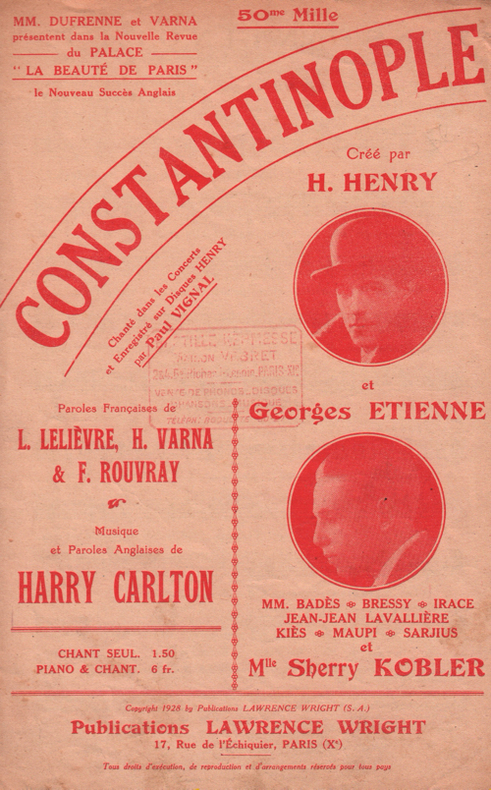
Kobler Cherry,Etienne George,Henry H. - Carlton Harry - Varna Henri,Lelièvre Léo,Rouvray Fernand
Partition de la chanson : Constantinople
Partitions sur la Turquie Wright Laurence 1928
Référence libraire : 84027
|
|
|
KOCA HÜSREV MEHMED PASHA, (Ottoman admiral, reformer and statesman, who was Kapudan Pasha ("Grand Admiral") of the Ottoman Navy), (1769-1855).
[FIRST ARMY of MODERNIZATION PERIOD - ASÂKIR-I MANSÛRE-I MUHAMMEDIYE] [Autograph letter sealed 'Hüsrev Mehmed' addressed to Serkâtib of Humayûn sealed 'Mustafa Nuri'].
Very Good Turkish, Ottoman (1500-1928) Original manuscript autograph handwritten document sealed 'Hüsrev Mehmed' sent to (and responded by) Serkâtib Mustafa. Written in special paper with 'ahar'. 39x21 cm. In Ottoman script. Slightly tear on folded place and slightly stains. Otherwise a very good manuscript paper. The document was written in accordance with the Ottoman state correspondence tradition prior to modernization. However, it is an indication of modernization that it is written to the serkâtib of Humâyûn (head clerk of the Ottoman / Turkish court) and not to the Sultan directly. The importance of this document is that it has many hints of modernization movements of the last period of Empire, depiction of the division of the first modern Ottoman army (Asakir-i Mansure-i Muhammediye) that's before one year of Egyptian Campaign by Koca Husrev Pasha and before eight years of proclamation of Reform (Tanzimat) and after only 22 years of Turkish Magna Carta (Sened-i Ittifak). Husrev Pasha was 'serasker' (commandant and head) of Assakir-i Mansure-i Muhammediye Army in that year. Husrev's text starts as 'Devletlü, inayetlü, atufetlü, oglum.." in 'Elqab'. In the Ottoman diplomacy, first person who used 'oglum' [i.e. my son] in elqab of the documents was Koca Hüsrev Pasha. (Source: Osmanli Arsiv Belgeleri, Orhan Sakin). Koca Hüsrev Pasha (Khosrew Pasha) was an Ottoman Kapudan Pasha ("Grand Admiral") of the Ottoman Navy and statesman who reached the position of Grand Vizier rather late in his career, between 2 July 1839 and 8 June 1840 in the reign of Abdülmecid I. However, during the 1820s, he occupied key administrative roles in the fight against regional warlords, the reformation of the army, and the reformation of Turkish attire. In 1801, Hüsrev Pasha commanded the 6,000 Ottoman troops who assisted the British in removing the French from Rashid (Rosetta). For this, he was made governor of Egypt Eyalet (province), in which position he was charged with assisting Hüseyin Pasha in the killing or imprisoning the surviving leaders of the Mamluks. Many of these were freed by or fled with the British, while others held Minia between Upper and Lower Egypt. [.] He was later made governor again by Muhammad Ali for 2 days [.] After Diyarbekir and Salonica, in 1806 he was governor of Bosnia Eyalet, before being reappointed as governor of Salonica in 1808. Hüsrev Pasha held the rank of Kapudan Pasha of the Ottoman Navy from 1811 to 1818. He was then appointed governor of the Eyalet of Trabzon twice, during which time he conducted for the Black Sea region of Turkey the struggle the central Ottoman state was waging against local feudal rulers (Derebeys). During the Greek War of Independence, he was appointed Kapudan Pasha again in the end of 1822. In 1826, Husrev Pasha played vital roles both in the Auspicious Incident (the annihilation of the Janissary Corps in 1826) and in the formation of the new "Mansure Army" modeled after those of European Powers. Appointed as seraskier (commander the army) of the Mansure in May 1827, Husrev reformed and disciplined the corps. Himself ignorant of modern military methods, he assembled a staff of foreign experts and other personnel to assist him, the "Seraskeriye", which constituted the first staff in Ottoman history. Due to his early championing of military reform and virtual control over the new Ottoman army, Husrev was able to install many of his protégés in senior military positions. Husrev Pasha was also instrumental for the near-abandonment of the turban and the adoption of the fez as a universal headgear for Muslim men of the Ottoman Empire (excluding the religious classes) under Sultan Mahmud II. (Wikipedia). Möltke talks about him in famous book includes his personal letters as 'he is more powerful than sultan'. Following the suppression of the Janissaries in 1826, Sultan Mahmud II transferred the functions of the old Agha of the Janissaries to the seraskier.
|
|
|
KODAMAN Bayram
Les ambassades de Moustapha Réchid Pacha à Paris.
Ankara, Imprimerie de la Société Turque d'Histoire, 1991. 16 x 24, 207 pp., broché, bon état.
Référence libraire : 84358
|
|
|
Kondis, Basil
Greece and Albania. 1908-1914 (=Institute for Balkan Studies ; No 167) (=Zugl.: New York, Diss.)
Thessaloniki, Inst. for Balkan Studies, 1976. original cloth binding, gr.-8?, 151 pages, Includes index ; a very good copy
Référence libraire : GC10-470

|
|
|
KONRAD, Alexander N.
Old Russia and Byzantium. The Byzantine and Oriental Origins of Russian Culture.
8vo, 390pp ills. card covers, Ex lib. but perfect. russia e bisanzio
|
|
|
KONSTANDINOS PANDAZOGLU.
Sartroupolis: La Communaute Grecque de Sartrouville originaire majoritairement d'Asie Mineure.
New English Paperback. Pbo. Roy. 8vo. (24 x 17 cm). In French. 368 p. Contents: Préface. Introduction. Remerciement. 1. Rappel historique de la migration en France et son incidence sur la création de la communauté grecque de Sartrouville. 2. Répartition géographique dans les différents quartiers de la ville. 3. L'Union des Grecs de Sartrouville (U.G.S.) 1936-1940 et A.G.O.G.Y. L'entre aide. 4. Les professions. 5. Grecs figurants dans les annuaires et les bottins. 6. Les relations amicales. 7. Les représentations théâtrales. 8. Langues parlées par les Grecs de Sartrouville. 9. Les mariages Les mariages mixtes Les célibataires. 10. Les joueurs. 11. L'opinion politique. 12. La vie hors du commun de quelques Grecs de Sartrouville. 13. La première école grecque (1936-1940).14. Les bombardements de la Pentecôte 1944. 15. L'école grecque de la libération à nos jours . 16. La création du "Yérokomeio" et de notre église" L'Eglise de la Présentation du Sauveur au Temple". 17. La carte d'identité. 18. L'intégration. 19. Androniki Gounaris, ma mère. 20. L'Annuaire des Grecs de Sartrouville. 1. Les Grecs classés par région d'origine. 2. Grecs venus d'Allemagne. 3. Les surnoms et changements de noms. 21. Les Grecs du Foyer Hellénique classés par 1. Ordre alphabétique 2. Région d'origine Conclusion Glossaire Bibliographie Listes des Photos Le Kaléidoscope de Sartroupolis.
|
|
|
KONSTANTIN MIHAILOVIÇ.
Bir Yeniçerinin hatiralari. [= Memories d'un Jannissarie]. Translated by Nuri Fudayl Kiciroglu, Behiç Anil Ekin.
Fine Turkish Paperback. Roy. 8vo. (24 x 16 cm). In Turkish. 135, [1] p. Bir Yeniçerinin hatiralari. [= Memories d'un Jannissarie]. Translated by Nuri Fudayl Kiciroglu, Behiç Anil Ekin.
|
|
|
KONSTANTINOU RAMFOU [KONSTANTINOS RAMFOS, or, RAMPHOS], (1776-1871).
[TEPEDELENLIS: EARLY APPEARANCE OF ALI PASHA IN A GREEK HISTORICAL NOVEL] Ai teleutaiai imerai tou Ali-Pasa.
Very Good Greek, Modern (post 1453) Original half morocco with four raised bands to gilt spine. Second compartment has title 'Ali Pasha' in Greek. All edges marbled. Text block slightly stained. A clean copy, with minimal wear on extremities of boards and spine, with no restorations of any kind. Marbled end-papers. Demy 8vo. (21 x 14 cm). In Greek (Modern). 272 p., engraved portrait of Ali Pasha on frontispiece. This historical novel is written by Konstantinos Ramfos (1776-1871) and published in 1862, "accompanied by a new articulation of the enunciative and denotative position", is one of the most interesting cases of intertextuality in MG prose-fiction. Constantinos Ramphos was originally from Chios, he devoted himself to trade, was a member of the Hétairie, and took part in the fights of the Greek war of independence before participating in the politics of his country. He was a diplomat, and then a journalist, from 1860 he began to publish stories devoted to the heroes of the insurrection, Katsandonis, "Despot l'Epirote", Ali Pasha for example, and the most famous Halet Efendi. He mixed in his novels realism, dreams, patriotism against a historical background. Ali Pasha of Ioannina [or, Tepedelenli Ali Pasa, Tepelena or of Janina, the Lion of Yannina], (1740-1822), was an Ottoman Albanian ruler who served as pasha of a large part of western Rumelia, the Ottoman Empire's European territories, which was referred to as the Pashalik of Yanina. His court was in Ioannina, and the territory he governed incorporated most of Epirus and the western parts of Thessaly and Greek Macedonia. Ali had three sons: Muhtar Pasha, who served in the 1809 war against the Russians, Veli Pasha, who became Pasha of the Morea Eyalet and Salih Pasha, governor of Vlore. Ali first appears in historical accounts as the leader of a band of brigands who became involved in many confrontations with Ottoman state officials in Albania and Epirus. He joined the administrative-military apparatus of the Ottoman Empire, holding various posts until 1788 when he was appointed Pasha, ruler of the sanjak of Ioannina. His diplomatic and administrative skills, his interest in modernist ideas and concepts, his popular piety, his religious neutrality, his suppression of banditry, his vengefulness and harshness [.] Western writers and poets such as Alexander Dumas, Lord Byron were inspired and influenced by Ali Pasha in their works. Only two copies located in OCLC 835283685 (Institut français d'études Byzantines and Sorbonne Université). A fine printing and a very early "historical novel" example in the Greek literature. First Edition. Very scarce.
|
|
|
KONTENTE (Léon)
Smyrne et l'Occident. De l'Antiquité au XXIe siècle. Nouvelle édition revue et augmentée.
In-8, broché, couverture illustrée, 917 p., carte, statisiques, index, "Smyrne (Izmir) est une ville située en Turquie, sur la mer Egée. Comme beaucoup de ports méditerranéens, Alexandrie, Livourne ou Marseille, elle a connu de multiples mutations, sociales, économiques, linguistiques et culturelles. Cité grecque avant d’être un port romain, elle est devenue une forteresse byzantine, puis une ville ottomane. Terminus de la caravane d’Iran au XVIIe siècle elle deviendra un port d’exportation de produits agricoles un siècle plus tard, pour devenir au XIXe siècle la ville la plus dynamique de l’Empire ottoman. C’est à Smyrne que verra le jour la presse ottomane ainsi que la première ligne de chemin de fer de l’Empire. Smyrne est par ailleurs un des plus intéressants exemples de la cohabitation pluri-ethnique des villes ottomanes. Cet ouvrage est avant tout une histoire de Smyrne par rapport à l’Occident. Cette ville qui entretiendra toujours des relations privilégiées avec l’Occident et deviendra la ville cosmopolite où cohabiteront Turcs, Grecs, Juifs, Arméniens et Levantins. Le but de ce livre est aussi d’offrir une trame chronologique ; c’est une histoire "continue" depuis l’Antiquité jusqu’à la période contemporaine ayant pour objectif de faire apparaître sur la durée, les évolutions, les ruptures, les changements, les renaissances multiples, et surtout mettre en exergue le surprenant potentiel d’adaptation de cette ville aux multiples facettes" (Note de l'éditeur). Exemplaire neuf.
|
|
|
KONTENTE (Léon)
Smyrne et l'Occident. De l'Antiquité au XXIe siècle. Nouvelle édition revue et augmentée.
In-8, broché, couverture illustrée, 917 p., carte, statisiques, index, Montigny-le-Bretonneux,Yvelinédition, 2007.
Référence libraire : 35276
|
|
|
Konuk Kader
East West Mimesis: Auerbach in Turkey
8vo, pp. xiv-300.
|
|
|
KONYA PROVINCE MEDICAL INSPECTORATE.
[MANUSCRIPT] [Ottoman Prokopi / Ürgüp - Avanos expedition for a sanitary report] Konya Sihhiye Müfettisligi'nin 16 Tesrinievvel 1327 tarihli mezkûr müfettislige takdim olunan rapordur ki 327 senesi Ürgüp'te zuhur eden koleraya dairdir.; Vilâyetin topografya-yi sihhiye ve harita-yi sihhiyesi.
Very Good Turkish, Ottoman (1500-1928) Original registry book in its original grey art nouveau cloth. All edges marbled. 'The English manufactory of book and register' written on end-papers. 'Zugologion' written in Greek letters on front cover. Slightly faded. A fine copy. Demy 8vo. (22 x 15 cm). In Ottoman script. 52 p. is written of which apprx. 200 p., but it's finished and complete; one folding hand-drawn color map, and 3 tables. [MANUSCRIPT] [Ottoman Prokopi sanitary report] Konya Sihhiye Müfettisligi'nin 16 Tesrinievvel 1327 tarihli mezkûr müfettislige takdim olunan rapordur ki 327 senesi Ürgüp'te zuhur eden koleraya dairdir.; Vilâyetin topografya-yi sihhiye ve harita-yi sihhiyesi. The report on the cholera occurring in Ürgüp in 1910, which was presented to the Inspectorate of Konya Sihhiye on October 16, 1910. Besides cholera, it contains information about diseases such as measles. 1329 (Hegira) written at the end of first 10-paged report. The second part contains title: Mecelle-i Memâlik-i Osmaniye'ye ait minvallere cevabât yazilarak Üsküp Kaymakamligi'na takdim olunan 'Müslüman Sihhiye' raporu [= Muslim health report submitted to the Ürgüp (Prokopi) District Governor]. This and following next chapters include general health and sanity registers on epidemics like 'frengi' (syphilis, pox), all kinds of 'humma' (pyrexia) and several others (almost more 15 titles) and give information about how often diseases are encountered in the region of Prokopi and Cappadocia. One folded map which is hand-drawn includes color markers as 'Ürgüp Bölgesi saglik haritasi' [= Prokopi region sanity and epidemic map]. Also it shows demographic and historical info about region. There are 3 statistical tables contain demographic, historical, religious info such 'Muslim' and 'Non-Muslim'. Maps and tables are perfectly drawn. Another chapter is 'Usul-i sihhiye', has all epidemics and their historical and demographic contexts, their cures etc. Book was written in a very nice hand-writing. Used black, blue, and red inks. Report was not published before such as that. Roumi: 1327 = Gregorian: 1910. The Ottoman land represented a bridge between Asia and Europe, which was destroyed by epidemic diseases that emerged in different periods. In the 19th century, the main source of epidemic was the cholera morbus that emerged in India in the lower Bengal delta between the Ganges and Brahmaputra rivers. At the beginning of the 19th century, the disease became a global threat. Cholera epidemic appeared for the first time in the Ottoman territory in 1822, and continued to emerge into intermediate outbreaks. Due to its geographical location, the cholera epidemic was easily spread to the Ottoman territory and caused great losses in the 19th century, when it became a global threat. At the beginning of the 20th century, still cholera was a serious problem. Prokopi is a settlement in Central Asia Minor, built on a plateau at an altitude of 1,200 m above sea level. It lies near the confluence of four tributary rivers of the Alys River (Kizilirmak), which flows to the north of Ürgüp, within about 10 km from the settlement. It has been claimed that the word Ürgüp is the Turkish version of the Greek name Prokopi. The latter is supposed to refer to St. Prokopios, although there is no evidence suggesting the existence of a namesake church. Levidis supported that the ancient name of the settlement was Osiana, which the traveller Texier (Charles) adopted as well. Ürgüp was inhabited by Muslims, Turkish-speaking Greek-Orthodox and some Armenians. Several conflicting opinions have been stated about the population. Farasopoulos talks about 15,000 Muslims and 5,000 Christians. According to an inventory carried out by the state in 1919, Ürgüp was inhabited by 12,500 Muslims, 6,000 Christian-Orthodox and 15-20 Armenian families.
|
|
|

 Recevoir par e-mail
 Télécharger en PDF
 Flux RSS
 Lien permanent


