67 651 résultats
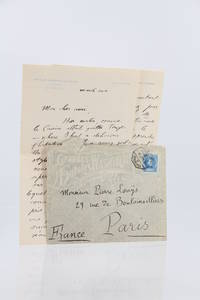
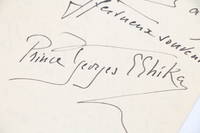
1944réf. 87922Paris 1944. Fine. Paris s.d. ca 1944 13.50 x 18 cm deux pages et demi sur un bifeuillet Autograph letter signed by Prince Georges Ghilka 31 lines in black ink on a double sheet with letterhead from the Majestic Hotel in Paris probably addressed to René-Louis Doyon who devoted in 1944 a biography to Isabelle Eberhardt entitled ""Au pays des sables Isabelle Eberhardt"". Fold mark inherent to the mailing. Prince Georges from the House of Ghika a princely family of Romania of Albanian origin married in Paris in 1910 the most famous Amazon of All Paris Liane de Pougy. René-Louis Doyon sent his work to his friend the prince who thanks him for it: ""Nous avons lu votre livre et c'était délicieux comme une causerie avec vous une causerie qui emporte dans ces pays aimés du soleil et d'Isbelle Eberhardt que vous vous plûtes à citer. Merci encore pour ce grand plaisir que vous nous avez donné."" We read your book and it was delightful like a conversation with you a conversation that carries one away to those beloved lands of sun and of Isabelle Eberhardt whom you took pleasure in quoting. Thank you again for this great pleasure you have given us. unknown
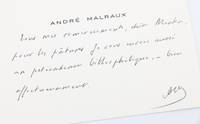
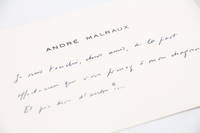
1973réf. 87973s. l.: s. n. 1973. Fine. s. n. s. l. 1973 13.50 x 9 cm une feuille Printed visiting card signed by André Malraux to which he has added in black ballpoint pen these few words for his friend Minka Strauss: ""All my thanks dear Minka for the pastries. I am also sending you a small bibliophilic gift. Most affectionately."" s. n. unknown
1974réf. 87999s. l.: s. n. 1974. Fine. s. n. s. l. 27 Novembre 1974 15 x 10 cm une feuille Manuscript postcard enhanced with André Malraux's signature written from Bombay to their friends Minka and Karl Hans Strauss 13 lines in blue ballpoint pen. The postcard shows a reproduction of Hindu sculpture. ""Chers amis que c'était beau ! Nous vous embrassons affectueusement Sophie."" ""Dear friends how beautiful it was! We embrace you affectionately Sophie."" Separated from his wife Madeleine at the end of the 1960s André Malraux began a second relationship with the writer Louise de Vilmorin and moved in with her at the Vilmorin château in Verrières-le-Buisson. After her death on December 26 1969 André Malraux continued to live at the château with Louise's niece Sophie de Vilmorin who became his last companion and cared for him until his death on November 23 1976. s. n. unknown
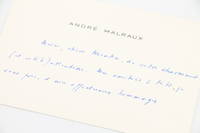
1973réf. 87972s. l.: s. n. 1973. Fine. s. n. s. l. 1973 13.50 x 9 cm une feuille Printed visiting card on which André Malraux has added in blue ballpoint pen these few words for his friend Minka Strauss: ""Thank you dear Minka for your charming and useful attention. My regards to K.H. I beg you and my affectionate respects."" s. n. unknown
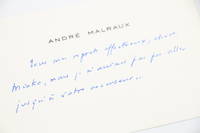
1974réf. 88006s. l.: s. n. 1974. Fine. s. n. s. l. s.d. ca 1974 13.50 x 8.50 cm une feuille Printed visiting card of André Malraux on which he added these few words for his friend Minka Strauss: ""All my affectionate regrets dear Minka but I could not have made it to your elevator."" Handsome copy. s. n. unknown
1953réf. 88024Saint-Jean-Cap-Ferrat 1953. Fine. Saint-Jean-Cap-Ferrat 29 Août 1953 21 x 27 cm une page Autograph letter dated and signed by Jean Cocteau 26 lines in blue ink to Olivier Quéant editor of the magazine Plaisir de France sent from villa Santo-Sospir. Fold marks inherent to postal handling. Quéant journalist and notably editor of the magazine Plaisir de France maintained a fine friendly and literary correspondence with the writer. He notably delivered a glowing review of Antigone at its premiere in 1944: ""depuis Racine l'on avait rien écrit d'aussi beau d'aussi grand et d'aussi profondément humain"" since Racine nothing so beautiful so great and so profoundly human had been written L'Illustration. Jean Cocteau at the twilight of his life rebels and complains about his diminished and merely symbolic role in French theater of the 1950s. The second sentence of this letter will be taken up almost word for word in the famous verses of his longest poem Requiem 1962: ""Il est juste qu'on m'envisage / Après m'avoir dévisagé"" It is right that I should be considered / After having been stared at which will also serve as his epitaph. Despite official recognition Cocteau felt until his death ""méconnu inconnu invisible"" misunderstood unknown invisible Jean Cocteau sur le fil du siècle 2003 - a malaise masterfully expressed through these lines. ""Voilà plusieurs années que j'accepte d'être en secret mis à ma place et publiquement remis à ma place. Bref de n'être pas envisagé mais dévisagé. Il est beau de recevoir des lettres ""retournées"" où Anouilh me dit ""Sans vos pièces je n'aurais pas écrit une ligne des miennes"" et Giraudoux ""Rilke avait raison. Nos figures blanches à côté du hâle de tes séjours dans l'antiquité."" Il est beau d'être comme le Pisanelle - enterré sous les roses ."" For several years I have accepted being secretly put in my place and publicly put back in my place. In short not being considered but stared at. It is beautiful to receive ""returned"" letters where Anouilh tells me ""Without your plays I would not have written a line of mine"" and Giraudoux ""Rilke was right. Our pale faces beside the tan of your sojourns in antiquity."" It is beautiful to be like Pisanello - buried under roses . Interesting and touching missive from Cocteau with disordered and furious handwriting twisting and stretching in the manner of a calligram. unknown
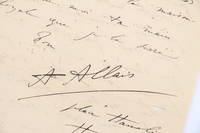
1895réf. 88099Honfleur: s. n. 1895. Fine. s. n. Honfleur s.d. ca 1895 14 x 22 cm une page recto verso Autograph letter signed addressed to a journalist friend at Figaro illustré 28 lines in black ink. Fold mark inherent to envelope insertion a lack to upper corner of the letter without any damage to the text. Alphonse Allais must do a favor for his friend: ""Un peu de patience mon cher Abel un peu de patience. Sitôt rentré à Paris ma première démarche sera pour ton parapluie que je choisirai en soir gorge-pigeon et manche d'argent."" A little patience my dear Abel a little patience. As soon as I return to Paris my first errand will be for your umbrella which I will choose in pigeon-throat evening silk with a silver handle.; he therefore also allows himself to solicit the kindness of his correspondent: ""Et bien envoie-moi le n° du Figaro illustré d'il y a un mois ou deux où il y avait des choses de Toulouse-Lautrec."" Well then send me the issue of Figaro illustré from a month or two ago where there were things by Toulouse-Lautrec. He concludes his letter with a sententious: ""Donne-moi ta main loyale que je la serre. Ton Alphonse Allais. Bonjour aux amis."" Give me your loyal hand so I may shake it. Your Alphonse Allais. Greetings to friends. s. n. unknown
1973réf. 88071s. l.: s. n. 1973. Fine. s. n. s. l. 1973 13.50 x 9 cm une feuille Printed calling card on which André Malraux added in blue ballpoint pen these few words for his friends Minka and Karl Hans Strauss: ""I am touched dear friends by the affectionate part you take in my grief. And what else is there to say."" Â s. n. unknown
1913réf. 88289Londres 1913. Fine. It is no longer a question of conquering the world; but of pacifying it. Work let us work together for world peace. Londres 12 décembre 1913 20 x 25.50 cm en feuillets Complete autograph manuscript in French by Anatole France 7 pages in black ink on 7 leaves and a signed autograph note on a bifolium. Complete and extensively corrected speech by Anatole France on the occasion of a banquet given in his honor in London. The future Nobel Prize winner for Literature delivers a passionate appeal for peace between nations and an ode to England - its philosophy literature and politics - less than a year before WW1. The writer offered this manuscript with a signed note: Keep dear colleague and friend keep these leaves of paper if they are of any value to you. Anatole France London December 12 1913. Anatole France's English biographer witnessed this speech which foreshadowed the absolute necessity of a close relationship between France and England based on their long and rich relationship: ""In December 1913 the Master paid a brief but memorable visit to this country. The central event of his sojourn in London was the banquet given in his honour at the Savoy Hotel. On this occasion it was apparently decided in those remote and exalted circles where such decisions are made that the socialist should be ignored his turn was to come later with the Fabians but that honour could and should be paid to the man of genius the foremost man of letters of the day. The feast was therefore presided over by a peer the late Lord Redesdale himself a gifted writer. The company was numerous and distinguished. . Monsieur France though an inimitable talker is not a speaker and on this occasion he read his discourse. All that I now remember of it was the rich deliberate music of the voice that uttered it and the words which he repeated with strange insistency: 'Travaillons de concert a la paix du monde''Let us work together for the peace of the world.' This was in December 1913. The exhortation thus reiterated seemed even then to be fraught with ominous significance and now looking back over the years of horror that were so soon to follow one wonders whether this old man with his strange inscrutable eyes and musical melancholy voice had somehow seen the shadow of the coming catastrophe."" J. Lewis May Anatole France the man and his work: an essay in critical biography p. 98-99. The manuscript contains numerous crossed-out and rewritten passages and shows the genesis of the writing of this beautiful speech: M.M. I am not sure that I am not dreaming. Welcomed with this splendid cordiality by so many men whose names works and thoughts represent so much greatness strength and beauty. . Your compatriots have authored masterpieces of this kind for two centuries. Need I remind you of Richardson and Fielding Swift and Daniel Defoe Walter Scott Dickens and Thackeray George Elliott . the novel is in England in its favorite soil like the apple in Normandy and the orange in Valencia. Why It takes a large volume or a single word to explain it. Well let's say it in a word. This word Lord Redesdale gave us a foretaste of it. It is that the novel is intimate cordial and familiar by nature and that the English has a familiar intimate and cordial spirit. Gentlemen I am not dreaming: it is a banquet I see the shining cups and the benevolent faces of the guests. And I can understand why you invited me. I am a symbol an allegory for you. I represent at this table the French literati just as at the festivals of the French Revolution the citizen Momoro represented the goddess Reason. Without being a goddess or particularly reasonable this idea puts me at ease and I won't quibble too much with you about the choice of your symbol. I tell myself that perhaps you didn't mind having a Frenchman at your table who having the weakness to write at least had the merit which you greatly value of never d unknown
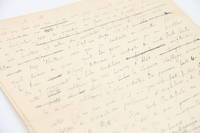
1948réf. 873581948. Fine. « A Londres pour la première fois des possibilités d'accord sont apparues pour les problèmes allemands même sur les Réparations. » In London for the first time possibilities for agreement have appeared on German problems even on Reparations. s. d. 1948 21 x 27 cm quatre feuillets Signed autograph manuscript entitled ""A Compiègne et au Palais Bourbon"" by Léon Blum 3 and a half pages in blue ink on the verso of four sheets with letterhead from the newspaper Le Populaire Central Organ of the Socialist Party S.F.I.O. Numerous passages crossed out and rewritten in black ink. Horizontal fold mark on each sheet notes from a previous bibliographer in pencil at the head of the first sheet. The article appeared in the daily newspaper Le Populaire on March 9 1948. Fine and virulent diatribe by Léon Blum following General De Gaulle's Compiègne speech denouncing his maneuvers toward a ""strong State."" He paints a hopeful picture of German reconciliation European construction as well as the Marshall Plan soon to be ratified - of which he had been the great negotiator. On March 7 1948 the general who had just founded the Rally of the French People was invited by the new mayor Jean Legendre who had rallied to the RPF. At a pivotal moment of international tensions before several tens of thousands of people gathered at the château square De Gaulle called on the French to unite to refound the Fourth Republic and free countries to unite against communism following the ""Prague coup."" Remaining excluded from power he then began his crossing of the desert until his return in 1958 thanks to the Algerian crisis which brought down the weak Fourth Republic. Having established the foundations of this same Republic Blum disapproves in these pages of De Gaulle's challenge to parliamentary institutions - even as his own Gaullists deputies obstruct debates in the assembly. He opposes the general's catastrophist discourse with an optimistic vision of European and international reconstruction convinced of the great resilience of the French nation and confident in its institutions. « Chose curieuse c'est la presse gaulliste qui attendait le discours de Compiègne avec la curiosité et l'impatience la plus marquées. . En fin de compte le discours de Compiègne n'a apporté rien de neuf. Il a fait entendre que toutes ses mesures étaient arrêtées et que sans doute aussi ses hommes étaient choisis. Il a déclaré que la situation était trop critique en France en Europe et dans le monde pour permettre qu'on différât davantage. Mais il a persisté cependant à affirmer - c'est du moins ainsi que j'interprète un texte volontairement obscur biffé : ambigu - qu'il ne gouvernerait pas dans le cadre des institutions présentes biffé : anciennes et qu'il n'accepterait qu'un pouvoir taillé à sa mesure . Rien de bon ne peut en sortir a-t-il conclu ; il n'est que temps de tirer la France de ce marécage pour l'installer sur le sol ferme et salubre de l'Etat fort. Tout cela va fort bien. Seulement à l'heure même où le général prononçait contre les partis et les institutions parlementaires le réquisitoire altier l'Assemblée nationale siégeait au Palais Bourbon. Elle promouvait l'examen des propositions relatives au prélèvement René Mayer. Et là on voyait la coalition du parti gaulliste avec ces mêmes « séparatistes » que le discours de Compiègne dénonçait comme des traîtres s'étaler avec une impudence plus scandaleuse de jamais . Dénoncer l'impuissance parlementaire tout en l'organisant stigmatiser la malfaisance et l'immoralité des partis tout en en fournissant l'exemple éhonté c'est une attitude commode mais qui brave par trop violemment le bon sens et l'honnêteté. . Certes la situation intérieure est sérieuse et la situation internationale ne l'est pas moins. Mais le redoutable hiver s'achève le ravitaillement s'améliore. La tendance s'améliore vers la baisse des produits alimentaires s'accentue et s'acce unknown
1908réf. 86215Grenade Granada 1908. Fine. Grenade Granada 1908 20.50 x 27 cm huit pages sur deux doubles feuillets une enveloppe Humorous autograph letter signed by Claude Farrère then on a Mediterranean cruise and posted from the Hotel Washington Irving in Granada 8 pages on two double sheets in which he notably recounts his exploits with the fairer sex. Fold marks inherent to postal handling envelope included. Claude Farrère leaving Tangier for Granada via Gibraltar humorously narrates his latest feminine conquest and his rivalry with another suitor: ""Yesterday morning as the Cassini was about to leave Tangier - where I had a delicious flirtation with a young girl!! . We spotted a human being on the quarterdeck. which human being was screaming like a suckling pig caught by the tail in a door. It was my successor. Suppose this good man had had less powerful lungs: we would not have heard him."" He thanks Pierre Louÿs for his latest letter to which he hastens to respond: ""I picked up your letter yesterday. And you see I don't wait twenty-four hours to answer you. I note indeed that as soon as one is away more than fifteen days all conversation becomes impossible. Judge for yourself!!!"" while clarifying things about the too numerous women he has seduced to the point that Pierre Louÿs can no longer keep track: ""I would have sworn on my life that I had narrated to you in detail my adventure with Mlle M.; I must have searched a good hour in my memories for what the initials CG could represent!!! That's where we stand. It's maddening."" But Claude Farrère sometimes exposes himself to the risks of his abundant sentimental victories and ironically boasts of his setbacks: ""M.M. possesses about twenty letters from me. at least one that I remember and which is a profession of sadism. I no longer sleep. Trust pretty flirtatious persons after that who write you delicate horrors to procure prose for posthumous publication!!!"" He also details for him in a playful and epic manner his last evening aboard the Cassini and the marks of sympathy he received: ""My departure from the Cassini was the most perfectly grotesque thing on earth and even of the five oceans. Toasts effusions feasts. R. solemnly informs me that I am 'warmly' proposed for the cross by him and the admiral. I who knew it classic and profound stupefaction. Thereupon the launch comes alongside my suitcases embark I follow them. the crew had been sleeping for two hours theoretically. But barely does the launch push off savage howling clamors vivats hurrahs. Without saying anything all these good people had patiently waited for it to be time to shout. Naturally I began to cry. Finally total idiocy."" He concludes this missive by enumerating the Andalusian cities he will visit: ""I leave the day after tomorrow for Seville then Córdoba and Toledo."" unknown
1908réf. 86173Toulon 1908. Fine. Toulon 20 Juillet 1908 13.50 x 21.50 cm deux pages et demie sur un double feuillet une enveloppe Autograph letter signed by Claude Farrère then serving in the military 47 lines in blue ink written from Toulon to his friend Pierre Louÿs. Fold marks inherent to mailing envelope included. The soldier Claude Farrère thanks his friend for defending him during a dispute opposing him to a certain Monsieur B even though it was hardly worth devoting so much importance to him: ""Monsieur B read in some Annales that his fierce enemy was busy waging war in Safi against the Muslims. By incredible misfortune it happened that I had returned from there. His stupor was then so great that he lost his head."" ""Now I will never tell you to what extent I was moved by your role and by V.'s role in the whole affair."" Confident in his qualities as a fencer and marksman Claude Farrère allows himself this gentle and humorous jibe at his friend and seeks to reassure him at the risk of falling into anachronism: ""Lose the disastrous habit of seeing me killed each time someone speaks of swords around. On the contrary it is I who will kill the others. I do a great deal of fencing now. And I shoot the pistol like the late William Tell. Therefore be quiet. There. When shall we meet"" unknown
1905réf. 86168s. l. 1905. Fine. s. l. s. d. ca 1905 11.50 x 18 cm 5 pages sur un double feuillet Autograph letter signed by Maurice Leblanc to a friend from Rouen named Louis asking him to perform several services as he lacks the time to handle them himself. Maurice Leblanc entrusts his friend with two commissions: first to collect some furniture reserved by one of his friends at an antique dealer's: ""Go to a man named Chassaigne antique dealer 20 rue St Romain.He sold 6 chairs to the Prats two months ago. . apparently he refused to accept a deposit. No response. Let him say frankly that he has sold everything. The bench was for me 40 francs and I would very much like to have it."" the second concerning an administrative matter: ""Go to the registry of the civil court. and request an extract of my birth certificate and an extract of my parents' death certificates. It's for a marriage."" unknown
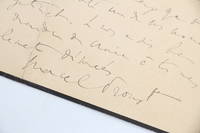
1908réf. 86094s. l. 1908. Fine. Proust and the future of pastiche: ""it seems to me that it could perhaps become a more discreet more fragile and more elegant form of literary criticism"" s. l. s. d. 1908 ou 1919 11.60 x 17.80 cm 4 pages sur un feuillet remplié Autograph letter signed by Marcel Proust to his friend Maurice de Fleury a psychiatrist and famed man of letters close to Émile Zola who wrote a collection of short stories as well as various medical works on neurasthenia insomnia epilepsy Chiara Carraro Philip Kolb. Four pages written in black on a bifolium with ""Island Mill"" watermark and framed in black. Usual traces of folds. Published in Kolb VIII no. 32 p. 74-75. Superb letter extolling the merits of literary pastiche by one of the greatest writers of the genre: Marcel Proust. The writing of this letter may coincide with the publication of Proust's series of pastiches on the Lemoine Affair a scam set up by a French engineer of that name who claimed to be able to make genuine diamonds. The articles were printed on the front page of the literary supplement of 'Le Figaro' between 1908 and 1909 or date from its publication in volume under the title 'Pastiches et mélanges' in 1919. The autograph letter is presented in a midnight blue half morocco chemise with marbled paper boards beige suede lined pastedowns and a slipcase edged with the same morocco. Proust warmly thanks his correspondent Maurice de Fleury whom he describes as a ""scholar and writer"" for his favorable reception of his ""little pastiches"": ""Your double merit should make you doubly severe: and you excuse pastiche that inferior genre!"" Votre double mérite devrait vous rendre doublement sévère : et vous excusez le pastiche ce genre inférieur ! acknowledging with irony the still precarious place of this unusual genre although popular during Proust's lifetime. Pastiche was perceived more as a stylistic musing or even a student exercise than a true creation worthy of literary praise. Yet here the writer considers it here a refreshing addition to the strict hierarchy of genres that still prevailed: ""Handled however by your hands more beautiful than mine it seems to me that it could perhaps become a more discreet more fragile and more elegant form of literary criticism. Very proud minds could devote themselves to it and very fine minds like yours very attached to greatness seriousness duty as wise could take pleasure in it and follow these games."" Manié pourtant par vos mains plus belles que les miennes il me semble qu'il pourrait peut-être devenir comme une forme indirecte plus discrète plus frêle et plus élégante de critique littéraire. Des esprits très fiers pourraient s'y adonner et des esprits très fins. comme le vôtre très attraché par la grandeur le sérieux le devoir aussi sage pourrait s'y plaire suivre ces jeux. With these words Proust asserts the interest of 'critical pastiche' which was already well established and acted as an empirical analysis of an author's style. Since his years as a student in Condorcet the writer had regularly indulged in this activity with according to him varying degrees of success: ""I have also sometimes made pastiches of medical literature! these writings are now lost If I could have found them again or started them again but all that is too far away I would have published them if I had known that you read this for fun. I don't need to tell you that considered inimitable you are not among the authors I pastiched. But . others are less perfect and combined some very interesting qualities with small flaws that could be imitated and caricatured."" J'ai été aussi quelques fois à faire des pastiches de littérature médicale ! Si j'avais pu les retrouver ou les recommencer mais tout cela est trop loin je les aurais publiés si j'avais su que vous lisiez cela pour vous amuser. Je n'ai pas besoin de vous dire que jugé inimitable vous n'y figurez pas. Mais . d'autres sont moins parf hardcover
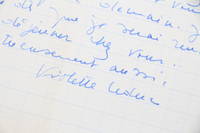
1956réf. 86293Saint-Cirq-Lapopie 1956. Fine. Saint-Cirq-Lapopie s. d. ca 1956 13 x 21 cm une page et demie sur un feuillet Autograph letter signed by Violette Leduc addressed to Adriana probably Adriana Salem 21 lines in blue ink. Folding inherent to mailing and small marginal lacks due to removal of the sheet. Thank-you letter sent from her Versailles home: ""J'ai bien reçu la boîte de gâteaux merci de tout mon coeur comme c'est gentil."" ""I received the box of cakes thank you with all my heart how kind."" Violette Leduc being mentally ill she informs her correspondent of her medical treatment program: ""Simone de Beauvoir m'emmenera à la Vallée aux Loups dans la clinique du Dr Le Savoureux mais Diatkine me reverra avant ici c'est long enfin si j'en sors ! "" ""Simone de Beauvoir will take me to Vallée aux Loups to Dr Le Savoureux's clinic but Diatkine will see me again before that here it's long finally if I get out of it!"" and asks for her news. Adriana Salem was the daughter of Frederic Gentili di Giuseppe representative of the Italian Minister of Finance in Paris and great collector of Italian Renaissance paintings. unknown
1925réf. 86356s. l.: S. n. 1925. Fine. S. n. s. l. 25 Novembre 1925 14.50 x 19.50 cm 2 pages sur un feuillet Autograph letter dated and signed by Henri Barbusse addressed to a female friend 32 lines written in black ink from the steamship Vaporul Regele Caroli. Folds inherent to mailing letterhead paper of the Romanian maritime services and the Vaporul Regele Caroli. While on a cruise from Constanza to Constantinople Henri Barbusse languishes in the absence of the woman he loves: ""Pendant tout le voyage qui en est à peu près à la moitié je n'ai cessé de penser à toi ma belle et je viens à toi en ce moment à travers les distances et les préoccupations de toutes sortes comme à ma vérité essentielle et suprême comme partout et comme toujours."" Throughout the entire journey which is about halfway through I have not stopped thinking of you my beautiful one and I come to you at this moment across distances and preoccupations of all kinds as to my essential and supreme truth as everywhere and as always. He lists the stages of his return journey from Constantinople through the Balkans then Europe: ""Je resterai deux trois jours à Constantinople puis quatre jours à Sofia et quatre jours à Belgrade. puis deux jours à Budapest Vienne et Paris."" I will stay two or three days in Constantinople then four days in Sofia and four days in Belgrade. then two days in Budapest Vienna and Paris. and worries about not having received news from his love: ""Je n'ai pas reçu de lettre de toi par le canal que je t'avais indiqué. Adresse moi un mot pour me dire comment tu vas."" I have not received a letter from you through the channel I had indicated to you. Send me a word to tell me how you are. He shows himself very satisfied with the time he spent in Romania politically speaking: ""Mon séjour en Roumanie a été extrêmement rempli et a eu une très grande répercussion : campagnes de journaux incidents à la chambre mainfestations populaires et qq criailleries fascistes etc. je te raconterai tout cela en détail."" My stay in Romania was extremely full and had a very great impact: newspaper campaigns incidents in the chamber popular demonstrations and some fascist squawking etc. I will tell you all this in detail. S. n. unknown
1833réf. 86496s. l. Neuchâtel 1833. Fine. Eve's first kiss: 'The gods grant no favours untainted.' s. l. Neuchâtel 29 septembre 1833 13.40 x 21.10 cm une page sur un double feuillet Autograph letter signed by Honoré de Balzac addressed to his friend the writer Charles de Bernard. One page written in black ink on a bifolium. On the verso of the second leaf appears the address of the recipient Charles de Bernard du Grail written in Balzacs hand along with postal stamps and the seal bearing the arms of the Balzac dEntraigues family which the author had appropriated. A few minor holes not affecting the text; fold marks as usual from mailing. Published in his correspondence Paris Calmann Lévy 1876 CXIV pp. 252253. Balzac wrote this letter four days after his very first meeting and first kiss with Madame Hanska in Neuchâtel following many months of epistolary correspondence. « Jai été très heureux ici. Je suis très content de ce que jai vu le pays est délicieux ; mais vous savez que Jupiter a deux tonneaux et que les dieux nont point de faveurs qui soient pures. » ""I have been very happy here. I am most pleased with what I have seen; the country is delightful. But you know that Jupiter has two jars and the gods grant no favours that are untainted."" Two years after receiving the first letter from the Stranger Éveline Rzewuska a lovestruck Balzac left Paris to join her in Switzerland. His brief stop in Besançon ostensibly a convenient detour served as a polite pretext for his departure from the capitalwhere he took the opportunity to visit his correspondent Charles de Bernard. « Il me semble que je vous ai bien peu remercié de la bonne journée que vous mavez donnée ; mais jespère vous prouver que je ne suis point un ingrat. À mercredi donc ; vous devez penser que jaurai bien du plaisir à vous revoir vous qui avez fait que mon voyage à Besançon na pas été inutile et que jy ai trouvé du plaisir ». I fear I thanked you all too little for the delightful day you gave me; but I hope to prove that I am not ungrateful. Until Wednesday then you must know how much I look forward to seeing you again you who ensured that my journey to Besançon was not in vain and even brought me joy. After a day in Besançon and a chaotic journey by mail coach Balzac finally met his beloved though regrettably in the company of her husband Count Hanski. Seizing upon the Counts absence the writer stole a long-awaited kiss with Madame Hanska on an ancient stone bench upon the hill of Crêt. In the rapture of their first encounter he could not help but invoke La Fontaines ominous fable in his letter: « mais vous savez que Jupiter a deux tonneaux et que les dieux nont point de faveurs qui soient pures ». but you know that Jupiter has two jars and the gods offer no favours untainted. His love affair with Madame Hanska would prove far from serene as Gonzague Saint Bris aptly summed it up: eighteen years of love sixteen of waiting two of happiness and six months of marriage. Neuchâtel would remain a powerful emblem of their union recurring in some sixty of their letters. Neuchâtel is like the white lily he wrote to her pure with a penetrating fragrance youth freshness brilliance hope happiness glimpsed. De Bernard who had previously arranged his journey to Switzerland was once again tasked with organising Balzacs return: « Jaurai le plaisir de vous revoir mercredi 2 octobre. Voulez-vous avoir lobligeance de me retenir une place à la malle pour Paris ». I shall have the pleasure of seeing you again on Wednesday 2 October. Would you be so kind as to reserve me a place in the mail coach to Paris The journey separating him once again from his beloved proved wretched: The mail coach was fully booked for six days so my friend from Besançon Charles de Bernard was unable to secure me a place. I was thus obliged to travel on the roof of a diligence in the company of five Swiss from the canton of Vaud unknown
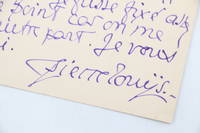
1900réf. 86497Paris 1900. Fine. Paris s. d. circa 1900 14 x 9 cm un bristol recto verso une enveloppe Autograph signed postcard from Pierre Louÿs addressed to Henri Davray 14 lines in purple ink envelope included. ""Il n'a jamais été question entre nous de ""fonds à déposer"" pour cette traduction. Vous savez comment se font mes éditions au Mercure. Si votre traducteur est bon et s'il veut se hâter je prends tout à ma charge. Mais il faudrait que je fusse fixé assez vite sur ce point car on me presse d'autre part. Je vous dirai qui.Votre Pierre Louÿs."" There has never been any question between us of ""funds to deposit"" for this translation. You know how my editions at Mercure are done. If your translator is good and wants to hurry I'll take everything on myself. But I would need to be settled quite quickly on this point because I am being pressed from elsewhere. I will tell you who. Yours Pierre Louÿs. unknown
1960réf. 86494Saint-Cirq-Lapopie 1960. Fine. Saint-Cirq-Lapopie s. d. ca 1960 16 x 22 cm une page sur un feuillet Autograph letter signed by Violette Leduc addressed to Adriana probably Adriana Salem 20 lines in blue ink. Fold marks inherent to postal handling and small marginal losses due to removal of the leaf. Violette Leduc is still in Saint-Cirq-Lapopie: "". bloquée par les belles choses cherchées et trouvées dans la nature : des grosses des vieilles pierres de couleurs des fossiles"" "". blocked by the beautiful things sought and found in nature: big old colored stones fossils"" and cheerfully enjoys her walks in the open countryside: ""J'ai marché des kilomètres et des kilomètres sous la pluie sous l'orage ."" ""I walked kilometers and kilometers in the rain in the storm ."" She worries about having everything she has gathered during her wanderings transported to Paris: "". j'ai porté ces chargements. Maintenant je me demande comment les expédier. Il y en a beaucoup. L'idée que tout arriverait en miettes me désole vous le comprendrez."" "". I carried these loads. Now I wonder how to ship them. There are many. The idea that everything would arrive in pieces dismays me you will understand."" unknown
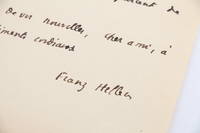
1928réf. 86536Paris: S. n. 1928. Fine. S. n. Paris 19 Août Juillet 1928 13.50 x 21 cm une feuille une enveloppe Autograph letter dated and signed by Franz Hellens addressed to André Malraux 21 lines in black ink. Fold marks inherent to postal handling. We include an envelope addressed to Franz Hellens and written by André Malraux which probably contained the response to our letter. Franz Hellens responds to a request for information made by André Malraux: ""Je n'ai pas oublié le renseignement que vous m'avez prié de vous procurer au sujet du Voyage au Congo. Voici la réponse que j'ai reçu de la compagnie belge maritime du Congo. Ce n'était pas du tout ce que j'avais demandé"" ""I have not forgotten the information you asked me to obtain regarding the Journey to Congo. Here is the response I received from the Belgian maritime company of Congo. It was not at all what I had requested"" and will attempt to learn more in order to help his friend: ""Je vais écrire autre part et tâcher d'obtenir une réponse précise à ma question. Patientez donc quelques jours encore."" ""I will write elsewhere and try to obtain a precise answer to my question. Please wait a few more days."" Franz Hellens mentions the forthcoming publication at Grasset of his next work: ""Brun m'a envoyé copie signée du contrat. Il m'écrit que le livre pourra paraître en janvier prochain. J'aurai voulu octobre mais enfin."" ""Brun sent me a signed copy of the contract. He writes to me that the book will be able to appear next January. I would have wanted October but well."" and inquires about André Malraux's book in progress: ""Et vos Conquérants Je suis bien impatient de lire le tout."" ""And your Conquerors I am quite eager to read it all."" S. n. unknown
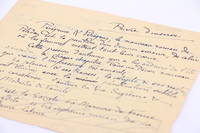
1932réf. 86589Paris: S. n. Mercure de France 1932. Fine. S. n. Mercure de France Paris 22 Mai 1932 21.50 x 17.50 cm une feuille Manuscript publisher's slip written by Sar Péladan for the publication of his Pérégrine & Pérégrin at Mercure de France. Fold mark inherent to mailing. Manuscript with corrections. ""Prière d'insérer Pérégrine & Pérégrin le nouveau roman de Péladan est la peinture d'un dernier amour de celui où les femmes mettent tout leur coeur. Cette passion d'automne qui a les ardeurs de l'été s'encadre à chaque chapitre dans un décor nouveau quii varie l'impression des amants. La jalousie & les transes la volupté & ses réactions sont étudiées avec la même crossed out word pénétratiion subtile qui caractérise l'autuer du Vice suprême& la modestie & vanité. C'est la société du Mercure de France qui édite le dixseptième roman de la décadence latine this sentence having been crossed out."" S. n. [Mercure de France] unknown
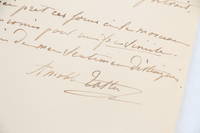
1840réf. 866121840. Fine. s. d. circa 1840 9.80 x 13.80 cm une page sur un feuillet Autograph letter signed by Amable Tastu monogram stamped in blind in upper left corner 11 lines written in black ink. Fold mark inherent to mailing. The author sends various works to his correspondent and also informs him that he has at his disposal: ""le morceau que je vous ai promis pour un fac-simile."" ""the piece I promised you for a facsimile."" unknown
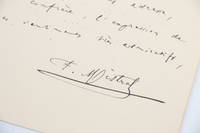
1898réf. 86539Maillane Bouches du Rhône Maillane 1898. Fine. Maillane Bouches du Rhône Maillane 28 Février 1898 11.50 x 17.50 cm trois pages sur un double feuillet Autograph letter dated and signed by Frédéric Mistral addressed to Anatole France 44 lines in black ink regarding the publication of his work ""Les mannequins d'osier"" which he has just sent him with a dedication. Fold marks inherent to postal delivery a vertical shadow on the first leaf. Frédéric Mistral has just received ""Les mannequins d'osier"" and gives a glowing portrait of his correspondent's style: "". ce livre qui m'a donné tous les plaisirs de la lecture. Je suis de ceux que le roman n'intéresse guère lorsqu'ils ne sont que prétentieux tableaux de la vie contemporaine. . mais il y a dans les vôtres une si fine quintessence d'érudition et d'observation agréablement mêlées et une si joyeuse fleur d'optimisme tolérant qu'on s'y retrouve sans rechercher dans la façon gauloise omnisciente et libre de Maître Rabelais."" this book which has given me all the pleasures of reading. I am one of those whom novels hardly interest when they are merely pretentious tableaux of contemporary life. . but there is in yours such a fine quintessence of erudition and observation agreeably mixed and such a joyful flower of tolerant optimism that one finds oneself in it without seeking in the Gallic omniscient and free manner of Master Rabelais. The félibrige loves equally the characters created by his illustrious and charming master ""Tous vos personnages sont si naturels si bien en situation si logiques que ma foi on les aime tous et quoique tout cela provienne d'un aimable et indulgent scepticisme on y a là l'explication de ce phénomène étrange que si loin si injuste si douloureux que soit le monde chacun pourtant y pousse volontiers sa brouette avec la conviction en le réconfort d'avoir raison."" All your characters are so natural so well placed in their situations so logical that my faith one loves them all and although all this comes from an amiable and indulgent skepticism there one has the explanation of this strange phenomenon that however distant unjust painful the world may be each person nevertheless willingly pushes his wheelbarrow with the conviction and comfort of being right. as the spirit that breathes and animates his books: "". la sympathie du reste vraiment universelle qui accueille tous vos écrits doit vous prouver combien vous êtes humain et sage dans l'antique sens de ces mots."" the truly universal sympathy that welcomes all your writings must prove to you how human and wise you are in the ancient sense of these words. unknown
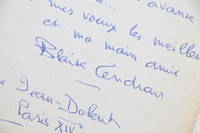
1950réf. 86569Paris: S. n. 1950. Fine. S. n. Paris s. d. ca 1950 11.50 x 16 cm une page Autograph letter signed by Blaise Cendrars addressed to Luc Estang 16 lines in blue ink. Fold traces inherent to postal handling. Luc Estang has just sent his latest books to Blaise Cendrars who delights in them in advance and thanks him for this: "". je me réjouis d'avance de vous lire. "" "". I look forward with pleasure to reading you. "" S. n. unknown
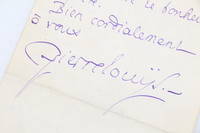
1896réf. 86610Paris 1896. Fine. Paris 1896 13 x 20.50 cm 3 pages sur un double feuillet Autograph letter signed by Pierre Louÿs addressed to his publisher Alfred Vallette 50 lines written in purple ink on a double sheet. Pierre Louÿs responds to his friend and publisher Alfred Vallette after a controversy launched by a journalist from Comoedia a controversy that could damage their friendship: ""Je ne suis pour rien dans l'écho publié par Comoedia. Mais ce que vous en citez suffit à me montrer que le rédacteur s'est mal informé."" ""I had nothing to do with the piece published by Comoedia. But what you quote from it is enough to show me that the writer was misinformed."" and he intends to remind him that they had not been able to agree on the publishing terms for Aphrodite and that he envisioned only a confidential distribution for his latest book: ""L'histoire de notre édition est très simple. Vous m'avez proposé un traité que je n'ai pas trouvé bon ; j'ai préféré le ""compte d'auteur"" et je ne peux pas vous accuser d'avoir mal prévu le succès du livre puisque moi-même j'avais écrit mon roman pour vingt amis et quelques inconnus."" ""The story of our edition is very simple. You offered me a contract that I did not find good; I preferred the 'author's account' and I cannot accuse you of having poorly predicted the book's success since I myself had written my novel for twenty friends and a few strangers."" This is why the father of Aphrodite is astonished by the triumph achieved by the work: ""Si une diseuse de bonne aventure nous avait prédit alors qu'Aphrodite dépasserait un jour le 300e mille nous l'aurions traitée comme une pauvre folle."" ""If a fortune teller had predicted then that Aphrodite would one day exceed 300000 copies we would have treated her as a poor madwoman.""; the latter consecrating his fame and wealth in the literary world: ""J'ai en outre une seconde raison pour ne pas vous en vouloir du traité que j'ai signé avec vous : c'est qu'en préservant mes droits d'autuer sur ce roman j'ai fait sans le savoir ma fortune. C'est à cela seul que je dois mon indépendance littéraire et cette inestimable liberté du silence qui n'est pas l'idéal de tous mais qui me paraît être le bonheur du poëte."" ""I have furthermore a second reason for not resenting the contract I signed with you: it is that by preserving my author's rights on this novel I made my fortune without knowing it. It is to this alone that I owe my literary independence and this invaluable freedom of silence which is not everyone's ideal but which seems to me to be the poet's happiness."" Very fine autograph on Pierre Louÿs's literary triumph. unknown