Gibier, PaulBiblio.com

2,986 results
ref. 1120493927.Gpaperback. Good. Access codes and supplements are not guaranteed with used items. May be an ex-library book. paperback
ref. 1120493919.Gpaperback. Good. Access codes and supplements are not guaranteed with used items. May be an ex-library book. paperback
ref. 1017515522.Ghardcover. Good. Access codes and supplements are not guaranteed with used items. May be an ex-library book. hardcover
ref. 6207199464.Gpaperback. Good. Access codes and supplements are not guaranteed with used items. May be an ex-library book. paperback
1989ref. 1215824PN. New. 1989. Reprint Edition. Soft Cover. Date is copyright date; this is a later reprint edition . PN paperback
1989ref. 793821PN. New. 1989. Soft Cover. Date is original print. This is a reprint edition. . PN paperback
1952ref. 301859N. Y.: Charles Schribner's Sons 1952. An ex-university-library copy. Minimal defacements. Hinging is evident at front inside cover and back inside cover but cover is secure to text. Text is clean and unmarked. Hardcover. Fair-good. Charles Schribner's Sons Hardcover
ref. 42797Boston: Rust Craft n.y. Heavy stock 6" X 3½" printed envelope that opens to reveal two pockets one containing 16 heavy stock 5" X 3" printed cards and the other containing a single heavy stock bifold 6" X 5" printed card. Very good. Printed envelope faintly age toned and lightly edgeworn with small discreet archival mends along couple of weakened folds; cards near fine with the occasional small foxing. This pioneering greeting card company was founded in Boston by Fred Rust in 1906 and their product line also included packets such as this noted as product number "599". Each of the 16 cards contains several clever word play questions such as #1 "When did the fly fly" and the last #49 "When was beef the highest" The bifold "Answers to Conundrums" card lists all answers "1. When the spider spied her" and "49. When the cow jumped over the moon". Undated although the typeface and style suggest perhaps 1920s vintage. The charming printed envelope front actually appears hand colored and shows a young man and young woman facing each other in front of a large window; "Conundrums" title below includes the rhyming explanatory stanza: "Each conundrum here will show / How quick we are -- perhaps how slow! / If slow there are surely others too / Just as slow as me and you!" Quaint and complete -- and also scarce. Rust Craft unknown
ref. elala4546Harborne: c1910. 54 x 27.25 mm. chromolithograph mounted on thick card & backed with roan with 2 folds slight chipping to roan along folds [Harborne: c1910] unknown
ref. ZQ-6QSZ-02Y4Fine. unknown
ref. I1-TAYS-KI47Fine. Mancala wood/glass game in vg condition in metal tin shipping daily. unknown
1983ref. 8741Limited to 50 non-commercial copies marked "H.C." Hors Commerce. Complete with 16 loose-as-issued black/white numbered plates housed in a red paper portfolio together with a signed limitation page . All clean copies with no defacements. Scarce. 12 x 16.25 in 30.5 x 41 cm. Editions Deesse hardcover
ref. B9781164137993New. unknown
1870ref. 27855France 1870. Board game. Fine. A French childrens' board game complete with the folding board 10 number disks 6 wooden pieces the instruction sheet and box. The box is papered in apricot & gold spotted paper with an image on the cover of clowns ascending a pyramide and one tumbling down. The box measures 11 x 8". All in very good condition. unknown
1920ref. 22166Paris 1920. Good overall. Beautiful printers proof of a french swimming game with vivid color images of swimmers from around the world flags spectators dogs fish and sailing boats game rules and peculiar oversized characters holding a broom! The object of the game is to find treasure and avoid monsters. Approx. 22 x 30" 3 closed tears repaired archivally from the back edges slightly ruffled not affecting text or images. unknown
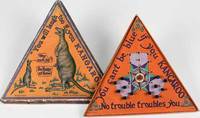
1915ref. 20568New York: Kangaroo Corporation; Gray Lith. Co. 1915. A large laughing female kangaroo with a joey in her pouch who says "Be Happy at Home!" to another young kangaroo asking "Why such joy" decorates the triangular box lid of this amusing bright orange and purple 1915 peg board game. The playing board itself is framed with the text "You can't be blue if you KANGAROO. No trouble troubles you." The unusual triangular box features three kangaroos on the top lid with edges decorated with horse shoes and shamrocks on a purple ground. The instructions are printed on the under side of the top lid including the offer of a $500 reward. The Kangaroo Corporation offered the prize for any correct solution to the game which involves landing the King in Goal No. 14. "The above prize to be awarded January 15 1916." 25 numbered holes on the board with 12 small wooden pegs. The object of the game was to jump holes so that only the King remained in hole number 14 in the manner of Chinese checkers. Each side of the triangular box measures 9 1/4". The box printed by Gray Lith. Co. N.Y.;1915 copyright by the Kangaroo Corporation. The top lid with little scratch in the lower edge corners repaired with sticky tape. Previous owner signature verso of lower box. The board interior with color more vivid just a bit of wear around numbered peg holes. Not found on Trove. Kangaroo Corporation; Gray Lith. Co. unknown
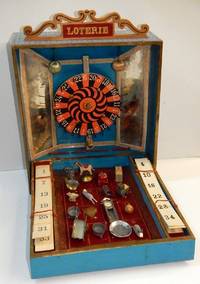
1900ref. 2210013Wooden box 32 x 26 x 8 cm with light blue patterned paper covering; the lid with a label lettered 'Loterie' and a hinged pierced wooden sign with the words 'Loterie' lettered in gilt paper on red; the lined paper interior with a central mounted wheel between mirrored sides and two hanging silk balls; the fall front where the prizes are held with two spaces left and right containing six lottery cards one from another set together with 16 toy prizes as listed below. Lottery or carnival wheels games became popular at the end of the nineteenth century. Their construction was more complicated than heretofore with the addition of a rotating wheel with pins with a 'clack' mechanism sounding as the wheel is spun. The numbers on the wheel are randomly arranged from 0 through to 25 in white on alternating in black and red ground - clearly based on the 'single zero' form of roulette wheel that became the norm in Europe from the middle of the nineteenth century. The design has a second purpose as the box is hinged so that open it is given the form of a fairground entertainment with an assortment of prizes laid out in a display on squares below the wheel that each have a number too. The idea of the game is twofold firstly as the wheel is spun and numbers called out the player who first completes a card of numbers is the winner. In the second game when the numbers 1 to 16 are called out and a player has the number on one of the cards they can then claim one of the small toy prizes. The sixteen twenty assorted of toy prizes include: a handcart wall clock bracelet scales pram wooden top bracelet fairground horse two rabbits a chicken a dish a parcel a metal top metal puzzle pair antimony jardinieres and a heart broach. There is no makers name and the design although of a solid construction is nevertheless probably a bespoke production possibly made in order to be sold through fairgrounds and market stalls rather than the more salubrious emporia for children. The interior is lined in turquoise paper with bevelled mirrored silvered card sides and although simple the idea was glittery enough to catch any passing child's attention.
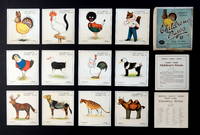
1930ref. 3220291Complete with 12 coloured and numbered cards; 11.5 x 11 cm; 6 double page score cards each with instructions mostly filled in with answers in pencil; and a a 'Key' card containg the corect answers; contained in the original box 11.5 x 13 x 1.8 cm the lid with coloured title label some dust marks minor damp stain affecting two edges. A party game where the illustrated cards are placed around a room and each of the children given a score card then trying to recognise the four different birds animals and toys combined into a composite picture. Assorted head body legs and tails of rabbits chickens giraffes elephants hens camels etc. are combined together. The toys including a clown doll and 'golliwog' but this is chiefly a semi-educational game as the majority of the Nuzoo creatures are real. E. T. W. Dennis and Sons principal productions were postcards - including novelty topographical and latterly saucy types - commercial art greeting cards and tourist guides etc. Party games seem to have been a small offshoot of their business with other titles including Guessit Pintail Pinnet and Jumbles. [Scarborough: E. T. W. Dennis and Sons. Ltd.],
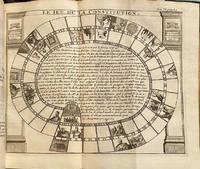
1724ref. BB_88102Game of the Goose Poesies sur la Constitution Unigenitus. Recueillies par le Chevalier de G. Officier de Regiment de Champagne. Villefranche i.e. Amsterdam: Chez Philalete Belhumeur 1724. Two volumes. Illustrated with duplicate frontispieces title-vignettes and many decorative woodcut head- and tail-pieces. 8vo. i i xxiv 317 pp. – i i 389 pp.; uniform polished tree-calf extra-gilt all edges gilt covers with armorial gilt stamp. First edition thus greatly revised and expanded from an earlier version with essays letters poems reviews and songs with political Constitution religious Pope Clement XI and literary interest. Most important this work includes an essay titled "Essai du Nouveau Conte de Ma Mere L'Oye" NewTales of Mother Goose showing the influence of Perrault's tales barely twenty years after his death AND a handsome folding-out engraved board game titled "Le Jeu de la Constitution" designed in a race-game format. As a notable compilation of pro-Jansenist writings of an often satirical nature with the aforementioned board game and its five pages of rules on a folding plate. Selections include: "Les 101 propositions de la constitution Unigenitus exprimées en cent et un couplets"; "Ode pindarique sur la destruction du monastère de Port-Royal-des-Champs"; "Adieu d'une dame janséniste qui se refugie en Hollande". Brunet 4: 755. Weller 2: 88. Willaert 2: 9370. For the game see Phillippa Plock & Adrian Seville "Rothschild Collection of Printed Board Games at Waddesdon Manor" in: Of Boards and Men: Board Games Investigated Proceedings of the XIIIth Board Game Studies Colloquium Paris 14-17 April 2010 pp. 101-103: "B3 2669.2.25 Le Jeu de la Constitution - 1721/22 or to give its the full title Le Jeu / De la Constitution / Sur l'air du branle de Mets sic is one of the most controversial games ever devised on the pattern of the game of Goose and perhaps may be regarded as the first polemical variant Girard and Quétel 1982: 58 and 73. It dates from about 1721 but is associated with a book that appeared a year later the Essay Essai du Nouveau Conte de ma Mère l'Oye ou Les Enluminures de la Constitution. This book contains a folding plate of the game in smaller format and with some omission of text. It also contains 18 enluminures in rhymed couplets which explain the game in detail. The claimed author is given in the subtitle: 'Poesies sur la Constitution Unigenitus recuellies par le Chevalier de G. Officier du Regiment de Champagne'. The publisher is given as Philalete Belhumeur "Good Humour" Villefranche. These publication details are of course wholly fictitious as is the claimed author who in reality was the Abbe é Louis de Bonnaire 1680-1752; the book was published in Amsterdam the full-sheet game probably in Paris. De Bonnaire was a supporter of the Jansenist heresy named for Cornelius Jansen 1585-1638: this theology emphasised a particular reading of Augustine's idea of efficacious grace which stressed that only a certain portion of humanity were predestined to be saved. Though the Jansenists were strongly Catholic Jesuits and the papacy were suspicious of their beliefs which seemed to limit free will and the ability to choose to do good or evil. Despite condemnation by Pope Innocent X in 1655 the movement gained strong support in the Church. The Jansenist position as included in 101 of the propositions of Pasquier Quesnel Jansenist theologian b1634 d1719 in his Épitomé des Morales des Évangélistes of 1671 was finally condemned by Pope Clement XI's Unigenitus bull of 1713 but even this condemnation did little to diminish the enthusiasm of adherents. Indeed in 1717 four French Bishops attempted to appeal Unigenitus to a General Council a move that received considerable support from other clergy and the parlements though the majority of clergy stood by the Pope: Clement responded in the next year by excommunicating all those who had called for a General Council. Even so it was not until 1728 that the death of Jansenism was marked by the submission to the Pope's authority of Cardinal Noailles Archbishop of Paris who had originally approved Quesnel's book and was reluctant to support Unigenitus arguing that many of the 101 propositions were in fact orthodox. The point of the game and of De Bonnaire's book is to challenge and mock the authority of the Church and in particular that of the Pope and of his bull. For example the columns on either side are each headed by a cartoon depicting the Pope in council all present being represented by geese wearing mitres. Below the lefthand cartoon is the Latin phrase "Non ego cum Gruibus simul Anseribusque sedebo in Synodis - S. Greg. Nazianz Carm. 10" I shall not sit in Synod with cranes and geese. This refers to a dictum of Gregory of Nazianzus c329-390 Archbishop of Constantinople who compared the rowdy Council of Constantinople 381 AD to the loud cackling of a flock of geese. The 'good' spaces show the Apostles 'equal in number to that of the geese which they replace': there are thirteen including St Paul and they occupy the traditional spaces. The traditional hazards are likewise replaced or given special significance and others are added. The usual entry arch appears as Noah's Ark at space 1 symbolising the Church as it is tossed about on the waters of Unigenitus. The bridge of explanations at the expected space 6 shows bishops falling into the water marking their error in taking the wrong sense of the 101 propositions: it leads to space 12 acceptance where a young woman blindfolded is shown as accepting Unigenitus through ignorance. At space 15 there is the torn robe symbolising schism of the Church. The labyrinth here at space 16 symbolises error into which fall those who subscribe to the condemnation of the 101 propositions. The inn at space 19 is here the cabaret and represents the 'accommodation' accommodement or submission of the Jansenists to the bull. The Tower of Babel at space 24 represents the confusion of language into which the bull has fallen. At space 26 is the first appeal of 1717 represented by a notice on the Vatican door. At space 33 we find the avertissemens or pronouncements of the Archbishop of Soissons Jean-Joseph Languet de Gergy 1677-1753 a notorious anti-Jansenist and vehement defender of Unigenitus. He has an oboe a horn and a trumpet the three instruments symbolising 'his three avertissements and their different tones': a special rule refers to moving forward with the 'small dice' and with 'the other' when going back. Next is the prison at space 40 where the player must wait until a throw of 5 which multiplied by 3 will lead to Louis XV and deliverance. The well space 49 symbolises the body of doctrine in which the truth is hidden. At space 51 are the re-appealing Bishops the second appeal being at space 53. At space 55 is the portrait of Louis XV - enluminere XV in the book makes clear that he was seen as a force for change and re-unifying the Church. The death space at 58 shows the skeleton of Pope Clement XI sitting in an armchair wearing his papal tiara and raising his bony hand to bless an infant at his feet which represents the Unigenitus bull. Cardinal Noailles appears at the penultimate space 62 from which point 'one may only go backward'. The explanatory text in the centre of the game claims that it 'presages the day that the constitution of the Church will no longer be nothing but un Conte de ma Mère l'Oye' - a Mother Goose tale here used as a figure of speech for something unbelievable and ridiculous. The winning space at 63 shows that this result is to be achieved by a General Council in reference to that called for in 1717. De Bonnaire's book was condemned at Arras in 1726. Although his anonymity as author seems to have been effective in protecting him the publishers father and son were thrown into the Bastille. Even today the game has the power to shock by the force of its imagery. Philalete Belhumeur hardcover
1943ref. 2018Austin TX: Texas Parks & Wildlife Commission 1943 thru 1992. 1st Ed. Paperback. Various. Pattern. See Description No DJ. Texas Game and Fish Magazine Collection by Texas Game & Fish Commision. Published by Texas Parks & Wildlife Commission Austin TX 1943 thru 1992. 1st Edition. Paperback. No DJ. No Pg Count. A collection of 424 magazines. Most of the magazines are in very good to very fine condition however some have their covers loose only one is missing its front cover. These magazines are published by the State of Texas therefore there are few advertisements. CONTACT SELLER REGARDING SHIPPING COSTS - books weigh 88 lbs. Description text copyright 2000 BooksForComfort. Item ID 2018. Texas Parks & Wildlife Commission paperback
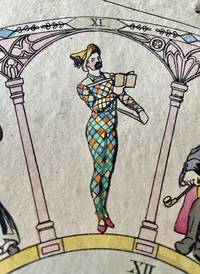
1840ref. 5201GAME. Arlequin und Columbine oder Arlequins Hochzeit. Nach der bekannten Pantomime gleichen Namens stellen bei diesem Spiele sämtliche Mitspieler Freier um Pantolons Tochter Columbine vor. n.p. n.p. ca 1830. VAT in EU & UK Lithograph broadside mounted on board 365 x 325 mm hand-coloured; board showing some staining and edges a little frayed; numbered 222 at bottom. A well preserved board game played with two dice relating to the marriage of Harlequin and Columbine. Based on the well-known pantomime of the same name in this game all the players introduce suitors for Pantolon's daughter Columbine etc. The central circular field depicts the wedding couple surrounded by a number of acrobats. The surrounding twelve numbered arches show twelve stock male courtship figures all vying for Columbine's attention. The four corners show Commedia dell'arte figures. Clockwise from the top the arches are numbered 2 7 5 4 10 2 8 3 6 9 2 11 while the central circle is numbered 12. The numbers thus represent all chances upon double dice with double 1 appearing three times. The rules give pay or take instructions for the various throws. The rules of the game are printed below. One participant is the 'banker' who organises the game and takes the pawns from all participants and arranges for the money to be distributed. The players throw dice andmove along according to their results. This board game is number 222 from the fund of an unknown German publisher printed about 1840. See Plock Phillippa and Adrian Seville "The Rothschild Collection of printed board games at Waddesdon Manor" in XIIIth Board Game Studies Colloquium Paris 14-17 April 2010; Buijnsters P.J. Papertoys. Speelprenten en papieren speelgoed in Nederland 1640-1920. Waanders Uitgevers-Zwolle 2005. n.p.
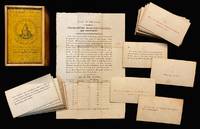
1834ref. 322002724 printed cards 9.5 x 5.4 cm including 12 question cards printed in red and 12 Answer cards printed in black; a folding printed sheet of instructions; contained in the original wooden box two sides very skilfully replaced; sliding lid with printed title label depicting a seated Moses reading from the Tablets. The game is intended for six players who are each provided with a piece of scrap paper called 'Contracts'. The Answer cards are dealt to the players and the Question cards retained by the dealer. The players each examine their aAswer card they have been given after which the dealer selects a question card and lays it down in front of the players and then asks each in turn until the Answer card is produced. If no answer is forthcoming then the dealer refers to a 'key' which matches questions to the correct answers. Whoever reads the wrong answer or fails to recognise they have the correct card in their hand forfeits a Contract. The player who has parted with the fewest Contracts is the winner. Questions include 2 'What time did God employ in forming the Creation' the Answer 'Six days: and rested on the seventh day. We are not to suppose by this expression that God was weary and required rest but that he rested from or left off creating.' 16 'Who is supposed to have arranged and published the Old Testament' Answer 'Ezra a priest of the Jews. Some of the answers stray into the New Testament and are also fearsomely long for children to remember:- 15 'How did the Jews forfeit the favour of God; and will they ever regain it' Answer 'They forfeited the divine favour but their obstinate rejection of the Son of God whose pure doctrine of humility and love was in direct opposition to the worldly pomp and glory which they had falsely led themselves to expect at the coming of Christ. It is predict that they will one day acknowledge Christ as the Messiah and be restored to their former privileges' One has to admit there is quite a lot of anti Jewish feeling in many of the Answer cards reinforcing contemporary prejudices - 22 'In reading the Bible what part may be passed over in order to connect the historical records' - Answer 'You may be allowed to pass over the book of Leviticus and the eight first chapters of the book of Numbers. The books of Chronicles may be read as a repetition of the book of Kings both bring you to the Babylonish Captivity; you then pursue the History of the Jews and read to the end of Esther. The writings of the Prophets as connected with the History of the Bible should be read next. The book of Job the Psalms &. are beautiful compositions and may be read as such at any time.' Produced by the short lived partnership of William Mason Wood a typefounder and shareholder in the Austin Letter Foundry in Aldergate and Kilelm Chandler a printer from Tewkesbury who had recently moved to London and married in 1834. The partnership in Beech street was a few hundred yards from the Austin Letter foundry and as far as we can tell lasted as a business for only a few months before it was dissolved in October 1834. Chandler was successively a printer Station Master Compositor and latterly a Fruitier. We have found no other item issued from their partnership and one feels as a product of their business the cards were a commercial failure. Wood and Chandler, Printers, 41, Beech Street, Barbican.
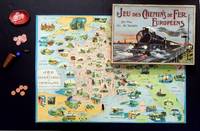
1920ref. 3220195Two-fold chromolithograph playing board measuring approximately 85.5 × 61.5cm 6 metal Locomotive playing pieces 30 counters two shakers a dish and two dice one a later replacement; all contained within the original box 45 x 33cm lid with pictorial scene of a locomotive outside Paris the Eiffel tower visible in the distance with the printed rules pasted to underside of lid some rubbing to extremities but overall in very good original condition. A wonderful railway game beautifully illustrated taking players from Paris space 1 on route's through France her neighbours and beyond. The mechanic is roll and move as in the Goose-type games. If you land on a red space you are penalised but landing on green you get some assistance. The publisher reports the game will be most instructive not only for learning about French towns but also about the towns in neighbouring countries. The toy and games maker Saussine were established in 1860 by Léon Saussine after he had acquired the prolific children's bookseller and publishers Hugues-Marie Duru at the rue du Cloitre Saint-Jacques in Paris. Saussine developed the business making board games card games and puzzles but also began producing shadow theatres under the mark 'LS edit Paris'. Like most such enterprises Saussine thought up ideas for his wares and employed various specialist manufacturers in France Belgium and Germany to construct them. After Léon's death in 1896 his widow continued to run the business until her sons George and Maurice were able in their turn to take over the reigns in 1916. They were then succeeded by a grandson of the founder in 1944 the company continued to supply the marketplace until around 1964. Saussine Ed.
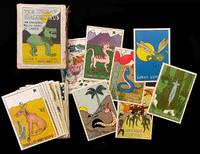
1923ref. 3210241Complete set of 48 cards 93 x 62 mm including 4 'Privilege Cards' marked with a star; folded sheet of rules; contained in the original purple card slipcase 98 x 76 x 25mm illustrated title label. A round game based on nonsense names of creatures probably the name The Great Galumphus derived from invention of the word 'galumph' by Lewis Carroll for Through the Looking Glass of 1872. Certainly all the other named creatures whose images decorate the cards are each in the same nonsense fashion and include the Crowned Cornubian Tasselled Snort Hound Bubbling Water-Hog Pushfoot Polliwog Climbing Chumtrunk Painted Pooh-Pooh Cissling Sand-Snapper Hairless Hunkum Flying Umbratunk Long Eared Scootler Scru-Wuzzium Lunar Lumpkin Putty Faced Popcat and Spotted Sniffle-Grub. This is a memory game where the players have to claim cards from their opponents after they have been turned over with a set of cards needed to become the winner. Jaques as a games maker had been established in 1795 however it was John Jaques II in the mid Victorian era who is credited with inventing such perennials as Happy Families Tiddledywinks Ludo and Snakes and Ladders where the company's fame was most in the ascendent. We have not been able to trace Miss Jessie Veal but wonder if she actually lived in some part of the far flung British Empire the animals and exotic scenery tend strongly to support this idea. Published by J. Jaques & Son Ltd.,
1969ref. 2111902160603911Takahashi shoten 1969. Soft Cover. Fine. The book is in fine condition. Takahashi shoten paperback