4 409 résultats
8vo. X, (11-)54 pp. 27 ff. Original lithographed wrappers bound in splendid blue morocco with giltstamped cover borders, green inlays, title to gilt spine, marbled endpapers. Stored in marbled slipcase. First editon, with the first German translation of this collection of moralizing addresses by the Arabic-Persian scholar Zamakhshari (1075-1144). Another translation, by H. L. Fleischer, appeared that same year in Leipzig. The present copy, untrimmed and partly uncut in the original lithographic wrappers, boasts a fine full morocco binding of the early 20th century with green morocco inlays and elaborate gilt ornamentation. - Some foxing throughout; spine sunned. A beautiful copy from an Austrian private collection. GAL I, 292, no. XVI (p. 349). Zenker I, 164, 1347. Fück 165, 175. WG² 47. Goedeke VII, 766, 90. Wurzbach VII, 277, 49. Brieger 965. Hirschberg 195. Kosch VII, 242. OCLC 978579284.
réf. DADAX0831740353New unknown
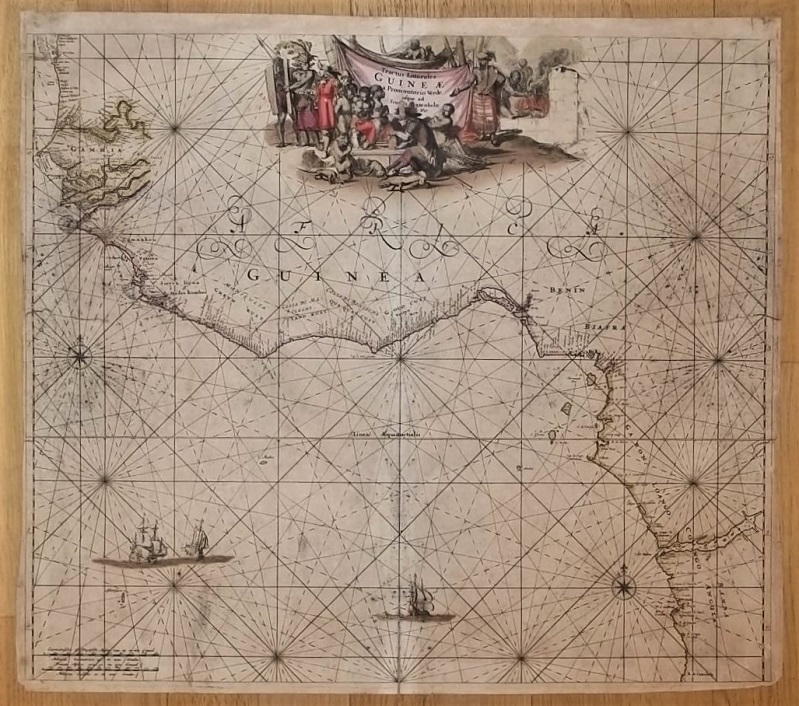
1700réf. 17369Amsterdam, de Wit, 1675 (recte um 1700). Ca. 49,5 cm x 57 cm. [4 Warenabbildungen]
8vo. pp. 97-105 (entire volume: iv, 65-128 pp., with 18 photographic illustrations and a folding colour map). Original printed blue wrappers. Early account of a visit to the seaport of Dhofar (Oman) on the southern coast of the Peninsula, including an interesting account of the local boats and the sailing skills of their owners. The illustrations show Makalla in Hadramaut, a camel drawing water in Dhofar, and the ruins of the temple of al-Bilad. Macro 777. OCLC 49427292.
12mo. 180 pp. Rebound in green buckram. Title page with engraved vignette of a Kangaroo and three full page engraved plates. First edition. - A third hand account of the travels of one Captain Blisset, "an Englishman of birth and large fortune", in company with William Walsh, from Bombay, to the Arabian Gulf, having toured which they pass on to Muscat and Mecca, thence to the Holy Land. Nothing seems to be known of Blisset. Possibly a fictitious account, but the detail seems firmly based on fact, save for the incongruous Kangaroo on the title page.
4to (185 x 248 mm). 80 pp. Illustrated throughout with photographs, diagrams, and maps. Original light blue printed wrappers. Pamphlet covering the history of Kuwait, the operations of the Kuwait Oil Company, and the "New Kuwait" of the 1950s. The Kuwait Oil Company was founded in 1934 and was heavily involved in the modernization of Kuwait, whose large petroleum and natural gas reserves were first tapped at Burgan Field in 1938, with production beginning in 1946. The pamphlet focuses on the changes brought to Kuwait by the oil industry in the first ten years since its inception: graphs and photographic illustrations show the rise in oil production, numerous scenes of the refineries, pipelines, workers' houses, mosques, and recreational scenes at Ahmadi, and an early gas station and new housing in Kuwait City. Also explained is the family history of the al Sabah rulers of Kuwait, with a family tree and portraits of previous and contemporary rulers, including Sheikh Mubarak Al-Sabah (1837-1915), Sheikh Ahmad Al-Jaber Al-Sabah (1885-1950), and Sheikh Abdullah Al-Salim Al-Sabah (1895-1965), first Emir of Kuwait; one image depicts him ceremonially opening an oil well. - Wrappers slightly browned at extremities, quite well preserved. OCLC 21880314.
Colour printed map, 540 x 680 mm, with yellow covers (195 x 110 mm). Map of Iran, Iraq and parts of the surrounding countries, including modern Kuwait, Bahrain, Qatar and the UAE, in the 1930s, published in the series "Philips' authentic imperial maps for tourists & travellers". Published in the early years of the discovery of oil in the Middle East, the map shows roads and railways, but also caravan routes, submarine cables and oil pipelines. - Slightly soiled, in very good condition.
Folio. 2 pp. Clichy provides 25 horses in fulfilment of a mandate issued on September 4, concerning the requisition of 40,000 horses. - Somewhat spotty and browned.
8vo. 279, (1), (6, publisher's catalogue) pp., final blank leaf. With 5 maps in the text. Original illustrated green wrappers. First French translation, by Geneviève and Pierre-François Caillé, of Captain Armstrong's 1934 biography of Abdulaziz Ibn Saud (1875-1953), the founder and first monarch of Saudi Arabia, "Lord of Arabia, Ibn Saud", revised and expanded with a new chapter by the author. - From the library of Vittorio Emanuele III, King of Italy, with shelfmark label of the royal library to spine. An excellent copy.
8vo. 368 pp. With numerous illustrations in the text. Modern green half calf. First edition of this account of the author's pilgrimage to Mecca. The writer and Islamic scholar Abd al-Wahhab Azzam (1895-1959), nephew of the Pan-Arabist statesman Abd al-Rahman Azzam, was educated at London's School of Oriental Studies and at Cairo University, then taught at the latter institution, where he became dean in 1945. "Appointed Egypt's ambassador to Pakistan in 1950 and to Saudi Arabia in 1954, he founded King Saud University in Riyadh and in 1957 became its first director [...] Azzam was Egypt's foremost pan-Arab intellectual" (Goldschmidt, Biographical Dictionary of Modern Egypt, p. 29f.). - An excellent copy. Rare; OCLC lists only nine copies in libraries worldwide. OCLC 23512537.
Large 8vo (180 x 250 mm). (288) ff. Full auburn leather, titled on paper spine label. A volume of medical pathology printed lithographically in Persian (with occasional Arabic), featuring detailed descriptions of physical ailments, including the appearances of ailing organs as might be seen by a surgeon, the areas of the world in which a particular disease or ailment was more common, and the history of a disease as known to medical science at the time. Each entry is titled and numbered, though not always consecutively, and a table of contents can be found at the rear. - An interesting and detailed medical textbook, covering everything from the venereal to the cardiovascular, probably reproduced lithographically from a contemporary manuscript. The likely scribe of that original manuscript, named in the colophon, was Muhammad Baqir ibn Muhammad Jawad al-Mussawi al-Asfahani. - Blindstamps from the library of the Fabryky Sergyeva, Ukraine, appear on some pages. Light exterior wear. Title-page loose with edge flaws, occasional light stains, otherwise generally in good condition.
8vo. (2), 73, (1) pp. Original green printed wrappers. First edition. The author was Director of Revenue and Customs for the Government of Palestine and was put in charge of supervising the religious endowments. Finding no European work on the subject of wakfs, he was compelled to publish his notes on the subject. - A few small splits to spine, small area of loss to rear wrapper, otherwise good. Duplicate stamp and partially erased reference stamp to front wrapper. OCLC 42828458.
8vo. VIII, 9-253, (1) pp., final blank. With 8 photographic plates and several illustrations in the text. Contemporary full blindstamped cloth with silver-stamped title to cover and spine. First edition, rare. A classic of falconry describing the training and care of hawks, by the renowned falconer Blaine, drawing on more than 40 years of experience in the field. When the book was reprinted in 1970, the publisher's blurb noted that the book was "extremely scarce and second-hand copies are making as much as eight guineas in the sales rooms". - Blaine, a longtime member of the Old Hawking Club, "was one of those legendary figures who seems to come along in falconry every so often, raising the standards of the sport as well as pushing the envelope of what can be accomplished" (Gallagher). His useful handbook provides an introduction to the sport, and includes a glossary of falconry terms as well as a short bibliography on the subject, mentioning an English edition of the famous Persian falconry treatise "Baz-Nama-Yi Nasiri". - The plates show a greenland falcon, a falcon eyass, a passage falcon, a falcon pluming a grouse, two eyass tiercels, a goshawk, and a team of passage hawks weathering. The smaller illustrations in the text display falconer's equipment, the beaks of falcons and hawks, and the technique of repairing damaged feathers. - Handwritten ownership of Charles Henry Stanley Garton (b. 1920), dated Kingswood 1946, to front pastedown. Two black and white photographic illustrations clipped from a magazine, showing tiercels, are loosely inserted. - Somewhat browned and brownstained throughout. A single copy in auction records. Gallagher, Falcon Fever 177. U.S. Air Force Academy Library, Special Bibliography Series 3, 2. OCLC 603525547.
8vo. (4), VI, 299, (1) pp. With one folding map. Publisher's yellow printed wrappers. First edition of Bonet-Maury's study of Abrahamic religions in Africa, supporting both Christianity and Islam as superior alternatives to local beliefs. A protestant clergyman and academic, Gaston Bonet-Maury (1842-1919) wrote extensively on monotheistic faiths and their unity, proposing them as a significant factor in the development of Western civilisation. - Slight marginal toning, a few light marks, otherwise a very good copy. From the library of Vittorio Emanuele III, King of Italy, with manuscript pencil poem to final blank and shelfmark label of the royal library to spine.
Colour map and 111 plates and plans, some collotype, one double-page, 4 pp. advertisements at end. Original cloth. First and only edition of this study of mainly Hindu and Jaina architecture in the state of Gujarat on the western coast of India, superbly illustrated with collotypes. Published as volume IX of the Archaeological Survey of Western India. - The Scottish archaeologist James Burgess (1832-1916), founder of "The Indian Antiquary", did educational work in Calcutta, 1856 and Bombay, 1861, and was Secretary of the Bombay Geographical Society 1868-73. He was Head of the Archaeological Survey, Western India, 1873, and of South India, 1881. From 1886 to 1889 he was Director General of the Archaeological Survey of India. - With light foxing to first few leaves, binding slightly rubbed.
Folio, ca. 58 x 44 cm. 1 p. At the beginning of the third year of war against the Ottoman army in the Austro-Russian-Turkish War of 1735-39: a mandate to the Upper Austrian Estates and their subservients regarding an extraordinary tax to be raised for the support the Imperial army. "We [the Emperor] should have wished nothing better, from the time that we were obliged to take arms against the hereditary enemy, than to re-establish the peace, and effect this either through the force of weapons or by kind acts; however, as during the time of our recent campaign our so numerous and well-equipped armies have much suffered from illnesses, long and tiring marches, and other hardships which must needs accompany a war, and thus have been hindered in achieving the desired further successes, and peace negotiations are yet distant, though We do not desist in pursuing all means conducive to achieving such an end, all that is now necessary is to replenish our forces, and convey here the necessary tools, in other words, to make our forces capable of effectively preventing all enemy action, and to bring peace and safety to our kingdom and dominions; all of which, as everybody will readily acknowledge, cannot be done without great expenditure, for which our treasury and the ordinary grants from the estates are not sufficient, We have found Ourselves compelled, even if against our own wishes, to apply a general contribution, or Turk tax [...]". - Traces of folds with slight tears and paper defects; captioned on reverse by a contemporary hand.
8vo. XV, (1), 297, (1) pp. Original printed wrappers. First edition. Classic, minute account by Luciano Cordeiro (1844-1900) of the events that led to the fall of Hormuz to the Anglo-Persian forces in 1622. Based on contemporary documents, many of which are reproduced here. - Slight edge chipping; evenly browned throughout as common. A good copy. Wilson 48. OCLC 27860289.
Toned lithograph. 375:540 mm. From a series of illustrations depicting the Old Testament story of Joseph within oriental scenery of bedouins, palms, and camels. Joseph (Yusuf) is regarded by Muslims as a prophet (Qur'an, suras vi, 84; xl, 34), and a whole chapter Yusuf (sura xii) is devoted to him, the only instance in the Qur'an in which an entire chapter is devoted to a complete story of a prophet. - A few edge flaws, some repaired, with some browning and staining.
Large 8vo. (4), VIII, 332 pp., 1 bl. f. With a frontispiece showing a mural from the Holy Mosque. Original printed wrappers. First edition. - Principal work of the French Arabist Maurice Gaudefroy-Demombynes (1862-1957), a religio-historical study of the pilgrimage to Mecca. The author taught at the École nationale des langues orientales vivantes (now the Institut national des langues et civilisations orientales) and also translated into French the travelogue of the Arabic explorer Ibn Jobair (1145-1217). - Margins slightly browned and brittle, still a very good, untrimmed copy. Macro, Bibliography of the Arabian Peninsula, 1008.
1995170 x 115 mm. Watercolour over pencil, heightened with white. Signed and dated. Matted.
8vo (150 x 230 mm). (2), XVIII, 257, (3) pp. Contemporary green full calf, spine prettily gilt with title and ornaments, cover with gilt rules and border decoration enclosing a blind-tooled Rocaille centrepiece. Leading edges gilt, gilt inner dentelle, all edges gilt. Red silk divider. First edition of this important study of the plague in Egypt and the quarantine laws to prevent its spread; the "principal work" (Hirsch) of the German physician J. F. Reinhold Grohmann (1784-1867). Educated in Leipzig and Vienna, Grohmann was travelling to Constantinople when the Russo-Turkish War of 1806 stopped short his journey in Bucharest. He remained there and witnessed a particularly severe plague epidemic in 1813. He spent much of his subsequent career in the East before settling in Vienna; from 1831 to 1833 he was a member of a committee convened to formulate new standards for plague epidemics. In his medical work he described the plague as a nervous fever affecting the brain, little influenced by the climate. His son Paul Grohmann would go on to be one of Austria's most famous mountaineers of his age. - Very well preserved in a splendid Austrian master binding. Removed from a baronial library with a crowned monogram stamp "MK" to title-page. Ibrahim-Hilmy I, 278. Hirsch II, 661. OCLC 14832432. Not in Wellcome.
Engraved map (360 x 315 mm). A map by Captain S. B. Haines (1805-60), Commander in the Indian Navy and the first political agent in Aden, showing his surveys of the coastal areas that had never before been recorded or charted, with one area remaining unexplored after his expedition. - Being the first charting of this section of the coast, Haines's map is a rare primary source. Haines commanded the East India Company's survey ship "Palinurus" from 1833 to 1839. His survey of the coast of Southern Arabia, performed in 1839, was driven by the Company's requirement for a coaling station to service its steamship on the Bombay-Suez route. The map extends from the Wadi Masilah near Sawit to Jebel Saffan, passing Morbat and Ras Madrakah, also showing Masirah Island and some smaller islands in Curia Muria Bay. Elevations are indicated, as are freshwater lakes, small villages, and a region irrigated for cultivation at Dafhar. One section along the coast is marked "unexplored". - This map pre-dates by more than two decades the construction of the Suez Canal Company, which opened on 17 November 1869. During this time, mail came overland through Egypt from Alexandria to Cairo, then Suez. - Folded, but in very good condition.
8vo. 64 pp., 1 folding table. With printer's woodcut device on title-page. Contemporary marbled wrappers. First 18th century edition of this widely used introduction to Syriac, first issued by the Helmstedt professor of oriental languages, Hermann von der Hardt (1660-1746), in 1690 and again in 1694 (all printed by Hamm). - Some browning and brownstaining throughout; occasional slight edge defects without loss of text. The folding plate shows the conjugation of Syriac verbs. - Provenance: ownership of the Heidelberg Jesuits' Seminarium Carolinum (opened in 1730 for Catholic students in the strongly Protestant Palatinate), dated 1744, on title-page. Cf. VD 17, 3:013822V.
Colour lithographed postcard, 130 x 90 mm. A very rare Ottoman postcard featuring one of the earliest printed maps to focus on the Asir region, then nominally part of Ottoman Yemen, but today a part of Saudi Arabia. The card was part of a series made by Ibrahim Hilmi, one of the premier Istanbul cartographers of the era. - Ibrahim Hilmi Cigiracan (1876-1963) was one of the most important publishers and cartographers of the late Ottoman Empire. Born in Tulcea (now in Romania), he founded his first printing shop in Istanbul in 1896, under the name "Kitaphane-i Islami" (Islamic Library), largely producing religious books. Subsequently, Hilmi became interested in military affairs, geography and history, and changed the name of his press to "Kitaphane-i Islam ve Askeri" (Islamic and Military Library). He published about 200 military books, and his atlases (especially his "Pocket Atlas") were among the most popular cartographic items throughout the empire. During WWI, Hilmi gained the affection of the public for his charitable programme of sending free books to poor children in Anatolia. - Hilmi's enterprise thrived until Atatürk's Republican regime nationalized the publishing of law and school books in the 1920s, undercutting the most lucrative part of his business. However, Hilmi left an enduring legacy, having published over a thousand books on a wide variety of topics over three decades. - Very good, overall clean and crisp, just some very light even toning and slight stains to verso.
17394to. (2), 56, (2) pp. With engr. printer's device on t. p. Marbled wrappers. University oration on the Arabic language, its age, beauty, and usefulness, held by the noted Arabic scholar Thomas Hunt (1696-1774). Hunt studied at Christ Church, Oxford, and was chaplain to Thomas Parker, 1st Earl of Macclesfield. In 1738, he became the fourth Laudian Professor of Arabic, additionally becoming Lord Almoner's Professor of Arabic in 1740 (the year in which he was elected a Fellow of the Royal Society) and Regius Professor of Hebrew in 1747. - Many type specimens in Arabic, as well as some in Greek, Hebrew, and Syriac. Traces of old binding stitches; slight tear in final errata leaf restored with Japanese paper. Schnurrer 12. OCLC 27855095.