4438 resultados
Engraved map (360 x 315 mm). A map by Captain S. B. Haines (1805-60), Commander in the Indian Navy and the first political agent in Aden, showing his surveys of the coastal areas that had never before been recorded or charted, with one area remaining unexplored after his expedition. - Being the first charting of this section of the coast, Haines's map is a rare primary source. Haines commanded the East India Company's survey ship "Palinurus" from 1833 to 1839. His survey of the coast of Southern Arabia, performed in 1839, was driven by the Company's requirement for a coaling station to service its steamship on the Bombay-Suez route. The map extends from the Wadi Masilah near Sawit to Jebel Saffan, passing Morbat and Ras Madrakah, also showing Masirah Island and some smaller islands in Curia Muria Bay. Elevations are indicated, as are freshwater lakes, small villages, and a region irrigated for cultivation at Dafhar. One section along the coast is marked "unexplored". - This map pre-dates by more than two decades the construction of the Suez Canal Company, which opened on 17 November 1869. During this time, mail came overland through Egypt from Alexandria to Cairo, then Suez. - Folded, but in very good condition.
8vo. 64 pp., 1 folding table. With printer's woodcut device on title-page. Contemporary marbled wrappers. First 18th century edition of this widely used introduction to Syriac, first issued by the Helmstedt professor of oriental languages, Hermann von der Hardt (1660-1746), in 1690 and again in 1694 (all printed by Hamm). - Some browning and brownstaining throughout; occasional slight edge defects without loss of text. The folding plate shows the conjugation of Syriac verbs. - Provenance: ownership of the Heidelberg Jesuits' Seminarium Carolinum (opened in 1730 for Catholic students in the strongly Protestant Palatinate), dated 1744, on title-page. Cf. VD 17, 3:013822V.
Colour lithographed postcard, 130 x 90 mm. A very rare Ottoman postcard featuring one of the earliest printed maps to focus on the Asir region, then nominally part of Ottoman Yemen, but today a part of Saudi Arabia. The card was part of a series made by Ibrahim Hilmi, one of the premier Istanbul cartographers of the era. - Ibrahim Hilmi Cigiracan (1876-1963) was one of the most important publishers and cartographers of the late Ottoman Empire. Born in Tulcea (now in Romania), he founded his first printing shop in Istanbul in 1896, under the name "Kitaphane-i Islami" (Islamic Library), largely producing religious books. Subsequently, Hilmi became interested in military affairs, geography and history, and changed the name of his press to "Kitaphane-i Islam ve Askeri" (Islamic and Military Library). He published about 200 military books, and his atlases (especially his "Pocket Atlas") were among the most popular cartographic items throughout the empire. During WWI, Hilmi gained the affection of the public for his charitable programme of sending free books to poor children in Anatolia. - Hilmi's enterprise thrived until Atatürk's Republican regime nationalized the publishing of law and school books in the 1920s, undercutting the most lucrative part of his business. However, Hilmi left an enduring legacy, having published over a thousand books on a wide variety of topics over three decades. - Very good, overall clean and crisp, just some very light even toning and slight stains to verso.
17394to. (2), 56, (2) pp. With engr. printer's device on t. p. Marbled wrappers. University oration on the Arabic language, its age, beauty, and usefulness, held by the noted Arabic scholar Thomas Hunt (1696-1774). Hunt studied at Christ Church, Oxford, and was chaplain to Thomas Parker, 1st Earl of Macclesfield. In 1738, he became the fourth Laudian Professor of Arabic, additionally becoming Lord Almoner's Professor of Arabic in 1740 (the year in which he was elected a Fellow of the Royal Society) and Regius Professor of Hebrew in 1747. - Many type specimens in Arabic, as well as some in Greek, Hebrew, and Syriac. Traces of old binding stitches; slight tear in final errata leaf restored with Japanese paper. Schnurrer 12. OCLC 27855095.
Large 4to. (4), IV, 40, 111, (1) pp. With 2 facsimile plates. Original staple-bound printed wrappers (professionally restored). In slipcase. Second edition. "Texte arabe publié pour la première fois d'après le manuscrit unique de la biblithèque Zèki Pacha accompagné d'une préface en Francais et enrichi de notes critiques par Ahmed Zeki Pacha." - The "Book of Idols" (Arabic: Kitab al-Asnam), written by the Arab scholar Hisham Ibn Al-Kalbi (737-819), describes godheads and rites of ancient Arab religion. The text is critical of pre-Islamic religion and decries the state of religious corruption which the Arabs had supposedly descended to since the founding of the Kaaba. The book was instrumental in identifying "shirk" (the sin of polytheism) with the idolatry of the pre-Islamic Arabs. Ahmad Zaki Pasha, the Egyptian philologist, discovered the text; he bought the sole extant manuscript at auction in Damascus. The manuscript, one of many in his extensive collection, was donated to the state after his death in 1934. - Edge defects to French title page, otherwise insignificant edge wear; a good, untrimmed copy. From the library of the Swedish theologian (Karl Vilhelm) Helmer Ringgren (1917-2012), Professor of Old Testament exegesis at Turku and Uppsala, with his pencilled margin notes and ownership to title page. Ringgren's works include "Islam, Aslama and Muslim" (1949) and "Studies in Arabian Fatalism" (1955). GAL S I, p. 212. OCLC 7012435.
8vo. 144 pp. Contemp. marbled boards. All edges sprinkled in red. Only issue of this edition of the text, with commentary, Latin translation and a loose German version of an Arabic poem by Ibn Saiyid an-Nas, a Persian one by Nizami, and a Turkish one by Emri. Following his dissertation, this was the first great scholarly publication by Johann Gottfried Ludwig Kosegarten (1792-1860), who later assisted Goethe with his "Diwan". In 1817 he was made professor of oriental languages at Jena. - Some browning due to paper; inscribed to a "Dr. Vermehren" (dated 1816) on front pastedown. Although the print shop used by the publisher was equipped with Arabic, Persian and Greek types, no types were available for the passages in Sanskrit and Armenian: these few words, on p. 48-49, had to be supplied in manuscript (possibly by the author himself?). GAL II, p. 85. Brunet VI, 15940. Graesse IV, 45. Goedeke XVI, 605, 1 & XVII, 749, 1. Hamberger/Meusel XVIII, 420.
8vo. 111 pp., final blank page. With 31 photographic illustrations in the text. Original full cloth with stamped title to cover and spine. First edition of this brief introduction to falconry, re-issued in 1964 and 1978. It features impressive photographs of trained falcons with their prey, as well as hawks on perches or falconers' hands, some hooded. In addition, the illustrations display wild animals, including a sparrow-hawk at its nest, young hawks about to leave the nest, a lemming in Lapland, and an eagle owl. - Handwritten ownership of Charles Henry Stanley Garton (b. 1920), who received this book as a gift from John Osmaston, dated "Christmas 1946". - In near mint condition. Not seen at auction since 1960. Oelgart 25A. U.S. Air Force Academy Library, Special Bibliography Series 81, 289. OCLC 774638616.
1991429 pages. Numerous colour photographic plates and black and white reproductions of photos. Text in English. "Describes the stages of militant, intellectual and political life of one of the most distinguished existing leaders of the Arabian world and of the Third World. Tends to find and tell the truth to those who look for it far from fanaticism, resentments and prejudices." - from back cover. Unmarked with average wear. Binding intact. A sound copy. Book
8vo. (2), 490, (2) pp. Contemporary half calf with marbled boards and giltstamped spine title. All edges red. First edition of this Arabic-Latin dictionary, prepared to accompany the author's Arabic chrestomathy. While both works were published simultaneously, they were sold separately and hence are not usually encountered together. - The Czech theologian and orientalist Jahn (1750-1816) taught at Olomouc and Vienna, where he also served as Canon of St. Stephan's Cathedral. - Somewhat browned throughout, as common. Old Linz library stamp to title page (cancelled); ink ownership of Wenzel Hajduk (dated 1826) on flyleaf.
8vo. (14), 311, (1) pp. With 3 lithogr. folding plates, the first two depicting a horse led by a man on foot, and the third a lithographed folding table. Contemporary blue boards, gilt-tooled spine, gilt edges. Second edition of a work on all aspects of horses, horsemanship, the horse trade, horse carriages etc. The work contains 6 chapters by Karl Kegel and 12 by Seufert von Tenecker, with 3 early lithographed plates. It was first published in 1817 and was apparently very popular: the present edition contains a six-page list of subscribers. It was followed by several other editions. - A stain in the last folding plate and some smudges to the binding. A good copy. Huth p. 92. Not in Mennessier de la Lance; Nissen, ZBI; Podeschi.
4to. (2), 51-130 pp. With several black-and-white photographic and schematic illustrations. Original printed wrappers bound within contemporary full cloth with giltstamped spine-title, signed by R. Numans. Scarce essay on medieval carpet weaving in Egypt, particularly on the so-called Marby Rug, the oldest preserved oriental carpet in Sweden discovered in 1925 in the abandoned church of Marby in the province of Jämtland. The personal copy of Carl Johan Lamm with his bookplate to front pastedown. In an attempt "to fix the place of the Marby rug in the early evolution of Oriental carpet knotting", the essay discusses 29 fragments of carpets obtained from antiquity dealers in Cairo, including Abbasid rugs, carpets of the "Konya" type, chiefly Seljuq, and Anatolian carpets of the 14th and early 15th centuries, as well as Anatolian or Caucasian carpets of "nomad" type, Mamluk carpets, and Anatolian "Holbein" carpets of the 15th century. - Lamm studied archaeology at the University of Stockholm. He wrote about the glass excavated at Samarra in 1928 and became a leading scholar on Islamic arts and crafts, notably in glass and carpets. He was on the staff of the Stockholm Museum and taught at Uppsala University. - Offprint from the Swedish Oriental Society's yearbook. In near-mint condition. OCLC 472515825.
8 volumes. Each volume ca. 100 pp. Issues present are vol. 7, no. 1; vol. 10, nos. 2 and 3; vol. 11, nos. 1 and 2; vol. 12, nos. 1 and 2; vol. 13, no. 1. Also included are 2 volumes of abstracts from the group's conferences, and a booklet on "American Images of Middle East Peoples: impact of the high school". - Some slight wear, otherwise in very good condition.
8vo. 1 p. To the council of the Omar Khayyam Club: "Please forgive my delay but the [...] paper was mislaid & I had forgotten the date of dinner. I shall be happy to attend alone, no guest [...]". - On headed paper.
Pen-and-ink drawing on wove paper, monogrammed "VO". 142 x 182 mm. Matted. "A demonstration given by Abdi Pasha, governor of Albania, during our audience (Scutari, August 1858)". Prince Odescalchi, member of a Vienna-based family of the Roman high nobility, painted genre as well as military scenes. Himself a military officer, he captured many events of his active years in drawings and paintings. He remains a conspicuous figure in art history especially by virtue of the portrait Friedrich von Amerling painted of the orientally garbed five-year-old prince. - With Odescalchi's autogr. note on the reverse: "begun on the 12th at 8 p.m., finished on the 13th, 11 a.m., 5 hrs". From the Ottoman collection of Herry W. Schaefer.
8vo. XIII, (3), 200 pp. Contemporary blindstamped calf (spine rebacked; giltstamped red spine label). 7th edition of this "often reprinted" (DNB) treatise, first published in 1697. Its scholarship depended in particular on Pococke. "Prideaux's literary reputation rests on his ‘Life of Mahomet’ (1697) [... of which] the story has been told that the bookseller to whom he offered the manuscript said he ‘could wish there were a little more humour in it.’ No sign of humour was ever shown by Prideaux, except in his proposal (26 Nov. 1715) for a hospital in each university, to be called ‘Drone Hall,’ for useless fellows and students. The ‘Life of Mahomet’ was in fact pointed as a polemical tract against the deists. [...] Some of its errors were noted by Sale in the discourse and notes to his translation of the ‘Koran,’ 1734" (ibid.). From the library of the British philosopher of religion, David Arthur Pailin (b. 1936), with his bookplate. Chauvin XI, 658. Cf. Gay 3623 (1st. ed.).
8vo. (4), XVIII, 231, (1) pp. With engraved portrait frontispiece. Contemporary marbled half calf with giltstamped spine title. Tenth edition of this "often reprinted" (DNB) treatise, first published in 1697. Its scholarship depended in particular on Pococke. "Prideaux's literary reputation rests on his ‘Life of Mahomet’ (1697) [... of which] the story has been told that the bookseller to whom he offered the manuscript said he ‘could wish there were a little more humour in it.’ No sign of humour was ever shown by Prideaux, except in his proposal (26 Nov. 1715) for a hospital in each university, to be called ‘Drone Hall,’ for useless fellows and students. The ‘Life of Mahomet’ was in fact pointed as a polemical tract against the deists. [...] Some of its errors were noted by Sale in the discourse and notes to his translation of the ‘Koran,’ 1734" (ibid.). - From the library of the British philosopher of religion, David Arthur Pailin (b. 1936), with his bookplate and notes laid in. Previously in the collection of Charles William Tupper (b. 1898), grandson of the Canadian physician and sometime Prime Minister Sir Charles Tupper (1821-1915), one of the Canadian Fathers of Confederation, with his engr. armorial bookplate. Cf. DNB 46, 353. Chauvin XI, 656-660 (earlier editions). Gay 3623 (1st. ed.).
8vo. XXIX, (1), 879, (1), 28, (3) pp. Publisher's temporary wrappers with series title stamped to upper cover. Detailed study of the Shafi'i school of fiqh named after Abu 'Abdullah Muhammad ibn Idris, Imam al-Shafi'i, or 'Shaykh al-Islam'. Al-Shafi‘i developed the science of fiqh unifying 'revealed sources' - the Quran and hadith - with human reasoning to provide a basis in law. With this systematization of shari'a he provided a legacy of unity for all Muslims and forestalled the development of independent, regionally based legal systems. The four Sunni legals schools or madhhabs- keep their traditions within the framework that Shafi'i established. The Shafi'i school is followed in many different places in the Islamic world, including Indonesia, Malaysia, Egypt, Somalia, and Yemen. - Includes the Arabic text of 'Abû-Shugâ. - An uncut, untrimmed copy.
8vo. VII, (1), 124, (4) pp. Printed in red and black throughout. Contemporary quarter leather with gilt spine over turquoise marbled boards. Rare Osmanli grammar, attractively printed in red and black throughout, with all words in Arabic characters given in red. - Binding a little bumped at extremeties; occasional very minor brownstaining. Still a pretty copy. OCLC lists only three copies (Hungarian Academy of Sciences; University Library of Basel; Bogaziçi University Library, Istanbul). OCLC 1015017770.
12mo. 247, (1) pp. With engr., illustrated title page. Contemp. vellum. Second edition of this collection; a reprint of the 1633 Jansson edition. Contains: 1. Sionita & Hesronita. De nonnullis orientalibus urbium. "This important work contains early descriptions of Baghdad, Bokhara, Damascus, Medina, Mecca, and Aleppo" (Blackmer). 2. "De moribus atque institutis Turcarum" by the French diplomat C. Richier. 3. W. Drechsler's "Historia Arabum". - Slightly browned throughout. Gay 3452 (year mis-stated as "1653"). OCLC 69059126. Cf. Macro, Bibliography of the Arabian Peninsula, 2084. Hage Chahine 4533. Blackmer 1544 (note). Schnurrer 188 (first ed. 1633).
4to. XXIII, (1 blank), 199, (1 blank) pp. With the title-page in red and black, 1 map of the Hadhramaut titled: "Seen in the Hadhramaut", and 50 double sided plates. The plates are included in the pagination. Blue cloth with black lettering on front cover and spine. With dust jacket. First edition. A perspective on the Hadhramaut region in Southern Arabia and its people through the eyes and camera lens of traveller, writer, and photographer Freya Stark (1893-1993). Of Italian and British descent, Stark was born in Paris and grew up in several places throughout Europe. Her present account tells the story of Southern Arabia in 130 photographs with corresponding descriptions. - Dust jacket is slightly soiled and very slightly damaged (mostly around head and foot of spine), binding and edges with some slight discoloration and foxing, endleaves partially browned. Blackmer 1470. Howgego IV, S 61. Smith, The Yemens, 98. Sotheby's, Burrell sale, lot 889. Cf. article "Freya Stark" in Encyclopaedia Britannica; Macro 2118 (1939 ed.); Shapero, The Islamic World (2003), 468.
8vo. pp. 293-298 and 211-216 of the Geographical Journal of 1899 and 1900, respectively. With an illustration of the Mausolia near Bandar Abbas. Offprints in modern wrappers. Parts 5 and 6 of Stiffe's account of former and ancient trading centres of the Arabian Gulf, treating Kung (pp. 294-297, 1899) and Bandar 'Abbas (211-215, 1900), both on the Persian coast. Well-preserved. Cf. Macro, Bibliography of the Arabian Peninsula, 2135 (vols IV and VII).
Folio. (1), 286 pp. With 26 folding plates. Original cloth. First edition, based on the unpublished 1942 proofs. The noted numismatist Eduard von Zambaur (1866-1947) was a specialist for the coinage of the Muslim peoples; in 1927 he published his "Manuel de Généalogie et de Chronolgie pour l'Histoire de l'Islam" (1927). - A perfect copy. OCLC 6321389.
8vo. (6), 437, (1 blank) pp. With a cut-out picture of a Bedouin woman on the verso of the half-title-page, a picture of "a typical Arab of Yemen" as the frontispiece, 15 plates, a floor plan of a mosque, 2 maps and numerous small illustrations in the text. Yellow cloth. An account of the history, geography, religion, and political and social situation of the Middle East, and especially of the Arabian Peninsula, from a Christian missionary point of view. This information is presented alongside accounts of the author's experiences, and it is illustrated with images of local peoples, landscapes and examples of Arabic script and music. According to the preface, this second edition of Zwemer's first work, first published in 1899/1900, was published in order to correct some minor errors that had made their way into the first edition because of the physical distance between the author and the publishers. At the time of publication, Zwemer was doing missionary work in Arabia, while his work was being published in the U.S. The present copy was published in Edinburgh and London, but apparently (according to the verso of the title-page) printed by the Caxton Press in New York. - Reverend Samuel Marinus Zwemer (1867-1952), sometimes nicknamed "the Apostle to Islam", was an American missionary, traveller and scholar. He was a part of the Reformed Church of America, meaning that his beliefs and later missionary work were rooted in Calvinistic traditions, and he was ordained within that church in 1890. Together with James Cantine and John G. Lansing, Zwemer founded the Arabian Mission, which was active from 1889 until 1913. During that time, Zwemer was active in Iraq, Bahrein, and several locations in Arabia. He also worked in Egypt and travelled extensively throughout Asia Minor. From 1929 until his retirement at the age of 70 in 1937 he taught at the Princeton Theological Seminary, as a professor of missions and as a professor of the history of religion. - Binding rubbed, soiled and slightly damaged around the corners, edges foxed, water stain in the top margin of the first leaves (until p. 14), hinges weak. With an inscription in German on the first flyleaf dated 17 January 1904; cut-out picture of a Bedouin woman pasted on the verso of the half-title. List of works in the NYPL relating to Arabia and the Arabs (1911), p. 174. Cf. Macro 2371; Shapero, The Islamic World (2003), 511.
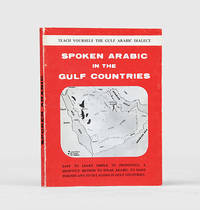
1971ref. 171721al-Khobar: The International Publications Industries 1971. Keep the following in mind and everything will be easy Fourth printing of this institutionally rare phrasebook which adopts "a short cut method simple and easy enough for a businessman to teach himself the spoken Arabic while relaxing in the Aircraft or in his Hotel room. Many of the oil industry people in Arabia owe their local friendship to this book". Arranged by topic the book has sections on greetings shopping food and drink and other practicalities such as taking one's car to a mechanic. The unnamed author places a premium on language as a key to understanding local culture: "you will find the Gulf Arabs intensely loyal to their friends as well as to their families. Most of them are blessed with a keen sense of humor. For these and other reasons such as their hospitality and courtesy you will enjoy getting acquainted with them". Further sections discuss the etiquette of being a guest at a traditional wedding and how to behave if invited to a private house as a guest. WorldCat lists only four copies in institutions Oxford National Library of Wales National Library of Israel Bilkent University. Small octavo 115 x 117 mm. Wire stitched in the original printed wrappers spine lettered in black. Minor wear to wrappers contents lightly toned not affecting text. A very good copy. unknown
ref. 686284to. 265 pp. 23-24 & 173-174 missing 11 pages unused page 71 repeated i.e. 251 of 300 numbered pages employed for the manuscript minutes of board meetings and for occasional other purposes; several typed pages or notes laid in or affixed to a page. Minutes in pen and pencil in the hands of recording secretaries Harry Hartmeir Frank Piaget John Connolly and others. Founded in 1895 as the Paterson Golf Club and incorporated as the North Jersey Country Club in 1897 this minute book covers an important period in club history as plans to build roads through the Paterson location occasioned a move to Wayne in 1917 the purchase of the 327 acre Greenbrook Farm in 1921 and the building of a new club house there in 1922; the construction of its new golf course designed by Walter Travis began the same year opening in 1923. The club and course continue today. Contemporary notebook half-leather and black pebbled cloth very worn leather spine gone leather corners mostly gone edges bumped and worn; interior very good and quite legible. unknown