4 361 résultats
Aquatint print (image size: 485 x 390 mm, not including title and imprint; paper size: 55 x 45 cm), engraved by Jean Pierre Jazet after Vernet. Striking aquatint of a Mamluk leader by the acclaimed French artist Carle Vernet (1758-1836), best known for his depiction of horses and war scenes. The Mamluk leader is depicted in traditional garb with a scimitar dangling from a robe in his hand, on a horse, with a fighting scene in the background in front of a Middle Eastern town. The engraver, Jean Pierre Jazet (1788-1871), must have been a skilled artist himself. - A lithographed copy, retaining some of the original splendour, was published in Vienna by Joseph Trentsensky a few years later. - A fine copy in a crisp impression. Dayot, Carle Vernet (1925), no. 102. Nagler XXII, p. 440. Cf. Mennessier de la Lance II, p. 617.
1900réf. 664unknown: unknown 1900. 9 1/2 x 8 inches 8 x 8 inches 8 x 8 inches. Very good condition. This is a set of three very rare etchings of golf. The first is a layout of the first tee and closing hole at St. Andrews Old Course. The second is of a golfer finishing his swing with. golfers in the background. The third is a golfer loonig at a difficult shoe if not impossible. These are very old and quite rare. They have been in my possession for 40 years and are new to the market. At one time I had the name of the artist but have misplaced my fact sheet. See pics. unknown unknown
1842Large 4to. 216, (2) pp. With lithogr. portrait frontispiece, map and 47 plates (46 of which are costume lithographs in original colour). Original illustrated wrappers bound within contemporary brown cloth with giltstamped front cover illustration (spine rebacked with giltstamped label). First edition. - When Count Loevenhjelm was appointed Swedish ambassador to the Porte, the naturalist Hedenborg (1787-1865) accompanied him as his medical attendant. He published another work on Egypt and died in Rhodes. The attractive plates in this present work depict the costumes of a wide range of the inhabitants of Constantinople. - Binding rubbed; interior browned, showing the occasional fingerstain. Rare. Atabey 567. Blackmer 800. Howgego II, E5 (p. 195). Göllner 40. OCLC 34458777. Not in Lipperheide, Colas or Hiler.
Hand-coloured engraved map (645 x 540 mm). Guillaume de l'Isle used the three classic divisions in this map, but it also contains other divisions and subdivisions based on geographical and political considerations. - Well preserved. Tibbetts 199. Cf. Al-Qasimi 268 (Paris ed. 1707).
Engraved map (61 x 51 cm), hand-coloured in outline. Shows east to west Caravan routes. Marked with various well locations. Al-Qasimi 221.
Oblong folio (590 x 500 mm). Engraved map in contemporary hand colour. Decorative cartouche, compass rose. Beautiful example of Cornelis Danckerts’ map showing the Arabian Peninsula, Persia, Turkey, Cyprus, Egypt, and the eastern part of the Mediterranean. Slightly brownstained; otherwise in fine condition. Al Ankary 77.
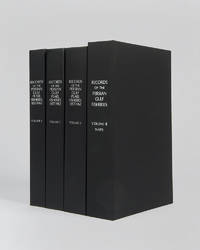
réf. 122017London Archive editions 2026. . 4 vols 8vo; includes a map portfolio with 7 maps original black cloth lettered in white a fine set. A very important work on the pearl fisheries of the Arabian Gulf bringing together in a single research collection all relevant documents from British government records relating to the pearl industry the most important economic activity in the Gulf before the oil era. London, Archive editions, 2026. hardcover
1963réf. 153757London: Geographical Section General Staff 1963. Scarce charts of Bahrain and the Straits of Hormuz A rare and historically interesting pair of adjacent maps of the Arabian Gulf covering six degrees of longitude each the geographical area encompassing the whole of Qatar Bahrain and part of what was to become the United Arab Emirates Al-Hofuf being the major city in the Al-Ahsa Oasis Eastern Province Saudi Arabia; sixth and fifth editions respectively. Maps of the period issued by the GSGS Geographical Section General Staff use a 7-colour tint scale to distinguish altitude and a glossary that highlights towns of significance and other standout features which provided steady references for army personnel to aid navigation in the challenging conditions of the region. The Bander Abbas map was compiled by the US Army Map Service Corps of Engineers from a number of sources including USAF Aeronautical Approach Charts of 1951-55 and the US Geological Survey of the Arabian Peninsula 1958. The Hofuf chart is based inter alia on 512 Field Survey Royal Engineers charts 1942-4. WorldCat lists just three individual copies for Hofuf NG39 SUNY at Buffalo University of Notre Dame and Eastern Illinois University alongside four copies of Bandar Abbas NG40 University of Exeter University of Notre Dame Eastern Illinois University and University of South Florida. It should be noted that major national institutions - BL for example - will have holdings of these maps within the complete GSGS series. Most copies would be discarded on supersession making these an important record of cartographic progress in the region. Two two-colour printed maps 1:1000000 scale 690 x 610 & 750 x 610 mm respectively. Ex- libris stamp of Arizona State Library both stamped "superseded" in blank margin and "withdrawn" on verso some pencilled marginalia; both in excellent condition. unknown
1956réf. 153759London: Geographical Section General Staff 1956 & 1957. Scarce maps of Oman and south-east Arabia dating to the Jebel Akhdar War A pair of decidedly uncommon and impressively sized regional maps both second editions Muscat-Musira following the first of 1945 S. E. Arabia first published in 1956. The Muscat-Masira map drawn up by D Survey of the Ministry of Defence reaches as far north as Khaburah Oman on the coast south beyond Masirah Island and westward reaching beyond Lahus and Hadhi. It is based on several mappings including Bertram Thomas's map of Rub' al Khali the "Empty Quarter" 1931 the sand desert covering most of the southern third of the Arabian Peninsula Samuel Barrett Miles 1910 map of Oman and Captain F. F. Hunter's map of Arabia 1935 revision. The aeronautical chart goes into greater detail reaching beyond Sur in the North South to Masirah Island and Manadhif and West to Uruq ash Shaybah UAE; this was drawn up by No. 1 SPC.RE i.e. Survey Production Centre Royal Engineers and is based largely on the USAF Aeronautical Approach Charts 1956 and World Aeronautical Chart 563 1951. During the mid to late-1950s Britain was involved in a number of disputes in Oman perhaps the most serious involving the Imam Ghalib al-Hinai and his brother Talib bin Ali who led the Imamate's revolt against Sultan Said bin Taimur which resulted in the Jebel Akhdar or Oman War 1954-1959. In this the RAF played a leading role not least because aircraft could at the same time expedite oil exploration operations in the interior of Oman. Pembrokes light transport aircraft and heavier Avro Ansons from 1417 Communication Flight RAF carried out reconnaissance "and other tasks during this operation against the Imamate and were the first aircraft ever to land at Nizwa marked "Nazwa" on the chart on a roughly cleared strip which proved extremely hazardous for the pilots but which was later transformed into a passable airfield" Lee p. 22. The present chart has two pencilled lines radiating from Masira airfield one of which passes through Nizwa near which is marked the "approx. position" of an airstrip. The chart bear the proviso that they should "not be taken as an authority on names" and that "the alignment of all tracks is approximate". Users were also directed to update information and highlight errors which were to be directly sent to the Director of the Military Survey in the War Office. There are noticeable graphical variations between the chart and map as fitting their usage. Before the Second World War pilots flew using landmarks - such as train tracks or roads - as pointers which meant that they relied on perfect weather conditions. However technological advances in aviation alongside the use of radio for more accurate navigation meant that to a degree pilots could work in more challenging conditions. This meant that maps with their focus on terrain and details relevant from the perspective of ground troops would become irrelevant when observed from a plane's altitude. Therefore a number of countries started to produce charts highlighting key information by reducing the contour structure and focusing on key landmarks necessary for aviators. The Muscat-Masira map uses a five-colour tint scale to distinguish altitude includes a glossary and key the latter identifying towns given four categories of importance significant ruins geographical features such as mountains hills marshes saddles and passes rivers water holes and man-made features such as railways roads tracks telegraph lines pipelines and pumping stations mosques and temples; tribal and regional names are also given. However reflecting the simplification required by pilots the S. E. Arabia chart only uses fives tones to highlight land mountains paths and the sea. These maps intended for use in the field would have had a high rate of attrition; WorldCat locates just a handful of copies of the Muscat-Masira map whilst S.E. Arabia 4802 is well represented institutionally but decidedly uncommon on the market. Two colour printed maps the first 1: 1000000 scale 860 x 640 mm the second 1:500000 scale 1100 x 825 mm. Both with creases from old folds and some minor marginal splits and spots the second with pencil lines marking a flight route from Masira Island and a notation in the margin; both remain very good. Sir David Lee The RAF in the Mediterranean and Middle East 1945-71 1978. unknown
8vo. (16) pp. Modern marbled wrappers. Extremely rare German slavery account by the Prussian clockmaker F. G. Albertus. Born in Potsdam in 1770, he visited Amsterdam in 1797, was press-ganged into joining an East India Company ship bound for Batavia, but fell into the hands of Tunisian pirates off the coast of Gibraltar. He details the horrors of his eight-year slavery in North Africa and mentions several of his fellow sufferers by name, including a Spanish Countess named Carolina who was captured at age 16 and was finally ransomed after nine years of slavery. Ultimately, Albertus is ransomed by a Dutch jeweller named Birkenthal and returns to Germany, physically broken but full of praise for the workings of God. - Trimmed rather closely (slight loss to text). Title page bears contemporary censorship stamp of the Delitzsch police. Of the utmost rarity: a single other copy is known (bound within sammelband A/31581:9 in the State and University Library of Hamburg). OCLC 837821535 (SUB Hamburg).
Folio (262 x 358 mm). 35, (1) pp. With 9 plates. Original wrappers printed in red, stored loosely within original dedicatory giltstamped cloth portfolio with white moirée endpapers. Handsome facsimile publication produced on the occasion of the centenary of the University of Turin (27 October 1906), under the editorship of the professor of philosophy Ettore Stampini (1855-1930) for the Academic Council. Dedication copy for Sultan Abdülhamid II (1842-1918), the 99th caliph of Islam and the 34th sultan of the Ottoman Empire. The Sultan was to be deposed in 1909; but two years later, Italy and the Ottoman Empire would go to war over Libya. - Rather strongly browned throughout, as usual; still a good copy with fine provenance. OCLC 16164614.
4to. 3 vols. (4), CII, 603 pp. VIII, 730 pp. VIII, 650 pp. Contemporary brown full calf by Gosselin of Paris, with richly gilt spines, red giltstamped title labels to spines, and giltstamped borders to covers, leading edges gilt, gilt inner dentelles. Marbled endpapers. All edges sprinkled red. Important collection of research on and excerpts from manuscripts concerning history, diplomacy, literature, and science from the Bibliothèque du Roi, now the Bibliothèque nationale de France, including important contributions by the oriental scholars Antoine Isaac Silvestre de Sacy and Joseph de Guignes, the historians François de l'Averdy and Louis-Georges de Bréquiny, and the classicists Guillaume Dubois de Rochfort and Jean-François Vauvilliers. - Volume 1 contains a long preface on the history of the oriental types of the Imprimerie Royale that were cast for the diplomat and orientalist François Savary de Brèves (1560-1628). Acquired by Richelieu for the Imprimerie, the valuable types were almost destroyed in the 18th century and saved by Joseph de Guignes, who wrote the preface. The volume also contains Guignes's comments on Al-Masudi's "Kitab Muruj al-Dhahab wa-Ma‘adin al-Jawhar" and Ibn-al-Athîr's "Al-Tarikh al-bahir fi al-Dawlah al-Atabakiyah bi-al-Mawsil" and two essays on Arabic manuscripts by Silvestre de Sacy. - Volume 2 includes two contributions each by Joseph de Guignes and Silvestre de Sacy on oriental manuscripts of the Bibliothèque du Roi. - The final volume focuses primarily on documents relating to the trial of Jeanne d'Arc, with several articles written by François de l’Alverdy. To this volume Guignes contributed a commentary on a 15th century Arabic manuscript recommending pilgrimages to the Al-Aqsa Mosque in Jerusalem, and another on a manuscript entitled "On the prerogatives of the Al-Aqsa Mosque" by Ibn Abul Sherif. - The collection was inceived under the auspices of King Louis XVI and the Baron de Breteuil. By 1965 it grew to encompass 43 volumes, but only the three volumes at hand were published under the original title by the Académie Royale des Inscriptions & Belles-Lettres. The printing of a 4th volume had already begun in 1791 when it was interrupted by the French Revolution, which also led to the suppression of the Academy in 1793. - Spines rebacked, spine ends, corners and hinges repaired. Internally entirely sound.
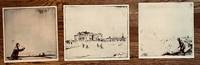
Small 8vo. 2 vols. VIII, 320 pp. 406, (2) pp. With 2 engraved frontispieces. Somewhat later brown cloth with giltstamped spine titles. Edges sprinkled. First edition; very rare. This is the earliest "édition pour la jeunesse" cited by Chauvin, containing such popular episodes as "Haroun al Raschid" and "Ali Baba". The editor chose not to tamper with Galland's century-old text, since modernisations would have compromised the "naïveté de narration". Contemporary reviewers, however, were quick to point out that any parts unfit for juvenile consumption had been omitted, while difficult passages referring to oriental customs were elucidated by editor's notes. A second edition (enlarged by a glossary) was published in 1825; a German translation would appear in 1828. - Bindings slightly rubbed. Interior evenly browned with light spotting. From the library of the Bohmian lawyer and amateur naturalist Ludwig Grasse of Reichenbach, with his repeated ownership stamps (ca. 1900). Rare; OCLC lists only three copies in libraries internationally (Cleveland; Weimar; Erlangen-Nuremberg). Chauvin IV, 76. OCLC 4433944.
8vo. 128 pp. Original printed yellow wrappers (spine repaired). First separate edition of this tale from the Thousand and One Nights. The Arabic text, printed here in its entirety with a French translation by the editor, is taken from the six-volume Constantinople edition. - Lower corner a little buckled, still a good, sound copy. Removed from the "Institut für Geschichte und Kultur des Nahen Orients an der Universität München" with their stamp on the title-page. Rare. Chauvin VI, p. 18. OCLC 4447422.
Albumen prints: 3 cabinet cards (ca. 14 x 10 cm) and 3 cartes-de-visite (ca. 9 x 5 cm, including 1 repeat), all mounted on cardboard, two with Geiser's studio imprint. A collection of rare portraits by the Algiers-based photographer Jean Geiser (1848-1923) showing Algerian women in traditional dress, both veiled and with uncovered faces. - Occasional light staining, but well preserved.
4to. (8) pp. Later marbled boards with shelfmark label to front cover. Extraordinary account of a fire in the port of Algiers planted by the British pirate-hunter Richard Gifford. Of the utmost rarity: "unknown to Lowndes, and other bibliographers" (Libri). Only two library copies traceable internationally (St. Pancras Library, London, and Amsterdam University Library). - On Holy Tuesday 1604, in the service of the Duke of Tuscany and under the pretext of becoming a pirate, Gifford set the Algerian galley fleet on fire in the notorious pirate-ridden port of Algiers, causing fierce retaliation by the Algerians. "Although he escaped and there was not much damage done, about a dozen Englishmen including his abandoned crew members were all executed. Furthermore, the pasha banned English ships, Janissaries seized English citizens and arrested English merchants, confiscating their goods for the damage done by Gifford" (Güvenç). - "During the Anglo-Spanish wars Captain Richard Gifford had served under Sir Francis Drake and Sir John Hawkins [...] after the wars he became a pirate-hunter, a freelance mercenary hired by the grand Duke of Florence to extirpate the infamous nest of sea rovers at Algiers" (Bak). - Spine rubbed; somewhat foxed throughout. Handwritten date "1825" to flyleaf, likely the date of acquisition. The celebrated library of M. Guglielmo Libri 184. Senlen Güvenç, "A Foe to All Christians": The Notorious English Corsair Captain and Ottoman Reis John Ward", Çanakkale Arastirmalari Türk Yilligi 29 (2020), 35-54, at p. 41. Bak, Barbary Pirate, Stroud 2006, 47.
8vo. 8 ff. With woodcut printer's device to title page. Modern boards. Brief introduction to the Armenian language for Catholic missionaries. "The types are those cut by Grandjon in 1579, and this is therefore a late specimen of that fount" (Smitskamp). Includes a table of the alphabet and the Lord's Prayer and Ave Maria in Armenian. "The best known products of the Propaganda Press, apart from its missals, grammars, and dictionaries, are the Alphabeta" (Smitskamp 193). This is, perhaps, litte surprise, for the missionaries sent forth to all parts of the globe by the Roman see through the Sacra Congregatio de Propaganda Fide, founded by Pope Gregory XV in 1622 for the purpose of spreading the Catholic interpretation of the Gospel, depended on language study textbooks such as these. The production of such alphabets was taken up as early as 1630 and was not discontinued until the early years of the 18th century; in 1812 the Congregation's in-house printing office was dissolved. - Slightly browned throughout. Smitskamp 200. Graesse I, 85.
Gelatin silver prints (vintage). Approx. 87 x 142 mm. Rare collection of vintage photographs showing the breeding of race horses, mostly Arabians: the sire covering the dam, surrounded by handlers; individual portraits of horses, captioned on reverse ("Jerez Arabe", "Bourbon Barrymore", "Idilio I Arabe", "Hoyo Arabe"). - Two additional images show the breeding of donkeys. Removed from an album, with traces of glue mounting on reverse. Some brownstaining; occasional nicks or slight edge damage (slight loss to left of one image).
Royal 8vo (24 x 16 cm). 14 (instead of 17) vols. With frontispieces and numerous illustrations (vol. 8 lacking one image). Contemporary richly gilt full cloth. Top edges gilt. - (2) The same. The Book of the Thousand Nights and a Night. A Plain and Literal Translation of the Arabian Nights Entertainments. Vol. IV. (Including: Supplemental nights, vol. VI). (Colophons: USA), ibid., [ca. 1940]. Contemporary richly gilt and silvered full cloth. Top edges red. The first Burton Club edition of Richard Burton's celebrated translation of Alf Laylah wa-Laylah, commonly known in English as the Arabian Nights. These Arabic tales, cherished in Europe since the early 18th century, are often erotic in content, and in Burton's unexpurgated translation they outraged Victorian England. Burton included numerous footnotes and a scholarly apparatus, offering a vivid picture of Arabian life, which set his translation apart from earlier English renderings. Bold to a fault, Richard Burton travelled to Mecca, explored the African Great Lakes, shocked his readers with his candid travel accounts, and gained fame and riches with his translation of the Arabian Nights. The first edition was published in 1885-88 and re-issued by the Burton Club shortly thereafter. - The present set lacks volume 4 of the "Nights", as well as volumes 4 and 7 of the "Supplemental Nights". The volumes numbered "IV" and "V" of the "Supplemental Nights" are in fact volumes 5 and 6. In lieu of the missing tomes the collection includes volume 4 of the "Arabian Nights" and volume 6 of the "Supplemental Nights" from a later 16-volume Burton Club edition, which Ross dates ca. 1940. This later date is supported by the fact that this edition is not included in Penzer's thorough bibliography published in 1923. - Spines slightly faded; extremities lightly worn. A fine set, uncut and partly unopened. Penzer 131. (2) Scheherazade's Web: The 1001 Nights & Comparative Literature, J. Ross 10 & 11.
Engraved map in hand-drawn outline colour. 720 x 533 mm. Constant ratio linear horizontal scale 1:7,000,000. Relief shown by hachures and shading. Greenwich meridian. A fine engraved map of the Arabian Peninsula, also showing the Arabian Gulf, the Red Sea, and the Horn of Africa. Shows boundaries, rivers, deserts, caravan routes and principal settlements. With early outline hand-colouring on wove paper with watermark date of "1823". Also issued as plate 46 in Thomson's "A New General Atlas" (1821-29). - Well preserved. Cf. Al-Qasimi (2nd ed.) pp. 255 & 258. Tooley's IV, 271. OCLC 43216571.
8vo (18 x 13 cm). 78 ff., naskh script with features of ta'liq, in several different hands. Half-leather Oriental binding with a flap and pasted boards. A collective volume with texts in Arabic on Arabic manuscript paper (for ff. 43-45 and from f. 73 onwards European paper is used). It was copied by Ahmad b. 'Uthman al-Arzan al-Rumi in the city of Qustantiniyya (Istanbul) in one of the eight madrasas (colophon in a later hand on f. 78a). - 1) ff. 1v-13v. Fragment without beginning or end, and possibly misbound, of a gloss on logic (Qala-aqulu structure). Possibly this is the commentary by Qutb al-Din al-Razi al-Tahtani (d. 766/1364) on al-Risala al-Shamsiyya fi al-Quawa 'id al-Maniqiyya, by Nagm al-Din 'Ali b. 'Umar al-Quazwini al-Katibi (d. 675/1276 or 693/1294), Gal G I, 466. Outb al-Din is mentioned on f. 1v. Heavy interlinear and marginal glossing. - 2) ff. 14b-59b. Gloss on logic (Qala-aqulu structure), apparently by al-Sayyid al-Sharif, whose name is mentioned variously. This is the gloss by al-Sayyid al-Sharif al-Gurgani (d. 816/1413), GAL G II, 216, on the commentary by Muhammad b. Qutb al-Din Muhammad al-Razi al-Tahtani (d. 766/1364), GAL G II, 209, on al-Risala al-Shamsiyya fi al-Qawa 'id al-Mantiqiyya, by Magm al-Din 'Ali b. 'Umar al-Qazwini al-Katibi (d. 675/1276, or 693/1294), GAL G I, 466, as confirmed by comparison with MS Berlin Mq. 63 (= Ahlwardt 5260). - 3) ff. 60a-78b. Acephalous fragment of a gloss on logic (Qala-aqulu structure). In the margin of f. 60a is the name "'Sayyid Tasdiqat'", which may indicate that his is another gloss by al-Sayyid al-Sharif al-Gurgani.
Vintage lithographed poster backed on linen. 1060 x 680 mm. Tiger-themed poster by the British Overseas Airways Corporation (BOAC) in association with Qantas Empire Airways, South African Airways, and Tasman Empire Airways. An early document of modern aviation in Pakistan, which had gained independence only in 1947, after the Partition of the British Indian Empire, which awarded separate statehood to its Muslim-majority regions. Affiches Air-France-2006, p. 149.
8vo. (4), 78 pp. - (Bound with) II: Epistola ad Hebraeos arabice. Ibid., 1742. (4), 54 pp. - (Bound with) III: [Acta apostolorum arabice. Ibid., 1742.] 192 pp. (lacking title pages). - (Bound with) IV: [Summula historiae sacrae Arabice. Ibid., 1737]. (2), 26 (instead of 28) pp. (Arabic title only; lacking final leaf of text). In a single appealing 19th-century half calf binding with marbled boards; spine lettered in gilt. All edges yellow. Collection of rare Arabic versions of several parts of the New Testament: St Paul's Epistle to the Romans and the Epistle to the Hebrews, as well as the Acts of the Apostles (with the Latin and Arabic title pages in facsimiles) and a brief synopsis of the Sacred History, for the benefit of Muslim readers (lacking the final leaf). Edited by the German oriental scholar and Lutheran theologian J. H. Callenberg (1694-1760), a champion of the Protestant mission among Jews and Muslims, and published at his own printing office. - In Arabic throughout. Well preserved. All very rare. Cf. Jöcher/Adelung II, 39ff.
Folio (271 x 493 mm). Broadsheet with 5 engravings and two columns of letterpress. Extremely rare, uncommon print describing the legendary Biblical city of Enoch, the "first city of the world", founded by Cain and named after his first son (cf. Gen. 4:17). The centre of the sheet shows a large (264 x 152 mm) view of the city (workmen erecting the walls in the background; Cain's family farming in the foreground), with numerous animals including elephants and lions. The smaller engravings to the left and right (130 x 85 mm each) show pumpkins ("Pepones"), a white falcon, a crane, and several marine animals (including a seal, dolphin, and sand flea). To the left and right of these are columns of letterpress text describing the city in eight twelve-line verses. - The style of the view is obviously closely related to the illustrations familiar from the Prague engraver Jan Hiller (active 1716-46, cf. Dlabacz, Allgemeines Künstlerlexikon für Böhmen I, 628-631), who also provided the plates for Myller's "Peregrinus in Jerusalem", a work that not only contains several topographical views, but also botanical and zoological illustrations. The Myller plate "La Ragna, die Meer-Spinne" shows several of the marine creatures depicted here in exactly the same fashion: clearly, Hiller re-used his work for the present broadsheet. This conclusion is further supported by the fact that the five plates evidence varying degrees of wear: while the large, central illustration shows good, strong contrast, the other four are markedly fainter. - Mounted on sturdy paper, probably by a near-contemporary collector; trimmed close to the plate edges. Slight brownstaining.
Folio. 28 (misnumbered: 29) pp., 1 blank f., (2) pp. 19th century marbled wrappers. Amsterdam legal injunction against the mother, father, and brother-in-law (formerly defendants and now counterclaimants) of Frans Canter, manager of the VOC factory at Basrah from 1746 till 1750, who had infamously fled his post when he was to be replaced by Tido Baron Kniphausen. Fearing exposure for having embezzled Company funds, Canter had escaped to nearby Grain (Kuwait): "Sig van Bassoura door de vlugt heeft geretireert naar Green" (p. 4, no. 46). He continued his flight by caravan to Aleppo, then to Iskenderun, and finally by ship to Amsterdam, "where the East India Company was unable to get him prosecuted by the autonomous government of this town. - Canter's flight to Grain is a typical manifestation of a basic characteristic of Kuwait. Its essential function in the life of the Gulf at that time was that it was an area outside the sphere of influence of the Ottoman Government of Basra. In this way, it could serve as a refuge for both persons and trade when, for one reason or another, there was risk of trouble in Basra. This little desert trading town was born and continued to grow because of the simple fact of its being outside the troubled area of Ottoman Iraq" (Slot, The Origins of Kuwait, p. 117). Canter is also memorable for having composed, in the course of his escape, the first known letter written in Kuwait. While the original is lost, a contemporary copy made by an Amsterdam notary during these legal proceedings now rests in the General State Archives of the Netherlands (cf. Slot, p. 117-121). - Slight duststaining to the wide margins. A rare survival. Landwehr, VOC, 1020. OCLC 71711399. Not in Knuttel.