4 577 résultats
2017réf. 029687OnePutt Press 2017. INSCRIBED / SIGNED by the AUTHOR directly on the dedication page. NEW and unread in PERFECT condition. Flat spine. NO chips tears creases rubbing or fading. Bright and shiny. Sharp corners. Pages are fresh crisp clean and unmarked - obviously never read. Laid in are two full color photos of The Westin Mission Hills Gary Player Signature Course in Ranch Mirage California where the author is a golf writer and Head Teaching Professional. Bound in the original pictorial wraps. From the rear cover: " A young man determined to launch a career as a gold professional must first overcome self-doubt heartbreak and limited resources. His propects improve when he meets Jitterbug Bell a local golf legend with a unique gist for teaching. Jitterbug's Gift is a treasure trove of golf knowledge.". INSCRIBED / SIGNED by the AUTHOR. 1st ed No additional printings listed. Softcover. New. xi 148pp. Great Packaging Fast Shipping. OnePutt Press Paperback
4to. (8), 200 pp. With 8 engraved plates (some with touches of colour, two folded). - (Bound with) II: Wenner, Adam. Türckisches Reisebuch von Prag aus biß gen Constantinopel [...]. Nuremberg, Johann Andreas Endter & Wolfgang Endter's heirs, 1665. (8), 135, (5) pp. Title printed in red and black. Contemporary full vellum with handwritten title to spine. Exceedingly rare Mediterranean travelogue: one of two German editions published in the same year (the other, an entirely different translation, by Cunradus in Amsterdam; the Nuremberg edition cited by several bibliographies is fictitious). Dutch editions had previously appeared in 1649 (the first) and in 1661. Although the Amsterdam-published German edition dates the journey to 1640-42, the Dutch first edition as well as the present translation make it clear that it had taken place as early as 1590-92! Somer's voyage began inauspiciously - he was captured by a Turkish galley in the harbour of Famagusta and briefly enslaved, but was soon set free after the French consul at Alexandria intervened for him. In spite of this episode, he travelled the Ottoman Empire at a time of relative peace (the Long Turkish War with the Habsburgs would not break out until 1593), spending several months in Egypt, Constantinople and Palestine. His colourful account includes a description of desert sandstorms and the trade in Egyptian mummies (not all of them ancient) as well as extensive chapters on Constantinople, the Ottoman court, the ubiquitous baths, Turkish customs and manners, the Muslim faith, curses and magic, etc. Somer returned via then-Ottoman Greece and Hungary, which he also describes. An appendix (pp. 170ff.) contains A. Stockram's topical account of the voyage of the Dutch ship Arnheim, which foundered off Mauritius on the return from Batavia. The translation is credited to "Philemerus Irenicus Elisius" (i.e., Martin Meyer). Rare; the last copy in auction records sold in 1983 (Erasmushaus, an incomplete reissue with only 5 views). - Bound after this is the second edition of A. Wenner's narrative of the Imperial embassy to the Porte in 1616-18, to ratify the Treaty of Zsitvatorok. Wenner served as secretary to the embassy; his "book is a day-to-day account of the journey to Constantinople from Prague, and includes a list of all the entourage from nobles to the apothecary, goldsmith, musicians, tailors, cooks, and so on. A list of presents for the sultan, with their values, is also given" (Atabey). The Treaty of Zsitvatorok "was a landmark in Turkish-European diplomatic relations, when the Turks first began to observe the general principles and courtesies of international law, and to exchange special ambassadors on an equal footing with European nations" (Blackmer). - Some browning throughout due to paper, more pronounced in Somer's work, the title-page of which shows an unobtrusive tear in the upper edge. Contemporary handwritten ownership "Bocken" to recto of flyleaf; verso has stamp and 1978 ownership of the Viennese collector Werner Habel (1939-2015). I: VD 17, 23:231760C. Tobler 86. Röhricht p. 217, no. 820. Paulitschke 532; Ternaux-Compans, Bibliothèque asiatique et africaine, 1977 (both have "Nuremberg" in error for Frankfurt). Cf. Weber II, 216 (Amsterdam German ed.); Kat d. Scheepvart Mus. I, 254f. (Dutch eds.). Not in Atabey, Blackmer, Aboussouan, Howgego, Henze, Cox, or Chauvin. - II: VD 17, 23:234557B. Cf. Atabey 1326; Blackmer 1783; Brunet VI.2, 435 (all for the 1622 first edition). Not in Röhricht, Tobler, Aboussouan or Brunet.
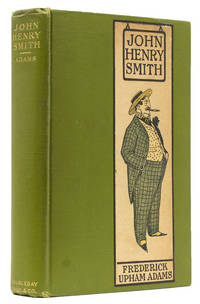
1905réf. 245773New York: Doubleday Page 1905. First edition. With 42 illustrations by A.B. Frost. 346 pp. 1 vols. 8vo. Cloth with inset paper label of Golfer on upper cover. Gift inscription on front flyleaf. Owner blindstamp on rear flyleaf. Very good. Frost A.B. First edition. With 42 illustrations by A.B. Frost. 346 pp. 1 vols. 8vo. Donovan & Murdoch 4850 Doubleday, Page unknown
1905réf. 245773New York: Doubleday Page 1905. First edition. With 42 illustrations by A.B. Frost. 346 pp. 1 vols. 8vo. Cloth with inset paper label of Golfer on upper cover. Gift inscription on front flyleaf. Owner blindstamp on rear flyleaf. Very good. Frost A.B. First edition. With 42 illustrations by A.B. Frost. 346 pp. 1 vols. 8vo. Donovan & Murdoch 4850 Doubleday, Page unknown books
Pastel on paper, laid onto canvas stretched over (original?) wooden board (305 x 410 mm). This pastel was drawn by the prolific itinerant portraitist John Saunders (1682-c. 1758) at Peterborough in September 1739. Saunders is recorded as active in East Anglia, the Midlands and elsewhere in the mid-18th century (cf. Neil Jeffares, "John Saunders", Dictionary of Pastellists Before 1800 [London, 2006]). The sitter, John Sturges in Turkish costume, wearing a white turban with blue feather and golden embroidered coat, was probably drawn from a mezzotint after John Vanderbank (1694-1739) by Francis Kyte (d. 1744), published in 1733. The pastel is of interest as an example of mid-18th century depiction of Turkish costume. Saunders, perhaps in an attempt to add extra exoticism to Mr. Sturges, has included a curling moustache that is not present in the mezzotint. Sturges, an architect based in the East Midlands, is known to have collaborated with William Talman (1650-1719) at Chatsworth and Milton House in Northamptonshire. The fact that this pastel was produced in Peterborough may indicate some connection with descendants of Sturges, assuming that he himself was dead by 1739. The Fitzwilliam Museum holds a drawing of John Sturges by John Vanderbank (wash on paper, PD.1-1992). - Verso with label bearing 19th century manuscript note concerning the autograph pencil inscription by Saunders top right: “Saunders pinxit after Mr. J[oh]n Vanderbank Peterborough Sept. anno d. 1739”. Two negligible scratches to surface, otherwise good, offered without frame.
Hand-coloured engraved map (456 x 345 mm). Decorative map of Turkey, Persia, Arabia, Afghanistan, Beloochistan and contiguous regins., with large inset views of Smyrna, Trebisond and Muscat. Shows excellent detail, including towns, rivers, mountains, deserts, roads, etc. Al-Qasimi 270.
Folio (212 x 298 mm). 25 ff. Contemporary brown leatherette binding with giltstamped cover-title. The original Joint Venture Agreement between the state-owned Iraqi Drilling Company (IDC) and the Mesopotamia Petroleum Company (MPC), with the autograph signatures of Idriss Muhsen Al-Yassiri, General Director of IDC, Stephen Remp, Director of MPC and its associate Ramco Energy, and Peter Redman, Director of Midmar Energy and Firstdrill, other associate companies of MPC. - This joint venture, known as the Iraqi Oil Services Company LLC (IOSCO), was created with the objective of drilling 60 new wells each year in the Republic of Iraq, thus significantly increasing oil and gas production. This groundbreaking deal was the first joint venture of its kind between the Iraqi Ministry of Oil and a foreign oil company since the fall of the regime of Saddam Hussein in 2003. On 7 July 2009, IDC terminated the agreement after MPC failed to fulfil financial obligations. MPC was unable to confirm funding of $44.1 million to meet the initial capital commitments to preserve its 49 percent stake in the venture. - Handwritten addition by Stephen Remp on fol. 4 specifying the territory of the joint venture: "(i.e. Missan Province or any other Provinces to be mutually agreed by The Parties.) [...]". - In mint condition.
8vo. 4 vols. 36 pp. (Jordan). 192 pp. (Iraq). 88 pp. (Iran). 52 pp. (Afghanistan). Original illustrated stiff wrappers, each volume with a map on the inside front cover. Collection of four curious foreign trade monographs issued by the Austrian Chamber of Commerce, directed at Austrian concerns aiming to do business with the Near and Middle East. With the exception of Iraq, where the revolution of 1958 had just heralded a republic, all countries here discussed were still monarchies. Contains general geographical data and statistics, details on units of measurements, economic structure, and customs of trade.
Toned lithograph. 375:540 mm. From a series of illustrations depicting the Old Testament story of Joseph within oriental scenery of bedouins, palms, and camels. Joseph (Yusuf) is regarded by Muslims as a prophet (Qur'an, suras vi, 84; xl, 34), and a whole chapter Yusuf (sura xii) is devoted to him, the only instance in the Qur'an in which an entire chapter is devoted to a complete story of a prophet. - A few edge flaws, some repaired, with some browning and staining.
8vo. English ms. in blue ink on paper. 69 pp., interleaved with pink blotting paper. With several coloured ink sketches. Bound in red morocco with inscribed cover "Journal of the proceedings on board the ship Oriental from London to Bombay". Marbled endpapers, inscribed "W. Collingwood. Journal Book". A passage journal kept aboard the ship "Oriental" from London around Africa to Bombay between 6 January and 30 May 1846, written in a neat and clear hand with occasional coloured ink sketches. The varied content includes weather observations, poetry, and day-to-day commentary: "March 31st 1846 Tuesday: A large shoal of porpoises playing about the bows the mate went out on the dolphin striker to harpoon one but was unsuccessful [...]", "May 11th 1846 Monday: This morning we sighted Coëtivy, it is a low rocky shore sprinkled with Cocoa nut trees etc., before 12 it was out of sight [...]" (includes a panoramic sketch of the coastline). - Lieutenant William Collingwood, a distant cousin of the Admiral, was an R.I.N. surveyor who did much valuable work in Iraq, including the large-scale, though surreptitious, mapping of Baghdad in 1855. During this same expedition, Collingwood also surveyed the Shatt-ul-Arab, the city of Bussorah (also by stealth) and much of the country between the Tigris and Euphrates Rivers, and he was undoubtedly one of the most gifted and productive R.I.N. surveyors of his day. - Binding slightly rubbed at extremeties; in good condition altogether.
4to. VI, 50 pp. With a portrait frontispiece of the author, from a photograph, 34 other photographic illustrations on plates, and a double-page sketch map of the Kittar Mountains. Publisher's purple cloth, blocked in black and gilt with ibex and palm tree. All edges gilt. First edition. Extremely rare example of this journal which covers Pretyman's 1891 hunting expedition to the Kittar mountains, the Eastern Desert of Egypt between Qena on the Nile and Quseer on the Red Sea, using the only known map of the area produced by Floyer four years earlier. H. E. Pretyman, a lieutenant in the Grenadier Guards, travelled back from Ismalia to London in 1891 but died the same year, whilst Camp Adjutant at Bisley, and it is believed he had not fully recovered from a severe attack of typhoid and jaundice in 1889. His father, the Rev. Frederic Pretyman, arranged to have the journal published as a memorial volume. - Extremeties insignificantly rubbed, light brownstaining or foxing to a few places in the first and last few leaves. An excellent copy. Meckly, Alpine Journal. Bibliography of Privately Printed Mountaineering Books 204. Lloyd, Cat. of the Graham Brown and Lloyd Collections in the NLS, 813. Not in Czech, Asian Big Game Hunting Books.
1982réf. ABE-2678142178216 PAGES-SYLVIE VARTAN EN COUVERTURE/"LES NOUVELLES CONFIDENCES DE SYLVIE"-RENE MONORY PAR CATHERINE NAY-LES NOUVELLES CONFIDENCES DE SYLVIE/6P-MALOUINES: L'ESCALADE-VILLENEUVE: LE DERNIER VIRAGE/4P-SAINT NOM: DEUX MAITRES SOUS LA PLUIE//4P-VARSOVIE LA COLERE/4P-AZNAVOUR: "MON GRAND RETOUR"/4P-A 12 ANS ILS RECOIVENT LE BAPTEME DE LA TELE-LES SURPRISES DU LIMOUSIN/POULIDOR/CHIRAC/MITTERRAND-DAVE: CET ETE AU FIL DE L'EAU-LES MALOUINES POUR LES BEAUX YEUX DE LA POMPADOUR PAR CHRISTIAN BRETAGNE/4P
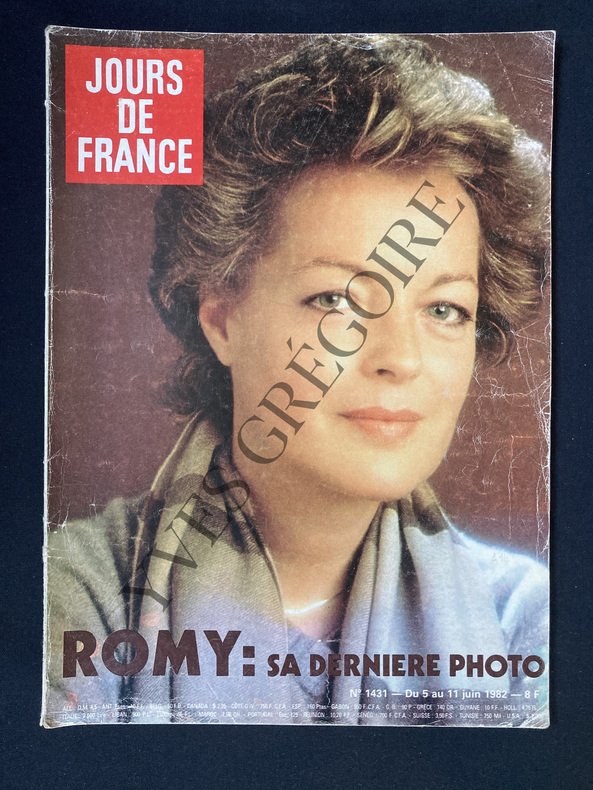
1982réf. ABE-1551260319540EN COUVERTURE "ROMY: SA DERNIERE PHOTO", GROS PLAN-KIRAZ COLOR, PARTIE DE TENNIS-INTERVIEW DE CATHERINE NAY: MAURICE FAURE, 4P-ROMY N'EST PLUS, 6 PAGES-ROLAND-GARROS: DEUX NOUVEAUX VISAGES, 4 PAGES, CATHERINE TANVIER, LOIC COURTEAU, 3 PHOTOS-ET PENDANT CE TEMPS-LA BORG ET MARIANA, 2P, PHOTO-HOSSEIN: LE MARIAGE DE COSETTE, 4P, 4 PHOTOS-AIRE SUR L'ADOUR: L'ENFER DES INNOCENTS, 6P-LES LAURIERS DE CANNES, 8P-REVILLON: LE NOUVEL ELAN DE LA HAUTE FOURRURE, 2P-LES "22" SUR LEUR 31, COUPE DU MONDE DE FOOTBALL, 2P, 5 PHOTOS-LA MODE "JOURS DE FRANCE" SPORTS, 10P, TENNIS, GOLF-COUVERTURE LEGEREMENT FROTTEE
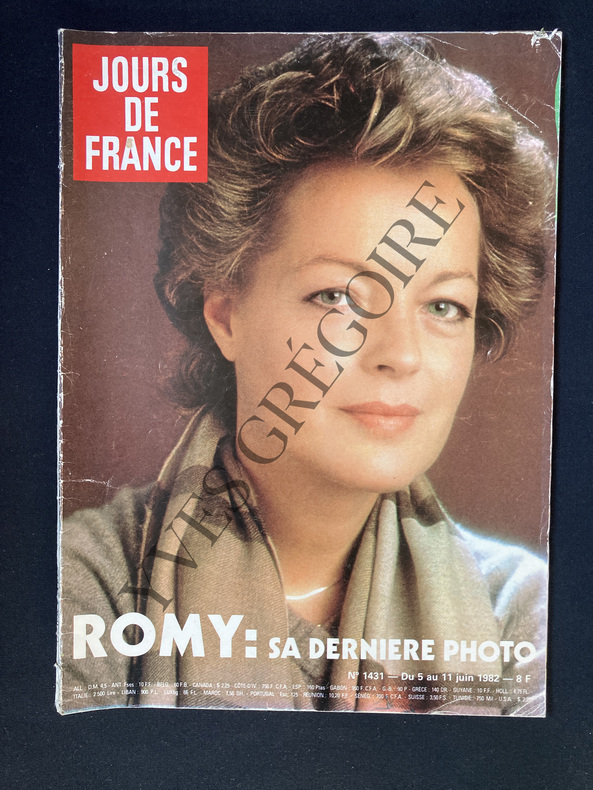
1982réf. ABE-1552585782247EN COUVERTURE "ROMY: SA DERNIERE PHOTO", GROS PLAN COULEURS-KIRAZ COLOR, PAGE COULEURS-MAURICE FAURE, 4P PAR CATHERINE NAY-ROMY N'EST PLUS, 6P-ROLAND GARROS: DEUX NOUVEAUX VISAGES, 4P, CATHERINE TANVIER, LOIC COURTEAU-DANS LA VOITURE D'ANNA: LA BOMBE, ANNA COSMEDIS, 6P-HOSSEIN: LE MARIAGE DE COSETTE, 4P-AIRE SUR L'ADOUR: L'ENFER DES INNOCENTS, 6P-CANNES-LES "22" SUR LEUR 31, 2P, 5 PHOTOS, COUPE DU MONDE DE FOOTBALL-LA MODE "JOURS DE FRANCE" SPORTS, 10P, TENNIS, GOLF
82 x 96 cm. Original colour-printed map. Scale 1:5,000,000. Rare political map of Southwest Asia from the Cold War era, centred on the Arabian Peninsula and the Gulf region but including Turkey and the Levant, Iraq and Iran. With Cyrillic titles and captions. - Small marginal flaws.
8vo. XIX, (1), 196 pp. Contemporary calf with giltstamped cover borders, gilt spine, gilt cover dedication; leading edges gilt; all edges gilt. First edition, second impression with corrected title page. Hammer's German translation of verses by a 16th-century dervish residing in Constantinople. - From the library of the Swedish diplomat Ulf Torsten Undén (1877-1962) with his ownership "U. T. Undén" signed twice to endpapers. Goedeke VII, 763, 60. Wurzbach VII, 276, 42. WG² 28. Hayn/Gotendorf III, 498. OCLC 41405611.
Folio (335 x 432 mm). 3 ff. of letterpress matter (half-title, title and list of plates). With 40 mounted calotypes. Contemporary marbled half morocco on five raised bands with giltstamped spine title; marbled endpapers. Second, "better known" (Parr/Badger) edition of this pioneering work, first published in 1854: only the plate volume with the 40 magnificent calotypes, wanting the separately published 90 pages of text. - Wishing to support L. F. J. Caignant de Saulcy in the controversy concerning the dating of the wall of Jerusalem that followed his journey to the Dead Sea, Auguste Salzmann set out for the Holy Land on 12 December 1853. With the help of his assistant Durheim, he prepared some two hundred waxed-paper negatives of the Jerusalem monuments during his four-month stay. While his findings were first published in a monumental volume in 1854 (the copy of the Duke de Luynes commanded 463,500 Euros at Sotheby's Paris in 2013), the present reduced edition, with prints by Blanquart-Evrard, is better known. "It was an expensive book, a livraison, or fasicle of three prints costing 24 gold francs. A single print was 10 francs [...] Salzmann was acutely attentive to both patina and pattern in attempting to define the architectural strata of a city in which building was built upon building, thus leaving a vertical record of the various cultures that had occupied the city and left their remains on the foundations built by earlier conquerors [...] Salzmann himself described his pictures as having 'a conclusive brutality', but to modern eyes their poetic aspect seems paramount. It would appear that Salzmann was at one and the same time both expert and layman, dispassionate observer and enthusiast. His pictures have this dual quality, flickering rapidly between documentary and poetry. This, one might suggest, is the ideal goal for any photographer". - Binding slightly rubbed and chafed in places. Marginal foxing throughout, affecting only a few photographs; insignificant waterstain to edge; old ownerships erased from title, leaving slight traces. Parr/Badger, The Photobook I, 25. Tobler 181f. Röhricht 440f. Baier, Geschichte der Fotografie 452f. Gernsheim, History of Photography 186. Witkin/London, Photograph Collector's Guide 86f.
4to. 48 ff., printed in red and black throughout. Contemporary yellow boards with restored calf spine. First edition. "Editio princeps of this popular short syntax of the Arabic language, written in the 13th century. Two centuries later an Oriental printed edition was published in Istanbul (1786), but in the meantime this edition, printed in Arabic (30 point) throughout, could well have passed for a manuscript [...] To some copies a Latin title page was added bearing the legend: 'Grammatica Arabica dicta Caphia auctore filio Alhagiabi'" (Smitskamp). - Composed by the Arabian grammarian Uthman Ibn Umar, known as Ibn al-Hajib (1175-1249), and printed at the Medicean Press, founded in 1584 by Cardinal Ferdinando I de’ Medici and directed by Giambattista Raimondi (1536-1614), an able scholar of Arabic. - Some edge faults (professionally repaired), old repairs to title page, with slight loss to letterpress. A wide-margined copy, generously printed in 13 lines per page. An exceptionally appealing typographical achievement. Edit 16, CNCE 44392. Adams U 102 (both s. v. Uthman). BM-STC Italian 706. GAL I, p. 303. Smitskamp 30. Schnurrer 42.
Standard issue, 685 x 1025 mm. Scale 1:29,420. Nautical chart of Kamaran Island and Kamaran passage in the Red Sea, prepared by the British Admiralty. With an inset map of Kamaran harbour. - During the second part of the 19th century, Kamaran Island was occupied by the Ottomans, who built a quarantine station for pilgrims from East Africa, the Gulf, India and the East conducting the Hajj by sea to the Ottoman-controlled holy city of Mecca. The chart details the quarantine area on the island, labelling quarantine buildings and the quarantine anchorage. Among the most prominent labelled places are Ras Rasha, Ras el Yemmen, Ras el Bayádh, and Saliff. Other details include Risha Island with a coral-free spot marked "good landing", as well as a warning of buoys adrift in the Kamaran passage. - The British Admiralty has produced nautical charts since 1795 under the auspices of the United Kingdom Hydrographic Office (HO). Its main task was to provide the Royal Navy with navigational products and service, but since 1821 it has also sold charts to the public. The present chart was composed after Admiralty surveys in 1899; it was first published in 1900 and saw several corrections up to 1919. - With a single fold. Captioned in a former collector's hand on verso. Two small marginal tears.
Large 4to (176 x 262 mm). Arabic ms. on oriental paper. 325 ff., expertly written naskh script, possibly in more than one hand, black ink with rubrics, usually 6-8 lines to the page, considerable interlinear and marginal glossing. Full-leather Islamic binding with fore-edge flap; original blind tooled ornamentation (medallion). Manual on Islamic Law by Abu al-Barakat `Abdallah b. Ahmad b. Mahmud al-Nasafi (d. 710/1310), an important Hanafi legist and theologian. Born in Nasaf in Sogdian, he taught in the Madrasa al-Kutbiya al-Sultaniya in Kirman, came to Baghdad in 710 and died in Rabi` I 710 (August 1310), apparently on his return journey to Idjadj (in Khuzistan), where he was buried. The Kanz al-Daqa'iq is an important text on Hanafite law and formed the basis for a great number of commentaries, especially in the 9th/14th and 10th/15th centuries (EI² VII, p. 96; GAL II, pp. 250-53). Contains both the `Ibadat and the Mu`amalat. - Final 12 leaves (f. 313ff.) show edge damage with some loss of text. Copied by Khidr b. Shaykh `Ali (colophon in a chancery hand on f. 325v). Cf. GAL S II, 265.
3 engraved maps of 2 sheets each (ca. 740 x 790 mm, 980 x 700 mm, 510 x 1070 mm) in contemporary light border colour, cut into segments and mounted on cloth. Engraved by Jacob Adam and A. Amon. Scale ca. 1:7.4 million. Folded in contemporary marbled slipcase with leather cover label. Complete set of Schraembl's Asia maps, based on D'Anville's maps with improvements by the Austrian cartographer F. A. Schraembl and also issued as part of his "Great General Atlas" (Vienna, P. J. Schalbacher, 1786-1803). The first map shows the Near and Middle East from Turkey and Egypt to Arabia, Persia, India and Ceylon (Sri Lanka). Although the southwestern part of the Gulf is poorly explored, various Gulf cities are identified, including "Dsjulfar" (Ras al-Khaimah), "Mekehoan" (Umm Al Quwain), "Kalba", and "Ras ol Lima". The city of "Al Katif" is clearly identified. The Qatar Peninsula is entirely absent, but the island of Bahrain is noted (though misaligned), and the coastline between "Gattar" (south of Bahrain) and Kalba is marked as a "little-known coast". - A well-preserved set. Phillipps I, 694. Kretschmer/Dörflinger, Lex. Kartogr. 566. Dörflinger/Hühnel I, 133, 11-16. Not in Al-Qasimi, Al-Ankary, Couto/Bacqué-Grammont/Taleghani, etc.
Lithographed map, ca. 55 x 71 cm. Scale 1:25,000. German military map of Aleppo, printed in the field by German troops during the last months of the First World War. Shows railway lines, roads, caravan trails, pastures and arable land, irrigated gardens, Muslim and Christian cemeteries, etc. The cartography, performed during April and May 1918, is credited to a Lieutenant Erdmann. A note (in German) instructs the user that "the city topography is based on the 'Plan général de la Ville d'Halep'; the environs were mapped by the compass-time-route method. The contour lines, about 8 by 8 metres, are intended merely to convey a rough notion of the terrain. The names are written so as to sound most pleasing to those not versed in the language". - Folded. Formerly in the collections of the Geographical Institute of the University of Berlin with 1940s stamp and shelfmark. Well preserved. OCLC 179713973.
4to (180 x 225 mm). Arabic manuscript on paper. 47 pp. 23-25 lines, per extensum, in black and occasional red and yellow ink. Bound in modern blue cloth with marbled covers. A mystical contemplation of animate and inanimate creatures, in particular of birds and flowers, whose various qualities proclaim the existence and wisdom of their creator. A popular and much-copied work by the Muslim mystic Ibn Ghanim al-Maqdisi (d. 678 H/1279 CE?). A French translation was published in Paris in 1821; an edition of the Arabic text appeared in Cairo in 1280 H. - Written in an elegant northern African, very probably Moroccan calligraphy. A few edge flaws due to brittleness of paper, but on the whole well preserved. Cf. GAL I, 451 & II, 808f.
4to (187 x 234 mm). Arabic manuscript on wove paper. 49 ff., 16 lines per extensum within blue and gilt rules. Written in brown maghribi with headings and emphases in gold, blue and red; numerals written in red; one illuminated headpiece in colours and gold. Pretty contemporary brown leather binding with gilt borders and recessed central medallions and corner pieces, stamped in relief and outlined in gold. Green endpapers. Prettily calligraphed and bound manuscript treatise on mathematics and arithemetics, being a compendium of the author’s larger work entitled "Kashf al-jilb?b 'an 'ilm al-hisab", copied in the late 19th century CE in Northern Africa, very likely in Morocco. - The author Abu'l-Hasan ibn Ali al-Qalasadi (1412-86) was a Muslim Arab mathematician from Al-Andalus; Franz Woepcke singled him out as one of the most influential voices in algebraic notation for having taking "the first steps toward the introduction of algebraic symbolism". Al-Qalasadi was born in Baza, an outpost of the Emirate of Granada. He received his education in Granada, but continued to support his family in Baza. He wrote numerous books on arithmetic and algebra, eventually retiring to his native Baza. His algebraic works provided precise mathematical answers to problems of everyday life, such as the composition of medications, how to calculate the inclination of irrigation canals, and the explanation of frauds linked to measuring instruments. Others belonged to the ancient tradition of judicial and cultural mathematics, including a collection of little arithmetical problems presented in the form of verse riddles. - Occasional insignificant foxing and browning; very well preserved. GAL I, 266, 2.
Folio (205 x 312 mm). Arabic manuscript on paper. 53 ff., 33 lines to the page written in minute ghubar script in black ink, verse separated by a gold roundel, surah heading in red thuluth on gold background, margins illuminated with gilt discs or lozenges inscribed in red and enclosed within ornamental borders dotted in blue; fols. 1b-2a with a double-page illuminated frontispiece, lavishly coloured and gilt. Contemporary blindstamped and gilt black leather binding; spine rebacked. Marbled pastedowns. A fine, complete Qur'an manuscript, written in meticulous ghubar script and with pretty illumination, originating from the Kashmir region in the late 18th century. The characteristic calligraphy is known as "ghubar", or "dust script", for the minuscule size of its rounded letter forms. Created around the 10th century, it was first used for information and commands conveyed by carrier pigeon. Even the present, more generous form fits the entire Holy Qur'an into a slim folio of only fifty-odd pages. - Edges occasionally very slightly chipped but generally very fine. Binding well preserved with modern spine. The central compartment of the pretty binding shows a Qur'anic verse (Surah 56, verse 79: "to be touched only by the purified") stamped in blind three times on both covers.