4 577 résultats
8vo. XXX, 177, (1) pp. Original printed wrappers with oriental-style vine pattern. German verse translation of the famous work of Persian poetry by the oriental scholar Weiß (1818-86), a graduate of the Austrian Oriental Academy, in collaboration with Schwarzhuber, another graduate of the Academy and an interpreter for the Austrian embassy to Constantinople since 1841. Dedicated to Joseph Othmar Ritter von Rauscher. - Binding loosened; block broken after p. 48. Somewhat foxed. Publisher's record copy with the bookplate of Vienna's L. W. Seidel & Sohn publishing house to inside of upper cover. Zenker I, 65, 540. Wurzbach LIV, 144.
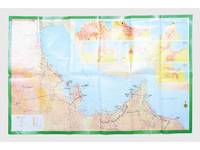
réf. 181557Saudi Arabia: Kruger for I.P.A. International Bookshops Dharan Airport 1977. Road construction faster than map production A folding road map of the Gulf and an interesting snapshot of its natural and human geography in the 1970s with 25 attractive photographs of Dubai. The map extends from Kuwait to Oman's Jabal al-Akhdar showing primary metalled roads roads under construction secondary roads towns wadis oil wells and pipelines oilfields and the morphology of the terrain. It also features 7 inset maps of the city centres of Manama Doha Abu Dhabi Kuwait Dubai Mutrah and Muscat. The small print in the reference section explains that "all roads under construction are being completed as the progress was faster than our production". The photos of Dubai include views of Dubai Creek dhows dromedaries and camels local inhabitants and the main heritage sites. Colour printed map folded 295 x 157 mm; unfolded 585 x 910 mm. Text in Arabic and English. Seven inset maps of Gulf capital cities verso with 25 colour photograph views of Dubai by Said Salah. Original colour self-wrappers printed in yellow black and white on a red and green ground. A few tiny chips or light wear to some folds couple of minor creases to outer corners: a very good exemplar. unknown
12mo. 52 pp. Wrapper title printed within decorated borders. Extremely rare autobiography of As'ad al-Shidyaq (1798-1830, brother of the writer Faris), who came under the influence of the American Congregationalist missionaries in Beirut when he was employed by them as a teacher and translator, and embraced Protestantism in defiance of the Maronite Patriarch. In retaliation, the Patriarch imprisoned and tortured al-Shidyaq in a convent in the Lebanese mountains, starving him to death in 1830. Al-Shidyaq's autobiography, the story of his conversion and persecution, was published three years later by the CMS press of Malta. "This of course is also anti-Catholic, or rather anti-Maronite. It has been quite erroneously attributed to his brother Faris al-Shidyaq by a number of eminent authorities, who have cited it as the latter's earliest work. In fact it is clearly by As'ad himself, being written in the first person, and his mentor Isaac Bird has recorded that it was written in 1826 at his (Bird's) request, 'that we might make use of it to his advantage in future time'; English translations were published in Boston (USA) in 1827 and 1839 and it was later incorporated into Bird's biography of As'ad, published in 1864" (Roper, p. 239). - A clean copy in very good condition. Copies known only at the British Library and Glasgow University. Zenker I, 1658. Sarkis 1105. Brockelmann S II, 868. Ellis I, 323. Alwan 18. Agius 43f. Roper (Arabic printing in Malta 1825-1845) no. 49.
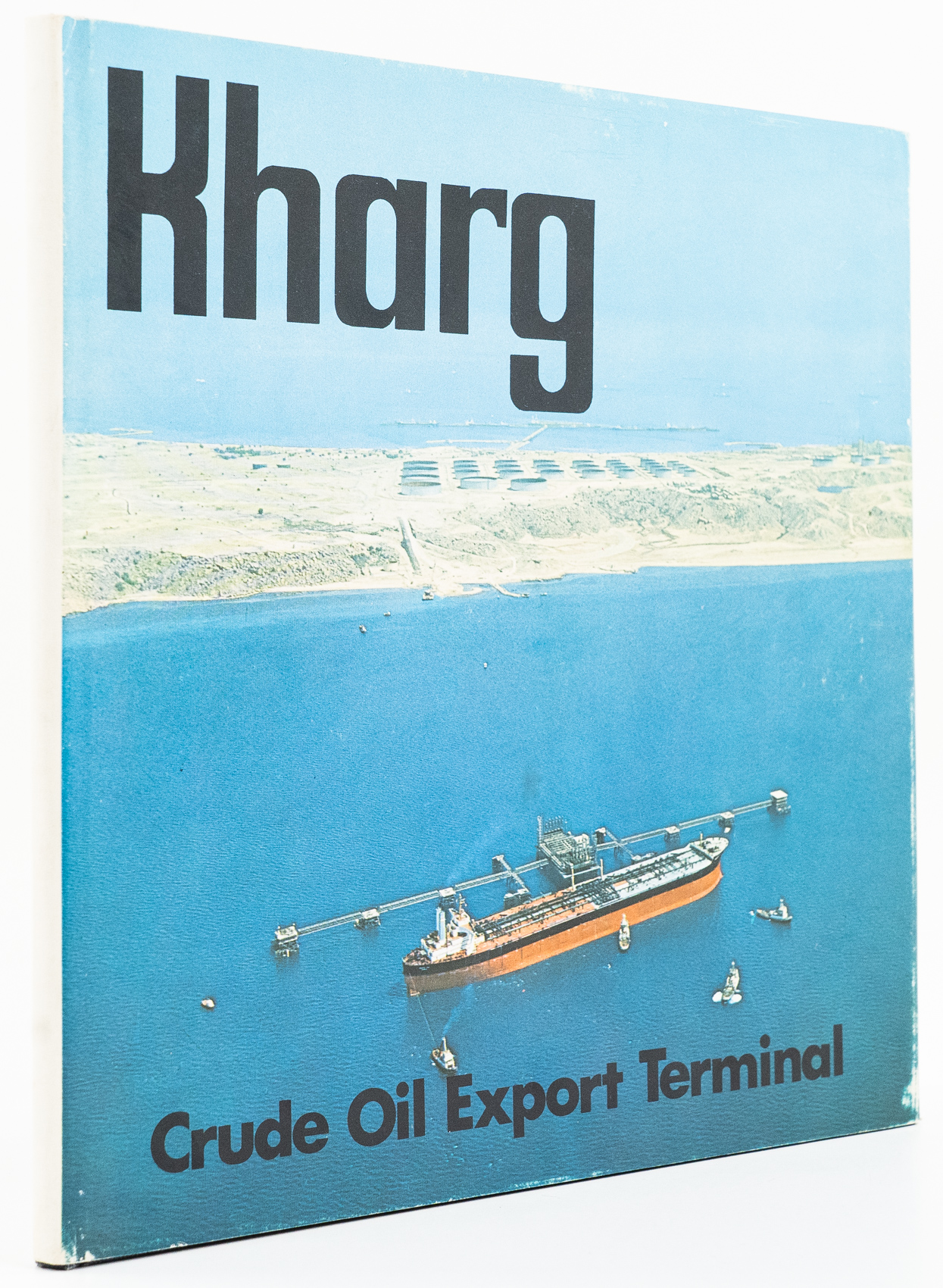
1971réf. 98504HBo.O. [Teheran], Iraanse Aardolie Exploratie en Productie Maatschappij, o.J. [um 1971]. 3 Bll., 28 Seiten, 1 Bl., OLn., OU., 21,5 x 21,5 cm.
Colour-printed political and physical map, ca. 134 x 94 cm. Scale 1:2,000,000. Mounted on cloth. Rare, detailed Syrian-printed map of the short-lived United Arab Republic, which aimed to unite Egypt and Syria politically in 1958. Although it effectively ceased to exist with the Syrian coup of 1961, Egypt continued to use the name until 1971. - Cartography by Niqola Zariq and Izzat Saydawi. Shows borders, rivers, valleys, principal, secondary and desert roads, railways, oil pipelines, capitals, provinces and centres, important cities and villages. The areas, population, railway length, cultivated lands and provinces of Syria and Egypt are specified separately. The Red Sea coast of Saudi Arabia is shown as far as Al Lith, south of Jeddah. - The declaration of the United Arab Republic bolstered the trend towards Pan-Arabism, and confrontational attitudes toward neighbouring states increased. The province of Hatay, on the Turkish border, is shown on Syrian territory, reflecting ongoing disputes over claims on Hatay beginning after the end of the First World War. Similarly, Israel is designated "Palestine" in the Palestinian territories. - Some stains; wrinkled with several edge tears and chips. Folded.
1957réf. 355490719342London: Robert Hale 1957. First Edition. Hard Cover. Dust Jacket. First UK Edition. Publisher's black boards with title author and publisher in green and publisher's logo in silver to the spine. A bookseller's ticket to the front paste-down and just a touch of foxing to the page block edges otherwise a VG copy in like D/W. A very nice copy indeed. In the 1950's Robert Hale was primarily a library supplier hence why this publisher's first editions are so difficult to find in such nice shelvable condition. The novel features Tony Pearson a failed professional golfer in a novel that ticks all the noir boxes with frenetic pace and noir atmosphere laid on with a trowel in a tightly-constructed dark and paranoid entertaining novel famous for its golf content. A rare find indeed. Scans/photographs available upon request. Robert Hale hardcover
réf. 121948Cambridge Cambridge Archive Editions 2020. . 2 works in 8 vols 25.5 x 16.5 cm; publisher's original black cloth silver gilt lettering a fine set. An extensive collection of documents and letters covering the reign of King Abdulaziz also known as Ibn Saud and the first king of a unified Saudi Arabia from the reconquest of Riyadh in 1902 until his death in 1953. Many of the documents and letters here are published for the first time and many of the letters are reproduced in facsimile in King Abdulaziz's own hand. Cambridge, Cambridge Archive Editions, 2020. hardcover
réf. 121947Cambridge Cambridge Archive Editions 2020. . 2 works in 8 vols 25.5 x 16.5 cm; publisher's original black cloth silver gilt lettering a fine set. An extensive collection of documents and letters covering the reign of King Abdulaziz also known as Ibn Saud and the first king of a unified Saudi Arabia from the reconquest of Riyadh in 1902 until his death in 1953. Many of the documents and letters here are published for the first time and many of the letters are reproduced in facsimile in King Abdulaziz's own hand. Cambridge, Cambridge Archive Editions, 2020. hardcover
4to. 52 pp. With numerous black-and-white and colour photographic illustrations. Original printed wrappers. Stapled. Richly illustrated report of a state visit by King Saud to the United States in 1957. The remarkable images show the King with President Eisenhower and former president Truman, strolling aboard the S.S. Constitution or visiting UN headquarters in New York, as well as the Islamic Center in Washington, D.C. Further illustrations show Saudi armed forces as well as the Kaaba, while others seek to demonstrate how modern Saudi Arabia is benefitting from American influence and the oil industry. - Central bifolium loosened, otherwise very well preserved. OCLC 734597.
18858vo. XIV, 322, (2) pp. Original brown cloth with giltstamped title to spine. First edition of the standard work by W. Robertson Smith, Lord Almoner's Professor of Arabic at Cambridge. - Removed from the Harvard College Library (with duplicate stamp). A single ink marking in the margin, otherwise fine. Remains of shelfmark labels. Another copy sold for £1,500 at Sotheby's in 1998 (Oct 14, lot 1125: some underlining of text & marks in margins). Macro, Bibliography of the Arabian Peninsula, 1921. Fück 210. OCLC 2156214.
4to. 160 pp. Ottoman Turkish text set in Arabic characters. Half-title on the upper wrapper and the first page of text are set within a decorative printed frame. With an integral manuscript French translation of the text in the margins. Original publisher's printed paper wrappers. - With: (II) [Shaikhzade Ahmed Misri] / Belleteste, [Henri Nicolas]. Contes Turcs en langue turque, extraits du roman intitulé, les quarante vizirs. [= Kirk vezir hikâyeleri ...]. Ibid., 1812. 4to. (2), 258, (2) pp. The text is entirely in Ottoman Turkish except for an additional title-page in French. Both Arabic and French title-pages include the vignette of the French Imprimerie Impériale. Blue wrappers with a white printed title label on the spine, stored in a custom-made case: half red leather with the title in gold on the spine and white and green decorated sides. Two excellent examples of Arabic type printing by the French Imprimerie Impériale: the 1812 edition of "the history of the forty viziers" in Ottoman Turkish. This collection of Turkish folk tales is a variation of the Thousand and One Nights stories. These frame stories play an important role in the storytelling tradition of the Middle East and often form the basis (Middle) Eastern literature in general. Examples of these stories are found in early Indian, Iranian and Arabic sources, but the exact origin of the stories of the forty viziers is not clear. The stories and/or the first translations of the stories from Arabic were attributed to Ahmed-i Misri and/or Seyhzade (or Sheykh-Zada), about whom nothing is known. These names were possibly pseudonyms of the actual authors-translators who did not want to be associated with stories that were composed in prose, had suggestive or crude passages, and were compiled from other earlier frame stories. - According to extant sources, the entire collection of folk tales concerning the stories of the viziers could contain eighty stories, forty of the viziers during the day and forty of the women during the night. In addition, the stories could also include various advice sections, other small stories, Arabic, Persian and Turkish poems, verses, hadiths, dreams and their interpretations. Different compositions and adaptations would differ in size and would contain varying sets of stories from the complete collection. - I: A unique annotated early 19th century copy of "Kirk vezir hikâyeleri" (The stories of forty queens), known as the "History of the forty viziers", containing an integral and literal translation of the first 160 pages of the Ottoman Turkish work. The translation and further annotations on Ottoman Turkish syntax and vocabulary are written in a (near) contemporary hand in brown ink. The marginal annotations were probably written around the 1820s by a French orientalist. This particular manuscript translation is unique and one of the very first French translation of these stories. Another adaptation of the stories, containing 19 stories and the introduction, was translated into French by François Pétis de la Croix as "L'histoire de la sultane de Perse et des vizirs", published in Paris in 1722. - II: The present copy is a complete example of the 1812 edition. It contains forty stories, including the introduction, the story of (and dedication to) Sultan Mahmud, the frame story, twenty stories of the viziers, and twenty stories of the women. - Both works are compiled by the French orientalist Henri-Nicolas Belleteste (Belletête, ca. 1746-1808) and published posthumously. Belleteste was educated in Oriental languages and in 1798 he was appointed government interpreter. He subsequently served as a military interpreter during the Egyptian Campaign led by Napoleon Bonaparte (1798-1801). He published an Arabic vocabulary for military use and together with French orientalist Jean-Daniel Kieffer (1767-1833), Belleteste translated the Bulletins de la Grande Armée into Turkish for Napoleon's campaigns from 1805 to 1807. He had taken on the project of translating a collection of Turkish stories, entitled in French "Les Quarante Vizirs" (the forty viziers), allegedly from a manuscript found in Egypt. Unfortunately, he died unexpectedly at the age of 30 in 1808, thus leaving the work unfinished. Nevertheless, an edition of the Ottoman Turkish text Belleteste was translating was published in 1812, expertly printed in Arabic characters by the French Imprimerie Impériale, of which the present two works are examples. - I: With the integral manuscript translation of the text into French in a contemporary (ca. 1820s) hand in brown ink in the margins. Front wrapper detached, spine damaged, edges frayed, lacking the back wrapper and the last 96 pages of the work. - II: Without the frequently missing 48 pp. of Belleteste's unfinished French translation. Wrappers are slightly stained and slightly damaged, mainly around the spine and the edges, without affecting the integrity of the binding. The text has generous, uncut margins, thus the edges are slightly frayed. The custom-made case is slightly scuffed around the corners and edges. Otherwise in good condition. - Overall, these works present an extraordinary example of early 19th century Arabic printing by the French Imprimerie Impériale together with a unique manuscript translation of the text of the "history of the forty Viziers", into French by an unidentified early 19th-century orientalist. Atabey 908 (incomplete). Chauvin VIII, p. 18, no. 52. Zenker I, 729. Brunet 17781. Gay/Lemonnier I, 718. Not in Blackmer.
760 x 625 mm. Scale 1:500,000. With some notes in pencil. In excellent condition.
(8) pp., 1 blank f., 410 pp. Contemporary green half morocco over marbled boards with giltstamped spine title. Only edition of this treatise about the Arabian horse ("hayl", referred to in the introduction as "the first and foremost of all mounts"), discussing their history, types, uses, domestication and breeding, as well as the various traditions of folklore, religion and literature attached to it in Arab-Islamic culture. - Muhammed al-Jazairi, or Muhammad Pasha (1840-1912/13), was a son of the famous Emir Abdelkader al-Jazairi (1808-83), an Algerian religious and military leader who led the struggle against the French colonial invasion in the mid-19th century. - Binding slightly rubbed; paper evenly browned as common. Contemporary ink ownerships of Fernand Patorni (b. 1837), chief interpreter in Algiers and author of "Les Tirailleurs algériens dans le Sahara" (1884). Very rare: only two copies in library catalogues internationally (Orient-Institut Beirut; Constance University, Germany). OCLC 311370556. Not in Boyd/P.
Large 4to (187 x 274 mm). Arabic manuscript on paper. (18) pp., 31 lines per extensum. Written in clear, neat black naskh, emphases picked out or underlined in red; catchwords. Modern brown leather binding with blind rules and stamped central medallions to both covers. A late 14th or early 15th century mathematical manuscript, probably written in Iran or possibly the Eastern Mediterranean. The Persian scholar Nasir al-Din Muhamad ibn Muhamad ibn al-Hasan at-Tusi (1201-74) was known for his extensive work on science, physics, mathematics and theology. He is often credited with the invention and identification of trigonometry as an independent division of mathematics (cf. GAL I, 509), and the lunar crater "Nasireddin" is named after him. As well as compiling many important works in these fields, he is also known for translating the definitive Arabic editions of Euclid, Ptolemy and Archimedes' works, among others. The only other copy of his present work, treating multiplication and division in algebra and arithmetic, survives in the Topkapi Seray in Istanbul (MS 3327: a more extensive version in 3 books and 11 sections, 51 ff.). - Light dampstaining throughout, mostly confined to lower borders; edges frayed. GAL S I, p. 930, no. 36a. B. A. Rosenfeld & E. Thsanoglu, Mathematicians, Astronomers and other Scholars of Islamic Civilisation and their Works (Istanbul 2003), pp. 211-219, M18. Krause, Stambuler Handschriften Islamischer Mathematiker, p. 497, no. 12.
4to (200 x 144 mm). 81 pp. French manuscript, black ink on watermarked laid paper. 19th century blindstamped half calf with smooth spine, title lettered in gilt. A hitherto unknown French translation of an Arabic medical and philosophical text by a 13th century author from Al-Andalus: part of the first sections of the third chapter from the "Kitab al-Aghdiya", or the "Book of Food and the Preservation of Health", by Ibn Khalsun (ca. 1203-88). This chapter discusses general hygiene and personal health, that is to say, the body and spirit in their entirety. The present manuscript fragment is entitled "Traicté des choses non naturelles" ("Treatise on matters not natural"), meaning the things necessary for human life that are part of the external, material world, such as air, food and drink, including paragraphs on wine and sleep. It provides no information as to its source, but there was at the time no French edition of the work, and this would appear to be an entirely original, albeit unfinished, effort at translating an Arabic manuscript. The first published French translation was that included with the critical edition published in Damascus in 1996. - According to the Andalusian scholar Ibn al-Khatib (1313-74), Ibn Khalsun was originally from Rueda in Spain and lived in Malaga and Granada where he was part of the Nasrid ruler Abu 'Abdallah Muhammad bin Muhammad bin Yusuf's court (1272-1302). This is his only recorded work on medicine. - Some worming to the wide margins. Binding slightly rubbed at extremeties. Provenance: from the library of the French writer Jules Claretie (handwritten note dated 1919); subsequently owned by Dr. René-Albert Gutmann (1885-1981), and acquired from his heirs.
Large 4to (220 x 266 mm). 2 parts in one vol. (4), 7, (1), 984, (4), 3, (1), 318 pp. Contemporary brown calf with ornamental blind-tooling; gilt title to spine. Well-preserved copy of the first complete edition of the Bible in Ottoman Turkish, printed in a vocalized Arabic typeface. Based on the manuscript of Ali Ufki Bey (Albert Bobovius), this version became the basis for further Turkish translations used by Armenian and Greek Christians. The New Testament had appeared separately in 1819. "In 1820 J. D. Kieffer [...] began a thorough revision of Ali Bey's translation of the Bible by comparing it with the original texts, as well as with the standard English, French, and German versions. He also collated it with W. Seaman's Nogai NT of 1666, with T. Erpenius' Arabic version, with H. Martyn's Persian version, with H. Brunton's Nogai NT of 1813, and with the London Polyglot. The translation of the NT was also carefully revised in view of the criticisms passed on the first edition. On crucial questions he had the advice of Baron Silvestre de Sacy. The complete Bible (without the Apocrypha) appeared in 1827, printed in Arabic character with full vocalization. The edition consisted of 5,000 copies of the Bible, and 2,000 copies of the NT issued separately" (Darlow/M.). - Binding insignificantly rubbed at extremities, very slight brownstaining due to paper. An excellent copy. Darlow/Moule 9456. Bruce Privratsky, A History of Turkish Bible Translations, v. S (2014), pp. 43ff. OCLC 61141750.
Large 8vo. (4), 352 pp. Contemporary calf (spine rebacked). A reprint of the Roman Bible of 1671, already reissued thus by British and Foreign Bible Society in the previous year. The Society adopted this text at the suggestion of the Syrian Archbishop of Jerusalem. - Some browning and edge chipping. Binding rubbed and bumped (professionally repaired, with loss to corners). Darlow/Moule 1667. OCLC 38586842.
4to (180 x 260 mm). Arabic manuscript on oriental paper. 190 leaves. 20 lines of unvocalized black naskh in black and occasional red ink. Numbering of quires partially preserved in the upper left corner, foliation and part of the claims subsequent to the copy, numerous marginal glosses. Later coloured paper boards with leather spine and fore-edge flap. The earliest surviving textual witness, copied during the author's lifetime from his lost autograph, of what is the first and still the most popular Hanafi text on legal distinctions: the "Kitab al-furuq" by Abu al-Muzaffar As'ad ibn Muhammad ibn al-Husayn al-Nisaburi al-Karabisi al-Hanafi (d. 1174/75). Composed in the 6th century AH, most likely in Samarkand, where the author was living at the time (cf. Saba, pp. 71, 204), this is the only text on furuq (legal distinctions) to have been composed in that century and is also important as the first work on the subject in the Hanafi Madhhab. Several manuscripts of it are preserved (Cairo, Dar al-Kutub, 292 fiqh hanafi, undated; Cairo, Dar al-Kutub, 293 fiqh hanafi, dated 622 H [1224/25 CE]; Istanbul, Süleymaniye Kütüphanesi, Fatih 2039, dated 776 H [1374/75 CE]; Istanbul, Süleymaniye Kütüphanesi, Carullah 821, 1007 H [1598/99 CE]). - The present manuscript is of major importance as the oldest surviving manuscript of this text. The colophon provides the date of completion of the copy, Sunday, 11th of the month of Rabi I 569 H (20 October 1173), as well as the name of the copyist, Muhammad b. Hibatallah b. Muhammad b. Hibatallah b. Ahmad b. Abi Jarada. The colophon further states that the copyist prepared the manuscript for his personal use by collating the text (balagha) against the autograph, which is not preserved for us. - The scribe can be identified as a calligrapher who belonged to a powerful family of Aleppine intellectuals, the Banu'l-Abi Jarada, a Sunni family of the Hanafi rite (cf. James, p. 354). While no other manuscript in his hand is known to survive, he is referenced in the oldest dated manuscript of al-Hariri's "Maqamat". This codex, which bears an ijaza of al-Hariri dated Sha'ban 504 H (February 1111 CE), belonged to his first cousin, the famous historian and jurist, Kamal al-Din Abu 'Umar b. Ahmad b. Abi Jarada, known as Ibn al-'Adim. A reading mark dated 17 Jumada II 604 H (8 January 1208 CE) attests to the presence of our scribe in Aleppo and to his involvement in the literate circles of the time (on the subject of the manuscript and the reading mark, see MacKay, p. 22). He is later traced in Süleyman Müstakimzade's biographical dictionary of calligraphers, which states that Muhammad b. Hibatallah Abi Jarada was known to work in the manner of the great calligrapher Ibn al-Bawwab and copied an entire Qur'an during each month of Ramadan (Tuhfe-i hattatin [Istanbul, 1928], p. 464). He is said to have died in 628 H (1230/31 CE) at the age of 82. - Binding rubbed and chipped; sewing loosened. Restored in the 19th century, notably the first leaf, with several remarginings and an added table of contents. Provenance: from the collection of Paul Lebaudy (1858-1937), with the bookplate of his library at the Château de Rosny "La Solitude". The Château de Rosny is the former property of the Duchess of Berry. GAL I, 375 (464) & S I, 642. Cf. Elias G. Saba, Harmonizing Similarities. A History of Distinctions Literature in Islamic Law (Berlin, 2009). David James, "Qur'ans and Calligraphers of the Ayyubids and Zangids", in: Robert Hillenbrand and Sylvia Auld (eds.), Ayyubid Jerusalem. The Holy City in Context, 1187-1250 (London 2009). Pierre MacKay, "Certificates of Transmission on a Manuscript of the Maqamat of Hariri (MS. Cairo, Adab 105)", in Transactions of the American Philosophical Society NS 61, no. 4 (1971).
Folio (213 x 322 mm). (4), 316 pp. Parts printed in red and black. With numerous ornamental lines and several woodcut tailpieces. Modern half calf. "The Evangelion of the Greek Church, containing the Gospels arranged for liturgical reading throughout the year" (Darlow/M.). From the printing office of the monastery of St. John the Baptist at Shuwair in the Lebanon, which was operative between 1734 and 1899 (cf. Silvestre de Sacy I, pp. 412-414; Middle Eastern Languages and the Print Revolution. A Cross-Cultural Encounter, Westhofen 2002, pp. 179-181). Particularly remarkable in this present publication is the typographic decor: all pages are framed by double rules; new sections of text are headed with an ornamental line of floral elements across the entire page width, and numerous pages show smaller figural endpieces (roses, baskets, crosses, as well as the Virgin with the Child Jesus) - a charming juxtaposition of simple woodcuts showing floral and geometrical decor familiar from the Hebrew prints produced in 19th-century Palestine with the more elaborate products "à la italienne". - Some occasional worming, browning and brownstaining. Schnurrer 360. Darlow/Moule 1661.
8vo. 354, (14) pp., wanting final blank. Contemporary blindstamped brown calf. Rare Psalter from the printing office of the Melkite monastery of St. John the Baptist at al-Shuwayr in the Lebanese Kisrawan mountains, operative between 1734 and 1899, during which time it produced in all 69 Arabic books, including re-editions (cf. Silvestre de Sacy I, pp. 412-414; Middle Eastern Languages and the Print Revolution. A Cross-Cultural Encounter, Westhofen 2002, pp. 179-181). Nasrallah counts 15 editions of the Psalter alone, the last (produced in 1899, the only as-Shuwayr Psalter in the Aboussouan collection) constituting the swan-song of that important press. "Le Psautier a longtemps été le livre classique unique des écoles d'Orient. Cela nous explique pourquoi il fut si souvent édité" (Nasrallah, p. 38). - Binding a little rubbed; some light browning and brownstaining (mainly confined to margins). A good copy. Not in Nasrallah.
8vo (150 x 206 mm). (564) pp. Ottoman Turkish and Arabic manuscript written in Naskh script on polished oriental paper. 2 columns, 17 lines. Black ink; chapter headings in red. Text ruled in gilt, red and black; first two pages have attractive 'unwan decorations in gilt, red, lapislazuli, pink, and orange; final page has gilt floral scrollwork decoration. Gilded line decorations on some pages, a red and gillt inscribed figure known as the "Flag of the Prophet on the Day of Judgment" (Liwa al-Hamd) on one page. 19th century oriental brown leather binding with fore-edge flap, decorated with gilt borders and lozenge-shaped ornamentation to both covers. Marbled endpapers. Early Turkish manuscript of the "Magharib al-Zaman" ("Sunsets of Time"), a widely popular devotional work on the Prophet Muhammad, first written in Arabic in 1449 by the Ottoman Sufi poet Yazicioglu Mehmet (d. 1491) and translated into Ottoman Turkish by his younger brother Ahmed Bican. Mehmet, a native of the Gallipoli peninsula, was a follower of Haci Bayram-i Veli (1352-1430) and was influenced by the writings of Andalusian mystic Ibn 'Arabi. The earliest printed edition appeared in 1842 at Istanbul's Military Press. - Comprising some 9,000 couplets, the "Muhammadiyah" is one of the longest works in Turkish literature, but its style is easily accessible, and it contributed much to the formation of Ottoman Sufi culture. Written to disseminate the basic tenets of Islam among the common people, it covers Muhammad's biography, various aspects of Muslim devotion, and eschatological matters, including Gog and Magog, the Sun rising in the west, and the Day of Resurrection. Mehmet is notably preoccupied with the eschatological role of Jesus and of the Ottoman conquest of Constantinople, which he anticipated by several years. - Anonymously copied (as common for religious texts), this manuscript includes occasional explanations and Qur'an verses that are extraneous to Yazicioglu's text and were introduced by the scribe (or by the copyist of the MS he followed). Among the appealing decorations the first two leaves stand out, as does the gilt depiction of the Prophet's standard, "Liwa al-Hamd" (Banner of Praise), which is to be unfurled on the Day of Judgment. Three phrases written in red ink appear on this banner: "Al-Hamdu Lillahi Rabbil-'Alamin" (Praise be to God, Lord of the Universes), "Bi-smi llahi r-rahmani r-rahim" (In the name of Allah, the Most Gracious, the Most Merciful), and "La ilaha illallah, Muhammadun rasulullah" (There is no god but Allah and Muhammad is messenger of Allah). - Occasional light brownstaining, mainly confined to margins; generally very finely preserved. The first leaf of the book bears a faint Ottoman note of acquisition from the 19th century: "Isbu bin iki yüz doksan bes senesi Zilkade'nin yigirmi üçüncü sali günü yüz elli gurus fiyat" ("This book was bought for 150 Kurush on 23 Dhu al-Qadah, 1295 H" [18 November 1878 CE]. A complete list of the individual chapter titles is available on request. Cf. J. Spencer Trimingham, The Sufi orders in Islam (Oxford, 1971); Arin Shawkat Salamah-Qudsi, Sufism and Early Islamic Piety: Personal and Communal Dynamics (Cambridge, 2018).
Tall 8vo (104 x 220 mm). Arabic manuscript on polished paper. (1), 185, (1) ff. Naskh script in black and occasional red ink, with catchwords and extensive marginal notes in a contemporary hand. 19th century leather, ruled and decoratively stamped in blind. Popular and influential mediaeval Arabic handbook for medical students by the great Damascus anatomist Ibn al-Nafis (1210-88). Long considered a commentary on Avicenna, this is now viewed by scholarship as an original work which also discusses Avicenna's ideas, and thus as "an independent book meant to be a handbook for medical students and practitioners, not as an epitome of Kitab Al-Qanun of Ibn Sina as thought by recent historians" (Abdel-Halim, 2008). One of the author's most widely received works, it provides a useful sum of medical knowledge to aspiring physicians of the mediaeval and early modern periods alike. It was still being copied centuries on from the death of Ibn al-Nafis, who is famous for first describing the pulmonary blood circulation, thereby anticipating by many centuries the efforts of William Harvey. - Not dated by the scribe, but one of the ownership dates on the first leaf is dated Shawwal 1100 AH (July/August 1689 CE), and the date of copying would be estimated around 950 AH, or possibly later. Covers lightly scuffed, interior shows marginal paper repairs and slight trimming to outermost marginal notes. The main text is clean and unmarred. GAL I, 493, 37, 2 & I, 457 (s. v. Ibn Sina). Rabie E. Abdel-Halim, "Contributions of Ibn Al-Nafis (1210-1288 AD) to the Progress of Medicine and Urology. A Study and Translations From his Medical Works", in: Saudi Medical Journal 29.1 (2008), pp. 13-22.
4to. 17 parts in 5 vols. Contemp. half calf. Principal work of Ibn Sîdah (1007-1066), the great blind Andalusian lexicographer: the most important Arabic encyclopedia and dictionary. Lemmas are arranged in groups based on different classes of words. Two manuscripts are preserved: one in Cairo (dated 1202) and one in the Escorial. - Occasional edge wear; some browning and brownstaining. A good copy. GAL I, p. 308. EI II, 445. OCLC 20111625.
8vo (154 x 208 mm). Arabic manuscript on paper. 267 ff. (final 6 leaves are supplied in a 19th century hand). Naskh script in black and red, with many numerical charts and calculations in text and margins. Rebacked contemporary red morocco, ruled and stamped in blind. Commentary on a work by the Egyptian mathematician Ahmad ibn Muhammad ibn al-Ha'im (ca. 1352-1412), the "Murshidat al-talib ila asna al-matalib fi ilm al-hisab" ("A student's guide to the summit of learning on the science of mathematics"). Al-Ha'im is famous for his contributions to mathematics, especially in the field of early algebra. The author of the commentary, Baha al-Din Muhammad al-Shinshawri (d. 1590), finished this work in 1587. The present copy was completed by the scribes Abd al-Rahman bin Wali Allah and Shihab al-Din al-Wiqay al-Shinway al-Shafi' on Friday, the 18th of Rabi' al-Thani 1023 AH at Cairo's Al-Azhar Mosque in Ottoman Egypt. - The text incorporates several small mathematical charts as well as marginal calculations, which provide a key insight into the development of mathematical notation and visual organization in the early 17th century. - Covers rebacked and spine replaced, along with final six leaves which were probably completed in Western Asia in the 19th century. Several small waqf stamps. A few paper repairs and marginal wormholes, otherwise well-preserved. Cf. GAL II, 125.
8vo (166 x 234 mm). 2 parts in one volume. 8, 4, 299, (1) pp. 10, 7, (1), 272 pp. Contemporary full red morocco with fore-edge flap, covers with blind rules and stamped oriental ornaments in central compartment. First printing of "Al-Muzhir", an encyclopedic work on Arabic linguistics and its various disciplines, compiled from earlier philologists by the prominent Egyptian scholar Jalal al-Din al-Suyuti (d. 911/1505). It counts as a significant contribution to the study of Arabic linguistics. Al-Suyuti was an enormously prolific polymath whose "versatility stands out as unique in the history of Arabic literature" (GAL II, 144). - Binding a little rubbed, one corner bumped. Light fore-edge flaws to the preliminary matter of the first juz' (part); old pencilled and typed bibliographical notes to front pastedown. A very good copy. GAL II, p. 155, no. 258. OCLC 20066914.