4 114 résultats
2 vols. of text (4to) and one volume of plates (folio, 284 x 378 mm). Text: XXIII, (1), 228, (2) pp. With 3 genealogical tables and 2 folding maps. XVIII, 397, (1) pp. Half calf with gilt-stamped morocco label to spine. Atlas: 4 chromolithogr. plates (conjoined as 2), 6 (1 double-sized) toned lithogr. plates, and 65 mounted photographs on a total of 40 plates; 1 letterpress leaf of contents. Cloth portfolio with gilt cover title. Remarkable set, rarely encountered complete with the plates volume. The Dutch orientalist Snouck spent a year in Mecca and Jeddah during 1884/85 and was married to a Mecca woman. He was the first non-Muslim to visit the city outside the annual pilgrimage. The photographs, taken by himself and an Arabic physician, are among the earliest to show Mecca and its pilgrims. - Very nicely rebound, in matching period style portfolio and half calf. An unusually crisp and clean copy throughout: text volumes spotless; the plates with the vintage photographs, much sought after as the earliest photographic documents of the city, its dignitaries and its pilgrims, are backed on thin linen and preserved in perfect condition. Macro 1239 (omitting mention of the Atlas). Henze V, 177. Dinse 443.
2 vols. of text (4to) and one volume of plates (folio, 284 x 378 mm). Text: XXIII, (1), 228, (2) pp. With 3 genealogical tables and 2 folding maps. XVIII, 397, (1) pp. Atlas: 4 chromolithogr. plates, 5 (of 6) toned lithogr. plates (one folding), and 65 mounted photographs on a total of 39 (of 40) plates; 1 letterpress leaf of contents. Includes original printed upper board cover, loosely inserted. Modern black library cloth with gilt title to spine; atlas portfolio uniform with books. Contemporary black half roan, spines in five compartments with raised bands gilt, original atlas-portfolio of black cloth-backed printed cream boards. First edition, a complete set with both text volumes and the portfolio with all the photographic plates, but lacking one of the lithographs. The Dutch orientalist Snouck spent a year in Mecca and Jeddah during 1884/85 and was married to a Mecca woman. He was the first non-Muslim to visit the city outside the annual pilgrimage. The photographs, taken by himself and an Arabic physician, are among the earliest to show Mecca and its pilgrims. - Spines of both text volumes and portfolio professionally restored. Atlas lacks plate XVII (detail of Kiswah fabric), some light scattered spotting, minor creasing to mounts. Macro 1239 (omitting mention of the Atlas). Henze V, 177. Dinse 443.
1931Large 8vo. VI, 309, (3) pp. With 20 half-tone plates, folding plan of Mecca, and plan of the Haram. Original blue cloth. First edition of the English translation of a book on the holy city of Mecca by the Dutch orientalist and professor Christiaan Snouck Hurgronje (1857-1936). The book is divided into four large chapters, dealing respectively with daily life, family life, learning and the Jâwah in Mecca. Each chapter is illustrated with several photographs, mostly portraits, depicting among others a physician, a merchant with his slave, a bride and groom, pilgrims and the doorkeeper of the Kaabah, and also including a view of the Masjid al-Haram mosque. The book closes with an index and two maps, one showing Mecca. During his travels Snouck Hurgronje took many pictures of the holy city and its inhabitants, which made him the first western photographer in the city. In 1888 he published two volumes in German entitled "Mekka" describing his travels, to which a "Bilder-Atlas zu Mekka" was added in 1888. The present translation is based on the second of the two German volumes from 1888, "which seems likely to appeal to a wider public" (p. V), thus representing a Mecca from nearly fifty years earlier. The two maps included in the first German volume are included here as well, and the 21 reproductions of photographs are a selection from the photographs in the "Bilder-Atlas". - Binding only slighty worn at the top and bottom of the spine. Interior slightly browned, but otherwise a very good copy, clean and well-preserved, with both the text and plates in very good condition. Macro 1238. D. van der Wal, Christiaan Snouck Hurgonje: the First Western Photographer in Mecca, 1884-1885 (2011). OCLC 1088989. Cf. Fück 231.
4to. German ms., ink on paper. 180 pp. (on 91 unnumbered leaves). Contemporary half calf over green cloth boards, spine on five raised bands, titled in gilt with giltstamped covers; all edges red. Bookbinder's label of Albert Günther, Vienna, on lower flyleaf. A clean and well-legible manuscript describing the author's six-week pilgrimage to Jerusalem undertaken in February and March 1902 from Vienna via Budapest, Fiume, Ancona, Rome, Naples and Messina to Alexandria, Jaffa, and Jerusalem. Proksch gives an extensive and colourful account not only of the holy sites of Palestine, which he has long wished to visit, but also of various sites in Egypt, including the Al-Azhar Mosque in Cairo and the oriental bazaars. - Dedicated to Princess Marie (Wilhelmine Franziska) "Maritschy" Auersperg (1880-1960), daughter of Prince Franz Joseph Auersperg: "Der Prinzessin Maritschy gewidmet, zur freundlichen Erinnerung an den alten Procksch" ("To Princess Maritschy, so that she may fondly remember old Procksch"). Proksch, a doctor of canon and civil law, had been the private educator of Prince Auersperg and his siblings. In 1905 the princess would marry Karl von und zu Trauttmansdorff. The family acquired Weissenegg Castle (near Mellach in Styria) in 1923; the castle library's bookplate (dated 1935) is affixed to the pastedown. Remains of a pasted shelfmark label to spine; very well preserved.
Pen-and-ink drawing on wove paper, monogrammed "VO". 142 x 182 mm. Matted. Depicting the artist's "March from Ostrog Monastery to Zdrebanik, Montenegro, 8 August 1858". Prince Odescalchi, member of a Vienna-based family of the Roman high nobility, painted genre as well as military scenes. Himself a military officer, he captured many events of his active years in drawings and paintings. He remains a conspicuous figure in art history especially by virtue of the portrait Friedrich von Amerling painted of the orientally garbed five-year-old prince. - From the Ottoman collection of Herry W. Schaefer.
825:620 mm. Scale: 1:1,000,000. First edition, with air information. Map of the western coast of Saudi Arabia from Abu Shaytanah in the north to Lith in the south, and from the Sudanese coast in the west to Turubah in the Arabian interior. Reproduced in 1944 and reprinted in 1945 "from W. O. Pulls 1st Edition 1941". - In excellent condition.
808:640 mm. Scale: 1:1,000,000. Folded. First edition. Map of the western coast of Saudi Arabia from Abu Shaibana in the north to Rakah in the south, and from Rabigh and Jeddah in the west to Turbah in the interior. Including parts of Anglo-Egyptian Sudan and Egypt. Compiled by W. O. 1939, drawn and heliographed by O. S. 1940. With 2 printed straight lines giving degrees of longitude dated December 1943. - Inscribed "Mecca 5" by a former collector near lower margin. - A few small tears and creases.
808:640 mm. Scale: 1:1,000,000. First edition. Map of the western coast of Saudi Arabia from Abu Shaibana in the north to Rakah in the south, and from Rabigh and Jeddah in the west to Turbah in the interior. Including parts of Anglo-Egyptian Sudan and Egypt. Compiled by W.O. 1939, drawn and heliographed by O.S. 1940. With 2 printed straight lines giving degrees of longitude dated December 1943. - In excellent condition.
8vo. IX, (5), 333, (1) pp. With 8 plates. Yellow cloth with title information in blue on front cover and spine, with a dust jacket designed by Paul Wenck, map of Ethiopia and Arabia on the endpapers. First edition of Coon's account of his experiences in Ethiopia and Arabia. From 1933 to 1934 Coon travelled through Ethiopia to conduct physical anthropological research, but after conflicts with the authorities he had to escape to Arabia. He states in his foreword that the purpose of the present work is a memoir, since it was not meant to "impress the public with our scientific findings, for, interesting as these results may or may not be, they are reserved for more formal publication", but simply to tell what he and two others did during the expedition. C. S. Coon (1904-81) was an American anthropologist and professor of anthropology at Harvard University and the University of Pennsylvania. He spoke ten languages and made notable contributions to the fields of cultural and physical anthropology and archaeology. He was the author of multiple works, including highly controversial works on race, such as "The Origin of Races" (1962), which were widely disputed during his lifetime and are considered pseudoscientific by modern anthropology. - Dust jacket somewhat damaged, covered with clear protective plastic, edges foxed. Otherwise in very good condition. Macro 747. Shapero, The Islamic World (2003), 178. Sotheby's, Burrell sale, lot 889.
1951Pages 1025-1124 (99 pages in total). Includes index and prices. Profusely illustrated in black and white. Intended to be read by shop owners. Presents a wonderful cross-section of "the most complete stocks in Western Canada" - from page 1024. Extensive listings of firearms and related products. Also included are products for dogs, traps, thermos and related products, flashlights and batteries, lighters, harmonicas, cards, baseball, tennis, badminton, golf, football, hockey, soccer, volleyball, basketball, boxing, lawn bowling, croquet, roller skating, snow shoes, bicycles and ski equipment. Above-average but not excessive wear. Front cover taped in place. Back cover missing. A very enjoyable and nostalgic item. Young readers will be amazed to see how far today's gear has advanced in the past 50+ years, particularly ski equipment. Book
4to. 3-36, (2) pp. With 1 folding map of the Sinai Peninsula (450 x 692 mm) in rear pocket. Original printed wrappers. Rare contemporary account of the 1956 Israeli "Operation Kadesh" in Sinai during the Suez Crisis, under the chief of staff of the IDF, Moshe Dayan, in Hebrew. Israeli military planning for this operation hinged on control of four main military objectives: Sharm el-Sheikh, Arish, Abu Uwayulah (Abu Ageila), and the Gaza Strip. Moshe Dayan's plan put an emphasis on air power combined with mobile battles of encirclement. Israeli forces would in a series of swift operations encircle and then take the main Egyptian strong points in the Sinai. Reflecting this emphasis on encirclement was the "outside-in" approach of "Kadesh", which called for Israeli paratroopers to seize distant points first, with those closer to Israel to be seized later. Thus, the 202nd Paratroop Brigade commanded by Colonel Ariel Sharon was to land in the far-western part of the Sinai to take the Mitla Pass and thereby cut off the Egyptian forces in the eastern Sinai from their supply lines. The map shows the main troop movements on the peninsula, highlighting military objectives such as Sharm-el-Sheikh as well as the landing points of the Paratroop Brigade. - Only 6 copies worldwide, 4 of which in the United States, and one in the Jewish National Library in Jerusalem. - A little worn at the edges, otherwise very well preserved. OCLC 763138388.
1984152 pages. Index. Footnotes. Reproductions of archival black and white photos. Includes two voters lists from over one-hundred years ago. Moderate wear. Unmarked. Binding intact. A sound copy of this informative history. Book
4to. (2), 132, VIII, 132, 55, (1) pp. Contemporary vellum. First edition of the annals of Egypt written by Jamaleddin Abul Mehassen. Original Arabic text followed by the Latin translation and Latin notes, each with separate pagination. - Occasional browning to text. An errata leaf follows the title page. Old library stamps of the Congregation of the Redemptorists, New York, and the Bibliotheca Mt. St. Alphonsus, Esopus, N.Y. - Rare. Schnurrer 184. Ibrahim-Hilmy II, 25. Gay 2073. OCLC 165551800.
1931réf. ABE-5174254313FORMAT 32 CM X 45 CM-EN COUVERTURE "TOULON EST CHAMPION DE FRANCE DE RUGBY"/SCENE DE LA FINALE DU CHAMPIONNAT DE FRANCE A BORDEAUX ENTRE LE R.C.TOULONNAIS ET LYON O.U. "UNE DANGEREUSE OFFENSIVE LYONNAISE ECHOUE SUR LA LIGNE DE BUT TOULONNAISE"-LA COURSE PARIS LILLE REVIENT AU BELGE DERVAES/1P/2 PHOTOS-LE CHAMPIONNAT DE FRANCE DE GOLF/"AVEC LES JOUEURS SUR LE PARCOURS DE CHANTILLY"/1P/4 PHOTOS-LA FINALE DU CHAMPIONNAT DE FRANCE DE RUGBY/2P/6 PHOTOS-AUX ARENES DE LUTECE LE FOYER DE MULHOUSE EST CHAMPION DE FRANCE DE BASKET POUR LA 7 E FOIS/PHOTO PLEINE PAGE-LES PRECIEUX CONSEILS DE JOHNNY WEISSMULLER/COMMENT ON DOIT POUVOIR AMELIORER LE CRAWL/2 PHOTOS-PETITES DECHIRURES PERIPHERIQUES
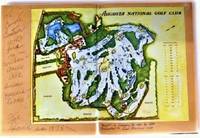
1978réf. 76031aozThe Augusta National Golf Club 1978. imitation_leather. Good/Missing. 0x0x0. Signed by Other. Signed and isncribed by golf course designer Fred Sparks. Oversized green hardbound without dust jacket. Apart from the inscription no text markings noted. The Augusta National Golf Club hardcover
1998133 pages. eng
Folio (212 x 324 mm). Persian manuscript on faintly ruled paper. 1 blank leaf, 336 pp. (168 ff.), 1 blank leaf. Text is complete, but last leaf is missing. 1 illuminated headpiece and 49 illustrations in ink and bright watercolour wash. Text in black, ruled in black, with important words and phrases picked out in purple. 19th century leather ruled and stamped in blind. Lavishly illuminated Persian manuscript depicting the romance which came to define the love story in Western literature. Composed by Abu al-Qasim Hasan Unsuri (ca. 961-1039), the original Persian was in fact lost, and preserved in a Turkish translation. Unsuri's version was itself based on what was already an ancient love story in his own time, the Ancient Greek novel "Metiochus and Parthenope", which also survives only in fragments. Though certainly derived from the Greek, like many Persian romances with Greek origins, "the nature of the relationship is not [...] the simple one of the earlier (Greek) material influencing the later (Persian) material, as the Greek novels contain a number of motifs and topoi which are identified within the narratives themselves as Persian in origin. The relationship between the love narratives of the two cultures appear, therefore, to have been one of mutual reciprocity over a considerable stretch of time" (Davis). - Some fragments of the original Persian do survive: Sa'id Nafisi collected 141 verses of "Wameq o 'Adra" that were used as evidence in Persian dictionaries, and 372 more verses were discovered by Mohammad Šafi' in the binding of an old manuscript in 1950 (Blois, 201). Unsuri's version was translated in the 16th century into Turkish by Shaikh Mahmud Lame'i, though in comparison with the earlier fragments, this is considered a loose translation of the original. However, it provides the source of most subsequent translations and most of what we know of "Vamiq va 'Azra", as a romance which underpins the genre. In literature both medieval and modern, the narratives of the original persist: lovers separated by a kidnapping, a virgin who must use a range of tricks to elude unworthy attempts on her chastity, an interrupted wedding, and a seemingly final separation with the (supposed) death of one of the lovers. In this way, "Vamiq va 'Azra" echoes down the literary ages. - Covers somewhat worn but professionally repaired; still tightly bound. Light soiling, otherwise a beautifully illustrated and uncommon manuscript. Richard Davis, "Greece IX. Greek and Persian Romances", in: Encyclopaedia Iranica XI, 339-342. Francois de Blois, Persian Literature: A Bio-Bibliographical Survey. Vol. V: Poetry of the Pre-Mongol Period (London: Royal Asiatic Society, 2004), pp. 201-204.
8vo. 32 pp. in paper cover, illustrated title page. Numerous illustrations in the text Shortened Italian version of this account of a journey made from Port Said, down the Red Sea to Mascate, and then along the Arabian Gulf ending in Baghdad (Obock, Mascate, Bouchire, Bassorah. Paris 1883). No. 61 of the famous "Biblioteca illustrata dei viaggi intorno al mondo per terra e per mare" series, published 1899-1904. - Some wear, but altogether well preserved. OCLC 799578383.
Royal folio. 2 vols. V, 76 pp. III, 148 pp. Arabic text printed in red and black. With 2 chromolithogr. frontispieces, 2 chromolithogr. title pages, 243 phototype plates (27 in colour), 2 folding maps, folding table, and numerous text illustrations. Original blind- and giltstamped green cloth. First, original Arabic edition; much rarer than the English edition, which appeared a year later. "The finest piece of book production achieved in Egypt" (Creswell). A history of Islamic architecture in Egypt, containing several beautiful views of the principal mosques, with plans and notes. Both volumes include the double page with the preface by the Minister for Religious Foundations as well as Creswell's introduction (dated 1954), which supplanted the original pages 1-2 (probably a dedication to King Farouk). An unusually good, clean copy from the library of Tarek Wahby (his bookplate on the flyleaf).
Large 4to (210 x 267 mm). (2), 168, (2) ff. Publisher's original printed and illustrated boards with an oriental design in three colours and Persian letterpress on both covers. First and only edition of the "Meditations" of Emperor Marcus Aurelius both in the original Greek and in Persian, edited and translated by Joseph Hammer-Purgstall and printed in parallel on opposite pages throughout. "A meticulous typographical production" (Durstmüller). "The 1831 publication of Marcus Aurelius' Meditations in Persian comprises one of the 19th century's most intriguing cross-cultural and inter-religious texts. Produced by the Austrian Orientalist Joseph von Hammer-Purgstall, and addressed to the reigning Shah of Persia, this translation negotiates a wide diversity of concerns, including political diplomacy, literary aesthetics and religious difference" (J. Einboden, Stoicism or Sufism? Hammer-Purgstall's Persian Meditations, Middle Eastern Literatures 13.1 (2010), pp. 49-68. - Corners bumped, edges a little rubbed. Clean and uncut as issued in the publisher's charming original printed boards, a rare and early example of such a binding. Hoffmann I, 187. Engelmann/Preuss I, 148. Goedeke VII, 766, 80. Durstmüller I, 263. Graesse I, 329. OCLC 257616436.
4to. (14), 591, (23) pp, final blank. With additional engr. title page (frontispiece), 4 full-page text woodcuts (2 folding) and several smaller woodcuts in the text, as well as 1 folding woodcut plate, latterly backed with cloth. Sumptuous mid-19th-century three quarter morocco binding with gilt spine. Extremely rare and early edition of this great English hippiatric manual, first published in 1615, by one of the earliest Western owners of and dealers in Arabian horses. A distinctly modern touch is provided by the small woodcut pointing hands scattered about the margins, denoting new cures and "medicines that are most certaine and approved; and heretofore never published". Gervase (Gervais, Jarvis) Markham, as well as his father Robert, a Nottinghamshire MP and Sheriff, was the owner of valuable horses, and "is said to have imported the first Arab. In a list of Sir Henry Sidney's horses in 1589 'Pied Markham' is entered as having been sold to the French ambassador [and it, or a horse of the same name, may have been given to Markham by Sir Francis Walsingham], and Gervase sold an Arabian horse to James I for £500" (DNB). - Variously browned; occasional corner faults (no loss to text). From the library of Sir Robert Throckmorton, Bt. (1800-62), member of an eminent Anglo-Catholic noble family who sat in the House of Commons from 1831 to 1835 (his bookplate on front pastedown; a later bookplate is opposite on the flyleaf). Wing M659. Poynter 20.7. Wellcome IV, 56 (incomplete). Cf. Mennessier de la Lance II, 156. Huth p. 17 (other editions).
200148 pages. Features include: Dockwalk - Victoria and Sydney; Pushing in the Gulf - Seaspan Challenger and Coastal Express; From the Design Table - Paul Gartside Ltd. 16'6" Inboard Workboat; Noise Suppression - Lowering On-Board Decibel Levels; Gorge-ous... and quiet; Nautical Beginnings; Mariner's Photos. Average wear. Usual library markings. Book
1992réf. 86148Addim, coll. « Les Armes et les Hommes » 1992 In-4 cartonnage éditeur sous jaquette 30 cm sur 24. 141 pages. Publ. par le Service d'information et de relations publiques de la Marine.. Jaquette comme neuve. Très bon état d’occasion.
Folio (209 x 318 mm). 459, (2), 14 (but: 13) ff. of index, numerous errors in Arabic pagination, but complete according to catchwords, numbered throughout by a later owner in pencil from left to right, 1-474 ff. Ottoman Turkish manuscript on thin, polished, cream-coloured laid paper. Text is in fine naskh script with black and red ink within a red double-lined border, 31 lines of text within a written area of 232 x 112 mm. Occasional red underlining, sections usually demarcated by a single word of red text on a line with a red border on either side. With 11 full-page colour illustrations of scientific diagrams, 2 full-page coloured world maps, 8 full-page coloured tables, 2 full-page illustrations of Mekka and Jerusalem, 4 coloured half-page diagrams and 1 coloured half-page table, as well as a round, black and red ink diagram on leaf 448v. Contemporary full calf, expertly rebacked with six compartments of raised bands and gilt motifs, gilt red title label, all edges speckled red. A fine 18th century manuscript copy of the famous scholarly encyclopedia, not printed until 1835 (in Bulaq). The "Marifetname", or "Book of Gnosis" is a compilation of astronomical, astrological, mathematical, anatomical, psychological, philosophical as well as mystical religious texts. It is famous for containing the first treatment of post-Copernican astronomy by a Muslim scholar. - Ibrahim Haqqi Erzurumi (1703-80) is considered an outstanding figure of 18th century Ottoman Turkey. Based on an immense knowledge of the Sufi branch of Islam as well as his studies in Western science, he devoted himself to the domains of both religion and science, considering both a means of approaching God. - Occasional smudging of ink; minor offsetting on pages facing illustrations, leaves 7-11 with minor waterstains in the upper corner margins, leaves 12-18 expertly reinforced in the upper margin, with rather severe loss to text in upper half of leaves 14v and 15. Text appears to be lost on 378r (faint traces of text still remain). Leaves 343v-350v have dark pink stain in centre of text toward gutter (no loss), likewise on 443v-463v. Leaves 448-454 have had their margins reinforced. Leaves numbered 449 and 450 must be switched, as well as 453 and 454. Altogether a very appealing copy with the numerous illustrations showing fine detail. Cf. Zenker I, 1709. F. Gülen, "Key Concepts in the Practice of Sufism," p. 106, n. 69. Z. Virk, "Science and Technology in Ottoman Sultanate".
4to (ca. 175 x 230 mm). Ottoman Turkish manuscript on paper. 11-277 numbered leaves (lacking the first 10 ff. from the front of the volume, all likely from the Fihrist), per extensum, 16 lines in black Naskh, words and headings in red throughout, over ten leaves with full-page illustrations and diagrams, some of these in colour, including the double-page illustration of the globe as spheres, many tables and diagrams also appearing throughout the text. Contemporary leather-backed cloth boards, cloth with stamped tughra of sultan to covers (head-over-heels). A fine early 19th century manuscript copy of the famous scholarly encyclopedia, not printed until 1835 (in Bulaq). The "Marifetname", or "Book of Gnosis" is a compilation of astronomical, astrological, mathematical, anatomical, psychological, philosophical as well as mystical religious texts. It is famous for containing the first treatment of post-Copernican astronomy by a Muslim scholar, placing the sun at the center of the universe. - Ibrahim Haqqi Erzurumi (1703-80) is considered an outstanding figure of 18th century Ottoman Turkey. Based on an immense knowledge of the Sufi branch of Islam as well as his studies in Western science, he devoted himself to the domains of both religion and science, considering both a means of approaching God. - Although Ibrahim Haqqi completed his work in 1756, very few surviving manuscripts predate the first quarter of the nineteenth century. The British Library holds a copy (MS.Or.12964) compiled in 1235 H (1820 CE), and the earliest known manuscript copy was long thought to be that in the Khalili collection, dated 1226 H / 1811 CE (J. M. Rogers, Empire of the Sultans, 1995, no. 74, pp. 121 & 123), but a copy predating this by seven years was sold by Bloomsbury in 2014 (7 December sale, lot 123), and a manuscript dated to ca. 1760 was offered by Inlibris. - While this copy of the text is in a relatively informal hand, the diagrams have been executed to an excellent standard. The text and drawings were likely executed in different workshops, as the scribe allocated far more space than necessary for the illustrator, resulting in numerous blank pages throughout the text. - Leather spine worn with slight loss to leather at extremities, cloth also worn with loss. Contemporary foliation throughout, a few scuffs and smudges. Spine cracked with a few individual gatherings becoming loose. Overall a clean copy.