"Calamo Currente" [McHardy, James]Biblio.com
4 114 résultats
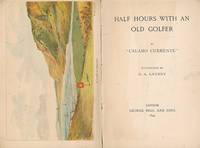
1895réf. c0549London: George Bell & Sons. Worn condition. Cover rubbed and faded with some loss. Fep soiled but content in overall good condition. 1895. First Edition. Green card cover. 180mm x 120mm 7" x 5". 184pp. 4 chromolithograpg plates 35 b/w illustrations. . George Bell & Sons unknown
8vo (160 x 244 mm). 456 pp. Lithographed Persian text, 25 lines of Urdu script to the page. Contemporary half leather with cloth covers (wants spine); original wrappers (front cover forming the title-page) bound within. Third Persian edition, printed in India, of "The Adventures of Haji Baba of Isphahan". The picaresque novel by the British diplomat James Morier (1782-1849), first published in English in 1824, satirised the Qajar dynasty in Iran, which supposedly caused the Iranian ambassador to Britain to lodge an official complaint. Translated by Mirza Habib Isfahani under the editorship of Shadan Bilgrami. - Binding rubbed and scuffed, extremeties chipped and bumped, spine missing. Interior clean and well preserved. Rare; no copy in institutional libraries listed in OCLC.
1970réf. 6663ABMünchen, Goldmann, 1970. 18 cm. 147 S. Taschenbuch (Softcover). Ungekürzte Ausg. Vorsatz und Schnitt schwach braunfleckig. Goldmann-Abenteuertaschenbücher ; A 38.
Folio (280 x 382 mm). (2), 5, (1) pp., 32 photographic plates. Original green half cloth with printed covers. First Arabic edition. Atlas of plates intended to accompany Aly Bahgat's 1928 Arabic translation of the original French edition of his "Fouilles dal Foustât" (Paris, 1921). The city of Fustat, the first capital of Egypt under Arab rule, reached its peak in the 12th century, with a population of approximately 200,000. It was the center of administrative power in Egypt until it was ordered burned in 1168 by its own vizier, Shawar, to keep its wealth out of the hands of the invading Crusaders. The remains of the city were eventually absorbed into nearby Cairo. Today, Fustat is part of Old Cairo, with few buildings remaining from its days as capital, though there have been many archaeological digs which have taken advantage of the wealth of buried material in the area. Many ancient items recovered from the site are on display in Cairo's Museum of Islamic Art. - Table of contents and captions in Arabic and French. At head of title: Dar al-Athar al-Islamiyah / Musée de l'Art Arabe. - Corners insignificantly bumped; altogether well-preserved. OCLC 28312546.
1852Folio. 2 vols. 503, (1) pp. 460 pp. Dark brown calf bindings with fore-edge flap; oxydized giltstamped cover decorations); wants upper cover of vol. 1.
8vo. 2 vols. 310 pp., final blank f. 263, (1) pp. Contemporary half calf over green and marbled boards with gilt spine and handwritten spine-labels. A guide to the Muslim monuments of Istanbul: perhaps the most important Ottoman literary source for the Islamic landmarks of the capital. Long recognized by Turkish scholars as a unique source for the city's architecture and urban form, the text, which was completed in 1195/1780 and revised and enlarged between 1248/1832-33 and 1253/1838 by Ali Sati, contains separate descriptions of each of Istanbul's more than 800 mosques, plus accounts of its medreses, tombs, tekkes, and other monuments. - From the library of John R. Walsh (1919-93), Professor of Turkish Studies at Edinburgh University, with many neat marginal notes, a few underlinings and a few notes loosely inserted or tipped in, most of which appear to be in his hand. A Turkish newspaper clipping from 1950 glued in vol. 1. - Covers rubbed and bumped at extremeties, but firm. Internally very good. Özege 6565. Cf. Faeuk Sumer, i. A. fas. 59, pp. 386-388.
4to (235 x 325 mm). (1), 118 pp. Lithographed throughout; pp. 8-97 comprise a continuous genealogical tree. Contemporary plain black cloth-covered boards with black sheepskin spine. First edition: a rare and important work on the genealogy of the Arab tribes, also an early, graphically sophisticated lithographic effort from the Arab World. The "Book of Gold Bars" by the prominent Iraqi theologian and historian Suwaydi (1786-1831) is a revised and expanded interpretation of the "Dictionary of the Arab Genealogy" by the legendary Medieval Egyptian scholar Ahmad ibn Ali Qalqashandi; notably, Suwaydi continued the genealogical profile up to modern times. The book seeks to trace the genealogy of the Arab peoples, and the branches of their tribes, from Biblical times up to the age of Muhammad and then to the modern era. The introductory text (pp. 1-7) is followed by the grand, 90-page genealogical table and ultimately by an alphabetical reference section and analytical section (pp. 98-118). - Suwaydi is thought to have commenced preparation of the work as early as 1814, although he did not complete the treatise until 1830 or 1831, shortly before his death. Highly regarded in its time, for some years a small number of manuscript copies circulated in Islamic academic circles. The present publication represents the first printed edition of the work. The second edition was published in Bombay in 1877 (and is likewise rare), while several subsequent editions appeared during the 20th century. - Covers slightly stained. Last 3 leaves with light tide-marking to outer margins and some sporadic light stains elsewhere, but overall in a good clean condition, a few leaves with short marginal tears some closed with discreet old restoration. Very rare: we can trace only six institutional examples (British Library; University of Cambridge; Bibliothèque de Genève; Yale University Library; University of California at Berkeley; National Library of Israel). No examples have appeared on the market over the last generation. OCLC 708712572 & 32728624. British Library: Asia, Pacific & Africa 14548.c.5. Yale University Library: CS1129.A2 S8 1864. On early lithography in Iraq, cf. A. Al-Rawi, Media Practice in Iraq (2012), passim.
960 x 820 mm. Colour-printed map (folded). Scale 1:4,700,000. A large map of the Middle East, produced by Israel's General Staff soon after the Suez Crisis, showing the Arabian Peninsula and adjoining countries with major roads, railroads, and petroleum pipelines. - A few tears to folds, but well preserved.
8vo. 160 pp. Illustrated. Original pale blue wrappers titled in navy. First edition of "The Campaign for the Liberation of Israel": a rare publication on the First Arab-Israeli war by Israeli geographer Zev Vilnay (1900-88). Better known for his lectures on outdoor hiking and touring in Israel, Vilnay also served as a military topographer in Haganah and later the Israel Defense forces. His work, written in Hebrew, is profusely illustrated with maps showing transportation corridors, troop movements, and military and civilian installations. Vilnay's maps depict battles in and around Jerusalem, Haifa, Tel Aviv, the Upper and Eastern Galilee, and many more, discussing strategy and the use of infrastructure and landscape in waging war. An interesting geographer's view of Israeli military action during the 1948 Arab-Israeli War. - Light wear to spine. OCLC 19195703.
Small 4to (125 x 175 mm). 67, (5) pp. Original printed wrappers. A description of travels throughout Lebanon, written in Hebrew and including a map of the region labeled in Hebrew as well as numerous half-tone illustrations from photographs. Rafael Sverdlov (b. 1885) was a geography teacher at schools in Tel Aviv, and as both resident and teacher had both a personal and professional understanding of the landscapes of the area. The in-text illustrations show Roman-era ruins, rivers, and tree plantations. - A touch of wear, otherwise quite well preserved. OCLC 19179078.
4to (20.5 x 15.5 cm). [20], 211, [1] pp. With the title in red and black in an ornamental, architectural woodcut frame with a palm tree at the head, and woodcut palm tree device above the colophon (both acquired from Erpenius), a decorated woodcut initial, a woodcut factotum and factotums and decorative bands built up from cast fleurons. Set in serto Syriac, meruba Hebrew, Greek and roman types, with incidental estrangela Syriac and italic. Contemporary or near contemporary vellum, sewn on 4 velum tapes laced through the joints, with a hollow back, red edges. The first edition of any early text of the Book of Revelations in the ancient Syriac language, a book that had been lacking in the manuscripts followed by the earlier Syriac New Testaments. It is also the first book the Elzeviers printed with Syriac or any other "oriental" type, their earlier forays into printing with non-Latin types having been limited to Greek and Hebrew. The main text is set in two columns, with the Syriac text set in Syriac type on the outside and the Syriac text set in Hebrew type on the inside, an aid to scholars less familiar with the Syriac script. Two columns in smaller type at the foot provide the original Greek text and a literal Latin translation of the Syriac. The whole is well printed and laid out, showing why the Elzeviers were quickly gaining a reputation as the leading scholarly printers and publishers. Thomas Erpenius made Leiden University the leading centre for the study of oriental languages when appointed professor of oriental languages in 1613. He set up his own printing office, acquiring or commissioning types for Arabic, Syriac, Samaritan and Ethiopic, and inaugurating it with his edition of Lockman's fables in Arabic (1615). His death from the plague at age forty cut his work short in 1624. Ludovicus de Dieu (1590-1642), Regent of the Walloon College associated with the University, had studied under Erpenius and his successor in Arabic studies Jacob Golius, but for Syriac he became Erpenius's spiritual successor. The present book was nearly his first publication. Although Syriac New Testaments had been published earlier, no source had been found for the Syriac text of the Book of Revelation, which was lacking in the standard "Peshitta" Bible, a Syriac Old and New Testament whose text was probably established in the 4th century. In his 1599 Polyglot, Elias Hutter therefore filled the gap with his own new translation, but De Dieu published the present text based on a manuscript from the library of the great orientalist Joseph Scaliger, apparently a copy made in Rome ca. 1580 of an ancient manuscript of the Syriac text established by the Persian Philoxenus, Bishop of Mabbug, in Mesopotamia in 508 and corrected by the Palestinian monk Thomas of Harkel near Alexandria in 616. For that reason, Darlow & Moule, Smitskamp and others call the present book the "editio princeps". Erpenius's widow briefly continued her husband's printing office, completing the Syriac psalter that he had begun, but it was published jointly by the Elzeviers and Johannes Maire, and on 9 October 1625 the Elzeviers bought her printing office and took over most of its materials and workmen. At the same time they began to acquire and commission new printing materials, greatly expanding the printing office they had added to their publishing house in 1617. This made the period 1625 to 1640 the press's golden age. Erpenius had commissioned the woodcut of the present title-page for his Arabic Historia Josephi in 1517 and most of the types and fleurons came from him as well. Plantin commissioned the serto and estrangela Syriac types from Robert Granjon for volume 5 (1571) of his Polyglot Bible (Erpenius added and revised a few characters in the serto) and Daniel Bomberg commissioned the Hebrew type for his press in Venice, where he used it in 1517. The lovely arabesque initial V with a face in the centre, however, belongs to a series cut exclusively for the Elzeviers and used here nearly for the first time. The book also shows them beginning to supplement their 16th-century French types (Garamont romans and Granjon italics) with 17th-century types cut in the Dutch Republic. The New Testament was originally written in Greek, the language of the Christian Church and Christian scholars in the first centuries of the Christian era, and a lingua franca among the diverse groups living in the Middle East at that time. But it relates stories that would have first been told (and in some cases probably also written down) in Aramaic, the vernacular language of Palestine in Jesus's time. It also presents Jesus's words in Greek translation, while he would have spoken them in Aramaic. While no early New Testament survives in Palestinian Aramaic, the Greek was translated into Syriac, probably already in the second century, and surviving manuscripts may date back to the fifth century. Syriac, another dialect of Aramaic, served as the vernacular language of much of the Middle East (it has nothing to do with today's Syria, where the native language is Arabic). The Syriac text therefore provides valuable clues to the Aramaic sources of the New Testament. The Peshitta Bible remains the standard text among some Christian groups. Debates continue as to how much of the "original" Aramaic can be found in the surviving Syriac versions. - The watermark in the endpapers (a simple bend) does not closely match any found in the literature, but the nearest is Heawood 129, used in Amsterdam in 1646. In fine condition, with only an occasional minor spot and at the edge of the last few leaves some tiny (0.2 mm!) worm holes, and with large margins (the leaves are a couple millimetres taller than those noted by Berghman and Rahir). The binding is very slightly rubbed but still very good. A fine copy of an important work of biblical scholarship and a showpiece of the Elzevier's press at the beginning of its golden age. Berghman, Cat. Raisonné 48; Copinger 1310; Darlow & Moule 8962; Rahir 230; Smitskamp, Phil. orientalia 303; STCN (9 copies); Willems 269; www.bibliasacra.nl, 1627.Rev.poly.BE.a.; for the types: J.F. Coakley, Typography of Syriac W3B & S3.
8vo. 12 vols. With 72 engr. maps. Contemp. French full calf with giltstamped labels and gilt spines. All edges red; marbled endpapers. A fine copy of the twelve-volume octavo edition of the most detailed and accurate geography of its day (published simultaneously in four quarto volumes). All the maps are taken from the "Atlas Portatif" (1748-49) of Robert de Vaugondy. The fine map of the Arabian Peninsula is derived, via Vaugondy, from Delisle; "it includes the three classic divisions of the Arabian Peninsula and the following regional subdivisions: Tahama in the south west, Bahrain, which extends along the east coast and includes the town of Cathema, Yemen in the south which includes Oman, the States of the Cherif of Mecca which includes Hagiaz and parts of the centre of the Arabian Peninsula. Although the width of the Red Sea is exaggerated, the Sinai peninsula's shape is very close to reality. The topographical features and watercourses are not very different to how they are shown on other maps of the same period. A town named Naged is shown to the north west of the town of Janama" (Al Ankary). - Some bindings slightly bumped at extremeties. Contemporary ms. ownership "Leon. van Berg" to pastedowns; titles bear stamp of the La Valsainte Charterhouse, Switzerland (dissolved in 1825). Slightly browned. Formerly in the collection of the Swiss industrialist Herry W. Schaefer. Streit 17, p. 252, n. 6198. Brunet VI, 19613. OCLC 34221488. For the map of Arabia cf. Tibbetts 278. Sultan Bin Muhammad Al-Qasimi, The Gulf in Historic Maps, S. 162. Al Ankary Collection 338 (all referencing Vaugondy's map).
8vo. 12, 483, (1) pp. Contemporary half calf on four raised bands with sparsely gilt spine; pink cloth covers and marbled endpapers. First printing of this prose and verse anthology on the subject of Islamic ethics, containing eight chapters on virtues and another eight on vices. - Al-Watwat al-Kutubi (1234-1318), celebrated as an entertaining compiler, lived in Mamluk Egypt all his life. Unlike many writers of his era was not a member of the Mamluk administration, but rather a wealthy bookseller (hence his byname "Al-Kutubi", "the Bookseller"). - Binding slightly rubbed; paper evenly browned as common. Blank first page has contemporary ink ownership of Fernand Patorni (b. 1837), chief interpreter in Algiers and author of "Les Tirailleurs algériens dans le Sahara" (1884). GAL II, 55. OCLC 253615769.
2000réf. 1326257PN. New. 2000. Soft Cover. Date is original print. This is a reprint edition . PN paperback
1998réf. 1307061PN. New. 1998. Soft Cover. Date is original print. This is a reprint edition . PN paperback
1997réf. 1302135PN. New. 1997. Soft Cover. Date is original print. This is a reprint edition . PN paperback
1998réf. 1303608PN. New. 1998. Soft Cover. Date is original print. This is a reprint edition . PN paperback
1999réf. 1316254PN. New. 1999. Soft Cover. Date is original print. This is a reprint edition . PN paperback
1997réf. 299304PN. New. 1997. . Soft Cover. Date is original print. This is a reprint edition . PN paperback
1999réf. 1314627PN. New. 1999. Soft Cover. Date is original print. This is a reprint edition . PN paperback
1998réf. 1308689PN. New. 1998. Soft Cover. Date is original print. This is a reprint edition . PN paperback
1999réf. 1317589PN. New. 1999. Soft Cover. Date is original print. This is a reprint edition . PN paperback
2007réf. 949952Gulf Research Center, 2007. 536 S. Fadengehefteter Pappband mit Schutzumschlag.
réf. ria9780309267649_inpPaperback / softback. New. New Book; Fast Shipping from UK; Not signed; Not First Edition; Although all wars since World War I have involved the use of explosives by the enemy the wars in Afghanistan and Iraq differ from previous wars in which the United States has been involved because of the enemy's use of improvised explo paperback
2014réf. 8767256National Academies Press 2014. Volume 9. This is an ex-library book and may have the usual library/used-book markings inside.This book has soft covers. In good all round condition. Please note the Image in this listing is a stock photo and may not match the covers of the actual item500grams ISBN:9780309267649 National Academies Press paperback