1799 risultati
1984rif. 14224Japan: Ken Knutson and James Wanless 1984. First Edition. Paperback. Collectible; Like New/Box Very Good. Japan: Ken Knutson and James Wanless 1984. First Edition First Printing. 1984 Voyager Tarot Cards Printed in Japan Published by Ken Knutson and James Wanless 1984. A TRUE FIRST EDITION! Stated as such in the book and on the back of the box. The Voyager is one the most original tarot decks ever created and the first edition is superior in quality both in color and design compared to later editions. The cards illustrations have dazzling color and sharp clear images and the cards themselves are of a much heavier card stock with a print quality far superior to the later editions. The first printing Voyager decks are extremely rare and will become even more rare as time goes on making this a wise investment for the collector. Tarot Card Deck Has all 78 cards with Small Booklet Titled: Voyager Guidebook Tarot Instruction Book and Manual For Voyager Tarot. Condition is Near Fine For the Cards and Booklet Booklet has some very mild wear at edges. Case is Very good with a some wear around the edges. Cards seem new and never used. The Voyager Tarot is a deck of pure symbolism that reflects our present day circumstances in bright and colourful photographic collages of images from multiple cultures. James Wanless's deck is intended to be used for self-empowerment and self-awareness. . First Edition. Cards. Collectible; Like New/Box Very Good. Ken Knutson and James Wanless paperback
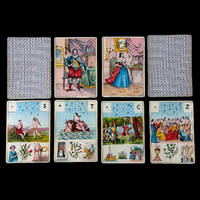
1845rif. 121Original complete divination card deck Grand Jeu de Mlle Le Normand The most used divination deck beside Tarots Card Deck. Grand Jeu de Mlle Le Normand. Paris B.P. Grimaud c.a. 1845. Complete deck 128 x 9 cm 54 chromolithographic cards printed on thick cardboard with French suit-marks. Each card except for the Querent cards includes a variety of zodiacal classical and modern images. In addition there is a miniature playing card illustration in the top left corner and a letter of the alphabet in the top right. The two Querent cards representing a man and a woman depict figures dressed in 17th-century clothing. The backs of the cards are adorned with violet geometric designs with rounded corners. The Grand Jeu de Mlle Lenormand takes its name from the famous French bookseller necromancer fortune-teller and cartomancer Marie Anne Lenormand although there is no definitive evidence that these cards were used by Lenormand herself. Her deck was later reprinted in English-speaking countries under the name: Grand Jeu Lenormand Astro Mythological Cards. The Grand Jeu de Mlle Lenormand is known for its intricate and intellectual iconography featuring complex scenes based on Greek mythology. Each card includes multiple layers of symbolism including references to astrology alchemy and divination. Each card features: <!-- if !supportLists-->· <!--endif-->A playing card reference <!-- if !supportLists-->· <!--endif-->An astrological reference/constellation <!-- if !supportLists-->· <!--endif-->A letter of the alphabet <!-- if !supportLists-->· <!--endif-->A central image which is a particular scene from Greek mythology <!-- if !supportLists-->· <!--endif-->Two further smaller scenes depicted on the bottom left and bottom right of the card <!-- if !supportLists-->· <!--endif-->A particular flower bottom centre. The primary elements for divination are the central image and the two smaller scenes at the bottom with the other symbols providing additional context and meaning. The 52 all but the Querent cards cards can be divided in 5 categories : <!-- if !supportLists-->· The Conquest of the Golden Fleece which represents Business 6 cards <!-- if !supportLists-->· <!--endif-->The Trojan War representing the Right of the Strong over the Weak 9 cards <!-- if !supportLists-->· <!--endif-->Hermetic Knowledge based on alchemy which represents Marriage and more generally relations between people. 7 cards <!-- if !supportLists-->· <!--endif-->The Zodiac Cards representing an amount of Time. 12 cards <!-- if !supportLists-->· <!--endif-->The Unexpected. 18 cards. Marie Anne Adelaide Lenormand 1772–1843 also known as Marie Anne Le Normand was a renowned French bookseller necromancer fortune-teller and cartomancer especially famous during the Napoleonic era. It is said that notable figures such as Marat Robespierre and Saint-Just sought her counsel and received ominous predictions of their deaths. She is also reputed to have had connections with Empress Joséphine and Napoleon Bonaparte as well as Talleyrand the French minister who navigated France through the Congress of Vienna. Lenormand is widely regarded in France as the greatest cartomancer of all time instrumental in the rise of French cartomancy that began in the late 18th century. An identical deck can be found in the collection of the Bibliothèque Nationale de France BNF: https://gallica.bnf.fr/ark:/12148/btv1b10510163j/f7.item; Conditions: Light marks of use overall in excellent condition. References: Catherine Perry Hargrave A History of playing cards Dover publications 2021; Peter Endebrock 2021; Henry Rene D'Allemagne Les cartes à jouer du XIV au XX siècle Paris : Librairie Hachette 1906; W. GURNEY BENHAM History of the Pack and Explanations of Its Many Secrets Read Books 2019; B.P. Grimaud
2011rif. 062216Atu House 2011. Book. As New. Paperback. Signed by Authors. Limited First Edition. Scarce Limited First Edition Tabula Mundi Tarot deck Nox Et Lux Edition with 232-page companion book Liber Mundi. Incredibly deck is still sealed with and additional card that is signed and numbered by the author. No. 25 of only 418 decks. Deck is housed in a silver foil stamped black box with silver ribbon lift and tie finished with a numbered banner. Book is tight and unread with embossed bookmark and a minor bit of rubbing. . Atu House Paperback
1943rif. 135COMPLETE DIVINATION DECK OF ITALIAN TAROT "MODERN PIEMONTESE PATTERN" PRINTED IN GENOA AND USED DURING THE SECOND WORLD WAR IN THE AREA OF THE "ITALIAN SOCIAL REPUBLIC" Tarocchi Piemontesi Genoa Italy Faustino Solesio 1944-1945. 78 Tarot cards 10.5 x 5.5 cm featuring chromolithographic images; backs of the cards adorned with a green diagonal pattern; rounded corners. A complete deck of the "Tarocchi" characterized by Italian suits: Spade Swords Bastoni Batons Coppe Cups and Denari Coins with Spade and Bastoni interlaced in a manner typical of these decks. The deck features double-headed court cards comprising four face cards—King Queen Knight and "Valet"—and ten numeral cards in each suit totaling 56 cards. It includes 21 double-ended "atouts" trump cards atutti in Italian numbered one to twenty-one and an extra card called "Il Matto" The Fool numbered 0. The trumps are captioned in Italian; the trumps and the suits are numbered with Arabic numerals inside or above a small image representing the suit. On the Ace of Coins is the name of the maker: "Faustino Solesio Genova – Casa Fondata nel 1774" House Founded in 1774 and the tax stamp. The Italian Social Republic RSI also known as the Republic of Salò was a puppet state created in the northern part of Italy during the Second World War from September 1943 to April 1945. Formally led by Benito Mussolini it was under the political and military control of Nazi Germany. The RSI represented the fascist regime's last attempt to maintain power in Italy with a precarious state structure and a context marked by partisan resistance and the Italian civil war. Faustino Solesio was an important printer of playing cards and tarot decks active in Genoa during the 19th and early 20th centuries. He was known for printing various types of cards including Tarocchi Piemontesi produced using woodblock printing techniques and colored with pochoir; Minchiate Fiorentine of which he was the last known producer around 1930. The Minchiate Fiorentine were created based on designs by the Modenese artist Pipein Gamba probably intended mainly for collectors since players had by then disappeared. He also produced playing cards with Italian suits. Conditions: Unused perfectly preserved. Provenance: On the Ace of Coins there is a tax stamp with the inscription "IX – Lire tre". This rare stamp was used during the period 1944-1945 when northern Italy was under the control of the Italian Social Republic RSI which used specific fiscal stamps. The Roman numeral did not represent the year according to the Fascist calendar as is often erroneously believed but indicated the city to which the deck belonged. The number XII represented the city of Milan XIII was Trento and IX present on this deck probably represented Genoa. Reference: Stuart Kaplan The Encyclopedia of Tarot Volume II U.S. Games Systems 1986. Peter Endebrock's Playing-card Pages. Faustino Solesio
1947rif. 014875Paris Sagittaire 1947 In-12 Broché
2012rif. SBBI-mon0000156506Frances Lincoln Children's Books 2012. hardcover. Acceptable. Rip to the cover or dustjacket if hardback or significant tearing to pages. Please see the condition note after this for details if this is missing please consider Acceptable to mean poor quality that could include major staining water damage writing missing dustjacket etc etc. Our books are dispatched from a Yorkshire former cotton mill. We list via barcode/ISBN so please note that the images are stock images and may not be the exact copy you receive furthermore the details about edition and year might not be accurate as many publishers reuse the same ISBN for multiple editions and as we simply scan a barcode or enter an ISBN we do not check the validity of the edition data when listing. If you're looking for an exact edition please don't order at least not without checking with us first although we don't always have time to check. We aim to dispatch prompty the service used will depend on order value and book size. We can ship to most countries see our shipping policies. Payment is via Abe only. Frances Lincoln Children's Books hardcover
2014rif. SBBI-mon0000099575Race Point Publishing 2014. hardcover. Acceptable. Some major bending or creasing to the book. Please see the condition note after this for details if this is missing please consider Acceptable to mean poor quality that could include major staining water damage writing missing dustjacket etc etc. Our books are dispatched from a Yorkshire former cotton mill. We list via barcode/ISBN so please note that the images are stock images and may not be the exact copy you receive furthermore the details about edition and year might not be accurate as many publishers reuse the same ISBN for multiple editions and as we simply scan a barcode or enter an ISBN we do not check the validity of the edition data when listing. If you're looking for an exact edition please don't order at least not without checking with us first although we don't always have time to check. We aim to dispatch prompty the service used will depend on order value and book size. We can ship to most countries see our shipping policies. Payment is via Abe only. Race Point Publishing hardcover
2014rif. SBBI-mon0000100619Race Point Publishing 2014. hardcover. Good. Our good condition books are generally good for reading but not for gifting or collecting. They could have imperfections such as creasing fanning inscriptions margin notes yellowing staining on edge or cover or pages bumps scuffs etc etc sometimes multiple of these. It's a wide category that encompasses anything that isn't almost-new down to anything that is slightly better than poor. We would NOT recommend gifting Good books - these should be considered reading copies. Our books are dispatched from a Yorkshire former cotton mill. We list via barcode/ISBN so please note that the images are stock images and may not be the exact copy you receive furthermore the details about edition and year might not be accurate as many publishers reuse the same ISBN for multiple editions and as we simply scan a barcode or enter an ISBN we do not check the validity of the edition data when listing. If you're looking for an exact edition please don't order at least not without checking with us first although we don't always have time to check. We aim to dispatch prompty the service used will depend on order value and book size. We can ship to most countries see our shipping policies. Payment is via Abe only. Race Point Publishing hardcover
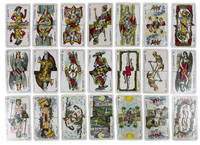
1900rif. 136CARDS TO PREDICT "THE PAST THE PRESENT AND THE FUTURE" A COMPLETE DECK BELONGING TO AUSTRIAN TAROCK PATTERN TYPE C THE MOST BEAUTIFUL OF THE "WORK AND PLAY" TAROTS PRODUCED IN EUROPE. Austrian Tarock Pattern Type C Wien Ferdinand Piatnik & Söhne 1900-1920. 54/54 tarot cards 114 x 62 mm chromolithography backs of the cards enriched by a double-ended neoclassical decoration round corners French suits. Tax stamp and printer's device with "Ferd. Piatnik & Söhne Ag – Wien – Registrirte Schutzmarke" on the Ace of Hearts "Ferd. Piatnik & Söhne Ag" on the Jacks of Diamonds. The deck belongs to the pattern called Austrian Tarock pattern Type c. Four suits of 8 cards each King Queen Knight Jack and Hearts and Diamonds Ace–4 and Spades and Clubs 7–10 plus twenty-two trump cards. The trump cards depict scenes of outdoor life in various countries. The trumps and court cards are double-ended and the trumps display a different scene at each end. They are numbered with Roman numerals. Trump number II invariably has at one end the picture of a crowned eagle sword in claw perched on a rock inscribed with "Industrie Und Glück" Trump No. I the Fool is always portrayed as a stage musician. Provenance: Tax stamp known as Kartenstempel named after the inscription on the upper part of the stamp which is commonly found on antique decks of playing cards particularly in Austria and the territories of the Austrian Empire. The stamp guaranteed that the deck had been legally produced and that taxes had been paid. The type of stamp present on this deck was in use between 1900 and 1920 and the value of 60 Heller indicated "a deck of more than 36 cards not lacquered not washable." Endebrock 2000. REFERENCE: KATHLEEN WOWK Playing Cards of The World Lutterworth Press 1983 pp. 137-140; Peter Endebrock Playing-card Pages website 2000; SYLVIA MANN Collecting Playing cards Arco Publications 1966 pp. 105-108 Ferdinand Piatnik & Söhne
1926rif. YRG-373Première édition, in-8 broché, complet des onze planches soit 22 arcanes en couleur. 327 pages, quelques pages légèrement jaunies dans les marges, couverture sous plastic, insolée en partie, 4ème de couverture taché en bas. Page de titre désolidarisée, rabat de la couverture replier désolidarisés et présent. Voir photographies. Nourry. Paris.
rif. GOR004193541Paperback. Very Good. paperback
rif. 140943789Tokyo: Fukuinkan-Shoten 1977. First Edition. Very Good. First edition first printing in the original Japanese language of this best-selling plotless children's book. Bound in publisher's original stiff printed wraps. Very Good with toning and wear to wraps musty odor and sporadic foxing to pages. Very uncommon indeed--while everybody poops few can own a book this rare plus most things that poop do not have money. Fukuinkan-Shoten unknown books
2007rif. 76660Steidl/ICP. New. Hardcover. FREE UPGRADE to Courier/Priority Shipping Upon Request - IN STOCK AND IMMEDIATELY AVAILABLE FOR SHIPMENT - Flawless copy brand new pristine never opened -- Text in English. 176 pp. With 154 ills. 28 col. . 29 x 22 cm. -- with a bonus offer--; In 1934 after reading John Dos Passos' 1919 Gerda Taro left her home in Stuttgart for Paris. There she met the now legendary photographer Robert Capa with whom she traveled to Spain at the start of the Civil War. As his lover and photographic partner--and as his manager--she is often credited with launching his career. She was also the first woman photojournalist to enter the heat of battle. The couple worked together until Taro was killed while photographing a crucial clash near Madrid in July 1937 just six days shy of her twenty-sixth birthday. The International Center of Photography holds by far the world's largest collection of Taro's work including approximately 200 prints as well as original negatives. This selective survey of the ICP's holdings is organized chronologically and set in context with the inclusion of magazine layouts; it is the first major collection of Gerda Taro's photographs ever published. . 2007. 3865215327 . Steidl/ICP hardcover
2010rif. 87603Gerhard Steidl Verlag. New. Paperback. FREE UPGRADE to Courier/Priority Shipping Upon Request - IN STOCK AND IMMEDIATELY AVAILABLE FOR SHIPMENT - Flawless copy brand new pristine never opened -- TWO 2 VOLUME SET. Vol. 1: 160 pages; 129 illus. ; Vol. 2: 432 pages; 1330 illus. -- with a bonus offer-- . 2010. 3869301414 . Gerhard Steidl Verlag paperback
rif. 2081002109000811Kure Naval Arsenal Ordnance Department Historical Materials Compilation Committee N.A. Soft Cover. Fine. Number of pages: 3 Size: 30cm Number of books: 3 Kure Naval Arsenal Ordnance Department Historical Materials Compilation Committee paperback
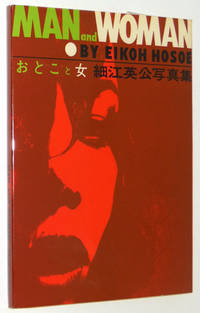
1961rif. 1041121961 Tokyo, Camera Art, 1961, 244x188mm, 33 photographies de Hosoe avec les poèmes de Taro Yamamoto, les textes de Van der Elsken et Tatsuo Fukushima. Bradel papier jaune, jaquette illustrée, complet de la brochure (agrafée, 30 p., 209x147mm) avec le texte original d’Elsken, emboîtage avec titre et nom de l’auteur, bande-annonce grise. Conception graphique : Minoru Araki. Exemplaire neuf, complet et signé. Prix du jeune photographe de The Japan Professional Photographers Society en 1961." (…) C’était la première fois que la photographie de nus a échappé à la représentation de ‘nu’ et évoque les problèmes de sexualité au même niveau que la littérature. Nous voyons là la crise de l’existence, l’état de ruine de notre monde, le désir originel vers la vie, et entendons des gémissements de haine à travers le corps humain. Mais résolument, le jeune photographe crie l’amour, la liberté et la joie. (texte de Tatsuo Fukushima) "Réf. 328 Outstanding Japanese Photographers, Tokyo Metropolitan Museum of Photography, 2000, p.277. Japanese Culture : The Fifty Postwar Years 1945 - 1995. Tokyo, Asahi Shinbunsha, 1995, p.65, Iib-4-1,2,3.Eikoh Hosoe : 1950-2000 Photographes. Tokyo, Kyôdô-tsûshinsha, 2000, p.286, ill.Japon 1945-1975 Un renouveau photographique. 2003, p.10, 92-96, ill.New Japanese Photography. New York, The Museum of Modern Art, 1974, p.82-83.The Photobook Parr+Badger, Londres, Phaidon, 2004, p.279.Livres de nus. A. Bertolotti, Paris, Éditions de la Martinière, 2007, p.158-159, ill.Les livres de photographies japonais. Ryuichi Kaneko+Ivan Vartanian, Paris Éditions Seuil, 2009, p.50-55, ill.Photobooks. M.Auer, Hermance, Éditions M+M, 2007, p.413, ill.(104112)
1961rif. 14843Tokyo: CameraArt 1961. Hardcover. SIGNED. First edition first printing. Hosoe's first book; a collaboration with choreographer Tatsumi Hijikata and Butoh dancers to explore the relationships between men and women. Photographs by Eikoh Hosoe; poems by Taro Yamamoto; text by Ed van der Elsken and Tatsuo Fukushima. SIGNED BY HOSOE on the ffep in silver ink; no inscription. Unpaginated 64 pages; 34 full-page or full-spread gravure-printed b&w plates; 7.25 x 9.5 inches. Text in Japanese. Condition: Near Fine hardcover with two blunted tips a light bump to the heel and one tiny abrasion in a Fine dust jacket with a touch of rubbing to the spine ends in a Near Fine publisher's printed card slipcase with light overall rubbing with the promotional belly band. Tipped in to the last page is the colophon information with a vellum overlay. A very nice copy. Reference: Auer 802 Photo Books p.413; Bertolotti Books of Nudes p.158-159. All dust jackets are protected by a clear mylar cover. Ships the next business day wrapped in padding in a box. CameraArt hardcover
1938rif. 214245New York: Covici Friede 1938. First edition and first printing. Hardcover. Features a preface by Jay Allen who also translated Capa's captions. Legendary collection of black and white photographs by Robert Capa and Gerda Taro of the Spanish Civil War. The book's layout was arranged by Andre Kertesz. A clean very near fine copy in oatmeal colored cloth with the typical toning to the gutters of the endpapers and in a very good plus dust jacket with some slight toning along the edge of the front panel near the spine some small chips to the spine ends some other tiny edge chips and tears and with a nickel sized spot to the front panel. Still easily one of the nicest copies I've ever seen and one that is free of any repairs. Parr & Badger v1 139. Covici Friede unknown
1938rif. 214245New York: Covici Friede 1938. First edition and first printing. Hardcover. Features a preface by Jay Allen who also translated Capa's captions. Legendary collection of black and white photographs by Robert Capa and Gerda Taro of the Spanish Civil War. The book's layout was arranged by Andre Kertesz. A clean very near fine copy in oatmeal colored cloth with the typical toning to the gutters of the endpapers and in a very good plus dust jacket with some slight toning along the edge of the front panel near the spine some small chips to the spine ends some other tiny edge chips and tears and with a nickel sized spot to the front panel. Still easily one of the nicest copies I've ever seen and one that is free of any repairs. Parr & Badger v1 139. Covici Friede unknown books
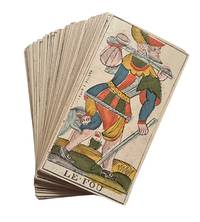
1800rif. 10253Besançon: Jean-Jacob Jerger 1800. Complete deck of 78 bi-laminate cards approx. 123 x 66 mm horizontal chain lines comprising Four suits of four single-figure court cards and ten pip cards plus 21 numbered single-figure trump cards and one Fool card. Captions in sometimes corrupted French. Woodcut illustrations colored by stencil in red green ochre grey blue and yellow; card backs covered in reddish-pink Tupfpapier with a non-repeating pattern. The Two of Cups bears Jerger's Besançon imprint while the Major Arcana and court cards are marked "France J. Jerger." Light wear and soiling to extremities but corners sharp without dog-ears. Cards cut in-square with precise right angles but some cards fractionally longer than others. Deck preserved in a modern wrapper printed on old paper. A beautiful and early example of the Tarot de Besançon a Franco-Swiss variant of the Marseille deck distinguished by its substitution of the pagan deities Juno and Jupiter for the Pope and Popess. This secularized form proved especially popular in the religiously mixed and Protestant regions of Central Europe where it became the dominant style of tarot deck. The German-born engraver and cardmaker Jean-Jacob Jerger established his workshop in Besançon during the French First Republic. Although he did not originate the Juno and Jupiter substitutions he did much to codify and popularize the pattern - so much so that decks of this type became known as Tarots de Jerger. His prominent identification of Besançon on the Two of Cups reflects the city's importance as a culturally diverse center of the European card trade. Produced as tarot was beginning its transition from a social trick-taking game - often played in taverns and for stakes -to an instrument of divination this is a complete and unusually well-preserved survival. Jerger was particularly important in the development of uniform card backs experimenting with randomized patterns that prevented individual cards from being recognized and used for cheating. This deck retains his distinctive non-repeating daubed-paper backs. Altogether a particularly desirable example of the archetypal Tarot de Besançon. . Jean-Jacob Jerger unknown
1943rif. 140948100Topaz UT: The Topazette The Topaz Times 1943. First Edition. Very Good. Archive of documents from the Central Utah Relocation Center known as Topaz. From the estate of Susan Nail daughter of the camp's Military Police company captain who attended Topaz High School for her senior year. Includes 5 issues of the high school newsletter The Topazette, The Topaz Times unknown
1943rif. 140948100Topaz UT: The Topazette The Topaz Times 1943. First Edition. Very Good. Archive of documents from the Central Utah Relocation Center known as Topaz. From the estate of Susan Nail daughter of the camp's Military Police company captain who attended Topaz High School for her senior year. Includes 5 issues of the high school newsletter The Topazette, The Topaz Times unknown books
1981rif. 2081402109703271Kyukoshoin 1981. Soft Cover. Fine. The book is in fine condition. Kyukoshoin paperback
1945rif. 140943882Topaz UT: The Topaz Times 1945. Four hundred issues of The Topaz Times; 197 of which are in English and 203 in Japanese; with 47 fragments of various issues 17 illustrated calendars and nine pieces of ephemera including high school newspapers from Topaz War Relocation Center Ram-bler and Topazette. Following two Pre-Issues from September of 1942 the run spans from Vol. II #49 February 27 1943 to Vol. X #19 March 6 1945. The newspaper was issued with varying frequency from daily to weekly or less. Illustrated with drawings many of which are cartoons. Each issue from 2 to 10 pages or so generally printed on both sides of mimeographed sheets measuring about 36.5 x 22.5 cm 14¼" x 8 ¾". Stitched together into monthly groups or fascicles with string through small holes in the top margins. Very Good overall with some edge wear chips and tears; very infrequent loss of text or biopredation. Most issues appear complete but archive is sold "as is" with regards to completeness. Rare. The English language issues are as follows: vol. II no. 49; vol. III nos. 6 7 8-B 9 13 15 18-25 27 30 31 33 34 36 38 39 40 two copies; vol. IV nos. 2 5 7 8-A 9 11-17 20 21 23 24 two copies 26 27 29-31 34-36; vol. V nos. 1 3-13 16-25 27-31 33 two copies 34 36 two copies; vol. VI nos. 1 two copies 2 3 two copies 3-8 9 two copies 10-34; vol. VII nos. 1-3 5-7 8 two copies 9 10 12-22 24 25 27 two copies; vol. VIII nos. 1-3 4 two copies 7 9 two copies 10 12-15 19 21; vol. IX nos. 1-7 9 10 13-18 20 21 23-26; vol. X nos. 1-3 19. Japanese issues are as follows: vol. II no. 49; vol. III nos. 3 6-8 8-B 12-14 18-22 23 two copies 25 29-39; vol. IV nos. 2-4 7 8-A 9 10 12-17 19 two copies 20 21 23 24 26-30 31 two copies 33-37 39; vol. V nos. 1-29 30 two copies 31 33 two copies 34 36 two copies; vol. VI nos. 1-35; vol. VII nos. 1-3 5 6 two copies 7 8 two copies 9 10 12-17 19-22 24 25 27 two copies; vol. VIII nos. 1-3 4 two copies 6 7 9 11-15 18 19 two copies 20 22 25; vol. IX nos. 1-11 13-19 21 23-26; vol. X nos. 1 3. Special editions include: Election Special June 14 1943 bilingual; Extra Dec 18 1944; Extra / Special Edition Jan. 31 1944 lists youths named in draft; Pre-Issue Sept. 26 1942. 6 pp.; Pre-Issue No. 3 September 30 1942. 6 pp.; Special edition Dec. 18 1943 2 pp.; Special edition January 21 1944 bilingual; Special edition May 19 1944 bilingual; Special edition May 23 1944 bilingual two copies; "The Sporting Green" January 22 1944 1 pp.; Topaz Times Extra Two Issues April 16 1943 & April 20 1943 bilingual. Illustrated monthly calendars: May 1943 August-December 1943; Happy New Year 1944 two copies January 1944 two copies February 1944 March 1944 May-August 1944 Dec. 1944. Incomplete issues: Sept. 18 1943 English pp. 3 & 4; Japanese Americanization Supplement only; Sept. 23 1943 English pp. 2 3; vol. IV #37 English pp. 1-3 5; Sept. 25 1943 Japanese Americanization Supplement; vol. IV #38 Japanese p. 3; vol. IV #16 English duplicate of pages 1 & 2; August 12 1943 English p. 5 Japanese p. 3; vol. IV #19 English pp. 1 2 5 6; vol. IV #22 English pp. 1 2 5-8; Japanese pp. 34; vol. IV #27 English pp. 78; vol. V #1 Japanese pp. 23; vol. V #2 English p. 3; vol. V #12 Japanese p. 3; vol. IX #11 English pp. 3 4; vol. VIII #25 English p. 3 4; vol. VIII #21 Japanese pp. 3 4 only but may just be misnumbered; vol. #20 English p. 5; Jan. 6 1944 Japanese pp. 34; Jan. 8 1944 Japanese pp. 34; Feb. 19 1944 English p. 5 b/w Japanese p. 3; vol. VII #6 English pp. 5 6; vol. V #36 Japanese p. 3; Dec. 16 1943 English p. 3 Japanese p. 3; Dec. 9 1943 English p. 3; Japanese p. 3 two copies; Dec. 24 1963 pp. 3 4 7 8; vol. V #28 Japanese pp. 12; Dec. 18 1943 English pp. 3 4; Dec. 11 1943 English pp. 3 4; Dec. 21 1943 English p. 3 Aug. 9 Japanese pp. 34; vol. VI #1 Japanese pp. 3-6; vol. VII #18 Japanese pp. 3 4; June 17 1943 Japanese pp. 4 5; vol. III #37 English p. 3; vol. III #35 English p. 3; June 10 1943 Japanese p. 3 English pp. 3-5; vol. IV #4 English pp. 3 4; July 15 1943 English p. 3 Japanese p. 3; April 24 1943 English pp. 3-6; April 22 1943 English p. 5 Japanese p. 3; vol. III #8 English pp. 3-5; vol. III #21 Japanese pp. 1 2 two copies; vol. III #26 English pp. 3-5 Japanese p. 3; Sept. 25 1943 Americanization Supplement; August 14 1943 English pp. 3 4; Sept. 25 1943 English p. 5; vol. X #2 Japanese pp. 1 2 5. An immense archive of original issues of the camp newspaper for the Topaz War Relocation Center which opened near the town of Delta Utah in September 1942 and closed in October 1945. Now considered concentration camps the centers several of which were scattered across the American west housed Americans of Japanese descent and immigrants who had come to the United States from Japan. President Franklin Roosevelt signed controversial Executive Order 9066 in February 1942 ordering people of Japanese ancestry to be incarcerated in what were euphemistically called "relocation centers" during World War II. Most of the people incarcerated at Topaz came from the Tanforan Assembly Center in California and had previously lived in the San Francisco Bay Area. The articles in these newspapers are concerned mainly with internal camp matters with much on schools and intramural sporting events churches and religious activities camp safety navigating the camp bureaucracy births and a few deaths Nisei soldiers who were either drafted or enlisted into service job opportunities both inside and outside the camp some of which were at The Topaz Times itself and much more. The tone is surprisingly positive and upbeat though perhaps that can be expected due to overt or implied censorship. The illustrations in particular which occasionally take the form of full page comic strips with reoccuring characters demonstrate a unique artistic sensibility born of the grim realities of internment that could not be directly challenged tempered with a distinctly American mid-century optimism. These newspapers' most unsettling quality is their continual insistence on finding and displaying normalcy in the midst of a monumental abnormality namely the tremendous injustice of mass incarceration and displacement on the basis of ethnicity. The Topaz Times unknown books