3 205 résultats
1965réf. 2110502150410768elementary school 1965. Soft Cover. Fine. Volume: 1 elementary school paperback
1982réf. 2092902137403253Kodansha 1982. Soft Cover. Fine. Volume: 1 Kodansha paperback
réf. 2b11036verschiedene Verlage und Orte circa 1988-1996 jeweils circa 200-500 Seiten mit zahlreichen Abbildungen verschiedene Einbände. - Enthalten: Die Psychologie des Tarot/ Tarot-Welten/ Symbolon. Das Spiel der Erinnerungen zu Symbolik astrologischer Aspekte/ Das Spiel der spiele. Tarot initiation und Schaltsymbolik des Schicksals/ Karma im Tarot. Das persönliche Schicksal aus den Tarotkarten erkennen/ Tarot Konstellationen. Persönlichkeits- und Wesenskarten/ Tarot für Teens. Das Orakelbuch für junge Leute/ Tarot- Deutungsbeispiele/ Schlüsselworte zum Tarot. Ds Einstiegsbuch mit vielen Legearten/ Das große Buch der Tarot Legemuster/ Wahrsagen mit Tarot-Karten/ Tarot. Spiegel Deiner Möglichkeiten/ Das Tarot übungsbuch/ Karten der Kraft. Ein schamanistisches Einweihungs-Spiel in den "Pfad der Tiere"/ Tarot/ Tarot. Das eigene innere Wissen wahrnehmen/ Lenormand- Lernbuch/ Das Orakel der Mlle Lenormand - unknown
in-8°, 196 pages, notes, broche, couverture. Bel exemplaire [CA32-5]
1976réf. 2110502150414827Heibonshuppan 1976. Soft Cover. Fine. Volume: 1 Heibonshuppan paperback
1979réf. 2110502150413583Chikushobo 1979. Soft Cover. Fine. Volume: 1 Chikushobo paperback
1963réf. 2110502150402515Kodansha 1963. Soft Cover. Fine. Volume: 1 Kodansha paperback
1981réf. 2110502150413580Kisotengaisha 1981. Soft Cover. Fine. Volume: 1 Kisotengaisha paperback
1981réf. 2110502150414062Kisotengaisha 1981. Soft Cover. Fine. Volume: 1 Kisotengaisha paperback
1986réf. 2110502150413584Byakuyashobo 1986. Soft Cover. Fine. Volume: 1 Byakuyashobo paperback
1975réf. 2110502150413208Dandi-sha 1975. Soft Cover. Fine. Volume: 1 Dandi-sha paperback
1970réf. 2110502150406760Naniwashobo 1970. Soft Cover. Fine. Volume: 1 Naniwashobo paperback
1971réf. 2110502150412117Mushi Pro Trading Co. Ltd. 1971. Soft Cover. Fine. Volume: 1 Mushi Pro Trading Co., Ltd. paperback
1971réf. 2110502150414457Kodansha 1971. Soft Cover. Fine. Volume: 1 Kodansha paperback
1940réf. 2110502150401967music club office 1940. Soft Cover. Fine. Volume: 1 music club office paperback
1972réf. 2110502150415392Jitsugyo no Nihonsha 1972. Soft Cover. Fine. Volume: 1 Jitsugyo no Nihonsha paperback
1952réf. 2110502150412670modern movie company 1952. Soft Cover. Fine. Volume: 1 modern movie company paperback
1956réf. 2110502150411841Kodansha 1956. Soft Cover. Fine. Volume: 1 Kodansha paperback
1963réf. 2110502150414043Kodansha 1963. Soft Cover. Fine. Volume: 1 Kodansha paperback
1982réf. 2111902156002145Ethnological Society of Japan 1982. Soft Cover. Fine. The book is in fine condition. Ethnological Society of Japan paperback
2007réf. 2083002117800064Rokusai-sha 2007. Soft Cover. Fine. Number of pages: 215p Size: B6 Rokusai-sha paperback
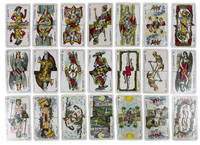
1900réf. 136CARDS TO PREDICT "THE PAST THE PRESENT AND THE FUTURE" A COMPLETE DECK BELONGING TO AUSTRIAN TAROCK PATTERN TYPE C THE MOST BEAUTIFUL OF THE "WORK AND PLAY" TAROTS PRODUCED IN EUROPE. Austrian Tarock Pattern Type C Wien Ferdinand Piatnik & Söhne 1900-1920. 54/54 tarot cards 114 x 62 mm chromolithography backs of the cards enriched by a double-ended neoclassical decoration round corners French suits. Tax stamp and printer's device with "Ferd. Piatnik & Söhne Ag – Wien – Registrirte Schutzmarke" on the Ace of Hearts "Ferd. Piatnik & Söhne Ag" on the Jacks of Diamonds. The deck belongs to the pattern called Austrian Tarock pattern Type c. Four suits of 8 cards each King Queen Knight Jack and Hearts and Diamonds Ace–4 and Spades and Clubs 7–10 plus twenty-two trump cards. The trump cards depict scenes of outdoor life in various countries. The trumps and court cards are double-ended and the trumps display a different scene at each end. They are numbered with Roman numerals. Trump number II invariably has at one end the picture of a crowned eagle sword in claw perched on a rock inscribed with "Industrie Und Glück" Trump No. I the Fool is always portrayed as a stage musician. Provenance: Tax stamp known as Kartenstempel named after the inscription on the upper part of the stamp which is commonly found on antique decks of playing cards particularly in Austria and the territories of the Austrian Empire. The stamp guaranteed that the deck had been legally produced and that taxes had been paid. The type of stamp present on this deck was in use between 1900 and 1920 and the value of 60 Heller indicated "a deck of more than 36 cards not lacquered not washable." Endebrock 2000. REFERENCE: KATHLEEN WOWK Playing Cards of The World Lutterworth Press 1983 pp. 137-140; Peter Endebrock Playing-card Pages website 2000; SYLVIA MANN Collecting Playing cards Arco Publications 1966 pp. 105-108 Ferdinand Piatnik & Söhne
1943réf. 135COMPLETE DIVINATION DECK OF ITALIAN TAROT "MODERN PIEMONTESE PATTERN" PRINTED IN GENOA AND USED DURING THE SECOND WORLD WAR IN THE AREA OF THE "ITALIAN SOCIAL REPUBLIC" Tarocchi Piemontesi Genoa Italy Faustino Solesio 1944-1945. 78 Tarot cards 10.5 x 5.5 cm featuring chromolithographic images; backs of the cards adorned with a green diagonal pattern; rounded corners. A complete deck of the "Tarocchi" characterized by Italian suits: Spade Swords Bastoni Batons Coppe Cups and Denari Coins with Spade and Bastoni interlaced in a manner typical of these decks. The deck features double-headed court cards comprising four face cards—King Queen Knight and "Valet"—and ten numeral cards in each suit totaling 56 cards. It includes 21 double-ended "atouts" trump cards atutti in Italian numbered one to twenty-one and an extra card called "Il Matto" The Fool numbered 0. The trumps are captioned in Italian; the trumps and the suits are numbered with Arabic numerals inside or above a small image representing the suit. On the Ace of Coins is the name of the maker: "Faustino Solesio Genova – Casa Fondata nel 1774" House Founded in 1774 and the tax stamp. The Italian Social Republic RSI also known as the Republic of Salò was a puppet state created in the northern part of Italy during the Second World War from September 1943 to April 1945. Formally led by Benito Mussolini it was under the political and military control of Nazi Germany. The RSI represented the fascist regime's last attempt to maintain power in Italy with a precarious state structure and a context marked by partisan resistance and the Italian civil war. Faustino Solesio was an important printer of playing cards and tarot decks active in Genoa during the 19th and early 20th centuries. He was known for printing various types of cards including Tarocchi Piemontesi produced using woodblock printing techniques and colored with pochoir; Minchiate Fiorentine of which he was the last known producer around 1930. The Minchiate Fiorentine were created based on designs by the Modenese artist Pipein Gamba probably intended mainly for collectors since players had by then disappeared. He also produced playing cards with Italian suits. Conditions: Unused perfectly preserved. Provenance: On the Ace of Coins there is a tax stamp with the inscription "IX – Lire tre". This rare stamp was used during the period 1944-1945 when northern Italy was under the control of the Italian Social Republic RSI which used specific fiscal stamps. The Roman numeral did not represent the year according to the Fascist calendar as is often erroneously believed but indicated the city to which the deck belonged. The number XII represented the city of Milan XIII was Trento and IX present on this deck probably represented Genoa. Reference: Stuart Kaplan The Encyclopedia of Tarot Volume II U.S. Games Systems 1986. Peter Endebrock's Playing-card Pages. Faustino Solesio
réf. 202600843Paris, Jacques granger, 2003 ; in-8, 174 pp., broché, couverture illustr.
réf. 9761Paris (8, rue de Nesle). Directeur-éditeur : Jean-Jacques Pauvert. In-4° agrafé. 5 numéros ont paru en 5 livraisons, d'avril 1971 à mai 1972. (Destribats, 768) // N° 1 : " Le Tarot ", par Jean-Marie Lhôte. N° 2 : " Position politique du surréalisme ", par André Breton, suivi de " Discours au Congrès des écrivains, et " Du temps que les surréalistes avaient raison " (tous ces textes datent de 1935). N° 3 : " Les Nouveaux dessinateurs " (Béringer, Bonnaffe, Boogaerts, Cousin, Cauquil, Guitton, Henich, Nicoulaud, Zim). N° 4 : " A-t-on lu Rimbaud ? ", par Robert Faurisson, suivi de " L'Affaire Rimbaud ". N° 5 : " La Mort des Halles ou la Destruction des Pavillons Baltard ".