3 226 résultats
1974réf. 2111902154900390Ohira shubbansha 1974. Soft Cover. Fine. The book is in fine condition. Ohira shubbansha paperback
1930réf. 2092902143900412Shugakusha 1930. Soft Cover. Fine. Volume: 1 Shugakusha paperback
1930réf. 2092902143800419Shugakusha 1930. Soft Cover. Fine. Volume: 1 Shugakusha paperback
réf. BN304826NieR:Automata Roman 01 NieR:Automata Roman 01 Yoko Taro unknown
réf. 9791042014391Kurokawa
réf. 9782380715163Kurokawa
1960réf. 017049Japan: Geibi Shuppansha 1960. Hardcover. Near Fine/Very Good. Printed slipcase present. Blue front board and red back board with green endpapers. Geibi Shuppansha hardcover
1971réf. 2080302106800877new person oraisha 1971. Soft Cover. Fine. Number of pages: 453 Size: B6 new person oraisha paperback
réf. 057623Billion Land Enterprised Limited Book. As New. Tarot Deck. Sealed box includes deck of 64 cards and guidebook. Billion Land Enterprised Limited unknown
1987réf. 2082402113802850Shibundo 1987. Soft Cover. Fine. Number of books: 1 Shibundo paperback
réf. 2082702114904351Not Available N.A. Soft Cover. Fine. Number of pages: 80p Size: A4 Not Available paperback
1996réf. 52212Yokohama: Yokohama Museum of Art 1996. First edition. Softcover. Near fine condition. Large Quarto. 181 4pp. Original photo-illustrated wraps black lettering on spine in photo-illustrated gray dustjacket with red lettering on spine with photo-illustrated Obi red lettering on spine. Gray endpapers. Photographic double page frontispiece. Half-title printed in red title page in black. Catalog published in conjunction with the exhibition at the Yokohama Museum of Art presenting the new works of Yasumasa Morimura an artist who occupies an important place in the Museum's contemporary collections. "The Actresses series by Yasumasa Morimura brutally exposes the position attitude or stance we assume when we see this boy of work. The viewer's one-sided "gaze" inflicted upon the women Morimura has impersonated is repelled and hurled back to the viewer as the pointed question: Who are you" and "What is your position" Kaori Chino. Profusely illustrated with full page color portrait photographs of Morimura impersonating actresses as Marilyn Monroe Jan Fonda Faye Dunaway and others as well as himself. Various text contributions at rear. Text in Japanese and English. Minor wear. Yokohama Museum of Art unknown books
1996réf. 52212Yokohama: Yokohama Museum of Art 1996. First edition. Softcover. Near fine condition. Large Quarto. 181 4pp. Original photo-illustrated wraps black lettering on spine in photo-illustrated gray dustjacket with red lettering on spine with photo-illustrated Obi red lettering on spine. Gray endpapers. Photographic double page frontispiece. Half-title printed in red title page in black. Catalog published in conjunction with the exhibition at the Yokohama Museum of Art presenting the new works of Yasumasa Morimura an artist who occupies an important place in the Museum's contemporary collections. "The Actresses series by Yasumasa Morimura brutally exposes the position attitude or stance we assume when we see this boy of work. The viewer's one-sided "gaze" inflicted upon the women Morimura has impersonated is repelled and hurled back to the viewer as the pointed question: Who are you" and "What is your position" Kaori Chino. Profusely illustrated with full page color portrait photographs of Morimura impersonating actresses as Marilyn Monroe Jan Fonda Faye Dunaway and others as well as himself. Various text contributions at rear. Text in Japanese and English. Minor wear. Yokohama Museum of Art unknown
1957réf. 2110502150407191elementary school 1957. Soft Cover. Fine. Volume: 1 elementary school paperback
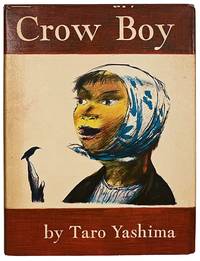
1956réf. 1004316New York: The Viking Press 1956. Second printing of this Caldecott Honor book first published in 1955 inscribed with a full-page original painting by Taro Yashima 1908-1994. A dissident imprisoned for his antimilitarist beliefs Yashima left Japan in 1939 to pursue an artistic career in New York and California. Crow Boy is inspired by Yashima's childhood experiences in a small village school and dedicated to a favorite teacher depicted here as the thoughtful Mr. Isobe. The book follows a friendless non-verbal child called "Chibi" or "tiny boy" a character based on Yashima's memories of a real classmate. Chibi exhibits many of the characteristics now associated with autism: withdrawal from social interaction a rigid focus on pattern and routine and close observation of the natural world reflected in his command of the "voices of crows" memorized on his long walk to school. In the end Mr. Isobe reintroduces Chibi to the school community: "nobody called him Chibi any more. We all called him Crow Boy." Yashima has inscribed this copy to children's author and psychologist Lucile Phillips Morrison 1896-1991; the label of her charitable foundation Angel Island Institute later Phillips-Morrison Institute of California is affixed to the rear endpaper. A near-fine copy of a compelling book inscribed with a vivid painting of a bird flying away from its nest. Single volume measuring 12 x 9 inches: 2 37 1. Original pink cloth stamped in maroon color pictorial endpapers original unclipped color pictorial dust jacket. Color lithographic illustrations throughout text. Original painting of bird and nest facing title page with author's stamp and ink inscription: "To Lucile Morrison / with best wishes / Taro Yashima / Nov. 1959." Small ownership label of Angel Island Institute of California to rear pastedown. Light toning and edgewear to jacket. The Viking Press unknown books
1960réf. 010060Cleveland and New York: World Publishing 1960 Blue cloth with light wear and indent to front cover; pictorial dust jacket is worn with a long slice to front panel price clipped. The story of a kit fox its parents and a little boy. Two-color illustrations by Yashima throughout. Scarce. Stated First Edition. Cloth Hard Cover. Near Fine/Good Minus. Illus. by Taro Yashima. 8vo. World Publishing hardcover books
1947réf. 67705New York: Henry Holt and Company 1947. Bilingual edition. Hardcover. Very Good /Good. 276pp. Octavo 21 cm Gray cloth over boards. With gentle bruising to the spine ends. In a price-clipped dust jacket with a loss from the paper at the head of the spine measuring 3 inches deep by 1 inch wide. The jacket also has a small piece of tape backing tears to the foot of the spine. Text in English and Japanese. A Japanese graphic novel from the 1940s. The second volume of the remarkable story begun in "The New Sun." The second book by Taro Yashima and an autobiographical book telling in pictures more than words the story of a young Japanese resistance painter and his family. Scarce early Japanese graphic novel. Henry Holt and Company hardcover books
1943réf. 617234New York: Henry Holt 1943. Hardcover. Very Good/Very Good. First edition. Profusely illustrated by the author. 310pp. Light foxing on flyleaves and topedge very good in a very good dust jacket with small chips and tears and heavy foxing. The painter and cartoonist's autobiographical picture book about life in pre-war statist Shwa Japan including details of the inhumane treatment that he and his wife underwent for participation in anti-militarist groups. Henry Holt hardcover books
2008réf. 157684Honolulu: University of Hawai'i Press 2008. Softcover. Fine but art school ex-lib. copy with usual marks. Beige/color-illus. wraps. xxxiv 310 pp. full of bw illus. In 1939 the painter Iwamatsu Jun 1908–1994 and his artist wife Tomoe arrived in the U.S. as political refugees. During World War II Iwamatsu used his artistic talents for the U.S. war effort and he adopted a pseudonym Taro Yashima to protect his young son whom he left behind in Japan. The New Sun which was published in the U.S. in 1943 is an account of his life in prewar Japan. In its depiction of ordinary Japanese The New Sun is both an indictment of Japanese militarism and a plea for American understanding of "the enemy." Told mainly though Yashima’s powerful artwork it is a personal and political text of a rural doctor’s son who becomes an anti-imperialist artist-activist. Yashima recounts how his wife and their peers were imprisoned and brutalized by the Tokkoka Japan’s secret police often for months without being formally charged or knowing when they would be released. Despite the arbitrary deprivations and cruelties of life in prison and in Imperial Japan Yashima retains faith in the regenerative possibilities of art and in a future without tyranny. This work of quiet conscience and protest is now as relevant as when it first appeared more than sixty years ago. University of Hawai'i Press paperback books
1953réf. 35448New York: The Viking Press 1953. First edition. Near fine in like jacket. First edition of Taro Yashima's first children's book about long summer days spent playing in and around a large tree inscribed by the author/artist to radio personality Lowell Blanchard. Taro Yashima real name Jun Iwamatsu was an antifascist activist in addition to an artist; he met his wife Mitsu in the Japanese Proletarian Artists' League. After being arrested and tortured by the Japanese government for their activism they fled to America; they took on their pseudonyms when they were hired by the Office of War Information and later the Office of Strategic Services to protect their family still living in Japan. They produced anti-military propaganda for Japanese consumption in various forms throughout World War II including illustrating handbills for dropping over battlefields. THE VILLAGE TREE was Yashima's first children's book. After the war he developed a stomach ulcer which kept him home for long periods; he began to tell his American-born daughter Momo about life when he was a child in a rural village in Japan and these stories grew into several publications. THE VILLAGE TREE presents a hazy and nostalgic snapshot of the simplicity of childhood when the priorities of the day included catching bugs and swimming. 10'' x 7.75''. Original brown publisher's cloth binding with orange stamped titles and design. Original color pictorial dust jacket unclipped $2.50. Color pictorial endpapers of a bird in flight. Illustrated in color throughout. 34 pages. Inscribed and stamped on half-title page by Taro Yashima to Lowell Blanchard dated "Nov. 25 1956." Mild edgewear to dust jacket with two tiny closed tears to rear; shallow creases to joints. Mild sunning to edges of binding. A sharp vibrant copy. The Viking Press unknown books
1964réf. 95231NY:: Viking Press. Near Fine. 1964. Hardcover. 1959 Caldecott Honor Book. Illustrated by the author. Fifth printing library binding - NOT ex-library. Near fine in illustrated boards. No dust jacket. . Viking Press, hardcover books
1962réf. 28529New York: Viking Press 1962. Near fine in very good plus dust jacket. Scarce first edition of the story of how Yashima's daughter Momo makes friends with a painfully shy little boy with an original watercolor by the artist. Taro Yashima real name Jun Iwamatsu was an antifascist activist in addition to an artist; he met his wife Mitsu in the Japanese Proletarian Artists' League. After being arrested and tortured by the Japanese government for their activism they fled to America; they took on their pseudonyms when they were hired by the Office of War Information and later the Office of Strategic Services to protect their family still living in Japan. They produced anti-military propaganda for Japanese consumption in various forms throughout World War II including illustrating handbills for dropping over battlefields. Yashima began writing children's books for Momo the couple's American-born daughter. While these were originally recollections life as a child in Japan as Momo grew he began writing stories about her American childhood. The shy child in YOUNGEST ONE recalls the main character of Yashima's earlier Caldecott Honor title CROW BOY usually interpreted as being on the Autism spectrum. 8.25'' x 9.25''. Original orange publisher's cloth binding with black stamped titles and designs. Original color pictorial dust jacket unclipped $2.75. Color pictorial endpapers of a child's doodle. Illustrated in color throughout. 33 pages. Original watercolor of two birds soaring over a nest with a speckled egg inside signed and stamped by Yashima and dated 1964. Very mild scuffing and light edgewear to dust jacket; several tiny closed tears to edges two closed with tape to verso. Spine ends of book lightly bumped tiy tape-closed tear to lover margin of page 19/20. A sharp vibrant copy. Viking Press unknown books
1956réf. 1004316New York: The Viking Press 1956. Second printing of this Caldecott Honor book first published in 1955 inscribed with a full-page original painting by Taro Yashima 1908-1994. A dissident imprisoned for his antimilitarist beliefs Yashima left Japan in 1939 to pursue an artistic career in New York and California. Crow Boy is inspired by Yashima's childhood experiences in a small village school and dedicated to a favorite teacher depicted here as the thoughtful Mr. Isobe. The book follows a friendless non-verbal child called "Chibi" or "tiny boy" a character based on Yashima's memories of a real classmate. Chibi exhibits many of the characteristics now associated with autism: withdrawal from social interaction a rigid focus on pattern and routine and close observation of the natural world reflected in his command of the "voices of crows" memorized on his long walk to school. In the end Mr. Isobe reintroduces Chibi to the school community: "nobody called him Chibi any more. We all called him Crow Boy." Yashima has inscribed this copy to children's author and psychologist Lucile Phillips Morrison 1896-1991; the label of her charitable foundation Angel Island Institute later Phillips-Morrison Institute of California is affixed to the rear endpaper. A near-fine copy of a compelling book inscribed with a vivid painting of a bird flying away from its nest. Single volume measuring 12 x 9 inches: 2 37 1. Original pink cloth stamped in maroon color pictorial endpapers original unclipped color pictorial dust jacket. Color lithographic illustrations throughout text. Original painting of bird and nest facing title page with author's stamp and ink inscription: "To Lucile Morrison / with best wishes / Taro Yashima / Nov. 1959." Small ownership label of Angel Island Institute of California to rear pastedown. Light toning and edgewear to jacket. The Viking Press unknown
réf. 67675463-6Penguin Publishing Group. Used - Good. Pages intact with minimal writing/highlighting. The binding may be loose and creased. Dust jackets/supplements are not included. Stock photo provided. Product includes identifying sticker. Better World Books: Buy Books. Do Good. Penguin Publishing Group unknown
réf. 12913309-6Penguin Publishing Group. Used - Good. Pages intact with minimal writing/highlighting. The binding may be loose and creased. Dust jackets/supplements are not included. Stock photo provided. Product includes identifying sticker. Better World Books: Buy Books. Do Good. Penguin Publishing Group unknown