Norman BridgeBiblio.com
2 786 résultats
1898réf. 000596Chicago: Herbert S. Stone & Company 1898. First Edition. Hardcover. Very Good. Book has top edge gilt previous owner's name on front pastedown bumping/rubbing at spine ends/corners shelf wear. Interesting essays from 1898. Herbert S. Stone & Company hardcover
réf. 1330830210.Gpaperback. Good. Access codes and supplements are not guaranteed with used items. May be an ex-library book. paperback
2012réf. G1573874507I3N00Information Today Incorporated 2012. Paperback. Good. Pages can have notes/highlighting. Spine may show signs of wear. ~ ThriftBooks: Read More Spend Less.Dust jacket quality is not guaranteed. Information Today, Incorporated paperback
1974Ex-library book with the usual stamps and markings. Very large oblong format, Light scuffing and general wear to covers. Text/interior clean and unmarked. Short history of timber and glulam bridge construction, typical design math for glulam deck and girders, 10 pages of engineering drawings showing elevations, sections, statistic and detail pages by Hurlbut, Kersich & McCullough followed by 5 outlines, with photos, of completed pedestrian bridges.
1974Very large oblong format, Light scuffing and general wear to covers. Text/interior clean and unmarked. Short history of timber and glulam bridge construction, typical design math for glulam deck and girders, 10 pages of engineering drawings showing elevations, sections, statistic and detail pages by Hurlbut, Kersich & McCullough followed by 5 outlines, with photos, of completed pedestrian bridges.
1995Ex-library book with the usual stamps and markings. 26 pages depicting General Layout and notes, General details, Rail option details, Fabrication details, Materials and construction recommendations, Construction recommendations & Design procedure for both Stress-laminated sawn lumber decks and Stress-laminated glued laminated timber decks with another section on Longitudinal stringer with transverse plank decks. Large oblong format with very detailed architectural drawings created for use by "smaller highway departments with limited engineering staff." Staple-bound. 16 5/8"w x 10 5/8"h.
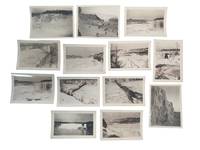
1938réf. 233971938. Natural DisastersEngineering Niagara Falls bridge collapse photo archive documenting the failure of the Honeymoon Bridge during the catastrophic ice jam of January 1938 one of the most dramatic engineering failures in the history of the Niagara frontier. Built in 1898 as the Upper Steel Arch Bridge and renamed the Honeymoon Bridge in 1937 the structure connected Niagara Falls New York and Niagara Falls Ontario carrying tourists automobiles and cross-border traffic directly beside the falls. During the severe winter of 1938 massive accumulations of ice in the Niagara River created extraordinary pressure against the bridge's steel arch and supports. On January 27 1938 after days of strain and closure to traffic the bridge collapsed into the frozen river below. The destruction ended forty years of continuous operation at one of the most heavily visited tourist and transportation corridors in North America and directly led to construction of the Rainbow Bridge completed in 1941. The archive captures both the frozen landscape that preceded the disaster and the immediate aftermath including crowds gathered along the edge of the falls observing the twisted remains of the bridge lodged in the ice. Photo archive of 13 black and white silver gelatin photographs approximately 3"x5" to 3 x 4.5 inches Niagara Falls New York and Ontario circa January-February 1938. Images show the Horseshoe Falls and American Falls almost entirely surrounded by ice formations with enormous frozen shelves extending across the river basin and dense accumulations of icicles hanging from the cliff faces beside pedestrian overlooks. Several scenes show groups of bundled spectators standing near railings at the edge of the falls while the collapsed steel arch of the Honeymoon Bridge lies broken and partially submerged downstream. Two photographs focus closely on the twisted central truss section bent sharply downward into the ice-choked river while another wider view shows the destroyed span framed directly beside the falls emphasizing the scale of the collapse relative to the landscape. Additional views depict the intact approach structures before failure heavy ice movement beneath the bridge and broad panoramas of the frozen gorge crowded with drifting ice masses. Four photos unmarked appear to show the icy conditions preceding the collapse while the remaining nine stamped "Feb 10 1938" show the aftermath of the disaster. The collapse exposed the fatal weakness of the Honeymoon Bridge's low placement in the gorge where winter ice could press directly against its abutments. Authorities closed the bridge before the final collapse and workers escaped before the steel arch failed resulting in a dramatic but ultimately non-deadly engineering failure. The Rainbow Bridge opened in 1941 about 500 feet from the old site with higher clearance and a design better suited to ice and flood pressure. The event permanently altered the architectural and transportation structure of Niagara Falls with projects designed around ice floes as a primary structural threat not a seasonal inconvenience. Light curling consistent with age and handling; images remain clear and well preserved overall. Overall in very good condition. unknown books
1938réf. 233971938. Natural DisastersEngineering Niagara Falls bridge collapse photo archive documenting the failure of the Honeymoon Bridge during the catastrophic ice jam of January 1938 one of the most dramatic engineering failures in the history of the Niagara frontier. Built in 1898 as the Upper Steel Arch Bridge and renamed the Honeymoon Bridge in 1937 the structure connected Niagara Falls New York and Niagara Falls Ontario carrying tourists automobiles and cross-border traffic directly beside the falls. During the severe winter of 1938 massive accumulations of ice in the Niagara River created extraordinary pressure against the bridge's steel arch and supports. On January 27 1938 after days of strain and closure to traffic the bridge collapsed into the frozen river below. The destruction ended forty years of continuous operation at one of the most heavily visited tourist and transportation corridors in North America and directly led to construction of the Rainbow Bridge completed in 1941. The archive captures both the frozen landscape that preceded the disaster and the immediate aftermath including crowds gathered along the edge of the falls observing the twisted remains of the bridge lodged in the ice. Photo archive of 13 black and white silver gelatin photographs approximately 3"x5" to 3 x 4.5 inches Niagara Falls New York and Ontario circa January-February 1938. Images show the Horseshoe Falls and American Falls almost entirely surrounded by ice formations with enormous frozen shelves extending across the river basin and dense accumulations of icicles hanging from the cliff faces beside pedestrian overlooks. Several scenes show groups of bundled spectators standing near railings at the edge of the falls while the collapsed steel arch of the Honeymoon Bridge lies broken and partially submerged downstream. Two photographs focus closely on the twisted central truss section bent sharply downward into the ice-choked river while another wider view shows the destroyed span framed directly beside the falls emphasizing the scale of the collapse relative to the landscape. Additional views depict the intact approach structures before failure heavy ice movement beneath the bridge and broad panoramas of the frozen gorge crowded with drifting ice masses. Four photos unmarked appear to show the icy conditions preceding the collapse while the remaining nine stamped "Feb 10 1938" show the aftermath of the disaster. The collapse exposed the fatal weakness of the Honeymoon Bridge's low placement in the gorge where winter ice could press directly against its abutments. Authorities closed the bridge before the final collapse and workers escaped before the steel arch failed resulting in a dramatic but ultimately non-deadly engineering failure. The Rainbow Bridge opened in 1941 about 500 feet from the old site with higher clearance and a design better suited to ice and flood pressure. The event permanently altered the architectural and transportation structure of Niagara Falls with projects designed around ice floes as a primary structural threat not a seasonal inconvenience. Light curling consistent with age and handling; images remain clear and well preserved overall. Overall in very good condition. unknown
1996321 pages including index. For anyone interested in doing business in this rapidly expanding market, this book offers practical tips and comprehensive background information to help you better understand and serve your Chinese customers. "A clear and comprehensive guide for mainstream business people to bridge cultural gaps while making a profit from emerging consumption trends." - Dr. Don DeVoretz, Economist, Simon Fraser University. Clean, bright and unmarked with lightest wear. Excellent copy. Book
195664 pages. Features: Cover art by John Little features Grey Cup final game at Vancouver's Empire Stadium between the Edmonton Eskimos and the Montreal Alouettes; The revolution that's changing your shopping habits - topsy-turvy trends produced by the frenzied battle for the consumer's dollar; Will they ever beat the Eskimos? - with their baffling split-T the Edmonton Eskimos have won the CFL's Grey Cup twice in a row - the task they pose is not to stop them but to find the ball; We adopted a family of criminals - Rev. Gordon Phillips and Bluebell Stewart Phillips took in prostitutes, murderers aand gunmen, and rejoiced when they went straight; Remember when we raved about the radio? - in the depression thirties, when there was little to laugh about, the comedians on radio convulsed a continent and made the radio in the parlor the centre of every family's life - many great photos; The Secret War of Charles Goodeve, Part Two - How they opened the door for D-day - with photos, including his floating bridge and rocket-propelled grapnel inventions; What would Carrie Nation do?, by Vernon Hockley; Amazing General Motors colour centerfold featuring a kitchen completely finished in pink; Canadian Club ad features colour photos of white water skiing in Austria's Salzach River, a sport (first called skiyaking) invented by Austrian champ Harald Strohmeier; Painter A.Y. Jackson recalls his most memorable meals - one in Tom Thomson's shack on Severn St. in Toronto, the other given by Lord Beaverbrook; Great colour vintage ad for Labatt's Chrystal lager beer shows man relaxing with smoke being served by his wife in front of the tv after he has been cutting grass; Expensive Sunbeam Bread promotion was Canada's biggest; Nice colour photo Coke ad on back cover features old man in white rocking chair. Average wear. Binding intact. Unmarked. A sound vintage copy of this excellent issue. Magazine
réf. 100682Codette SK: Newfield School and Districts History Book Committee 1984. hardcover 476pp. Fine no dust jacket. 476p 4to illus. ports. maps. Previous owners name small and neat to ffep. Newfield School and Districts History Book Committee Hardcover
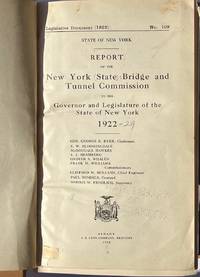
réf. 014056Albany 1922-1929 A collection of 8 annual reports 1922 to 1929 of the NYSB&TC Documenting the design construction and operation of the Holland Tunnel connecting New York City with New Jersey. Reports with photographs drawings and folding plates thoroughly document every step in the process of designing digging and opening the automobile tunnel under the Hudson River referred to at the time as the "Eighth Wonder of the World". First editions. 23 cm; 559 pp.; illustrated. Ex-library copy 8 reports bound as one in library buckram. Albany, 1922-1929 hardcover
2013réf. Gyan-9789333138123Isha Books 2013. Hardcover. New. 25.13 x 18.78 x 2.59 cm. English Isha Books hardcover
2013réf. Gyan-9789333138123Isha Books 2013. Hardcover. New. 25.13 x 18.78 x 2.59 cm. English Isha Books hardcover
réf. 0332038807.Ghardcover. Good. Access codes and supplements are not guaranteed with used items. May be an ex-library book. hardcover
1927réf. 002912Hyde Park: B. F. Sturtevant Company 1927 1927. Second printing. 8vo; 68 pp.; thirty illustrations from photographs and plans. Owner's name else a very good copy or better in original brown cloth. The story of the technical aspects of engineering and constructing the Holland Tunnel. Hyde Park: B. F. Sturtevant Company, (1927) hardcover
1850réf. 23992New York 1850. Very good overall. An interesting letter detailing the negotiation over wooden vs. iron railroad bridges. In this letter addressed to Strong M. M. White agent of the New York Iron Bridge Co. seeking to persuade the Vermont railroad to eschew a wooden bridge and setting out advantageous terms for purchasing an iron bridge. Strong was "liable as endorser on paper for the Rutland and Washington Railroad Company which subsequently failed to an amount considerable exceeding all his property." He was sued in the Supreme Court of Vermont lter in the 1850s and looks to have been bankrupted losing his real estate marble quarry share etc. See "Reports of Cases Argued and Determined in the Supreme Court of Vermont vol. 42 Montpelier Vt 1870 by Wheelock Veazey a Vermont Civil War hero. Letter written on blue laid paper 4pp 8 x 10 1/4"written on 1pp docketed on the verso with period folds. A small raised oval in the top left corner unreadable by this cataloguer. Verso a little marked a little creased. unknown
réf. 0666050570.Ghardcover. Good. Access codes and supplements are not guaranteed with used items. May be an ex-library book. hardcover
réf. 0265831857.Ghardcover. Good. Access codes and supplements are not guaranteed with used items. May be an ex-library book. hardcover
réf. LCS-14623New York, Joseph Koehler, 1903. 645 x 975 mm.
réf. 0266861903.Ghardcover. Good. Access codes and supplements are not guaranteed with used items. May be an ex-library book. hardcover
2026réf. LRB22002794Paris: Editions Recreasoft 2026 Language: English. Approximately 800 pages. English : Print-on-demand reprint. Original edition : 1884. Detailed report issued by the Board of Trustees of the New York and Brooklyn Bridge reflecting the administrative and technical concerns surrounding one of the major infrastructure projects of the period. Of interest for researchers in urban history civil engineering municipal governance and the development of New York in the late nineteenth century. Book images are non-contractual. Editions Recreasoft. Softcover. New. Editions Recreasoft paperback
2026réf. LRB39022853Paris: Editions Recreasoft 2026 Hardcover binding. Language: English. Approximately 828 pages. English: Print-on-demand reprint. Original edition : 1884. Text in English. This comprehensive report details the financial examination of the New York and Brooklyn Bridge conducted by a committee appointed by the Board of Trustees including the mayors of New York and Brooklyn. The accountants' report provides an in-depth analysis of the bridge's financial affairs as of December 31 1883. The document offers valuable insights into the financial management and challenges faced during the construction of this iconic engineering project. Book images are non-contractual. Editions Recreasoft. Softcover. New. Editions Recreasoft paperback
réf. 2080502106914119Not Available N.A. Soft Cover. Fine. The book is in fine condition. Not Available paperback
1828réf. 2111902160201307Itamoto's seal is also unknown 1828. Soft Cover. Fine. Volume: 1 Itamoto's seal is also unknown paperback