ARIOSTO, LudovicoBiblio.com

1582 risultati
rif. 2121709Venice: Gabriele Giolito de' Ferrari. 1551. 12mo. Early 19th-century English half calf roll-tooled in blind spine with raised bands tooled in blind and lettered directly in gilt; ff. 43 1; woodcut printer's device to recto of first and final leaf woodcut initials and ornaments; extremities a little worn hinges cracked but hold firm head of spine chipped; a few small stains but otherwise a very good crisp copy; armorial bookplate of Samuel R. Block to front pastedown his ownership signature in ink to title page.First edition the final and definitive ""Ferrara"" version of Ariosto's first comedy in verse and his ""most problematic work for the stage"" Portner.Ludovico Ariosto 1474-1533 best known today for his epic poem Orlando furioso was also the author of five comedies. Following the successful staging of his comedy I Suppositi in the Vatican during the 1519 Carnival he was commissioned by Pope Leo X to write a new play. Il Negromante The Necromancer was sent to Rome on 16 January 1520 however its planned Roman premiere never took place; the pope instead chose to stage Niccolo Machiavelli's La Mandragola. The most likely reason for the play's cancellation was its veiled yet pointed critique of Leo X and the Vatican particularly regarding the sale of indulgences and clerical corruption. While Ariosto's wit was tolerated in other settings a performance of Il Negromante in the heart of the papal court - just three years after Martin Luther's Ninety-five Theses - may have been considered too unsettling.In the play the charlatan Mastro Iachelino the so-called ""Necromancer"" is summoned to cure the supposed impotence of Clintio through his claimed magic arts. Clintio a newlywed is in fact secretly married to another woman Lavinia. Seeking to escape the marriage imposed on him by his foster father Massimo he later turns to Iachelino himself hoping to maintain the illusion of impotence. Meanwhile another young man Camillo also seeks the Necromancer's help hoping to win the favour of Emilia the bride involved in the unconsummated marriage with Clintio.Two versions of the comedy exist: one ""for Rome"" and one ""for Ferrara"". The first sent to the papal court in 1520 was published posthumously in Venice in 1535. The second revised for the Ferrarese court around 1528 was also published posthumously in this edition printed by Gabriele Giolito de' Ferrari in 1551 and dedicated by the editor Lodovico Dolce c. 1508-1568 to Giovan Vincenzo Vigliona. Dolce based his edition on the original manuscript which he had acquired from Ariosto's heirs.Adams A-1655; Edit16 CNCE 2665; Agnelli-Ravegnani Annali delle Edizioni Ariostee II p. 123 ""of considerable rarity like all Giolito editions and of undeniable importance regarding the text of Il Negromante inasmuch as it provides us with a version of the comedy not merely corrected but entirely rewritten by the poet"" trans. See Portner ""A Non-Performance of Il Negromante"" Italica 59/4 Renaissance Winter 1982 pp. 316-329. hardcover
1854rif. 177051Florence: Felice Le Monnier 1854. A nicely bound set of Ariosto's Orlando Furioso with notes by Vincenzo Gioberti from Del primato morale e civile degl'Italiani "On the Moral and Civil Primacy of the Italians". In the prefatory notes he crowns Ariosto as "the prince of heroic poetry" "principe della cantica eroica" second only to Dante. Gioberti 1801-1852 was an Italian Catholic priest philosopher and politician serving as Sardinia's prime minister in 1848-9. This is the third Le Monnier edition the first appearing in 1846. 2 vols small octavo 175 x 108 mm. Contemporary vellum spine lettered and patterned in gilt covers with gilt floral borders textured endpapers gilt edges red silk bookmarkers. Vellum a little soiled bowing to boards dust soiling to top edges sporadic foxing light soiling to rear endpapers of vol. II. A very good set. hardcover
rif. 1h11344Friedrich Frommann Verlag Jena 1804 - 1808. 434/419/385/414 S. original Halbleder-Einbände mit goldgeprägten Rückentiteln etwas berieben und bestossen. - übersetzt von J.D. Gries/gute Exemplare/in erster Auflage/Goedeke VII 636192; Kosch VI 791; NDB VII. 59 - unknown
rif. 1p2678Olms Hildesheim 1995. Zusammen XXVI/695 S. kart. - Neuwertig ungelesen. Archivio Tematico della Librica Italiana-Atli vol. 3.1-3.2 - unknown
rif. 2b9989B. Behr`s Verlag Bln. 1904. XV/79 S. mit einem in Holz gestochenen Portraitfrontispiz Lodovico Ariostos gold- und rotgeprägter original Pergamenteinband mit Hopfgoldschnitt in Rot und Schwarz auf Büttenpapier Einband etwas fleckig. - Im Versmaß des Originals übersetzt von otto Gildemeister herausgegeben von Paul Heyse/gutes Exemplar - unknown
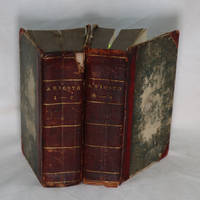
1810rif. FB5630(1&2) /17Tomes 1-2 & Tomes 3 - 4. bound as two books. Red calf spine with marbled boards. Gilt title and banding. Dimensions are for one book. Four books encapsulated into two volumes. The interior of all four books is good and clean. The 19th century bindings have seen better days. F.B.A. debated whether to have these two volumes rebound into four books that said the economy of time suggested these volumes are first offered in their acquired condition. Orlando furioso The Frenzy of Orlando is an Italian epic poem by Ludovico Ariosto which has exerted a wide influence on later culture. The earliest version appeared in 1516 although the poem was not published in its complete form until 1532. Orlando furioso is a continuation of Matteo Maria Boiardo's unfinished romance Orlando innamorato Orlando in Love published posthumously in 1495. In its historical setting and characters it shares some features with the Old French Chanson de Roland of the eleventh century which tells of the death of Roland. The story is also a chivalric romance which stemmed from a tradition beginning in the late Middle Ages and continuing in popularity in the 16th century and well into the 17th. Orlando is the Christian knight known in French and subsequently English as Roland. The story takes place against the background of the war between Charlemagne's Christian paladins and the Saracen army that has invaded Europe and is attempting to overthrow the Christian empire. The poem is about war and love and the romantic ideal of chivalry. It mixes realism and fantasy humor and tragedy.The stage is the entire world plus a trip to the Moon. The large cast of characters features Christians and Saracens soldiers and sorcerers and fantastic creatures including a gigantic sea monster called the Orc and a flying horse called the hippogriff. Many themes are interwoven in its complicated episodic structure but the most important are the paladin Orlando's unrequited love for the pagan princess Angelica which drives him mad; the love between the female Christian warrior Bradamante and the Saracen Ruggiero who are supposed to be the ancestors of Ariosto's patrons the House of Este of Ferrara; and the war between Christian and Infidel. The poem is divided into forty-six cantos each containing a variable number of eight-line stanzas in ottava rima a rhyme scheme of abababcc. Ottava rima had been used in previous Italian romantic epics including Luigi Pulci's Morgante and Boiardo's Orlando Innamorato. Ariosto's work is 38736 lines long in total making it one of the longest poems in European literature. Ludovico Ariosto 8 September 1474 – 6 July 1533 was an Italian poet. He is best known as the author of the romance epic Orlando Furioso 1516. The poem a continuation of Matteo Maria Boiardo's Orlando Innamorato describes the adventures of Charlemagne Orlando and the Franks as they battle against the Saracens with diversions into many side plots. The poem is transformed into a satire of the chivalric tradition. Ariosto composed the poem in the ottava rima rhyme scheme and introduced narrative commentary throughout the work. Ariosto also coined the term "humanism" in Italian umanesimo for choosing to focus upon the strengths and potential of humanity rather than only upon its role as subordinate to God. This led to Renaissance humanism. Gioacchino Avesani. hardcover
1975rif. SKU0516476Penguin Classics 1975-08-30. paperback. Good. 7x5x1. Textbook May Have Highlights Notes and/or Underlining BOOK ONLY-NO ACCESS CODE NO CD Ships with Tracking Penguin Classics paperback
1975rif. SKU0609063Penguin Classics 1975-08-30. paperback. New. 7x5x1. New Textbook Ships with Tracking Penguin Classics paperback
rif. 88234Nizza Società tipografica 1785. Ganzleder gebunden; marmorierte Einbände reich verzierte goldgeprägte Rücken je 1 grünes und 1 rotes goldgeprägtes Rückenschild Rotschnitt / 5 Bände / Anz. Seiten: XXXVIII 411 381 391 387 404 / 10 x 162 cm / Zustand: sehr gut geringe Alters-/ Gebrauchsspuren; Ecken teils etwas beschabt/bestossen äussere Lagen teils leicht stockfleckig Bibliotheksstempel auf Titelseiten handschriftliche Nummerierung auf Innendeckeln handbeschriftete Papieretiketten an Rücken Nizza, Società tipografica, 1785 unknown
1972rif. 1-0198124074OUP Oxford 1972. Hardcover. New. 744 pages. 10.94x7.80x1.89 inches. OUP Oxford hardcover
rif. 138660London: A. Dulau & Co. and L. Nardini 1801. 4 vols. 12mo 6¼ x 4 ins. Contemporary polished calf spines gilt tooled in six compartments with contrasting gilt lettered labels board edges gilt tooled blue sprinkled edges some light wear at joints and title label of vol I chipped - otherwise a VG set. Pp. viii ix 1 287 1 annotazioni 4 blank & viii 406 4 blank & viii 360 4 blank & viii 326 4 blank with half titles illus with engraved frontispiece in vol I endpapers toned at edges; no inscriptions. London: A. Dulau & Co. and L. Nardini, 1801 unknown
1996rif. x-0520200098Univ of California Pr on Demand 1996. Paperback. New. 368 pages. 8.25x5.25x0.75 inches. Univ of California Pr on Demand paperback
1974rif. 209693Venezia: Corbo & Fiore 1974. Rilegato pelle leather binding. Ottimo Fine. A cura di Lanfranco Caretti. Riproduzioni di cinque acquaforti di Ugo Attardi ispirate al testo. 4to. pp. XXXV - 286. Ottimo Fine. Prima edizione First Edition. Corbo & Fiore, hardcover
1924rif. 81572Bari: Laterza Scrittori d'Italia 1924. Brossura wrappers. Molto buono Very Good. a cura di Giuseppe Fatini. 8vo. pp. 379. Molto buono Very Good. Firma di appartenenza alla prima pagina. Lievi mende alla copertina Owner's name on the first blank page. . Laterza, Scrittori d'Italia unknown
1974rif. 69716Venezia: Corbo & Fiore 1974. Brossura wrappers. Molto buono Very Good. A cura di Lanfranco Caretti. Riproduzioni di acquaforti di Ugo Attardi ispirate al testo. 4to. pp. XXXV - 286. Molto buono Very Good. Dorso rovinato Some chipping at spine. Prima edizione First Edition. Corbo & Fiore, unknown
1942rif. ZB627467Buenos Aires: El Ateneo 1942. xii 204 pp rebound in cloth ex library text browned with early leaves margin chipped needs careful handling and a working copy only. - If you are reading this this item is actually physically in our stock and ready for shipment once ordered. We are not bookjackers. Buyer is responsible for any additional duties taxes or fees required by recipient's country. Buenos Aires: El Ateneo, hardcover
rif. 108859Venetia Felice Valgrisi 1887. Kl.4° Titelholzschnitt 8 Bl. 654 S. 16 Bl Tavola zahlreiche Vignetten und 51 blattgrossen Holzstich-Illustrationen von Dosso Dossi am Anfang jedes Gesanges. Perg. d. Zeit handschriftl Rückentitel Deckel etwas fleckig Titelbl. aufgezogen Buchblock etwas fleckig min. wasserärndig 13 Bl. der Tavola mit grösseren hinterlegen ersetzten Fehlstellen Textverlust. Einige Illustrationen etwas stumpf. abgezogen einige Marginalien von alter Hand.Cover slightly stained; title page reattached; text block slightly stained with minimal water damage; 13 leaves of the Tavola with larger gaps filled in loss of text. Some illustrations slightly faded; some marginal notes in an old hand. Die erste Valgrisi-Ausgabe des „Furioso“ stammt aus dem Jahr 1556; ab 1565 erscheinen die 5 posthumen Gesänge begleitet von den Zusammenfassungen von Luigi Grotta d’Adria. - Ludovico Ariosto deutsch Ariost; 8. September 1474 in Reggio nell’Emilia; † 6. Juli 1533 in Ferrara war ein italienischer Humanist Militär Höfling und Autor. Sein Hauptwerk das Versepos Orlando furioso „Der rasende Roland“ gilt als einer der wichtigsten Texte der italienischen Literatur und wurde in ganz Europa rezipiert.Text Ital. 010 Venetia, Felice Valgrisi, 1887 unknown
rif. 106334Zurigo Orell Füssli und Comp 1842. Gr.-8° 56 S. Geheft. Etwas stockfl. sonst gutes Ex. Text ital.Johann Caspar von Orelli 13. Februar 1787 in Wädenswil; † 6. Januar 1849 in Zürich war ein Schweizer Klassischer Philologe. 010 Zurigo, Orell, Füssli und Comp, 1842 unknown
1759rif. 015325London: A. Millar 1759. Book measures 18x11.5.cm. 6135pp. Bound in full period calf raised bands gilt lines leather title label. Calf rubbed wear loss on head and tail of spine hinge joints worn but binding holding firm. Internally portrait of Ariosto pasted to free endpaper. Pages in good clean condition. A good clean copy. . Full Calf. Near Very Good. Small 8vo. A. Millar Hardcover
1815rif. 40621815. : 7 In part 3 a few pages have some torn pieces but the text is still readable. Volume III & V Binding: Contemporary Half Leather 24mo Height cm: 145 CM Width cm: 9 CM Thickness cm: 65 CM hardcover
1962rif. 024858Carbondale: Southern Illinois University Press 1962. Reprint . Hardcover. Very Good-/No Jacket. 4to - over 9¾" - 12" tall. Edited and introduced by Graham Hough. Corner's lightly bumped 4 small dots on side exterior pages. Some light spots on cover. Text fine. 579 pages. Expedited or International shipping may cost more. Southern Illinois University Press hardcover
rif. 38918PARIS LEFEVRE 1825. EIGHT VOLUMES. A CABINET EDITION 48mo. 10 by 7 cm. ATTRACTIVELY BOUND IN HALF LEATHER MARBLED BOARDS FRONTIS. ARMORIAL BOOKPLATE. ITALIAN TEXT. SLIGHT FOXING BUT CLEAN AND TIGHTLY BOUND. SCARCE. PARIS, LEFEVRE, 1825 hardcover
1818rif. 26781818. : 75 Cover chipped and pages undulated. Small corner of white margin missing on page 207. Uncut folio paper between pages 413-415. . 3 Blank pages / 1 Portret / 1 Title Page / 1 Blank pages / 36 Roman numbered pages / 547 Pages / 1 NNP / 2 Blank pages Binding: Contemporary Half Leather Folio Height cm: 333 CM Width cm: 244 CM Thickness cm: 58 CM hardcover
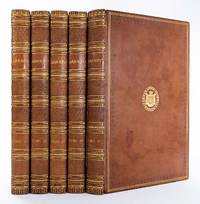
rif. 55160Pisa: Dalla Tipografia della Societa Letteraria 1809. 5 vols. Folio. 39 x 24 cm. Full contemporary russia double gilt fillet and blind-stamped borders spines with raised bands decorated in gilt and blind stamped panels marbled edges and endpapers armorial gilt stamp to upper covers. Engraved portrait frontispiece by R. Morghen. Ex libris Merthyr Guest with his sepia printed armorial bookplate and with the circular gilt stamp of Richard Grosvenor Richard 2nd Marquess of Westminster 1795 - 1869 "Ricardus Comes Grosvenor - 1833" to upper covers. Some light foxing to end-leaves trivial old wormhole to foot of upper joint of vol. 4 minor abrasion to lower board of vol III generally very fresh and clean in a handsome binding. Edition of 250 copies this being no 195 for the Florence publisher Guglielmo Piatti printed using the typefaces of the Amoretti Brothers followers of Giambattista Bodoni. Pisa: Dalla Tipografia della Societa Letteraria, 1809. hardcover
1826rif. 010474Lyon: Laurent Libraire 1826. Book measures 22x14.cm. 2401pp engraved portrait. Bound in period marble boards with leather title label. Binding rubbed on edges with some wear loss. Generally a very good clean binding. Internally 1 gathering pages 97-112 has heavy browing. Pages in good condition. A nice well bound copy. Hard Cover. Very Good. 8vo. Laurent, Libraire Hardcover