3.091 resultados
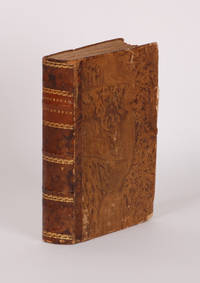
In-8°; cc. 72, s.n.t., (1525). Si apre con la lettera “Al gentile et valoroso giovane messer Francesco Tomacello da Fano, Lucio Paolo Rosello”, sacerdote padovano, segue il testo dell’opera “Invettiva ... contra una malvagia donna, detto Laberinto d’amore, et altrimenti il Corbaccio”. Da c. 57 l’Episola a Pino de Rossi. Legatura in piena pergamena più tarda con tassello e titolo in oro al dorso. Gamba 203 “non ho trovato registrata da verun bibliografo questa stampa”. Mostra di manoscritti, documenti e edizioni, Certaldo, 1975, v. 2, n. 42, EDIT16 2367.
1803ref. 270497Milan: Societa Tipografica 1803. hardcover. very good. 4 volumes. Thick 8vo full tree calf ornately gilt spine and covers rubbed at extremities all edges gilt. Milan: Societa Tipographica 1803. Very good. Societa Tipografica unknown
1803ref. 270497Milan: Societa Tipografica 1803. hardcover. very good. 4 volumes. Thick 8vo full tree calf ornately gilt spine and covers rubbed at extremities all edges gilt. Milan: Societa Tipographica 1803. Very good. Societa Tipografica unknown books
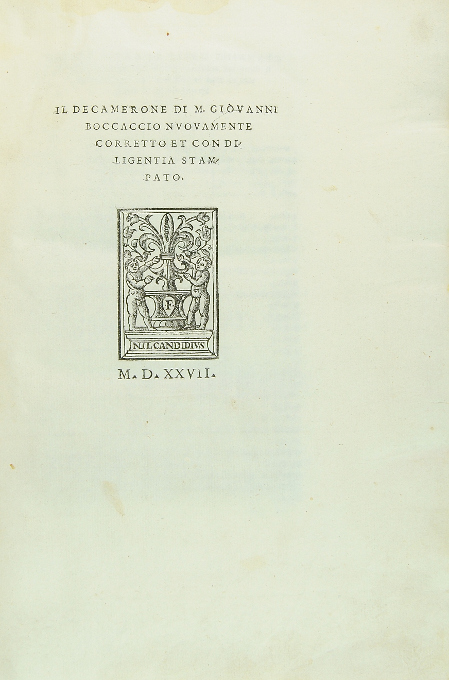
1729ref. ABC_49826Florence: Heirs of Filippo Giunta 1729. 18th-century vellum gold-tooled spine with a red morocco label lettered in gold and blue-sprinkled edges. 4to. With a woodcut device on the title page and the final leaf. A rare celebrated typographical facsimile of the so-called Ventisettana widely regarded as the finest early edition of Il Decamerone. Produced in Venice in 1729 in a strictly limited edition of approximately 300 copies many of which were reportedly destroyed by fire.Executed with remarkable technical skill by Stefano Orlandini using the presses of Pasinello the edition reproduces the original with such fidelity that it may easily deceive even a trained eye. It has long been regarded as one of the earliest and most accomplished examples of printed facsimile sometimes described somewhat misleadingly as a case of book forgery. The enterprise was financed by Salvatore Ferrari though other sources attribute its patronage to the English consul in Venice the noted bibliophile Joseph Smith 1682-1770.Composed in the mid-14th century by Boccaccio Il Decamerone stands as one of the foundational works of European prose literature. Boccaccio a Florentine writer and humanist was a close contemporary and friend of Francesco Petrarca 1303-1374 and played a key role in the early development of Renaissance humanism. Educated partly in Naples he was deeply influenced by courtly culture as well as classical antiquity which shaped both his literary style and intellectual outlook. Structured as a frame narrative set against the backdrop of the Black Death in Florence it recounts how 10 young Florentines 7 women and 3 men withdraw to the countryside where they pass 10 days telling stories resulting in a collection of 100 tales. The work combines wit satire and vivid observation of human behaviour ranging from the comic and erotic to the moral and tragic. Its influence on the development of vernacular Italian prose was profound and it has remained a cornerstone of the Western literary canon ever since.The gutter of leaf 143 and the outer margin of leaf 258 have been reinforced a tear in leaf 263 some minor damp-staining to the outer margin of leaves 264-276. Otherwise in very good condition.l COPAC TO0E108243; EDIT16 CNCE 24078; Gamba no. 172 pp. 54-55; USTC 814784; cf. Brunet I 999. Heirs of Filippo Giunta, hardcover
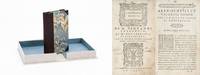
1584ref. 31320AB1584. Venetia Appresso I Gioliti 1584. 9.5 cm x 15.4 cm. 107 1 pages including illustrated titlepage with Giolito's printer mark and Giolito's stunning colophon of Phoenix rising from the ashes and the Motto: "Semper eadem" "Always the same". Hardcover in custom - made solanderbox. Recently rebound in half-leather with marbled paper-covered-boards. The bookblock in very good condition with some minor contemporary inkstains. Name of preowner "Exlibris Bernard Rielliae "Bernard Reilly" in contemporary ink 16th or 17th century entry. Small lesion to titlepage and first three pages only. Very faint faded dampstain to the outer margins of a few pages. This is one of the rare Giolito editions of Boccaccio's "L'Elegia di Madonna Fiammetta" in which the important italian publisher Gabriel Giolito added a two-page-dedication to the women of Citta di Casale. His dedication reads: to the Gentili et Valorose donne della Città di Casale di Monferrato Gentle and Valorous women of the city of Casale Monferrato. This early dedication to women conveyed what later became the normative terms of Giolitos advertising techniques. According to Giolito Lamorosa Fiammetta was ideal feminine reading since it narrated a womans amorous experiences" Source: Androniki Dialeti - "The Publisher Gabriel Giolito de Ferrari Female Readers and the Debate about Women in Sixteenth-Century Italy" Elegia di Madonna Fiammetta or The Elegy of Lady Fiammetta in English is a novel by the Italian writer Giovanni Boccaccio probably written between 1343 and 1344. Written in the form of a first-person confessional monologue it describes the protagonist Fiammetta's passion for Panfilo a Florentine merchant and takes place in Naples. It has been characterised as the first psychological novel in Western literature. It consists of a prologue and nine chapters. Wikipedia Giovanni Boccaccio 16 June 1313 21 December 1375 was an Italian writer poet correspondent of Petrarch and an important Renaissance humanist. Boccaccio wrote a number of notable works including The Decameron and On Famous Women. He wrote his imaginative literature mostly in the Italian vernacular as well as other works in Latin and is particularly noted for his realistic dialogue which differed from that of his contemporaries medieval writers who usually followed formulaic models for character and plot. Boccaccio grew up in Florence. His father worked for the Compagnia dei Bardi and in the 1320s married Margherita dei Mardoli who was of a well-to-do family. Boccaccio may have been tutored by Giovanni Mazzuoli and received from him an early introduction to the works of Dante. In 1326 his father was appointed head of a bank and moved with his family to Naples. Boccaccio was an apprentice at the bank but disliked the banking profession. He persuaded his father to let him study law at the Studium the present-day University of Naples where he studied canon law for the next six years. He also pursued his interest in scientific and literary studies. His father introduced him to the Neapolitan nobility and the French-influenced court of Robert the Wise the king of Naples in the 1330s. At this time he fell in love with a married daughter of the king who is portrayed as "Fiammetta" in many of Boccaccio's prose romances including Il Filocolo 1338. Boccaccio became a friend of fellow Florentine Niccolò Acciaioli and benefited from his influence as the administrator and perhaps the lover of Catherine of Valois-Courtenay widow of Philip I of Taranto. Acciaioli later became counselor to Queen Joanna I of Naples and eventually her Grand Seneschal. It seems that Boccaccio enjoyed law no more than banking but his studies allowed him the opportunity to study widely and make good contacts with fellow scholars. His early influences included Paolo da Perugia a curator and author of a collection of myths called the Collectiones humanists Barbato da Sulmona and Giovanni Barrili and theologian Dionigi di Borgo San Sepolcro. Wikipedia hardcover
1573ref. 21702Florenz, Giunti, 1573. 16 Bll., 578 S., 2 Bll. mit einigen einigen großen, figürlichen Holzschnitt-Initialen und Holzschnitt-Vignetten. 8°. Pgmt. der Zeit (knitterfaltig, etw. fleckig und gebräunt sowie etw. bestoßen, oberes Kapitell mit kl. Einriss). [5 Warenabbildungen]
1531In folio, pp. (24), 374, (1), all’ultima pagina marca tipografica incisa su legno; con l’aggiunta di due carte manoscritte datate bologna 1553 che contengono un’epistola di Rigus a Francesco Cospo, in cui l’autore della lettera sostiene che la traduzione dell prima opera di Diodoro qui pubblicata sia da ascriversi a Angelo Cospo e non a Bartolomeo, come indica il frontespizio, che infatti è stato corretto a mano dallo stesso. Il grecista bolognese Cospo fu variamente chiamato anche Angelo Bartolomeo. LEgatura in piena pergamena. Al frontespizio piccola lacuna restaurata in corrispondenza di un legno ovale. fori di tarlo alle prime e ultime carte.
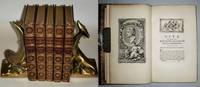
1757ref. 48199Londra Paris 1757. Brilliantly designed by Gravelot who is responsible for 89 of the 111 plates and all 97 tailpieces as well as Eisen Cochin a . Londra Paris 1757. Brilliantly designed by Gravelot who is responsible for 89 of the 111 plates and all 97 tailpieces as well as Eisen Cochin and Boucher. Called by Gordon Ray "one of the masterpieces of the illustrated book." It is said that this Italian text has superior impressions of the plates. Brunet I p. 291. Five volumes in full crushed morocco by Stykeman. All edges gilt. Five volumes 20 cm. Various paginations. b/w engraved plates chapter heads and tailpieces . unknown
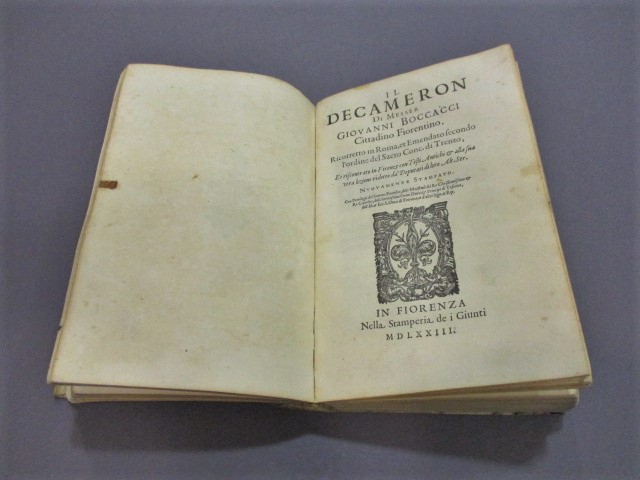
1573ref. 047703Florence: Giunti 1573. Early Edition. Hardcover. Very Good Condition. Later quarter calf front cover and free endpaper detached rear board just about detached. Mild dampstain over first 100 pages scattered foxing and browning but generally quite bright otherwise. Two small worm holes in gutter of final colophon leaf. Two portraits Boccaccio and an unidentified woman and lovely historiated initials throughout - a finely printed Giunti edition of Boccaccio's masterpiece. 32 580 1pp. Admas B2156 Brunet I 1002 note Pettas Giunti of Florence 496. The first of the famed Council of Trent editions - having been unable to ban a book as widespread and beloved as The Decameron it was censured in 1564 the council of Trent instead removed all mention of priests clergy and the Church from the work while leaving all the erotic bits that would have been too easily missed. Marketed as a "correction" of earlier supposedly erroneous editions. Provenance: Kimbolton Castle copy with case/shelf ticket inside front cover. Size: Quarto 4to. Quantity Available: 1. Shipped Weight: Under 1 kilo. Category: Poetry; Antiquarian & Rare. Inventory No: 047703. Giunti hardcover
1757ref. 48199Londra Paris 1757. Brilliantly designed by Gravelot who is responsible for 89 of the 111 plates and all 97 tailpieces as well as Eisen Cochin a . Londra Paris 1757. Brilliantly designed by Gravelot who is responsible for 89 of the 111 plates and all 97 tailpieces as well as Eisen Cochin and Boucher. Called by Gordon Ray "one of the masterpieces of the illustrated book." It is said that this Italian text has superior impressions of the plates. Brunet I p. 291. Five volumes in full crushed morocco by Stykeman. All edges gilt. Five volumes 20 cm. Various paginations. b/w engraved plates chapter heads and tailpieces . unknown books
ref. 14062[Au colophon] : Venise, Vettore di Ravani, 1534. 1 vol. petit in-8°, veau blond glacé, dos lisse orné de fleurons dorés et de triples filets dorés à l'emplacement des nerfs, pièce de titre en maroquin brun et date en pied sur pièce de maroquin brun, encadrement d'un triple filet doré sur les plats, filet doré sur les coupes, roulette dorée intérieure, tranches dorées. Reliure du XVIIIe s. Titre dans un encadrement architectural gravé sur bois, marque de l'imprimeur au r° du dernier feuillet, lettrines historiées sur fond criblé, impr. en car. ital., 102 ff., (1) f. Signatures : [A-N]8. Manque le dernier feuillet blanc (N8).
1582ref. 33055-217Florence Filippo & Iacopo Giunti October 1582. Printer's woodcut device on title large historiated woodcut initials a different printer's device on last leaf. In Italics. 16 leaves 585 pp. 1 38 leaves. 4to c. 210 x 145 mm. 18th century half calf rep. Florence Filippo & Iacopo Giunti October 1582. An important edition of this classic of Italian literature by Giovanni Boccaccio 1331-1375. This literary ten-day odyssey became the emblem of creative expression in the Italian Renaissance about the human experience its nature and psyche. Boccaccio's epic is edited here by Leonardo Salviati 1540-1589 a Florentine nobleman who was a founder member of the Accademia della Crusca. Its avowed aim was to uphold the purity of the Tuscan language as it had been in the fourteenth century. The Accademia Florentina founded in 1540 was dedicated to the same purpose and Salviati was active in both bodies. In 1584 Salviati published his "Degli Avvertimenti della Lingua sopra il Decamerone" a detailed discussion about the language used by Boccaccio. In this edition of the Decameron Salviati returned to the old texts and dedicated the work to Jacopo Buoncompagni one of his patrons. The text includes many beautiful historiated initials. - A very well printed and rare edition. - Ind. Aur. 120.402; Adams B-2158; STC Italian 110; Brunet I 1002; Gamba Serie dei testi di lingua p. 59 no. 181. LITERATURE:ITALIAN ; EROTICA ; GRAPHIC ARTS:GIUNTA ; Florence, Filippo & Iacopo Giunti unknown
1585ref. 142483Florence: Per li Giunti di Firenze 1585. bound in later half mottled leather and brown marble-patterned boards. Giunti. 8vo. bound in later half mottled leather and brown marble-patterned boards. 648 4 pages. Edited by Leonardo Salviati 1540-1589 drawing from 14th century manuscripts in the Tuscan dialect. Stated third Giunta edition "terza edizione" of the important Salviati text of the Decameron Not in Adams - 1582 Giunta second edition is Adams B-2158. With the exlibris bookplate of Christopher Clark Geest 1936-2023 on the front pastedown. Leather boards with some rubbing and wear along the edges and corners minor worming mostly to blank margins minor spotting; small unobtrusive exlibris institutional stamp to title page signature torn from foot of title but professionally repaired. Printed in italic and roman typefaces. Printer's woodcut device to title page a nice suite of historiated woodcut initials used throughout the text; leaf with engraved and printed dedication on page 587. Opens with the Medici dedication and privilege followed by Salviati's prefatory matter and the hundred novelle. Collation appears complete with dedication and final register present. As the great rivals of the Aldine Press the Giunti aggressively captured large portions of the lucrative governmental and Church's printing business. From their base in Florence and Venice family members set up printing presses in Burgos Salamanca Madrid Valladolid Lerma and Lyons. In Spain they became printers to the most powerful King in the world and established "The Imprenta Real" changing their name to "Junta." This particular book was prepared under Medici patronage Salviati's recension regularized Boccaccio's Tuscan and offered a "safe" post-Tridentine version of the work making this a key late-Renaissance edition of the classic Italian novella collection. Provenance: Christopher Clark Geest had a great love for literary works in the English language and focused his collecting on some of the best-known and beloved verse and prose by Chaucer Shakespeare Burton Swift Burns Johnson and beyond. His special interest in the development of the novel in the early modern period is highlighted by number of earliest gothic novels including first editions of Horace Walpoles The Castle at Otranto and Charles Brockden Browns Wieland. Other important books include first editions of Hobbes Leviathan Johnsons Dictionary and Spensers Faerie Queen as well as Coriolanus and Titus Andronicus as extracted from Shakespeares First Folio. Per li Giunti di Firenze unknown
1585ref. 142483Florence: Per li Giunti di Firenze 1585. bound in later half mottled leather and brown marble-patterned boards. Giunti. 8vo. bound in later half mottled leather and brown marble-patterned boards. 648 4 pages. Edited by Leonardo Salviati 1540-1589 drawing from 14th century manuscripts in the Tuscan dialect. Stated third Giunta edition "terza edizione" of the important Salviati text of the Decameron Not in Adams - 1582 Giunta second edition is Adams B-2158. With the exlibris bookplate of Christopher Clark Geest 1936-2023 on the front pastedown. Leather boards with some rubbing and wear along the edges and corners minor worming mostly to blank margins minor spotting; small unobtrusive exlibris institutional stamp to title page signature torn from foot of title but professionally repaired. Printed in italic and roman typefaces. Printer's woodcut device to title page a nice suite of historiated woodcut initials used throughout the text; leaf with engraved and printed dedication on page 587. Opens with the Medici dedication and privilege followed by Salviati's prefatory matter and the hundred novelle. Collation appears complete with dedication and final register present. As the great rivals of the Aldine Press the Giunti aggressively captured large portions of the lucrative governmental and Church's printing business. From their base in Florence and Venice family members set up printing presses in Burgos Salamanca Madrid Valladolid Lerma and Lyons. In Spain they became printers to the most powerful King in the world and established "The Imprenta Real" changing their name to "Junta." This particular book was prepared under Medici patronage Salviati's recension regularized Boccaccio's Tuscan and offered a "safe" post-Tridentine version of the work making this a key late-Renaissance edition of the classic Italian novella collection. Provenance: Christopher Clark Geest had a great love for literary works in the English language and focused his collecting on some of the best-known and beloved verse and prose by Chaucer Shakespeare Burton Swift Burns Johnson and beyond. His special interest in the development of the novel in the early modern period is highlighted by number of earliest gothic novels including first editions of Horace Walpoles The Castle at Otranto and Charles Brockden Browns Wieland. Other important books include first editions of Hobbes Leviathan Johnsons Dictionary and Spensers Faerie Queen as well as Coriolanus and Titus Andronicus as extracted from Shakespeares First Folio. Per li Giunti di Firenze unknown books
1665ref. CLL-190Amsterdam, Daniel Elzevier, 1665 In-12 de (12) ff., 744 pp., maroquin rouge, trois filets dorés en encadrement, dos lisse orné de caissons de fleurons dorés, coupes et bordures décorées, tranches dorées (reliure du début du XVIIIe siècle).
1757ref. 016455Londra Paris. Five volumes. Full mottled calf with the spines divided into six compartments by gilt designs. Red title slips and volume slips in two of the compartments on each spine and a gilt decoration in the others. 8.25" by 5.25". Called by Ray "one of the masterpieces of the illustrated book." Superbly designed by Gravelot 89 of the 111 plates and all 97 tailpieces Eisen Cochin and Boucher. Italian text with its better impressions of the plates. Heads of spines of Volumes 1 and 4 with slight loss spines of Volumes 1 and 2 rubbed but very nice and very tight. Large margins dark impressions. Armorial bookplates of William Tennant of Aston Hall. . Very Good. Hardcover. First Edition Thus. 1757. hardcover
1913ref. 86052Roma: Treccani 1913. Cm. 36 pp. 340. Con molte decorazioni policrome nel testo. Legatura edit. in velluto rosso con decorazione in oro al piatto anteriore. Entro custodia edit. in piena pelle. Perfetta conservazione in stato di nuovo. Bella ristampa impressa su similpergamena in tiratura limitata di 599 esemplari ns. n. 97. Riproduce il manoscritto Holkham misc. 49 in possesso della Bodleian Library di Oxford. Le miniature sono opera di Taddeo Crivelli. Privo del volume di commentario. Treccani unknown
2008ref. 75035Madrid: Egeria 2008. Cm. 30 pp. 656. Con molte belle miniature nel testo. Legatura editoriale in piena pelle con titoli e decorazioni in oro. Entro custodia. Pregiata edizione stampata su carta pergamenata e d in edizione a tiratura limitata e numerata a mano. Ottima conservazione. Non sono presenti i due volumi di commentario e traduzione dell'opera in italiano. Egeria unknown
ref. 76533Club Internacional del Libro . Club Internacional del Libro unknown
1729ref. 50857(Florenz, Philippo di Giuntas Erben, 1527 [Nachdruck: Venedig, Pasinello, 1729]). 4°. Mit wiederh. Holzschn.-Druckermarke am Titel u. am Ende. 8 nn. (das letzte weiß), 284 num. Bll., Pgmt. d. Zt. m. goldgepr. Rückenschild.
ref. 26046Paris, Nicolas Eve, relieur du Roi, 1578. 1 vol. petit in-8°, vélin ivoire souple à recouvrement, titre écrit à la plume au dos. Reliure de l'époque, couv. sup. déboîtée. Bon exemplaire, traces de lacets. Ex-dono ms. sur le titre. Titre orné d'une marque typographique, (4) ff., 696 pp. Signatures : at4 [a-z]8 [A-V]8 X4. Quelques petites rousseurs.
1594In-4°; pp. (24), 585, (3 pp. bianche), 589-648; marca tipografica incisa su legno al frontespizio Dedicato a Giacomo Buoncompagni Duca di Sora. Edizione a cura di Leonardo Salviati, frutto di un lavoro filologico assai approfondito, ampiamente spiegato nella lettera ai lettori. In fine “Alcune differenze che sono tra’l testo del 1573 e’l nostro”.
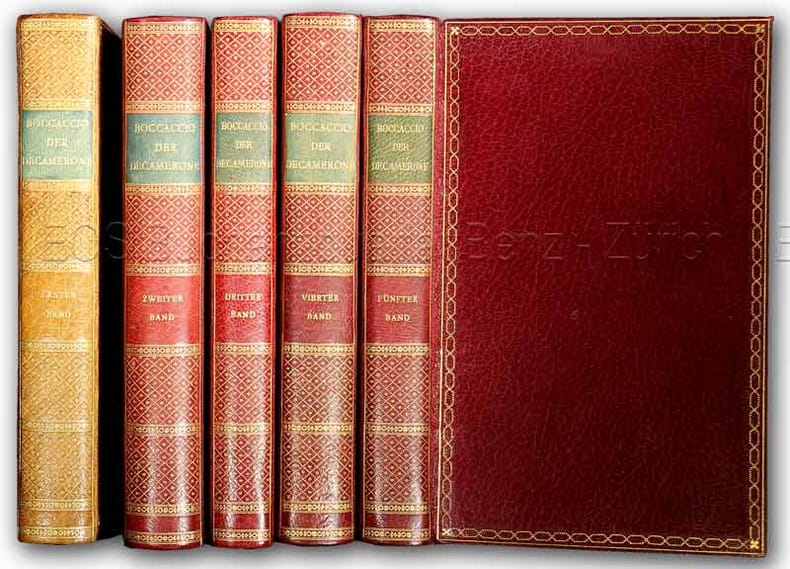
1912ref. 3011BB1912. München und Leipzig Georg Müller und Hans von Weber 1912-13. 8°. 264 252 188 238 227 Seiten. Orig. rotes Maroquin mit grünen Rückenschildchen reicher Rückenvergoldung Goldbordüre auf Deckeln Kopfgoldschnitt. Nicht bei Rodenberg. - Faksimile der berühmten Boccaccio-Ausgabe. "Von dieser Ausgabe wurden 100 Exemplare für die Mitglieder der Vereinigung 'Die Hundert' auf Velin von Van Gelder mit dem Hundertzeichen weitere 100 Exemplare auf gleichem Velin mit dem Wasserzeichen "Boccaccio" für die Luxusausgabe abegezogen." Vorliegendes Exemplar ist Nr. 42 der Luxusausgabe. - Rücken von Bd. 1 und Teil des hinteren Deckel etwas verblasst Kratzer auf Vorderedeckel von Bd. 4. unknown
1912ref. 3011BBMünchen und Leipzig, Georg Müller und Hans von Weber, (1912-13). 8°. 264, 252, 188, 238, 227 Seiten. Orig. rotes Maroquin mit grünen Rückenschildchen, reicher Rückenvergoldung, Goldbordüre auf Deckeln, Kopfgoldschnitt.
1520ref. 11556Jehan & Gourmont o. J. 1520 1520. priv. Einband . 4°.117s-. fachmännisch Restauriert einige Seiten mit geringem Textverlust sonst in gutem Zustand AZB7LS4 HC Jehan & Gourmont, o. J., (1520), unknown