VREDEMAN DE VRIES, Jan (1527-1609), FLORIS, Cornelis (1514-1575) et GALLE, Philippe (1537-1612).Livre Rare Book

41.116 resultados
ref. LCS-18476Provenance: Rothschild; Baron Alexis de Rédé. Vredeman de Vries, Jan (1527-1609), Floris, Cornelis (1514-1575) et Galle, Philippe (1537-1612). - Hortorum viridariorumque elegantes & multiplicis formae… Anvers, Philippe Galle, 1583. In-folio oblong (260 x 323 mm). Titre-frontispice et 20 planches de jardins, numérotées. Edition originale. Berlin Kat. 3390 ; Hollstein XLVIII, 470-490. - [Relié avec] : du même : Jardins. Anvers, Philippe Galle, c. 1583. 6 gravures numérotées. Edition originale. - [Relié avec] : du même : Artis Perspectiuae plurium generum elegantissimae Formulae, [graphic], multigenis Fontibus, nonnullisq[ue] Hortulis affabre factis exornatae, in comodum Artificum, eorumq[ue] qui Architectura, aedificiorumq[ue] comensurata uarietate delectantur, antea nunquam impressae. Anvers, Gerardus de Jode, 1568. Titre-frontispice et 17 gravures. Edition originale. - [Relié avec] : du même : Puits et fontaines. Anvers, Philippe Galle, 1573. 24 gravures numérotées sur 12 feuillets, minime déchirure à une planche. - [Relié avec] : Floris, Cornelis. Veelderleij niewe inventien van antijcksche sepultueren diemen nou zeere ghebruijkende is met noch zeer fraeije grotissen... Anvers, Jerôme Cock, 1557. Titre et 15 planches gravées montrant des décorations fantastiques, et des monuments funéraires dans le style grotesque. Edition originale rarissime. Reliure en vélin ancien, gardes renouvelées. Titre de la première suite frotté et effrangé avec déchirures marginales et pliure et joint à la garde ; taches à quelques planches. 257 x 326 mm.
ref. 5572SLND [Pays-Bas ou Belgique, circa 1470-1480]. 1470 1 vol in-12° (186 x 135 mm) manuscrit de [110] ff. de parchemin rédigé à lencre sur réglures tracées à lencre pâle de: [1] f. bl.), [6] ff. Note manuscrite de mariage à l'encre brune sur la 1ére contre-garde datée 1590. (calendrier calligraphié à l'encre brune et rouge sur 32 lignes avec lettrines enluminées), [102] ff. avec texte calligraphié sur 20 lignes, textualis formata ; 14 miniatures pleine page, 22 vignettes enluminés (Péricopes, Obsecro te, O intemerata et suffrages), initiales champies peintes dorées à la feuille avec entrelacs de fleurs trilobées en leur centre (sur six lignes), initiales champies dorées à la feuille (sur deux lignes) parfois avec antennes filigranées et fleuries, initiales dorées ou filigranées dans le texte, encadrements sur fonds criblé doré avec feuilles dacanthe bleues et oranges et petite végétation simple aux couleurs vives, bouts de lignes à lencre rouge et bleue avec un écu doré au milieu (litanies), rubriques, [1] f. bl. (rares salissures, traces dusage ou de frottements, corps douvrage demeuré frais et avec des coloris très vifs). Plein veau à entrelacs d'époque Renaissance avec vestiges de cires colorées et médaillon central (XVIe s.), dos à 5 nerfs orné, plats à riche décors dentrelacs dans encadrement de filets avec frise de feuillages et oiseaux, trace de cire blanche, bleue et rouge dans les entrelacs, roulette sur les coupes, tranches dorées, écoinçons et fermoirs de laiton. (restaurations au dos, petites usures ou défauts dusage)
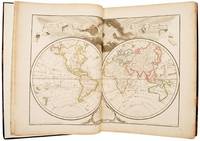
1789ref. 51612Paris: chez Dezauche 1789. Updating the work of "one of the key figures in the development of French cartography" First edition thus and uncommon with just four listings on WorldCat three of these for the BnF and no complete copy at auction for 30 years; an excellent complete and inclusive French atlas of the 18th century. Jean-Claude Dezauche 1745-1824 was one of the geographer-publishers most influential in the establishment of the French theoretical approach to cartography. This movement which downplayed the decorative elements valued by the Dutch school in favour of scientific rigour and accuracy can be traced back to the work of Guillaume Delisle - "one of the key figures in the development of French cartography" Tooley - who had studied under Jean-Dominique Cassini director of the Paris observatory. Delisle's business was inherited by his son-in-law Philippe Buache who had studied with him and who entered the Depôt des Cartes et Plans de Marine in 1721 in 1729 being appointed "premier géographe du roi" a position previously held by his father-in-law. On Buache's death his widow sold his work to Jean Nicholas Buache de la Neuville Philippe's nephew and in 1780 Dezauche bought it from him together with work by Delisle Jaillot and others. He in turn made his own alterations and improvements to the maps and then re-issued them in a revised form. For example the twin- and four-hemispheric world maps in volume I the former dated 1792 have been revised to include the latest discoveries from Cook's voyages. 2 vols folio 453 x 375 mm. Engraved allegorical title page and contents leaves to each and 151 double-page or folding maps all coloured in outline. Contemporary calf rebacked red morocco labels. Somewhat rubbed and with some restoration at the corners light dampstain in the lower margin of vol. I slightly heavier at the title page which has been reinforced with archival tissue map of Paris shaved to the ruled border at the upper margin a few minor splits and chips in the margins but overall very good. unknown
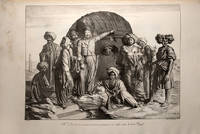
ref. 114525Paris Imprimerie Royale 1819. . First edition; elephant folio; 80 plates including 70 lithographs 8 aquatints & 2 engravings; contemporary calf over blue paper boards red morocco label to upper cover vellum tips; spine rubbed corners worn; internally a fine clean uncut example. The scarce first edition of Forbin's Voyage with text and plates together of which Brunet says only 325 copies were printed. Forbin's was one of the first important French books to use lithography on a grand scale and the standard of production is equal to that of Napoleon's Description de l'Égypte. The plates are after drawings by Forbin Isabey Prevost Fragonard and Carle Vernet. The aquatinted plates are all after drawings by Forbin himself. Most of the plates illustrate views in Egypt and Syria including the famous view of Drovetti French consul in Egypt measuring a giant head. In 1816 Forbin replaced Denon as Director of Museums and in 1817 he undertook a year-long voyage to the Levant having been authorised to purchase antiquities for the Louvre. He travelled to Milos where his son-in-law had negotiated the purchase of the recently discovered Venus de Milo and from there to Athens Constantinople Asia Minor Syria and Palestine. From Jaffa he travelled overland to Egypt and visited Alexandria. Atabey 447; Blackmer 614; Colas 1089; Hilmy I 163; Koç I 209; Weber 70; Paris, Imprimerie Royale, 1819. hardcover
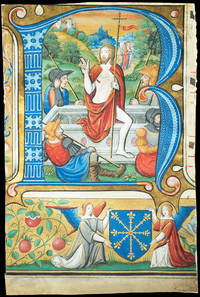
1500ref. 627This magnificent historiated initial R depicting the Resurrection of Christ is among the finest surviving remnants of a monumental illuminated gradual produced in Paris during the opening decade of the sixteenth century for the celebrated Abbey of Saint-Victor. Painted on an imposing scale for use upon the choir lectern the initial introduced the Introit for the Mass of Easter Sunday Resurrexi et adhuc tecum sum "I have risen and I am still with you" one of the most important chants of the entire liturgical year. Within the initial Christ rises triumphantly from the open sarcophagus his right hand raised in blessing as he steps forward in serene majesty. The artist contrasts Christ's calm monumental presence with the animated reactions of the Roman soldiers below who lie asleep. In the background the Three Marys approach the tomb. Mary Magdalene is distinguished by her ointment jar while beyond them Jerusalem rises. The composition masterfully compresses moments of the Resurrection narrative into a single unified image. The lower margin displays the arms of the Abbey of Saint-Victor supported by two graceful angels. Blazoned azure with eight fleur-de-lys scepters these distinctive arms firmly identify the manuscript's original owner. Founded in 1113 the Abbey of Saint-Victor became one of the most renowned Augustinian houses of medieval Europe. It was celebrated equally for its theological school distinguished scholars and remarkable library. Although a portion of its medieval library survives today in the Bibliothèque nationale de France and the Bibliothèque Mazarine the great Renaissance liturgical choirbooks commissioned for its choir were largely dispersed or destroyed. The illumination of the present Gradual is attributable to the Master of Philippe de Gueldres one of the leading illuminators active in Paris during the beginning of the sixteenth century. The artist takes his modern name from his work in the Vie de Christ a French translation of Ludolph of Saxony's Vita Christi made in 1506 for Philippe Philippa de Gueldres 1464–1547 Duchess of Lorraine Lyon Bibliothèque municipale MS 5125. First distinguished as an independent artistic personality by John Plummer the Master was once associated with Bourges because of stylistic affinities with the work of Jean Colombe and subsequently with Rouen. François Avril and Nicole Reynaud situate his mature career firmly in Paris where he collaborated with other Parisian illuminators including Jean Pichore and supplied illustrations for deluxe books produced by the celebrated publisher Antoine Vérard. His patrons belonged to the highest circles of French court and ecclesiastical society and included in addition to the Duchess of Lorraine King Louis XII and Cardinal Georges d'Amboise. Among his most important liturgical commissions were the monumental Graduals made for Louis XII and Anne of Brittany for the Sainte-Chapelle in Paris. These choirbooks were subsequently dismantled and dispersed a fate strikingly similar to that of the Saint-Victor Gradual from which the present miniature derives. Of particular importance is the Master's continuing relationship with the Abbey of Saint-Victor itself. The Gradual was not his only commission for this important Parisian Augustinian house. An illuminated Missal made for Saint-Victor now Paris BnF MS lat. 14818 is likewise attributed to the Master providing further evidence of his association with the abbey. Another richly illuminated Missal from Saint-Victor BnF MS lat. 14448 belongs to the same broader milieu of Parisian illumination and merits comparison with the work of the Master and his contemporary Jean Pichore. BnF MS lat. 14448 prominently incorporates the arms of the abbey supported by two kneeling angels providing particularly striking visual testimony to its institutional provenance and a close parallel for the same heraldic device preserved beneath the present Resurrection fragment. Taken together these manuscripts and the dispersed Gradual attest to the rich tradition of illuminated liturgical book production at Saint-Victor and provide compelling evidence for the Master's sustained relationship with the abbey around the turn of the sixteenth century. At least six historiated initials can presently be associated with the dispersed Saint-Victor Gradual. A group of four fragments appeared together in the sale of the collection of renowned bibliophile Ambroise Firmin-Didot in Paris in 1884 lot 73: the Presentation in the Temple the Resurrection the present miniature the Trinity and Saint Michael Slaying the Dragon. The Trinity reappeared with Les Enluminures Catalogue 9 no. 34. A fifth initial depicting Saint Victor was sold at Sotheby's London 23 June 1992 lot 25. A sixth fragment depicting the Last Supper appeared at Christie's London 15 November 2006 lot 9 and may likewise have formed part of the same monumental choirbook. Other important manuscripts attributed to the Master include a Book of Hours now at the Huntington Library HM 1101 as well as manuscripts in Paris BnF MSS fr. 54 702 and 2678–2679 and Vienna ÖNB Cod. 2565 and Cod. 2582. His oeuvre encompasses both secular and devotional manuscripts although much of his surviving work is found in secular commissions for courtly and aristocratic patrons. Provenance: 1. Abbey of Saint-Victor Paris. 2. Collection of Ambroise Firmin-Didot 1790–1876. 3. Paris Hôtel Drouot Collection Ambroise Firmin-Didot 10–14 June 1884 lot 73. 4. France Private Collection 5. Published: Les Enluminures Chicago and Paris published in Catalog 8: Symbolism and the Medieval World # 33 1999 6. Published: Les Enluminures Chicago and Paris published in Catalog 15 France 1500: The Pictorial Arts at the Dawn of the Renaissance # 2010 7. USA Private Collection Literature: Avril François and Nicole Reynaud. Les manuscrits à peintures en France 1440–1520. Paris 1993 pp. 278–281. Plummer John. The Last Flowering: French Painting in Manuscripts 1420–1530. New York 1982 pp. 69–71. Victor Leroquais Les sacramentaires et les missels manuscrits des bibliothèques publiques de France 3 vols. Paris 1924 vol. III. pp. 222-223 Ambroise Firmin-Didot Catalogue illustré des livres précieux manuscrits et imprimés faisant partie de la bibliothèque de M. Ambroise Firmin-Didot Paris Hôtel Drouot 10–14 June 1884 lot 73 p. 57. Illuminated Miniature on parchment
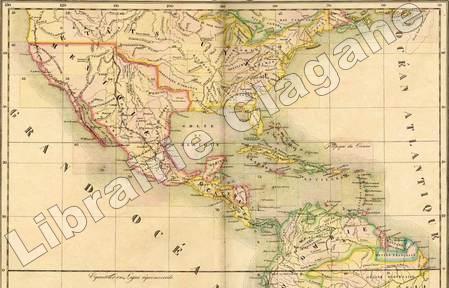
1827ref. 9452Bruxelles, PMG Vandermaelen éditeur, 1827 ; cinq tomes (Europe, Asie, Afrique, Amérique Septentrionale, Amérique Méridionale), in-folio atlantique (52,5 x 36 cm) ; demi-veau havane à petits coins verts, dos à faux-nerfs dorés, palette décorative dorée en tête et en pied, titre doré, tranches marbrées (reliure uniforme de l'époque) ; 1- Europe : (4), 43 pp., (1) p., tableau comparatif des principales hauteurs du globe (illustré en couleurs), carte d'assemblage de l'Europe et 29 cartes doubles. 2- Asie : (6) pp., carte d'assemblage de l'Asie et 111 cartes doubles. 3- Afrique : (4) pp., tableau d'assemblage de l'Afrique et 60 cartes doubles. 4- Amérique Septentrionale : (4), tableau d'assemblage et tableau provisoire d'assemblage d'une partie de l'Amérique Seple et d'une partie de l'Amérique Méridionale et 77 cartes doubles. 5- Amérique Méridionale : (4), carte d'assemblage d'Amérique Méridionale et 44 cartes doubles. Toutes les cartes sont en couleurs à quelques rares exceptions près et montées sur onglets.
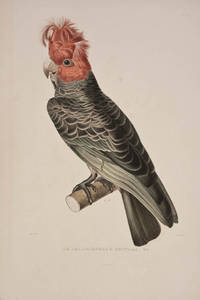
ref. 98481Paris Arthus Bertrand 1837. . First edition. 3 vols comprising 2 vols 4to text and 1 vol. folio atlas 53 x 35 cms text a little spotted as usual atlas with 56 plates comprising 34 lithographed views and portraits after V. Adam Sabatier and others from sketches by E.B. de la Touanne printed by Bernard & Frey 12 hand-colored engraved natural history plates after P. Bessa and J.-G. Pretre by Coutant H. Legrand Oudet Dumenil and Massard double-page hand-colored aquatint of various native vessels folding engraved map 2 double-page coastal profiles and 6 double-page engraved maps and charts by A. Tardieu after E.B. de la Touanne usual sporadic toning and light staining plate 4 a bit foxed contemporary calf-backed marbled boards atlas rebacked to match a very good set. The official record of Bougainville's voyage around the world. The main intention of the voyage was political: to extend French influence in Indochina. However Bougainville also touched at Pondicherry Manila Macao Surabaya Sydney Port Jackson Valparaiso and Rio de Janeiro. Bougainville son of the explorer Louis Antoine de Bougainville had served as an eighteen-year-old ensign on the Baudin voyage and after distinguished service in the Napoleonic wars he was given command of the frigate La Thetis and the corvette L'Esprance. He spent several months in and around Sydney where most of the ornithological material gathered by the voyage had been collected here and resulted in three drawings by Bessa of four species of birds including 'superb illustrations' Wood of the male and female Gang-gang or red-crested parrot. From here both ships crossed to Valparaiso where La Touanne commenced his overland journey to rejoin the expedition at Rio. The account of this journey takes up much of the second volume together with R.-P. Lesson's account of the natural history. Ayer/Zimmer p83; Borba de Moraes I115; Ferguson 2236; Fine Bird Books p79; Hill 162; Nissen ZBI 483; Sabin 6875; Whittell p68; Wood p251. Paris, Arthus Bertrand, 1837. hardcover
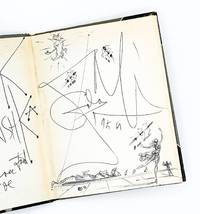
1954ref. 55808New York: Simon and Schuster 1954. First edition. Very good. Lavishly inscribed association copy with multiple drawings from the surrealist master - signed to movie studio mogul Jack Warner and his wife. Jack Warner 1892-1978 was the legendary co-founder and CEO of Warner Bros. Studios which produced such classic films as THE JAZZ SINGER 1927 the first feature-length "talkie" LITTLE CAESAR and PUBLIC ENEMY 1931 THE MALTESE FALCON 1941 CASABLANCA 1943 A STREETCAR NAMED DESIRE 1951 THE SEARCHERS 1956 MY FAIR LADY 1964 and WHO'S AFRAID OF VIRGINIA WOOLF 1966 as well as innumerable other iconic films. By the time Dalí inscribed this copy in 1954 the two had already known each other for at least a decade. In 1944 Dalí had come to Hollywood to work on the Hitchcock film SPELLBOUND for which the artist contributed a pioneering dream sequence. By 1945 Warner had commissioned Dalí to paint portraits of both Warner and his wife Ann with Dalí actually living with the couple while he completed the works Sperling and Millner 269. This unconventional arrangement in fact led to a now-famous meeting between Dalí and Walt Disney an encounter that resulted in "a lifelong friendship between the man behind the mouse and the painter of melted clocks" Jukareddy. At a dinner party hosted by Warner Dalí and Disney were introduced and hit it off so well they began a collaboration that would eventually result in the production of "Destino" a six-and-a-half-minute surrealist animated film: "Dalí and Disney immediately connected and an overjoyed Dalí accepted Disney's proposal to collaborate on a surrealist animated short. Over the next eight months they created more than 200 storyboard sketches" ibid. A work of myth-making and fame-enhancement as much as anything Dalí's whimsical MUSTACHE finds him and his mustache answering questions "Your mustache looks so rigid - how does it react to the winds of public opinion" with playful responses "She bends" all accompanied by surrealist photographs and photo collages. A close and important association between these two titans with among the most elaborate and exuberant Dalí inscriptions we've seen. Original black-and-white pictorial boards. No jacket as issued. 126 pages. Illustrated throughout with photos of Dalí by Philippe Halsman. Preface by Dalí with a "Postface" by Halsman plus publisher's notes "on how some of the photographs were made." Inscribed in year of publication by Dalí to Jack Warner and his wife Ann across the front pastedown and endpaper: "Pur sic a pun / Prince des Gouts Felines / Jack / ei / Anunshka / L'amour de sur tout / Dalí / Gala / 1954. Roughly: "Purr for the Prince of Feline Tastes Jack and Ann Love above all." Dali has added numerous figures including a crown a shooting star a drawing of two figures dancing in a desert plus three scurrying ants and a moon playing a trumpet overhead. Chipping to head of spine with top centimeter or so of spine beginning to separate but holding. Some toning to endpapers and some starting at gutter before title-page. Housed in a custom clamshell box. Simon and Schuster unknown
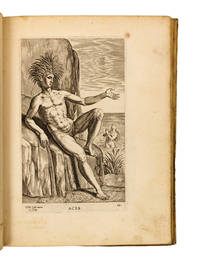
1586ref. 1648421586. GALLE Philippe. Semideorum marinorum amnicorumque sigillariae imagines perelegantes in picturae statuariaeque artis tyronum usum a Philippo Gallaeo delineatae sculptae et aeditae. Engraved title-page followed by 17 numbered engraved plates. Antwerp: Galle 1586. BOUND WITH: Nimpharum oceanitidum ephydridum potamidum naiadum lynadumque icones in gratiam picturae studiosae ivventutis deliniatae scalptae et editae a Phillip. Gallaeo. Engraved title-page followed by 17 numbered engraved plates. Small 4to. 219 x 165 mm bound in contemporary Flemish vellum with title in manuscript on the spine. Preserved in a green half morocco folding box. Antwerp: Galle 1587. First Editions of both sets of prints designed and meticulously executed by Philipp Galle one of the foremost Flemish engravers of the day. These allegorical depictions of classical water deities and personifications of European waterways set male and then female figures among their appropriate geographical environment. The settings often include topographical or mythological iconography i.e. Nilus or the Nile shows a pyramid and obelisk in the background or Lerna with its Hydra in the distance however it is undoubtedly the figures themselves that are of most interest to the artist. They clearly show the influences of High Renaissance Italy with the musculature of the male figures evoking Michelangelo and the elongation of the female figures reminiscent of Parmigiano's Madonnas. Philippe Galle 1537-1612 ranks among his peers Johannes Stradanus 1523-1605 Martin de Vos 1532-1603 Adriaen Collaert 1560-1618 and Maarten van Heemskerck 1498-1574 as being known for introducing Italian art into the Northern Netherlands and influential on Dutch artists of the great period of pictorial art the Dutch Golden Age in the following century. Both sets of prints are rare. We locate a copy of both at the National Gallery a complete copy of just Semideorum marinorum at the Bibliotheque Nationale and a selection of odd plates at the Metropolitan Museum of Art and British Library. A very desirable copy bound in an un-restored contemporary vellum binding with nice impressions of the plates and wide margins. Some insignificant soiling or spotting. Brief early manuscript notes on the verso of seven plates. hardcover books
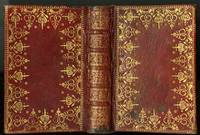
ref. LCS-17816« Dernière édition publiée du vivant de l’auteur, elle est très complète, très belle et justement estimée ». (Tchemerzine, II, 890). Paris, Mamert Patisson, 1600. 1 volume in-8 de (8) ff., 338 pp., (6) ff. Maroquin rouge, plats ornés d’un décor doré à la fanfare, dos à nerfs richement orné, filet or sur les coupes, roulette intérieure, tranches dorées sur marbrures. Reliure signée de Trautz-Bauzonnet vers 1860. 172 x 105 mm.
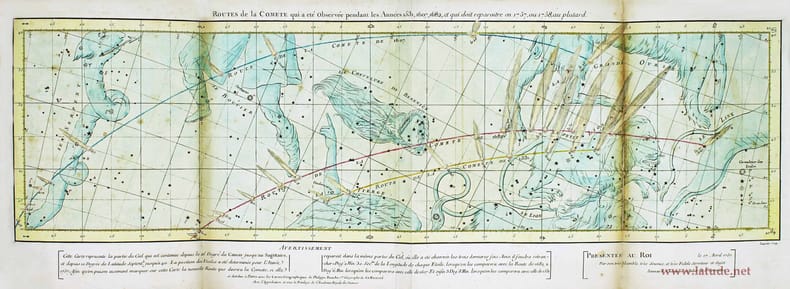
ref. 16085Paris, Delisle, Buache, 1757.
1772ref. 30530Paris: Edme 1772. Folio. 19 3/4 x 13 1/8 inches. Engraved frontispiece by B.L. Prevost after Sullier engraved portrait frontispiece by J. Baptiste Michel after Harguinier engraved title vignette by and after Prevost engraved arms of Charles-Eugene de Lorraine on dedication 56 hand-coloured engraved plates by B. Michel Adam femme Fessard F.A. Aveline C. Baquoy Benard Ch. Beulier L. Bosse Prevost and others after Harguinier Lafosse Saullier 19 folding and 7 engraved headpieces by Delaunay Hubert Levilain Lucas Mlle Massard Mesnil Michel after Le Carpentier type-ornament headpieces woodcut head- and tailpieces and initials. Contemporary calf covers bordered with gilt double fillet expertly rebacked to style spine gilt retaining the original red morocco lettering piece period marbled endpapers Deluxe hand-coloured first edition of the best 18th century French work on equine medicine and the anatomy of the horse. Cours d'hippiatrique is distinguished not only by Lafosse's anatomical skill and knowledge of equitation gained through both study and practice of the subject but also by the excellence of its execution: "Ce livre est un veritable monument eleve a l'Hippologie. Papier impression dessin gravure sont egalement signes" Mennessier de la Lance. The vivid colouring of the anatomical plates elevates this hand coloured issue far beyond the regular black and white edition. "Ouvrage fort bien execute et qui a ete longtemps le meilleur que l'on eut sur cette science" Brunet. Brunet III 765; Cohen-de Ricci col.587; Huth p.46; Mellon Books on Horses and Horsemanship 61; Mennessier de la Lance II pp.20-21; Nissen ZBI 2360. Edme unknown books
ref. 3092New York: The Neikrug Press 1981. First edition. Original linen clamshell box. Very Good. THE RARE STUNNING COMPLETE PORTFOLIO OF 10 LARGE ICONIC SILVER GELATIN PRINTS OF MARILYN MONROE BY PHILIPPE HALSMAN. EXTREMELY RARE ARTIST PROOF: From the collection of John Springer one of Monroe's press representatives. This portfolio was given to Springer by Yvonne Halsman at the time of publication. Nine of the prints are from Halsman's famous 1952 shoot at Monroe's apartment for LIFE Magazine including the cover shot for the April 7 1952 issue; one "Marilyn Jumping" from his 1959 "Jumpology" series. Halsman explained the circumstances of the 1952 shoot: "I drove to the outskirts of Los Angeles where she lived in a two-room apartment. What impressed me in the living room was the obvious striving for self-improvement. I saw a photograph of Eleanora Duse and a multitude of books that I did not expect to find there like the works of Dostoevsky Freud the history of Fabian socialism etc. On the floor were two barbells." Philippe Halsman website. In addition to the LIFE cover photograph and "Marilyn Jumping" the portfolio includes: "Portrait of Marilyn 1952"; "Marilyn with Barbells 1952"; "Marilyn Entering the Closet 1952"; "Marilyn Flirting 1952"; "Marilyn at the Drive-In 1952"; "Marilyn Listening to Music 1952"; "The True Marilyn 1952"; "Marilyn-Mao 1952". Limitation signed by Yvonne Halsman Philippe Halsman died two years before the portfolio was issued and with artist's proof designation "a/p". Each photograph with hand-stamped copyright on the reverse and the limitation number left blank indicating the artist's proof. Size: 11x14 inch prints; archivally fastened and matted onto 16x20 inch Museum Rag Board. Note: Two of the original mattes have recently been replaced with nearly indistinguishable archival matte boards. New York: The Neikrug Press 1981. Large portfolio. Prints loose as issued in linen clamshell box with title label. Some soiling to box as often; photographs fine. Over the years many sets have been broken up and the prints sold individually; complete sets are now very rare. The Neikrug Press unknown
1569ref. 5032541569. Book. A lengthy series of royal edicts / decrees / writs produced by the court under Philippe's close scrutiny in 1569 regarding financial and other obligations on the part of the persons in the area of Castro del Rio and elsewhere. 49 vellum leaves 98pp of manuscript 4 blank pages. The last page of which bears the date 18 November 1569 and the elaborate signatures and marks of the King and a number of his courtiers. Each page of the text bears 2 flourishes ie initials likely by the King and by the person responsible for the production of the document. In the original leather covers much rubbing and wear with remnants of the binding ribbons but the document still well-bound and with we think the original tri-coloured spine-cord binding the text to the cover. The first page with ornate decoration and illustrations in ink embellished with gold detailing and flourishes. Exquisite calligraphy throughout on well-preserved vellum. No seals present. 14" x 10". hardcover
1772ref. 30530Paris: Edme 1772. Folio. 19 3/4 x 13 1/8 inches. Engraved frontispiece by B.L. Prevost after Sullier engraved portrait frontispiece by J. Baptiste Michel after Harguinier engraved title vignette by and after Prevost engraved arms of Charles-Eugene de Lorraine on dedication 56 hand-coloured engraved plates by B. Michel Adam femme Fessard F.A. Aveline C. Baquoy Benard Ch. Beulier L. Bosse Prevost and others after Harguinier Lafosse Saullier 19 folding and 7 engraved headpieces by Delaunay Hubert Levilain Lucas Mlle Massard Mesnil Michel after Le Carpentier type-ornament headpieces woodcut head- and tailpieces and initials. Contemporary calf covers bordered with gilt double fillet expertly rebacked to style spine gilt retaining the original red morocco lettering piece period marbled endpapers Deluxe hand-coloured first edition of the best 18th century French work on equine medicine and the anatomy of the horse. Cours d'hippiatrique is distinguished not only by Lafosse's anatomical skill and knowledge of equitation gained through both study and practice of the subject but also by the excellence of its execution: "Ce livre est un veritable monument eleve a l'Hippologie. Papier impression dessin gravure sont egalement signes" Mennessier de la Lance. The vivid colouring of the anatomical plates elevates this hand coloured issue far beyond the regular black and white edition. "Ouvrage fort bien execute et qui a ete longtemps le meilleur que l'on eut sur cette science" Brunet. Brunet III 765; Cohen-de Ricci col.587; Huth p.46; Mellon Books on Horses and Horsemanship 61; Mennessier de la Lance II pp.20-21; Nissen ZBI 2360. Edme unknown
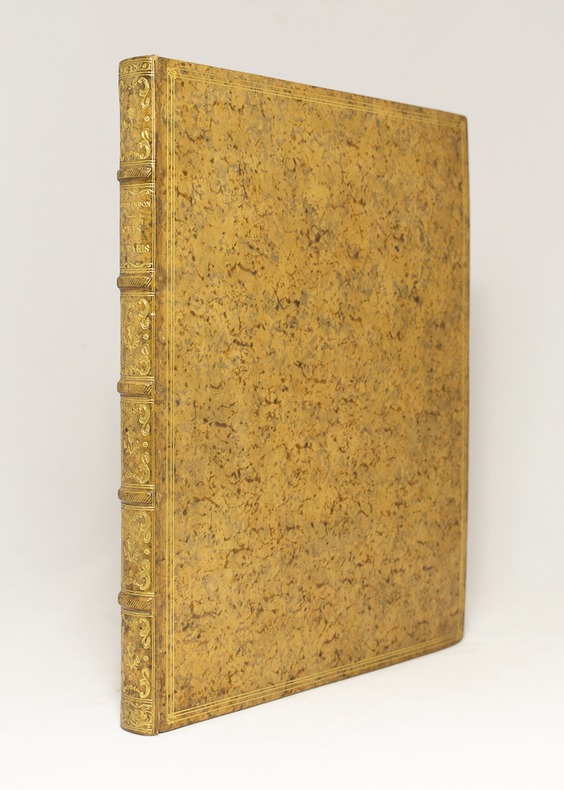
ref. 15999Paris, Chez Fessard, 1737 - 1746. In-folio de [60] feuillets montés sur onglets, plein veau moucheté, dos à nerfs orné de filets et fleurons dorés, triple filet doré en encadrement des plats, roulette dorée aux coupes, dentelle dorée intérieure. Jolie reliure pastiche signée Pagnant.Pretty binding imitation signed by Pagnant.
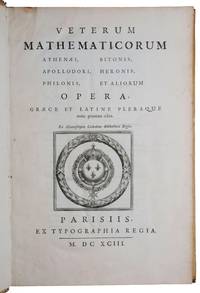
1693ref. 6467Paris: Typographia Regia 1693. First edition. First edition a very fine copy of this collection of early Greek writings on technology especially military technology and hydrostatics. It contains several treatises on the mechanics and siege operations or poliorcetica of the Hellenistic period the period between Alexander and Augustus including the construction and management of projectile engines. . DIBNER 84: ANCIENT GREEK TECHNOLOGY. First edition of this collection of early Greek writings on technology especially military technology and hydrostatics. It contains several treatises on the mechanics and siege operations or poliorcetica used in the Hellenistic period the period between Alexander and Augustus including the construction and management of their projectile engines. The first six works in the volume comprise the writings on the subject of military engines that were compiled by Athenaeus Apollodorus Biton Heron and Philon. These works include the first edition in both Greek and Latin of Biton's Construction of War Machines and Artillery of extant part of the Mechanike Syntaxis attributed to Philon of Byzantium and of the Poliorcetica of Apollodorus of Damascus. These are followed by the Greek and Latin texts of Hero of Alexandria's works on hydrostatics the Pneumatica and Automata which include what some regard as the first description of a steam-engine; this is the first printing of the Greek text of these works. Thévenot the King's librarian to Louis XIV prepared the present work from a rather defective secondary manuscript Codex Parisinus 2435. After Thévenot's death in 1692 it was revised by the mathematician La Hire with insightful annotations by Boivin an official in the King's library. It is one of three early publications of the French Academy of Sciences grouped together as Dibner 84. "Printed at the royal press in small editions they were intended as gifts for the King and Academy. In size binding and beauty of the plates they are among the most sumptuous books in science" Dibner. This is a rare book on the market only eight copies having appeared at auction in the last 40 years. The Evelyn copy was sold at Christie's in 1977. To gain access to the walls of a site under siege a siege tower or ram was brought into position and used to launch an attack onto the walkway aided by missile fire from the higher levels of the tower. Simultaneous attacks with scaling ladders took place. A siege tower is a specialized siege engine constructed to protect assailants and the ladders used when approaching the defensive walls of a fortification. The tower was usually rectangular with four wheels and a height roughly equal to that of the wall; it was sometimes higher to allow archers to stand on the top and fire into the fortification. The tower was made chiefly of wood but sometimes there were metal components as well. They were unwieldy to manoeuvre and slow to assemble and consequently were usually constructed at the siege site. Sometimes siege towers themselves incorporated other devices including artillery rams and dropbridges. Two main types of artillery equipment were used in this period: bolt-throwers ballistae: used for picking off prominent individuals and stone-throwers scorpiones onagri. Stone throwers could cause structural damage but were generally confined to firing at towers gates or siege machinery. Artillery might use incendiary ammunition when firing at gates or equipment. In common with much Byzantine literature poliorcetica draw heavily on earlier classical material. Since these were composed before the development of heavy artillery the poliorcetica are not so much concerned with large machines but rather with describing techniques for bringing men close to fortifications and then ways of undermining them. They also suggest various psychological tricks which might be used to outwit the enemy. Such ancient works on military machines were a source of fascination to the Italians of the late 15th and 16th centuries not only because of their historic interest but also as a source for modern inventions to be used in contemporary warfare and several of these works were first published in Renaissance Italy. The present volume begins with the De Machinis of Athenaeus a Cilician ex-statesman living in Rome in the 20s B.C. and a contemporary of the architect-engineer Vitruvius who like Vitruvius worked under the patronage of the Emperor Augustus Vitruvius devoted Book 10 of his De Architectura to machines. In addition to describing individual siege engines and theorizing on tactics Athenaeus draws on actual instances from history of the use of these machines in order to make various points and elucidate his text. The author of the next text is Apollodorus of Damascus who was a Roman architect and engineer of the late 1st to early 2nd century A.D. As Emperor Trajan's architect and military engineer he was responsible for Trajan's forum and possibly Trajan's column and produced designs for new siege machines. In his treatise Poliorcetica he describes a system of banks and ditches and also sheds that would be needed to protect the legionaries during undermining work or to carry battering rams against a tower gate or wall. Next he describes the construction of a siege tower followed by a system of interlocking ladders. He concludes his treatise with a description of a battlemented raft for river assaults. Although some of the elaborations are considered somewhat unrealistic − for example the addition of a torsion-powered truncheon to the end of a battering ram − and some of these are believed to have been added by a later editor the core of Apollodorus' text is believed to be authentic and to accurately describe highly effective machinery. Apollodorus dedicated Poliorcetica to the Emperor Hadrian perhaps an attempt to gain forgiveness for an earlier insult. On that occasion Trajan was discussing with Apollodorus the buildings which the great architect had built in Rome. Hadrian's assessment only demonstrated his ignorance which was bluntly pointed out by Apollodorus. Hadrian never forgot the insult and when he came to power banished Apollodorus accused him of several crimes and had him put to death. The third text in the volume is the Mechanike Syntaxis attributed to Philon of Byzantium who is believed to have been born about 280 B.C. in Byzantium and to have died around 220 B.C. Only the fourth and fifth books of this work have come down to us. Although there are few references to him in literature he is mentioned by Vitruvius. Amongst other weapons of siegecraft he describes the catapult recently invented by Ctesibius fl. 285-222 BC a Greek or Egyptian inventor and mathematician and probably the first head of the Museum at Alexandria. From this Philon's treatise can be dated fairly accurately to around 250 B.C. He describes journeys he made to Rhodes and to Alexandria to study catapults and it seems he may have earned his living advising military rulers. "The fourth book is headed κ τν Φιλνο βελοποιικν and the general subject is the manufacture of missiles. He mentions in it an invention of his own which he denominates ξυβλη p. 56. In the fifth book we are shocked to find that while recommending a besieging army to devastate the open country on the approach of an enemy he advises them to poison the springs and the grain which they cannot dispose of p. 103; and what renders this the worse he mentions his having treated of poisons in his book on the preparations that should be made for a war. What principally attracted attention to this work in modern times is his notice of the invention of Ctesibius p. 77. &c. The instrument described by him named εÏτονο acted on the property of air when condensed and is evidently in principle the same with the modern air-gun" A Dictionary of Greek and Roman Biography and Mythology William Smith ed. Philon's work is followed by the brief treatise of Biton of Pergamon 3rd or 2nd century B.C. about whom little is known; it is the only extant work to give a full description of advanced tension catapults. Biton's handbook describes four tension bow catapults a helepolis city-taker = siege tower and a sambuca mechanical scaling ladder. The bow catapults consisted of two stone throwers small and large and two bolt shooters a medium "belly bow" and mountain "belly bow". The latter took their name from the concave rest at their rear end against which the archer braced his stomach while drawing the bow. The work is dedicated to a King Attalus and was therefore composed between about 230 BC when Attalus I assumed the title of King and 133 BC death of Attalus III. As Biton mentions older types of catapults but not the torsion catapult that was otherwise well attested from the end of the 4th cent. BC the work probably belongs to the early years of the reign of Attalus I King of Pergamum 241-197 B.C. We do not know if Attalus employed the devices Biton described but they were definitely used in numerous later sieges and naval battles. The final two texts of siegecraft in the volume the Belopoeica and the Cheiroballistra are both attributed to Heron of Alexandria ca. 10-75 AD. Heron possibly taught at the Museum at Alexandria since many of his writings have the appearance of student lecture notes. The Belopoeica "On arrow making" describes the hand-held "belly bow" also discussed by Biton. The Cheiroballistra describes a small hand-held catapult. Some of Heron's designs derived from the works of Ctesibius none of whose works survive although they are mentioned by Vitruvius Athenaeus and Philo of Byzantium as well as Heron. In 1616 Bernardino Baldi 1553-1617 published a Latin translation of Heron's Belopoeica along with Heron's Greek text and a biography of Heron also written in Latin. Some of Baldi's commentary is appended to the present work. The volume concludes with the Pneumatica and Automata of Hero or Heron of Alexandria fl. 62 CE. "The Pneumatica in two books describes a menagerie of mechanical devices or "toys": singing birds puppets coin-operated machines a fire engine a water organ and his most famous invention the aeolipile the first steam-powered engine. This last device consists of a sphere mounted on a boiler by an axial shaft with two canted nozzles that produce a rotary motion as steam escapes" Britannica. "The introduction treats the occurrence of a vacuum in nature and the pressure of air and water . Some of the theory is right some is wrong for instance the horror vacui of nature but it was the best theoretical explanation to be had at the time . The first chapters most of them taken from Philo's Pneumatics describe experiments to show that air is a body and that it will keep water out of a vessel unless it can find an outlet and will keep water in if it cannot enter. Hero goes on to siphons . With very few exceptions it is evident that the chapters were written by Hero himself and without exception they are very clear: each instrument can be reconstructed from the description and the figure. While there is no order at all in the general arrangement of the chapters we find here and there a short series of related chapters in which it is clear that Hero is searching for a better solution to a mechanical problem. This shows unmistakably that he was an inventor; it is therefore probable that he himself invented the dioptra the screw-cutter and the odometer as well as several pneumatic apparatuses" DSB. The first appearance in print of Pneumatica was a Latin paraphrase in Giorgio Valla's De expetendis et fugiendis rebus 1501; the complete text was first published in Latin by Federico Commandino 1509-75 in 1575. The excellence of Commandino's translation persuaded the editors that it was unnecessary to include a further Latin translation in the present work and therefore only the Greek text of Pneumatica appears. Some of the commentary on Pneumatica from the 1589 Italian translation by Giovanni Battista Aleotti 1546-1636 is appended to the present work. "The Automata or Automatic Theater describes two sorts of puppet shows one moving and the other stationary; both of them perform without being touched by human hands. The former moves before the audience by itself and shows a temple in which a fire is lit on an altar and the god Dionysus pours out a libation while bacchantes dance about him to the sound of trumpets and drums. After the performance the theater withdraws. The stationary theater opens and shuts its doors on the performance of the myth of Nauplius. The shipwrights work; the ships are launched and cross a sea in which dolphins leap; Nauplius lights the false beacon to lead them astray; the ship is wrecked; and Athena destroys the defiant Ajax with thunder and lightning. The driving power in both cases was a heavy lead weight resting on a heap of millet grains which escaped through a hole. The weight was attached by a rope to an axle and the turning of this axle brought about all the movements by means of strings and drums. Strings and drums constituted practically all the machinery; no springs or cogwheels were used. It represents a marvel of ingenuity with very scant mechanical means" DSB. The Automata was first published in Italian by Baldi in 1589. "The design of this collection was formed by Thévenot 1620-92 deputy librarian of the Royal library in the reign of Louis XIV and after his death it was carried out by De la Hire 1640-1718. Thévenot's plan was to publish an accurate transcript of the MSS. of the several authors. The inevitable obscurity arising from the numerous corruptions which had crept into the manuscripts was to be remedied by an appendix of notes and a Latin translation. But for the Pneumatics of Hero it seemed sufficient to adopt the already well-known translation of Commandine; and in consequence of the eight MSS. of this treatise existing in the Royal Library that one was chosen which most nearly agreed with the Latin version" The Pneumatics of Hero of Alexandria translated and edited by Bennet Woodcroft 1851 preface. Brunet V 1163; Dibner Heralds 84; Norman 2148; Schweiger I 358. For a detailed account of the works contained in the present volume see Marsden Greek and Roman Artillery: Historical Development 1969. Folio 432 x 288 mm pp. xvi including half-title 279 290-365 9 index & colophon occasional mostly light browning. Text in double columns Greek or parallel Greek and Latin many engraved diagrams and illustrations in text engraved head- and tail-pieces. Contemporary blind-stamped vellum. A very fine copy. Typographia Regia unknown
ref. 51-0523Paris: Alphonse Lemerre Editeur 1869. 10.5 x 14.5 inches. width x height 270 x 370 cm. Bound in contemporary red cloth. Original wrappers bound in. One of 350 copies this one certified by the printer of the text J.Claye and of the etchings A. Salmon. The editor who selected the poets and artists was Philippe Burty. This is considered the first livre de peintre with text by the major poets of the period and accompanying full page etchings by the major French artists of the mid Nineteenth century. There are 42 etchings. This one includes a second copy of the etching by 10 artists .VICAIRE.MANUEL DE L'AMATEUR de Livres du xixe siècle1801-1893579SONNETS et eaux-fortes. MDCCCLXIX. Alphonse Lemrerre éditeur Paris Impr. J. Claye in-fol. couv. impr.1 f. faux-titre; au v° justification du tirage ; 1 f. titre rouge et noir orné d'un dessin de E. Renard gravé sur boispar A. Prunaire; x f. « Aux poëtes et aux artistes qui ont collaboré à cette OEuvre à M. Philippe Burty qui en adirigé l'illustration. L’éditeur reconnaissant A. Lemerre » ; 42 ff. sonnets; 1 f. n. ch. table; et 1 f. n. ch. achevéd'imprimer.45 42 in fact eaux-fortes et 1 dessin hors texte savoir1° La Mer sonnet de Jean Aicard eau-forte de Léon Gaucherel.2° Le Masque sonnet de Joseph Autran eau-forte d'Emile Lévy.3° Promenade galante sonnet de Théodore de Banville eau-forte d'Edmond Morin.4° To Kalon sonnet d'Auguste Barbier eau-forte de Giacomotti.5° Le Sang des géants sonnet de Louis Bouilhet eau-forte de Célestin Nanteuil.6° Le Sphinx sonnet d'Henri Cazalis eau-forte de Queyroy.7° Le Lion sonnet de Léon Cladel eau-forte de Gustave Doré.8° Le Fils de Louis XI sonnet de François Coppée eau-forte de Charles Courtry.9° Supplice de Judas sonnet d'Antoni Deschamps eau-forte de Veyrassat.10° Dernier mirage; sonnet d'Émile Deschamps eau-forte de Ranvier.11° Révolte sonnet de Léon Dierx eau-forte de G. Howard.12° Les Incroyables sonnet d'Emmanuel des Essarts eau-forte de Jundt.13° Un Sénateur romain sonnet d'Anatole France eau-forte de Gérôme.14° Promenade hors des murs sonnet de Théophile Gautier eau-forte de Leys.15° Le Roman comique sonnet d'Albert Glatigny eau-forte de Félix Régamcy.16° La Salina sonnet d'Edouard Grenier eau-forte d'E. Edwards.17° Les Conquérants sonnet de José-Maria de Heredia eau-forte de Claudius Popelin.18° La Rookery sonnet d'Ernest d'Hervilly eau-forte de Seymour Haden.19° Le Pays inconnu sonnet d’Arsène Houssaye eau-forte de Tancrède Abraham.20° La Fontaine sonnet de Georges Lafenestre eau-forte de Lansyer.21° Au bord du puits sonnet de Victor de Laprade eau-forte de Francais.22° Réverie sonnet de Laurent-Pichat eau-forte de Jules Héreau.23° Le Combat homérique sonnet de Leconte de Lisle eau-forte de Léopold Flameng.24° Paysage normand sonnet d'André Lemoyne eau-forte de Corot.25° Batavia sonnet de Robert Luzarche eau-forte de Jongkindt Jongkind.26° Le Verger sonnet de Gabriel Marc eau-forte de Daubigny.27° La Pivoine sonnet de Judith Mendès eau-forte de Jacquemart.28° Théodora sonnet de Catulle Mendès eau-forte d'Ingomar Frankel.29° Sur une composition de F. Millet sonnet d'Albert Mérat eau-forte de F. Millet.30° L'Eclair sonnet de Paul Meurice dessin de Victor Hugo.31° Le Dernier amour de Charlemagne sonnet de Claudius Popelin eau-forte d'Ehrmann.32° Fleur exotique sonnet d'Armand Renaud eau-forte de Manet.33° Théroigne de Méricourt sonnet de Louis Xavier de Ricard eau-forte de Victor Giraud.34° Le Pont des Arts sonnet de Sainte-Beuve eau-forte de Maxime Lalanne.35° Une grande douleur sonnet de Joséphin Soulary eau-forte de Ribot.36° Silence et nuit des bois sonnet de Sully Prudhomme eau-forte d'Hédouin.37° Nénuphars sonnet d'Armand Silvestre eau-forte de Feyen-Perrin.38° Souvenir du Bas-Bréau sonnet d'André Theuriet eau-forte de Michelin.39° L'Éclipse sonnet d'Auguste Vacquerie eau-forte de Bracquemond.40° La Chute sonnet de Léon Valade eau-forte de Solon.41° Le Pitre sonnet de Paul Verlaine eau-forte de Rajon.42° Après la harangue sonnet de Jean Vireton eau-forte de Boilvin. Paris: Alphonse Lemerre Editeur, 1869. hardcover
1686ref. 92213Paris: Christophe Ballard 1686. Fine. Outstanding armorial binding of Louvois minister to Louis XIV Christophe Ballard Paris 1686 19.3 x 24.9 cm Relié First edition of the opera libretto. Full red morocco binding spine with five raised bands and panels stamped with fleurs-de-lys boards framed three times in gilt stamped at center with the arms of the Marquis de Louvois and de Courtenvaux gilt roll-tooling to the edges marbled paper endpapers and pastedowns contemporary binding. A few scuffs to the lower cover binding with light spotting. Illustrated with a superb frontispiece by Berin Berain who also designed the opera's sets etched by Jean Dolivar depicting the destruction of Armide's palace by the demons at the close of the work. A superb copy of Lully's penultimate operatic tragedy sumptuously bound with the arms of his contemporary and ""colleague"" within the French court: the celebrated Marquis de Louvois who played an essential role in the circumstances surrounding the work's creation. This masterful late work of the Florentine composer would prove his last collaboration with his longtime librettist the poet Philippe Quinault: ""The opera Armide is Lulli's masterpiece and Armide's monologue is the masterpiece of this opera"" Diderot Au petit prophète de Boesmischbroda au Grand Prophète Monet 1753 This first edition of Armide composed by Lully who reigned supreme over the pleasures of the court found its place in the library of a figure equally central to this golden era of XVIIth-century France: Louvois holder of the kingdom's political and administrative power whose responsibilities notably included supervision of Lully's Académie Royale de Musique. As Thierry Sarmant recalls ""The early years of Louvois's superintendency corresponded to the last great creative years of Lully: he produced Amadis in 1684 Roland and the Idylle sur la Paix in 1685 and Armide in 1686. The subjects inspired romance rather than fable as in the earlier decades of the reign are thought to have been chosen by Louis XIV."" Les Demeures du Soleil Louis XIV Louvois et la surintendance des bâtiments du Roi. A letter from Louvois reveals that he personally presented the opera to the king: I have reported to the king on the subject of the prologue of the opera Armide which His Majesty has approved and so you may proceed with this project which I am returning to you. Letter to Philippe Quinault of the Académie française Versailles 7 January 1686 A1 761 fol. 104. He had undertaken the same presentation the previous year for the opera Roland: ""It will be noted that this approval was given about a month before the premiere of each work Roland and Armide both inspired by Tasso's La Gerusalemme liberata which suggests that the prologues were written after the five acts. One may also conclude that Quinault and Lully worked quickly to finish the words the libretto was printed before the first performances and the music of these prologues or that their work was already well advanced and that they were nearly certain their project would not be rejected."" Buford Norman. Armide came about against a backdrop of court intrigue and above all amid a scandal of morals that struck the Surintendant de la Musique and concerned Louvois directly. One of Lully's young pages presented as his lover had been arrested a year earlier by men placed under Louvois's authority. This notorious Brunet affair was nonetheless covered up by the minister himself since his own cousin was involved and shared the great Lully's preferences. Louis XIV distanced himself from his composer despite having personally chosen the subject of Armide. When the opera premiered on 15 February 1686 on the stage of the Académie Royale de Musique at the Palais-Royal the monarch was not present. The Grand Dauphin attended the performance conducted by Colasse with sets by Bérain who also designed the frontispiece of this libretto. Whether Louvois was among the audience remains Christophe Ballard hardcover
1500ref. 046291Paris: Philippe Pigouchet 1500. Hardcover Full Leather. Very Good Condition. Early ca. early 17th c. full red calf elaborately gilt modest wear at hinges a few surface marks and scuffs but a lovely binding. 4 old bookplates on endpapers Syston Park Howard Pease John William Pease old pencil note on endpaper. 1 leaf with long vertical cut in the outer margin 1 leaf with mended tear. Last leaf cut in lower part and filled out with paper. Some foxing spotting and discoloration mostly to the few few and last few leaves generally quite clean. Trimmed a little close in the top margin touching the border. Added section of final leaf says “printed in Paris by Philippe Pigouchet. Quaritch notes”. In a custom clamshell box. 116 leaves incomplete lacking title anatomical man and 6 calendar leaves signed Aa1-8Bb1-10a1-7lacks one leaf g1-4b1-8c1-8d1-8e1-8f1-8h1-8i1-8k1-4A1-8B1-8C1-3lacks C4-8 D1-8. A fine and largely complete example of a printed book of hours on vellum with 17 nearly full-page cuts and 27 smaller cuts from the life of Christ and page borders featuring figures and mythical creatures; each page with a decorative border letters with color added throughout in blue red and gold. Pigouchet produced around 150 printed books of hours creating techniques along the way to bring them to life in the manner of the manuscript versions so revered by the aristocracy. Size: Octavo 8vo. Quantity Available: 1. Shipped Weight: Under 1 kilo. Category: Religion & Theology; Incunabula. Inventory No: 046291. Philippe Pigouchet hardcover
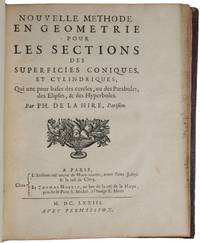
1676ref. 6181Paris; Paris: chez l'autheur et Thomas Moette; np 1676. First edition. First edition extremely rare of these two works of which the Nouvelle Méthode is the first substantial treatment of projective geometry explicating the Brouillon Projet of Girard Desargues 1591-1661. "The BrouillonProjet 1639 was published in an edition of only 50 copies and won very little support . Projective geometry secured a place in mathematics only with the publication of a book by Philippe de Hire 1673" Stillwell Mathematics and its History. . PROJECTIVE GEOMETRY SECURES A PLACE IN MATHEMATICS. First edition extremely rare of these two works of which the Nouvelle Méthode is the first substantial treatment of projective geometry explicating the Brouillon Projet of Girard Desargues 1591-1661. "The BrouillonProjet 1639 was published in an edition of only 50 copies and won very little support. In fact its reception was generally hostile and Desargues was engaged in a pamphleteering battle for years with his detractors. At first his only supporters were Pascal most of whose work on projective geometry is also lost and the engraver Abraham Bosse. Desargues became discouraged by the attacks on his work and left the dissemination of his ideas up to Bosse who was not really mathematically equipped for the task. Projective geometry secured a place in mathematics only with the publication of a book by Philippe de Hire 1673. It seems quite likely that La Hire's book influenced Newton see below" Stillwell p. 153. Michel Chasles writing in 1837 noted that La Hire's work is "extrêmement rare" Chasles p. 128. "The treatise of 1673 is where De La Hire shows himself to be truly original and innovative and which leads us to regard him as one of the founders of modern geometry" translated from ibid. "La Hire certainly read the Rough Draft on Conics Brouillon Projet thoroughly; for a long time the only known copy of the work was one made by La Hire himself in 1679. Possibly he made his own handwritten copy of the Rough Draft on Conics from a printed copy belonging to his father the painter Laurent de la Hire 1606-1656 a pupil of Desargues and a friend and colleague of Abraham Bosse at the Académie. Philippe de la Hire had by then written his first book on geometry his Nouvelle Méthode en Géométrie . It too has become extremely rare and he was later to write that his new method had been found difficult because it involved planes and solids" Field & Gray p. 37. La Hire's point of view in his Nouvelle Methode was entirely projective. He regarded all conics as projections of circles and used the harmonic division of four points which he showed was projectively invariant to obtain theorems about poles and polars. The work is in two parts. In the first pp. 1-72 La Hire treats conics as sections of the cone which are then projected onto the plane of the base of the cone; this approach was later expanded in his Sectiones conicae 1685. In the second Les Planiconiques pp. 73-94 he treats conics by entirely planar methods; Chasles notes that this part which Chasles regards as the more original "offered the first sufficiently general method for transforming figures of one kind into other figures of the same kind". The Planiconiques was published one year after the Nouvelle Méthode and was not added to all copies the Lyon and Marburg copies of the Nouvelle Méthode end at p. 72. The second work in the present volume De Cycloid Lemma is even rarer than the Nouvelle Méthode. It presents a geometrical construction of the tangent at any point of the cycloid - the method was discovered by Descartes and Fermat but they did not publish it. OCLC list 12 copies of the Nouvelle Méthode worldwide Columbia only in US and 6 copies of De Cycloide Lemma of which three are bound with the Nouvelle Méthode including Columbia and three are bound separately BL Erfurt & Lyon the first two of which hold the Nouvelle Méthode. It is unclear how many of the copies of the cycloid pamphlet are complete as several lack the plate e.g. the BNF copy. RBH lists only the Macclesfield copy of the Nouvelle Méthode since 1961 bound with De Cycloide Lemma but lacking its plate and no other copy of the cycloid pamphlet. "When Desargues circulated fifty copies of his Brouillon Project d'une Atteinte aux Événemens des Rencontres du Cone avec un Plan Rough Draft of an Essay on the results of taking plane sections of a cone in 1639 he was contributing to a lively contemporary study of geometry. Descartes's novel algebraic methods had been published two years before and in 1639 Mydorge published a more classical treatment of the conic sections. The classical authors themselves were increasingly well studied. Desargues had available Commandino's Latin edition of Euclid's Elements published in 1572 as well as his Latin edition of the first four books of Apollonius' Conics published in 1566 with extensive commentaries by Eutocius Pappus and Commandino himself. The last four books of the Conics were unknown in Desargues' time" Field & Gray p. 1. "The Brouillon Projet on conics of which he published fifty copies in 1639 is a daring projective presentation of the theory of conic sections; although considered at first in three-dimensional space as plane sections of a cone of revolution these curves are in fact studied as plane perspective figures by means of involution a transformation that holds a place of distinction in the series of demonstrations. But the use of an original vocabulary and the refusal to resort to Cartesian symbolism make the reading of this essay rather difficult and partially explain its meager success. "Although he praised the unitary conception that inspired Desargues Descartes doubted that the use of geometry alone could yield results as good as those that a recourse to algebra would provide. As for Fermat he reserved his judgment and the only geometer who really comprehended the originality and breadth of Desargues's views was the young Blaise Pascal who in 1640 published the brief Essay pour les Coniques inspired directly by the Brouillon Projet. But since the great Traité des Coniques that Pascal later wrote has been lost Desargues's example survived only in certain of the youthful works of Philippe de La Hire and perhaps in a few essays of the young Newton" DSB. "Philippe de la Hire 1640-1718 published three treatises on conics in 1673 in 1679 and in 1685. From the point of view of modern geometry the treatise of 1673 is by far the most original. Unfortunately because of its rarity it did not have a very wide circulation and today too many historians of science pass over it in silence concentrating instead on the Latin treatise of 1685 which is merely a development of the first part of the treatise of 1673. Although La Hire in a note attached to his copy of the Brouillon Projet of Desargues claims not to have known the treatise of Desargues until after 1673 and not to have been inspired by it it seems to us on the contrary that this inspiration is manifest. A first reason is that La Hire's father the king's painter was a diligent student of Desargues's oral lectures so it would be very surprising if he were unaware of the existence of this treatise and were unable to make its content known to his son. The second and most important reason is drawn from the study of the text. It seems that La Hire knowing at least the spirit of Desargues's treatise has tried to derive from it a work using the same principles but avoiding the faults that were the source of the violent criticisms by Desargues's adversaries. "Indeed La Hire seems to want to make a synthesis of the theories of Desargues while giving them a classical gloss . His method . amounts to deducing the projective properties of an arbitrary conic in space situated on a cone with a horizontal circular base from the properties of the base circle via the intermediary of the projection of the conic section onto the plane of the base. He uses in fact the properties of cylindrical projection for the passage from the curve in space to its projection and of homology for the passage from the conic to the projection of the base circle. "The method for studying the properties of conic sections 'in the cone' led quite logically to another procedure for studying them which consists in deducing directly - in the plane - every conic from a circle by a homology. This is the object of the second part of La Hire's small treatise titled Les Planiconiques. This very ingenious method is applied with the aid of several lemmas on the elementary properties of homology. So here apparently we have a treatise which although inspired by the ideas of Desargues is not afraid to develop them further" translated from Taton pp. 204-205. Chasles pp. 128-9 describes the method of the Planiconiques as follows. "Suppose that we have in a plane two straight lines parallel to each other which the author calls the formatrice and directrice and a point called the pole.Through each point M of a given curve in the plane one draws in an arbitrary direction a transversal; it meets the directrix at a point which one joins to the pole by a line;and the former at a second point through which we draw a parallel to this line.This parallel meets the straight line which goes from the point M to the pole in a point M' which is said to be formed by the point M.Each point of the proposed curve will thus form a corresponding point of a second curve. The points of a straight line form points belonging to a second straight line and these two straight lines will intersect on the formatrice.Finally the points of a circle will form the points of a conic section. Such is the method by which De La Hire studied in the plane without the need for any solid nor any other plane than that of the figure the sections of a cone.This is what he called reducing the cone and its sections to a plane." "Whiteside has pointed out Mathematical Papers of Isaac Newton VI 271 n.70 that the Nouvelle Méthode received a favourable review probably from CoIlins in 1676 and that Newton may have read it for Hooke wrote to him mentioning it in 1679. There are certainly similarities between ingenious projective transformations described by both men . In Book I of his Principia Newton showed how to solve all of the six different problems of the form: find the conic through k points and tangent to m lines k m = 5. In the course of accomplishing this feat he introduced a projective transformation capable as he remarked of transforming any conic to a circle . It is strikingly similar to the one given by La Hire in his Planiconiques which was printed in the same volume as his Nouvelle Méthode" Field & Gray p. 37. The Nouvelle Méthode also influenced Leibniz. "The ideas of Desargues and Pascal led Leibniz to a 'dynamical' vision of geometry. In the years 1672-76 Leibniz was in Paris where he greatly increased his mathematical knowledge. In 1673 he was informed on Desargues' perspective through La Hire's Nouvelle Méthodeen Géométrie ." Del Centini & Fiocca. Determining the properties of the cycloid the curve traced out by a point on the circumference of a circle as it rolls along a straight line served as a test bed for the techniques of seventeenth century mathematics. The earliest significant work on the cycloid is due to Gilles Personne de Roberval 1602-75 who obtained many of its properties before 1636 although he kept his results secret and they remained unpublished until 1693. Roberval in particular gave a construction of the tangent at a point on the cycloid using his method of 'composition of movements' a precursor of the differential calculus. This problem was also solved by Pierre de Fermat and René Descartes although they also did not publish their work. It was instead first published by La Hire in the first part of his De Cycloide Lemma pp. 1-4. The remainder of this little pamphlet is devoted to a problem relating to conics which is perhaps why it is often although not always found bound together with the Nouvelle Méthode. Chasles AperVu historique des Méthodes en Géométrie 1837. Del Centini & Fiocca 'Boscovich's geometrical principle of continuity and the 'msyteies of infinity' Historia Mathematica 45 2018 pp. 131-175. Field & Gray The Geometrical Work of Girard Desargues 1987. Stillwell Mathematics and its History 3rd edition 2010. Taton Le Prehistoire de la 'Geometrie moderne' Revue d'Histoire des Sciences et de leurs Applications 2 1949 pp. 197-224. 4to 201 x 162 mm. Nouvelle Méthode: pp. viii 94 with 25 folding engraved plates 10 bound before title page 15 at end of volume the last 2 referring to Les Planiconiques woodcut vignette on title woodcut initials head- and tail-pieces. De Cycloide Lemma: pp. 6 with 13 figures on one plate cut up with each figure tipped in at the appropriate place in the text. chez l'autheur et Thomas Moette; [np] unknown
1500ref. 046291Paris: Philippe Pigouchet 1500. Hardcover Full Leather. Very Good Condition. Early ca. early 17th c. full red calf elaborately gilt modest wear at hinges a few surface marks and scuffs but a lovely binding. 4 old bookplates on endpapers Syston Park Howard Pease John William Pease old pencil note on endpaper. 1 leaf with long vertical cut in the outer margin 1 leaf with mended tear. Last leaf cut in lower part and filled out with paper. Some foxing spotting and discoloration mostly to the few few and last few leaves generally quite clean. Trimmed a little close in the top margin touching the border. Added section of final leaf says "printed in Paris by Philippe Pigouchet. Quaritch notes". In a custom clamshell box. 116 leaves incomplete lacking title anatomical man and 6 calendar leaves signed Aa1-8Bb1-10a1-7lacks one leaf g1-4b1-8c1-8d1-8e1-8f1-8h1-8i1-8k1-4A1-8B1-8C1-3lacks C4-8D1-8. A fine and largely complete example of a printed book of hours on vellum with 17 nearly full page cuts and 27 smaller cuts from the life of Christ and page borders featuring figures and mythical creatures; each page with a decorative border letters with color added throughout in blue red and gold. Pigouchet produced around 150 printed books of hours creating techniques along the way to bring them to life in the manner of the manuscript versions so revered by the aristocracy. Size: Octavo 8vo. Quantity Available: 1. Shipped Weight: Under 1 kilo. Category: Religion & Theology; Incunabula. Inventory No: 046291. Philippe Pigouchet hardcover books
1686ref. 92213Christophe Ballard | Paris 1686 | 19.3 x 24.9 cm | Relié
1676ref. 6349Paris; Paris: chez l'autheur et Thomas Moette; n.p. 1676. First edition. First edition extremely rare of these two works of which the Nouvelle Méthode is the first substantial treatment of projective geometry explicating the Brouillon Projet of Girard Desargues 1591-1661. "The BrouillonProjet 1639 was published in an edition of only 50 copies and won very little support . Projective geometry secured a place in mathematics only with the publication of a book by Philippe de Hire 1673" Stillwell Mathematics and its History. . PROJECTIVE GEOMETRY SECURES A PLACE IN MATHEMATICS. First edition extremely rare of these two works of which the Nouvelle Méthode is the first substantial treatment of projective geometry explicating the Brouillon Projet of Girard Desargues 1591-1661. "The BrouillonProjet 1639 was published in an edition of only 50 copies and won very little support. In fact its reception was generally hostile and Desargues was engaged in a pamphleteering battle for years with his detractors. At first his only supporters were Pascal most of whose work on projective geometry is also lost and the engraver Abraham Bosse. Desargues became discouraged by the attacks on his work and left the dissemination of his ideas up to Bosse who was not really mathematically equipped for the task. Projective geometry secured a place in mathematics only with the publication of a book by Philippe de Hire 1673. It seems quite likely that La Hire's book influenced Newton see below" Stillwell p. 153. Michel Chasles writing in 1837 noted that La Hire's work is "extrêmement rare" Chasles p. 128. "The treatise of 1673 is where De La Hire shows himself to be truly original and innovative and which leads us to regard him as one of the founders of modern geometry" translated from ibid. "La Hire certainly read the Rough Draft on Conics Brouillon Projet thoroughly; for a long time the only known copy of the work was one made by La Hire himself in 1679. Possibly he made his own handwritten copy of the Rough Draft on Conics from a printed copy belonging to his father the painter Laurent de la Hire 1606-1656 a pupil of Desargues and a friend and colleague of Abraham Bosse at the Académie. Philippe de la Hire had by then written his first book on geometry his Nouvelle Méthode en Géométrie . It too has become extremely rare and he was later to write that his new method had been found difficult because it involved planes and solids" Field & Gray p. 37. La Hire's point of view in his Nouvelle Methode was entirely projective. He regarded all conics as projections of circles and used the harmonic division of four points which he showed was projectively invariant to obtain theorems about poles and polars. The work is in two parts. In the first pp. 1-72 La Hire treats conics as sections of the cone which are then projected onto the plane of the base of the cone; this approach was later expanded in his Sectiones conicae 1685. In the second Les Planiconiques pp. 73-94 he treats conics by entirely planar methods; Chasles notes that this part which Chasles regards as the more original "offered the first sufficiently general method for transforming figures of one kind into other figures of the same kind". The Planiconiques was published one year after the Nouvelle Méthode and was not added to all copies the Lyon and Marburg copies of the Nouvelle Méthode end at p. 72. The second work in the present volume De Cycloid Lemma is even rarer than the Nouvelle Méthode. It presents a geometrical construction of the tangent at any point of the cycloid - the method was discovered by Descartes and Fermat but they did not publish it. OCLC lists 12 copies of the Nouvelle Méthode worldwide Columbia only in US and 6 copies of De Cycloide Lemma of which three are bound with the Nouvelle Méthode including Columbia and three are bound separately BL Erfurt & Lyon the first two of which hold the Nouvelle Méthode. It is unclear how many of the copies of the cycloid pamphlet are complete as several lack the plate e.g. the BNF copy. RBH lists only the Macclesfield copy of the Nouvelle Méthode since 1961 bound with De Cycloide Lemma but lacking its plate and no other copy of the cycloid pamphlet. "When Desargues circulated fifty copies of his Brouillon Project d'une Atteinte aux Événemens des Rencontres du Cone avec un Plan Rough Draft of an Essay on the results of taking plane sections of a cone in 1639 he was contributing to a lively contemporary study of geometry. Descartes's novel algebraic methods had been published two years before and in 1639 Mydorge published a more classical treatment of the conic sections. The classical authors themselves were increasingly well studied. Desargues had available Commandino's Latin edition of Euclid's Elements published in 1572 as well as his Latin edition of the first four books of Apollonius' Conics published in 1566 with extensive commentaries by Eutocius Pappus and Commandino himself. The last four books of the Conics were unknown in Desargues' time" Field & Gray p. 1. "The Brouillon Projet on conics of which he published fifty copies in 1639 is a daring projective presentation of the theory of conic sections; although considered at first in three-dimensional space as plane sections of a cone of revolution these curves are in fact studied as plane perspective figures by means of involution a transformation that holds a place of distinction in the series of demonstrations. But the use of an original vocabulary and the refusal to resort to Cartesian symbolism make the reading of this essay rather difficult and partially explain its meager success. "Although he praised the unitary conception that inspired Desargues Descartes doubted that the use of geometry alone could yield results as good as those that a recourse to algebra would provide. As for Fermat he reserved his judgment and the only geometer who really comprehended the originality and breadth of Desargues's views was the young Blaise Pascal who in 1640 published the brief Essay pour les Coniques inspired directly by the Brouillon Projet. But since the great Traité des Coniques that Pascal later wrote has been lost Desargues's example survived only in certain of the youthful works of Philippe de La Hire and perhaps in a few essays of the young Newton" DSB. "Philippe de la Hire 1640-1718 published three treatises on conics in 1673 in 1679 and in 1685. From the point of view of modern geometry the treatise of 1673 is by far the most original. Unfortunately because of its rarity it did not have a very wide circulation and today too many historians of science pass over it in silence concentrating instead on the Latin treatise of 1685 which is merely a development of the first part of the treatise of 1673. Although La Hire in a note attached to his copy of the Brouillon Projet of Desargues claims not to have known the treatise of Desargues until after 1673 and not to have been inspired by it it seems to us on the contrary that this inspiration is manifest. A first reason is that La Hire's father the king's painter was a diligent student of Desargues's oral lectures so it would be very surprising if he were unaware of the existence of this treatise and were unable to make its content known to his son. The second and most important reason is drawn from the study of the text. It seems that La Hire knowing at least the spirit of Desargues's treatise has tried to derive from it a work using the same principles but avoiding the faults that were the source of the violent criticisms by Desargues's adversaries. "Indeed La Hire seems to want to make a synthesis of the theories of Desargues while giving them a classical gloss . His method . amounts to deducing the projective properties of an arbitrary conic in space situated on a cone with a horizontal circular base from the properties of the base circle via the intermediary of the projection of the conic section onto the plane of the base. He uses in fact the properties of cylindrical projection for the passage from the curve in space to its projection and of homology for the passage from the conic to the projection of the base circle. "The method for studying the properties of conic sections 'in the cone' led quite logically to another procedure for studying them which consists in deducing directly - in the plane - every conic from a circle by a homology. This is the object of the second part of La Hire's small treatise titled Les Planiconiques. This very ingenious method is applied with the aid of several lemmas on the elementary properties of homology. So here apparently we have a treatise which although inspired by the ideas of Desargues is not afraid to develop them further" translated from Taton pp. 204-205. Chasles pp. 128-9 describes the method of the Planiconiques as follows. "Suppose that we have in a plane two straight lines parallel to each other which the author calls the formatrice and directrice and a point called the pole.Through each point M of a given curve in the plane one draws in an arbitrary direction a transversal; it meets the directrix at a point which one joins to the pole by a line;and the former at a second point through which we draw a parallel to this line.This parallel meets the straight line which goes from the point M to the pole in a point M' which is said to be formed by the point M.Each point of the proposed curve will thus form a corresponding point of a second curve. The points of a straight line form points belonging to a second straight line and these two straight lines will intersect on the formatrice.Finally the points of a circle will form the points of a conic section. Such is the method by which De La Hire studied in the plane without the need for any solid nor any other plane than that of the figure the sections of a cone.This is what he called reducing the cone and its sections to a plane." "Whiteside has pointed out Mathematical Papers of Isaac Newton VI 271 n.70 that the Nouvelle Méthode received a favourable review probably from CoIlins in 1676 and that Newton may have read it for Hooke wrote to him mentioning it in 1679. There are certainly similarities between ingenious projective transformations described by both men . In Book I of his Principia Newton showed how to solve all of the six different problems of the form: find the conic through k points and tangent to m lines k m = 5. In the course of accomplishing this feat he introduced a projective transformation capable as he remarked of transforming any conic to a circle . It is strikingly similar to the one given by La Hire in his Planiconiques which was printed in the same volume as his Nouvelle Méthode" Field & Gray p. 37. The Nouvelle Méthode also influenced Leibniz. "The ideas of Desargues and Pascal led Leibniz to a 'dynamical' vision of geometry. In the years 1672-76 Leibniz was in Paris where he greatly increased his mathematical knowledge. In 1673 he was informed on Desargues' perspective through La Hire's Nouvelle Méthodeen Géométrie ." Del Centini & Fiocca. Determining the properties of the cycloid the curve traced out by a point on the circumference of a circle as it rolls along a straight line served as a test bed for the techniques of seventeenth century mathematics. The earliest significant work on the cycloid is due to Gilles Personne de Roberval 1602-75 who obtained many of its properties before 1636 although he kept his results secret and they remained unpublished until 1693. Roberval in particular gave a construction of the tangent at a point on the cycloid using his method of 'composition of movements' a precursor of the differential calculus. This problem was also solved by Pierre de Fermat and René Descartes although they also did not publish their work. It was instead first published by La Hire in the first part of his De Cycloide Lemma pp. 1-4. The remainder of this little pamphlet is devoted to a problem relating to conics which is perhaps why it is often although not always found bound together with the Nouvelle Méthode. Chasles AperVu historique des Méthodes en Géométrie 1837. Del Centini & Fiocca 'Boscovich's geometrical principle of continuity and the 'msyteies of infinity' Historia Mathematica 45 2018 pp. 131-175. Field & Gray The Geometrical Work of Girard Desargues 1987. Stillwell Mathematics and its History 3rd edition 2010. Taton Le Prehistoire de la 'Geometrie moderne' Revue d'Histoire des Sciences et de leurs Applications 2 1949 pp. 197-224. 4to 201 x 162 mm. Nouvelle Méthode: pp. viii 94 with 25 folding engraved plates 10 bound before title page 15 at end of volume the last 2 referring to Les Planiconiques woodcut vignette on title woodcut initials head- and tail-pieces. De Cycloide Lemma: pp. 6 with 13 figures on one plate cut up with each figure tipped in at the appropriate place in the text. chez l'autheur et Thomas Moette; [n.p.] unknown