Philippe PigouchetBiblio.com
47 215 résultats
1500réf. 046291Paris: Philippe Pigouchet 1500. Hardcover Full Leather. Very Good Condition. Early ca. early 17th c. full red calf elaborately gilt modest wear at hinges a few surface marks and scuffs but a lovely binding. 4 old bookplates on endpapers Syston Park Howard Pease John William Pease old pencil note on endpaper. 1 leaf with long vertical cut in the outer margin 1 leaf with mended tear. Last leaf cut in lower part and filled out with paper. Some foxing spotting and discoloration mostly to the few few and last few leaves generally quite clean. Trimmed a little close in the top margin touching the border. Added section of final leaf says “printed in Paris by Philippe Pigouchet. Quaritch notes”. In a custom clamshell box. 116 leaves incomplete lacking title anatomical man and 6 calendar leaves signed Aa1-8Bb1-10a1-7lacks one leaf g1-4b1-8c1-8d1-8e1-8f1-8h1-8i1-8k1-4A1-8B1-8C1-3lacks C4-8 D1-8. A fine and largely complete example of a printed book of hours on vellum with 17 nearly full-page cuts and 27 smaller cuts from the life of Christ and page borders featuring figures and mythical creatures; each page with a decorative border letters with color added throughout in blue red and gold. Pigouchet produced around 150 printed books of hours creating techniques along the way to bring them to life in the manner of the manuscript versions so revered by the aristocracy. Size: Octavo 8vo. Quantity Available: 1. Shipped Weight: Under 1 kilo. Category: Religion & Theology; Incunabula. Inventory No: 046291. Philippe Pigouchet hardcover
2016réf. SBBIH-DPLXVDWUXFJ7Trotamundos 2016. paperback. Good. Our good condition books are generally good for reading but not for gifting or collecting. They could have imperfections such as creasing fanning inscriptions margin notes yellowing staining on edge or cover or pages bumps scuffs etc etc sometimes multiple of these. It's a wide category that encompasses anything that isn't almost-new down to anything that is slightly better than poor. We would NOT recommend gifting Good books - these should be considered reading copies. Our books are dispatched from a Yorkshire former cotton mill. We list via barcode/ISBN so please note that the images are stock images and may not be the exact copy you receive furthermore the details about edition and year might not be accurate as many publishers reuse the same ISBN for multiple editions and as we simply scan a barcode or enter an ISBN we do not check the validity of the edition data when listing. If you're looking for an exact edition please don't order at least not without checking with us first although we don't always have time to check. We aim to dispatch prompty the service used will depend on order value and book size. We can ship to most countries see our shipping policies. Payment is via Abe only. Trotamundos paperback
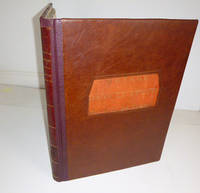
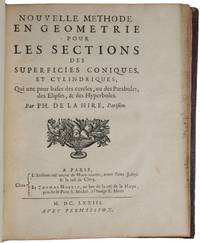
1676réf. 6181Paris; Paris: chez l'autheur et Thomas Moette; np 1676. First edition. First edition extremely rare of these two works of which the Nouvelle Méthode is the first substantial treatment of projective geometry explicating the Brouillon Projet of Girard Desargues 1591-1661. "The BrouillonProjet 1639 was published in an edition of only 50 copies and won very little support . Projective geometry secured a place in mathematics only with the publication of a book by Philippe de Hire 1673" Stillwell Mathematics and its History. . PROJECTIVE GEOMETRY SECURES A PLACE IN MATHEMATICS. First edition extremely rare of these two works of which the Nouvelle Méthode is the first substantial treatment of projective geometry explicating the Brouillon Projet of Girard Desargues 1591-1661. "The BrouillonProjet 1639 was published in an edition of only 50 copies and won very little support. In fact its reception was generally hostile and Desargues was engaged in a pamphleteering battle for years with his detractors. At first his only supporters were Pascal most of whose work on projective geometry is also lost and the engraver Abraham Bosse. Desargues became discouraged by the attacks on his work and left the dissemination of his ideas up to Bosse who was not really mathematically equipped for the task. Projective geometry secured a place in mathematics only with the publication of a book by Philippe de Hire 1673. It seems quite likely that La Hire's book influenced Newton see below" Stillwell p. 153. Michel Chasles writing in 1837 noted that La Hire's work is "extrêmement rare" Chasles p. 128. "The treatise of 1673 is where De La Hire shows himself to be truly original and innovative and which leads us to regard him as one of the founders of modern geometry" translated from ibid. "La Hire certainly read the Rough Draft on Conics Brouillon Projet thoroughly; for a long time the only known copy of the work was one made by La Hire himself in 1679. Possibly he made his own handwritten copy of the Rough Draft on Conics from a printed copy belonging to his father the painter Laurent de la Hire 1606-1656 a pupil of Desargues and a friend and colleague of Abraham Bosse at the Académie. Philippe de la Hire had by then written his first book on geometry his Nouvelle Méthode en Géométrie . It too has become extremely rare and he was later to write that his new method had been found difficult because it involved planes and solids" Field & Gray p. 37. La Hire's point of view in his Nouvelle Methode was entirely projective. He regarded all conics as projections of circles and used the harmonic division of four points which he showed was projectively invariant to obtain theorems about poles and polars. The work is in two parts. In the first pp. 1-72 La Hire treats conics as sections of the cone which are then projected onto the plane of the base of the cone; this approach was later expanded in his Sectiones conicae 1685. In the second Les Planiconiques pp. 73-94 he treats conics by entirely planar methods; Chasles notes that this part which Chasles regards as the more original "offered the first sufficiently general method for transforming figures of one kind into other figures of the same kind". The Planiconiques was published one year after the Nouvelle Méthode and was not added to all copies the Lyon and Marburg copies of the Nouvelle Méthode end at p. 72. The second work in the present volume De Cycloid Lemma is even rarer than the Nouvelle Méthode. It presents a geometrical construction of the tangent at any point of the cycloid - the method was discovered by Descartes and Fermat but they did not publish it. OCLC list 12 copies of the Nouvelle Méthode worldwide Columbia only in US and 6 copies of De Cycloide Lemma of which three are bound with the Nouvelle Méthode including Columbia and three are bound separately BL Erfurt & Lyon the first two of which hold the Nouvelle Méthode. It is unclear how many of the copies of the cycloid pamphlet are complete as several lack the plate e.g. the BNF copy. RBH lists only the Macclesfield copy of the Nouvelle Méthode since 1961 bound with De Cycloide Lemma but lacking its plate and no other copy of the cycloid pamphlet. "When Desargues circulated fifty copies of his Brouillon Project d'une Atteinte aux Événemens des Rencontres du Cone avec un Plan Rough Draft of an Essay on the results of taking plane sections of a cone in 1639 he was contributing to a lively contemporary study of geometry. Descartes's novel algebraic methods had been published two years before and in 1639 Mydorge published a more classical treatment of the conic sections. The classical authors themselves were increasingly well studied. Desargues had available Commandino's Latin edition of Euclid's Elements published in 1572 as well as his Latin edition of the first four books of Apollonius' Conics published in 1566 with extensive commentaries by Eutocius Pappus and Commandino himself. The last four books of the Conics were unknown in Desargues' time" Field & Gray p. 1. "The Brouillon Projet on conics of which he published fifty copies in 1639 is a daring projective presentation of the theory of conic sections; although considered at first in three-dimensional space as plane sections of a cone of revolution these curves are in fact studied as plane perspective figures by means of involution a transformation that holds a place of distinction in the series of demonstrations. But the use of an original vocabulary and the refusal to resort to Cartesian symbolism make the reading of this essay rather difficult and partially explain its meager success. "Although he praised the unitary conception that inspired Desargues Descartes doubted that the use of geometry alone could yield results as good as those that a recourse to algebra would provide. As for Fermat he reserved his judgment and the only geometer who really comprehended the originality and breadth of Desargues's views was the young Blaise Pascal who in 1640 published the brief Essay pour les Coniques inspired directly by the Brouillon Projet. But since the great Traité des Coniques that Pascal later wrote has been lost Desargues's example survived only in certain of the youthful works of Philippe de La Hire and perhaps in a few essays of the young Newton" DSB. "Philippe de la Hire 1640-1718 published three treatises on conics in 1673 in 1679 and in 1685. From the point of view of modern geometry the treatise of 1673 is by far the most original. Unfortunately because of its rarity it did not have a very wide circulation and today too many historians of science pass over it in silence concentrating instead on the Latin treatise of 1685 which is merely a development of the first part of the treatise of 1673. Although La Hire in a note attached to his copy of the Brouillon Projet of Desargues claims not to have known the treatise of Desargues until after 1673 and not to have been inspired by it it seems to us on the contrary that this inspiration is manifest. A first reason is that La Hire's father the king's painter was a diligent student of Desargues's oral lectures so it would be very surprising if he were unaware of the existence of this treatise and were unable to make its content known to his son. The second and most important reason is drawn from the study of the text. It seems that La Hire knowing at least the spirit of Desargues's treatise has tried to derive from it a work using the same principles but avoiding the faults that were the source of the violent criticisms by Desargues's adversaries. "Indeed La Hire seems to want to make a synthesis of the theories of Desargues while giving them a classical gloss . His method . amounts to deducing the projective properties of an arbitrary conic in space situated on a cone with a horizontal circular base from the properties of the base circle via the intermediary of the projection of the conic section onto the plane of the base. He uses in fact the properties of cylindrical projection for the passage from the curve in space to its projection and of homology for the passage from the conic to the projection of the base circle. "The method for studying the properties of conic sections 'in the cone' led quite logically to another procedure for studying them which consists in deducing directly - in the plane - every conic from a circle by a homology. This is the object of the second part of La Hire's small treatise titled Les Planiconiques. This very ingenious method is applied with the aid of several lemmas on the elementary properties of homology. So here apparently we have a treatise which although inspired by the ideas of Desargues is not afraid to develop them further" translated from Taton pp. 204-205. Chasles pp. 128-9 describes the method of the Planiconiques as follows. "Suppose that we have in a plane two straight lines parallel to each other which the author calls the formatrice and directrice and a point called the pole.Through each point M of a given curve in the plane one draws in an arbitrary direction a transversal; it meets the directrix at a point which one joins to the pole by a line;and the former at a second point through which we draw a parallel to this line.This parallel meets the straight line which goes from the point M to the pole in a point M' which is said to be formed by the point M.Each point of the proposed curve will thus form a corresponding point of a second curve. The points of a straight line form points belonging to a second straight line and these two straight lines will intersect on the formatrice.Finally the points of a circle will form the points of a conic section. Such is the method by which De La Hire studied in the plane without the need for any solid nor any other plane than that of the figure the sections of a cone.This is what he called reducing the cone and its sections to a plane." "Whiteside has pointed out Mathematical Papers of Isaac Newton VI 271 n.70 that the Nouvelle Méthode received a favourable review probably from CoIlins in 1676 and that Newton may have read it for Hooke wrote to him mentioning it in 1679. There are certainly similarities between ingenious projective transformations described by both men . In Book I of his Principia Newton showed how to solve all of the six different problems of the form: find the conic through k points and tangent to m lines k m = 5. In the course of accomplishing this feat he introduced a projective transformation capable as he remarked of transforming any conic to a circle . It is strikingly similar to the one given by La Hire in his Planiconiques which was printed in the same volume as his Nouvelle Méthode" Field & Gray p. 37. The Nouvelle Méthode also influenced Leibniz. "The ideas of Desargues and Pascal led Leibniz to a 'dynamical' vision of geometry. In the years 1672-76 Leibniz was in Paris where he greatly increased his mathematical knowledge. In 1673 he was informed on Desargues' perspective through La Hire's Nouvelle Méthodeen Géométrie ." Del Centini & Fiocca. Determining the properties of the cycloid the curve traced out by a point on the circumference of a circle as it rolls along a straight line served as a test bed for the techniques of seventeenth century mathematics. The earliest significant work on the cycloid is due to Gilles Personne de Roberval 1602-75 who obtained many of its properties before 1636 although he kept his results secret and they remained unpublished until 1693. Roberval in particular gave a construction of the tangent at a point on the cycloid using his method of 'composition of movements' a precursor of the differential calculus. This problem was also solved by Pierre de Fermat and René Descartes although they also did not publish their work. It was instead first published by La Hire in the first part of his De Cycloide Lemma pp. 1-4. The remainder of this little pamphlet is devoted to a problem relating to conics which is perhaps why it is often although not always found bound together with the Nouvelle Méthode. Chasles AperVu historique des Méthodes en Géométrie 1837. Del Centini & Fiocca 'Boscovich's geometrical principle of continuity and the 'msyteies of infinity' Historia Mathematica 45 2018 pp. 131-175. Field & Gray The Geometrical Work of Girard Desargues 1987. Stillwell Mathematics and its History 3rd edition 2010. Taton Le Prehistoire de la 'Geometrie moderne' Revue d'Histoire des Sciences et de leurs Applications 2 1949 pp. 197-224. 4to 201 x 162 mm. Nouvelle Méthode: pp. viii 94 with 25 folding engraved plates 10 bound before title page 15 at end of volume the last 2 referring to Les Planiconiques woodcut vignette on title woodcut initials head- and tail-pieces. De Cycloide Lemma: pp. 6 with 13 figures on one plate cut up with each figure tipped in at the appropriate place in the text. chez l'autheur et Thomas Moette; [np] unknown
1500réf. 046291Paris: Philippe Pigouchet 1500. Hardcover Full Leather. Very Good Condition. Early ca. early 17th c. full red calf elaborately gilt modest wear at hinges a few surface marks and scuffs but a lovely binding. 4 old bookplates on endpapers Syston Park Howard Pease John William Pease old pencil note on endpaper. 1 leaf with long vertical cut in the outer margin 1 leaf with mended tear. Last leaf cut in lower part and filled out with paper. Some foxing spotting and discoloration mostly to the few few and last few leaves generally quite clean. Trimmed a little close in the top margin touching the border. Added section of final leaf says "printed in Paris by Philippe Pigouchet. Quaritch notes". In a custom clamshell box. 116 leaves incomplete lacking title anatomical man and 6 calendar leaves signed Aa1-8Bb1-10a1-7lacks one leaf g1-4b1-8c1-8d1-8e1-8f1-8h1-8i1-8k1-4A1-8B1-8C1-3lacks C4-8D1-8. A fine and largely complete example of a printed book of hours on vellum with 17 nearly full page cuts and 27 smaller cuts from the life of Christ and page borders featuring figures and mythical creatures; each page with a decorative border letters with color added throughout in blue red and gold. Pigouchet produced around 150 printed books of hours creating techniques along the way to bring them to life in the manner of the manuscript versions so revered by the aristocracy. Size: Octavo 8vo. Quantity Available: 1. Shipped Weight: Under 1 kilo. Category: Religion & Theology; Incunabula. Inventory No: 046291. Philippe Pigouchet hardcover books
1686réf. 92213Christophe Ballard | Paris 1686 | 19.3 x 24.9 cm | Relié
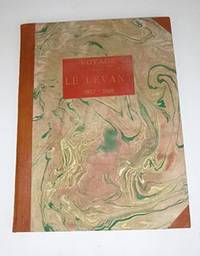
réf. 51-4752Paris: Imprimerie royale 1819. Large folio. New full calf by the artisan bookbinder Sasha Mosalov. Part of original spine and front cover title preserved Complete with 80 plates.Colas 1089; Brunet II 1337; not in OCLC.Nicolas Nicolaides: Baron Louis Nicolas Philippe Auguste de Forbin later count de Forbin la Roque-d'Anthéron 1777 – ΠαÏίσι 1841 was a French painter author and antiquarian. He was also a pupil of painter Jacques-Louis David. During the Bourbon restauration Forbin served as general director of the Louvre Museum and other museums of France.Inspired by the travels of François-René de Chateaubriand Forbin sailed out from Toulon on 22 August 1817 to tour the eastern Mediterranean. Like Chateaubriand Forbin travelled on his own initiative without an order from the French government; however since the aim of his journey was to discover Greek and Roman antiquities and to draw landscapes of the places he would visit he was able to travel on the ships of the French fleet of the Levant Flotte du Levant.In his venture Forbin was accompanied by painters Pierre Prevost and Léon Matthieu Cochereau also a pupil of David and a nephew of Prévost as well as architect Jean-Nicolas Huyot. Abbé de Forbin-Janson later bishop of Nancy was also a member of the company for the first part of the journey while Huyot had to retire when he fractured his leg on Milos island. In addition twenty-four year old Cochereau died of dysentery off the coast of Cythera and was replaced by Linant de Bellefonds who at the time was a mate on "Cleopatra" the mission's ship. De Bellefonds resigned from his position on the ship and participated in the expedition as a painter and chartographer. When the expedition ended in December of 1817 de Bellefonds decided to stay on in Egypt and explored its territory as member of several missions. From 1831 to 1869 he served the kingdom of Egypt as chief engineer of several public works including the Suez Canal.The expedition sailed to Acre Galilee and thenceforth travelled by land. While in Palestine the travellers visited the Dead Sea and Jordan river reached Cairo and sailed the Nile down to Upper Egypt. The main places they visited includde Milos island Athens Constantinople Ephesus Acre Jerusalem Gaza Damietta Cairo Luxor Thebes Rosetta and Alexandria. When the expedition returned to France in April 1818 Forbin had spent approximately 28.000 francs on the purchase and transportation of antiquities some of which ended up in the Louvre collections at the time Royal Museum of France. Prevost drew panoramic views of Jerusalem and Athens but succumbed to pneumonia in 1823 without completing his panorama of Constantinople.The descriptions of Forbin show him to be a mature observer in possession of deep humanistic culture. Forbin also travelled to Sicily in 1820 and published his travel account as he had done with his expedition of 1817.Moyen-Orient - FORBIN Claude Comte de. Voyage dans le Levant. Paris Imprimerie Royale 1819.Atlas seul in-folio 74 x 55 cm ; demi-maroquin rouge à coins dos lisse orné. 3 ff. 110 pp. 1 f. pp. 111-132 80 planches numérotées 1-78 dont 70 lithographies par Baltard Bourgeois Fragonard Lecomte Vernet… d’après Forbin Vernet Isabey et Fragonard 8 aquatintes par Debucourt et 2 plans in fine.L'atlas in-folio qui accompagne l'édition originale du Voyage dans le Levant en 1817 et 1818 de Forbin ne fut tiré qu'à 325 exemplaires.Peintre et archéologue élève de David le Comte de Forbin fut nommé par Louis XVIII directeur du Musée du Louvre. Il entreprit ce voyage en Grèce en Asie Mineure en Palestine et en Égypte en 1817 et 1818 sur une frégate de l'escadre du Levant. Sa mission était d'acheter des antiquités pour le Louvre.De la bibliothèque Paul Lagrave avec son ex-libris au contreplat et de la bibliothèque du Comte François Chandon de Briailles 1892-1953 descendant des fondateurs de la fameuse maison de Champagne avec son ex-libris sur la première garde. Paris: Imprimerie royale, 1819. unknown
1676réf. 6349Paris; Paris: chez l'autheur et Thomas Moette; n.p. 1676. First edition. First edition extremely rare of these two works of which the Nouvelle Méthode is the first substantial treatment of projective geometry explicating the Brouillon Projet of Girard Desargues 1591-1661. "The BrouillonProjet 1639 was published in an edition of only 50 copies and won very little support . Projective geometry secured a place in mathematics only with the publication of a book by Philippe de Hire 1673" Stillwell Mathematics and its History. . PROJECTIVE GEOMETRY SECURES A PLACE IN MATHEMATICS. First edition extremely rare of these two works of which the Nouvelle Méthode is the first substantial treatment of projective geometry explicating the Brouillon Projet of Girard Desargues 1591-1661. "The BrouillonProjet 1639 was published in an edition of only 50 copies and won very little support. In fact its reception was generally hostile and Desargues was engaged in a pamphleteering battle for years with his detractors. At first his only supporters were Pascal most of whose work on projective geometry is also lost and the engraver Abraham Bosse. Desargues became discouraged by the attacks on his work and left the dissemination of his ideas up to Bosse who was not really mathematically equipped for the task. Projective geometry secured a place in mathematics only with the publication of a book by Philippe de Hire 1673. It seems quite likely that La Hire's book influenced Newton see below" Stillwell p. 153. Michel Chasles writing in 1837 noted that La Hire's work is "extrêmement rare" Chasles p. 128. "The treatise of 1673 is where De La Hire shows himself to be truly original and innovative and which leads us to regard him as one of the founders of modern geometry" translated from ibid. "La Hire certainly read the Rough Draft on Conics Brouillon Projet thoroughly; for a long time the only known copy of the work was one made by La Hire himself in 1679. Possibly he made his own handwritten copy of the Rough Draft on Conics from a printed copy belonging to his father the painter Laurent de la Hire 1606-1656 a pupil of Desargues and a friend and colleague of Abraham Bosse at the Académie. Philippe de la Hire had by then written his first book on geometry his Nouvelle Méthode en Géométrie . It too has become extremely rare and he was later to write that his new method had been found difficult because it involved planes and solids" Field & Gray p. 37. La Hire's point of view in his Nouvelle Methode was entirely projective. He regarded all conics as projections of circles and used the harmonic division of four points which he showed was projectively invariant to obtain theorems about poles and polars. The work is in two parts. In the first pp. 1-72 La Hire treats conics as sections of the cone which are then projected onto the plane of the base of the cone; this approach was later expanded in his Sectiones conicae 1685. In the second Les Planiconiques pp. 73-94 he treats conics by entirely planar methods; Chasles notes that this part which Chasles regards as the more original "offered the first sufficiently general method for transforming figures of one kind into other figures of the same kind". The Planiconiques was published one year after the Nouvelle Méthode and was not added to all copies the Lyon and Marburg copies of the Nouvelle Méthode end at p. 72. The second work in the present volume De Cycloid Lemma is even rarer than the Nouvelle Méthode. It presents a geometrical construction of the tangent at any point of the cycloid - the method was discovered by Descartes and Fermat but they did not publish it. OCLC lists 12 copies of the Nouvelle Méthode worldwide Columbia only in US and 6 copies of De Cycloide Lemma of which three are bound with the Nouvelle Méthode including Columbia and three are bound separately BL Erfurt & Lyon the first two of which hold the Nouvelle Méthode. It is unclear how many of the copies of the cycloid pamphlet are complete as several lack the plate e.g. the BNF copy. RBH lists only the Macclesfield copy of the Nouvelle Méthode since 1961 bound with De Cycloide Lemma but lacking its plate and no other copy of the cycloid pamphlet. "When Desargues circulated fifty copies of his Brouillon Project d'une Atteinte aux Événemens des Rencontres du Cone avec un Plan Rough Draft of an Essay on the results of taking plane sections of a cone in 1639 he was contributing to a lively contemporary study of geometry. Descartes's novel algebraic methods had been published two years before and in 1639 Mydorge published a more classical treatment of the conic sections. The classical authors themselves were increasingly well studied. Desargues had available Commandino's Latin edition of Euclid's Elements published in 1572 as well as his Latin edition of the first four books of Apollonius' Conics published in 1566 with extensive commentaries by Eutocius Pappus and Commandino himself. The last four books of the Conics were unknown in Desargues' time" Field & Gray p. 1. "The Brouillon Projet on conics of which he published fifty copies in 1639 is a daring projective presentation of the theory of conic sections; although considered at first in three-dimensional space as plane sections of a cone of revolution these curves are in fact studied as plane perspective figures by means of involution a transformation that holds a place of distinction in the series of demonstrations. But the use of an original vocabulary and the refusal to resort to Cartesian symbolism make the reading of this essay rather difficult and partially explain its meager success. "Although he praised the unitary conception that inspired Desargues Descartes doubted that the use of geometry alone could yield results as good as those that a recourse to algebra would provide. As for Fermat he reserved his judgment and the only geometer who really comprehended the originality and breadth of Desargues's views was the young Blaise Pascal who in 1640 published the brief Essay pour les Coniques inspired directly by the Brouillon Projet. But since the great Traité des Coniques that Pascal later wrote has been lost Desargues's example survived only in certain of the youthful works of Philippe de La Hire and perhaps in a few essays of the young Newton" DSB. "Philippe de la Hire 1640-1718 published three treatises on conics in 1673 in 1679 and in 1685. From the point of view of modern geometry the treatise of 1673 is by far the most original. Unfortunately because of its rarity it did not have a very wide circulation and today too many historians of science pass over it in silence concentrating instead on the Latin treatise of 1685 which is merely a development of the first part of the treatise of 1673. Although La Hire in a note attached to his copy of the Brouillon Projet of Desargues claims not to have known the treatise of Desargues until after 1673 and not to have been inspired by it it seems to us on the contrary that this inspiration is manifest. A first reason is that La Hire's father the king's painter was a diligent student of Desargues's oral lectures so it would be very surprising if he were unaware of the existence of this treatise and were unable to make its content known to his son. The second and most important reason is drawn from the study of the text. It seems that La Hire knowing at least the spirit of Desargues's treatise has tried to derive from it a work using the same principles but avoiding the faults that were the source of the violent criticisms by Desargues's adversaries. "Indeed La Hire seems to want to make a synthesis of the theories of Desargues while giving them a classical gloss . His method . amounts to deducing the projective properties of an arbitrary conic in space situated on a cone with a horizontal circular base from the properties of the base circle via the intermediary of the projection of the conic section onto the plane of the base. He uses in fact the properties of cylindrical projection for the passage from the curve in space to its projection and of homology for the passage from the conic to the projection of the base circle. "The method for studying the properties of conic sections 'in the cone' led quite logically to another procedure for studying them which consists in deducing directly - in the plane - every conic from a circle by a homology. This is the object of the second part of La Hire's small treatise titled Les Planiconiques. This very ingenious method is applied with the aid of several lemmas on the elementary properties of homology. So here apparently we have a treatise which although inspired by the ideas of Desargues is not afraid to develop them further" translated from Taton pp. 204-205. Chasles pp. 128-9 describes the method of the Planiconiques as follows. "Suppose that we have in a plane two straight lines parallel to each other which the author calls the formatrice and directrice and a point called the pole.Through each point M of a given curve in the plane one draws in an arbitrary direction a transversal; it meets the directrix at a point which one joins to the pole by a line;and the former at a second point through which we draw a parallel to this line.This parallel meets the straight line which goes from the point M to the pole in a point M' which is said to be formed by the point M.Each point of the proposed curve will thus form a corresponding point of a second curve. The points of a straight line form points belonging to a second straight line and these two straight lines will intersect on the formatrice.Finally the points of a circle will form the points of a conic section. Such is the method by which De La Hire studied in the plane without the need for any solid nor any other plane than that of the figure the sections of a cone.This is what he called reducing the cone and its sections to a plane." "Whiteside has pointed out Mathematical Papers of Isaac Newton VI 271 n.70 that the Nouvelle Méthode received a favourable review probably from CoIlins in 1676 and that Newton may have read it for Hooke wrote to him mentioning it in 1679. There are certainly similarities between ingenious projective transformations described by both men . In Book I of his Principia Newton showed how to solve all of the six different problems of the form: find the conic through k points and tangent to m lines k m = 5. In the course of accomplishing this feat he introduced a projective transformation capable as he remarked of transforming any conic to a circle . It is strikingly similar to the one given by La Hire in his Planiconiques which was printed in the same volume as his Nouvelle Méthode" Field & Gray p. 37. The Nouvelle Méthode also influenced Leibniz. "The ideas of Desargues and Pascal led Leibniz to a 'dynamical' vision of geometry. In the years 1672-76 Leibniz was in Paris where he greatly increased his mathematical knowledge. In 1673 he was informed on Desargues' perspective through La Hire's Nouvelle Méthodeen Géométrie ." Del Centini & Fiocca. Determining the properties of the cycloid the curve traced out by a point on the circumference of a circle as it rolls along a straight line served as a test bed for the techniques of seventeenth century mathematics. The earliest significant work on the cycloid is due to Gilles Personne de Roberval 1602-75 who obtained many of its properties before 1636 although he kept his results secret and they remained unpublished until 1693. Roberval in particular gave a construction of the tangent at a point on the cycloid using his method of 'composition of movements' a precursor of the differential calculus. This problem was also solved by Pierre de Fermat and René Descartes although they also did not publish their work. It was instead first published by La Hire in the first part of his De Cycloide Lemma pp. 1-4. The remainder of this little pamphlet is devoted to a problem relating to conics which is perhaps why it is often although not always found bound together with the Nouvelle Méthode. Chasles AperVu historique des Méthodes en Géométrie 1837. Del Centini & Fiocca 'Boscovich's geometrical principle of continuity and the 'msyteies of infinity' Historia Mathematica 45 2018 pp. 131-175. Field & Gray The Geometrical Work of Girard Desargues 1987. Stillwell Mathematics and its History 3rd edition 2010. Taton Le Prehistoire de la 'Geometrie moderne' Revue d'Histoire des Sciences et de leurs Applications 2 1949 pp. 197-224. 4to 201 x 162 mm. Nouvelle Méthode: pp. viii 94 with 25 folding engraved plates 10 bound before title page 15 at end of volume the last 2 referring to Les Planiconiques woodcut vignette on title woodcut initials head- and tail-pieces. De Cycloide Lemma: pp. 6 with 13 figures on one plate cut up with each figure tipped in at the appropriate place in the text. chez l'autheur et Thomas Moette; [n.p.] unknown
réf. 237316S.l. [La Forêt-sur-Sèvre] [puis :] Amsterdam, [Jean Daillé], puis : Jean Bureau [II], puis : Louis Elzévir [III], 1624 - 1652 4 forts vol. in-4, veau fauve marbré, dos à nerfs cloisonné, armes dorées poussées dans les entre-nerfs (deux lions passant), pièces de titre et de tomaison, encadrement de triple filet à froid sur les plats, double filet doré sur les coupes, tranches rouges (reliure du XVIIIe). Un mors supérieur fendu, charnière du tome IV fendue, des pages roussies.
réf. 453Francofurti ; id. ; Romae : Matthiae Beckeri ; Ioannem Wolffium ; Ex Officina Accoltiana, 1610 ; 1611 ; 1580. UN PRÉCIEUX RECUEIL DE TRAITÉS POLITIQUES À L'USAGE DU DERNIER DES VALOIS
1929réf. 732Lyon LEs XXX 1929 GRUEL Léon In-4(235x250mm.) maroquin havane foncé, sur les plats, en diagonale, décor géométrique de pièces de maroquin de tons roses et rouges foncés et de filets or et à froid, dos sans nerf, doublures de maroquin rouge orné d'un treillis de filets or et de filets à froid avec des intersections mosaïquées, gardes de tabis havane, tête dorée, non rogné, couverture imprimée sur Japon.(Reliure strictement d'époque de GRUEL).
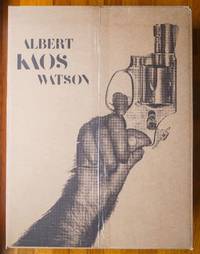
réf. 2482Taschen 2017. First Edition First Printing. Hardcover. New/new. BOOK DESCRIPTION: ART A - SOLD OUT! - Taschen 2017. Hardcover with faux chimpanzee fur fitting dust jacket housed in clamshell box. First EditionFirst Printing. 408 pages 14.6 x 19.7 in. This Deluxe Art Edition A" was issued in an edition of only 50 SIGNED/NUMBERED copies with this being #3/50 and comes with the HAND-SIGNED print: "Prince Cleveland 2004" 13 inches x 19 inches housed in separate portfolio folder a simple unplugged composition of the iconic pop star that was originally shot for Rolling Stone magazine to mark Prince’s smash tour and record Musicology. The image is SIGNED in pencil on the verso and was printed by Watson in his New York studio on MOAB Entrada Rag paper and also has Watson’s “Monkey with Mask” image stamped on the verso above Watson's signature in India ink. The book is also SIGNED by Albert Watson and numbered 3/50. CONDITION: New - opened only for inspection and still contained in the original Taschen shipping box. SIGNED KAOS presents a kaleidoscopic overview of Watson’s career to date and the dazzling array of subjects objects people and places he has encountered along the way. It is a skillfully curated survey of a uniquely diverse dynamic portfolio. From Watson’s breakthrough portrait of Alfred Hitchcock for the Christmas 1973 edition of Harper’s Bazaar to a 2016 shot of Kanye West each photograph reverberates with tightly coiled power tension and poetry. Whether it’s a portrait of a Las Vegas dominatrix Elvis’s gold suit or a street scene in China Watson excels in capturing the details seamlessly and probing its myriad depths. Along the way his celebrity portraiture includes the likes of David Bowie Jay Z Mick Jagger Michael Jackson Jack Nicholson Steve Jobs and Andy Warhol. Taschen hardcover
1920réf. 82181Sous étui et chemise. Reliure plein maroquin ébène. Plats ornés de pièces mosaïquées de box cyan, bleu turquoise, gris-bleu et marbré, criblées de petits carrés et points au palladium, lettre argentée sur le dos, doublures et gardes de papier gris, tranches au palladium sur témoins. Couverture et dos conservés. Reliure signée Alain DEVAUCHELLE, datée de 1985. Quelques discrètes restaurations à la couverture. En frontispice, reproductions de portraits de Breton et Soupault par Picabia.
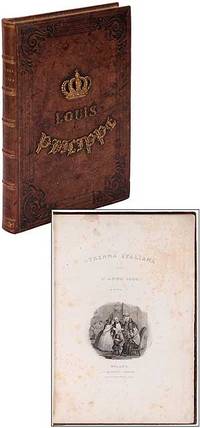
1838réf. 339910Milano: P. Ripamonti Carpano 1838. Hardcover. Very Good. First edition. Text in Italian. Quarto. pp. iv 280 4. With 7 engraved plates frontispiece title page and five plates in text. Bound in contemporary mottled calf gilt spine and turn-ins white silk moiré endpapers all edges gilt. An impressive armorial binding of King Louis Philippe I of France with his crown and name in an ornate metal relief design affixed to the front board. Professionally re-jointed with the original binding fully preserved modest chipping to the edges of the front free endpaper and fly leaf scattered foxing very good. The Strenna Italiana was a popular literary gift annual of Italian poetry and prose: this copy was likely given by Louis Philippe as a gift to an important political ally personal friend or dignitary. A scarce unique copy intended to display Louis Philippe's armorial binding conspicuously on a tabletop. P. Ripamonti Carpano hardcover
réf. 51-3962Paris: Imprimerie royale 1819. Large folio. 67 x 50 cm. New half Sakora goatskin with marbled boards preserving the original label by the artisan binder Sasha Mosalov. Plate volume only with 71 of 80 plates lacking plates 3 15 17 25 40 52 55 73. Lacking the title page. Some stains in the margins. Very good.Colas 1089; Brunet II 1337; not in OCLC.Written by Nicolas Nicolaides: Baron Louis Nicolas Philippe Auguste de Forbin later count de Forbin la Roque-d'Anthéron 1777 – ΠαÏίσι 1841 was a French painter author and antiquarian. He was also a pupil of painter Jacques-Louis David. During the Bourbon restauration Forbin served as general director of the Louvre Museum and other museums of France.Inspired by the travels of François-René de Chateaubriand Forbin sailed out from Toulon on 22 August 1817 to tour the eastern Mediterranean. Like Chateaubriand Forbin travelled on his own initiative without an order from the French government; however since the aim of his journey was to discover Greek and Roman antiquities and to draw landscapes of the places he would visit he was able to travel on the ships of the French fleet of the Levant Flotte du Levant.In his venture Forbin was accompanied by painters Pierre Prevost and Léon Matthieu Cochereau also a pupil of David and a nephew of Prévost as well as architect Jean-Nicolas Huyot. Abbé de Forbin-Janson later bishop of Nancy was also a member of the company for the first part of the journey while Huyot had to retire when he fractured his leg on Milos island. In addition twenty-four year old Cochereau died of dysentery off the coast of Cythera and was replaced by Linant de Bellefonds who at the time was a mate on "Cleopatra" the mission's ship. De Bellefonds resigned from his position on the ship and participated in the expedition as a painter and chartographer. When the expedition ended in December of 1817 de Bellefonds decided to stay on in Egypt and explored its territory as member of several missions. From 1831 to 1869 he served the kingdom of Egypt as chief engineer of several public works including the Suez Canal. The expedition sailed to Acre Galilee and thenceforth travelled by land. While in Palestine the travellers visited the Dead Sea and Jordan river reached Cairo and sailed the Nile down to Upper Egypt. The main places they visited includde Milos island Athens Constantinople Ephesus Acre Jerusalem Gaza Damietta Cairo Luxor Thebes Rosetta and Alexandria. When the expedition returned to France in April 1818 Forbin had spent approximately 28.000 francs on the purchase and transportation of antiquities some of which ended up in the Louvre collections at the time Royal Museum of France. Prevost drew panoramic views of Jerusalem and Athens but succumbed to pneumonia in 1823 without completing his panorama of Constantinople.The descriptions of Forbin show him to be a mature observer in possession of deep humanistic culture. His style sometimes resembles a clumsy imitation of Chateaubriand's "Journey to the Holy Land" 1806. However as Forbin was not a professional author but a painter his descriptions are way more exact than those of Chateaubriand.Forbin also travelled to Sicily in 1820 and published his travel account as he had done with his expedition of 1817. Paris: Imprimerie royale, 1819. hardcover
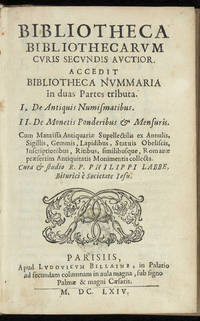
réf. 294916 p.l. 394 i.e. 392 pp. 8vo cont. vellum over boards minor browning. Paris: L. Billaine 1664. “This is the first edition of the earliest extant bibliography of bibliographies despite the ‘curis secundis auctior’ on the title. It is basically an alphabetical list arranged by authors’ first names followed by eight intricate subject indices among them one of publishers’ and booksellers’ catalogues. Appended is a very useful numismatic bibliography. The work enjoyed three later editions during the seventeenth century and provided the basis for Teissier…Labbé 1607-67 one of the most learned polymaths of his time was a Jesuit professor of philosophy in Paris.”–Grolier Club Bibliography 62. Haebler in his Handbuch states that this is the second book on incunabula and the first in which the word is used in connection with printing. A fine copy and rare. Old stamp on verso of title and another on following leaf. ⧠Besterman The Beginnings of Systematic Bibliography pp. 50 & 54. Taylor Book Catalogues pp. 176 208 & 219-20. unknown
1561réf. CLL-368Paris, Galliot du Pré, 1561 In-folio de (6) ff., 341 pp., (9) pp. de table, maroquin rouge, plats ornés d'un décor à la Duseuil doré, dos à nerfs très finement orné d'un décor à feuillage doré, coupes et bordures décorées, tranches dorées sur marbrure (Petit).
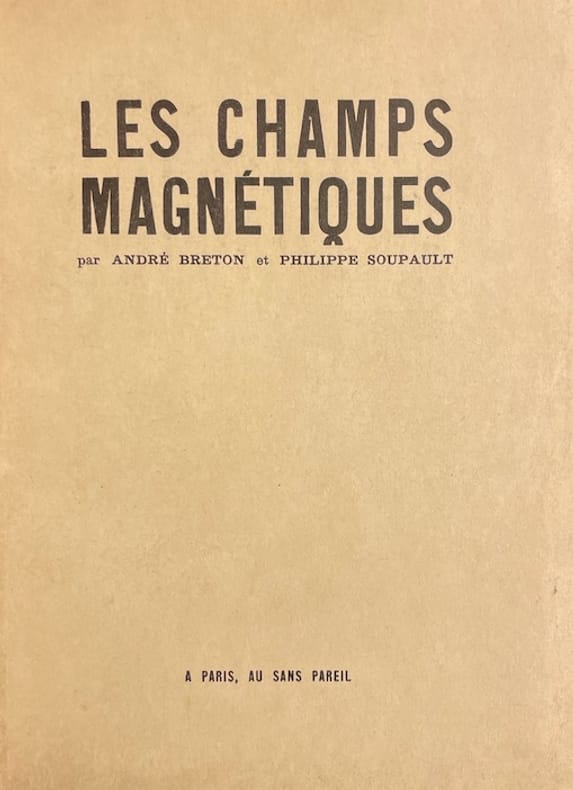
réf. 40971Paris, Au Sans Pareil, 1920 In-8°, 124 p. Reliure box rouge orangé avec décor mosaïqué sur les plats, dos lisse avec titre en long anthracite, couverture conservée, sous étui bordé [reliure signée Georges Leroux].
1822réf. 65421822 Paris, Crapelet, Renouard, Lefèvre, 1822. 6 vol. gr. in-8: 15,5 x 24 cm. I/viii-494-[1] pp. + [7] pl. grav.; II/ [1] f., 554-[1] pp. + [6] pl. grav.; III/ [2] ff., 589-[1] pp., [6] pl. grav.; IV/ [2] ff., 466-[1] pp. [2] pl. grav.; V/ [2] ff., 543-[1] pp. + [4] pl. grav.; VI/ [2] ff., 579-[1] pp. + [2] pl. grav. Edition ornée de 5 portraits de lauteur dont un avant la lettre et de 11 figures dessinées par Laffitte et gravées par Ribault, Langlois, Delvaux, etc... en deux états dont un sur Chine monté, avant la lettre. Edition sur grand papier tirée à 100 exemplaires seulement. Celui-ci lun des 80 sur grand raisin vélin (n° 59). Superbes reliures de lépoque en plein maroquin rouge signées L. Claessens. Dos à 5 nerfs avec titre, tomaison, année et caissons richement décorés dentrelacs en doré. Plats ornés dun triple encadrement fleuronné aux angles. Tranches dorées. Larges roulettes intérieures. Gardes recouvertes de papier marbré. Quelques rousseurs sur les gravures. Mors supérieur du premier volume légèrement fendu et coin supérieur frotté, sinon ensemble en excellent état et de très belle présentation.
1635réf. 0000195Paris: S. le Moyne 1635. First edition. Full Leather. Very Good. 4to 236 x 180 mm Modern pebble leather binding with new end papers. Bookplates of Ashton Allis on new front pastedown Edward Sanford Burgess present on recto of original free end paper respectively. 16 1-238 2 158 as 358 220 as 196 pp 68 full-page copper engraved plates all botanical. Ink manuscript present on verso of front free end paper inscriptions in ink on title page and numerous notations mainly in the Enchiridion. The text block has usual browning from age some minor fore edge damp staining away from text and occasional light foxing. The plates have been attributed to Pierre Valet. This is the first description of the Canadian Flora. Cornut was a French botanist and physician who never visited North America but instead received the majority of his plant specimens from the Robins family who supervised the gardens of Henry IV and the garden of the Paris Faculty of Medicine and the Morin family who owned several Parisian commercial nurseries. Over thirty species from eastern North America are here described and illustrated for the first time; the importance of which recognized by Linnaeus over a century later as he consulted this work in order to better understand the plants of that region. Cornut also included five South African bulb plants again illustrated here for the first time. Provenance: Bookplates of Ashton Allis on new front pastedown Edward Sanford Burgess present on recto of original free end paper respectively. Edward Sandford Burgess the eldest child of Chalon and Emma Burgess was born in Little Valley New York on 19 January 1855 d. 1928. Edward took an early interest in botany. By the age of sixteen he had analyzed 280 plants near his home. By the age of nineteen he had penned the Flora of Chautauqua County in which he presented the name and locality of every plant known to him 710 in that county. JB vol. 3 p. 28 This work was eventually published as the following: The Chautauqua flora: a catalogue of the plants of Chautauqua County New York native or naturalized; extending through the cryptogamous plants to the end of the Hepaticae Clinton New York 1877. In 1895 Edward went to New York City to become the head of the Department of Biological Sciences at Hunter College. Eventually he entered Columbia University where he received his Ph.D. in 1899. In addition he received the honorary degree of Doctor of Science from his alma mater Hamilton College in 1904. Edward continued in his post at Hunter College until 1925. During this period he published many works on botany. Among them were the following: "The Work of the Torrey Botanical Club" Bulletin of the Torrey Botanical Club 27 1900: 552-8; "Plant Illustrations in the Middle Ages" Torreya 2 1902: 60-1; "History of pre-Clusian botany in its relation to aster" Memoirs of the Torrey Botanical Club 10 1902: 1-447; "Aster" in Flora of the Southeastern United States J.K. Small 1903; "Species and variations of Biotian asters with a discussion of variability in Aster" Memoirs of the Torrey Botanical Club 13 1906: 1-419; and "A method of teaching economic botany" Memoirs of the Torrey Botanical Club 17 1918: 52-5. JB vol. 3 pp. 50-4 As might be deduced from his list of publications Edward was remembered most for his important work as a student of the genus Aster. In this group of extremely variable plants he hoped to find the forces of evolution at work. Indeed Edward discovered 84 species of Aster when only two to eleven had previously been known.Univ. Oregon Special Collections Cleveland 190; Hunt 227; Nissen BBI 406; Pritzel 1894; Stafleu & Cowan 1233 S. le Moyne, hardcover books
réf. 294916 p.l. 394 i.e. 392 pp. 8vo cont. vellum over boards minor browning. Paris: L. Billaine 1664. "This is the first edition of the earliest extant bibliography of bibliographies despite the 'curis secundis auctior' on the title. It is basically an alphabetical list arranged by authors' first names followed by eight intricate subject indices among them one of publishers' and booksellers' catalogues. Appended is a very useful numismatic bibliography. The work enjoyed three later editions during the seventeenth century and provided the basis for Teissier.Labbé 1607-67 one of the most learned polymaths of his time was a Jesuit professor of philosophy in Paris."-Grolier Club Bibliography 62. Haebler in his Handbuch states that this is the second book on incunabula and the first in which the word is used in connection with printing. A fine copy and rare. Old stamp on verso of title and another on following leaf. ❧ Besterman The Beginnings of Systematic Bibliography pp. 50 & 54. Taylor Book Catalogues pp. 176 208 & 219-20. hardcover books
1844réf. 58482Paris, Chez l'Auteur - Saint-Petersburg, Issakoff, 1844-48. Small folio. (35 x 27 cm.). In a worn contemp. hcalf. Spine cracked and broken. Boards detached. All parts stitched, a few loose. All parts uncut and unopened. All parts clean and fine. Each part separately paginated and with own title-page. Text to each part (from 8-12 pp.). Each part having a large folded engraved general map and from 11 to 27 engraved folio-maps. In all 292 textpages and 441 engraved maps.
1844réf. 58482Paris Chez l'Auteur - Saint-Petersburg Issakoff 1844-48. Small folio. 35 x 27 cm. In a worn contemp. hcalf. Spine cracked and broken. Boards detached. All parts stitched a few loose. All parts uncut and unopened. All parts clean and fine. Each part separately paginated and with own title-page. Text to each part from 8-12 pp. Each part having a large folded engraved general map and from 11 to 27 engraved folio-maps. In all 292 textpages and 441 engraved maps. The parts volumes comprises: 1. Turquie. 2. Afrique. 3. Grèce et Iles Ioniennes. 4. Portugal. 5. Mer des Indes 1ere Division. 6. Autriche Mer Adriatique. 7. Espagne Cotes N. Mer de Biscaye. 8. Espagne Mer Méditerranée. 9. Sardaigne. 10. Brésil. 11. Amérique Équatoriale Colonies européennes 1re Section. 12. Amérique Équatoriale et Continentale. 13. Prusse. 14. Russie Mer Blanche. 15. Russie Mer Baltique. 16. Russie Mer Noire. 17. Norvège. 18. Suéde. 19. Deux Siciles 1re Section. 20. Deux Siciles 2e Section. 21. Danemarck. 22. Hanovre. 23. Pays-Bas. hardcover
réf. LCS-17939Bel exemplaire imprimé sur papier de Hollande relié en maroquin rouge aux armes et chiffre couronné du jeune roi Louis XV (1715-1774). Paris, Imprimerie Royale, 1724. In-4 de (2) ff. et 175 pp. Plein maroquin rouge, triple filet doré encadrant les plats, armoiries au centre, dos à nerfs fleurdelysé orné du chiffre royal couronné répété cinq fois, coupes décorées, roulette intérieure, tranches dorées, découpe réparée sur le titre. Reliure aux armes du roi Louis XV. 252 x 190 mm.
réf. 14315Antverpen (Anvers), 1572.