43 898 résultats
1941réf. R200017223PUF. 1941. In-8. Broché. Bon état, Couv. convenable, Dos satisfaisant, Intérieur frais. 613 pages.. . . . Classification Dewey : 800-LITTERATURE (BELLES-LETTRES)
1941réf. 041804Presses Universitaires De France Paris 1941 "collectioin "" peuples et civilisations - histoire générale "" - 614 pages en format 14 - 22 cm - cachet - reliure rigide en semi - cuir avec quatres nervues et filets et titre en dorure - dos insolé"
1941réf. R260168927PRESSES UNIVERSITAIRES DE FRANCE / PEUPLES ET CIVILISATIONS. 1941. In-8. Broché. Bon état, Couv. convenable, Dos satisfaisant, Intérieur frais. 614 pages. Bandes de papier kraft collées au dos et en bordure des plats. Etiquette et tampons de bibliothèque.. . . . Classification Dewey : 970-Histoire générale de l'Amérique du Nord
réf. LW663Broché état correct . Quelques pages non coupées . Texte propre .614 pages . 1947. PHOTOS SUR DEMANDE
1946réf. 4044744712Couverture tachée, GLN-44, Presses Universitaires de France 1946
réf. 4532Presses Universitaires de France 1945
1934réf. R240015986EDITIONS AKTUELL. 1934. In-4. Cartonnage d'éditeurs. Bon état, Couv. convenable, Dos satisfaisant, Intérieur frais. 388 pages. Nombreuses planches et illustrations en couleur et en noir et blanc. Plat de couverture repoussé.. . . . Classification Dewey : 944.04-Révolution de 1789
1996réf. 762531990 Saglio 1996 In-4 broché. Bon état d’occasion.
1993réf. 74623Couverture crème souple et imprimée en couleurs. Petite fiche d'erratum jointe au texte. Excellent état du contenu orné de photographies en couleurs ou en noir et blanc hors-texte, ainsi que de multiples tableaux et graphiques en noir et blanc in- et hors-texte.
réf. SLIVCN-9782813226563TREDANIEL GUY EDITEUR
réf. SLIVCN-9782757868607POINTS
réf. lc_110747LOMBARD
1999réf. RO20265148PAUVERT. 1999. In-12. Broché. Bon état, Couv. convenable, Dos satisfaisant, Intérieur frais. 199 PAGES- couverture rempliée. . . . Classification Dewey : 840.091-XX ème siècle
1988réf. 038075Maren Sell et Cie broché Bristol Paris 1988 376 pages en format 14 - 22 cm 2-87604-004-2
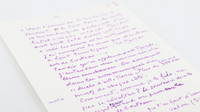
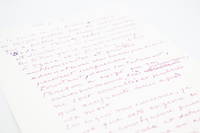
1980réf. 86791s. l.: S. n. 1980. Fine. S. n. s. l. s. d. ca 1980 14.50 x 21 cm 1 page Manuscript note with corrections by Philippe Soupault 22 lines in purple ink on a sheet bearing at the top this inscription: ""p.14 bis"" recalling the creation on May 18 1917 at the Théâtre du Châtelet in Paris of the famous ballet Parade by Sergei Diaghilev's Ballets Russes on a text by Jean Cocteau music by Erik Satie and scenography by Pablo Picasso. This work being inspired by Georges Seurat's painting Circus Sideshow. The co-author with André Breton of the surrealist manifesto ""Les champs magnétiques"" relegates the ballet to the rank of distraction for rear-guard shirkers completely unconscious of the historical stakes of the moment: ""C'était l'année de la bataille de Verdun le Tout-Paris les snobs et les embusqués parlaient d'un ballet ""russe"" intitulé Parade 1 dont Erik Satie disait : ""Picasso a créé les décors et les costumes et j'ai composé la musique et Cocteau a écrit trois lignes. Et Parade est de Cocteau."""" It was the year of the Battle of Verdun all of Paris the snobs and draft dodgers were talking about a ""Russian"" ballet titled Parade 1 of which Erik Satie said: ""Picasso created the sets and costumes and I composed the music and Cocteau wrote three lines. And Parade is by Cocteau."". Philippe Soupault is outraged by such indifference to the fate of the valorous Poilus in the trenches: ""Tandis qu'on applaudissait Parade j'entendais mes voisins revivre leurs cauchemars. On annonçait dans les communiqués des ""duels d'artillerie"". Plus de trois cents mille morts de chaque côté. Comment comme je le fis ne pas se révolter Le souvenir de cette révolte surgit en moi en prononçant le nom de Cocteau."" While they were applauding Parade I heard my neighbors reliving their nightmares. The communiqués announced ""artillery duels"". More than three hundred thousand dead on each side. How as I did not to revolt The memory of this revolt surges in me upon pronouncing Cocteau's name. Fascinating and acerbic memories from the last living historical surrealist concerning the revolutionary ballet ""Parade"" likening it to a preoccupation of idle bourgeois neglecting the hecatombs of the Great War. S. n. unknown
1980réf. 86825s. l.: S. n. 1980. Fine. S. n. s. l. s. d. ca 1980 14.50 x 21 cm 1 page Autograph note with deletions by Philippe Soupault 18 lines in purple ink on a sheet discussing the different attitudes of his surrealist friends toward love. Some deletions and a cigarette burn hole on the sheet. All the surrealists did not adopt the same behavior regarding the amorous feelings that moved them: ""Nous étions très discrets en ce qui concernait nos expériences amoureuses. Sauf bien entendu Louis qui nous tenait régulièrement au courant de ses amours. . Mes amis Tzara Breton et moi-même nous tenions à garder nos secrets."" ""We were very discreet regarding our amorous experiences. Except of course Louis who regularly kept us informed of his loves. My friends Tzara Breton and myself insisted on keeping our secrets."" He also reveals the importance of feelings in surrealism and the central place of Woman: ""En vérité l'amour et ses conséquences jouaient un grand rôle dans notre vie. Les femmes étaient toujours respectées jusqu'à l'adoration et nul d'entre nous n'aurait osé se moquer de nos inclinations même si elles étaient fugitives."" ""In truth love and its consequences played a great role in our life. Women were always respected to the point of adoration and none of us would have dared mock our inclinations even if they were fleeting."" Interesting memories from the last living historical surrealist concerning the loves of the surrealists and their veneration for Woman. S. n. unknown
1980réf. 86763s. l.: S. n. 1980. Fine. S. n. s. l. s. d. ca 1980 14.50 x 21 cm 1 page Autograph manuscript note by Philippe Soupault 20 lines in purple ink on a leaf bearing at the head this inscription: ""J.B."" drawing the portrait of Jacques Baron. The co-author with André Breton of the surrealist manifesto ""Les champs magnétiques"" shares with us all his sympathy for Jacques Baron one of the most unrecognized figures of surrealism: ""Quand je vis Jacques Baron pour la première fois je fus surpris par sa jeunesse. Il aimait sourire. Un grand naturel et une franchise qui plaisait mais inquiétait parfois. Il avait le sens de la camaraderie et je ne l'ai jamais entendu dire du mal de personne."" When I saw Jacques Baron for the first time I was surprised by his youth. He liked to smile. A great naturalness and frankness that pleased but sometimes worried. He had a sense of camaraderie and I never heard him speak ill of anyone. Philippe Soupault also seems to appreciate Jacques Baron for his detachment and free spirit unlike certain orthodox surrealists who followed the movement unwaveringly: ""Il disparut pendant un certain temps pour devenir marin puis fidèlement retrouva ses amis surréalistes et la poésie."" He disappeared for a certain time to become a sailor then faithfully found his surrealist friends and poetry again. Interesting memories from the last living historical surrealist for once gracious with one of his former companions. S. n. unknown
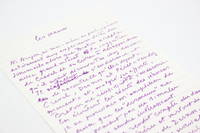
1980réf. 86753s. l.: S. n. 1980. Fine. S. n. s. l. s. d. ca 1980 14.50 x 21 cm 1 page Manuscript note by Philippe Soupault 22 lines in mauve ink on a sheet headed with this inscription: ""Les séances"" devoted to the famous ""sleep"" sessions conducted in André Breton's studio consisting of oneiric writings or texts dictated by a dreamer. The manuscript notes contain three deletions and corrections. Philippe Soupault considers his attempts questionable and even labels them as imposture distancing himself from any active participation in these practices: ""Neither Aragon nor I participated actively in the experiments called sleep sessions while Breton accepted with great interest Crevel's suggestion to engage in experiments he had discovered among friends. One had to fall asleep and recount what 'one saw'."" He recalls the results that were not always convincing: ""Crevel Desnos and Péret 'fell asleep' and despite his efforts Breton could not manage to fall asleep. Listening to the accounts of these sessions I could not help thinking that the 'sleepers' did not hesitate to simulate in order to make themselves interesting."" to such an extent that the intransigent leader of surrealism interrupted them: ""Breton realized the danger of one-upmanship and especially of Desnos's exaltation. He ceased attempting new sleep experiments."" Interesting recollections from the last living historical surrealist often harsh toward his former or new companions. S. n. unknown
1980réf. 86790s. l.: S. n. 1980. Fine. S. n. s. l. s. d. ca 1980 14.50 x 21 cm 1 page Manuscript note with crossed-out passages by Philippe Soupault 22 lines in purple ink on a sheet bearing at the top this inscription: ""B.P."" narrating Benjamin Péret's encounter with surrealism. The co-author with André Breton of the surrealist manifesto ""Les champs magnétiques"" tells us with a touch of nostalgia of Benjamin Péret's arrival in the surrealist adventure: ""André Breton fut bien étonné de recevoir la visite d'une 'dame' qui lui tendit un n° de la revue Littérature. Elle lui demanda d'aider son fils Benjamin qui voulait venir à Paris pour devenir écrivain. Quelques temps après cette démarche Benjamin Péret arriva à Paris et fut accueilli par Breton."" André Breton was quite astonished to receive a visit from a 'lady' who handed him an issue of the journal Littérature. She asked him to help her son Benjamin who wanted to come to Paris to become a writer. Some time after this approach Benjamin Péret arrived in Paris and was welcomed by Breton. He depicts the character of the newcomer: ""A cette époque Péret était timide inquiet et dévoué. Il admirait sans réserves et respectueusement André Breton et ses amis. Il était obéissant."" At that time Péret was shy anxious and devoted. He admired unreservedly and respectfully André Breton and his friends. He was obedient. and emphasizes his devotion to the group of disrespectful and disruptive surrealists: ""Lors du procès Maurice Barrès il accepta le rôle ingrat et dangereux du soldat inconnu venu témoigner en allemand."" During the Maurice Barrès trial he accepted the thankless and dangerous role of the unknown soldier who came to testify in German. Interesting recollections from the last living historical surrealist reminiscing tenderly about one of his former companions. S. n. unknown
1980réf. 86752s. l.: S. n. 1980. Fine. S. n. s. l. s. d. ca 1980 14.50 x 21 cm 1 page Manuscript note by Philippe Soupault 24 lines in mauve ink on a sheet headed with this inscription: ""Note p.57"" concerning André Breton and the numerous letters he received. The co-author with André Breton of the surrealist manifesto ""Les champs magnétiques"" shows little kindness toward those who seized upon and hastened to publish part of his deceased friend's correspondence: ""At the end of his life Breton agreed to let M. Sanouillet who published a university thesis 'Dada à Paris' a questionable thesis illustrated with numerous errors publish the letters he had addressed to Tzara and Picabia enthusiastic letters which may surprise admirers of the correspondents."" even betraying the wishes of the pope of surrealism: ""Breton demanded that his correspondence very voluminous should only be consulted and published fifty years after his death."" Philippe Soupault faithful to the author of Nadja will not be confronted with this situation: ""As for myself I think this requirement will have no consequences since all the letters the author of Mont de Piété had addressed to me were stolen and destroyed."" Interesting recollections from the last living historical surrealist often harsh toward his former or new companions. S. n. unknown
2025réf. B1259London: Weidenfeld & Nicholson 2025. First UK edition. Hardcover. Fine/Fine. From the publisher: In this intimate legal and historical detective story the world-renowned lawyer and acclaimed author of East West Street traces the footsteps of two of the twentieth century’s most merciless criminals—accused of genocide and crimes against humanity—testing the limits of immunity and impunity after Nuremberg. “Though nearly a decade in the making this book could not arrive at a better time because its subject is one of the most pressing themes of our era: impunity. . . . Sands has created an indelible and enthralling work of moral witness.” —Patrick Radden Keefe author of Say Nothing On the evening of October 16 1998 Chilean dictator Augusto Pinochet was arrested at a medical clinic in London. After a brutal seventeen-year reign marked by assassinations disappearances and torture—frequently tied to the infamous detention center at the heart of Santiago Londres 38—Pinochet was being indicted for international crimes and extradition to Spain opening the door to criminal charges that would follow him to the grave in 2006. Three decades earlier on the evening of December 3 1962 SS-Commander Walter Rauff was arrested in his home in Punta Arenas at the southern tip of Chile. As the overseer of the development and use of gas vans in World War II he was indicted for the mass murder of tens of thousands of Jews and faced extradition to West Germany. Would these uncommon criminals be held accountable Were their stories connected The Nuremberg Trials—where Rauff’s crimes had first been read into the record in 1945—opened the door to universal jurisdiction and Pinochet's case would be the first effort to ensnare a former head of state. In this unique blend of memoir courtroom drama and travelogue Philippe Sands gives us a front row seat to the Pinochet trial—where he acted as a barrister for Human Rights Watch—and teases out the dictator’s unexpected connection to a leading Nazi who ended up managing a king crab cannery in Patagonia. A decade-long journey exposes the chilling truth behind the lives of two men and their intertwined destinies on 38 Londres Street. This copy is fine in black cloth with gilt titles on the spine. No marks or damage at all. The unclipped DJ is also excellent. It is signed by the author on a special second title page tipped in by the publisher. . WA25. Weidenfeld & Nicholson hardcover
2025réf. 1961London: Weidenfeld and Nicolson 2025. 1st UK 1st impression. Hardback. Fine/Fine. Important 2025 account of the links between post-war Nazi Germans and the Chilean dictatorship under Pinochet. This book has been flat signed to a special publisher's title page with no dedication. Book is unmarked no foxing or spotting and with its jacket unclipped and intact. Very lightly read and very clean. Weidenfeld and Nicolson unknown
réf. 42479113-nnew. unknown
réf. DADAX8843555308New unknown
réf. DADAX082301200XNew unknown