Camus, AlbertBiblio.com
Camus, AlbertBiblio.com
Pest Die
1991rif. 8991ROWOHLT ERNST 05/1991. 1226.-1245. Tsd. softcover. ROWOHLT, ERNST paperback
3462 risultati
1950rif. 8993ROWOHLT ERNST 11/1950. 1. softcover. ROWOHLT, ERNST paperback
1991rif. 8991ROWOHLT ERNST 05/1991. 1226.-1245. Tsd. softcover. ROWOHLT, ERNST paperback
1962rif. 44658Paris: Gallimard 1962. Fine. Gallimard Paris 1962 12.50 x 19.50 cm relié First edition one of 90 numbered copies on Hollande paper the tirage de tête. Elegant half red morocco binding over marbled paper boards by P. Goy & C. Vilaine spine in six compartments marbled endpapers and pastedowns covers and spine preserved top edge gilt. A very good well-margined copy in a handsome binding. Gallimard hardcover
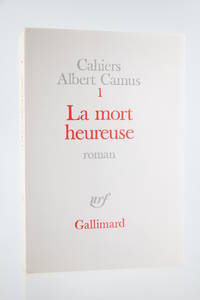
1971rif. 78115Paris: Gallimard 1971. Fine. One must imagine a dead man happy Gallimard Paris 1971 14.50 x 21.50 cm broché First edition one of 106 numbered copies on Hollande paper constituting the deluxe issue. Fine copy of this important work in Albert Camus's literary career. Although published eleven years after his death it was in fact his first novel written and revised between 1936 and 1938 before being abandoned in favour of The Stranger for which it is regarded as the precursor. Despite its markedly different plot in which the murder is committed at the victim's request and Patrice Mersault is far more expressive than his younger literary counterpart Meursault A Happy Death offers a revealing insight into the heart of Camus's philosophical concerns. It brings to the fore his earliest preoccupation the absence of guilt which emerges here as a first expression of the absurdity of the human condition. Â Gallimard unknown
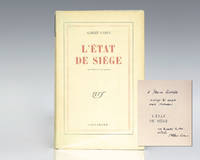
1948rif. 137545Paris: Gallimard 1948. First edition early printing of Camus' fourth play a political allegory about resistance to the plague of authoritarian rule. Octavo original wrappers. Presentation copy inscribed by the author on the half-title page "A Jean de Bosschère assiege sure anso mars insoumais L'Etat de Siege are Esperes a plus cordials Albert Camus." The recipient Jean de Bosschère lived for most of the 20th century between London and France and illustrated his own works as well as the works of Oscar Wilde Charles Baudelaire and the classical works of Aristophanes Ovid Strato and Apuleius. He published his own works of poetry and in 1952 was awarded the Prix de la Méditerranée and in November the Mandat des Poètes. In near fine condition. Written in 1948 The State of Siege—the original sense is closer to state of emergency—is a play in three acts presenting the arrival of plague personified by a young opportunist in sleepy Cadiz and the subsequent creation of a totalitarian regime through the manipulation of fear. In a piece written in 1948 in reply to criticisms from Gabriel Marcel Camus defended his decision to set the play in Spain and not in Eastern Europe citing the ongoing oppression in Spain France's collusion in it and the Catholic Church's abandonment of Spanish Christians. The piece was first performed in October 1948 and was initially received poorly by critics and public who had eagerly awaited the work but expected a dramatization of Camus's novel The Plague. While the two share a common background the treatments are entirely different in tone. The work has remained almost constantly in print in French and since 1958 in an English translation by Stuart Gilbert—in Caligula and Three Other Plays—with a foreword by Camus. Gallimard unknown
1955rif. 122226London: Hamish Hamilton Pub.;.TRINITY PRESS. Very Good in Very Good dust jacket. 1955 VERSO. first editionUK. HARDCOVER. 6x8". VERY GOOD CONDITION IN VERY GOOD UNCLIPT15s. ne t DUST JACKET. Includes old newspaper page 778 from "THE TIMES LITERARY SUPPLEMENT FRIDAY DECEMBER 23 1955" review by Translator for this edition.JUSTIN O'BRIENstated pr ice was 15s. confirms this is first ed DUST JACKET .Has left light tan area on inner ep from being laid in since purchase.now in its own plastic protector. book look new I do not describe any book above VG/VG.but it has no defects beside effect oof newspaper review. ; BOOK APPEARS WITH SILVER SPINE TITLES ON DARK BLUE TEXTURED HARD COVERS.Tan paper dust jacket has black & red titles. with red and black border designs. Back pane describes revies for THE PLAGUE. ; 169pgg pages; Hamish Hamilton. States "First published Year" or "First published in Great Britain in Year" on copyright page; notes subsequent printings.this copy meets that standard no subs. printing noted to proper statement verso. . Hamish Hamilton Pub.;.TRINITY PRESS hardcover
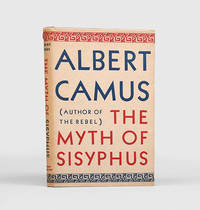
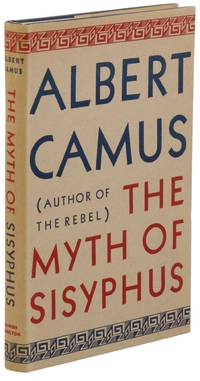
1955rif. 192704London: Hamish Hamilton 1955. One must imagine Sisyphus happy First edition in English including a new preface by Camus and collecting the title essay alongside "Summer in Algiers" "The Minotaur or The Stop in Oran" "Helen's Exile" "Return to Tipasa" and "The Artist and His Time". Camus's absurdist treatise on the philosophical problem of suicide was first published as Le Mythe de Sisyphe in 1942. Addressing his English readers Camus comments that "written fifteen years ago in 1940 amidst the French and European disaster this book declares that even within the limits of nihilism it is possible to find the means to proceed beyond nihilism. This book is in a certain sense the most personal of those I have published in English". It acts as a non-fictional companion to his novel L'Étranger 1942. The translator Justin O'Brien 1906-1968 was a professor of French at Columbia University who translated many works by Camus and certain works by Jean-Paul Sartre and André Gide including Gide's collected journals. Octavo. Original blue boards spine lettered in silver. With dust jacket. Spine ends bumped a few spots to edges; jacket unclipped spine lightly toned closed tear to spine head couple of nicks and creases: a very good copy in like jacket. hardcover
1958rif. 52286Gallimard | Paris 1958 | 13 x 20 cm | relié
1954rif. 73748Sous étui bordé et sous chemise en demi-maroquin rouge signés Patrice Goy et C. Vilaine. Couverture souple piquée. Rousseurs éparses. En partie non coupé.
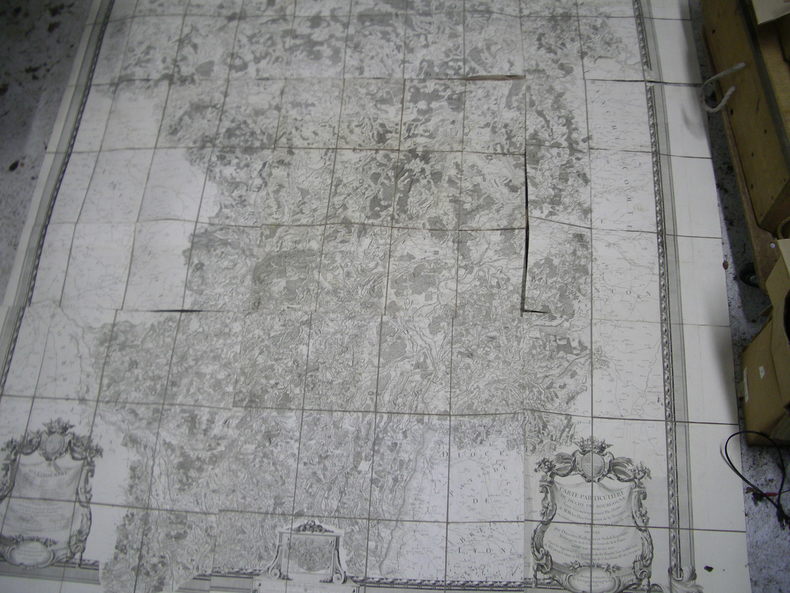
1763rif. 177041763 toile, dans un emboitage 35 x 25 x 7 cm (XIXe sur laquelle on a placé l'étiquette XVIIIe). carte composée de 9 feuilles, 290 x 246 cms, 1763
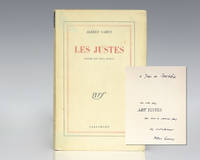
1950rif. 137191Paris: Gallimard 1950. First edition early printing of Camus' classic examination of the moral issues associated with murder and terrorism. Octavo original wrappers. Presentation copy inscribed by the author on the half-title page "A Jean de Bosschère crossing through "Les" an nom des que vous no sommes sens tes cordialement Albert Camus." The recipient Jean de Bosschère lived for most of the 20th century between London and France and illustrated his own works as well as the works of Oscar Wilde Charles Baudelaire and the classical works of Aristophanes Ovid Strato and Apuleius. He published his own works of poetry and in 1952 was awarded the Prix de la Méditerranée and in November the Mandat des Poètes. In near fine condition. Camus separated his work into three cycles. Each cycle consisted of a novel an essay and a play. The first was the cycle of the absurd consisting of L'Étranger Le Mythe de Sysiphe and Caligula. The second was the cycle of the revolt which included La Peste The Plague L'Homme révolté The Rebel and Les Justes The Just Assassins. The third the cycle of the love consisted of Nemesis. Each cycle was an examination of a theme with the use of a pagan myth and including biblical motifs. Camus began his work on the second cycle while he was in Algeria in the last months of 1942 just as the Germans were reaching North Africa. Based on the true story of a group of Russian Socialist-Revolutionaries who assassinated the Grand Duke Sergei Alexandrovich The Just Assassins explores the moral issues associated with murder and terrorism. Gallimard unknown
1946rif. 150923New York: Alfred A. Knopf 1946. First American edition of Camus' first novel and masterpiece. Octavo original beige cloth. Fine in a fine dust jacket with a single closed tear. Jacket design by Warren Chappell. Translated by Stuart Gilbert. The nicest example we have ever seen. Through the story of an ordinary man unwittingly drawn into a senseless murder on an Algerian beach Camus explored what he termed "the nakedness of man faced with the absurd." With the publication of this first novel L’Etranger The Stranger Camus introduced his lifelong attempt to reconcile a philosophy of heroic nihilism with “the ideal of human fraternity” Encyclopedia of Philosophy. It remains one of the classic works of the twentieth century. Alfred A. Knopf hardcover
1953rif. 63678Paris: Gallimard 1953. Fine. Rebels of all countries unite! Gallimard Paris 1953 12 x 19 cm relié First edition one of the review copies. A few marginal reading marks. Bradel binding in raspberry-red half morocco smooth spine with date at foot marbled paper boards original wrappers preserved top edge gilt. Binding signed by P. Goy & C. Vilaine. Signed autograph inscription from Albert Camus to Gilbert Sigaux his fellow contributor to Combat: "". avec l'affectueuse pensée de son vieux camarade.""A novelist winner of the 1949 Prix Interallié and journalist for Combat Sigaux had joined Camus in the activities of the Groupes de liaison internationale International Liaison Groups. The second volume of Camus's collected essays and commentaries Actuelles II brings together his polemical writings from 1948 to 1953. At its heart are the « Lettres sur la révolte » in which Camus responds to the attacks provoked by L'Homme révolté: those of André Breton the libertarians associated with Le Libertaire Francis Jeanson and through him Sartre. His letter to the editor of Les Temps modernes subsequently published under the title « Révolte et servitude » marked the definitive rupture between the two writers.Although Gilbert Sigaux like Camus had worked as a journalist for Combat and had published a highly favourable review of the first volume of Actuelles in its pages Camus's presentation of this new collection of politically engaged writings was far more than a gesture of professional gratitude.From November 1948 onwards the two men were united in a new struggle one fundamentally opposed to the Manichaean outlook for which Camus would later reproach Sartre:« Il ne sagit pas dajouter encore à la haine du monde et de choisir entre deux sociétés ».This conviction that uncompromising revolt need not entail the rejection of others was one of the founding principles of the Groupes de liaison internationale established in November 1948 at the initiative of the trade unionist Roger Lapeyre with Camus at their centre. Camus drafted most of the manifesto which Sigaux signed alongside him before becoming an active member of the organisation.Together they sought « de faire connaître en Europe lexistence des non-conformistes américains et des opposants russes de rendre une voix enfin à tout ce qui dans lhistoire déshonorée que nous vivons donnera à des millions de solitaires des raisons lucides et valables despérer ». Meeting at the offices of Force ouvrière in the rue de l'Université writers trade unionists and libertarians worked to support Spanish Republicans and refugees from Eastern Europe. Between 1949 and 1950 they published four bulletins one of which was devoted to forced labour in the USSR. Daniel Martinet himself a member would later write that their « seul ciment » was « la personnalité dAlbert Camus ». This humanist endeavour eventually came to an end following Camus's departure for South America and his illness in 1950 although as Martinet recalled « sans que les gens qui y avaient participé se perdent de vue » cf. Maitron.Actuelles II gives voice to the uncompromising yet fiercely independent political commitment that had brought the two men together through public interventions and a steadfast opposition to totalitarianism: Camus's speech opposing Francoist Spain's admission to UNESCO his address « Le pain et la liberté » to trade unionists in Saint-Étienne in May 1953 and his preface to Alfred Rosmer's memoir Moscou sous Lénine.An important review copy of this veritable manifesto of political independence personally inscribed by Camus to his « vieux camarade » a comrade in both the editorial battles of Combat and the wider struggle for their shared ideals. Gallimard hardcover
1953rif. 47737Paris: Gallimard 1953. Fine. Gallimard Paris 1953 12 x 19 cm broché First edition on ordinary paper. Handsome fine autograph inscription signed by Albert Camus : ""à Albert Béguin qui trouvera ici les raisons de mes désaccords avec Esprit avec mon bien cordial souvenir.to Albert Bégiun who will find here the reasons for my disagreements with the Spirit in friendly remembrance "" A little light spotting primarily to upper cover and ffep. Retaining its advertising notice entitled ""Lettres sur la révolte"". Gallimard unknown
1953rif. 54039Paris: Gallimard 1953. Fine. Gallimard Paris 1953 10.50 x 16.50 cm relié First edition of the French version translated and adapted by Albert Camus a numbered copy on alfa paper. Half green shagreen by Goy & Vilaine spine in six compartments gilt date to foot cover and spine sunned preserved top edge gilt. Autograph inscription signed by Albert Camus to Jean Gillibert. A good copy in an elegant binding Gallimard unknown
1947rif. 64501Paris: Gallimard 1947. Fine. Gallimard Paris 1947 12 x 18.50 cm broché First edition one of 13 numbered copies on pur fil paper this copy one of 3 lettered hors commerce the only grand papier deluxe copies. Preface by Albert Camus. Endpapers slightly and partially shaded. Rare and nice copy with a photographic portrait of the author as frontispiece. Gallimard unknown
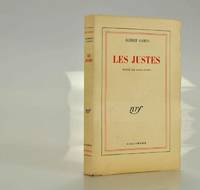
1950rif. 300420181614Albert Camus – Les Justes – 1950 First edition copy numbered No. 79/200 on Alpha Mousse Navarre 182 Pages Very good condition uncut small stains and marks of wear on the cover including very slightly marked folds see photos. Éditions Gallimard 19 x 12cm Gallimard Nrf blanche paperback
1958rif. 74045Paris Gallimard 1958 1 vol. Broché in-12, broché, sous double emboîtage, 69 pp. Édition originale de ces deux discours que Camus dédie à Louis Germain, son instituteur à Alger : le premier prononcé le 10 décembre 1957 à l'Hôtel de ville de Stockholm, selon la tradition, à la fin du banquet qui clôturait la cérémonie d'attribution du Prix Nobel de Littérature ; le second, "L'artiste et son temps", donné le 14 décembre 1957 dans le grand amphithéâtre de l'Université d'Upsal. Un des 56 premiers exemplaires numérotés sur vélin Hollande van Gelder. En parfait état.
1958rif. 74045Paris Gallimard 1958 1 vol. Broché in-12, broché, sous double emboîtage, 69 pp. Édition originale de ces deux discours que Camus dédie à Louis Germain, son instituteur à Alger : le premier prononcé le 10 décembre 1957 à l'Hôtel de ville de Stockholm, selon la tradition, à la fin du banquet qui clôturait la cérémonie d'attribution du Prix Nobel de Littérature ; le second, "L'artiste et son temps", donné le 14 décembre 1957 dans le grand amphithéâtre de l'Université d'Upsal. Un des 56 premiers exemplaires numérotés sur vélin Hollande van Gelder. En parfait état.
1958rif. 28520Exemplaire sur Hollande, en maroquin d'Alix Paris, Gallimard, (6 février) 1958. 1 vol. (115 x 185 mm) de 69 p. et [3] f. Maroquin rouge, dos lisse, titre doré, date en pied, tranches dorées sur témoins, doublures et gardes de chèvre velours havane, couvertures et dos conservés, étui bordé (Alix). Édition originale. Un des 56 exemplaires sur vélin de Hollande (n° 32).
1948rif. 46405413Paris, Gallimard, 1948 ; in-12, demi-chagrin grenat, dos lisse, non rogné, couv. et dos. (Lobstein). Tirage de janvier 1948. cet exemplaire a appartenu à Paul Celan (1920 - 1970). La page de garde porte sa signature autographe suivie de la mention : Insbrück, 28 juin 1948. Paul Célan avait quitté la Roumanie en 1947 pour l’Autriche. C’est à Vienne qu’il publiera son premier livre Der Sand aus den Urnen. En Autriche, il fit la connaissance de Erica Lilleg, romancière née à Graz en 1907 (morte en 1988), une liaison amoureuse de plusieurs années. Il se lia aussi, à cette époque, avec le peintre Edgar Jéné (Saarbrücken 1904 - La-Chapelle-Saint-André (Nièvre) 1984). Ce dernier avait quitté l’Allemagne pour des raisons politiques en 1935 pour se fixer à Vienne où il épousera Erica Lilleg. Edgar Jéné a illustré de deux planches le livre de Paul Célan. En 1948 Celan publie à Vienne une monographie sur E. Jéné : Edgar Jené. Der Traum vom Traume. Le volume provient de la bibliothèque de Edgar Jené et Erica Lilleg. Il a été relié postérieurement.
rif. 28520Paris Gallimard 6 février 1958. 1 vol. 115 x 185 mm de 69 p. et 3 f. Maroquin rouge dos lisse titre doré date en pied tranches dorées sur témoins doublures et gardes de chèvre velours havane couvertures et dos conservés étui bordé Alix. . Édition originale. Un des 56 exemplaires sur vélin de Hollande n° 32. . Les Discours de Suède sont un ensemble de deux allocutions prononcées par l'écrivain à la suite de l'obtention du prix Nobel de littérature : celui du 10 décembre 1957 prononcé à Stockholm pour la remise du prix et celui du 14 décembre 1957 prononcé à l'université d'Upsala intitulée « L'artiste et son temps » - un texte rédigé en 1953 en guise de préface au texte de Wilde La Ballade de la gêole de Reading. Une postface clôt l'ouvrage où il est question des deux totalitarismes de l'art pour l'art du réalisme socialiste et du fameux « engagement » de l'intellectuel - en des termes qui n'ont rien perdu de leur acuité. Qu'on en juge : « C'est ainsi que beaucoup de nos artistes aspirent à être maudits ont mauvaise conscience à ne pas l'être et souhaitent en même temps l'applaudissement et le sifflet » ; ou encore : « L'académisme de droite ignore une misère que l'académisme de gauche utilise ». Le texte est imprimé sur les presses de l'Imprimerie Moderne à Montrouge le 6 février 1958. Il est dédié à Louis Germain à qui Camus avait écrit dès novembre : « Ma première pensée après ma mère a été pour vous. Sans vous sans cette main affectueuse que vous avez tendue au petit enfant pauvre que j'étais sans votre enseignement et votre exemple rien de tout cela ne serait arrivé. Je ne me fais pas un monde de cette sorte d'honneur. Mais celui-là est du moins une occasion pour vous dire ce que vous avez été et êtes toujours pour moi et pour vous assurer que vos efforts votre travail et le coeur généreux que vous y mettiez sont toujours vivants chez un de vos petits écoliers qui malgré l'âge n'a pas cessé d'être votre reconnaissant élève. » Bel exemplaire en pleine reliure d'Alix. Paris, Gallimard, (6 février) 1958. 1 vol. (115 x 185 mm) de 69 p. et [3] f. Maroquin rouge, dos lisse, titre doré, date en p unknown
rif. 51-4757Paris: Gallimard 1956. 8vo. 10.5 x 17.5 cm. Contemporary blue cloth with leather titled label on spine. The first edition and the 9th printing from May 1956 the same month as the first printing.Likely a Presentation copy to Adolf Herckenrath. Accompanied by a publicity photo of Albert Camus by Lennart Green 27 x 21 cm. . See provenance below.First published in 1956 it is his last complete work of fiction.Provenance:From the archives of the celebrated bookstore and literary salon Herckenrath on Veldstraat in Ghent Gand Belgium. Founded by the writer Adolf Herckenrath 1879-1958 in 1909; continued by his son Walter Herckenrath 1907- 1989 and by Walter’s children Guy and Helga Herckenrath until around 2000….Poète dramaturge libraire et éditeur. Adolf Herckenrath est entré dans l' histoire en tant qu'ami d'enfance pour lequel Karel van de Woestijne a écrit son Laethemsche Brieven sur Lente 1901… À partir de novembre 1909 Herckenrath résida dans la Veldstraat où il conserva la librairie Adolf Hoste et une fois l'université devenue bilingue principalement consacré à la littérature francophone. Entre les deux guerres mondiales Herckenrath était toujours actif en tant que professeur et membre du conseil d'administration de l'académie de théâtre de Gand pour laquelle un magazine De Tooneelschool 1937-1940 avait également été fondé. Il aida à fonder Pan le cercle de la littérature flamande orientale en 1938… En 1935 Herckenrath s'installa dans la villa 't Kersouwken sur l'Eikeldreef à Sint-Martens-Latem. Pendant la Seconde Guerre mondiale il y résidera officiellement pendant quelques mois de mai à novembre 1944. Il est ensuite retourné dans sa librairie de la Veldstraat où il vivrait au moins officiellement jusqu'à sa mort. Après la guerre sa librairie a été reconstruite par le célèbre architecte Geo Henderick. Grâce à la continuation de son fils Walter et de ses petits-enfants Guy et Helga le nom Herckenrath a également survécu jusqu'à la fermeture de l'entreprise à la mi-2000. 175 x 105 cm 171 pp mention de 'neuvième édition' sur la page de titre. achevé d'imprimer en mai 1956. Imprimé très peu de temps après l'édition originale. Exemplaire SIGNÉ envoi AUTOGRAPHE de l'auteur. Reliure privée en toile bleue. Paris: Gallimard, 1956 hardcover
1955rif. 140945412London: Hamish Hamilton 1955. First British Edition. Near Fine/Near Fine. First British edition and the first English language edition. Bound in publisher's original blue cloth with spine lettered in silver. Near Fine with very slight lean to spine slight fading and wear to spine ends offsetting to endsheets and contents lightly tanned. In a Near Fine unclipped dust jacket with light tanning and a small indentation to the spine panel light wear. A beautiful copy of a book that does not normally turn up in such nice condition. Hamish Hamilton unknown books
1958rif. 1022151958 Paris, Gallimard, 1958, 200x130mm, broché sous couverture imprimée.Un des 25 exemplaires sur Hollande, premier papier.Neuf et non coupé, étui et chemise (Devauchelle).(102215)