Jean-Paul SARTRE - (Albert CAMUS)Biblio.com

3 988 résultats
1946réf. 83512Sceaux: Aux dépens du Palimugre 1946. Fine. Aux dépens du Palimugre Sceaux s. d. 1946 12 x 14.50 cm broché First hors commerce edition printed in a small number of copies on Lana paper. Covers marginally sunned as is often the case otherwise a handsome copy. Aux dépens du Palimugre unknown
1957réf. 83533Paris: Calmann-Lévy 1957. Fine. Calmann-Lévy Paris 1957 14.50 x 21.50 cm broché First collected edition one of 260 numbered copies on tinted wove paper the only large-paper issue after 45 copies on white Dutch wove paper. Introduction and critical study by Jean Bloch-Michel. Spine and covers slightly and marginally sunned with a faint offset mark from a bookseller's description label to the margin of one endpaper. Calmann-Lévy unknown
1957réf. 16667London: Hamish Hamilton 1957. First edition first printing. Published by Hamish Hamilton in London 1957. This is a near fine copy. The dust wrapper has some slight curling and tearing along the top edge. It has not been price clipped and shows the original 18s. net price. There are some small pen annotations to the front flap marking page numbers of interest to the previous owner. The boards are tight and free from notable chips and marks but with a band of minor sunning at the tail of the spine. The internals are clean throughout and the text blocks though with some slight spotting to the side edge. The wraparound band outlining Camus' 1957 Nobel Prize win is slightly sunned though not chipped or marked. Overall this is a near fine copy with the scarce band. This book offers an evaluation of Albert Camus leading novelist and a pioneer of existentialism. The editor Philip Thody analyses Camus' development as a prose writer and the creation of such classics as 'The Stranger'. Hamish Hamilton hardcover
1980réf. 81484Paris: Hachette 1980. Fine. Hachette Paris 1980 14 x 20.50 cm broché The first edition of which there were no deluxe copies. Handsome copy. Autograph inscription dated and signed by Renaud Camus to Claude Arthaud: "". en très voisine amitié."" Hachette unknown
réf. 2070212041.Gpaperback. Good. Access codes and supplements are not guaranteed with used items. May be an ex-library book. paperback
1958réf. 82402Paris: Gallimard 1958. Fine. Gallimard Paris 1958 12 x 19 cm broché First edition one of 56 numbered copies on Holland paper deluxe copy. Additionally 210 copies were printed on pure thread paper and hors commerce 50 copies on Madagascar paper. A very handsome copy of Camus's finest text on commitment and the responsibility of new generations facing the challenges of the world to come. Gallimard unknown
1953réf. 80262Paris: Nrf 1953. Fine. Nrf Paris 1953 12 x 19 cm broché First edition of the theatrical adaptation by Albert Camus one of 65 numbered copies on pure thread paper deluxe copy. A transverse crease mark at the foot of the rear board. Handsome copy. Nrf unknown
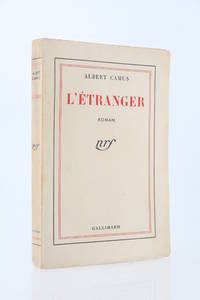
1942réf. 80260Paris: Gallimard 1942. Fine. Precious Advance Copy as Issued Gallimard Paris 1942 12 x 19 cm broché sous chemise et étui First edition first issue for which no grand papier deluxe copies were printed one of the rare service de presse advance copies. Some very discreet restorations to spine paper browned some discreet traces folds at the bottom of some leaves. A handsome copy as issued. The book is housed in a slipcase signed by Julie Nadot reproducing the original design of the cover and spine. This first edition of L'Étranger was printed on 21 April 1942 with a run of 4400 copies: 400 advance copies service de presse 500 copies without statement and 3500 copies with false statements from the second to eighth edition. The advance copies not intended for sale do not include the indication of price 25 francs on the back of the cover. Paper was rare in 1942 and Albert Camus being then an unknown author Gallimard did not print any deluxe grands papiers copies as was often the case. The advance copies or copies without false statements are particularly sought after. Precious and rare unsophisticated copy under an elegant slipcase by Julie Nadot. Gallimard unknown
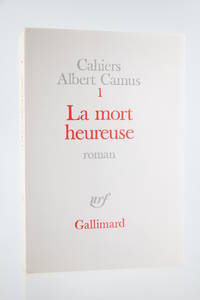
1971réf. 78115Paris: Gallimard 1971. Fine. One must imagine a dead man happy Gallimard Paris 1971 14.50 x 21.50 cm broché First edition one of 106 numbered copies on Hollande paper constituting the deluxe issue. Fine copy of this important work in Albert Camus's literary career. Although published eleven years after his death it was in fact his first novel written and revised between 1936 and 1938 before being abandoned in favour of The Stranger for which it is regarded as the precursor. Despite its markedly different plot in which the murder is committed at the victim's request and Patrice Mersault is far more expressive than his younger literary counterpart Meursault A Happy Death offers a revealing insight into the heart of Camus's philosophical concerns. It brings to the fore his earliest preoccupation the absence of guilt which emerges here as a first expression of the absurdity of the human condition. Â Gallimard unknown
réf. 39979054-6Used - Good. Pages intact with minimal writing/highlighting. The binding may be loose and creased. Dust jackets/supplements are not included. Stock photo provided. Product includes identifying sticker. Better World Books: Buy Books. Do Good. unknown
1947réf. 75293Paris: Editions du trèfle 1947. Fine. Editions du trèfle Paris 1947 23 x 26 cm en feuilles Edition ornamented with original color illustrations by Jean-Marie Camus one of 40 numbered copies on Arches vellum with wide margins deluxe issue after 10 other Arches copies. Our copy includes as indicated in the print justification a complete color suite of all illustrations. The slipcase and chemise are missing. Handsome copy. Editions du trèfle hardcover
1957réf. 74926Paris: Gallimard 1957. Fine. Gallimard Paris 1957 11 x 17 cm broché First edition of the French translation established by Albert Camus one of 65 numbered copies on laid paper deluxe copy. Albert Camus also wrote the preface. Handsome copy. Gallimard unknown
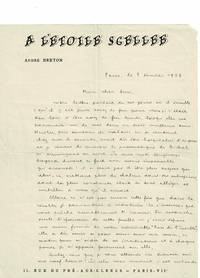
1953réf. 75729Paris 1953. Fine. Paris 8 janvier 1953 21 x 27 cm 1 pages et quelques lignes sur un feuillet Unpublished handwritten signed letter from André Breton addressed to critic Charles Estienne; one page and a few lines in black ink on a paper from the à l'étoile scellée gallery. Two transverse folds from having been sent a small corner missing in the upper right margin. Very beautiful letter giving an account of the death of one of André Breton's dearest friends and of his quarrel with Albert Camus. Breton tells his friend about the death of the Surrealist Czech artist Jindich Heisler: Your letter spoke of those days where it seemed that there was only just enough fire to live: on Monday there was far from enough fire when it reached me: one of my two or three best friends Heisler taken suddenly unwell on his way to mine on Saturday had to be hospitalised urgently and I had just received the pneumatic from Bichat telling me of his death. The event no less inconceivable than accomplished left me distraught for a long time: there was no-one more exquisite than he putting more warmth into everything he did the most constant of which was to lighten and embellish those whom he loved. The two poets were indeed very close: Heisler participated alongside Breton in the launch of Néon in 1948 and supported him during a period of depression accompanying him with other friends to the Île de Sein. The beginning of 1953 was overshadowed by the death of Jindich Heisler 4 January. Loyal among the faithful he lived entirely for Surrealism according to Breton who pays tribute to his activity as a leader: This is how he was between 1948 and 1950 the soul of Néon and until his last moments the greatest bearer of projects that as if by magic his talent gave him the means to achieve. Henri Béhar André Breton In this letter laden with pain Breton suddenly makes reference to L'Homme révolté by Albert Camus published two years earlier: Come on it is not yet the time in the rebellion that I will succeed in introducing the measure that M. Camus kindly preaches to us. The two writers met in New York at the end of March 1946 when Camus was invited to the United States for a conference tour as a representative of Combat. The two agree on the best way to preserve the testimony of certain men free from ideological distortions. They dream of a kind of pact by which people of their calibre would commit to not join any political party to fight against the death penalty to never claim any credit whatsoever. ibid. With other intellectuals they founded the Rassemblement démocratique révolutionnaire RDR in 1948; but the idyll ended a couple of years later in the autumn of 1951 when Camus published Lautréamont et la banalité an extract from his Homme révolté which was published later. Breton was extremely hurt and responded to him in an article entitled Sucre jaune in Arts: This article . testifies to the part of Camus for the first time for an indefensible moral and intellectual position. . He only wants to see a guilty adolescent in Lautréamont whom he - in his capacity as an adult - must discipline. He goes as far as to find him in the second part of his work: Poésies a deserved punishment. According to Camus Poésies would be but a mass of laborious banalities . It could still be worse if the destitution of these views did not intend to promote the most suspect thesis in the world which is that absolute revolt can generate only the taste for intellectual enslavement. This is a completely gratuitous ultra-defeatist statement which must incur even more contempt than its false demonstration. Thus two years later Breton still holds out against Camus' crime of lese-majesty towards that which Breton constructed as the father of surrealism but even more this allusion to Camus' pacifist philosophy bearing witness to the incompatibility between a thought of moderation and a poetry of revol unknown
1965réf. 85694Paul Brand. Good No dust jacket as issued. Third Edition. Flexible cloth. Printed yellow flexible boards Camus with microphone on the front. Crude revisions in ink and erasure on the front. Moderate rubbing brief spine loss several pages with ink marginalia. Uncommon in any condition. International shipping billed at cost. Photos upon request. Please note that the buyer is responsible for any customs duties tariffs or import fees levied by the destination country.; 12mo 7" - 7½" tall . 1965. Paul Brand hardcover
réf. 1566638739.Gpaperback. Good. Access codes and supplements are not guaranteed with used items. May be an ex-library book. paperback
1953réf. 75124Paris: Nrf 1953. Fine. Camus a Reluctant Molière! Nrf Paris 1953 12 x 19 cm relié First edition of Albert Camus's theatrical adaptation one of 65 numbered copies on pur fil paper constituting the deluxe issue. Bradel-style binding in bronze-coloured half box calf boards covered with abstract-patterned paper smooth spine original wrappers and spine preserved binding signed by Thomas Boichot. Les Esprits has its roots in Camus's early theatrical career: he first adapted the play in 1940 for the Théâtre de lÉquipe the company he directed in Algiers and it was performed in Algeria in 1946. He revised it for the Angers Festival in June 1953 personally taking over the productions prepared by Marcel Herrand who had died just days before the premiere. Alongside it Camus staged his translation of Calderón's La Dévotion à la croix. First published in 1579 Larivey's comedy freely adapted from Lorenzino de' Medici's Aridosia owes its lasting reputation to Molière. In his foreword Camus describes it as « le modèle que prit Molière pour écrire son Avare » containing « le fameux monologue que Molière modifia à peine ». Condensing the original five acts into three Camus brings out the play's commedia dell'arte spirit recognising in Larivey's characters « dauthentiques figures darlequins et de ruffians » merely disguised under different names. In doing so he follows in the footsteps of Jacques Copeau his theatrical mentor. Less of an anomaly than it might initially seem this early theatrical venture infused with exuberance and playful lightness could well have served as a perfect prelude to Camus's cycle of the Absurd had he chosen to acknowledge it as such! Nrf hardcover
réf. 1809718-6Edition Olms. Used - Good. Former library copy. Pages intact with minimal writing/highlighting. The binding may be loose and creased. Dust jackets/supplements are not included. Includes library markings. Stock photo provided. Product includes identifying sticker. Better World Books: Buy Books. Do Good. Edition Olms unknown
1954réf. 58192Paris Gallimard 1954. Uncut in the original printed wrappers. Excellent copy. First edition Service de presse-copy i.e. review-copy "S.P" to bottom of title-page and to verso of back wrapper with an excellent presentation-inscription of Camus' magnificent and highly influential collection of essays entitled "Summer". The copy is inscribed to Camus' close friend and ally in numerous respects Jean Paulhan: "a Jean Paulhan/ en affectueuse pensée/ Albert Camus" on half-title. The famous French writer literary critic and publisher Jean Paulhan 1884-1964 shared many things with Camus with whom he grew very close. Not only did he participate actively in the publication of Camus' first books by Gallimard was one of the first to see the true value of Camus' "The Stranger" he was also a confidante of Camus who considered Paulhan one of the main reasons that he became a proper author. In a letter to Paulhan dated September 17 1952 at the moment of break with Sartre Camus writes: "Ever since I thanks to you became what is called an author I have not ceased to be astonished by my brethren. Sometimes it is true in the sense of admiration. Today it is in another sense." Depuis que je suis devenu en peu grâce à vous ce qu'on apelle écrivain je n'ai pas cessé d'être étonné par mes confrères. Parfois dans le sens de l'admiration il est vrai. Aujourd'hui c'est dans un autre sens.Paulhan was an early and active member of the French Resistance director of the literary magazine Nouvelle Revue Française NRF from 1925 to 1940 and again from 1946 to 1968 and a great translator of Malagasy poetry which attracted the interest of the likes of Guillaume Apollinaire and Paul Éluard. He also wrote numerous works of literary criticism "The Flowers of Tarbes or Terror in Literature" 1941 probably being the most famous and he wrote several autobiographical short stories. After the war Paulhan he founded "Cahiers de la Pléiade" and in 1953 he re-launched NRF.Interestingly especially in connection with Camus' famous essays in "L'été" which are devoted entirely to his beloved Algiers Paulhan was loudly against independence for Algeria. He caused great controversy by opposing independence and supporting the French military during the Algerian War. This not only caused public problems for him it also cost him on the personal front as for instance Maurice Blanchot denounced him. The essays in "L'été" are devoted to Algiers and represent a very personal side of Camus who provides a marvelous poetic and humorous picture of the provincial simplicities of Oran and Algiers. For many Camus-devotees "L'Été" constitutes one of the most beloved works as it gives the feel of a certain intimacy with the author that few of his other works does. "In "Return to Tipasa" perhaps the most confessional essay in "Summer" which dates from a long trip to Algeria in December 1952 Camus issues his now famous testimony of survival - "In the depths of winter I finally learned that within me lay an invincible summer" Hawes: Camus A Romance 2009 pp. 181-82. unknown
1959réf. 68972Paris: Gallimard 1959. Fine. Gallimard Paris 1959 12 x 19 cm broché First edition of the theatrical adaptation by Albert Camus one of 40 numbered copies on alfa paper reserved for the author the most limited deluxe issue after 21 on Hollande paper. We include on Gallimard editions letterhead the printed slip ""de la part de M. Albert Camus."" Spine and boards slightly and marginally sunned a pale and small dampstain at foot of spine a marginal crease to front board. Gallimard hardcover
1947réf. 64501Paris: Gallimard 1947. Fine. Gallimard Paris 1947 12 x 18.50 cm broché First edition one of 13 numbered copies on pur fil paper this copy one of 3 lettered hors commerce the only grand papier deluxe copies. Preface by Albert Camus. Endpapers slightly and partially shaded. Rare and nice copy with a photographic portrait of the author as frontispiece. Gallimard unknown
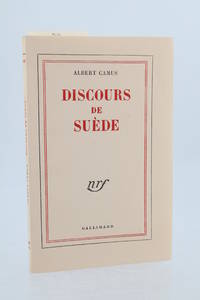
1953réf. 63678Paris: Gallimard 1953. Fine. Rebels of all countries unite! Gallimard Paris 1953 12 x 19 cm relié First edition one of the review copies. A few marginal reading marks. Bradel binding in raspberry-red half morocco smooth spine with date at foot marbled paper boards original wrappers preserved top edge gilt. Binding signed by P. Goy & C. Vilaine. Signed autograph inscription from Albert Camus to Gilbert Sigaux his fellow contributor to Combat: "". avec l'affectueuse pensée de son vieux camarade.""A novelist winner of the 1949 Prix Interallié and journalist for Combat Sigaux had joined Camus in the activities of the Groupes de liaison internationale International Liaison Groups. The second volume of Camus's collected essays and commentaries Actuelles II brings together his polemical writings from 1948 to 1953. At its heart are the « Lettres sur la révolte » in which Camus responds to the attacks provoked by L'Homme révolté: those of André Breton the libertarians associated with Le Libertaire Francis Jeanson and through him Sartre. His letter to the editor of Les Temps modernes subsequently published under the title « Révolte et servitude » marked the definitive rupture between the two writers.Although Gilbert Sigaux like Camus had worked as a journalist for Combat and had published a highly favourable review of the first volume of Actuelles in its pages Camus's presentation of this new collection of politically engaged writings was far more than a gesture of professional gratitude.From November 1948 onwards the two men were united in a new struggle one fundamentally opposed to the Manichaean outlook for which Camus would later reproach Sartre:« Il ne sagit pas dajouter encore à la haine du monde et de choisir entre deux sociétés ».This conviction that uncompromising revolt need not entail the rejection of others was one of the founding principles of the Groupes de liaison internationale established in November 1948 at the initiative of the trade unionist Roger Lapeyre with Camus at their centre. Camus drafted most of the manifesto which Sigaux signed alongside him before becoming an active member of the organisation.Together they sought « de faire connaître en Europe lexistence des non-conformistes américains et des opposants russes de rendre une voix enfin à tout ce qui dans lhistoire déshonorée que nous vivons donnera à des millions de solitaires des raisons lucides et valables despérer ». Meeting at the offices of Force ouvrière in the rue de l'Université writers trade unionists and libertarians worked to support Spanish Republicans and refugees from Eastern Europe. Between 1949 and 1950 they published four bulletins one of which was devoted to forced labour in the USSR. Daniel Martinet himself a member would later write that their « seul ciment » was « la personnalité dAlbert Camus ». This humanist endeavour eventually came to an end following Camus's departure for South America and his illness in 1950 although as Martinet recalled « sans que les gens qui y avaient participé se perdent de vue » cf. Maitron.Actuelles II gives voice to the uncompromising yet fiercely independent political commitment that had brought the two men together through public interventions and a steadfast opposition to totalitarianism: Camus's speech opposing Francoist Spain's admission to UNESCO his address « Le pain et la liberté » to trade unionists in Saint-Étienne in May 1953 and his preface to Alfred Rosmer's memoir Moscou sous Lénine.An important review copy of this veritable manifesto of political independence personally inscribed by Camus to his « vieux camarade » a comrade in both the editorial battles of Combat and the wider struggle for their shared ideals. Gallimard hardcover
1939réf. 44692Alger i.e. Algiers 1939. 8vo. Entire 2nd issue of "Rivages" present. Uncut. Original printed wrappers showing an outline map of the Mediterranean. A bit of brownspotting and a tiny tear to front wrapper. A bit of wear to lower capital and minor wear to extremities. All in all a fine copy. Été à Alger: Pp. 87-91. Entire issue: 16 -advertisements pp. pp. 65-128 16 -advertisements pp. The very rare first printing of one of Camus' earliest literary productions namely the first part of his famous "Été à Alger" which was printed later the same year in his second book "Noces" for which there is an advertisement on the inside of the back wrapper in the second part of the very rare Algerian review "Rivages".In all only two numbers of "Rivages" appeared as it was interrupted due to the censorship at the beginning of the war. It was edited by Camus together with Gabriel Audisio René-Jean Clot Jacques Heurgon and Jean Hytier and was published by Edmond Charlot in Algiers. The aim of the review was to provide to the rest of the world with an insight in to the rich cultural life of the Mediterranean. When "Été à Alger" originally appeared in "Rivages" Camus had only published one book ""L'Énvers et l'Endroit" 1937. Later in 1939 his second book "Noces" which is announced in the present volume of "Rivages" appears. unknown
1735réf. 46584Paris L'Imprimerie Royale 1735. 4to. Without wrappers. Extracted from "Mémoires de l'Academie des Sciences. Année 1733". Pp. 117-140 and 4 folded engraved plates. Fine and clean. By this paper Camus was the first to work out the mathematical theory of gearteeth into a systematical and general theory of the mechanism. unknown
1749réf. 40768Paris Ballard Fils Vol. I Paris De Prault Vol.3-4 1749-67. Large 8vo. Bound in 4 fine full mottled calf. Raised bands richly gilt compartments tome-and titlelabels with gilt lettering. A paperlabel pasted on upper compartment. Top of spine to vol. one with wear. Volume one slightly different in binding. Stamps on titlepages. 4IV bound at end472;VI563XXXII3;XX396;VIII442 pp. and 92 large folded engraved plates. Internally clean and fine printed on good paper. Camus main work. He joined Maupertouis Clairaut and Lemonnier on the scientific expedition to Lapland in 1736 to determine the shape of the earth. "In 1730 he was named to the Academy of Architecture and became its secretary shortly thereafter. There he gave public lessons to aspiring architects as the Academy's professor of Geometry. These lessons later served as the basis of a "Course de mathematique".In 1755 when Camus was also named the examiner for artillery schools this "Course" became the standard work for artillery students." Seymor Shapin in DSB. hardcover
1983réf. 55663Paris: Lettres vives 1983. Fine. Lettres vives Paris 1983 14.50 x 22 cm broché First edition one of 40 numbered copies on vellum Lafuma and justified by the author. Signed autograph Michel Camus to Leo Charance. Nice copy. Lettres vives hardcover