Livre Rare Book

6 234 résultats
1681réf. 43386Correriae, Per Laurentium Gilibert, typographum Juratum apud Gratianopolim, 1681. Petit in-8 de 339-(41) pp. 48 pp. (8)-91-(1) pp., index, errata (signatures: A-Aa dernier blanc, A-C a-f ), veau granité, dos orné à nerfs (reliure de l'époque).
17973 parti in un vol. in-4 gr., 2 ff. n.n. (occhietto latino e greco per la Teogonia) 16, 1-45, 1 bianca, 1 f bianco aggiunto e n.n., 1 f. n.n. di occhietto greco per le Opere e i Giorni, 49- 110; 1 f. n.n. occhietto Teogonia Latino, 279, 104 p. L'occhietto Opere e Giorni latino è inserito nella numerazione, leg. cartone editoriale arancione, con titolo in oro su tassello coevo in pelle. Sul titolo delle tre parti vi è inciso il ritratto in medaglione del poeta. Splendida edizione bodoniana, dedicata dallo Zamagna a Ferdinando d'Austria. Ottimo esempl. su carta forte, a pieni margini con barbe.. Brooks nn.689 e 690: Il Brooks non descrive il f. bianco tra 46 e 47 della parte greca, mentre per il resto la collazione coincide. De Lama II, 36..
réf. 15939Paris, Presses de Louis Jou, 1934-1936 ; 3 tomes in-4 raisin (25 x 33 cm), brochés sous couverture crème rempliée illustrée, chemise demi-toile noire, titre repris du portefeuille d'origine or sur fond rouge, étui noir bordé de toile noire (étuis renouvelés avec titres conservés) ; composé de plus de 1200 pages, 3 couvertures, 3 titres, 3 portraits, colophons, bandeaux, lettres ornées, culs-de-lampe, etc. ; soit environ 380 gravures ; le tirage est en noir et rouge et, selon les besoins, or et camaïeu, le blason à fond bleu et meubles dorés.
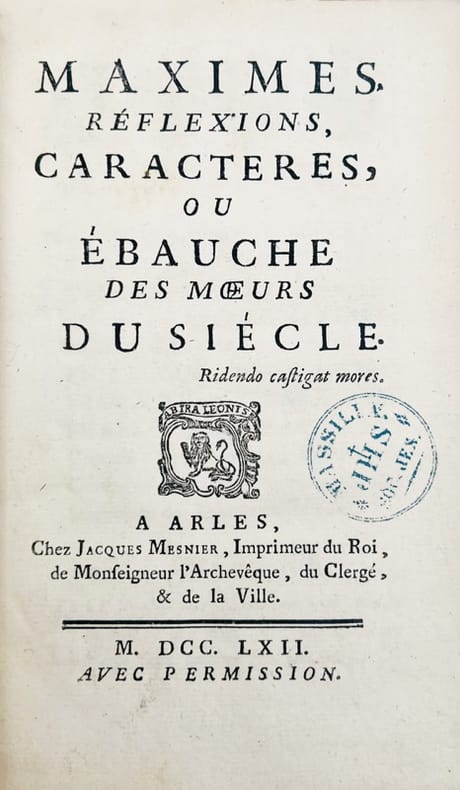
1762réf. 44592Arles, Jacques Mesnier, 1762. In-12 de (8)-235-(1) pp. maroquin rouge, dos lisse orné, roulette, filet et frise dorés d'encadrement sur les plats, armes et devise dorées de la ville d'Arles frappées au centre, tranches dorées (reliure de l'époque).
1572réf. 42366In Venetia, , 1572. In-12 oblong (15 x 20,6 cm) de (4) ff. de texte (43) ff., modèles de calligraphie, titre avec vignette gravée sur bois, veau brun, dos orné à nerfs (reliure du XVIIe siècle). Manque 8 feuillets (signatures D 6 à E 5).
1803réf. 42625Londres, A. Dulau et Prosper, Imprimerie de L. Nardini, 1803. In-4 de XXVIII-199-(1) pp., 5 gravures hors texte, maroquin rouge à long grain, roulette, filets et frise dorés en encadrement, fleuron aux angles, chiffres couronnés au centre des plats, dos lisse orné, tranches dorées (reliure de l’époque).
1684réf. 41014Sans lieu, , 1684. 5 pièces reliées en 1 vol. petit in-12, maroquin rouge, dos orné à nerfs, plats orné d'un encadrement à petits fers d'écoinçons, filets et roulettes dorés, chiffre couronné sur les plats, dentelle intérieure, tranches dorées (reliure de l'époque).
1521réf. 41475Paris, Jehan Petit, 1521. Petit in-8 gothique à deux colonnes (106 x 165 mm) de CXVI-(5) ff. (sign. a-o8, p4, q5), demi-basane marbrée, dos orné à nerfs, pièce de titre en maroquin rouge, tranches rouges (reliure du XVIIIe siècle).
1624réf. 41596Metz, Domenge Brecquin, 1624. In-4 réglé de (20)-221 pp., portrait gravé in-texte, vélin doré, dos lisse orné, double filet d'encadrement et motif ornemental sur les plats, tranches dorées (reliure de l'époque).
1639réf. 14738Douai, Veuve Marc Wyon, 1639. 4 parties en 1 vol. grand in-4 (19 x 30 cm) de XXX-(2)-588-(48) pp. (8) pp. de généalogie entre les pp. 244 et 245, 1 titre-frontispice, 1 carte repliée, 1 portrait de l'auteur, veau fauve, dos à nerfs orné de filets et fleurons dorés, armes de la ville de Valenciennes poussées sur les plats dans un filet d'encadrement doré (reliure de l'époque).
1519réf. 44686Paris, Jehan de Marnef, 1519. In-8 gothique à deux colonnes de 208-8 ff. (sign. a-π8, A8, le dernier blanc), veau brun estampé à froid, dos à trois nerfs, traces de lacet (reliure de l'époque).
1899réf. 002740Paris, Edouard Pelletan, 1899
1610réf. 15256Valenchienne, Jean Veruliet, 1610. Petit in-8 de (24)-328-(24) pp., titre-frontispice, vélin souple, titre manuscrit sur le dos, traces de lacet (reliure de l'époque).
1956réf. 194540Beijing Shanghai and other cities: assorted publishers 1956-80. The aesthetics of revolution A visually attractive grouping spanning a quarter of a century during which China was gripped by successive political campaigns. These booklets were aimed at grassroots organizations in urban and rural areas offering guidance for formatting lettering and sample graphics. Aesthetic correctness was paramount: those issued during the Cultural Revolution carefully regulate the presentation of Mao's quotations. One publication the specimen catalogue for the Beijing Xinhua Matrix Factory is a window onto the operation of the state-run printing industry. Issued in July 1967 when the country was swept by a mania for printing political broadsides screeds and newsheets it details the dozens of typefaces available to central and local presses. a Meishu zi xue xi "Studying Fine Lettering". Shanghai: 1956. b Meishu zi xiefa "A Method for Fine Lettering". Shanghai: 1963. c Nongcun yingyong meishu zi "Fine Lettering for the Countryside". Shanghai: 1964. d Beijing xinhua zimo chang hanwen waiwen ziti yangzhang "Beijing Xinhua Matrix Factory Specimen Sheets: Chinese and Foreign Languages". Beijing: 1967. e Geming da pipan baotou xuanji "Selections from Revolutionary Periodicals". Hangzhou: 1970. f Geming wenyi "Revolutionary Art". Harbin: 1970. g Meishu "Fine Art". Hohhot: 1971. h Meishu cankao ziliao baotou xuanji "Art Reference Materials: Selected Banners". Beijing: 1971. i Meishu zi cankao ziliao "Reference Materials for Fine Lettering". Tianjin: 1972. j Hongxiaobing baotou xuan "Selections from Little Red Guard Publications". Shanghai: 1973. k Liandui meishu cankao ziliao "Art Reference Materials for Air Force Companies". Beijing: 1980. Eleven works octavo or duodecimo. Illustrations throughout many in colour. Text in Chinese. All in original printed wrappers excepting catalogue of specimen sheets cover and sheets with punch holes tried with pink ribbon as issued. A few contemporary ink stamps and ownership markings. Cover of catalogue of specimen sheets pulling at holes Hohhot manual with writing indentations on front cover earlier publications with browning and spotting as expected but overall very good. unknown
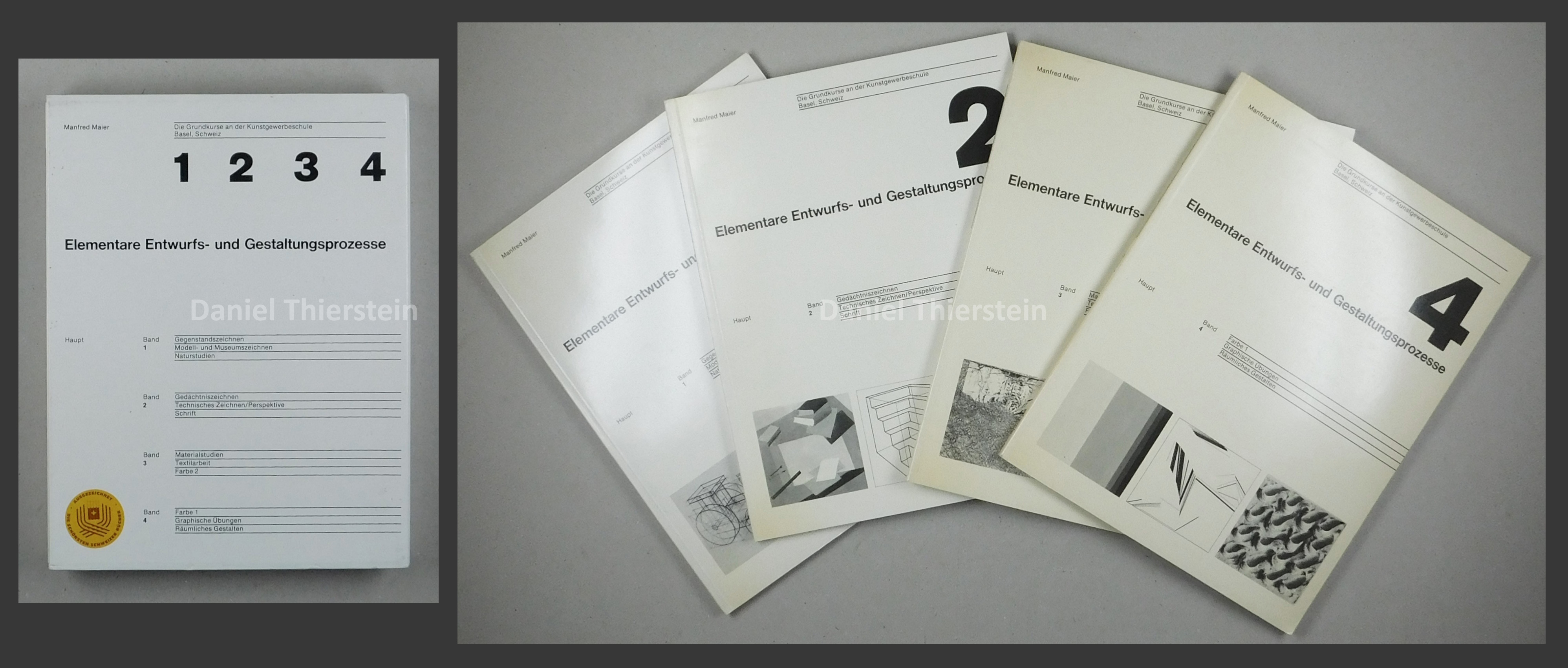
1977réf. 55311ABBern, Haupt., 1977. 4°. Jeder Band 104 S. Mit vielen teils farbigen Abbildungen. Originalbroschuren in Schuber. 4 Bände.
1977réf. 55311AB4 Bände. Bern, Haupt. 1977. 4°. Jeder Band 104 S. Mit vielen teils farbigen Abbildungen. Originalbroschuren in Schuber.
Folio (440 x 270 mm), title followed by 111 leaves printed on one side only, 7 leaves with small area excised, 1 leaf torn in half with remaining portion loosely inserted, 1 leaf torn across centre, title-page printed with elaborate wood-engraved decorative border, some light fraying to blank margins of several leaves, orig. half calf, re-cased, title stamped in gilt on upper cover, corners rubbed. Figgins had issued specimens as early as 1792, but these were in small pamphlet form. By the 1820s they were issuing specimens in a 8vo book form, these were followed by quarto specimens in the early 1840s. "The Quarto Specimen Book was supplemented in 1847 by the 'Epitome of Specimens,' which contains a selection of antiques, blacks, and jobbing types, with flowers, borders, and ornaments, the book and news founts being shown in small paragraphs."?Bigmore & Wyman. This book was continually added to until 1871, when it became too large and heavy for the post, thereafter the specimens issued by Figgins were issued in a smaller condensed form. All edition of this folio specimen are rare. Bigmore & Wyman I p. 218; Gray, p. 185.
1791réf. 0005591Worcester & Boston: Isaiah Thomas 1791. First edition. Hardcover. Good. With two of the 50 copperplate engravings from the folio edition plates 29 & 48. Royal quarto 1310 pages contemporary blindstamped full sheep repaired joints and head and foot spine panels replaced and with new endpapers; The frontispiece has been tipped-in on the new endpaper; rear cover very scuffed foxing and spots throughout edgeworn a few minor marginal tears and chips some leaves imperfectly sewn in. The Family Record leaves have extensive handwritten notes of the families of Gen. Joseph Badger Jr. Signed by him of Gilmanton Belmont NH father of Gov. Wm. Badger 1834-36. & Charles Jacobs of Gilmanton. Isaiah Thomas whom Benjamin Franklin called 'the Baskerville of America' was one of the notable publishers during the early days of the Republic.He made every effort to ensure accuracy of the text by comparing some thirty different editions and having the text carefully examined by several clergymen and others who compared it with eight Bibles - Herbert 1353." The First Illustrated Bible printed in America is the 1791 folio Bible by Isaiah Thomas "The most sumptuous American Bible of the eighteenth century" : thus this quarto-sized version of that work is the Second Illustrated Bible printed in America and the first Royal Quarto Bible in English published in American both editions were announced as "completed" on the same date altho vol. 2 of the folio was still in progress. Rumball-Petre 172; Sabin 5173 variant; O'Callaghan pp. 40-42; Hills 30. Evans 23185 states that some copies were issued with no Concordance and 48 additional plates. This state however has only two copperplates as frontispieces of the 50 copperplate engravings from the folio edition plates 29 & 48 . Included are 200 pages of Tables Apocrypha and Family Records Index etc. The subscription price was $7 but half the price could be paid in wheat rye Indian corn butter or pork! It is believed that 1500 copies of each format were printed. "The two Thomas Bibles of 1791 were without doubt far in advance of any other publications of the same kind that had appeared in America in point of typography excellence of paper binding and general execution - Wright EARLY BIBLES OF AMERICA." Isaiah Thomas hardcover
1525réf. 43463S.l.n.d. (Paris, Jean Cornillau, Hémon Le Fèvre, 1525). Petit in-folio gothique (185 x 275 mm) de CXXXIX-[1] ff. (sig. a-q8, r-s6), caractères gothiques, veau brun estampé à froid, dos à nerfs, traces de fermoir, pièce de titre papier anonyme au dos (reliure de l'époque).
réf. 8450Paris. Imprimerie Nationale. 1900-1914. 4 tomes en 4 volumes in-folio. Reliure demi-maroquin rouge à coins, tête dorée, dos à cinq nerfs. Impression sur papier japon. E.O. tirée à 500 exemplaires. Bon exemplaire ; ne sont à mentionner que quelques frottements aux coins, bords et nerfs des reliures, sans gravité. Imposant et rare.
1587réf. 40231Paris, Abel L'Angelier , 1587. In-16 de (16)-404 ff. (A-Z8, Aa-Zz8, AA-FF8), saut de foliotation (16 à 21) sans manque, table et portrait de l'auteur au verso du titre, maroquin rouge, dos orné à nerfs, motif d'ornement doré sur les plats, dentelle intérieure, tranches dorées (reliure du XIXe siècle).
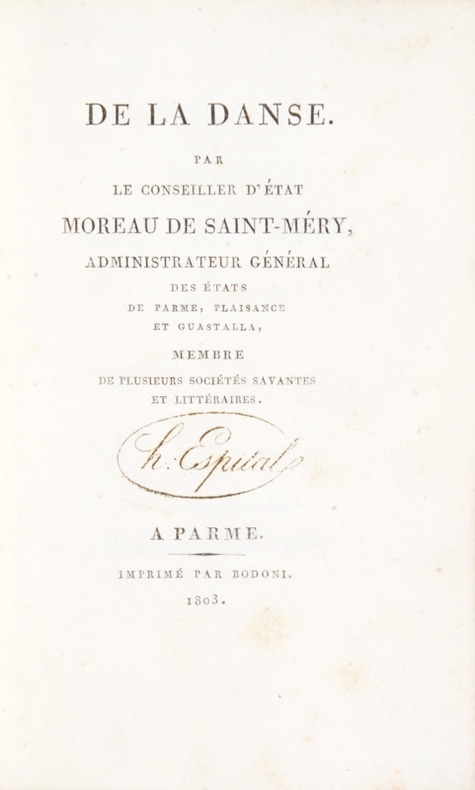
1803réf. 41822A Parme, imprimé par Bodoni, 1803. Petit in-8 de (8)-61 pp. 1 feuillet blanc, basane blonde, dos lisse orné, pièce de titre en maroquin rouge, roulette dorée sur les plats (reliure de l'époque).
1884réf. 41090Blois, Raoul Marchand, 1884. In-8 à pagination multiple (14,5 x 22,5 cm) cartonnage Bradel de soie à motifs de fleurs, dos lisse muet, non rogné (Thiolat, rel. Blois).
1736In folio. pp (2), 38, un rame al frontespizio “dominicus muratori inv. et delin. Vincen. Franceschini scul.”, nel testo da indisegni di Muratori e incisi da Rossi, Limpach, Allet, 6 vignette incise su rame come testatine e finalini e un capolettera. Contiene gli elogia a Maria Clementina in diverse lingue: ebraico, graco, arabo, siriaco, armeno, caldaico, copto, polacco, gotico, illirico, ecc ecc. Legatura in piena pelle con cornice dorata ai piatti e decorazioni in oro al dorso.
2008réf. 94189Birkhäuser Architecture. New. 2008. Hardcover. 3764385812 . FREE UPGRADE to Courier/Priority Shipping Upon Request - IN STOCK AND IMMEDIATELY AVAILABLE FOR SHIPMENT - Flawless copy brand new pristine never opened -- Text in English. 460 pages; 430 color 620 b/w illustrations. Description: "Adrian Frutiger first came to the design world's attention in the late 1950s with his design of Univers and the numbering concept behind it. A considerable proportion of his output has also been informed by developments in typesetting technology. In the 1970s he set a standard for signage typefaces with his Alphabet Roissy for the Paris-Roissy airport. Slightly reworked this went on to enjoy great success as a body typeface under the name Frutiger. His machine-readable OCR-B which is used on paying-in slips passports credit cards and as ISBN numbers on books has become an official ISO standard. His sans serif typefaces Avenir and Vectora which appeared at the end of the 1980s stand out because of their exceptional readability and have cemented Frutigers reputation as 'Mr Sans Serif'. The Complete Works is based on interviews and conversations with the designer and on comprehensive research by the editors. Its depth and range make it an indispensable reference work. Completed in the year of Adrian Frutiger's 80th birthday it represents as is his wish his legacy to further generations of type designers and typographers." Birkhäuser Architecture hardcover