THEOCRITE.Livre Rare Book

6.391 Ergebnisse
1792Best.-Nr. 5795Parme, Bodoni, 1792. 2 parties en 1 vol. in-8 de (4)-175-(1) pp. et (4)-190-(2) pp. 1 f. blanc, veau marbré, dos orné à nerfs, triple filet doré sur les plats, fleurons aux angles, pièces de titre en maroquin rouge et en maroquin noir, tranches dorées (reliure de l'époque).
1838Very Good Turkish, Ottoman (1500-1928) Original full leather bdg. with its miklep (traditional flap), embossed shamsa (mystical sun) on boards. Roy. 8vo. (24 x 17 cm). In Ottoman script. [8], 263 p. Sarlavla page decorated with traditional ornaments. First edition of this extremely rare and the first translation of the Anabasis of Alexander in the Ottoman / Turkish literature. One of 1010 copies. The Anabasis of Alexander was composed by Arrian of Nicomedia in the second century AD, most probably during the reign of Hadrian. The Anabasis (which survives complete in seven books) is a history of the campaigns of Alexander the Great, specifically his conquest of the Persian Empire between 336 and 323 BC. Both the unusual title "Anabasis" (literally "a journey up-country from the sea") and the work's seven-book structure reflect Arrian's emulation (in structure, style, and content) of the Greek historian Xenophon, whose own Anabasis in seven books concerned the earlier campaign "up-country" of Cyrus the Younger in 401 BC. The Anabasis is by far the fullest surviving account of Alexander's conquest of the Persian Empire. It primarily revolves around the military history, reflecting the content of Arrian's model, Xenophon's Anabasis; the work begins with Alexander's accession to the Macedonian throne in 336 BC and has nothing to say about Alexander's early life (in contrast, say, to Plutarch's Life of Alexander). Nor does Arrian aim to provide a complete history of the Greek-speaking world during Alexander's reign. Arrian's chief sources for his writing of the Anabasis were the lost contemporary histories of the campaign by Ptolemy and Aristobulus and, for his later books, Nearchus. One of Arrian's main aims in writing this work on history seems to have been to correct the standard "Vulgate" narrative of Alexander's reign that was dominant in his own day, primarily associated with the lost writings of the historian Cleitarchus. The Anabasis gives a broadly chronological account of the reign of Alexander the Great of Macedonia (336-323 BC), with a particular focus on military matters. George Rhasis (Yorgaki Razi) translated Anabasis Alexandrou = "History of Alexander the son of Philip" the work of Xenophon under the title "Târîh-i Iskender bin Filipos". This is the first translation of an ancient Greek historian into Turkish. Georgios Rhasis, who was one of the first writers of the French-Turkish dictionary in the early period, was an Ottoman intellectual who worked as an instructor and translator in Ottoman and French languages. He also taught at the Eastern Languages School in Paris and continued her studies in Corfu and Paris. In 1821 he came to be in Istanbul as a famous orientalist. Rhasis left the city and the homeland he lived in to settle in Tsarist Russia due to concerns during the Greek Revolution in 1821. The Bulaq or El-Amiriya Press is the first official and governmental printing press to be established in Egypt, and functions according to industrial printing basis, causing not just a qualitative but also a quantitative and knowledgeable leap in science throughout the Arab region. It's established in 1820 by Muhammad Ali Pasha of Egypt and Sudan (1769-1849) and it was part of Muhammad Ali's inclusive development plans for the modernization of Egypt. Library of Congress, Karl Süssheim Collection, no. 129. (OCLC: 966315151). Only 6 copies in OCLC: 27236333.; Alex II 25.; BM e15.; Cairo FKT 166.; IstUKT 802.; Bianchi CD 155.; Bulaq IF 8:21.; Bulaq FK 7:8.; Ridwan 162.; Özege 19837 (No author and no translator in Özege record).
In-folio, legatura edit. in Mz.Tela con piatti in cartone ill., cc. 4 con doppio front. ed indici delle tavole +100 tavole in fotoincisione, protette da velina. Fioriture sparse, legatura con difetti alle cuffie e piatti con usure ai margini. Invio autografo dell'editore. Viene considerato il capolavoro della fotoincisione veneziana.
1936Edizione originale. Esemplare appartenente all’emissione originale, sciolta, fatta per la circolazione pubblicitaria; in eccellenti condizioni di conservazione, pulito e intatto in ogni sua parte, senza gli inevitabili segni di adesione degli esemplari inseriti tramite pinzatura («glued» secondo l’Associazione Campo Grafico) nel numero IV,2 di «Campo grafico». Rarissimo opuscolo pubblicitario firmato dalla ditta di grafica e pubblicità R + M di Milano, fondata nel 1931 dai giovani Riccardo Castagneri (RiCas) e Bruno Munari, artista futurista già piuttosto noto e destinato a diventare uno dei principali designer del Novecento italiano. «Nero A.O.» è un prodotto eccezionale sia sotto il profilo grafico che dal punto di vista della comunicazione pubblicitaria (slogan, copywriting &c.), configurandosi in tutto e per tutto all’altezza delle più creative realizzazioni degli anni ’60 — ma siamo a metà degli anni trenta, nel profondo dell’Italia fascista e imperialista. -- Oltre alla celebre «Tavolozza delle possibilità tipografiche», «another advertising project, however, receives a positive reception, this one also created during the same period together with Muggiani, marked by an improved economy of means. It is the promotional brochure “Nero A.O.” 1936 for the company Concentra/F.lli Hartmann, and features a new printing ink, appropriately renamed with a nod to the war going on in Africa, as is the photographic idea on the cover; inside, instead, text and images alternate in a clear layout, with large, well-spaced type, printed in color and, on the front, suggestive black-and-white images (photo- montage and typographic compositions) or demonstrative images displaying the product’s qualities (print proofs with different screens)» (Colizzi). -- Fu recensito molto positivamente sul n. IV,2 di «Campo grafico», febbraio 1936, p. 29, che ne proponeva anche copia dell’originale interfoliata (si ricorda qui che la tiratura dei fascicoli di «Campo grafico», in ogni caso, non superava le cinquecento copie). Colizzi, Bruno Munari and the invention of modern graphic design in Italy (PhD thesis Universiteit Leiden 2011), p. 124; manca a Maffei, Munari: i libri
2 volumi in-4, (Primo vol.:) antiporta incisa in rame da Gubernatis, occhietto, ff. 3 n.n., pp. III, 231. (Secondo vol.:) antiporta incisa in rame da Rosaspina su soggetto di Pigozzi, 3 ff. n.n., pp. IX, (2), 252. Legatura originale in cartonato arancione, tasselli con titolo ai dorsi. Importante opera bio-bibliografica su G.B. Bodoni, il grande stampatore saluzzese (1740-1813). Il De Lama nel secondo volume compila il primo catalogo bibliografico completo e preciso delle oltre 200 edizioni bodoniane, dal 1768 al 1816, ancora oggi consultato e fondamentale. Esemplare a pieni margini con barbe.. .
1544Best.-Nr. 14383Parisiis, Ex officina Rob. Stephani, 1544. In-8 de 394-(14) pp. (sign. aa-zz, AA, BB8, CC4), vélin ivoire, étiquette ancienne sur le dos (reliure de l'époque).
1681Best.-Nr. 43386Correriae, Per Laurentium Gilibert, typographum Juratum apud Gratianopolim, 1681. Petit in-8 de 339-(41) pp. 48 pp. (8)-91-(1) pp., index, errata (signatures: A-Aa dernier blanc, A-C a-f ), veau granité, dos orné à nerfs (reliure de l'époque).
17973 parti in un vol. in-4 gr., 2 ff. n.n. (occhietto latino e greco per la Teogonia) 16, 1-45, 1 bianca, 1 f bianco aggiunto e n.n., 1 f. n.n. di occhietto greco per le Opere e i Giorni, 49- 110; 1 f. n.n. occhietto Teogonia Latino, 279, 104 p. L'occhietto Opere e Giorni latino è inserito nella numerazione, leg. cartone editoriale arancione, con titolo in oro su tassello coevo in pelle. Sul titolo delle tre parti vi è inciso il ritratto in medaglione del poeta. Splendida edizione bodoniana, dedicata dallo Zamagna a Ferdinando d'Austria. Ottimo esempl. su carta forte, a pieni margini con barbe.. Brooks nn.689 e 690: Il Brooks non descrive il f. bianco tra 46 e 47 della parte greca, mentre per il resto la collazione coincide. De Lama II, 36..
Best.-Nr. 15939Paris, Presses de Louis Jou, 1934-1936 ; 3 tomes in-4 raisin (25 x 33 cm), brochés sous couverture crème rempliée illustrée, chemise demi-toile noire, titre repris du portefeuille d'origine or sur fond rouge, étui noir bordé de toile noire (étuis renouvelés avec titres conservés) ; composé de plus de 1200 pages, 3 couvertures, 3 titres, 3 portraits, colophons, bandeaux, lettres ornées, culs-de-lampe, etc. ; soit environ 380 gravures ; le tirage est en noir et rouge et, selon les besoins, or et camaïeu, le blason à fond bleu et meubles dorés.
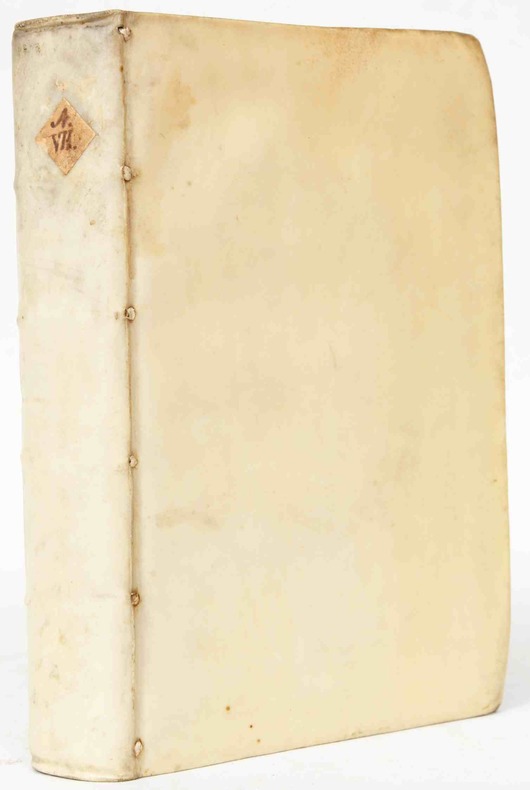
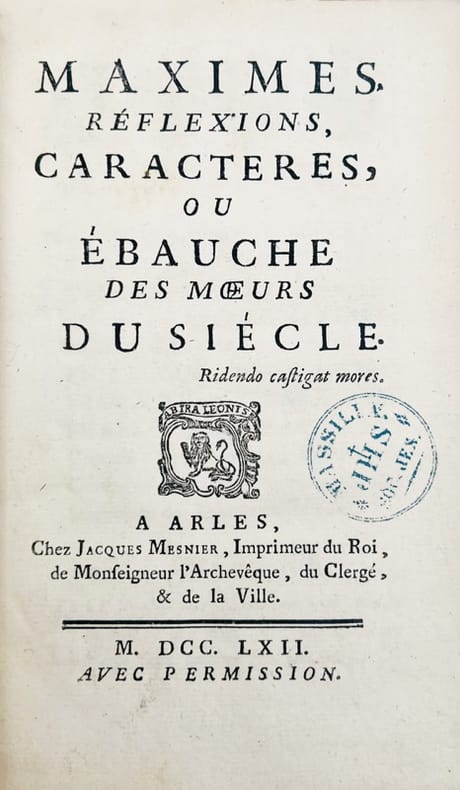
1762Best.-Nr. 44592Arles, Jacques Mesnier, 1762. In-12 de (8)-235-(1) pp. maroquin rouge, dos lisse orné, roulette, filet et frise dorés d'encadrement sur les plats, armes et devise dorées de la ville d'Arles frappées au centre, tranches dorées (reliure de l'époque).
1572Best.-Nr. 42366In Venetia, , 1572. In-12 oblong (15 x 20,6 cm) de (4) ff. de texte (43) ff., modèles de calligraphie, titre avec vignette gravée sur bois, veau brun, dos orné à nerfs (reliure du XVIIe siècle). Manque 8 feuillets (signatures D 6 à E 5).
1803Best.-Nr. 42625Londres, A. Dulau et Prosper, Imprimerie de L. Nardini, 1803. In-4 de XXVIII-199-(1) pp., 5 gravures hors texte, maroquin rouge à long grain, roulette, filets et frise dorés en encadrement, fleuron aux angles, chiffres couronnés au centre des plats, dos lisse orné, tranches dorées (reliure de l’époque).
1684Best.-Nr. 41014Sans lieu, , 1684. 5 pièces reliées en 1 vol. petit in-12, maroquin rouge, dos orné à nerfs, plats orné d'un encadrement à petits fers d'écoinçons, filets et roulettes dorés, chiffre couronné sur les plats, dentelle intérieure, tranches dorées (reliure de l'époque).
1521Best.-Nr. 41475Paris, Jehan Petit, 1521. Petit in-8 gothique à deux colonnes (106 x 165 mm) de CXVI-(5) ff. (sign. a-o8, p4, q5), demi-basane marbrée, dos orné à nerfs, pièce de titre en maroquin rouge, tranches rouges (reliure du XVIIIe siècle).
1624Best.-Nr. 41596Metz, Domenge Brecquin, 1624. In-4 réglé de (20)-221 pp., portrait gravé in-texte, vélin doré, dos lisse orné, double filet d'encadrement et motif ornemental sur les plats, tranches dorées (reliure de l'époque).
1639Best.-Nr. 14738Douai, Veuve Marc Wyon, 1639. 4 parties en 1 vol. grand in-4 (19 x 30 cm) de XXX-(2)-588-(48) pp. (8) pp. de généalogie entre les pp. 244 et 245, 1 titre-frontispice, 1 carte repliée, 1 portrait de l'auteur, veau fauve, dos à nerfs orné de filets et fleurons dorés, armes de la ville de Valenciennes poussées sur les plats dans un filet d'encadrement doré (reliure de l'époque).
1519Best.-Nr. 44686Paris, Jehan de Marnef, 1519. In-8 gothique à deux colonnes de 208-8 ff. (sign. a-π8, A8, le dernier blanc), veau brun estampé à froid, dos à trois nerfs, traces de lacet (reliure de l'époque).
1899Best.-Nr. 002740Paris, Edouard Pelletan, 1899
1610Best.-Nr. 15256Valenchienne, Jean Veruliet, 1610. Petit in-8 de (24)-328-(24) pp., titre-frontispice, vélin souple, titre manuscrit sur le dos, traces de lacet (reliure de l'époque).
1956Best.-Nr. 194540Beijing Shanghai and other cities: assorted publishers 1956-80. The aesthetics of revolution A visually attractive grouping spanning a quarter of a century during which China was gripped by successive political campaigns. These booklets were aimed at grassroots organizations in urban and rural areas offering guidance for formatting lettering and sample graphics. Aesthetic correctness was paramount: those issued during the Cultural Revolution carefully regulate the presentation of Mao's quotations. One publication the specimen catalogue for the Beijing Xinhua Matrix Factory is a window onto the operation of the state-run printing industry. Issued in July 1967 when the country was swept by a mania for printing political broadsides screeds and newsheets it details the dozens of typefaces available to central and local presses. a Meishu zi xue xi "Studying Fine Lettering". Shanghai: 1956. b Meishu zi xiefa "A Method for Fine Lettering". Shanghai: 1963. c Nongcun yingyong meishu zi "Fine Lettering for the Countryside". Shanghai: 1964. d Beijing xinhua zimo chang hanwen waiwen ziti yangzhang "Beijing Xinhua Matrix Factory Specimen Sheets: Chinese and Foreign Languages". Beijing: 1967. e Geming da pipan baotou xuanji "Selections from Revolutionary Periodicals". Hangzhou: 1970. f Geming wenyi "Revolutionary Art". Harbin: 1970. g Meishu "Fine Art". Hohhot: 1971. h Meishu cankao ziliao baotou xuanji "Art Reference Materials: Selected Banners". Beijing: 1971. i Meishu zi cankao ziliao "Reference Materials for Fine Lettering". Tianjin: 1972. j Hongxiaobing baotou xuan "Selections from Little Red Guard Publications". Shanghai: 1973. k Liandui meishu cankao ziliao "Art Reference Materials for Air Force Companies". Beijing: 1980. Eleven works octavo or duodecimo. Illustrations throughout many in colour. Text in Chinese. All in original printed wrappers excepting catalogue of specimen sheets cover and sheets with punch holes tried with pink ribbon as issued. A few contemporary ink stamps and ownership markings. Cover of catalogue of specimen sheets pulling at holes Hohhot manual with writing indentations on front cover earlier publications with browning and spotting as expected but overall very good. unknown
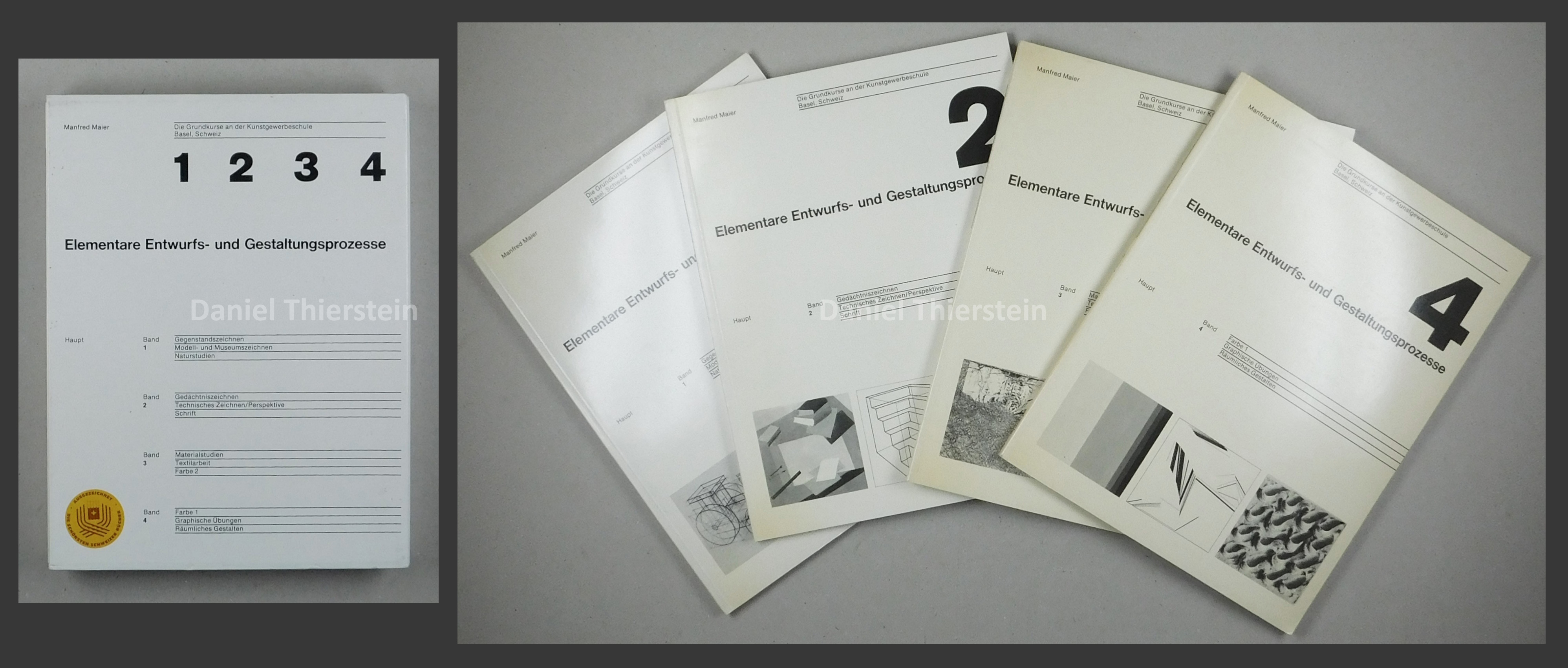
1977Best.-Nr. 55311ABBern, Haupt., 1977. 4°. Jeder Band 104 S. Mit vielen teils farbigen Abbildungen. Originalbroschuren in Schuber. 4 Bände.
1977Best.-Nr. 55311AB4 Bände. Bern, Haupt. 1977. 4°. Jeder Band 104 S. Mit vielen teils farbigen Abbildungen. Originalbroschuren in Schuber.
Folio (440 x 270 mm), title followed by 111 leaves printed on one side only, 7 leaves with small area excised, 1 leaf torn in half with remaining portion loosely inserted, 1 leaf torn across centre, title-page printed with elaborate wood-engraved decorative border, some light fraying to blank margins of several leaves, orig. half calf, re-cased, title stamped in gilt on upper cover, corners rubbed. Figgins had issued specimens as early as 1792, but these were in small pamphlet form. By the 1820s they were issuing specimens in a 8vo book form, these were followed by quarto specimens in the early 1840s. "The Quarto Specimen Book was supplemented in 1847 by the 'Epitome of Specimens,' which contains a selection of antiques, blacks, and jobbing types, with flowers, borders, and ornaments, the book and news founts being shown in small paragraphs."?Bigmore & Wyman. This book was continually added to until 1871, when it became too large and heavy for the post, thereafter the specimens issued by Figgins were issued in a smaller condensed form. All edition of this folio specimen are rare. Bigmore & Wyman I p. 218; Gray, p. 185.
1791Best.-Nr. 0005591Worcester & Boston: Isaiah Thomas 1791. First edition. Hardcover. Good. With two of the 50 copperplate engravings from the folio edition plates 29 & 48. Royal quarto 1310 pages contemporary blindstamped full sheep repaired joints and head and foot spine panels replaced and with new endpapers; The frontispiece has been tipped-in on the new endpaper; rear cover very scuffed foxing and spots throughout edgeworn a few minor marginal tears and chips some leaves imperfectly sewn in. The Family Record leaves have extensive handwritten notes of the families of Gen. Joseph Badger Jr. Signed by him of Gilmanton Belmont NH father of Gov. Wm. Badger 1834-36. & Charles Jacobs of Gilmanton. Isaiah Thomas whom Benjamin Franklin called 'the Baskerville of America' was one of the notable publishers during the early days of the Republic.He made every effort to ensure accuracy of the text by comparing some thirty different editions and having the text carefully examined by several clergymen and others who compared it with eight Bibles - Herbert 1353." The First Illustrated Bible printed in America is the 1791 folio Bible by Isaiah Thomas "The most sumptuous American Bible of the eighteenth century" : thus this quarto-sized version of that work is the Second Illustrated Bible printed in America and the first Royal Quarto Bible in English published in American both editions were announced as "completed" on the same date altho vol. 2 of the folio was still in progress. Rumball-Petre 172; Sabin 5173 variant; O'Callaghan pp. 40-42; Hills 30. Evans 23185 states that some copies were issued with no Concordance and 48 additional plates. This state however has only two copperplates as frontispieces of the 50 copperplate engravings from the folio edition plates 29 & 48 . Included are 200 pages of Tables Apocrypha and Family Records Index etc. The subscription price was $7 but half the price could be paid in wheat rye Indian corn butter or pork! It is believed that 1500 copies of each format were printed. "The two Thomas Bibles of 1791 were without doubt far in advance of any other publications of the same kind that had appeared in America in point of typography excellence of paper binding and general execution - Wright EARLY BIBLES OF AMERICA." Isaiah Thomas hardcover
1525Best.-Nr. 43463S.l.n.d. (Paris, Jean Cornillau, Hémon Le Fèvre, 1525). Petit in-folio gothique (185 x 275 mm) de CXXXIX-[1] ff. (sig. a-q8, r-s6), caractères gothiques, veau brun estampé à froid, dos à nerfs, traces de fermoir, pièce de titre papier anonyme au dos (reliure de l'époque).