LEAVES FROM A MEDIEVAL VELLUM MANUSCRIPT CHOIR BOOK CONTAINING A SEQUENTIARY, OFFERED INDIVIDUALLYBiblio.com

1484 resultados
ref. ST21065CNortheastern France or Rhineland early 14th century. 345 x 239 mm. 13 1/2 x 9 3/8". Single column nine lines of music and text in a gothic hand. Rubrics and staves in red calligraphic initials in black. Later ink foliation in upper right corners. See: de Hamel Christopher. "Medieval and Renaissance Manuscripts from the Library of Sir Sydney Cockerell" British Library Journal 13 1987. Vellum with light soiling and a little light creasing mostly marginal a few negligible marks but very clean and in excellent condition. From a manuscript fragment that once passed through the hands of Sir Sydney Cockerell the leaves in this group appear to come from a rarely seen liturgical text called a Sequentiary. Consisting of sung hymns called "sequences" performed between the Alleluia and Gospel readings during Mass a Sequentiary could be either a standalone volume or part of a longer work such as a Gradual or Missal. The script here is a neat and legible gothic book hand with some interesting calligraphic initials in black--some with little spikes or other flourishes--that might warrant further study. These leaves were previously bound into a later perhaps 18th century limp vellum binding the pastedown of which contained a tipped-on handwritten note from Cockerell 1867-1962 who was William Morris' private secretary and the director of the Fitzwilliam Museum for nearly 30 years. Cockerell attributed this manuscript to Northern France and suggested a date of ca. 1280 we believe it dates a little later noting that it was probably made for Dominican use based on the presence of the sequences for St. Peter Martyr and St. Dominic. It is unclear whether Cockerell actually owned this manuscript at one point or served as a consultant for a dealer or a private collector as he was known to do: in the words of de Hamel Cockerell became "the arbiter of quality before whom generations of collectors and scholars brought their acquisitions and attributions for judgement. . . . Dyson Perrins Yates Thompson Chester Beatty Pierpont Morgan St John Hornby Lord Kennet Francis Wormald Eric Millar J. R. Abbey and many others never felt that a manuscript acquisition was truly made until Sydney Cockerell had seen and approved it." De Hamel also notes that Cockerell "gave away sold or exchanged manuscripts on many occasions during his life of collecting" making it difficult to know exactly how this manuscript may have crossed his path or for how long it was in his possession. His appraisal does however suggest that this manuscript was in a defective state from at least the 1920s and probably a good deal earlier than that. Most of the choir book leaves that we offer for sale come from 15th and early 16th century manuscripts typically Italian or Spanish in origin; the present leaves offer an uncommon opportunity to purchase earlier specimens of musical notation from an unusual liturgical text with distinguished if uncertain ownership history and at an attainable price. The price given here is for a single leaf; for additional leaves from this same manuscript please see our website. unknown
ref. ST21065CNortheastern France or Rhineland early 14th century. 345 x 239 mm. 13 1/2 x 9 3/8". Single column nine lines of music and text in a gothic hand. Rubrics and staves in red calligraphic initials in black. Later ink foliation in upper right corners. See: de Hamel Christopher. "Medieval and Renaissance Manuscripts from the Library of Sir Sydney Cockerell" British Library Journal 13 1987. Vellum with light soiling and a little light creasing mostly marginal a few negligible marks but very clean and in excellent condition. From a manuscript fragment that once passed through the hands of Sir Sydney Cockerell the leaves in this group appear to come from a rarely seen liturgical text called a Sequentiary. Consisting of sung hymns called "sequences" performed between the Alleluia and Gospel readings during Mass a Sequentiary could be either a standalone volume or part of a longer work such as a Gradual or Missal. The script here is a neat and legible gothic book hand with some interesting calligraphic initials in black--some with little spikes or other flourishes--that might warrant further study. These leaves were previously bound into a later perhaps 18th century limp vellum binding the pastedown of which contained a tipped-on handwritten note from Cockerell 1867-1962 who was William Morris' private secretary and the director of the Fitzwilliam Museum for nearly 30 years. Cockerell attributed this manuscript to Northern France and suggested a date of ca. 1280 we believe it dates a little later noting that it was probably made for Dominican use based on the presence of the sequences for St. Peter Martyr and St. Dominic. It is unclear whether Cockerell actually owned this manuscript at one point or served as a consultant for a dealer or a private collector as he was known to do: in the words of de Hamel Cockerell became "the arbiter of quality before whom generations of collectors and scholars brought their acquisitions and attributions for judgement. . . . Dyson Perrins Yates Thompson Chester Beatty Pierpont Morgan St John Hornby Lord Kennet Francis Wormald Eric Millar J. R. Abbey and many others never felt that a manuscript acquisition was truly made until Sydney Cockerell had seen and approved it." De Hamel also notes that Cockerell "gave away sold or exchanged manuscripts on many occasions during his life of collecting" making it difficult to know exactly how this manuscript may have crossed his path or for how long it was in his possession. His appraisal does however suggest that this manuscript was in a defective state from at least the 1920s and probably a good deal earlier than that. Most of the choir book leaves that we offer for sale come from 15th and early 16th century manuscripts typically Italian or Spanish in origin; the present leaves offer an uncommon opportunity to purchase earlier specimens of musical notation from an unusual liturgical text with distinguished if uncertain ownership history and at an attainable price. The price given here is for a single leaf; for additional leaves from this same manuscript please see our website. unknown books
1813ref. 12217Paris, Antoine-Augustin Renouard, 1813. In-12 XX-234-[2] pages, plein maroquin noir à grains longs, dos lisse orné de filets et fleurons dorés et à froids, plats décorés de même, roulette dorée sur les coupes et intérieures, tranches dorées, gardes de papier rose.
1931ref. 14589Paris, Les Amis de l'Amour de l'Art, Librairie de France, 1931 ; in-folio, broché ; (48) ff. non chiffrés, le premier et le dernier blancs, et 16 lithographies dont 15 hors-texte et une vignette de titre.
1633ref. 14597Lugdunum Batavorum (Leyde), Elzevier, 1633 ; in-12 ; plein vélin ivoire à recouvrement rigide de l'époque, titre manuscrit au dos ; (12) dont titre illustré gravé et portrait d'Alexandre le Grand, carte dépliante, 338, (21) pp., (1 bl.), 1 gravure sur bois hors-texte (p.75).
1904ref. 260651904. Librairie de la Collection des Dix, A. Romagnol, Paris. Illustriert von Frabcois Courboin. Dekorativer Ledereinband mit reicher Vergoldung und Ganzgoldschnitt sowie Innenkantenvergoldung und mit Seide bezogenen Vorsätzen. [10], 192, [8] Seiten. 26,5 x 19 cm.
1917ref. 96522(Dresden, Petzschke & Gretschel, 1917). XIII, 383 S. Mit illustr. Titel von Erich Büttner und Illustrationen von Julius Diez. 34,5 cm. HPgt mit Kopfgoldschnitt im Orig.-Pp.-Schuber (Schuber gebräunt, angestaubt, etwas bestoßen).
ref. 10900Préface de E. COORNAERT, 2 tomes en 2 volumes in 4 en feuillets, couverture cartonnée, de couleur gris bleu, à rabats, avec titre au dos et sur les plats. Pagination continue, non coupé. Tome 1 1 page additions et corrections, faux-titre, titre, XL, 199 pages, 1 portrait de Catherine ANCILLON épouse de Dominique Nicols KRANTZ maître papetier de Dinozé . Tome 2 faux-titre, titre pages 200 à 524. Nombreuses reproduction de filigranes vosgiens en blanc sur papier gris bleu. . Cet ouvrage réalisé par des Lorrains, dans un esprit de désintéressement absolu, a été tiré à 600 exemplaires. Les papiers de chiffon à la forme vergés et vélins ont été fabriqué spécialement par les papeteries de LANA à DOCELLES- Le filigrane de Saint Antoine, ermite, patron des papetiers vosgiens a été dessiné par GEO CONDE. . Achevé d’imprimer à Nancy sur les presses de BERGER LEVRAULT le 11 mai 1952. Exemplaire n° 465. Etui cartonné. Très bon état
2012ref. 012473Paris Gallimard NRF 2012 In-8 Broché, couverture à rabats
1971ref. 005640Colombes , Collection Génération n°5 (Gervais Jassaud) 1971 In-8 Broché Edition originale
1600ref. 97208[Heidelberg], Commelinus [Hieronymus Commelinus Erben], 1600. [7] Bll., 274 S.; 1 Vakatbl., 291 S. Mit Druckermarke aT, einig. Holzschnitt-Vignetten u. -Initialen. 17 cm. Geflecktes Pergament d. Zt. m. eingeschlagenen Vorderkanten, und hs. Rückentitel.
1967ref. 013650Paris Nouveau Cercle parisien du livre 1967 In-2 En feuilles, couverture illustrée, emboitage éditeur
1645ref. 6365Leyde, Adrianus Wyngaerden et Franciscus Moiardus, 1645 ; in-12 ; plein vélin ivoire rigide, titre manuscrit au dos (reliure de l'époque) ; (1) f. blanc, (22), 159, (15) pp. (index) ; (8), 254, (23) pp., (1 bl.), (2) ff. blancs.
1892ref. 12349Lyon, Librairie Artistique et Littéraire, Dizain et Richard, 1892 ; in-4, plein chagrin rouge cerise, dos à nerfs soulignés de filets à froid et dorés, fers dorés aux lions au dos, titre et tête dorés, non rogné, couverture t dos conservés (reliure de l’époque) ; IV, (1), 358, (2) pp., très nombreuses illustrations (32 hors-texte, 1 eau-forte).
1926ref. 2589Paris, Editions Briant-Robert, 1926 ; in-4, broché ; (36) ff. ; 31 planches d'illustrations en noir ; couverture blanche à rabats imprimée en rouge.
1975ref. 2206Seyssinet-Pariset, André Philippe, Editions du Grésivaudan, 1975 ; in-folio, en feuillets sous chemise-étui de l'éditeur tissu marron, titre bleu au dos de la chemise, étui muet ; 245 pp., 16 lithographies en couleurs hors-texte ; couverture blanche à rabats imprimée bleu.
1697The second volume (of two?). Thick 8vo. pp. 501-862, (50), 224 + Engraved folding map, and engraved portrait plate. Edges colored brown. **Painted vellum binding and hidden lettered fore-edge** Early full vellum binding, decorated with small, bold pen drawings of ships sailing below a seven line motto in Latin (this text, no longer easily legible). On the rear board is an ink drawing of a Tudor rose. Painted under the brown fore-edge, and visible only when fanned, is the following text: "TULLIUM M. C. JULIUS CAESAR CICERONEM OB E GRECIAS EJUS / DOMITUM SALVUM ET INCOLUMEM / ESSE JOBEMUS C. JA BOIENUS / NOSTRIS ARMIS VIRTUTEQUE". Later manuscript vellum spine label: "INCERTA" (meaning uncertain or doubtful). Was this perhaps a critic's warning about the accuracy of the notes on Caesar that Scaliger gathered together? A UNIQUE AND ENTIRELY REMARKABLE ITEM. CHEST 2/2
1934ref. 011800Paris Robert-J. Godet 1934 In-8 Demi-reliure
1627ref. 11183Lyon, Simon Rigaud, 1627 ; très fort in-8 ; plein vélin ivoire, titre manuscrit au dos (reliure de l'époque) ; (32) (titre en rouge et noir, Epistre du traducteur, l'Imprimeur au Lecteur, portrait gravé par Charles Audran, Tables), 1451, (3), (90) pp. (table des matières).
1986ref. 000094Paris Opéra-Grafica 1986 In-4 En feuilles, couv. illustrée Ed. originale
1929ref. 20991Paris, Floury, 1929 ; grand in-4° (337 mm), broché ; 98, [2] pp. 12 aquarelles 4 eaux-fortes hors texte , couverture grise rempliée, plats décorés de compositions tirées en couleurs, 105 dessins in-texte.
1982ref. boz_006821Auteur : Marguerite Yourcenar Titre : Comme l'eau qui coule (Anna, soror..., Un homme obscur, Une belle matinée) Édition : Éditions Gallimard (nrf), Paris, 1982 Tirage : Édition originale, exemplaire n 69, l'un des 62 exemplaires sur vélin d'Arches Arjomari-Prioux (numérotés de 43 à 104). Reliure : Broché, couverture souple imprimée. Exemplaire tel que paru, avec ses marges non coupées. Dimensions : 14,9 x 21,7 cm État : Très bel exemplaire. Intérieur d'une grande fraîcheur, couverture propre. Voir photos pour plus de détails. Nombre de pages : 266 pages.
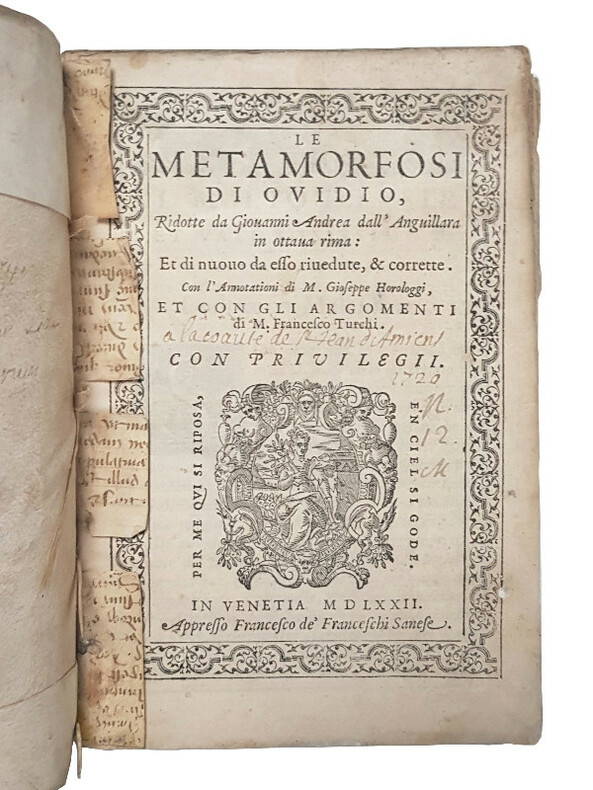
1572ref. LCPCLIT-0037(Une très rare édition de poche des Métamorphoses d'Ovide en italien, conservée dans sa toute première reliure en vélin souple de l'époque) OVIDE (Publius Ovidius Naso). (Sulmona, 43 a.J.-C. - Tomis, 17-18 ap. J.-C.) "LE METAMORFOSI DI OVIDIO, RIDOTTE DA GIOVANNI ANDREA DELL'ANGUILLARA IN OTTAVA RIMA...". 1572, Venetia, F. de Franceschi Senese. 1 volume in-12° (155x112 mm) (dimensions pages 154x106 mm) 209, (1) pp. (y compris titre et dédicace), (2) ff. (table), (1) f. b., 15 gravures sur bois dans le texte. (A-Z8, Aa-Cc8, Dd4) Reliure en vélin souple strictement de l'époque. Très rare édition de poche. Quelques rares et infimes brunissures marginales, sinon très bel et séduisant exemplaire, conservé dans sa toute première reliure en vélin souple du temps. Composées au tout début du Ier siècle, sous le règne de l'Empereur Auguste, les Métamorphoses sont un long poème dont la composition débute probablement en l'an 1. L'oeuvre comprend quinz elivres (près de douze mille vers) écrits en hexamètres dactyliques et regroupe plusieurs centaines de récits courts sur le thème des métamorphoses issus de la mythologie grecque et de la mythologie romaine, organisés selon une structure complexe et souvent imbriqués les uns dans les autres. La structure générale du poème suit une progression chronologique, depuis la création du monde jusqu'à l'époque où vit l'auteur. Aucun exemplaire dans les collections publiques françaises. Un seul exemplaire dans les collections publiques italiennes (Verona). Provenance : Ex dono ms. "a lacoaule (sic! école?) de St Jean d'Amiens 1720". (LCPCLIT-0037)
ref. 110967Paris, Le Livre d'Artiste, Le Vasseur et Cie, Editeurs, 33 rue de Fleurus, 1938, 1 volume in-folio de 330x270 mm environ, 1f.blanc, 93 pages, 1f. (justificatif de tirage) 1f.blanc, en feuillets libres sous chemise rempliée titrée en rouge, et emboîtage de l'éditeur, dos et ouverture de l'étui en parchemin crème, dos demi-lune. Quelques trous sur le dos de la chemise interne, petites rousseurs éparses, chemise-étui avec début de fente restaurée à l'adhésif, frottements et cernes sur l'étui. Exemplaire N° 148, un des 150 exemplaires sur Vélin teinté de Rives, numérotés de 51 à 200, d'un tirage à 200 exemplaires seulement. Complet des 45 monotypes gravés en noir par Louis Icart, une lettrine en couleurs, des mots et lettrines peints en rouge, tirés dans les ateliers d'Alfred Porcaboeuf avec la collaboration de Charles Meunier, calligraphie gravée par l'artiste.
1862ref. 20300Paris, E. Dentu, Librairie de la Société des gens de lettres, 1862. Grand in-12 de [6]-XVIII-298-[2] pages, demi-maroquin brun à coins, dos à nerfs, tête dorée. Couvertures et dos conservés. La reliure est signée Stroobants.