22 305 résultats
1831réf. F72I8N01U79Omostly on board the barque Sarah of London 1831. Contemporary sheepskin parchment sewn on 2 tapes. 4to 19.5 x 16.5 cm. The journal with an engraved view as frontispiece "Island of Saint Helena" engraved by Everingham in London 15 full-page 1 nearly full-page and 1 smaller manuscript maps and coastal profiles plus a small engraved view "Tomb of Napoleon" mounted on 1 page. The lecture notes with a matching pair of engravings of a scull one signed "A. East del" on and facing the title-page and 27 pencil and/or ink anatomical drawings including 2 full-page some also with red. Most are drawn on the album leaves a few on separate slips mounted on the leaves. Both the lecture notes and the journal are written in brown ink with occasional additions in pencil. Including: MANUSCRIPT - ANATOMICAL. MORSE Edward George.Lecture Book notes on anatomical lectures by Joseph Constantine Carpue.London November-December 1828. A manuscript ship's journal kept by Edward George Morse Bromyard 1805-Deal post 1850 who no doubt served among other functions as the ship's surgeon. Morse made his earliest dated entries in April 1831 at the island Mauritius in the Indian Ocean and others at Madagascar and its surrounding islands from May to August 1831. Morse provides extensive notes on the natural history topography and people of the Seychelles Madagascar and the neighbouring islands and provides detailed maps of many of the islands and coastal areas along with a few coastal profiles. The two manuscripts are written in a single album of laid paper. Morse used it 1828 to take notes when he attended the London lectures on anatomy and blood circulation by the innovative surgeon Joseph Constantine Carpue who had pioneered facial reconstructive surgery by introducing ancient Indian techniques. He was famous for illustrating his lectures with chalk drawings which no doubt served as the models for the anatomical illustrations in Morse's notes. A few clippings and hand-written notes have been inserted. unknown
1866réf. 010620London: Office for Advertisments and Publications 1866. A near complete run from 1866 to 1994. 231 volumes. Lacking July-Decenber 1948 & January-June 1949. Books measure 36x26.5 last 31 volumes measure 30x21.5. Illustrated throughout. Most volume bound in modern black cloth with gilt lettering others bound in quarter calf. The calf volumes are faded on spines. Generally all bindings in very good clean firm condition. Internally very occasional library mark stamp. Pages and illustrations in very good clean condition. . Cloth. Very Good. Small Folio. Office for Advertisments and Publications Hardcover
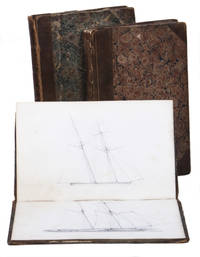
1822réf. ABC_49460Aboard the Winchelsea written and drawn at sea 1822. Contemporary half gold-tooled brown calf marbled paper sides each volume with a different marbled paper the journal volume with marbled endpapers. 8vo. The two sketchbooks contain a total of ca. 100 pages of sketches of ships done in pencil including 1 page containing signal flags in colour. 3 volumes. With: Two sketchbooks with pencil drawings of ships. A neatly-written and illustrated sea journal kept by James Dudman the second mate on board the East India Company's ship Winchelsea during a 1822-23 voyage to India. Launched in 1803 the Winchelsea was already a veteran East Indiaman this being her ninth voyage - she made a total of eleven voyages for the EIC before she was broken up in 1834. On the present voyage commanded by Captain William Adamson she carried 592 people including the 17th and 44th Regiments of Foot and detachments of the King's and EIC's soldiers and a number of women and children. The sea journal volume is accompanied by two additional volumes by Dudman containing pencil sketches of unidentified masted sailing vessels.The Winchelsea's journey from its departure at Blackwall Dock on April 24 1822 to its arrival in Bengal and eventual return to England via St. Helena and The Downs on May 24 1823 reflects the extensive maritime routes integral to British imperial dominance. The ship's role in transporting personnel and cargo exemplifies the strength of the EIC's logistical network sustaining Britain's colonial and economic interests in India. The journal with its careful record-keeping offers an intimate glimpse into the daily operations experiences and extraordinary events encountered by the second mate aboard an East Indiaman during Britain's height of imperial expansion.The journal written in Dudman's beautiful scribe-like handwriting opens with an entry dated 24 April 1822 at Blackwall Dock where the voyage started "bound for Bengal." The next few pages contain a detailed listing of the people on board beginning with the ship's company of 122 men with names followed by the troops on board: "List of a detachment of His Majesty's Troops belonging to the 44th Regt. of Foot on board the Honable. Company's Ship Wincelsea for Bengal" comprising name and rank of 367 men followed by the names of 42 women on board as well as the name and age of 57 children on board including 3 who died at sea plus 4 additional passengers.At Saugur meaning Sagar Island they took on board further passengers duly noted in an additional "List of H.M. 17th Regiment of Foot with the Women and Children accompanying them. Embarked on board the Honble. Company's ship Winchelsea at Saugur New Anchorage for England."Beyond the usual records of position winds weather and other ships Dudman includes interesting notes on unusual occurrences. Perhaps the most fascinating event was recorded on February 10 1823: a major earthquake off the coast of India experienced by the Winchelsea: "At 10 minutes past 1 PM every one on board was greatly alarmed at the singular feel of the ship which was in a violent trembling motion as if the ship was grazing over a rocky shoal and a loud rumbling noise similar to the roll.g! of a Bull quickly along the deck this very singular seuration lasted certainly not less than a minute those below ran on deck to enquire the cause and those below the poop below to ask the same question. I was in the round house at the time when it comen'd. The noise appeared to me as coming along the quarter deck and instantly over the poop the sea was smooth and the day clear. I looked out at the stern windows but saw no appearance of any shoal which I certainly would have done had such existed. The water being very clear and the ship not going more than 2 knots I cannot account for this very singular phenomenon in any other way than its being the shock of an Earthquake".The voyage journal of the Winchelsea during its 1822-23 journey to Bengal provides valuable insight into the maritime operations of the EIC its commercial and colonial reach and the strategic importance of British trade with India in the early 19th century. As a veteran East Indiaman the Winchelsea was part of the vast trading network that connected Britain with the Indian subcontinent transporting soldiers goods and passengers under the auspices of the EIC which functioned as both a commercial enterprise and a colonial governing force.The journal volume contains the typographic book plate of Mr. Jas. Dudman on the front pastedown and a manuscript inscription in ink on the first flyleaf by Lumsden Dudman who was married to Mary Anne Shirreff "Joseph H. Shirreff from L.S. Dudman Xmas 1892" one of the sketchbooks contains a manuscript inventory list in Greek of goods for sale on the first flyleaf and one of the sketchbooks with ownership signature "L: Dudman / Sept. 27 1836" likely Rev. Lumsden S. Dudman perhaps a brother of James Dudman. Some general wear to the leather spines and corners of the boards of the volumes occasionally foxed but overall internally clean. Overall in good condition. unknown
1813réf. 19270Paris: L’Imprimerie de la Republique 1813. FIRST EDITIONS. Woodcut vignettes head- and tailpieces many with folding engraved plates. All volumes in original bindings uncut some unopened completely unsophisticated. Other than 2 volumes in the original calf-backed marbled boards all are bound in original plain or printed wrappers and preserved in half-calf slipcases with morocco spine labels. First editions of the Journal de l'Ecole Polytechnique one of the oldest scientific journals. It contains sections in mathematics physics chemistry geology astronomy and mechanics design and architecture. Here you find original contributions by the top French scientists of the time. A listing of each of the issues is set forth below with a sampling of the contributors. We offer Numbers 1-16 missing only Numbers 2 9 10. No. 1. viii 189 pp. Folding engraved plate. No binding.1 leaf of contemporary manuscript describing the plate laid in. Contributions from Monge Prony Barruel Hassenfratz Fourcroy Chaptal Berthollet Guyton etc. No. 3. iv xvi ii 209-444 pp. Original marbled wrappers. Contributions from Prony Guyton Berthollet Observations on the eudiometric properties of phosphorus. No. 4. ii xxviii 445-743 3 pp. including errata. With 9 folding engraved plates. Contemporary calf-backed marbled boards. Not in a folding case. Contributions from Fourcroy et Vauquelin Hassenfratz. Tom II No. 5. iv 208 iv pp. Original printed wrappers. Contributions from Fourcroy Lagrange Laplace Guyton Prony. Tom II No. 6. iv 209-456 pp. Original printed wrappers. Contributions from Fourcroy Lagrange Hassenfratz Laplace Monge. Tom III Nos. 7 and 8. iv vii I 477 2 pp. Original marbled paper-covered boards. Contribution from Prony Philosophical mechanics or reasoned analysis of the various parts of the science of balance and movement. Tome IV No. 11. ii 395 pp. With 9 folding engraved plates. Contemporary calf-backed marbled boards. Not in a folding case. Contributions from Monge Prony Hachette Poisson Biot Hassenfratz Buyton Berthollet Gauss a short report on his Disquisitiones arithmeticae Tom V No. 12. iv 324 pp. Original wrappers. Contribution from Lagrange Lecons sur le calcul des fonctions. Tom VI No. 13. ii 378 1 pp. Original wrappers. Contributions from Monge Poisson Ampere Biot Fourcroy et Thenard chemistry Hassenfratz chemistry. Tom VII No. 14. iv 400 4; ii 90 pp. Supplement. With 3 full-page engraved plates. Original wrappers. Contemporary signature on title. The Supplement is Lagrange Supplement aux lecons sur le calcul des fonctions. Also a contribution from Montgolfier On the possibility of substituting the hydraulic ram for the old Marly machine. Tom VIII No. 15. ii 358 pp. Original wrappers uncut and partially unopened. Contributions from Poisson Memoir on the secular inequalities of the means of movement of the planets Lagrange Clarification of a singular difficulty which is encountered in the calculation of the attraction of spheroids very little different from a sphere Monge Essay on the application of analysis to some questions of elementary geometry another from Monge Construction of the vibrating string equation a number of articles from Poisson Laplace Dissertation on various points of analysis. Tom IX No. 16. iv 354 2 pp. Original boards. Contributions from Cauchy Poisson. École Polytechnique was created in 1794 a politically and economically troubled time but also the culmination of the Enlightenment. The Journal commenced publication the following year and has since then maintained the highest reputation of published research. L’Imprimerie de la Republique unknown
1890réf. X111626Wien (Vienna), Mechitharisten-Kongregation (-Buchdruckerei) 1890-2013 Collection of 120 complete years of this rare and highly important academic Armenian periodical published since 1887 (making it the second oldest Armenian journal still in print) and mainly related to Armenian philology and history, most texts are in Armenian (though some of them are in English, French, German and Italian), together ca. 35.000 pp., 30cm., The volumes up till 1989 are bound in modern hardcovers in full red cloth in very good condition (most of the 44 physical volumes contain two years each), volumes 1990-2013 are in original softcovers, some of the older illustrated frontcovers are preserved and bound in, text and interior are clean and bright, very good set, weight: 90kg., [This is a list of the "physical" volumes contained in this set: 1890, 1891-1892, 1893-1894, 1895-1896, 1897-1898, 1899-1900, 1901-1902, 1903-1904, 1905-1906, 1907-1908, 1909-1910, 1911-1912, 1913-1914, 1915-1916-1917-1918-1919-1920, 1921-1922, 1923-1924, 1925-1926, 1927, 1928-1929, 1930-1931, 1932-1933, 1934-1935, 1936-1937-1938, 1939-1940-1941-1942-1943-1944-1945, 1946-1947-1948, 1949-1950, 1951-1952, 1953-1954, 1955-1956, 1957-58, 1959-1960, 1961, 1962-1963, 1964-1965, 1966-1967, 1968-1969, 1972-1973, 1974-1975, 1976-1977-1978, 1979-1980-1981, 1982-1983-1984, 1985-1986, 1987, 1988-1989, 1990, 1991, 1992, 1993, 1994, 1995, 1996, 1997, 1998, 1999, 2000, 2001, 2002, 2003, 2004, 2005, 2006, 2007, 2008, 2009, 2010, 2011, 2012 and 2013], X111626
1886réf. 6348127 vol. in-8 cartonnage pleine percaline vert, nom de la "Fondation Thiers" au dos en queue, Ministère de l'Instruction Publique et des Beaux-Arts, Comité des Travaux historiques et scientifiques, Ernest Leroux éditeur, puis Imprimerie Nationale, Année 1886, 382 pp. et 11 planches hors texte (dont cartes ethnographiques en couleurs de la Tunisie), parfois dépliantes ; 1887, 350 pp. et 11 planches hors texte, parfois dépliantes (dont nombreuses illustrant les "Principes de la Fortification antique depuis les temps préhistoriques jusqu'au Croisades", par le Lieutenant-Colonel G. de La Noë) ; 1888, 448 pp. 9 planches hors texte, parfois dépliantes (dont Oppidum du Mont-Beuvray par Bulliot, Densité de la Population dans le SE de la France, en couleurs, par Victor Turquan, Péninsule Malaise en couleurs, etc.) ; 1889, 334 pp. et 9 planches hors texte, souvent dépliantes (dont Embouchure la Loire, Saint-Nazaire, Kairouan, Fortifications romaines, etc...) ; 1890, 487 pp. et 6 planches hors texte, parfois dépliantes (dont Carte de l'Ile Formose au XVIIIe siècle, Carte de la Province de Touraine en 1766 par Chauvigné, Carte en couleurs du Tonkin, avec "Pays Montagneux inexploré occupé par les Pirates", "Carte du Pays des Mans-Tiens" par le Lieutenant Massy, Itinéraire de Catat et Maistre à Madagascar, etc...) ; 1891, 526 pp. et 12 planches hors texte, parfois dépliantes (dont "Le Darvaz et le Karatéguine", Carte des connaissances géographiques des Portugais en Indonésie vers 1519, Carte en couleurs du Véron (Touraine) avant 1789 par Chauvigné, Cartes anthropologiques en couleurs de la Khoumirie, etc...) ; 1892, 441 pp. et 7 planches hors texte, parfois dépliantes (dont Carte du Territoire de Hami, Extraite du K'in-ting Sin-Kiang tche-lio (Livre III), Carte de la Région du Thé d'après les itinéraires de la Mission Pavie, etc...) ; 1893, 449 pp. et 14 planches hors texte, parfois dépliantes (dont Nho-Quanphanphudo Région de Hoa-Lu dressée par G. Dumoutier, etc.) ; 1894, 464 pp. et 6 planches hors texte, parfois dépliantes (dont Detailed hydrographic and topographic Chart of the Itasca State Park by Browser, Itinéraires en Mongolie orientale par Bretschneider, Carte de la Brenne avant 1789 par Chauvigné, Copie d'une carte manuscrite de la Guiane dresée par les Jésuites en 1741 communiquée par M. Buache en 1787, Esquisse inédite de la Guyane par M. Buache, etc.) ; 1895, 499 pp. et 12 planches hors texte, parfois dépliantes (dont Itinéraire de Fes à Oudjda suive an 1891 par H. de La Martinière, Carte chinoise du Si-Yu ou Asie Centrale pour accompagner le Mémoire intitulé Récit officiel de la Conquête du Turkestan par les Chinois 1758-1760, Carte de Pho-Hien, Plan de la Forêt d'Arties au XVe siècle, etc...) ; 1896, 415 pp. et 25 planches hors texte, parfois dépliantes (dont fac-similé complet d'un Portulan annamite du XVe siècle par G. Dumoutier, en 24 cartes) ; 1897, 519-11 pp. et 8 planches hors texte, parfois dépliantes (dont Ile de Cayenne et ses environs d'après Bellin, Mappemonde Syriaque, Somal Harrar et Pays Gallas par Alfred Bardey, Carte du Territoire russe administré par la Chine, Itinéraire dans le Quang-Binh au Nord de Dong-Hoï, etc....) ; 1898, 420 pp. et 6 planches hors texte, parfois dépliantes (dont Carcasses flottantes de 1866 à 1893, Itinéraire dans le Quang-Binh au Nord de Dong-Hoï, Itinéraire dans le Quang-Tri, etc...) ; 1899, 505 pp. et 1 grande carte dépliante (El-Yemen et Partie de l'Hadramaut Arabie Méridionale dressés par Alfred Bardey...) ; 1900, 369 pp. et 2 planches dépliantes ; 1901, 423 pp. et planches dans le texte ; 1902, 423 pp. et planches dans le texte ; 1903, 539 pp. et 5 planches hors texte, dont une dépliante ; 1904, 491 pp. et 5 planches hors texte dont une dépliante ; 1905, 496 pp. et 6 planches hors texte, parfois dépliantes ou doubles (dont Schéma des Principales Migrations au Congo Français, etc...) ; 1906, 432 pp. et 3 planches hors texte (dont Distribution géographique des Races sur la Côte occidentale d'Afrique, de la Gambie à la Mellacorée) ; 1907, 497 pp. avec 1 planche dans le texte et 4 planches hors texte, parfois dépliantes ; 1908, 452 pp. avec 3 cartes sur une planche dépliante ; 1909, 420 pp. et 23 planches hors texte (dont reproduction d'un "Atlas inconnu de la dernière expédition de Drake, vues prises de son bord) ; 1910, 446 pp. et 3 planches hors texte ; 1911, 462 pp. avec 6 planches hors texte (dont mappemonde de Ripoll) ; 1912, 520 pp. avec 4 et 22 planches hors texte
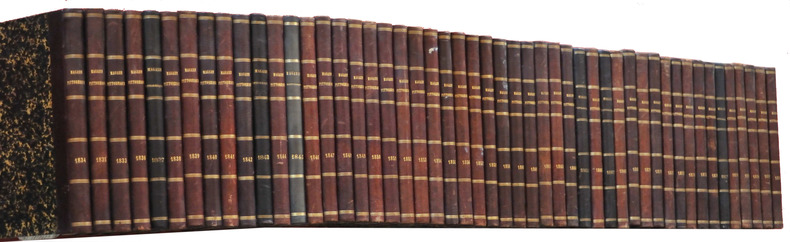
1833réf. 46404463Paris, Le Magasin Pittoresque, 1833-1882 ; 50 volumes in-4, demi-basane brune, dos lisses ornés, titre et année en lettre dor. au dos, filets dorés, tranches jaspées. (Reliures de l’époque). RARISSIME COLLECTION COMPLÈTE DE LA PREMIÈRE SÉRIE EN RELIURES UNIFORMES. Edouard Charton (Sens 1807 - Versailles 1890) a commencé sa carrière de publiciste dans les revues saint-simoniennes Le Globe et Le Journal de la doctrine de Saint-Simon. Il rompt avec les Saint-Simoniens en 1831 et fonde Le Magasin Pittoresque en 1833 avec l’imprimeur saint-simonien Lachevardière sur le modèle du Penny magazine anglais. D’abord hebdomadaire, la revue devient mensuelle en 1850 puis bi-mensuelle. Le premier numéro annonce le projet : “Le Magasin pittoresque, revue illustrée bon marché, a pour ambition d’intéresser et d’instruire, tout en les distrayant, ceux qui n’ont ni les moyens financiers ni les loisirs de le faire”. Les articles sont confiés aux plus grands spécialistes, chaque livraison aborde les différents domaines du savoir : Beaux-Arts, sciences et techniques, géographie, archéologie, etc. Charton assumait seul le contenu de la revue, corrigeant chaque article avant publication. Dans cette première série aucun article n’est signé mais les collaborateurs sont connus : Darondeau, Reynaud, Souvestre, Carnot, Cazeaux, Charton, Fortoul, Aicard, V. de Joncières, Pauline Roland, R. Töpffer, Transon, Alby, Urbain, Alexandre de Saint-Chéron, Morville ou encore George Sand, Camille Flammarion ou Eugène Delacroix. Le succès de cette revue fut considérable dès les premiers numéros et suscita de nombreuses vocations, ainsi l’égyptologue François Joseph Chabas (1817-1882), un négociant en vins à Châlons-sur-Saône qui découvre l’égyptologie en 1852 dans le Pittoresque, grâce aux articles de Nestor Lhôte. Sand, Balzac ou encore Zola revendiquent cette revue didactique comme source importante de leur œuvre.Mais c’est en tant que revue illustrée que Le Magasin Pittoresque demeure inégalée, Charton considérait qu’une illustration abondante et de qualité était essentielle à son projet d’éducation populaire. Pour donner une si nombreuse illustration en maintenant un prix modique, Charton fit appel à la gravure sur bois qui avait presque disparu en France à cette époque. Les graveurs français ne pouvant fournir tant de planches à une revue hebdomadaire, il fit appel pour les premiers numéros à des graveurs anglais. Par la suite, grâce au succès de la revue, les ateliers parisiens revinrent à ce genre délaissé. Parmi les illustrateurs Grandville a donné de nombreux dessins (voir à ce sujet Renonciat Grandville p. 295) ou encore G. Doré (v. H. Leblanc Catal. de l'Oeuvre de G. Doré. p. 227)Le Magasin Pittoresque a occupé l’essentiel de la vie d’Edouard Charton. Bien que sa revue n’ait jamais abordé les questions politiques il était un Républicain fervent et fut élu dans l’Yonne à deux reprises en 1848 et 1871. Il fut aussi l’un des fondateurs de la revue d’actualité l’Illustration en 1842.Rare collection complète de cette première série en reliure uniforme de l’époque. Bel exemplaire frais, les reliures sont en bon état.
1856réf. 5405121 vol. in-4 reliure de l'époque demi-percaline bleue, Le Passe-Temps, Paris, 1856-1879, Volume 1 : du numéro 1 de mai 1856 au numéro 104 du 30 avril 1857Volume 2 : du 105 du 1er mai 1858 au 192 du 31 décembre 1859Volume 3 : du 193 du 7 janvier 1860 au 283 du 29 décembre 1860Volume 4 : du 284 du 2 janvier 1861 au 387 du 28 décembre 1861Volume 5 : du 388 du 1er janvier 1862 au 492 du 31 décembre 1862Volume 6 : du 493 du 3 janvier 1863 au 596 du 30 décembre 1863Volume 7 : du 597 du 2 janvier 1864 au 701 du 31 décembre 1864Volume 8 : du 702 du 4 janvier 1865 au 805 du 30 décembre 1865Volume 9 : du 806 du 5 janvier 1866 au 909 du 29 décembre 1866Volume 10 : du 910 du 2 janvier 1867 au 1013 du 28 décembre 1867Volume 11 : du 1014 du 1er janvier 1868 au 1118 du 30 décembre 1868Volume 12 : du 1119 du 2 janvier 1869 (Gorilles enlevant des femmes, illustrant un roman de Louis Noir) au 1222 du 29 décembre 1869Volume 13 : du 1223 du 1er janvier 1870 au 1346 du 27 décembre 1871Volume 14 : du 1347 du 3 janvier 1872 au 1398 du 26 décembre 1872Volume 15 : du 1399 du 1er janvier 1873 au 1451 du 31 décembre 1873Volume 16 : du 1452 du 7 janvier 1874 au 1503 du 30 décembre 1874Volume 17 : du 1504 du 6 janvier 1875 au 1555 du 29 décembre 1875Volume 18 : du 1556 du 5 janvier 1876 au 1607 du 27 décembre 1876Volume 19 : du 1608 du 3 janvier 1877 au 159 du 26 décembre 1877Volume 20 : du 1660 du 2 janvier 1878 au 1711 du 25 décembre 1878Volume 21 : du 1712 du 1er janvier 1879 au 1764 du 31 décembre 1879
1879réf. 43501Paris, Aux Bureau du Journal, 1879-88. 4to. Bound in 29 uniform contemp. hcalf. Spines gilt and with gilt lettering.Top of spine on 3 vols. with wear. A nick to spine on 2 vols. 4 vols. with some wear to spines. A few vols. slightly rubbed. Internally fine. More than 14000 pp. Profusely illustrated with fine woodcuts in the text. The work is known for its fine executed illustrations of machinary and apparatus.
1879réf. 43501Paris Aux Bureau du Journal 1879-88. 4to. Bound in 29 uniform contemp. hcalf. Spines gilt and with gilt lettering.Top of spine on 3 vols. with wear. A nick to spine on 2 vols. 4 vols. with some wear to spines. A few vols. slightly rubbed. Internally fine. More than 14000 pp. Profusely illustrated with fine woodcuts in the text. The work is known for its fine executed illustrations of machinary and apparatus. This is the first journal entirely devoted to theory of light and electricity in its practical applications documenting the early history of Telegraphy and Telephony. It describes and depicts the new inventions of electrical apparatus used in industries and communications. It describes the installments of telegraphy in Amerika as well as in Europe. It describes arch-lamps Eddison-lamps the Telephoneworks of Gray Edison Bell and others the introduction of electric lightening in houses and towns applications of electricity to railways electro-motors and dynamoes electromagnetism microphones etc. etc. It contains importent papers on the theory of electricity and magnetism as well.- Weaver Cat.of the Wheeler Gift No. 5919. unknown
1843réf. RO80039187IMP. RENOUARD Paul. 1841 - 1843. In-Folio. Relié demi-cuir. Etat passable, Couv. défraîchie, Dos satisfaisant, Intérieur frais. Environ 1000 + 1500 pages. Une carte dépliante en noir et blanc, hors-texte. Titres, tomaisons et filets dorés sur le dos cuir bordeaux. Texte sur 2 colonnes. Quelques épidermures sur le cuir. Quelques pages volantes. Rares passages de vers en marges. Marges abîmées, avec des manques et des pliures altérant légèrement la lecture du texte, en fin de 1er volume. Quelques tampons en marges. Coiffe en-tête abîmée sur le 2ème volume. Ouvrages déboités.. . . . Classification Dewey : 70.49-Presse illustrée, magazines, revues
1848réf. 218421848 Journaux éphémères du “printemps 1848”. Suite au renversement de la monarchie de Juillet, le 24 février 1848, la IIe République rétablit la liberté de la presse. “L’effet de cette mesure est immédiat. La liberté acquise permet à tous ceux qui en ont les moyens d’imprimer leur feuille: les titres nouveaux pullulent, les numéros un se multiplient; en quelques semaines, près de 300 titres se créent à Paris, presque autant en province” (Anne-Claude Ambroise-Rendu). Notre ensemble est effectivement essentiellement constitué de numéros 1 ainsi que de trois numéros spécimen. “Ces saturnales durent jusqu'aux journées de juin qui sont le point de départ d'une réaction toute naturelle. Le cautionnement est rétabli, des lois sont portées contre les crimes et délits de la presse. Le torrent, contenu par toutes sortes de digues, rentre enfin dans son lit, et ne roule plus, à partir de 1849, sauf quelques recrudescences momentanées, que des ondes de plus en plus inoffensives” (Hatin). Rareté parmi les journaux de 1848, "Le Petit homme rouge" semble être la seule publication à utiliser la couleur (Ambroise-Rendu). La vignette de titre de notre numéro (N°1, avril 1848) illustre un petit homme - imprimé… en rouge! Au bas, on lit: “L’homme rouge apparaît encore, il rit d’un air moqueur… Béranger”. L’exemplaire du journal "Le Travail" est illustré d’une jolie lithographie à pleine page de X. Maissner représentant les sœurs de la charité. Sur le titre, une vignette représente deux mains qui se serrent.Hatin "Bibliographie historique et critique de la presse périodique française". A.-C. Ambroise-Rendu "Les journaux du printemps 1848: une révolution médiatiques en trompe-l'oeil" in Revue d'histoire du XIXe siècle, n°19.
1884réf. 103781884 demi-chagrin tête de nègre. 17 volumes (9 vol. in-4 et 8 vol. in-8 à partir de 1889), illustrés, London Illustrated London News, 1884-90
1900réf. 43529- 1900 In-folio, pleine toile, 217 pp. Plus d’un millier d’articles de presse ou de revue contrecollés 1 à 10 par page, pleine page, plusieurs pages En-tête de chaque article : titre et date tamponnés ou manus.
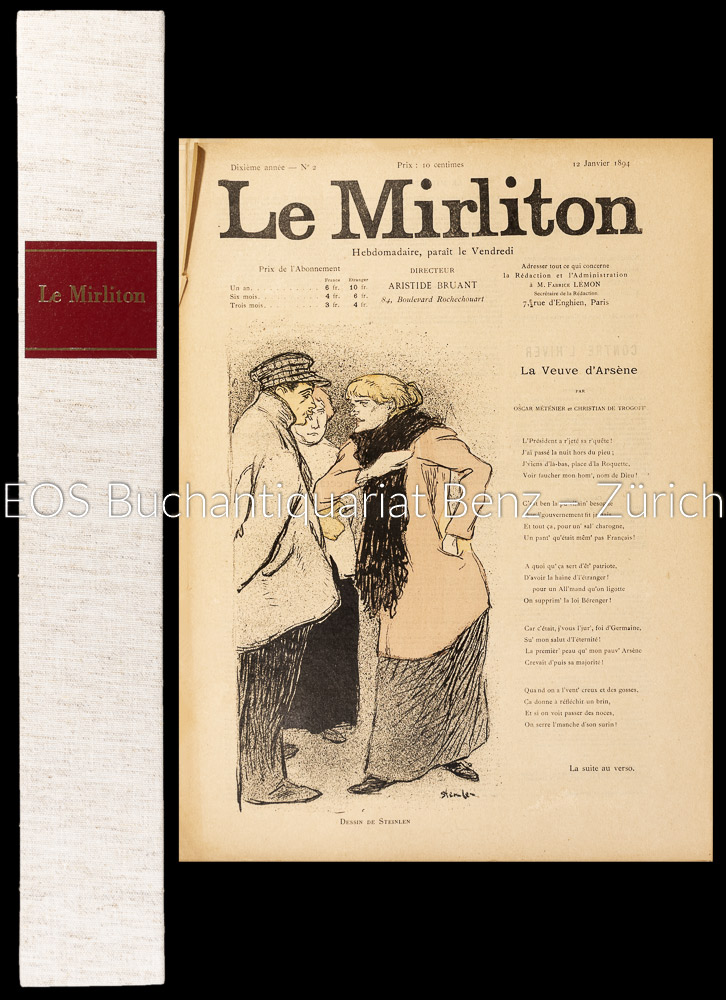
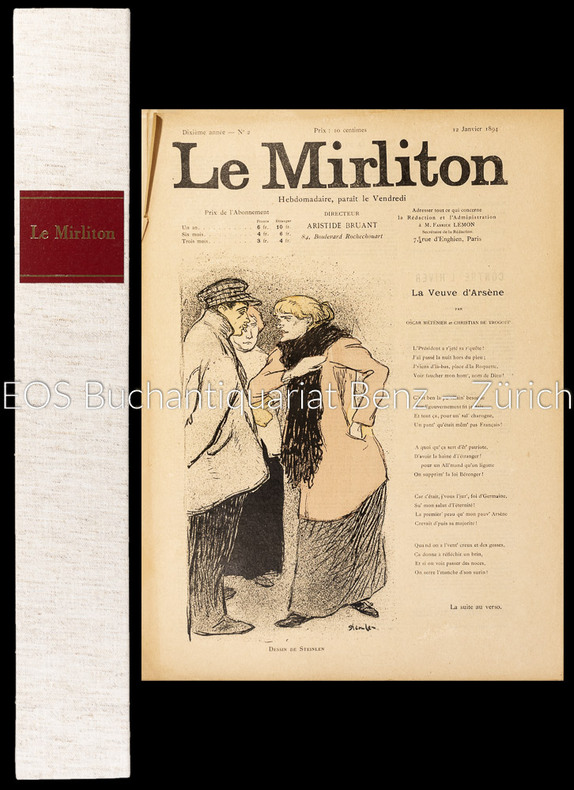
1885réf. 31053ABParis., Directeur Aristide Bruant., 1885?1905. Quarto (27,5 x 14 und 37,5 x 27,5 cm). 190 von 194 Heften. Nummern 1?142 (ohne die Hefte 69 und 103)m Serie 2: Nummern 1?30, Serie 3: Nummern 1?21 (ohne die die Hefte 6 und 22). + Wichtig: Für unsere Kunden in der EU erfolgt der Versand alle 14 Tage verzollt ab Deutschland / Postbank-Konto in Deutschland vorhanden +, A Jahrgänge 1?21. Lose Hefte mit meist farbigen Titeln in Lithographie von Toulouse-Lautrec und Steinlen.
1885réf. 31053ABJahrgänge 1–21. Paris. Directeur Aristide Bruant. 1885–1905. Quarto (27,5 x 14 und 37,5 x 27,5 cm). 190 von 194 Heften. Nummern 1–142 (ohne die Hefte 69 und 103)m Serie 2: Nummern 1–30, Serie 3: Nummern 1–21 (ohne die die Hefte 6 und 22). Lose Hefte mit meist farbigen Titeln in Lithographie von Toulouse-Lautrec und Steinlen.
1899réf. 6360724 vol. in-8 reliure uniforme demi-toile bordeaux, Union Faulconnier. Société Historique et Archéologique de Dunkerque et de la Flandre Maritime, 1899-1936. Rappel des titres : Bulletin (Série suivie de 1899 à 1936 : 24 Volumes) Vol. I : Bulletin 1899 ; II : 1900 ; III : 1901 ; IV : 1902 ; V : 1903 ; VI : 1904 ; VII : 1905 ; VIII : 1906 ; IX : 1907 ; X : 1908 ; XI : 1909 ; XII : 1910 ; XIII : 1911 ; XIV : 1912 ; XV : 1913 ; XVI : 1914-1919 ; XVII : 1920-1922 ; XVIII : 1923-1924 ; XIX : 1925-1926 ; XX : 1927-1928 ; XXI : 1929-1930 ; XXII : 1931-1932 ; XXIII : 1933-1934 ; XXIV : 1935-1936
1848réf. 44410Paris, chez Lévy, 1848-1849. 6 livraisons in-folio de 4 pp. chacune, en feuilles.
1814réf. 101246P., Adrien Le Clère, 1814-1849, 130 vol. in-8°, reliures demi-basane naturelle et cartonnages disparates, reliures frottées, rousseurs éparses sur qqs volumes, C. de bibl., état correct. Très rare
1819réf. 204461819 (1819),manuscrit autographe de 47 pages (paginé),carton relié in fine,annonçant le depart de l’auteur, le 11 fervier 1819,et interrompant le memoire.
1898réf. 57768Le Vin de Bordeaux. Organe hebdomadaire de la Propriété viticole girondine (Lot de 55 numéros, du n° 1 du 5 janvier 1898, Première année, au n° 68 du 31 mars 1900, Troisième Année, sauf les n° 37, 43, 45, 47, 51, 53, 54, 58, 59, 61, 66, et 67), 55 numéros in-folio, 1898, 1899, 1900, 4 ff. par numéros
1834réf. 791261834-1835 | 26 x 33 cm | 3 volumes reliés
1888réf. 52911888 Paris 1888 et 1889, 31,5 x41cm, relié dans un album: demi percaline verte , plats avec papiers bradel. Edition originale, collection complète de ce rare journal littéraire satirique dirigé et illustré par Adolphe Willette. 51 numéros du 6 juillet 1888 au 20 septembre 1889 ) avec les numeros speciaux en fin d'album , autographiés parus deux apres la faillite du "Pierrot" et qui sont de veritables chefs d'oeuvre de la lithographie . Chacun composé de deux feuilles au format in-folio, illustré sur la première page d'une lithographie d'A. Willette et pour certains numéros, de caricatures en troisième page.Ayant pour rédacteur en chef Emile Goudeau, ce journal à la parution annoncée le vendredi comprend des poèmes, des publications,. Adolphe Willette est indissociable du quartier Montmartre dont il décora de nombreux cabarets, bistrots et le fameux Moulin Rouge. Peintre tout d'abord, il exposa au Chat Noir après avoir participé à sa création. Par la suite il collabore à de nombreux journeaux comme le Rire ou l'Assiette au beurre avant de fonder le Pierrot. Personnage controversé, il se présenta comme candidat antisémite aux élections législatives de 1889 à Paris. Il fut le premier président de la République de Montmartre, association philanthropique destinée à aider les enfants du quartier.
1848réf. R320140098L'aimable Faubourien journal de la canaille. 1848. In-Folio. En feuillets. Etat d'usage, Livré sans Couverture, Dos satisfaisant, Mouillures. 2 pages en feuillets - textes sur deux colonnes - livré sans couverture - quelques traces de mouillures sans conséquence sur la lecture - papier jauni - 2 photos disponibles.. . . . Classification Dewey : 70.1-Journaux