Charles Louis Fleury Panckoucke,Biblio.com
3 664 résultats
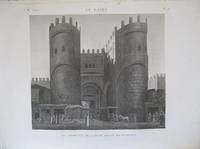
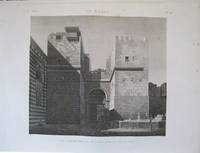
réf. 1963Middle East: Paris Impremerie de C.L.F.Pancoucke 1820-1829. Copper engraved view of one of the gateways to Cairo from the first volume of the "Etat Modene "of the "Description de l'Egypte" 2nd Edition; 1822; black & white; verso blank. Blind stamp of the publisher Panckoucke to margin. The view shows the massive gateway to the city with some small workshops & shops built against the walls. Good dark impression; a few some spotting mainly to margins but also a few in image. "Description de l'Egypte ou Recueil des observations et des recherches qui ont été faites en Egypte pendant l'expédition de l'armée française." When Napoleon Bonaparte invaded Egypt in 1798 he brought with him an entourage of more than 160 scholars and scientists. Known as the French Commission on the Sciences and Arts of Egypt these experts undertook an extensive survey of the country's archeology topography and natural history. . For four years more than 150 artists engineers linguists and scientists traveled throughout the country examining almost every aspect of ancient and contemporary Egypt. They recorded and measured in meticulous detail Egypt's topography flora and fauna and its ancient and contemporary architecture. A soldier who was part of the expedition found the famous Rosetta Stone which the French linguist and scholar Jean-François Champollion 1790-1832 later used to unlock many of the mysteries that long had surrounded the language of ancient Egypt. The Egyptian expedition ended with a total military failure. The French left Egypt in 1801 with the honors of war but defeated; yet military failure remains a significant event in the history of knowledge because it is the first time a military expedition was accompanied by a scientific expedition. In 1802 Napoleon authorized the publication of the commission's findings in a monumental multi-volume work that included plates maps scholarly essays and a detailed index. Publication of the original Imperial edition began in 1809 and continued to 1822 sold by subscription. It proved so popular that a second edition was published under the post-Napoleonic Bourbon Restoration. The "Royal edition" published in Paris by C.L.F. Panckoucke from 1820-1830. The Second edition consists of 11 or 12 volumes of plates in folio and 24 of text bound as 26 8vo. Brunet:II 617; Blackmer/Navari: 476 1st edition Middle East Egypt Cairo Paris Impremerie de C.L.F.Pancoucke 1820-1829 unknown
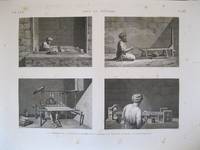
réf. 1987Trades Professions & the Arts: Paris Impremerie de C.L.F.Pancoucke 1820-1829. Copper engravings 4 on 1 plate showing the trades of lacemaker cord maker wool weaver and belt maker from the second volume of "Etat Moderne" of the "Description de l'Egypte" 2nd Edition; black & white; verso blank. Blind stamp of the publisher Panckoucke to margin. The images show the workshops of the various trades: all the trades use a kind of loom. Good dark impression; generally clean; some spotting to margins; remains of glue and tissue guard to upper margin. "Description de l'Egypte ou Recueil des observations et des recherches qui ont été faites en Egypte pendant l'expédition de l'armée française." When Napoleon Bonaparte invaded Egypt in 1798 he brought with him an entourage of more than 160 scholars and scientists. Known as the French Commission on the Sciences and Arts of Egypt these experts undertook an extensive survey of the country's archeology topography and natural history. . For four years more than 150 artists engineers linguists and scientists traveled throughout the country examining almost every aspect of ancient and contemporary Egypt. They recorded and measured in meticulous detail Egypt's topography flora and fauna and its ancient and contemporary architecture. A soldier who was part of the expedition found the famous Rosetta Stone which the French linguist and scholar Jean-François Champollion 1790-1832 later used to unlock many of the mysteries that long had surrounded the language of ancient Egypt. The Egyptian expedition ended with a total military failure. The French left Egypt in 1801 with the honors of war but defeated; yet military failure remains a significant event in the history of knowledge because it is the first time a military expedition was accompanied by a scientific expedition. In 1802 Napoleon authorized the publication of the commission's findings in a monumental multi-volume work that included plates maps scholarly essays and a detailed index. Publication of the original Imperial edition began in 1809 and continued to 1822 sold by subscription. It proved so popular that a second edition was published under the post-Napoleonic Bourbon Restoration. The "Royal edition" published in Paris by C.L.F. Panckoucke from 1820-1830. The Second edition consists of 11 or 12 volumes of plates in folio and 24 of text bound as 26 8vo. Brunet:II 617; Blackmer/Navari: 476 1st edition Trades Professions & the Arts Egypt Lacemaker Weaver of wool Cordmaker beltmaker Paris Impremerie de C.L.F.Pancoucke 1820-1829 unknown
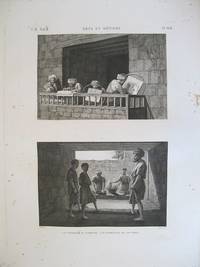
réf. 1994Trades Professions & the Arts: Paris Impremerie de C.L.F.Pancoucke 1820-1829. Copper engravings 2 on 1 plate showing the trades of embroiderer & the felt maker from the second volume of "Etat Moderne" of the "Description de l'Egypte" 2nd Edition; black & white; verso blank. Blind stamp of the publisher Panckoucke to margin. Good dark impression; spotting to margins; remains of glue and tissue guard to right margin. "Description de l'Egypte ou Recueil des observations et des recherches qui ont été faites en Egypte pendant l'expédition de l'armée française." When Napoleon Bonaparte invaded Egypt in 1798 he brought with him an entourage of more than 160 scholars and scientists. Known as the French Commission on the Sciences and Arts of Egypt these experts undertook an extensive survey of the country's archeology topography and natural history. . For four years more than 150 artists engineers linguists and scientists traveled throughout the country examining almost every aspect of ancient and contemporary Egypt. They recorded and measured in meticulous detail Egypt's topography flora and fauna and its ancient and contemporary architecture. A soldier who was part of the expedition found the famous Rosetta Stone which the French linguist and scholar Jean-François Champollion 1790-1832 later used to unlock many of the mysteries that long had surrounded the language of ancient Egypt. The Egyptian expedition ended with a total military failure. The French left Egypt in 1801 with the honors of war but defeated; yet military failure remains a significant event in the history of knowledge because it is the first time a military expedition was accompanied by a scientific expedition. In 1802 Napoleon authorized the publication of the commission's findings in a monumental multi-volume work that included plates maps scholarly essays and a detailed index. Publication of the original Imperial edition began in 1809 and continued to 1822 sold by subscription. It proved so popular that a second edition was published under the post-Napoleonic Bourbon Restoration. The "Royal edition" published in Paris by C.L.F. Panckoucke from 1820-1830. The Second edition consists of 11 or 12 volumes of plates in folio and 24 of text bound as 26 8vo. Brunet:II 617; Blackmer/Navari: 476 1st edition Trades Professions & the Arts Egypt Embroiderer Felt Maker Paris Impremerie de C.L.F.Pancoucke 1820-1829 unknown
réf. 1964Middle East: Paris Impremerie de C.L.F.Pancoucke 1820-1829. Copper engraved view of one of the gateways to Cairo from the first volume of the "Etat Modene "of the "Description de l'Egypte" 2nd Edition; 1822; black & white; verso blank. Blind stamp of the publisher Panckoucke to margin. Good dark impression; a few some spotting mainly to margins but also a few in image. "Description de l'Egypte ou Recueil des observations et des recherches qui ont été faites en Egypte pendant l'expédition de l'armée française." When Napoleon Bonaparte invaded Egypt in 1798 he brought with him an entourage of more than 160 scholars and scientists. Known as the French Commission on the Sciences and Arts of Egypt these experts undertook an extensive survey of the country's archeology topography and natural history. . For four years more than 150 artists engineers linguists and scientists traveled throughout the country examining almost every aspect of ancient and contemporary Egypt. They recorded and measured in meticulous detail Egypt's topography flora and fauna and its ancient and contemporary architecture. A soldier who was part of the expedition found the famous Rosetta Stone which the French linguist and scholar Jean-François Champollion 1790-1832 later used to unlock many of the mysteries that long had surrounded the language of ancient Egypt. The Egyptian expedition ended with a total military failure. The French left Egypt in 1801 with the honors of war but defeated; yet military failure remains a significant event in the history of knowledge because it is the first time a military expedition was accompanied by a scientific expedition. In 1802 Napoleon authorized the publication of the commission's findings in a monumental multi-volume work that included plates maps scholarly essays and a detailed index. Publication of the original Imperial edition began in 1809 and continued to 1822 sold by subscription. It proved so popular that a second edition was published under the post-Napoleonic Bourbon Restoration. The "Royal edition" published in Paris by C.L.F. Panckoucke from 1820-1830. The Second edition consists of 11 or 12 volumes of plates in folio and 24 of text bound as 26 8vo. Brunet:II 617; Blackmer/Navari: 476 1st edition Middle East Egypt Cairo Paris Impremerie de C.L.F.Pancoucke 1820-1829 unknown
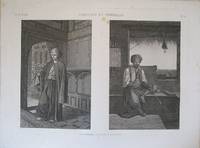
réf. 2000Middle East: Paris Impremerie de C.L.F.Pancoucke 1820-1829. Copper engravings 2 on 1 plate showing costumes from the second volume of "Etat Moderne" of the "Description de l'Egypte" 2nd Edition; black & white; verso blank. Blind stamp of the publisher Panckoucke to margin. The images show the marmeluke standing inside a richly decorated house; the Sailor sits in a simple seaside house; they are both smoking chibouques Good dark impression; some light spotting to margins; remains of glue and tissue guard to right margin. "Description de l'Egypte ou Recueil des observations et des recherches qui ont été faites en Egypte pendant l'expédition de l'armée française." When Napoleon Bonaparte invaded Egypt in 1798 he brought with him an entourage of more than 160 scholars and scientists. Known as the French Commission on the Sciences and Arts of Egypt these experts undertook an extensive survey of the country's archeology topography and natural history. . For four years more than 150 artists engineers linguists and scientists traveled throughout the country examining almost every aspect of ancient and contemporary Egypt. They recorded and measured in meticulous detail Egypt's topography flora and fauna and its ancient and contemporary architecture. A soldier who was part of the expedition found the famous Rosetta Stone which the French linguist and scholar Jean-François Champollion 1790-1832 later used to unlock many of the mysteries that long had surrounded the language of ancient Egypt. The Egyptian expedition ended with a total military failure. The French left Egypt in 1801 with the honors of war but defeated; yet military failure remains a significant event in the history of knowledge because it is the first time a military expedition was accompanied by a scientific expedition. In 1802 Napoleon authorized the publication of the commission's findings in a monumental multi-volume work that included plates maps scholarly essays and a detailed index. Publication of the original Imperial edition began in 1809 and continued to 1822 sold by subscription. It proved so popular that a second edition was published under the post-Napoleonic Bourbon Restoration. The "Royal edition" published in Paris by C.L.F. Panckoucke from 1820-1830. The Second edition consists of 11 or 12 volumes of plates in folio and 24 of text bound as 26 8vo. Brunet:II 617; Blackmer/Navari: 476 1st edition Middle East Egypt Costumes Paris Impremerie de C.L.F.Pancoucke 1820-1829 unknown
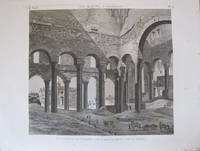
réf. 1970Middle East: Paris Impremerie de C.L.F.Pancoucke 1820-1829. Copper engraved view the interior of a mosque Cairo from the first volume of the "Etat Modene "of the "Description de l'Egypte" 2nd Edition; 1822; black & white; verso blank. Blind stamp of the publisher Panckoucke to margin. The view shows the interior of an abandoned mosque within the Citadel of Cairo. Engineers are excavating whilst a canon is brought forward by 2 camels. Good dark impression; some foxing to blank margins. "Description de l'Egypte ou Recueil des observations et des recherches qui ont été faites en Egypte pendant l'expédition de l'armée française." When Napoleon Bonaparte invaded Egypt in 1798 he brought with him an entourage of more than 160 scholars and scientists. Known as the French Commission on the Sciences and Arts of Egypt these experts undertook an extensive survey of the country's archeology topography and natural history. . For four years more than 150 artists engineers linguists and scientists traveled throughout the country examining almost every aspect of ancient and contemporary Egypt. They recorded and measured in meticulous detail Egypt's topography flora and fauna and its ancient and contemporary architecture. A soldier who was part of the expedition found the famous Rosetta Stone which the French linguist and scholar Jean-François Champollion 1790-1832 later used to unlock many of the mysteries that long had surrounded the language of ancient Egypt. The Egyptian expedition ended with a total military failure. The French left Egypt in 1801 with the honors of war but defeated; yet military failure remains a significant event in the history of knowledge because it is the first time a military expedition was accompanied by a scientific expedition. In 1802 Napoleon authorized the publication of the commission's findings in a monumental multi-volume work that included plates maps scholarly essays and a detailed index. Publication of the original Imperial edition began in 1809 and continued to 1822 sold by subscription. It proved so popular that a second edition was published under the post-Napoleonic Bourbon Restoration. The "Royal edition" published in Paris by C.L.F. Panckoucke from 1820-1830. The Second edition consists of 11 or 12 volumes of plates in folio and 24 of text bound as 26 8vo. Brunet:II 617; Blackmer/Navari: 476 1st edition Middle East Egypt Cairo Citadel Paris Impremerie de C.L.F.Pancoucke 1820-1829 unknown
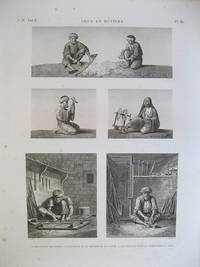
réf. 1997Trades Professions & the Arts: Paris Impremerie de C.L.F.Pancoucke 1820-1829. Copper engravings 5 on 1 plate showing a variety of trades from the second volume of "Etat Moderne" of the "Description de l'Egypte" 2nd Edition; black & white; verso blank. Blind stamp of the publisher Panckoucke to margin. The images show cotton being sorted and spun; the spinning of woolen thread; A wood turner using his foot to shape the wood on the lathe and the "serrurier" planing a block of wood. Good dark impression; some light spotting to margins; remains of glue and tissue guard to right margin. "Description de l'Egypte ou Recueil des observations et des recherches qui ont été faites en Egypte pendant l'expédition de l'armée française." When Napoleon Bonaparte invaded Egypt in 1798 he brought with him an entourage of more than 160 scholars and scientists. Known as the French Commission on the Sciences and Arts of Egypt these experts undertook an extensive survey of the country's archeology topography and natural history. . For four years more than 150 artists engineers linguists and scientists traveled throughout the country examining almost every aspect of ancient and contemporary Egypt. They recorded and measured in meticulous detail Egypt's topography flora and fauna and its ancient and contemporary architecture. A soldier who was part of the expedition found the famous Rosetta Stone which the French linguist and scholar Jean-François Champollion 1790-1832 later used to unlock many of the mysteries that long had surrounded the language of ancient Egypt. The Egyptian expedition ended with a total military failure. The French left Egypt in 1801 with the honors of war but defeated; yet military failure remains a significant event in the history of knowledge because it is the first time a military expedition was accompanied by a scientific expedition. In 1802 Napoleon authorized the publication of the commission's findings in a monumental multi-volume work that included plates maps scholarly essays and a detailed index. Publication of the original Imperial edition began in 1809 and continued to 1822 sold by subscription. It proved so popular that a second edition was published under the post-Napoleonic Bourbon Restoration. The "Royal edition" published in Paris by C.L.F. Panckoucke from 1820-1830. The Second edition consists of 11 or 12 volumes of plates in folio and 24 of text bound as 26 8vo. Brunet:II 617; Blackmer/Navari: 476 1st edition Trades Professions & the Arts Egypt Spinning Wood workers Paris Impremerie de C.L.F.Pancoucke 1820-1829 unknown
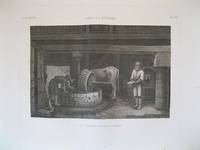
réf. 1990Trades Professions & the Arts: Paris Impremerie de C.L.F.Pancoucke 1820-1829. Copper engraving showing the interior of an Olive press or mill from the second volume of "Etat Moderne" of the "Description de l'Egypte" 2nd Edition; black & white; verso blank. Blind stamp of the publisher Panckoucke to margin. Good dark impression; some light spotting to margins; remains of glue and tissue guard to upper margin. "Description de l'Egypte ou Recueil des observations et des recherches qui ont été faites en Egypte pendant l'expédition de l'armée française." When Napoleon Bonaparte invaded Egypt in 1798 he brought with him an entourage of more than 160 scholars and scientists. Known as the French Commission on the Sciences and Arts of Egypt these experts undertook an extensive survey of the country's archeology topography and natural history. . For four years more than 150 artists engineers linguists and scientists traveled throughout the country examining almost every aspect of ancient and contemporary Egypt. They recorded and measured in meticulous detail Egypt's topography flora and fauna and its ancient and contemporary architecture. A soldier who was part of the expedition found the famous Rosetta Stone which the French linguist and scholar Jean-François Champollion 1790-1832 later used to unlock many of the mysteries that long had surrounded the language of ancient Egypt. The Egyptian expedition ended with a total military failure. The French left Egypt in 1801 with the honors of war but defeated; yet military failure remains a significant event in the history of knowledge because it is the first time a military expedition was accompanied by a scientific expedition. In 1802 Napoleon authorized the publication of the commission's findings in a monumental multi-volume work that included plates maps scholarly essays and a detailed index. Publication of the original Imperial edition began in 1809 and continued to 1822 sold by subscription. It proved so popular that a second edition was published under the post-Napoleonic Bourbon Restoration. The "Royal edition" published in Paris by C.L.F. Panckoucke from 1820-1830. The Second edition consists of 11 or 12 volumes of plates in folio and 24 of text bound as 26 8vo. Brunet:II 617; Blackmer/Navari: 476 1st edition Trades Professions & the Arts Egypt Olive press Paris Impremerie de C.L.F.Pancoucke 1820-1829 unknown
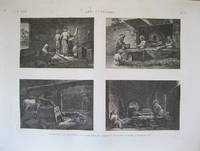
réf. 1985Trades Professions & the Arts: Paris Impremerie de C.L.F.Pancoucke 1820-1829. Copper engravings 4 on 1 plate showing the trades of miller baker pastry chef & confectioner from the second volume of "Etat Moderne" of the "Description de l'Egypte" 2nd Edition; black & white; verso blank. Blind stamp of the publisher Panckoucke to margin. The images show the workshops of the various trades: the miller grinding flour; the Baker placing loaves in the oven; the confectioner cutting and pulling sugar; the pastry chef baking above a fire. Good dark impression; generally clean; some spotting to margins; remains of glue and tissue guard to upper margin. "Description de l'Egypte ou Recueil des observations et des recherches qui ont été faites en Egypte pendant l'expédition de l'armée française." When Napoleon Bonaparte invaded Egypt in 1798 he brought with him an entourage of more than 160 scholars and scientists. Known as the French Commission on the Sciences and Arts of Egypt these experts undertook an extensive survey of the country's archeology topography and natural history. . For four years more than 150 artists engineers linguists and scientists traveled throughout the country examining almost every aspect of ancient and contemporary Egypt. They recorded and measured in meticulous detail Egypt's topography flora and fauna and its ancient and contemporary architecture. A soldier who was part of the expedition found the famous Rosetta Stone which the French linguist and scholar Jean-François Champollion 1790-1832 later used to unlock many of the mysteries that long had surrounded the language of ancient Egypt. The Egyptian expedition ended with a total military failure. The French left Egypt in 1801 with the honors of war but defeated; yet military failure remains a significant event in the history of knowledge because it is the first time a military expedition was accompanied by a scientific expedition. In 1802 Napoleon authorized the publication of the commission's findings in a monumental multi-volume work that included plates maps scholarly essays and a detailed index. Publication of the original Imperial edition began in 1809 and continued to 1822 sold by subscription. It proved so popular that a second edition was published under the post-Napoleonic Bourbon Restoration. The "Royal edition" published in Paris by C.L.F. Panckoucke from 1820-1830. The Second edition consists of 11 or 12 volumes of plates in folio and 24 of text bound as 26 8vo. Brunet:II 617; Blackmer/Navari: 476 1st edition Trades Professions & the Arts Egypt Baker Miller Confectioner Pastry Chef Paris Impremerie de C.L.F.Pancoucke 1820-1829 unknown
2000réf. 4436Perrin 2000 690 pages 15 5cmx24cmx4 6cm. 2000. broché. 690 pages. Ouvrage historique de Georges Fleury retraçant la guerre d'Indochine de 1945 à 1954 période marquant la fin de la présence coloniale française en Asie du Sud-Est et le début du conflit vietnamien
2006réf. 8660Vilo Jeunesse 2006 113 pages 21 4x1 8x27 6cm. 2006. cartonnage editeur avec jaquette. 113 pages.
1832réf. 9625Paulin Libraire-Éditeur 1832 in8. 1832. reliure editeur. 2 volume(s). Cet ouvrage historique de Pierre-Édouard Lemontey examine la période de la régence du Duc d'Orléans et de la minorité du roi Louis XV en France jusqu'au ministère du cardinal de Fleury. Il se concentre sur les événements politiques économiques et sociaux de cette époque cruciale
1926réf. 18604ALBIN MICHEL ÉDITEUR 1926 301 pages in12. 1926. broché. 301 pages.
1980réf. 13598Grasset 1980 356 pages in8. 1980. broché. 356 pages. Cet ouvrage retrace l'histoire des fusiliers marins de la France Libre une unité d'élite formée à Londres en juillet 1940 par des marins ralliés au général de Gaulle. Il couvre leur parcours depuis le débarquement manqué de Dakar et les combats de Syrie jusqu'à leurs campagnes en Italie et sur le Rhin de 1940 à 1945
1977réf. 17651Imprimerie cholet 1977 182 pages collection Chemin de Ronde. in8. 1977. broché. 182 pages.
1746réf. 9771746 Couverture rigide Paris. Pierre-Jean Mariette, 1746. 2 parties en un volume in-12, reliure pleine basane fauve, dos à 5 nerfs orné de motifs dorés, pièce de titre rouge, tranches rouges, coiffes arasées, coins émoussés, trous de vers au bas du dos et en pied au premier plat, quelques épidermures, nerfs frottés. Faux-titre, titre (vignette au titre), 392 pages (erreur de pagination sur la dernière page), petite déchirure au bas de la page 271. L'abbé Fleury fut notamment précepteur du Comte de Vermandois, puis le sous-précepteur des petits-fils de Louis XIV, les Ducs de Bourgogne, de Berry et d'Anjou (Fénelon en est le précepteur). L'édition originale fut publiée en 1681 et 1682. Bon état intérieur.
réf. 202600517Paris, Grasset, 1994 ; in-8, 382 pp., br.
réf. 202403810Paris, Grasset, 1986 ; in-8, 351 pp., br.
réf. 201905853Paris, Grasset, 1980 ; in-8, 356 pp., br. De londre a bir-haceim de l'italie au rhin -.
réf. 201708359Paris, Grasset, 1992 ; in-8, 356 pp., br. Broché bon état.
réf. 201706510Paris, Chez pierre-jean mariette , 1765 ; in-12, 391 pp., cartonnage de l'éditeur.
réf. 201508096Paris, Hachette, 1940 ; in-12, 249 pp., cartonnage de l'éditeur.
réf. 201505348Paris, Grasset, 1992 ; in-8, 356 pp., br.
réf. 201406233Paris, Club pour vous, 1979 ; in-8, 428 pp., br. En très bon état avec sa jaquette Les quatres guerres du général Delayen 1940-1945 Indochine Algérie, Tchad 1972-1978.
réf. 201310880Paris, Grasset, 1992 ; in-8, 356 pp., br.