3 940 résultats
1832réf. 44146Leipzig Johann Ambrosius Barth 1832. Contemp. hcalf. raised bands gilt spine. Light wear along edges. In "Annalen der Physik und Chemie. Hrsg. von J.C. Poggendorff" Band 25. Entire volume offered. VIII648 pp. and 6 folded engraved plates. Small stamps on verso of titlepage and plates. Faraday's papers: pp. 91-142 a. pp. 142-186. with 3 folded engraved plates. Clean and fine. First German editions of the 2 first memoirs of Faradays groundbreaking researches on electricity constituting the first 2 papers of his "Experimental Researches in Electricity" and containing his fundamental discovery of electromagnetic induction THE FOUNDATION OF NEARLY ALL THE ELECTRICITY IN USE TODAY. In 1820 Oersted had generated magnetism from electricity Faraday here finds the opposite effect generating electricity by magnetism. He also described the first electrical generator second paper. THESE PAPERS ARE SOME OF THE GREAT CLASSICS OF CHEMISTRY AND PHYSICS."Faraday demonstrated this theory involving the lines of force.by inserting a magnet into a coil of wire attached to a galvanometer. While the magnet was being inserted or removd current flowed through the wire. If the magnet was held stationary and the coil moved over it one way or the other there was current in the wire. In either case the magnetic lines of force about the magnet were cut by the wire.If the magnet and coil were both held motionless whether the magnet was within the coil or not there was no current.Faraday hd thus discovered electricalinduction.It was to lead to great things but this was not apparent."Asimov."Although his discovery of the electric motor and the dynamo was almost entirely identical to his theoretical discoveries it laid the foundation of the modern electrical industry - electric light and power teælephony wireless telegraphy televison etc. - by providing for the production of continous mechanical motion from an electrical source and vice versa." PMM 308.Horblit 29 - Milestones 62. - Dibner 64. - PMM 308.The volume contains further notable papers. Elie de Beaumont "Zweiter geologischer Brief.an A.v. Humboldt über die relative Alter der Gebirgszüge" pp. 1-58 a. 2 plates one handcoloured papers by Döbereiner E. Lenz Moser Mitscherlich de Saussure J. Dumas F.E. Neumann Gay-Lussac Johannes Müller "Beobachtungen zur Analyse der Lymphe des Bluts und des Chylus" pp. 513-590. hardcover
1832réf. 44145Paris Crochard 1832. Contemp. hcalf. gilt spine light wear along edges. In: "Annales de Chimie et de Physique Par MM. Gay-Lussac et Arago." tome 50 Series 2. Entire volume offered. 448 pp. 2 folded engraved plates. Faraday's papers: pp. 5-67 a. pp. 113-162. First French editions of the 2 first memoirs of Faradays groundbreaking researches on electricity constituting the first 2 papers of his "Experimental Researches in Electricity" and containing his fundamental discovery of electromagnetic induction THE FOUNDATION OF NEARLY ALL THE ELECTRICITY IN USE TODAY. In 1820 Oersted had generated magnetism from electricity Faraday here finds the opposite effect generating electricity by magnetism. He also described the first electrical generator second paper. THESE PAPERS ARE SOME OF THE GREAT CLASSICS OF CHEMISTRY AND PHYSICS."Faraday demonstrated this theory involving the lines of force.by inserting a magnet into a coil of wire attached to a galvanometer. While the magnet was being inserted or removd current flowed through the wire. If the magnet was held stationary and the coil moved over it one way or the other there was current in the wire. In either case the magnetic lines of force about the magnet were cut by the wire.If the magnet and coil were both held motionless whether the magnet was within the coil or not there was no current.Faraday hd thus discovered electricalinduction.It was to lead to great things but this was not apparent."Asimov."Although his discovery of the electric motor and the dynamo was almost entirely identical to his theoretical discoveries it laid the foundation of the modern electrical industry - electric light and power teælephony wireless telegraphy televison etc. - by providing for the production of continous mechanical motion from an electrical source and vice versa." PMM 308.Horblit 29 - Milestones 62. - Dibner 64. - PMM 308. unknown
1863réf. 44144Paris Victor Masson et Fils 1863 a. 1864. Boundin 2 contemp. hcalf. Gilt spines raised bands light wear along edges. In: "Annales de Chimie et de Physique" 3e Series - Tome 68 a. 4e Series tome 1. 512 pp. a. 5 large folded engraved plates. 512 pp. a. 3 large folded engraved plates. Kirchhoff's papers: pp. 5-45 a. pp. 396-411. 5 plates belongs to K's papers 4 showing spectra and 1 plate double page depicts the famous spectroscope invented by K. and used by K. and Bunsen in their importent analysis of the spectra of the elements. First edition in French of Kirchhoff's milestone papers on the interpretation of the dark D lines - noticed by Fraunhofer in 1814 - in the spectrum of the sun the papers that inspired Max Planck to his theory of quanta 1900. The papers are the French translations of his papers published in Abhandl. d. königl. Akad. d. Wissenscchaften in Berlin in 1861 and 1862.In the course of his preparatory work in the autumn of 1859 Kirchhoff made an unexpected observation. It had long been known that the dark D lines noticed in the solar spectrum by Fraunhofer 1814 coincided with the yellow lines emitted by flames containing sodium.Kirchhoff's unexpected discovery was that if the intensity of the solar spectrum increased above a certain limit the dark D lines were made much darker by the interrposition of the sodium flame. He instantly felt that he had got hold of "something fundamental" even though he was at a loss to suggest an explanation. On the day following the surprising observation Kirchhoff found the the correct interpretation which wass soon confirmed by new experiments: a substance capable of emittiing a certain spectral line has a strong absorptive power for the same line.The dark D lines in the solar spectrum could accordingly be ascribed to absorption by a solar atmosphere containing sodium. Immense prospects thus opened up of ascertaining the chemical composition of the sun and other stars from the study of their optical spectra. A few more weeks sufficed for Kirchhoff to elaborate a quantitative theory of the relationship between emissive and absorptive poweer."DSB VII pp. 381-82.PMM 278 b. - Barchas 1169-70 - Sparrow 117 - Horbli 59 - Dibner 153 the note. hardcover
réf. SONG020594194XUsed: Good unknown
réf. SONG0805361189Used: Good unknown
réf. SONG1305930134Used: Good unknown
réf. SONG1259390586Used: Good unknown
réf. SONG1305667042Used: Good unknown
réf. SONG1319075797Used: Good unknown
réf. SONG1319061125Used: Good unknown
réf. SONG146412020XUsed: Good unknown
réf. SONG0205936741Used: Good unknown
réf. SONG1118130359Used: Good unknown
réf. SONG0134013530Used: Good unknown
réf. SONG1133495575Used: Good unknown
réf. SONG0495776254Used: Good unknown
réf. SONG0077924797Used: Good unknown
réf. SONG0470401672Used: Good unknown
1950réf. 145904N.p.: N.p. 1950. Ribbon copy typed manuscript for an unproduced play with essays on the history of the project the production casting and set/costume design written by June Shannon a drama student at the Carnegie Institute of Technology. With extensive manuscript annotations in ink and pencil on virtually every page and 15 hand painted watercolor sketches of set and costume designs. Based on the 1775 play by Richard Sheridan. A comedy of manners set in 18th century Bath where three suitors quarrel over the love of one woman. In this hypothetical casting Tony-winning Broadway actor Jose Ferrer assumed the role of Bob Acres a buffoonish country suitor to young Lydia played by Laura Hope-Crews. The character of Mrs. Malaprop who throughout the play uses words incorrectly helped coin the term malapropism. Set in France. Black untitled wrappers. 166 leaves with last page of text numbered 139. Typescript rectos only. Pages Very Good plus wrapper Very Good plus in a spring binder. N.p. unknown
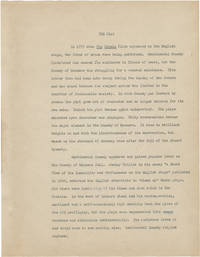
1950réf. 145904N.p.: N.p. 1950. Ribbon copy typed manuscript for an unproduced play with essays on the history of the project the production casting and set/costume design written by June Shannon a drama student at the Carnegie Institute of Technology. With extensive manuscript annotations in ink and pencil on virtually every page and 15 hand painted watercolor sketches of set and costume designs. Based on the 1775 play by Richard Sheridan. A comedy of manners set in 18th century Bath where three suitors quarrel over the love of one woman. In this hypothetical casting Tony-winning Broadway actor Jose Ferrer assumed the role of Bob Acres a buffoonish country suitor to young Lydia played by Laura Hope-Crews. The character of Mrs. Malaprop who throughout the play uses words incorrectly helped coin the term malapropism. Set in France. Black untitled wrappers. 166 leaves with last page of text numbered 139. Typescript rectos only. Pages Very Good plus wrapper Very Good plus in a spring binder. N.p. unknown books
1851réf. 2111902160201050Santoshorin 1851. Soft Cover. Fine. Number of books: 4 Santoshorin paperback
1937réf. 2092902141600518Arikosha 1937. Soft Cover. Fine. Volume: 1 Arikosha paperback
1999réf. 1731New York: Little Simon 1999. First Edition Stated on Rear Board. Publisher's Illustrated Boards with White and Yellow Printing Backed in. Near Fine. A Near Fine Pop-up Book in its Originally Issued Condition Signed and Inscribed in Silver Ink to the Front Cover. Light rubbing and a couple faint scratches to the boards. Pages show trace signs of having been read. Pop-up art intact with interactive parts still fully functional. Beautiful and unique piece likely signed at the Briar Patch a children's book shop which did a signing at the time of publication. Hardcover. 26 x 21 cm. 6 unnumbered dual-sided pop-up board-book-style pages each containing smaller bundles of pages for reading. Little Simon unknown
réf. DADAX0122526732New unknown
1824réf. 2110502150908263Not Available 1824. Soft Cover. Fine. Number of books: 4 Not Available paperback