New International VersionBiblio.com

2430 risultati
1998rif. GB000K0A7HQI3N00Serendipity House 1998. Hardcover. Good. Disclaimer:A copy that has been read but remains in clean condition. All pages are intact and the cover is intact. The spine may show signs of wear. Pages can include limited notes and highlighting and the copy can include previous owner inscriptions. At ThriftBooks our motto is: Read More Spend Less.Dust jacket quality is not guaranteed. Serendipity House hardcover
rif. Z1-C-054-01579Information Age Publishing. Used - Good. Worn cover. Ships from UK in 48 hours or less usually same day. Your purchase helps support Sri Lankan Children's Charity 'The Rainbow Centre'. Ex-library so some stamps and wear but in good overall condition. 100% money back guarantee. We are a world class secondhand bookstore based in Hertfordshire United Kingdom and specialize in high quality textbooks across an enormous variety of subjects. We aim to provide a vast range of textbooks rare and collectible books at a great price. Our donations to The Rainbow Centre have helped provide an education and a safe haven to hundreds of children who live in appalling conditions. We provide a 100% money back guarantee and are dedicated to providing our customers with the highest standards of service in the bookselling industry. Information Age Publishing unknown
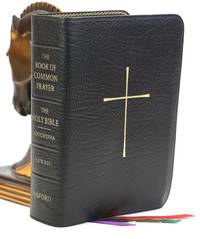
1990rif. 515107Oxford University Press 1990. First Edition. Leather. FINE. First printing of the combined Episcopal Book of Common Prayer with the newly published NRSV Bible with Apocrypha. Finely bound in supple Black Calfskin Leather with pronounced grain gilt stamped spine lettering and gilt stamped cross to front cover chain dentelle all edges gilt six multi-colored place ribbons. With only the most trivial scuffs to the edges this is a FINE copy with tight sound binding no markings and blank dedication pages. Although it has regularly appeared in subsequent Korean printings with bonded leather this first edition in genuine calfskin leather and printed in the U.S. has become quite scarce in trade. Oxford University Press unknown
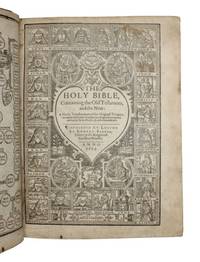
1613rif. AQ36763Imprinted at London By Robert Barker 1613. The text is collated and complete bound without the Map which sometimes is included. 1352pp. Signatures: A8 2A-3Z8 A-M8 square brackets as printed. NT has separate title page dated 1613; register is continuous. In this edition Genesis I 11 has: 'bring forth'; Ruth III 15 has: 'she went'. Very small burn holes to text of leaves O5 and O7 short tear to head of leaf Aa2 some loss to lower corner of leaf H8 early ownership inscription to blank verso of leaf K4: 'Edward Pointz his Book 1663'. ESTC S116976 STC 2228. Bound after: SPEED John. The genealogies Recorded In The Sacred Scriptures. London. Printed by John Beale 1613. 2 43pp. Without two terminal leaves. Initial four leaves laid down with substantial loss to title page. ESTC S102017. Bound before: PSALTER - English Sternhold & Hopkins. The booke of psalmes. London. Imprinted at the Company of Stationers 1614 8 93pp 5. Defective without 11 terminal leaves substantial portion of title page torn away final two leaves laid down. Modern blind-tooled calf. Scattered spotting. An early example textually complete and with both title pages of the definitive Anglican text of the Reformation. 'The Authorized Version of the English Bible first printed in 1611.is the most widely-published text in the English language. During many generations large portions of it were known by heart by people on both sides of the Atlantic. With Shakespeare its exact contemporary the Authorized Version has contributed countless quotations and expressions which have slipped hardly noticed into English language and idiom.The book was always printed according to a very precise formula. The lengthy wording of the title-page was unvarying. Every Bible opened with the standard preface to James I 'To the Most High and Mighty Prince James.' beginning 'Great and manifold were the blessings.' The text of the Bible was arranged in strict convention. It was generally laid out in two columns with separate numbered verses. Each chapter opened with a short summary of its content. There were no interpretative notes but there were brief references in the margins to parallel passages or variant readings. 246-249pp HAMEL Christopher De. The Book. A History of the Bible. London 2001. . Authorized Version. Quarto. unknown
2006rif. SONG1529391334Hodder & Stoughton 2020-06-11. flexibound. Used: Good. 6.77x1.42x9.76. Buy with confidence. Excellent Customer Service & Return policy. Hodder & Stoughton unknown
1905rif. 111472Depósito Central de la Sociedad Bíblica 1905. hardcover. Aceptable. Madrid 1905. Depósito Central de la Sociedad Bíblica. Piel. 1056 pp. 17x12. Falto de lomo. Depósito Central de la Sociedad Bíblica hardcover
1795rif. 60373ERlangen: WAltherschen Buchhandlung 1795. Erster Theil. Hardcover. Good Solid Copy Light Foxing At Fore edgeOctavo Cloth Wrapped Spine Marbled Boards FFep Corner Clipped Light Surface Wear At Boards Some Wear At Extremities. Octavo Cloth Wrapped Spine Marbled Boards Embossed Title At Spine. Important Medical Work on the basics of the human body; Lundsgard 483 ERlangen: WAltherschen Buchhandlung hardcover
rif. SONG0966825519Brand: Cichlid Press 0000-00-00. 1st US. hardcover. Used: Good. 0.00x0.00x0.00. Buy with confidence. Excellent Customer Service & Return policy. Brand: Cichlid Press hardcover
rif. 47329671like new. unknown
1990rif. 76706Nauta 1990. hardcover. Bueno. Barcelona 1990. Nauta. Piel. 8 Tomos. 1034 pp. 28x21. Ilustrado. Nauta hardcover
1962rif. 3379Ediciones Nauta 1962. unbound. Bueno. 8 Volumenes. Ediciones Nauta. Barcelona 1990. Símil piel decorada. 24x17. 1036 pp. Ediciones Nauta unknown
2004rif. 89358Generalitat Valenciana Conselleria de Cultura Educació i Sport 2004. paperback. Bueno. Valencia 2004. Generalitat Valenciana. Rústica. 36 pp. 20x14. Ilustrado. Programa de mano y Libreto. Generalitat Valenciana Conselleria de Cultura, Educació i Sport paperback
rif. DADAX877247159X2016-07-01. hardcover. New. xx. Buy with confidence. Excellent Customer Service & Return policy. hardcover
1946rif. 709New York: Ars Sacra-Herbert Dubler Inc 1946. Boards. Near fine. Ida BOHATTA-MORPURGO. 16mo; 20pp; color pictorial grey boards with anthropomorphic bee on the front; 6 full-page color illustrations; light shelf wear; near fine. This little book of noted Austrian illustrator and author Ida Bohatta-Morpurgo 1900-1992 translated into English by June Head. Unusually fine condition. Ars Sacra-Herbert Dubler, Inc unknown
1832rif. 44145Paris Crochard 1832. Contemp. hcalf. gilt spine light wear along edges. In: "Annales de Chimie et de Physique Par MM. Gay-Lussac et Arago." tome 50 Series 2. Entire volume offered. 448 pp. 2 folded engraved plates. Faraday's papers: pp. 5-67 a. pp. 113-162. First French editions of the 2 first memoirs of Faradays groundbreaking researches on electricity constituting the first 2 papers of his "Experimental Researches in Electricity" and containing his fundamental discovery of electromagnetic induction THE FOUNDATION OF NEARLY ALL THE ELECTRICITY IN USE TODAY. In 1820 Oersted had generated magnetism from electricity Faraday here finds the opposite effect generating electricity by magnetism. He also described the first electrical generator second paper. THESE PAPERS ARE SOME OF THE GREAT CLASSICS OF CHEMISTRY AND PHYSICS."Faraday demonstrated this theory involving the lines of force.by inserting a magnet into a coil of wire attached to a galvanometer. While the magnet was being inserted or removd current flowed through the wire. If the magnet was held stationary and the coil moved over it one way or the other there was current in the wire. In either case the magnetic lines of force about the magnet were cut by the wire.If the magnet and coil were both held motionless whether the magnet was within the coil or not there was no current.Faraday hd thus discovered electricalinduction.It was to lead to great things but this was not apparent."Asimov."Although his discovery of the electric motor and the dynamo was almost entirely identical to his theoretical discoveries it laid the foundation of the modern electrical industry - electric light and power teælephony wireless telegraphy televison etc. - by providing for the production of continous mechanical motion from an electrical source and vice versa." PMM 308.Horblit 29 - Milestones 62. - Dibner 64. - PMM 308. unknown
1811rif. 43628Halle Rengerschen Buchhandlung 1811 1811 1812. Without wrappers as published in "Annalen der Physik. Herausgegeben von Ludwig Wilhelm Gilbert" Bd. 37 Drittes u. Viertes Stück Bd. 38 Sechtes Stück Bd. 40 Zweites u. Drittes Stück. The entire issues offered 5 issues. With titlepage to vol. 37 38 a. 40. Pp. 233-480 a. 3 engraved plates. pp. 121-236 a. 2 engraved plates. pp. 117-348 a. 1 engraved plate. Berzelius's papers: pp. 249-337 a. 415-472.- Pp. 161-226. - Pp. 162-208 a. 235-330. The papers represents one of the first announcements of Berzelius' discovery of the fixed chemical proportions determining the weights and valencies of the various constituent elements in inorganic compounds. The papers were published at the same time in German both here in Annalen and in Schweiger's Journal and in French. By running many hundreds of analysis of chemical compounds he gave so many examples of the law of definite proportions that the world of chemistry could no longer doubt its validity and in so doing he gave experimental evidence to the atomic theory. He hereby laid a solid fundation for the further development of chemistry.According to Söderbaum Jac. Berzelius 2 p.12 "It was a giant work one of the most importent in the history of chemistry which was here presented. One is even more impressed when one remembers that it was a pioneer undertaking in every sense of the term. Analytic and synthetic methods existed before Berzelius' time to be sure but there were no precise methods of the sort which he required. They all had to be elaborated at the cost of time and labour."J. Erik Jorpes "Jac. Berzelius" p.45."In general Berzelius's efforts were directed toward the consolidation and extension of the atomic theory. He improved chemical analysis and determined the composition of a large number of compounds thus verifying the laws of constant and multiple proportions and furnishing the most accurate equivalent weights then available. By ingenious methods he arrived at the correct atomic composition of most common substances and thus was enabled to draw up in 1826 a table of atomic weights very nearly identical with the modern one."Leicester & Klicktein "A Source Book in Chemistry" p. 258.Parkinson "Breakthroughs" 1810-20 C. unknown
1834rif. 49065Leipzig Barth 1834. Contemp. hcalf. raised bands spine gilt. Spine with light wear. in. "Annalen der Physik und Chemie. J.C. Poggendorff" Zweite reine 3. bd.VIII5584 pp. and 5 plates. Entire volume offerd. Faradays papers: pp. 149-189 Sixth series pp. 301-331 a. 481-520 Seventh series. Internally clean and fine printed on good paper. First appearance in German - prepared by Faraday himself for publication in Annalen - of 2 historical papers in chemistry and physiscs in which Faraday in the first detects a new recombination-effect in electrolysis and in the second we have the MILESTONE PAPER in which Faraday announces the discoveries of further laws of electrochemistry stating the general relations of electricity to chemistry and introducing new terms with precise meanings. The first part of the paper introduces his new terminology giving the words a limited and precise meaning. These words devised with the assistance of William Whewell are now familiar to all chemists electrode anode cathode ion anion and cation. He also introduces the "Volta-electrometer" and arrives at the "Law of electro-chemical equivalents". The paper offered is one of Farday's most famous papers."Another section of the paper is devoted to a closer examination of the law of constant electrochemical action with respect to water and to the development of a gas electrometer to measure quantities of electricity. Faraday's "Volta-electrometer" provided the first practical means for the quantitative measurement of electricity." Source Book in Chemistry p. 280-81.The Sixth series: "In the course of his experimental investigations of a general and importent law of electro-chemical action which required the accurate measurement of thegases evolved during the decomposition of water and other substances the author was lead to the detection of a curious effect which had never been previously noticed and of which the knowledge had he before possessed it would have prevented many of the errors and inconsistencies occurring in the conclusions he at first deduced from his earlier experiments. The phenomena observed was the gradual recombination of elements which had been previously separated from each other by voltaic action. This happened when after water had been decomposed by voltaic electricity the mixed gases resulting from such decomposition were left in contact with the platina wires or plates which had acted as poles; for under these circumstances they gradually diminished in vo.umes water was reprioduced and at lust the whole of the gases disappeared."Abstract - Faraday explains the causes of this recombination. hardcover
1832rif. 44146Leipzig Johann Ambrosius Barth 1832. Contemp. hcalf. raised bands gilt spine. Light wear along edges. In "Annalen der Physik und Chemie. Hrsg. von J.C. Poggendorff" Band 25. Entire volume offered. VIII648 pp. and 6 folded engraved plates. Small stamps on verso of titlepage and plates. Faraday's papers: pp. 91-142 a. pp. 142-186. with 3 folded engraved plates. Clean and fine. First German editions of the 2 first memoirs of Faradays groundbreaking researches on electricity constituting the first 2 papers of his "Experimental Researches in Electricity" and containing his fundamental discovery of electromagnetic induction THE FOUNDATION OF NEARLY ALL THE ELECTRICITY IN USE TODAY. In 1820 Oersted had generated magnetism from electricity Faraday here finds the opposite effect generating electricity by magnetism. He also described the first electrical generator second paper. THESE PAPERS ARE SOME OF THE GREAT CLASSICS OF CHEMISTRY AND PHYSICS."Faraday demonstrated this theory involving the lines of force.by inserting a magnet into a coil of wire attached to a galvanometer. While the magnet was being inserted or removd current flowed through the wire. If the magnet was held stationary and the coil moved over it one way or the other there was current in the wire. In either case the magnetic lines of force about the magnet were cut by the wire.If the magnet and coil were both held motionless whether the magnet was within the coil or not there was no current.Faraday hd thus discovered electricalinduction.It was to lead to great things but this was not apparent."Asimov."Although his discovery of the electric motor and the dynamo was almost entirely identical to his theoretical discoveries it laid the foundation of the modern electrical industry - electric light and power teælephony wireless telegraphy televison etc. - by providing for the production of continous mechanical motion from an electrical source and vice versa." PMM 308.Horblit 29 - Milestones 62. - Dibner 64. - PMM 308.The volume contains further notable papers. Elie de Beaumont "Zweiter geologischer Brief.an A.v. Humboldt über die relative Alter der Gebirgszüge" pp. 1-58 a. 2 plates one handcoloured papers by Döbereiner E. Lenz Moser Mitscherlich de Saussure J. Dumas F.E. Neumann Gay-Lussac Johannes Müller "Beobachtungen zur Analyse der Lymphe des Bluts und des Chylus" pp. 513-590. hardcover
1803rif. 45109Paris Chez Fuchs An Xe 1803. In: "Annales de Chimie ou Recueil de Mémoires concernant la Chemie" Tome 45 Cahier 2 a. Tome 46 Cahier 3. Pp. 113-212 entire issue offered and pp. 225-336 entire issue offered. Dalton's papers: pp. 177-181 a. pp. 250-272. First appearance in French of these importent papers. publication of which at once gave him European reputation. The first paper combated Rumford's view that the circulation of heat in fluids is by convection only. Second paper is the French translation of the first of the 5 seminal papers which appeared under the general title "Experimental Essays on the constitution of mixed Gases; on the Force of steam or vapor etc."published 1801-3. The paper expresses the generalisation that the maximum density of a vapour in contact with its liquid remains the same whether other gases be present or not and the view that the particles of every kind of elastic fluid are elastic only with regard to those of their own kind the LAW OF PARTIAL PRESSURES. Smyth No 27 and No 29:1. - Parkinson "Breakthroughs" 1801 M/C. unknown
1842rif. 44147Leipzig Johann Ambrosius Barth 1842. Without wrappers. In "Annalen der Physik und Chemie. Hrsg. von J.C. Poggendorff" Ergänzungsband 1 Stück 2. Pp. 193-384 a. 1 folded engraved plate. The entire issue offered. Henry's paper: pp. 282-312. First German version of Henry's description of his discovery of self-induction. He missed the credit for the discovery of induction to Faraday but he had done the key experiment ahead of Faraday but Faraday was the first to publish. But he is credited for the discovery of self-induction 1832 and Faraday discovered it independently two years later 1834."In Henry's paper however he explained thet the electric current in a coil can induce another current not only in another coil but in itself. The actual current observed in the coil is then the combination of the original current and the induced current. This is called self induction."Isac Asimov.The issue contains further notable papers Michael Faraday's "Vierzehnte Reihe von Experimental-Untersuchungen über Elektricität" § 2o-22. Nos 1667-1748. Pp. 249-281. First German version. In this paper FARADAYamplifies his theory of electrostatic induction by making further use of the analogy with the induction of magnetism. Whittaker describes the paper as having "THE FUNDAMENTAL EQUATION OF ELECTROSTATICS" as modified in order to take into account the effect of the specific inductive capacity."Whittaker I pp.187-89. unknown
1911rif. 46922London Harrison and Sons 1911. Small 4to. Contemp. full cloth. Spine gilt and with gilt lettering. A stamp to verso of titlepage and a few other leaves. In: "Proceedings of the Royal Society of London. Series A." Vol. LXXXV. XXIII605XXIV pp. and 11 plates. Entire volume offered. Wilson's paper: pp. 285-288 a. 1 plate. Clean and fine. First appearance of the paper which describes the final version of his invention the famous Cloud-Chamber - the first Cloud Chamber was invented by him in 1896 - for making visible and photographing the paths of charged particles an invention for which Wilson received a share of the Nobel Prize in 1827. By using the Cloud Chamber he was here 1911 able to observe the track of an alpha ray by condensing water drops onto the ions produced by its passage.The Cloud Chamber which Rutherford called "the most original apparatus in the whole history of physics" became standard equipment in physics laboratories and made possible numerous important discoveries in the fields of particle and nuclear physicsAfter 1896 "Wilson continued to experiment with ultraviolet radiation and other techniques for producing condensation effects but soon concentrated on atmospheric electricity not returning to the cloud chamber until December 1910. He designed an improved chamber with new methods of illumination and the possibility of photographing the results. At this time Wilson realized that it might be possible to reveal the track of an a ray by condensing water drops onto the ions produced by its passage. During March 1911 he saw this effect produced in his apparatus. Thus the elucidation of phenomena seen in the Scottish hills led to the possibility of studying the processes of radioactivity and the Wilson cloud chamber became an important piece of laboratory equipment. But it was in the study of cosmic rays that it achieved its full power particularly in the refined form developed by Patrick Blackett in which it was possible to study particles of very high energy and the production of electron-positron pairs with the chamber situated in a strong magnetic field." DSB. hardcover
1832rif. 48987Paris Crochard 1832. Contemp. hcloth gilt lettering to spine. In: "Annales de Chimie et de Physique Par MM. Gay-Lussac et Arago." tome 50 Series 2. Entire volume offered. 448 pp. 2 folded engraved plates. Faraday's papers: pp. 5-67 a. pp. 113-162. Some scattered brownspots. First French editions of the 2 first memoirs of Faradays groundbreaking researches on electricity constituting the first 2 papers of his "Experimental Researches in Electricity" and containing his fundamental discovery of electromagnetic induction THE FOUNDATION OF NEARLY ALL THE ELECTRICITY IN USE TODAY. In 1820 Oersted had generated magnetism from electricity Faraday here finds the opposite effect generating electricity by magnetism. He also described the first electrical generator second paper. THESE PAPERS ARE SOME OF THE GREAT CLASSICS OF CHEMISTRY AND PHYSICS."Faraday demonstrated this theory involving the lines of force.by inserting a magnet into a coil of wire attached to a galvanometer. While the magnet was being inserted or removd current flowed through the wire. If the magnet was held stationary and the coil moved over it one way or the other there was current in the wire. In either case the magnetic lines of force about the magnet were cut by the wire.If the magnet and coil were both held motionless whether the magnet was within the coil or not there was no current.Faraday hd thus discovered electricalinduction.It was to lead to great things but this was not apparent."Asimov."Although his discovery of the electric motor and the dynamo was almost entirely identical to his theoretical discoveries it laid the foundation of the modern electrical industry - electric light and power teælephony wireless telegraphy televison etc. - by providing for the production of continous mechanical motion from an electrical source and vice versa." PMM 308.Horblit 29 - Milestones 62. - Dibner 64. - PMM 308.The volume contains further notable papers. Elie de Beaumont "Zweiter geologischer Brief.an A.v. Humboldt über die relative Alter der Gebirgszüge" pp. 1-58 a. 2 plates one handcoloured papers by Döbereiner E. Lenz Moser Mitscherlich de Saussure J. Dumas F.E. Neumann Gay-Lussac Johannes Müller "Beobachtungen zur Analyse der Lymphe des Bluts und des Chylus" pp. 513-590. hardcover
1803rif. 44130Halle Rengerschen Buchhandlung 1803. Without wrappers as extracted from "Annalen der Physik. Herausgegeben von Ludwig Wilhelm Gilbert" Bd. 12. Pp. 257-291 a. 1 folded engraved plate showing the experimental apparatus used. First appearance in German of this extremely important paper in which Gay-Lussac first formulated the law the Gay-Lussac's Law stating that if the mass and pressure of a gas are held constant then gas volume increases linearly as the temperature rises. This is sometimes written as V = k T where k is a constant dependent on the type mass and pressure of the gas and T is temperature on an absolute scale. In terms of the ideal gas law k = n R / P."In 1802 he Gay-Lussac showed that different gases all expanded by equal amounts with rise in temperature. Charles had made the same discovery some years earlier but had not published it; the credit therefore belongs to Gay-Lussac at least as much and probably more. This was an extremely importent discovery which Avogadro was to use within the decade to formulate hid long-neglected hypothesis that equal volumes of different gases at equal temperatures contained equal numbers of particles."Asimov.Magie "A Source Book in Physics" p.165-172 - Leicester & Klickstein "A Source Book of Chemistry" p. 374-379. - Parkinson "Breakthroughs" 1802 C. unknown
1863rif. 44144Paris Victor Masson et Fils 1863 a. 1864. Boundin 2 contemp. hcalf. Gilt spines raised bands light wear along edges. In: "Annales de Chimie et de Physique" 3e Series - Tome 68 a. 4e Series tome 1. 512 pp. a. 5 large folded engraved plates. 512 pp. a. 3 large folded engraved plates. Kirchhoff's papers: pp. 5-45 a. pp. 396-411. 5 plates belongs to K's papers 4 showing spectra and 1 plate double page depicts the famous spectroscope invented by K. and used by K. and Bunsen in their importent analysis of the spectra of the elements. First edition in French of Kirchhoff's milestone papers on the interpretation of the dark D lines - noticed by Fraunhofer in 1814 - in the spectrum of the sun the papers that inspired Max Planck to his theory of quanta 1900. The papers are the French translations of his papers published in Abhandl. d. königl. Akad. d. Wissenscchaften in Berlin in 1861 and 1862.In the course of his preparatory work in the autumn of 1859 Kirchhoff made an unexpected observation. It had long been known that the dark D lines noticed in the solar spectrum by Fraunhofer 1814 coincided with the yellow lines emitted by flames containing sodium.Kirchhoff's unexpected discovery was that if the intensity of the solar spectrum increased above a certain limit the dark D lines were made much darker by the interrposition of the sodium flame. He instantly felt that he had got hold of "something fundamental" even though he was at a loss to suggest an explanation. On the day following the surprising observation Kirchhoff found the the correct interpretation which wass soon confirmed by new experiments: a substance capable of emittiing a certain spectral line has a strong absorptive power for the same line.The dark D lines in the solar spectrum could accordingly be ascribed to absorption by a solar atmosphere containing sodium. Immense prospects thus opened up of ascertaining the chemical composition of the sun and other stars from the study of their optical spectra. A few more weeks sufficed for Kirchhoff to elaborate a quantitative theory of the relationship between emissive and absorptive poweer."DSB VII pp. 381-82.PMM 278 b. - Barchas 1169-70 - Sparrow 117 - Horbli 59 - Dibner 153 the note. hardcover
1811rif. 46030Paris Chez J. Klostermann fils 1811-12. Bound in 6 contemp. hcalf. Gilt spines slightly rubbed. Wear to top of spines. In: "Annales de Chimie ou Recueil de Mémoires concernant la Chemie" Tome 78 79 80 81 82 and 83. Entire volumes offered. The 14 parts: Tome 78: pp. 5-37 105-132 217-242. - Tome 79: pp. 113-142 233-264. - Tome 80: pp. 5-37 225-258. - Tome 81: pp. 5-36 278-303. - Tome 82: pp. 5-33 113-125 225-72. Tome 83: pp. 5-35 a. pp. 117-127. With in all 3 engraved plates. Some scattered brownspots. The papers represents one of the first announcements of Berzelius' discovery of the fixed chemical proportions determining the weights and valencies of the various constituent elements in inorganic compounds. The papers were published at the same time in Swedish German both here in Annalen and in Schweiger's Journal and in French. By running many hundreds of analysis of chemical compounds he gave so many examples of the law of definite proportions that the world of chemistry could no longer doubt its validity and in so doing he gave experimental evidence to the atomic theory. He hereby laid a solid fundation for the further development of chemistry. A reprint is found in Ostwald's Klassiker der exakten Wissenschaften No. 35.According to Söderbaum Jac. Berzelius 2 p.12 "It was a giant work one of the most importent in the history of chemistry which was here presented. One is even more impressed when one remembers that it was a pioneer undertaking in every sense of the term. Analytic and synthetic methods existed before Berzelius' time to be sure but there were no precise methods of the sort which he required. They all had to be elaborated at the cost of time and labour."J. Erik Jorpes "Jac. Berzelius" p.45."In general Berzelius's efforts were directed toward the consolidation and extension of the atomic theory. He improved chemical analysis and determined the composition of a large number of compounds thus verifying the laws of constant and multiple proportions and furnishing the most accurate equivalent weights then available. By ingenious methods he arrived at the correct atomic composition of most common substances and thus was enabled to draw up in 1826 a table of atomic weights very nearly identical with the modern one."Leicester & Klicktein "A Source Book in Chemistry" p. 258.Parkinson "Breakthroughs" 1810-20 C. unknown