2,453 results
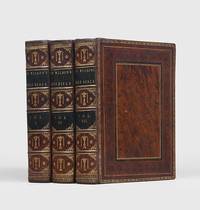
1785ref. 173867Bath: printed by R. Cruttwell; and sold by Rivingtons' Dilly Robson & Robinsons' 1785. With three Biblical fore edge paintings An imposing Bible handsomely bound by Edwards of Halifax in their celebrated "Etruscan" style. The set is unusual in featuring motifs relevant to the contents on all three fore-edges - scenes from the Old and New Testaments - as opposed to the more typical landscapes. Edwards famously almost never signed their bindings and their style was very frequently reproduced by others. This set is cited by Weber in his Annotated Dictionary of Fore-Edge Paintings as "a notable Bible from the Edwards bindery" Weber 2010 p. 118-9 and it is used as an example in a chapter devoted to distinguishing genuine Edwards bindings and paintings from imitations. The technique of concealing a painting under the gilt fore edge of books was revived in England by William Edwards about 1780. "The Edwards family not only carried on the art but enlarged it from the mainly floral and heraldic early efforts with occasional religious scenes and royal portraits to embrace views of well-known country houses set in landscapes" Marks p. 194. They were the originators of the bucolic English fore-edge painting which became standard in the 19th century. Scholars believe that the paintings were made in Halifax rather than in London by artists both within and outside the family and under the supervision of Thomas Edwards. Inspiration for the images was taken from various sources often engravings appearing in other books; for landscapes the favourite artist was William Gilpin a pioneer of the "picturesque". Volume I features a moment from Genesis: Abraham welcoming three angels into his home an act of hospitality which moved the Lord to bless Abraham and his wife with a son despite she was far beyond childbearing age. On Volume II is an episode from Exodus: an Egyptian princess and her attendants discover the infant Moses in the bulrushes of the Nile. Volume III displays an animated scene from the life of St. Paul as he preaches in Rome. The "Etruscan" style binding with a border of palmettes and other classical ornaments stencilled in black on brown calf was one of the firm's most popular designs. The origin of this style is debated: some 19th-century writers attributed the invention to John Whitaker while others ascribe it to the Edwards firm. It is known that Edwards employed it from at least 1775. Provenance: a Herman Frasch Whiton probably the American sailor and Olympic champion 1904-1967 with his elaborately designed bookplate featuring his arms and a ship on the verso of an initial blank in each volume. b Randall J. Moskovitz MD American collector from Memphis Tennessee with his bookplates loosely inserted. 3 vols large quarto 306 x 238 mm. Contemporary "Etruscan" calf by Edwards of Halifax spines with raised bands compartments tooled in gilt with flower and urn centerpieces and pediment cornerpieces black morocco labels covers with gilt pentaglyph and metope border stencilled frame of palmettes central panel of tree calf enclosed by gilt Greek key roll board edges and turn-ins tooled in gilt marbled endpapers each vol. with a contemporary fore-edge painting depicting a Scriptural scene edges gilt green silk bookmarkers. Spines uniformly darkened binding judiciously refurbished joints and spine ends repaired gilt retouched on spine light rubbing to palmettes design in places intermittent foxing and slight toning else clean the fore-edge paintings beautifully preserved. A handsome set. P. J. M. Marks "The Edwards of Halifax Bindery" British Library Journal vol. 24 no. 2 1998; Jeff Weber Annotated Dictionary of Fore-Edge Painting Artists & Binders 2010. See also: G. E. Bentley The Edwardses of Halifax 2015; Carl J. Weber Fore-Edge Painting 1966. hardcover
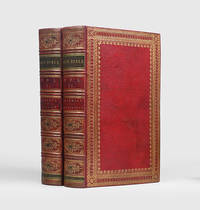
1763ref. 184488Cambridge: printed by John Baskerville 1763. An outstanding synthesis of fine printing illustration and binding First Baskerville edition: a spectacular copy of one of the greatest English Bibles and a crowning achievement of English printing in a magnificent Staggemeier and Welcher binding and abundantly extra-illustrated with 287 Old Master engravings. The copy adorned two of the greatest book collections of the last two centuries: the library of the Dukes of Marlborough at Blenheim Palace and of Estelle Doheny in California. Friedrich Leberecht Staggemeier 1759-1827 was esteemed for his elaborately decorated neoclassical bindings. He partnered with Samuel Welcher from 1799 to 1810 and the pair catered to the highest echelons of the market. Extra-illustration was a distinguishing feature of this market: here 171 of the illustrations are from Bernard Picart and Gerard Hoet's Figures de la Bible The Hague 1728 and 58 are from Pierre Mortier's Bible Amsterdam and Antwerp 1700 while others are from Jan Luyken's Icones Biblica Veteris et N. Testamenti Amsterdam 1729 and other sources. The extravagant binding and extra-illustration were commissioned by the first owner the collector and scholar Jacob Bryant. In 1804 he bequeathed the Bible to his patron George Spencer 4th Duke of Marlborough. It remained in the duke's collection at Blenheim Palace until 1881 when it passed to Fanny Octavia Louisa daughter of the 7th duke. Her descendants sold the book and it passed via Dawson's Book Shop to Estelle Doheny one of the greatest collectors of the 20th century where it joined her Gutenberg Bible and other landmarks of printing history. She bequeathed it to St. John's Seminary which sold it and the rest of Doheny's collection in 1988 where it realized $11000. Bound in 2 vols large folio 518 x 343 mm pp. 1146. Extra-illustrated with 287 Old Master engravings of which 198 are single page and 84 double each mounted mostly within a black ink and pale yellow wash frame. Late 18th- or early 19th-century red straight-grain morocco by L. Staggemeier & Welcher of London binder's ticket green morocco labels richly gilt in compartments wide gilt borders to covers gilt Greek-key turn-ins green watered-silk linings with gilt grapevine borders all edges gilt. Joints and extremities restored scattered light offsetting from plates and foxing else contents fresh very minor worming to front endpapers of first volume: a beautiful copy. ESTC T93106; Gaskell 26; Herbert 1146. unknown
1611ref. 16409London: Robert Barker 1611. A3 bound backwards. Title page the 2 leaves of the engraved map and the final 2 leaves in excellent facsimile. Additional title page from a later edition bound in behind the facsimile. Gothic and Roman types text double column with 59 lines per column and printed within woodcut rule-border calendar and almanac printed in red and black. General title-page within engraved border by Christian Boel and section title for the New Testament dated 1611 within woodcut border. Full-sheet engraved map of the Holy Land by John Speed after Dr John More 17 leaves of genealogical tables incorporating woodcut illustrations of Adam and Eve Noah’s Ark the Tower of Babel and other Biblical subjects numerous woodcut head- and tail-pieces historiated and ornamental initials. Contemporary calf boards rebacked spine labels; some staining a few leaves with small holes or edges torn away but generally a very good copy. With a notation on the paste-down that the book was “received of William Biggs for the sum of 5 shillings . by me John Lang. Ford Warminster” dated 1747 and with a small but elaborate bookplate of William Thomas Smedley 1858-1920 the noted collector of Elizabethaniana and Bacon; his library was sold in 1924 to Henry Clay Folger and the Folger library collection today includes nearly 1500 volumes formerly owned by Smedley. First edition second issue/state called the “she” Bible because of the reading of Ruth III 15: “she went into the citie”. In addition because of the small hole in C6 Matthew 26:36 it is impossible to tell whether the word Judas or Jesus is printed. The King James version of the Holy Bible is arguably the most important book ever published in English. Preparation of the Royal Version took more than 5 years and was laboriously attended to by over 50 translators and researchers. The final translations were then exchanged and reviewed reaching a final committee of six. Supervision of the printing was carried out by Miles Smith and Thomas Bilson. Although the Royal Version appropriates much from the Tyndale Coverdale Geneva and Bishops’ Bibles it is unquestionably regarded as the greatest literary translation of the Bible ever produced. Herbert 309; Pforzheimer 62; PMM 114; STC 2217. Robert Barker unknown