7 189 résultats
réf. 38900LONDON THOMAS TEGG 1812. 12 VOLUMES COMPLETE. BOUND IN FULL LEATHER RAISED BANDS A.E.G. WITH 12 FINELY ENGRAVED TITLE PAGES AND 38 OTHER PLATES. ARMORIAL BOOKPLATE REMOVED FROM EACH FRONT PASTEDOWN. SOME FOXING TO THE PRELIMS. ONLY THEN CLEAN AND TIGHTLY BOUND. CRACKED JOINT TO VOLUME 12. A VERY GOOD SET OF A SCARCE WORK. LONDON, THOMAS TEGG, 1812 hardcover
1909Very Good Turkish, Ottoman (1500-1928) In modern, handsome full brown morocco. Foolscap 8vo. (18 x 12.5 cm). In Ottoman script (Old Turkish with Arabic letters). 159 p. Extremely rare first Turkish translation of Macbeth, printed in Ottoman Cairo. Macbeth reflected Abdullah Cevdet's reaction against Hamidian despotism and his love and advocacy of liberty. One must also remember him as one of the founding members of the Party of Union and Progress - a secret organization that conspired to overthrow Abdülhamid's absolutist regime. The argument that Abdullah Cevdet's translation of Hamlet, Julius Caesar and Macbeth reflected his opposition to Abdülhamid II's absolute monarchy could be justified with the fact that the themes of the translated plays were perceived by the political authorities as threatening since they were about the murder of kings and heads of state. In Abdullah Cevdet's view, Macbeth is famous as a drama of "ambition for status" (hirs-i cah). Abdullah Cevdet was an Ottoman-born Turkish intellectual and physician of Kurdish ethnic descent, and one of the founders of the Committee of Union and Progress (CUP). In 1908, he joined the Democratic Party that later on merged with the Freedom and Accord Party in 1911. He was also a translator, radical free-thinker, and ideologist of the Young Turks until 1908. The son of a physician, and himself a graduate from the Military College in Constantinople as an ophthalmologist, Cevdet, initially a pious Muslim, was influenced by Western materialistic philosophies and came to oppose institutionalized religion but thought that "although the Muslim God was of no use in the modern era, the Islamic society must preserve Islamic principles." He published the periodical Içtihat from 1904 to 1932, of which articles he used to promote his modernist thoughts. He was arrested and expelled from his country several times due to his political activities and lived in European cities including Vienna, Geneva and Paris. His poetry was linked with the Symbolist movement in France and he received accolades from leading French authors like Gustave Kahn. (Source: DR. ABDULLAH CEVDET'S TRANSLATIONS (1908-1910): THE MAKING OF A WESTERNIST AND MATERIALIST "CULTURE REPERTOIRE" IN A "RESISTANT" OTTOMAN CONTEXT; Ayluçtarhan, Sevda). "Between 1908 and 1910, Abdullah Cevdet produced a large oeuvre of translations, including four translations of Shakespeare's tragedies: The translations of Hamlet and Julius Caesar (translated by Cevdet as Jül Sezar) were published in 1908, the same year as the declaration of the Second Constitution. Macbeth, translated by Cevdet as Makbes, was published in the following year. [.] Nonetheless, Abdülhamid II seemed to be even less tolerant of the dissemination of Hamlet, Macbeth, and Julius Caesar, since they were all about unjust rulers who were executed in the end. It is not surprising that the performances of these plays became subject to strict censorship in the Ottoman lands and banned (Paker 1986: 91). This could be shown as a reason why Abdullah Cevdet was able to publish the translations of these plays only after 1908, though he had finished translating Hamlet in 1902, Julius Caesar and Macbeth in 1904, and Romeo and Juliet in 1905 (Süssheim 1987). As Abdullah Cevdet was a planner of culture, his literary translations cannot merely be judged on an "aesthetic" level. It will be discussed in this chapter that Abdullah Cevdet's translations of Hamlet, Julius Caesar and Macbeth could be read as critical texts directed against Abdülhamid II's absolutist regime. [.] Due to the fact that the selection of source language and culture is an important factor in accounting for any kind of "translation policy", Abdullah Cevdet's selection of both these instruments needs to be taken into account (Toury 2000: 202). Özege 12009. Only one copy in OCLC: 949612474 (Bogaziçi University Library of Turkey).
réf. 30743LONDON 1684 AND 1692. TWO WORKS BY DRYDEN BOUND IN MODERN 1934 FULL BROWN LEATHER. THE STATE OF INNOCENCE AND THE FALL OF MAN AN OPERA. PRINTED BY H.H. FOR HENRY HERRINGMAN 1684. DEDICATION 4pp POEM OF PARADISE 2pp AUTHOR'S APOLOGY 6pp STATE OF INNOCENCE 26pp. BOUND WITH OEDIPUS; A TRAGEDY BY DRYDEN AND MR. LEE FOURTH EDITION PRINTED FOR RICHARD BENTLEY COVENT GARDEN 1692. PREFACE 2pp DRAMATIS PERSONAE 1pp PROLOGUE 1pp OEDIPUS 71pp EPILOGUE 1pp. NEW ENDPAPERS BOOKPLATE TO FRONT PASTEDOWN. BROWNING OF PAGES COMMENSURATE WITH THE AGE. NOTE THAT THE AGE OF INNOCENCE IS INCOMPLETE ENDING AT ACT V SCENE 1 PARADISE PARAGRAPH 11.'EVE - PLEASE THEN YOUR SELF WITH ME.'. FINE BINDING WITH A FEW MARKS TO THE LEATHER. VERY SCARCE. LONDON, 1684 AND 1692 hardcover
réf. 30744LONDON H PLAYFORD 1694. THE SECOND EDITION 58 PAGES. .AS IS ACTED AT THE THEATRE ROYAL BY HIS MAJESTY'S SERVANTS. VERY NICELY BOUND IN MODERN 1934 FULL BROWN LEATHER. NEW ENDPAPERS BOOKPLATE TO FRONT PASTEDOWN. BROWNING OF PAGES COMENSURATE WITH THE AGE. FINE BINDING WITH A FEW MARKS TO THE LEATHER. VERY SCARCE. LONDON, H PLAYFORD, 1694 hardcover
1831réf. 002014Paris Auguste Auffray 1831
réf. 34893LUGANO OFFICINA BODONI 1924. A PRESENTATION COPY FROM HANS MARDERSTEIG FOUNDER OF THE OFFICINA BODONI TO W J BURCH. LIMITED TO 224 COPIES PRINTED ON HAND-MADE PAPER BOUND IN GREEN VELLUM WITH THE ORIGINAL TYPES OF GIAMBATTISTA BODONI. A NEAR FINE COPY IN THE ORIGINAL SLIPCASE WHICH IS WORN AND DAMAGED BUT HAS DONE ITS JOB IN PROTECTING THE BOOK. LUGANO, OFFICINA BODONI, 1924 hardcover
1903réf. 107297Montreal: The Renaissance Press 1903. Deluxe Limited Edition. Hardcover. Very Good/No Dj. Larger 4to. Signed by Artist. pp 5 Phamplet and 17 illustrations. This is number 6 of 100 from the edition De luxe signed by R G Mathews on limitation page. The list of plates are as follows Mrs Patrick Campbell Marie Celeste Marie Celeste Clara Lipman Jan Kubelik Mrs James Brown-Potter Jean Gerardy George Grossmith Lillian Nordica Mrs Patrick Campbell… The Renaissance Press hardcover
1923réf. 016029NY Doubleday 1923 1923. First Edition stated 1st Printing. Orange Cloth. Very Good /No Jacket. Photographs of Stage Production. X 187 Pp. Orange Cloth Stamped In Black. First Am. Edition First Printing 1923 Date On Title And Copyright Pages Copyright Page Does State "First Edition". Frontispiece Photograph And Three Other Photographs Of The Stage Production. Vg Very Slight Fading To Spine. Front Hinge Broken But Holding Can Be Repaired. Ownership Signature Of Mental Hygienist Clare Moore De Gruchy See: Biography Of Alice B Toklas By Simon. An Early Play About Self-Aware Mechanico-Electric Humanoids Contributing The Word "Robot" To Twentieth Century Consciousness Before Mankind Became Aware Of How Dehumanized Humans Were Than Humanized Robots So Far. NY Doubleday 1923 hardcover
1949réf. 41451949 Paris : Éditions du Bélier, 1949. premiere edition , sur papier japon, ( 20 exemplaires) non coupé ,format 15cm/23 , Préface d'Édouard et Louise Autant-Lara ~, superbe reliure plein maroquin rouge :signée Janou-Neuville , mosaïquée pièce de cuir verte et caricature de l'auteur avec une cigarette( dessin de Picasso ) , dos lisse avec inscription du titre en vertical sur le dos et l'auteur en horizontal, interieur des plat avec une soie verte encadrement de chagrin rouge souligné d'un filet doré ; Superbe objet , parfait etat , photos sur demande
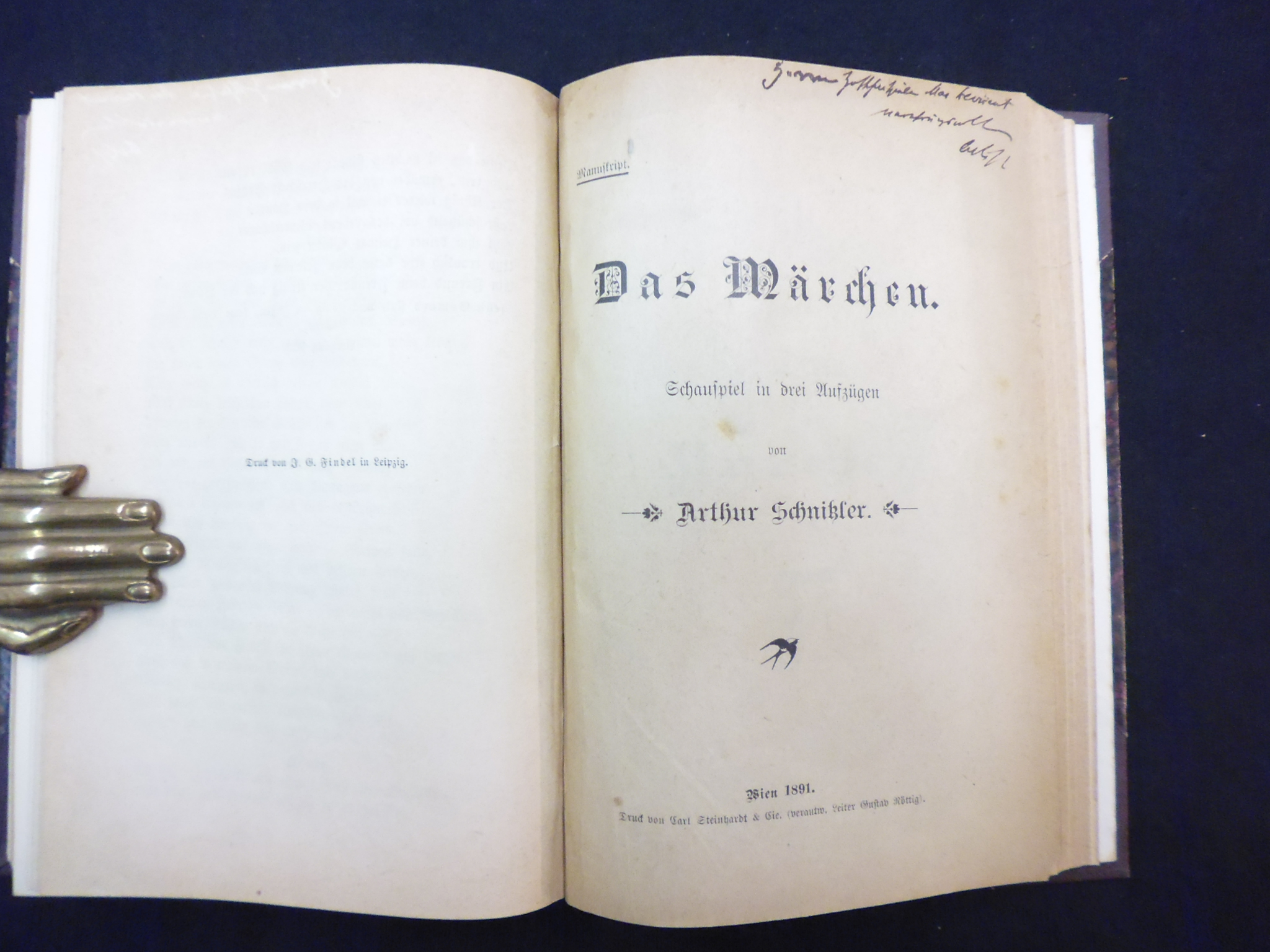
1891réf. STLE0119Wien, Druck von Carl Steinhardt 1891. 8°. 118(2) S. Mit 2 Bühnenskizzen. Halbleinenband der Zeit m. Deckelbezügen aus Achatmarmorpapier u. Rü.präg (?Theater 33.?). Buchdeckel mit Kratzspuren, Rü. geblichen, Deckelkanten abgerieben, papierbedingt gebräunt. - Auf Titelblatt mit eh. Widmung 'Herrn Hofschauspieler Max Devrient hochachtungsvoll. ArtSch'. Kosch 15, 660; vgl. WG² 2 (hier die erste Buchausgabe von 1894). Als ?Manuskript? gedruckte erste Ausgabe von Schnitzlers frühem Bühnenstück ?Das Märchen?. Drei Jahre vor der ersten Buchausgabe 1894 (bei Pierson in Dresden) erschienen und zwei Jahre vor ?Anatol? (1893). Schnitzler begann 1890 mit der Arbeit zu ?Das Märchen?, in dem der Schriftsteller Fedor Denner die Schauspielerin Fanny Theren liebt, doch es gelingt ihm nicht zu vergessen, daß er für sie nicht ?der erste? Liebhaber ist. ?S. schreibt sein erstes großes Bühnenstück in drei Akten, das auch ein Versuch ist, sich von der besessenen Eifersucht auf die Vergangenheit [] zu befreien. ?Begann das ?Mährchen? zu schreiben. ?Das Mährchen von der Gefallenen?. Befreie mich. ? Psychologisches aus meinem Verhältnis mit Mz. [d.i. Marie (Mizi) Glümer].? Notiert er im November 1890 in sein Tagebuch und am 26. Februar 1891: ?[?Das Mährchen?] Endet schlecht. ? Wie wird?s in Wirklichkeit enden??. (vgl. Farese, Arthur Schnitzler. Ein Leben in Wien. S.40ff.). Das Stück wurde am 1. Dezember 1893 am Wiener Volkstheater uraufgeführt. Es fällt durch und wird nur mehr ein einziges Mal gezeigt, dann verschwindet es vom Spielplan. ? Mit Widmung an den deutschen Schauspieler Maximilian Paul Devrient (1857-1929), der als einer der herausragendsten deutschsprachigen Schauspieler des ausgehenden 19. Jahrhunderts galt. Bereits 1882 wurde er an das Burgtheater in Wien engagiert, das zum Mittelpunkt seines künstlerischen Schaffens als Schauspieler wie auch als Regisseur wurde. 1911 spielte er in der Besetzung der Uraufführung von Schnitzlers ?Das weite Land? mit. ? Der Sammelband enthält außerdem: Fitger, A[rthur]. Die Hexe. 1885. / L?Arronge, Adolph. Hasemann?s Töchter. o.J. / Fortis, Leone. Kunst und Liebe. 1896. / Lope de Vega, König und Bauer. Bearbeitung v. August Förster. 1887. / Edler, Karl Erdm. Theodora. 1881. - DIESES OBJEKT UNTERLIEGT DER DIFFERENZBESTEUERUNG.
1984réf. 005516NY: GROVE PRESS. ONE OF THE RAREST OF MODERN DAY PLAYS. STATED FIRST EDITION WITH NUMERICAL SEQUENCE 54321 17.50DJ. CLEAN UNMARKED COPY! . Fine. Hardcover. First Edition. 1984. GROVE PRESS hardcover
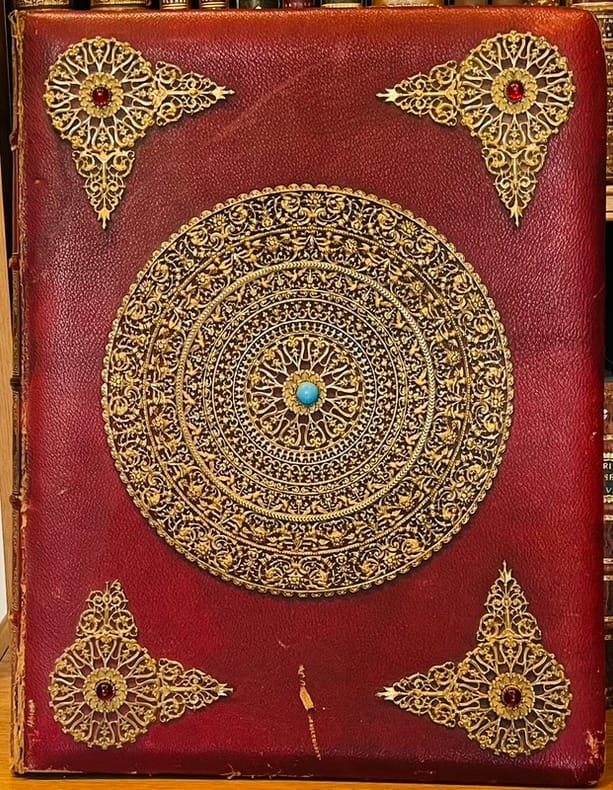
1880réf. 44443, , (Vers 1870-1880). Grand in-folio manuscrit (54 x 41 cm) de 52, 50 ff. enluminés sur peau de vélin à l'encre et aquarelle rouge, vert, bleu et or, chagrin rouge, dos orné à nerfs, décor sur le plat supérieur d'écoinçons et d'une grande plaque circulaire ajourés en laiton avec incrustations de cabochons de pierres, sur le second plat quatre plaques d'angles circulaires ajourés en laiton avec incrustations de cabochons de pierres, dentelle intérieure, gardes de papier dominoté (reliure de l'époque).
1524In-folio; ff. (392), in caratteri romani; il titolo, tranne le prime due righe, è in caratteri gotici; pelle marrone ottocentesca firmata Bedford, con decorazione dorata ai piatti entro doppia cornice, titolo in oro al dorso, fregi, nervature, tagli dorati. Ex libris John Fairfax Crowder. Al frontespizio sotto al titolo una xilografia raffigura "Petrus Delphinus Generalis" inginocchiato di fronte a A. Romualdo; la pagina è inquadrata in una cornice a grottesche su legno che reca il monogramma "I C", che era stata impiegata nel 1521 per Sallustio, e poi per l'edizione delle Vite de SS. Padri del 1532. Raro epistolario del generale dei camaldolesi, fonte ricchissima per la vita storica e artistica fiorentina del XV secolo. PIETRO DELFIN, (Venezia 1444-1525), venne eletto generale dei camaldolesi nel 1480, e coltivò costantemente le lettere e la teologia, tenendosi in relazione con gli uomini più illustri del suo tempo, soprattutto con gli umanisti. Irriducibile avversario del Savonarola, nel suo Dialogus in Ieronymum Ferrariensem arrivò a chiedere la condanna al rogo del frate. Prima edizione del suo epistolario, una ricchissima fonte per la dottrina teologica ma anche per i dettagli storici di cui le sue lettere sono corredate. L'argomento principale che è al centro degli scritti di Delfin è certamente la disputa teologica o comunque religiosa, oggetto di fitti scambi epistolari con i rappresentanti del clero e gli umanisti di tutta Italia; tra gli altri argomenti vi rientra anche una disquisizione piuttosto lunga (l. II ep.LXXVII) circa l'azione corruttrice delle rappresentazioni teatrali, in particolare delle commedie, con un richiamo ai ludi scaenici degli antichi romani. Ma dati i rapporti con gli umanisti del tempo, la raccolta contiene anche scambi epistolari con questi ultimi: Ugolino Verino, Ermolao Barbaro, Francesco Guicciardini ecc. Ad esempio proprio in una di queste missive si esprime l'augurio che si ponga mano ad una edizione completa delle opere di Leon Battista Alberti. In folio; ff. (392), in Roman characters; the title, except for the first two lines, is in gothic characters; 19th century brown calf binding signed Bedford, with gilt decoration on the plates within a double frame, gilt title on the spine, friezes, bands, gilt edges. Ex libris John Fairfax Crowder. On the title page, under the title, a wood plate depicts "Petrus Delphinus Generalis" kneeling in front of A. Romualdo; the page is framed in a grotesque frame on wood bearing the monogram "I C", which had been used in 1521 for Sallustio, and then for the edition of the Vite dei SS. Padri 1532. Rare epistolary of the general of the Camaldolese order, a very rich source for the historical and artistic life of Florence in the 15th century. PIETRO DELFIN, (Venice 1444-1525), was elected general of the Camaldolese order in 1480, and constantly cultivated literature and theology, keeping in touch with the most illustrious men of his time, above all with the humanists. Irreducible opponent of Savonarola, in his Dialogus in Ieronymum Ferrariensem he came to ask for the friar to be condemned to the stake. First edition of his epistolary, a very rich source for theological doctrine but also for the historical details with which his letters are accompanied. The main topic that is at the center of Delfin's writings is certainly the theological or religious dispute, the subject of dense exchanges of letters with representatives of the clergy and humanists from all over Italy; among the other topics there is also a rather long disquisition (l. II ep.LXXVII) about the corrupting action of theatrical representations, in particular of comedies, with a reference to the ludi scaenici of the ancient Romans. Given the relationships with the humanists of the time, the collection also contains correspondence with the latter: Ugolino Verino, Ermolao Barbaro, Francesco Guicciardini etc. For example, precisely in one of these letters the wish is expressed that a complete edition of the works of Leon Battista Alberti be put to work.
1986The action takes place in late August 1833 at a hedge-school in the townland of Baile Beag, an Irish-speaking community in County Donegal. In a nearby field camps a recently arrived detachment of the Royal Engineers, making the first Ordnance Survey. For the purposes of cartography, the local Gaelic place names have to be recorded and rendered into English. In examining the effects of this operation on the lives of a small group, Brian Friel skilfully reveals the far-reaching personal and cultural effects of an action which is at first sight purely administrative.