Tibullus; Paul Murgatroyd (Ed )Biblio.com

101 322 résultats
1994réf. 27362Oxford Clarendon Press. Very Good in Very Good dust jacket. Hardcover. Foxing/dustsoiling to top of textblock. DJ spine a bit sunned.; 328 pages . 1994. 0198149611 . Oxford Clarendon Press hardcover
1940réf. 27358Princeton University Press. Very Good with no dust jacket. Hardcover. Scholar's bookplate to inner cover G. P. Goold. A few small scratches to front board.; Includes tipped-in bibliography of George E. Duckworth published in 1971. 4 plates.; 464 pages . 1940. Princeton University Press hardcover
1979réf. 27368Arno Press. Very Good with no dust jacket. Hardcover. Light Foxing to textblock. Scholar's bookplate to inner cover G. P. Goold.; Text is in latin. Unchanged Reprint of 1885 edition.; Latin Texts and Commentaries Series; 286 pages . 1979. 0405116217 . Arno Press hardcover
1989réf. 27380Cambridge University Press. Very Good in Very Good dust jacket. Hardcover. Foxing/dustsoiling to top of textblock. DJ has minor edgewear.; An examination of the main characters in the Aeneid - Aeneas himself Dido and Turnus - in the light of Virgil's contemporary Augustan political and literary ideology. The characters and the plot and incident of the epic are seen as embodying and exemplifying first the ancient ideals of kingship and concord and second the Roman self-identification as at once 'Italian' and 'Trojan' and finally as reflecting the literary self-evaluation of the Augustan age. In the literary area Virgil's relations with contemporary Roman elegy with early Greek lyric and most important with Homer are studied and reevaluated. Virgilian scholars and students of Augustan literature in general will find this book of interest to them.; 296 pages . 1989. 0521353580 . Cambridge University Press hardcover
réf. 27401Cambridge University Press. Near Fine in Very Good dust jacket. First Edition. Hardcover. Very light shelfwear to book. DJ is price-clipped. DJ has 1 small tear with very minor chipping.; Machon was a writer of Comedies who lived and worked in Alexandria in the middle of the third century B. C. All of his work that survives is preserved in the Deipnosophistae of Athenaeus who besides two fragments of Comedies of no great importance quotes also 462 verses from a collection of anecdotes which Machon called Xpeiai. These anecdotes are written in the iambic verse of Comedy. They are concerned with the doings and sayings of courtesans parasites and musicians sometimes in relation to persons of historical importance. They are often scabrous but also not infrequently amusing; and they are of considerable interest both as documents of social history and as a type of literature which though popular in antiquity has hardly survived. The Xpeiai which present many problems of reading and interpretation have never before been separately edited. Recent editors of Athenaeus have improved the text; but to find commentaries it is necessary to go back to Casaubon's edition of Athenaeus published in 1600 and to Schweighauser's published in 1801-7.; Cambridge Classical Texts and Commentaries 1; 172 pages . 1965. 0521056314 . Cambridge University Press hardcover
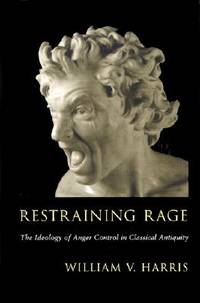
2002réf. 26259Harvard University Press. Very Good in Very Good dust jacket. Hardcover. Very faint bump to 1 corner else book is fine. DJ has light edgewear with a bit of creasing.; The angry emotions and the problems they presented were an ancient Greek preoccupation from Homer to late antiquity. From the first lines of the Iliad to the church fathers of the fourth century A. D. the control or elimination of rage was an obsessive concern. From the Greek world it passed to the Romans. Drawing on a wide range of ancient texts and on recent work in anthropology and psychology Restraining Rage explains the rise and persistence of this concern. W. V. Harris shows that the discourse of anger-control was of crucial importance in several different spheres in politics--both republican and monarchical--in the family and in the slave economy. He suggests that it played a special role in maintaining male domination over women. He explores the working out of these themes in Attic tragedy in the great Greek historians in Aristotle and the Hellenistic philosophers and in many other kinds of texts. From the time of Plato onward educated Greeks developed a strong conscious interest in their own psychic health. Emotional control was part of this. Harris offers a new theory to explain this interest and a history of the anger-therapy that derived from it. He ends by suggesting some contemporary lessons that can be drawn from the Greek and Roman experience.; 480 pages . 2002. 0674006186 . Harvard University Press hardcover
1930réf. 26279University of Chicago Press. Very Good with no dust jacket. Hardcover. Hinges just starting to weaken. Spine of V2 is sunned. Minor shelfwear.; 2 Volume Complete Set. Looks at growth and development of the Judiciary and to matters of practice and procedure. V1: 1930; V2: 1938; 2 Volume Set COMPLETE . 1930. University of Chicago Press hardcover
1985réf. 26294Princeton University Press. Very Good in Very Good dust jacket. Hardcover. Very light shelfwear to book. DJ has creasing along top edge and a couple of small tears. DJ has rubbing.; Plautus was Ancient Rome's greatest comic playwright Shakespeare drew heavily on his plots and his legacy is prevalent throughout modern drama. In this expanded edition of his successful book one of America's foremost Classical scholars introduces performance criticism to the study of Plautus' ancient drama. In addition to the original detailed studies of six of the dramatists's plays the methodology of performance criticism the use of conventions and the nature of comic heroism in Plautus this edition includes new studies on: the induction into the world of the play the scripted imitation of improvisation Plautus's comments on his previous work the nature of 'tragicomedy'. Includes the original detailed studies of six of the dramatists's plays the methodology of performance criticism the use of conventions and the nature of comic heroism in Plautus; 190 pages . 1985. 0691066248 . Princeton University Press hardcover
1968réf. 26287Cambridge University Press. Fine in Very Good dust jacket. Hardcover. Two Volume set with books In overall Fine Condition. DJs are Price-clipped. Vol 1: Dustjacket has minor shelfwear and a couple of tiny tears. Vol 2: Dustjacket has edgewear with chipping and 1 small tear 1".; 2 Volume Set. Volume 1: Introduction Text and Translation; Indexes of Sources and Epigrammatists. Volume 2: Commentary and Indexes.; 2 Volume Set; 1008 pages . 1968. 0521058740 . Cambridge University Press hardcover
1975réf. 26330B. G. Teubner. Very Good. Second Edition. Softcover. Rubbing and colour loss to spine. Else Minor shelfwear.; Text in latin; Apparatus in Latin.; Bibliotheca Scriptorum Graecorum Et Romanorum Teubneriana; 1.2 x 8.3 x 5.6 Inches; 190 pages . 1975. 3519013711 . B. G. Teubner paperback
1974réf. 26342Leicester University Press. Very Good with no dust jacket. Hardcover. Small stain to foreedge of last few pages. Else very light shelfwear.; 212 pages; Consists of twelve separate but inter-connected essays on poetry and personalities in late-republican Rome. Contents: The two worlds of Titus Lucretius; Cinna the Poet; Structural Patterns in Catullus; Catullus 'poem 68'; Lesbia and her Children; Who was Gellius The Good Goddess; The Go-Between; Two friends of Clodius in Cicero's Letters; Clodius at the Theatre; Pyxis Caeliana; The Last of the Metelli. . 1974. 0718511204 . Leicester University Press hardcover
1985réf. 26343John Hopkins University Press. Very Good in Good dust jacket. Hardcover. Bumping to upper corners. Small tape stain to front inner cover. A few pages with pencil and pen marginalia. DJ has tears with adhesive tape repairs to upper edge.; 0.94 x 9.13 x 6.14 Inches; 355 pages; Explores the opportunities for intellectual endeavor as well as the constraints placed on it with a special focus on the socioeconomic background of writers and their audiences and on the availability and use of written materials. Covers both Greek and Latin writing and examines activity in Rome as well as in other parts of Italy. . 1985. 0801828996 . John Hopkins University Press hardcover
1987réf. 26350Cambridge University Press. Very Good in Good dust jacket. First Edition. Hardcover. Pages tanned. Scholar's name to ffep R. E. Fantham. Large tear to DJ repaired with cellotape with a few tears with some loss.; Cambridge Classical Studies; 200 pages; Although Ovid is currently enjoying a new wave of popularity most critics withhold from his poetry the close word-by-word readings that are necessary for a thorough understanding of it. Ovid twice treated the myth of Persephone and Hinds's book is at first a historical inquiry--the most extensive yet done--into the double transformation in Metamorphosis 5 and Fasti 4 of the rape of Persephone one of the great Graeco-Roman myths. The study continues as a critical exploration of Ovid's self-conscious delight in language and in writing manifested in these twin narratives providing a feast for students of both Latin poetry and narratives in general. . 1987. 052133506X . Cambridge University Press hardcover
1998réf. 26353Princeton University Press. Very Good in Very Good dust jacket. Hardcover. From the library of R. E. Fantham. Pen notes to 1 pages. A few pages with pencil and underlining. Light rubbing and faint soiling to DJ.; This is the first book to describe the intimate relationship between Latin literature and the politics of ancient Rome. Until now most scholars have viewed classical Latin literature as a product of aesthetic concerns. Thomas Habinek shows however that literature was also a cultural practice that emerged from and intervened in the political and social struggles at the heart of the Roman world. Habinek considers major works by such authors as Cato Cicero Horace Ovid and Seneca. He shows that from its beginnings in the late third century b. C. To its eclipse by Christian literature six hundred years later classical literature served the evolving interests of Roman and more particularly aristocratic power. It fostered a prestige dialect for example; it appropriated the cultural resources of dominated and colonized communities; and it helped to defuse potentially explosive challenges to prevailing values and authority. Literature also drew upon and enhanced other forms of social authority such as patriarchy religious ritual cultural identity and the aristocratic procedure of self-scrutiny or existimatio. Habinek's analysis of the relationship between language and power in classical Rome breaks from the long Romantic tradition of viewing Roman authors as world-weary figures aloof from mundane political concerns--a view he shows that usually reflects how scholars have seen themselves. The Politics of Latin Literature will stimulate new interest in the historical context of Latin literature and help to integrate classical studies into ongoing debates about the sociology of writing.; 248 pages . 1998. 0691068275 . Princeton University Press hardcover
1989réf. 26355Cambridge University Press. Very Good with no dust jacket. Hardcover. Book has very light shelfwear and light pencilling to 1 page.; R G M Nisbet on Horace's Epodes; I M Le M DuQuesnay on Horace Sermones I; Yvan Nadeau on Virgil's Aristaeus epyllion; Tony Woodman on Horace's First Roman Ode; E L Harrison on the Aeneid and Carthage; T P Wiseman on Virgil and Cybele; Francis Cairns on Propertius and Actium; J C McKeown on Ovid's Fasti; 272 pages . 1989. 0521245532 . Cambridge University Press hardcover
1998réf. 26360Cambridge University Press. Very Good in Very Good dust jacket. Hardcover. Light bumping to 2 corners. Scholar's name to ffep Elaine Fantham. Minor shelfwear to DJ.; Cambridge Greek and Latin Classics; 304 pages; Book IV of Ovid's celebration of the calendar and the associated legends of the Roman year treats the month of April a particularly happy phase of the Augustan ceremonial year. Around the festival of Venus and the anniversary of the foundation of Rome Ovid retells the legends of Rome's royal founder Romulus and the Trojan hero Aeneas. The introduction and commentary pay special attention to Ovid's art as a poet but aim to provide both the general background and specific explanations of his historical and religious material.; Signed by Editor . 1998. 0521445388 . Cambridge University Press hardcover
2000réf. 26394Oxford University Press. Very Good in Very Good dust jacket. Hardcover. Bottom corner is very lightly bumped. Else very light shelfwear to book. Scholar's name to DJ flap R. E. Fantham. DJ has very minor shelfwear.; 8vo 8" - 9" tall; 281 pages; This book is a response to the literary pleasures and scholarly problems of reading the texts of Apuleius most famous for his novel Metamorphoses or Golden Ass. Living in second-century North Africa Apuleius was more than an author of fiction; he was a consummate orator and professional intellectual Platonist philosopher extraordinary stylist relentless self-promoter and versatile author of a remarkably diverse body of work much of which is lost to us. This book is written for those able to read Apuleius in Latin and Apuleian works are accordingly quoted without translation although where they exist suitable translations have been indicated. In this book Dr Harrison has provided a literary handbook to all the works of Apuleius as well as the Metamorphoses and has set his works against their intellectual background: not only Apuleius' career as a performing intellectual a sophist in second-century Roman North Africa but also the larger contemporary framework of the Greek Second Sophistic. While focusing primarily on the texts as literature and literary-historical the book also deals with Apuleius' works of didactic philosophy and his consequent connection with Middle Platonism. . 2000. 0198140533 . Oxford University Press hardcover
réf. 26389P. Schippers. Very Good. Hardcover. Scholar's small bookplate to ffep R. E. Fantham. Minor shelfwear. 1 corner lightly bumped.; Text is in german.; 237 pages . 1964. 9060321375 . P. Schippers hardcover
2004réf. 26390Cambridge University Press. Fine in Very Good dust jacket. Hardcover. Book is fine. Light edgewear and creasing along top edge of DJ.; Anger is found everywhere in the ancient world from the very first word of the Iliad through all literary genres and every aspect of public and private life. Yet it is only very recently that classicists historians and philosophers have begun to study anger in antiquity. This volume includes significant new studies by authors from different disciplines and countries on the literary philosophical medical and political aspects of ancient anger.; Yale Classical Studies XXXII; 336 pages . 2004. 052182625X . Cambridge University Press hardcover
1973réf. 26398Cambridge University Press. Very Good in Good dust jacket. Hardcover. Scholar's name and short note by her to ffep R. E. Fantham. Top corners are bumped. Dustjacket is intact but has tears and writing to DJ flap in pen. A bit of loss to DJ .; Combats the common notion that the Thebaid is an exercise in anachronism an episodic narrative of the Theban saga. He shows that the poem can and indeed must be reat as an elaborate and sustained allegory of the emotions-- a study in the extremes of human behaviour.; 366 pages . 1973. 0521200520 . Cambridge University Press hardcover
1993réf. 26400Routledge. Very Good in Very Good- dust jacket. Hardcover. Very minor shelfwear to book. Small chips to top of spine. DJ has creasing and 1 tear repaired with clear tape along upper edge.; 2 x 10 x 8 Inches; 340 pages; Roman epic lays firm claim to being Western civilization's prime literary form. Roman Epic draws together 14 critically and methodologically distinct essays focusing on particular epicists their reaction to influence on and rewriting of each other. The book examines the formation and transformation of Roman epic from its beginnings in the third century B. C. Saturnian poets Livius and Naevius to the Renaissance Latin epic of Petrarch and Vida. What results is the revelation of Roman epic not only as Rome's highest poetic genre but as a self-consciously intertextual primarily political form. The Roman epicist's creative exploitation of his predecessors is not restricted to stylistic similarities and generic codes but often encompasses more important levels of social moral and political meaning. In the Roman tradition the epic form shows an impetus to reform the celebratory values implicit in the form itself admitting a plurality of interactive often critical narrative voices. This book reveals how the epic developed and critically considers the generic and literary tradition to which the texts belong. It demonstrates epic's critical significance for the foundational culture of the Western world. . 1993. 0415042305 . Routledge hardcover
1980réf. 26402The Athlone Press. Very Good in Very Good dust jacket. Hardcover. Scholar's name to ffep R. E. Fantham. Else minor shelfwear to book. DJ spine has small tear to head. DJ has some creasing.; 650 pages . 1980. 048511190X . The Athlone Press hardcover
2002réf. 26414K. G. Saur. Near Fine. Second Edition. Hardcover. Very light sticker stain to rear board. Else book is fine.; Bibliotheca Scriptorum Graecorum Et Romanorum Teubneriana TEUBNER; 12mo 7" - 7½" tall; 242 pages . 2002. 3598712375 . K. G. Saur hardcover
1985réf. 26306Peter Lang. Very Good. Paperback. Pages tanned. Pencil marginalia and notes to about 5 pages. Minor shelfwear. Gift inscription from author to R. E. Fantham on ffep.; Studien Zur Klassischen Philologie 15; 359 pages; Signed by Author . 1985. 3820454888 . Peter Lang paperback
2006réf. 26301Cambridge University Press. Very Good in Very Good dust jacket. Hardcover. Very light bump to 1 corner. DJ has minor shelfwear. Scholar's small bookplate to ffep R. E. Fantham.; A comprehensive survey of Roman theatrical production this book examines all aspects of Roman performance practice and provides fresh insights on the comedies of Plautus and Terence. Following an introductory chapter on the experience of Roman comedy from the perspective of Roman actors and the Roman audience addressing among other things the economic concerns of putting on a play in the Roman republic subsequent chapters provide detailed studies of troupe size and the implications for role assignment masks stage action music and improvisation in the plays of Plautus and Terence. Marshall argues that Roman comedy was raw comedy much more rough-and-ready than its Hellenistic precursors but still fully conscious of its literary past. The consequences of this lead to fresh conclusions concerning the dramatic structure of Roman comedy and a clearer understanding of the relationship between the plays-as-text and the role of improvisation during performance.; 336 pages . 2006. 0521861616 . Cambridge University Press hardcover