719 risultati
1964IN YIDDISH. 23x15.5 cm. 64 pages. Hardcover. In good condition.
19381st Yiddish Edition. Original publishers decorated cloth, 12mo, 114 pages ; 18 cm. In Yiddish. The translator, Itzik Feffer (1900 1952) was a Soviet Yiddish poet executed on the Night of the Murdered Poets during Joseph Stalin's purges During the Second World War, he was a military reporter with the rank of colonel and was vice chairman of the Soviet Jewish Anti-Fascist Committee (JAC). He and Solomon Mikhoels traveled to the United States in 1943 in a well-documented fund-raising trip. In 1948, after the assassination of the JAC Chairman Solomon Mikhoels, Feffer, along with other JAC members, was arrested and accused of treason. Feffer had been an informer for the NKVD (predecessor of the KGB) since 1943. FeFfer reportedly cooperated with the investigation, providing false information that would lead to the arrest and indictment of over a hundred people, but at the trial, he made openly nationalistic statements and expressed pride in his Jewish identity. Feffer had also allegedly been one of the most loyal and conformist Yiddish poets, who had helped to enforce strict ideological control over other Yiddish writers, and had a history of denouncing colleagues for their nationalistic hysteria. However, in 1952, Feffer, along with other defendants, was tried at a closed JAC trial, and executed on August 12, 1952, at Lubyanka prison ..The American concert singer and actor Paul Robeson met Feffer on July 8, 1943, in New York during a Jewish Anti-Fascist Committee event chaired by Albert Einstein, one of the largest pro-Soviet rallies ever held in the United States. After the rally, Paul Robeson and his wife Eslanda Robeson, befriended Feffer and Mikhoels. Six years later, in June 1949, during the 150th anniversary celebration of the birth of Alexander Pushkin, Robeson visited the Soviet Union to sing in concert. According to David Horowitz: In America, the question "What happened to Itzik Feffer?" entered the currency of political debate. There was talk in intellectual circles that Jews were being killed in a new Soviet purge and that Feffer was one of them. It was to quell such rumors that Robeson asked to see his old friend, but he was told by Soviet officials that he would have to wait. Eventually, he was informed that the poet was vacationing in the Crimea and would see him as soon as he returned. The reality was that Feffer had already been in prison for a half year, and his Soviet captors did not want to bring him to Robeson immediately because he had become emaciated from lack of food. While Robeson waited in Moscow, Stalin's police brought Feffer out of prison, put him the care of doctors, and began fattening him up for the interview. When he looked sufficiently healthy, he was brought to Moscow. The two men met in a room that was under secret surveillance. Feffer knew he could not speak freely. When Robeson asked how he was, he drew his finger nervously across his throat and motioned with his eyes and lips to his American comrade. They're goin to kill us, he said. When you return to America you must speak out and save us. During his concert in Tchaikovsky Hall on June 14 - which was broadcast across the entire country - Robeson publicly paid tribute to Feffer and the late Mikhoels, singing the Vilna Partisan song Zog Nit Keynmol in both Russian and Yiddish .Feffer was a prolific poet who wrote almost exclusively in Yiddish, and his poems were widely translated into Russian and Ukrainian. He is considered one of the greatest Soviet poets in the Yiddish language and his poems were widely admired inside and outside Russia (Wikipedia, 2019). SUBJECT(S): Yiddish literature -- Translations from Russian. Russian literature. OCLC: 19304065. OCLC lists 15 copies worldwide, but 13 of these are in a listing which indicates Also issued online, so some (or many of these?) may be online access copies. Very Good Condition, a beautiful copy. (yid-41-82A)
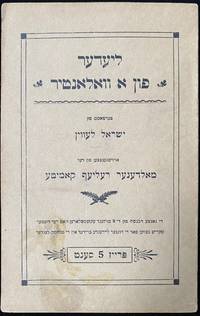
1919rif. 42896No Place Malden MA: Maldener Relief Komite 1919. No Date 1919. 1st Edition. Original printed paper wrappers 8vo 14 pages. 21 cm. In Yiddish. Title translates as "Verses of a Volunteer." No city or date listed but clearly published during or immediately after WW I with the Leksikon suggesting Malden MA 1919 OCLC suggests Boston the location of the printer and a clearly incorrect date of 1900 perhaps intending "1900s". Malden the poet's home town just outside of Boston and clearly the home of the "Maldener Relief Komite" makes much more sense making this is the first documented yiddish publication in Malden MA north of Boston. "The poet dedicated the entire income of 5 thousand copies to the brothers suffering from hunger in the countries at war" Translated from the front cover. Includes 4 poems: Der Volontir; Ikh Zukh a Vort; Nach der Milhome; Hazkharot Neshimot. The final poem is "in memory of the fallen Jewish heroes in all the war-torn lands." Israel Levine 1878-1970 "was born in a village in Minsk district Byelorussia. In 1895 he arrived in the United States lived in various cities worked as a teacher in Talmud Torahs and was secretary for Mizrachi in the town in which he lived Malden Massachusetts. He debuted in print in 1904 in Fraye arbeter-shtime Free voice of labor in New York with a poem entitled 'Funken shpritsn' Sparks fly and from that point he went on to contribute poetry and translations from Tanakh and from ethical books to: Yidishes tageblat Jewish daily newspaper Forverts Forward Dos yudishe folk The Jewish people Di varheyt The truth and Idisher kemfer Jewish fighter-in New York; Idishe shtime Jewish voice in Boston; and more. He published in book form: Lider fun a volontir Poems of a volunteer Malden 1919 16 pp.; Sefer naim zemirot tehilim Naim Zemirot on Psalms translated into a poetic form with short prefaces by Dr. Meir Vaksman and Aharon Kaminska Jerusalem 1934 19 pp" Khayim Leyb Fuks in Leksikon Fun Der Nayer Yidisher Literatur OCLC: 19307496. OCLC lists 4 copies worldwide YIVO Brandeis Harvard NYBC none outside the northeast. A few stains & discoloring Very Good Condition an excellent copy. Scarce. B YID-45-9XX-LE-'. No Place [Malden, MA]: Maldener Relief Komite unknown
19121st edition. Period boards. 8vo. 15 pages each, 31 cm. In Yiddish. Title translates to Jewish Literary World. Vokhenshrif? Far li? Era? Ur, ? Uns? , kritik un kultur-fragen. " Abraham Reisen was leading Yiddish writer and a founder (with his brother Zalman, Chaim Zhitlovsky, I. L. Peretz, and his close friends Scholem Asch and Hersch Dovid Nomberg) of the Yiddishist movement and took part in the Czernowitz Yiddish Language Conference of 1908 at which Yiddish was proclaimed a national language of the Jews (Wikipedia, 2019) . SUBJECTS: Yiddish literature - periodicals. OCLC lists 16 copies worldwide (OCLC: 33025197) . Ex-library with usual markings. Binding is starting. Some pages are lightly worn. Overall Very good condition. (YID-32-25-DL)
19141st edition. Period boards. 8vo. 119, 123, 122, 124, 124, 126, 123, 60 pages. 24 cm. In Yiddish. Title translates to Literature and Life: The Jewish World Literary Social Monthly. Featuring some of the biggest names in Yiddish literature, such as I. L. Peretz and Shalom Asch. These 3 volumes, published between 1914-1915, appear to be the only one published; we could find no record of later issues anywhere. SUBJECTS: Jews -- Periodicals. Contains OCLC lists 23 copies worldwide (OCLC 19048582) . Ex-library with usual markings. Bound out of order. Edge wear to boards. Contents are very good. Binding is starting. Overall Good Condition. (YID-40-68)
19141st edition. Period boards. 8vo. pages 315-438; 125, 119, 123 + ads. [490 pages total + ads] . 24 cm. In Yiddish. Nrs. 9-11 sub-titled: "Di yudishe velt." Title translates to Literature and Life: The Jewish World Literary Social Monthly. Featuring some of the biggest names in Yiddish literature, such as I. L. Peretz and Shalom Asch. It appears that 3 volumes were published between 1914-1915. SUBJECTS: Jews -- Periodicals. OCLC lists 23 copies worldwide (OCLC 19048582) . Small tear to title page, paper bright, binding solid Very Good+ Condition. (YID-40-68A-'++)
19281st edition. Original boards. 8vo. 89, 111 pages, 23 cm. In Yiddish. Title translates to "Literature-Lore. " Two parts: Ershter teyl: Elementn fun ritm un stil -- Tsveyter tley: Geboy fun Kinstlerishn verk un literarishe zshanren. Hofstein (1889-1952) was a prominent Russian-Yiddish poet. He rose to prominence through his elegies of the Jewish communities that suffered during the White pogroms of 1922, many of which were illustrated by Marc Chagall. He emigrated to Palestine in 1923 as a result of the official banning of Hebrew and subsequent persecution of Hebrew writers. He ultimately returned in 1939 and joined the Communist Party. Hofstein was executed on the Night of the Murdered Poets in 1952, along with 12 other Yiddish writers and artists (Wikipedia, 2019) . SUBJECTS: Yiddish language -- Rhetoric. Poetics. OCLC lists 16 copies worldwide (OCLC: 19306025) . Spine rebacked. Boards are worn and browning. Contents very good. (YID-33-72-EJLXGG'o)
1964Mm 140x215 Prima edizione italiana. Collana "La Gaja Scienza" - Traduzione di Bruno Oddera. Volume in copertina rigida con sovraccoperta, taglio superiore di color celeste, 323 pagine. Copia eccellente, mai letta. SPEDIZIONE IN 24 ORE DALLA CONFERMA DELL'ORDINE.
1954IN YIDDISH. 21x16cm. 350 pages. Hardcover. In good reading condition.
1951IN YIDDISH. 23.5x16.5cm. 541 pages. Hardcover. Cover corners slightly bumped. Spine slightly bumped. Text block edges slightly stained. Pages slightly yellowing. Else in good condition. PLEASE NOTE: This item is overweight. We may ask for extra shipping costs.
19441st Yiddish edition. Original illustrated paper wrappers. 12mo. 95 pages, 14 cm. In Yiddish with some Russian. Title translates to Lublin Extermination-Camp Majdanek. Soviet war correspondent and poet Konstantin Simonovs booklet on the atrocities of the Majdanek camp, published simultaneously in several languages, was only the second monograph published on the atrocities at Majdanek. Simonov (1915-1979) was a highly decorated poet, novelist, playright, and war correspondent whose works were widely known (Wikipedia, 2018) . A Polish-Soviet Special Criminal Court was established in Lublin in August 1944 in order to investigate the Nazi crimes in the Majdanek extermination camp, with Simonov covering the proceedings as the basis for this work. The Majdanek concentration camp was established on Heinrich Himmler's order and operated from October 1, 1941 until it was liberated by the Soviet Army on July 22, 1944. It is known to be the best preserved Nazi concentration camp of the Holocaust, as the Germans did not have enough time to destroy the evidences of their crimes. The Commission for investigating the German crimes was established in August 1944 and soon they published this booklet in several languages. Despite of the importance of this statement it must be mentioned that the Commission made many erroneous assumptions regarding the duration of the camp or number of people killed at Majdanek, probably because they were motivated rather by political and propaganda agenda than by a search for historical facts. The total number of the victims is still controversial, in this report 1.5 million victims of different nationalities were counted, however according to the latest researches there were 79, 000 victims, 59, 000 of whom were Jews. [Kranz, T. : Bookkeeping of Death and Prisoner Mortality at Majdanek. Pp. 81-110. In: Silberklang, D. (ed. ) : Yad Vashem Studies. Vol. 35: 1. Jerusalem, 2007.]. SUBJECTS: World War, 1939-1945 -- Atrocities. World War, 1939-1945 (OCLC: 145083668) . Light wear to wrappers and pages browning. Otherwise very good condition. (HOLO2-142-4-ALR)
rif. 102.791Paris, Gallimard, 1973. 14 x 20, 396 pp., reliure d'édition pleine toile + jaquette, bon état.
Hardcover in-8, 393 p., lexique, cartonnage sous jaquette illustrée. Très bel exemplaire. [CA-13] Réunis ici : Lumières allumées et Première rencontre, écrits de 1935 à 1944, date de la mort prématurée de Bella Chagall.
19261st Yiddish edition. Original decorated boards. 8vo. 288, 309, 350, 485, 275, 402 pages [1834 pages total![, 23 cm. Title translates to The Deluge. Yiddish translation of Henryk Sienkiewicz masterpiece historical novel The Deluge. It was originally published as a trilogy in 1886 and tells a story of a fictional Polish-Lithuanian Commonwealth soldier and noble Andrzej Kmicic and shows a panorama of the Commonwealth during its historical period of the Deluge, which was a part of the Northern Wars (Wikipedia, 2019). SUBJECTS: Polish fiction -- Translations into Yiddish. OCLC lists 9 copies worldwide (OCLC:173031593). Ex-library with usual markings. Cloth on all volumes are lightly worn. Pages browning as expected with interwar paper, but not too bad. Overall good condition. (YID-33-52'elx)
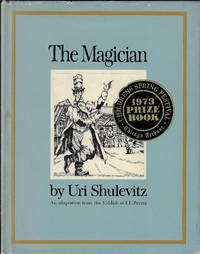
1973rif. 010596New York: Macmillan 1973 Blue cloth with a blindstamped design of the magician slight fading along bottom edge else fine; illustrated dust jacket slightly faded with a few edge tears "Chicago Tribune Children's Spring Festival Prize Book" sticker affixed to front panel original price intact $3.95. Shulevitz' adaptation of this well-known Yiddish tale by I L Peretz about how Elijah disguises himself as a traveling magician and conjures a feast for a needy couple. Detailed and wonderful b&w artwork by Shulevitz on every page. . First Printing. Cloth Hard Cover. Near Fine/Very Good. Illus. by Uri Shulevitz. 8vo. Macmillan hardcover books
1978Traduzione: Oddera Bruno dall'inglese . Edizione: Seconda edizione . Pagine: 208 . Formato: 8° . Rilegatura: Brossura editoriale . Stato: Ottimo . Collana: I narratori n°8 .
156 leaves. Probably lacks the colophon. A few other leaves are defective, including the title page. Yiddish text in Hebrew lettering. 4to. 220 mm. Original full leather binding, worn and broken; with the boards tooled in a crude, but interesting, geometric pattern. The festival liturgy according to the German-Polish rite, translated into Yiddish by Asher Anshel ben Joseph Mordecai in the 16th century for the use of Ashkenazi Jews living in Germany and Holland. The Mahzor is the prayer book used by Jews on the High Holidays of Rosh Hashanah and Yom Kippur. Many Jews also make use of specialized mahzorim on the three "pilgrimage festivals" of Passover, Shavuot, and Sukkot. The prayer book is a specialized form of the siddur, which is generally intended for use in weekday and Shabbat services. The word mahzor means 'cycle' ("to return"). It is applied to the festival prayer book because the festivals recur /return annually. SAWF. Hardbound. Rare. Apparently only two examples of this edition are held in U.S. Libraries. Roest 706; Mehlman (Ginzei) 327; Vinograd, Amsterdam 1166. SCARCE. CHEST 2 /4 $ 500.00
1947Paper Wrappers, 95 pages, 18 cm. Fiction. In Yiddish. Series: Kleyne bibliotek; Other Titles: Malkhus geto. Title on title page verso:; Krolewstwo ghetta SUBJECT(S): Holocaust, Jewish (1939-1945) -- Poland -- Lódz -- Fiction. Jews -- Poland -- Lódz -- Fiction. Originally bound in flimsy and fragile paper wrappers, this copy has been rebound in paper wrappers with original illustrated cover mounted on front. Paper browning as generally found, but solid. Good Condition. Scarce (H-40-17)
200017.5x24.5cm. XII+307 pages. Hardcover with dust jacket. Inner back cover slightly stained. Else in good condition.
1839Later Boards. 8vo. 55 pages. 22 cm. First edition. Introduction in German. Text in Hebrew with German translation on facing pages. Printed on fine ragpaper. The only work published by J. Harburger, Rabbinate Candidate. Also the first Hebrew book printed in Bayreuth (Freimann, Gazette) . Jehuda Harburger (1808-1854) studied in Fuerth and Munich, became Substitute Rabbi for Rabbi Aub in Bayreuth, finally Rabbi in Reckendorf, where he died. Subjects: Commentaries. Talmud. Minor tractates. Derekh erez - Commentaries. Talmud. Minor tractates. Derekh erez. OCLC lists 16 copies. Light wear to boards, light foxing throughout, overall clean and fresh. Very good condition. (GER-43-47)
19071st Edition, Original Printed Paper Wrappers, 54 pages. Includes portrait of the author; 19 cm. Grigory Andreyevich Gershuni (18701908) was born in Kaunas, in the Kovno Governorate of the Russian Empire (present-day Lithuania) , to a petty bourgeois family of Lithuanian Jews . In 1898, his parents were killed in a pogrom . Gershuni was a socialist and a founding member of the Workers' Party for the Political Liberation of Russia. This led to his arrest in 1900 by the Okhrana (secret police. After his release he joined with fellow revolutionaries including Catherine Breshkovsky, Victor Chernov, Alexander Kerensky and Yevno Azef to establish the Socialist-Revolutionary Party in 1901. Gershuni also founded the SR Combat Organization in 1902, which planned and executed the assassination of Dmitry Sipyagin, the Minister of Interior, in April 1902 and of N. M. Bogdanovich, the Governor of Ufa, in May 1903. They failed to assassinate Prince Ivan Mikhailovich Obolensky, the Governor of Kharkov, in July 1902. Gershuni was unaware that Yevno Azef, his deputy, was working as an Okhrana spy. In May 1903, Gershuni was arrested in Kiev. In February 1904, Gershuni was tried by a military court in Saint Petersburg and received a death sentence, which later was reduced to life imprisonment at a hard labour camp by Tsar Nicholas II of Russia. In 1906, he hid in a barrel of sauerkraut and escaped from the Akatuy katorga to China. From China he traveled to Japan and the United States, giving speeches from San Francisco to New York City in support of the socialist-revolutionary causes. In Chicago he met Jane Addams. He returned to Europe in February 1907 in time for the Second Extraordinary Party conference of the Socialist-Revolutionary Party. There he continued to argue for a campaign of terror to overthrow the Tsarist Empire in Russia (Wikipedia) . SUBJECT(S) : Political prisoners -- Russia (Federation) -- Siberia -- Biography. Exiles -- Revolutionaries. OCLC: 13419225 OCLC lists 18 copies worldwide. (KH-8-72 BLOR)
1959Orignal Cloth. 8vo; 180 pages; 23 cm. Poetic reminiscences for this Moldovan Jewish community SUBJECT(S): Travel. Joodse literatuur. Yiddish poetry. Ungheni (Moldova) -- Description and travel -- Poetry. Moldova. Very Good Condition; (ee-1-1)
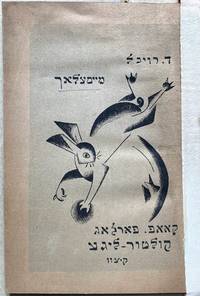
1922rif. 43563Kiev: Kultur lige 1922. 1st edition. Original modernist illustrated paper wrappers bound into pamphlet protector. 12mo 30 pages. With many illustrations. 22 cm. In Yiddish. Title translate as "Little Tales." A collection of five tales by Aleksander Afanasyev Vladimir Dal and Hans Christian Andersen adapted by David Roikhel and illustrated by the Yiddish Modernist artist Mark Epstein. A striking example of Mark Epstein's early Cubist-inspired graphic work produced for the now famous Jewish children's book Mayselakh. published in Kiev in 1922 and closely associated with the educational and cultural program of the Kultur Lige. Mark Epstein 1897-1949 was among the most important Jewish graphic artists associated with the Kultur Lige. Born in Babruysk he received a traditional Jewish education before studying at the Kiev School of Art. In 1918 he worked in the studio of Alexandra Exter whose influence can be seen in the dynamic Cubist-inflected vocabulary of his early work. That same year he participated in a Jewish artists' exhibition in Moscow and was one of the founders of the art section of the Kultur Lige in Kiev. Epstein was closely associated with the remarkable circle of Jewish modernist writers and poets active in Kiev including Der Nister Pinchas Kahanovich David Bergelson and Yechezkel Dobrushin. This milieu profoundly influenced his artistic development. Epstein worked across several media as a graphic artist painter sculptor and stage designer becoming one of the leading visual interpreters of the new Yiddish cultural movement. Children's illustration occupied an important place in his work. He designed covers and illustrations for Frayd Joy a Yiddish periodical for young people published in Kiev from 1922 to 1925. Mayselakh here is part of this same remarkable period of Yiddish publishing when artists associated with the Kultur Lige joined contemporary European artistic movements with with Yiddish literature and the educational needs of a new generation. Unlike many of his colleagues in the Kultur Lige's art section Epstein remained in Kiev after the establishment of Soviet rule and continued his artistic and educational activities under the transformed organization. From 1923 to 1931 he directed the Jewish Arts and Trades School in Kiev the institution that emerged from the Kultur Lige's former art section after its incorporation into the Soviet cultural system. He simultaneously worked as a stage and costume designer for theatres in Kiev and Kharkiv. In 1932 following the closure of the Jewish Arts and Trades School and the dissolution of the remaining Kultur Lige institutions Epstein was forced to leave Kiev for Moscow. Mayselakh is a stunning example of early Soviet Jewish children's publishing combining Yiddish literary culture with the bold modernist imagery of one of the most important artists of the Kiev Kultur Lige. For more see: Estraikh G. Hoge K. & Mikhail K. Children and Yiddish Literature from Early Modernity to Post-Modernity. Routledge 2016. Epstein's modernist masterpiece should not be confused with another Kultur Lige-issued-collection of childrens tales from 1922 the 58-page similarly titled work by Itsik Kipnis 1896-1974 Mayselekh far Klayne Kinder . Mayselakh has appeared at major auction only twice in its long history in 2019 when a copy sold for $2700 and in 2021 when a copy sold for $3000.00. OCLC: 122741292 1514928517. OCLC Locates only 4 copies worldwide Columbia Met-NYC YIVO & Bib. Nat. France Light dampstains & staple rust with light rippling from the epic 1966 JTSA fire which this book survived see photos. Otherwise Very Good. An attractive example of a famous example of Modernist Kultur Lige children's publishing. PBERL-1-14. Kiev: Kultur lige unknown
1984IN YIDDISH AND HEBREW WITH ENGLISH INTRODUCTION. 14X21 cm. ñå+233+XXIX. Softcover. Cover edges slightly wrinkled. Spine slightly wrinkled and chafed. Pen writing on inside side of cover and on several pages - no damage to text. Else in good condition.