714 risultati
1995pp. xvii, 262. Inscribed by Max Rosenfeld to Ron Lieberman (bookseller). 8vo. Original printed wraps. JUDAICA BOX 4
1906Publishers cloth. 8vo. 107 pages. 20 cm. First appearance? With frontispiece portrait of Ibsen. Nora, or, a Dolls House; a Drama in Four Acts, by Henrik Ibsen, translated into Yiddish by Morris Winchevsky. Undated, ostensibly the first appearance of A Dolls House in Yiddish translation; however, the publisher, Max Maisel, went through at least five print runs of A Dolls House in various years from 1906 until 1920. Bound in yellow cloth, with debossed title and border. Subjects: Yiddish drama. Norwegian drama - Translations into Yiddish. OCLC lists 18 copies encompassing all print runs of Nora individually printed. Light wear to cloth, otherwise fresh and clean. Very good + condition. (YID-18-18)
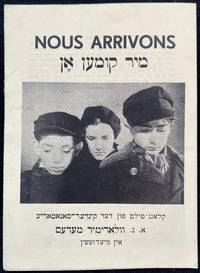
1938rif. 43520No Place Paris: No Publisher The Bund 1938. No Date 1938. 1st edition. Single fold pamphlet 12mo 3 pages. Includes photo on cover & inside. All text in Yiddish. Title translates as "We are Coming. A Sound-Film from the Children's Sanatorium Vladimir Medem in Miedzshin" a neighborhood in Warsaw. Promotional pamphlet for use in France and Belgium and possibly elsewhere for Aleksander Ford's 1936 film re-released in 1937-1938 for fundraising purposes on the children of the Medem Sanatorium entitled "Mir Kumen On" which translates literally as "We are Coming." For the English release of the film the title was instead translated as "Children Must Laugh;" it is viewable online at www.youtube.com/watchv=vozD_XbGHGA. The restored film was featured at the Museum of Modern Art's To Save and Project: The 14th MoMA International Festival of Film Preservation in 2016. "A rare record of Jewish life in Poland before World War II this 1936 film Mir Kumen Onwas produced in several language versions as an international fundraiser for the Medem Sanatorium near Warsaw a clinic sponsored by the General Union of Jewish Workers the Bund that provided care and an escape from urban poverty for some 10000 children between 1926 and 1939. Directed in a Soviet-influenced style by Alexander Ford a committed Communist who later became the head of Poland's National Film School the film follows three children as they gradually overcome their emotional withdrawal and distrust and enter the communal life of the institution" MoMA 2016. From the pamphlet text: "Narrow and dark streets of Greater Warsaw. Crowded and wet attics attics and cellars. 'Apartments' filled with people who lack mother's breasts for the always screaming child. An unemployed father. And - children everywhere many children. Children - withered rickety with crooked legs sunken chests and pale faces they - the children - know all the bitterness of life from a very early age. Often very often they are already 'earners' themselves - in a poor workshop in the street or until late at night they sell th apples and 'hot warm bagels'. And now from this environment the children arrive at the Medem sanatorium: Hanale from the Jewish secular school the pale Zalmanka from Cheder and Laser - the bagel seller. In the beginning everything is strange to them in the 'strange' Medem-Sanatorium: no one punishes no one shouts no one is angry. Everything is friendly to them everyone strives to understand them as their best friend. Joy and freedom mixed with free independent work rule over everything here. And our three heroes quickly got used to the new life-forms. They flourish. They become stronger physically and mentally they actively participate in the work of the 'self-management' of children they begin to understand that the world does not have to be like that as they realized in Warsaw that they can and must be someone else someone free someone equal someone beautiful. The children are taken in by the spirit of true friendship they begin to understand that person's suffering and get an aspiration to help that person. And when their daily newspaper brings news that the coal miners are on strike in Zaglembia that their children are starving they are deeply moved. Because - who can understand better than them what a strike means and feel more than them what is called hunger And at a general meeting the children according to their own proposal give each one a day of their time in the sanatorium so that the 180 children - create 180 days for their brothers in Zaglembia Times flies in the sanatorium. And now we see our 3 'heroes' as they drive off back home. The faces of all 3 are drawn. A deep sadness lies on the young childish faces." Both the pamphlet and the film end with the song "Mir Kumen On"--We Are Coming-the words by Nokhem Yud 1888-1966 and music by Yankl Troupianski 1909-1944. The film's theme song was also used by Camp Hemshekh in New York as its anthem in the 1960s & 1970s. "Everything in the film is factual and authentic. There is not a single artist in the film - everything is performed by the participating children of the Medem Sanatorium." We were unable to locate any copies using OCLC nor with a google search. An unrecorded promotional brochure for a very important film. Near Fine Condition. Very important. Exceedingly rare. PBERL-1-9-XX. No Place [Paris?]: No Publisher [The Bund?] unknown
1990Milano, Rizzoli, 1990, 16mo (cm. 18 x 11) brossura con copertina illustrata a colori, pp. 184 (I classici BUR, 763). Firma di possesso.
1996Seconda edizione. Introduzione, scelta e note a cura di Ferruccio Folkel In 16°; pp. 183; brossura editoriale illustrata; rilegato all'americana (fresato non cucito). CONDIZIONI OTTIME (conuseta ingiallitura delle pagine dovuta alla qualità della carta).
IN YIDDISH. 15x22 cm. VI+445+12+136 pages. Hardcover. Cover slightly stained. Cover edges slightly chafed. Cover partly detached from spine on lower edge. Spine is worn. Binding is visible between several pages. Else on good condition.
rif. 68771Mercure de France, 2000, 751 p., broché, très légères traces d'usage, bon état.
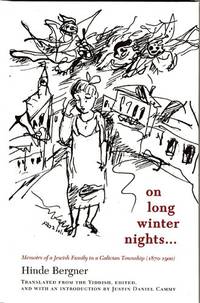
2005rif. L3 box729 a5On Long Winter Nights…: Memoirs of a Jewish Family in a Galician Township 1870–190 Harvard Center for Jewish Studies. By Hinde Bergner; Translated from the Yiddish edited and with an introduction by Justin Daniel Cammy. 2005 by Harvard University Center for Jewish Studies Harvard University Press. Hardcover 122 pp. Harvard University Center for Jewish Studies, Harvard University Press. hardcover
1973205x135, 198pp, hard green cover, slightly worn cover, Signed by the author, else in good+ condition.
191616', 229pp. hardcover. worn cover and edges, spine on edges slightly damaged. stamp and previous owners name on title page, yellowing pages, else in fair+ condition.
192024.5x16.5cm. 92 pages. Gilt hardcover. Cover slightly worn. Spine worn. Else in good condition.
1933rif. KNY100315631933. Language: Yiddish. Condition: not graded in detail, please see the photos. The photos show the actual copy offered. Ships from Ukraine by Nova Post with tracking after receipt of payment (bank transfer or PayPal); delivery time 12–28 business days including customs clearance. Shipping for this book (up to 1 kg): Netherlands €24.70, Belgium €29.60, Germany €19.90, France €29.10, Austria €29.10, Switzerland €46.00; other countries on request. The exact amount is confirmed when we accept your order. The parcel is sent from outside the EU/UK/Switzerland. Import VAT on books (e.g. Netherlands 9 %, Germany 7 %, Belgium 6 %, France 5.5 %, Switzerland 2.6 %, UK 0 %) and a customs handling fee of the carrier may be charged to the buyer on delivery; they are not included in the price. Antiquarian book (1933). Export from Ukraine of books older than 50 years may require a cultural-goods export certificate; we obtain it before shipping, which can add several weeks. Please ask before ordering if you need a firm delivery date. Consumers in the EU have the statutory 14-day right of withdrawal (see the seller terms). If the book does not match the description or is damaged in transit, please contact us right after receipt.
21.5x14 cm. 56 pages. Softcover. Cover edges worn and slightly torn. Cover yellowing and slightly age stained. Spine visible between several pages. Else in good condition.
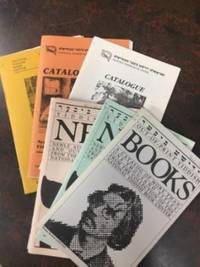
1988rif. bing65mm00009The National Yiddish Book Center 1988. Paperback. Very good. Prompt shipment with tracking. we ship in CLEAN SECURE NEW boxes Very good condition 7 staple-bound catalogues dating from the 1980s published by The National Yiddish Book Center Amherst MA. Mostly clean pages some dog-eared some dates and notes. The National Yiddish Book Center paperback
316pp. 24 cm. Hardcover Very good condition good
1947Stiff Wrappers, Small 8vo, 109 pages, with an additional [9] leaves of plates (1 folds out). 21 cm. In Yiddish. Added title page: "'Treblinka.' Reportaz". Series: Oysgabe fun der tsentraler Yidisher historisher komisye baym Ts. K. fun poylishe yidn ; number 33. SUBJECT(S): Holocaust, Jewish (1939-1945) -- Poland -- Personal narratives. World War, 1939-1945 -- Atrocities. World War, 1939-1945 -- Personal narratives, Jewish. OCLC lists 21 copies worldwide. Pages tanned. Some chipping to edges of wraps. Good Condition. Scarce (HOLO2-57-12A).
1993Publishers cloth. 8vo. 608 pages. 24 cm. First edition. In Yiddish. Title page verso: On the paths of history, Ashkenaz and East European Jewry = Bi-netive ha-historyah. Dr. Heszel Klepfish was born in 1910 in Zyrardow. Studied in heder and with his father. After turning nine years of age went away to study at various yeshivas. At the age of 12 became a member of the Tekhkemuni synagogue in Warsaw. Received rabbinic ordination. Studied history and philosophy at various universities in Poland and other European countries. Worked on various Polish journals. Was co-editor of Dos Yiddishe Togblat in Warsaw from 1931-1939. Edited the Yiddish-Polish weekly Jewish Echo from 1932-1934. Was an active participator in the Bes Yakov School system in Poland. Just before the Second World War he lived in Eretz Yisroel and worked on Hatzofe and Hahad and other literary and scientific periodicals. In the first year of the Second World War he edited the weekly Der Vokh in Paris. In 1940 he became the Chief Rabbi of the Polish Army on the Western Front. He held the rank of Major and accompanied the Jewish soldiers in the Polish army in France and England and afterwards in the fight to free Europe from the Nazis. Received high Polish, French and English distinctions, one of which was The Special Medal of Liberation awarded him by the Belgian City of Ghent. From 1949-1953 worked in helping Holocaust survivors. Was a lecturer in Jewish history and literature in the College of Jewish Studies in Glasgow, Scotland. From 1953- 1958 he was the spiritual leader of the Jewish Community in Costa Rica. From 1958 he has lived in Miami Beach the U. S. A. Where he lectures in the College of Jewish Studies and in the Hebrew Teachers' Seminary. He also lectures at YIVO. Authored many works and treatises in various languages. The literary collection Yiddishe Shriften (Jewish Writings) , published by the Union of Jewish Writers and Journalists in Poland right after the Second World War in 1946, mistakenly lists Reb. Dr. Heszel Klepfisz under the heading those who died as martyrs. (Biographical notes about Reb. Dr. Heszel Klepfisz, in Pinkas Zyrardow, Amshinov un Viskit, 1961) . Subjects: Judaism - History. Judaism - Europe, Eastern - History. Jews - Intellectual life. OCLC lists 29 copies. Lightly bumped corners of cloth, otherwise very fresh and clean. Very good + condition. (EE-5-27) Xx
First and only edition of this extremely rare and important bibliography of books and manuscripts in Hebrew and Yiddish up to 1863, with the almost equally rare supplement. Over 15,000 items thoroughly described. Title-pages in Hebrew, Russian, Latin, and German. Text in Hebrew (some titles in Yiddish), in two columns. Over 700 pp. Printed in a very small edition, much of which has surely been destroyed. WITH THE 481-PAGE SUPPLEMENT BY MENACHEM MENDEL SLATKINE, published in 1965. Slatkine provides numerous additions, corrections, and notes to the original work, as well a s a complete index. Small 4tos. Bound in original hardcover bindings. Light wear, else fine and bright. Slatkine also has dustjacket (none issued with Benjacob). Brisman gives a long, detailed, and highly favorable account of these works (A History and Guide to Judaic Bibliography, pp. 19-24, 33, etc.), in which he calls them "the most reliable and accurate Hebrew bibliography."
1964HEBREW AND YIDDISH SONGS TRANSLATED INTO ENGLISH WITH ENGLISH FOREWORD. 24X16 cm. 80 pages. Softcover with spiral binding. Few worm Holes on front cover. Else in good condition.
1999IN ENGLISH AND YIDDISH. Contain plates in black and white. 15.5X23 cm. 543 pages. Softcover. Pen writing in cover page, no damage to writing. Else in good condition.
Le Sycomore, 1979. In-8, broché, couverture illustrée d'une photographie, 296 pp. Bel exemplaire.
rif. 30532Le Sycomore, 1979. In-8, broché, couverture illustrée d'une photographie, 296 pp.
1979Traduzione: Biondi Mario dall'inglese . Pagine: 236 . Illustrazioni: Copertina di Luciano Mereghetti . Formato: 8° . Rilegatura: Brossura originale . Stato: Buono . Collana: I narratori n°17 .
1976IN YIDDISH. SIGNED BY AUTHOR. 22x15.5 cm. XII+537 pages. Hardcover. In good condition.
1856Original quarter leather. 8vo. 68; 115; 79; IV, 85 pages. 24 cm. First edition. Principally in German. 'Phoenician Studies'. Contains six fold out charts (housed at the rear of each volume) . Volume one published 1856, volume two, 1857, volume three, 1864, volume four, 1870. Moritz Abraham Levy (1817-1872) , German Orientalist ... Having received a rabbinical education, he became teacher in the Synagogen-Gemeinde of Breslau, where he was active for nearly thirty years. For his scientific labors he received from the King of Prussia, in 1865, the title of professor. Levy was preeminent in the field of Semitic paleography. He was the first person after Gesenius to treat the subject in a comprehensive manner. In the deciphering and interpretation of Phenician, old Hebrew, Punic, Aramaic, Himyaritic, and later Hebrew coins, seals, gems, and monuments his peculiar intuition guided him more surely than mere philological knowledge did others; such, for example, was the case with his deduction from the inscriptions found on the Hauran that at the beginning of the Christian era an Arabic people lived there which used the Aramaic language and alphabet. - 1906 JE. Contents: 1. Hft. Erklärung der grossen sidonischen und anderer phönizischen inschriften. Die ältesten formen des phönizischen alphabets und das prinzip der schriftbildung. --2. Hft. Herr professor Ewald nochmals als Punier gewürdigt. Backsteine, gemmen und siegel aus Mesopotamien mit phönizischer (altsemitischer) schrift. Erklärung sämmtlicher neuphönizischer inschriften. --3. Hft. Neue cyprische inschriften. Die sechste inschrift von Athen. Inschrift von Ipsambul. Eine zweite inschrift von Sidon. Drei inschriften von Umm-el-Awamid. Eine dreisprachige inschrift aus Sardinien. Neunzig carthagische inschriften. Unedirte neuphönizische inschriften aus Nordafrika. 2 unedirte siegelsteine. --4. Hft. Uebersicht über die erscheinungen auf dem gebiete der phönizischen wissenschaft seit 1863. Revision einiger älteren denkmäler durch bessere copieen: Athen IV und VI, Melit III. Inschrift von Cossura und eine dritte von Saida (Sidon) Inschriften von Abydos in Aegypten. Inschriften aus Sardinien. Inschrift aus Spanien. Inschriften aus Nordafrika. Ergänzungen zum Phönizischen wörterbuche. Nachtrag. Subjects: Inscriptions, Phoenician. Phoenician language - Alphabet. Inscriptions, Phoenician. Phoenician language Alphabet. Light rubbing to leather backstrip; previous owners inscription on endpage and title page, light pen marks in margins on a few pages; third chart has a tear; otherwise fresh and clean. Very good condition. (GER-43-29)